Episode 699: If only I could put these images into some kind of a sequence

In the Old House on the estate of Collinwood, nine year old Amy Jennings pops into her governess’ bedroom in the morning. The governess, Maggie Evans, hasn’t been to bed yet. Maggie’s other charge, twelve year old David Collins, disappeared into the haunted corridors of the great house on the estate some time ago, and cannot be found. The evil spirit of the late Quentin Collins has been possessing David and Amy off and on for many weeks, and has now grown so powerful that no one dares go into the great house alone. Maggie is too worried to go to bed.

Maggie questions Amy about David and Quentin. Amy tries to deny knowing anything about Quentin, but Maggie keeps up the pressure until Amy admits she is afraid that if she talks, Quentin will do something to her big brother Chris Jennings. Permanent houseguest Julia Hoffman overhears this admission, and demands to know what Quentin has to do with Chris.

Julia knows something neither Maggie nor Amy does. Chris is a werewolf. As Quentin’s power over the children and the great house has grown, so has Chris’ lycanthropy spread over more of the month. For the past several years, Chris took his wolf form only for the two or three nights the moon was fullest, never for more than four nights, and never during any other lunar phase. Now he has started changing even when the moon is new. What is more, Julia and her friend, old world gentleman Barnabas Collins, just came from the chamber where they coop Chris up when he is the werewolf. They found that he has not changed back even though the sun has been up for two hours. They have no way of knowing when or if Chris will ever be human again.

Amy won’t tell Julia or Maggie anything more about Quentin or about Quentin’s fellow ghost, Beth. Amy has communicated with Beth, knows her name, and she and David first saw Beth with Quentin. She knows also that Beth weeps when she thinks of Chris suffering. For their part, Julia and Barnabas saw Beth when she led them to save Chris when Quentin had tried to kill him. Chris told them that Beth had appeared to him, and when he took Barnabas to the spot where that happened he and Barnabas found a shovel and excavated the unmarked grave of an infant wearing a pendant meant to ward off werewolves. Julia saw a photograph of Beth in an old Collins family album, dated 1897, the same year Quentin disappeared. If they could combine Amy’s knowledge about Beth with what they have learned from these three experiences, Barnabas and Julia might get somewhere.

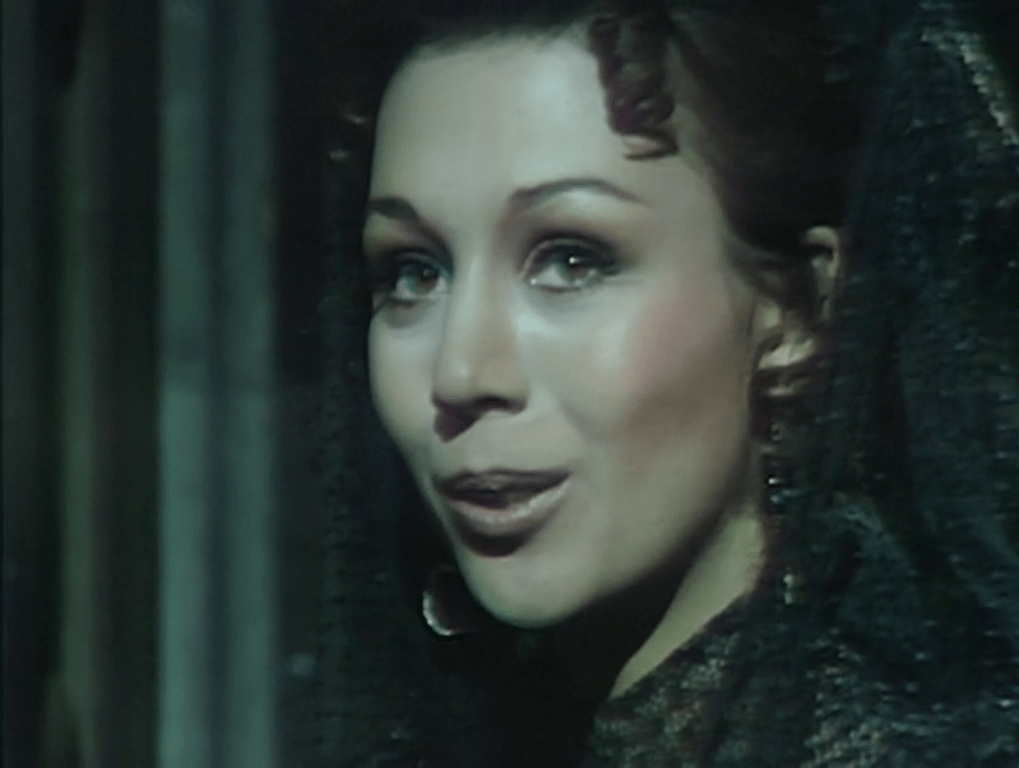
Julia and Amy leave, and Maggie goes to bed. As she lies under the covers, we see visual effects that might have been impressive on daytime television in 1969, but that we all got pretty sick of seeing people use on video calls in 2020. The picture wiggles in the middle and a transparent sticker of Quentin’s face sweeps around the screen.

Quentin sticker. Screenshot by Dark Shadows Before I Die.

Maggie has a dream. Dream sequences on Dark Shadows are usually messages sent to the dreamer by some supernatural force; the sticker of Quentin’s face suggests at first that he is the sender of this message. Maggie goes to a room in the long-deserted west wing of the great house. She was in the room in #680, and saw Quentin there. When she took matriarch Elizabeth Collins Stoddard and David to the room in #681, there was a tailor’s dummy wearing Quentin’s frock coat, with a face and mutton chops painted on it. Liz was glad to believe that the dummy was what Maggie saw, and David nattered on about how he and Amy called the dummy “Mr Juggins.” In her dream, Maggie recognizes Mr Juggins, then sees an opening in the wall.

Mr Juggins startles Maggie. Screenshot by Dark Shadows Before I Die.

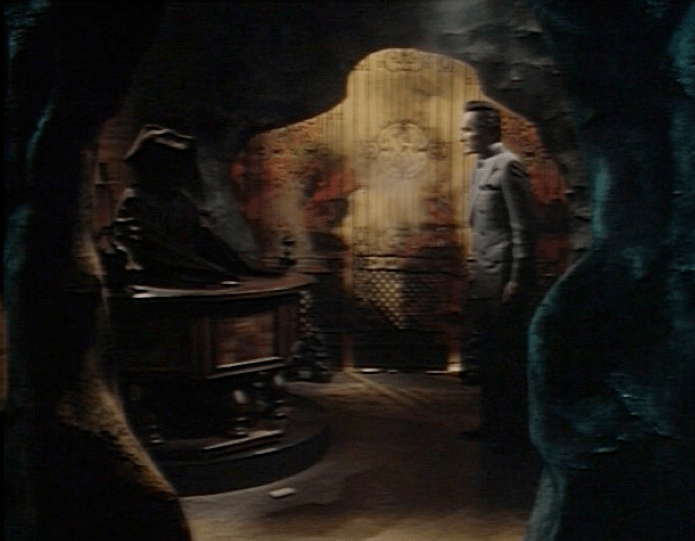
She goes through it, and finds a hidden chamber. Quentin is there. Quentin tried to strangle Maggie in #691, and earlier this week he dressed her up in a lovely outfit and did her hair in an elaborate up-do, so there’s really no telling what is going to happen when the two of them are alone together. This time, he kisses her passionately, and from the way she relaxes in his arms it is clear he is doing a great job.

Awake, Maggie tells Julia about her dream. This will bring back memories for longtime viewers. When we first saw Julia in #265, she was Maggie’s psychiatrist, and was asking her about, among other things, her dreams. The same viewers will have been marveling at the fact that Maggie is staying in the room of the Old House once occupied by the gracious Josette and now dominated by Josette’s portrait. In May and June of 1967, Barnabas was a vampire. He held Maggie prisoner in Josette’s room as part of his scheme to erase her personality and replace it with Josette’s. Julia hypnotized Maggie into forgetting that whole ordeal, and the show has recently been assuring us that they will not revisit the question of whether her memory will return. Putting her back in the room is their most heavy-handed way yet of telling us to stop wondering about that.

Maggie’s discussion with Julia also raises the question of who sent the dream. Had she responded to it by slipping out to the west wing without telling anyone where she was going, we could believe that Quentin was luring her to him by showing her what a good kisser he is. But this conference makes it clear that Maggie is not only consciously determined to do battle against Quentin, but that she is enlisting the support of the allies likeliest to make headway against him. Beth has done a great deal to warn people against Quentin, so she might have sent the dream. Since Maggie is in Josette’s room and the closing credits will run over a shot centered on Josette’s portrait, it is also possible that Josette’s ghost has returned to the business of sending dream warnings.

The image under the closing credits. Screenshot by Dark Shadows Before I Die.

Once Maggie figures out where Quentin’s chamber is, she decides that David must be there. She resolves to go to the chamber and find David. Julia tells her it is too dangerous for the two of them to go to Quentin’s stronghold alone, and insists they wait until Barnabas can join them. Julia goes to fetch Barnabas. When she brings him back to the Old House, Maggie says that now she can’t find Amy. Julia decides to look for Amy while Maggie and Barnabas go to the great house.

It might seem odd that Julia thinks it is OK for Maggie to go to the great house accompanied only by Barnabas when it would have been too dangerous had she herself been Maggie’s only companion. But Julia knows that Barnabas is not an ordinary man. He has been free of the effects of the vampire curse for almost a year, but his history made it possible for him to travel back in time in #661. It seems that he retains enough connection with the supernatural to make him a more formidable adversary for Quentin than is even so adroit a mad scientist as Julia.

Amy overhears Maggie’s conversations, and she goes to the west wing. She uses a crowbar to open the panel that leads to Quentin’s chamber. She goes in and calls for David. David is not there, but Quentin is. Amy tries to tell Quentin that she had come to warn him that Maggie and Barnabas were on their way; as her attempt to lie to Maggie had crumbled when Maggie kept questioning her, so her attempt to deceive Quentin collapses as he keeps staring at her. Amy’s face goes blank, and we realize that Quentin is transmitting commands into her mind.

Barnabas and Maggie do go to the room and they do find the opening in the panel. Barnabas looks through it, and sees a door on the other side. The opening is a small one, close to the floor. The children have been crawling through it, and evidently Maggie did the same in her dream. But Barnabas does not intend to get his suit dirty. He picks up the crowbar, and says he will rip out all the panels and walk through the door.

Barnabas is not going to crawl through that thing. Screenshot by Dark Shadows Before I Die.

Episode 666: Barnabas isn’t like anyone else

Thayer David joined the cast of Dark Shadows in August 1966, taking over the role of moody handyman Matthew Morgan from George Mitchell starting with #38. In that first episode, Matthew brawled in a barroom and left dashing action hero Burke Devlin gasping. The main storyline of the next few months was the investigation into the death of beloved local man Bill Malloy; it turned out Matthew had unintentionally killed Bill when they got into a fight and Matthew didn’t know his own strength.

Those two events explain the recast. George Mitchell was a slender little man whose white hair and craggy face made him look older than his 61 years. He was a fine actor, but no one would have believed that he could win a fight with Burke or that he was so strong that he would accidentally kill Bill. David was Mitchell’s equal in acting ability, but more importantly was a burly fellow in his late 30s.

Today, we hark back to David’s original function on the show. The setting is the year 1796; vampire Barnabas Collins has traveled back from the 1960s to rescue his fellow time traveler, well-meaning governess Victoria Winters, from death by hanging. David plays another servant. As Matthew was fanatically loyal to matriarch Elizabeth Collins Stoddard, so Ben Stokes is utterly devoted to Barnabas. Ben finds roguish naval officer Nathan Forbes and visiting Countess Natalie DuPrés about to drive a stake through Barnabas’ heart. Ben demands they stop; Nathan aims his pistol in Ben’s direction and squeezes the trigger. The gun misfires. Ben reflexively clutches at his chest, but finding he is not hurt he advances on Nathan. They fight. As Matthew was so strong he could not fight Bill without accidentally killing him, so Ben accidentally kills Nathan. Ben then tells the countess he doesn’t want to hurt her and that she will be all right if she stays put until he can figure out what to do; she is unable to assure him she will do so, and in his attempt to restrain her he inadvertently kills her, too.

Barnabas had originally lived in the eighteenth century. He passed from that time into the 1960s because he was chained in his coffin in 1796 and discovered in 1967 by would-be grave-robber Willie Loomis. Now, he has rescued Victoria, and he is eager to go back to 1969, when he is free of the effects of the vampire curse. He traveled back by standing in an old graveyard and calling to the spirit of Vicki’s boyfriend, an unpleasant man known variously as Peter and Jeff, to pull him into the past. He went to the same graveyard yesterday and tried the same trick in reverse. Peter/ Jeff isn’t in 1969, so he calls instead to his friend, mad scientist Julia Hoffman. That didn’t work, so he decided to have Ben chain him in the coffin and take the long way back.

Barnabas is unhappy to wake up this evening. He leaves his crypt to find Ben using a shovel to pat down some earth nearby. He asks why Ben did not chain the coffin as he was instructed. Ben tells him about Nathan and the countess; evidently he is only now finishing their shallow graves. Ben has never murdered anyone before, so he asks Barnabas’ expert opinion about the next steps. Barnabas tells him to get rid of the countess’ things and to tell whoever asks that she left for Paris.

The reference to Paris is a bit unexpected to longtime viewers. When the countess first appeared in #368/369, she said that she chose to live on the island of Martinique because metropolitan France had become a republic. She and her servant Angelique came to Collinwood along with the countess’ brother André DuPrés and André’s daughter Josette, who was at that time engaged to marry the still-human Barnabas. André is identified as the owner of a sugar plantation on Martinique.

In 1796, France was of course still a republic. But the Terror had ended shortly after the execution of Robespierre in the summer of 1794. Among the beneficiaries were the real-world counterparts of the DuPrés family, the vaguely aristocratic owners of a sugar plantation on Martinique. Their name was Tascher; the daughter of the family was named, not Josette, but Josephine, the widow of the Vicomte de Beauharnais. Josephine was imprisoned in Paris during the Terror, but she was freed, reunited with her son, and restored to her property by June 1795. In May of 1796, Josephine would marry an up-and-coming artillery officer named Napoleon Bonaparte. It would indeed be plausible that the countess would want to go back to Paris and take the opportunity to reestablish a life there.

After the story of Matthew Morgan and the consequences of the death of Bill Malloy ended in December 1966, Dark Shadows was for 13 weeks dominated by the battle between undead fire witch Laura Murdoch Collins and the forces of good, led by Victoria with assistance from the ghost of Josette. Laura was the show’s first supernatural menace.

The ghost of Josette had been introduced in #70 as the tutelary spirit of the long-deserted Old House on the estate of Collinwood. Matthew held Victoria prisoner in the Old House late in 1966, and in #126 he decided to kill her. Josette led the other ghosts out of the supernatural back-world that exists somewhere behind the action to save Victoria by scaring Matthew to death. During the Laura story, Josette’s ghost was deeply involved in the action, literally painting a picture to explain to the characters what was going on.

Prompted by Josette’s ghost, Victoria figured out that Laura was going to burn her son, strange and troubled boy David Collins, to death on the anniversary of similar immolations. This would turn out to be a key turn in Dark Shadows’ world-building. When you are telling stories about supernatural beings, you can’t rely on the laws of nature or logic to shape the audience’s expectations. You need to give them some other mechanism of cause and effect if you are going to create suspense. So from that point on, the show would use anniversaries as causal forces. “It happened exactly one hundred years ago tomorrow night!” means it will happen again then.

That was the basis of Barnabas’ trip to 1796 and of his hope to return by standing on the same spot. Tombstones indicating that Victoria and Peter/ Jeff had been hanged materialized at times related to the anniversaries of those events, and Barnabas must leave 1969 at a certain point to arrive at a certain point in 1796. Eight o’clock on a given night in 1796 corresponds to eight o’clock on a given night in 1969, and those are the times when Barnabas and Julia go to the graveyard from which he vanished and call out to each other.

Even though the conjoined eight o’clocks don’t facilitate Barnabas’ return trip, the structure of today’s episode plays on the same idea of intercutting timelines. We alternate between scenes of Barnabas and Ben in 1796, and of Julia and Willie in 1969. Barnabas bit Willie and enslaved him when he opened his coffin; by the time Barnabas was cured of the effects of the vampire curse, Willie had let go of any hard feelings about that. Barnabas has made the Old House his home, and Willie voluntarily lives there as his servant. Julia has been a permanent guest in the great house on the estate since 1967, but now is apparently staying at Barnabas’.

Julia is determined that Barnabas will return by rematerializing on the spot from which he vanished, and she keeps going back there. Willie doesn’t believe this will happen, but in a long interior monologue comes up with the idea that he might reappear in his old coffin. In her turn, Julia dismisses that idea. They quarrel about these competing absurdities, and Willie decides to put his hypothesis to the test. He goes to the old mausoleum to check on the coffin, and finds it empty. He returns to the house to report this to Julia.

Julia decides it’s time to sleep, so she goes upstairs- apparently to her own bedroom. Seconds later, a ghost appears to Willie. He recognizes it as Josette. She vanishes, and he calls Julia. When Julia comes he tells her that Josette had never appeared to either of them unless Barnabas was in danger. As far as I can recall the audience has never known Josette to appear to Willie or Julia at all, and Barnabas is always in danger, so that remark is a bit of a mystery to longtime viewers.

In the days leading up to Willie’s discovery of Barnabas in April 1967, he, and he alone, heard a heartbeat coming from the eighteenth century portrait of Barnabas that hangs in the foyer of the great house. While he is talking with Julia, Willie turns to the portrait of Barnabas that artist Sam Evans painted in May 1967 and hears the heartbeat again. Julia cannot hear the heartbeat. Willie combines the sound of the heartbeat with the sight of Josette and concludes that Barnabas has returned and the old coffin is no longer empty. We cut to the hidden room in the mausoleum. Chains materialize around the coffin, and we see Barnabas inside it, struggling to escape.

Willie realizes what’s going on and tells Julia about it. Screenshot by Dark Shadows Before I Die.

We may wonder if Barnabas has been struggling that way every night since he was chained there in his attempt to return to the 1960s. That would be 173 years, added to the 171 years the first time. It would seem that 344 years confined to a box would make Barnabas even screwier than he is. In a much later episode, we will see Barnabas released after a long entombment and he will be surprised that more than one day has passed. The 2012 film adaptation of Dark Shadows includes a humorous scene based on the idea that time does not pass for Barnabas while he is chained in his coffin. But when he was first released in April 1967, there were indications that he had undergone a nightly torment through the centuries, and the closing image of Barnabas in the box today echoes those indications.

Nathan’s death marks the final appearance of actor Joel Crothers, who has been one of Dark Shadows’ most valuable cast members since his debut in #3, when he played hardworking young fisherman Joe Haskell. We said goodbye to Joe last week; it was nice to have another glimpse of Crothers in his villainous role before he left for the last time.

Episode 629: I know him by another name

Suave warlock Nicholas has botched his main project, and is in big trouble with his supervisor. He is called into the corner office, which apparently represents Hell, and talks the boss into giving him another chance.

Nicholas gets an unsatisfactory performance review. Screenshot by Dark Shadows Before I Die.

Regular viewers will immediately recognize Hell as a redress of the basement of the Old House on the great estate of Collinwood, home to old world gentleman Barnabas. Strangely enough, this is not the first time it has seemed that Hell is in a corner of Barnabas’ basement. In #325, strange and troubled boy David had a dream in which the ghost of Barnabas’ sister Sarah brought him to the basement. The set was decorated much as we see it today. David met a faceless figure and saw Barnabas, who was at that time a vampire, rise from his coffin. In #512, the ghost of the Rev’d Mr Trask, a witchfinder whom Barnabas murdered in the late eighteenth century, conjured up the spirits of many of Barnabas’ victims, and put him on trial in the basement. Again, we see that it is the abode of the unhappy dead.

Nicholas has to admit to his boss that he has fallen in love with Maggie, The Nicest Girl in Town. Contemptuous of warm human feelings, the boss tells Nicholas that he and Maggie can indeed be together for all time, but only “here”- confirming that the set does represent Hell. Nicholas is horrified, but the boss yields nothing. He will have to sacrifice Maggie in a Black Mass so that she can be damned along with him. He must also get his original project back on track, breeding a race of Frankenstein’s monsters who will be loyal to the spiritual forces of darkness.

Returned to the world of the living, Nicholas goes to the great house of Collinwood, where he tries to persuade mad scientist Julia to help him with the Frankenbabies plan. She can see that he is desperate, and is therefore unimpressed with him. She presses him for more information, and he tells her to read the Book of Genesis. His boss figures in it, as the one who tempted Adam and Eve. Julia gasps at the idea that Nicholas is one of Satan’s direct reports. Nicholas explains what he wants her to do. Julia calls the idea “monstrous,” a description which Nicholas considers apt. She refuses to have any part in such an enterprise, but she capitulates when he threatens her dear friend Barnabas.

Danny Horn’s post about this episode on his great Dark Shadows Every Day is devoted to the packet of View-Master reels featuring images related to episodes made around this time. I’ve always enjoyed View-Master; I think it’s a shame it was slotted as something for young children only. I find it refreshing to spend three or four minutes peering into its little worlds. I left this comment:

Some years ago I bought a bunch of ViewMaster reels. I’d liked them when I was a kid, and I was curious about the non-cartoon ones, the reels depicting landscapes and such. I found that it was a meditative exercise looking into the viewer and teasing out all the 3-D effects.

Anyway, I still have those reels, including the Dark Shadows set. Inspired by this post, I looked at them this morning. There are a bunch of very good shots with high contrast between actors and background. Bud Astredo was particularly good at striking poses that would make him stand out. Grayson Hall is just as good, it’s a shame she’s only in the one picture.

(20 October 2020, 11:12 am Pacific time)

Danny’s post also links to this wonderful piece about the packet on a blog called View-Master 3D.

Episode 515: A word you’re saying

A lot of wonderful acting in this one. We start off with Willie Loomis (John Karlen,) staggering into the cottage Maggie Evans (Kathryn Leigh Scott) shares with her father Sam (David Ford.) Yesterday, Maggie’s boyfriend Joe beat Willie up. Maggie invites Willie in, comforts him, tries to treat his wounds, and agrees to drive him home. Joe had excellent reasons for insisting Willie stay away from Maggie, and those reasons might lead returning viewers to react to the beginning of the scene with frustration. But Karlen and Miss Scott are so good together that they very smoothly defuse that frustration, and we soon find ourselves as absorbed in the scene as we were in the many scenes the same actors shared in May and June of 1967, when Maggie was the prisoner of Barnabas the vampire* and Willie, as Barnabas’ slave, was trying desperately to reduce her suffering.

A very tall man named Adam (Robert Rodan) comes to the open front door and announces “Willie bad!” Maggie has no idea who Adam is. Adam enters the cottage and clarifies his intention with a declaration of “Kill Willie!” Willie tries to talk Adam out of this plan, and reminds him of the good times they had together. Maggie tells Adam that Willie is hurt, and Adam looks concerned when he responds “Willie hurt?” Rodan gets the same flicker of light into Adam’s eyes that you might see in the eyes of a toddler who is intrigued to hear that someone is having feelings he wouldn’t have expected them to have. Before long, though, Adam is angry again. Maggie takes a hammer and tries to hit Adam, leading Adam to state a new plan- “Kill Maggie!”

Sam comes home. Sam befriended Adam during a trip Maggie recently took out of town. He tells Maggie to stand behind him. She does, and he talks to Adam about their friendship. Adam agrees that Sam is his friend and that he would never hurt him, but he refuses to agree when Sam tells him that Maggie is also his friend. Maggie makes a move that confuses Adam. Trying to get at her, Adam hits Sam very hard. Adam sees that he has knocked Sam down, and he runs away.

We see Adam in the woods, and for the first time hear his voice in a pre-recorded monologue telling us his thoughts. “Afraid! Adam afraid! Adam bad! Adam hurt friend!” Rodan’s acting is more than sufficient to enable us to figure out that this was what Adam was thinking even without the monologue, but he does such a good job of voice acting that I don’t really begrudge it. Crude as the lines are, Rodan simultaneously expresses fine shades of fear and guilt through them.

Willie and Maggie have another scene in the Evans cottage. She is stern with him now, demanding to know what Willie knows about Adam. Willie denies that he knows anything, and she points out that when he was trying to calm Adam he appealed to several facts from their previous acquaintance. Willie tells a story to cover that up, essentially the same story Barnabas made up to tell the sheriff in #505. Maggie is a lot smarter than the sheriff- that isn’t saying much, chewing gum is a lot smarter than the sheriff- and even he didn’t buy this line when Barnabas was pushing it. She tells Willie in a firm tone that she will continue to ask questions until she gets answers she can believe. She explicitly tells him she will ask Barnabas. Maggie’s firmness and Willie’s barely controlled panic make for another gripping encounter.

Willie goes back home to Barnabas’ house. Barnabas’ best friend Julia Hoffman (Grayson Hall) is there. Willie tells Julia they have to find Adam before the police do, since he now knows enough words to get them all in a lot of trouble. Usually when Julia and Willie have their staff conferences, she is firmly in charge and full of ideas. But she is at a complete loss today. She has no idea how to capture Adam, and she doesn’t know where Barnabas is.

What’s more, Julia has just seen a ghost. She heard sobbing coming from the basement, and when she went down there she saw a woman in white whom she recognized as Josette Collins, deceased. Josette dematerialized in front of her. Now the sobbing starts back up, and Julia accompanies Willie to the basement.

Josette is already gone when they get there. Julia tells Willie what she saw earlier. She figures out that Barnabas is bricked up behind the wall where Josette’s ghost had stood. She explains her reasoning in terms that viewers who have seen the last several episodes will be able to follow, but which don’t make a bit of sense to Willie. His sharp befuddlement and her vague certitude make for a laugh-out-loud funny scene.

The bricked-up alcove in the basement of Barnabas’ house. Screenshot by Dark Shadows Before I Die.

In the early months of the show, several characters heard a sobbing woman in the locked room in the basement of the great house of Collinwood. It was strongly implied in a number of those episodes that the woman was the ghost of Josette. In #272, matriarch Liz said that she herself was the one who did the sobbing. That didn’t fit very well with what we had seen, but by that point the show had reconceived Josette as part of Barnabas’ story and stopped involving her ghost in the action. Longtime viewers have a strong reminder of the “Sobbing Woman” story today, since Barnabas’ basement is a redress of the set used for the basement of the great house and the alcove where he is walled up is in the same place as the door to locked room in basement of great house.

*Maggie has amnesia about all that, and thinks Barnabas is her friend. His vampirism is in remission now.

Episode 430: Do not disturb

Barnabas Collins became a vampire just a few weeks ago, and he doesn’t yet know what powers his new condition has brought him. On the chance that he might be able to raise the dead, he goes to the fresh grave of his ex-fiancée Josette. He whines about how much he misses her until the sound of her sobbing can be heard. She begs him to let her rest. Later, she appears to him in her former bedroom in the Old House on the estate of Collinwood, and shows him that in her ghostly form her face bears the severe disfigurement inflicted when she fell to her death while fleeing from him.

Screenshot by Dark Shadows Before I Die.

The audience is supposed to be in suspense at whether Barnabas will reach Josette. Unfortunately, the show ruins the surprise right at the outset, when Kathryn Leigh Scott delivers the opening voiceover. These monologues are spoken by an actress who appears in the episode, so we know that we will be seeing Miss Scott, and therefore Josette. It’s true that Miss Scott uses a very different voice for the opening monologues than she does for Josette or any of her other characters, but fans will recognize her right off.

Viewers who have been with Dark Shadows from the outset will recognize some connections with earlier episodes. Josette’s sobbing sounds more than a little like the mysterious sobbing heard several times in the basement of the great house of Collinwood in the first months of the show. They strongly hinted that the ghost of Josette was the source of this sobbing, only to give another explanation for it later.

Josette tells Barnabas that “the dead must rest!” This was a catchphrase of one of the funniest characters on the show, the Caretaker of the old cemetery. When we heard it from Josette, my wife and I laughed out loud.

Josette also commands “Do not disturb my rest.” A “Do Not Disturb” sign hung on a tombstone would be an apt symbol of Dark Shadows‘ view of the afterlife, since death on the show is usually about as temporary and as subject to interruptions as a stay at a cheap motel.

When Josette convinces Barnabas that she must not rise from the dead, not because she would have to prey upon the living as he does, but because she is ugly now, Mrs Acilius and I remembered two things. It’s true that when we saw Josette’s ghost in the first 73 weeks of the show, when it was set in 1966 and 1967, her face was almost always at least partly obscured. There were some brief exceptions, but in her most important appearances, when Miss Scott played her in #70 and #126, her face was completely veiled. So perhaps she bears her wounds then as well.

Our other recollection was not of Dark Shadows at all, but of the original Star Trek. And I do mean the original one, the first pilot, shot in 1964. At the climax of that one, our heroes commit themselves to die rather than stay on the planet where they have been trapped, as conditions there are such that no human being could possibly live a worthwhile life. When one woman says she wants to stay behind, they see that she is, contrary to the illusory appearance they have seen so far, severely disfigured. At that, the captain instantly accepts that she is right to stay. No uggoes allowed in space! Usually I’m reluctant to bring up the labels that end in “-ism,” but that ending and this one seem to be examples of looks-ism so extreme that they would be frankly genocidal if taken as a guide to real-world action.

Episode 415: Sarah Collins

Sarah dies. Screenshot by Dark Shadows Before I Die.

When Dark Shadows first aired in June 1966, it kept hinting that behind the action we saw there was a back-world of supernatural presences some of whom might eventually interact with the characters. Often these hints occurred in conversations between a character native to the village of Collinsport and newly arrived governess Vicki. The local would use the word “ghost” metaphorically to refer to unresolved conflicts around the estate of Collinwood, Vicki would shriek “You don’t mean you believe in ghosts!?,” and the other would say that he damn well did believe in ghosts and that if Vicki stuck around long enough she would, too.

The first ghost whose name we heard was Josette, mentioned in #5 as a grand lady from France who came to town to marry Jeremiah Collins, was unhappy with him, and threw herself to her death from the precipice known as Widows’ Hill. Josette manifested herself on camera in #70 and rescued Vicki from murderous groundskeeper Matthew Morgan in #126. In that climactic encounter, we saw Josette and a group of other wraiths. Joining the ghosts of women who jumped from Widows’ Hill at various points in the 19th century was the ghost of Bill Malloy, who had been a living character in the first ten weeks of the show and had shimmered into view as a ghost and sang a song in #85. This assemblage suggests that the spectres haunting Collinwood know each other and act with a common purpose at least occasionally.

The first supernatural menace to appear on the show was undead fire witch Laura Murdoch Collins, mother of strange and troubled boy David. Josette warned several characters of the threat Laura posed to David. Josette herself was unable to fight Laura directly. In #165, she manifested in the room where Laura held the sleeping David, but had to retreat when Laura ordered her to go. Thereafter it was up to Vicki, advised by Josette, to organize the opposition to Laura. If #126 showed that the benevolent spirits can act together to defeat a threat from a mortal man, #165 and its aftermath showed that they must withdraw into the back-world when the enemy is of an uncanny nature.

In April of 1967, vampire Barnabas Collins succeeded Laura as the show’s new danger from beyond the grave. In #212, Barnabas went to the Old House at Collinwood, the place where Josette is most present, and told her portrait above the mantel that her power was at an end. In #223 and #240, Josette’s friend David felt her absence from the Old House and lamented that the family had lost its tutelary spirit. With that, we bid farewell to the wispy presences we had seen in #126. A vampire is too dynamic an adversary for them. It seemed for a period that the show had simplified its ontology- there are those who live by the laws of nature we know, there is Barnabas, and that is that.

That period ended in #255. Barnabas has passed himself off as a cousin from the Collins family’s long-lost English branch and settled in to the Old House. He is keeping Maggie Evans, The Nicest Girl in Town, as a prisoner in a barred cell in the basement. Maggie looks out her window and sees a little girl in 18th century garb sitting in the corridor. The girl is holding a doll and singing “London Bridge.” She does not respond to Maggie’s attempts to get her attention.

In the next several episodes, we learn that the little girl’s name is Sarah, that she has a big brother, and that she can’t find anyone she knows. Even if the closing credits hadn’t immediately given away the fact that she is the ghost of Barnabas’ little sister, we would be able to gather that she is a supernatural being who was pulled out of the back-world when Barnabas rose from the grave. For the next 22 weeks, Sarah keeps popping up in the world of 1967. We wonder what she will do next, when she and Barnabas will confront each other, and what other paranormal beings are waiting to erupt into the visible world.

In #365, the major characters held a séance to contact Sarah and ask her what she was trying to tell them. Sarah spoke through Vicki and said that she would not appear to them again. She also said that she wanted to “tell the story from the beginning.” With that, Vicki vanished from the table and a woman in an 18th century dress appeared in her place. The woman identified herself as Phyllis Wick, governess to Sarah Collins, and demanded to know where she was. Meanwhile, Vicki found herself in the year 1795, in Phyllis’ place. At a stroke, the back-world and the foreground are interchanged.

Now it is 26 January 1796, Sarah’s eleventh birthday. She is not having a happy one. Last night she found Barnabas in the family mausoleum with blood smeared on his face. She may not know that he has become a vampire, but she knows that something has gone horribly wrong with him. She runs off and hides behind a tombstone. By the time faithful servant Ben finds her and carries her home, she is severely weakened by exposure. She cannot speak, but mouths Barnabas’ name and looks distressed. Her mother Naomi and cousin Millicent keep vigil at her bedside.

Night falls; Barnabas rises again, and Ben tells him that Sarah is gravely ill. Barnabas resolves to visit her. Unable to talk him out of this plan, Ben offers to help him get into her room unobserved.

Ben relieves Naomi and Millicent, then ushers Barnabas into the room. Barnabas tries to reassure Sarah. Eventually she warms to him. She regains the power of speech, and with her first words she asks her brother to hold her. He does. She tells him she will always love him, then dies in his arms.

This is Sharon Smyth’s last appearance on Dark Shadows. As a child, she had some rather obvious limitations as an actress, a fact Sharon Smyth Lentz cheerfully acknowledges nowadays. During her first 22 weeks, she was playing a ghost, so there were many scenes where all she had to do was seem vague and detached and she could be effective. The story moved very slowly during that period, giving the writers and directors time to figure out her strengths. Near the end of it, she excelled in two scenes with a lot of dialogue. In #348 she had a complicated, serious conversation with heiress Carolyn Collins Stoddard, and in #364 she had her confrontation with Barnabas. Supported by Nancy Barrett and Jonathan Frid, she executed those scenes very well indeed.

In 1795, Sarah is alive and the plot moves at a breakneck pace. Under those conditions, it would have taken intricate advance planning to craft scenes that would have been in Sharon Smyth’s range. But the writers of Dark Shadows rarely had time to do any advance planning. When the show was moving slowly enough, they could usually hit all the major points the audience would expect to see, but there are some glaring omissions in 1795. Young Daniel Collins will be played by David Henesy, who also plays David Collins. Since the relationship between Vicki and David had been the core of the first 39 weeks of the show and the relationship between Sarah’s ghost and David had been one of the most intriguing elements of the 22 weeks she was haunting Collinwood, it is particularly disappointing that we barely see Vicki with Sarah and never see Sarah and Daniel together at all.

I first saw Dark Shadows on the SciFi Channel, as it was then called, in the 1990s. I saw a handful of episodes on random mornings when I happened to be off work. They whetted my curiosity about the show, but I left it to chance until I saw an episode with Sarah’s ghost. Then I decided to set my VCR and watch regularly until I found an explanation for what was going on with her. The whole idea of supernaturalism is that there are phenomena which defy explanation, so of course I never reached that point. Naturally, I got hooked on the show within a couple of weeks.

On his Dark Shadows Every Day, Danny Horn rather unfairly, albeit hilariously, griped that “Sharon stopped acting after Dark Shadows, or possibly during.” When she looks back on her days as a child actress, Mrs Lentz talks about how excited her mother was to meet show biz celebrities, and says that her main gratification was in pleasing her. But she has fond memories of many castmates, and says that her favorite person to run lines with was Jonathan Frid. So there is something sweet about her ending her time on the show in his arms.

Episode 408: My imperfect science

Late in 1966, the ghost of Josette Collins emerged from the supernatural back-world behind the action of Dark Shadows and rescued well-meaning governess Vicki from homicidal groundskeeper Matthew Morgan. Early in 1967, Vicki and several other characters worked closely with the ghost of Josette to thwart the evil plans of undead fire witch Laura Murdoch Collins. After these experiences, Vicki felt so close to the ghost that, to some, it seemed possible that her personality might disintegrate and she might become a sort of reincarnation of Josette.

In November 1967, the back-world and the foreground traded places. Vicki came unstuck in time and found herself in 1795, where Josette and others whom she had met as uncanny entities are alive and she is the alien interloper from another world. Vicki did not in any way adapt to her new surroundings, and immediately brought suspicion on herself. Now she is in jail, spelled “gaol,” awaiting trial on charges of witchcraft.

Josette visits Vicki today and begs her to lift the curse that has brought a mysterious and apparently terminal illness to gallant gentleman Barnabas Collins. Despite her situation, Vicki is shocked that Josette believes her to be a witch. Unable to persuade her of her innocence, Vicki tells Josette that she is a time-traveler and sends her off to look for a book she brought with her from the future. Josette interprets this as a confession of witchcraft, and when she finds the book makes it clear that she could not possibly have interpreted it as anything else.

Vicki makes Josette cry. Screenshot by Dark Shadows Before I Die.

If the show had kept the memory of Vicki’s friendship with Josette’s ghost fresh, this might have been a powerful scene. But Josette’s ghost receded from the action after the Laura story ended in #191, and in #223 and #240 it was made explicit that she is no longer a palpable presence on the estate of Collinwood. We’ve barely heard of Vicki’s connection to Josette in recent months. By this point, even viewers who have been with the show from the beginning are unlikely to make a connection between Vicki’s behavior in her scene with Josette and those old stories. Instead, we see yet another case of Vicki being a tiresome fool.

Disappointing as that scene is, it is not the low point of the episode. That came in the scene immediately before. Actor Jack Stamberger appears as a doctor called to treat Barnabas. Doctors on Dark Shadows are ineffectual figures brought on to fill time, unless they are mad scientists who take a bad situation that is troubling one or a few characters and make it so much worse that it can be a major narrative arc. Stamberger’s part is of the former sort.

It is a particularly objectionable specimen of the category. The other G.P.s usually started with at least a theoretical possibility that they might do something to advance the plot, or turn out to be old friends with established characters who could show a new facet of their personalities in interaction with them, or at least bring out some unusual medical equipment that would be fun to look at. They’ve already foreclosed all of those possibilities before this doctor appears, so the scene is advertised as a waste of time.

One of these is not like the others. Screenshot by Dark Shadows Before I Die.

Worse, watching Stamberger’s performance is like sticking your head in a bucket of itching powder. His scene partners, Kathryn Leigh Scott, Lara Parker, and Grayson Scott with dialogue, and Jonathan Frid with moans and anguished facial expressions, are all totally committed to the period setting, and really do seem like gentlefolk inhabiting a mansion in a previous century. Stamberger doesn’t even try to do what they are doing. He puts on a growly voice that might have been acceptable if he were playing a trail-boss in a Western, but that doesn’t have much place in any scene set indoors. It certainly doesn’t make sense for a man in genteel surroundings who talks about nothing but how helpless he is. He doesn’t maintain eye contact with any of the ladies long enough to put himself into the same space with them. He bungles most of his lines, and even those he speaks as written he follows by shuffling his feet, breathing heavily, and looking around. Dark Shadows was, for all practical purposes, done live; if videotape editing had been freely available, it’s hard to imagine director Lela Swift wouldn’t have stopped the scene and taken the time to smack him upside the head.

On his Dark Shadows Every Day, Danny Horn argues that Addison Powell was, as he stylizes it, THE WORST ACTOR EVER TO APPEAR ON DARK SHADOWS. I’m not sure who deserves that title, but today Stamberger locks up the award for Most Irritating Performance.

Episode 292: I know who’s dead and who isn’t

Mad scientist Julia Hoffman is hanging around her new base of operations, the Old House on the great estate of Collinwood. She is getting ready to perform an experiment which, if successful, will convert vampire Barnabas Collins into a real boy. She learned of Barnabas’ existence when treating his former victim Maggie Evans, The Nicest Girl in Town. Julia answers a knock on the front door, and sees her old acquaintance, addled quack Dave Woodard.

Woodard has no idea what Julia is up to. So far as he knows, she is still on board with his own idiotic scheme, in which he, along with Maggie’s father Sam and her fiancé Joe, has told everyone in town that Maggie is dead in hopes that her captor would forget about imprisoning girls and draining their blood. In fact, Julia has told Barnabas that Maggie is alive and has lured him into cooperating with her project by promising to keep Maggie in a state of amnesia so that she will not represent a threat to him.

In yesterday’s episode, Sam and Joe called on Woodard and complained that Julia is staying at Collinwood while Maggie is a hundred miles away. They demanded that Woodard take her out of Julia’s care. Woodard tells Julia today that her conduct is growing “more and more unethical.”

Last week, Julia was able to forestall Woodard’s threat to take her off the case by playing dumb. This time, she has to take him partly into her confidence, telling him that Maggie encountered the supernatural and that her case represents an opportunity to find a crossing point on the boundary between life and death. She dangles the possibility of great fame before him, saying that the doctors who make the breakthrough she sees coming will go down in history. When he presses for details, she says that there is great danger in what she already knows, and that she must not tell him more.

Woodard has been on the show for months, and has been stuck in just two modes the whole time. When he’s with a patient, he makes a show of brisk dissatisfaction, as if trying to convince them that they oughtn’t to take their disease so seriously that they give up. This mode was as far as Richard Woods, the first actor to play Woodard, got in his two appearances (in #219 and #229.) When he is talking with someone else, Woodard struggles to find the words to express his bafflement at the terrible case he is treating. These two modes didn’t make Woodard a source of suspense. They were just filler between his announcements of what the script called for him to do next.

When Julia asks Woodard if, when he was in school, he dreamed of making a major contribution to the science of medicine, he gets a thoughtful look and says “Well, of course.” This is the first moment we have seen Woodard outside his two modes. When Julia tempts him with the idea that he will go down in history as the co-discoverer of the most fundamental truth imaginable, he displays an emotion that might lead to him to any of a number of exciting, story-productive actions. The first scene in the first episode credited to writer Gordon Russell manages the astounding feat of turning Dr Woodard into an interesting character.

We cut to the woods on the estate. We see the ghost of Barnabas’ nine year old sister Sarah sitting on a rock crying. All of Sarah’s previous scenes started with some other character on camera, then proceeded to Sarah making a mysterious entrance. That’s what we would expect of a ghost, after all. This time, Sarah is all by herself at rise. The first time we saw a ghost was in #70, when the ghost of Josette Collins emerged from her portrait and danced around the columns of the Old House. That was a solo appearance as well, but people had been in the Old House talking about Josette immediately before, so she was manifesting herself in response to attention from the living. Here, we see a ghost on her own, processing her emotions, hoping someone will come and hang out with her.

Strange and troubled boy David Collins shows up and asks Sarah why she is crying. She says she can’t find Maggie. David breaks the news to her that Maggie is dead. Sarah laughs, and assures David that she is still alive. When David insists that Maggie is dead, Sarah tells him that he may know “about leaves and everything,” but she knows “who’s dead, and who isn’t.”

Sarah laughs at the idea that Maggie is dead. Screenshot by Dark Shadows Before I Die.

Less than a week ago, in #288, David saw a portrait of Sarah and wondered aloud if the girl he has met is her ghost. In the first 39 weeks of the show, he was on intimate terms with Josette and some of the other ghosts. When he first met Barnabas in #212, he asked him if he were a ghost, and was disappointed to hear that he was not. So returning viewers expect David to ask Sarah the same question. Indeed, David has always interacted with ghosts as if they were people with whom he could pass the time of day, share thoughts and feelings, and get to know better from one encounter to the next. Seeing Sarah crying by herself should validate this attitude. But instead, David has developed Soap Opera Goldfish Syndrome, forgetting information which everything we have seen has led us to expect he will remember.

David insists Sarah come home with him to the great house of Collinwood and have dinner with the family. She tries to decline politely, but he will not take “I’ve been dead for centuries” for an answer. He gets Sarah into the foyer, then goes to the drawing room to announce her presence. He finds Julia there, with well-meaning governess Vicki and Vicki’s depressing boyfriend, fake Shemp Burke Devlin. By the time David gets the adults into the foyer, Sarah has disappeared.

Vicki is suffering from an even more frustrating version of Soap Opera Goldfish Syndrome. She had had extensive dealings with the ghosts of Collinwood on many occasions between #85 and #191, and that had been the basis of her bond with David. Vicki’s interactions with the supernatural reached a climax when she led the opposition to David’s mother, undead fire witch Laura Murdoch Collins, from #126 to #191. Since then, Josette has spoken through Vicki at a séance and she has seen Sarah.

But lately, Vicki has started to deny that there are ghosts. This is in response to Burke’s demands. Burke lost his connection to the story months ago, and he’s been trying to gaslight Vicki into dismissing all of her spectral encounters as signs of mental illness so that she will join him on the show’s discard pile of useless characters. In Friday’s episode, Vicki had apparently decided to give in to Burke and make herself believe that there were no supernatural beings at work around Collinwood. As a result, her scenes in that episode were unbearably dreary.

Before David brought Sarah home, Vicki had been dreary again. She’s excited about some old house she saw, and wants Burke to go look at it with her. As David’s governess, Vicki’s compensation consists largely of room and board, so as long as she has her job her interest in any particular piece of real estate isn’t going to lead to story development. If she quits the job and marries Burke, she will be giving up on ever being part of the action again. So her rambling about “the house by the sea” is suspenseful only to fans of Vicki who are afraid she will vanish into the background of the show.

When David starts telling the adults about Sarah, Vicki launches into the same garbage Burke has been giving her, talking down to him about imaginary friends and insinuating that anyone who believes in ghosts is soft in the head. Burke, who had previously been David’s great friend, joins in this abusive behavior. After David indignantly stalks away, Julia gets very uptight and lectures Vicki and Burke about the need to stifle David’s imagination and discourage him from telling them things they don’t already know. This scene is effective, but the effect is claustrophobic- by the end of Julia’s little speech, we feel like the mad scientist is holding us prisoner.

Vicki and Burke decide to leave to look at the house, and Vicki finds Sarah’s cap on the floor. That’s such a great moment that not only do we leave the episode no longer disappointed in David’s goldfish memory, we can even forgive Vicki’s.

The closing credits run over an image of the foyer with Sarah’s cap on the table. My wife, Mrs Acilius, thought it would have been hilarious if Sarah had marched in and taken the cap while the credits were rolling. I’d have liked to see that too, especially if, after putting it back on, Sarah had turned to the camera and put her finger to her lips, telling the audience to keep quiet about what we had seen.

Sarah’s cap on the foyer table. Screenshot by Dark Shadows Credits.

Episode 282: Sense memories

We cut back and forth between an opulent estate called Collinwood and a mental hospital called Windcliff.

At Collinwood, we spend our time with well-meaning governess Vicki. From the beginning of Dark Shadows, Vicki has been the audience’s main point of view character. The audience is now made up chiefly of people who want to see how they are going to fit vampire Barnabas Collins into an ongoing series, and Barnabas’ principal concern is getting hold of a woman, erasing her personality, and replacing it with that of his lost love Josette. So of course Vicki is fascinated with Barnabas and fantasizes about being Josette.

Matriarch Liz has functioned as a blocking figure. Her goal has been to keep her secrets. Her actions in pursuit of that goal have slowed story development in a largely futile attempt to create suspense. She’s fresh out of secrets, but is still trying to put the brakes on. She keeps complaining that Vicki’s interest in Josette is unwholesome.

Liz has a point. Barnabas has settled on Vicki as the next subject of his experiment. To that end, he has given Vicki Josette’s music box. When he was trying his lunatic plan on Maggie Evans, The Nicest Girl in Town, he had given Maggie the music box. Evidently the music box has some kind of magical power over the women to whom Barnabas gives it. When she opens it, Vicki sits for hours staring vacantly into space listening to its simple tune.

The previous night, Vicki had worn Josette’s dress at a costume party Barnabas hosted in his house on the estate. The party ended in a séance in which Josette spoke through Vicki. Liz mentions this possession as a sign that Vicki is becoming too involved with Josette. Vicki doesn’t see anything out of the ordinary. She blandly exclaims “It’s happened before!” Indeed, the show’s first séance, in #170 and #171, climaxed with Vicki channeling a message from Josette. Liz points out that this doesn’t make it better.

Vicki goes to Barnabas’ house to return the dress. She and Barnabas’ sorely bedraggled blood thrall Willie take it to Josette’s restored bedroom upstairs. There, she blissfully tells Willie she wishes she could wear Josette’s clothes all the time. Remembering what Barnabas did to Maggie and knowing his plans for Vicki, Willie winces. He hates the things Barnabas does, but is too far under his power to actively oppose him. Vicki goes on about how close she is coming to feel to Josette, and Willie winces harder. She tells him that she has been listening to the music box for hours at a time, and he shouts “You shouldn’t do that!” When she asks why not, he takes a second to come up with something that he can say. He tells her she might damage the mechanism. Still blissful, she says, “Oh, I’ll be careful.”

Willie tells Vicki that tomorrow is Josette’s birthday. Vicki is delighted with this information. She resolves to go to the cemetery and lay flowers on Josette’s grave. When she tells Liz of this plan, Liz objects to it. Because of Liz’ function as a blocking figure, her opposition implies that it will advance the plot. To appease Liz, Vicki agrees not to go alone, but to take Liz’ fellow narrative speed-bump Burke Devlin.

At Windcliff, Maggie is in session with her therapist, Dr Julia Hoffman. As a result of her time as Barnabas’ prisoner, Maggie has amnesia and can speak only with difficulty. In his effort to Josettify Maggie, Barnabas combined his own supernatural powers with sensory stimuli like the music box that were supposed to elicit the responses he had in mind. Now Julia is trying to recreate those stimuli in her effort to recover Maggie’s memories and restore her personality.

At one point, Maggie tells Julia about a sweet scent that regular viewers know to be that of Josette’s jasmine perfume. As she does so, music starts playing on the soundtrack that we have heard when Josette’s ghost has appeared. When this happened, my wife, Mrs Acilius, said “Josette is there.” Later in the episode, when Vicki is in Josette’s room with Willie, Vicki takes a whiff of the perfume. The music strikes up then too. Josette’s ghost hasn’t manifested since March- maybe the ghost’s musical cue is now the perfume’s.

Their use of sensory stimuli is not the only way in which Julia is a reverse-image reflection of Barnabas. Barnabas is a vampire, so we expect to hate him and oppose his plans. But he is also the character who makes the show fun to watch, so we find ourselves wanting to see more of him. Further, he evolves into a comic villain, with whom we identify as we see him scramble to keep his madcap schemes from backfiring. And the longer we see him, the more of actor Jonathan Frid’s personality comes through, and Frid seems to have been adorable.

Julia is a doctor trying to help a patient we know and care about, so we expect to like her and cheer her on. Yet she always seems more than a little sinister. She takes a stern, occasionally impatient tone with Maggie today, which we might think is part of her therapeutic technique. But in her previous appearance, in #265, she took the same tone with Maggie’s father, boyfriend, and family doctor, none of whom is her patient. More than once in that episode, she made remarks suggesting that she suspected that Maggie’s condition was the result of an encounter with an undead monster, then refused to explain what she meant. We wonder why she would withhold such information. At the end of today’s installment, she insists that Maggie return to a place where something terrible happened to her. When Maggie begs her not to make her go back there, we see a closeup of Julia’s face with a look of satisfaction that led Mrs Acilius to say “Julia can do ‘evil face’ as well as Barnabas can.”*

Julia’s E-face

Julia’s grim satisfaction mirrors ours. Ever since Liz gave her great show of reluctance at Vicki’s plan to lay flowers at Josette’s grave, we’ve been wondering what kind of progress a stop at the cemetery could possibly represent for the story. Julia has unwittingly answered that question for us. The place she is going to take Maggie is, of course, that very cemetery.

*Mrs Acilius had a lot to say about Julia as Barnabas in reverse, this whole section is derived from her insights.

Episode 281: All the unhappiness of all my ancestors

Vampire Barnabas Collins is giving a costume party in his home at the Old House on the great estate of Collinwood. His distant relatives, the living members of the Collins family, are dressed as their ancestors from Barnabas’ own time as a living being. The whole thing was impossibly dull until the mischievous and witty Roger Collins suggested they have a séance. Now well-meaning governess Vicki is in a trance, channeling the spirit of Josette Collins.

The last time Josette took possession of Vicki at a séance was in #170 and #171. At that time, Josette delivered her message in French. Since Vicki could not speak French (but Alexandra Moltke speaks it fluently,) that was evidence enough to convince even the most skeptical that something was going on. Today Josette speaks English. The characters are all sure that she is the one speaking, but it doesn’t have the same effect on the audience as did that earlier irruption of a language we had not expected to hear.

I do wonder if the decision not to use French came at the last moment. Even though Vicki/ Josette’s voice is loud and clear, the others make a show of struggling to understand what she is saying and seize on a word here and there (“Something about ‘run!'”,) as people do when they are listening to someone speak a language they don’t quite understand. Perhaps writer Joe Caldwell wasn’t quite up to writing in French, and the Writer’s Guild wouldn’t let Alexandra Moltke Isles or any other Francophones on set make a translation. Or maybe they thought that the switch to French wouldn’t be as effective the second time as it was the first.

Josette is telling the story of her death. A man was chasing her, and fleeing him she threw herself off the peak of Widow’s Hill to the rocks below. Barnabas interrupts and breaks Vicki’s trance.

When the others scold him for stopping Josette before she could reveal the name of the man who ran her off the cliff, Barnabas says that the name could not have been of any importance, since whoever it was who drove Josette to kill herself must have been dead for “almost 200 years.” The others do not suspect that he was that man. They do not know that he is a reanimated corpse; they think he’s just English.

When Dark Shadows started, the stories of the tragic death of Josette and of the building of the great house of Collinwood were set in the 1830s. In the weeks before Barnabas’ introduction in April of 1967, they implied that Josette’s dates were much earlier, sometime in the 18th century. Last week, they plumped for the 1830s again. But Barnabas’ line about “almost 200 years ago” puts us back to the 1700s.

After the séance ends, we have evidence that this bit of background continuity might start to matter. Vicki looks at the landing on top of the staircase and sees the ghost of Barnabas’ 9 year old sister Sarah watching the party.

Sarah watches the party. Screenshot by Dark Shadows Before I Die

It seems that when Barnabas was freed to prey upon the living, he unknowingly brought Sarah with him. Sarah has been popping in and out quite a bit the last few weeks, and she has already made some important plot points happen. We’re starting to wonder just how many more beings will emerge from the supernatural back-world into the main action of the show. The opening voiceover today tells us that “the mists that have protected the present from the past are lifting,” so perhaps they will have to nail these dates down sooner rather than later.

The whole party had accepted instantly that Vicki was channeling the spirit of Josette and none of them ever comes to doubt it. But when she says that she saw a little girl at the head of the stairs, they get all incredulous. By the end of the episode, Vicki will have encountered so much disbelief on this point that she herself will decide that she must have been hallucinating.

Back in the great house, Roger is still overjoyed that the séance turned out to be so exciting. His sister Liz and Liz’ daughter Carolyn consider this to be in terrible taste. But Roger won’t give an inch. He has some great lines, exiting with “I think that all of the unhappiness of all of my ancestors is my rightful heritage, and you shouldn’t try to keep it from me. Good night, ladies.” Both Patrick McCray, in his Dark Shadows Daybook post about this episode, and Danny Horn, in his Dark Shadows Every Day post, make insightful remarks as they analyze the fun Louis Edmonds has playing Roger.

Carolyn approaches Vicki to speak privately. She tells her that she isn’t bothered that fake Shemp Burke Devlin is dating Vicki. Vicki’s response to this is “What?” Carolyn reminds Vicki that she used to be interested in Burke and was initially jealous of Burke’s interest in her. But she assures her she doesn’t feel that way any longer. Vicki smiles, nods, and looks away. Carolyn then says “He’s really very nice!” Vicki answers “Who?” “Burke!” says Carolyn. Again, Vicki smiles, nods, and looks away.

This is probably supposed to tell us that Vicki is coming under some kind of spell associated with Barnabas, but in fact it is likely to suggest something quite different to the audience. Burke was originally a dashing action hero played by Mitch Ryan. Dark Shadows never really came up with very much for a dashing action hero to do, but Ryan’s skills as an actor and his charismatic personality always made it seem that he was about to do something interesting. Several weeks ago, Ryan was fired off the show after he came to the set too drunk to work.

Since then, the part of Burke has been played by Anthony George. George was a well-trained actor with an impressive resume, and by all accounts was a nice guy. But he cannot dig anything interesting out of the character of Burke as he stands at this point in the series. The only scene in which George has shown any energy so far was in #267, when Burke had lost a dime in a pay phone. The rest of the time, he has blended so completely into the scenery that it is no wonder Vicki can’t remember him from one line to the next.

Back in the Old House, Barnabas talks to Josette’s portrait. In the months from #70 to #192, it was established that Josette can hear you if you do this. Several times she manifested herself either as a light glowing from the surface of the portrait or as a figure emerging from it. In #102, we saw strange and troubled boy David Collins having a conversation with the portrait- we could hear only his side of it, but it was clear that Josette was answering him.

The first time we saw Barnabas in the Old House, in #212, he spoke to the portrait. At that point, Josette was not yet his lost love. It seemed that she was his grandmother, and that she had sided against him in some terrible fight with his father Joshua. He ordered Josette and Joshua to leave the house to him. The next time David tried to talk to the portrait, in #240, it seemed that they had complied- David could no longer sense Josette’s presence in it.

Barnabas had spoken briefly to the portrait the other day, but today he makes his first substantial address to it since banishing Josette and Joshua in #212. Again he entreats her to go, but for a very different reason. Now he says that she is lost to him forever, and must allow him to live in the present. Since he has been scheming to capture a woman, erase her personality, replace it with Josette’s, and then kill her so that she will rise from the grave as a vampiric Josette, this sounds like he has decided to make a big change in his relations to the other characters.

It turns out that he hasn’t, but the writers have decided to change their relationship to their source material. Barnabas’ original plan was identical to that which Imhotep, the title character in the 1932 film The Mummy, had pursued in his attempt to replicate his relationship with his long-dead love Princess Ankh-esen-amun. Imhotep met Helen Grosvenor, whom he regarded as the reincarnation of Ankh-esen-amun because they were both played by Zita Johanns, and subjected her to the same treatment Barnabas first inflicted on Maggie Evans, The Nicest Girl in Town, and now plans to try on Vicki.

Maggie is played by Kathryn Leigh Scott. The audience in 1967 would not have known that Miss Scott also played the ghost of Josette in some of her most important appearances. However, they would have noticed when David saw Maggie dressed as Josette in #240 he assumed it was the ghost, because her face was “exactly the same” as it had been when she manifested herself to him previously. So we have the same reason to believe that Maggie is the reincarnation of Josette that Imhotep had to believe that Helen was the reincarnation of the princess, and we therefore assume that Barnabas, like Imhotep, was trying to take possession of both the ghost and the living woman.

But after Barnabas tells Josette to go away, he declares that if he is to have her, she must be someone from the present. This sequence of words is nonsensical in itself, but harks back to a theory he had laid out to his sorely bedraggled blood thrall Willie in #274: “Take the right individual, place her under the proper conditions and circumstances, apply the required pressure, and a new personality is created.” Jonathan Frid would always sound and move like Boris Karloff, but now his project of Josettery is inspired less by Imhotep than by the various “mad doctors” Karloff played in the 1940s. Of course, in the 1960s real-life mad scientists such as Stanley Milgram and John Money were performing experiments on human subjects for which Barnabas’ statement might have served as a motto. So Barnabas is coming to be less a merger of Dracula and Imhotep than of Dracula and Dr Frankenstein.

One of the devices by which Barnabas tries to place women “under the proper conditions and circumstances” for Josettification is a music box which he bought for the original Josette and may or may not have given her.* He gives this to Vicki. To his satisfaction, she is reduced to a complete stupor when she hears it play. She is in that state when the episode ends.

* In #236, he says he never had the chance to give it to her. In subsequent episodes, he implies the opposite.