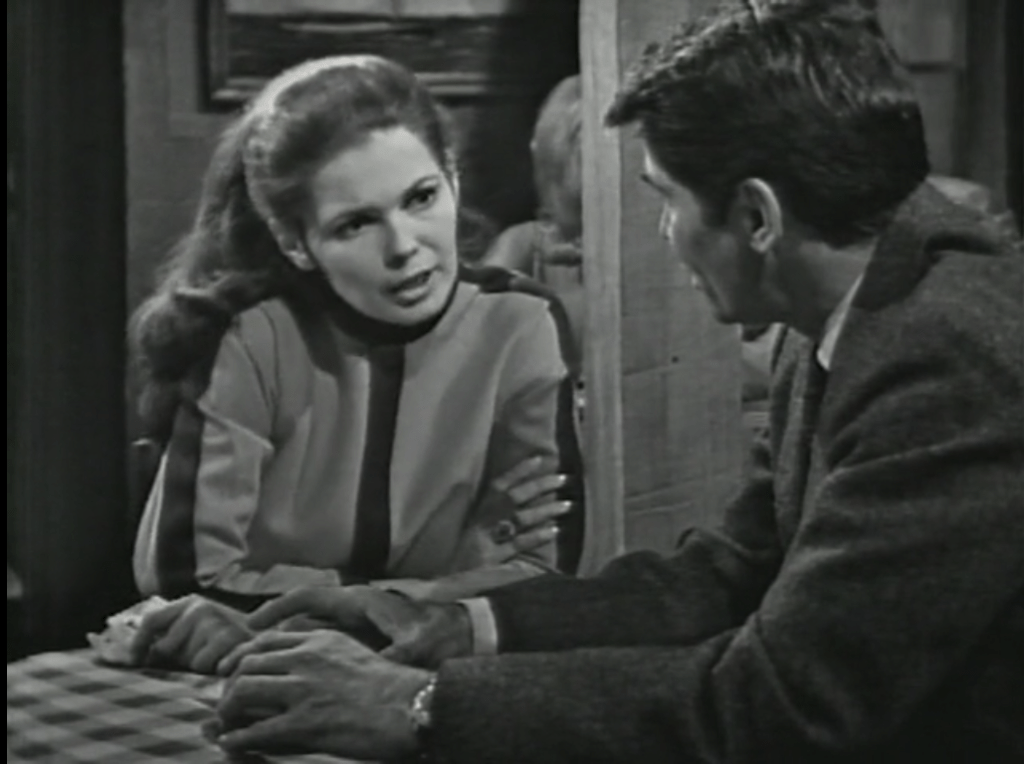
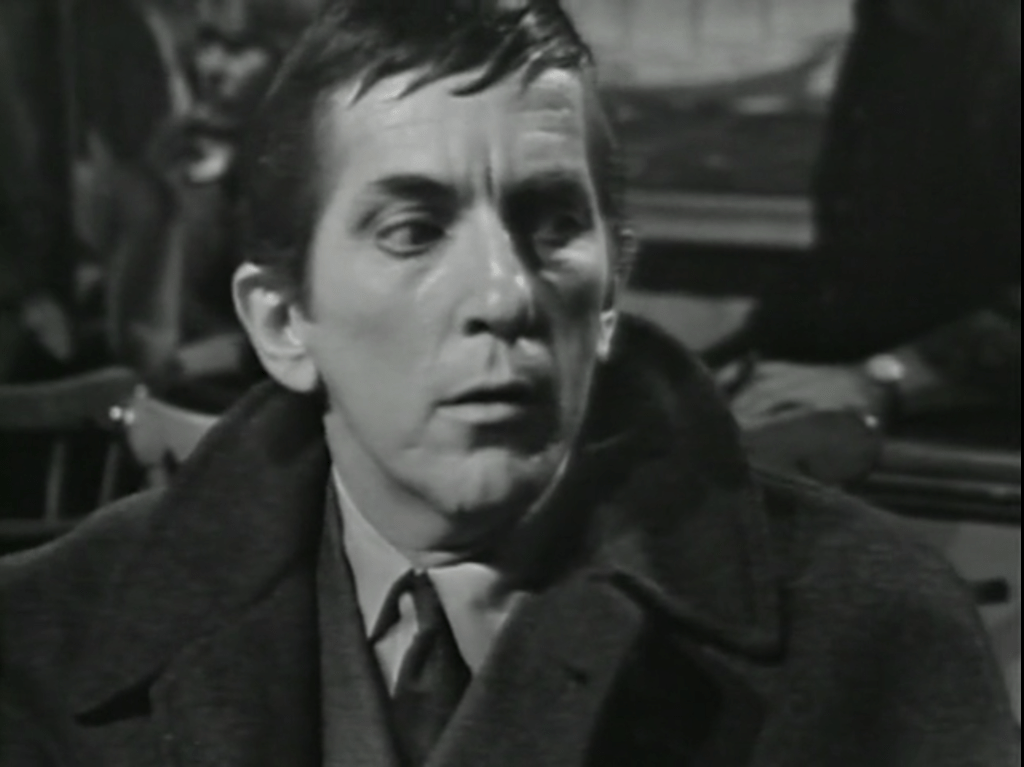
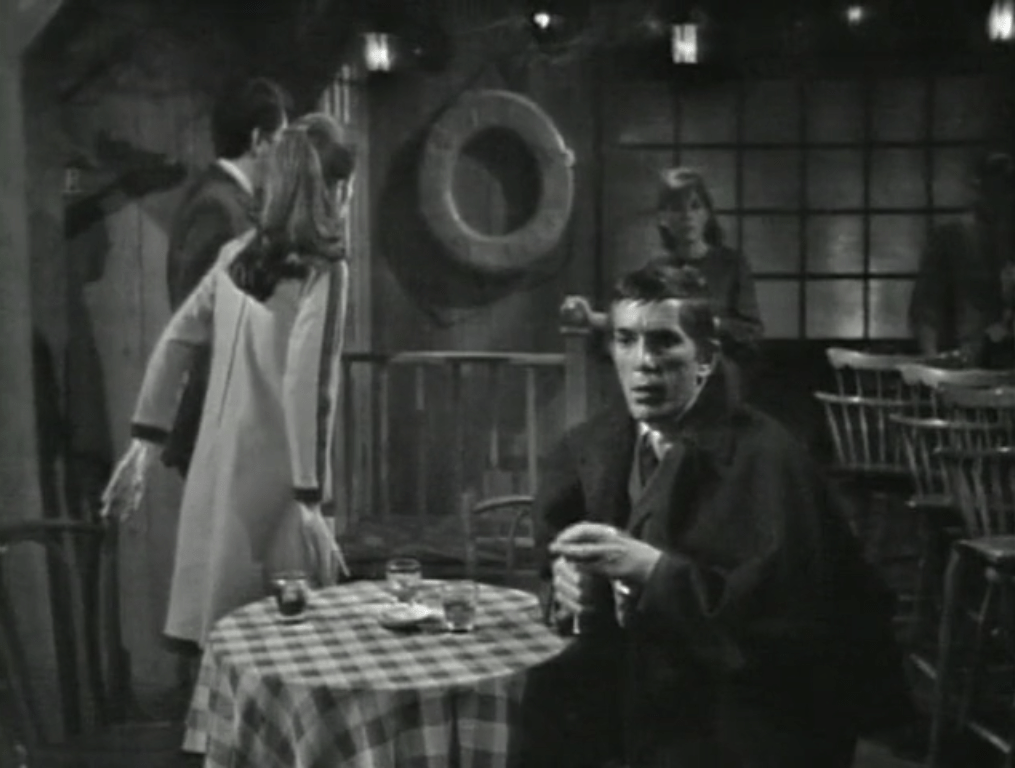
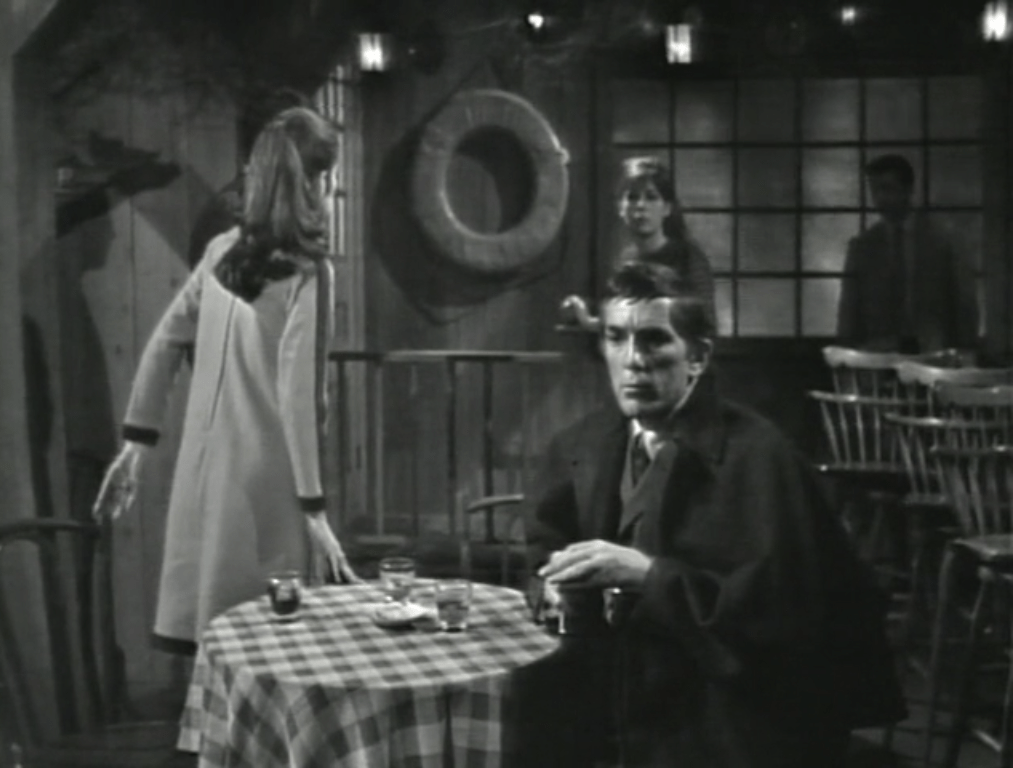
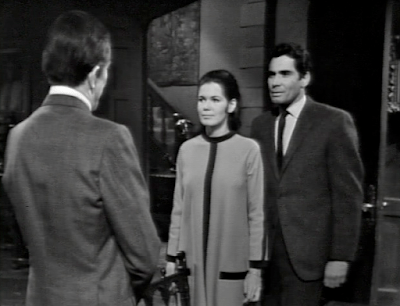
Episode 744: Sometimes he makes himself invisible

The House by the Sea

In September and October 1967, well-meaning governess Vicki and her depressing boyfriend Burke wanted to buy a long-disused property that everyone referred to as “The House by the Sea.” Collinsport is a coastal village, so many of its houses would lie by the sea, but at that point only that one was so designated on Dark Shadows. It was important that The House by the Sea lay on the other side of Collinsport from the great estate of Collinwood. When it was first introduced, matriarch Liz was eager to go there, signaling that the show was done with an old and unproductive theme presenting Liz as a recluse. And Burke was willing to live there with Vicki, whom he is determined to get away from Collinwood and the Collins family.

The house belonged to the Collinses, and the show suggested that it might be haunted in such a way that if Burke and Vicki lived there they would become possessed by the unquiet spirits of its former occupants, Caleb Collins and his wife, whom we know only by the initials “F. McA. C.” When Liz found in #335 that for legal reasons she would not be able to sell Vicki and Burke the house for a few years, the whole story vanished without a trace. We did not hear the phrase “The House by the Sea” again until #679, in January 1969.

At that point, the show was in fact running a story about ghosts taking possession of the living, a coincidence that leads me to wonder if the writers were making an inside joke about a story that was in the flimsies early in 1967, that was reflected in the talk about “The House by the Sea” that autumn, and that went nowhere. At the beginning of January 1969, strange and troubled boy David Collins was intermittently possessed by the ghost of his Aunt Liz’ great-uncle Quentin, and when Liz questioned him about some of his odd doings he made up a story about The House by the Sea to persuade her that he was just being silly.

In between those two stories, we did hear a great deal about another place called “A House by the Sea.” From #549 in August 1968 until #633/634 in November, this house was rented by suave warlock Nicholas Blair. At first it was said to be located at some distance from Collinwood, and it seemed that it might be the house Burke and Vicki had been interested in. But as we saw it, we could see that it was in quite a different architectural style. And as time went on, the house moved closer and closer to Collinwood. After a while, the opening narrations referred to it as “Another house on the same great estate.” That did not stop Big Finish Productions from conflating Vicki and Burke’s “The House by the Sea” with Nicholas’ “A House by the Sea” in their 2012 drama The House by the Sea, but the houses remained distinguishable on the show as of early 1969.

Now, Dark Shadows has become a costume drama set in the year 1897. Well-meaning time-traveler/ bloodsucking fiend Barnabas Collins has gone to that year, when Quentin was a living being, in hopes of preventing the events that made him into the all-destroying evil spirit of 1969. Barnabas does not have the slightest idea what those events were, and in the absence of that information he has decided that the best course of action is to antagonize as many people as possible.

Among the enemies Barnabas has made is the evil Rev’d Gregory Trask, head of a boarding school/ abusive cult called Worthington Hall. Another of Barnabas’ new enemies has, for reasons of her own, burned Worthington Hall to the ground. Trask has captivated the current mistress of Collinwood, spinster Judith Collins, and in #739 Judith offered Trask the use of a “small house on the estate” as a temporary base for the school until she can finance the restoration of the previous site. Today, Judith instructs a servant to take steps to prepare “the house by the sea” for this purpose.

Perhaps this means that Trask’s cruelty center will occupy the house Burke and Vicki wanted to buy. That Judith said it was “on the estate” would suggest that it is the one where Nicholas lived, and they have decided that so few people remember the dead-end storyline of autumn 1967 that they no longer need to keep the two houses distinct by calling only one of them “The House by the Sea.”

No More Knife

While Quentin was haunting Collinwood in late 1968 and early 1969, he showed himself to be a peculiarly corporeal sort of ghost. In addition to the usual ghostly business of materializing and dematerializing inside closed rooms, possessing children, and making noises resound from everywhere and nowhere all at once, he also poisoned one person, choked another, and came and went through a secret passage. Occasionally this served to show that Quentin’s power started small and grew steadily until he was irresistible, but it also left the impression that Quentin simply enjoyed feeling like he had a body. Now that we see Quentin as a living being, the impression that he revels in the flesh is frequently confirmed.

Quentin’s estranged wife Jenny has gone mad and is being kept prisoner in the great house by Quentin’s sister Judith and brother Edward, with the assistance of a couple of the servants. Quentin learned of Jenny’s continued presence at Collinwood only when she escaped and stabbed him a few weeks ago, and he still can’t figure out where in the house she is locked up. He has vowed to kill her once he does find her.

Jenny is on the loose again today. Judith has a close call in the drawing room. She finds Jenny there. Jenny menaces Judith with a knife; just as she gets Judith into a helpless position and it looks like she is about to stab her to death, Jenny picks up a candlestick and knocks Judith unconscious. Shortly after, Quentin comes in and finds Judith recovering from the blow. Judith tells him what happened. He gets a gun and goes out to hunt Jenny down.

Jenny makes her way to the Old House on the estate. She knocks on the door, and Barnabas answers. They introduce themselves to each other. His name means nothing to her; he arrived only nine weeks ago, long after she lost her marbles and was consigned to a hidden cell. No one has told her that Judith invited a distant cousin from England to stay in the Old House. But Barnabas knows exactly who Jenny is, and he listens to her every word and watches her every move with vivid interest.

Jenny announces that she has come to find Quentin. Barnabas says that Quentin is not there, and invites Jenny to search the house. As she walks through the front parlor, Jenny announces that “Sometimes he makes himself invisible.” That line will strike a chord with regular viewers who remember the ghostly Quentin of the 1960s, though Jenny is apparently thinking of a psychotic break she had earlier in the episode when she hallucinated his voice coming from various pieces of furniture in the drawing room. Nonetheless, Jenny is confident that she will know if Quentin is nearby.

Jenny talks about her “children”; Barnabas visited one of her former cells, and saw that there were dolls there. He asks twice if the children she is talking about are dolls, and each time she angrily insists that she has real live children and that they are in her room at Collinwood. She sings a lullaby in a minor key; she forgets the lyrics halfway through, and asks Barnabas if he knows them. She has a lovely voice, and he seems to be sincere when he says he is sorry that he cannot help her finish the song.

As Jenny talks about her children, it dawns on Barnabas that she may in fact have had children who were taken from her. His reaction to this is an important moment. In 1969, Barnabas learned that in 1897 a baby died and was buried in an unmarked grave on the grounds of Collinwood with an amulet meant to ward off werewolves. So far in his trip back to that year, he has found no babies and there is no werewolf. His response to Jenny’s talk of her children looks like a man making a wild surmise. If the baby in the unmarked grave was one of Jenny’s children, the werewolf must be coming very soon.

Barnabas makes the connection.

Jenny is sitting on the staircase for part of this conversation with Barnabas. Ever since Barnabas first met David in #212, he has had his most human moments while standing on the floor and talking to people on that staircase, and his talk with Jenny is an outstanding example. He talks to her very gently. Perhaps he has the presence of mind to try to befriend someone who might be useful to him, but whatever he is thinking he shows a real warmth.

Jenny tries to stab Barnabas; he takes the knife from her. She cowers in a heap on the floor, wailing that now he will kill her. He throws the knife in the fire and tells her she has nothing to fear. Of course, a metal blade could not harm a vampire, so it was easy enough for Barnabas to remain unruffled during the attack.

Barnabas vetoes Jenny’s demand to search the basement, where his coffin is, and takes her upstairs to a bedroom once occupied by his lost love Josette. In 1967, he restored that bedroom to the condition it was in when Josette lived there, and for some reason he has done the same this time. By the time they get to Josette’s room, Jenny thinks that she and Quentin are on their honeymoon and that Barnabas is a bellhop. She apologizes that she has no money to give him as a tip.

Jenny looks into the mirror and is revolted by the terrible person she sees there. Barnabas points to an assortment of lady’s toiletries and assures her that the terrible person will go away if she uses them. He locks her in the room and calls for his servant Magda.

Jenny is so crazy we can never be sure what she will make of any set of facts she encounters, and Barnabas is, for once, keeping his thoughts to himself throughout his scene with her. But however much ambiguity may be built into Barnabas and Jenny’s interactions with each other, there is no question what Marie Wallace and Jonathan Frid are doing. She is supposed to play Jenny without restraint, and she makes the most of that opportunity to be larger-than-life. He also seizes his chance to show what he can do when he has time to really learn his part. He is not only letter-perfect with his lines, but also subtle and precise in his characterization of Barnabas’ reactions and intentions. It is a fascinating performance.

Jenny hears Barnabas calling Magda’s name. She not only repeats it, but also says the name of Magda’s husband Sandor. Magda and Sandor have been in the Old House for quite some time, well before Barnabas showed up and forced them into his service, so it is no surprise that Jenny remembers them. It is interesting that she seems to have strong feelings about them, though. Before she left the great house, Jenny was talking to herself, saying that her father was “a king in India.” Sandor and Magda are Romani, and the Romani people originated in India. Their ethnicity may be what brought that part of the world to Jenny’s mind.

Magda and Sandor are out. The sun is rising. Barnabas leaves a note for Magda, and goes to his coffin for the day. Quentin enters, brandishing his pistol. He finds the note and a key, and goes upstairs. We close with him standing outside Josette’s room. He and Jenny talk to each other through the locked door. He tells her that he is coming to her and that they will never be separated again.

In a comment about Danny Horn’s post about this episode on Dark Shadows Every Day, David Pierce makes an interesting observation:

My favorite line was from Quentin to Judith when he wants to know how Jenny escaped: “What, did she leave by fasting and prayer?” He was misquoting Jesus from the New Testament, Matthew Chapter 17, verse 21 “Howbeit this kind goeth not out but by prayer and fasting.”

David Pierce, comment left at 12:01 PM Pacific time 13 January 2021 on Danny Horn, “Episode 744: Crazy Little Thing,” Dark Shadows Every Day, 9 October 2015

Quentin does paraphrase the Bible quite often, a habit which, combined with his penchant for Satanist ceremonial practice and his gleeful libertinism, suggests that he won’t pass up any potential source of delights.

Episode 679: Your make-believe people

The spirit of the late Quentin Collins is taking possession of children Amy Jennings and David Collins, and they now realize that Quentin’s plans for them are evil. David despairs of resisting Quentin; Amy tries to tell matriarch Elizabeth Collins Stoddard what is going on, but Quentin appears to Amy and stops her before she can say anything useful. I have some miscellaneous observations to make:

Quentin scares Amy and stops her telling Liz what is happening. Screenshot by Dark Shadows Before I Die.
  1. In a comment on Danny Horn’s post about this episode at Dark Shadows Every Day, I pointed out that it is unnecessary to call the story a “metaphor for child abuse” or “allegorical child abuse.” When adults terrorize kids into harming their loved ones, that simply is child abuse. Quentin is abusing David and Amy by means that don’t seem to exist in our world, but it is very definitely abuse and it can be expected to have the same consequences that would follow if he were using more realistic methods.

2. When Quentin interrupts Amy’s attempt to tell Liz what has been going on, the show is repeating a structure it used just a few days ago, in #675. Amy’s big brother Chris was about to confess to the sheriff that he was a werewolf when a telephone call from recovering vampire Barnabas Collins gave Chris an alibi and ended the sheriff’s interest in anything he might say. In each case a confession comes right to the point of terminating one of the two major ongoing storylines and is interrupted before it can do so.

3. Liz catches David twisting Amy’s arm, covering her mouth, and yelling at her. After Liz scolds David and sends him to his room, she tells governess Maggie Evans to discipline David by any means necessary. Several times in the last couple of weeks, the show has gone out of its way to demonstrate that Maggie is a hopelessly lax disciplinarian, no obstacle at all to Quentin’s designs on Amy and David. Now we see that even the other characters have started to catch on to this fact.

4. There are a couple of sequences of coming and going from David’s room. These feature a good deal of camera movement from the inside to the hallway outside. The show has been giving us a lot more of this kind of thing lately, laboring to suggest spaces connecting one room to another. There used to be scenes set in the village of Collinsport, and characters who lived there. Maggie lived in town then, and her house was a frequent set. But now she lives in the great house on the estate of Collinwood, and the only regular character who does not live somewhere on the estate is Professor Timothy Eliot Stokes, whom we have not seen since #660. If all the action is going to shrink to Collinwood, and most of it to the great house, it makes sense they would develop a strategy to make that house seem like a bigger place.

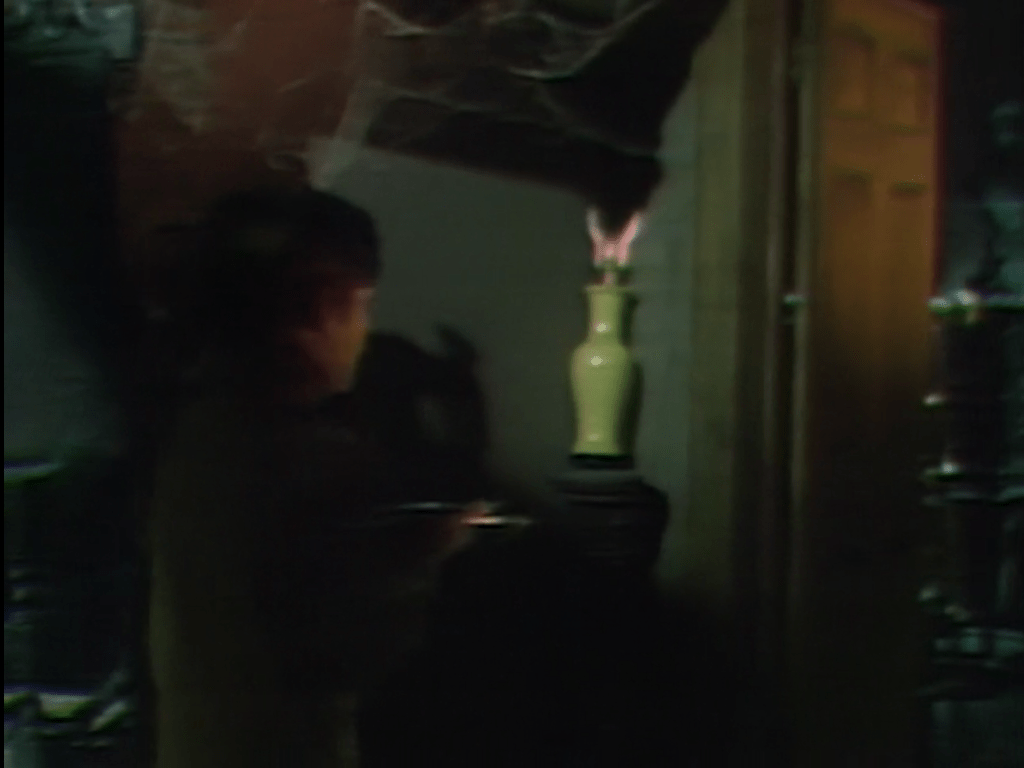
5. The show has a fondness for a particular shade of bright green at this point. You will notice it in the clothes that both Amy and Liz are wearing in the screenshot above. It also shows up towards the end of the episode. Maggie follows David into the long-deserted west wing of the great house; he is sneaking off to visit Quentin in his stronghold, a dusty little room there. The sequence again places an emphasis on the corridors. We have seen the west wing corridors several times. As before, they are draped with elaborate cobwebs but chock-full of objets d’art. There is a new one on display today, a lamp in that same bright green. It is in the center of the shot while David makes his way to the room. That helps to make the space seem bigger, as we measure David’s progress not by he slowness of his steps but by his steadily changing relationship to the lamp. The corridor is dark enough that only a brightly colored object could serve this function, but it is in focus for so long that we are left with a feeling that it must have some significance of its own.

The lamp gets its star turn.

6. When David is lying to Liz to keep her from making sense of what little Amy was able to tell her, he claims to have an imaginary friend named “Lars,” a giant who lives in “the house by the sea.” Collinsport is a coastal village, so there are lots of houses by the sea there, and for much of 1968 suave warlock Nicholas Blair lived in what was always called “a house by the sea.” But only one place has been called “the house by the sea,” a Collins family property that has been vacant since the 1870s. Well-meaning governess Victoria Winters and her fiancé Burke Devlin were interested in buying that house in September and October of 1967, but for legal reasons the sale turned out to be impossible. The business about The House by the Sea seemed very much like it was going to lead to a ghost story that would bring into view another branch of the Collins family and involve Burke and Vicki being possessed by evil spirits. Perhaps that was the intention when it was first dreamed up in the flimsies six months before, but it never went anywhere and was forgotten completely the minute it ended. This is the first reference to the house since #335. If that were at one time the plan, bringing up “The House by the Sea” today might be a way for the writers and producers to remark to each other on the fact that they are now making a story like the one they dropped back then.
Episode 586: The way my life has turned out

Some very big problems with this one. Danny Horn goes into detail about three of them in his post about the episode on Dark Shadows Every Day, and I have further complaints.

Friday’s episode ended with Frankenstein’s monster Adam in the act of strangling well-meaning governess Vicki as she lies in her bed at the great house on the estate of Collinwood. In today’s opening Adam goes on throttling Vicki for quite a while. At length heiress Carolyn and recovering vampire Barnabas mosey into Vicki’s room. Adam is long gone, and Vicki is still alive. Permanent houseguest Julia is a doctor, and we hear a report of her prognosis that Vicki will be all right. Carolyn has been hiding Adam in a spare room; suave warlock Nicholas shows up and does some damage control. He suggests to Carolyn that Adam might not be guilty of the attempted strangulation, then goes to Adam’s room to talk with him while they wait for Carolyn to come. By the time she gets there, Adam and Nicholas have their story straight. Carolyn accepts Adam’s denials. At that point, everyone loses interest in Vicki and what happened to her.
Nicholas had put Adam up to demanding that Barnabas and Julia build him a mate. Adam had threatened to kill Vicki if they did not comply. Yesterday, he concluded that they were not taking him seriously, and that was his motive for the murder attempt. At the end of today’s episode, Barnabas goes back home to the Old House on the estate and finds Adam waiting for him. Adam tells Barnabas that he has decided they should use Carolyn as the donor of the “life force” that will bring the mate to life.

Adam’s attack on Vicki was Friday’s week-ending cliffhanger. It might have generated substantial suspense, as it has been so long since Vicki has had much to do on the show that it is possible we might be seeing the last of her. But, as Danny points out, they botch the scene badly:

I mean, there is obviously no way that she could have survived this attack. Adam is an enormous Frankenstein creature; it’s been established that he can bend steel bars just by giving them a stern look. Even for a soap heroine, there’s no way that Vicki could maintain structural integrity under these circumstances. She’s just not built for it.

It’s quite a grisly little scene, actually, because it happens so quickly. She doesn’t really get a chance to react. She was sleeping, and then Adam put his hands around her neck, and now she’s dead, and she doesn’t even know what’s going on…

By the time Carolyn returns to the scene of the crime, Julia’s already been and gone — the invisible off-screen soap doctor who doesn’t actually appear in this episode.

Barnabas tells Carolyn that Vicki’s alive, but she’s in shock. I am too, actually; our lame Frankenstein monster can’t even kill a governess at point-blank range.

Danny Horn, “Episode 586: The Invisible Woman,” posted 17 February 2015 on Dark Shadows Every Day.

Danny revisits this point later in his post:

Problem number one is the lack of consequences. They actually opened the week with the murder of a main character — and ten minutes later, everyone’s back to starting positions. Vicki’s not dead, and Adam’s not even being blamed for the assault.

Now, I’m not complaining that Adam hurt somebody and isn’t expressing any noticeable remorse. It’s true that today’s felony places Adam squarely in the villain column, but that’s fine. Fantasy-adventure stories need villains, and villains are supposed to do villainous things.

The consequences issue is that Adam basically just killed Vicki, and it hardly even registers as a plot point. There’s no investigation, no confession, and no character development; it’s just a thing that happened, and we can all forget about it.

Danny Horn, “Episode 586: The Invisible Woman,” posted 17 February 2015 on Dark Shadows Every Day.

Adam’s threat to kill Vicki never seemed to fit with his personality, but considering that he accidentally killed his friend Sam because he didn’t know his own strength, we could at least imagine that he might inadvertently carry it through. And as Danny says, the brevity and simplicity of the scene add to its force if we think it might actually show Vicki’s death. She was the show’s protagonist for its first 38 weeks and an important part of it for a long time after, and for her life to end so abruptly that she doesn’t even have a chance to scream, for the sake of a plot point that isn’t even her killer’s own idea, would be shocking in the pointless, unsatisfying way that violent deaths are shocking in real life. But if Adam can shake Vicki by the neck from the opening teaser through the first scene without seriously injuring her, he clearly isn’t going to kill anyone, and Barnabas and Julia may as well go off and do something else.

Nicholas is Dark Shadows’ main villain at this point; he is supposed to seem so powerful that we can’t imagine how the other characters will overcome him, and so wicked that we will forgive them for any expedient they can find that will work against him. This is currently the show’s main source of suspense. As Danny explains, they do serious damage to that today:

Nicholas is supposed to be the real mastermind behind this operation, so Adam still ends up reduced to being the dumb muscle, rather than a strategic thinker.

Unfortunately, Nicholas’ management skills are also kind of questionable at the moment. We see him scolding Adam for trying to kill Vicki, but where has Nicholas been for the last couple weeks?

It’s up to Adam to fill Nicholas in on the latest plot development — that Barnabas has chosen Maggie to be the sacrificial victim in their Bride of Frankenstein mad science experiment, giving her “life force” so Adam’s new mate can live.

Nicholas has a crush on Maggie, so he’s furious about this, but it’s a hollow moment. If Nicholas is the manipulative wizard running the show, then he should have known that they spent a good chunk of last week discussing this.

Dude, you have a magic mirror that can show you anything that’s going on at the Old House. You should have been on top of this. It’s just irresponsible.

Danny Horn, “Episode 586: The Invisible Woman,” posted 17 February 2015 on Dark Shadows Every Day.

A third major flaw with the episode comes with Carolyn’s role. Danny explains:

I know that it’s odd to say, “This storyline about creating a female love-slave for a violent psychopath isn’t particularly strong on women’s issues,” but Dark Shadows isn’t just a fantasy-adventure story, where you can marginalize all the female characters and move on to the car chase. It’s also a soap opera, and soap operas are supposed to be about women, and women-related subjects like feelings and consequences.

But here we are, watching an episode of daytime television that begins with strangling a woman who doesn’t struggle or even cry out, and then the rest of the time is mostly Carolyn talking to a series of men who lie to her and boss her around.

This is a real problem, and it’s going to come up again. The Bride of Frankenstein story has turned into a reverse beauty pageant, where the guys get together and argue about which woman they’re going to sacrifice on the altar of mad science. This hot potato is going to be tossed around between Carolyn, Vicki and Maggie all week.

Julia is the one female character in the story who actually has agency of her own, but she’s kind of sidelined too — mostly just turning the knobs and flipping the switches while the guys decide whose life force they’re going to extract. The fact that they can have this whole episode with Julia off-camera pretty much says everything.

Danny Horn, “Episode 586: The Invisible Woman,” posted 17 February 2015 on Dark Shadows Every Day.

Danny goes so far as to say that the gullibility Carolyn has to display when Adam and Nicholas lie to her “actually threatens to break the show,” and he is right. The failure to take female characters seriously not only disrespects the show’s core demographic, but specifically makes it harder to tell a suspenseful story. We can see why when Carolyn asks Barnabas why he believes Adam attacked Vicki. At this point Barnabas knows that Carolyn is hiding Adam, and he believes that Carolyn, like everyone else in the great house, is in danger from him. He therefore has every reason to confide in her, and since she can’t go to the police, no reason to hold back even the parts of the story that would incriminate him. But he flatly refuses to tell her anything at all. Ever since March 1967, the rule on Dark Shadows has been that only the villains are allowed to know what is going on. That cramps the action seriously, and when they add further restrictions on who can participate, it limits the possible outcomes of any situation so severely that it becomes all too predictable.

The scene in which Barnabas refuses to tell Carolyn what he knows brings up yet a fourth problem, one Danny does not mention. Barnabas takes such an indefensible position that he winds up seeming ridiculously weak. The main villain already looks weak, so when the principal protagonist does too, we have little reason to hope for an exciting story.

What keeps this episode from the “Stinkers” bin is Robert Rodan’s performance as Adam. In his early days, when Adam knew only a few words, Rodan managed to play on our sympathies, but had little opportunity to do more. Now the character speaks fluently and the actor delivers his lines with remarkable precision. Danny calls it a blooper when, during the three-scene in Adam’s room, Nicholas tells Carolyn that Adam is growing used to being blamed, and he responds by shouting all but the last word of “I am not used to… it.” I disagree. The dropping of his voice shows that there is a great deal Adam is not used to and does not plan to get used to, more than he can put into words.

The final scene in Barnabas’ house is also a fine turn for Rodan. Barnabas finds Adam waiting for him in his front parlor. We had seen Adam there in his first weeks as an inarticulate, raging creature; now he is well-spoken and very much in control of himself as he presents Barnabas with an impossible demand implicitly backed by a horrifying ultimatum. The contrast is chilling. I particularly relished Rodan’s rendering of this little speech:

Barnabas, please sit down.

When I first knew you,

I never thought I could be the gentleman that you are.

You are a very imposing man, Barnabas.

I still find it difficult not to be frightened by your manner.

Adam does not make threats in this scene; he creates a frightening situation simply by the imperturbable calm with which he issues his commands. It is Rodan’s finest moment so far.

Adam states his requirements. Screenshot by Dark Shadows Before I Die.

Closing Miscellany

Nicholas tells Carolyn that he is concerned about what happens on the estate of Collinwood since “I live here too.” When he first moved into the house he now rents from the Collins family, it was on the other side of the village of Collinsport from their home. A week or two ago, the opening voiceover referred to it as “another house on the estate,” and we’ve been hearing people around Collinwood refer to it as “very near.” So that’s a retcon. Since Adam has been coming and going between Collinwood and Nicholas’ house without being seen, I suppose it is a logical one, but it does make you wonder what they were thinking when they originally made it so clear it was some distance away.

Barnabas asks Carolyn if there is a way into Vicki’s room than her locked door. He knows very well that there is, since he himself used a secret passage to get into that room twice when Dark Shadows was a costume drama set in the 1790s and the gracious Josette slept there.

Episode 572: Anyplace else

The Evans Cottage

Maggie Evans, The Nicest Girl in Town, was under the influence of vampire Barnabas Collins in May and June of 1967. At the beginning of that period, she spent her days sick in bed at home, and at night regained strength and insisted on going out. When her father Sam and her boyfriend Joe tried to keep Maggie in, her adorable personality vanished and she raged at them.

Maggie eventually escaped from Barnabas, and mad scientist Julia Hoffman erased her memory of the ordeal. Since then, Barnabas’ vampirism has gone into remission. Julia has taken up residence at the great house of Collinwood and has become Barnabas’ fast friend.

Julia drops in at Maggie’s house today. Maggie says she is worried about Joe. He has been standing her up for dates, hasn’t reported for work for three days, and won’t answer his phone.

After Julia leaves, Joe comes in through the back door. He is pale, sweaty, and wild-eyed, obviously ill. He faints for a second. Maggie goes to call a doctor. Joe protests against this idea, almost shrieking, and Maggie relents. He asks her to keep him in the house overnight no matter what he says or does; this is very much the sort of thing Maggie used to say when she was falling under Barnabas’ power. Also like Maggie in those days, minutes later Joe announces that he will be leaving the house and that Maggie has no right to keep him from going. Maggie tries to block the door; Joe grabs her, flings her aside violently, and rushes out.

Kathryn Leigh Scott and Joel Crothers do an excellent job with this last bit of business. Yesterday and the day before, there was a fight scene that was so poorly done I couldn’t get a screenshot that didn’t look like a joke. But the choreography is perfect here. The actors really make it look like Joe is throwing Maggie to the floor, and in her closeup at the end of the sequence Miss Scott convinces us Maggie is hurt.

The similarity between Maggie’s behavior in May 1967 and Joe’s now is no coincidence. He is the victim of Angelique, formerly a wicked witch, now a vampire under the control of suave warlock Nicholas Blair.

After he had asked Maggie to keep him in the house no matter what he said and before he told her he was going to leave no matter what she did, Joe talked to her about going away from Collinsport, far away, going anywhere at all, anywhere from which they would never come back. It’s a poignant moment. Once there were other places for Joe and Maggie, and once there were ways to go there. When art dealer Portia Fitzsimmons called on Sam in this room in #193, Dark Shadows had run out of story. For all we knew, Sam might have gone to New York and taken Maggie and Joe with him, and the show might have reinvented itself to follow them there. But Sam is dead now, Mrs Fitzsimmons is long forgotten, and outside Collinsport there is nothing but a mental hospital. Even Hell seems to be located in a corner of Barnabas’ basement, and Purgatory in the woods outside.

The House by the Sea

Nicholas lives in a house by the sea. Collinsport is a fishing village, so a lot of its people probably live in houses by the sea, but there are two that we have heard referred to as “The House by the Sea,” and this is the second of them.

Barnabas and Julia know that there is a vampire on the loose and are pretty sure that Nicholas is to blame for that fact. Maggie mentioned to Julia that Nicholas will be coming to her house at 5 PM to buy a painting, and so Julia suggests to Barnabas that they go to Nicholas’ at that time and search.

They find the door unlocked. The green screen behind them has an image that makes it look as if the house is floating in the sky. Maggie’s house has always been the place the show has taken us when it wanted to give us a feeling of realistic kitchen sink drama; the effect of this background outside Nicholas’ front door is to tell us that we are leaving that world behind and entering an exotic, paranormal space.

As they enter, Julia has second thoughts about trespassing. Now it is Barnabas’ turn to insist they probe forward.

They split up. Barnabas runs into Joe. The two men ask each other what they are doing there, and each tells a lie about having business with Nicholas. They then take turns ordering each other out of the house. We end with a view of Angelique’s coffin, its lid opening.

Episode 338: Suspicion itself

Dr Dave Woodard is onto vampire Barnabas Collins’ terrible secret. Woodard doesn’t think he can share his suspicions with the sheriff or a medical colleague or an expert in the supernatural or with any of his friends. Still, he has to tell someone. So he has gone to Barnabas and told him all about it. Barnabas tells him he’s crazy and orders him out of his house.

On his way out, Woodard crosses paths with his medical school classmate and onetime friend Julia Hoffman. He had introduced Julia to the case of Barnabas’ victim Maggie Evans, The Nicest Girl in Town, hoping that her dual qualification as an expert in psychiatry and hematology meant that she would be the perfect person to find out what happened to Maggie. He knows now that Barnabas was the source of Maggie’s troubles, and that Julia has gone over to Barnabas’ side. The doctors engage in a brief verbal sparring match, then Julia goes into the house. Woodard pretends to leave, then crouches by the window where we have already seen several people eavesdrop on Barnabas’ conversations. Even though Julia herself is one of those people, neither she nor Barnabas thinks to look out the window before they launch into a hugely incriminating conversation.

Among the more important pieces of information Woodard learns are that Julia is performing an experiment on Barnabas, that she is keeping notes on that experiment, and that she keeps those notes in a box in her room at the great house of Collinwood. For some unaccountable reason, she thinks that no one will look for them there.

Barnabas demands that Julia find out how much Woodard knows. He butters her up a bit, telling her that while she has said that Woodard was the most brilliant student in their medical school class, he is sure he can’t have been more than the second most brilliant. He even calls her “my dear,” the first time he has addressed her as anything more affectionate than “doctor.” She is facing away from him when he says all this, and we see her brighten. By the time she exits, she looks positively blissful.

Julia thrills to Barnabas’ non-hostile talk.

Perhaps this suggests that Julia is falling in love with Barnabas. She does get carried away with sympathy for him earlier in the scene, when he is whining about his situation and she exclaims “Poor Barnabas!” Perhaps it’s just that she has been spending all her time with him for months and is relieved to get some friendly attention. Whatever the cause of it, her excitement must be considerable- she even allows herself to bring up a topic to which she has never before so much as alluded, and says that “They didn’t take me as seriously as they should have because I’m a woman.”

Julia calls on Woodard at his office. She tries to sell him on an idea he himself had in #324, that she’s hanging around because she’s fallen in love with Barnabas. He confronts her with a list of the medical supplies she has ordered recently. She ignores the list and keeps saying that she is just a woman in love. Woodard isn’t having it, and she ultimately resorts to warning him that for his own good, he must stop asking questions.

Meanwhile, there is some activity at the great house. Well-meaning governess Vicki receives a visit from her depressing fiancé Burke. The two of them had hoped to buy a “house by the sea” that turned out to be unsaleable because of provisions in an old Collins family will. Matriarch Liz eavesdrops as they talk about this, then enters the room and offers to let them live in the long-abandoned west wing of Collinwood until the house they want becomes available. Vicki loves the idea, Burke is hesitant.

Liz eavesdrops on Burke and Vicki.

This echoes a theme of the first few months of the show, when Burke wanted to take possession of Collinwood and throw the Collinses out. In response, Liz vowed that Burke would never spend a night under its roof. This offer shows viewers who have been watching from the beginning how far we have come since those days.

I wonder if that vase is full of Cheetos

Episode 336: People don’t keep secrets anymore

Early in the story of vampire Barnabas Collins, local physician Dave Woodard decided to call in an expert from out of town. Dr Julia Hoffman was doubly qualified as a specialist in psychiatry and hematology, and so she seemed to be ideally suited to make sense of the baffling occurrences taking place around Collinsport. Readers of Bram Stoker’s Dracula will recognize Woodard as the counterpart of Dr John Seward and Julia as Professor Abraham Van Helsing.

Now, Woodard realizes that Julia has gone over to Barnabas’ side. So, crafted to be the stolid Seward, he must try to do the work of Van Helsing. Today, he manages to meet and talk with the ghost of Barnabas’ little sister Sarah, persuades her to show him the secret chamber in the tomb where her body is buried, and confronts Julia.

Sarah complains that “People don’t keep secrets anymore.” She’s had it with this damn century.

All of this would have been very powerful had Woodard been played by Robert Gerringer. Gerringer played the part starting in May. For most of that time, Woodard had little information and no power to advance the plot. He was largely confined to scenes that groaned under the weight of recapping. Gerringer made this thankless role as interesting as anyone could, managing to shade Woodard’s internal life so that we could see how confusing it would be for a trained scientist to confront facts that could be explained only by reference to the supernatural.

Gerringer’s acting style stands apart from those of his cast-mates. Most of the cast of Dark Shadows knew nothing at all about daytime serials when they joined the show, and they don’t sound or move in ways that are typical of the genre. But Gerringer’s voice is that of every doctor in the soaps my mother watched when I was a kid. His presence on Dark Shadows is a constant reminder of the incongruity of a vampire as a regular character on a soap opera in 1967.

Unfortunately, Gerringer is not in this one. The National Association of Broadcast Engineers and Technicians were on strike when this episode was made, and Gerringer refused to cross their picket line. So his part is being played by someone else, and the intended effect of the whole thing is badly blunted.

There’s also a scene between well-meaning governess Vicki and her depressing boyfriend Burke. There was some talk a while ago about them buying a “house by the sea,” and they make it clear today that we won’t be hearing much more about that. That never really amounted to a story, and it’s something of a disappointment that it is a dead end.

Episode 302: As dead as Jeremiah Collins

When new writers start working on Dark Shadows, they do some inventorying of ongoing and disused storylines. When Ron Sproat came aboard in November of 1966, he contrived a lot of scenes that served to mark storylines as “To be developed” or “To be discarded.” Now Gordon Russell has begun to be credited with scripts. He addresses continuity questions with brief lines of dialogue.

For example, for the last forty weeks the show has been equivocating about when it was that Barnabas Collins lived as a human being. Sometimes they say that he died and became a vampire in the 1830s. That fits with the original idea that Jeremiah Collins built the great house of Collinwood for his bride Josette in that decade, because Barnabas is supposed to have loved Josette and hated Jeremiah. At other times, they have pushed Barnabas, Josette, and Jeremiah back into the eighteenth century.

Now Barnabas has risen from the grave. Mad scientist Julia Hoffman has developed a series of injections to cure him of vampirism and turn him into a real boy. When Julia finds that Barnabas has heard the ghostly voice of his sister, nine year old Sarah, she declares that “The injection can wait!” and wants to talk all about Sarah. When Barnabas tries to avoid the subject, saying that Sarah has been dead for nearly 200 years, Julia replies “So have you.” That would seem to nail down that continuity question.

Julia speculates that Barnabas has subconsciously willed Sarah to return to the living, because she symbolizes the kindly side of his nature. There have been a bunch of possible explanations for why Sarah emerged shortly after Barnabas did; evidently this is the one we will be going with, at least for a while.

Barnabas has been looking through an album of family portraits, Sarah’s among them. He tells Julia that he is particularly intrigued by another portrait in the same volume, that of Jeremiah. He says that Burke Devlin, depressing boyfriend of well-meaning governess Vicki, bears a striking resemblance to Jeremiah. This point was first made in #280, when Burke came to a costume party at Barnabas’ in Jeremiah’s clothing and Barnabas was shocked by the resemblance. Barnabas says that he will be a happy man when Burke is as dead as Jeremiah. This tells us, not only that Barnabas is serious about his hostility to Burke, but also that we can expect some connection between Jeremiah and Burke to be developed.

Julia chases Barnabas around his living room until he hangs his head and mutters a promise not to hurt anyone, not even Burke, as long as there is a chance the injections will work. This helps both to explain why Barnabas has been so harmless lately and to reinforce the Bossy Big Sister/ Bratty Little Brother dynamic that is forming between him and Julia.

Julia goes to the great house. Matriarch Liz is under the impression that Julia is an historian writing a book about the old families of New England, and letting her stay in the mansion on the understanding that she is doing research into the Collinses. Liz asks about Julia’s previous books. Julia evades the question, saying that only scholars have ever heard of them. Liz mentions that she was a recluse for eighteen years, during which time she read so widely that she became aware of many scholarly books. Julia seizes on Liz’ reference to her time as a recluse, and asks a series of questions about it. Observing Julia’s facility at deflecting questions she doesn’t want to answer, Liz says that “If you are as nimble with the written word as you are with the spoken, you must be a very interesting writer.” This conversation not only marks Liz’ period of seclusion as an extinct topic, but also shows that Julia’s cover story is not going to be solid enough to cover her operations indefinitely. Moreover, it gives Joan Bennett a chance to show what Liz sounds like when she is smart.

Vicki meets Burke in the courtyard of the great house. She asks him why he’s late. He says he had a meeting with his lawyer, James Blair (a character we last saw in #95 and last heard mentioned in #133.) The reference to Blair tells regular viewers that Burke’s business interests may have something to do with an upcoming storyline.

Vicki asks what the meeting was about. Burke says it was to do with a message from London, then declares he didn’t come to talk about business. At the end of yesterday’s episode, Burke placed a call to London to initiate an investigation of Barnabas, so we know that he has already received some information about him. We also know that he is keeping the investigation secret from Vicki.

Burke brings up the marriage proposal he made to Vicki when last they saw each other. She says that she doesn’t know enough about him to be comfortable making a decision. In particular, she doesn’t know how he made his money or who his business associates are. In response to that, he launches into a speech dismissing those concerns as matters of “the past,” saying that he wants her to think only about “the future.” Considering that Burke won’t even tell Vicki what business he was conducting twenty minutes ago, “the past” that is off limits to her stretches right up to the present. This tells even first time viewers that Burke is a secretive and untrustworthy man likely to drag a wife into some shady enterprises.

It rings even louder warning bells for regular viewers. At this point in Dark Shadows, “the past” is how the characters refer to the vampire arc, which is the only ongoing storyline. Several times, Burke has angrily demanded Vicki renounce interest in “the past,” by which he means her attempts to stay relevant to the plot. As he has made those demands, he has accused her of being crazy when she told him that she saw and heard phenomena that we also saw and heard, in some cases phenomena that Burke himself is in a position to know are real. On Thursday, Burke enlisted Julia’s support in his effort to gaslight Vicki; in that conversation, Julia asked Burke if, when he said Vicki must “live in the present,” he meant that she must live with him, and he confirmed that he did. So Burke’s evasiveness in this scene shows that he is likely to be an abusive husband who will devote himself to controlling Vicki and stifling her contributions to the story.

The show is making something of an effort to launch a storyline in which Vicki and Burke will get married and move into a long-vacant “house by the sea” that has some kind of association with Barnabas and therefore with the supernatural. So the parade of red flags that Burke sends marching in front of his proposal may tell us to expect a story in which Vicki, the long-suffering wife confined to a haunted house, loses contact with the world of the living.

Perhaps that is where we will see Burke’s connection to Jeremiah. Maybe Burke will be possessed by the spirit of Jeremiah, and under that possession his abuse of Vicki will intensify. It is also possible that Burke will be revealed as a descendant of Jeremiah. On Friday, the story of Burke’s childhood was retconned, introducing the idea that his father left the family when Burke was nine. Perhaps it will turn out that he did this after he found out that Burke was the product of an extramarital dalliance with a Collins. That in turn might revive another paternity question concerning a nine year old boy. For months, the show hinted that Burke, not Liz’ brother Roger, was the father of strange and troubled boy David Collins. If Burke is a Collins bar sinister, then David can be his natural son and still retain his symbolic importance as the last in the male line of the family.

Whatever the nature of Burke’s connection to Jeremiah, Vicki’s eventual flight from him might lead her into the vampire story. Since Barnabas thinks he wants Vicki to be his next victim, he has been solicitous towards her, and she regards him warmly. My wife, Mrs Acilius, points out a sort of visual pun implicit in the prospect of Vicki choosing Barnabas over Burke. As played by Anthony George, Burke is an astonishingly poor kisser. As a vampire, Barnabas gives what might be called “the kiss of death.” A woman might prefer a single kiss of death to a lifetime of the impossibly awkward kisses of George.

Vicki caves in and agrees to marry Burke, even though he won’t answer any of her questions. They go into the drawing room and announce this ominous news to Liz, Barnabas, and Julia. Barnabas responds by looking off into space and exclaiming “Jeremiah!” Again, whatever relationship develops between Burke and Jeremiah, we know that Barnabas is committed to resisting its influence on Vicki.

“Jeremiah!” Screenshot by Dark Shadows Before I Die.

Barnabas cannot conceal his dismay. He and Julia leave, explaining that they had planned to spend the evening together in town. Liz remarks that Barnabas was happy when he came, and sad when he left. Still, the idea that he and Julia might be going on a date is enough to keep Burke smiling.

In the courtyard, Barnabas tells Julia that he will give her his full cooperation as she tries to cure him of vampirism. He explains he wants to become human again so that he can prevent Vicki from marrying Burke.

This is rather alarming for the viewers. Dark Shadows became a hit when a vampire joined the cast. If the Burke/ Vicki/ Barnabas story is going to be just another daytime soap love triangle among humans, you may as well watch The Guiding Light. The foreboding dun dun DUNN! that ends each episode has rarely seemed more apt than it does coming on the heels of this grim prospect.

Episode 298: You will remember nothing

The only story on Dark Shadows at this point is the one about vampire Barnabas Collins. They’re trying to get a second one off the ground, about an old vacant house that has caught the fancy of well-meaning governess Vicki. Vicki’s depressing boyfriend Burke has interpreted her interest in the place as a marriage proposal. He wants to buy the house and live in it with her.

Today, we find out that the house is the property of the ancient and esteemed Collins family. That isn’t a big surprise, since Barnabas clearly knew something about it from his time as a human. It does suggest a partial answer to a question Vicki had when she, Burke, and Barnabas visited the house on Thursday. Barnabas found a handkerchief there bearing the initials “F. McA. C.” and gave it to Vicki. She expressed a determination to find out what those initials stood for. Now she should be able to look at the family’s records and search for a Mrs Collins whose maiden name had the initials “F. McA.”

Burke asks matriarch Liz if she is willing to sell the house to him, and she is perfectly agreeable. Liz’ daughter Carolyn joins them for a tour of the house. There is some startlingly sloppy writing in this scene. Carolyn remarks that the house has a special warmth and speculates that it is the result of so much light reflected into its windows from the sea nearby. A couple of minutes later, Liz complains that the house is terribly cold, and Carolyn says that’s because it is so close to the sea.

Both Liz’ glad willingness to sell the house to Burke and her trip to it signal that storylines from the first year of the show are now behind us once and for all. Burke was introduced in episode 1 as a dashing action hero returning to his home town to wreak vengeance on his old persecutors, the Collins family. The “Revenge of Burke Devlin” arc consisted so largely of talk about people, places, and events we never saw that it didn’t amount to much, and by the time Burke formally renounced his revenge in #201 it had long since fizzled. That left some chance it would flare back up, so in #223 Liz vowed she would never sell Burke any property at any price, but now the door is firmly closed on that old theme.

When Dark Shadows started, Liz was a recluse who hadn’t left home in eighteen years. Since they never showed us anyplace Liz might want to go, that story was an even more total dud than was The Revenge of Burke Devlin. Even after the reason for Liz’ seclusion was exposed as fraudulent in #273, she still made a show of reluctance when her brother Roger suggested she go to town in #277. Now she doesn’t hesitate to hop in a car and go to the house by the sea. In fact, she is the one who urges Carolyn to get out of the house. So that sends another non-starter to the narrative junk yard.

In this episode, the characters refer to “the house by the sea” as “Seaview.” That was an inside joke. The Newport, Rhode Island mansion used in the exterior establishing shots of the great house of Collinwood was known as Seaview Terrace. In 1974, Martin and Millicent Carey bought the house, and it came to be known as the Carey Mansion.

Meanwhile, Vicki is visiting Maggie Evans, The Nicest Girl in Town. Maggie has amnesia, a condition induced by her doctor, mad scientist Julia Hoffman. Julia is in league with Barnabas, and has damaged Maggie’s memory to keep her from recalling that Barnabas abducted her and tried to replace her personality with that of his lost love Josette. Vicki is trying to help Maggie regain her memory.

There is another instance of distressingly sloppy writing in this scene. Vicki tells Maggie that she thought she saw her in Eagle Hill cemetery during the period she cannot recall. She tells Maggie that Burke tried to convince her that she can’t have seen her. In response, Maggie asks if Burke saw her, and Vicki again says Burke tried to convince her she hadn’t seen her.

Vicki tells Maggie that she and Burke had gone to the cemetery to lay flowers at Josette’s grave. Maggie reacts strongly to Josette’s name, and Vicki starts telling her about Josette. When she mentions that Barnabas has restored Josette’s room, a light comes on in Maggie’s eyes and she grows very animated. She is about to say something when a knock comes at the door. It is Julia.

There is a strange blooper in the conversation between Vicki and Julia at the door. Julia asks “Would it be all right if I came in and waited?” Vicki responds “Not at all.” My wife, Mrs Acilius, is usually very forgiving of bloopers, but she laughed out loud at this one.

It could be that Julia’s line was “Would you mind if I came in and waited?” Alexandra Moltke Isles was famously accurate with her line delivery, even when her scene partners bobbled, and it could be that she just went ahead and said what Vicki was supposed to say even though it didn’t make sense. In view of Carolyn’s self-contradictory lines about the temperature of the house and Vicki’s repetitious lines about Burke’s attempt to gaslight her, both of which were obviously scripted, it could also be that the actors are working from Ron Sproat’s unrevised first draft.

While Julia looks at some of Maggie’s father’s paintings, Vicki sits back on the couch with Maggie. Julia hears Maggie exclaim “Barnabas!” and get very agitated. It seems she is about to tell Vicki all about what happened when she was missing.

Maggie, remembering

Julia swoops in, asking if they like antiques. Vicki looks bewildered at the interruption, but answers with a polite yes.

Julia interrupts

Julia presses her jeweled medallion on her. Vicki passes it to Maggie, and Julia asks for a cup of tea. Maggie volunteers to make the tea, but Vicki insists on doing it. In #143, the living room and kitchen in the Evans cottage were two parts of an undivided space, but now we hear Vicki close a door when she goes to make tea. Not only is that confusing to viewers who remember the earlier episodes, but since Vicki goes in the direction of the front door it seems for a moment that she is leaving the cottage altogether.

While Vicki is out of the room, Julia hypnotizes Maggie. She commands her to forget everything that happened while she was missing. When Vicki returns, Maggie has indeed forgotten everything.

Maggie under hypnosis

Episode 294: The same way I got out

Maggie Evans, The Nicest Girl in Town, is a patient in a mental hospital run by a mad scientist who is in league with the vampire who kept her prisoner. So there are bars on the windows of her room, and a lock on the outside of the door. The vampire, Barnabas Collins, scrambled her memories before she escaped from him, and the mad scientist, Julia Hoffman, intends to keep her in her amnesiac state.

We see Maggie at the barred window, begging for someone to help her go home. At that, her friend, the ghost of nine year old Sarah Collins, materializes in the room. Maggie hugs Sarah, and Sarah apologizes for taking so long to find her. Sarah assures Maggie that she can help her get home, but tells her she will have to do what she says.

Sarah apologizes for taking so long to come

At Sarah’s direction, Maggie stands in the corner behind the door and calls the nurse while Sarah sits on the bed. The nurse opens the door and sees Sarah, but not Maggie. Maggie slips out and closes the door behind her, locking Sarah and the nurse in the room. The nurse tries the door, looks back, and sees that Sarah is nowhere to be found. The camera stays with her for a long moment as she looks around in bewilderment. As Nurse Jackson, Alice Drummond does a great job with this stage business.

Meanwhile, back in Collinsport, there is a misdemeanor in progress. Well-meaning governess Vicki, her depressing boyfriend Burke, and Barnabas are sneaking into an old vacant house that has captured Vicki’s fancy. Barnabas astounds Burke with his ability to see in the dark as he describes the “No Trespassing” sign, and refers to the same ability as he volunteers to explore the upper storey of the house while Burke and Vicki stand around on the ground floor.

Burke has taken Vicki’s interest in the house as a marriage proposal, and keeps talking about how they should furnish it when they live there together. The only thing he says that gets much of a reaction from her is a disparaging remark about Barnabas, which elicits flash of anger. Yesterday’s episode included a couple of clues that Vicki’s infatuation with “the house by the sea” might lead her, not to Burke and irrelevance, but to Barnabas and the center of the action. Her forceful response to Burke’s Barnabas-bashing renews those hopes.

Burke has spoken ill of Barnabas

Barnabas comes back from the upstairs with a handkerchief bearing the initials “F. McA. C.” He makes a present of it to Vicki. When she objects to this act of theft, he assures her that whoever it belonged to would want her to have it. That too picks up on hints from yesterday, when Barnabas indicated by his typical slips of the tongue that he had a connection to the house that he didn’t want the other characters to know about. We haven’t yet heard of anyone living or dead with the initials “F. McA. C.,” so presumably we are supposed to start waiting to hear a fresh story about Barnabas’ earlier existence.

Somewhere to the north, Maggie and Sarah are sitting in the woods. In recent days, we have heard several times that the mental hospital is a hundred miles from Maggie’s home in Collinsport, so if they are going to walk the whole way and take breaks it will be a while before they get back.

Maggie asks Sarah how she got into her room. “Do you really want to know?” Maggie says she does. “The same way I got out.” How did she get out? “The same way I got in!” At that, Maggie laughs. Sarah first met Maggie when she was Barnabas’ prisoner, and she remarks that this is the first time she has heard her laugh. She tells her she ought to do it all the time.

Apparently, an early draft of the script called for a truck driver to pick Maggie up and take her back to town. But that couldn’t be. How will Sarah get Maggie to Collinsport from the hospital? The same way she got to the hospital from Collinsport, of course.

In Collinsport, Vicki, Burke, and Barnabas are sitting at a table in the Blue Whale tavern. While Barnabas gets the drinks, Vicki tells Burke that he and Barnabas are extraordinarily unalike. Burke says he takes that as a compliment, a remark to which Vicki reacts with displeasure.

Burke has repeated his offense

We can sympathize- sure, Barnabas is a vampire, and that is sub-optimal in a potential husband. But it doesn’t make him the opposite of Burke, who has been draining the life out of Vicki lately with his demands that she steer clear of anything that might be interesting to the audience and become as dull as he is. The real difference between Burke and Barnabas is that Barnabas drives one exciting plot point after another, while Burke makes nothing happen.

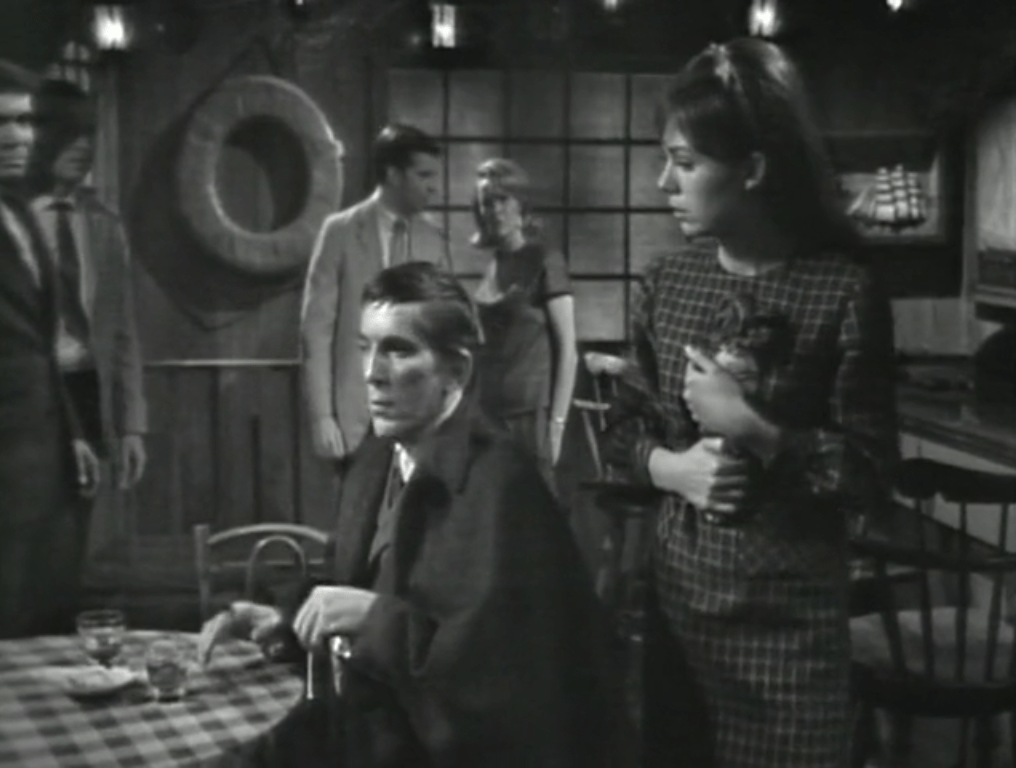
Barnabas comes back to the table, and the conversation returns to the “house by the sea.” Burke is about to propose marriage to Vicki. Suddenly, the jukebox stops playing and everyone falls silent. It is as if something has entered the room that everyone can feel but no one can see. The door opens, and in walks Maggie.

Vicki is the first to see her. She calls her name. Barnabas reacts with alarm. Maggie walks slowly towards their table. She approaches Barnabas, who tries to remain very still. She takes a long look at him, walking around to get the best angle. She touches her head, calls out “No!,” and faints. And that is what you call a “cliffhanger ending.”

Closing Miscellany

In a long comment on Danny Horn’s post about this episode on his Dark Shadows Every Day, I connected Sarah’s doings today with her overall development up to her final appearance. I won’t reproduce it here, it’s full of spoilers.

It was in that post of Danny’s that I learned about the draft including the truck driver. He read about it in a self-published book by Jim Pierson.

This is the final episode of Dark Shadows shot in black and white. Maggie’s collapse sends the first part of the series out on a bang.

Episode 293: A better story next time

Well-meaning governess Vicki was the main character of Dark Shadows in its first 39 weeks, and themost interesting storyline was her relationship to her charge, strange and troubled boy David Collins. That story came to its climax when David chose life with Vicki over death with his mother, blonde fire witch Laura Murdoch Collins, in #191, and Vicki hasn’t had much to do since.

Yesterday, Vicki told her depressing boyfriend, fake Shemp Burke Devlin, about an old vacant house that excites her. Since Vicki’s work with David is compensated mainly with room and board, the only way her interest in an empty house could lead to anything happening on the show would be if she quit her job, married Burke, and moved there with him. Since Burke has even less connection to the ongoing narrative arc than Vicki does, and has been spending his time lately demanding that she stop trying to attach herself to the story and settle in with him in his dead end far away from the plot, that is a dismal prospect.

All the action on the show is centered on vampire Barnabas Collins. In the opening scene, Barnabas talked with his sorely bedraggled blood thrall Willie Loomis about two women. One was Vicki. Willie was agitated that Barnabas is planning to bite Vicki. This is an odd thing to worry about- Vicki has gone out of her way to make herself available to Barnabas for biting, even contriving to spend the night in his house. But she still has all her blood, and no foothold in the vampire story. When Barnabas tells Willie that he does not intend to harm Vicki in any way, those of us who hope she will stay relevant to Dark Shadows have a sinking feeling that he might be telling the truth.

The other woman Barnabas and Willie discuss is mad scientist Julia Hoffman. In contrast to his assurances that he means no harm to Vicki, Barnabas muses openly that he might have to kill Julia at any moment. Observing Willie’s reactions, Barnabas comments that it is interesting that Willie is so concerned about Vicki, but utterly indifferent to Julia. If we remember Willie as he was before Barnabas enslaved him, this may not be so odd.

Before he became sorely bedraggled blood thrall Willie Loomis, he was dangerously unstable ruffian Willie Loomis, menace to womankind. Willie tried to rape Vicki, among others, and his guilt over the use he made of his freedom when he had it is reflected in his solicitousness towards those whom he once used so ill. By the time he met Julia, he had been under Barnabas’ power for months, so he has made no choices concerning her that he can regret.

Barnabas shows up as Vicki and Burke are getting ready to visit “the house by the sea.” Barnabas slips a couple of times as he talks with them about it, revealing to the audience that he is familiar with the house. This raises our hopes- perhaps Vicki’s fascination with the house will lead her to Barnabas and relevance, not to Burke and oblivion. Vicki invites Barnabas to come along with her and Burke as they tour the house, and he agrees.

While Vicki is upstairs changing her clothes, Barnabas and Burke talk in the drawing room. Barnabas points out that little is known of how Burke became so rich so quickly in the years before he came back to Collinsport. Burke responds that far less is known of Barnabas than of him, that his entire life before this year is perfectly obscure to everyone. As Barnabas, Jonathan Frid plays this scene with more variety and subtlety of expression than any previous one, and as Burke, Anthony George gives a tight, forceful performance. It is the first time Dark Shadows viewers have glimpsed the reason George had such a long and busy career as an actor.

George was a cold actor who excelled at characters whose intelligence and determination were obvious, but whose feelings and intentions the audience could only guess at. That would have made him a fine choice for the part of Burke in the early months of the show, but these days he spends most of his time giving big reactions to bewildering news and the rest in passionate love scenes with Vicki. George was just awful at both of those. But in today’s duel with Barnabas, Burke is choosing his every word and gesture with care, putting him right in the center of George’s wheelhouse. Opposite the much warmer Jonathan Frid, the effect is electric.

It leaves me wondering what might have been. Mitch Ryan was compelling as Burke #1, but his hot style of acting pushed Burke’s emotions to the surface and took away some of the mystery that would have been needed to make the “Revenge of Burke Devlin” storyline a success. With George in the part, that story would probably still have fizzled, but it might have taken a bit longer to do so. And of course the part George has been struggling with, until this scene in vain, was written for Ryan. If the two had just traded places and the scripts had stayed the same, Burke #1 and Burke #2 might both have been strong characters.

Of course, they wouldn’t have stayed entirely the same. The writers watch the show and are influenced by what they see the actors doing. But they may not have changed as much as you might expect. Neither Ron Sproat nor Malcolm Marmorstein seemed to have much sense of what actors could do. It’s no wonder that George’s first good scene comes in the second episode credited to Gordon Russell. Perhaps if Russell had been with the show earlier, Burke #2 might have been more of a success.

The scene also brings up one of my favorite fanfic ideas. People are going to wonder about Barnabas’ background, and Burke needs to be written off the show. Why not solve both of those problems by having Barnabas enslave Burke, make Burke set up businesses in Barnabas’ name and use his shadier contacts to get Barnabas false identification papers, then kill Burke off once he has exhausted his resources? You could do that in such a way that the other characters would think Barnabas was a nice guy who was using his wealth to prop Burke up, consolidating his position in their eyes. You could also use it to connect Barnabas to the wider world beyond the estate, suggesting that he poses a menace not only to one family but to a whole community.

At length, Vicki comes back downstairs. Burke greets her first, but she barely acknowledges him. She has eyes only for Barnabas. Barnabas may not be in any hurry to bite Vicki, but she is bursting with readiness to get into the vampire story and back into the main action of the show.

Eyes on the prize. Screenshot by Dark Shadows Before I Die.