In the first months of Dark Shadows, the audience’s point of view was represented by well-meaning governess Vicki, who needed to have explained to her everything we might want to know and who reacted to all the strange goings-on with the mixture of disquiet and curiosity that the makers of the show hope we will feel.
Vicki has long since been replaced as our representative by mad scientist Julia. We no longer want characters to tell us what has been going on, nor are we making up our minds about our moral evaluation of the events in the stories. We find ourselves in the middle of a whole clutch of fast-moving plots, trying to keep up with them all and hoping that nothing will stop the thrills. Julia’s loyalty to her best friend, sometime vampire Barnabas, and her supremely well-developed capacity for lying put her in the same position, and her vestigial conscience is no obstacle to any juicy storyline.
When Vicki was our on-screen counterpart, her charge, strange and troubled boy David, was the show’s most powerful chaos agent. David precipitated a series of crises that seemed likely to expose the secrets of the ancient and esteemed Collins family, to kill one or more of the major characters, or both. In #70, David led Vicki to his favorite playground, the long-vacant Old House on the estate of Collinwood. David would keep sneaking into the Old House even after Barnabas took up residence there in #218.
Today, David again lets himself into the Old House. He is caught there by Julia and a man he has not seen before. Julia is stern with him for entering the house without Barnabas’ permission; he defends his presence there, reminding Julia that she promised him he could play with the tape recorder on Barnabas’ desk. He asks who the man is.
The man introduces himself to David as “Timothy Eliot Stokes.” This is the first time time we have heard his middle name. Soon, the show will phase “Timothy” out, and his friends will address Stokes as “Eliot.” I suppose that’s because he’s a professor, and “Eliot” suggests Harvard.
Stokes introduces himself to David.
In 1966, Thayer David played crazed groundskeeper Matthew. Suspected of murder, Matthew hid out in the Old House and kept Vicki prisoner there until some ghosts scared him to death in #126. David didn’t believe Matthew was a killer and didn’t know he was holding Vicki, so when he stumbled upon him in the Old House he brought him food and cigarettes. Even after he found Vicki bound and gagged behind a hidden panel, he kept Matthew’s secret. When David meets another character played by the same actor on the same set, longtime viewers can see that Stokes is as genteel and urbane as Matthew was rough-hewn and paranoid. For her part, Julia recalls Vicki when she scolds David for sneaking into the Old House, but where Vicki was doing her job as David’s governess and trying to enforce the rules of the household as a governess might, Julia is scrambling to keep David from finding out about her own secret activities.
Julia tells David to take the tape recorder and go home to the great house on the estate. As he makes his way to the front door, Stokes takes Julia aside and tells her that it will not be well if it is known in the great house that David has seen him. Julia hurries to David and tells him to keep quiet about the fact that he has seen Stokes. She says that she hates to ask him to lie; at this, I mimicked Julia and said “I know you share my devotion to the truth,” prompting Mrs Acilius to laugh out loud. Later, Julia will go to the great house, where she lives as a permanent guest, and David will cheerfully assure her that he kept her secret. The two of them seem quite relaxed together, leading us to believe that he will continue to do so.
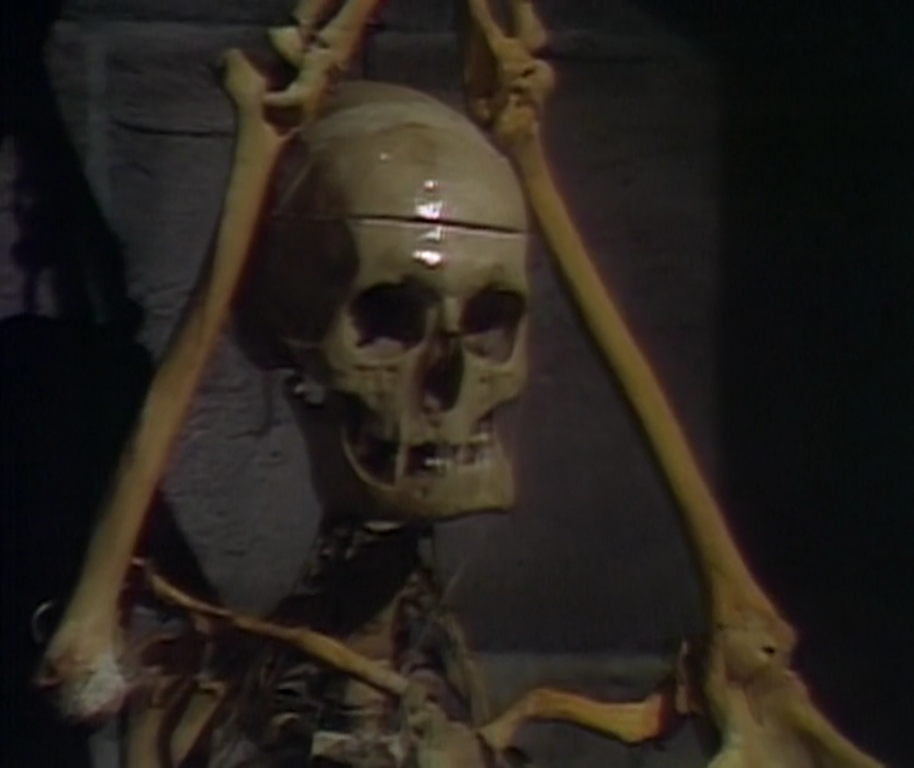
There is a bit of irony in Julia’s harshness with David for entering Barnabas’ house without his permission. She and Stokes didn’t have Barnabas’ permission to be there, either. Indeed, if he had known what they were up to he would likely have objected most strenuously. Along with a man named Tony, they held a séance in the part of the basement where Barnabas kept his coffin when he was under the full effect of the vampire curse. They were trying to contact the Rev’d Mr Trask, a Puritan divine whom Barnabas bricked up to die in the eighteenth century. The séance was so successful that the bricks crumbled, exposing Trask’s bones, still held together somehow in the shape of a skeleton hanging from the ceiling. At the end of the episode, Trask has resumed his corporeal form and set about taking revenge on Barnabas by walling him up in the same spot.
Odd that Trask’s skeleton holds together after all the ligaments and tendons have rotted away, odder that there is a straight cleavage separating the top of the skull from the rest, oddest of all that the section is attached to the rest of the skull by a piece of Scotch tape.
Yesterday, wiggéd witch Angelique/ Cassandra sent her cat’s paw Tony to kill sage Timothy Eliot Stokes. Stokes pulled “the old switcheroo” on him, and Tony drank from the glass into which he had put Angelique/ Cassandra’s poison. Today, we learn that Stokes gave Tony an emetic to save his life. Stokes calls mad scientist Julia Hoffman, MD to examine Tony and assist with the next stage of the battle against Angelique/ Cassandra.
Recovered, Tony has no idea why he obeyed Angelique/ Cassandra’s command to kill Stokes, and is ready to surrender to the police. Stokes tells him he is under the power of a witch, and enlists him in the battle against her.
Stokes takes out the memoirs of his ancestor Ben, who was Angelique’s cat’s paw in the eighteenth century. He does some automatic writing in Ben’s hand and finds that they must contact the spirit of the Rev’d Mr Trask, a witchfinder who inadvertently helped Angelique in those days. Fortunately, Trask, like Tony, was played by Jerry Lacy, so it shouldn’t be too hard to get hold of him. Stokes also finds that Trask was walled up in “the coffin room,” which Julia tells him is for some mysterious reason a nickname given to the space at the foot of the stairs in the basement of the Old House on the estate of Collinwood. Stokes decrees that he, Julia, and Tony must go to this room and hold a séance there.
On his way to the Old House, Tony follows Stokes’ instructions and stops at the main house on the estate and tells Angelique/ Cassandra that Stokes is dead. This follows a scene between Angelique/ Cassandra and her husband, sarcastic dandy Roger, in which Roger complains about her lack of interest in him. Her mind isn’t on the game of chess they are playing, she hasn’t been attentive to him for several nights, and she refuses to go on a honeymoon. Angelique/ Cassandra ensorcelled Roger into marrying her so that she could have a perch at Collinwood, and he seems to be slipping out of the spell’s power.
Stokes, Julia, and Tony gather in the coffin room. They begin the séance. This is the fifth séance we have seen on Dark Shadows, but the first that does not include well-meaning governess Vicki. In four of the previous five, it had been Vicki who went into the trance. On the other occasion, it was strange and troubled boy David who became the vessel through which the dead spoke to the living. The first three times Vicki served as the medium, she channeled the gracious Josette Collins, and when David filled that role he gave voice to David Radcliffe. In those days, Vicki was closely connected to Josette, perhaps a reincarnation of her, as David was another version of the cursed boy David Radcliffe. The final time Vicki spoke for the dead, she spoke for nine year old Sarah Collins, with whom she was no more closely connected than were any of a number of other characters. Sarah has no present-day counterpart, so her appearance at a séance suggested that Dark Shadows was moving away from its use of necromancy as a way of connecting characters from different time periods.
This time, Tony goes into the trance. In #481, Angelique/ Cassandra told Tony that she chose him as her cat’s paw because he resembled Trask, so when he is the medium through whom Trask speaks we are returning to Dark Shadows‘ original conception of how séances work. Trask mistakes Stokes for Ben, as Angelique did in a dream visitation last week. The brick wall behind which Trask’s remains are hidden bulges and is about to crumble when we fade to the credits.
True fans of Dark Shadows know that the episode’s real climax comes during those credits. Thayer David strolls onto the set under Louis Edmonds’ credit for Roger. He even looks into the camera when he realizes what he has done.
In #473, we saw that wicked witch Angelique had traveled from the eighteenth century to the year 1968 to reimpose the vampire curse she had once placed on old world gentleman Barnabas Collins. In a single day, Angelique met Barnabas’ distant cousin Roger, bewitched him, and married him. This secured her a home in the great house on the estate of Collinwood. Barnabas lives in the Old House on the same estate. Calling herself Cassandra and wearing a black wig, she pretends not to understand why Barnabas doesn’t like her.
In #477, Angelique appeared to Barnabas in a dream and told him and the audience how she would go about turning him back into a vampire. Her approach would essentially be a distributed malware attack on the wetware inside the heads of the people of Collinsport. One person after another would have the same basic nightmare. Each nightmare would begin with a visit from a person who had not yet had it, and after the dreamer awoke they would feel an uncontrollable compulsion to describe the dream to that person. Once they had done so, that person would have the nightmare, and the cycle would repeat. When the dream got back to Barnabas, he would become a vampire again.
Yesterday, heiress Carolyn Collins Stoddard had the dream. Carolyn met with occult expert Timothy Eliot Stokes and mad scientist Julia Hoffman at the Old House. Stokes managed to insert himself into Carolyn’s dream as the person to whom she must tell it. Today, Stokes has the dream. He sets out to function as an antivirus program. He has learned what the dreamer usually does, and consciously makes himself defy all those rules. His hack-back works sufficiently to force Angelique/ Cassandra to appear in the dream herself and get into an argument with him.
Angelique/ Cassandra addresses Stokes by the name of his eighteenth century ancestor Ben, an indentured servant whom she ensorcelled and used for her own nefarious purposes. She refuses to believe that Stokes is not Ben, and does not react strongly when he tells her that he knows her name is Angelique. When he later addresses her as Cassandra Collins, she is horrified and vanishes. It’s a staple of stories about magic that the act of calling adversaries by their true names can defeat them; Mrs Acilius brought up the story of Rumpelstiltskin. That the name “Angelique” has no effect while “Cassandra” drives her away suggests that she was using a pseudonym when we first knew her, and she really is Cassandra.
The power of naming also explains what Barnabas may have been thinking when he kept confronting Angelique/ Cassandra and telling her exactly what he did and did not know about her. Perhaps he hoped that simply by addressing her as “Angelique” he would make her vanish.
When Stokes awakens, he tells Julia he is confident that he has stopped the curse. That confidence is put to the test immediately when a knock comes at the door. Stokes opens it, and sees the man from his dream. He does not know the man, but we do. He is Sam Evans, an artist recently blinded by one of Angelique/ Cassandra’s spells. He is accompanied by Joe Haskell, fiancé to Sam’s daughter Maggie. They mention that Maggie is spending the evening in the nearby city of Bangor, Maine. Sam says that he heard the name “Stokes” in his head earlier in the evening, and that he also felt an urge to come to the Old House. He has a strong feeling that Stokes has something to tell him, and insists that he do so.
Stokes is disquieted to see Sam, but feels no compulsion to tell the dream. Sam is furiously dissatisfied. It is unclear whether his frustration at not hearing the dream will be as intense or as persistent as is the upset previous dreamers felt when they resisted telling it.
Sam and Joe leave. In front of Sam’s house, Joe reaches to open the front door. Sam is irritated with him. He not only insists on opening the door himself, but won’t do so until Joe leaves. Joe explains that Maggie made him promise to keep an eye on him, to which Sam replies with a threat to forbid their marriage unless he backs off. Joe mentions that a strange, very tall man who recently abducted Carolyn might still be at large; Sam replies that the man jumped off Widows’ Hill, which means certain death to “anything human.”
Inside the house, Sam finds that a window Joe had closed before they left is open. He hears someone in Maggie’s room. It turns out to be the strange, very tall man, badly cut from his recent fall and wielding a kitchen knife.
They don’t explain what Maggie is doing in Bangor. From episode #1 until she was attacked by Barnabas in #227, Maggie was the principal waitress at the restaurant in the Collinsport Inn. After some time as Barnabas’ prisoner and a longer period as a patient in Julia’s hospital, she returned to town in #295. For all they’ve told us since then, Maggie may have got her job back or taken another one. But if she had, they would have told us today that she was working the night shift, not that she was on some unexplained trip out of town. So now we know that nobody in the Evans house is gainfully employed.
Mad scientist Julia Hoffman has summoned sage Timothy Eliot Stokes to the Old House on the great estate of Collinwood, home of her friend, recovering vampire Barnabas Collins. Julia and Stokes talk about the ongoing Dream Curse, a distributed attack on the mental software of a series of people who are more or less connected with Barnabas. The curse takes the form of a nightmare that afflicts one person after another. When Julia declares that Stokes must stop the dreams, he says that she makes it sound like he is responsible for them. She replies that in a way, he is- he was the one who introduced Cassandra Blair to Roger Collins. Roger married Cassandra, giving her a home in the great house on the same estate. Stokes does not dispute the assumption that Cassandra set the curse, but he does deny that he had any influence over Roger’s decision to marry Cassandra.
In #488, Barnabas told Stokes that Cassandra is the witch, and his reaction to Julia’s remark shows both that Julia knows that Stokes is aware of this fact and that he has accepted it. Yet when Julia refers to the witch as “she” later in the episode, Stokes responds as if this were jumping to a conclusion.
Stokes puzzles us again when he says that in the eighteenth century, Josette DuPrés was “a love of Barnabas Collins.” We’ve known that for some time, since Barnabas keeps dwelling on his experiences in the 1790s. But Barnabas doesn’t let on about his past when Stokes is around, nor did his relationship with Josette make it into any written records or any of the legends that circulate in the town of Collinsport. How does Stokes know about it?
The obvious explanation would be that Stokes has been talking with well-meaning governess Vicki. Vicki came unstuck in time in #365 and was marooned in the 1790s until #461. She saw in those days that Barnabas and Josette had been lovers, a fact which Barnabas had inadvertently revealed to her in #233. Neither Vicki nor Stokes has been on the show much lately, leaving them plenty of time for off-camera consultations.
Vicki could also be a source of another piece of information Stokes surprises us with. So far as Stokes knows, the Barnabas of the 1960s is a descendant of another man with the same name. Vicki believes this too, even though she has seen a great deal of evidence that he was a vampire, as for example when he used to bite her on the neck and suck her blood. She did notice that the Barnabas of the 1790s looked, sounded, and moved exactly like his namesake of the 1960s. Today Stokes says that the two Barnabases are “interchangeable” in appearance and behavior, just what Vicki would have told him.
Vicki might possibly have contributed to another bewildering proclamation of Stokes’. He tells Julia that when Barnabas is under great stress, the dream comes to a person who is very close to him, while it settles on people who have no particular connection to him when he is relaxed.
This theory doesn’t work at all. The dreamers whom Stokes classifies as “comparative strangers” to Barnabas are Maggie Evans, The Nicest Girl in Town; Mrs Johnson, housekeeper in the great house; strange and troubled boy David; and an annoying man named Peter who keeps insisting people call him “Jeff.” Of these, only Peter/ Jeff is less than essential to Barnabas. Maggie was the first victim Barnabas sought out. It was his abuse of Maggie that defined Barnabas as a monster the audience should fear, as a lonely guy the audience can feel sorry for, as a bridge between past and present who is pulling the show deeper into the supernatural and towards time travel, and as a figure who will drive stories that bring the residents of Collinwood together with the townsfolk of Collinsport. Mrs Johnson was the first person we saw speak to Barnabas and was the one who invited him into the great house, at a time when the show was putting heavy emphasis on the idea that vampires can enter only where they are invited. David was the first we heard speak Barnabas’ name, and Barnabas was obsessed with killing him for eleven weeks, an obsession that led directly to Vicki’s trip back in time.
Vicki doesn’t know anything about the vital roles these three characters have played in shaping Barnabas’ relationship to the audience and to the structure of the show’s universe, so if Stokes were dependent on her for his information he may have believed they were “comparative strangers” to him. The most puzzling thing is Julia’s reaction. Julia has taken over the function Vicki had at the beginning of the series as the audience’s point of view. She knows what we know and learns what we need to learn. Julia is also supposed to be super-smart, so that when she reacts to Stokes’ theory with excited agreement the show is telling us that he is right.
Barnabas’ servant Willie had the dream the other night, and is supposed to pass it on to heiress Carolyn. He was foiled in his effort to do so yesterday, when Carolyn bit him before he could tell her how it went. Willie got off easy- the last time he was aggressive with Carolyn was in #204, when she pulled a loaded gun on him. He did manage to get enough through to her that she has the first minute of the dream, and she is filled with dread of it from the time she wakes up.
Today, Carolyn is in the Old House with Julia and Stokes. She doesn’t want to have the dream, Stokes believes that if she does he can take control of it and break the curse, and Julia mediates between them. Carolyn goes along with the plan, and it looks like it might succeed. That’s the whole story, which doesn’t add up to much, but Nancy Barrett, Grayson Hall, and Thayer David are all superb actors, and they maintain a fierce intensity that makes it work.
The late Dr Eric Lang built a Frankenstein’s monster with the intention of draining the “life force” from recovering vampire Barnabas Collins into it. Wicked witch Angelique turned Barnabas into a vampire in the first place, and has returned to the scene to thwart this experiment and make Barnabas once more an undead abomination preying upon the living. Angelique struck Lang dead with one spell, and with another has started a “Dream Curse” that has for the moment compromised the ability of the senior mad scientist in town, Barnabas’ best friend Julia Hoffman, to pick up where Lang left off.
In Lang’s laboratory, Julia and Barnabas recap the plot. Under the stress of the Dream Curse, Julia is having trouble controlling her emotions. At one point she refers to her crush on Barnabas. Every time she has mentioned this before, Barnabas has been a huge jerk about it, ridiculing her and reminding him of the crimes they have committed together, including murder. This time, he is warm and kindly. His non-obnoxious response marks a significant change in their relationship.
Lang left an audio message for Julia on his tape recorder. He said that if she does the experiment and Barnabas and the Frankenstein’s monster, whose name is Adam, both live, neither Barnabas nor Adam will be a vampire. But if Adam dies, Barnabas will revert. His recovery is already hanging by a thread, as he feels ever stronger cravings for blood.
Julia and Barnabas play the tape today, but leave the room before it gets to the part with the message. Lang’s voice plays to an empty set. Addison Powell didn’t do a very good job playing Lang on screen, and he’s no better as a voice actor. Powell appeared in a number of feature films, including hits like The Thomas Crown Affair and Three Days of the Condor, but is best remembered for a series of commercials he did in the 1980s as “The Gorton’s Fisherman.” I remember those spots- I thought he was an actual fisherman they’d hired to read copy. Usually I’m uneasy with the idea of taking a job away from an actor, since I know lots of very talented people who have spent years training in that craft, never to make a living at it. But Powell was so bad I wish my original impression had been correct.
Julia has reached out to Professor Timothy Eliot Stokes, a scholar of the occult, for help with the Dream Curse. When she met with him yesterday, she did not identify Angelique as the witch. She couldn’t tell him anything about the experiment or about Barnabas’ vampirism without confessing to her many crimes. Today, Stokes is trying to fill in the blanks Julia left so that he can help to oppose the Dream Curse. He calls on Barnabas at Lang’s house. He breaks down Barnabas’ resistance and learns that the witch is Angelique, whom he knows under her alias of Cassandra Blair Collins.
Stokes next calls on Maggie Evans, The Nicest Girl in Town, at her house. Maggie was the first person to have the dream, and she gives Stokes a detailed description of it. This gives Kathryn Leigh Scott an opportunity to look into the camera and emote, which is always worth seeing.
There are a lot of shots today using mirrors. In their post on Dark Shadows Before I Die, John and Christine Scoleri include several screenshots of these and of ambitious camera angles from other episodes.
For its first 38 weeks, Dark Shadows was the story of well-meaning governess Vicki and her attempt to make her way through life on the great estate of Collinwood. One by one, Vicki’s problems were either solved or forgotten. From week 43 on, the show has focused on vampire Barnabas Collins. Barnabas has refused to involve Vicki in his life, leaving her confined to B plots at best.
The current B plot is about Vicki’s relationship with a man named Peter, who keeps trying her patience and ours by pretending to be named Jeff. Peter/ Jeff’s shouting voice, which he uses by default, makes him sound like he is suffering from severe gastrointestinal distress. He has a habit of manhandling people around him, causing them obvious discomfort. These bad habits, and several others, are less the product of the writing or direction than they are symptoms of the casting of Roger Davis as Peter/ Jeff. Alexandra Moltke Isles, like all the other actresses, is so ill at ease when she is in proximity to Mr Davis that it is impossible to believe that Vicki is in love with Peter/ Jeff.
Peter/ Jeff had been connected to the A plot through his boss, mad scientist Eric Lang. Peter/ Jeff has total amnesia. Lang released him from a mental hospital and told him that he was suspected of strangling two women by the waterfront in Portsmouth, New Hampshire. He used Peter/ Jeff as his assistant in an experiment that is supposed to free Barnabas from vampirism. Now Lang is dead, and Peter/ Jeff goes to his house to search for the file on his own background.
There, he meets Barnabas. The two of them display hostility to each other, but the scene fizzles out as it becomes clear that Barnabas has no motivation to oppose Peter/ Jeff’s goals and wouldn’t be in a position to stop him if he did. Peter/ Jeff finds a paper which proves that Lang was lying, and he is not a murderer after all. With that, he and Vicki both lose whatever reason they had to be on the show.
His file from the mental institution had those three magic words: “No homicidal tendencies.” As something to be proud of, that’s a pretty low bar, but he seems happy.
Unfortunately, that basically nerfs Jeff’s entire storyline. He’s not working for Dr. Lang anymore, and the secret that Lang was holding over him — the idea that he might be a murderer — has just dissolved.
This is just throwing a story point away, rather than advancing anything, and Jeff is left at a loose end. He has no job, no family, and no real connection to a story. Now he doesn’t even have homicidal tendencies. It wasn’t much, but it was all he had.
Danny Horn, “Episode 487: Precious Moments,” Dark Shadows Every Day, 24 September 2014
Peter/ Jeff goes to share this news with Vicki. It’s a tribute to Mrs Isles’ acting ability that she makes us believe Vicki is bewildered that Peter/ Jeff thought he had homicidal tendencies. Mr Davis usually seems angry enough to kill someone, as for example at various points in today’s episode when Peter/ Jeff’s joy leads him to wrap his hands around Vicki’s throat, plant a rather painful-looking kiss on her, pick her up, and point her underwear at the camera.
The highlight of this episode is a scene between Julia Hoffman and Timothy Eliot Stokes. Julia is Barnabas’ best friend. She has decided to take over the experiment after the death of her fellow mad scientist Lang. Wicked witch Angelique is trying to prevent her helping Barnabas, and so Julia turns to Stokes, a sage in the ways of the occult.
Stokes is the second such character on Dark Shadows, after the ill-fated Dr Peter Guthrie. Vicki recruited Guthrie into her battle against undead fire witch Laura Murdoch Collins in #160 and Laura killed him in #185. We haven’t heard about Guthrie since the end of the Laura story, but the show went out of its way to remind him of us when it showed Lang’s death yesterday. Like Guthrie, Lang died as the result of an indiscreet word from housekeeper Mrs Johnson to an undead witch in the drawing room at Collinwood. Also like Guthrie, Lang is a paranormal researcher who is deeply involved with a tape recorder.
While these similarities served to remind us of Guthrie, they also reminded us of the radical differences between him and Lang. Guthrie was as sane and law-abiding as Lang is crazed and lawless. Seeing Stokes today, we recognize him as Guthrie’s successor, and wonder if his fate will be any different.
Julia is deeply troubled because of a dream she had last night. She was so very upset by it that she was up all night chain smoking.* It was no ordinary nightmare, but part of “The Dream Curse,” a piece of mental malware Angelique has sent to infect one character’s mind after another. Julia recaps the Dream Curse to Stokes while looking into a convex mirror. It’s a striking visual.
It doesn’t look good for Stokes. Angelique is a supercharged force of destruction, and Julia withholds several crucial pieces of information while recruiting him to the fight against her. Julia does not identify Angelique as the witch. She can’t tell him about Barnabas’ vampirism or about Lang’s experiment without incriminating herself in many felonies, including murder. When Vicki was recruiting Guthrie to the fight against Laura, a far less formidable adversary than Angelique, she held nothing back and ensured that her friends gave him their full support. If Stokes is going to survive, he will need more backing than Julia can offer him.
*Fans of Dark Shadows wince when they see Julia smoking; Grayson Hall had asthma.
Recovering vampire Barnabas Collins receives a visitor in his home, Professor Timothy Eliot Stokes. Stokes agrees to lend Barnabas a twelfth century Sicilian talisman to ward off the power of a witch, and makes it clear he will not rest until he finds out why Barnabas needs it.
This scene is a tour de force for Thayer David as Stokes. I’ve already quoted Danny Horn’s remark in his post about it that David “plays to the balcony. Not this balcony, naturally; I mean the balcony in the theater next door.” David’s style works brilliantly in this context.
The rest of the episode is marred by some bad writing. When wicked witch Angelique, pretending her name is Cassandra, comes to call on Barnabas, he immediately calls her by her right name and tells her everything she could want to know in her campaign to restore his vampirism. This is a pattern of Barnabas’; he withholds information from people who would use it to help him, and blabs without inhibition to his deadliest enemies.
Barnabas takes the talisman to Dr Eric Lang, the mad scientist who has freed him of the symptoms of Angelique’s curse. Lang knows that Barnabas has been a vampire and knows that a curse made him one, but scoffs at the idea of witchcraft and refuses to touch the talisman. Jonathan Frid is a good enough actor that we can wonder if Barnabas has a reason for disclosing all his secrets to Angelique, but Addison Powell plays Lang so ineptly that there is nowhere to hide the fact that his skepticism makes no sense.
Angelique shows up in Lang’s office and casts a spell on him that is about to cause his heart to burst. He staggers to the desk, touches the talisman, and quickly recovers. He will not let her take it from him.
Barnabas comes back and asks Lang if he now believes that he must carry the talisman to protect himself from Angelique. He says he does not want to believe, and again walks off leaving the talisman on his desk.
Barnabas presses Lang for information on the final stage of the treatment that is supposed to end the curse once and for all. Lang takes him to the secret laboratory in his home. There, amid a lot of flashy equipment, is a partially assembled Frankenstein’s monster. Lang says that he will drain the “life-force” from Barnabas’ body and use it to animate the creature once it is completed. Barnabas’ old body will be dead, and Angelique will presumably believe that he no longer exists. But he will live in the new body.
High-born ne’er-do-well Roger Collins was Dark Shadows‘ first villain. Through the first 40 weeks of the show, dashing action hero Burke Devlin was determined to prove that Roger, not he, had been driving when his car hit and killed a pedestrian ten years before, and Roger would stop at nothing to keep Burke from succeeding. The Revenge of Burke Devlin storyline was never particularly exciting. By the time Burke formally gave up on his quest for vindication in #201, it had been running on fumes for some time. Roger hasn’t been central to a plot since then. The show has capitalized on actor Louis Edmonds’ unrivaled gift for sarcasm by having him deliver the occasional zinger, and otherwise has used him as a symbol of the inability of the Collins family to use its wealth and connections to solve any of its problems.
For nineteen weeks ending this past Monday, Dark Shadows was a costume drama set in the late eighteenth century and Edmonds played haughty overlord Joshua Collins. That performance was a triumph, and the entire segment turned out to be The Tragedy of Joshua Collins. So returning viewers will have an appetite to see more of what Edmonds can do, and will be excited when we come back from the opening title sequence to a scene focusing on Roger.
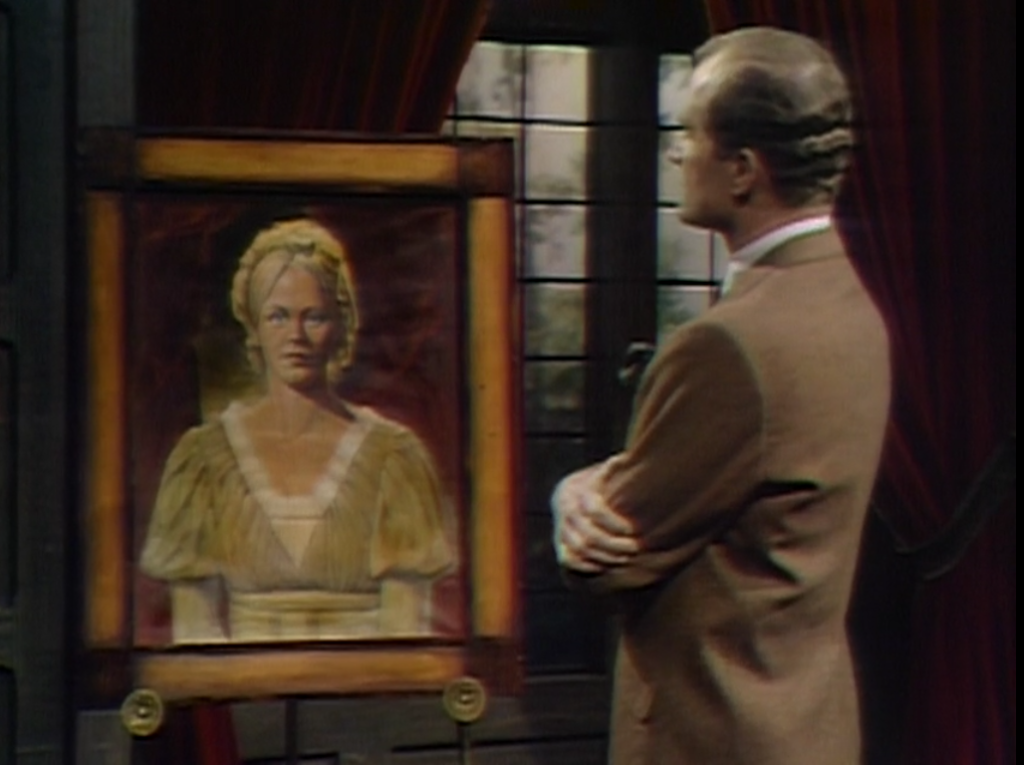
Roger spends this scene staring at a portrait and reciting poetry to it while various people enter the room and try to get his attention. That may not sound like a promise of thrills, but it is on this show. For example, Roger’s son, strange and troubled boy David, had a lively if somewhat one-sided conversation with the portrait of Josette Collins that hangs in the Old House on the estate in #102, and that conversation presaged danger for David and an important role for Josette’s ghost. The show’s first supernatural menace was Roger’s estranged wife, undead fire witch Laura Murdoch Collins, and several characters had important relationships with portraits of Laura during the four months she was in the cast. And dangerously unstable ruffian Willie Loomis once spent a week staring at the portrait of the late Barnabas Collins that hangs in the foyer of Collinwood. As a result, Willie wound up opening Barnabas’ coffin, finding that he was a vampire, and turning Dark Shadows into an entirely different kind of show.
Roger talks to the portrait of Angelique.
The portrait that has captured Roger’s attention is of Angelique, the wicked witch who turned Barnabas into a vampire in the first place. Well-meaning governess Vicki found this portrait in an antique store and brought it home yesterday. It was Vicki who took us to the 1790s when she became unstuck in time. While there, she met Angelique and the living Barnabas. Shortly after her return to the 1960s, Vicki found that her memory of her time in the past had become spotty. She can’t explain why she wanted the painting, but it does make sense to her that Barnabas reacts to it with violent dislike.
We first saw the portrait in #449, when it was clear that Vicki would be returning to the 1960s soon but unclear whether Angelique would follow her. Showing us that they had commissioned a portrait of Lara Parker was their way of telling us she would be back. Having Roger become obsessed with the portrait is their way of telling us that he will be the instrument of her arrival, as Willie was the instrument of Barnabas’.
We learn that Roger’s obsession will blur the distinction between him and Joshua when long-term houseguest Julia Hoffman approaches him and he speaks to her in Joshua’s voice, addressing her as the Countess DuPrés, who was a houseguest at Collinwood in Joshua’s time. Julia and the countess are both played by Grayson Hall. Vicki mistook the countess for Julia when she first met her in 1795, and since her return to 1968 has kept mistaking Julia for the countess. Now that Roger has made the same mistake, Julia must be trying to figure out what’s going on.
A man comes to the front door. Vicki answers it and sees a familiar face. It belongs to Professor Timothy Eliot Stokes. She hasn’t met him before, but she met his ancestor, much put-upon servant Ben Stokes, in the 1790s.
Like Ben and crazed handyman Matthew Morgan from 1966, Professor Stokes is played by Thayer David. Matthew and Ben were both major characters, so we can assume that Stokes will be as well. Matthew was a bad guy, Ben a good guy. When Ben was on the show, the contrast between him and Matthew was drawn very heavily to make the point that Matthew’s crimes are what Ben’s virtues would have led him to do had his personality been warped by the environment in which Matthew grew up. That environment was the consequence of the curse that Angelique placed on the Collinses in the 1790s. Burke expressed this idea in #64 when he said of Matthew that “Collinwood breeds murderers,” but he was understating the effect. Matthew grew up, not on the estate, but in the nearby village of Collinsport, and the curse leaves its mark on everyone who comes from there. Since Stokes is an out-of-towner, he is likely to be unaffected by the consequences of the curse, and so we do not know what we will find under his worldly and self-possessed exterior.
Stokes is researching his ancestor Ben, and wanted to buy the portrait because he thought it might depict a woman Ben knew. Stokes says that Ben wrote a memoir. Barnabas is in the room; in the 1790s, Ben was his closest friend, and knew all about his vampirism. So he is alarmed by the idea of a volume of memoirs by Ben. He can take some comfort when Stokes tells him that most of the manuscript was lost in a fire a few years ago.
The idea of a servant writing memoirs that might expose Barnabas’ secret first came up in #326. At that point, Willie was out of his control, and Barnabas told Julia, who is a mad scientist and his confederate, that he was afraid Willie might start “writing his memoirs!” That phrasing was meant to raise a laugh, since Willie is conspicuously not burdened with literary ambitions. But it planted a seed that flowers for the first time here, and that will flower again later.
Stokes offers Vicki $200 for the painting. Barnabas is eager to get the thing out of the house and urges her to take Stokes’ money, but before she can Roger bids $500. Stokes can’t afford that, and so it stays at Collinwood.
Stokes’ interest in family history establishes a contrast between him and Roger. Stokes, like Roger, appears to be a confirmed bachelor. But while Roger’s lack of interest in the responsibilities of marriage is of a piece with his indifference to all family ties, so that he was eager to divorce Laura and palm David off on her even after it had become clear to other characters that she was a danger to the boy, Stokes is an avid genealogist. He has renounced the prospect of marriage because he has other ways to be of service, not simply because he wants to wallow in his own crapulence as Roger does.
Suddenly Vicki remembers that the woman in the portrait is named Angelique, that Angelique was a witch, and that her spells caused all the misfortune that began at Collinwood in 1795. We hear all of this while Barnabas is in closeup, squirming gloriously. Stokes leaves with Barnabas and tells him he knew that the woman’s name was Angelique, but that it’s news to him that she was a witch. He is impressed by Vicki’s knowledge, and says that he can sense that she is attuned to paranormal phenomena. He wants to get to know her better.
Most characters we have met spend a long time slowing the story down by scoffing at the idea of the supernatural. That Stokes is a self-identified student of the occult and immediately receptive to Vicki’s identification of Angelique as a wicked witch tells us that he will serve to speed up the pace of events.
This again makes a stark contrast with Roger. When Vicki managed to get Roger away from the painting for a moment in Act One, he told her that he refused to believe that she traveled to the past and returned to the present. When she lists some of the abundant evidence he and everyone else saw that can be explained no other way, he says he attributes all of that to mass hallucination.
In his Dark Shadows Every Day post about this episode, Danny Horn at one point refers to Stokes as a character whose function is “to backfill Dr. Woodard’s spot in the cast,” referring to a stolid medico whom Barnabas and Julia murdered several months back. But in this contrast, we see that the character whose place Stokes is actually taking is Roger. When the show started, the Collinses of Collinwood were the central frame of reference for the action. But Roger and his sister, matriarch Liz, are for various reasons locked out of the supernatural storylines. Since those are the only storylines they have, the show needs to build another family to anchor the action, and that family is going to be defined, not by marriage and genealogy, but by a shared commitment to getting as deep as possible into the weirdest shit going.
Stokes tells Barnabas that there was a series of unsolved murders in Collinsport in the 1790s, and wonders if it might be possible to prove that Angelique was responsible for them. Barnabas suggests that it is too late to do justice in such an old case, to which Stokes replies that it is never too late to do justice to history. Not only does this reply deepen the contrast between Stokes and the amoral Roger, it has, by happenstance, a deep resonance for many who might see the episode today. It originally aired on 4 April 1968, just a few hours before the Rev’d Dr Martin Luther King, Jr, was assassinated. Millions are still unsatisfied with the official answers about who killed Dr King and why; they might cheer the idea that there is a species of justice that is still possible even after 56 years or more have gone by.
Barnabas bit Vicki the other day in an attempt to control her and keep her from revealing any information about him she may have acquired during her sojourn in the past. Disquieted by his conversation with Stokes, Barnabas stares out his window and summons Vicki to his house. In her bedroom, an enchanted music box Barnabas gave her as part of an earlier brainwashing attempt opens itself and begins to play. She rises from bed and goes to him listening to the music box all the way.
At Barnabas’ house, Vicki gives him the music box. He tells her that the next time he calls her, they will go away together forever. He bites her neck.
We cut to Vicki’s bedroom. The music box is back in its place and she is back in bed, asleep. Julia comes in to check on her. Vicki says she’d had a bad dream, and Julia finds the bite marks on her neck.
In the weeks leading up to Vicki’s visit to the past, Julia had alienated Barnabas by opposing his efforts to seduce Vicki. Now she marches over to Barnabas’ house and renews her opposition. She accuses him of having been in Vicki’s bedroom. He answers that he brought her to his house. This might seem to be a trivial distinction, but perhaps not to viewers who have been with the show from the beginning. Today’s focus on Roger might remind us of #4, when Roger tried to let himself into Vicki’s room while she was sleeping, obviously in search of some kind of sexual thrill that would not be preceded by her consent. Barnabas can’t deny that he is the moral equivalent of a rapist, but he isn’t going to miss an opportunity to differentiate himself from Roger.
Barnabas doesn’t seem very interested in anything Julia is saying. Even when she gives him an ultimatum, threatening to expose him if he doesn’t back off by tomorrow night, he reacts with a mild irritation. Regular viewers, remembering the displays of jeering contempt and seething rage which are typically the options from which Barnabas chooses his response to this sort of thing, will be startled by his relative blandness. Julia should be unnerved by it.







 Dark Shadows Commentary