Episode 306: Private little investigations

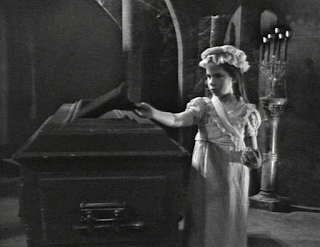
Sarah Collins has taken her friend and distant cousin, strange and troubled boy David Collins, home with her. Since Sarah is a ghost, her home is in a mausoleum. She has decided to show David one of the most interesting features of the place.

As we open, David is following Sarah’s instructions. He is standing on the sarcophagus of her mother and pulling a metal ring in the mouth of a stone lion’s head. The ring comes forward and a panel opens, revealing a room that was hidden for more than a century and a half.

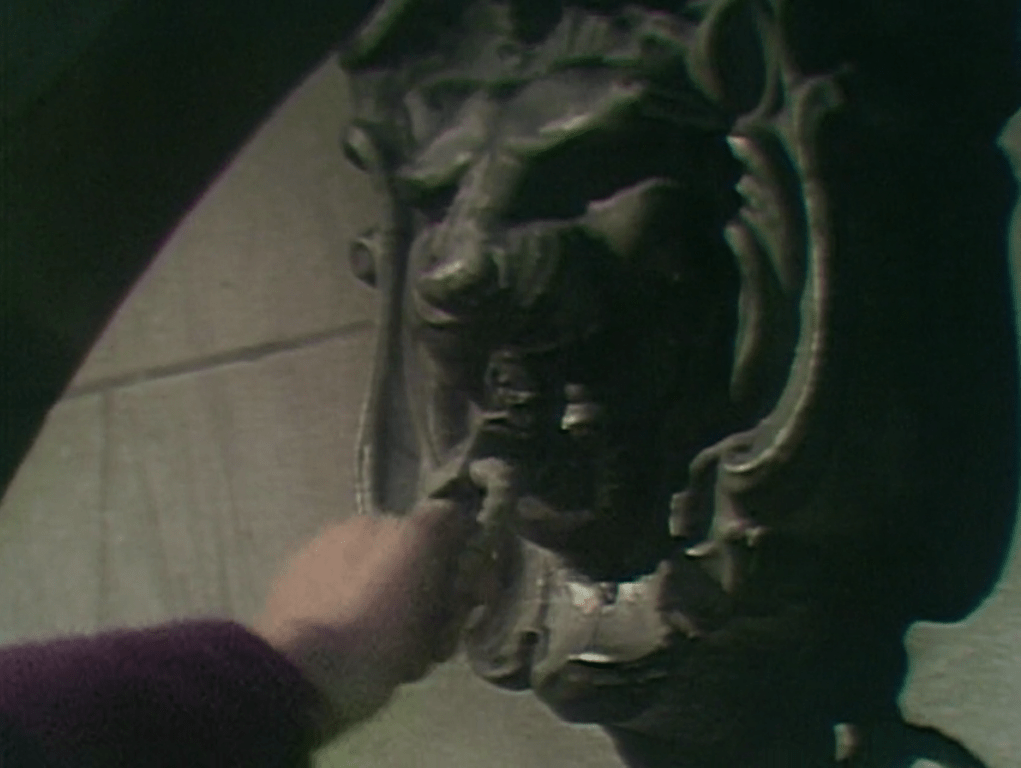
The lion’s head.
Pulling the ring
The panel opens

The first time we saw the panel open was in #210, when dangerously unstable ruffian Willie Loomis happened upon the ring and ended up releasing vampire Barnabas Collins from his coffin in the hidden room. Now that we see this gimmick again and see it in color, it’s starting to seem odd that all you have to do to open the panel is pull the ring. The ring stands out as the only piece of metal in the tomb. Anyone entering the space would be tempted to tug on it, if only to polish it. If you’re wanting to make sure your vampire doesn’t get loose, I’d think you’d install a more secure system. Maybe you could add two or three additional decorative doodads to the wall, one of which you turn, say, three quarters of the way to the left, the other of which you turn some other way, and between them they release the ring.

Be that as it may, Barnabas’ old coffin is still in the hidden room. Sarah announces they will be opening it, and David resists the idea. He debates with Sarah for a while before curiosity gets the better of him.

Sarah the psychopomp.
David wants to let the dead rest.
David’s resistance crumbles.

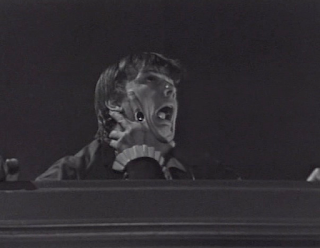
He is shocked to see that it is empty. David asks Sarah why an empty coffin would be put in such a place, and she happily tells him that it wasn’t always empty. There was someone in it once, but he got up and left. David protests that the dead don’t walk away, to which Sarah replies that “Sometimes they do.”

David is shocked.
Nobody’s home.

When David first met Sarah in #256, she was outside Barnabas’ house, puzzled that she couldn’t find her parents or anyone else she knew. Now it is starting to seem that she knows that she is a ghost haunting a time long after her own, but Sarah’s lines here are the first clear indication that she knows what is going on with her brother Barnabas.

David’s bafflement that the coffin is empty echoes #273. In that episode, matriarch Liz was shocked to find that the chest seagoing con man Jason McGuire buried in her basement did not contain the murdered remains of her husband. Liz kept asking “Why is there nothing there?” David seems almost as appalled as his aunt had been at the sight of some clean fabric unadorned with a rotting corpse. A few days after Liz found out Jason hadn’t really buried her husband in her basement, Barnabas killed Jason. Regular viewers will already have this story in mind, because in #276 Barnabas and his sorely bedraggled blood thrall Willie buried Jason in the floor of the very room David and Sarah are visiting at this moment. Clearly Barnabas would not be happy were he to find out that David knows about the room.

That wasn’t the first vacant grave in Dark Shadows. From #126 to #191, the show was mainly about David’s mother, undead fire witch Laura Murdoch Collins. As the Laura arc progressed, graves of various women named Laura Murdoch were revealed to be empty. Now Laura’s son is coming face to face with an unoccupied coffin, suggesting to loyal fans that he may yet learn something about his own origins.

To Sarah’s consternation, David says he has to go home. He tells her that if he does not, his governess, the well-meaning Vicki, will be upset with him. He simply refers to Vicki by name, as if Sarah already knows who she is. Regular viewers have reason to believe she does know who Vicki is, but it is not clear why David assumes that he can just say “Vicki” without explaining to Sarah who he means. Sarah swears David to secrecy about the existence of the room.

By the time David gets back to the great house of Collinwood, it is 9:30 PM and Vicki is indeed worried about him. Apparently no one else is at home; certainly, no one else has missed David. Vicki sits David down on a seat that’s been in the foyer from the beginning of the series, but which has only been used once or twice before. They have an earnest little talk that recalls the scenes they shared in the first 39 weeks of Dark Shadows, when their complicated relationship was the one storyline that consistently worked.

Rarely used seat.

David describes Sarah to Vicki. It finally dawns on her that Sarah is the little girl she saw on top of the stairs at Barnabas’ house in #280. When the light flashed in Vicki’s eyes, my wife, Mrs Acilius, shouted at the screen “Tell him!” Vicki and David again look like the fast friends they had become by #140, so we would indeed expect her to tell David that she thinks she has seen Sarah, and to tell him where and when she saw him. If she and David join their lines of inquiry and work together to find out about Sarah, the plot will move more quickly and on a much bigger scale than it can so long as everyone pursues their own questions in isolation.

Vicki catches on.

But, Vicki is also very fond of Barnabas, and reluctant to believe anything bad about him. Sarah has been seen in several places connected to the abduction of Maggie Evans, The Nicest Girl in Town. Vicki doesn’t want anyone to add Barnabas’ house to that list, so perhaps it is not a “Dumb Vicki” moment when she decides to keep the information to herself.

Meanwhile, Barnabas is at home. He is irritated with mad scientist Julia Hoffman. Julia is attempting to cure Barnabas of vampirism, and he is dissatisfied with the progress of the treatment. He is also irked that Sarah broke Maggie out of the mental hospital where Julia was keeping her locked up, and blames Julia for failing to ghost-proof the place. He declares that Julia is “a meddlesome and domineering woman,” and that he, as a native of a different century, has no intention of tolerating such a person.

Barnabas and Julia discuss Vicki’s depressing boyfriend Burke. Burke has been investigating Barnabas, and his operatives have come upon some information that would raise questions Barnabas would have a hard time answering. Julia agrees that Burke must be stopped, and urges Barnabas to let her handle the matter. He says that he will take care of it, and that he will do so with “finesse” of a sort unfamiliar to the loutish inhabitants of the twentieth century.

Barnabas’ masterful finesse consists of telling Vicki what Burke is doing and asking her to make him stop. Those eighteenth century guys must have been amazing, to come up with something so complex and subtle in just a couple of days.

Julia comes into the great house as Barnabas is leaving. She asks Vicki if David is back yet. Vicki tells her that he had been out playing with Sarah in some location he refuses to disclose. Barnabas tries to conceal his alarm with a laughing remark about leaving Vicki and Julia to investigate the mystery of David’s playmate.

David comes out of his room to ask for food. While Vicki goes to fetch the housekeeper for him, Julia meets him at the top of the stairs and they talk about Sarah. David points out that she is repeating questions she has asked in previous episodes. He tells her that he doesn’t mind questions and neither does Sarah, but cautions her that the answers Sarah gives don’t make much sense.

The stained glass windows at the top of the stairs look great in color, and it is a relief when David shares the audience’s awareness that we’ve heard Julia’s lines before. Even so, the scene is a disappointment. David and Julia were fun to watch in their previous scenes because they were so relaxed together. Perhaps that was because David Henesy and Grayson Hall understood each other right away. Not only did they have similar ways of working as actors, but her son Matthew is about his age, so she might already have been familiar with a lot of things in his life that the other adults on set wouldn’t have known about.

Today, though, they are both having trouble with their lines. That keeps them from making enough eye contact with each other to sell the scene. David Henesy keeps looking at the teleprompter, which he could evidently read from the top of the stairs with only a little squint; Grayson Hall couldn’t read from that distance, but she does tilt her head back and look up when she’s searching her memory for her next line. Since the characters aren’t looking at each other, we don’t feel an emotional connection between them.

Hall has to thread a particularly small needle in this scene. Julia is trying to make her interest in Sarah seem casual in the same way Barnabas affected a lack of interest in her, by delivering lines about her with a jokey inflection. We know that she is urgently concerned with finding Sarah, and her efforts have to leave David unsure whether she really is the easygoing adult he has so far taken her to be or whether she is trying to pull a fast one.

In the course of a friendly chat between two people who obviously like each other, onetime Academy Award nominee and frequent Broadway luminary Hall could certainly have accomplished all of this. But in the course of this awkward encounter, it all falls flat. Especially so with Julia’s last line to David. After he has told her how difficult it is to get a straight answer from Sarah, she puts on a goofy voice and says that she’ll keep that in mind if she ever meets her. Since she isn’t looking at him when says this, it comes off not as an affectionate gesture acknowledging that they’ve run out of things to say, but as a high-handed dismissal. Even though she pats him on the shoulder and he smiles after that line, it still doesn’t seem that David would come away from the interaction with as complex an emotional response as he is supposed to have. Most likely he would just be irritated with Julia, as indeed the audience is likely to be.

“I’lll kee-e-ep that in mind.”
Departure.

We end back at Sarah’s place. Barnabas is in the cemetery looking pathetic. He hears the strains of “London Bridge” coming from the mausoleum. We see Sarah sitting on her mother’s sarcophagus moving her fingers on her recorder far more rapidly than the music we hear would call for. She looks more like she’s playing a rock ‘n’ roll number.
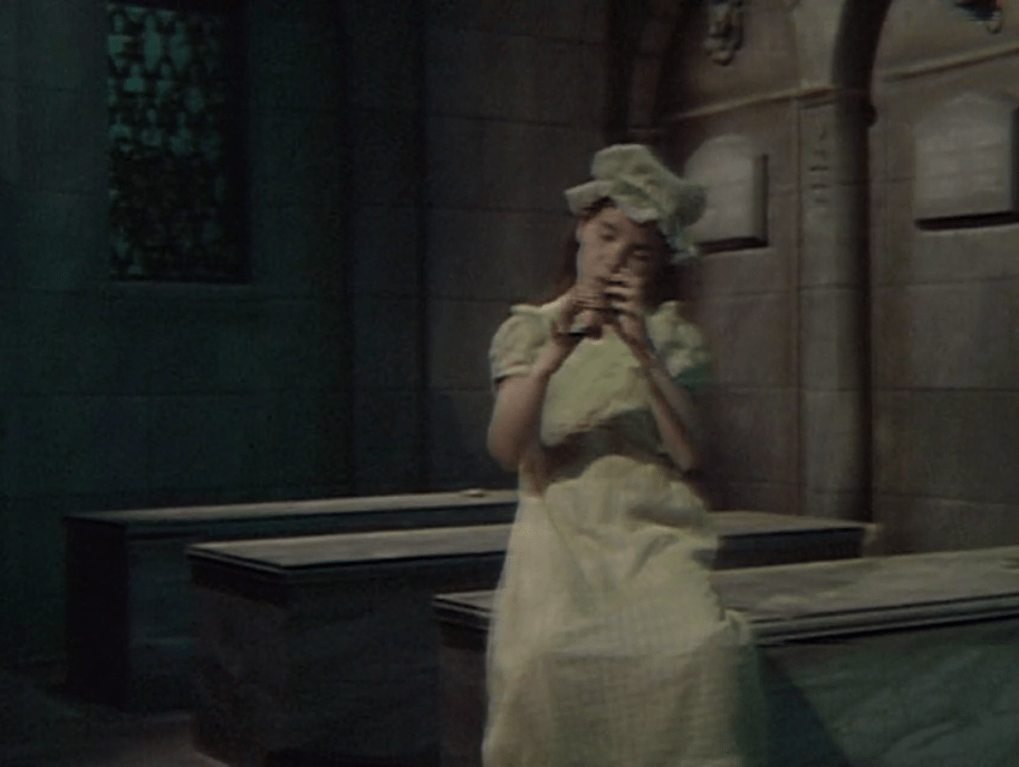
Jammin’ with the Junior Funky Phantom of 1967.

Barnabas calls out to Sarah. He identifies himself as her brother and says that he has come to take her home. He goes into the mausoleum only to find that she has vanished. Wracked with sorrow, he pleads with her to come back, saying that he loves her and needs her. He touches the plate marking her grave. This underscores the futility of his desire to take her home. Leading him here, it is she who has brought him to what is in fact her home, and what ought also to be his.

Sad Barney.
The impassable barrier.

This shows us a Barnabas we can sympathize with, but it also sets him on a collision course with David. Barnabas has been so harmless lately that we might wonder if his part is going to be recast with a purple felt puppet counting “Vun peanut butter saand-veech!” If he sets out to kill a child, he’ll be back on track as a horrifying menace.

Besides, David is not just any child- as the last bearer of the Collins name, David’s survival has a great symbolic importance to the show. He was central to everything that happened on Dark Shadows in its first 39 weeks. So if Barnabas becomes a threat to David, it will be a case of conflict between the current main character and the previous main character. Since Vicki originally represented the audience’s point of view and is still a major character, the divided loyalties between Barnabas and David that we first see influencing her behavior today could create a high level of dramatic tension. Especially so if Barnabas turns her into a vampire, and she winds up like Lucy in Dracula, the “Bloofer Lady” who herself preys on children.

Episode 305: I’m trying to be your friend

In a clearing in the woods, strange and troubled boy David Collins runs into his friend, the ghost of his distant cousin Sarah Collins. Sarah wants him to spend time with her, but he explains that he has to go and have dinner. Sarah persuades him to come with her to Eagle Hill cemetery, where she will show him a secret.

The secret turns out to be the hidden chamber inside the Tomb of the Collinses. David objects when Sarah tells him they will be opening the coffin there. His curiosity finally overcomes his scruples. He is shocked by what is inside, Sarah is pleased.

Screenshot by Dark Shadows Before I Die.

The whole interaction between Sarah and David is charming beyond words. At first she is lonely, and her simple rendition of this one emotion is sad enough to explain why David cannot stick with his resolution to get home in time for dinner. Once they are in the cemetery, she is brisk and commanding, insisting David open the door to the tomb, instructing him to release the secret panel inside, assuring him that it will be all right for him to stand on the sarcophagus of Naomi Collins* to reach the lever that controls the panel, directing him to open the coffin, and smiling when he does so.

Sarah shows such raw emotion in the scene in the woods and such verve in the cemetery sequence that I wonder if this may be the episode taped on the day of one of the more infamous moments in Dark Shadows history. Nine year old Sharon Smyth and eleven year old David Henesy would play on the set while the crew was preparing for taping. Mrs Sharon Smyth Lentz now tells the story that one day, they were playing hide-and-seek and she decided it would be a good idea to hide inside a coffin. She heard David Henesy approach the coffin, and just as she expected him to open it and find her inside, he jumped on top and sat there. She could hear the director calling out “We’re ready for Sharon! Where is Sharon?” but couldn’t open the lid of the coffin or make herself heard from within. Behind the scenes between Sarah and David C. may be a bit of unfinished business between Sharon and David H.**

There’s also some stuff in the Old House on the great estate of Collinwood. Vampire Barnabas Collins is feeling sick, and thinks it may be due to the efforts mad scientist Julia Hoffman is making to cure him of vampirism. He tells his sorely bedraggled blood thrall Willie to kill Julia if he suspects Julia is doing anything to harm him.

Barnabas also tells Willie that he is deeply worried about Sarah’s presence. He has no idea why she has come back or what she wants. Indeed, no one seems to know what Sarah is up to. David keeps complaining to her today of her mysteriousness, and everyone else who has mentioned her is full of unanswered questions. The audience hasn’t seen anything that would explain what she intends to do; it isn’t even clear that she has a plan. Whether she does or not, the writers are definitely making her story up as they go along. Which, oddly enough, turns out to be enormously compelling. The very wackiness of their improvisations gives us a feeling that Sarah really is a visitor from another plane of existence, one that does not follow any of the rules we expect to see in our daylight world.

Julia then comes in, and Barnabas tells her that he will kill her if the treatments do not work. She is irritated, and asks why he must continually pester her with death threats. Julia’s refusal to be frightened by Barnabas is so funny that the comedy must be intentional on the part of the actors and directors, if not of the writers.

*Her mother, as David doesn’t quite know. In the first year of the show, David had been on friendly terms with a number of the ghosts; as recently as #288, he wondered aloud if Sarah were a ghost. But now he seems to have forgotten all about the supernatural back-world of the action. In his post about this episode, Danny Horn writes that stripping David of his ghost-awareness just as Dark Shadows is going all-in on paranormal stories amounts to “grinding up his character for the sake of plot mechanics.” Considering that they are in the process of grinding several other characters up in the same way for the same short-sighted reason, it’s a worrying development.

**Mrs Lentz tells that story during this 2020 cast reunion.

Episode 283: The shock of recognition

Four and a half weeks ago, Maggie Evans, The Nicest Girl in Town, escaped from vampire Barnabas Collins. Barnabas managed to scramble Maggie’s brains sufficiently that she has amnesia covering her time as his victim and much of the rest of her life as well. She is now a patient at a mental hospital called Windcliff, where her care is supervised by Dr Julia Hoffman.

Maggie’s family doctor, addled quack Dave Woodard, is an old friend of Julia’s. He had recommended Maggie be sent to Windcliff. He had also come up with a cockamamie scheme to protect her from her captor by hiding her there and telling everyone in and around the town of Collinsport that she was dead. If he had known that the captor was a vampire, this might have made some kind of sense- no character on Dark Shadows has ever heard of Dracula, so they don’t know how to fight against vampires. But he doesn’t know that, so his plan is just a way for the writers to stall while they try to come up with more plot points.

Today we open with Woodard in Julia’s office, complaining that she isn’t communicating with him about Maggie’s case. She tells him that there have been no developments worth reporting. Returning viewers know that this is a lie, because in a session we saw yesterday Maggie remembered a lot of sense impressions from her time of captivity and Julia told her that they represented tremendous progress. Woodard tells Julia that a lack of new information is no excuse for her failure to return any of his last six phone calls. He says that she seems to be intent on hoarding any information she may glean from Maggie as her own private possession, an impression he describes as frightening.

Julia responds to this characterization with a display of offense, and Woodard apologizes. She then brings up an idea that occurred to her at the end of yesterday’s episode. She says that Maggie’s memory might improve if she takes her to visit Eagle Hill Cemetery, where she was found wandering early in her illness. Woodard objects strongly that Maggie’s condition, as Julia has described it, is so delicate that such a visit might do her permanent harm. Julia retreats and promises she won’t actually take Maggie to the cemetery. This is such a flagrant lie that the camera momentarily goes haywire, focusing on Woodard’s chair rather than his face.

Woodard leaves, and Julia calls Maggie in. She’s already wearing her coat. She asks where Julia is going to take her, and she tells her not to worry about that.

On the great estate of Collinwood, well-meaning governess Vicki is staring vacantly into space while listening to an antique music box Barnabas gave her as part of his plan to subject her to the same treatment he inflicted on Maggie. A knock comes at the door. Vicki closes the music box and goes to answer it. It is her boyfriend, fake Shemp Burke Devlin.

Burke is waging a determined battle against the story, and he is fighting dirty. He doesn’t want Vicki to have anything to do with Barnabas, or with the ghost of Josette Collins. When Vicki says she wants to lay flowers on Josette’s grave in the cemetery, where we know she will cross paths with Maggie and Julia, he resists furiously. When she reminds him that she has had dealings with Josette’s ghost, he says “Or you think you have.” In previous episodes, including yesterday’s and Monday’s, he knew she had, and in an earlier period of the show he knew that several other characters, including some of the most level-headed ones, had also encountered Josette’s ghost. When he starts belittling Vicki for believing in “the spooks of Collinwood,” it therefore comes off as an especially crude instance of gaslighting. The Mrs and I aren’t much for profanity, but we both cussed at the screen when Burke was disgracing himself this way.

Julia and Maggie are in the cemetery. I believe it is the first time we’ve seen the set in a daylight scene. You can see the shadows of the foliage on the soundstage walls, and the corners where the walls meet. I can’t believe the director meant for us to see those things, but I kind of like it- the situation needs a touch of unreality, and the obvious falsity gives it the feeling of a black box theater.

Some of the shadows on the wall that Art Wallace spoke of
Corner of the soundstage

Maggie is agitated. Julia tells her to calm down and that everything is all right. I’m no expert, but I kind of doubt that talk therapy involves a lot of “Calm down!” and “Everything is all right!” It reminded me of this Saturday Night Live sketch from the 90s, in which Patrick Stewart plays “Phil McCracken, Scottish Therapist,” a psychologist who won’t stand for any emotionalism from his patients.

Vicki and Burke see Julia and Maggie in the distance. When Maggie turns to face them, Vicki recognizes her. Julia whisks her away before Burke can see her. When Vicki tells Burke she saw Maggie, he immediately unloads on her with the same garbage he handed her at Collinwood. He declares that Maggie is dead, that Vicki knows she’s dead, that she can’t possibly have seen her, that “there is a resemblance, THAT’S! ALL!” When he asks “What’s wrong with you?” I stopped the streaming and shouted at the screen “She’s wasting her time with you, you ******* ********, that’s what’s wrong with her!” To that, Mrs Acilius said that we should just restart the show and get through the scene.

Part of what makes Burke’s behavior so infuriating is the writer’s fault. A first-time viewer, unaware that what Burke is telling Vicki are delusions that suggest she is crazy are in fact things he knows to be true, might think that he is being reasonable in dismissing ideas about ghosts and the like. But even that viewer will realize that a person ought to be nicer about it. When Vicki says she saw Maggie, Burke could easily have suggested that they go up to the woman and introduce themselves, thinking that a closer look will disabuse her of the notion. But actor Anthony George must also bear part of the blame.

George C. Scott famously told Gene Siskel that there are three things to consider in evaluating an actor’s performance: first is to make the audience believe that the person they are looking at is the sort of person who might do the things the character does. This is in turn dependent on casting- put the wrong person in the part, and all is lost. Second are the choices the actor makes in the key emotional moments. Performers have any number of options as to how they will use their faces, voices, and limbs to show a character’s feelings, and those who make a lasting impression are those who make choices that are at once totally unexpected and perfectly logical. Third is the zest of performance, the actor’s joy in the opportunity to create a character. If that doesn’t come through, nothing else is worth much.

As Burke, Anthony George fails all three of these tests. Burke would have been a difficult part for anyone to take over, both because the originator of the role, Mitch Ryan, was so memorable, and because the character had lost all connection to any ongoing storylines by the time Ryan left. And by his own admission, George knew nothing about soap operas and had no idea how to play a romantic interest on one when he joined Dark Shadows. That’s where he fails the casting part of the believability test.

As for the skill part, George has something going for him. He is always mindful of his physicality, moving only those parts of his body he needs to show us who he is and keeping the rest of himself admirably still. He also keeps his voice remarkably consistent, both by holding a steady level of volume and maintaining a simple, precise pitch. In these and other ways, he shows impressive levels of technical proficiency as an actor, but the result is a mannered, unconvincing performance. His Burke doesn’t seem to be a real person. As a cardboard figure, he becomes an abstract symbol of whatever he’s doing, and when he’s doing something bad he’s hard not to hate.

Since he makes one choice for each resource available to him and sticks with it unvaryingly throughout the episode, he doesn’t give the audience any surprises. Nor does he yield anything to his scene-mates. They always know exactly what’s coming from him. George’s eyes are always watching another actor intently, as he watches Alexandra Moltke Isles intently today, but nothing in her performance can divert him from his plan, not in the smallest particular. When Burke isn’t listening to the other character, as he isn’t listening to Vicki, George’s disconnection from the other actors makes Burke seem like an irredeemable jackass.

Nor does George show any zest for the part. He covers his discomfort with soap acting by plastering on a smile whenever the script allows it, but he is stiff when Burke ought to be loose, cool when he ought to be warm, and loud when he ought to speak with a quiet, nuanced voice. The result is just sad and awkward. When Burke is being pleasant, we can feel sorry for George, but when he has to play the scenes like the ones Burke gets today we just want him to get off the screen and leave us alone.

Compare George’s Burke with Grayson Hall’s Julia, and you will see how an actor can determine an audience’s reaction to a character. Julia is a terrible therapist. She lies repeatedly to Woodard in the beginning, denying the severe breach of ethics and disturbing disregard of public safety involved in covering up what she knows and suspects about Maggie’s experiences and running an unconscionable risk with Maggie’s mental health by taking her to the cemetery. She lies again to Maggie at the end, promising that they will duck into the Tomb of the Collinses only for a moment and then refusing to let her leave there when she starts to show a violent emotional reaction. Her methods are so unorthodox and so harsh that we suspect she is not interested in helping Maggie at all. Because we have known Maggie since episode #1, and Kathryn Leigh Scott’s performance as Maggie renews our fondness for her every time she appears, we ought to feel deep hostility towards Julia.

But we don’t. In fact, Julia quickly becomes (almost) every Dark Shadows fan’s favorite character. The George C. Scott tests tell us why. Hall’s manner is so intense that we can believe her as a mad scientist; her uninhibited use of every facial muscle, of the full range of her vocal output, and of subtle tricks of movement she learned from choreographers when she appeared in musicals may have produced a style that no acting teacher could recommend as a model, but they do mean that every moment she is on screen she is doing something we wouldn’t have predicted; and she’s clearly having a blast. She can do things vastly worse than what makes us hate Burke today, and we will still want her to come back again and again.

Closing Miscellany

The opening voiceovers aren’t usually the best-written parts of the show, but there is a particularly bad bit in today’s: “Hidden deep in the cliffs of Collinwood, the majestic, ancient rocks that separate the Earth from the sea, there is a tiny cove carved by a long-ago sea. No one at Collinwood has seen it, and no one will ever see it.” If no one ever will see it, why bother telling us about it? The narrator tells us that it is because “the Earth knows how to hide its secrets well. Sometimes men, too, must hide secrets.” Does this mean that “no one ever will” discover the secrets the characters are hiding from each other? That isn’t a very promising thing to tell the audience of a soap opera, a genre which is all about unsuccessful attempts to keep secrets and their aftermath.

Maggie tells Julia that she doesn’t recognize the name Collins. She has lived her whole life in the town of Collinsport, where most people are employed by Collins Enterprises, which is owned by the Collins family who live at Collinwood. That’s some pretty widespread amnesia she has.

The show has been going back and forth on the dates when Barnabas and Josette Collins originally lived and died. Today we get a long look at Josette’s tombstone, giving her dates as 1800-1822, and another at the plaque on Barnabas’ little sister Sarah’s resting place in the mausoleum, with the dates 1786-1796. Those dates fit with a remark Barnabas made to his sorely bedraggled blood thrall Willie in #271, that Sarah lived long before he met Josette, but not with his remark in #281 that Josette had been dead for “almost 200 years,” much less with a book we saw in #52 that gave her dates as 1810-1834.

Josette’s tombstone
Sarah’s marker

Episode 276: Into the room

For the first 54 weeks of Dark Shadows, reclusive matriarch Liz was paralyzed by the fear that someone would enter the locked room in the basement of the great house of Collinwood and find the murdered body of her husband Paul Stoddard buried there. For the last 16 of those weeks, seagoing con man Jason McGuire exploited that fear to blackmail Liz.

It turned out that Liz didn’t actually kill Stoddard and there never was a corpse hidden in the basement of the great house. There is, however, a corpse hidden in the basement of another house on the same estate. During the daytime, Liz’ distant cousin Barnabas Collins is a dead body resting in a coffin in the basement of the Old House. He gets up at night to feed on the blood of the living, lure the unwary to their damnation, and deliver rambling monologues about how sorry he feels for himself. Unlike Stoddard’s supposed grave in the great house, Barnabas’ coffin is not kept in a locked room, so the parallel has been incomplete.

Today, Barnabas decides to complete it. Trying to find and steal Barnabas’ jewels, Jason had broken into the Old House. He made his way to the basement, where he stumbled upon the coffin. He opened it, and Barnabas strangled him. Now, Barnabas orders his sorely bedraggled blood thrall Willie to help him carry Jason’s body to the secret room in the mausoleum where Barnabas himself was imprisoned and undiscovered for “nearly 200 years.”

Before they leave the basement, Barnabas tells Willie about his sister Sarah, who died when she was very young and innocent. After they leave, Sarah’s ghost appears and puts Jason’s sea cap on Barnabas’ coffin.

Sarah places Jason’s cap. Screenshot by Dark Shadows Before I Die

Episodes #1-#274 had all opened with voiceover narrations delivered by Alexandra Moltke Isles in character as well-meaning governess Vicki. Starting Friday, they gave the opening monologues to one of the actresses who happened to be in the episode to deliver as an unnamed external narrator. Today, this spoils a surprise. We haven’t seen Maggie Evans, The Nicest Girl in Town, for a while, and aren’t sure when we will see her again. When Kathryn Leigh Scott delivers today’s opening voiceover, we know we will see Maggie today.

Barnabas had held Maggie prisoner for several weeks. He had borrowed a plan from the 1932 Universal film The Mummy. He would erase Maggie’s personality and replace it with that of his long lost love Josette. Once he had done that, he would kill her and she would rise from the dead as a vampiric version of Josette. Maggie did not go along with the plan, and Sarah’s ghost helped her to escape. Barnabas managed to scramble Maggie’s memory before her father found her, and she is now in treatment at a sanitarium called Windcliff.

Maggie’s hometown doctor, addled quack Dave Woodard, is visiting the director of Windcliff, Dr Julia Hoffman. Woodard wants to show Maggie a sketch Maggie’s father, artist Sam Evans, made when the ghost of Sarah visited him to tell him where to look for Maggie. Julia resists, Woodard insists. While Julia delays, she feeds the fish in the aquarium in her office. We see enough of the aquarium to suggest that Julia is the keeper of a world within a world, a little enclosure with its own rules.

Aquarium. Screenshot by Danny Horn.

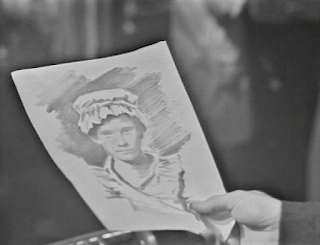
Woodard shows Maggie the sketch. After a moment, she says “Sarah.” She tells them that Sarah visited her in the room where she was confined, that she told her a riddle that showed her how to escape. She becomes too upset to talk. She starts miming her search for a loose brick in the wall of the cell, then sings a verse of Sarah’s signature tune, “London Bridge.” She is shouting words from “London Bridge” when the nurse drags her down the hall, back to her room. Julia declares that the whole thing was a waste of time, a judgment in which Woodard does not concur.

Sam’s sketch of Sarah. Apparently the drawing was done before Sharon Smyth was cast as Sarah, when they planned to give the part to Harvey Keitel in drag. Screenshot by Dark Shadows Before I Die

Meanwhile, Barnabas and Willie take the body of Jason to the tomb of the Collinses and bury it in the secret room. They talk about the people buried in the part of the structure known to the public- Barnabas’ parents and his sister Sarah. Barnabas confirms that Sarah is the one he was telling Willie about in the basement, the friend he knew long before he met Josette. He reminisces about repairing a doll of hers the night before she died. We see the plaque giving her dates as 1786-1796, implying that Barnabas met Josette after 1796. They leave, and Sarah appears.

Liz had last seen Jason the night she thought she killed Stoddard; his reappearance would lead to the opening of the locked room and the exposure of its secret. Barnabas last saw Sarah in 1796; her reappearance, today’s events suggest, might lead to the opening of all the rooms Barnabas wants to keep closed and to the exposure of all his secrets.

Episode 248: The bride of Barnabas Collins

At the end of yesterday’s installment, artist Sam Evans looked out the window of his house and saw his daughter, missing local girl Maggie. Today, the sheriff shows up and reports that he and his men couldn’t find anything to substantiate Sam’s report. The sheriff then tries to convince Sam that he didn’t really see Maggie at all. When last we see Sam, he is telling himself that it was only his imagination.

Maggie had escaped from the custody of vampire Barnabas Collins and Barnabas’ sorely bedraggled blood thrall, Willie Loomis. Today, Barnabas meets Maggie in the graveyard, chokes her, and takes her into the tomb where he spent a century or two. He declares that he will punish her for trying to leave him.

As Barnabas talks, Maggie seems inclined to go along with his plan to annihilate her personality and replace it with that of his long-dead love, Josette. He wonders aloud if the punishment he was planning is necessary after all. But then she remembers that she is holding her father’s pipe, and she calls out “Pop!” Barnabas then takes her to the hidden room in the back of the tomb and shuts her up in his old coffin.

Director Lela Swift was uncharacteristically sloppy with the framing yesterday, but today she makes up for it with one of the most remembered shots of the entire series. When Barnabas shuts Maggie up in the coffin, we see him from her point of view. Claustrophobic viewers beware!

Barnabas closing the lid

The next morning, Willie releases Maggie from the coffin, takes her back to Barnabas’ house, and urges her to convince herself that she is Josette. For a while, she tries it. We start to wonder if Willie will have as much success with Maggie as the sheriff had with her father. But then she looks in the mirror and shouts “I’m Maggie Evans!”

That may not sound like much story for 22 minutes, but it never feels slow. Swift and the actors are all in fine form today.

On the other hand, there are a couple of script problems. The sheriff is written as such a fool that we can’t help but be distracted, and the scene between Maggie and Barnabas in the outer section of the tomb goes on too long. But even at its lowest points the actors just about save it. Dana Elcar always makes it seem that Sheriff Patterson knows more than he’s letting on, so it isn’t until he starts trying to talk Sam into believing he didn’t really see Maggie that we get the sinking feeling that he is absolutely useless. And Jonathan Frid and Kathryn Leigh Scott are electric as Barnabas and Maggie, so much so that we could forgive the scene between them even if it had been twice as repetitious as it fact is. With two consecutive episodes including as much good stuff as was in yesterday’s and today’s, it’s starting to seem like they are due to land one in the ranks of the Genuinely Good Episodes any day now.

Episode 217: A terrible beating

Dennis Patrick was a fine actor, but so far he has had very little to do as seagoing con man Jason McGuire. Jason’s endlessly repeated blackmail threats against reclusive matriarch Liz are tedious in the extreme, and his attempts to charm others limit Dennis Patrick to the acting choices we might expect Jason to make. Things get livelier when he has to rein in his sidekick, Willie Loomis. Willie was introduced as a dangerously unstable ruffian, and Jason had to scramble to keep up with Willie’s moods. When Jason has to think fast, Patrick has room to maneuver.

Now, Willie is strangely changed. He is ill, and is for a second time a house guest in the great mansion of Collinwood. Flighty heiress Carolyn and well-meaning governess Vicki talk about Willie’s new demeanor, and Carolyn says that it is as if Willie has become another person. Considering that Willie tried to rape each of them the last time he stayed at Collinwood, you might think just about anyone else would represent an improvement, but Carolyn is for some reason distressed.

The episode really belongs to Dennis Patrick. It has never been clear why Jason wanted Willie around, and today there is only one possible answer- he cares about him. Even when Jason has a scene alone with Carolyn and confirms a threat he made a few days ago to make “serious trouble” for her mother Liz if Carolyn didn’t stop asking questions, he never stops being a man concerned for his friend.* It is interesting to see him combine that admirable quality with Jason’s overall rottenness.

Willie is very sick all day, barely able to stay awake, stumbling as soon as he tries to get out of bed. But at nightfall, he seems to gain strength. He hears the sound of a heartbeat. He gets up, goes downstairs, and gets past Jason. We hear a car squeal away while Jason calls after him to come back.

It is unclear whose car this is. The other day Carolyn mentioned “Willie’s car,” but before and after the idea of Willie leaving town had always been mentioned in connection with bus fare. Perhaps we are back to the idea that Willie has a car- he started it so quickly he must have had the keys. Since whatever car it is is parked by the house on what is supposed to be a large estate, its owner may have left the keys on the dashboard, but since Willie seems to have expected to have them it is at least as likely that it is his car and they were in his pocket.

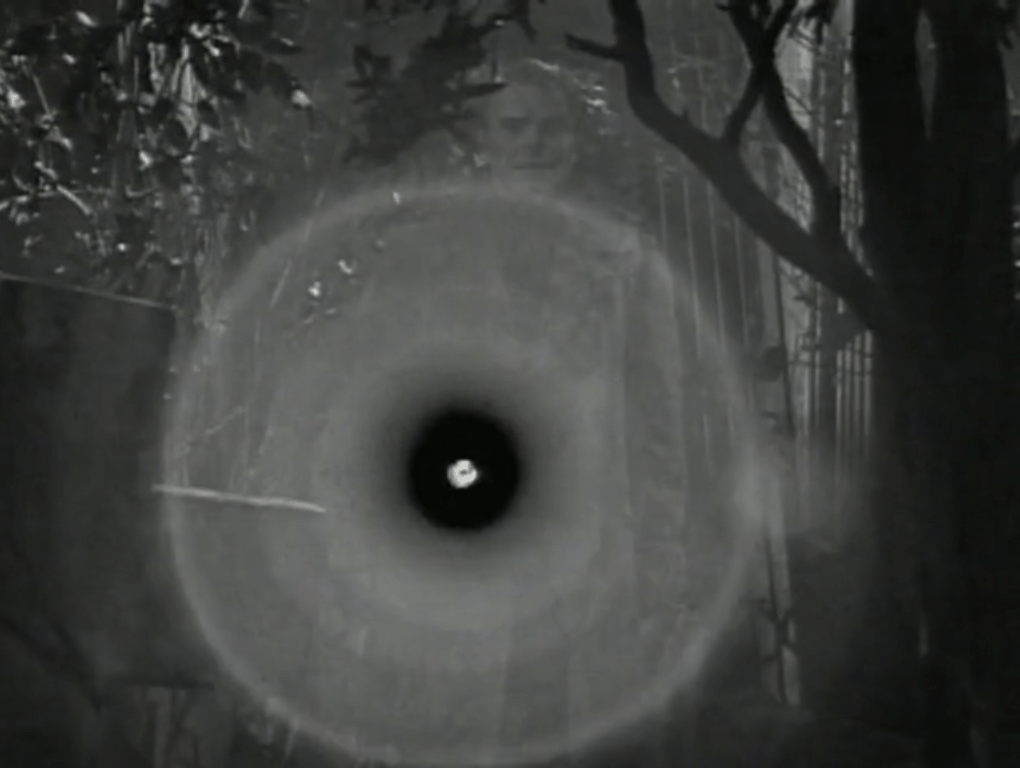
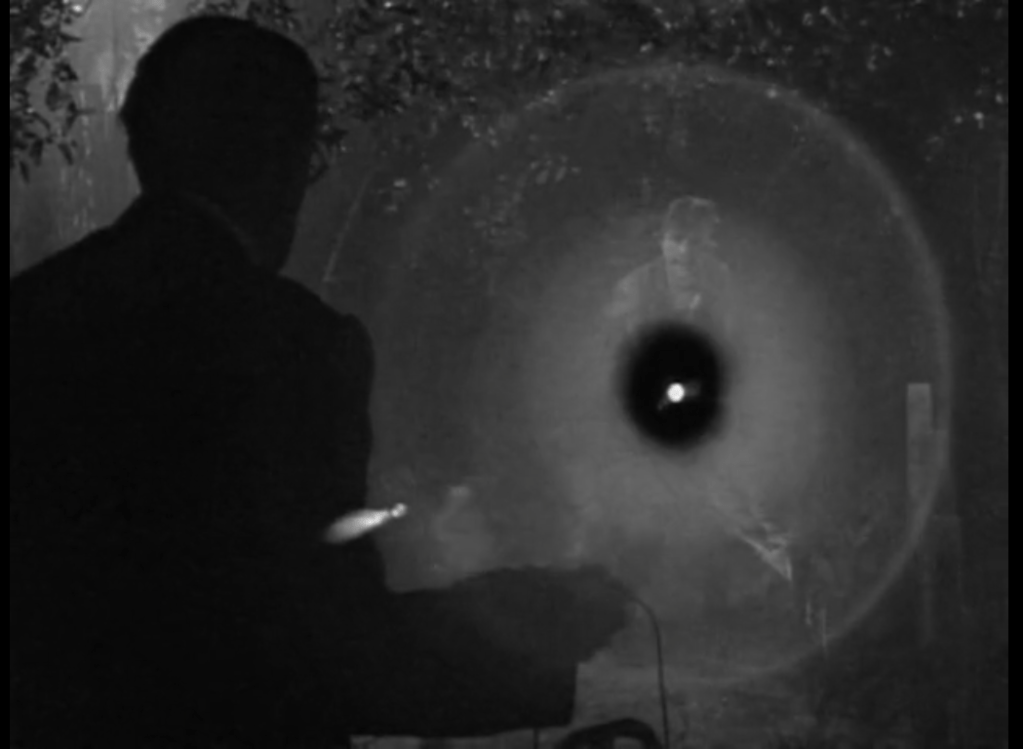
Jason follows Willie to the old cemetery north of town, where he shines a flashlight directly into the camera. Willie disappears into the Tomb of the Collinses, and Jason loses his trail there.

Flashlight halo

*My wife, Mrs Acilius, phrased it this way. She also developed the idea of the episode as a glimpse of a different side of Jason, and called my attention to the phrase “a terrible beating” as the best title for a post about it.

Episode 210: He’d want to say goodbye

Dangerously unstable ruffian Willie Loomis is under the impression that Dark Shadows is still the show ABC originally bought, a Gothic romance. So when he hears a tale of a grand lady in a manor house who fell in love with a pirate and is buried with a fortune in jewels that he gave her, he takes the story at face value and sets out to find and rob her grave.

Willie’s associate, seagoing con man Jason McGuire, believes that Dark Shadows is now the crime drama it more or less became for a couple of months after the Gothic romance approach petered out. He is blackmailing reclusive matriarch Liz, and refers to his incessant threats against her in their first conversation today.

Yesterday, the Caretaker of Eagle Hill cemetery tried to warn Willie that Dark Shadows has changed direction, and has been developing as a supernatural thriller/ horror show since December. Willie wouldn’t listen to him, but regular viewers know that all the old storylines are finished, and even people tuning in for the first time today will notice that the emphasis is on the uncanny.

At the end of today’s episode, Willie finds a hidden coffin and forces it open. It doesn’t have the jewels he was seeking, but something is in there that will bring great wealth to ABC and Dan Curtis Productions.

Screenshot by Dark Shadows Before I Die

This is the first episode of Dark Shadows most people see. Posting commentary on episodes 1-209 is a bit like driving down a quiet, picturesque country road. By contrast, googling “Dark Shadows episode 210” is like merging onto a busy highway. I want to respond to two of the many, many commentators on this one, Patrick McCray and Danny Horn.

On his great Dark Shadows Every Day, Danny writes:

Elizabeth calls Jason into the drawing room and throws an envelope of money at him — she’s paying Willie to leave town. She tells Jason to count it, but he turns on the charm, assuring her, “It’s all there. I can tell by the feel of it.” She barks at him that his friend should leave the house immediately. He apologizes: “I wanted this to be kept quiet. You know, the same way you wanted something kept quiet?” She walks out, and as soon as her back is turned, he opens the envelope and counts the money. Jason is funny. We like Jason.

Danny Horn, Dark Shadows Every Day, “Episode 210: Opening the Box,” 2 September 2013

Danny makes a point of ignoring the first 42 weeks of the show, often claiming never to have seen most of it. As his blog goes on, it becomes clear that he has seen a lot more than he wants to let on, but he is consistent enough about writing from the point of view of someone who started from this episode that I could always find a place in his comment section to add remarks about the connections to the early months.

And indeed, it is easy to see how someone tuning in for the first time today could say “We like Jason.” He is trying to keep control of the situation when he doesn’t understand what’s going on and he can’t afford to tell anyone the truth, so he has to keep coming up with fresh lies that will keep the ladies of the house from calling his bluff and new ways of pretending to be scary that will keep Willie from laughing at him. That’s a winning formula for a character, as witness the history of theater all the way back to the Greek New Comedy. Actor Dennis Patrick has the craft and the charisma to sell it beautifully.

Returning viewers may well have a far less enthusiastic response to Jason. His conversations with Liz today are the first time the two of them talk without falling into a pattern where Jason makes a demand, Liz resists, he threatens to expose her terrible secret, and she capitulates. They’ve enacted that depressing ritual ten times in the weeks Jason has been on the show, sometimes twice in a single episode. In Jason’s scenes with Willie and some of the other characters, we’ve had hints of the breezy charm Dennis Patrick exudes today. But the Jason/ Liz exchanges are so deadly that we get a sinking feeling every time either of them appears. Since blackmail has been the only active storyline going for the last two weeks and the two of them are the only full participants in it, that’s a lot of sinking feelings.

Patrick McCray’s Dark Shadows Daybook entry focuses on Jason’s opening scene with Willie:

Jason is harassing Willie. The big one is abusing the little one, demanding that he account for his whereabouts and doing so violently. David and Goliath. Shrill and meek. Had we started earlier, it would be tougher to be on Willie’s side. Starting here? Jason is the villain. He accuses the bruised kid of having a scheme, and the kid obviously lies to the Irish galoot, gazing at the portrait conspiratorially. It’s as if he and the man in the painting already have a relationship. Cut to opening credits.

A lovable weasel. A bully. A silent and stern third party, hanging on the wall like a watchful ally, holding his action. Only a few lines, but resonantly human to anyone who’s been victimized by a know-it-all lout. Somehow, we know this power dynamic is bound to change, and that, for once, the know-it-all knows zip.

Patrick McCray, The Collinsport Historical Society, “Dark Shadows Daybook: April 13,” 13 April 2018

Willie has been a frantically violent character, showing every intention of raping every woman he meets and picking fights with every man. Some of Willie’s attempted rape scenes, especially in his first five appearances when he was played by Mississippian method actor James Hall, were so intense that they were very difficult to watch. Nor has Willie become less menacing since John Karlen took the part over. Just yesterday, Jason had to pounce on Willie as he was creeping up on well-meaning governess Vicki. It is indeed tough for anyone who has seen the previous episodes to be “on Willie’s side” in the sense of hoping that he will be the victor, even if we find him interesting enough that we want him to stay on the show.

But I think Patrick McCray overstates the degree of sympathy Willie is likely to gain from an audience watching Jason’s attempt to bully him today. At no point does Willie seem the least bit intimidated by Jason. He chuckles at him throughout the whole scene, and keeps his head up and his eyes open. The bruise Willie still has around his eye from a bar fight he lost the other day is faint enough that it does not give him any particular look of vulnerability. It’s true Willie is smaller than Jason, but he’s also younger and in good shape, so there is no reason to suppose he would be at a significant disadvantage were they to come to blows.

Returning viewers will also notice that the carpenters have been busy. Today we get a look inside the Tomb of the Collinses, a new set introduced yesterday. We also see a much more modest structural addition for the first time, a second panel of wall space downstage from the doors to the great house of Collinwood.

During the first weeks of the show, the foyer set ended right by the doors. When they added a panel to represent a bit more wall space, they decorated it at first with a metal contrivance that looked like a miniature suit of armor, then with a mirror, then alternated between these decorations for a while. When Jason first entered the house in #195, the mirror reflected a portrait, creating the illusion that a portrait was hanging by the door.

Episode 195

By #204, a portrait was in fact there, one we hadn’t seen before, but that they must have been painting when Jason first came on the show.

Episode 204

In #205, the portrait is identified as that of Barnabas Collins, and it is accompanied by special audio and video effects. Sharp-eyed viewers remembering #195 may then suspect that the point of Jason and Willie is to clear out the last remnants of the old storylines and to introduce Barnabas Collins.

Today, a second panel is added to the wall next to the portrait, and the mirror is mounted on it. Liz and Vicki are reflected in the mirror. The split screen effect not only puts the painting in the same shot as their reactions to it, but also establishes a visual contrast between the present-day inhabitants of the house and another generation of Collinses.

Screenshot by Dark Shadows Before I Die

Episode 209: The darkest and strangest secret of them all

Dangerously unstable ruffian Willie Loomis stares at the portrait of Barnabas Collins hanging in the foyer of the great house of Collinwood. The portrait’s eyes glow and the sound of a heartbeat fills the space. Willie’s fellow unwelcome house-guest, seagoing con man Jason McGuire, comes into the room. Willie is surprised Jason can’t hear the heartbeat.

After consulting the Collins family histories, Willie goes to an old cemetery where legend has it a woman was interred with many fine jewels. The Caretaker of the cemetery stops Willie before he can break into her tomb. Willie hears the heartbeat coming from the tomb, but, again to his amazement, the Caretaker cannot hear it.

Yesterday, strange and troubled boy David Collins had told Willie that in some previous century, a pirate fell in love with Abigail Collins, gave her jewels, and that Abigail took those jewels to her grave. Today, Willie repeats this story to wildly indiscreet housekeeper Mrs Johnson, only he identifies the woman as Naomi Collins. Fandom likes to seize on this kind of thing, presenting it either as an error or as a sign of retcons in progress, but I suspect that it is just a clumsy way of suggesting that the characters are hazy on the details of the legend.

The legend itself is very much the sort of thing that inspired Dark Shadows in its first months. ABC executive Leonard Goldberg explained that he greenlighted production of the show when he saw that Gothic romance novels were prominently featured everywhere books were sold. The idea of a grand lady in a manor house somehow meeting and having a secret romance with a pirate is a perfect Gothic romance plot, as for example in Daphne du Maurier’s Frenchman’s Creek. Willie’s fascination with the tale might reflect an accurate assessment of the situation if Dark Shadows were still a Gothic romance, but the show left that genre behind as the Laura Collins storyline developed from #126 to #193. If Willie had been watching the show, he would know that the story David told him is not the one that is going to shape his future as a character on it.

When Willie is wandering around the old cemetery, he twice shines a flashlight directly into the camera and creates a halo effect. The first time might have been an accident on the actor’s part, but the second time the halo frames the Caretaker in a way that is obviously intentional. Patrick McCray’s entry on this episode in his Dark Shadows Daybook describes the Caretaker as “a refugee from the EC universe.” Indeed, Willie’s crouching posture and angry facial expression, the halo filling so much of the screen, the tombstones in the background, and the Caretaker’s silhouetted figure carrying a lantern add up to a composition so much like a panel from an EC comic book that it may well be a conscious homage:

Beware the Vault of Horror!

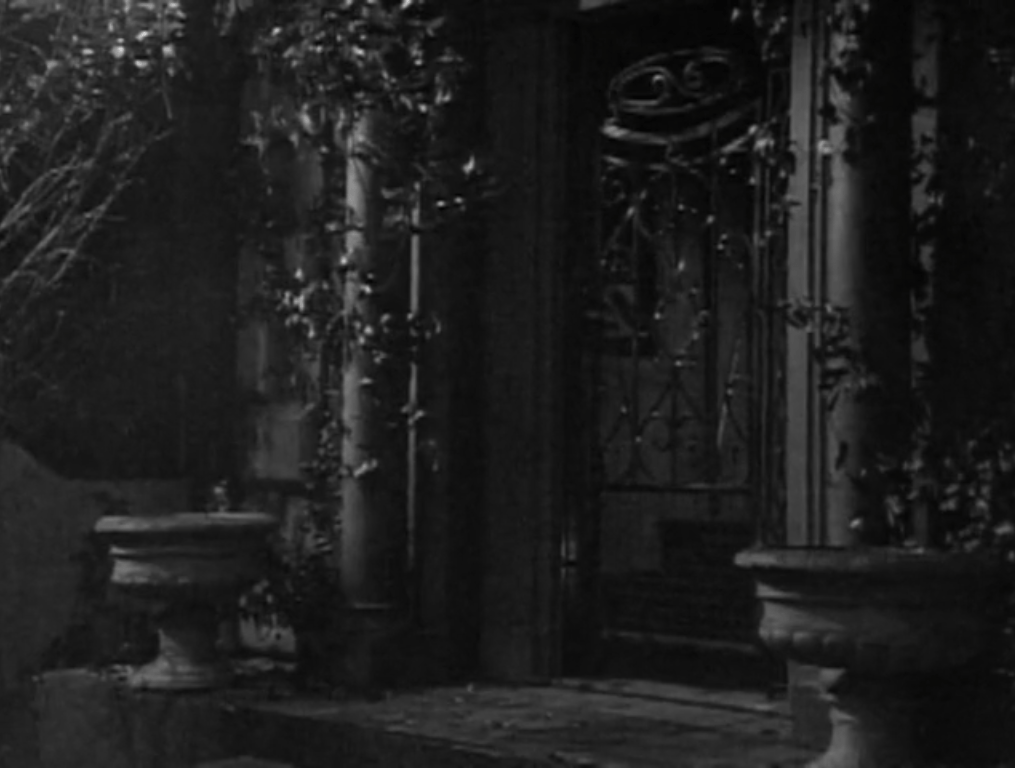
This is our first look at the Tomb of the Collinses.

Introducing the Tomb of the Collinses
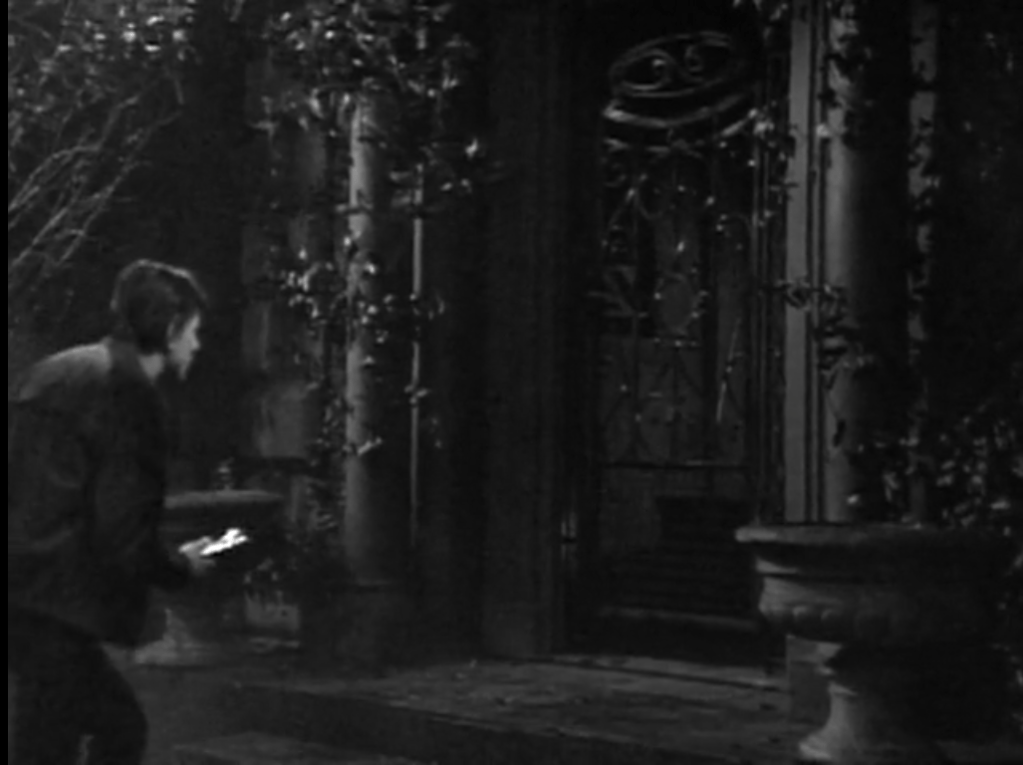
Willie sneaks up to the Tomb

It’s also the first time we are told the name of the cemetery five miles north of Collinsport in which the Tomb is situated. Mrs Johnson calls it “Eagle’s Hill Cemetery,” though later it will be called “Eagle Hill.” Mrs Johnson also mentions the Collinsport cemetery two miles south of town, and the Collins’ family’s private cemetery located in some other place. They won’t stick with any of this geography for long, though it all fits very neatly with everything we heard about burial grounds in the Collinsport area during the Laura story.