Episode 413: So sad for such a long time

Sarah Collins is going to turn 11 two days from now, on 26 January 1796. Sarah misses her big brother Barnabas. She has been told that Barnabas has gone to England, and today her mother, Naomi, tells her that Barnabas may not be back for a long time, maybe not until Sarah is grown up. Sarah refuses to believe this. She insists that if she lights a candle in the window of the bedroom where Barnabas’ onetime fiancée, the gracious Josette, has been staying, Barnabas will “somehow know it’s there” and come home.

Naomi lies to Sarah.

Sarah is right to disbelieve her mother. On the orders of her husband, haughty overlord Joshua, Naomi is repeating a lie to conceal Barnabas’ death. Joshua believes that Barnabas died from the plague, and that if that word gets out the men won’t report for work at the family’s shipyard. In fact, Barnabas never had the plague. He died of a witch’s curse. As a further result of the curse, he is now a vampire. The last few nights, he has been snacking on the women who frequent the waterfront of the village.

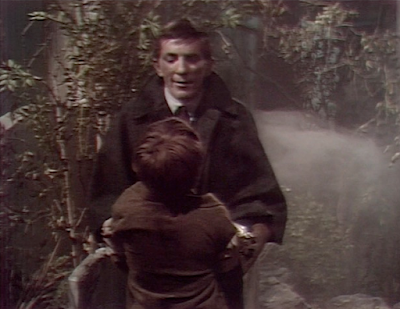
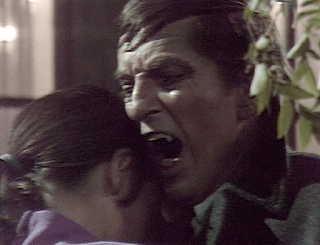
Josette is out of town, so Sarah takes the candle to her room, meaning to leave it there as a surprise. Looking out the window, she sees Barnabas on the lawn, peering up. Sarah is excited to see her brother, and runs out of the house after him. He doesn’t want her to know what has become of him, and runs off.

Barnabas on the lawn.
Sarah spots Barnabas.

Seconds after she exits the front door, Sarah is in the cemetery. It has been established many times that this cemetery is miles from the house; earlier in this very episode, Barnabas’ helper Ben visited him in his tomb there, and made it clear he had plenty of opportunity to shake anyone who might be following him as he journeyed there from the house. This inconsistency bothers a lot of people, but I kind of like it. We got to know Sarah as a ghost in 1967, and she was at the center of a number of very intriguing surrealistic sequences. She’s alive now, but the whole situation is so bizarre that it only seems right she moves as she would in a dream. Watching the scene this time, I was surprised- I had remembered the set behind Sarah being blurred as she ran and some other visual effects that would have presented it as an eldritch moment, but none of those was actually there.

The episode ends with Sarah in the outer part of the tomb, near the secret panel behind which Barnabas’ coffin is hidden. She is calling out to him. We have been warned that Sarah will die on her birthday as a result of exposure; when Barnabas does not come to her, she complains of the cold, and we end on an ominous note.

Sarah in the mausoleum.

When Sarah sees Barnabas standing on the lawn, we echo earlier phases of Dark Shadows. We often saw characters looking out that window during the first 73 weeks of Dark Shadows, when the dramatic date was 1966 or 1967 and the room was occupied by well-meaning governess Vicki. We also saw Barnabas peer up at Vicki’s window from the lawn several times. The first time was at the end of #214, when the camera stuck with him so long we wondered if he really was a vampire and not just a garden gnome.

The closing shot of #214, set in 1967. Compare with the image of Barnabas on the lawn above.

Barnabas’ penchant for staring at windows in turn echoed his predecessor as the show’s supernatural menace, undead fire witch Laura Murdoch Collins. As ten year old Sarah Collins looks out a window and sees her big brother Barnabas looking up at her from the lawn today, so in #134 did another child of the same age, strange and troubled boy David Collins, look out a window and see his mother Laura looking up at him from the same lawn.

Vicki is in this episode. Sarah’s ghost yanked her here from November 1967 so that she could “tell the story from the beginning.” It isn’t so much Vicki who has been getting the story as it is the audience. Vicki is left out of most of the key developments; in particular, she has no clue Barnabas is a vampire. She has done such a poor job of fitting into her new environment that even though witchcraft laws had been repealed throughout the English-speaking world sixty years before, the village of Collinsport has brought them back just for her. She is in gaol, and from there has continued to find ways to make her situation so much worse that she is now all but certain to be hanged.

Today, Vicki asks for Naomi to visit her in the gaol. Barnabas and Ben are the only ones who know who the witch really was, but neither of them is in a position to talk to the authorities and clear Vicki’s name. Naomi and Sarah are the only other people who believe that Vicki is innocent. Vicki tells Naomi that she has a book printed in the twentieth century that tells her Sarah will die of exposure on her eleventh birthday. In response, Naomi looks at her in wonderment and says that she is starting to believe she really is a witch. Vicki dismisses that topic, and pleads with her to keep Sarah indoors for the next few days. Naomi agrees to do so.

Vicki’s warnings not only make Naomi suspect that the charges against her are true; it is because Naomi is not home that no one stops Sarah running out and getting stuck in a cold place. I suppose there is meant to be a dramatic irony in seeing Vicki bring about the very disasters she is trying to prevent, but the character’s foolishness throughout the whole segment set in the late eighteenth century blunts that irony.

If we saw a smart person operating at the top of her form and still causing a series of calamities, we might have a sense of tragic inevitability, a feeling that the course of history cannot be changed whatever we do. But Vicki has not been that person. Movie reviewer Roger Ebert famously called stories that depend on the characters doing things the average member of the audience would be too smart to do “idiot plot.” For all the strengths of the 1795 segment, there is an idiot plot at the center of it, and Vicki is the Designated Dum-Dum. That undercuts the arc and destroys the character.
Episode 411: No longer really human

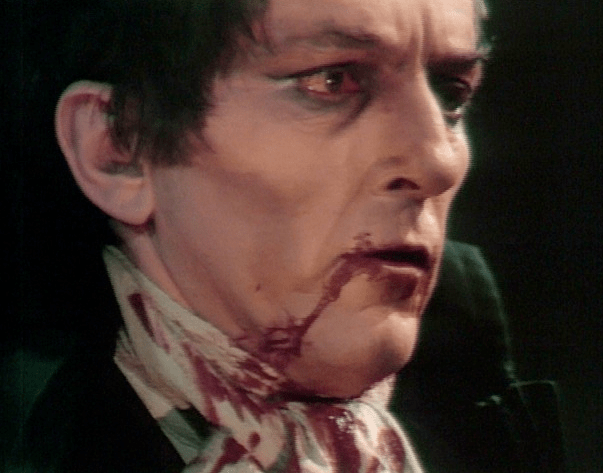
Messy eater. Screenshot by Dark Shadows Before I Die.

At the top of the episode, wicked witch Angelique is in the secret chamber hidden inside the Collins family mausoleum. She is standing before the open coffin of Barnabas Collins, a stake in one hand and a mallet in the other. The sun is setting; once it does, Barnabas will rise as a vampire. She would drive the stake through his heart to prevent this outcome, but she is moving in time with the background music, and it is too slow. Barnabas awakes, knocks the equipment from her hands, and grabs her throat.

In 1967, throat-grabbing was Barnabas’ reflex when someone opened his coffin at dusk. The character first appeared in #210 as a hand darting to the throat of would-be grave robber Willie Loomis; Barnabas would bite Willie and enslave him. In #275, seagoing con man Jason McGuire opened the coffin; again the hand darted to the throat, and in #276 we learned that Jason was dead. That was the first time in 1967 Barnabas killed someone.

Now it is 1795. When we return from the opening title sequence, Barnabas has let go of Angelique. He has questions, and she is trying to avoid answering them. He realizes that she is afraid of him. When he figures out that she has turned him into a monster, he strangles her. In 1967, thirteen weeks separated Willie’s freeing of Barnabas from the death of Jason; this time, Barnabas chokes the life out of Angelique only eight minutes after he first awakens as a vampire.

Barnabas opens the door to the outer part of the mausoleum. The mechanism that opens this door is hidden inside one of the stairs leading out, and the camera lingers on it long enough to show that Barnabas must already be very familiar with the room to have gone directly to it. Returning viewers will remember that Angelique seemed unable to find it yesterday, and committed fans will remember that strange and troubled boy David Collins spent a whole week trapped in the secret chamber in September 1967 because it was so well hidden. The ghost of Barnabas’ little sister Sarah had to manifest to David in #315 and show him the door opener before the plot could move forward.

In the outer part of the mausoleum, Barnabas finds much put-upon servant Ben. Ben had been Barnabas’ devoted friend, but Angelique cast a spell on him and forced him to do her evil bidding. He is glad to hear Angelique is dead, and pledges to help Barnabas. As a living man, Barnabas had always gone out of his way to reciprocate Ben’s friendship, but throughout their conversation in the mausoleum he keeps telling Ben about the reasons he has to kill him. Only when Ben points out that he will need someone to protect him during the day does Barnabas agree to let him live. This was the same appeal that mad scientist Julia Hoffman made to Barnabas in #351. Since Barnabas was busily preparing to kill Julia a few episodes after that, this echo does not inspire much hope for Ben’s future.

Barnabas and Ben are having a little talk about how to dispose of Angelique’s corpse when they hear someone approaching the mausoleum. Barnabas hustles back into the secret chamber. Ben turns to the entrance, an appropriately helpless expression on his face.

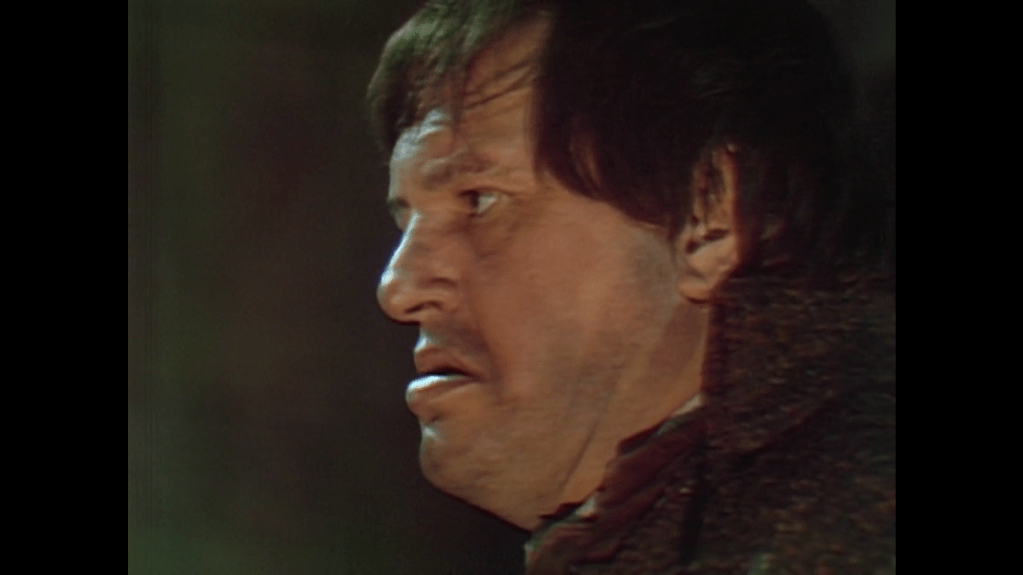
Ben faces the darkness, waiting for whatever fresh hell may be approaching.

Haughty overlord Joshua Collins enters. Joshua is Barnabas’ father and Ben’s legally recognized master. Joshua accuses Ben of coming to rob Barnabas’ grave. Ben denies it. Joshua demands to know who he was talking to a moment before. Ben says that he was praying and that the only way out of the chamber is the way Joshua came. Joshua says that it is not the only way- Ben’s confederate could have gone into the secret chamber. Joshua opens the secret chamber, looks inside, and sees only Barnabas’ coffin. He is about to close the panel again when a bat flies out and flusters him. After the bat is gone, he agrees to let Ben stay and say more prayers for Barnabas.

Ben is in the graveyard when Barnabas materializes in front of him. Barnabas tells Ben that his new existence has brought him new powers. When the two of them return to the mausoleum, Ben sees that Barnabas’ face is streaked with blood. Barnabas tells him that he has discovered that along with his new powers, he has a new need- he must drink other people’s blood in order to survive. Tomorrow, Ben will hear of an unfortunate woman in the village killed by a wild animal. Barnabas says that he should have let Angelique destroy him; Ben protests that he oughtn’t say things like that. Evidently Ben is going to stick with Barnabas no matter how gruesome his deeds become.

Episode 410: Do you know the word “vampire”?

The name “Barnabas Collins” was first spoken on Dark Shadows by strange and troubled boy David Collins in #205. By the time of his first appearance in #211, it was already clear to the audience that Barnabas was a vampire. Yet the word “vampire” was never spoken on the show in those days. Barnabas was referred to as one of “the Undead,” a title that had previously been given to David’s mother, blonde fire witch Laura Murdoch Collins, and also as “the living dead.” At times avoidance of the word led to a bit of fun. So in #315, mad scientist Julia Hoffman is trying to talk Barnabas out of killing David, and says that the boy must not die “at the hands of a-.” When her voice breaks off, Barnabas smiles, leans in, turns his face towards her, and asks “at the hands of a what, doctor?” He is positively gleeful that she has come so close to blurting out a taboo word. It’s as if he had caught her about to make a fool of herself by uttering a slur, and he all but dares her to say it out loud.

As of today, Barnabas has been a part of Dark Shadows for 41 weeks, the same length of time the show had been running before David spoke his name.* The embargo on the word “vampire” finally ends today. We are in the year 1795, and wicked witch Angelique has cursed Barnabas. The first part of the curse has killed him. His father, haughty overlord Joshua, believes Barnabas died of the plague and has hidden his corpse in the secret room of the Collins family mausoleum lest this news cause a panic at the shipyards. Joshua refuses to tell anyone where Barnabas’ remains are, even Angelique, who was Barnabas’ wife.

Angelique regrets the curse, and tried to lift it while Barnabas was still alive. Now that he has died, she wants to prevent the second part of it from coming true. If she does not drive a stake through Barnabas’ heart before dusk, he will rise as a vampire.

Angelique summons much put-upon servant Ben. Ben had been Barnabas’ loyal friend, and to his great misery Angelique has used her powers to enslave him and force him to help in her evil schemes. Now she orders him to find Barnabas’ body, make a sharp stake out of holly wood, and report back to her.

Joshua violently disapproved of Angelique’s marriage to Barnabas and wants to be rid of her. He offers her $20,000 in gold if she will go away and leave behind a signed paper promising never to return. He leaves the paper and the passbook to the bank account containing the gold, and we see her sign.

It isn’t always very meaningful to compare prices across centuries. You couldn’t get a smartphone or a Lexus or a roll of toilet paper for any amount of money in the eighteenth century. But we can compare the price of gold from year to year. In 1795, the official price of gold in the USA was $19.39 per ounce. So, when Joshua offers Angelique $20,000 in gold, he is offering her 1031.46** ounces of it. As I’m writing this (17 January 2024,) the price of an ounce of gold is $2010.60. So, there is a sense in which Joshua pays Angelique $2,073,852.50 to leave Collinwood.

Ben returns with the stake; he and Angelique go to the mausoleum. There, Ben opens the secret room, remarking that Joshua showed it to him on his first day as a servant at Collinwood. Joshua had explained that he hid guns there for the Continentals during the War for Independence, and he wants Ben to keep it clean so that it will be ready in case it is ever needed again. Ben says that it is hard to believe that Joshua was a patriot during the Revolution, but he supposes he was. That Joshua still thinks it might be necessary to take up arms at short notice during the second term of the Washington administration suggests his politics might have been rather fervent.

In the secret room, Angelique and Ben see Barnabas’ coffin. She introduces Ben to the word “vampire,” then tells him to open the coffin. He refuses, and runs out of the room. He shuts the door, sealing her in the chamber with Barnabas. It is surprising that he can do this- perhaps her power over him is waning. She opens the coffin herself and picks up the stake and mallet. The music plays on the soundtrack, and she moves in time with it. She raises the mallet, we catch a glimpse of Barnabas*** in his coffin, and the episode ends.

Angelique prepares to stake Barnabas. Screenshot by Dark Shadows Before I Die.

*Though he has been in the air for a bit longer than that. We first saw his portrait on the wall next to the front door of the great house of Collinwood in #204, and while the portrait was being painted an elaborate shot was tricked up in #195 to make it look like a portrait was on that spot. 

**To be exact, 1031.45951521 ounces.

***A stand-in wearing heavy makeup, not Jonathan Frid.

Episode 336: People don’t keep secrets anymore

Early in the story of vampire Barnabas Collins, local physician Dave Woodard decided to call in an expert from out of town. Dr Julia Hoffman was doubly qualified as a specialist in psychiatry and hematology, and so she seemed to be ideally suited to make sense of the baffling occurrences taking place around Collinsport. Readers of Bram Stoker’s Dracula will recognize Woodard as the counterpart of Dr John Seward and Julia as Professor Abraham Van Helsing.

Now, Woodard realizes that Julia has gone over to Barnabas’ side. So, crafted to be the stolid Seward, he must try to do the work of Van Helsing. Today, he manages to meet and talk with the ghost of Barnabas’ little sister Sarah, persuades her to show him the secret chamber in the tomb where her body is buried, and confronts Julia.

Sarah complains that “People don’t keep secrets anymore.” She’s had it with this damn century.

All of this would have been very powerful had Woodard been played by Robert Gerringer. Gerringer played the part starting in May. For most of that time, Woodard had little information and no power to advance the plot. He was largely confined to scenes that groaned under the weight of recapping. Gerringer made this thankless role as interesting as anyone could, managing to shade Woodard’s internal life so that we could see how confusing it would be for a trained scientist to confront facts that could be explained only by reference to the supernatural.

Gerringer’s acting style stands apart from those of his cast-mates. Most of the cast of Dark Shadows knew nothing at all about daytime serials when they joined the show, and they don’t sound or move in ways that are typical of the genre. But Gerringer’s voice is that of every doctor in the soaps my mother watched when I was a kid. His presence on Dark Shadows is a constant reminder of the incongruity of a vampire as a regular character on a soap opera in 1967.

Unfortunately, Gerringer is not in this one. The National Association of Broadcast Engineers and Technicians were on strike when this episode was made, and Gerringer refused to cross their picket line. So his part is being played by someone else, and the intended effect of the whole thing is badly blunted.

There’s also a scene between well-meaning governess Vicki and her depressing boyfriend Burke. There was some talk a while ago about them buying a “house by the sea,” and they make it clear today that we won’t be hearing much more about that. That never really amounted to a story, and it’s something of a disappointment that it is a dead end.

Episode 334: Help the boy

High-born ne’er-do-well Roger Collins was the first of Dark Shadows’ icy, calculating villains, and Roger’s son, strange and troubled boy David, was the first of its adorable homicidal maniacs. By the time David’s mother, blonde fire witch Laura Murdoch Collins, went up in smoke in #191, well-meaning governess Vicki had converted David from evil to good, and the subsumption of the “Revenge of Burke Devlin” storyline into Laura’s arc had set Roger on the path to becoming occasional comic relief.

Now, bumbling vampire Barnabas Collins combines the roles Roger and David pioneered. Barnabas has been so inept at keeping his secrets that David has learned some of them and is frantically trying to warn the adults about him, but he has shown enough calculation in his damage control that most of the adults receive David’s warnings as signs of mental illness.

The highlights of today’s episode are two sequences in which Roger makes himself remarkably vulnerable to his old nemesis Burke Devlin and family doctor Dave Woodard. Early on, Burke and Woodard are telling him that David is a frightened boy, and Roger answers them with a speech in which he claims that all boys live in constant terror. “I was a child in this house. I was terrified of the darkness in the corners and frightened to walk along the corridors by myself. I used to think that all the people in these Collins portraits… all those dead people… stared at me wherever I went… looked at me with piercing eyes… hated me! Well, I outgrew it, and so will David.” Burke and Woodard simply ignore Roger’s speech- evidently they are true New England men, and cannot imagine talking to each other about their feelings. After Burke and Woodard leave Roger, he looks at the portrait of Jeremiah Collins above the fireplace in the drawing room, and recoils in fear.

Roger, alone with the portrait of Jeremiah Collins, and still scared out of his wits. Screenshot by Dark Shadows Before I Die.

After Burke and Woodard have talked with David a while, they come back to ask Roger’s permission to take the boy to look for a secret chamber he says can be found in the Collins family mausoleum. Roger says in reply that they should forget about looking into tombs and get a psychiatrist who can look into David’s mind. He says that David “is like a person on a thin wire, very high off the ground… Any minute he may fall and plunge downward- out of our reach forever.”

Again, Burke and Woodard don’t react to Roger’s speech at all. Viewers who have been with the show from the beginning, though, will see these two scenes as a significant retcon. For the first 38 weeks of Dark Shadows, Roger openly hated David, was eager to get rid of him, and exploited his troubles for his own advantage. Perhaps the single most shocking scene in the entire series came in #68, when Roger coolly manipulated David into making an attempt on Vicki’s life. But now Roger is a caring father whose concern for David drives him to make the most astonishing emotional displays.

In the scene between Roger’s speeches, David told Burke and Woodard about two vacant coffins he has seen. Woodard, who is inclined to believe David is onto something, can’t help but try his hand at psychotherapy, and asks David if he isn’t terribly afraid of coffins. Again, long-time fans will remember that matriarch Liz went eighteen years without once willingly leaving home, because she thought that the murdered body of her husband Paul Stoddard was buried in the basement. In #275, it turned out that Stoddard’s supposed grave held only an empty trunk. Burke was there when that came to light, and Woodard probably knows about it too. So he might well imagine that David would have a lot of unresolved feelings surrounding the image of a vacant coffin. The Liz-is-a-recluse story was a dud from the beginning, so it is understandable it hasn’t been referenced in months, but it’s a shame Woodard doesn’t have the chance to clue new viewers into what may well be on his mind.

Also in that scene, David tells Burke and Woodard he will have to break a promise he made to his friend, the ghost of ten-year-old Sarah Collins. When he says this, the wind blows the window to his room open, and the strains of “London Bridge” play on a wooden flute. When David asks the men if they can hear the music, they make it clear that they can. He tells them that it is Sarah objecting that he ought not to share her secret, but that he has no choice.

He takes them to the Tomb of the Collinses, where Sarah and her parents are buried. He tries to open the panel to the secret chamber, but it has been locked. When Burke and Woodard tell him they don’t believe that there is a secret chamber, he finds Sarah’s flute on her mother’s crypt. This is enough to convince Woodard that there is something to David’s story.

In life, Sarah was Barnabas’ sister. Her current relationship to Barnabas echoes Liz’ relationship to Roger, and the relationship developing between Barnabas and mad scientist Julia Hoffman. She tries to prevent him from committing crimes, but she will not allow him to be caught once he has committed them. At the moment, the crime Barnabas is busiest committing is an attempt to spread the idea that David is insane and to trick the adults into giving him inappropriate psychiatric treatment. So Sarah leaves her flute where it will give David’s doctor evidence that he is not ill at all. On the other hand, Barnabas has reason to fear that if the secret chamber becomes generally known, he will be exposed and destroyed. So she swears David to secrecy about it, and is upset when he is going to violate that secrecy. The usual Dark Shadows dynamic, seen in both the Liz/ Roger and Julia/ Barnabas relationships, is that of Bossy Big Sister and Bratty Little Brother; Sarah is Barnabas’ little sister, and she isn’t exactly bossy, but the end result is similar.

Episode 318: What can a little girl know?

In the outer room of the Tomb of the Collinses, Sam Evans and Dr Dave Woodard recap the story so far. In the hidden chamber on the other side of the wall, vampire Barnabas Collins and mad scientist Julia Hoffman eavesdrop on their conversation. When they hear how close Evans and Woodard have come to discovering their terrible secrets, Julia squirms and Barnabas looks shocked.

Busted.

When Dr Woodard mentions that Julia had used the word “supernatural” in a conversation with him, Barnabas nearly blows their cover. He grabs Julia by the throat and she lets out a yelp. Sam hears this, Woodard does not. Woodard suspects that there are ghosts at work in the area, but he cannot believe that Sam’s hearing is better than his, so he dismisses the idea.* He notices the plaque marking the burial site of Sarah Collins, 1786-1796, and says out loud that the little girl named Sarah whom everyone has been looking for lately is the ghost of that Sarah.

Evans and Woodard leave the tomb, and Barnabas resumes raging at Julia. He opens his old coffin and pushes her head into it, asking if she wants to spend eternity confined there. She talks him down with warnings of what would happen were he to kill strange and troubled boy David Collins.

Woodard goes to the great house of Collinwood, where he questions David. Woodard is much more forthcoming with what he knows than he has been in any previous conversation. David listens closely, trying to find out what he knows. But Woodard’s questions are all about David’s friend, Sarah. David doesn’t know that answers to many of Woodard’s questions, and Sarah has sworn him to secrecy about much of what he does know. So the only new piece of information Woodard learns from David is that Julia was lying to him the other day when she said that she hadn’t given much thought to Sarah. David tells him that she asks him about her all the time.

Julia comes in and tries to stop Woodard questioning David. He ignores her and asks another question, then warns him to stay away from the Tomb of the Collinses. When he tells David that whatever secret Sarah told him about the tomb is also known to someone else, and that that other person is very dangerous, David is horrified. When he was trapped in the hidden chamber last week, Barnabas and his servant Willie entered. David hid from them in Barnabas’ old coffin and eavesdropped on a conversation in which Barnabas dropped a huge number of clues about his secrets. Since Woodard started his questioning of David with a reference to the unknown person who has been terrorizing the area since April, David now has reason to believe that Barnabas is that person.

David leaves the room, and Woodard asks Julia what she was trying to prevent him from finding out. She refuses to answer any of his questions. She hears the sound of dogs howling, and knows that it means Barnabas is getting ready to kill someone. Knowing that she has very little time to try to prevent David’s murder, she cannot focus on Woodard’s questions. For once, she can’t think of any lies that will hold him off. Her reason for being in town, so far as Woodard is concerned, is that she is a doctor treating Sam Evans’ daughter Maggie, Barnabas’ former victim. When she won’t answer his questions, he takes her off Maggie’s case.

Julia goes to Barnabas’ house. She finds him on his way out the door, on a mission to kill David. She opposes him, and he declares that nothing can stop him. At that, the wind blows the doors open. It extinguishes some of the candles in the room. The strains of “London Bridge” begin playing, and Barnabas and Julia realize that Sarah, who in reality is the permanently nine year old ghost of Barnabas’ little sister, is in the room. Barnabas cannot leave. Julia says with satisfaction that nothing can stop him- “except one little girl.”

The whole episode is very strong from beginning to end. Julia is usually so much in charge that the only suspense is what she will choose to do, but throughout this one she is scrambling to bring Barnabas under control. When her final attempt fails, Sarah’s intervention comes as a thrilling surprise.

The performances of both Jonathan Frid and Grayson Hall stand out today. Hall is as powerful a presence playing a character who controls nothing as she usually is playing a character who controls everything. And few could match Frid’s ability to appall us with Barnabas’ plan to kill a ten year old and seconds later to elicit tears by calling out to his beloved little sister.

*My wife, Mrs Acilius, put it that way.

Episode 315: The night holds no danger for me

In our house, we watch Dark Shadows on Tubi, a free advertiser-supported streaming app. As we click on each episode, we see a summary reading “Freed from his grave after 200 years, a tormented vampire returns home to protect his loved ones in this classic gothic daytime TV series.”

That “tormented vampire” is Barnabas Collins. In the opening scenes of today’s episode, Barnabas is talking with Julia Hoffman, a mad scientist who is trying to cure him of vampirism. They are discussing the missing David Collins, the ten-year old boy who is the last bearer of the Collins family name. This ardent protector of family announces that he must be the first to find David, because he is going to kill him. He tells Julia that he’d been “getting very fond” of David, but that he is pretty sure the boy knows that he is a vampire, so he will have to choose survival over “sentiment.” When Julia objects, Barnabas smiles and tells her that he might also be killing her and his sorely bedraggled blood thrall Willie soon. He invites her to inform Willie of this fact.

Barnabas goes to the great house of Collinwood, where he visits well-meaning governess Vicki. Vicki is worried sick about David, to whom she is devoted. She regards Barnabas as a dear friend, and he enjoys spending time with her. He has some vague intention of killing Vicki so that she will rise as his vampire bride, and may get around to doing that once he has killed David, Vicki’s fiancé Burke, and maybe Julia and Willie. Perhaps what he is determined to “protect his loved ones” from is aging- with him around, it seems unlikely anyone is going to get much older.

Vicki unwittingly tips Barnabas off as to where David is. David is trapped in the secret chamber inside the Collins mausoleum in the old cemetery north of town. Vicki doesn’t know that this chamber exists, but Barnabas was confined there for 170 years. So when she tells him that the doddering caretaker of the cemetery thought he heard voices coming from behind the stone walls of the outer chamber, she thinks she is giving evidence that the old man has lost his mind. Barnabas, however, knows different.

David learned about the chamber from the permanently nine year old ghost of Barnabas’ sister Sarah. Sarah has been showing up a lot lately, and yesterday we saw several characters starting to admit that she must be a supernatural being. It is Sarah’s friendship with David that has led Barnabas to believe that he knows he is a vampire. In fact, she did not tell him about this, but David did overhear a conversation between Barnabas and Willie which gave him enough clues that he could probably figure it out.

When Barnabas arrives at the cemetery, he meets the caretaker and has a confusing conversation that is straight out of vaudeville. On his Dark Shadows Every Day, Danny Horn compares it to “a summer stock production of Abbott and Costello Meet Frankenstein, where Abbott is being played by Count Dracula.” At one point Barnabas is so exasperated with the caretaker that he nearly blurts out that he is Sarah’s brother. That’s the second time in the episode a character almost blurts out a word that would make a major change in the show- towards the beginning, Julia came within a breath of saying “vampire,” a word we have not yet heard on Dark Shadows.

Meanwhile, Sarah appears to David. He asks her how she got into the sealed chamber, and she replies “I can get in anywhere.” David is dissatisfied with this answer, but doesn’t really seem surprised to see her. He seems to know that she is a ghost, and to be holding off on using the word in her presence in the same way that Julia is holding off on using the word “vampire” with Barnabas. It’s just sort of indelicate to use a label people haven’t told you they like. Maybe Sarah prefers to be called a Phantom-American, and it would be this whole big thing if you called her a “ghost.”

Sarah shows David how to open the panel. He does, and when he looks back she is gone. He expresses irritation with her for “hiding,” which is rather strange- he was trapped in the chamber for days, so clearly she wasn’t hiding there the whole time. She must have made her way in through the solid walls. Even if David hasn’t figured out that she is a ghost, he must know that she can get out the same way.

David walks out of the mausoleum, directly into the hands of his cousin Barnabas. It was obvious that he would, but that obviousness is not a problem- on the contrary, it comes with a sense of inevitability that leaves us dreading what Barnabas is going to do to David.

Protector of his loved ones. Screenshot by Dark Shadows Before I Die.

That Sarah shows David the secret chamber just in time for his presence there to alarm Barnabas and leaves him there for days, letting him out at precisely the moment when he will run into Barnabas, raises questions about Sarah’s motivations. Danny Horn and some of his commenters find themselves considering “the uncomfortable possibility that Sarah has lured David here because she’s actively trying to starve him to death, so that he becomes her ghost playmate.”

I think that’s too simple an interpretation to cover everything we’ve seen Sarah do so far on the show. It is true that she never really gets anyone out of danger. She helped Maggie Evans, The Nicest Girl in Town, escape from Barnabas when he was about to kill her, but that escape led directly to her imprisonment in Julia’s hospital. She broke Maggie out of that hospital before Julia could complete her evil plan to keep her in a state of total psychological collapse, only to lead her directly to Barnabas. She prevented Barnabas killing Maggie in her bed, but left him determined to strike again if Julia failed to keep her memory from returning.

Some say that Sarah is really an avatar of Barnabas, that she is his conscience roaming free in the world. Julia explicitly proposed this interpretation on screen in #302, and Sharon Smyth Lentz says that it is direction she was given when she was playing Sarah. So it was an idea that the writers meant to develop, but I don’t think it covers everything either. A guilty conscience can lead a person to take actions that will lead to his own exposure, but the likeliest way Sarah’s latest actions will lead to Barnabas’ exposure will be if he kills David and is caught. That doesn’t really sound like “conscience.”

Dark Shadows is, in all its phases, the story of the great estate of Collinwood and the accursed family that lives there. I would say that, whatever else Sarah is, she is a symptom of the curse that Barnabas also embodies. For several weeks, Barnabas has had a tendency to lie low and keep quiet, letting the curse fester silently and pull the Collinses and the community around them deeper into its power by imperceptible steps. Sarah disrupts all of his plans, prompting him to act and forcing into the open more and more evidence that spiritual forces of darkness are at work.

But for all the inconvenience she represents to Barnabas, Sarah is no more an opponent of the curse itself than he is a protector of family and friends. On the contrary, she presents a different version of the curse. She confronts the living characters with facts they are desperate to avoid facing. If they continue on the form they have set so far, most of them will react to the evidence of otherworldly dangers by digging ever deeper into denial. If they do that, even Barnabas’ destruction would not really free them from the life-draining evil that engendered him.

Episode 313: You must rest

This one is an exercise in nostalgia for people who have been watching Dark Shadows from the beginning.

We remember the days when high-born ne’er-do-well Roger Collins was the show’s chief villain, a man with so little sense of family loyalty that he openly hated his own son. That son, strange and troubled boy David, repaid his father’s hatred by trying to murder him. Roger has been off-screen for over six weeks; when he comes back today, the first thing he sees is the sheriff’s car in the driveway, and the first thing he hears is that the sheriff has come about David. He stiffens, and in a voice dripping with distaste asks “What about David?” When well-meaning governess Vicki explains that David is not suspected of a crime, but is missing, Roger scolds her for failing to earn her pay by keeping track of the boy. He seems to be far more irked by the money wasted on Vicki’s salary than by David’s disappearance.

When heiress Carolyn and hardworking young fisherman Joe come to report on their fruitless search for David, Roger turns his disdain on them, berating them for letting him get away in the first place. Seeing Joe and Carolyn together brings back memories of the early months of the show, when the two of them were dating and there was a whole storyline about how bored they were with each other. For that matter, we were reminded of the first 40 weeks when Vicki hesitated to tell Roger that she had been on a date with her depressing fiancé Burke Devlin- Burke had been Roger’s sworn enemy until he decided to peace out in #201.

Roger agrees to go with Joe on a search of the countryside. When Vicki and Carolyn are left alone in the drawing room, they have a conversation about how tired they both are. Each of them urges the other to take a nap, and each responds that she can’t sleep. Writer Malcolm Marmorstein was fired off the show a few days ago; he was perfectly capable of taking a conversation like that and making a whole episode out of it. Today’s episode is filler from the point of view of the overall plot, but the ludicrous pointlessness of this conversation is a rarity in the post-Marmorstein era.

Roger and Joe’s search is represented in a couple of shots done in front of a green screen showing outdoor locations. That casts our minds back to the black and white episodes, which occasionally spliced in location inserts. Most of that footage was taken before the series started principal photography, and none of it can be reused now that the show is in color. The last of these inserts came in #275, when Carolyn took a walk on the beach. Now Dark Shadows is shut within the doors of 442 West 54th Street forever, and its only memory of the outside is in these green screen shots.

Joe and Roger in front of a green screen. Screenshot by Dark Shadows Before I Die.
A less successful use of the same process. Screenshot by Dark Shadows Before I Die.

Roger continues his flagrant display of indifference to David throughout this sequence. When he sees men in blue uniforms searching for David, he makes some acerbic comments about the incompetence of the local police.* When Joe points out a nearby cemetery where odd events have been taking place of late, Roger remarks on its dreariness and on the generally low aesthetic standard of cemeteries in central Maine. When Joe suggests searching there, Roger is appalled, and joins him only with loud reluctance.

After Roger says “down” meaning “up,” which is a feature of Collinsport English we heard in #12, In the cemetery, we get another reminder of the show’s past. The Caretaker, a doddering old fool played hilariously by Daniel F. Keyes, had a significant part in the story of Roger’s ex-wife, undead fire witch Laura Murdoch Collins, appearing in #154, #157, #179, and #180, and appeared again in episodes #209 and #211, which dealt with the introduction of vampire Barnabas Collins.

When we find him today, the Caretaker is inspecting the area around the Tomb of the Collinses. Unknown to him, there is a secret chamber hidden inside this tomb. David is trapped in that chamber. The Caretaker opens the door to the visible part of the tomb and asks if anyone is there. He hears David’s voice calling for help from the other side of the wall, and jumps to the conclusion that he is hearing a bunch of ghosts. “There is no help for you!” he cries out. As he hurries away, he shouts, “You must rest!”

David is nothing if not obedient. A minute after the Caretaker told him he must rest, he sits down and falls asleep.

The Caretaker runs into Roger and Joe. He asks them if they are alive. As “You must rest!” harked back to his constant refrain in his previous appearances that “The dead must rest!,” so this greeting echoes his first line in his first scene, when he asked Vicki and her instantly forgettable boyfriend Frank if they were alive. Frank responded to that one calmly; with his personality, it was a question he probably got from a lot of people. By contrast, Joe is disbelieving and Roger scoffs.

When they tell the Caretaker they are looking for a boy named David, he replies “Yes, he is here,” then describes the death of a boy named David who is buried in one of the graves. His compulsion to tell us the circumstances of people’s deaths is another trait of his we remember from the Laura days, especially in his oft-repeated phrase “died by fire!”

The Caretaker tells them that he heard the voices of the dead in the tomb. He urges Roger and Joe to stay away from it. Roger tells him he will be happy to oblige, but Joe insists they search there. Roger declares that he is embarrassed by the very idea of going inside such a place, and says that if anyone finds out he did he will blame Joe. Again, Roger can barely restrain his eagerness to give up the search for David.

David is too deeply asleep to hear Roger and Joe in the outer chamber. Since they are there, Roger decides to take a moment and look at the plaques naming the people buried in the tomb. After all, they are his “incestors – incestors! I mean ancestors.” This is one of the most famous bloopers in the entire series. If Louis Edmonds hadn’t stopped, glanced back at Joel Crothers, repeated “incestors,” and corrected himself, I doubt many people would have noticed it. It was a suprisingly unprofessional moment, but who would have it otherwise? To the extent that the episode is a retrospective of Dark Shadows so far, it wouldn’t be complete without an attention-grabbing mess-up. If the camera isn’t going to drift away from the mark and show a crew member eating a sandwich, “incestors” is the least we can expect.

Since the episode is so much a review of the show’s bygone themes, it is understandable that some viewers are disturbed by a line in the first scene. Roger mentions to Vicki that, while he has just returned from a trip to Boston, matriarch Liz is staying on in that city a while longer. The Dark Shadows wiki objects: “Elizabeth has decided to stay in Boston. This is incredible, since she was still afraid to leave Collinwood a few weeks ago, even hesitant to go to the Old House.”

I don’t find it incredible. Liz’ hesitation about going out was last mentioned in #280, and by #298 she was not only quick to accept Burke’s suggestion that she go with him to inspect a property on the other side of town, but she was the one who talked Carolyn into coming along with them. Neither Carolyn nor Burke expressed surprise that Liz was the one who was enthusiastic about getting out of the house. With that, Dark Shadows told us that it had no further use for the “Liz is a recluse” theme. They may be taking us on a stroll down memory lane today, but they aren’t going to take us all the way to that particular dead end.

*In all fairness, the Collinsport police are exceptionally incompetent.

Episode 311: Attached to children

Both Danny Horn and Patrick McCray wrote fine blog posts about this episode. I have a few things to add to what they’ve said.

When vampire Barnabas Collins and his sorely bedraggled blood thrall Willie approach the Tomb of the Collinses, strange and troubled boy David hears them talking about mysterious little girl Sarah. Since Sarah had made him promise to keep her connection to the place secret, he opens the panel to the concealed chamber she had shown him and hides there. To his horror, he hears Barnabas order Willie to open the panel. Still trying to keep Sarah’s secret, he hides in the coffin in the center of the chamber while Willie and Barnabas walk around it. He hears them talk about Barnabas’ relationship with Sarah and Willie’s discomfort with the chamber.

They don’t mention that Barnabas is a vampire, or that he was the one who imprisoned Maggie Evans, The Nicest Girl In Town. But they say enough that David should be able to figure out all of Barnabas’ secrets. Once he has heard Barnabas say that he was left to comfort Sarah after their dog was put down, it isn’t much of a leap to conclude that Sarah is his little sister. And once he’s heard Barnabas ask Willie if he is frightened by the “contents” of the chamber, he should know that there is something in there more than can be seen at a first glance.

In episodes #301 and #306, we were reminded of Jason McGuire, whom Barnabas killed and forced Willie to bury in the floor of this chamber. We also saw the chamber itself in #306, so that regular viewers would be sure to think of Jason’s grave. If David should repeat Barnabas’ comment about the chamber’s “contents” at the right time, Jason might yet be exhumed. So Barnabas has created an extreme danger to himself with his big mouth. Since it does not seem that Dark Shadows could continue if either Barnabas or David were to destroy the other, we are in suspense as to how they will get out of this situation.

After Barnabas and Willie leave, David gets out of the coffin and finds he cannot open the panel from the inside. Willie had used a gadget hidden in the stairs to open it, the first time we have seen this device. As David starts to panic, he hears the strains of Sarah’s signature tune, “London Bridge.” He turns away from the panel, looks at the blank walls of the chamber, and starts calling on Sarah.

In his post, Danny Horn asks “Has David just figured out that Sarah’s a ghost?” I think it’s more complicated than that. In #288, David happily considered the possibility that Sarah might be a ghost, and throughout the series he has been on easy terms with several ghosts. So I think he has assumed she was a ghost all along, and was just too tactful to bring it up when he was talking with her.

Back in the great house of Collinwood, well-meaning governess Vicki is on the terrace, worried about David’s disappearance. Barnabas peeks at her through the gate, as he would do if he were not allowed to look at her. Then he just walks up and starts a conversation with her, leaving us to wonder what the whole peeping-Tom act was about.

Vicki is so concerned for David that she starts crying. Barnabas tells her to put her head on his shoulder, which she does. He seems to be trying to restrain himself, but she has such a long, pretty neck, and it’s right there, and he’s so very thirsty…

Snack time. Screenshot by Dark Shadows Before I Die.

Patrick McCray says of this moment:

As Barnabas lunges in to bite her, my concern and sympathy is challenged as I ponder her almost athletic lack of awareness. Of course, I’ll inevitably side with the person getting her throat ripped out… but it won’t stop me from wondering why she’s practically painting a landing strip on her neck. Vicki? You have a generation of young people idolizing you.

Today, the discussion isn’t even a metaphor. No, she’s not asking for it. No one is. So, what is the message that we’re supposed to take away from a dangerous conversation like this? For a person constantly asking questions about everything — and never understanding what she hears — Vicki is the picture of unawareness. Evil is evil. An attack is an attack. And awareness is power. Ironic that her would-be attacker, Barnabas, is frequently even more unaware than is she. However, if anyone on a soap paid attention at all, the stories would last ten minutes. But that’s the point. The more the characters lack focus, the more we learn its value. David is the most aware character on the show, and in this episode, he learns the most he ever will in one night. Pity it’s from inside a coffin.

That part of the discussion is too much metaphor to ignore.

Patrick McCray, “The Dark Shadows Daybook: August 22,” The Collinsport Historical Society, 22 August 2018.

Again, I think it’s a more complicated. I think we have to analyze Vicki’s behavior at three levels of intentionality. First, there’s the in-universe level, the sort of analysis of her motives another character in the same story might give if they had the same information we do. If that character saw Vicki’s depressing fiancé Burke angrily telling her she was crazy for saying that she had seen and heard things that we have also seen and heard, refusing to give her even the most basic information about himself and airily dismissing her questions as a morbid preoccupation with “the past,” and telling other people that her imagination will “run wild” unless he monitors and controls her, they might very well think that Vicki is tired of Burke’s abusive ways. To that character, there would be nothing “athletic” about Vicki’s failure to suspect Barnabas- it is perfectly natural for her to want to think the best of a man who has always been pleasant and respectful to her, unlike the blatant villain she is supposed to marry.

The second level of intentionality is of Vicki’s usual function in the narrative. Up to this point, every storyline has come to its climax when Vicki found out what was going on. She is still the audience’s main point of view character, and as such she naturally tends towards the center of the action. All of the action lately has been in the vampire story, so we expect her to involve herself deeply in it. In the first weeks, when it was possible that Barnabas, as the second in a parade of supernatural nemeses, would be destroyed and make way for a third as undead fire witch Laura Murdoch Collins had made way for him, we expected Vicki to be the one who drive the stake into his heart. Now that it is clear he is on the show for the long haul, we are expecting Vicki to become his victim, and presumably to become a vampire herself. As the protagonist, she is actively working to get more deeply involved with Barnabas. She hasn’t yet resorted to “painting a landing strip on her neck,” but she did invite herself to spend the night at Barnabas’ house in #285 and #286, and it wasn’t her fault she left in the morning still having all her blood.

Vicki the unappreciated fiancée wants only a friend who will respect her; Vicki the protagonist wants to be part of the main story. The tension between the incompatible goals of these two aspects of Vicki is expressed in the third level of intentionality, which Alexandra Moltke Isles expresses in the choices that make up her performance. Mrs Isles takes every opportunity to show that Vicki is more strongly drawn to Barnabas than to anyone else, most definitely including Burke. That attraction brings the character back to life. After a few days when she was trying to submit to Burke’s abuse and ignore “the past,” Barnabas asks her to intercede with Burke on his behalf and she comes roaring back, an assertive character who will not give an inch even when Burke makes some good points.

It is the sight of this strong Vicki that introduces a conflict into the audience’s feelings. On the one hand, we don’t want to lose her, and if she does not become a vampire, it’s hard to see a future for her on the show. On the other, it would be a terrible betrayal for Barnabas to repay her trust in him by doing such a thing to her. All the more so because we’ve spent so much time seeing Vicki become close to David, and if she follows the pattern set in Bram Stoker’s Dracula, vampire Vicki will be a threat to all children.

Our sadness at that betrayal would be a deep emotion of exactly the kind soap operas are supposed to create. That so shocking a crime would lead to a more meaningful and more suspenseful story and a richer part for our favorite character would guarantee that we would surprise ourselves by forgiving Barnabas for it and cheering when he and Vicki become a couple. So, I think a savvy audience watching Dark Shadows up to this point would have to expect to see just that story play out.

Episode 310: A logical place

Strange and troubled boy David is peering into his crystal ball.* David’s cousin Carolyn tells him it is time to go to dinner. He tells her he is looking for his friend, mysterious little girl Sarah. Sarah has been driving the story of Dark Shadows for weeks now, and the ratings keep going up. Not only does she get viewers to tune into their television sets, she even gets Carolyn to start watching the crystal ball.

Hazel Roy is billed as costume designer for this episode. Mrs Roy died in 2010, no doubt still embarrassed by David’s shirt.

Hardworking young fisherman Joe comes to the house. Joe is also looking for Sarah, and asks if David can help find her. He explains that Sarah might know who abducted Maggie Evans, The Nicest Girl in Town. David says that he knows where Sarah is, but that it is a place he promised he would keep secret. He offers to go himself and bring her back. Joe is all for it, but Carolyn points out that it is after dark, David’s dinner is getting cold, and that his source of information is something he saw in his crystal ball. Joe backs down.

David recognizes the urgency of the situation. He sneaks out of the house and goes to the secret place, the Tomb of the Collinses in the old cemetery north of town. Sarah is indeed there. When David asks if she knows who abducted Maggie Evans, she replies that all she knows is that she has a friend named Maggie.

David takes that at face value. Regular viewers cannot be so sure. We know that Sarah is a ghost, and that she returned to the Earth after her brother, vampire Barnabas Collins, was loosed to prey upon the living. We do not know whether Sarah knows that she is a ghost or that Barnabas is a vampire. Nor do we know what she remembers from one apparition to the next. Clearly she remembers the people she has spent time with, but we can’t be sure if she remembers that Maggie told her that her father’s name was Evans and where she could find him. She might be telling the truth when she denies knowing anything more than Maggie’s first name, or she might be lying to protect Barnabas from exposure.

My wife, Mrs Acilius, compares Sarah to a superhero. Like a superhero, Sarah shows up, does what needs to be done to meet the immediate need, and disappears. You could almost say that she “lives in the moment,” if that were not the opposite of what ghosts do. Maggie needs a friend, Sarah shows up and befriends her. Maggie needs to escape from Barnabas, Sarah arranges her escape. Maggie needs to escape from mad scientist Julia Hoffman, Sarah breaks her out and leads her home. Barnabas needs to be stopped from killing Maggie, Sarah stops him.

Playing catch with David, Sarah throws the ball wide, and he ducks to look for it. When he looks up to complain that she threw it where he can’t find it, she has disappeared. Evidently all that needed to happen was that David had to go to the tomb- she has accomplished that, so she goes back to her rest.

David looks for her in the tomb and in the secret room. As he is about to leave, he hears voices approaching. He must honor Sarah’s secret, so he looks for a hiding place. The only place he can find is the tomb, so he stays inside.

The voices are those of Barnabas and his sorely bedraggled blood thrall Willie. Willie had seen Sarah through the window of their house** in the opening scene, and Barnabas has decided to come to the tomb where Sarah was buried in hopes that she will appear to him.

David realizes that Barnabas and Willie are coming into the tomb. He hides in the secret room. Little does he know that Barnabas is an expert on this room- he was trapped in a coffin there for a century or two, until Willie accidentally released him in April. That old coffin is still there, and when David hears Barnabas order Willie to open the panel he hides inside it.

We don’t know an in-universe reason why this was what needed to happen. We do know that Barnabas has been so harmless lately that the vampire story is running out of juice, so we can see why the writers would want to create a situation where Barnabas decides he has to kill David. But it is so mysterious what Sarah’s motives are or whether she is the kind of being who has what we could recognize as motives that the episode leaves us in suspense, not only as to how David will get out of danger, but what we will learn about her as a result of the incident.

*The crystal ball was a big deal for a while after dashing action hero Burke Devlin gave it to David in #48. He hasn’t really used it since #82, and Burke has since lost his connection to the plot, been recast with a less interesting actor, and turned into a hopeless schlub. It’s hard to see any way back into the story for Burke, but maybe there is hope that the crystal ball will again be a focus of interest.

**Willie was polishing the chandelier when he turned to the window and saw Sarah. Evidently he had seen her reflection in the crystal. So Sarah is twice detected today through scrying.