Episode 441: The subject of vicious gossip

When well-meaning governess Vicki came unstuck in time and found herself in the year 1795, regular viewers of Dark Shadows could expect certain plot points to be resolved before she returned to the 1960s. We would learn how Barnabas Collins became a vampire, and how he wound up trapped in a chained coffin in the secret chamber of the Collins family mausoleum. We would learn how Barnabas’ little sister Sarah died. We would see Barnabas’ lost love, gracious lady Josette, marry his uncle Jeremiah Collins. We would see Josette jump to her death from the precipice atop Widows’ Hill. And we would see Vicki escape from some dangerous situation and find herself back in her own time.

Now, the only items on that list left unresolved are Barnabas’ chaining and Vicki’s return. The show has made it clear to people paying close attention how each of those events will happen, and they could fit them both into one episode. Into any given episode, in fact- they’ve given us all the foundation we need for both stories.

But they aren’t going home to a contemporary setting quite yet. The eighteenth century segment has been a ratings hit, Dan Curtis Productions owns the period costumes, and several fun characters are still alive. So they have decided to restart some storylines they had shut down earlier and to build up some new ones.

The main thing that happens today is the first step towards restarting an apparently concluded story. Fluttery heiress Millicent Collins had shared a series of wonderful comedy scenes with untrustworthy naval officer Nathan Forbes, become engaged to him, and discovered that he was already married to someone else. Since that discovery, Millicent has been grimly determined to exact revenge on Nathan, and the rest of the Collins family has regarded him with icy disdain.

Nathan has made a discovery of his own. He has learned that Barnabas did not go to England, as his family has been telling everyone, but that he is still in Collinsport, and is the serial killer preying on the young women of the town. Last week, he made it clear to the audience he had a plan to turn this information into money, apparently by blackmailing the Collinses. Today, we learn that his plans are more complicated, and involve a renewal of his relationship with Millicent. Late at night, he shows up at the lodgings of a visiting witchfinder, the Rev’d Mr Trask. He asks Trask to take a letter to Millicent.

Trask does not want to let Nathan into his room, since the corpse of a prostitute is sprawled across his bed. She is Maude Browning. Barnabas murdered her in Friday’s episode. As part of his campaign to make life difficult for Trask, he deposited her remains at his place.

Nathan won’t take no for an answer, so Trask throws a blanket over Maude and lets him in. Nathan notices Maude’s arm sticking out from under the blanket and is delighted to think that Trask is not the fanatical ascetic he seems to be. Trask breaks down and starts telling Nathan what happened. He tells him that he was astounded to find Maude’s body on his bed, and he asks him to help get rid of it. Nathan agrees to do so on condition he deliver the letter to Millicent.

The scene is just marvelous. Danny Horn devotes most of his post about this episode on Dark Shadows Every Day to a rave review of it, to which I happily refer you.

We then cut to the great house at Collinwood, where Millicent is studying a layout of Tarot. All the Dark Shadows fansites point out that Millicent misidentifies the Queen of Cups as the High Priestess. This is not the fault it is often made out to be. On Dark Shadows Before I Die, Christine Scoleri reminds us that the Countess DuPrés made the same mistake in #368. Since the countess introduced the Tarot to Collinwood and presumably taught Millicent how to read the cards, it would have been a break in continuity had she called it anything else.

Millicent looks at the cards and addresses the absent Nathan, telling him that she is filled with hatred for him and that he faces certain destruction as punishment for his mistreatment of her. Naomi Collins, mistress of the house, enters and asks Cousin Millicent to whom she is speaking. When she answers that she is talking to Nathan, Naomi tells her Nathan is not there. Millicent replies that he does not need to be present to hear her voice. Since Barnabas was able to magically project his own taunting voice across space into Trask’s hearing in Thursday and Friday’s episodes, this claim of Millicent’s has a curious resonance for returning viewers.

Trask shows up with Nathan’s letter. He wants to meet with Millicent alone in the drawing room to give it to her, but Naomi insists on being present. They stay in the foyer. When Naomi forces Trask to tell them that the letter is from Nathan, Naomi takes it and tears it to pieces. Millicent says that she approves of Naomi’s action, but we can see a flicker in her eye and hear a quiver in her voice that suggest the hatred of Nathan she spoke of a few minutes before may not be quite so undiluted as she would like to believe. Trask leaves the house, Naomi leaves the foyer, and Millicent gathers up the shredded pieces of the letter.

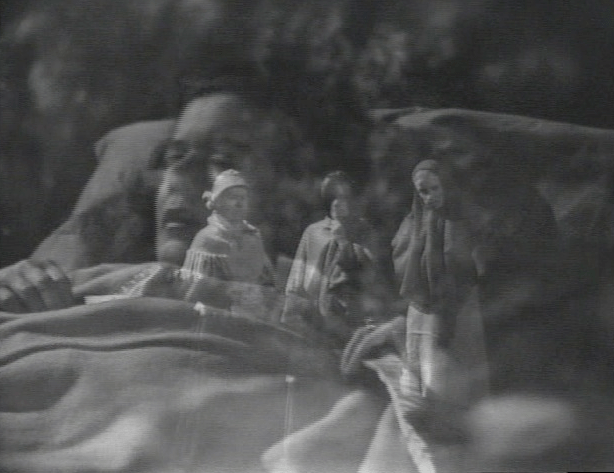
Back in his room, Trask goes to sleep. He has a dream. The dream sequence begins with an image reminiscent of pieces moving in a kaleidoscope.

Trask goes into a dream world. Screenshot by Dark Shadows Before I Die.

That kaleidoscopic pattern was part of a visual effect we saw when Dark Shadows was still set in 1967. That effect introduced scenes that took place in #347, #352, and #354, when mad scientist Julia Hoffman hypnotized Vicki and took her to the Old House at Collinwood. At Collinwood, Barnabas’ helper Carolyn spotted Julia and Vicki, putting Julia in great danger.

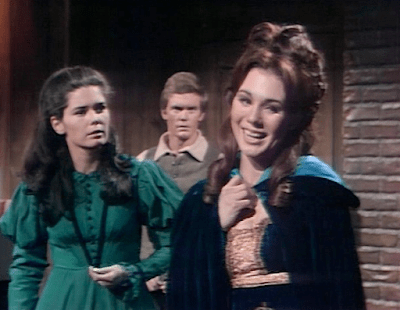
The echo of those episodes is startling coming on the heels of the scene we just saw, in which Millicent figures as a student of the countess. Julia and the countess are both played by Grayson Hall, and Millicent and Carolyn are both played by Nancy Barrett. The relationships between their characters are different now, shifted as the colored pieces shift in a turning kaleidoscope. But remembering those earlier episodes, we might remember that what is seen in a semiconscious state might be a message sent to manipulate and deceive, and we certainly remember that people who go to the Old House are in danger from Barnabas.

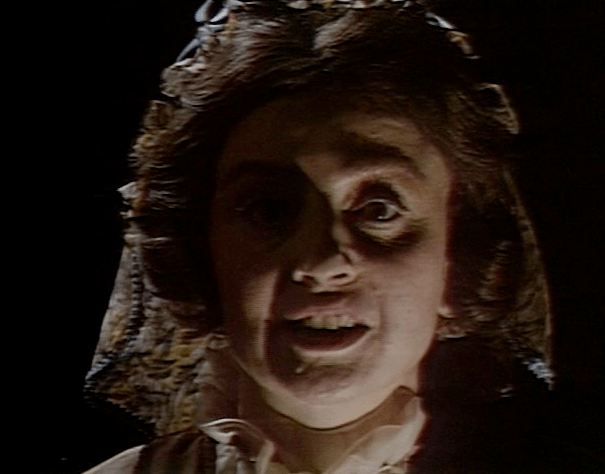
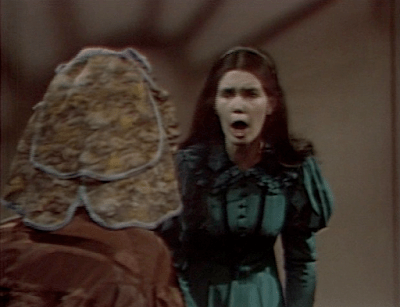
Trask’s dream brings him face to face with the ghost of Maude, accusing him of having her remains dumped in the sea, so that she cannot rest. She predicts that everyone will learn that her dead body was in his bed. He denies both her accusation and her prediction, but does not convince either her or himself.

The ghost of Maude tells Trask the score. Screenshot by Dark Shadows Before I Die.

Another ghost then appears. It is that of Trask’s great supporter, repressed spinster Abigail Collins. Trask tries to tell Abigail that he is innocent of Maude’s charges, but she tells him she has no idea what he is talking about. She wants to tell him that there is a great evil he must destroy. Trask has a vision telling him the evil is lurking in the Old House. He resolves to go there.

All of the acting is excellent in this one. That’s no more than we would expect from most of the cast members we see today, but Vala Clifton’s two turns as the living Maude were pretty bad, so that it is a pleasant surprise that she is so good as Maude’s ghost. The physical space gives her a hard job. She is standing a very few feet in front of Jerry Lacy with only a couple of wispy stage decorations indicating that she is separated from him, but she strikes a pose and maintains a degree of stillness that really does create the sense that she is speaking to him from another realm. She also manages to keep up an ethereal quality while making it clear that Maude is determined to be avenged. I wonder what her first appearances would have been like if she had had more time to rehearse. If they had been as good as this one, Ms Clifton and Maude would be among the more fondly remembered parts of the eighteenth century segment.
Episode 436: Thin air

Bewildered time traveler Vicki Winters is on trial for witchcraft, and it is not going well. Her lawyer/ gaoler/ boyfriend/ whatever else they don’t have the budget to hire another actor to play, an unpleasant young man named Peter, says that he wants the judges to see her as he does, as “a lovely girl who isn’t capable of witchcraft or anything else.” Unfortunately, Peter is right about Vicki’s capabilities- ever since she came unstuck in time and found herself in the year 1795, Vicki hasn’t done a thing worth mentioning.

Later, Peter catches up to much put-upon servant Ben Stokes. He persuades Ben to take him to the unmarked grave of wicked witch Angelique. Peter digs up the grave, but Angelique isn’t in at the moment, and there is no place to leave a message. Peter goes back to Vicki’s gaol cell and tells her that she may as well take the stand at her trial and tell the judges that she is a refugee from the 1960s.

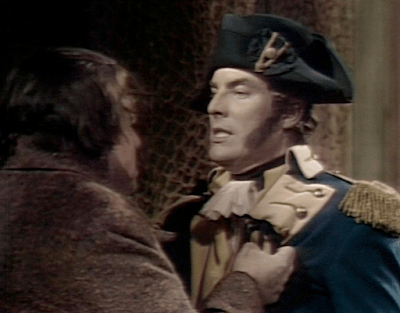
In between these scenes, untrustworthy naval officer Nathan Forbes finds Ben and tries to pay him for information about a man who was once their mutual friend, Barnabas Collins. Ben indignantly refuses the money. When Nathan keeps trying to talk him into it, Ben handles him roughly, then stalks off.

Ben shows Nathan he is not for sale. Screenshot by Dark Shadows Before I Die.

This exchange will be of some interest to those who have been watching Dark Shadows from the beginning. Nathan is played by Joel Crothers, who in the parts of Dark Shadows set in the 1960s plays hardworking young fisherman Joe Haskell. In #3, hard-charging businessman Burke Devlin found Joe and tried to pay him for information about the Collins family. Joe indignantly refused the money.

It’s interesting to see Crothers reprising the situation, playing the opposite role. Burke had poured on a heavy display of oily charm in response to Joe’s quiet stiffening, telling a rather alarming story about the beginning of his rise to wealth and inviting Joe to adopt him as a father figure. By contrast, Nathan retreats rather quickly in response to Ben’s angry outburst, but then rephrases the offer in a hale and hearty tone, trying to assure Ben that he sees him as an equal and wants to be his buddy.

Neither Burke nor Nathan gets anywhere with his persistence, but each man’s approach is typical of him. As a man born into the working class of Collinsport who became a millionaire, Burke proceeds from an ironclad certainty that every wage earner in town wants to follow his example. He cannot doubt that Joe will jump at the chance to take his money and his advice. As a self-involved navy officer, Nathan believes that enlisted sailors will be sincerely grateful to him if he acts like their friend, and extends that belief to include governesses, ladies’ maids, bartenders, streetwalkers, indentured servants, and everyone else he sees as his inferior.

Ben’s angry response to Nathan’s proposition also echoes the early days of the show. When Dark Shadows was set in 1966, Thayer David played violently irritable handyman Matthew Morgan. When Ben lunges at Nathan today, he is the very image of Matthew lunging at Burke in #64. But where Matthew had to be restrained by bystanders and threatened by the sheriff before he settled down, Ben quickly backs off.

The contrast between Matthew and Ben goes to the heart of the eighteenth century flashback. Each is a formidable fighter. Each is excessively devoted to a member of the Collins family, Matthew to reclusive matriarch Elizabeth Collins Stoddard, Ben to Barnabas. Each lands himself in trouble because of that devotion. But Matthew grew up in a Collinsport that had been laboring under a curse for many generations. He is unstable, irrational, dangerous. But for Ben, the curse just began a few months ago, long after his adult personality was fully formed. He is a sane man, and a good one. We can hope that he will emerge from Barnabas’ shadow and make a bright future. In that hope, we can see what the curse will cost not only the Collinses, but all the people of Collinsport.

Episode 435: No next witness

For the second Friday in a row, the identity of the actress delivering the opening voiceover ruins what is supposed to be the big surprise at the end of the week. Last Friday, we were supposed to be shocked when the ghost of gracious lady Josette appeared at the end, but when we heard Kathryn Leigh Scott at the beginning we knew she was coming. Today, we are supposed to be surprised that a phantom of wicked witch Angelique manifests at the trial of bewildered time traveler Vicki, but when Lara Parker gives the narration we know she will be along.

Until #274, all the opening voiceovers were delivered by Alexandra Moltke Isles in character as Vicki. From #275, other actresses would deliver them if Mrs Isles was not in the episode, and they were usually given in the third person. Mrs Isles lost her place as the show’s default narrator starting with #332, in which she appeared but which Grayson Hall narrated. Not until #459 will a man read the opening voiceover. Vicki and Angelique are both in this episode; Mrs Isles does sound like she has a cold, but surely it would be better to have her deliver the introduction even if she were struggling than it is to spoil the surprise by giving it to Parker.

Angelique shows up at Vicki’s trial to undercut a witness for the defense. Much put-upon servant Ben Stokes, once Angelique’s unwilling catspaw, has testified that he knows Vicki is not a witch, because he saw Angelique casting the spells for which Vicki is being blamed. He explains to the court that he went along with Angelique because he was himself subject to one of her spells. When he is asked why he is free of her power now, he finds himself in a tricky position. Ben knows that Angelique is dead. Barnabas Collins killed Angelique when he realized she had turned him into a vampire, and as Barnabas’ loyal friend Ben buried her body. Ben doesn’t want to expose Barnabas, so he can’t tell that story. He says that he supposes that he is free of her because she “went away.”

Angelique materializes outside the courtroom and enters. Shocked to see Angelique, Ben points at her and shouts that she is dead. She takes the stand as a witness for the prosecution and recaps some plot points from the episodes where Vicki was arrested. Everything she says is true, and she shows no animus towards Vicki, but her appearance both discredits Ben and adds to the case for the prosecution. She leaves the room and dematerializes. When everyone is gone, she rematerializes and laughs merrily.

Angelique takes satisfaction in a job well done. Screenshot by Dark Shadows Before I Die.

When Angelique was alive, she never took much interest in Vicki. It wasn’t even her idea to frame Vicki for her crimes- Vicki stumbled into the witchcraft charge by her own foolish behavior, and Angelique just helped the prosecution along a couple of times. So it is a bit odd that she bothers to come back from the dead, however briefly, to ensure Vicki’s conviction. No doubt we are supposed to think she is doing it because Barnabas wants Vicki to be acquitted, and she wants to deny Barnabas any happiness. But a more intriguing interpretation is possible. In a comment on Danny Horn’s post about this episode on Dark Shadows Every Day, “Jason” writes:

I don’t really understand the confusion over Angelique”s motive. This Angelique is from the future. She knows that Barnabas is in love with Victoria in 1967. In fact I would argue that is the entire reason Vicki went back in time. Angelique orchest rated it to get rid of Vick either as part of curse or to get Barnabs when she return’s to 1968.

Comment by “Jason,” left at 12:30 AM Pacific time 10 September 2019 on Danny Horn, “Episode 435: Next Stop Kansas,” Dark Shadows Every Day

This idea was enlarged in a followup comment, apparently by the same person:

The reason it has to be Angelique from the future is this never happened the first time. So obviously thI’d Angelique is from the future. The only way this storyline makes sense!

Comment by “Jas,” left at 12:36 AM Pacific time 10 September 2019 on Danny Horn, “Episode 435: Next Stop Kansas,” Dark Shadows Every Day

When Vicki went back in time in #365, the ghost of Barnabas’ little sister Sarah was speaking through her at a séance, saying that she ought to “tell the story from the beginning.” In the months leading up to that episode, we had seen that Sarah was the face of an enormously powerful complex of supernatural phenomena, so it made sense that she would be the one to rend the fabric of time and space and turn the show into a costume drama set in the late eighteenth century. But we won’t be seeing Sarah again, not least because the actress isn’t ten years old anymore and ghosts aren’t allowed to grow up. So we’re going to tend towards other ways of thinking about the temporal disruptions. Angelique can stick with the show for the long term, and she’s already been built up as the biggest of all the Big Bads. So “Jason’s” theory is likely to become more appealing as we go.

Episode 433: Quite enough bickering

Today is taken up with the witchcraft trial of bewildered time-traveler Victoria Winters. That is to say, the actors stand around the courtroom set and shout random nonsense at each other until it is time for the closing credits.

Two of the good actors whose talents are wasted in this episode. Screenshot by Dark Shadows Before I Die.

The only line of dialogue that made an impression on me was Vicki shouting “That’s! Not! TROOOO!” when untrustworthy naval officer Nathan Forbes was on the stand falsely accusing her of something or other. In the first months of the show, Vicki often shouted that to strange and troubled boy David, usually in response to David saying something that the audience knew was perfectly true. In those days, the show’s slow pace and its focus on the budding friendship between Vicki and David gave Alexandra Moltke Isles and David Henesy a chance to overcome the crummy writing of their scenes together and show us what it looks like when two people learn to trust each other. But the part of the show set in the late eighteenth century moves at a rapid clip, and nothing human is at stake in the witchcraft trial. So when we hear another “That’s! Not! TROOOO!” this time, we miss the days when Mrs Isles was in a position to rescue us from the writers’ delinquencies.

When Nathan makes his entrance, we hear some music I don’t believe we have heard before. Christine Scoleri of Dark Shadows Before I Die identified it as a piece that it is on Dark Shadows: The Soundtrack Music Collection as “Cue 157: Dramatic Curtain.” It doesn’t fit the situation. It’s a busy little tune, suggestive of fidgety nervousness. It’s true that the whole trial is just so much fidgeting on the part of the show, but the background music really isn’t the place to complain about that.

Episode 427: I object

The opening voiceover melds into a sequence in which we cut back and forth between repressed spinster Abigail Collins and the fanatical Rev’d Mr Trask standing in front of black backgrounds, looking directly into the camera, and declaring that the trial of bewildered time-traveler Vicki for witchcraft must begin at once.

Soap Opera Land famously does not observe the legal codes that prevail elsewhere. If that is going to bother you, you probably aren’t in the right frame of mind to enjoy the show at all. But there is an art to depicting a fictional trial. You can deviate as much as you like from the rules that prevail in the real world, but there have to be some kind of rules the audience can understand. We can either see those rules applied with the result that a disorderly world is reduced to order, or see them flouted so that our heroes’ hopes of justice are cruelly dashed. If we aren’t aware of any rules, there is no point in setting the play in a courtroom.

That’s the first problem with Vicki’s trial. Now and then her lawyer/ gaoler/ boyfriend/ etc Peter will object to some question or move that a statement be stricken, and once or twice the judges will agree with him. But they are just as likely to respond to identical protests by ordering him to stop interrupting. The witnesses respond to questions with extended free association sessions. Vicki herself interrupts testimony repeatedly, usually to make self-incriminating remarks, and no one tries to stop her. Trask is for some reason simultaneously the prosecutor and one of the witnesses. Opposing counsel periodically engage in shouting matches with each other while the judges watch. The whole thing is so chaotic that it may as well be taking place in a bar-room or at the county fair or on the waterfront after dark.

The second problem with the trial is that it requires Peter to raise his voice repeatedly. Actor Roger Davis can deliver dialogue more or less competently when he is speaking in a normal conversational tone, but his loud voice always tends toward an ugly snarl. This is a major limitation for any performer on a show as shouty as Dark Shadows, but the opposition of Peter to Trask puts Davis head to head with Jerry Lacy, who is a virtuoso of shouting. Next to Lacy’s, Davis’ shouting is not recognizable as a performance.

When I’m watching a scene on Dark Shadows that suffers because of an actor’s shortcomings, I sometimes try to make it bearable by imagining what it would have been like had someone else who may have been available for the part been cast instead. Harvey Keitel was an extra on the show in #33; no doubt he would have accepted a speaking part if offered. Roger Davis plays Peter as a deeply angry man, and Mr Keitel is one of the very best at making audiences empathize with such characters. So it’s interesting to try to picture him as Peter.

On the other hand, there’s nothing in the scripts that requires Peter to constantly seethe with barely contained rage. That was Mr Davis’ contribution. Had the show gone with a more amiable Peter, they might have been able to cast Frederic Forrest in the part. In #137, Forrest was a background player. While Forrest played his share of angry men over the years, he also excelled as goofily cheerful characters, most famously as Chef in Apocalypse Now. I would have liked to see Peter played that way. I think he would have had some real chemistry with Alexandra Moltke Isles’ Vicki, and that we would have had protective feelings for him as he went up against the formidable Trask.

There is a third problem with the trial that neither Harvey Keitel nor the late Frederic Forrest could have done any more with than could Mrs Isles. That is that Vicki and Peter are written as phenomenally stupid. Vicki hasn’t done a single intelligent thing since arriving in the late eighteenth century in November,* but she has become, if anything, even dumber since 1795 gave way to 1796. Peter’s behavior has also been deeply foolish, and today he hits rock bottom when he blurts out to the court that he abused his position as gaoler to help Vicki sneak out, to commit a burglary at the great house of Collinwood, and to steal evidence against her so that it could not be presented to the court. Even under Soap Opera Law, that’s three felonies.

Some claim that the phrase “Dumb Vicki” is ableist. I disagree. “Dumb” really does not mean “mute” anymore, so that using it isn’t ableist against people who do not have the power of speech. And the intelligence characters like Peter and this version of Vicki lack is not the intelligence that IQ tests are supposed to measure. One of the most interesting characters in the part of Dark Shadows set in the eighteenth century is fluttery heiress Millicent Collins, who would probably fall far short of a triple digit score on a Stanford-Binet scale, but whose behavior makes sense to us because we tell what she wants out of life and how she thinks her actions will help her get it. That’s really all we mean when we talk about a “smart character.” A well-crafted story about someone with profound developmental disabilities can depict that person as a smart character, in that sense, as easily as can one about a great sage or a brilliant scientist. Vicki and Peter are not smart characters, no matter how what kind of school we might suppose would best suit them as students, because there is nothing for us to learn by observing their behavior and no suspense as to what their several actions will add up to. They just do one damn thing after another.

Clarice Blackburn and Jerry Lacy do some fine acting today, as does Grayson Hall in a brief turn as the Countess DuPrés. The pre-title bit with Blackburn and Lacy in front of the black backgrounds is so specific to theater in the 1960s that I can’t help but smile at it, but I’m glad it’s there. It isn’t as though you could ever really forget that the show is 56 years old, and I like to see that they preserved something that would have been so typical of the off-Broadway productions that would have been such a big part of the working lives of the cast and other creatives in those days.

*In her testimony today, Abigail gives the dramatic date of Vicki’s arrival in the past as 12 October 1795. The episodes in which the events she describes happened were broadcast on 17 November and 20 November 1967. In the last few weeks, the show has explicitly told us that the day and month of the dramatic setting in 1796 is the same as the broadcast date in 1968, so it’s confusing.

Episode 425: Widows’ Hill

In episode #2 of Dark Shadows, well-meaning governess Vicki first visited the precipice known as Widows’ Hill. She was standing near the edge when high-born ne’er-do-well Roger Collins crept up on her, breaking his silence with a loud voice in a deliberate attempt to startle her. He tells her that she wouldn’t be the first to jump to her death from Widows’ Hill. The precipice is thus established as a place of danger.

Roger surprises Vicki atop Widows’ Hill.

In #5, Vicki again stood atop Widows’ Hill, and again a man she had never met startled her there. He was drunken artist Sam Evans, and he told Vicki the story of Josette Collins, a grand lady of a previous century who leapt to her death from the cliff.

In the same episode, strange and troubled boy David Collins mentions the ghosts of “The Widows” to Vicki. Later, we will hear that these are the ghosts of women who jumped to their deaths from Widows’ Hill at various moments in the nineteenth century. In #12, we will learn of “The Widows’ Wail,” a peculiar sound that can be heard in the wind around Widows’ Hill on nights when the ghosts of these sad women are restless. We will hear the Widows’ Wail several times, most effectively in #344, when Vicki is trying to talk her depressing fiancé Burke out of going on an airplane journey from which he will never return, leaving her a widow before she can become a bride.

The association of Widows’ Hill with deadly danger is reinforced in #50, when Vicki and heiress Carolyn look down from it and see the corpse of beloved local man Bill Malloy on the rocks below.

Bill in the water, as seen from the precipice of Widows’ Hill. Screenshot by Dark Shadows Before I Die.

In #75, we hark back to Vicki’s first meeting with Roger. Vicki finds Roger standing on the spot where she had stood when he startled her in #2. She reenacts that scene with the roles reversed. He exclaims angrily that she might have caused him to fall; she reminds him that he had done the same to her. He laughs happily and apologizes. They have a sweet little moment together after that, but his protest shows that she really was in danger then, and that she is none too safe now.

The death of Bill set off a series of events that ended with crazed handyman Matthew Morgan abducting Vicki, holding her bound and gagged in the Old House on the estate of Collinwood, and bringing an ax with the express intention of chopping her head off. At the last moment, he is stopped from decapitating Vicki by the manifested ghosts of Josette, the Widows, and Bill. When Bill appears with Josette and the Widows, it ceases to matter that he died somewhere else and only washed up below Widows’ Hill. Thereafter he is joined with them, and like their deaths, his death belongs to that place.

The Dead of Widows Hill confront Matthew. Josette manifested earlier in the episode, and is represented here by her portrait above the mantel. Screenshot by Dark Shadows Before I Die.

In #266, the Widows briefly reemerged from the supernatural back-world implicit in the action into the story, this time associated with a malign intention towards the characters. Reclusive matriarch Liz heard their voices luring her to throw herself off Widows’ Hill. We haven’t heard about them since then.

Liz dreams of the Widows, calling her to join them. Screenshot by Dark Shadows Before I Die.

Josette’s ghost was central to the action from #126 to #191, when she and Vicki together protected David from his mother, undead fire witch Laura Murdoch Collins. That Laura posed a danger to David was not clear to the characters in #139 and #140, when Laura startled David while he was at the edge of the precipice on Widows’ Hill. Vicki rescued him, then urged him to go to his mother. 

Vicki rescues David. Screenshot by Dark Shadows Before I Die.

In #185, Sam and Vicki visited the Old House, the seat of Josette’s power. Sam saw the portrait of Josette that hangs over the mantel. He asked if she was “the lady who went over the cliff.” Again, we join the image of Widows’ Hill with the concept of danger and the role of David’s protectress. Sam and Vicki came to the Old House to hold a séance. Josette speaks through Vicki at séances, suggesting that in sharing her role with regard to David, Vicki’s personality is coming to merge with that of Josette.

In April 1967, vampire Barnabas Collins succeeded Laura as Dark Shadows‘ resident supernatural menace. Barnabas was too dynamic an adversary for wispy presences like Josette and the Widows to oppose. In #212, he went to the Old House and told Josette’s portrait that her power there was at an end. In #223 and #240, David lamented that the family had lost its tutelary spirit.

With that, Josette ceased to be an active presence. She lost the role of David’s protectress, and with it her link to Vicki. But Josette is still an important element of the show. Instead of a guardian who intervenes in the story, she becomes the object of Barnabas’ obsession. Instead of a companion who acts with Vicki, speaks through her, and inspires her devotion, she becomes Barnabas’ motivation to victimize women, Vicki perhaps to be among them. Vicki’s personality may yet be replaced, not by a merger with Josette’s spirit, but by Barnabas’ insane plan to find a woman he can brainwash into becoming a facsimile of his long-lost, long-dead love.

The transformation of Josette from an active presence to the object of Barnabas’ delusions revolves around Widows’ Hill. In #233, Barnabas tells Vicki and Carolyn a story about Josette’s fatal leap. He says that she threw herself off the cliff to escape a lover with whom she quarreled there. Vicki was a bright person in those days, and she figured out that the lover must have been Barnabas Collins. She believes the Barnabas in question to have been the ancestor of the one she knows, but of course it is the man himself, as he was in that previous century. When Barnabas realizes that Vicki has picked up more information than he intended to disclose, he reacts apprehensively, and seems as if he is thinking about killing her. Barnabas would revise the story of Josette’s death many times, most notably in #345, when told it while standing on Widows’ Hill with his associate, mad scientist Julia Hoffman.

At the end of #365, the visible foreground and the implicit back-world traded places when Vicki came unstuck in time and found herself in the late eighteenth century. When she first arrived in the year 1795, Barnabas and Josette were living beings, as was Barnabas’ little sister Sarah, whose ghost haunted Collinwood in 1967. Sarah is dead and gone now; Barnabas is dead, but as a vampire he is not at all gone. He’s been sucking Josette’s blood, and today he plans to kill her so that she can rise as his undead bride.

Barnabas became the star of Dark Shadows and turned it into a hit with his efforts to scam everyone into believing that he was a living man native to the twentieth century. When Vicki first found herself in 1795, we may have hoped to see her running an equally suspenseful con game. But the show hasn’t given her any such thing to do. Instead, she flailed around helplessly. Lately, she’s taken to telling everyone how and when they will die. That has led to her imprisonment on charges of witchcraft. She told Josette and her aunt, the Countess DuPrés, that Josette would throw herself to her death off Widows’ Hill. The countess has been trying desperately to keep Josette off the hill, and Barnabas doesn’t want her to go there either. But the ghost of wicked witch Angelique tricks her into going there tonight.

Barnabas realizes what has happened. He races to Widows’ Hill. He sees Josette there. Angelique causes Josette to see a gruesome image of a vampiric version of herself, and brings it home that it reflects Barnabas’ plans for her. Barnabas approaches; terrified, Josette flees, and goes over the cliff.

Bride to be. Screenshot by Dark Shadows Before I Die.

For a scene that we’ve been hearing about for all 85 weeks Dark Shadows has been on the air, Josette’s death is not very impressive visually. Since they are going to pan from Josette and Barnabas over to the ghoul version of Josette, they have to put the camera very close to the action. The whole sequence also has to be in a low contrast color scheme for the ghoul version to have its effect. The tight frame and the drab palette make it impossible to create an illusion of space, leaving Jonathan Frid and Kathryn Leigh Scott looking like a couple of people monkeying around in a tiny television studio. At times we see so little of the set that it is not clear what’s happening. We don’t even see the edge of the cliff, blunting the effect of the climactic fall.

The introduction of the living Josette to the ensemble during the 1795 segment reduced the character’s importance in the show’s mythology. That is not any reflection on Miss Scott’s performance, or even of the scripts she had to work with or the direction she had to follow. It is the consequence of the whole idea of supernaturalism. To accept the idea of the supernatural is to believe that what seems to be weak is in fact strong. The dead, to all outward appearances, would seem to be utterly powerless, and the living would seem to have a monopoly on the means of making things happen in the world. But phantoms and revenants and zombies and vampires and the rest are supposed to have overwhelming advantages that we can defeat only by precise application of knowledge that only the rarest sort of people have. Likewise, people who are disadvantaged by the social order of the visible world are supposed to have access to powers in the supernatural realm that leave even the most eminent people at their mercy. So servant girl Angelique brought lofty aristocrats Barnabas and Josette to the very lowest of positions.

As a living person, Josette is charming, kindly, and beautiful. But she is not at all forceful. She cannot be. If she were, her ghost could not have gained the potency it would have in the 1960s. Our acquaintance with the living Josette has been a long anticlimax to the tales of her sovereign haunting of Collinwood. Her death scene is an anticlimax to that anticlimax. Widows’ Hill itself will continue to be a place of danger and death, but Josette will no longer be its patroness in the way she was before this episode.

Episode 421: A series of prepared speeches

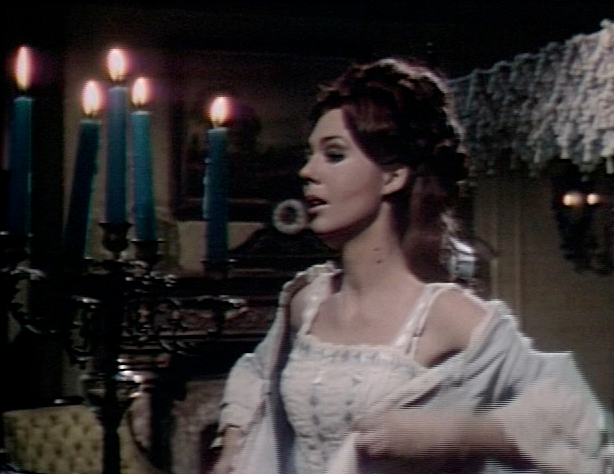
The Countess DuPrés (Grayson Hall) complains to her niece, gracious lady Josette (Kathryn Leigh Scott,) that life on the great estate of Collinwood is nothing but “a series of prepared speeches.” It’s hard to top that for commentary on this episode, but I do have a couple of things to add.

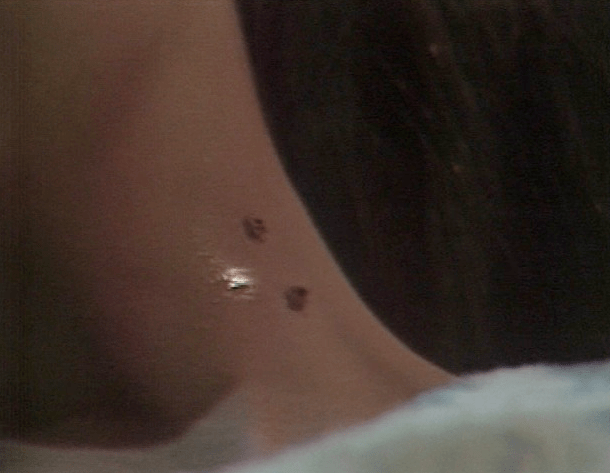
Josette has been seeing her lover and onetime fiancée, the late Barnabas Collins. Since his death, Barnabas has become a vampire. On Friday, he bit Josette. Now, she is trying to conceal her neck wounds from her aunt.

Josette, her neck wounds visible. Screenshot by Dark Shadows Before I Die.
These wounds are a single piece of makeup. Kathryn Leigh Scott still has it, she showed it in a Dark Shadows cast reunion on Zoom in 2020. The other cast members didn’t know why she wanted it any more than I do. Screenshot by Dark Shadows Before I Die.

Those who have been watching Dark Shadows for a while will find this story all too familiar. Until #365, the show was set in contemporary times, 1966 to 1967. Since then, it has been set in the years from 1795 to 1796. In the segments set in the 1960s, Miss Scott plays Maggie Evans, The Nicest Girl in Town, and Hall plays mad scientist Julia Hoffman. Maggie was Barnabas’ victim in May and June of 1967, and after she escaped from him, Julia was her psychiatrist. The countess is different enough from Julia that Hall has a lot of room to maneuver. But there are only so many ways an actor can convey the idea that her character is in a daze and alternately blissful and defensive. So Miss Scott winds up recycling the performance she gave as Maggie, and the result is pretty stale.

We traveled back to the 18th century with well-meaning governess Vicki. Vicki has not in any way adapted to her new environment, with the result that she is now in gaol on charges of witchcraft. When the countess visits her today, Vicki tells her that she is from the 1960s and that in that period she had learned from history and legend that a grim fate awaits Josette. The countess concludes from Vicki’s presentation that she is indeed a witch, and that she is not giving her warnings, but is cruelly gloating over the evil spells she has cast.

Vicki is accompanied by her gaoler/ defense attorney/ boyfriend, Peter. Peter had tried to stop her blabbing to the countess, and asks her why she did it. Vicki says that she is counting on the idea that if she keeps telling the truth, people will have to believe her. Peter asks her to think of how she would react if someone from the 21st century traveled to 1968 and went around telling everyone how and when they were going to die. At this, Vicki’s eyes widen. “Oh, Peter, what a fool I’ve been!”

At that, we can hear the sound of the viewing public giving up on Vicki once and for all. Peter isn’t even the first person to try to explain her situation to her. Both kindly gentleman Jeremiah Collins and caddish naval officer Nathan Forbes gave her explicit instructions about her need to lie and scam her way through her predicament, and neither of them made any impression on her. Movie reviewer Roger Ebert famously described stories that work only because the characters do things the average member of the audience would be too smart to do “idiot plots”; for the last eleven weeks, Vicki has been the Designated Dum-Dum at the heart of the most irritating idiot plot imaginable.

There actually is a very sweet little scene between Vicki and Peter right after that low point. She tells him about airplanes and other features of twentieth century life, and he tries to figure out what she’s talking about. Almost all of the anger we feel towards Vicki for being written so badly and towards Peter for being played by Roger Davis melts away by the end of that scene.

Episode 415: Sarah Collins

Sarah dies. Screenshot by Dark Shadows Before I Die.

When Dark Shadows first aired in June 1966, it kept hinting that behind the action we saw there was a back-world of supernatural presences some of whom might eventually interact with the characters. Often these hints occurred in conversations between a character native to the village of Collinsport and newly arrived governess Vicki. The local would use the word “ghost” metaphorically to refer to unresolved conflicts around the estate of Collinwood, Vicki would shriek “You don’t mean you believe in ghosts!?,” and the other would say that he damn well did believe in ghosts and that if Vicki stuck around long enough she would, too.

The first ghost whose name we heard was Josette, mentioned in #5 as a grand lady from France who came to town to marry Jeremiah Collins, was unhappy with him, and threw herself to her death from the precipice known as Widows’ Hill. Josette manifested herself on camera in #70 and rescued Vicki from murderous groundskeeper Matthew Morgan in #126. In that climactic encounter, we saw Josette and a group of other wraiths. Joining the ghosts of women who jumped from Widows’ Hill at various points in the 19th century was the ghost of Bill Malloy, who had been a living character in the first ten weeks of the show and had shimmered into view as a ghost and sang a song in #85. This assemblage suggests that the spectres haunting Collinwood know each other and act with a common purpose at least occasionally.

The first supernatural menace to appear on the show was undead fire witch Laura Murdoch Collins, mother of strange and troubled boy David. Josette warned several characters of the threat Laura posed to David. Josette herself was unable to fight Laura directly. In #165, she manifested in the room where Laura held the sleeping David, but had to retreat when Laura ordered her to go. Thereafter it was up to Vicki, advised by Josette, to organize the opposition to Laura. If #126 showed that the benevolent spirits can act together to defeat a threat from a mortal man, #165 and its aftermath showed that they must withdraw into the back-world when the enemy is of an uncanny nature.

In April of 1967, vampire Barnabas Collins succeeded Laura as the show’s new danger from beyond the grave. In #212, Barnabas went to the Old House at Collinwood, the place where Josette is most present, and told her portrait above the mantel that her power was at an end. In #223 and #240, Josette’s friend David felt her absence from the Old House and lamented that the family had lost its tutelary spirit. With that, we bid farewell to the wispy presences we had seen in #126. A vampire is too dynamic an adversary for them. It seemed for a period that the show had simplified its ontology- there are those who live by the laws of nature we know, there is Barnabas, and that is that.

That period ended in #255. Barnabas has passed himself off as a cousin from the Collins family’s long-lost English branch and settled in to the Old House. He is keeping Maggie Evans, The Nicest Girl in Town, as a prisoner in a barred cell in the basement. Maggie looks out her window and sees a little girl in 18th century garb sitting in the corridor. The girl is holding a doll and singing “London Bridge.” She does not respond to Maggie’s attempts to get her attention.

In the next several episodes, we learn that the little girl’s name is Sarah, that she has a big brother, and that she can’t find anyone she knows. Even if the closing credits hadn’t immediately given away the fact that she is the ghost of Barnabas’ little sister, we would be able to gather that she is a supernatural being who was pulled out of the back-world when Barnabas rose from the grave. For the next 22 weeks, Sarah keeps popping up in the world of 1967. We wonder what she will do next, when she and Barnabas will confront each other, and what other paranormal beings are waiting to erupt into the visible world.

In #365, the major characters held a séance to contact Sarah and ask her what she was trying to tell them. Sarah spoke through Vicki and said that she would not appear to them again. She also said that she wanted to “tell the story from the beginning.” With that, Vicki vanished from the table and a woman in an 18th century dress appeared in her place. The woman identified herself as Phyllis Wick, governess to Sarah Collins, and demanded to know where she was. Meanwhile, Vicki found herself in the year 1795, in Phyllis’ place. At a stroke, the back-world and the foreground are interchanged.

Now it is 26 January 1796, Sarah’s eleventh birthday. She is not having a happy one. Last night she found Barnabas in the family mausoleum with blood smeared on his face. She may not know that he has become a vampire, but she knows that something has gone horribly wrong with him. She runs off and hides behind a tombstone. By the time faithful servant Ben finds her and carries her home, she is severely weakened by exposure. She cannot speak, but mouths Barnabas’ name and looks distressed. Her mother Naomi and cousin Millicent keep vigil at her bedside.

Night falls; Barnabas rises again, and Ben tells him that Sarah is gravely ill. Barnabas resolves to visit her. Unable to talk him out of this plan, Ben offers to help him get into her room unobserved.

Ben relieves Naomi and Millicent, then ushers Barnabas into the room. Barnabas tries to reassure Sarah. Eventually she warms to him. She regains the power of speech, and with her first words she asks her brother to hold her. He does. She tells him she will always love him, then dies in his arms.

This is Sharon Smyth’s last appearance on Dark Shadows. As a child, she had some rather obvious limitations as an actress, a fact Sharon Smyth Lentz cheerfully acknowledges nowadays. During her first 22 weeks, she was playing a ghost, so there were many scenes where all she had to do was seem vague and detached and she could be effective. The story moved very slowly during that period, giving the writers and directors time to figure out her strengths. Near the end of it, she excelled in two scenes with a lot of dialogue. In #348 she had a complicated, serious conversation with heiress Carolyn Collins Stoddard, and in #364 she had her confrontation with Barnabas. Supported by Nancy Barrett and Jonathan Frid, she executed those scenes very well indeed.

In 1795, Sarah is alive and the plot moves at a breakneck pace. Under those conditions, it would have taken intricate advance planning to craft scenes that would have been in Sharon Smyth’s range. But the writers of Dark Shadows rarely had time to do any advance planning. When the show was moving slowly enough, they could usually hit all the major points the audience would expect to see, but there are some glaring omissions in 1795. Young Daniel Collins will be played by David Henesy, who also plays David Collins. Since the relationship between Vicki and David had been the core of the first 39 weeks of the show and the relationship between Sarah’s ghost and David had been one of the most intriguing elements of the 22 weeks she was haunting Collinwood, it is particularly disappointing that we barely see Vicki with Sarah and never see Sarah and Daniel together at all.

I first saw Dark Shadows on the SciFi Channel, as it was then called, in the 1990s. I saw a handful of episodes on random mornings when I happened to be off work. They whetted my curiosity about the show, but I left it to chance until I saw an episode with Sarah’s ghost. Then I decided to set my VCR and watch regularly until I found an explanation for what was going on with her. The whole idea of supernaturalism is that there are phenomena which defy explanation, so of course I never reached that point. Naturally, I got hooked on the show within a couple of weeks.

On his Dark Shadows Every Day, Danny Horn rather unfairly, albeit hilariously, griped that “Sharon stopped acting after Dark Shadows, or possibly during.” When she looks back on her days as a child actress, Mrs Lentz talks about how excited her mother was to meet show biz celebrities, and says that her main gratification was in pleasing her. But she has fond memories of many castmates, and says that her favorite person to run lines with was Jonathan Frid. So there is something sweet about her ending her time on the show in his arms.

Episode 413: So sad for such a long time

Sarah Collins is going to turn 11 two days from now, on 26 January 1796. Sarah misses her big brother Barnabas. She has been told that Barnabas has gone to England, and today her mother, Naomi, tells her that Barnabas may not be back for a long time, maybe not until Sarah is grown up. Sarah refuses to believe this. She insists that if she lights a candle in the window of the bedroom where Barnabas’ onetime fiancée, the gracious Josette, has been staying, Barnabas will “somehow know it’s there” and come home.

Naomi lies to Sarah.

Sarah is right to disbelieve her mother. On the orders of her husband, haughty overlord Joshua, Naomi is repeating a lie to conceal Barnabas’ death. Joshua believes that Barnabas died from the plague, and that if that word gets out the men won’t report for work at the family’s shipyard. In fact, Barnabas never had the plague. He died of a witch’s curse. As a further result of the curse, he is now a vampire. The last few nights, he has been snacking on the women who frequent the waterfront of the village.

Josette is out of town, so Sarah takes the candle to her room, meaning to leave it there as a surprise. Looking out the window, she sees Barnabas on the lawn, peering up. Sarah is excited to see her brother, and runs out of the house after him. He doesn’t want her to know what has become of him, and runs off.

Barnabas on the lawn.
Sarah spots Barnabas.

Seconds after she exits the front door, Sarah is in the cemetery. It has been established many times that this cemetery is miles from the house; earlier in this very episode, Barnabas’ helper Ben visited him in his tomb there, and made it clear he had plenty of opportunity to shake anyone who might be following him as he journeyed there from the house. This inconsistency bothers a lot of people, but I kind of like it. We got to know Sarah as a ghost in 1967, and she was at the center of a number of very intriguing surrealistic sequences. She’s alive now, but the whole situation is so bizarre that it only seems right she moves as she would in a dream. Watching the scene this time, I was surprised- I had remembered the set behind Sarah being blurred as she ran and some other visual effects that would have presented it as an eldritch moment, but none of those was actually there.

The episode ends with Sarah in the outer part of the tomb, near the secret panel behind which Barnabas’ coffin is hidden. She is calling out to him. We have been warned that Sarah will die on her birthday as a result of exposure; when Barnabas does not come to her, she complains of the cold, and we end on an ominous note.

Sarah in the mausoleum.

When Sarah sees Barnabas standing on the lawn, we echo earlier phases of Dark Shadows. We often saw characters looking out that window during the first 73 weeks of Dark Shadows, when the dramatic date was 1966 or 1967 and the room was occupied by well-meaning governess Vicki. We also saw Barnabas peer up at Vicki’s window from the lawn several times. The first time was at the end of #214, when the camera stuck with him so long we wondered if he really was a vampire and not just a garden gnome.

The closing shot of #214, set in 1967. Compare with the image of Barnabas on the lawn above.

Barnabas’ penchant for staring at windows in turn echoed his predecessor as the show’s supernatural menace, undead fire witch Laura Murdoch Collins. As ten year old Sarah Collins looks out a window and sees her big brother Barnabas looking up at her from the lawn today, so in #134 did another child of the same age, strange and troubled boy David Collins, look out a window and see his mother Laura looking up at him from the same lawn.

Vicki is in this episode. Sarah’s ghost yanked her here from November 1967 so that she could “tell the story from the beginning.” It isn’t so much Vicki who has been getting the story as it is the audience. Vicki is left out of most of the key developments; in particular, she has no clue Barnabas is a vampire. She has done such a poor job of fitting into her new environment that even though witchcraft laws had been repealed throughout the English-speaking world sixty years before, the village of Collinsport has brought them back just for her. She is in gaol, and from there has continued to find ways to make her situation so much worse that she is now all but certain to be hanged.

Today, Vicki asks for Naomi to visit her in the gaol. Barnabas and Ben are the only ones who know who the witch really was, but neither of them is in a position to talk to the authorities and clear Vicki’s name. Naomi and Sarah are the only other people who believe that Vicki is innocent. Vicki tells Naomi that she has a book printed in the twentieth century that tells her Sarah will die of exposure on her eleventh birthday. In response, Naomi looks at her in wonderment and says that she is starting to believe she really is a witch. Vicki dismisses that topic, and pleads with her to keep Sarah indoors for the next few days. Naomi agrees to do so.

Vicki’s warnings not only make Naomi suspect that the charges against her are true; it is because Naomi is not home that no one stops Sarah running out and getting stuck in a cold place. I suppose there is meant to be a dramatic irony in seeing Vicki bring about the very disasters she is trying to prevent, but the character’s foolishness throughout the whole segment set in the late eighteenth century blunts that irony.

If we saw a smart person operating at the top of her form and still causing a series of calamities, we might have a sense of tragic inevitability, a feeling that the course of history cannot be changed whatever we do. But Vicki has not been that person. Movie reviewer Roger Ebert famously called stories that depend on the characters doing things the average member of the audience would be too smart to do “idiot plot.” For all the strengths of the 1795 segment, there is an idiot plot at the center of it, and Vicki is the Designated Dum-Dum. That undercuts the arc and destroys the character.

Episode 412: The book

For the first 39 weeks of Dark Shadows, well-meaning governess Vicki was the main protagonist. Her understated, sometimes diffident manner fit with the pace and themes of the show in that period. When the show introduced its first supernatural villain, undead fire witch Laura Murdoch Collins, Vicki rose to the occasion and led the opposition to her. When Laura went up in smoke, the last of the themes that made Vicki a suitable lead went with her. Vicki remained our chief point-of-view character for some time after that, but she didn’t find much footing in any of the stories. She receded steadily from center stage for months.

In November 1967, Vicki came unstuck in time and found herself in the year 1795. At first this seemed to be an opportunity for a reset, but Vicki wound up being written in the time-travel story as a complete moron. She kept yelling at the other characters that they were being played by actors who had other parts in the first 73 weeks of the show, refused to take advice from people who tried to explain how she could fit in with her new surroundings, and insistently held onto possessions that eighteenth century people would take as evidence that she was evil. Now she finds herself in gaol, accused of witchcraft and facing a possible death sentence.

The other day, the gracious Josette visited Vicki in gaol and begged her to lift the spell that had brought a terminal illness on the gallant Barnabas Collins. Unable to persuade Josette that she was not a witch, Vicki told her that she had come from the future and brought with her a book about the history of the Collins family printed in the twentieth century. She told Josette where to find this book. When she did find it, Josette was more convinced than ever that Vicki was the witch.

Now, Barnabas has died. Josette visits Vicki again, and vows to do whatever she can to see that she is hanged. Josette is so distraught over Barnabas’ death that she quite calmly says she may want to take her own life soon, but she does look forward fondly to testifying against Vicki and seeing her execution.

Josette takes consolation in the idea that she will help get Vicki sentenced to death. Screenshot by Dark Shadows Before I Die.

After Josette leaves, Vicki asks her gaoler/ defense attorney/ prospective boyfriend Peter to sneak her out of the gaol. She wants to go to Collinwood and steal the book back.

Evidently Peter is no brighter than Vicki, because he agrees to this plan. Vicki goes to Josette’s bedroom. As we might have expected, Vicki is seen in the room- Josette’s aunt, the Countess DuPrés, opens the door and finds her with the book in her hands. By the time the countess returns with Josette and the witch-hunting Rev’d Trask, Vicki and the book are gone. This will be Vicki’s own bedroom in 1967, and she knows of a secret passage leading out of it. The other three do not know of this passage, and no one in 1795 knows of any reason Vicki would be aware of it. So far as they know, she has appeared and disappeared by magic.

Back in the gaol, Peter locks Vicki in her cell and hides the book in his desk. Trask and the ladies knock on the door and demand to see Vicki. Peter swears that she has been in her cell all night. Josette is concerned that they no longer have the book, but Trask says they don’t need it- only a witch can be in two places at once. Peter’s statement will suffice to put Vicki’s neck in the noose.

As of this writing (18 January 2024,) four of the five actors in this episode are still alive. Only Grayson Hall is no longer with us; she died in 1985. Hall’s countess, like Kathryn Leigh Scott’s Josette and Jerry Lacy’s Trask, is a lot of fun to watch. Vicki is so brainless that the part defeats Alexandra Moltke Isles, and Roger Davis is never an agreeable screen presence. So we wind up cheering on the people who want to put the heroine to death and hoping that her love interest joins her on the gibbet.