Episode 142: Firelight is not for looking closely

A few times in the early months of Dark Shadows, writers Art Wallace and Francis Swann found themselves in a corner. The story could move forward only if a character took a particular action, but they couldn’t come up with a reason to explain why any character would take that action. So they had the character do whatever it was simply because it was in the script, and hoped the actors or director or somebody would come up with sleight of hand to conceal their desperation.

Since well-meaning governess Vicki was on screen more than anyone else, she was the one most often required to behave without motivation. Sometimes, Alexandra Moltke Isles finds a way to make Vicki’s behavior intelligible in spite of the writers. The scenes in which Vicki tries to befriend her charge, strange and troubled boy David Collins, are Dark Shadows‘ premier example of good acting trumping bad writing, and there are smaller examples as well. But there are three times in the Wallace/ Swann era- in episodes 26, 38, and 83– when Vicki simply looks like an idiot. This “Dumb Vicki” will appear more and more often as the series goes on, and will eventually ruin the character and do grave damage to the show.

Some weeks ago, Wallace and Swann were succeeded as the principal writers of the show by Ron Sproat and Malcolm Marmorstein. Sproat was a cut below Wallace and Swann, and Marmorstein was far less talented even than Sproat. Today, we get a succession of Dumb Vicki moments resulting from basic incompetence on Marmorstein’s part.

Vicki is visiting her friend Maggie Evans, The Nicest Girl in Town. Maggie has shown her a canvas that her father, drunken artist Sam, was possessed by an unexplained force to paint. Sam hates the painting and is surprised as he watches it take shape under his brush, but is powerless to stop working on it. It depicts Laura Collins, mother of David. Laura is shown as a winged figure, nude and engulfed in flames.

Sam has had several scenes in which he was shown in closeup delivering speeches about his hatred for the painting and going through convulsions while spooky music plays on the soundtrack. He has also had scenes with Maggie and with Laura’s husband, high-born ne’er-do-well Roger Collins, in which he tries to explain what is going on with him and the painting. Yesterday, Maggie recapped much of this to Vicki, sharing the suspicion that Laura is somehow responsible for Sam’s compulsion to paint the picture. Since the show has also given us loads of hints that Laura is connected to the supernatural, this all adds up to a very heavy-handed way of telling the audience that Sam is possessed.

Once you can say that your characters are possessed by unseen spirits, you get a lot of extra latitude as to what constitutes motivation. Once they have shown us that he is possessed, all we need to know about Sam for his actions to make sense is that he has some kind of connection to Laura and that Laura has some connection to the supernatural. The results of the possession hold our interest as we compare them with other events in the story and look for a pattern we can fit them into.

As far as the supernatural beings responsible for the possession go, we don’t need much information at all about their motivation. Far less than for human characters. Most audiences have more or less definite ideas as to what human beings are and what makes them do the things they do. We’re more flexible as to what supernatural beings are, and are willing to spend a long time searching for coherence hidden in story elements that don’t seem to have a logical connection once we have seen that there are uncanny forces in operation.

To get the benefit of that audience participation, a writer does have to show that supernatural forces are at work. Today, Vicki seems to be possessed, but there is no scene showing us that this has happened. Vicki looks at the painting and says she wants it. Asked why, she says she doesn’t know. Nothing she says makes much sense, or much impression.

Three seconds of Vicki staring at the painting while we hear a theremin cue on the soundtrack would have sufficed to tell us that she was falling under a spell. Not only don’t we get that, Mrs Isles never gets a chance to show us what is happening to Vicki. When Vicki first looked at the painting, she was partially obscured, standing behind Maggie; examining it later, she has her back to the camera. During her dialogue with the loudly agitated Sam, only a few brief shots focus on her. Sam gives Vicki the painting. When Maggie says she wonders how Laura will react when Vicki brings the painting into the house, Vicki mumbles that she doesn’t know.

Vicki struck dumb. Screenshot by Dark Shadows Before I Die

Had we seen Vicki falling under the spell, the result could have been a powerful moment. As a supernatural storyline goes on, the mysterious forces behind it spread their influence from one character to another. The first moment in this one when we could see that sort of contagion at work is when the powers that have been controlling Sam take hold of Vicki. To hide that moment from us is to hide the whole development of the narrative arc.

Moreover, that this particular development takes place on this set among these characters is quite significant. When Vicki and Maggie first met, Maggie told her that she was a jerk for taking a job at the great house of Collinwood. She told Vicki that Collinwood was a source of trouble for the town of Collinsport. As the weeks went on, Maggie and other Collinsport natives made it clear that a big part of that trouble comes from the ghosts and ghoulies that are housed in Collinwood and that threaten to break out and take over the town. This will indeed become the major theme of the show in the years ahead.

Now Vicki has lived in Collinwood for over six months, and the only ghosts she has seen are the friendly, protective spirits of Josette Collins and beloved local man Bill Malloy. The first time a supernatural being does something frightening to Vicki is in the town of Collinsport, in Maggie’s own house.

Indeed, the Phoenix storyline is the only one in the whole series to invert the usual pattern of Collinwood as hell-mouth and Collinsport as a beleaguered outpost of normality. There are other storylines where evil powers came from far away, from across the sea or from another dimension, and settled in Collinwood before spreading out to threaten Collinsport, but in this story the source of the disturbance is Laura. While she may tell David in episode 140 that she comes from one of the realms described in the legends of the Holy Grail, that origin applies only to her uncanny side. When Laura first came to town, she had told Maggie that she was originally from Collinsport, and in episode 130, Laura’s estranged husband Roger, and Roger’s sister, reclusive matriarch Liz, had mentioned that Laura’s family had moved away from town.

The episode also leaves us on our own trying to figure out what Vicki is thinking. Regular viewers might take some time during the commercial break to puzzle it out, put it in the context of what we’ve seen previously, and wonder if Vicki is in a stupor because she too is possessed. That might help us to get through the rest of the episode, but if we are to feel a live connection to the character we have to understand what she is feeling while we are watching her. A theory we come up with after the fact is no substitute for empathy we experience during the scene. And of course people tuning in to Dark Shadows for the first time will simply think that Vicki is some kind of idiot.

Many fans of Dark Shadows, especially those who haven’t seen the first 42 weeks of the show or who didn’t see them until later episodes had given them fixed impressions, blame Alexandra Moltke Isles’ acting for Dumb Vicki. But today’s scene in the Evans cottage shows how deeply unfair that is. If an actor doesn’t have lines to deliver, she can’t use her voice to create a character. If the camera isn’t pointed at her, her body language is no use. And if the director is telling her to play the scene quietly while the others are going over the top, she’s likely to fade into the background. Without even a musical sting on the soundtrack to support her, there is nothing Mrs Isles could have done to communicate to the audience what Vicki is going through in this scene.

It is easy for me to denounce Malcolm Marmorstein, since his scripts are so often so bad. I am reluctant to place a share of the blame on director John Sedwick, since I am always impressed with Sedwick’s visual style and usually with his deployment of actors. But I can’t believe anyone would have stopped him pointing a camera at Mrs Isles at the appropriate moment, giving her a chance to play her part.

Back at the great house of Collinwood, David and Laura are sitting by the fire. David asks his mother about her old boyfriends. He wants to know if she ever dated dashing action hero Burke Devlin. She admits that she did. When David lets on that he wishes Burke, rather than Roger, were his father, Laura squirms. We’ve had a number of indications that Burke might in fact be David’s biological father, and Laura is alarmed that David is raising the topic.

The front door opens, and David and Laura are glad to see their friend Vicki. They are intrigued by the package Vicki is carrying. David begs to see what’s inside. Laura, in a light and cheerful voice, tells him that if Vicki wanted him to see it, she would have shown it to them. He continues to beg. Vicki says “All right!,” and unveils it. When we were watching the episode, Mrs Acilius exclaimed “All right!?,” appalled at Vicki’s nonsensical decision to yield to David’s pleas despite the cover Laura was giving her. Again, the idea that Vicki’s weird decisions and vague, distracted manner might be symptoms of possession was somewhere in our minds, but since nothing had been shown to give direct support to that idea our emotional reaction suited a Dumb Vicki moment.

As Maggie had suggested she might be, Laura is horrified to see herself depicted in this fiery image. David is thrilled- he had been plagued by a recurring nightmare, one he had described in detail to the deeply concerned Vicki, in which his mother stood in a sea of flames and beckoned him to join her. He asks how Sam knew about his dream- did he have the same dream? Vicki mumbles that he didn’t, that he didn’t know anything about the dream or even why he was painting the picture. The audience may have wondered why Vicki didn’t remember the dream until now- the explanation that fits best with the story is that she has been possessed by the same spirit that possessed Sam, but with so little attention given to Vicki as she was reacting to the painting some very insightful critics have taken it as another Dumb Vicki moment.

David points to a white space in the painting, one the shape of his own head, and asks what goes there. Vicki mumbles that she doesn’t know, and that Sam himself didn’t know. David is delighted with the painting and wants to hang it in his room. He asks Vicki to give it to him. Vicki tells him that his mother will have to rule on that question. Laura hates the painting and tries to talk David out of hanging it, but he is nothing deterred. She finally caves in.

While David goes upstairs with the painting, Laura asks Vicki what she was thinking bringing such a terrible thing into the house. Vicki says she doesn’t know- something just came over her. That goes to show that the writer wanted us to think that Vicki was possessed, which in turn makes it all the more exasperating that he didn’t let us in on it at the appropriate time. The fact that we know the writer wants us to have a reaction doesn’t mean that we actually have it. Confusion pushes people away from a story, and merely intellectual explanations offered after the fact don’t draw us back in.

Vicki, seeming to regain some of her brainpower, goes to David’s room and tries to talk him out of keeping the painting. He dismisses her concerns immediately, without even changing his delighted manner, and hangs it on his wall. Looking at it, Vicki admits that it looks like it belongs there.

Laura enters, and tells David she has changed her mind. She thinks it would be bad for him to have such an image on display, and asks him to get rid of the painting. David responds by threatening never to speak to her again. Laura has just been reunited with David after years of separation, and his initial reaction to her return was confused and traumatic. So it is understandable that she capitulates to this extortion.

It is more surprising that Vicki responds by turning away and wringing her hands after Laura leaves. Usually Vicki scolds David after he is nasty to people, and she has been on a particular mission to break down the barriers between him and his mother. If it were clear that Vicki was under the influence of a spirit and was not herself, this uncharacteristically diffident response might have carried a dramatic punch, at least for regular viewers. As it is, it slides past as yet another Dumb Vicki moment.

Back in the Evans cottage, Sam comes back from his usual night of drinking at the local tavern. Maggie is infinitely weary of her father’s alcoholism, but does smile to hear him reciting poetry and talking about a seascape he is planning to paint. At least he’s happy. Sam goes to his easel to start that seascape, only to recoil as he realizes that he is in fact painting another version of the picture of Laura in flames.

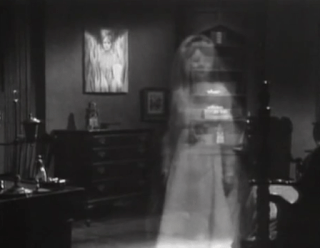
David is asleep in his room. The painting starts to glow. Then Laura’s painted likeness is replaced with a video insert of her face. The insert grows and grows, and David screams for it to stay away.

Night-time visitor. Screenshot by Dark Shadows Before I Die

Maggie’s suspicion that Laura is behind the portrait fits with the many signs the show has given us of Laura’s uncanny nature. Laura’s reaction when Vicki brings the painting home, though, shows us that what has been happening to Sam does not serve Laura’s interests, any more than David’s nightmare did.

I think there are three possible explanations for the origin of the compulsion Sam had to paint the picture, the compulsion Vicki had to claim it, and David’s nocturnal disturbances. It could be that by exposing David time and again to the image of him following her into flames, Laura is gradually wearing down David’s resistance to a horrible idea that will lead to his destruction. In support of this interpretation, we remember the first night Laura was at Collinwood. She was calling David’s name in a quiet voice at the window of her cottage, far from the great house. Yet the sound of her voice penetrated David’s mind as he slept. He writhed on his bed, and went into the nightmare. Laura’s objection to the painting militates against this explanation.

When we were watching the episode, Mrs Acilius suggested a second reading. There might be a lot to Laura. Maybe in addition to the physical presence in the house that wants David to come away with her, there is also a ghostly presence that wants to warn him and everyone else of the danger that implies. That interpretation would fit with David’s sighting, the night Laura first came to the house, of a flickering image on the lawn that looked like Laura. David longed for that Laura to come to him, but reacted with terror when he saw the fleshly Laura in the drawing room. Perhaps there are two of her, and one is trying to protect David from the other. It is also possible that the two Lauras are not aware of each other, or even fully aware of themselves. So this interpretation is easier to reconcile with apparently contradictory evidence.

Vicki’s involvement suggests a third possibility. The ghost of Josette Collins appeared to her and comforted her in episode 126, and an eerie glow had emanated from the portrait of Josette when David left Laura alone in the Old House yesterday. Laura was alarmed to hear that David was interested in the ghosts of Collinwood, had not wanted to go to the Old House, and lies to David when he asks if he saw any sign of Josette’s presence. Perhaps Josette is intervening to thwart Laura’s plans, and it is her power that is benumbing Vicki today. Josette’s previous interventions have been intermittent and subtle, suggesting that it is difficult for her to reach the world of the living. So if she is preparing for a showdown with Laura, we might it expect it to take her some time to recruit her strength.

Again, this is the kind of search for patterns that an audience will gladly go into once you’ve let them know that there are supernatural forces at work in your story. Since Josette has been in the background of the show from week one, has appeared repeatedly, has a set devoted to her in the Old House, and has established connections with both Vicki and David, we might expect her to be the first of the uncanny presences we think of when we enter a supernatural storyline. That she is a tutelary spirit presiding over Collinwood brings it into sharp focus that the estate is under assault from a supernatural force emanating from the town of Collinsport. Today’s failure with Vicki kicks Josette’s ghost out of the spotlight, and that is one of the major faults with the episode.

Episode 121: Ghosts and ghosts-to-be

Each of the 1225 episodes of Dark Shadows features one name under the credit “Written by.”* A total of nine names rotate in that spot. While we know that some episodes included writing from uncredited contributors, the only such contributors we can identify come from among that tiny group of eight men and one woman. For example, Malcolm Marmorstein, credited with today’s script, wasn’t officially named among the writers until #115, but he may well have written additional dialogue as far back as #46. Joe Caldwell’s name doesn’t appear on-screen until #245, but he will actually be writing some of the scripts attributed to Ron Sproat starting this month, maybe this week.

Opinions will of course vary as to which of the nine identifiable writers was better and which was worse. Few, however, will find a place for Marmorstein on a list of Dark Shadows’ eight best writers. Although he had extensive experience in the theater, Marmorstein had none of the sense of what actors can do that Art Wallace and Francis Swann brought to the first nineteen weeks of the show. Nor did he know how to structure a drama, write crisp dialogue, or invent fresh story points. Directors Lela Swift and John Sedwick collaborate with a uniformly strong cast to put Marmorstein’s scripts on such a strong footing that at moments they seem like they are about to be good. Those brief flashes of hope are invariably, cruelly, disappointed.

There are indeed some bright spots in today’s episode. Reclusive matriarch Liz is in the drawing room of the great house of Collinwood. Well-meaning governess Vicki and homicidal fugitive Matthew are both missing, and Liz is worried that Vicki may have fallen into Matthew’s hands. Wildly indiscreet housekeeper Mrs Johnson shares her conviction that Matthew has killed Vicki, and won’t stop talking about this belief even after Liz expressly orders her to do so. Clarice Blackburn plays Mrs Johnson as a woman with no self-awareness whatsoever, and no screen actor has ever had a more effective way of showing horror at displays of social maladroitness than did Joan Bennett. In their hands, this scene is laugh-out-loud funny.

A knock at the door rescues Liz from Mrs Johnson’s untrammeled morbidness. The sheriff has come to report to Liz on the state of the searches for Vicki and Matthew. Mrs Johnson answers the door and won’t let the sheriff see Liz until she’s given him a piece of her mind about the incompetence of his department. There aren’t any memorable lines in this exchange, but the contrast between Blackburn’s highly animated movements and Dana Elcar’s cheerful placidity is so obviously suitable for comedy that it feels funny.

Back in the drawing room, the episode starts to fall apart. Liz and the sheriff talk about the searches for Vicki and Matthew. The dialogue is full of repetition and wasted words. Liz asks if the sheriff has an idea where Matthew might be, to which he replies, “He could be anywhere, and everywhere.” Might he hurt Vicki? “He might, but on the other hand he might not.” After all, “he’s very unpredictable.” Then, “you know how unpredictable he is.” Yep, unpredictable, let’s repeat that word five or six more times, that’ll keep us busy until the commercial break.

They could have cut some of that smoke-blowing and replaced it with lines about what the sheriff has done. My wife, Mrs Acilius, wishes the sheriff had mentioned telephoning Vicki’s former residence, the Hammond Foundling Home, and asking people there about where Vicki might have gone and whom she might have tried to contact. That might not have led to any action, but at least it would invite us to imagine that something might be going on somewhere.

The scene between Liz and the sheriff does have an effective ending. She asks him if he holds out much hope for Vicki. He replies, “Frankly, no.” She turns to leave the room. We break for commercial on that downbeat, which lets the bleakness of the situation sink in.

Strange and troubled boy David Collins comes home. David is the one person who knows that Matthew is hiding in the long-abandoned Old House on the grounds of the estate. He has been delivering supplies to him. Even David does not know that Matthew is holding Vicki prisoner in a hidden chamber. David sees that the sheriff is in the house, and asks Mrs Johnson if the sheriff has any news about Vicki or Matthew. Mrs Johnson seizes this opportunity to resume denouncing the sheriff’s incompetence, saying that the only clue he can recognize one that tells him it is time to eat and make himself even fatter than he already is.

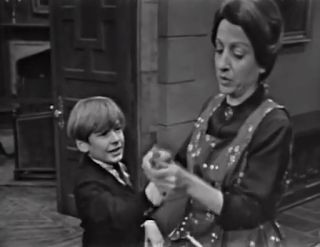
David is about to move on when Mrs Johnson questions him about the pack of cigarettes he stole from her earlier. She sets some punchlines up for David in this exchange. She mentions that she lit a cigarette while serving David his breakfast, to which David replies by asking if she is supposed to smoke while working. She says she knows that she set her pack of cigarettes on the table when she and David were alone in the kitchen, and that she hasn’t seen it since. He suggests it walked away by itself. She tells him he’s the only one who could have taken them; he says that if he wanted cigarettes, he wouldn’t steal them, he’d buy them. None of these lines is much on the page, but as delivered by Blackburn and David Henesy, they are genuinely funny.

Mrs Johnson looks for nicotine stains on David’s fingers. Screenshot by Dark Shadows Before I Die.

David goes into the drawing room and talks with the sheriff. Picking up on Mrs Johnson’s remark about the sheriff’s vigilant observation of meal-times, David asks him what it means when the whistle blows at the cannery. “Lunch,” says the sheriff. Again, not a world-class piece of comic material, but Henesy and Elcar make it land.

David then asks the sheriff for the details of his search for Matthew. The sheriff happily answers all of David’s questions in detail, as if he were giving a briefing to the state police. He tells David that anyone who might be hiding Matthew will go to jail.

This scene shows the limits of what a good actor can do with bad material. David is going to return to the Old House at the end of the episode. He will be prompted to go back there because he has learned information from the sheriff that Matthew will want to know. While there, he will set up suspense by revealing to Matthew that the sheriff has triggered his intense phobia of jail. That locks the sheriff into playing his scene with David as a babbling oaf.

In Elcar’s first episodes as the sheriff, he had made indiscreet remarks to David, but as we saw him observing the reactions those remarks elicited from David and others he seemed to be using them as ploys to advance his investigations. For example, in #59, he had given David some information that excites him and unnerves his father, high-born ne’er-do-well Roger Collins.

We can see how he might use similar tactics in this situation. After all, Vicki is David’s governess, and David has spent more time with her than has anyone else. Matthew had been the caretaker in the house where David lives, and David knows him quite well also. In this conversation, when the sheriff refers to Matthew as unlikable, David becomes very excited and exclaims “I like him! Er, I did like him, I mean.” If the sheriff knows his business he might well pay very close attention to everything David says, and keep encouraging David to say more. He will certainly notice David’s terrified reaction to the idea that someone helping Matthew will go to jail, and test his reaction to further comments on related themes. But if he takes any note at all of David’s attitude, the current storyline will end within minutes. So in this scene, Marmorstein leaves Elcar no way to play the sheriff as an intelligent character.

After the sheriff leaves, David and Liz have a scene in the drawing room that builds up to a tremendously frustrating moment. David keeps asking his aunt one question after another about Matthew and Vicki, Vicki and Matthew, does Matthew have Vicki, is Vicki in danger from Matthew, then without taking a breath “Do you know any secrets about the Old House?” Liz responds “I wish that someday you’d ask an important question.”

Granted, we know that Matthew is holding Vicki prisoner in the Old House and Liz does not, but it is hard to imagine anyone failing to see the connection between these two thoughts. Joan Bennett and David Henesy had a fine rapport that made the scenes between Liz and David Collins a delight, and you can see them trying to save this exchange. David is in a panic at the beginning of the scene and gets steadily more worked up as it goes along. We see Liz observing his agitated emotional state, paying such close attention to his facial expressions, tone of voice, and frantic bodily movements that she misses key elements of his words. It’s a valiant attempt on their part to make the scene work.

David wants to go to the Old House to see Matthew. In the foyer, Mrs Johnson again confronts him about the cigarettes. He yells at her to “Get off my back!” and runs out. This might have been an attempt to show that David feels his world closing in on him, but it doesn’t succeed. We’ve already seen those two characters say everything they had to say about that topic on that set. Repeating it just feels like filler.

*There are reference works that draw on the original paperwork produced by the makers of the show; even these list one writer per episode. That’s how the Dark Shadows wiki manages to list a writer for every episode, including those that don’t show writing credits on-screen.

Episode 119: We criss-crossed paths a dozen times

Nothing today but recapping.

The actors do what they can to hold it together, and there are a couple of memorable lines. Reclusive matriarch Liz calls her daughter, flighty heiress Carolyn, a “young girl” during yet another conversation pleading with her to stop dating the family’s arch-nemesis, dashing action hero Burke Devlin. Carolyn asks when her mother will admit that she is a woman. “When it is a fact,” Liz replies. Carolyn declares that “It won’t be a woman who bestows that title on me, but a man- Burke Devlin!” Everyone in Collinsport seems to be living according to a rule of chastity, so Carolyn’s open declaration that she plans to have sex with Burke is rather startling.

Liz’ brother, high-born ne’er-do-well Roger, comes home. Liz tells Roger that well-meaning governess Vicki is missing and may be in danger. Roger refuses to take an interest in the matter. When Liz is shocked by his indifference, he says that she sometimes expects too much of him. Considering that Burke and hardworking young fisherman Joe are searching the grounds of the estate for Vicki, and that the sheriff’s department has been involved in the search as well, Roger’s disregard for Vicki is not merely cavalier, but childish in the extreme.

When Roger finds out that Carolyn had been on a date with Burke, he tries to take the authoritative tone that her mother had taken with her earlier. Neither Carolyn nor Liz is impressed with the attempt this boy-man is making to impersonate a paterfamilias. Liz and Roger are the prototype for Dark Shadows‘ most characteristic relationship, that between a bossy big sister and her bratty little brother. She tries to correct his behavior, and when he disappoints her she shields him from accountability. In this scene, she sees yet again how useless he really is.

Burke and Joe come to the house to report that their search for well-meaning governess Vicki has been fruitless. Roger makes one sarcastic remark after another to Burke. Louis Edmonds is so skilled at delivering acerbic dialogue that these lines are fun to listen to, even though they don’t advance the plot or add to our understanding of the characters in any way.

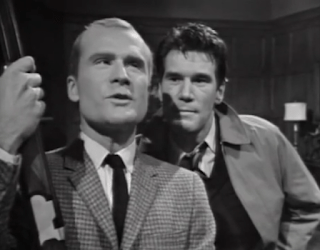
Burke and Roger having words. Screenshot by Dark Shadows Before I Die

It’s a shame the scene isn’t better written. During the nineteen weeks when Art Wallace and Francis Swann were in charge of writing the show, they hinted that there may have been some kind of sexual relationship between Burke and Roger. This time, Burke has borrowed Roger’s shotgun, and Roger very conspicuously handles the gun after Burke returns it to him. He unloads it, and for no reason that we can see reloads it. As directed by Lela Swift, the actors are uncomfortably close to each other, and can’t keep themselves from getting closer as they exchange their wildly bitter remarks. In the hands of Wallace or Swann, or for that matter of almost any moderately competent writer, that scene would have made sense as a Freudian interlude. But today belongs to Malcolm Marmorstein, and the evidence of repressed sexuality doesn’t add up to much.

Carolyn tries to break the tension in the drawing room by playing “Chopsticks” on the piano. All she gets for her trouble is an irritated look from her mother.

Joe and Carolyn were dating when the series started. All we saw of their relationship was one breakup scene after another. They have a nice loud one today. If there had ever been anything between them, it would be a dramatic moment.

Earlier in the episode, Burke had told Joe he didn’t think he would ever really put his attachment to Carolyn behind him. We’ve seen Joe have a couple of happy dates with Maggie Evans, The Nicest Girl in Town, and are hoping the two of them will have a storyline together. The prospect that Burke may be right and we may be sentenced to sit through yet more bickering between Joe and Carolyn is too dreary for words.

In place of 109 and 110: Dividing Dark Shadows into periods

The makers of Dark Shadows set out to give every episode airing on a Friday a number divisible by 5. Since no episode aired on Thanksgiving Day or the day after, that meant that episode 108, originally broadcast Wednesday, 23 November 1966, was followed by episode 111, originally broadcast Monday, 28 November 1966. There never was an episode 109 or 110. I’ve decided to take advantage of such breaks in the flow of the series to post general notes.

When we finished our first watch-through of Dark Shadows on 2 April 2021,* I looked back over the show and divided it into these 14 periods:

  • Episodes 1-45 “Meet Vicki” 
  • Episodes 46-126 “Meet Matthew”
  • Episodes 127-192 “Meet Laura”
  • Episodes 193-209 “Meet Jason”
  • Episodes 210-260 “Meet Barnabas”
  • Episodes 261-365 “Meet Julia”
  • Episodes 366-466 “Meet Angelique”
  • Episodes 467-626 “Monster Mash”
  • Episodes 627-700 “Meet Amy” (subdivided into “Chris the Werewolf,” 627-638, and “The Haunting of Collinwood,” 639-700)
  • Episodes 701-885 “1897″ (subdivided into “Meet Quentin,” 701-748, and “Meet Petofi,” 749-885)
  • Episodes 886-969 “Leviathans”
  • Episodes 970-1060, “Meet Another Angelique” 
  • Episodes 1061-1198, “Meet Gerard” (subdivided into “1995,″ 1061-1070, “The Re-Haunting of Collinwood,” 1071-1109, and “1840,″ 1110-1198)
  • Episodes 1199-1245, “Dying Days”

I’ve decided that it makes more sense to divide the first 42 weeks into two periods defined by writing staff rather than four periods defined by characters. So I now think of the first 21 weeks as the Art Wallace/ Francis Swann era, and of the second 21 weeks as the Ron Sproat/ Malcolm Marmorstein era. Wallace and Swann wrote finely etched character studies that gave their fine cast a chance to show their stuff. Sproat and Marmorstein didn’t really understand what actors could do, and needed much busier and more outlandish plots to keep the show going.

As for the stories, I’ve noticed a 14 week cycle. For the first 14 weeks of the series, characters occasionally use the word “ghost” as a metaphor for unresolved conflicts that have ongoing consequences. Often as not, they go on to say that around the great estate of Collinwood, ghosts are more than a metaphor- literal ghosts haunt that place. We see a few events for which no non-ghostly explanation is immediately forthcoming. Some of them would have to be either legitimately supernatural occurrences or deliberate hoaxes in the tradition of Scooby-Doo. In episode 70, at the end of week 14, we get our first sighting of an unmistakable, non-metaphorical ghost.

The second 14 week cycle ends with episode 140. That comes early in the saga of the “Phoenix.” The one storyline in the first 42 weeks that works every time we see it is well-meaning governess Vicki’s attempt to befriend her charge, strange and troubled boy David. In episode 140, David is terrified of his mother and goes to her only after Vicki has persuaded him to do so. It is a powerful scene, showing that David has come to trust Vicki totally. That marks the end of the Vicki-befriends-David story, and sets up the rest of the Phoenix saga as an exploration of what that trust means and what will become of it.

The third 14 week bloc ends with #210. That one is mostly about petty thief Willie Loomis trying to find some jewels that he believes are buried somewhere around the estate. It ends with Willie opening a coffin, from which a hand shoots out and grabs him by the throat. That moment turns out to be quite an important break from one phase to another.

So, my revised periodization of the first 42 weeks is:

Episodes 1-106, the Wallace/ Swann era. Subdivided into 1-35, Prologue; 36-106, The Mystery of Bill Malloy. In its turn, The Mystery of Bill Malloy is further divided into Bill Investigates, Bill Disappears, and Who Killed Bill?

Episodes 107-210, the Sproat/ Marmorstein era. Subdivided into 107-126, Matthew Imprisons Vicki; 127-192, the Phoenix; 193-210, Jason.

*The fiftieth anniversary of the first broadcast of the final episode.

Episode 106: Swann song

At the end of Friday’s episode, dashing action hero Burke Devlin and the sheriff caught high-born ne’er-do-well Roger Collins digging up a fountain pen from under a rock. It appears to be the fountain pen Roger had stolen from well-meaning governess Vicki. Some think that Roger stole the pen and hid it because it is evidence implicating him in the death of beloved local man Bill Malloy. Today, Roger is in the sheriff’s office.

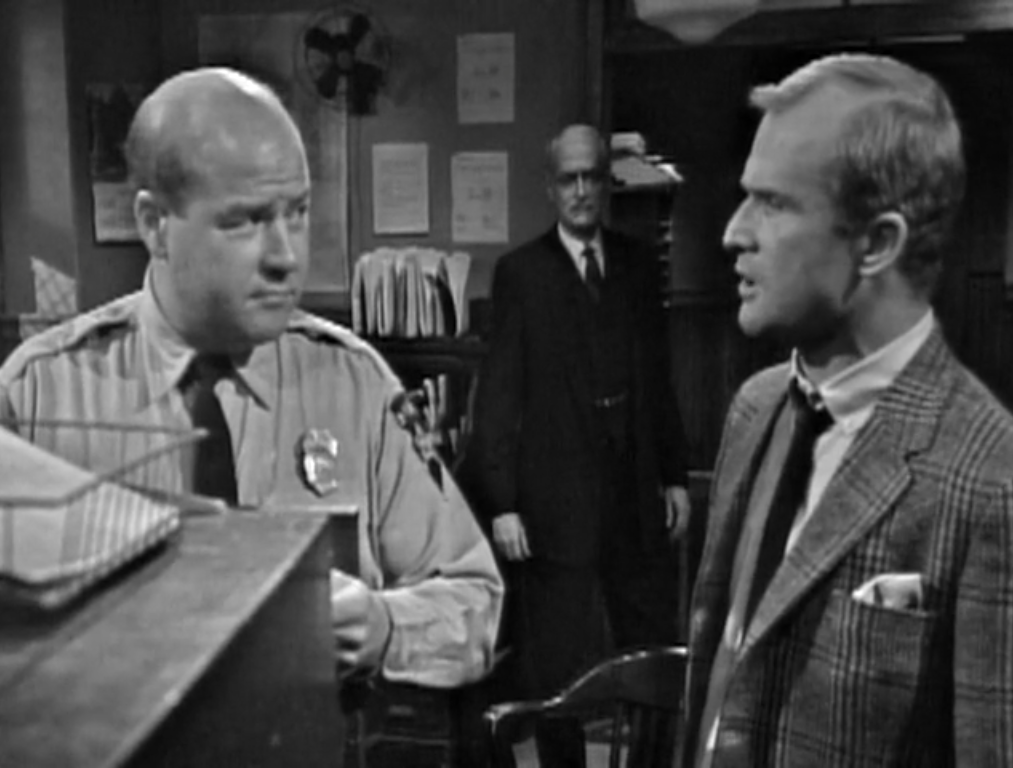
Accompanied by Richard Garner, the Collins family’s lawyer, Roger talks and talks, admitting that he saw Bill that night, badly injured and face-down in the water. He jumped to the conclusion that Bill was dead, and left the scene without notifying anyone. He also admits that he concealed evidence that he believed the police would find relevant to the investigation. As if that weren’t enough, he admits that he lied to the police time and again, most recently the night before, and is caught in yet another lie when he gives a nonsensical explanation of his plan to meet Bill that night.

Roger begins his confess-a-thon

Garner makes only one feeble attempt to interrupt Roger’s torrent of self-incriminating remarks. When the sheriff questions Vicki, Garner takes the opportunity to ask her some questions of his own, questions which produce even more information that is adverse to his client’s interests. On their site Dark Shadows Before I Die, John and Christine Scoleri feature commentary on Garner’s performance from a lawyer friend of theirs. Setting aside the utter hopelessness of Garner’s work from a real-world perspective, this friend analyzes his conduct by contrast with the standards set by other TV lawyers:

This brief addendum will review the competence of Garner using a “TV Lawyer Competency Rating” (TVLCR) scale. This WAG scale is based on my estimation of how a general audience might rate a TV Lawyer’s performance. I have supplemented these TVLCR scores with some comments reflecting real-world practices.

http://dsb4idie.blogspot.com/2016/11/episode-106-112166.html

Even by those standards, Garner doesn’t come out very well:

Garner strikes me as the go-to civil attorney for the Collins family who got dragged into this murder case just because they are familiar with him. Based on Garner’s poor competency rating as a TV Lawyer, Roger Collins should fire him and instead reach out to Raymond Burr or Andy Griffith.

Soap operas typically generate suspense by sharing information with the audience that some, but not all, of the characters have. We wonder when the secrets will be revealed, and how those to whom they are revealed will react when they finally get the news.

By the end of today’s episode, all of the characters will know almost everything the audience knows. Even what the characters don’t know, they’ve heard of. For example, Roger and drunken artist Sam Evans have not confessed the guilty secrets they share to any of the other characters, but everyone seems to have figured out more or less what they’ve been up to. Not everyone believes in ghosts, but it’s all over town that Vicki and her charge, strange and troubled boy David Collins, have seen ghosts in and around the great house of Collinwood, and even the most skeptical are not in a hurry to hang around the place after dark.

This is the next-to-last episode credited to writer Francis Swann. Swann will fill in for the new writers a week from Wednesday, but today is really the end of the Art Wallace-Francis Swann era of the show. From tomorrow, the new team of Ron Sproat and Malcolm Marmorstein will be holding the reins. By bringing all the characters up to at least our level of knowledge about the ongoing storylines, Swann is clearing the decks for Sproat and Marmorstein to set up their own crises and dilemmas.

Swann’s great strength is his ability to give actors room to show what they can do. Today’s episode is a case in point. Just when Garner’s disastrous intervention in the sheriff’s questioning of Vicki has led us to wonder if he’s all there, he has a moment when he opens his eyes wide and looks out the window. As Hugh Franklin plays it, that’s enough to make us wonder what’s on Garner’s mind, and to think he might be about to do or say something interesting.

Of course stage veteran Louis Edmonds thunders delightfully as the wildly indiscreet Roger, and of course TV stalwart Dana Elcar does an expert job of presenting the sheriff as a skilled professional firmly in control of the situation. There might be a crying need for a defense attorney to intervene when a suspect is blabbing as freely to the police as Roger is to the sheriff, but there is no need for a third actor to get in the way of Edmonds’ and Elcar’s interplay. Standing in the background between those two, Franklin occasionally gives a slight facial expression that underlines some point or other, but never upstages them.

In the first half of the episode, Alexandra Moltke Isles’ Vicki has to give some long speeches full of recapping, and in those she takes the character through several distinct shades of discomfort. She begins with diffident nervousness, builds up to frightened indignation, and ends with pure sadness.

Later, flighty heiress Carolyn comes into the sheriff’s office and pleads with Vicki to say that her beloved Uncle Roger couldn’t be a criminal. In front of the sheriff and Garner, all Vicki will say is that the two of them should leave. As Carolyn, Nancy Barrett makes the most of the melodramatic turn, but Mrs Isles takes possession of the scene with her few words spoken in a quiet, husky voice we haven’t heard before. Those brief remarks cap the progression we saw her making in her speeches earlier, and define the mood she is still in during a conversation between Vicki and Carolyn in Collinwood later. Vicki’s feeling for the pity of it all holds the episode together, and leads us back into the texture of the life of the family at the center of the story.

Episode 103: The girl can’t help it

Another action-packed episode from writer Francis Swann. His new colleague Ron Sproat seems to have given him a jolt of energy.

High-born ne’er-do-well Roger Collins has been Dark Shadows‘ foremost villain so far. This week’s theme is that well-meaning governess Vicki suspects Roger of murdering beloved local man Bill Malloy. She is terrified of what Roger might do to her, and Roger is terrified she might go to the sheriff. Vicki and Roger scramble to keep up with each other, and draw the other characters into their frantic activity.

Today we divide our time between the great house of Collinwood, where Roger and Vicki live and play their high-stakes game of cat and mouse, and the Blue Whale, a tavern in the village of Collinsport where we see the consequences of their actions ripple out into the broader community. In yesterday’s episode, Vicki and Roger had a talk in which he told her that he did see Bill the night he died, but that he was already dead when he found him. That accounted for the evidence Vicki found, but only increased the tension between them.

We begin and end today in Vicki’s bedroom. In the opening teaser, Roger knocks on her door and lets himself in when she doesn’t answer him. In the closing scene, Vicki’s door is unlocked and opens while she is in bed. This prompts her to scream. When she does, the door quickly closes. Roger comes in seconds later, and implausibly denies that he opened it until after she screamed.

In between, we see Vicki in the tavern, telling Roger’s arch-nemesis, dashing action hero Burke Devlin, what Roger told her yesterday. Burke is incredulous that Vicki seems willing to believe that Roger might be telling the truth this time. She responds “I know you think I’m an idiot, but I can’t help it!” Maybe Bill wasn’t pushed to his death- maybe he was just clumsy and fell without anyone’s intervention. Burke does not contradict Vicki when she tells him he thinks she is an idiot. He urges her to leave town, since Roger might kill her at any time. She insists on staying at Collinwood.

Vicki and Burke leave the tavern. Drunken artist Sam Evans and his daughter Maggie Evans, The Nicest Girl in Town, enter. Maggie tells Sam that she talked to Vicki yesterday. Vicki told her almost everything, holding back Roger’s name but making it clear she can’t be thinking of anyone else. Maggie sees that the idea of the investigation into Bill’s death being reopened and connected with the incident that sent Burke to prison ten years ago disturbs Sam intensely. When Sam answers one of her questions with a lie, she asks “Haven’t you thought of a better one than that?” He mumbles a response, but won’t tell his daughter what he has to be afraid of.

Maggie calls Collinwood. Roger answers, and Maggie asks to speak to Vicki. Returning viewers will remember that when Burke called Vicki in yesterday’s episode, Roger was in the room. Vicki concealed the fact that she was talking to Burke by pretending she was talking to Maggie. Maggie’s call tips Roger off to Vicki’s lie. He tells her that Vicki isn’t home. She tells him that the Evanses are at the Blue Whale, that they haven’t been home all evening, and that they haven’t seen Vicki.

Vicki comes home. She tells Roger she was visiting Maggie at her house. Roger plays along and encourages Vicki to elaborate on this story. At the tavern, Burke had told Vicki she was a bad liar. She proves him right, giving Roger one falsifiable detail after another about her time at the Evans cottage.

After the affair of the door, Roger sees Vicki’s frank disbelief that he will not admit that he unlocked and opened it. Facing her unspoken accusation that he is brazenly lying to her, he casually mentions Maggie’s call. He suggests Vicki call her tomorrow, so that the two of them can get their story straight. He saunters away, having deflated her righteous indignation about his apparent lies.

As Vicki, Alexandra Moltke Isles was one of the cast members who delivered her lines with the fewest stumbles. She has a doozy today, though. When she returns from her conference with Burke, Roger sees her climbing the stairs and calls out to her: “Vicki!” She replies: “Rodgie!” A man you address as “Rodgie” is not someone of whom you are deathly afraid. They have done such a good job building up an atmosphere of tension between Vicki and Roger that this slip is one of the most breathtaking bloopers in the entire series. It’s still a Genuinely Good Episode, but that moment does make you wish for a videotape editor.

Vicki and Rodgie. Screenshot by Dark Shadows Before I Die

Episode 94: The Sproatening

This is the first episode credited to writer Ron Sproat. Before long, Francis Swann will leave Dark Shadows, and for several months the only credited writers will be Sproat and Malcolm Marmorstein. Marmorstein will write 82 episodes and leave in August of 1967. Sproat will write hundreds and will stay with the show until 1969.

Today’s setup might remind us of the show’s first writer, Art Wallace. It’s shaped like one of Wallace’s diptych episodes, intercutting between two contrasting groups of characters. This time, we cut back and forth between, on the one hand, a dull but pleasant dinner date between well-meaning governess Vicki and instantly forgettable lawyer Frank at a restaurant in Bangor and, on the other hand, an extremely uncomfortable dinner date between hardworking fisherman Joe and flighty heiress Carolyn at the Blue Whale in Collinsport.

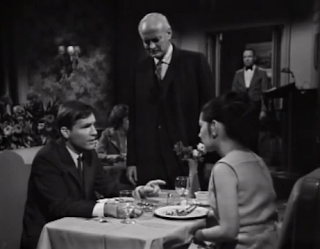
In Bangor, Vicki and Frank smile at each other while Vicki tells the sorts of stories she’s been telling all along. Vicki hopes Frank will be able to aid her in her effort to learn the identity of her birth parents, a quest she has been on since episode 1. Frank’s father Richard briefly joins him and Vicki at their table. Amid good wishes for the two of them, Richard delivers a cautionary message about Vicki’s research. Later, he talks privately with Frank. He strongly approves of Vicki as someone to date, but is chary of many aspects of the research Frank has volunteered to do for her.

Frank’s father stops by the table. Screenshot by Dark Shadows Before I Die

In Collinsport, Joe and Carolyn are bickering about Carolyn’s obsession with dashing action hero Burke Devlin when Maggie Evans, The Nicest Girl in Town, enters the tavern with her father, drunken artist Sam Evans. Carolyn invites the Evanses to join them at their table. Carolyn eventually starts talking about Burke again, prompting Joe to ask her to dance. Away from the Evanses, Joe tells Carolyn he is tired of her falling bacxk on him when Burke isn’t available. Carolyn storms out. Joe takes her home, then returns to the tavern, and he and Maggie start a conversation they both seem to be enjoying hugely.

Carolyn, Joe, and the Evanses at the Blue Whale. Screenshot by Dark Shadows Before I Die

By intercutting scenes, Wallace’s diptychs usually achieve a contrast that brings into focus details of the psychology of the characters and their relationships to each other that we might not have thought about had we watched the scenes straight through. In Sproat’s hands, today’s episode doesn’t do that so much as it comments his own position as a new writer joining an established show.

Vicki has learned nothing about her origins since episode 1, and there is no prospect she ever will. In Frank, she has found a potential boyfriend. In the ears of the audience, Richard’s advice to Frank to pursue Vicki energetically but to pursue her inquiries only circumspectly is a recommendation that the show drop an old, unproductive old storyline and to develop a new one.

Carolyn and Joe’s relationship is another story element that has been in place from the beginning and that has not advanced in any way. We have never seen any reason for them to be a couple, and are simply impatient with scenes where they sit around and make each other miserable. Joe recently had a date with Maggie, and it was sweet to watch those two having fun together. So today’s scenes in the Blue Whale make it emphatically clear that the time has come to drop the Carolyn and Joe story and move on to a new phase where Maggie and Joe are together.

Sproat not only makes himself visible in this episode, he also provides mirrors for critics and commentators. When Richard shows up and interrupts the ten thousandth* sad story the audience has heard about the Hammond Foundling Home, Frank and Vicki seem to be having a pleasant enough time with each other. It is possible that viewers who weren’t watching on many of the days when Vicki told those previous stories are having a pleasant enough time with the episode. But on any given day, only so much of your audience will consist of new viewers and people with short-term memory loss. A time will come when you have to move on to something new, and Richard is the in-universe representative of those who would say that time is already upon us.

In the Blue Whale, the Evanses represent the critics. Joe and Carolyn leave the table twice to dance. The first time, they look happy, and Sam tells Maggie that there is no chance of Joe and Carolyn splitting up. Sam is a chronic pessimist. If he makes a prediction, we take it that it would be bad news for that prediction to come true. In this context, to say that Joe will never break it off with Carolyn is to say that the show will never become more interesting. The second time Joe and Carolyn dance, they are obviously giving up on each other. Maggie, almost as much the optimist as her father is a pessimist, gives a little smile. Joe and Carolyn’s quarrel is embarrassing for her to watch, but it’s good news for her that she’s getting a boyfriend, and maybe a storyline. It’s also good news for us that the show is open to exploring fresh topics.

I don’t think that Richard and the Evanses are so much Sproat’s attempt to impose particular readings on the audience as they are the results of his analysis of the reactions thoughtful viewers are likely to have. If so, I have one data point in support of his theory. In their discussion about this episode on their blog Dark Shadows Before I Die, John and Christine Scoleri actually find themselves playing the roles of optimistic and pessimistic critic as Sproat scripted them for the Evanses. Here are John as Maggie and Christine as Sam:

John: Have we finally seen the end of the Joe/Carolyn relationship? Now that it’s clear to Joe that Carolyn only comes running to him when she’s jealous, I think he’s had enough of her. The only offenses on Maggie’s record are the bad blonde wig she started with, and calling Vicki a jerk when they first met. But other than that, she’s far less maintenance than Carolyn, so hopefully the change will do Joe some good, provided his job working for the Collins fishery isn’t in jeopardy…

Christine: It’s a soap opera, so I expect the relationship to go through its death throes before the last gasp. Joe’s a glutton for punishment, so I don’t think it’s over yet.

http://dsb4idie.blogspot.com/2016/11/episode-94-11366.html

The Scoleris always do a good job of pretending not to know what’s coming next even when they demonstrably do know. So there is a bit of role-playing to start with. But they are such patient and insightful critics that I don’t think they would just start imitating the characters, certainly not unintentionally. It’s more likely that this exchange represents evidence that Sproat was right about the ways people were likely to read the episode.

*A rough approximation. Could be the twelve thousandth, I haven’t counted.

Episode 85: What do you do with a drunken sailor?

The final episode written by Art Wallace is the first to feature actors singing. It’s also the first to feature a talking ghost.

The song is “What Do You Do With A Drunken Sailor?” It is sung first in the tavern, where drunken artist Sam Evans and dashing action hero Burke Devlin are reminiscing about their late friend, beloved local man Bill Malloy. Bill worked on the fishing boats for many years, and sang that old shanty all the time. Sam and Burke croon a few of its more family-friendly lines.

We hear the song again, sung by the ghost of Bill Malloy. Well-meaning governess Vicki is, for reasons far too tedious to repeat, imprisoned in a disused room. Bill’s ghost manifests itself in the doorway, takes a step into the room, and begins singing. Draped in the wet seaweed that covered his body after it washed up on shore, he warns Vicki that she will be killed if she does not escape. He turns back towards the door and vanishes into thin air. Vicki tells herself that the apparition was a dream, but finds wet seaweed on the floor where Bill had stood.

Bill Malloy manifests himself. Screen capture by Dark Shadows Before I Die

As the representative of the business operations that support the ancient and esteemed Collins family in their old dark house on the hill, Bill Malloy had been central to the rational, daylight logic side of the show. He came to the house to keep reclusive matriarch Liz updated on the operations of the cannery and the fishing fleet, and he discussed financial affairs with her. There had been a couple of indications that he once had a crush on Liz, suggesting the possibility that they might fall in love, complicating their business relationship and giving rise to a rather tame soap opera romance. For the last couple of months a mystery story about his death and the investigation into it has kept us mindful of evidence and witnesses and the sheriff and other symbols of explainable, shared reality. When Art Wallace, who wrote the series bible and was credited with the first 40 episodes, moves Bill Malloy into the supernatural back-world of Josette and the Widows, he forecloses any possibility that Dark Shadows will be a conventional soap opera with plots about slightly inconvenient love affairs and struggles over the ownership of a sardine packing concern. We’re going to be seeing “ghosties and ghoulies and long-leggedy beasties and things that go bump in the night,” to repeat a quote Sam delivers today.

It’s also worth pointing out the type of ghost Bill is. He is mostly spirit, but there is a corporeal side to him as well. He enters the room at the closed door. Since he is insubstantial enough that wooden barriers won’t stop him, he isn’t a revenant or a zombie or any other kind of reanimated corpse. On the other hand, he is substantial enough that he moves from one location- somewhere on the other side of the door, apparently- to another. So he isn’t a pure phantom. Unlike a true revenant, he vanishes into thin air, but unlike a pure phantom he leaves behind clumps of the wet seaweed with which he was festooned. We will see more ghosts in the years ahead, and most of them will be a mixture of the spectral and the bodily.

Art Wallace’s name is on every episode of Dark Shadows under “Story Created and Written by,” but he had nothing to do with it after this episode. He will be missed. He wasn’t perfect- this week has been pretty grim, with the unwelcome story of Vicki’s confinement, and with Wednesday’s episode and Thursday’s having been utter stinkers- but he was usually quite good. He and Francis Swann both had a firm understanding of what actors can do and how writers can enable them to do it. After Swann leaves the show late next month, they won’t have another writer of whom that can be said until Joe Caldwell comes aboard next summer.

Episode 72: Whose eye is she after

Well-meaning governess Vicki sits placidly in her bedroom at the great house of Collinwood, sewing and looking out the window. Flighty heiress Carolyn comes in and loudly berates Vicki for spending the day away from her charge, problem child David. Carolyn saw Vicki coming home as a passenger in a car driven by the family’s arch-nemesis, dashing action hero Burke Devlin, and jumped to the conclusion that Vicki was both on a date with Burke and on Burke’s side in his conflict with her family. Vicki is at first bewildered by Carolyn’s rage, and then confronts her with her own record of infatuation with Burke.

This scene shows how well cast Nancy Barrett and Alexandra Moltke Isles were as Carolyn and Vicki respectively. Miss Barrett throws herself completely into whatever her character is supposed to be doing at any given moment, a perfect style for the role of someone who is stormy and unpredictable. Mrs Isles takes a very deliberate approach to her part, working her way from the center of Vicki’s thoughts out to whatever lines she has to deliver. That suits the role of someone who is often baffled by the strange goings-on around her and who gradually gathers the strength to stand up for herself.

Carolyn is on her way to the front door when her mother, reclusive matriarch Liz, asks her where she’s going. Still upset after her confrontation with Vicki, Carolyn snaps at Liz and gives sarcastic answers. Eventually she tells her that Vicki didn’t give David his lessons for the day, that she spent the day with Burke, and that she brought Burke home with her. Alarmed by this report, Liz heads upstairs towards Vicki’s room. Carolyn remembers her latest project, persuading her mother to take Mrs Sarah Johnson onto the domestic staff as a housekeeper. Liz cuts her off, saying that she has no time to think of hiring a housekeeper- all she can think about is firing a governess.

After Liz leaves the foyer to fire Vicki because Carolyn has led her to suspect she might be a spy for Burke, Carolyn picks up the telephone. She tries to call Burke. Evidently the infatuation Vicki had brought up to her is still driving Carolyn to inexplicable actions.

Mrs Johnson is in the restaurant at the Collinsport Inn. In fact, we first see her on the pay-phone there, talking to Burke about her plan to join the staff at Collinwood so she can work as a spy for him. Patrick McCray makes a nice remark about this on his Dark Shadows Daybook:

[P]lanting a spy for Burke Devlin is just the touch of espionage intrigue that Collinwood needs. Finally, someone can actually be the spy that Vicki is suddenly accused of working as. (In the same episode no less, with the irony and subtlety of an anvil landing in your lap.) That kind of duality — especially among the backstairs staff — is a concession to the dramatic thinking that DARK SHADOWS kinda lost over the years. The show gained plot, but it lost those opportunities for characters to reflect one another. As it reached a supernatural frenzy, this earlier, authorial delicacy was a necessary casualty. However, it’s vital to know that a sculpted duality like Mrs. Johnson and Vicki is an instinct buried in the program’s DNA.

I think he paints with a bit of a broad brush when he says that “this earlier authorial delicacy was a necessary casualty.” The frenzied pace of the later years didn’t stop Joe Caldwell or Violet Welles from crafting dramatic miniatures Art Wallace and Francis Swann would have been proud of. While Sam Hall and Gordon Russell were no miniaturists and did often value slam-bang story development over every other consideration, they did take time to show characters in each other’s reflections. Indeed, the whole “1970 Parallel Time” arc is months and months of nothing but “opportunities for characters to reflect one another,” and the actors could often make those reflections interesting (at least the first two or three times you saw them.) Of course, there are also large numbers of episodes written by Ron Sproat and Malcolm Marmorstein, but you can’t blame their shortcomings on excessively rapid pacing.

Mrs Johnson is a difficult customer for Maggie Evans, who runs the restaurant. She sends a sandwich back because she disapproves of the mayonnaise, and the look on Maggie’s face shows us that the cost of that sandwich is coming out of her paycheck. Mrs Johnson insists her meal be served in courses, demands that Maggie sit at her table, and gives her a tip of 10 cents (I checked- 10 cents in October 1966 would have the same purchasing power as 90 cents in October 2022. You could take that to your local hardware store, buy several nails, and still have enough left to operate a gumball machine.) She declares that the death of her late employer, beloved local man Bill Malloy, was no accident, and that according to the Bible someone will have to pay for it. When Carolyn comes into the restaurant, Maggie leaps at the opportunity to leave Mrs Johnson and wait on her.

Clarice Blackburn must have had tremendous fun playing Mrs Johnson in these sequences. The character is exaggerated almost to the level of what would become Dark Shadows’ Go back to your grave!” house style of acting, so that there is no need to worry about overacting. Besides, so many performers wait tables that one of the standard responses young people in Los Angeles get when they tell people they are actors is “Great! What restaurant?” So it must always be gratifying to play a character who will show the world what a bad restaurant customer looks like.

As Maggie, Kathryn Leigh Scott also has a juicy role today. We usually see her in one of two settings. Either she is in the restaurant, where she is required to be nice to everyone, or she is at home with her father, drunken artist Sam. As the adult child of an alcoholic, she has a thousand habits designed to keep the mood light. When she is dealing with Mrs Johnson, Miss Scott shows us what Maggie looks like when her Nicest Girl In Town persona is stretched to the max.

When she greets Carolyn, Maggie goes right into the chirpiest version of that persona. It’s a version that brings home the continuity between Maggie’s relationship to her father and her relationship to her customers. She speaks the first few syllables of each of her lines through a laugh. Many Dark Shadows fans complain about that as a habit of Kathryn Leigh Scott’s, but it’s a habit of Maggie’s. And if you start watching the series from episode 1, seeing all the scenes in the Evans cottage between Maggie and Sam, you’ll recognize it as something many adult children of alcoholics do. At the risk of giving away a spoiler, I’ll say that Sam will eventually cut back on his drinking, and some time after that will be written out of the show altogether. But Maggie’s character is formed in these weeks, when Sam is drunk all the time. Some of Miss Scott’s other characters on the show have similar habits, but those are the characters who are presented as Maggie Evans by other means, so they would have to be recognizable as her.

Carolyn tries to explain to Maggie, sotto voce, why Mrs Johnson is so upset, and Maggie drops her Nicest Girl In Town voice completely for a second- “I know who she is,” she rasps. Carolyn has been friendly to Maggie, and is equally friendly when she goes to sit with Mrs Johnson and tries to talk her into taking the job as housekeeper at Collinwood, assuming that her mother will offer it to her. After Mrs Johnson leaves, Maggie tells Carolyn that she has never been able to stand her- “She’s always given me the willies. I don’t know why,” she says, looking thoughtfully off into the middle distance.

Carolyn’s friendliness to the working class Maggie and Mrs Johnson is a welcome relief from her terribly snobbish sneer at Vicki as “Little Orphan Annie” who should “go back to your precious foundling home.” And it’s an opportunity for Nancy Barrett to take her performance from one emotional extreme to another within a single episode.

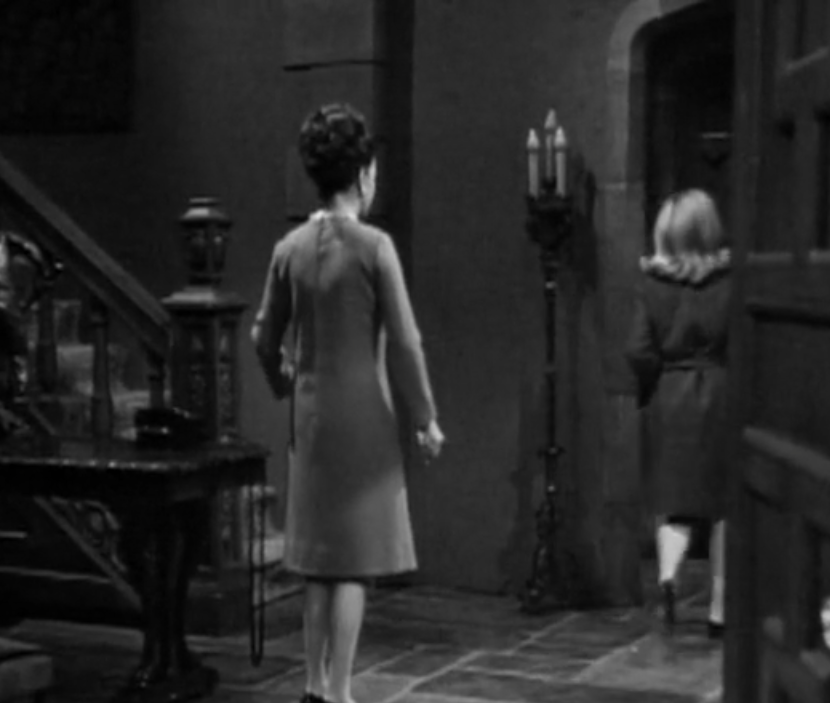
Back in the mansion, Liz confronts Vicki about not giving David his lessons. Vicki replies that Liz’ brother, high-born ne’er-do-well Roger, had said that he would tell Liz that he had taken Vicki on a tour of the cannery and had given David the day off. When Vicki hears Liz on the telephone confirming this with Roger, she blows up at Liz. She objects to being checked up on, she objects to being accused of lying, and, turning to look at the last spot where she had seen Carolyn, she objects to being accused of stealing people’s boyfriends. After she is done with her objections, she walks over to Liz. With their backs to the camera, the women quietly apologize to each other. Vicki explains that her protests mark the only way she can go on living in the house. Liz for the first time calls Vicki by her first name. Hearing this conversation when they are looking away from us is remarkably effective at creating a sense that they are sharing an intimate moment- more is happening between the two of them than even the audience can know.

Mrs Isles and Joan Bennett, as Liz, both play a wide array of emotions in their two scenes together, and do so brilliantly. It’s particularly interesting to compare Liz’ startled reaction to Carolyn’s snapping at her in the foyer when she asks her where she’s going to with her startled reaction to Vicki raising her voice at her in the drawing room when she’s been on the phone with Roger. They are two quite distinct startles. We see Liz from behind when Carolyn startles her. From that angle, we see the muscles in the back of her neck tense, signifying anger. That startle gives way to a parental sternness. The startle Vicki provokes is shown in profile. Liz pulls back a little, suggesting guilt. It leads to a rapid retreat.

Startled by Carolyn
Startled by Vicki