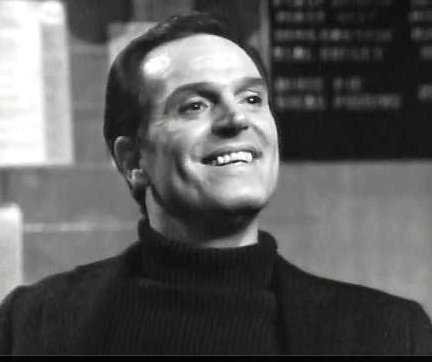
Episode 635: Adam smiles

Robert Rodan joined the cast of Dark Shadows in #485 as Frankenstein’s monster Adam. For his first few months, Adam could barely speak, limiting Rodan’s performance to facial expressions expressing his very intense emotions. He did well with that, and, as Adam came to master English, Rodan’s considerable range as an actor quickly became apparent. He gets a showcase today.

An experiment meant to bring Adam’s mate back to life has failed, and he decides that old world gentleman Barnabas Collins is at fault. Adam originally extorted Barnabas’ cooperation with the experiment in #557 by threatening to kill well-meaning governess Vicki and everyone else in the great house of Collinwood unless he were given a mate. Now Adam is in that house ready to carry out his threat.

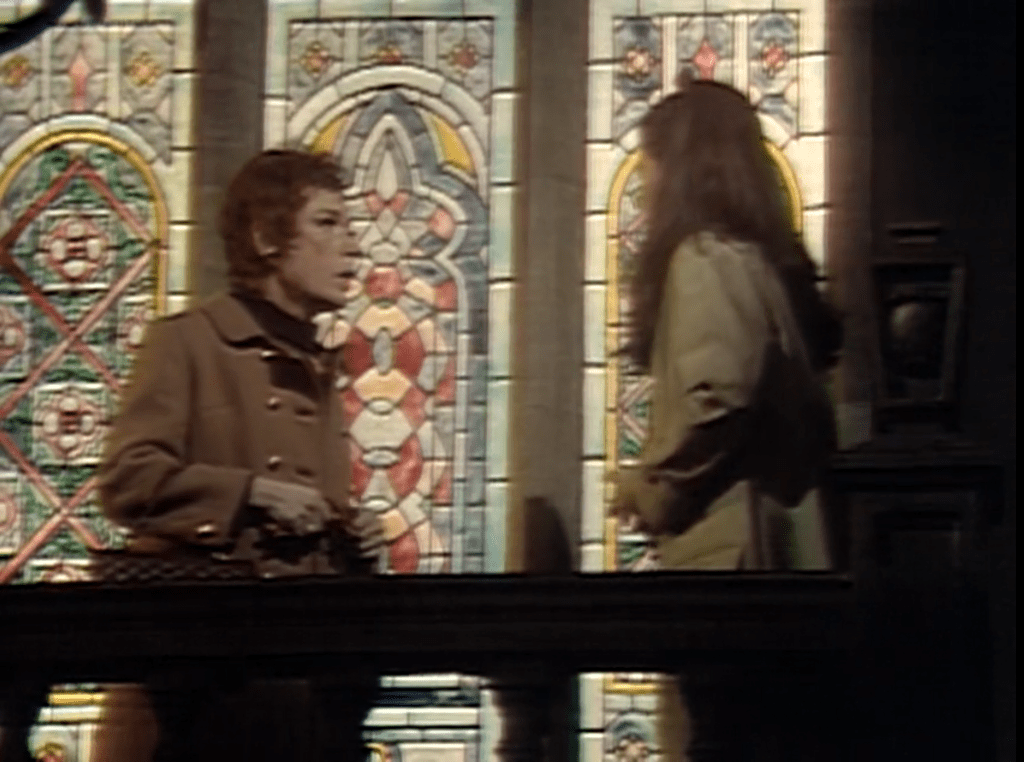
He stands outside Vicki’s bedroom door. Through it, he hears heiress Carolyn Collins Stoddard talking with Vicki. Adam fell in love with Carolyn some time ago, while she was protecting him from the police. Since Vicki is Carolyn’s best friend, and since Carolyn, her mother, her favorite uncle Roger, and Roger’s son David all live in the great house, Adam’s threat to kill everyone there always lacked a certain credibility. He eavesdrops as Carolyn tells Vicki she was recently very much attracted to a man, she can’t say who, and that ever since that man had to go away she has been depressed. Regular viewers know that Carolyn is talking about Adam, and he may know as well. Once Carolyn has left the room, Adam slips in. He tries to abduct Vicki. She screams, and Carolyn comes.

Adam slaps Vicki in the face and she collapses on the floor. In #515, Adam struck his friend Sam Evans across the face, inflicting an injury that contributed to Sam’s death shortly after. Adam didn’t know his own strength then; now, he only knocks Vicki unconscious. Carolyn tries to call the police; Adam takes the telephone from her hand and rips it from the wall. She is shocked that he is prepared to hurt even her. He puts his hands on her throat and squeezes it between his thumbs. The reason his mate needed to be brought to life a second time is that he strangled her in #626, and what he is doing to Carolyn looks unnervingly like what we saw him do then.

The sorrowful strangler. Screenshot by Dark Shadows Before I Die.

Rodan is self-possessed and deliberate when Adam is alone with Vicki, apparently smug in his certitude that whatever plan he has for her will work. When Carolyn enters, he abruptly shifts to a mixture of sorrow and rage. While he is strangling her, the sorrow overwhelms him completely. He knows exactly what he is doing, and is utterly miserable to be doing it.

Mad scientist Julia Hoffman is in Barnabas’ house. Barnabas had figured out that Adam was likely to go to Collinwood to carry out his threats, and she is waiting for him to come home and tell her whether he succeeded in thwarting Adam. She hears a noise, and calls out for Barnabas. He does not come, but the equipment in her basement mad science laboratory starts making its noises. Adam enters.

Julia and Adam exchange some mutually evasive dialogue. Rodan had played Adam’s scene with Carolyn and Vicki very hot, his emotions right on the surface. Now he shows that he can just as effectively play cold. Julia keeps asking him questions, which he parries without losing his smile, becoming excited, or in any way giving a clue as to what is in his mind. He deploys each syllable like a chess player selecting the right square for a piece. He shows a bit of feeling at first when he refers to the charred skeleton in the basement as “the only bride I ever had,” but then settles into an imperturbable calm. He responds to Julia’s repeated questions about his plans for vengeance against Barnabas with perfectly logical questions of his own about what he would have to gain by hurting Barnabas- “or you, for that matter?” He is indifferent to the news that suave warlock Nicholas Blair, whom he once considered a friend, has vanished, never to return. When Julia tries to escape, he asks her where she is going, and she tries to deflect the question. He is still altogether composed until the very second Julia turns to go to the basement, when the placid surface suddenly breaks and he knocks her out.

Barnabas donated the “life force” that brought Adam to life, and there are moments when longtime viewers will recognize deep similarities between the two characters. For example, when Julia first met Barnabas he was a vampire, and he was deeply suspicious of her interest in him. In that period, they often faced each other in this room in conversations that could easily have ended with Barnabas murdering her. Barnabas would not condescend to using Julia’s first name, addressing her only as “doctor.” Adam has no way of knowing about that history, but he does know that each time he calls Julia “doctor” she seems a little bit more uncomfortable. So he does it as often as possible.

Julia regains consciousness sometime after Adam attacked her and finds that Barnabas is with her. She tells him that Adam is in the basement doing something with the equipment; he tells her what he found when he talked with the slightly injured Carolyn earlier, that Adam has abducted Vicki. They put two and two together, and go to the cellar door. It is locked, so they have to find another way to the basement.

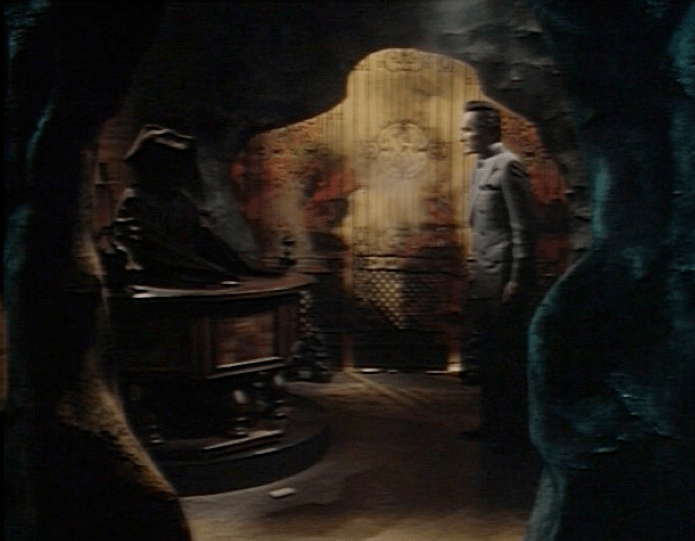
We cut there to see Vicki strapped on a table, energy flowing from the equipment into her while she writhes and cries out in pain. Adam is at the controls. Images of Julia and of Carolyn, speaking and pleading with Adam to show mercy to Vicki, wipe across the screen. These effects may seem a little corny nowadays, but must have been quite startling on daytime television in 1968, and are typical examples of director Lela Swift’s visual artistry and technical ambition.

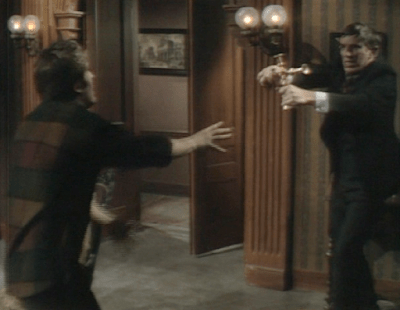
Barnabas and Julia enter. Barnabas points a gun at Adam and says he will kill him unless he lets Vicki go. Adam laughs at him. He and Barnabas have a connection like that between Alexandre Dumas’ Corsican brothers, so that any harm one suffers will endanger the other. Adam knows this, and he also remembers an audiotape in which the designer of the Frankenstein experiment that created him says that if he dies, “Barnabas Collins will be as he was before.” Barnabas knows about the Corsican brothers thing, but he never heard that tape, so he is puzzled when the laughing Adam says “If I die, you will revert back to what you were. That’s what it said on Dr. Lang’s tape and I heard it. I memorized it. I don’t know what you were but I know you don’t want me to die.” While Adam reaches for the switch to give Vicki a lethal jolt of electricity, Barnabas shoots him in the shoulder and he falls.

The giddy electrocutioner. Screenshot by Dark Shadows Before I Die.

Adam’s laughter in this scene is of a piece with his sorrowful expression while he chokes Carolyn. Nothing matters, no one matters, life and death are just the same, he will kill and torture and maim and it will all be a big joke. Viewers who remember the first weeks of Adam’s life, when Julia the mad scientist and Barnabas the recovering vampire, symbols of extreme selfishness both, kept him locked in a cell a few paces from the spot where he is standing now, will see in this total nihilism the logical outcome of that horrifying act of child abuse. As Rodan sold Adam’s heartbreak so effectively that his scenes in the cell were hard to watch, so he sells his total alienation from humanity so effectively that we can believe that he is ready to commit any crime against any person and to laugh all the way through it. This utterly bleak moment brings the character’s development to a fitting climax.

There are a couple of notable goofs in this one. The right sleeve of Adam’s sweater can be seen at the edge of the shot when the closing credits start; the camera zooms in to get clear of him. Robert Rodan had played his part with so few slips that he hadn’t quite seemed at home on Dark Shadows; it’s good to see him making up for lost time now. Much more embarrassingly, while Barnabas and Julia are looking through the barred window of the cellar door Jonathan Frid touches his face, and it looks very much like he is picking his nose.

Pre-emption Day: Adam in New York

No episode of Dark Shadows premiered 56 years ago today. That was Thanksgiving, and ABC was showing football at 4 PM.

At this point, Alexandra Moltke Isles had left the part of well-meaning governess Victoria Winters, marking the last step in the character’s long decline from her original position as the show’s chief protagonist. Vicki spent her childhood in a foundling home where she was left as a newborn with a note reading “Her name is Victoria. I cannot take care of her.” During Dark Shadows‘ first months, Vicki was on a quest to find out who her parents were. The show hinted pretty heavily that her mother was reclusive matriarch Elizabeth Collins Stoddard and her father was someone other than Liz’ long-missing husband, the scoundrelly Paul Stoddard, but the whole thing was dropped without any real resolution long ago.

In yesterday’s episode, Frankenstein’s monster Adam was on his way to Vicki’s room, apparently meaning to kill her. We understand Adam’s violence too well to regard him as a very cold villain. Most of the harm he has done is the result of his not knowing his own strength, and the rest is the predictable consequence of the abominable education he has received from his creators, mad scientist Julia Hoffman and recovering vampire Barnabas Collins, and from suave warlock Nicholas Blair. To longtime viewers, Vicki has been important enough for long enough that we do not see any prospect that a character as sympathetic as he is will become her murderer. On the other hand, Nicholas has now left the show, and there is nowhere for Adam to go within any of the ongoing storylines. If he simply disappears, he will be another significant loose end.

In September 2023, I left a long comment on Danny Horn’s Dark Shadows Every Day describing a fanfic idea that would at one stroke answer the questions of Vicki’s origin and of Adam’s fate. Below is a lightly edited version of that comment:

Here’s an idea I had today for a story that would save Vicki.

It would be a TV movie airing late in 1969. Start with a prologue set in Collinwood at that time. Adam returns, looking for Barnabas and Julia. He’s very well-spoken and accomplished now, but still socially awkward, still prone to fits of anger, and in need of help to get papers that he needs to establish a legal identity.

He finds that Barnabas and Julia are gone. He also happens upon some mumbo-jumbo that dislocates him in time and space.

It plops him down in NYC in 1945. With his facial scars, everyone assumes he’s a returning GI injured in the war. He meets a young woman, supporting herself working at a magazine about handheld machines, trying to establish independence from her wealthy family back in Maine. This woman, played by Alexandra Moltke Isles, is Elizabeth Collins.

Adam and Elizabeth slide into a love affair. She has another boyfriend, a dashing young naval officer named Paul Stoddard (Ed Nelson.)

Ed Nelson as the Paul Stoddard of 1945
Dennis Patrick as the Paul Stoddard of 1969

Elizabeth is frustrated with both Adam and Paul; Adam refuses to talk about his background, and while Paul says many words when asked about himself, he doesn’t really give significantly more information than Adam does. Paul is slick, charming, and familiar with all the most fashionable night spots, but he does show signs of a nasty side. Besides, he rooms with a disreputable young sailor named Jason McGuire (John Connell) who keeps turning up at the most disconcerting moments.

From #143, John Connell, suggesting the Jason McGuire of 1945
Dennis Patrick as the Jason McGuire of 1967

For his part, Adam is sincere, passionate, and attentive, but given to quick flashes of anger. He’s just as quick to apologize and sometimes blubbers like a giant baby with remorse for his harsh words, but he’s so big and so strong that when he is carried away in his fits of anger Elizabeth can’t help but be afraid of him. Besides, he’s not a lot of fun on a Saturday night. He doesn’t have a nickel to his name, and his idea of an exciting weekend is an impromptu seminar on Freud’s TOTEM AND TABOO, followed by a couple of games of chess.

Elizabeth’s mother (Joan Bennett) comes to town. Mrs Collins is appalled by Adam’s scars, impatient with his refusal to discuss his background, and contemptuous of his obvious poverty. Paul’s effortless charm and sparkling wit, packaged in the naval dress uniform he makes sure he’s wearing when she first sees him, fit far more tidily into her vision of a son-in-law. Mrs Collins presses her daughter to spurn Adam and pursue Paul, and for a time Elizabeth tries to comply with her wishes.

Yet she cannot forget Adam. Paul realizes this, and sees his chance at an easy life slipping away. We see him in a dive in Greenwich Village telling Jason McGuire that Elizabeth and her inheritance are going to end up with the scar-faced scholar. He and McGuire review Adam’s weaknesses, and decide they can exploit Elizabeth’s concern about his temper. They trick her into believing that Adam is on the run from the law, having beaten his wife to death. They lead her to believe that it’s just a matter of time before his occasional verbal outbursts give way to physical abuse, and that when that happens it will be too late- he will kill her. Believing this, Elizabeth gives Paul another chance, but still cannot break things off with Adam.

Adam does not know what Paul and Jason have led Elizabeth to believe. He knows only that she has become distant from him, and that she is still seeing Paul. He becomes angry and shouts at Elizabeth. He reaches for an object; she believes it is a blunt instrument with which he will kill her. In a moment of panic, she grabs a gun she has been studying for an article the magazine has assigned her to write and shoots him. As he lies motionless on her floor, she discovers that he wasn’t reaching for a weapon at all- he was reaching for a love letter that he had written to her. She realizes that he was no threat to her, that she has shot him for no reason.

She flees to Paul and Jason’s apartment, telling them that she has killed Adam. Paul calms her and promises to take care of matters so that she will not be suspected of any crime. Paul and Jason go to her apartment and find it empty. There are bloodstains on the carpet where Adam fell, and a trail of bloodstains leading down the hallway out the front door. They follow the stains and find Adam nursing a serious, but clearly not fatal, wound. They lead Adam back to Elizabeth’s apartment. They draw on their naval training to remove the bullet, clean and dress the wound. After a conversation. Adam admits that there is no point in his pursuing Elizabeth, and he agrees to leave town. Paul gives Adam some money and promises to tell Elizabeth that he is all right and that he doesn’t hold a grudge. Adam shakes Paul’s hand and leaves.

Paul and Jason clean the bloodstains. They then return to their own apartment. On the way they exchange a look that begins as nervous, and ends with two broad grins. Elizabeth asks why they were away so long. They tell her that it takes quite a while to dispose of a corpse. She sobs. Paul holds her.

Paul and Elizabeth announce their engagement. A few weeks later, the doctor informs Elizabeth that she is pregnant. The child must be Adam’s. Paul is not interested in raising any child, and certainly not interested in splitting the estate with a child not even his own. He orders Elizabeth to give the baby up. She refuses. He points out that she wouldn’t be able to do much mothering if she were in prison for murder. She sobs. In the final scene, we see Elizabeth outside on a snowy day, holding a basket and writing a note. In voiceover, we hear the contents of the note: “Her name is Victoria. I cannot take care of her.”

Episode 633/634: Now was the moment, or never at all

Suave warlock Nicholas has had bad news. His boss, Satan, will be recalling him to Hell, and does not plan to send him out to the world of the living again. Satan gave Nicholas two tasks to complete before his time runs out. He is to perform a Black Mass during which he will sacrifice Maggie, The Nicest Girl in Town, and afterward take her to Hell with him as his bride. He is also to complete the project he has been working on, forcing mad scientist Julia and old world gentleman Barnabas to resurrect Eve, the mate of Frankenstein’s monster Adam. Yesterday, we saw that Nicholas plans to make Barnabas and Julia use Maggie as the donor of the “life force” that will bring the mate back to life. It was entirely unclear how Maggie could both be sacrificed on Nicholas’ altar and used as the “life force.”

We open today with a reprise of yesterday’s closing sequence, showing Nicholas performing a rite while Maggie lies on his altar. We then cut to the basement of Barnabas’ house, where Eve’s body lies on a bed in a laboratory full of mad science equipment. Barnabas vows to Julia that this is the last time they will ever go through the vivification procedure; she asks “What’s the point of saying that? We’re at Nicholas’ mercy.” The other day, Barnabas confronted Nicholas with some demands, threatening to stop cooperating with his project unless he complied. Nicholas gave some ground in response, suggesting there might yet be some dramatic tension left in his relationship with Barnabas and Julia. But when Julia sounds this note of total defeat she is telling us that their conflict with Nicholas is exhausted, that the Frankenstein story has nowhere to go, and that Barnabas is therefore right and this is the last time we will see them run the experiment.

Julia looks at the body and expresses sympathy for “poor motherless Eve.” “There’s a poem about that,” she says. Indeed there is, and it is an apt reference here. Nicholas’ attachment to the ingenuous Maggie has always been jarringly out of character for him; Ralph Hodgson’s 1913 poem “Eve,” with its juxtaposition of the innocent Eve with the crafty serpent, not only tells a story that is as broadly melodramatic as any episode of Dark Shadows, but also dwells on the incongruity of Eve and the serpent, the sheer strangeness of the fact that they coexist at all. “Here was the strangest pair/ In the world anywhere.”

Yesterday we caught our first glimpse in a long time of a character who, like Maggie, was introduced in the first episode. He was Mr Wells, the innkeeper. Maggie has been with us through all of the show’s transformations, but we hadn’t seen Mr Wells since #61, when Dark Shadows was all about what went on among people while they were drinking coffee together. Seeing him again puts that 1966 show side by side with this dramatization of “The Monster Mash,” and that contrast is as jolting as anything Hodgson manages.

Visitors let themselves into the lab. First comes Nicholas. He is trying to seem cheerful. He comes down the stairs with a bounce in his step and greets Julia and Barnabas with a jokey “Why are my conspirators so reluctant?” He might be trying to evoke the same unholy jollity that we see at the end of Hodgson’s poem, “Picture the lewd delight/ Under the hill tonight/ ‘Eva!’- the toast goes round-/ ‘Eva’ again.” But the imminent prospect of his return to Hell has Nicholas in no jolly mood, and his mask of good cheer falls away the moment Barnabas complains of his untrustworthiness.

It is true that Barnabas’ complaint strikes Nicholas at a most sensitive spot. He tells him that “You seem to specialize in second chances” and gripes that he revived vampire Tom Jennings and left him to do the dirty work of ensuring Tom would never rise again. Giving second chances was the very habit for which Satan reproved Nicholas in #629 when he told him he would soon be returning to Hell. Stung by the echo of his master’s words in Barnabas’ mouth, Nicholas retorts that destroying a vampire must have been “traumatic” for Barnabas, who was until recently a vampire himself. Because of some magical business, Barnabas will revert to that condition if Adam dies, and it is Nicholas’ threat to kill Adam that has compelled him and Julia to assist in his diabolical plan. Having reminded Barnabas and Julia of the source of his power over them, Nicholas composes himself, agrees with Julia that there is no time for quarrels, and leaves the room.

A moment later, Adam enters. Adam hates Barnabas and Julia, believes that Nicholas is his friend, and looks forward to Eve’s resurrection. Barnabas tells Adam he doesn’t want him there, but Nicholas enters with the command “He stays, Mr Collins.” A third visitor follows and shocks Julia and Barnabas even more deeply. It is Maggie.

The rite on the altar dedicated Maggie to Satan, but it did not involve her death. When Julia and Barnabas see that Nicholas has brought Maggie, they declare that they will not go ahead with the procedure. But Maggie declares that she is there of her own free will. Quite calmly, she looks around the laboratory in Barnabas’ basement, and says “I’ve been here so often.” Indeed she has- in May and June of 1967, Barnabas was still a vampire, Maggie was his victim, and he kept her imprisoned in a cell here. Julia used her extraordinary hypnotic abilities to make Maggie forget her ordeal, but this line suggests that she now remembers what Barnabas did to her, and that she is, terrifyingly enough, happy about it.

When Maggie was Barnabas’ prisoner, he was trying to erase her personality and replace it with that of his lost love Josette. Later, the show took us back in time to the year 1795, where we saw Josette when she was alive and realized that she wasn’t on board with Barnabas’ plans then any more than Maggie was in 1967. But it looks like Nicholas has succeeded where Barnabas failed and remade Maggie as a companion fit for a demon. Barnabas is already miserable at being forced to toil in Satan’s cause, and now he goes nuts with jealousy.

Barnabas loudly protests that he will not be a party to the experiment. Nicholas silences him by causing Adam’s heart to beat dangerously fast. Their magic bond gives Adam and Barnabas the connection Alexandre Dumas’ Corsican Brothers had, so that Barnabas also suffers the pain. Julia was originally introduced as Maggie’s doctor, but she long ago betrayed her patient for Barnabas’ sake. She pleads with Maggie to stop Nicholas, but Maggie just smiles and asks “Why should I?” Julia tells her that otherwise Nicholas will kill both Adam and Barnabas. Perfectly relaxed, Maggie responds “Then you stop him. Do what he wants.” Julia capitulates, saying “We’ll use her.”

This glimpse of Evil Maggie is breathtaking for longtime viewers. In #1, Maggie premiered as a wisecracking waitress who was, in the words of the original series bible, “everybody’s pal and nobody’s friend.” Soon, we saw her with her father Sam, the town drunk, and she emerged very clearly as a classic Adult Child of an Alcoholic (ACoA.) In #20, Maggie left behind the short blonde wig she had worn in her first appearances, and from then on she was The Nicest Girl in Town.

When Barnabas first bit Maggie, she went through the phases the vampire’s victim usually experiences, including snappishness towards her loved ones when they try to get between her and the ghoul on whom she is becoming dependent. During her time in Barnabas’ house, her level-headedness and warm-heartedness reasserted themselves, and even when she was in the mental hospital as a psychological wreck after escaping from him she was never far from a display of kindliness. In the eighteenth century flashback, Kathryn Leigh Scott took on the part of Josette. Josette was so unfailingly virtuous that not even Miss Scott could find a way to make her interesting. This brief moment of a Maggie utterly indifferent to the value of human life, even her own, is such an extreme departure that we can immediately see a world of possibilities opening up for her as a character and for Miss Scott as a performer.

Maggie is strapped to a table and Julia and Barnabas get to work. We have seen the procedure often enough that it is far from fresh, but in-universe it is still highly experimental. The equipment doesn’t work as Julia and Barnabas expected; gauges indicate higher readings than they want, and the adjustments that are supposed to bring them down just make them go even higher.

Maggie cries out that she is dying; Eve barely moves. The readings get even worse; Barnabas shuts the apparatus down. Nicholas tries to cast a spell to immobilize Barnabas; he struggles against Nicholas’ power at first, but still smashes the equipment, and soon is free of the spell altogether. Nicholas calls out to his master and pleads “Don’t desert me now!” His powers gone, he runs to Adam and starts trying to choke him, but Adam brushes him aside easily. Nicholas runs away; Barnabas runs after him, saying that he will take the opportunity to kill Nicholas.

Adam is shocked that Nicholas attacked him. He and Julia find that nothing is left of Eve’s body but a skeleton with a wig. Adam sobs, declaring that now he has no one. Adam decides that Barnabas is to blame for Eve’s destruction. He goes upstairs, tells himself that Barnabas “doesn’t deserve to love,” then leaves the house. Later, we see him in the great house of Collinwood. Regular viewers know that Adam has in the past thought of punishing Barnabas by murdering well-meaning governess Vicki, in whom Barnabas does not actually take much interest but whom he frequently claims to love. So we can expect that Friday’s episode will involve some apparent danger to Vicki.

Julia is too busy with Maggie to take any notice of Adam’s doings. The last time Julia ran the experiment, the “life force” donor died. Julia is frightened when she cannot get Maggie to respond to any stimulus. She gives her a shot, and Maggie opens her eyes.

Longtime viewers wonder what Maggie will be like now. If Satan has lost interest in Nicholas, it seems unlikely that the heartless Maggie of a moment ago will stick around. If she returns to her usual sensibilities with her memories of Barnabas’ crimes restored, the show will no longer be able to use the sets representing the houses at Collinwood since Dark Shadows will become a prison drama about the activities of Barnabas and Julia on their respective cell blocks. If she just snaps back to the way she was before she got involved with Nicholas, it will feel like a cheat.

What they actually choose to do is to give Maggie total amnesia. She does not recognize her own name or Nicholas’, refuses to believe she has ever met Julia, and has no idea where she is. Julia tries desperately to reactivate Maggie’s memory. She takes her up to Barnabas’ living room. In a moment longtime viewers will find impossible to believe, Julia takes a music box and plays it for Maggie. She tells her that it once belonged to Josette and that Maggie has heard it many times. Indeed she has- Barnabas forced her to listen to it incessantly during the weeks when he was trying to Josettify her. Julia, who has gone to such great lengths to bury Maggie’s memory of what Barnabas did to her, is now trying to dislodge her recollection of his very worst crimes. When Maggie does not remember the music box, Julia takes her up to Josette’s bedroom, where Barnabas kept her for much of her time as his prisoner. It is simply impossible to imagine what Julia could be thinking at this point.

Meanwhile, Barnabas is skulking in the foliage near the peak of Widow’s Hill. He is eavesdropping on Nicholas, who is pleading with Satan to give him another week to get the Frankenstein project back on track. He dissolves into a process shot depicting flames, and Barnabas smiles the most evil grin anyone has ever managed.

Mr Warmth. Screenshot by Dark Shadows Before I Die.

Even though poor motherless Eve is on screen for only a minute or two, doesn’t open her eyes, has no lines, and moves only a couple of fingers and those just barely, they brought Marie Wallace back to play her. That was $333 well spent. Miss Wallace’s presence on screen convinces us that Eve is really dead and that she will not be back. Combined with Maggie’s amnesia, that leaves Nicholas without any connection to an unresolved storyline. The only former underling of his still at large is witch-turned-vampire Angelique, and she had broken from him decisively a couple of weeks ago. When he vanishes, we can accept it as a line drawn under the part of the show in which he was the principal villain.

Eve’s decomposition and Nicholas’ damnation are not the only departures today. This was the final episode directed by John Walter Sullivan. As “Jack Sullivan,” he was credited as an associate director on a great many episodes, from #15 to #549. When John Sedwick left the show in the summer of 1968, Sullivan took over his share of the directing duties, alternating with Lela Swift. He directed a dozen episodes as “Jack Sullivan,” from #504 to #580. He then took the name “Sean Dhu Sullivan,” and directed 50 more. Sullivan was not as accomplished a visual artist as either Swift or Sedwick, and the camera operators had more trouble keeping his episodes in focus than they did either Swift’s or Sedwick’s. But his scenes were never any more confusing than you would have expected, considering the ridiculously convoluted stories the scripts gave him to work with, and he seems to have been as good a director of actors as either of them. The period when he was helming segments happened to be the one when the show had its most explicitly Christian elements, which you might say made him a Sean Dhu for the Goyim,* but I doubt he had anything to do with that.

*This is my only chance to make this joke, please just let me have it.

Episode 632: A new mate

Two arcs overlap today. Suave warlock Nicholas Blair is in one that is coming to its end, while mysterious drifter Chris Jennings is in one that is beginning.

The fansites I consult when I write these posts vary in how much detail they give about what happens in the episodes. At one pole is John and Christine Scoleri’s Dark Shadows Before I Die, which gives detailed summaries of every plot point, usually illustrating each with at least one screenshot. Their post about this one is no exception.

At the other pole is Patrick McCray and Wallace McBride’s Dark Shadows Daybook. They typically present a brief essay about one key point in an episode. Halfway between the two is Danny Horn’s Dark Shadows Every Day, which occasionally drifts towards one or the other of those extremes and occasionally disregards the episode altogether to focus on some other Dark Shadows related topic, but which as a rule focuses on two or three points and weaves them together as it runs through an overview of the day’s narrative outline. It’s a sign of the thickness of today’s story that not only Danny’s post, but even Patrick’s, approaches a Scoleri-esque level of retelling.

Nicholas is under orders from his boss, Satan, to do two things in a very short time. He must sacrifice Maggie Evans, The Nicest Girl in Town, in a Black Mass. For this, he will be rewarded with Maggie’s eternal companionship in Hell. He doesn’t exactly seem happy about this, but he does drug Maggie, dress her up, and put her on an altar, so it seems like he’s going to comply.

Nicholas’ other task is to create a humanoid species entirely subject to the spiritual forces of darkness. This would seem like a big project, but he already has a start on it. A male Frankenstein’s monster known as Adam lives in his house, and at Nichol;as’ bidding Adam has coerced mad scientist Julia Hoffman and her friend, old world gentleman Barnabas Collins, to revive a female of the same breed known as Eve. As their names suggest, Adam and Eve are to be the parents of this new race of people.

Nicholas finds that Adam has grown reluctant. Eve needs reviving because Adam killed her the first time she was brought to life. She hated Adam and rebelled against Nicholas’ command that she mate with him, and at the end the big guy murdered her. Adam says that if Eve comes back to life with the same personality, he will kill her again. Nicholas tells Adam that the reason Eve was so hard to live with was that the woman who donated the “life force” Julia used to animate her was evil, and that the woman who takes that role when Eve is brought back to life will be very sweet and loving. When Adam is skeptical, Nicholas tells him that Maggie will donate the “life force.” Knowing Maggie, Adam finds this acceptable.

Nicholas doesn’t have time to recruit any other woman, since the experiment must take place tonight. It seems he must be telling Adam the truth about Maggie. Perhaps he will take her to Barnabas’ basement and tell Julia to hook her up to the machinery. But even before the end of the episode, when we see her on the altar, her throat apparently about to be cut, it puzzles returning viewers how this can be. Yesterday Barnabas forced Nicholas to promise he would not harm Maggie in any way, and said that he and Julia would not continue working to revive Eve unless he honored that promise. So it is a mystery how he can expect them to cooperate if he shows up with Maggie and tells them to subject her to a procedure that is more likely than not to kill her.

Meanwhile, Chris is visiting his little sister in the hospital. The hospital is Windcliff, a sanitarium about a hundred miles north of Collinsport; Julia is its nominal head. The sister was first mentioned in #627; her name was “Molly” then. It’s “Amy” now. There’s good precedent for such an identity change. When Julia was first mentioned in #242, she was simply “Dr Hoffman,” and she was “one of the best men in the field” of rare blood diseases. A change from “Molly” to “Amy” isn’t so drastic as that.

Amy reacts blankly to Chris. He offers her a box of paints. He tries to get her to say something in response; at length, she replies “Why didn’t you come before?” He doesn’t have a satisfactory answer to that, and she says “You did what you had to do. You brought me the present. You can go now.” He looks for words to express his wish that he could be with her, and all she hears is that he is about to go away again. He breaks down and promises to stay “right here in Collinsport.” Regular viewers will recognize that as a continuity error, but if we imagine it to be a slip on Chris’ part it is intriguing- he has been so far away for so long that any location in Maine seems like Collinsport. He repeats his promise, and finally she throws her arms around him, bursts into tears, and pleads with him to stay.

This is our introduction to Denise Nickerson. In the hands of another actress, Amy’s transition from suspecting Chris to embracing him could have seemed very pat indeed, but she is so utterly cold to him in the first part of the scene, so subtle in showing signs of hope in the middle of it, and so abrupt when time comes to warm up, that the whole thing plays as a real surprise. When we see that she has those skills, we can be confident that the show will be in good hands as long as Nickerson is part of the cast.

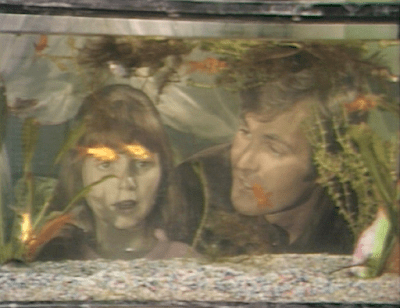
Nickerson and Don Briscoe play part of their scene behind an aquarium. We last saw that aquarium in #276. In that one, we were supposed to be uneasy about Windcliff and about Julia as its director. When we saw her feed the fish, it was a metaphor for her role as the mistress of a strange, self-contained little world whose inhabitants were at her mercy. Julia has been living on the estate of Collinwood for well over a year now, and the only member of Windcliff’s staff whom we see today is a nurse whose bit part was a prize given to beauty contest winner Bobbi Ann Woronko. So our attention is directed not to whoever is in charge of the place, but to Nickerson and Briscoe’s faces distorted in the water as the goldfish pass in front of them. This is rather a heavy-handed way of telling the audience that they are, each in their own way, as much prisoners as are the fish.

In the tank. Screenshot by Dark Shadows Before I Die.

Chris has seen the weather report in the newspaper and realized that the moon will be full tonight. This alarms him. Back at the Collinsport Inn, he asks the innkeeper, whom longtime viewers met in #1 and know as Mr Wells, if he can change his room. He wants the most isolated room in the place. He also wants Mr Wells to lock the door from the outside and to leave the door closed no matter what he hears inside. Mr Wells is reluctant, but agrees to all of these conditions.

Even viewers who stumbled onto Dark Shadows never having heard of it would know from what we have seen between Maggie and Nicholas that it is a horror story. Those who have been to the movies will add Chris’ status as a mysterious drifter to his alarm at the full moon and his request to be locked up and left alone no matter what Mr Wells may hear and will come up with the irresistible conclusion that he is a werewolf. They will also be sure that Mr Wells will eventually decide the sounds coming from behind the door are so terrible he cannot leave Chris alone, and that when he unlocks it Chris will kill him. Of course this is exactly what does happen. Our last shot of Mr Wells shows his face streaked with red and blue markings. The red ones presumably signify blood, and the others signify that most TV sets in the USA in 1968 received only in black and white, so blue lines would look like bruises.

Blue and red. Screenshot by Dark Shadows Before I Die.
The same shot in black and white.

Mr Wells, played by veteran character actor and future TV star Conrad Bain, had last appeared in #61. That was one of the longest gaps between appearances by a cast member, though the record belongs to Albert Hinckley, who like Bain appeared in #1. Hinckley, a train conductor in that one, will return playing a doctor in #868. That’s quite an extended absence from the show, but a remarkably short period to make it all the way through medical school, he must have been very bright.

Also in #1 was Alexandra Moltke Isles as well-meaning governess Victoria Winters; Mrs Isles left the show three days before this episode was taped. Victoria was Dark Shadows’ chief protagonist for its first year, and Mrs Isles’ presence in the cast was a powerful reminder of the show’s history even after the character was relegated to the sidelines of the action. Combining her departure with Mr Wells’ on-screen death, it might seem plausible that Maggie, another survivor from the first episode, might really die on Nicholas’ altar.

Episode 631: The curse of the undead

Old world gentleman Barnabas Collins, himself a recovering vampire, bursts into well-meaning governess Victoria Winters’ bedroom just in time to prevent another vampire from claiming her as his victim.

Once the coast is clear, Barnabas explains to Victoria what happened, using the word “vampire” and telling her what it means. For the first 40 weeks Barnabas was on the show no one used that word, and even when Victoria was briefly Barnabas’ victim in March 1968 it seemed she didn’t understand what it was all about. The scene of Barnabas bringing Victoria up to date is interesting, but it could have been so much more. Victoria is played today by Betsy Durkin, making her second appearance in the role. Had Alexandra Moltke Isles still been in the part, it would have been electrifying to see Victoria reconnected with the plot after her long exile. Miss Durkin does what she can, but as a new face she simply does not bring the iconography of all those hundreds of episodes in which we saw Mrs Isles held at arm’s length from the story.

Barnabas and Victoria identify the vampire as the late Tom Jennings. Victoria tells Barnabas that she had, earlier that evening, gone to see suave warlock Nicholas Blair and confront him about his plans to marry Maggie Evans, The Nicest Girl in Town. Barnabas is shocked to learn of this plan, and agrees with Victoria’s surmise that Nicholas must have made Tom a vampire and sent him to kill her. He promises to take care of the problem, but won’t tell her how.

For his part, Nicholas is dealing with a visit from Tom’s brother, the mysterious Chris Jennings. Chris was introduced in #627, Mrs Isles’ last episode as Vicki. He is a drifter who refuses to answer any questions about himself, but he has plenty of questions for other people about what happened to his brother. While Nicholas is dodging Chris’ inquiries, he glances out the window and sees Tom. This implies videotape editing, since Tom and Chris are both played by Don Briscoe and Tom’s makeup is slightly different than Chris’. Chris himself notices a figure at the window, but does not get a good enough look to know who it is.

Later, Barnabas comes to see Nicholas. Nicholas has extorted Barnabas and his friend Julia Hoffman, MD, to perform an experiment. Only they can do the experiment, and if it is not completed, Nicholas’ boss, Satan, will punish him. Barnabas says that he and Julia will not continue working unless Nicholas can assure him that neither Victoria nor Maggie will be harmed and that Tom Jennings will be destroyed. Nicholas gives him those assurances, and he leaves. As dawn approaches, Barnabas slips back into Nicholas’ house. He meets Tom there. He uses two candlesticks to make a cross, and at the sight of it Tom is immobilized. The sun rises, and Tom vanishes, destroyed forever.

Drac on Drac violence. Screenshot by Dark Shadows Before I Die.

Episode 630: Held back by something that is over

Well-meaning governess Victoria Winters ran out of story at the end of #191, but they kept putting her on the show. Frustrated by her character’s uselessness, Alexandra Moltke Isles finally gave up and left Dark Shadows last week, but not even that sufficed to get the point across to its producers. Today they bring in one Betsy Durkin as a fake Shemp to postpone the character’s departure.

Vicki’s big scene today is a confrontation with suave warlock Nicholas about his plans to marry Maggie, The Nicest Girl in Town. In the course of it, Vicki says “I know you’re going to say it’s none of my business, and it isn’t. Except I’m making it my business!” In other words, Vicki has to meddle in other people’s affairs, since she is not involved in any ongoing story that the audience could possibly care about.

Vicki tells Nicholas everything she knows about him and everything she suspects, leaving the audience with no questions about what is in her mind. Nicholas points out that Maggie would laugh uproariously if Vicki repeated her speech to her. Vicki does not deny this, but nonetheless says she will to go to Maggie unless Nicholas breaks his engagement to her.

This blatantly empty threat draws a contrast between Vicki, who is powerless to change the direction of any story she might join, and mad scientist Julia, who in #619 faced Nicholas down in this same room. Julia also began by ignoring Nicholas’ display of geniality, stating the facts about his nature, and declaring her hostility. But Julia had information Nicholas didn’t have, and when she revealed it to him she knocked him off his guard and took charge of the situation. Vicki has no such cards to play, and comes out of the scene looking more foolish and helpless than ever. Considering these scenes side by side, it is no surprise that Julia has taken over as the audience’s main point-of-view character, a function Vicki served in the show’s first year.

Nicholas does not use his magical powers against Vicki, and after she leaves his house he wonders why he did not. Again the contrast with Julia shows why this is so bad for Vicki’s character. When Julia brought Nicholas news about trouble he did not know he was in, he couldn’t be sure he would not need her help to get out of it. That not only explained how she managed to get out of his house without being turned into a toadstool, it also helped cement her status as Dark Shadows’ most dynamic protagonist. But when the only explanation Nicholas can find for his failure to brush Vicki aside is that he is ceasing to be much of a villain, he is telling the audience in so many words that Vicki is not worth their time.

Nicholas decides that he really ought to do something with Vicki after all. He goes to his basement and rips the tiles out of the floor. Longtime viewers will remember #273, when the flooring in the basement of the great house of Collinwood was torn to reveal that no corpse was buried there. That brought one of the principal storylines of the show’s first year, matriarch Liz’ long seclusion in the great house, to a ridiculous anticlimax.

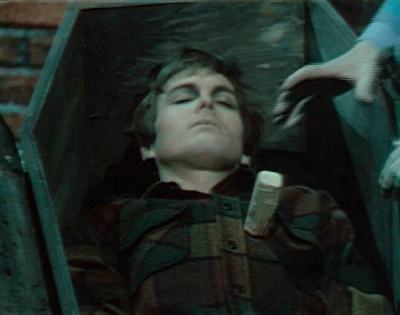
Now the result is rather different. Nicholas drags a coffin up out of the hole he makes in his basement floor, opens it, and exposes a body with a stake in its chest. It is the body of Tom Jennings, who became a vampire in #564 and was staked in #571. Tom’s body disappeared shortly after the staking, and Nicholas was in the area at the time, so we were warned that he may not have been truly destroyed. Today we find that Nicholas did in fact preserve Tom, when he pulls the stake out of Tom’s heart and declares himself to be his master. At the end of the episode, Vicki is in bed when Tom crawls in through her window and bares his fangs at her.

The unstaking feels like a cheat, despite the earlier warning Tom might return. It looks silly when Nicholas pulls the stake out. Vampires are important enough in the world of Dark Shadows that they really oughtn’t to be things you can turn on and off like an electric light.

Nicholas reaches for Tom’s power switch. Screenshot by Dark Shadows Before I Die.

But the shot of Tom crawling into Vicki’s room is pretty effective, suggesting that he is a feral beast. It makes a nice counterpoint to the scene of ex-vampire Barnabas crawling out of a cell in #616, when Barnabas was reduced to a very basic psychological condition. Barnabas disappeared after his crawl, but Don Briscoe follows Tom’s by wiggling his tongue at the camera in his final closeup, making it look like he is super-excited to drink Vicki’s blood.

Nicholas and Maggie have a funny scene. Yesterday his boss, Satan, ordered Nicholas to sacrifice Maggie in a Black Mass so that she could join him in Hell. Today, Nicholas shows her an ancient cup. He tells her it was made “before your Christ* was born.” Maybe Maggie knows Nicholas isn’t Christian, but certainly she doesn’t know that he isn’t human, much less that he is a minion of the Devil. So you might think that she would react to the bizarre formulation “your Christ,” but she doesn’t seem to pick up on it at all. When Nicholas uses the cup for a little fortune-telling trick and tells her she will have a long and happy life, she does notice that he sounds disappointed.

*The first mention of that title on the show. Dark Shadows is in a weird little quasi-Christian phase at this point.

Episode 629: I know him by another name

Suave warlock Nicholas has botched his main project, and is in big trouble with his supervisor. He is called into the corner office, which apparently represents Hell, and talks the boss into giving him another chance.

Nicholas gets an unsatisfactory performance review. Screenshot by Dark Shadows Before I Die.

Regular viewers will immediately recognize Hell as a redress of the basement of the Old House on the great estate of Collinwood, home to old world gentleman Barnabas. Strangely enough, this is not the first time it has seemed that Hell is in a corner of Barnabas’ basement. In #325, strange and troubled boy David had a dream in which the ghost of Barnabas’ sister Sarah brought him to the basement. The set was decorated much as we see it today. David met a faceless figure and saw Barnabas, who was at that time a vampire, rise from his coffin. In #512, the ghost of the Rev’d Mr Trask, a witchfinder whom Barnabas murdered in the late eighteenth century, conjured up the spirits of many of Barnabas’ victims, and put him on trial in the basement. Again, we see that it is the abode of the unhappy dead.

Nicholas has to admit to his boss that he has fallen in love with Maggie, The Nicest Girl in Town. Contemptuous of warm human feelings, the boss tells Nicholas that he and Maggie can indeed be together for all time, but only “here”- confirming that the set does represent Hell. Nicholas is horrified, but the boss yields nothing. He will have to sacrifice Maggie in a Black Mass so that she can be damned along with him. He must also get his original project back on track, breeding a race of Frankenstein’s monsters who will be loyal to the spiritual forces of darkness.

Returned to the world of the living, Nicholas goes to the great house of Collinwood, where he tries to persuade mad scientist Julia to help him with the Frankenbabies plan. She can see that he is desperate, and is therefore unimpressed with him. She presses him for more information, and he tells her to read the Book of Genesis. His boss figures in it, as the one who tempted Adam and Eve. Julia gasps at the idea that Nicholas is one of Satan’s direct reports. Nicholas explains what he wants her to do. Julia calls the idea “monstrous,” a description which Nicholas considers apt. She refuses to have any part in such an enterprise, but she capitulates when he threatens her dear friend Barnabas.

Danny Horn’s post about this episode on his great Dark Shadows Every Day is devoted to the packet of View-Master reels featuring images related to episodes made around this time. I’ve always enjoyed View-Master; I think it’s a shame it was slotted as something for young children only. I find it refreshing to spend three or four minutes peering into its little worlds. I left this comment:

Some years ago I bought a bunch of ViewMaster reels. I’d liked them when I was a kid, and I was curious about the non-cartoon ones, the reels depicting landscapes and such. I found that it was a meditative exercise looking into the viewer and teasing out all the 3-D effects.

Anyway, I still have those reels, including the Dark Shadows set. Inspired by this post, I looked at them this morning. There are a bunch of very good shots with high contrast between actors and background. Bud Astredo was particularly good at striking poses that would make him stand out. Grayson Hall is just as good, it’s a shame she’s only in the one picture.

(20 October 2020, 11:12 am Pacific time)

Danny’s post also links to this wonderful piece about the packet on a blog called View-Master 3D.

Episode 628: Taking it to corporate

Angelique, wicked witch turned vampire, is dissatisfied with her boss, suave warlock Nicholas. She finds out that Nicholas has botched his current project and sees an opportunity to report him to his boss, a figure identified in the dialogue simply as “The Master” but in the closing credits as “Diabolos.” She performs a ceremony that is intended to get Diabolos to come to her in the basement of Nicholas’ house, but Diabolos insists she meet him in his office. That is obviously a redress of the set used for the basement of old world gentleman Barnabas Collins’ house. The show never does explain where Barnabas gets his income, so I guess it makes sense he rents out space to local businesses.

Diabolos is impatient with Angelique. When she starts complaining that Nicholas has been harsh with her, he responds “From what I know, you deserved it.” When she persists on this point, he says “I don’t want to hear anymore.” He goes on to praise Nicholas, saying that “His plan for creating a super-race which will follow only me is excellent.” Angelique then tells him that this plan has in fact failed. “One of the beings chosen for the plan has destroyed the other.” Indeed, the male Frankenstein’s monster known as Adam killed the woman built to be his Eve on Monday. Diabolos is shocked to hear this, and at the end of the episode we hear his voice telling Nicholas that he will soon face judgment.

Diabolos and Angelique. Screenshot by Dark Shadows Before I Die.

Duane Morris plays Diabolos. Morris appeared several times as a stand-in for Adam before Robert Rodan wa s cast in the part; this is his first speaking role on the show. It would be a very difficult challenge for any actor. In the first place, his costume conceals his face altogether, so his physical movements and his voice acting in his scene with Angelique are two separate performances which he has to give simultaneously. Second, in that scene he spends much of his time looking away from her, so he cannot use his imposing height to create a sense of menace. Third, his voiceover at the close plays during an extreme closeup on the motionless face of Maggie, The Nicest Girl in Town, who is supposed to be acting as his medium. But there is nothing to suggest Maggie is in peril, so even the mood lighting and other practical effects that precede the speech do not focus our attention on Diabolos as a threat. Fourth, the lines Morris has to deliver are written for a middle manager in a mundane office, not for one of the principalities of Hell. At every turn, Morris has to convince us of Diabolos’ dread might with only his voice. Unfortunately, his voice was anything but intimidating. As a result, the whole episode falls flat.

There is also some business with Adam and mad scientist Julia. An unpleasant man known variously as Peter and Jeff is in police custody, charged with Eve’s killing, and Julia tries to convince Adam to help her clear him. In recent months Julia has become the audience’s chief point of view character, but in this case it is Adam’s resolute indifference to Peter/ Jeff’s fate that reflects our attitude. Julia tells Adam that Peter/ Jeff’s life may be on the line if he is tried for murder. In the state of Maine that exists in our universe, capital punishment was abolished for the last time in 1887. In November 1966, this was also true of the version of Maine in which Dark Shadows was set. It was mentioned in #101, broadcast that month, that the state did not carry out executions. Perhaps the fictional Mainers in the show’s universe responded to the horrendous news continually emanating from Collinsport by reestablishing the death penalty, or perhaps Julia realizes that no true statement could enlist anyone’s sympathy for the entirely repellent Peter/ Jeff and so she is resorting to a desperate lie.

Episode 627: Her name is Victoria. I cannot take care of her.

Dan Curtis often said that the idea for Dark Shadows came to him in a dream about a girl with long black hair taking a journey by train. When he persuaded ABC-TV to let him make a pilot for a series, the most difficult part of the casting process was finding the actress who would embody that girl, whose name came to be Victoria Winters. Alexandra Isles, then still known as Alexandra Moltke, finally emerged as the one person who combined the right physical appearance with a mysterious, otherworldly quality that suggests a figure from a dream.

From Episode 1: The girl on the train. Reflected in the window behind her is Burke Devlin, her original love interest.

Mrs Isles’ casting had an immediate effect on the underlying story in Art Wallace’s original series bible, Shadows on the Wall. Wallace projected a puzzle about Vicki’s origins that would be resolved when it was revealed that she was the child of an extramarital liaison between Paul Stoddard, the long-missing husband of matriarch Elizabeth Collins Stoddard, and some unknown woman. Liz’ guilty feelings about Paul would explain her concern for Vicki and her decision to bring her to the great house of Collinwood as governess for her nephew, strange and troubled boy David Collins. Since Vicki would not be a blood relative of the Collins family, it would also leave an option for Vicki to develop a romance with David’s father, Liz’ brother Roger.

From Episode 1: The front doors of Collinwood open for the first time. Liz and Vicki come face to face, and each sees her own reflection in the other.

Wallace did include a note saying that if it was more story-productive, it could turn out that Liz was Vicki’s mother. Liz was played by Joan Bennett, whom Mrs Isles strongly resembled. When Bennett first saw Mrs Isles, she famously mistook her for her own daughter. From the first episode on, the show heavily signaled that Vicki was Liz’ daughter by a man other than Paul. Liz soon treats Vicki so much like a daughter that the only events that would follow from confirming the relationship would be to make some changes to Liz’ will. Since the business aspects of the characters’ lives ceased to generate action after the first few months, that would have been a severe anti-climax. So they wound up dropping the question altogether.

For the first 39 weeks of Dark Shadows, Vicki was its main protagonist. Not many of the storylines worked in those days; the only scenes that reliably clicked were those between Vicki and David. Even though their dialogue was as dreary as anything else in those early scripts, Mrs Isles and David Henesy managed to use their physical movements and the spaces they occupied to tell the story of a young woman persuading a boy to trust her. That version of the show ended with #191, when David ran from the mother who was trying to lure him to his death and flung himself into Vicki’s arms. That completed their story, and left neither character with a clear path forward.

From Episode 191: David turns from his mother and death, embracing Vicki and life.

After #191, the show was on course for the introduction of vampire Barnabas Collins. Vicki kept trying to get close to Barnabas; she even invited herself to spend the night at his house in #285 and #286. But he wouldn’t bite her, and she couldn’t get a foothold in the A-story otherwise. There was an odd meta-fictional side to Vicki in this phase. In-universe, she didn’t know that Barnabas was a vampire, and she certainly didn’t know that she was a character on a soap opera that was coming to be all about him. But her behavior made sense only if she did know those things and was making an effort to reestablish herself as a central figure in the action. I don’t know whether Mrs Isles or any other particular person was lobbying the writers to present her that way, or if it was a response to fan mail. It happened so often and led to so little that it did seem to be coming from somewhere outside the usual creative process behind the scripts.

In November 1967, Vicki came unstuck in time and found herself in the year 1795. She took the audience with her, and for several months the show was a costume drama set in the late eighteenth century. On balance, the result was a triumph. By the time Vicki and the show came back to contemporary dress in March 1968, Dark Shadows had become a real hit, and Barnabas had become one of the major pop culture phenomena of the 1960s. But Vicki did not benefit from that success. When the costume drama insert started, fans had every reason to expect it would revive her character. Barnabas spent most of his time in 1967 scrambling to impersonate a native of the twentieth century; Jonathan Frid would always say that it was in that scramble that he found Barnabas, and that he thought of him first and foremost as a liar. When Vicki turns up in Barnabas’ original period, we look forward to seeing her doing what he did, and trying to pass as his little sister’s governess. Remembering how well Mrs Isles did during the 39 weeks she carried the show on her shoulders, we look forward to her showing us what Vicki can do when she has to think fast.

But that was not to be. Instead, Curtis and his staff chose to write Vicki as an intolerable moron. She introduced herself to every new person by telling them that they are being played by actors who had other parts in the first 73 weeks of the show. Tedious as that habit was, it was compounded when she made one inexplicably idiotic decision after another as she failed utterly to adapt to her new surroundings. That would have been a difficult role to make appealing even if she had shared her screen time with a partner as capable as David Henesy. It became utterly impossible when Vicki made the least intelligible move of all and fell in love with her jailer/ lawyer/ boyfriend/ accomplice Peter Bradford, played by the abusive and shouty Roger Davis. Marooned in scene after scene with Mr Davis, Mrs Isles withered and Vicki became a cipher. By the time the court sentenced Vicki to be put to death for her many crimes, half the audience was on their side.

Shortly after Vicki returned to the 1960s, Barnabas finally bit her. Each of Barnabas’ victims reacted to his bite differently; Vicki’s reaction was perhaps the most unexpected, and certainly the funniest. She was just sort of chill about the whole thing. She showed up when Barnabas summoned her and didn’t object when he told he her she would become his vampire bride for all eternity, but first she had some errands to run, and she was irritated with him when he tried to get her to skip them. When a doctor saw the bite marks on her neck, she did not react with the fear or defensiveness of other victims, but innocently asked “Why are they bad?” She seemed to regard them as just another hickey, the result of Barnabas’ peculiar make-out technique.

Unfortunately, Peter came back to life and ruined Vicki’s relationship with Barnabas. He jumped out in the road in front of her car while she was driving off with Barnabas, causing her to crash. Vicki and Barnabas were taken to the hospital. There, one of the doctors turned out to be a mad scientist who cured Barnabas of vampirism. Once the cure took hold, Vicki forgot all about her time as Barnabas’ victim, and she sunk into a relationship with the irredeemably repellent Peter. Every time we’ve seen her in recent months, she has dragged Peter back to our attention. Mrs Isles has found ways to liven up Vicki’s scenes; she always projected a forceful personality when she was standing near the clock in the foyer of the great house of Collinwood, and she has even managed to coax Roger Davis into playing a couple of scenes competently. Mr Davis never had quite as much to offer as did the clock, but when Mrs Isles could raise her voice and fix him with a steely stare it does seem to have come back to him that he had had a lot of acting lessons and could deliver dialogue interestingly.

Today is Mrs Isles’ last day on the job. We open with a reprise of the end of yesterday’s episode, when Vicki finds the corpse of a strangled woman in the closet in Peter’s room. Peter assures her he doesn’t know how the corpse got there. She tells him they have to call the police. He says he needs time to figure out what happened before they can involve the police; she points out that delaying will only make him look guiltier in their eyes. He tells her that she should leave so that her name won’t be connected with the case; she tells him it is too late for that. We can see why Vicki has faded- she is thinking like a rational person from our world, not like anyone you would meet in Soap Opera Land.

Vicki goes home to Collinwood and tells permanent houseguest Julia Hoffman that Peter is in jail, suspected of murder. She explains that the dead person is a woman Peter knew only as Eve. Julia reacts with shock to the name; Vicki asks if she knew Eve. Julia says of course not, and Vicki tells her she will go wake Roger and ask him to help arrange bail for Peter. She goes into the door leading to the bedrooms, never to be seen again.

In her final appearance, Vicki talks with Julia, her successor as the principal audience-identification character.

Viewers who have been with the show from the beginning will see a loop closing in the idea of Vicki going to Roger’s bedroom while he sleeps. In #4, Roger had tried to let himself into Vicki’s bedroom at night, only to be caught with his hand on the doorknob by Liz. In response to Liz’ threats, Roger told her not to bother him about his “morals,” a choice of words that made it clear that his intentions with regard to Vicki were of a sexual nature. Later in the episode, he and Vicki bantered flirtatiously after he offered her a snifter of brandy; for the first and last time, Vicki sounded like what she was supposed to have been, a street kid from NYC. Roger has long since been stripped of all his villainous qualities; in #585, he and Vicki even shared a scene in her bedroom while she was in her nightgown, and it was all perfectly innocent. In that scene, we not only saw that the old menacing Roger was gone forever, but that Vicki was also reduced to such a humdrum status that a man can enter her bedroom at night without raising an eyebrow. Now that Julia sees nothing out of the ordinary in Vicki dropping in on Roger while he sleeps, that humdrum status is reinforced.

When Vicki first arrived in the village of Collinsport in #1, she met her original love interest, dashing action hero Burke Devlin. Burke told her she had found her way to “the beginning and the end of the world.” We are reminded of the beginning of the world since we know that the man who killed Eve was named Adam. This Adam and Eve are no one’s parents; they share nothing but hostility and death. The episode ends with the wicked Angelique trying to summon up the Devil, a symbol of the end of the world. She herself disappears, apparently destroyed. Burke’s description is finally fulfilled.

The part of Vicki will be recast twice in the months ahead, but those actresses never had a chance to breathe any life into her. The character had lost any reason to be on the show long before Mrs Isles’ departure. In #87, David had trapped Vicki and left her to die; wondering where she was, Roger said, “She came to us from nowhere, and now it seems she has disappeared into nowhere.” And so, at last, it has come to be. The long-haired girl from Dan Curtis’ dream, the image that started it all, has vanished, never to be seen again.

Episode 626: The sad case of Victoria Winters and Peter Bradford

From November 1967 to March 1968, Dark Shadows was a costume drama set in the years 1795 and 1796. Well-meaning governess Vicki had come unstuck in time, found herself in that period, and failed utterly to adjust to her new surroundings. While she was in gaol charged with witchcraft, she befriended an unpleasant man named Peter, who served as her defense attorney. Peter handled the case so badly that he and Vicki were both sentenced to hang, but they nonetheless fell in love with each other.

Shortly after Vicki was whisked back to the 1960s, she found that Peter had also come back to life. Unfortunately, he had total amnesia covering everything prior to his arrival in the twentieth century, and he became belligerent every time Vicki tried to tell him about himself. These traits did nothing to improve Peter’s already repellent personality, but having fallen in love with him once Vicki remained grimly determined to make a life with him.

The other day, Peter and Vicki were about to get married when a mysterious woman known as Eve presented Peter with evidence that what Vicki has been telling him is true. He ran off to exhume the grave marked with his name and found that the coffin was empty. For some reason he took this to mean that he shouldn’t marry Vicki after all. He has gone back to his room, where he is packing his bags and looking at a train schedule.

Unknown to Peter, there have been two visitors in his room while he was away. Eve came in and called for him, saying aloud that she would “make it all right” for him. A man known as Adam followed her in and overheard this. Adam thus learned that, despite their names, he and Eve would never be a couple. He asked if, when “yesterday, you made me happy- that was a lie, wasn’t it?” She confirmed that it was, that she would never love him, that she had always hated him, and that she found him ugly. That last apparently struck a nerve, because Adam responded with great rage. He choked Eve, and she collapsed.

Vicki drops in on Peter while he is getting ready to leave town. He tells her they cannot be together, and she insists on giving their relationship a second chance. Peter opens his closet to get some more clothes to pack, only to close it quickly. Vicki opens it, and finds Eve’s strangled corpse crumpled on the floor.

There is a genuinely horrifying moment in this episode. Vicki thinks back to the night in the 1790s when she was taken to the gallows, and we see events from her point of view. At one point we see Peter’s face looming towards the camera with his lips puckered. We’ve seen how Roger Davis manhandles his female scene partners, and in particular how miserable Alexandra Moltke Isles is when he kisses her. The sight of him coming at us for a kiss is enough to make even the most seasoned horror viewer flinch.

Get away from me. Screenshot by Dark Shadows Before I Die.

Mrs Isles read the opening narration of episodes 1-274 in character as Vicki. After she lost her monopoly on the opening narrations, she read more than 100 others, no longer as part of that role. This is the final time she takes on that task. It is also the first time “and Alexandra Moltke as Victoria Winters” is followed on screen by other acting credits.