
In #949, eleven year old Amy Jennings saw twenty-nine year old Quentin Collins. She reacted with terror, certain that he was the ghost of her great grandfather, the ghost who had persecuted her and everyone else at the great house of Collinwood from December 1968 to September 1969. Heiress Carolyn Collins laughed at Amy and told her that he was not a ghost, but was a cousin of theirs, another descendant of Quentin’s. In fact, Quentin was Amy’s great-grandfather and Carolyn’s great-great-uncle, but he wasn’t a ghost, and he meant no harm to Amy.
Amy refused to accept Carolyn and Quentin’s assurances that he was “not that Quentin Collins.” That refusal highlighted Quentin’s convoluted backstory. The show went back in time in March 1969 to the year 1897, and during an eight-month costume drama segment it introduced us to Quentin as he was before he died. He was a charming rascal who immediately became a huge breakout star. During the 1897 segment, they showed history being changed so that Quentin never died and was the beneficiary of a magic spell that immunized him against aging. Ever since early 1967, Dark Shadows has been operating on a model of the cosmos in which the usual laws of cause and effect are replaced with anniversaries. So in #839, we saw that Quentin’s haunting of Collinwood had gone on for ten months and had finally resulted in the death of strange and troubled boy David Collins. But that day was also the 72nd anniversary of the change in history which prevented Quentin’s death, so the haunting broke and David came back to life. When Quentin showed up in 1969 as a living being, everyone remembered the haunting. Most characters accepted Quentin’s claim to be his own great-grandson, but Amy saw the truth, that he and the ghost were two continuations of one man.
The show’s metaphysics probably didn’t bother anyone who watched it the first time it was broadcast. The characters just take them for granted, as in our world we take hard-to-explain phenomena like gravity and magnetism for granted, and the story keeps on going as if they somehow made sense. What the writers were worried about when Amy saw the living Quentin was not that their model of the universe lacked plausibility, but that they hadn’t found a way to keep Quentin at the center of the story. He’d made a hit in the 1897 segment because he was connected to everyone and was naturally involved in everything that was happening, but in 1969 and 1970 he is a visitor, a distant relative who has come wandering in from who knows where. When Amy tries to figure out in what sense he is “that Quentin Collins,” she is trying to solve a puzzle that the show has to solve to keep him generating heat in the ratings.
Now, Dark Shadows has crossed over to an alternate universe. Here, we have met yet another iteration of Quentin. This Quentin Collins is the Master of Collinwood. Amy lives in the house in this continuity as well, but she really is Quentin’s cousin, and her last name is Collins.
Parallel Quentin hasn’t thought to tell Amy that there is a houseguest staying at Collinwood. She is Alexis Stokes, identical twin sister of his late wife Angelique. Since there are a lot of people around the estate who keep saying that Angelique is going to come back to life, the sight of Alexis comes as quite a shock to everyone. Amy sees Alexis today, and reacts with terror, certain that she is the ghost of Angelique. She does not accept Quentin’s belated explanations, anymore than her counterpart accepted Carolyn’s. Amy Jennings had specialized in looking directly into the camera; as Amy Collins, Denise Nickerson has a moment after Quentin and Alexis have explained the situation to her when it looks like she is about to make this move, but she does not.
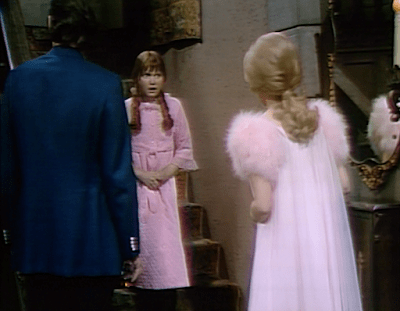
Amy has two more scenes today. She opens the front door and lets Angelique’s associate, sleazy musician Bruno Hess, into the house. Amy greets Bruno with “She’s upstairs.” He asks how she knows who he came to see, and she tells him he always came to see “her” before. She wonders if “they” will make Bruno call the woman “Alexis.” Perhaps she thinks all adults are in on this scam, pretending that the dead can be counted on to leave the living alone. Later, she gives Quentin a telegram. When he scolds her for having opened it, she is at once sincerely remorseful about what she has done and indignant about what is going on upstairs. She says that while opening other people’s mail is indeed bad, what “she” has done is even worse.
On Friday, the show hinted that Alexis might be Angelique. Today, Bruno starts an investigation to check up on Alexis’ report that she arrived in New York from Genoa a couple of days before. They spend enough time on Bruno’s activities that it would be surprising if her story simply held up, so that keeps the question alive.
Quentin’s new wife, the former Maggie Evans, left him and went to her sister Jennifer’s place in New York on Friday. She was fed up with Quentin’s high-handed attitude, with everyone’s preoccupation with Angelique, and with Alexis’ presence in the house. Quentin picks up a telephone today, says “Operator, this is a person to person call. Mrs Collins!” And they connect him to Jennifer’s place! In spite of this magical power, he still can’t persuade Maggie to come to the phone. By the end of the call, he and Jennifer are mad at each other, too.
When this episode was taped, principal photography was underway for the feature film House of Dark Shadows. Many of the best-known members of the cast are going to be in Tarrytown, New York for the next six weeks. When Quentin talks to Jennifer Evans, he offers to go to Maggie in New York- we might assume he means NYC, but I suppose Jennifer might live in Tarrytown, and Maggie’s real reason for staying with her is that she doesn’t want to be separated from Kathryn Leigh Scott.
As Quentin and Alexis, David Selby and Lara Parker are the biggest names currently on Dark Shadows, and they are playing characters quite different from those that made them famous. This Quentin intermittently displays the charm which the one from the main continuity exudes so effortlessly, but he is a downer at least half the time, and his position as Master of Collinwood keeps him from being the lovable rascal who has been a fixture on the cover of the fan magazines for a year now. And even if Alexis is Angelique, she is an Angelique who has not gone through any of the development that has held the fans’ attention for over two years. Angelique was a story dynamo from her introduction at the end of 1967, but what has made her indispensable in arc after arc is that she usually knows everything the audience knows about what is happening and has some crazy scheme that no one else would have thought of as to how she can make it all much worse. And over the last year, she has shown an ability to learn and grow that has made her a much more interesting character. A new Angelique, starting from scratch, won’t match the audience’s understanding of the situation, and won’t remember anything that gave her new depth in 1969 and early 1970.
You may wonder if these two can carry the show for a month and a half. The writers certainly did, as witness a conversation between Alexis and Quentin today. She goes on at length about how difficult it was to grow up in her sister’s shadow, saying that she tried to imitate Angelique but could never make it. The harder she tried to copy the habits that attracted everyone to Angelique, the more embarrassed their reactions were.
Not only does Alexis tell us explicitly that she isn’t as appealing as Angelique, Quentin couldn’t be less interested what she is saying. He is preoccupied with a dispute he is having with Bruno. That dispute, were Alexis aware of it, would probably interest her as little as what she is saying interests Quentin. In their scene together, Alexis does not give any sign that she recognizes Bruno. After he leaves, she looks at a picture of him on some sheet music he composed, as she would do if she never had seen him before. So, if she is Angelique returned from the grave, she would appear to have lost her memory of Bruno along the way. And whoever she is, her attitude towards him throughout is one of amused tolerance. We can’t imagine her being particularly invested in a conflict about whether Bruno has a right to live in the caretaker’s cottage on the grounds of Collinwood. So the scene between Angelique and Quentin, in which neither has anything to say that is of concern to the other, seems to be something like the opposite of a programmatic statement. Rather than telling us what they plan to do, the writers are telling us what they are afraid we will think they have done.
Not that they have despaired of making it work. By the end, Quentin and Alexis have drawn each other’s attention sufficiently to do some pretty firm smooching. Maggie has been a fan favorite from episode #1, and many of the nine year old girls in the audience probably identify with her and are excited about the idea of her being married to Quentin. The image of him cheating on Maggie with the wicked witch will outrage them enough to keep them tuning in.
The prospect of an affair between Quentin and Alexis presents something of a puzzle in logic. If she really is who she says she is, he is cheating on Maggie with her. But if she is Angelique, he has been cheating on her with Maggie, albeit unknowingly. One way or another, it is far from gentlemanly behavior on his part. As for Alexis, what we know so far would tend to confirm our initial assumption that Angelique is an Evil Twin, but seeing her go after Maggie’s husband will keep regular viewers from labeling her the Good Twin.
 Dark Shadows Commentary