Reclusive matriarch Liz is in a catatonic state, and her doctor is at a loss to explain why. Well-meaning governess Vicki has confided in her boyfriend, instantly forgettable young lawyer Frank, that she thinks Liz is the victim of blonde fire witch Laura. Frank has sent for a Dartmouth psychology professor, Dr Peter Guthrie, whose research concentrates on reports of paranormal phenomena.
Keeping vigil in Liz’ room, Vicki tells Liz’ daughter, flighty heiress Carolyn, that she and Frank have sent for another doctor. When Carolyn asks what Dr Guthrie specializes in, Vicki claims not to know. A few minutes later, Dr Guthrie shows up and has a brief conversation alone with Vicki. He asks her if she knows what he specializes in, and she immediately gives the correct answer. Now that the audience knows without doubt that Vicki was lying to Carolyn, she asks Dr Guthrie what she should tell the others in the house if they ask about him. He says that he is in fact a psychologist who studies psychosomatic ailments, so she can tell them that. When he says that he is uncomfortable with secrecy, Vicki asks him if he understands why absolute secrecy is necessary in this case. She doesn’t leave him much choice but to agree.
Dr Guthrie takes his first look at the drawing room
The whole episode is very awkwardly written. There’s so much repetition, unnecessary dialogue, and unexplained change of attitude from scene to scene* that it’s hard to avoid the conclusion that it could have been five minutes long. But the actors make me glad it went the full twenty-two minutes. It’s interesting to see Vicki manage Dr Guthrie in the same way Liz manages everyone- at first she is understated and demure, and before you know it she is so fully in command that you would feel like a ruffian if you were to disobey her.
John Lasell’s performance as Dr Guthrie is tremendous. He disappears into the character- I’ve never had a harder time recognizing the same actor in two roles than when I found out that the same man who played the quiet, methodical, entirely trustworthy scientist from upper New England in Dark Shadows also played the floridly romantic, flamboyantly sinister, and emphatically Southern John Wilkes Booth in the Twilight Zone episode “Back There.” Every fine muscle of his face and eyes represents a well-thought-out acting choice. When it is Lasell’s turn to take the spotlight, he not only commands the screen, but creates a whole new atmosphere- when he’s on, the show suddenly feels like a primetime broadcast or a feature film. And when he’s around, the whole cast, even Joan Bennett who spends the entire episode being absolutely still, is obviously having fun giving a performance.
*For example, a few minutes after acquiescing in Vicki’s insistence on secrecy, Guthrie demands of the apparently reluctant Vicki and Carolyn that they maintain secrecy. In the interval, we saw Guthrie so absorbed in his examination of Liz and the young women so distraught about her condition that it doesn’t feel like a contradiction, but that’s a credit to the actors, not to the script.
Writer Ron Sproat stayed with Dark Shadows too long, and fans of Danny Horn’s great blog Dark Shadows Every Day will have fond memories of his frequent denunciations of Sproat. It is true Sproat had many glaring weaknesses. For example, he was pretty bad at inventing stories to tell, which you might think would get in the way of building a career as a fiction writer. But one strength Sproat undoubtedly had was a sense of structure. There might not be anything happening in one of his episodes, but you can count on him to make it clear why it isn’t happening, where it isn’t happening, to whom it isn’t happening, and who isn’t making it happen. Today there are some events, and between Sproat’s script and the work of the actors, it is plain to see what purpose each of those events serves in keeping the story on track.
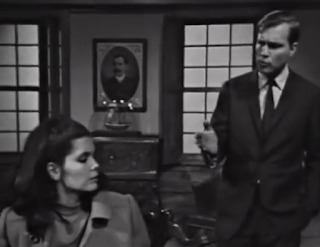
As the episode opens, Lieutenant Dan Riley of the Maine State Police is visiting instantly forgettable young lawyer Frank Garner in an office. Regular viewers will be confused; we’ve seen this set several times, with exactly these decorations, as high-born ne’er-do-well Roger Collins’ office at the headquarters of Collins Enterprises. We haven’t seen the set since #69, and Roger wasn’t there at that time. So apparently Frank has moved in.
Frank hasn’t even moved the portrait of the Mustache Man from the spot where Roger had it when he was in the office. Screenshot by Dark Shadows Before I Die
Lieutenant Riley wants to pass along to Frank the information that the Phoenix, Arizona police have given him about a fire in Laura Collins’ apartment in that city. Laura is Roger’s estranged wife, and Frank is representing Roger in their upcoming divorce. It isn’t clear why Riley wants to tell Roger’s lawyer what he has heard about Laura. Later in the episode, Frank will tell well-meaning governess Vicki that Riley came to him because he is a “lawyer for the Collins family.” Perhaps that means he believed that Frank represented Laura. Throughout their conversation, Frank repeatedly protests that no one has any grounds for accusing Laura of anything, encouraging Riley in such a belief. I suppose it’s a lawyer’s job to collect damaging information about the opposition, but Frank does seem to be pushing an ethical boundary here.
The charred body of a woman was found in what was left of Laura’s apartment. Since the woman appeared to be the same age, height, and build as Laura, the room was locked from the inside, and everyone associated with the building other than Laura was accounted for, the body was initially identified as hers. Riley now tells us that the police have determined that the fire started in Laura’s apartment, and that a witness claims to have seen Laura in the building the day of the fire.
Laura checked into the Collinsport Inn the day of the fire and has been in and around town ever since, as many witnesses can testify. Riley says that there is no indication that Laura has been on an airplane recently, and it would seem impossible to travel from Phoenix, Arizona to central Maine in a few hours any other way.
The lieutenant goes on to say that because the room was locked from the inside and the woman who died in the fire made no attempt to escape, the police suspect murder. This is nonsense. An attempt to escape might have been evidence of murder, not the lack of such an attempt. And if the room was locked from the inside, how did the murderer get out?
Frank doesn’t raise these objections, but just blusters through a lot of verbiage as he protests against any suggestion that Laura should be suspected of murder. The lieutenant keeps pointing out that Arizona isn’t his jurisdiction, so he doesn’t have anything to do with it. He’s just a messenger.
Some scholar of acting really ought to make a frame-by-frame study of Conard Fowkes portrayal of Frank in this scene. He has plenty of dialogue, he’s challenging statements made by a policeman, he raises his voice, makes gestures, moves around the room, looks down moodily and up excitedly. Yet he is still so bland that it is difficult to remember a word he says. It is far beyond my understanding of the actor’s craft to explain how Fowkes manages to be so consistently dull no matter what the character is doing.
When Frank is a small part of an episode, I think of his blandness as a note of pure realism. He is just the sort of person you would expect to meet in a small-town law office in 1967, and indeed it is reassuring to think that someone who has obviously never thought of putting himself in the spotlight would handle your sensitive legal affairs. The last person anyone should want as a lawyer is some guy who habitually makes himself interesting to watch on television.
Today, Frank is the leading man of the first half of the episode, and comes back with a key part in the second half. Giving that much time to a performer with such a bland screen presence does serve a purpose. None of the characters has really committed to the notion that they have to worry about crimes and physical danger, much less that they are facing a challenge from the realm of the supernatural. As far as they know, the whole story today is about a couple of romances and a child custody matter. That’s the right speed for dull, amiable Frank Garner.
That the characters don’t yet know the true dimensions of what they are facing in the storyline is one of the points this scene has to make. The other is that we will be hearing more about the investigation in Phoenix, and that it will advance the plot.
I think an acting problem muddies this second point. Today Vince O’Brien takes over the part of Lieutenant Dan Riley from John Connell, who played him in #143 and #144. As Connell played him, Riley was an out-of-town cop, not the least bit awed by the Collinses of Collinsport. His matter-of-fact speaking and impatient listening made it clear that the family’s connection to the case in Phoenix was not going to result in the discreet, abbreviated treatment that the local authorities have given them. But O’Brien’s version of the character is noticeably quick to agree when Frank makes a statement. When Frank does a TV lawyer “may I remind you” about the elements of a murder charge (elements which he gets wrong, but hey, it’s TV, not law school,) O’Brien’s Riley is agitated. He shows defiance by declaring “You don’t have to remind me” in a harrumphing voice, but his wide eyes and trembling legs show that he is intimidated to be in a discussion with the representative of the mighty Collinses. There’s no point in bringing in an out-of-town character if that’s what you’re going for- the residents of Collinsport can show you what it’s like to live under the thumb of the people in the big house on the hill. And it introduces a doubt as to whether anything will come of the investigation, a doubt which leaves us wondering why we just spent so much time watching these two guys talk to each other.
Meanwhile, Vicki is visiting dashing action hero Burke Devlin in his hotel suite. Burke has asked her to come. Yesterday, she told him that she was suspicious there was something sinister about Laura, and he had listened attentively. Later, he met with Laura and the love he once felt for her had flared back into life. So today, he wants to tell Vicki that Laura is A-OK and she should do everything she can to help her.
Like the scene with Frank and Lieutenant Riley in Roger’s office, this scene has two points to make. First is to establish Vicki as a credible protagonist for the rest of the storyline about the danger Laura presents to her son, strange and troubled boy David. Second is to show that Burke is so smitten with Laura that he won’t be much help in protecting David.
Burke guides Vicki into his kitchen, a cozy space where people can confide in each other. Last time they were in this space, she made coffee for him; this time, he makes coffee for her. He’s remarkably dainty about it, sifting cream and sugar in separate cups. He makes a pitch about how remarkable Laura is, how he’s rethought everything they said yesterday, and how a fine woman like her deserves Vicki’s trust and support.
Vicki is unimpressed. She was in the room when Laura telephoned Burke yesterday, and heard him agree to meet her at one of their old places. She presses him to explain what has changed his mind, and he won’t give a clear answer. She asks how well he really knows Laura, and he looks dreamily off into space and says that he knows her better than anyone else. She asks if his feelings for Laura might be clouding his judgment, and he demands she change the subject. When Burke urges her to persuade David to grow closer to his mother Laura, Vicki replies “I’ll do what I can for David.” Burke says “You’re hedging.” Vicki replies coolly, “I can’t help it.” When he repeats his urging, he tells her she doesn’t look convinced. She replies, “I can’t help how I look, either.”
Vicki’s strength and intelligence and Burke’s dreamy infatuation should impress anyone watching this scene, but especially viewers who just saw yesterday’s episode. When Vicki is asking Burke what happened between yesterday and today to change his mind, she is waiting for him to talk about the meeting he arranged with Laura while she was right next to him. He never mentions it, and his repeated statements that all he has done is think more deeply implies that he does not remember that Vicki heard him talking to Laura. He is so captivated with Laura that the sound of her voice erases his awareness of everyone else, even of someone he is trying hard to persuade of an important idea.
Shortly after Vicki leaves, Burke receives another visitor from the great house of Collinwood. Flighty heiress Carolyn shows up. Carolyn is pouting because Burke hasn’t been paying attention to her since her Aunt Laura showed up.
This scene has one major point to make, which is that the budding Burke/ Carolyn romance is not going to be blooming this winter. Nancy Barrett’s Carolyn bursts off the screen as she bounces from one extreme to another, trying to attract Burke by pushing her breasts at him, trying to anger him by suggesting that her mother Liz and her Uncle Roger were right when they said he was just using her to get at them, trying to embarrass him by bringing up the obstacles between him and Laura, trying to break through his reserve by flinging her arms around his neck and pleading with him to love her.
Burke tries to let Carolyn down easy, smiling at her, caressing her face, hugging her, kissing her on the forehead. But signs of boredom and irritation keep slipping out. He tells her that the time has come for them not to see each other any more, and there can be no doubt he means it.
Burke, bored with Carolyn
Vicki goes to visit Frank. Frank blabs everything to her that the lieutenant had told him.
Vicki is deeply concerned about the idea that Laura might be a murderer. Frank keeps telling her that there’s probably nothing to that idea, but Vicki resolves at the end of the episode to do whatever she can to keep Laura away from David. Having established Vicki as a character strong enough and smart enough to square off with Laura in her previous scene, this scene shows us her decision to do just that.
Sheriff Patterson is at the mansion on the estate of Collinwood, talking with reclusive matriarch Liz and Liz’ ne’er-do-well brother Roger about the mysterious death of plant manager Bill Malloy. Liz listens as Roger answers the sheriff’s questions, seeming every bit the trusting sister. The minute the sheriff leaves, she turns to Roger and asks in an icy voice “How much of what you told him was the truth?” She confronts Roger with the differences between what he told the sheriff and what he’d told her. Roger is upset, and finally tells Liz she has to trust him. Liz looks sadly off into the distance and says that yes, she does have to do that.
“Yes, I do have to do that.”
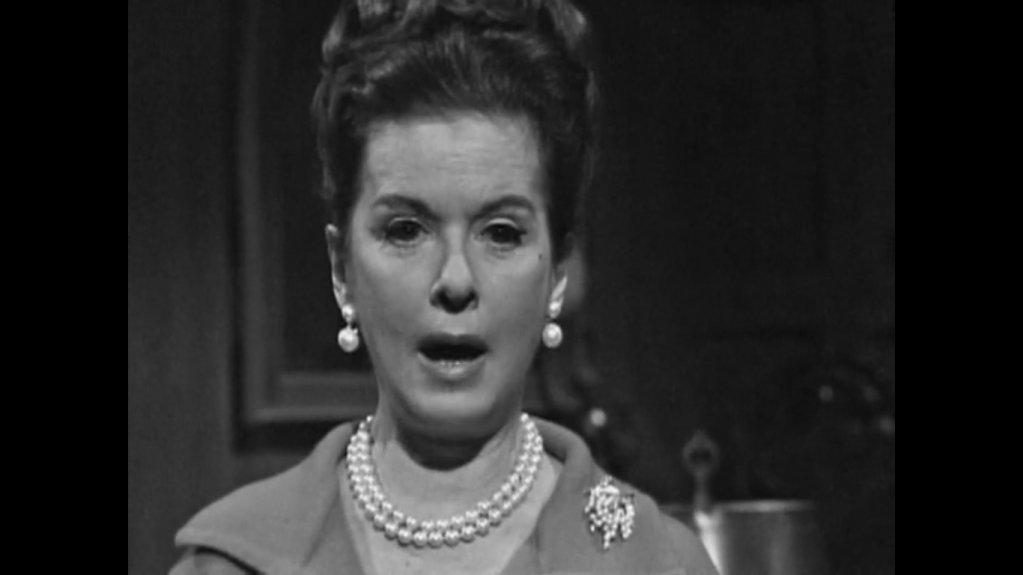
I’m always interested to watch actors play characters who are themselves acting. When she’s concealing her doubts about Roger from the sheriff, Joan Bennett has her first chance to show us what sort of actress she thinks Liz would be. She’s a skillful one- she does have some subtle reactions to Roger’s evolving story when the sheriff isn’t looking at her, but her abrupt, contemptuous turn to Roger is the removal of a convincing enough mask that it shocks the audience. And her statement that she does have to believe Roger, coming after she has made it clear that she knows he has been lying to her and is likely to go on lying, is a performer’s resolution to go on playing a part, however unpromising that part may be.
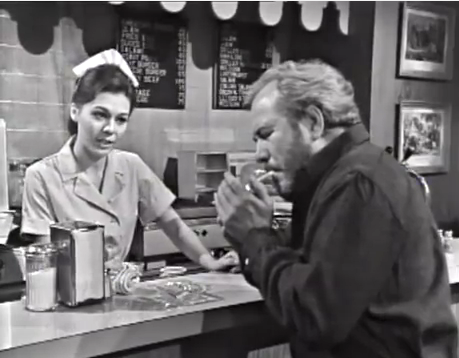
Intercut with the scenes at Collinwood are scenes in the restaurant at the Collinsport Inn. Waitress Maggie Evans is serving one customer, her father Sam Evans. Sam wants Maggie to return a sealed envelope he gave her some time ago. He won’t tell her what’s in the envelope, why he wants it back, or why he gave it to her in the first place. She won’t give it back to him without answers to at least some of those questions.
Francis Swann is the writer credited with today’s script, but the contrast between the scenes at Collinwood and those in the restaurant form a diptych of the sort Art Wallace specialized in. Sister Liz demands information which brother Roger won’t give; Roger is a fountain of lies and evasions, and finally tells Liz that her idea of family loyalty requires her to behave as if he were telling her the truth. Daughter Maggie demands information which father Sam won’t give; Sam mutters little lies, stonewalls, and begs her to forget about the whole thing.
The two family pairs are both unhappy, but in different ways. The Evanses aren’t having any fun, but you can imagine them reopening communication and re-establishing trust, if only Sam can get off the hook in this crisis. Liz and Roger don’t seem ever to have trusted each other, but they are so much fun to watch that you can see how they might choose to go on fighting these battles indefinitely.
No one has told Maggie or Sam or anyone else that Bill Malloy is dead. When Maggie wonders if Bill might be able to help Sam with whatever troubles he’s refusing to tell her about, Sam replies that yes, Bill might be the only one who can help him. Dashing action hero Burke Devlin telephones the restaurant to order delivery of a meal; he asks if Maggie has seen Bill. Maggie tells Sam that everyone has been asking about Bill.
The sheriff comes in to the restaurant. Roger had told him that he was with Sam and Burke the night Bill disappeared, and the sheriff mentioned then that he’d be talking to both of them. The sheriff reacts strongly when he sees Sam, and tries to strike up a friendly conversation with him. Before the sheriff can elicit much of a response, he gets a telephone call. He rushes out of the restaurant as soon as he’s hung up. On his way out, he casually mentions to the Evanses that it was the Coast Guard calling to say they’d found Bill Malloy’s corpse. They are shocked at the news.
The sheriff doesn’t seem to be watching Sam’s reaction to the news about Bill’s death. That’s odd- while viewers know that Roger is the show’s principal villain at this point, Sam seems to be an equally likely suspect in the case of Bill Malloy. Casually mentioning such a terrible piece of news would seem to be a tactic that a policeman might use to gauge a suspect’s emotional state. Unless it is a tactic of some kind, it would be a spectacularly unprofessional way of announcing to the people of a small town that a highly respected local man was dead. Up to that point the sheriff hadn’t been presented as a blundering fool, so I wonder what they were saying by having him do that.
Miscellaneous:
Marc Masse’s blog posts about the first 54 episodes of Dark Shadows include promotions for Kathryn Leigh Scott’s novel Dark Passages. His post for episode 55 is the first that doesn’t include one of those, and is also the first in which he refers to Miss Scott as “the actress who plays Maggie Evans.” As in “scenes like this emphasize the great and natural chemistry for the father-daughter relationship being portrayed as embodied by David Ford and the actress who plays Maggie Evans.” I wonder if Miss Scott was alienated by “The Dan and Lela Show,” the dialogues between executive producer Dan Curtis and director Lela Swift that he claims to have heard in the background of the episodes. Many Dark Shadows fans were indignant about these, and I’m sure they let Miss Scott know about their objections. Perhaps she pulled her ads from Masse’s blog, and he couldn’t bring himself to mention her name afterward.
Sam Evans is starting to regret writing his Get Into Jail Card that confesses his role in Devlin’s railroading. He tries to get Maggie to return it to him, but she’s not stupid. Maggie is probably a better avatar for the show’s audience than Victoria, and if there’s anything we like more than a mystery, it’s learning the solution to said mystery. While there’s genuine concern for her father’s latest alcohol, caffeine and tobacco binge, she suspects she’s in possession of the final few pages in the mystery novel the whole town is talking about. And she’s running out of reasons not to take a peek and see how things end.
Sam is doing his usual “I’m not looking suspicious by trying not to look suspicious, am I?” thing at the restaurant when Patterson arrives. There’s something of a performer in Sam, who brings his sketchiest A-game when he sees the sheriff, and gets twitchier than Peter Lorre with a pocket full of letters of transit. Luckily for him, the sheriff has other things on his mind. The Coast Guard has found Bill Malloy. Dead.
I’m beginning to lose track of how often we’ve been given the news that Malloy is dead.
This one is so good that I can’t resist going over it scene by scene. It has a wide variety of mood and image, tautly structured in a clearly told story, subtly realized by highly accomplished acting, and memorably presented in superb photography and imaginative sound design.
Well-meaning governess Vicki, out for a night-time stroll, makes her way to the crest of Widow’s Hill, where flighty heiress Carolyn stands looking down at the ocean swirling a hundred feet below. “Advance and be recognized! Friend or foe?” Carolyn challenges. Seeing Vicki, she remarks “Even the tutors are out tonight.”
Despite her whimsical greeting, Carolyn is in a low mood. She’s wondering at her own inability to take hardworking young fisherman Joe Haskell’s desire to marry her seriously. She tries to interest Vicki in some of the ghost stories that surround the great estate of Collinwood, while the wind whips around the hill making the eerie sound known as “The Widows’ Wail.” Vicki stoutly insists on reducing all of Carolyn’s tales to psychology and asking her about her feelings. You can really see Nancy Barrett’s Carolyn trying to maintain a light tone despite her gloom, and in Alexandra Moltke Isles’ Vicki you can just as easily see a determination to cut through the nonsense and stick to what’s real, a determination fueled partly by her empathy for Carolyn and partly by her reflexive rejection of the weirdness of her new home in the old dark house.
In the house, troubled rich boy David Collins is complaining to his aunt Liz that the ghosts won’t let him sleep. Liz tells him to turn the lights on and chase them away. Unsatisfied by that response, David persists. Liz tells him that she has no time for him now and sends him to his room. Ten year old David Henesy trades these well-written lines with veteran movie star Joan Bennett as her professional equal. David Collins continually does nasty things to characters we like, refuses to take responsibility for any of his wrong-doing, and becomes violently surly when interrupted in his endless bouts of self-pity. He ought by rights to be a difficult character to take. But David Henesy finds something lovable in him, and brings that out clearly enough that he’s always a welcome presence on screen.
Vicki and Carolyn come to the house. Liz is disappointed they aren’t her ne’er-do-well brother Roger. Liz had ordered Roger to leave his desk at her company and come home early in the afternoon. She has questions about the disappearance of plant manager Bill Malloy, and about Roger’s lie that he hadn’t seen Malloy the night before. It’s well after 10 PM now, and no one has seen or heard from Roger since Liz called him.
Carolyn and Vicki have tea and try to take Liz’ mind off her worries, but without success. Liz scolds Carolyn for bringing up the ghost stories at a time when everyone is worried about Bill Malloy, but she can’t long keep herself from drifting off into the tale of the two women who died falling off the cliff, and the third who will someday follow them. That drifting, as Joan Bennett plays it, speaks volumes about Liz’ state of mind. She’s agitated about Bill Malloy, about Roger, about the possible connection between their two absences. That agitation gives way to hopelessness.
Roger comes home. Liz greets him with a demand for explanations. He responds with perfect insouciance, informing his sister, in whose house he lives as a guest and from whose business he draws a salary on her sufferance, that he is going to the kitchen to make a sandwich. Louis Edmonds’ delivery of Roger’s lines is brilliantly funny- we laughed out loud.
Liz most definitely does not see the humor. She has a brief scene by herself after he goes off to prepare his snack. All she does is watch him leave the foyer, turn, walk a few steps to the drawing room, and take a seat. With no dialogue and no mugging for the camera, she shows anger, disbelief, exasperation, and despair. It is a wonderfully economical performance, quite as extraordinary as is Edmonds’ comic turn preceding it.
In Vicki’s room, we see the word “death” scrawled on her mirror in all caps. Vicki enters, dragging David behind her. She demands to know who wrote it. He insists that the ghosts of the Widows did it. Vicki remarks that it is surprising that the Widows have the same handwriting as David. Carolyn enters, sees the word, and scolds David. Vicki silences Carolyn with a glance and asserts control of the situation. Only when Vicki threatens to tell Liz about the word does David erase it, though he still insists it was the Widows who wrote it, not him.
After David has left the room, Carolyn tells Vicki how horrid David is. Vicki perks up and makes a series of jokes about the Widows. She’s in such a chipper mood as soon as David is out of earshot that she must have been putting on an act presenting herself to him as angry. Much to Carolyn’s mystification, Vicki likes David and is confident that sooner or later she will make friends with him.
At another point in the series, this scene might have been padded out to fill a whole episode. Today, Art Wallace writes a quick and forceful interlude, showing us everything we need to know about what the three characters in it are like and where they stand in their relationships to each other, shedding some light on the idea of the ghosts of the Widows, then moving on to the next story point. The writing is as economical as the acting, and as absorbing.
Liz and Roger have a confrontation in the drawing room. Liz asks why Roger didn’t come home when she told him to. He tells her that he went to Bill Malloy’s cousins’ house to see if Bill had been there, and that he simply forgot to tell her he would be making the trip. This response is so unsatisfactory that it seems to double the anger with which Liz puts her next question- why did he lie to her when he denied having seen Bill Malloy last night? Roger tries to weasel out of answering that question, and does manage to get Liz to give him some information he can use to craft more plausible lies, but does not get himself off the hook.
The relationship between Liz and Roger is the first of Dark Shadows’ several relationships between a Bossy Big Sister and a Bratty Little Brother. In Liz and Roger’s case, they are literally older sister and younger brother; the most important such relationship will be a figurative one, between Julia and Barnabas. But it’s Liz and Roger who set the pattern. Roger’s impossible behavior in this scene is certainly among the finest examples of brattiness among all the little brothers, and Liz shows with crystal clarity the limitations of the power of the Bossy Big Sister when confronted with a truly horrid Bratty Little Brother.
Carolyn and Vicki come downstairs. They are going back to the crest of the hill to look for Carolyn’s wristwatch. Once they’ve left, Liz meets David at the top of the stairs. She tells David that they are looking for a wristwatch. “That’s not what they’ll find- they’ll find death” replies the boy. Last episode, David received the gift of a crystal ball; that marked the beginning of his career as a clairvoyant.
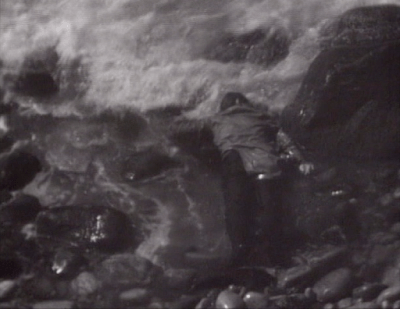
No sooner has the seer made his prediction than we hear Vicki screaming. Looking down from the cliff, she and Carolyn see a figure on the beach- a man face-down in the water. We hear the tide and the wind, sounds of nature on a large scale, and the immobile figure seems to represent something vast and inevitable.
Vicki tells Carolyn that David was the one who sabotaged Roger’s car, which Carolyn accepts as fact almost immediately. The story does build a foundation for Carolyn’s reaction- she repeatedly calls David a monster, and has been guilt-stricken at the thought that she let Burke into the house to commit the crime. But it is also the first example of what will become the hallmark of all of Nancy Barrett’s performances on the show. Her characters are the first to throw themselves into whatever is going on. She comes to serve as a one-woman chorus backing whoever happens to be the protagonist at the moment.
Liz still refuses to face the facts about David. When Vicki finds David’s Mechano magazine in her underwear drawer with the page about hydraulic braking systems marked, she and Carolyn see it as evidence that David had access both to the drawer and to the technical information he needed to commit the crime. Liz sees it differently, saying in a distant, ghostly voice “It was in your room, Miss Winters.”
Liz’ ghostliness is highlighted strikingly earlier in the episode. In the upstairs hallway, Carolyn is chattering away about ghosts, both the metaphorical ghosts of current problems resulting from past conflicts and the literal ghosts that, she would have you know, most definitely exist. Vicki looks at the door to the rest of the house which inexplicably opened and closed itself a few episodes back, and gasps as it opens again. This time it’s Liz coming out, having looked for David in the closed-off wing. Liz is impatient with the girls’ talk of ghosts, but her manner and appearance as she enters through that door are spectral.
The other setting in today’s diptych is a hotel room in Bangor.* Burke is meeting a private investigator there. He’s giving him a tough assignment. He wants more information about the Collinses in less time than the investigator had originally expected. He also wants the job done in absolute secrecy, and if the Collinses catch wind of the project the investigator will suffer dire consequences. The investigator is played by Barnard Hughes, a highly accomplished actor, and his skills are needed. Burke is being harsh and unreasonable, and the investigator is being deferential. Hughes is able to give his character enough texture that he seems to be keeping his dignity. Without that, Burke would have come off as a bully. The audience has to like Burke, so Hughes makes an important contribution to the show in this, his only appearance.
There’s an irony to Burke’s hard-driving intensity. He’s looking for information to hurt the Collinses, while the women at Collinwood have information far more damaging to the family than anything he’s sending his man to look for. So we’re in suspense as to what he’ll do when he catches up to them.
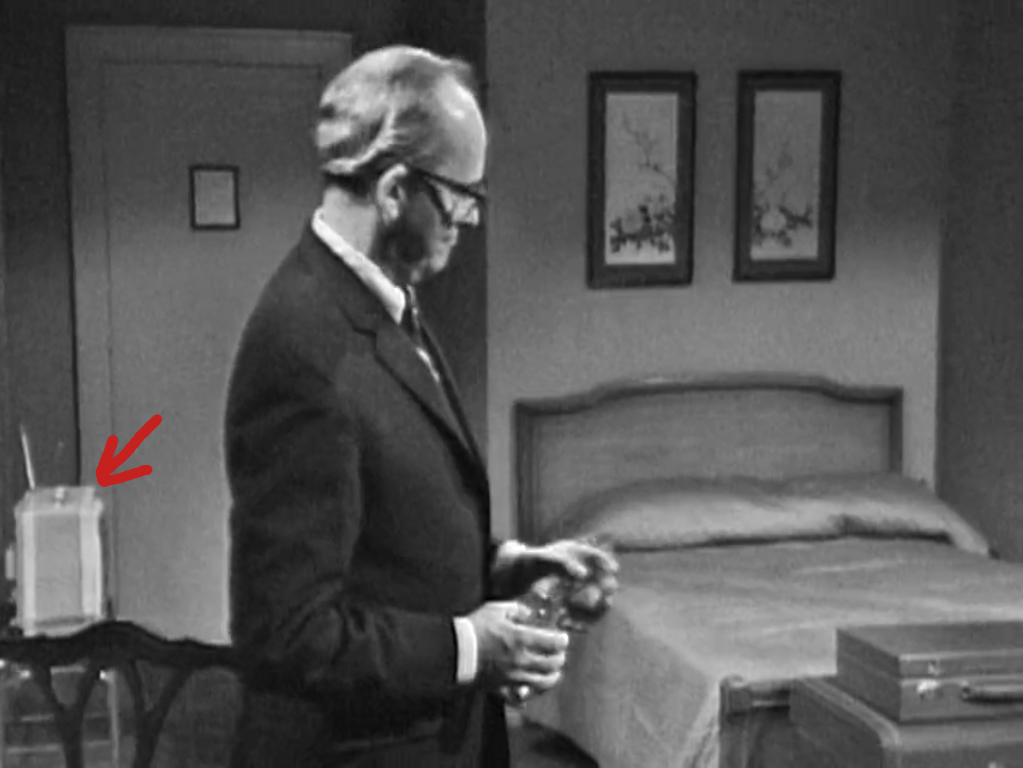
*In a comment on Danny Horn’s Dark Shadows Every Day, “TD” points out that the hotel room in Bangor has a television set, the first such device we see on Dark Shadows. We will not see another until 1970. That one will be in a parallel universe. We never do see a TV set in the Collinsport of the main continuity.
Evidently Mr Bronson had the hotel send a TV up to his room.
The entire episode is set in the Collinsport Inn- the lobby, the restaurant, and Burke’s room.
In episode 21, Vicki took Liz in hand as if she were Plato’s Socrates and Liz were some pompous Athenian aristocrat, leading her through a series of simple, seemingly innocent questions to a most uncomfortable conclusion. That took place in the drawing room at Collinwood, while Carolyn watched. In episode 24, Carolyn joins Burke and the sheriff in Burke’s room. It’s Burke’s turn to play Socrates, Carolyn’s to answer the questions, and the sheriff’s to be an audience. Burke’s questioning is not only effective at raising doubts in the sheriff’s mind, but also prompts regular viewers to bracket Vicki and Burke together and see them as a likely, indeed inevitable, romantic pair.
The scenes in Burke’s room also highlight Roger’s bizarre folly in telling Burke his evidence against him before going to the police. We saw Vicki try to talk Roger out of this in two episodes, and the sheriff commented on it later. Watching the well-prepared Burke cross-examine Carolyn as effectively as any defense attorney, it is all the clearer that Roger’s behavior was driven not by any rational calculation, but by some wild impulse he cannot entirely control.
The scenes in the lobby and the restaurant show us a quiet rewriting of some characterizations laid out in episode 1. In that episode, Burke stood in the lobby and refused to admit that he so much as knew the name of Mr Wells, the hotel clerk, simply because Wells was from the town from which he was sent to prison ten years before. Now he stands on the same set, warmly greets one of the policemen who made the case against him, and repeatedly tries to persuade him to join him for lunch. Also in episode 1, Maggie stood behind the counter of the restaurant and told Vicki that she considers her, as a member of the staff of Collinwood, to be a “jerk” practically as bad as the family that owns the house. In this one, Carolyn herself comes into the restaurant and she and Maggie have a warm, cozy chat, like old friends.
I suppose it was inevitable that they would retcon Burke into a hail-fellow-well-met and Maggie into a friend of at least some of the Collinses. After all, soap operas consist mostly of conversation, so characters who aren’t on speaking terms with each other are dead weight. Placing these scenes on the same sets used in episode 1 is an emphatic way to make it clear to viewers who remember that episode that the change is intentional and permanent.
The videography is also as ambitious as we ever see it in this show. The camera tracks fluidly through the lobby, showing us more of that set than we see in any other episode, ending in a low angle shot of the sheriff that makes him look ominous. Some of those tracking shots are too much for Michael Currie, the actor playing the sheriff- during his scene alone with Burke, he bumps into one camera, stumbles into a piece of furniture, and then the other camera hits him in the back of the head. After that, he stands with his back to Burke and his elbows bent in front of him, looking for all the world like he is urinating on the floor:
Currie is so physically awkward that when Burke asks the sheriff the rhetorical question “Have you ever sat on a wrench?,” it seems to be a pretty near certainty that the answer is yes.
Currie has a rough time in this episode with his lines as well as with his movement. Perhaps the single funniest blooper comes when he declares that a good memory “is what I’m paid for,” then forgets his next line. It’s also interesting when he calls Burke “Burt.” Bloopers are after all one of the things Dark Shadows is known for, so we can’t be too annoyed with him for those. Worse is what happens when he does remember his lines. He intones them all as if he were leading the Pledge of Allegiance.
In the months after Mark Allen left the show, the standard of acting on it was remarkably high. Every actor other than Currie consistently turns in performances so strong that watching an episode feels like a fine evening at the theater. And bad as he is, even Currie doesn’t keep his scene partners from delivering good performances. He just wasn’t ready for professional acting. So I don’t have the same need to complain about him as about Allen, but he does deliver the series’ first laugh-out-loud moments of incompetence, and it is a relief when he is replaced.
In episode 18, Roger (Louis Edmonds) had demanded Vicki (Alexandra Moltke Isles) come with him to Burke’s hotel room, where they will tell Burke (Mitch Ryan) about all the evidence they have connecting him to Roger’s car wreck. Vicki repeatedly protests in that episode that it would be better to take this information to the police. In this one, they arrive at the hotel, and again Vicki objects that they really should be going to the police. Roger, however, is a man obsessed. He asks Vicki to wait in the restaurant while he goes to Burke’s room, telling her that it may not be necessary for her to join him.
Sam (Mark Allen) comes to the restaurant looking for his daughter Maggie. Finding that Maggie isn’t at work, he invites himself to Vicki’s table. Their previous encounter had been a strange and frightening one on the top of Widow’s Hill; Vicki is no more comfortable with Sam now than she had been then. He bellows at her, she reacts with quietly frosty disdain. These attitudes may have less to do with the script or the direction than with Mark Allen’s limitations as an actor; he bellows all of his lines in this episode, and quiet frostiness is as effective a technique as any other for holding onto the audience while sharing a scene with an incompetent loudmouth.
There’s no incompetence in the scenes in Burke’s room. Louis Edmonds and Mitch Ryan were first-rate stage actors, and their confrontation is a terrific fireworks display. When Roger brings Vicki up to tell Burke what she saw him do in the garage, she again plays the scene quietly, an effective counterpoint to the artillery blasts the men have been letting loose.
In the Evans cottage, Sam finds that Maggie (Kathryn Leigh Scott) has been home all this time. When Allen bellows at her, Scott bellows back at him, a far less effective tactic than the quiet intensity Mrs Isles had used earlier. The scene has some potential- the situation is that an alcoholic finds that his adult daughter has been checking up on him, he resents it, and they have a fight about all of the ways in which she has been forced to take on the parental role in their relationship. But as a shouting match, it might as well be about anything, or about nothing.
Returning home after their confrontation with Devlin, Roger and Vicki say goodnight in the foyer. Time and again in these early episodes, people have urged Vicki to leave Collinsport while she still can. Even in this episode, Burke had told her that. But as they part ways for the night, Vicki to her bedroom and Roger to the brandy bottle, Roger tells her that as a witness, “you can’t leave now.”
That line is effective enough, but if the scene between Sam and Maggie had worked it would have been very powerful. The Evanses, father and daughter, are a case of two people who are trapped, trapped in Collinsport, trapped with each other, trapped with his alcoholism and her sense of obligation to keep him alive. As written, the scene could have brought all that out, and induced a claustrophobic sense in the audience that would have made Roger’s line feel like a death sentence. As ruined by Mark Allen, it just leaves us with the sense that we’re watching a show that needs some recasting.
One of the great challenges of writing a serial is fitting enough recap of previous story points into each installment that new viewers can catch up without putting so much in that you bore the regulars. A time will come when Dark Shadows gives up recapping altogether, but in these early weeks they are scrupulous about soapcraft.
In episode 11, much of the recapping takes place in a scene between innkeeper Mr Wells (Conrad Bain) and drunken artist Sam Evans (Mark Allen.) The story justification for Mr Wells telling Sam everything the audience might need to know about Burke Devlin and the Collinses is that Sam’s daughter Maggie, who runs the restaurant in the inn, is about to return to work, and Mr Wells doesn’t want her to see her father drunk. He knows that as long as Sam thinks he might have something new to tell him about Burke, he will sit there and drink coffee.
The scene between Mr Wells and Sam is an example of something that becomes ever more important to Dark Shadows as it goes on: good acting trumping not-so-good writing. And good acting trumping bad acting- while Mark Allen is the worst actor on the show, Conrad Bain is phenomenally good. He single-handedly takes what must have looked in the script to be a terribly dull scene and makes it completely absorbing. I can imagine a show entirely composed of him looking into the camera and telling stories, and that show would be great. No wonder he went on to have such a big career in television!
In which I disagree with Danny Horn’s assessment of Addison Powell as The Worst Actor Ever to Appear on Dark Shadows, and award the title instead to Jack Stamberger.
In which I praise three accomplished solo performances- Joan Bennett playing opposite her own voiceover, Louis Edmonds playing opposite an empty room, and Alexandra Moltke Isles playing opposite Roger Davis.



 Dark Shadows Commentary