Episode 368/369: Whole future

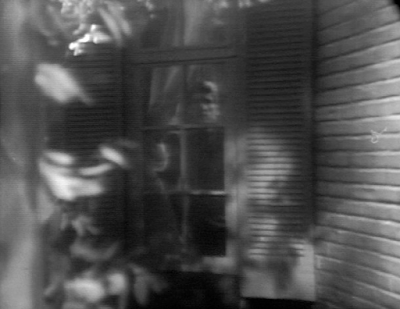
In 1966 and 1967, supernatural menaces Laura Murdoch Collins and Barnabas Collins would often be seen staring out the windows of their houses on the great estate of Collinwood, sending psychic energy towards the targets of their sinister plans. In 1795, Barnabas is neither supernatural nor menacing, but we already see him peering out one of those windows. He is not projecting bad vibes into the world, but is worried about his beloved fiancée, Josette DuPrés. She is supposed to arrive soon, in fact was supposed to arrive some time ago. Now there is a storm, and he hopes she is not at sea.

Earliest window-stare, by dramatic date. Screenshot by Dark Shadows Before I Die.

The audience’s main point-of-view character in 1966 and for most of 1967 was well-meaning governess Vicki. Now Vicki has come unstuck in time, and found herself in this extended flashback to the eighteenth century. Since she will know Barnabas and regard him as a close friend in the 1960s, she is at her ease talking to him now. Although she is a member of the staff in his family’s house in a period when it was customary for masters to summon their servants with bells and communicate with them only in direct commands, Barnabas is a remarkably genial and democratic sort who welcomes her casual manner.

Vicki has already annoyed the audience several times by blurting out information that makes it obvious to the other characters that she does not belong in their world. She does that again in this scene. Barnabas is worried something may have happened to Josette, and Vicki tells him that she will arrive safely. He is surprised by the assurance with which she delivers this prediction, and asks if she is clairvoyant. She realizes that she has been indiscreet, and denies that she is. He is unconvinced.

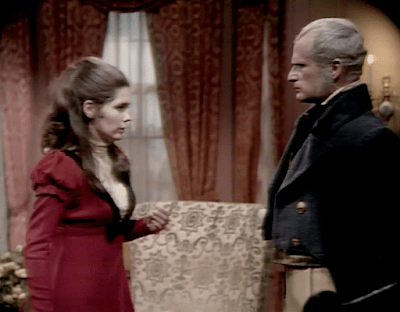
Barnabas’ father, haughty overlord Joshua Collins, enters. He is appalled to find his son socializing with a servant. He dispatches Vicki to the nursery to look after her charge, his young daughter Sarah. He demands to know why Barnabas is not tending to his own duties at the family’s shipyard. They begin to quarrel, when a knock comes at the door.

Barnabas opens the door to find a woman named Angelique, whom he identifies as maid to Josette’s aunt, the Countess DuPrés. Angelique says that the countess was on her way to Collinwood, but that her carriage is stuck in the mud. Joshua orders Barnabas to send a footman to rescue her. Angelique is the first character we have met in 1795 who is not played by a performer we have seen in the first 73 weeks of the show.

Enter Angelique. Screenshot by Dark Shadows Before I Die.

Joshua goes to his wife, Naomi. Naomi is an alcoholic, a fact of which we are made aware because almost her every scene begins with a shot of her drinking alone. That’s what she is doing before Joshua finds her. He scolds her for her drinking; she complains that he doesn’t allow her to do anything else. She can’t even pass the time with a book- we saw Monday that Naomi is completely illiterate.

Glug glug glug. Screenshot by Dark Shadows Before I Die.

Naomi’s alcoholism is both a nod to the concern of first-wave feminism with the atrophy of the elite housewife, and a suggestive side-light on Barnabas as we knew him in the 1967 segment. Then, Barnabas abducted Maggie Evans, The Nicest Girl in Town, and tried by more or less magical means to replace her personality with that of Josette. For the first 40 weeks of Dark Shadows, Maggie’s father’s alcoholism had been a substantial story element, and she would always retain a number of classic Adult Child of an Alcoholic (ACoA, in the lingo of the recovery movement) characteristics, such as beginning utterances with a little laugh to prove that she is happy. Now that we know that Barnabas is also an ACoA, we can wonder if that shared experience was part of the reason he was drawn to Maggie.

The countess arrives. Since she is played by Grayson Hall, who also plays mad scientist Julia Hoffman in the parts of the show set in the 1960s, Vicki blurts out “Julia!” when she sees her. Hall had also been nominated for an Academy Award for her performance as Judith Fellowes in the 1964 film Night of the Iguana; if Vicki is going to keep the audience up to date on the cast’s resumes, it would have been more interesting if she’d exclaimed “Judith!” Vicki explains that the countess looks like someone she once knew who was named Julia, a remark which irritates the countess, who would like to think her appearance is distinctive. Vicki has certainly not made a favorable impression on this grand lady.

Joshua tells the countess he is surprised that “You still affect a title” when “France has followed our example and become a republic.” His pride in this development, after the Terror and in the bloodiest year of the wars in the Vendée, marks Joshua as a member of the Jeffersonian party in US politics. The Federalists and others had long since turned against the French Revolution by that year.

The countess tells Joshua that it is precisely because France has become a republic that she chooses to live on the island of Martinique. That answers a question that some fans ask about Angelique- why is she white? If the DuPrés family lives on Martinique and are major sugar planters there, they must hold a great many African people in slavery. When we hear that they are bringing a servant with them, we expect that servant to be Black. When we learn that the the countess is an emigré, we realize that she brought Angelique with her from France.

The countess may solve one puzzle for us in her exchange with Joshua, but she presents us with another. Josette’s father André is the countess’ brother, yet he is never referred to as a count. Indeed, when he appears, we will see him answer to “Mr DuPrés.” Perhaps he renounced his title, as many French aristocrats did during the Revolution.

Whatever the explanation, “DuPrés” would seem to represent a missed opportunity. When Josette was first mentioned, in the early months of Dark Shadows, her maiden name was given as “LaFrenière.” It would have been a nice touch to have kept that name for Josette and her father, and to have reserved “DuPrés” as the name of the countess’ late husband.

“LaFrenière” had been a perfect choice because of its class ambiguity for a show about an aristocratic family in the state of Maine- it was originally the family name of the barons of Fresnes, and could therefore be a sign of a senior order of nobility, but is also a very widespread name in Quebec. So “Josette LaFrenière” might either have been a French noblewoman who deigned to marry into the mercantile Collins family at the apex of their prestige, or a working class girl from the north who eloped with the boss’ son.

The choice of Martinique as Josette’s place of origin might add a new twist to this class ambiguity. The Empress Josephine grew up there as a member of the untitled but ancient Tascher family, who, like the fictional DuPrés family, owned an enormous sugar plantation on the island. The Taschers of Martinique went back and forth between Martinique and metropolitan France, and Josephine herself was living there in 1779 when she married her first husband, the Vicomte de Beauharnais. Josephine herself was in prison when the vicomte was guillotined in 1794, one of the last to die in the Reign of Terror, and she was freed just a few days later. The next year, she recovered her husband’s property, and a year after that married the young general Napoleon Bonaparte. It seems likely that the similarity between the names “Josephine” and “Josette” was writer Sam Hall’s inspiration for placing Josette’s origins on Martinique. Association with a figure who was at once a grand lady and an example of very steep upward social mobility could synthesize the two possible Josettes LaFrenière into a single figure.

Had they developed the story of the family’s relationship with the town of Collinsport more richly in Dark Shadows 1.0 and 2.0, they could have used this ambiguity to build up suspense that would be resolved today, in the third episode of Dark Shadows 3.0. Since they did so little with that theme in those days, when the story was moving very slowly and it would have been relatively easy to fit just about anything in, I suppose we shouldn’t be surprised that they drop it so completely at this period of the show, when the story is flowing at a breakneck speed.

The countess’ lofty aristocratic manner stings Joshua. Alone with Naomi, he loudly proclaims his belief that all men are equal. We already know enough about Joshua’s tyranny over his household that this absurd little speech must be an intentional spoof of the rich landowners who supported the Jeffersonian party in the early decades of the Republic. Again, this would be funnier and more poignant if the show had done more with social class in its first 73 weeks.

Barnabas sees the countess dealing out tarot cards. He tells her she is too sophisticated for them, and is reluctant to sit with her while she uses them to read his fortune. The moment she says that the cards suggest a connection between him and the concept of infinity, his skepticism evaporates instantly and he excitedly asks if that means he will live forever. The countess cautions that his jubilation at this idea may be misplaced. She notices the “Wicked Woman” card, and takes a significant look at Vicki. Evidently the audience is not alone in objecting to Vicki’s brainless nattering about what the show used to be like.*

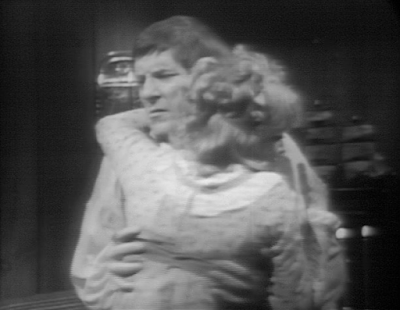
Angelique comes to Barnabas’ room. It turns out the two of them had a brief affair when he was first on Martinique, and she expects to resume it. He is not at all pleased at her attentions.

Not how every man would react to a passionate embrace from Lara Parker… Screenshot by Dark Shadows Before I Die.

Barnabas explains that he was already falling in love with Josette when he and Angelique had their fling, but that he didn’t really know her. He couldn’t believe that she would reciprocate his feelings, and consoled himself by dallying with Angelique. This explanation goes over with her about as well as you’d expect, and she storms out of the room, vowing that she will get her way in the end.

We know that the tarot cards are giving accurate information, because the show leans heavily on the uncanny and they wouldn’t have spent so much time on a gimmick that wasn’t meant to advance the plot. We also know that Vicki is not the Wicked Woman the countess is looking for. That leaves Angelique, and we can assume that her wickedness will express itself in some supernatural action taken to avenge herself on Barnabas. Since we know that Barnabas will become a vampire, we wonder if it is Angelique who makes him one.

Closing Miscellany

I usually refer to surviving cast members with courtesy titles and to deceased ones by surname alone. So Alexandra Moltke Isles is “Mrs Isles,” which has been her professional name for 56 years, David Henesy is “Mr Henesy,” Nancy Barrett is “Miss Barrett,” etc, while Jonathan Frid, Joan Bennett, Louis Edmonds, and Grayson Hall are just “Frid,” “Bennett,” “Edmonds,” and “Hall.” Until last month, I’d been looking forward to saying lots of things about “Miss Parker” and her portrayal of Angelique, but Lara Parker died on 12 October 2023. So she’s just going to be “Parker,” and I’m going to be sad about it.

Artist Teri S. Wood has created a number of short animations about Angelique and Barnabas. This one is based on their two-scene at the end of today’s episode:

https://www.youtube.com/watch?v=pyxI0q2aOIk

Patrick McCray has a post about this episode that mystifies me. He writes that “After seven months of hearing about Angelique, today, she enters. So, no pressure Lara. You only have to live up to a half year of build-up.” Uh, what? There has been absolutely no reference to Angelique on the show before today. I can think of an interpretation of the story that might retroject Angelique into episodes #211-365, and I will talk about it next week. But I don’t think it is an interpretation Patrick would favor.

He also talks about David Ball’s method of reading plays from the ending back to the beginning and then from the beginning forward, so that the ending comes to seem implicit in everything else. He allows that Dark Shadows has more than one ending, but I would say he doesn’t go far enough. I’d say the series has ten endings. The first came in #191, when Laura went up in smoke while her son David found refuge in Vicki’s arms. That ending defined Dark Shadows 1.0 as the story of David’s escape from his evil, undead mother Laura, and his adoption of Vicki as his new, life-affirming mother. The second came in #364, when Barnabas met the ghost of his little sister Sarah, she commanded him to be nice to the living, and he went right on with his murderous plans. That ending defined Dark Shadows 2.0 as the story of Barnabas’ irredeemable evil.

Two of the other endings will feature Angelique dying in Barnabas’ arms, and Patrick suggests that those make the whole show the story of their relationship. I don’t buy it at all. Each of the ten parts is about what it is about, and even those two episodes with Angelique dying derive more dramatic charge from other moments.

*Making connections with the first 73 weeks is my job!

My usual themes: Continuity

In 281 of the posts that follow, I link to comments I made on Danny Horn’s blog, “Dark Shadows Every Day.”

Not all of these comments were absolutely unique. A number of times I argued that the show was not so discontinuous as people were making it out to be. To be sure, the creative process is very close to the surface, so that viewers have to do a lot of re-writing in their heads to make sense of what they’re watching. Sometimes the writers just lost track of the story and contradicted themselves from one episode to the next, and other times they changed their minds abruptly. But there were other times when alleged contradictions can be reconciled without having to invent anything drastic.

For example, Danny and many of his regular commenters from time to time mock the depiction of Dr Julia Hoffman as sometimes a blood specialist, sometimes a psychiatrist. I think that’s a pretty easy one to resolve. In this comment, I added some fanfic of my own to sell the idea that she started as a hematologist and retained an interest in that field after switching to psychiatry:

The story I made up for myself is that Julia started out as a blood specialist but switched to psychiatry. She was interested in rare diseases, the rarer the better. She found that in hematology, there’s so much money to be made from developing treatments for the most widespread disorders that a researcher with an emphasis in the exotic is constantly fighting an uphill battle for funding and recognition.* Even those colleagues who had an abstract appreciation of the importance of studying rare disorders had to work within a system where all the institutions push them towards the biggest projects possible.

Psychiatry, on the other hand, always had room for the unusual.** In fact, Julia discovered that high-strung rich people would pay a great deal of money to be told that whatever happens to be bothering them at the moment is not the same kind of problem that one of their servants might have, but is a mental aberration hitherto unattested in the annals of psychiatry.*** So she switched to that field and quickly made enough money to open her own, hugely profitable, mental hospital. But she never stopped working in rare blood diseases, and the experiments she was able to finance by flattering the vanity of her wealthier patients earned her such a reputation in a male-dominated field that even her old acquaintance Dave Woodard would commit sexist slips of the tongue and say of “Hoffman” that “he” is “the top man in the field” of rare blood diseases.

Lucrative as Windcliff was, Julia’s true love was never money, or even science per se, but the exotic. When she found herself as the best friend/ frequent accomplice/ bossy big sister of an honest-to-wickedness vampire, surrounded by ghosts and witches and werewolves and Frankensteins and time travelers and interdimensional anomalies and who knows what else, there was never any question of her going back to the office.

*I have no reason to believe this was true in the real world in the middle decades of the twentieth century, or that it is true today. It’s simply part of the fictional world in which I see Julia.
**(Same note)
***(Same note)

In this comment, I devised a much more modest bit of fanfic to answer a simpler question. Quentin has a girlfriend named Tessie, and at some point in the night he had, in his werewolf form, attacked her in the woods. Why was she in the woods? Danny and his commenters had proposed various awkward scenarios to answer this question, but I suggest she just followed Quentin after she saw him in town looking for booze.

In the “1995” segment, Mrs Johnson and Carolyn talk about how Mrs Johnson brushed Carolyn’s hair for her when she was a little girl. Some say this was a continuity error, because Mrs Johnson didn’t come to work at Collinwood until episode 81. Before that, she’d been housekeeper to Collins family retainer Bill Malloy. However, I say that she still could have brushed little Carolyn’s hair while working for Malloy:

I have a theory that could explain Mrs Johnson brushing Carolyn’s hair when she was little.

In the early episodes, Carolyn talks about having gone to school in town. How did she get there?

She can’t have walked; it was miles away, much of it along a winding road with several blind curves. Her mother never left the grounds during those years, she couldn’t have driven her. Roger was living in Augusta with Laura. The only servant was Matthew. Matthew and Carolyn don’t seem at all close; it doesn’t seem likely that he drove her to school every morning. If a school bus came up the hill to Collinwood day after day, the kids who rode it couldn’t have maintained the attitude Carolyn describes, whispering behind her back about her living with the witch in the haunted house. Sooner or later they’d have started talking to her face to face about it.

Carolyn also talks about Bill Malloy being more like a father to her than any other man, and the two of them do have a cozy relationship. Carolyn is also very quick to fall in with Mrs Johnson when Burke pitches the idea of her joining the household staff at Collinwood. So I think we have to conclude that Bill Malloy and his housekeeper were in charge of getting Carolyn to school in the mornings. Malloy was on the fishing boats, so that would require an early start to the day. There were probably many days when little Carolyn was still in her pajamas when she got to the Malloy house. On those days, Mrs Johnson brushed her hair while the water came to a boil for breakfast.

Several times I explained my theory about how the “Meet Gerard” segment (episodes 1061-1198, including “1995,” “The Re-Haunting of Collinwood,” and “1840”) fits together. This iteration also suggests ways to resolve a couple of puzzles about Angelique:

For me, a lot can be explained by the smile of satisfaction Gerard gives when he sees Julia and Barnabas take the staircase from 1995 to 1970. The dark power he represents called them to 1995 from Parallel 1970, and is now sending them back in time, first to 1970, then to 1840 to make it possible for the future they see in 1995 to exist.

This is analogous to what the Leviathans did at the end of 1897. First Quentin’s ghost, then Barnabas and Julia’s I Ching trips, had created a rift in the order of things that made it possible for the Leviathans to erupt from the underworld into the human world, and to send Barnabas to 1969 as their agent. So too have the journeys Barnabas and Julia took into Parallel Time torn open the fabric of time and space, and made it possible for Judah Zachery to bring a Frankenstein maker back to his time.

Attributing to Zachery the same power to exploit disruptions in time to shuttle people between past and future and thereby to rewrite his own history that the Leviathans had shown, we also have a way to resolve the Angelique/ Miranda paradox. Perhaps Angelique really was relatively new to witchcraft in 1795. Perhaps also, in her early naive attempts, she stumbled into the same kind of trouble Barnabas stumbled into with his time-travel. That’s what Zachery had in mind when he shouted at her during his trial that she ought to tell the truth, that she had come to him of her own accord- it was only because she had already worked in the black arts that he could call her to him, from the days after she first left Collinwood in 1796 to a nearby town 104 years before. And perhaps, with the first beheading of Zachery, his spell broke returning her to a time shortly after the “Burn Witch Burn!” moment in the tower room.

Come to think of it, that might also put sense into Angelique’s remark that she is “consigned to this century forever.” There were a few days after Zachery calls her to 1692 and before she returns from 1692, and until Barnabas and Ben torched her, she was sentenced to relive those few days over and over again, Bill Murray-style.

That’s a comment on Danny’s post for episode 1140. Just four episodes later, the show will kick away the explanation I offer for Angelique‘s various incarnations in the main continuity, but leave open the rest of it.

The logic that counts the most in the show isn’t so much the kind of sequential reasoning that I’ve done in these posts as it is the associational logic of a dream. An image or situation or word reminds a dreamer of something, and suddenly the dreamer is in the middle of that something. You dream about polishing your Ford with Turtle Wax, and the next thing you know Polish turtles are whacking away at a shallow spot in a river. You tell a story about rich, selfish people who obsessively keep secrets and set a dreary tone for their town, and the next thing you know your main character is a vampire. I left an unreasonably long comment where I natter on about the concept of dream logic.

Episode 912: Blink

In which I identify the ultimate Dark Shadows supercouple- greater than Barnabas/ Julia, greater than Barnabas/ Angelique, greater than Quentin/ Whoever, is the immortal and unchallengeable love of Jonathan Frid and the TelePrompter. 

Episode 912: Blink