When Dark Shadows began in June of 1966, hardworking young fisherman Joe Haskell was dating flighty heiress Carolyn Collins Stoddard. The two of them were bored beyond words with each other. They only kept going out because Carolyn’s mother, reclusive matriarch Elizabeth Collins Stoddard, was determined that they should get together, and neither of them wanted to disappoint her. For months, we were subjected to one scene after another of Joe and Carolyn having nothing to say to each other while we waited for Liz to give up on them.
Joe and Carolyn finally called it quits in #84, and shortly afterward Joe started seeing Maggie Evans, The Nicest Girl in Town. The audience has been rooting for Joe and Maggie ever since, but because there are too few obstacles to their romance for them to have a storyline of their own, we sometimes go months at a time without seeing them together.
Now, Joe has become the blood thrall of vampire Angelique, and Angelique’s master Nicholas has designs on Maggie. If Nicholas and Angelique were ordinary criminals and she were blackmailing Joe or had hooked him on drugs, this would be an archetypal soap opera situation. The supernatural twist makes it specific to Dark Shadows among the daytime serials of its period, but the story is still so deep in the genre’s wheelhouse that it is no wonder they’ve spent three days in a row luxuriating in it.
There’s a lot of emphasis on bachelor’s quarters this time out. Maggie lives alone, but we see so much of and hear so much about her late father’s paintings today that it feels as if the Evans cottage is still his house and Maggie is still his little buddy. That makes her relationship with Joe feel all the more urgent. She is waiting to make a home with him so that her adult life can begin.
We see Joe’s apartment as well. It is apartment 24, the default number for a Collinsport bachelor pad. Dashing action hero Burke Devlin lived in suite 24 at the Collinsport Inn in the first year of the show, and Humphrey Bogart-esque lawyer Tony Peterson lived in apartment 24, presumably in some other building, in the fall of 1967. Joe is sitting in his apartment 24 and staring at a glass of booze when Maggie knocks on the door. She tells him that his boss called her at home and told her that Joe hasn’t shown up at work lately. If Joe doesn’t call soon, he’ll have to fire him. Joe says he won’t call the boss, since he can no more explain the nature of his trouble to him than he can to Maggie.
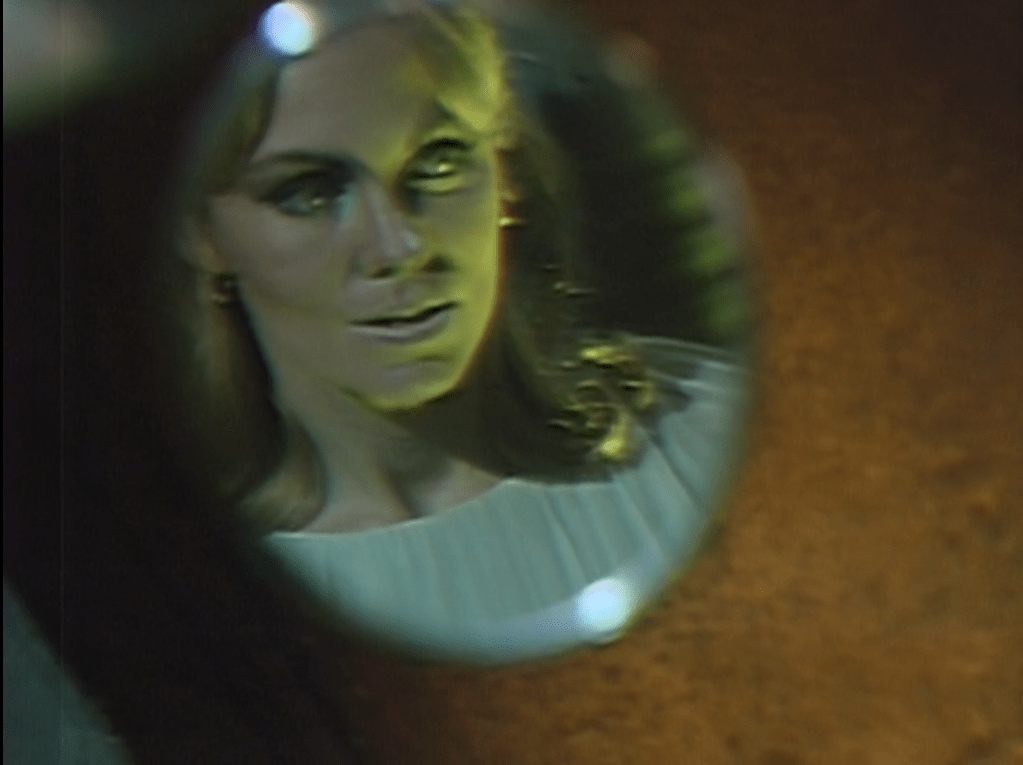
We also see Nicholas’ house. Even though he is keeping Angelique on the premises, Nicholas is very much a bachelor. He peers into his magic mirror and sees Willie Loomis, servant to old world gentleman Barnabas Collins. Willie is asleep in his room in Barnabas’ house. The only other time we saw Willie’s room was in #328, when Barnabas framed Willie for terrible crimes he had himself committed against Maggie. Now, Nicholas uses his mirror for a magical video call with Willie. He interrogates Willie about an evil plan of his that is playing out in Barnabas’ house.
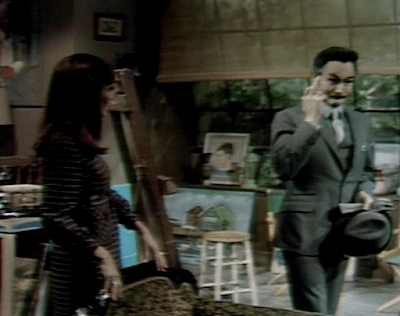
On Dark Shadows Before I Die, John and Christine Scoleri caught this screenshot of Nicholas making an unfortunate gesture while he is telling Maggie what he thinks of Willie:
Suave warlock Nicholas Blair is furious with his subordinate, vampire Angelique. He had ordered Angelique to summon her blood thrall, hardworking young fisherman Joe Haskell. While Joe was out of the way serving as Angelique’s breakfast, Nicholas would be making time with Joe’s fiancée, Maggie Evans, The Nicest Girl in Town. Much to Nicholas’ dismay, Joe turned up at Maggie’s house.
Angelique explains that she did summon Joe, but that old world gentleman Barnabas Collins was with him and persuaded him to leave before she could take a bite. Since Nicholas has, for reasons of his own, forbidden Angelique to harm Barnabas, he has no choice but to accept that explanation. Angelique teases him about his interest in Maggie. Nicholas used to be very harsh with Angelique about her lingering human attachment to Barnabas, and she is hugely amused to find him chasing Maggie. Her amusement fades when he tells her that if she doesn’t bring Joe back tonight, he will not allow her to return to her coffin at sunrise.
Back at the Evans cottage, Joe is pleading with Maggie to keep him from leaving. “You’ve got to watch me tonight. Be with me. Don’t take your eyes off me. Don’t let me get away like I did this afternoon. If I start to leave, just take something — hit me over the head. Do anything you have to, to keep me here with you!” He keeps telling her that he needs her, that he belongs with her, and that it is his last chance. He hears Angelique’s voice and yells back to it; Maggie is bewildered.
Joe asks Maggie for two sleeping pills. She says that the pills she has are very strong. He says that if he can be knocked out until morning, he might be all right. It is daytime television and it is 1968, so while Joe sleeps on the couch, she goes into her bedroom and closes the door. Angelique’s voice finally wakes him, and he goes.
Nicholas knocks on the door. He apologizes for disturbing Maggie at 4 AM. He explains that he had a strange feeling she was in danger. She tells him about Joe, and says she is glad Joe is sound asleep on the couch. He breaks the news to her that the couch is vacant. While she is looking away, he allows himself a self-satisfied smile.
This episode features the first appearance on Dark Shadows by an actor of color, and the only speaking part any non-White performer ever had. (CORRECTION: Mr Nakamura, played by Sho Onodera in #903, has a couple of lines.) This fact is made even more depressing because that performer fits so perfectly into the show that a first time viewer would assume she had been a major player from episode #1.
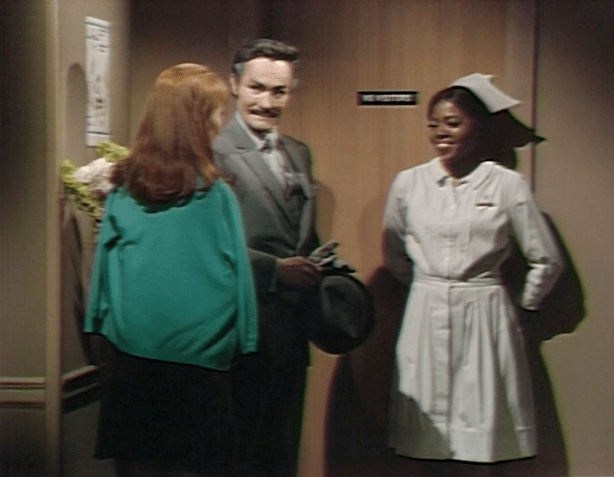
Beverly Hope Atkinson plays an unnamed nurse who meets suave warlock Nicholas Blair when he is trying to make his way into a hospital room occupied by Tom Jennings, a victim of one of Nicholas’ evil schemes. She firmly refuses him admittance. When Maggie Evans, The Nicest Girl in Town, enters and asks to see Tom, the unnamed nurse smiles brightly and says “Of course, Maggie!” in a tone that makes it sound like they’ve been friends all their lives. She then shuts the door before Nicholas can follow. He asks her why Maggie can go in and he cannot, and she tells him sternly that Maggie has permission from the doctor.
I have a fanfic idea about Atkinson’s nurse that I originally posted as a comment on Danny Horn’s Dark Shadows Every Day. I can’t find it there, but here is a copy of it:
In the first 42 weeks of the show, when the supernatural was in the background and the stories were slow, it would have been easy to have a couple of tea party scenes at the Evans cottage where Maggie and her lifelong friend, Unnamed Nurse, recap whatever is going on. Those scenes could have led to a whole exploration of the tension between the working-class people in the village and the jerks in the big house on the hill. That in turn could have led to the introduction of Unnamed Nurse’s family, headed by Unnamed’s parents, Mr and Mrs Nurse, including her brothers, Young Mr Nurse and Master Nurse, and her sister, Moody Miss Nurse. We could then have seen the ancestors of the Nurse family in each of the flashback segments and analogues of them in Parallel Time.
At some point in my musings about this idea, I decided the family should be named “Wilson” (if I had a reason for this, I’ve forgotten it, but I now think of Atkinson’s character as Nurse Wilson,) and that in a flashback segment we should learn that they are descended from free persons of color who settled in Collinsport before the Civil War and were the first proprietors of the Collinsport Inn. Some wicked deed by a member of the Collins family knocked them out of the entrepreneurial class long ago, and they’ve been working their way back up the socio-economic ladder ever since.
We met Maggie in #1 as the waitress at the diner in the Collinsport Inn. She, her late father Sam, and her fiancé, hardworking young fisherman Joe Haskell, have been Dark Shadows‘ main representatives of the people in the village. Her house, the modest counterpoint to the mansions on the Collins family’s great estate, has been familiar to us from the beginning, and is the place where we have seen most vividly what the Collinses’ doings have meant for the people who work for their businesses and live in their town. So, as a frequent visitor there, the nurse could have given a whole new dimension to the drama, showing that it isn’t just one family whose lives hang in the balance, but that a whole community is exposed to the consequences of what happens on the hill.
The Blue Whale
Joe is sitting alone at a table in the Blue Whale tavern, and he looks terrible. He’s pale and fidgety, looking around and periodically jumping up to peek out the window.
Maggie comes in and joins Joe. At first she is angry with him- he stood her up last night, without so much as a telephone call. She sees how upset he is and her anger is mixed with worry. He pounds on the table while the camera is tight on her. Her startled reaction reminds us of the early months of the show, when Sam was a self-pitying drunk and Maggie was a sophisticated portrait of an Adult Child of an Alcoholic.
After that moment, Maggie gets very quiet. When Joe says with alarm that it is getting dark, she responds that “It usually does, at this time of day.” It’s inherently funny to hear someone make that kind of matter-of-fact statement in response to an inexplicably intense remark, but also poignant to those of us who remember Maggie’s early interactions with Sam. From childhood on, simple rationality must have seemed to Maggie like a joke in the face of the overpowering irrationality at the center of her life.
As it happens, Joe is indeed exhibiting addicted behavior. But he isn’t hooked on alcohol. Instead, he is under the power of a vampire. Angelique, who was once the wicked witch who first made Barnabas Collins a vampire, found herself reduced to bloodsucker status when she displeased Nicholas. At Nicholas’ direction, she bit Joe the other day, and now Joe is desperate to hear her summons and report for another bite. She does call, and he does dash out, leaving a bewildered Maggie behind.
It was at the Blue Whale that we first met Joe, back in #3. Then, he was an upstanding young man who indignantly rejected the attempts of one of the Collins family’s sworn enemies to bribe him into spying against them. We’ve seen him in the tavern many times since then, always as the doughty representative of the wholesome and intelligible world against the sinister and supernatural. For example, in #215 it was a deeply troubled Joe who brought the news to Maggie and others at the Blue Whale that the cows on his uncle’s farm had been somehow drained of blood, news which turned out to be the first sign of vampirism in the area. This is the first time we’ve seen the Blue Whale since #358, back in November, and the first time a scene has closed with the formerly very familiar Blue Whale jukebox dance tunes in even longer than that. Longtime viewers see a loop closing. Joe leaves the place where he has most often shown himself as one who dwells in the daylight and goes down to the deepest dark.
Once Joe is gone, Nicholas enters. He engages Maggie in conversation, and talks his way into the seat Joe vacated. Soon he is doing magic tricks for her and she is agreeing to have dinner with him. He brings up the idea of staying out all night, and she seems amenable. Where is her old friend the nurse when you need her?
The Fix
Joe lets himself into Nicholas’ house, a place by the sea that he is renting from the Collinses. Angelique is there. Joe laments his dependency on her, and asks if she was the one who attacked Tom, whom he identifies as his cousin. Perhaps the son of the uncle whose cows fell victim to Barnabas long ago! She doesn’t bother to deny it. She tells him that they will both visit Tom tonight. She bites Joe.
Joe visits Tom, who has emerged from the coma in which Angelique’s first bite left him. He tells Joe all about Angelique’s attack on him. He says he knows how bizarre the story sounds, but that he hopes that if he has Joe to vouch for him he will be able to make the police take it seriously. Joe gives Tom a few perfunctory assurances, then opens the window. Joe explains that he is doing this because it is hot in the room. Tom does not agree that it is hot, but Joe insists, and Tom is too ill to argue long.
Joe leaves, and we jump forward to 2 AM. The window is still open- apparently no nurse was on duty. Perhaps the hospital thought Beverly Hope Atkinson’s character did such a good job on the day shift that the patients could just cruise along through the night. We hear a bat squeaking, and Angelique appears. She bites Tom.
In Barnabas’ first weeks on Dark Shadows, the show made heavy use of the idea that vampires can enter a lodging only when they have been invited. For example, he went to the diner after hours so that Maggie would have to invite him in, and later went to her house and stood just outside the front door for a noticeably long time before she explicitly asked him to enter. They haven’t done anything with that idea in a long time, but neither have they very clearly contradicted it. Perhaps Joe’s opening of the window is the invitation Angelique needs to make her way into the hospital.
Hardworking young fisherman Joe has always been at his most appealing when he is going out of his way to help a new friend. My favorite example is #58, when strange and troubled boy David asks him for help deciphering a set of tide tables. He drops everything and is completely absorbed in the task.
Friday, we saw Joe’s impulse to help turned against him. Vampire Angelique claimed to be a prisoner of the suave and mysterious Nicholas. He wanted to take her straight to the sheriff’s office, but agreed to let her rest her head on his shoulder first. With that, she bit him, and he was enslaved.
Today, old world gentleman Barnabas pays a call on Joe. Barnabas was a vampire himself for 172 years, and he knows that a vampire is operating in the area. He is deeply disquieted by what he sees of Joe, but does not attempt to diagnose his condition.
Barnabas came to the 1960s when dangerously unstable ruffian Willie opened his coffin in #210. Willie hoped to steal jewels, but was instead bitten and enslaved, becoming a sorely bedraggled blood thrall. Now that Barnabas’ curse has gone into remission, he controls Willie without supernatural means. He wants Willie to dig up corpses so that he and his friend, mad scientist Julia, can build a Frankenstein’s monster. On Friday, Willie tried to refuse, and Barnabas extorted his agreement by describing a scenario in which Maggie, the girl on whom Willie has a crush, might be killed if Barnabas and Julia do not complete their grotesque plan. Willie protests again today that he cannot “rob a grave.” Well he might protest- all of the trouble going on now started the last time he tried it.
The sun goes down, and we return to Nicholas’ house. Angelique rises. She hasn’t been a vampire long, and doesn’t know how to summon Joe until Nicholas tells her. From November 1967 to March 1968, Dark Shadows was a costume drama set in the 1790s, and Angelique was a wicked witch. Her spells, including the one that made Barnabas a vampire, so often misfired that it seemed she was new to witchcraft. Viewers who remember that phase of the show and see her today will be quite sure that Barnabas was the first vampire she ever made, and that she is on altogether unfamiliar ground.
While Joe is responding to Angelique’s summons, he crosses paths with Willie in the cemetery. The episode ends with Joe announcing he will take Willie to the sheriff. In itself, that doesn’t produce much suspense. We know that he has no choice but to go directly to Angelique. But since Nicholas is ultimately behind both Angelique’s vampirism and Barnabas and Julia’s attempt to stitch a person together, it does suggest that his skill at manipulating events might ultimately prove to be as faulty as is Angelique’s. Perhaps the next time Nicholas’ pawns bump into each other, there will be consequences that he cannot control.
Barnabas Collins may not be a vampire these days, but he’s still at his best when he gets to be an absolute bastard. He has such an opportunity today. His bedraggled servant Willie Loomis has been refusing to steal corpses from their graves so that Barnabas and mad scientist Julia Hoffman can build a mate for Frankenstein’s monster Adam. At first Barnabas threatens to have Julia recommit him to the psychiatric institution she runs; Willie says he would rather spend the rest of his life as a mental patient than dig up dead bodies, and Julia tells him she won’t send him back to the institution in any case.
When Barnabas learns of this, he gets a sinister gleam in his eye and tells Willie that if Adam finds out Willie is refusing to help in the project, he might kill Maggie Evans, The Nicest Girl in Town, on whom Willie has a crush. As Barnabas presses this idea on Willie, he seems more and more pleased with himself, and Willie becomes more and more distraught. When Willie finally caves in and agrees to do what he wants, Barnabas looks as happy as we have ever seen him.
Maggie is engaged to marry hardworking young fisherman Joe Haskell. Joe has received a note asking him to call at the home of the suave and mysterious Nicholas Blair shortly after sundown. When he does, a woman named Angelique meets him and tells him Nicholas will be back soon. She tells Joe that Nicholas is holding her prisoner. As Barnabas shows to his best advantage when he is a cold villain, so Joe shows to his when he suddenly finds himself with a chance to help a new friend. He is great right up to the moment when Angelique embraces him and reveals the vampire fangs with which she will bite him.
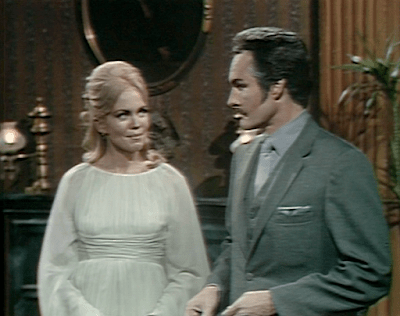
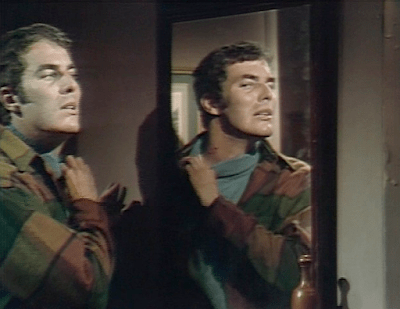
Suave warlock Nicholas is studying a mirror in his parlor. His subordinate, vampire Angelique, enters and comments on his vanity. He invites her to look at the mirror and tell him what she sees. “Only your reflection,” she replies. But the audience also sees the reflection of her hair and forehead. Her line, coupled with the fact that we do not see her whole face, suggests that her reflection was not supposed to be visible. In #288 the idea that vampires do not cast reflections was a crucial plot point. When old world gentleman Barnabas was a vampire, he several times cast the sorts of reflection Angelique casts today, usually as the result of Jonathan Frid missing his mark. Perhaps Lara Parker simply took half a step too many in this scene.
Nicholas’ mirror is no simple reflector. It functions as a closed circuit TV. He uses it to show Angelique the room in the attic where well-meaning governess Vicki is being held prisoner. He lets Vicki go, casts a spell to cause her to forget her captivity, and then tells Angelique that he will be going out.
Angelique asks what she is supposed to do while he is gone- sit in her chair and get bored? He says he couldn’t have put it better himself. When he returns, she is in fact in the chair, sitting still. It’s hilarious that she doesn’t pace, or get a book, or try to see if the mirror gets any other channels.
Nicholas was away visiting Maggie, The Nicest Girl in Town, on whom he has a crush. Maggie’s fiancé Joe dropped in while he was at her house. He tells Angelique that Joe is to be the next victim of her vampire’s bite.
Suave warlock Nicholas Blair has turned his subordinate Angelique into a vampire. Nicholas tells Angelique that she will bite only those people he orders her to bite.
Nicholas leaves Angelique in his house. She answers a knock at the door and finds a sheriff’s deputy asking questions related to a local man who recently suffered some mysterious neck wounds. Angelique identifies herself as Nicholas’ secretary and answers some questions. She invites the deputy to sit on the couch. He asks why, and she responds that it is because they are obviously attracted to each other. Within seconds, they are locked in an embrace. Angelique is about to bite his neck when Nicholas enters and breaks things up. The embarrassed deputy clambers to his feet and straightens his uniform. He asks Nicholas a few cursory questions about the injured man, then hastens away.
Some of the commenters on the various fan sites point out that the deputy’s behavior does not conform to law enforcement’s conventional best practices, and others compare the scene to porno movies they have watched. I think the strength of the scene is that it shows how quickly an encounter between two people can take a turn in an utterly unexpected direction, perhaps with drastic consequences.
The deputy seems competent enough when first we see him, and for all we know he might have been a model policeman for years up to this point. But all he has to do is get lost in Angelique’s eyes for one second, and there he is in her arms, about to become her breakfast. When Nicholas interrupts them, the deputy’s reaction shows that he knows he is misbehaving and risking his job; the audience is clearly supposed to know that police officers are not supposed to act this way.
I don’t know about the porno movies, but a resonance with them would reinforce the same point. The movies those commenters describe begin with fully clothed people delivering dialogue and establishing scenarios, as if they were in domestic dramas or situation comedies. But then the clothes come off and the unsimulated sex starts, and they jump into a different genre, one from which there is no return. The deputy may act like a character in a police procedural, a genre in which Dark Shadows dabbled in its first months on the air. But it is a horror story now, and he comes within an ace of becoming someone who could fit only into such a story.
Nicholas chastises Angelique for ignoring his commands. He is holding well-meaning governess Vicki prisoner in another room in the house, and orders Angelique to go to that room and terrorize her. It turns out that he also wants her to persuade Vicki to give her her engagement ring. Vicki was unconscious when Nicholas claimed her and took her to his house, so if he simply wanted the ring he could have taken it then. Perhaps the people who bring up the porno movies are onto something about Nicholas’ motivations, and he is hoping to drop in on another seduction scene.
Vicki knows Angelique and knows that she has died. Vicki suspects that Angelique is a ghost; Angelique offers her hand as proof that she is not. This rather chilly contact is the only moment the two women touch.
As it happens, Vicki has had extensive experience with ghosts, most of it quite friendly. During her first captivity, when strange and troubled boy David trapped her in a room in the west wing of the great house of Collinwood, the ghost of local man Bill Malloy appeared to her, sang, and dripped seaweed on the floor. That frightened her at the time, but led to the breakthrough that ended David’s hostility to her. During her third captivity, when crazed handyman Matthew Morgan kept her in a secret room in the Old House on the same estate, the ghost of gracious lady Josette appeared to Vicki, told her not to be afraid, and led other ghosts, including Bill’s, in scaring Matthew to death before he could kill her. Vicki and Josette’s ghost teamed up to lead the opposition to David’s mother, undead fire witch Laura Murdoch Collins, when she came back to Collinwood and tried to lure David to his death. So Angelique might be missing a chance to ingratiate herself to Vicki when she shows her that she is not a ghost.
Angelique asks Vicki for her ring and promises to give it to Vicki’s fiancé, an unpleasant man named Peter who prefers to be called Jeff. Vicki refuses, explaining that the ring is the only possession she has in this latest captivity to assure her that she is still connected to the world outside. Angelique says that if she does not give her the ring, she will spend eternity in the room.
Some time ago, Vicki spent nineteen weeks in the late eighteenth century, during which time she learned that Angelique was an enormously malign being responsible for the deaths of any number of people. She was herself accused of and sentenced to be hanged for some of Angelique’s crimes. Since she returned to the present, Vicki and the people she most cares about have suffered further agonies at Angelique’s hands, and Vicki knows about this, too. There is absolutely no reason why she should trust her, and she explicitly tells her she does not. Yet she does give her the ring at the end of the scene. The performers do what they can. Alexandra Moltke Isles’ steady gaze and trembling body do suggest that Vicki is so worn out, confused, and desperate that she might turn for help even to her bitterest enemy. But the script just does not give her enough support to make this interpretation stick.
Mrs Isles is facing another script problem that makes her character look like that old bane, Dumb Vicki. There is a window in the room with a Venetian blind in front of it and a shutter behind. Vicki looks at the window, but we do not see her even try to open it. The room is full of all sorts of objects, and she has a bed covered with blankets. Even if the window is sealed shut, she could easily cover it with a blanket and use some of the junk to smash the glass and beat on the shutters. That it does not occur to her to do so makes it all too easy to believe Angelique is telling the truth when she says Vicki will be in the room forever.
Suave Nicholas Blair, a middle manager in Satan’s terrestrial operations, has met with considerable success in his efforts to corrupt Frankenstein’s monster Adam. Today, Nicholas finds that Adam has abducted well-meaning governess Vicki Winters as part of his effort to force old world gentleman Barnabas Collins to create a mate for him. Nicholas praises Adam’s plan, and persuades Adam to let him take Vicki from his hiding place in the west wing of the great house of Collinwood. Nicholas says that he can keep Vicki far more securely in his own house.
Nicholas gives Adam a vial full of drugs and tells him to put them in Vicki’s drink when she comes to so that she will be easier to handle. In #528, Nicholas described himself as “much too talented to spend my time drugging drinks.” Perhaps he is, but the writers have to pump out five scripts a week, so whaddaya gonna do.
When Vicki wakes up, she pleads with Adam to let her go. She asks what reason he has for abducting her, and he immediately says “No reason!,” then scrunches up his face and says “No, I have a reason.” He won’t tell Vicki what that reason is, but he is interesting to listen to. Vicki makes a run for the door; he grabs her and puts her back on the bed. He asks her, with genuine concern, whether he hurt her. She assures him he did not. He gives her the drugged drink.
Nicholas comes to take Vicki. We cut directly from Vicki unconscious on Adam’s bed to her unconscious on a bed in Nicholas’ house. I don’t think this is the first time Dark Shadows has used a jump cut, but we certainly haven’t seen it often. Abrupt editing is so much at odds with the stately visual grammar of the show that it qualifies as a special effect. Unfortunately, it is an effect that does not make any particular point here, and so is wasted.
The other day, the corpse of Nicholas’ subordinate, wicked witch Angelique, disappeared. We then saw a coffin in Nicholas’ basement. Nicholas talked to the coffin, calling it “Angelique,” indicating that her body was inside. Yesterday, there was a vampire attack. We didn’t see the vampire, but there couldn’t be much doubt that it was her. That is confirmed in the final shot of today’s episode, when we see Angelique in the coffin, her fangs showing.
Recovering vampire Barnabas Collins is in the woods on the estate of Collinwood, searching for well-meaning governess Vicki Winters. He hears dogs howling, as they used to howl when he was in the grip of bloodlust. He goes to pieces at the memory.
Barnabas’ fellow searcher, Vicki’s fiancé Peter Bradford, sees him standing petrified. Barnabas asks him if he can hear the dogs. Peter says he can, and is puzzled that Barnabas was afraid he was hallucinating their sounds. Peter asks Barnabas if he is all right. Barnabas insists that he is just worried about Vicki, and resumes searching.
Shortly after, Barnabas finds himself in the foyer of the great house on the estate, slumped in a chair under his own portrait. He makes a sad contrast with the haughty figure in the painting. His friend Julia Hoffman enters, and he gives her a pleading look that emphasizes the contrast between his present weakness and the arrogant power he wielded when he posed for the portrait, more than 170 years before.
Barnabas tells Julia that he does not know how he got into the house. The last he remembers, he was in the woods and heard the dogs howling. She suggests that their noise may not mean anything, but he is sure there is some unearthly horror afoot.
Barnabas tells Julia something else he is sure of. Earlier this evening, Frankenstein’s monster Adam came to his house. Adam mistakenly believes that Barnabas created him, and demanded that he build a woman to be his mate. When Barnabas told him that would be impossible, Adam vowed to make him sorry, then left. Shortly after, Vicki came by for a brief visit. Barnabas is certain that Adam abducted Vicki to use as a hostage, and that the only ransom he will accept is the artificially created woman he has no way of supplying.
Barnabas goes to the telephone and announces he is going to tell the police what he knows about Adam. Julia objects that Adam can tell the police enough about the two of them to expose them both to prosecution. Barnabas says that he is willing to take that risk for Vicki’s sake, and begins dialing. Julia says she is not, and places her finger on the telephone receiver to end the call.
Julia has never been able to entirely conceal her dislike for Vicki, rolling her eyes when Vicki talks to her and making sarcastic remarks when Barnabas praises her, so regular viewers can hardly be surprised that Julia does not volunteer to go to prison for her sake. Still, Julia has often enough shown a troubled conscience about the many crimes she has committed during her association with Barnabas that her utter coolness represents a new step in the character’s development. The other day she wanted to shoot wicked witch Angelique, but Angelique was not really human and was enormously dangerous. Even so, Julia was deeply upset when she made up her mind to kill her, and she backed down when she came face to face with Angelique. But Vicki is resolutely, unfailingly, rather tediously good, Good with a capital G. That Julia is so blandly willing to consign her to death at Adam’s hands suggests that her sense of right and wrong will no longer serve as a brake on any sinister plans that might advance whatever goals she and Barnabas are pursuing.
Barnabas looks at Julia, shocked. Perhaps her coldness shocks him. Perhaps what shocks him is that he is so dependent on her that he does not resume dialing.
Meanwhile, another drama has played out not so far away. Electrician Tom Jennings was inspecting the wiring in a house that suave warlock Nicholas Blair is renting from the ancient and esteemed Collins family. Tom told Nicholas that he wanted to inspect the cellar to make sure the foundation was in good repair. Nicholas replied that this would not be necessary, but Tom insisted. He opened the cellar door, and found a coffin. Nicholas told him that the coffin was there when he moved in. Tom asked if he’d called the police, and Nicholas replied there was no need, since the coffin was empty.
On his way home, Tom told himself that the Collinses wouldn’t leave a coffin in the basement of one of their houses. That shows what he knows- for the first 55 weeks of the show, matriarch Elizabeth Collins Stoddard thought that her husband was buried in a box in the basement of the great house, and when he was a vampire Barnabas kept his coffin in the basement of his house. It wouldn’t be a Collins house if it didn’t have a coffin in the basement, and a dungeon too.
Tom sees someone and asks who it is. The part of the other person is played by the camera, so we do not know. The camera zooms in, and Tom collapses.
Later, Peter finds Tom propped against a tree. He touches Tom, and Tom falls over, apparently dead. He has two bloody wounds on his neck. Peter goes back to the great house. He tells Barnabas and Julia that he must use the telephone. They hear him describe Tom’s wounds to the police. Afterward, Barnabas and Julia realize that there is another vampire operating in the area.
Tom’s appearance is the debut of Don Briscoe, who would be a big part of Dark Shadows for almost two years. On his Dark Shadows Every Day, Danny Horn told an amazing story about Briscoe:
Many years ago, when I was in high school, my mother walked into the room while I was watching Dark Shadows.
She looked at the guy on the screen, and said, “Is his name Don?”
I said, yeah, that’s Don Briscoe, and she said, “I thought so. I knew him, when I was in grad school. He asked me out once.”
Seriously, true story. She said that they were both getting a master’s in English — he was at Columbia University, and she was at Barnard, which is right across the street. He asked her out on a date, and he was very handsome, and very nice, but he wasn’t Jewish, so she said no.
At the time, I had no way to verify this, and I never really knew what to think about it. I mean, she knew the guy’s first name, but maybe she confused him with some other brown-haired guy named Don.
But now I have this excellent book called Barnabas & Company, which has extensive bios on everybody in the cast. It turns out that he really did get a master’s degree in English at Columbia University, and that means that Don Briscoe is kind of my dad.
Granted, hundreds of actors had parts on Dark Shadows over the five years of its run, a great many people have blogged about the show, and I’m sure Danny’s mother was a very attractive young woman who had offers from lots of fellows. But Briscoe was one of the more important members of the cast, and Danny is as good as any of the bloggers. So it really is a noteworthy coincidence that they are connected to each other in that particular way.
Wicked witch Angelique defied her supervisor, suave warlock Nicholas, one too many times. Yesterday, Nicholas stripped Angelique of her powers, including her immunity to aging. Since she is 194 years old, this leaves her with a sharply limited future.
Today, Nicholas tells Angelique he will think of sparing her from her imminent demise if she can persuade recovering vampire Barnabas to forgive her for her extreme abuse of him and of everyone he has ever cared about. She goes to Barnabas and begs him for forgiveness. Barnabas replies that when he asked her for forgiveness, she responded by turning him into a vampire. He does show signs of concern for her, but cannot pardon everything she has done. He specifically mentions The Dream Curse, a three month storyline that not only brought great suffering to him and a dozen other characters, but which also made the audience miserable. She dies.
Nicholas’ only acknowledged motivation to this point has been a selfless devotion to evil for its own sake. That makes it odd that he would place a value on forgiveness. Dark Shadows is pervaded with ghost stories, and ghost stories are, first and foremost, explanations of how unresolved conflicts in the past can poison relationships among people in the present. It is also a soap opera, and the biggest events in soaps are changes in the way particular characters feel about each other. So both genres tend to elevate forgiveness, not only as a virtue, but as the highest form of The Good in human life. We saw this in the first year of the show, when well-meaning governess Vicki kept forgiving strange and troubled boy David for his attempts to kill her, acts of forgiveness which culminated in #191 when David ran from the mother who was trying to lure him to his own death into Vicki’s arms and an acceptance of life. Two weeks later, in #201, dashing action hero Burke closed another narrative thread left over from episode #1 when he forgave sarcastic dandy Roger for an old grievance he had against him. With those events, it was pardoning that cleared the flotsam left over from Dark Shadows 1.0, paving the way for the introduction of Barnabas and the advent of Dark Shadows 2.0.
Perhaps Nicholas was so certain Barnabas would not be able to bring himself to forgive Angelique in the time available before her death that making her beg for forgiveness was his way of perverting the world’s best thing into yet another instrument of cruelty. Certainly he suggests this interpretation when he introduces the idea with a laugh and a comment that he might find it “amusing.”
When Nicholas stands over Angelique’s corpse, he tells her that her own hatred had made it impossible for Barnabas to forgive her because it had “become too much a part of him.” That Angelique’s hatred became a part of Barnabas rings a bell for longtime viewers. The show has always depicted supernatural beings, not as self-contained individuals, but as complexes of phenomena that operate more or less independently, often without each other’s knowledge, sometimes in pursuit of mutually exclusive goals. For example, in 1967 the ghost of Barnabas’ little sister Sarah visited David during the day and tried to prevent him finding out Barnabas was a vampire, but she also appeared to David in a dream and showed him everything the daytime ghost wanted to keep hidden. When David told the Sarah of the waking hours what her dream visitation form had shown him, she was horrified and forbade him from following up on any of that information.
When Angelique places a curse, she sometimes seems to create a little version of herself, give it possession of the person she is targeting, and turn it loose in the world. Sometimes that little Angelique turns against her. For example, she raised the body of Barnabas’ uncle Jeremiah from the dead to use for her own nefarious purposes, only to find that it would not return to its grave when she was finished with it. When Barnabas was a vampire, he had some obsessions that were strikingly similar to obsessions Angelique had shown. So Angelique wanted Barnabas to love her, and had the power to cast a spell that would make him do so, but instead wrought immense havoc on everyone else with one wild scheme after another, because she wanted him to come to her “of his own will.” Likewise the vampire Barnabas wanted to make Vicki his victim, but passed up one opportunity after another to bite her because he wanted her to come to him “of her own will.” That similarity is so close that it makes us wonder if the Barnabas we first met was simply Angelique in disguise. Not only her hatred, but all of her quirks had become part of him.
Angelique came from the 1790s to 1968 by some magical process that involved a portrait of her that is now on a stand in Vicki’s room. Today she uses a secret panel to let herself into the room and look at the portrait. We first saw that panel open when the show was a costume drama set in the 1790s. The room was occupied then by gracious lady Josette, and it was the vampire Barnabas who used the panel to enter. We haven’t seen the panel since, leaving it strongly associated with Barnabas in the minds of regular viewers. Angelique’s use of it today further suggests her identity with him when he is in his vampire state.