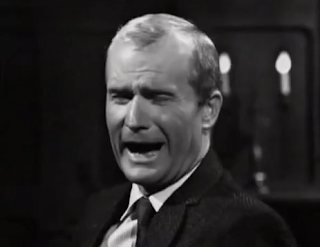
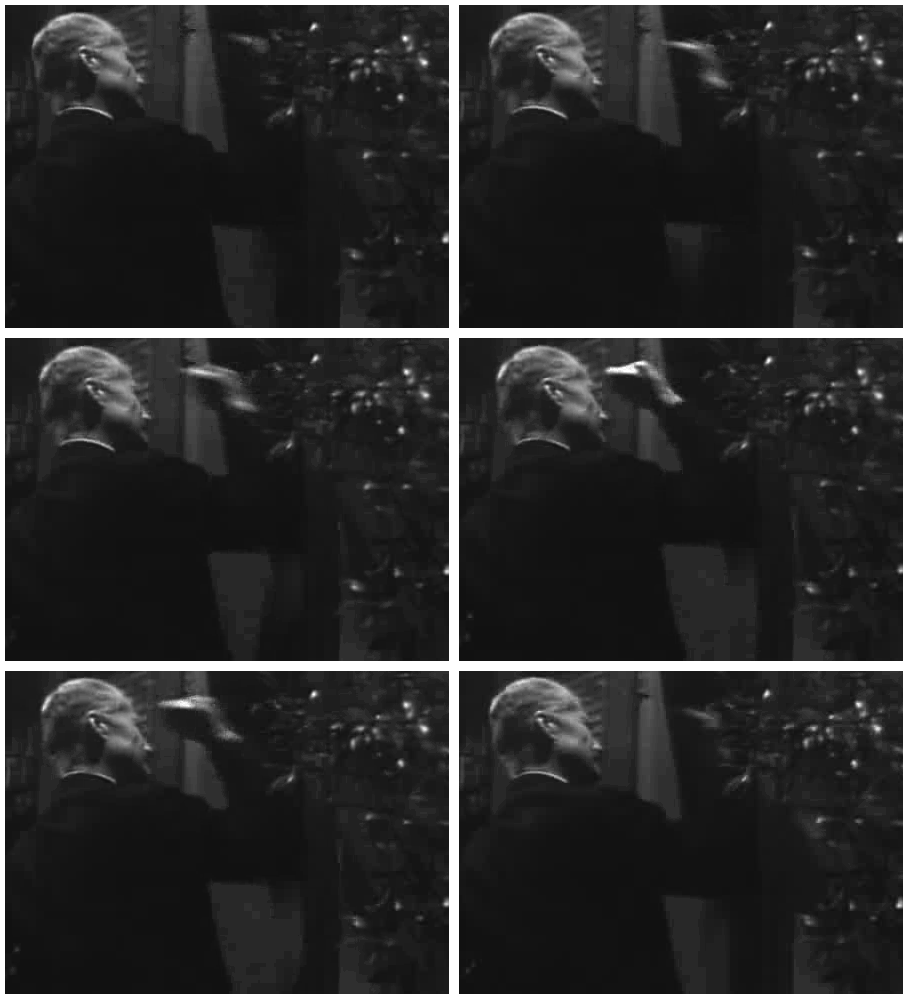
Episode 50: He wasn’t there again today

This one is so good that I can’t resist going over it scene by scene. It has a wide variety of mood and image, tautly structured in a clearly told story, subtly realized by highly accomplished acting, and memorably presented in superb photography and imaginative sound design.

Well-meaning governess Vicki, out for a night-time stroll, makes her way to the crest of Widow’s Hill, where flighty heiress Carolyn stands looking down at the ocean swirling a hundred feet below. “Advance and be recognized! Friend or foe?” Carolyn challenges. Seeing Vicki, she remarks “Even the tutors are out tonight.”

Despite her whimsical greeting, Carolyn is in a low mood. She’s wondering at her own inability to take hardworking young fisherman Joe Haskell’s desire to marry her seriously. She tries to interest Vicki in some of the ghost stories that surround the great estate of Collinwood, while the wind whips around the hill making the eerie sound known as “The Widows’ Wail.” Vicki stoutly insists on reducing all of Carolyn’s tales to psychology and asking her about her feelings. You can really see Nancy Barrett’s Carolyn trying to maintain a light tone despite her gloom, and in Alexandra Moltke Isles’ Vicki you can just as easily see a determination to cut through the nonsense and stick to what’s real, a determination fueled partly by her empathy for Carolyn and partly by her reflexive rejection of the weirdness of her new home in the old dark house.

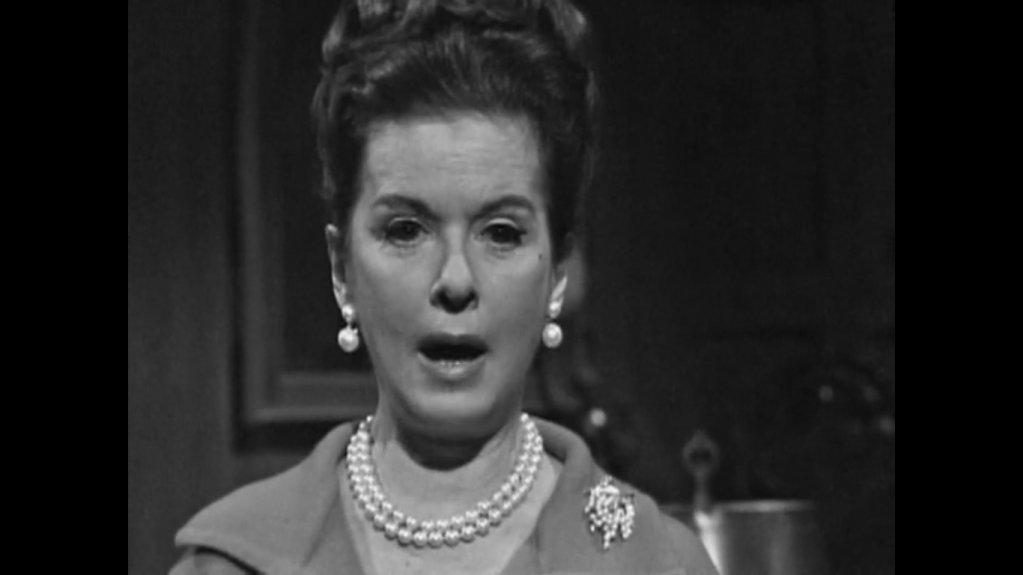
In the house, troubled rich boy David Collins is complaining to his aunt Liz that the ghosts won’t let him sleep. Liz tells him to turn the lights on and chase them away. Unsatisfied by that response, David persists. Liz tells him that she has no time for him now and sends him to his room. Ten year old David Henesy trades these well-written lines with veteran movie star Joan Bennett as her professional equal. David Collins continually does nasty things to characters we like, refuses to take responsibility for any of his wrong-doing, and becomes violently surly when interrupted in his endless bouts of self-pity. He ought by rights to be a difficult character to take. But David Henesy finds something lovable in him, and brings that out clearly enough that he’s always a welcome presence on screen.

Vicki and Carolyn come to the house. Liz is disappointed they aren’t her ne’er-do-well brother Roger. Liz had ordered Roger to leave his desk at her company and come home early in the afternoon. She has questions about the disappearance of plant manager Bill Malloy, and about Roger’s lie that he hadn’t seen Malloy the night before. It’s well after 10 PM now, and no one has seen or heard from Roger since Liz called him.

Carolyn and Vicki have tea and try to take Liz’ mind off her worries, but without success. Liz scolds Carolyn for bringing up the ghost stories at a time when everyone is worried about Bill Malloy, but she can’t long keep herself from drifting off into the tale of the two women who died falling off the cliff, and the third who will someday follow them. That drifting, as Joan Bennett plays it, speaks volumes about Liz’ state of mind. She’s agitated about Bill Malloy, about Roger, about the possible connection between their two absences. That agitation gives way to hopelessness.

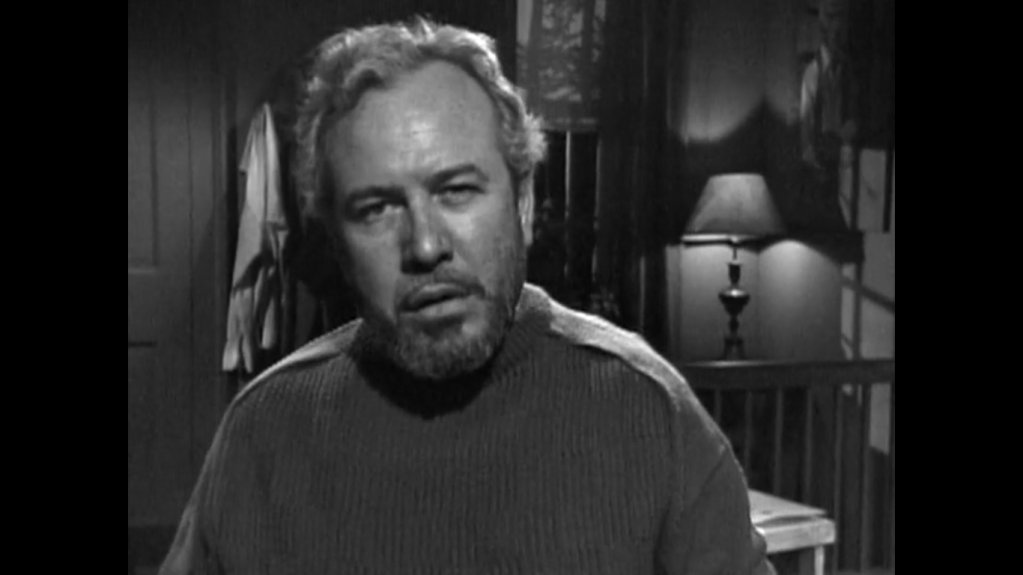
Roger comes home. Liz greets him with a demand for explanations. He responds with perfect insouciance, informing his sister, in whose house he lives as a guest and from whose business he draws a salary on her sufferance, that he is going to the kitchen to make a sandwich. Louis Edmonds’ delivery of Roger’s lines is brilliantly funny- we laughed out loud.

Liz most definitely does not see the humor. She has a brief scene by herself after he goes off to prepare his snack. All she does is watch him leave the foyer, turn, walk a few steps to the drawing room, and take a seat. With no dialogue and no mugging for the camera, she shows anger, disbelief, exasperation, and despair. It is a wonderfully economical performance, quite as extraordinary as is Edmonds’ comic turn preceding it.

In Vicki’s room, we see the word “death” scrawled on her mirror in all caps. Vicki enters, dragging David behind her. She demands to know who wrote it. He insists that the ghosts of the Widows did it. Vicki remarks that it is surprising that the Widows have the same handwriting as David. Carolyn enters, sees the word, and scolds David. Vicki silences Carolyn with a glance and asserts control of the situation. Only when Vicki threatens to tell Liz about the word does David erase it, though he still insists it was the Widows who wrote it, not him.

After David has left the room, Carolyn tells Vicki how horrid David is. Vicki perks up and makes a series of jokes about the Widows. She’s in such a chipper mood as soon as David is out of earshot that she must have been putting on an act presenting herself to him as angry. Much to Carolyn’s mystification, Vicki likes David and is confident that sooner or later she will make friends with him.

At another point in the series, this scene might have been padded out to fill a whole episode. Today, Art Wallace writes a quick and forceful interlude, showing us everything we need to know about what the three characters in it are like and where they stand in their relationships to each other, shedding some light on the idea of the ghosts of the Widows, then moving on to the next story point. The writing is as economical as the acting, and as absorbing.

Liz and Roger have a confrontation in the drawing room. Liz asks why Roger didn’t come home when she told him to. He tells her that he went to Bill Malloy’s cousins’ house to see if Bill had been there, and that he simply forgot to tell her he would be making the trip. This response is so unsatisfactory that it seems to double the anger with which Liz puts her next question- why did he lie to her when he denied having seen Bill Malloy last night? Roger tries to weasel out of answering that question, and does manage to get Liz to give him some information he can use to craft more plausible lies, but does not get himself off the hook.

The relationship between Liz and Roger is the first of Dark Shadows’ several relationships between a Bossy Big Sister and a Bratty Little Brother. In Liz and Roger’s case, they are literally older sister and younger brother; the most important such relationship will be a figurative one, between Julia and Barnabas. But it’s Liz and Roger who set the pattern. Roger’s impossible behavior in this scene is certainly among the finest examples of brattiness among all the little brothers, and Liz shows with crystal clarity the limitations of the power of the Bossy Big Sister when confronted with a truly horrid Bratty Little Brother.

Carolyn and Vicki come downstairs. They are going back to the crest of the hill to look for Carolyn’s wristwatch. Once they’ve left, Liz meets David at the top of the stairs. She tells David that they are looking for a wristwatch. “That’s not what they’ll find- they’ll find death” replies the boy. Last episode, David received the gift of a crystal ball; that marked the beginning of his career as a clairvoyant.

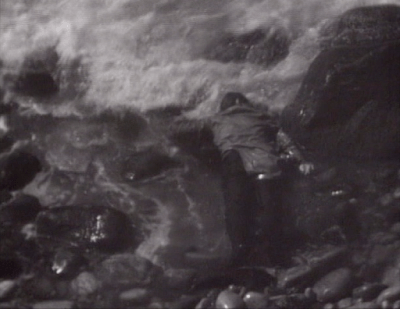
No sooner has the seer made his prediction than we hear Vicki screaming. Looking down from the cliff, she and Carolyn see a figure on the beach- a man face-down in the water. We hear the tide and the wind, sounds of nature on a large scale, and the immobile figure seems to represent something vast and inevitable.

Face down in the water, wearing an overcoat, with a flask in his back pocket
Screenshot by Dark Shadows Before I Die

Episode 46: Collinwood, with all its dark shadows

Bill Malloy’s investigation into the manslaughter case that sent Burke Devlin to prison ten years ago is coming to a head. Bill tells Burke, Sam Evans and Roger Collins to meet him to discuss the case in Roger’s office at 11 PM. When Bill leaves the Evans cottage, Sam mutters something about stopping him and looks directly into the camera.

Sam looks directly into the camera

Roger is no happier at the idea of the meeting. Louis Edmonds’ performance ever so subtly hints at Roger’s reluctance to attend:

Roger contemplating unwelcome news
Screenshot by Dark Shadows Before I Die

Roger gives a speech to Vicki about how David is better off than he was at nine, since he already knows that the world is a horrible place. The speech is vague, rambling, and high-flown. That’s suitable for the occasion, since Vicki isn’t supposed to know what the hell he’s talking about, but Louis Edmonds struggles with it. In a future period such speeches will become a hallmark of the show. Malcolm Marmorstein is credited as the writer of 82 episodes in all, from 115 (broadcast 2 December 1966) to 309 (broadcast 31 August 1967,) and often as not speeches just like that crop up in them. Marmorstein’s flowery gibberish will defeat actor after actor, until Jonathan Frid joins the cast as Barnabas Collins. In Frid’s voice, the speeches sound so gorgeous you barely notice that they don’t make a lick of sense. After a while, Marmorstein stops giving them to other actors, and they become the way Barnabas talks. I wonder if Marmorstein did some uncredited work on this episode. Art Wallace, sole credited writer of episodes 1-40, is listed on screen again as the author of this teleplay, but at many points it sounds more like Marmorstein than it does like Wallace.

This one also has a key moment in one of the aspects of the show that most saddens me, the decline and fall of Vicki. In the drawing room, Roger is in a panic about Bill’s investigation. Vicki sees this and asks if the investigation has something to do with her quest to learn her origins. Roger laughs in her face. Of course it doesn’t have anything to do with that story-line- nothing happening on the show does. As long as she’s chained to that rotting corpse of a narrative element, Vicki is going to be of limited relevance.

Episode 37: Fatigue lines

Roger’s mounting anxiety about what Burke may learn from Sam leads him to alternate in each scene between yelling and begging. Depicting this, Louis Edmonds’ chews the scenery so hard that he momentarily loses track of Roger’s mid-Atlantic accent and slips into his native Louisiana drawl, yelling at Vicki “Jes supposin’ you a-tell me how long you wah standin’ in that doah-way?” Perhaps this is Marc Masse’s “David Ford Effect”– Ford came to the show from a long engagement as Big Daddy in Cat on a Hot Tin Roof, maybe they’ve decided to transport Collinsport from Maine to the Mississippi Delta.

At the Evans cottage, Sam gives Maggie a sealed envelope to be opened in event of his death. Maggie is bewildered and upset. Surmising that her father’s trouble is to do with Collinwood, she wishes that the mansion would burn to the ground. Sam waxes philosophical, opining that “Ghosts of the past don’t live inside a home. They live inside each man. They fight for his soul.. twist it into something unrecognizable.”

Moments later we find out that Sam is wrong, ghosts totally live inside a home. In the middle of the night, Vicki is awakened by the same strange sobbing she had heard in episode 4. She follows it to the basement. Last time she was in the basement, in episode 6, Matthew found her there and spoke sharply to her. Now Roger finds her there and yells at her. As she had stood up to Roger in the drawing room earlier, so she stands up to him now. After their showdown, he even admits that he has heard the sobbing woman many times, and says that she may be “one of our ghosts.”

I divide the series into several periods, the first of which I call “Meet Vicki.” The major story-lines of the Meet Vicki period are all in a down-cycle during this episode. Roger’s panic and Sam’s melancholy are part of the Revenge of Burke Devlin story, but Roger’s activities today do nothing to advance that story, and Sam’s letter will become one of the most tedious MacGuffins in a series that is notorious for forcing the audience to sit through overlong contemplation of its MacGuffins. Roger’s angry reaction to finding Vicki in the basement touches on the Mystery of the Locked Room, which is connected with the question of why Liz became a recluse. Those stories haven’t advanced for weeks. The sobbing woman revives the question of whether the house is haunted. While Roger’s admission that he has heard the sobbing marks the first time one character knows what another is talking about concerning the ghostly happenings, it does not prompt any further action. The question of Vicki’s origins is at a stalemate, the romance between Carolyn and Joe is dead in the water, and David is so alienated right now that they can’t do much with Vicki’s attempts to befriend him.

So the Meet Vicki period has reached a dead end. Tomorrow we’re going to meet someone else, and a new period is going to begin.

Episode 36: Politeness is a passing phase

The actors all go big in this one. Marc Masse calls it “The David Ford Effect” and concentrates on Louis Edmonds’ thunderous performance in Roger’s confrontation with Liz, but since the entire cast has turned up the volume, I think it is more likely a response to direction coming from the people who hired David Ford (and, to be seen in a couple of days, Thayer David) than to David Ford himself.

Masse isn’t the only commentator who tends to ignore the directors and producers as influences on the acting. Perhaps that tendency goes back to an interview John Karlen gave in which he says that he doesn’t recall ever getting any direction at all on Dark Shadows. His first day, Lela Swift said “Go!” and that was it, he just did whatever he wanted for the next four years. On the other hand, Joel Crothers said that he left the show because the directors were so busy with special effects they no longer had any time to work with actors, implying that they had worked with them at one point. Since Crothers was there from the beginning and Karlen joined the cast ten months in, I can only assume that it was during these first months that the directors told the actors what they wanted.

Why would Lela Swift and the other masterminds behind the scenes start hiring actors like David Ford and Thayer David and tell the existing cast members to start hamming it up at this point? Well, the saga of the bleeder valve has wrapped up, and there is no other story going on that wasn’t there in episode 1. Some of those stories are starting to look pretty pointless. There’s “The Revenge of Burke Devlin”- they haven’t told us what exactly he wants revenge for, but if he ever takes it we will see either the death of Roger, which would have the disastrous effect of requiring Louis Edmonds to leave the show, or Burke taking control of the Collins family assets, which will bring the equally disastrous requirements of a showing a bunch of episodes about various forms of debt and building a new set for Joan Bennett to play her scenes on. So we’re starting to suspect that Burke will just keep going in circles. Roger’s angry scene with Sam in this episode is fun to watch because Edmonds and Ford play well off each other, but as part of The Revenge of Burke Devlin story it doesn’t take us to any new ground.

There’s “Vicki Seeks Her Origin.” We might expect that one to lead somewhere, eventually, but if that happens it won’t be for a good while. In this one, Vicki tells Liz that she’s decided she can’t help David and replies to Liz’ plea with her to stay with “Why am I so important?” She doesn’t renew her inquiries into how Liz knew about her and why she hired her. Of course not- that was getting tedious. So Alexandra Moltke Isles and Joan Bennett just emote furiously while exchanging lines that don’t add up to much.

We don’t see Carolyn or Joe in this one, but their romance is another dead end. Joe is a nice guy who wants to get married, Carolyn is a rich girl who doesn’t. There aren’t that many ways to make a story out of that.

The one story that works in the first 42 weeks is the growing friendship between Vicki and David. Right now there isn’t much to do with that one, either. David has just been caught trying to murder his father- he isn’t going to be particularly reachable. Today, he openly threatens Vicki at the beginning of the episode, then comes out of hiding after Liz persuades her to stay and declares that he doesn’t want her to stay. We have to see them at rock bottom today for the gradual rise in the months ahead to grip us the way they will, but not a lot happens while you’re at rock bottom.

So, maybe the producers and directors decided to dial the acting up to 11 because they knew they didn’t have much of a story to tell. This is Art Wallace’s final week as the sole credited writer on the show; I don’t know how much help he had in those first eight weeks, how much involvement he really had in episodes attributed to him in the nine weeks after, and whether anyone is already around whose name will be printed on the screen in that period. But they don’t have a story to tell right now. So it falls to the cast to distract us while they wait for the next phase.

Episode 32: Where all criminals belong

In today’s compare-and-contrast, we see the sheriff and Bill Malloy demonstrating how mentally healthy people might react to the idea that a nine year old boy has devised and executed a plan to murder his father. Then we go to Collinwood, where we see how Liz and Roger react to the idea.

The sheriff can’t bring himself to say out loud what the evidence is leading him to suspect David has done. Bill can say it only in part, and then only to express shock and bewilderment.

The scenes between Liz and Roger in this episode are among the strongest in the entire series. Roger is quite drunk, almost giddy, almost laughing at the fact that his son tried to kill him. Liz cycles through a half dozen intense emotions before finally accepting the fact that David is the culprit. She orders Roger to lie to the sheriff and say that what happened to his car was a simple accident, that no one was at fault.

In response to her explanation that this is the sort of thing the Collinses have always done, Roger brings up his suspicion that David may not be a Collins at all. David was born less than nine months after Roger and Laura* were married; she’d been Burke’s girl… Liz won’t hear such things, and insists that David is a Collins, that he belongs to all of the ancestors. She blames Roger for raising David in a home where he knew nothing but hate from the moment he was born, hate he couldn’t understand or cope with.

Roger insists that David be sent away to a mental hospital; Liz says no, that he will stay in the house, that “Miss Winters and I” will give him the home life he needs. Her mention of “Miss Winters” in this connection makes it clear that Vicki is central to Liz’ plans for the future, whatever those might be.

The sheriff shows up. He’s taking his time to get to the point. Roger cuts him off: “Is it about David?” At that, even the background music falls silent. The sheriff starts talking. Liz jumps in and says that the sheriff should drop the investigation, that it was all just an accident. The sheriff looks uneasily from Liz to Roger and back again, and finally agrees to do so.

In the coda, Roger tells Liz that she will regret covering up for David. He gives her a look of contempt that is among the most powerful things I’ve ever seen on a screen. Liz is totally alone now; Roger will obey her, but he’ll never respect her again. Joan Bennett was pushed to the margins of the show in later years, but she really did fill her “Starring” credit in these first months. It isn’t every show that would present us the leading lady devastated like this.

*Aside from the prologue delivered by Alexandra Moltke Isles, there are no surviving cast members in this episode. As of 9 August 2022, it is the earliest episode of which that can be said.

**Laura’s name is first mentioned here.

Episode 29: The Burke Devlin Special

Today’s exercise in the Art Wallace school of compare-and-contrast juxtaposes Burke Devlin’s hotel room with the interiors of Collinwood. Burke is a bouncy, cheerful host to an unannounced visitor, David Collins; after a short time, David is happy and exuberant, the first time we’ve seen him smile about something other than hatred and murder. Vicki, Carolyn, and Liz are thoroughly miserable.

Liz still refuses to believe that David could be the one who sabotaged his father’s car, at one point suggesting that Vicki might have done it. That idea crumbles immediately in the face of Carolyn’s disbelief, and Liz offers Vicki an apology. But she still clings to the thought that David might somehow be innocent. Her refusal to face facts takes a depressing situation and robs it of all hope for improvement.

David has gone to Burke’s room to hide the incriminating bleeder valve there. He had originally set out a few episodes before, after Vicki found the valve in his own room but before the sheriff had searched Burke’s room. He was caught trying to sneak into Burke’s room before the sheriff got there, so it’s really too late for his plan to work. He goes ahead with it anyway, but tries to retrieve the valve from the cushion after Burke wins him over. That attempt fails as well- unknown to David, Burke has already found the valve and has it in his pocket.

I suppose a definition of “dashing” is a fellow capable of great charm who makes things happen, things which we cannot predict and of which, even when they have happened, we can’t be sure whether we approve. By that definition, Burke is at his most dashing in this episode and the next.

Episode 17: Such a strange question

Another of the diptych episodes in which Art Wallace excels. This time we have two pair of contrasting scenes.

David, thinking he has succeeded in his attempt to murder his father by tampering with the brakes on his car, awakes from a nightmare and walk out through a feature no nine-year-old boy’s bedroom should be without, a full window that opens on a ledge above a two hundred foot drop to the sea. Elizabeth stops him before he can jump. David is hysterical, Elizabeth frantic to console him.

Juxtaposed with the wrenching scene between David and Elizabeth is a very light scene between Roger and his doctor. Roger is in the doctor’s office, pitying himself for his minor injuries. The doctor is overly friendly and relentlessly makes little jokes at which he himself seems to be quite amused. Roger is annoyed with the doctor’s manner and impatient with his work. The self-contained, self-satisfied, ultimately trivial Roger seems to live in a different world than the one where his son is suffering so grievously.

Then we have two scenes of teacher and student. Bill Malloy explains hydraulic braking systems to Roger and a scene in the drawing room where Elizabeth tells stories from family history to David. Since Malloy’s explanation advances the mystery story that is the main thread of the show at the moment, it is fascinating, and since the early history of the family is not (yet!) relevant, Elizabeth’s stories are intentionally presented as tedious. Here’s how I put it in the comments on John and Christine Scoleri’s Dark Shadows Before I Die:

Bill Malloy was a talented guy. His explanation of a hydraulic braking system, supplemented by that admirably drawn schematic, was not only crystal clear, but genuinely interesting.

There’s a structural justification for it- Liz’s lecture to David about Isaac Collins in front of Isaac’s portrait is deliberately presented as boring. So including another lecture supported by a single illustration and making it urgently interesting shows that what’s boring isn’t the format, but the relevance of the content to the story.

That venture into educational programming is a fine example of the freewheeling experimentation the series was doing in these early weeks. Some of those experiments come up again. The final 2 seconds of the episode is the first time a character looks directly into the camera, a trick they will use to advantage many times down the line.

Also, the date 1690 is interesting, not only because the portrait is ludicrously anachronistic- the man is wearing clothes from and is painted in a style that date from 200 years after that date- but also because we will hear about that period again, near the end of the series. Most likely that’s a coincidence, but I suppose it’s possible someone connected to the show in its final months remembered that the 1690s were supposed to be important in the history of the family.

Episode 10: To the death of the monster

Carolyn is in Burke’s hotel room, where he charms her and tricks her into believing that he’s planning to leave town soon. I suppose the definition of “dashing” would be a charming fellow who makes things happen, things you wouldn’t have predicted and of which you aren’t sure you can approve. Burke is at his most dashing in scenes where he’s trying to enlist the women and children of Collinwood to his side. With Carolyn here, with Vicki back in episode 7, most of all with David in episode 30, we wonder what exactly he’s trying to do. He’s not so good with the men- when he tries to recruit Joe Haskell to his intelligence-gathering operation in episode 3, he ends up baldly offering him a bribe.

Liz and Roger are in the drawing room, where she demands he be less openly hostile to his son David. Unknown to them, David and his toy robot (a Horikawa “Attacking Martian,” which sold for $4.22 in 1966, not including two D batteries) are hiding behind a chair listening to Roger’s brutal denunciations of the boy. Unknown, that is, until Roger goes to the brandy bottle for his second drink, when the Attacking Martian starts attacking Roger.

Roger all but assaults David in response. David flees his father’s rage. He runs out of the house, telling Roger he hopes Burke Devlin gets even with him. Roger is as bleak and maladroit in these interactions as Burke is glittering and skillful in his handling of Carolyn. Again we see Art Wallace’s use of intercut scenes to bring out a comparison between characters.

After the second part of the scene in Burke’s room, David slips back into the house to find his Aunt Elizabeth asleep in a chair, muttering about ghosts. After all the talk about ghosts in the first two weeks, Elizabeth’s muttering about them seems significant- perhaps we are to think that her dream is a message from the ghosts who linger about the house, a sign that something is happening that will stir them up. Elizabeth awakes, and sees that David is in front of her, smeared with grease and holding a small object. He won’t answer any questions or let her see what he has in his hand. Before she can pursue the matter, Carolyn appears in the foyer, bringing an unexpected guest- Burke Devlin. Confronted with this shocking sight, she forgets all about David.

Episode 3: Open your door!

Episode 3 of Dark Shadows is remembered chiefly for two things. It’s the one where Carolyn and Vicki first meet, and Carolyn introduces herself by going on at alarming length about her crush on her Uncle Roger. Vicki’s quiet reaction is just what you’d expect from a new member of the household staff discovering that a member of the family is a raving loon.

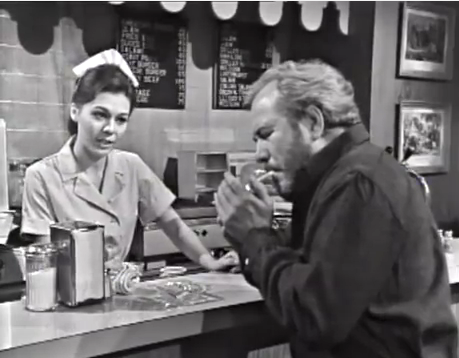
It’s also the one that opens with Roger pounding on the door to the Evans cottage and shouting “Open yer doah, ya drunken bum!”:

There is more to it. At the Blue Whale, Burke tries to enlist Joe in his intelligence-gathering operation, an attempt Joe virtuously rebuffs. Bill Malloy confronts Burke, showing that he, like Joe, is devoted to protecting the Collinses.

Art Wallace, the author of the show’s story bible and sole credited writer for its first eight weeks, specializes in a diptych structure, building an episode by interweaving two parallel scenes. That structure leads us to compare and contrast characters with each other in a wider variety of ways than we might if the scenes followed each other in succession. In this one, we see Joe and Bill faithfully standing up to Collins family foe Burke, while newcomer Victoria tries to assume the persona of a loyal retainer in her response to Carolyn’s bizarre talk.

Episode 2: Wouldn’t be the first, you know

Marc Masse’s Dark Shadows from the Beginning is in one of its accessible phases now, and his discussion of episode 2 includes some interesting comparisons between the finished episode and Art Wallace’s story bible for the series, Shadows on the Wall. For example:

Here is Art Wallace’s introductory description of Joe in Shadows on the Wall: “Joe Haskell is twenty-one. A rugged New Englander with a deep love of the sea, Joe is a young man of natural dignity and quiet ambition.”

But the viewer’s first impression of Joe Haskell is that of a sap, cuckolded into brooding over a mug of beer while his date plays the field before his very eyes.

And:

During the scene with Elizabeth and Carolyn in the drawing room, episode writer Art Wallace lifts two of Carolyn’s lines directly from his story outline in Shadows on the Wall. These are: “Besides, how do you expect me to go away and leave you alone in this beautiful nuthouse?” and “All I can say for her, mother, is she must be out of her mind.” In the story outline, the lines are written as “Besides, how do you expect me to get married and go off and leave you alone in this beautiful nuthouse.” and “All I can say for her is she must be out of her mind.”

The scene at the Blue Whale and Carolyn’s mood when she arrives home and the topic of discussion with her mother coincide exactly as given by Art Wallace in Shadows on the Wall: “Carolyn’s in a vile mood. The boy she’d been with had been a dud….had started an argument in the juke joint. There’d been a free-for-all, and her evening had been ruined.”

Then:

In this episode Elizabeth is seen playing the piano in the drawing room. The reason for there being a piano in the drawing room comes from the character of a previous work by Art Wallace, which he drew on when creating the character of Elizabeth Stoddard. In The House, a one-hour production for NBC-TV’s Television Playhouse broadcast on September 8, 1957, Caroline Barnes is a wealthy recluse in a New England fishing village who occupies her time as a piano teacher.

In Art Wallace’s story outline for Shadows on the Wall, when Victoria Winters arrives at Collinwood it is the month of October.

In later posts, Masse will clarify that the 1957 version of The House was actually Wallace’s second treatment of the story that would later give rise to the characters of Elizabeth and Carolyn Stoddard. Three years before, a thirty-minute anthology series called “The Web” had broadcast his first version of it. That version, as shown at a Dark Shadows convention, has been posted on YouTube: