Episode 794: The hand doesn’t always bring out the best in people

Soap operas usually have at least one set representing a public gathering place where characters can meet one another unexpectedly. By this point in the development of Dark Shadows, the population of its universe is so heavy with monsters and witches that unexpected meetings usually take place in graveyards, or basements, or out in the woods someplace. But for the first seventy three weeks of the show, one of the most important meeting places was a tavern called The Blue Whale, and as the bartender Bob O’Connell was a significant, though almost always silent, presence.

The Blue Whale has been mentioned occasionally since those days, most recently in #704, shortly after vampire Barnabas Collins traveled back in time to the year 1897. Today is the first time we visit the Blue Whale in the 1897 segment, and the first time we have seen Bob O’Connell as the man pouring since #439, when Dark Shadows was set in the 1790s. In those days, the tavern was called The Eagle and O’Connell’s character’s name was Mr Mooney.

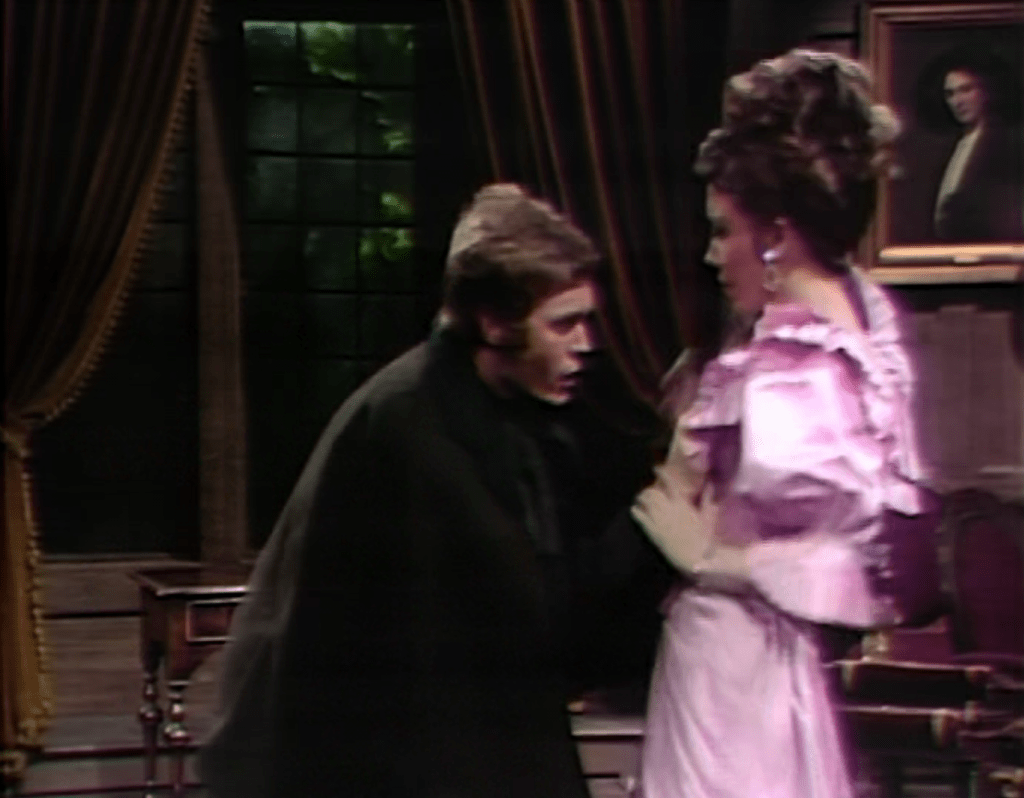
When we arrive at the tavern today, there is only one customer, a young man sitting at a table. When the bartender sets a drink in front of him, he orders a Chartreuse. The bartender moves to take the drink he has just served, apparently thinking the young man changed his mind, but the young man explains that he is waiting for someone else. This man, a heavyset fellow with gray side whiskers, enters a moment before the bartender brings his liqueur.

The bartender wonders if Aristide still wants the drink he originally ordered. Screenshot by Dark Shadows Before I Die.

The younger man is known to returning viewers as a knife-wielding criminal named Aristide, the older as his master, who calls himself Victor Fenn Gibbon. The two urgently discuss a woman named Angelique. Fenn Gibbon tells Aristide that he can almost forgive him for being so distracted by Angelique’s beauty that he allowed her to take “the Hand” from him, and furthermore that she appears to have magical powers. He says that he showed forged papers to one Edward Collins, and that on the basis of those papers Edward concluded that he was “a member of the British aristocracy” and invited him to stay at the great house on the estate of Collinwood. Aristide will have to stay in the village of Collinsport, since Fenn Gibbon does not want their association to become known to the Collinses. Aristide is bitterly disappointed.

This will remind longtime viewers of seagoing con man Jason McGuire and his sidekick, dangerously unstable ruffian Willie Loomis. Jason turned up in March 1967 with a sinister plan and soon took up residence as a guest at Collinwood. Shortly afterward, Willie joined him. At first Jason insisted Willie stay in town. He made that insistence while sitting at virtually the same spot Fenn Gibbon and Aristide occupy today, and Willie reacted with the same disappointment Aristide shows when he was told to stay in a flophouse when his co-conspirator was to be a guest in a mansion.

When Fenn Gibbon tells us that the letters he showed Edward were forgeries, he raises the question of his real name. He seems to have a whimsical sense of humor, and a double barreled name that sounds like a species of small ape found in a peat marsh would appeal to someone trying to test the credulity of an American impressed by the naming conventions of the British upper classes. And indeed, returning viewers know that Edward lacks a sense of humor, is quite a snob, and displays all the tell-tale signs of a hopeless case of Anglophilia.

A small young woman takes her place at the bar. Fenn Gibbon recognizes her as of Romani extraction. He becomes agitated and leaves, but directs Aristide to get to know her. Aristide, whom returning viewers saw meet with misfortune when he tried to pick up Angelique, gladly complies. She responds to his initial approach with a flat declaration that she isn’t interested, but when he mentions the other Romani people in the area, she perks up. She gives her name as Julianka, and asks if he knows a woman named Magda. He says he has met her.

This will intrigue returning viewers. The other day, Aristide robbed Edward’s brother Quentin of the legendary “Hand of Count Petofi,” a severed appendage which broad ethnic stereotype Magda Rákóczi had stolen from Romani chieftain/ organized crime boss King Johnny Romana and which she plans to use to lift a curse she had placed that made Quentin a werewolf. When Quentin told Magda what had happened, he described Aristide only as a “young man.” If Magda really has met Aristide, Quentin’s reticent reply would have cost him an opportunity to help Magda figure out who her enemies really are.

Whether or not Aristide has met Magda, he does know where she lives. He escorts her to the grounds of the Old House at Collinwood. He does not offer to accompany her into the house, but asks her to meet him later at the Blue Whale. As Angelique had responded to Aristide’s overtures by choking him within an inch of his life, Julianka responds to them by drawing a dagger. Aristide just doesn’t have game.

After Aristide parts from Julianka, the werewolf pounces on him. He is about to be devoured when Fenn Gibbon shows up. The sight of pretty little Julianka drove Fenn Gibbon away in a barely concealed panic, but the werewolf doesn’t scare him a bit. He talks calmly to the werewolf, and says that he has orders for him. The werewolf docilely complies. This would be a much bigger surprise if the werewolf were not an adorable little doggie wearing a tidy suit with a watch fob, but it still sends the message that Fenn Gibbon has very extensive powers.

In the Old House, Julianka meets Barnabas. She says that she can use the Hand of Count Petofi to cure Quentin. She also says that Magda’s husband Sandor is in Montreal. This point will be of interest to regular viewers. We haven’t seen Sandor since #750. We may well have been wondering whatever happened to him. We are particularly likely to have been wondering about that this week, since Thayer David, who plays him, is playing Fenn Gibbon. They don’t usually double actors within a time period, and so Fenn Gibbon’s introduction might have suggested they wanted us simply to forget about Sandor. If they are going to take the trouble to tell us he is in Montreal, perhaps we can hope he will return before long, and simply not share scenes with Fenn Gibbon.

Barnabas is in a glum mood. He always is, more or less, but especially so when he has had to deal with Angelique. She told him earlier that she has moved on from her centuries-long fixation on him and now wants to marry Quentin. Barnabas responds with disbelief, declaring that the only reason she would do that is to spite him. Since her obsession led her to turn him into a vampire and kill everyone he ever loved, you can see that Barnabas would have mixed feelings when she tells him that she is looking for a fresh start. On the one hand, it suggest the possibility that he might achieve some kind of freedom. But he’s still a bloodsucking ghoul, his sister and mother and true love and uncle and aunt and countless others are still dead, and the person behind all that doesn’t even care about it anymore.

My wife, Mrs Acilius, points out that it is only appropriate that Angelique made Barnabas a vampire. Angelique too is phenomenally selfish, and whatever she creates becomes a replica of herself. So of course her greatest achievement is to turn a man into a metaphor for extreme selfishness. Barnabas’ selfishness tempers his rage at Angelique’s news; when Julianka comes to him, he is deep in thought, no doubt brooding about what it all means for him.

In his post about this episode at Dark Shadows Every Day, Danny Horn shows that the relationship between Fenn Gibbon and Aristide is modeled on that between Gutman and Wilmer in The Maltese Falcon, and he and his commenters demonstrate that that novel and its 1941 film version included explicit hints that Gutman and Wilmer were occasional sex partners. Aristide has been so eager to connect with the ladies that it’s hard to see much gay subtext between him and Fenn Gibbon so far, but it’s early days for them on the show. Moreover, the echo of Jason and Willie reminds us of the hints the show dropped that those two had shared more than a firm handshake at some point in their seafaring days. The original series bible and the early drafts of the first scripts had referred to The Blue Whale as “The Rainbow Bar”; maybe Aristide and Fenn Gibbon are destined to bring that name back.

Episode 793: All the revolted spirits

When wicked witch Angelique first turned Barnabas Collins into a vampire in the 1790s, he went to the waterfront and preyed on the women he found spending their nights there. When Barnabas traveled in time from the 1960s to the year 1897, he again made his way to the waterfront. Whether he bit the women or not, he choked them to death, earning the sobriquet “The Collinsport Strangler.”

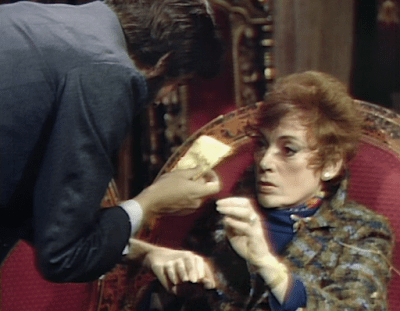
Once he had become a vampire, Barnabas displayed so many traits he had come to have in common with Angelique that we suspect he is not only cursed by her, but possessed by her. More precisely, it often seems that when Angelique made Barnabas a vampire she created a copy of her own personality and put it in his mind, where it took control of him. We have further support for that interpretation in today’s opening reprise. We see Angelique on the same set where Barnabas has several times been the last person a young woman would encounter. This time, she encounters a young man. He flirts with her, as the women flirted with Barnabas. Before long, he is choking and within seconds of death because of her action. In this case, she has taken his handkerchief and is tightening it around the neck of a toy soldier that once belonged to Barnabas. She is threatening to kill him unless he tells her where he has hidden the legendary “Hand of Count Petofi.”

The man’s name is Aristide. He capitulates, telling her he buried the hand at the old cemetery, in a grave marked with a stone bearing the name of Townsend. She gives the handkerchief another tug, and he falls down, unconscious.

Later, we are in the great house on the estate of Collinwood. Angelique comes down the stairs, carrying the box in which the hand is kept. Stuffy Edward Collins sees her. Regular viewers have seen the box on a table in the upstairs hallway many times, from the first week of the show onward. It is rather odd that Edward doesn’t ask her why she is carrying it around. Even if we decide to forget that the prop is familiar and decide to treat it as representing something Edward hasn’t seen before, people don’t usually walk around carrying wooden boxes in front of themselves.

Still, Edward does have other matters on his mind. Angelique had been introduced to the family as Barnabas’ fiancée, at a time when all the Collinses knew about Barnabas was that he was their distant cousin. She disappeared when he was exposed as a vampire. Edward tells her that the family’s lawyer, Evan Hanley, told him that he knew her before she met Barnabas, and that he believes that her association with him was innocent. Edward also says that he cannot believe that this is true. Angelique tells Edward a story about Barnabas biting her and making him her slave; Edward is convinced instantly, and declines her offer to leave at once. He urges her to stay at Collinwood until she can make new plans.

Meanwhile, we have learned that Aristide is alive and not seriously injured. A man in a set of whiskers that represent the aesthetic sensibilities of the late Victorian era developed to their uttermost extremity finds Aristide crumpled on the ground, rouses him from unconsciousness, and responds to his story about Angelique almost killing him with dismay that she stopped short. He tells Aristide not to do anything more. His own credentials are in order, and he will present them at Collinwood as he sets about his second attempt to get the hand.

The man does go to Collinwood. He gives Edward a letter from their “mutual friend,” the Earl of Hampshire. It attests to the good character of its bearer, Victor Fenn Gibbon. Edward insists that Fenn Gibbon stay in the house, and he accepts.

Angelique emerges from the drawing room, still carrying the box. Edward continues to ignore it; Fenn Gibbon can’t take his eyes off it. Edward introduces her as Angelique Duvall. This is the first time we have heard the name “Duvall” in connection with her; when we met her in the part of the show set in the 1790s, her name was Angelique Bouchard, and when she turned up in 1968 she called herself Cassandra Blair. Fenn Gibbon asks if she is French. She says that she was born in the USA, but that her forebears were French people who lived on Martinique. Indeed, when she was known as Angelique Bouchard she lived on that island, and it was there she met Barnabas. Fenn Gibbon tells her that lovely as France’s colonial possessions may be, none is as “exquisite” as she. She is charmed, and excuses herself. She leaves the house, taking the box with her.

While Fenn Gibbon regales Edward with tales of derring-do from the battle of Khartoum, Angelique takes the box to the Old House. There, she meets the rakish Quentin Collins, whose desperately handsome face has been severely disfigured by a previous encounter with the hand. Angelique dismisses Quentin’s girlfriend, maidservant Beth, telling her that she cannot be present during what she must now do for Quentin. Beth leaves, Angelique shows Quentin the hand, and Quentin demands that Angelique set to work curing him. She says there will be a price for her services. If she cures him, he will have to marry her. He has nothing to lose, and she looks exactly like Lara Parker, so of course he agrees.

Angelique picks up the hand and gets to work casting a spell, but the hand quickly escapes her control. She turns to find that it is on Quentin and he is in agony. He pleads with her to help, she cries out that she can do nothing, and we see Fenn Gibbon peering in through the window.

Fenn Gibbon looks on. Screenshot by Dark Shadows Before I Die.

Fenn Gibbon* is the fifth role Thayer David played on Dark Shadows. The first, second, and fourth were all closely associated with the Old House. They were crazed handyman Matthew Morgan, who holed up there after he killed local man Bill Malloy; much-put-upon indentured servant Ben Stokes, who lived and worked there; and broad ethnic stereotype Sandor Rákóczi, who with his even more offensively conceived wife Magda lives at the Old House in 1897. With this iconography behind David, regular viewers will know that when they see Fenn Gibbon in the window of the Old House, they are seeing a man who knows his way around the place.

David’s third role sheds even more light on Fenn Gibbon. In the parts of the show set in 1968 and subsequent years, he plays Professor Timothy Eliot Stokes, expert on the occult and descendant of Ben. Unlike most of the characters who made a splash on the show, Stokes has a functioning conscience. He does not always live within the law, but he always strives to do what is right. When we see that Fenn Gibbon knows about the hand and has orchestrated a criminal conspiracy to obtain it, we see that he is an evil version of Stokes. At once this makes him fascinating to regular viewers. Stokes himself is a reimagining of the show’s first academic specialist in the paranormal, Dr Peter Guthrie, who was killed by a witch in #186. He is a jovial and talkative eccentric, where Guthrie was a tight-lipped and understated Yankee. Fenn Gibbon seems to have inherited Stokes’ whimsical bent and exaggerated manner; we now have to wonder what Stokes would be like as a villain.

Even those who joined the show after it went to 1897 and who therefore do not know about Stokes will be intrigued when they see David as Fenn Gibbon. Sandor hasn’t appeared since #750, but he is still alive. This marks the first time Dark Shadows has cast the same actor as two living characters in the same time frame.** Sometimes an actor has doubled as a living character and as a ghost, or has appeared in two roles in parts of an episode set in different periods of history. But this is a new frontier for doubling on the show. Sandor is always a lot of fun, so we might hope that he will be back and that he and Fenn Gibbon just won’t have scenes together. But coming on the heels of his long absence, it does have an ominous ring.

In #758, Quentin backed Angelique against a wall and asked her why she preferred Barnabas to him. That was a very good question. The two of them are obviously attracted to each other, and have a lot of fun every time they are alone together. By contrast, the only emotions Barnabas has ever shown in response to Angelique are glumness and rage. Her maniacal insistence that Barnabas should love her drove Angelique to wreak immense havoc in the 1790s, and also motivated some story in 1968. But there is nothing to it beyond his misery and her self-absorption. When we see her turn her attentions to Quentin, longtime viewers will cheer at the hope that we are about to be freed from that dead end once and for all.

*He introduces himself today as “Fenn Gibbons,” which is how he is almost always addressed. But the closing credits leave the S off his name. The closing credits have been unreliable lately, identifying Edward as his grandson Roger and misspelling Aristide’s name. Still, “Fenn Gibbon” sounds better to me; “Fenn Gibbons” suggests a group of small apes found in a peat bog.

**Don Briscoe briefly played both werewolf Chris Jennings and Chris’ brother Tom, but that is only a partial exception- Tom was a vampire at that time.

Episode 790: Making a demon of her

The evil Gregory Trask orchestrated a plot to murder his first wife, Minerva, and has married wealthy spinster Judith Collins. Now he and his accomplice, lawyer/ Satanist Evan Hanley, have conjured up a simulacrum of Minerva to hang around Judith and drive her insane. Once Judith is safely confined to the nearest high-class asylum, Trask will enjoy Judith’s riches, minus only whatever percentage Evan squeezes out of him.

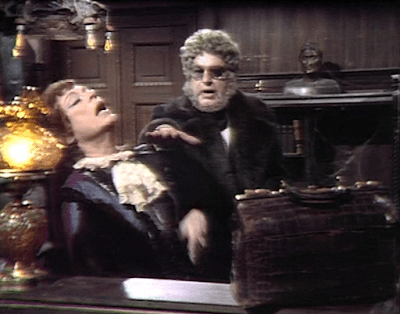
Today, Judith stands in her bedroom in the great house on the estate of Collinwood. She isn’t ready to go to bed, and the simulacrum of Minerva is sitting in the rocking chair, sewing. Trask pretends he cannot see the simulacrum, and forbids Judith to leave the room. When Judith becomes upset, he slaps her. This slap occurs on the soundtrack and in our imaginations. What we see on screen some time before the slapping sound effect plays is Jerry Lacy waving his hand a considerable distance short of Joan Bennett’s face. The two of them do such a good job of acting that this failure of blocking does nothing to undercut the oppressive atmosphere. For her part, Clarice Blackburn plays the pseudo-Minerva with just enough animation that we cannot predict what she will do. These performances take a sequence which may not have seemed like much on the page and make it into one of the most frightening scenes on Dark Shadows. When Judith lies to Trask and says that she does not see Minerva, it’s enough to produce a shudder.

Trask slaps Judith while pseudo-Minerva sews. Screenshot by Dark Shadows Every Day.

Downstairs, Trask answers a knock at the door and broad ethnic stereotype Magda Rákóczi enters. Regular viewers know that Judith despises Magda and Magda hates her, and so it is surprising when we hear that Judith has sent for Magda. Trask blocks her way upstairs. Magda is defiant towards Trask; she knows what he did to Minerva, and is using that knowledge to force him to let her and her husband stay in the Old House on the grounds of Collinwood. But Trask has a new threat to make.

Trask knows that Magda is the sister of the late Jenny, who married Judith’s brother Quentin. He also knows something that not even Quentin knows, that Jenny bore twin children to Quentin after he left her. He threatens to send Jenny’s children away from the village of Collinsport. Evidently Magda wants the children to stay where they are, in the care of a woman named Mrs Fillmore. It is unclear why this would matter to her; we have had no indication that she has met Mrs Fillmore, much less visited the children at her house. But it is important enough to her that they not be moved that Magda responds to Trask’s threat with “What do you want me to do to her?”

We cut to Judith’s room. Magda enters. Judith tells her that the ghost of Mrs Trask vanished a few minutes ago, after sitting in the rocking chair for hours. Judith asks if she thinks she sounds mad, to which Magda replies there is nothing so strange about a simple ghost. The simulacrum reappears, and Judith asks Magda if she sees it. Magda says she does not.

Back downstairs, Magda tells Trask that he is a swine. She spits on the floor next to him and stalks off. Much as Magda hates Judith and many as are the crimes in which she is implicated, she is a warm-hearted sort, and Trask’s bloodless cruelty is not to her liking. Indeed, it is strange she did not tell Judith of Trask’s attempt to extort her complicity and make an alliance with her against him.

Meanwhile, Quentin is being held in the jail. When Magda realized that he murdered Jenny, she turned Quentin into a werewolf. She did not then know about the twins, and so she made the curse hereditary. Once she found out that her own kin were in line to become monsters, she started looking for a way to undo the curse.

The police captured Quentin the night before, while he was in his lupine form. As a result of Magda’s latest futile attempt to cure him, Quentin emerged from his bout of lycanthropy with his face disfigured and his memory a blank. Though his clothing and his hairstyle are so highly distinctive that virtually everyone who has seen the show before can tell that the man in the cell is Quentin, the Collinses suffer from a peculiar form of blindness that keeps them from recognizing people with globs of makeup on their faces, so his brother Edward is at a loss as to who he could be.

Magda is working with time-traveling vampire Barnabas Collins, distant cousin of Quentin, Edward, and Judith, who has set out on a mission to set the events of the year 1897 right so that Quentin will not become a malign ghost ruining things for everyone at Collinwood in 1969. Unfortunately, vampires are not problem-solvers; their function in a story is to create problems. Since coming to 1897, Barnabas has been responsible for at least six homicides. He has wrought a great deal of havoc even beyond those killings. For example, it was as a direct result of his actions that Judith and Trask got together in the first place. Today, Magda goes to Quentin’s cell and tries to tell him that Barnabas will come to him after nightfall and take him to the Old House.

We do not see Barnabas. We are watching Quentin in his cell when we hear a bat squeaking outside the jail. Barnabas can materialize wherever he chooses; he does not choose to materialize in the cell, where Quentin is alone and unattended, but goes into the outer office in his bat form. We hear a deputy in that office talking to the bat affectionately, asking him where he came from. We haven’t seen the deputy before this episode, but one suspects that a fellow who sees a bat in his office and strikes up a friendly conversation with it must have an extremely sweet personality. We then hear the deputy make a horrified exclamation, and the doors to Quentin’s cell and to the world outside open by themselves. As Quentin walks out, we see the deputy slumped at his desk, two bleeding wounds on his neck.

We cut to the darkened interior of the great house at Collinwood. Quentin comes ambling in. Biting the deputy was certainly not part of any plan Barnabas made with Magda, but it isn’t completely surprising- he hadn’t had a square meal for quite a while. But even for Barnabas, it shows an unusually low degree of operational competence to let Quentin wander off by himself when the whole idea is to get him to the Old House.

In the drawing room, we hear Quentin’s thoughts as he dwells on his amnesia. He does not know who he is, where he is, or why he has come. He sees his gramophone, and starts playing his only record. That brings him back to himself.

Judith enters. Quentin is not only wearing his usual suit and his distinctive hairstyle, he is listening to the music he has been playing obsessively for months and reciting the lyrics to it. As if that weren’t enough, his voice is quite outstanding- he must be the only senior member of an aristocratic Maine family with a West Virginia accent. Yet Judith not only fails to recognize her brother, she refuses to believe him when he identifies himself to her by name.

The simulacrum of Minerva enters, holding a letter opener above her head. Earlier this week, Minerva’s actual spirit had possessed Judith, and under her power Judith had held that same letter opener in that same position as she confronted Evan and accused him of her murder. Judith does not remember that, and she screams at the sight.

Episode 787: You said that, I said nothing

Dark Shadows fans like to make jokes about the inefficiency of law enforcement in the fictional town of Collinsport, but in this episode we see that the sheriff and his men really never had a chance. The ancient and esteemed Collins family controls everything in the area, and they will go to any lengths to keep the police from obtaining the information they need to do their job effectively.

Stuffy Edward Collins invokes the police when he demands that broad ethnic stereotype Magda Rákóczi vacate the Old House on the estate of Collinwood. Magda laughs and says that if the police show up, she will tell them that Edward’s distant cousin Barnabas is a vampire. Horrified at the damage it would do to the Collins family name were word of Barnabas’ condition to get out, Edward backs down. Barnabas is at large and has been responsible for at least six homicides since traveling through time to the year 1897, including the murder of Edward’s brother Carl in the drawing room of their home just the other day. But evidently that is a small matter to Edward compared to the danger that the sheriff might be indiscreet.

Barnabas materializes at the police station, where a werewolf is being held in custody. A deputy is startled to see Barnabas in front of him all of a sudden. For only the third time in the series, Barnabas says “Look into my eyes!” and induces an hypnotic trance in someone not his blood thrall. It is the first time he has exercised this power on someone other than Edward’s nine year old daughter Nora. Barnabas tells the deputy that once he has completed his task, he will remember nothing. So he is following the family policy with regard to keeping the police in total ignorance.

Edward shows up and sees Barnabas. Edward is wearing a cross and holding a revolver loaded with six silver bullets, which on Dark Shadows are as effective against vampires as they are against werewolves. Barnabas hides behind the deputy and tells Edward that he is acting in the interests of the future of the Collins family. Edward says that he belongs to the past, not the future. Barnabas doesn’t explain anything; he vanishes.

Not exactly an heroic look for ol’ Barney. Screenshot by Dark Shadows Before I Die.

Barnabas’ post-hypnotic suggestion has its effect, and the deputy is bewildered to find himself face to face with Edward. Edward tells him that they must watch the werewolf. The deputy starts to say something about the sheriff, and Edward replies “The sheriff doesn’t realize what this animal is!” Of course he doesn’t, no one will tell him anything about it.

Back in the Old House, Barnabas and Magda lament their failures. He could not take the werewolf from the cell in the police station to the cell in the basement of the house; she could not persuade lawyer/ Satanist Evan Hanley to return a severed hand he stole from them. They wanted to do these things because the werewolf is Edward’s brother Quentin, whom Magda is trying to free from his curse by means of the hand’s magical powers. Barnabas knows that if they do not succeed, terrible consequences will ensue in 1969.

Closing Miscellany

It is a serious mistake to show the werewolf when he is not in the act of committing a spectacular homicide. They didn’t have the budget to put him in full-body makeup, so he wears a tidy little suit, complete with a watch fob. He is so well put together that it is difficult to imagine him inspiring any fear other than the fear that one will not meet his apparently rather exacting standards of attire.

Whoooo’s a well-dressed doggie? You are! Screenshot by Dark Shadows Before I Die.

There is a noteworthy blooper in this one. Magda confronts Evan, declaring “The book, I know you took it from the Old House!” Usually actors roll with each other’s bobbled lines, but this is far enough out that Humbert Allen Astredo obviously has no idea where Grayson Hall is in the script. All he can do is ask “The book?” “The hand!” she corrects.

They also make a goof in the closing credits. This is one of three consecutive days when Louis Edmonds is billed not as Edward, but as Roger Collins, the role he plays in the parts of Dark Shadows set in the 1960s. He’s been identified correctly throughout the first seventeen weeks of the 1897 segment and everyone else is identified correctly in these episodes, so it is not clear what happened.

Danny Horn’s posts at Dark Shadows Every Day are often laugh-out-loud funny, and the one for this episode is especially so. His description of the scene between Magda and Evan has some big laughs, and when he imagines the sheriff’s deputies trying to catch the werewolf by “putting on their alluring lady-werewolf disguises a la the Warner Brothers cartoons,” well that’s just super how could anyone improve on it.

Episode 785: Time is my hobby

Early in 1969, the great estate of Collinwood became uninhabitable. The ghost of Quentin Collins took possession of the place and was about to kill strange and troubled boy David Collins. Quentin and David’s distant cousin Barnabas Collins traveled back in time to the year 1897, when Quentin was a living being, and hoped to somehow prevent Quentin from becoming an evil spirit.

So far, Barnabas has managed to make everything much, much worse. As soon as he arrived in 1897, he found that he had become a vampire. So far, he has been responsible for at least six homicides that did not take place the first time through this period of history. He has also enslaved three people by biting them. He has not prevented a curse that has made Quentin a werewolf, which is evidently the origin of the disaster at Collinwood in 1969.

Moreover, Barnabas’ blunderings have caused Judith Collins, who owns Collinwood and the Collins family businesses, to become close to the hypocritical Rev’d Gregory Trask. Trask has responded to Judith’s interest in him by enlisting lawyer/ Satanist Evan Hanley to carry out a particularly cruel plan to murder Trask’s wife Minerva. Now Trask and Judith are married. Today she tells her brothers, Quentin and the stuffy Edward, that she is changing her will. Edward’s twelve year old son Jamison will still be her heir, but Gregory will administer the estate if Judith dies before Jamison is 21. Regular viewers know, not only that Gregory killed Minerva on the off-chance that he would thereby get a shot at taking Judith’s money, but that he is a sadist who takes special pleasure in making Jamison miserable. So this provision is a death sentence for Jamison. Since the residents of the great house at Collinwood in the 1960s are Jamison’s daughter Liz, son Roger, and grandchildren Carolyn and David, Trask will negate Dark Shadows‘ contemporary timeline if he murders Jamison.

It is not impossible that this might happen. The show is now chiefly about time travel, and the 1960s are not an indispensable destination. Barnabas did leave a few interesting characters behind when he traveled to the nineteenth century- sooner or later he is going to have to be reunited with mad scientist Julia Hoffman, MD, and occult expert Professor Timothy Eliot Stokes also has a lot to offer. But if Barnabas could find a way to come unstuck in time, Julia and Stokes can too. Wicked witch Angelique has already made her way to 1897. And anyone else we might miss can be replaced by the same actor playing a similar part. It does seem unlikely Collinwood will become Traskwood. But in April 1967 it seemed even less likely that the ABC network would devote thirty minutes of airtime five days a week to showing a vampire feeling sorry for himself, yet here we are.

Quentin is amused by Judith’s marriage to Trask, Edward appalled. Edward tells Judith that their grandmother’s will specified that he and Quentin would have the right to stay in the house as long as they wished, a point Judith concedes. This is a retcon. When the will was read in #714, it was made very clear that only Quentin was given a place in the house. Jamison was named as contingent heir. Edward was not mentioned at all. Neither was Carl Collins, another brother of Judith’s, whom Barnabas murdered a couple of days ago and who has already been forgotten.

Judith runs Edward and Quentin out of the drawing room. When she comes back in, she finds that the new will has been torn to shreds, a dagger has been stuck into a Bible under a verse lamenting the sufferings of the righteous, and there is a childish drawing tacked to the wall labeled “Mrs Trask.” Although “Mrs Trask” is now her own name, a fact which she proudly declared to Edward a few minutes before, she immediately assumes the drawing depicts Minerva.

Not the usual sort of portrait one finds on the walls of the great house. Screenshot by Dark Shadows Before I Die.

This resonates with two stories that longtime viewers will remember. From November 1967 to March 1968, Dark Shadows was set in the 1790s. The ancestor of the future Collinses in that period was Daniel Collins, who like Jamison and David is played by David Henesy. Daniel’s big sister Millicent married roguish naval officer Nathan Forbes, who set about trying to murder Daniel in order to get all of Millicent’s wealth for himself.

Yesterday Judith saw Minerva’s ghost in the same part of the drawing room where these odd occurrences have taken place, and the Biblical verse is very much the sort of thing Minerva would have been likely to quote. So we are to assume that she is indulging in a little poltergeist activity. But the “Mrs Trask” drawing is so unlike anything the somber Minerva would have made herself that we can only assume she took it from some other spirit out in the unseen realm. Since “Mrs Trask” is Judith’s name now, the question of who that spirit might be brings up a second old story.

From March to July 1967, Liz was being blackmailed by seagoing con man Jason McGuire. Jason’s ultimate demand was that Liz should marry him, giving him control of the Collins family fortune. Liz’ daughter Carolyn was outraged when it looked like she was going to marry Jason, and in #252 she taunted her mother by shouting the name “Mrs McGuire!” over and again. Perhaps Minerva’s dead spirit has crossed paths with Carolyn’s unborn one, and Carolyn has drawn the picture as a way of rehearsing for that scene. Though Carolyn is an adult, Jamison had a dream in #767 in which he caught a glimpse of the Collinwood of 1969 and saw that Carolyn has a fondness for childish imagery.

There is also some business in this episode about broad ethnic stereotype Magda Rákóczi’s effort to lift the werewolf curse she placed on Quentin. Magda has stolen a severed hand that has magic powers and plans to put it on Quentin’s heart when he begins transforming tonight. Yesterday, Evan forced Magda to let him see the hand; when he looked at it, the hand grabbed him. It left him unconscious and severely disfigured. Now Magda is keeping Evan in her home, the Old House at Collinwood, and treating him with surprising tenderness. Quentin sees Evan there. He does not recognize him, even though he and Evan were close friends, Evan is wearing the same gray suit he always wore, and his very distinctive hair and beard are unchanged. Eventually Evan regains the ability to say his name, and Quentin freaks out. He does not want to go through with Magda’s plan, but when the transformation begins he drops his opposition.

Magda placed the hand on Quentin. Screenshot by Dark Shadows Before I Die.

The hand looks very much like a Halloween decoration, so much so that I wonder if Dan Curtis hoped to make some money by getting copies of it into department stores by October 1969. It’s pretty disgusting to look at, but that’s the point.

One of the problems Dark Shadows had throughout its run was that it tended to veer between appealing exclusively to adults and exclusively to children. In the early months, its glacial pace, heavy atmosphere, psychological depth, and reliance on the star power of Joan Bennett drew a rather mature audience. As the supernatural and fantastic themes came to predominate, the average age of the viewers dropped towards the single digits. By the end of the big Monster Mash that ran through 1968, the show’s strongest demographic was probably elementary school pupils. Dividing an episode between the relatively adult melodrama of Edward’s reaction to the Judith/ Trask marriage and the undisguised kids’ stuff of The Hand of Count Petofi would seem to be a way of offering something to both the oldest and youngest viewers.

This episode originally aired on 27 June 1969. That was the third anniversary of the show’s premiere. That first installment, like 332 of those that followed it, revolved around the character of well-meaning governess Victoria Winters, played by Alexandra Moltke Isles. Mrs Isles left the show in November 1968; her son Adam Isles, who would in the 2000s become a top official of the USA’s Department of Homeland Security, was born this day. Mrs Isles has said in interviews that while she was recovering from the birth she tuned in to Dark Shadows, but that the show had changed so much in her time away from it that she couldn’t figure out what was going on.

I imagine Mrs Isles had changed a great deal as well. Like so many members of the cast and production staff, she was a fashionable, sophisticated New York society figure. While she was working on the show, she was immersed in its imaginary world, but after several months away she would have refocused her attention on the sorts of things she was raised to care about when she was growing up as the daughter of Countess Mab Moltke. One doubts that magical severed hands, werewolves, devil worshipers, and actors in brownface makeup would have ranked especially high on that list.

Episode 784: Impaled by a pin

Vampire Barnabas Collins has come unstuck in time and traveled from 1969 to 1897, a year in which he hopes to prevent a disaster. Unfortunately, Barnabas generates disasters with his every action, and so he has taken the grim situation he found upon his arrival and made it incalculably worse.

Now, Barnabas has been exposed as a vampire. Shortly before dawn, he returns to the cave where he has been hiding his coffin. There, he finds lawyer/ Satanist Evan Hanley (Humbert Allen Astredo) waiting for him, holding a cross. When Evan makes it clear he has no immediate plans to destroy him, Barnabas says that he does not want to be treated as an exhibit for the curious or a subject for research. This will remind longtime viewers of Barnabas’ initial response when in 1967 Dr Julia Hoffman (Grayson Hall) offered to develop a medical treatment for his vampirism. That treatment was not entirely successful, but it set Julia and Barnabas on a path that led them to become fast friends, and a later medical intervention did free him of the effects of his curse.

Barnabas needs all the friends he can get, and indeed there have been some signs that he is about to make new ones. But Evan is not going to be one of them. He knows that Barnabas has the famed “Hand of Count Petofi,” a relic of someone to whom Barnabas refers as “the most evil man who ever lived.” When Dark Shadows was set in 1968, Astredo played suave warlock Nicholas Blair, who was hung up on the idea of recruiting “the most evil woman who ever lived” to take part in one of his schemes, an idea which led directly to the failure of his mission and his own recall from Earth to Hell. Evan forces Barnabas and Barnabas’ reluctant sidekick, broad ethnic stereotype Magda Rákóczi (Grayson Hall,) to let him look at the hand. That backfires immediately, and leaves Evan’s face severely disfigured. When Barnabas sees what has happened, he declares that Magda must not go through with her plan to use the hand to release rakish Quentin Collins from the werewolf curse she placed on him.

Evan uglified. Screenshot by Dark Shadows Before I Die.

Meanwhile, the cruel and hypocritical Rev’d Gregory Trask proposes marriage to wealthy spinster Judith Collins (Joan Bennett.) In the parts of Dark Shadows set in the 1960s, Bennett plays reclusive matriarch Elizabeth Collins Stoddard. Liz stayed in her house for 19 years because she thought she had murdered her husband Paul; only when seagoing con man Jason McGuire tried to use this belief to force Liz into marrying him and giving him control of the estate of Collinwood and the Collins family businesses did she confess to the killing. It then turned out that Paul wasn’t dead at all, and the whole thing was a cruel trick he and Jason played on Liz.

Unlike Liz, Judith actually has killed someone. She shot neurotic intellectual Rachel Drummond to death in #775. Gregory prevented Judith from telling the police about this, persuading her that because she was under a vampire’s* power at the time she was not responsible. Since then, Judith has been putty in Trask’s hands. She accepts his proposal, and they are married by the end of the episode.

On Dark Shadows, wedding days are always occasions of horror and sorrow, and today is no exception. Trask’s wife Minerva was murdered in #773; unknown to Judith, Trask conspired with Evan to commit this crime and leave everyone thinking that a man named Tim Shaw did it. Trask’s plan to frame Tim fell apart in #777, when Tim showed up at Collinwood and revealed that he had seen Judith shoot Rachel. Since Trask killed Minerva in order to free himself to marry Judith and take control of Collinwood and the Collins businesses, he cannot risk Judith’s conviction on a murder charge, and so he tells the sheriff that Tim cannot have killed Minerva. When Trask and Judith come home from their wedding, Judith sees Minerva’s ghost in the drawing room. Evidently Minerva is not ready to rest and let Gregory reap the rewards of her murder.

*Not Barnabas, another one. Collinwood is crowded at night in 1897.

Episode 783: Talk to the hand

Nine year old Nora Collins walks in on her teacher, Charity Trask, being bitten by vampire Barnabas Collins. Barnabas tells Nora to “Look into my eyes!” He hypnotizes Nora and mind-wipes away her memory of him. Barnabas has been on Dark Shadows for more than two years now, and this is only the second time he has pulled the “Look into my eyes!” move with someone whose blood he has not been drinking. The previous occasion was also with Nora, in #756. In the parts of Dark Shadows set in the 1960s, Barnabas is usually paired with mad scientist Julia Hoffman, who is the master of a magical form of hypnosis that allows her to rewrite people’s memories at will. So if Barnabas exercised this traditional vampire power in those segments of the show, he’d be stepping on Julia’s territory. But this episode is part of a time-travel story set in 1897, and Julia is not here.

Barnabas has been exposed and is being hunted by a number of people. His current hiding place is inside a cave. He confers there with his reluctant sidekick, broad ethnic stereotype Magda Rákóczi. Today the show is being taped on new cameras, and the image is crisper and more nuanced than we have seen since it went to color in August of 1967. The cave would barely have shown up through yesterday’s cameras, but it looks nifty today.

Magda is Barnabas’ sidekick, she is quick with lies, and she is played by Grayson Hall, but she does not do hypnosis. Screenshot by Dark Shadows Before I Die.

Magda has stolen a severed hand that a crime boss was keeping in a box, and believes that she can use it to undo a curse she placed on the rakish Quentin Collins. Barnabas is worried that they will not use the hand correctly when the time comes to release Quentin. Since there is no way to test the procedure they plan to use on Quentin, he asks if it will be able to help someone else. Magda says that it should. He has the bright idea to summon Charity. He evidently overate, and she is in danger of dying from loss of blood.

Vampires are metaphors for extreme selfishness, and with this suggestion Barnabas is a case in point. If the hand can lift curses from the people it touches, why does Barnabas not have Magda place it on him? If it freed him of vampirism, that would heal Charity and his other victims, and would allow him to stroll up to the vampire hunters on some sunny day and watch their suspicions of him collapse. But that is out of the question, because he does not know how to control the hand. He is simply using Charity as a laboratory animal.

Barnabas telepathically summons Charity. As it happens, lawyer/ Satanist Evan Hanley is at her bedside. Evan is among the vampire hunters, and knows Charity is under Barnabas’ power. He physically restrains her from leaving her room. Barnabas and Magda despair of bringing Charity and the hand together. The hand then disappears from its box. Magda thinks the hand is simply lost and is terrified that she will not be able to return it to its owner, but Barnabas is serenely convinced that it has gone to Charity under its own power.

This turns out to be true. The hand materializes in Charity’s room. Evan sees it, and, expert that he is in occult lore, exclaims “The hand of Ojden!” It settles on Charity’s face, and when it vanishes the bite marks are gone from her neck and she is once again her brisk, authoritative, and intensely priggish self, no longer a thrall of Barnabas. The hand reappears in the cave next to the box, and Barnabas smugly announces to Magda that it completed its mission.

For some reason, Barnabas’ self-satisfied certitude crumbles and he feels compelled to check on Charity to see that she has indeed been healed. He materializes in her room, but she is not there and the cock is already crowing. When he returns to the cave, Evan meets him, holding up a cross and keeping him from getting back into his coffin.

Episode 782: Satan on the run

Vampire Barnabas Collins has been exposed and is in hiding. Most of those who would destroy him are as evil as he is, and none is as much fun to watch, so we’re on his side.

Stuffy Edward Collins catches Barnabas’ blood thrall Charity Trask in the basement of the Old House on the estate of Collinwood. Barnabas sent her there to fetch some soil from his original grave which he will use to make a new coffin habitable. Edward asks Charity what she is doing in the basement; she lies and claims that she can’t remember. This is an interesting moment for fans of Dark Shadows. Nancy Barrett’s acting style is uninhibited and often larger-than-life; one suspects that she was often accused of overacting. But Charity really does overact. In the contrast between her one-dimensional, exaggerated manner when she feigns amnesia and Miss Barrett’s own very noisy but highly textured performances, we see the definitive refutation of any such charge.

Charity got into the basement through a tunnel that connects the beach below Widows’ Hill to a prison cell in the basement of the Old House. In #260, set in 1967, we saw that the tunnel was in place when Barnabas and his little sister Sarah were living beings in the eighteenth century, that Sarah was aware of the tunnel, and that their father Joshua forbade her to tell Barnabas about it. Sarah’s ghost told Barnabas’ victim Maggie Evans how to escape through the tunnel. When Barnabas pursued her through it, we could see from his reaction that he was seeing the tunnel for the first time. The other Collinses of the 1960s were unaware of the existence even of the cell, let alone of the tunnel.

Now it is 1897, and when Charity mentions the tunnel to Edward he impatiently responds that he knows all about the tunnel. His tone suggests that he would expect Charity to know that he knows about it; evidently it is no secret among the residents of Collinwood. Since Edward’s twelve year old son Jamison is one of those residents, and Jamison’s daughter Liz and son Roger will be the adults at Collinwood in the 1960s, one wonders how that knowledge was lost in the seventy years separating this time-travel story from the principal time frame.

In the last scene, Barnabas is in Charity’s bedroom, about to chow down on her bloodstream. We pan from a two-shot to a closeup of Charity. She gives a thirty five second speech about how it isn’t safe for him to stay long, since her father knows that she is under Barnabas’ power and is lying in wait for him. Thirty five seconds is evidently how long it took for Jonathan Frid to put in Barnabas’ fangs, because when we pan back to him they are showing and he is ready to bite. At that moment, Jamison’s nine year old sister Nora walks in and reacts with horror to the sight of Barnabas with his mouth on Charity’s neck.

Nora, shocked. Screenshot by Dark Shadows Before I Die.

Episode 781: Sympathy somewhat disturbing

When vampire Barnabas Collins first appeared on Dark Shadows in April 1967, regular viewers may have thought they knew what to expect. They had just spent four months focused on undead blonde fire witch Laura Murdoch Collins, mother of strange and troubled boy David. David’s well-meaning governess Victoria Winters gradually realized that Laura was a deadly threat to him. After some initial confusion, Vicki rallied the other characters in opposition to Laura. Ultimately Laura went up in smoke and David escaped her clutches, choosing Vicki and life over his mother and death.

In many ways, the Laura story was modeled on Bram Stoker’s Dracula. So when Laura’s successor as supernatural menace was an out and out vampire, we may have expected further mining of that source. Barnabas bit and abducted Vicki’s friend Maggie Evans. As the daughter of drunken artist Sam, Maggie had played a key role in the “Revenge of Burke Devlin” storyline. But that storyline fizzled in the show’s early months, and by #201 even Burke Devlin lost interest in it. Maggie was at that point surplus to requirements, and when Barnabas added her to his diet we might have suspected that she would die and rise as a vampire. As Mina and the group she led in Dracula had to destroy her friend Lucy when Lucy rose as “the Bloofer Lady,” so Vicki and her friends would have to destroy Maggie. Vicki herself would then stake Barnabas. The average viewer would have expected this to be the sign to move on to the next menace; those who were aware of TV ratings and programming decisions might think it would be Dark Shadows‘ way of going out with a flourish before its impending cancellation.

Barnabas turned out to be a hit. The idea of a vampire on a daytime soap was such an oddity that a sizable new audience tuned in out of curiosity, and Jonathan Frid’s portrayal of Barnabas’ scramble to impersonate a living man native to the twentieth century resonated with so many of them that he became a breakout star. So they had to figure out a way to make him a permanent part of the cast. That meant Maggie couldn’t die. In the first place, they couldn’t risk making Barnabas responsible for the death of so likable a character. Second, as the survivor of the horrendous abuse Barnabas inflicts on her Maggie would have a new function, as the witness who might emerge to expose him and wreck the show. Third, while Maggie was in Barnabas’ clutches Kathryn Leigh Scott proved herself such a versatile actress that it would obviously damage the show to lose her. So Barnabas not only failed to kill Maggie, he completed only two homicides in the whole of 1967. Each of his two victims was a male character who had run out of story. As a result, the killings and the victims were quickly forgotten.

Barnabas’ nonlethal vampirism made it easier to keep the cast intact, but it also drained him of the lurid novelty that had made him such a draw. To reassure the audience that Barnabas really was a bloodthirsty fiend from the depths of Hell, the show had Vicki come unstuck in time in #365. She found herself in the 1790s, when Barnabas first became a vampire. That gave us a whole cast of characters whom we did not expect to see again once the show returned to contemporary dress. So Barnabas was free to slaughter people to his heart’s content.

The 1790s flashback was a hit in the ratings. When Vicki brought us back to 1968 in #461, the makers of the show had to figure out a way to keep the momentum going. They cured Barnabas of the effects of the vampire curse and surrounded him with a hectic parade of other refugees from 1930s horror movies- mad scientists, Frankensteins, witches, werewolves, and a couple of fresh vampires. After that Monster Mash period exhausted itself, they took us through a long, deliberately paced segment focusing on just two stories, one about a tormented werewolf and the other about a ghost who takes possession first of two young children, then of the whole estate of Collinwood. Barnabas, who has come to see himself as a good guy and the protector of the family, tries to cure the werewolf and reason with the ghost. His efforts instead transport him back in time to 1897.

In that year, Barnabas is a vampire again. He keeps saying that his only goal is to prevent the evils that will befall the family in 1969, but he is as uninhibitedly murderous as he ever was in the periods when he was unambiguously a villain. In Friday’s episode, he murdered one of the principal members of the Collins family, prankster Carl Collins, uncle of the Jamison Collins whose daughter and son are the adults at Collinwood in the 1960s. Barnabas had become so careless after so many killings that he left Carl’s body propped up behind the curtains in the windows of the drawing room, where it fell into plain view moments after Barnabas’ foe the Rev’d Gregory Trask entered. In this episode, Trask enlists Edward Collins, brother of Carl and father of Jamison, to help him hunt Barnabas.

My wife, Mrs Acilius, points out that when we see a character closing the doors to the drawing room, that person is in charge of the house. So in the early months of the show matriarch Liz was the one to close the doors; when Liz was taken to a hospital and her daughter Carolyn was in charge, Carolyn closed the doors. When Vicki was fully in command of the campaign against Laura, she closed the doors to consult privately with her lieutenants. When Trask and Edward go into the drawing room to discuss the situation, it is Trask who closes the doors. Vicki was good, so consistently so that she had to be written out of the show months ago. But Trask is overwhelmingly evil. That he has ascended to the rank of door-closer means that virtue has no stronghold anywhere.

Edward and Trask go to the Old House on the estate, where Barnabas has been staying. They find Barnabas’ reluctant sidekick, broad ethnic stereotype Magda Rákóczi. Magda denies that Barnabas is in the house and pretends not to know what Trask and Edward are talking about when they say that Barnabas is a vampire. Trask slaps Magda in the face; we have seen many face-slaps on Dark Shadows, but so far as I can recall this is the first delivered while the slap-ee has her back to the camera. Since he does not have to swing his hand very close to Grayson Hall’s face, Jerry Lacy can therefore put full force into the gesture, making it look like Trask is delivering a truly brutal blow to Magda. Afterward, Magda rubs her face and vows revenge on Trask. She quotes a rather confusing “old gypsy saying”: “Walk fast and the Devil will overtake you; walk slow and misfortune will catch you. You’d better not walk slow, because I will never be far behind.”

Edward and Trask search the Old House and find nothing. At dusk, Barnabas emerges from the secret room behind the bookcase in the front parlor. Magda hadn’t thought to look there, and Trask and Edward didn’t know the room existed. Barnabas says he will have to find a new hiding place for his coffin. Magda says she will do whatever she can to help him. Barnabas is surprised at her support for him; after all, he has bitten and enslaved her husband Sandor, and his destruction would mean Sandor’s restoration. Magda has an atypical moment of speechlessness, after which she says that Trask is an “animal” and must be punished at all costs.

Trask and Edward went back to the main house early in the morning to look for the plans to the Old House. It apparently took them all day to find them. By the time they have gone through them and identified all of its secret rooms, Barnabas is already up. They come back to the Old House and find the empty coffin in the secret room. Trask says that he will make the coffin “unusable” for Barnabas before daybreak. He leaves Edward, who is carrying a gun loaded with silver bullets, to guard the house.

Barnabas goes to one of his blood-thralls, Trask’s daughter Charity. He tells Charity that he is “in serious trouble” and commands her to go to the basement of the Old House. There, she will find some soil from his original grave, which he needs to prepare his new resting place. He tells her about a tunnel from the beach to the basement which she can use to elude detection by Edward. Since Barnabas has just materialized in Charity’s room and will shortly materialize in the secret room in the Old House while Edward is standing on the other side of the bookcase, we wonder why he can’t use that same power to get into the basement himself.

Barnabas finds that the coffin is topped with a cross. He can’t get close enough to take hold of the coffin and move it, so presumably even after he gets the soil he needs he will have to plunder a mortuary showroom to get a fresh resting place before dawn.

The unusable coffin. Screenshot by Dark Shadows Before I Die.

Charity does go to the basement. She puts some soil in her purse, then knocks over a crate, attracting Edward’s attention. She does not run away, but merely hides in an alcove until Edward comes down, sees her in shadow, and orders her to show herself.

Episode 780: Carl was not mad

In yesterday’s episode, inveterate prankster Carl Collins told his brother, the rakishly handsome Quentin, that their distant cousin Barnabas was a vampire. Quentin has problems of his own, and he is counting on Barnabas to help him. So he locked Carl up in Barnabas’ hiding place, expecting that when night came Barnabas would prune one more branch off the Collins family tree.

Today, Quentin finds that Carl has escaped. He goes to Barnabas and tells him what has happened. Carl’s practical jokes annoy Barnabas intensely, and Barnabas has never bothered to conceal his disdain for him. He reacts to Quentin’s news with fury and a lot of orders. When Quentin later finds Barnabas standing by Carl’s corpse in the drawing room of the great house of Collinwood, he is really torn up about his brother’s death for almost a whole minute.

Quentin mourns for Carl- blink and you’ll miss it. Screenshot by Dark Shadows Before I Die.

A knock comes at the door; it is the oppressively evil Rev’d Gregory Trask. Quentin keeps Trask in the foyer for a bit while Barnabas hides Carl’s body. When Trask forces his way into the drawing room, Barnabas is gone. Carl’s body is cunningly hidden… behind the curtains, propped upright. Of course it falls out almost immediately. Earlier in the episode, Carl took Trask to Barnabas’ hiding place, and we saw that Barnabas had single-handedly lugged his coffin and the structure on which it rests some distance away. If he is strong enough to do that, surely he could have tossed Carl’s body out the window. And regular viewers know that there is a secret panel in this room, of which Barnabas has repeatedly shown that he is well aware. They would probably have expected him to hide the body there. That he just stashes it behind the curtains where it is certain to come into Trask’s view suggests that he isn’t even trying to get away with this particular murder.

Closing Miscellany

John Karlen is breathing pretty deeply during Carl’s big closeup as a corpse. It’s really confusing, I thought they were telling us he wasn’t dead yet.

I don’t know what the writers planned for Carl in the flimsies they sketched out six months before this episode was made, though there is so little room for him in subsequent plot-lines that I suspect he was supposed to die at about this point in the story. Still, his death was accelerated because Karlen had other things to do. He won’t be back on the show until #956, in February of next year.

The creaky little waltz that Quentin listens to obsessively was released as a single in June of 1969 and would hit #13 on the Billboard Hot 100 in August. Regular viewers may be sick of it already, and the characters certainly wish Quentin would get another record. It’s Trask’s turn to complain about it today, giving him something in common with Barnabas.

Trask wears a cross which he uses as a weapon against Barnabas. The show is oddly inconsistent about the effect of the cross on vampires. We’ve seen other characters use crosses against them, and at one point it was said that a cross inside the lid of Barnabas’ coffin immobilized him. But his hiding place is in the middle of a cemetery full of grave markers in the shape of huge crosses, and we see several of them today. Barnabas just walks right past those with no problem. You might think that since the show was made in the USA, where sincerity is so highly regarded, that the cross might be effective against him only if it is wielded by the pure of heart. But Trask is every bit as evil as are Barnabas and Quentin, and it works for him. It’s a puzzlement.

In a long comment on Danny Horn’s post about this episode at Dark Shadows Every Day, I responded to a discussion about whether there is a point in thinking of Barnabas as someone possessed by demons:

I think of the climax of the Iliad. As Achilles moves in to kill Hector, Athena takes hold of his spear and drives it in, delivering the fatal wound herself.

For modern readers, this may ruin the story. The whole poem has been leading up to this moment; we’ve spent a lot of time with Achilles, listening to him try to figure out what it would mean for him to kill Hector. So why have the goddess take over at the last minute? Isn’t it an evasion of Achilles’ responsibility for his actions, and a cheat for us as we’ve been observing his psychological development?

For the original audience, it was not. They actually believed in their gods. Athena really existed, as far as they were concerned. When an event was important enough, they took a interest. If it was really huge, they would get involved. Moreover, the gods worked closely with each other. So much so that you didn’t pray to one at a time, but always to groups of them. When Athena joins Achilles in his fight, it isn’t her pushing him aside- it’s him doing something so important it blurs the boundary between human and divine.

Something like that is at work in the traditional, pre-modern, conception of demonic possession. To say that a person is possessed is a way of looking at behavior that is reducible neither to moralistic judgment nor to psychological analysis. It isn’t individualistic in the way that those modes of discourse are. Rather, it suggests that the boundaries between the person and the spiritual forces of darkness have broken down. Perhaps the person is partly to blame for that breakdown, but the whole point is that s/he is no longer a distinct being, but is merging into those supernatural forces.

So, imagine a version of Dark Shadows where Elizabeth Collins Stoddard really was the main character. Her whole approach to life is denial. So, you could have had a story with a beginning, middle, and end. In the beginning, we see the lengths she has gone to in her quest to keep from ever having to have an embarrassing conversation. In the middle, we see various horrors take place around her, each worse than the one before, each more obvious than the one before, and each time she finds a way to convince herself it doesn’t exist. At the end, a couple of innocent characters go to her in the drawing room of Collinwood to rescue her from the monsters who are running rampant there. She looks at them placidly and tells them she sees nothing wrong. Why ever do they think she would want to leave her home? All the while leathery-winged demons are fluttering about her head. She doesn’t see them, and they have no choice but to flee.

Comment left 10 November 2020 by “Acilius” on “Episode 780: The Establishment Vampire,” posted 2 December 2015 by Danny Horn at Dark Shadows Every Day