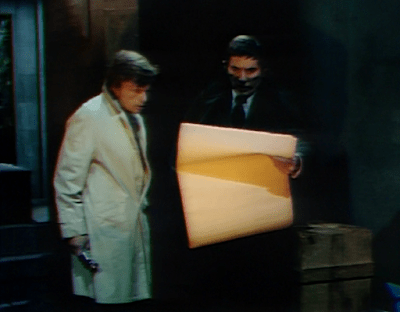
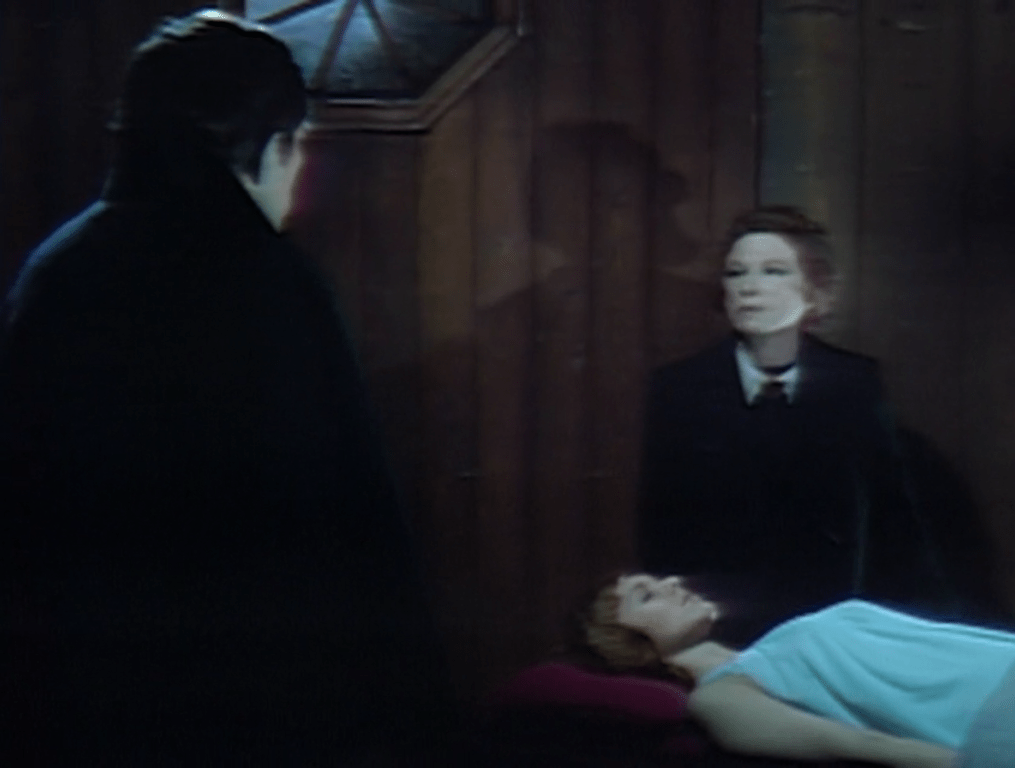
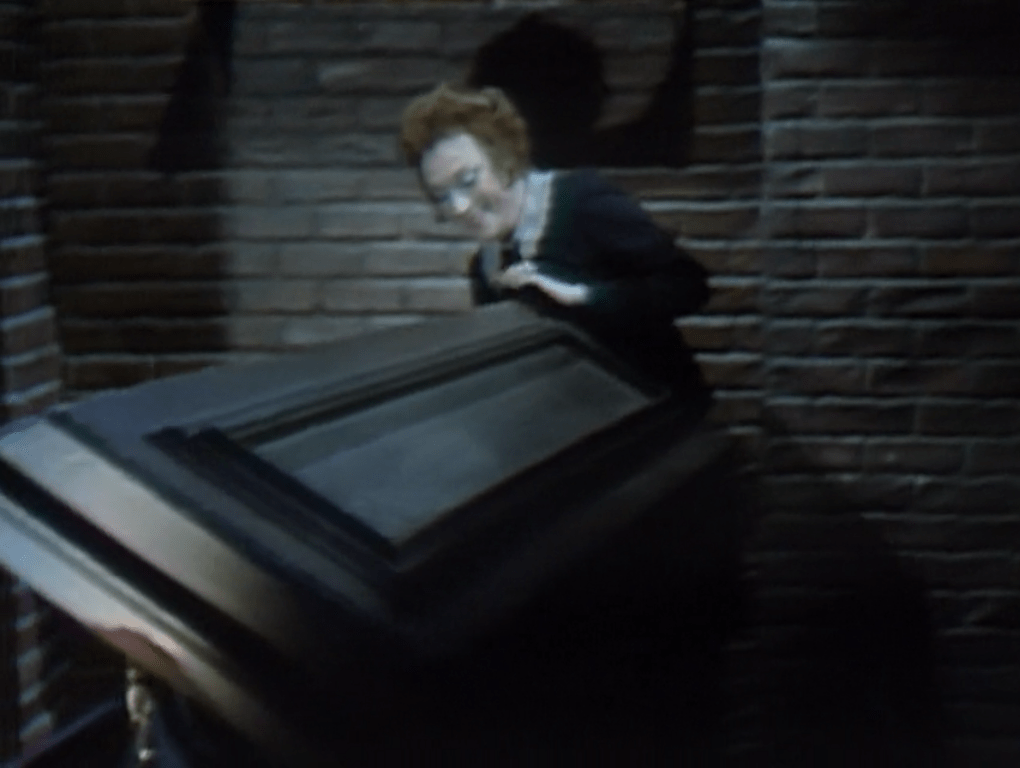
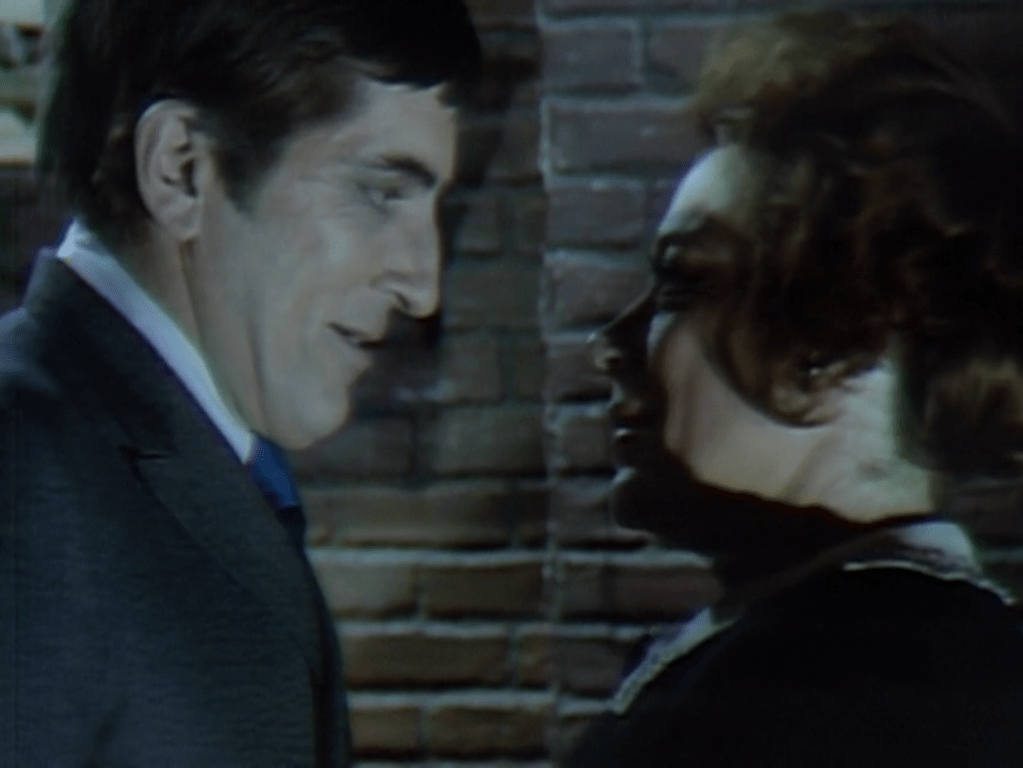
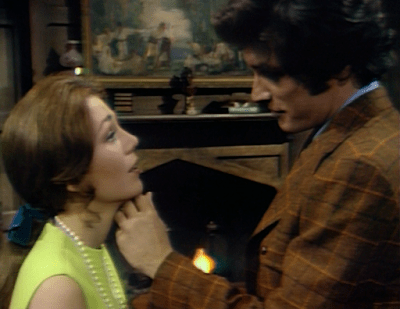
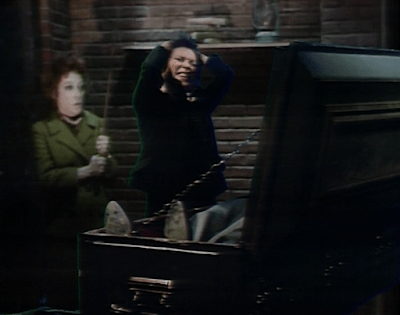
Maggie Collins is unnerved because people keep getting murdered in and around the great house of Collinwood. Her husband Quentin was arrested for one of those murders and is the prime suspect in another. He escaped from jail, just in time to be unable to account for his whereabouts during yet another. Maggie goes downstairs and finds old world gentleman Barnabas Collins in the foyer.
Maggie mentions that Alexis Stokes, identical twin sister of Quentin’s late wife Angelique, has suddenly taken ill and is asking her to call her father, evil barfly Tim Stokes. Maggie does not understand what Stokes can do that a doctor can’t, but this has happened before and Stokes was able to fix the problem. Barnabas excuses himself, saying he has urgent business to attend to at the Old House on the other side of the estate. He promises to be back soon.
Maggie hears footsteps outside her bedroom, which she thinks might be Quentin’s. The only friend she has in the great house at the moment is Elizabeth Collins Stoddard, who is under sedation following the murder of her daughter. So she rushes to the Old House to look for Barnabas. He is not in; she finds a strange man in the parlor. She asks him who he is and what he is doing there. He insists that he will ask the questions. He asks what Barnabas has done with “her.” Maggie has no idea what he is talking about. He demands that she look into his eyes; as soon as she does, he realizes she is telling the truth. He orders her to tell Barnabas that he will be back, but refuses to give his name.
Maggie runs back to the great house. She finds Barnabas in the foyer, and gives him a full report. Barnabas urges Maggie to believe in Quentin’s innocence. That is something she can no longer do. She says that she is afraid that Quentin has lost his mind and that he will kill everyone in the house, one by one. We pan out and see Quentin lurking at the top of the stairs, listening.
Maggie has a dream. Quentin comes home smiling, with a spring in his step, after chairing a meeting of the board of directors of Collinsport Enterprises. He takes her in his arms and tells her he’s neglected her long enough. She says she doesn’t feel neglected. He says he is taking six months off work, and that the two of them will be leaving tomorrow for a trip around the world.
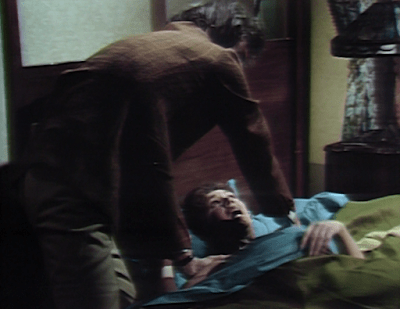
Quentin finds a bouquet of flowers. He instantly becomes extremely hostile. He accuses Maggie of receiving the flowers as a gift from her lover. She is baffled and denies his allegations. He strangles her. She wakes up, and finds Quentin standing over her, his hands on either side of her neck.
We’ve never seen Quentin and Maggie as happy as they are in the opening part of her dream, but we have several times seen his mood abruptly flip from cheerful to violent. He is not entirely guilty of any of the murders, but he does sometimes choke people, and was in fact choking the person he is charged with strangling immediately before a witch cast a spell to complete the killing.
Moreover, we have seen a dream very much like this one before. For its first 196 weeks, Dark Shadows was set in another universe. In that continuity, Maggie’s counterpart dreamed of Quentin’s ghost in #682. That dream began with Quentin taking a delighted Maggie in his arms and dancing with her; all of a sudden, for no discernible reason, he interrupted the dance to strangle her.
That Quentin did not confine his strangulations to dreams. He murdered his wife Jenny by strangulation in #748. Wife-strangling is a pastime the two Quentins have in common. This Quentin is suspected of killing Angelique. His defense against that charge is that he could not have driven the pin into the back of her head that killed her, because he was using both hands to choke her at the time. So it would seem that Maggie’s fears are well-founded.
Evil wizard Tim Stokes combined medicine with black magic to connect his late daughter Angelique with a woman named Roxanne. The connection drains most of the “life force” from Roxanne into Angelique. This rendered Roxanne comatose and allowed Angelique to move among the living so long as Roxanne neither dies nor gets even a tiny bit better.
Vampire Barnabas Collins and mad scientist Julia Hoffman are interlopers from another dimension. They know what Stokes has done and want to defeat Angelique. They made off with Roxanne and were keeping her in the Old House on the grounds of the estate of Collinwood, planning to use some mad science equipment to revive her. Roxanne did perk up after the first treatment, and Barnabas took her on a date to his favorite place, the old cemetery north of town, where she showed some signs of recognizing her surroundings.
Yesterday, Stokes went to the Old House to search for Roxanne while Barnabas was out. When Barnabas got home, Roxanne was nowhere to be found. We learn today that Stokes does not have her. He turns to a man named Claude North for help in finding her. Yesterday he told Angelique that he was most reluctant to contact North; only after an incantation calling upon all the spiritual forces of darkness fails to solve their problem does he consider turning to him. He told Angelique that North was no ordinary man, and he is evidently more unpleasant to deal with than are Satan and his minions. But he answers when Stokes picks up the telephone and calls him.
Barnabas is also familiar with “Claude North” as the name of someone linked to Roxanne. He found a drawing of her signed by North in the secret chamber in the back room of the mausoleum in the cemetery. He goes back to the cemetery twice tonight. The first time, he goes into the secret chamber and finds evidence that a man with the initials “CN” has been staying there. He takes this as confirmation that it is Claude North’s roost. It does not seem likely that it is North’s only residence, since there is no sign of a telephone there. Stokes is spying on Barnabas while he does this. He is disturbed that Barnabas knows about the secret chamber, and wonders if he has been keeping Roxanne there.
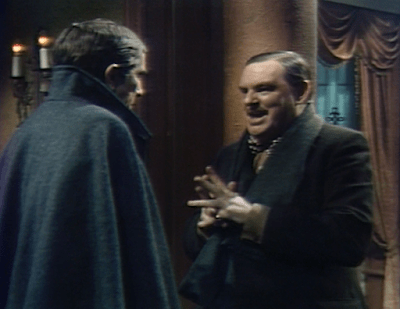
Barnabas goes back to the Old House and finds Stokes talking with the lady of the house, Carolyn Loomis. Angelique killed Carolyn’s husband Will the other day because he would not reveal Barnabas’ secret, and Carolyn has been drinking steadily ever since. Barnabas tells Stokes that since he has extended his condolences to Carolyn, he can leave now. Stokes takes his time about going. He says that Will thought that Barnabas might have a girl someplace. “Is he right, Mr Collins? Do you have a girl someplace?” Thayer David delivers this line with an urgency that elevates it from mildly clever to almost brilliant. Jonathan Frid responds with a slow burn that brings the exchange to perfection. Barnabas knows that Stokes neither has Roxanne nor knows that he does not have her, but he also knows that Stokes, as a native of this universe, is likelier to find her than he is.
“Do you have a girl someplace?” Screenshot by Dark Shadows Before I Die.
Barnabas goes back to the cemetery and finds Roxanne there. She is kneeling at a gravestone. It marks the grave of Claude North, who lived from 1814 to 1866.
In his own world, Barnabas was trapped in the counterpart of the secret chamber in the mausoleum for 171 years. So regular viewers think of that chamber as a place for vampires. North’s tombstone suggests that he might be such a creature.
Moreover, the drawing of Roxanne evokes Charles Delaware Tate, an artist who was a character on the show in 1969. Tate had the magical power to bring people to life by drawing them. He became obsessed with a woman he created in that way. As my wife, Mrs Acilius, points out, Tate’s erotic preoccupation with a product of his own imagination is as much a metaphor for extreme selfishness as is the vampire. So if the answer to the question of Roxanne’s origin is that she sprang into being as the result of North’s drawing of her, it would only be appropriate if North were also a vampire.
There is a scene in the room on top of the tower at the great house of Collinwood. Carolyn goes there and looks at the window from which Will fell to his death. To her surprise, sourpuss Quentin Collins enters the room. Quentin is a fugitive from justice, having assaulted a policeman and fled from jail because he was under arrest for murder. He makes menacing remarks demanding her silence; she’s so drunk that it doesn’t seem likely she will remember he was there. In the other continuity, the Collinses had a habit of using the tower room, which is entirely enclosed in windows that can be seen from every part of the estate, as a hiding place; we can see that their counterparts here maintain the same self-defeating tradition.
Writer Gordon Russell takes bits of old episodes and mixes them as if he were rotating a kaleidoscope. There is a plot involved also, but the screen iconography is the main thing.
The show has been operating on the principle of the kaleidoscope for some time. They’ve traveled back in time repeatedly. Now they have traveled sideways in time and taken us to an alternate universe, which they insist on calling “Parallel Time.” Each of these segments represents a turn of the kaleidoscope, rearranging the actors, sets, musical cues, curse stories, imaginary geography of the estate of Collinwood and village of Collinsport, and other elements to create new patterns that shed unexpected light on familiar material.
Evil wizard Tim Stokes has used a combination of black magic and medical science to establish a remote connection between a woman named Roxanne and his late daughter, Angelique Stokes Collins. This connection drains the “life force” from Roxanne into Angelique, reanimating her and leaving Roxanne comatose. To sustain this circumstance, Roxanne must remain in precisely her current condition. If she dies, all of her “life force” will vanish, returning Angelique to the tomb. Whenever she recovers even a tiny bit of her lost strength, Angelique collapses, possibly to die.
Vampire Barnabas Collins and mad scientist Julia Hoffman are visiting from the main continuity, and they are determined to stop Angelique’s evil plans. They have learned what Stokes has done, and have taken Roxanne into their own custody. As we open, Julia has just given up on an attempt to revive Roxanne and gone back to the great house at Collinwood, where she is impersonating her own Doppelgänger, the housekeeper. This woman, also named Julia Hoffman, was Angelique’s most fanatical devotee until Julia killed her, stole her French maid outfit, and assumed her identity.
Alone with Roxanne in the secret room behind the bookcase in the front parlor of the Old House on the grounds of the estate, Barnabas gives a soliloquy about his feelings for her. She opens her eyes and sits up.
In the spring of 1968, Julia took charge of an experimental procedure another mad scientist had devised to free Barnabas of his vampirism. The core of this procedure was the creation of a Frankenstein’s monster named Adam. In #490, Julia ran the apparatus and was disappointed when Adam seemed still to be inanimate. She and Barnabas left the lab, and Adam came to life. Her disappointment and departure are repeated in this scene, though Barnabas is there to see Roxanne open her eyes.
When Roxanne comes to, we cut to the great house and see Angelique collapse. She crawls around on the floor, trying to make her way to a telephone. This action is shown in quick cuts, but not quite quick enough. It is so much the sort of melodramatic business that was overdone in movies in the 1940s and 1950s and parodied in sketches on The Carol Burnett Show in the 1960s and 1970s that it raises a bad laugh.
Barnabas takes Roxanne out of the secret room, to the parlor. He finds that she cannot speak. He shows her a drawing of her that he found in another secret room, the chamber in the back of the Collins family mausoleum in the old cemetery north of town. It is signed “Claude North.” Roxanne reacts to the drawing with delight and to the name “Claude North” with dismay.
In the summer of 1969, the show was set in the year 1897. One of the characters we got to know in that year was the mysterious Amanda Harris. It turned out that Amanda had popped into existence when an artist thought her up and made a sketch of her. This artist, a repellent little man named Charles Delaware Tate, had no idea he was endowed with the power to bring his fancies to life by drawing them until he met Amanda, at which point he developed an exceedingly unpleasant obsession with her.
Roxanne’s origins are at this point as unknown to us as Amanda’s were when we first got to know her. So the drawing will suggest to longtime viewers that “Claude North” will turn out to be this universe’s version of Tate. When Stokes tells Angelique that he might be able to bring Roxanne back by contacting North, the thought of having further dealings with the man is abhorrent to him. Like Roxanne’s own display of distaste at North’s name, that fits with the idea that he might be a version of the loathsome Tate.
In the great house, Maggie Collins, current wife of Angelique’s widower Quentin, finds Angelique crawling on the floor and picks up the telephone to call the doctor. Angelique says that she needs her father, not the doctor, puzzling Maggie. While they contact Stokes, Barnabas takes Roxanne to the mausoleum and shows her the secret room in an attempt to restore her memory and her power of speech.
In #283, the original continuity’s version of Maggie was a mental patient at Windcliff, a private hospital Julia controls. She had succumbed to amnesia, reverted to early childhood, and become largely nonverbal after an ordeal as Barnabas’ victim. In that episode, Julia took Maggie on a trip to the mausoleum, where Barnabas had tortured her, in an attempt to restore her memory and power of speech. Now, the relatively benevolent Barnabas is taking Roxanne to this universe’s version of the same location in the same hope.
Stokes attends to Angelique in her room. He gives her some medicine to keep her alive until they can find Roxanne. He warns her that if Roxanne manages to speak, her first word will send Angelique back to the grave. He performs an incantation to summon the spiritual forces of darkness to come to their aid. When Mrs Acilius and I were watching this on Amazon Prime, Stokes’ incantation was interrupted by an ad for Chipotle. I’d always thought calling on the Devil and his minions was likelier to bring Taco Bell upon you, but I don’t suppose Chipotle is all that different.
During the 1897 segment, we saw a new version of a character from an earlier phase of the show, undead blonde fire witch Laura Murdoch Collins. That iteration of Laura was a heat vampire who drained the warmth from the living to remain animated. They’ve given the current version of Angelique the same condition, though we haven’t seen it lately. In #737, Laura was in a bad way. She lay in bed and her thrall Dirk Wilkins cozied up to her in the most sex-like interaction we had seen on the show up to that point (or up to this point, come to that.) Angelique’s bedroom is laid out the same way today as Laura’s was then, and as Dirk was on Laura’s right, Stokes is on her right. Earlier episodes made it clear that there was something deeply weird about the relationship between Stokes and Angelique. In the contrast between this scene and the one between Laura and Dirk, longtime viewers can see that Angelique and Stokes’ particular weirdness does not involve incest per se. Rather, it is their shared dedication to evil for its own sake that warps everything between them.
Back in the Old House, Barnabas puts Roxanne to bed on her table in the secret room. He goes into the parlor. A car pulls up. It is Carolyn Loomis, wife of his late blood thrall Will Loomis. Carolyn chatters happily about some shopping she did and asks for Will. Barnabas realizes she does not know that Will has died. He breaks the news to her. He says that Angelique killed him, which is part of the truth. Carolyn says it is because of Barnabas that Will was killed, which is the other part of the truth. Barnabas seems to have a whole speech prepared about how he will avenge Will’s death by defeating Angelique, but Carolyn keeps interrupting to ask who will avenge it by defeating him
Elsewhere in the 1897 segment, Barnabas’ enemies had killed his blood thrall Sandor Rákóczi. In #798, Sandor’s wife Magda blamed Barnabas for her husband’s death. She told him she would avenge Sandor by killing him. She then despaired of that and offered herself to him as his next victim. Barnabas grandly replied, “No, Magda, you will not kill me, and I will not harm you. We will grieve together.” Carolyn does not allow Barnabas to speak so loftily.
Carolyn goes to the great house. She is just about to reveal Barnabas’ secret to Maggie when Barnabas himself shows up. While he defuses the situation, Stokes realizes that the Old House is vacant. He slips out to search for Roxanne there. When Barnabas returns, Roxanne is nowhere to be found.
It may seem unlikely that the show will resolve this cliffhanger in the obvious way, by showing us that Stokes took Roxanne from the secret room. They usually go for surprise. Nonetheless, longtime viewers will be inclined to expect this to happen, even though it is so on-the-nose. This room was first seen in #113, when crazed handyman Matthew Morgan opened it as a dungeon for well-meaning governess Victoria Winters. Not even Vicki’s charge, strange and troubled boy David Collins, knew of the room’s existence, and David knew the Old House better than any other character on the show at that point. The room is therefore uniquely Matthew’s territory.
Like Matthew, Stokes is played by Thayer David. Stokes’s ancestor was eighteenth century indentured servant Ben Stokes, whose counterpart we saw in the 1790s segment as a commentary on Matthew, an example of the good and sane man Matthew might have been had he not grown up in the shadow of the ancient curses of Collinwood. Once those curses had been in operation for a little while, Ben started turning into Matthew. As Matthew inadvertently killed a man because of his unbounded devotion to matriarch Elizabeth Collins Stoddard, Ben inadvertently killed a man because of his unbounded devotion to Barnabas. As Matthew set out to cover up his accidental homicide by killing Vicki, who was played by an actress whose father was a Danish count, so Ben deliberately committed a murder to cover up his own accidental killing, and his victim was a lady with the title “Countess.” As a descendant of Ben and therefore a reflection of Matthew, it is a matter of course that Stokes knows about the room. Barnabas’ decision to hide Roxanne in the room is just one more case of a severe misreading of Dark Shadows by someone who didn’t watch the 1966 episodes.
We open in the room atop the tower of the great house on the estate of Collinwood. Wicked witch Angelique, enemy of the mysterious Barnabas Collins, confronts Will Loomis, Barnabas’ henchman. She demands Will tell her Barnabas’ secret. Returning viewers know that Barnabas is a vampire, and Will is his blood thrall. When Will tells Angelique that he is incapable of betraying Barnabas, we know that he is making a literal statement of fact. But Angelique has power over Will, too. Caught between these opposing forces, Will does the only thing he can. He opens the window and flings himself to his death.
John Karlen plays Will, Lara Parker Angelique. In his post about this episode at his great Dark Shadows Every Day, Danny Horn observes that Karlen approached all of his parts as if he were in a play by Tennessee Williams. In a comment I left under that post, I said that while most of Karlen’s scene partners stuck with their own distinctive styles of acting while playing opposite him, resulting in surprisingly effective mashups of techniques that you wouldn’t think could coexist on any stage, Parker followed his volcanic lead in today’s first act. Will’s anguish and Angelique’s vehemence both go way over the top, but the result is far from hammy. Orson Welles famously said that hamminess is not overacting, it is false acting. There is nothing false between Will and Angelique today.
Just before Will jumped out the window, Julia Hoffman entered the room. Furious that Will has died without telling her what sort of creature Barnabas is, Angelique accuses Hoffman of startling him and ruining everything. Wondering if Will may have survived his fall, she orders Hoffman to accompany her to the foot of the tower. Hoffman kneels down and says that Will’s spinal cord snapped on impact resulting in instant death. Angelique says that she is intrigued by Hoffman’s diagnosis. “Have you a medical degree?”
Unknown to Angelique, the true answer would be yes. Angelique believes herself to be with Hoffman the housekeeper, her most fanatical devotee. In fact, the woman is Hoffman’s counterpart from an alternate universe, Dr Julia Hoffman, MD. Julia has followed her best friend Barnabas into this continuity and is assisting Barnabas in his battle against Angelique. Julia killed Hoffman and assumed her identity. Julia responds to Angelique’s puzzlement with a story about an incident when she saw a man fall from a roof and land in the same twisted position Will now holds. She remembered the words the doctor said when examining that man and merely repeated them when she saw Will’s distorted neck. Angelique compliments Julia on her extraordinary memory, and proceeds as if she were telling the truth. There seems little else she could do.
I remembered the line “Have you a medical degree?” from the first time Mrs Acilius and I watched Dark Shadows. Angelique has noticed that Julia is different from the Hoffman she knows, and has been showing signs of impatience with her. But she has not suspected she is a different person, only that she is going soft on her enemies. “Have you a medical degree?” makes it seem that might be changing. Julia may be in grave danger before long.
Barnabas rises from his coffin in the basement of Will’s house. He goes upstairs and finds Angelique waiting for him. She says she came, not to see him, but to console the widow Loomis. Thus Barnabas learns that Will has died.
Barnabas tells Angelique that he will avenge Will’s death upon her, but she tells him that he is the one to blame. It was because his power over Will matched hers that Will could respond to her commands only by killing himself.
Angelique’s counterpart in Barnabas’ own universe placed the curse that first made him a vampire. She was also wholly or partially responsible for the deaths of his mother, sister, aunt, uncle, fiancée, and many other people he cared about. So he reacts to the sight of this Angelique with barely controlled rage. For her part, she has no idea who he is, and does not know why he is hostile to her. She, therefore, is much cooler. The contrast is fascinating to watch, far more interesting than are the scenes between Barnabas and the other Angelique and one of the joys of the “Parallel Time” segment.
Julia and Barnabas are busy with a science project. They have learned that Angelique returned from the grave because her father, evil barfly Tim Stokes, somehow established a remote connection between her and a woman named Roxanne whom he keeps in the back room of his apartment. This connection, whatever it is, drains most of the “life force” from Roxanne into Angelique. This creates a delicate situation. If Roxanne dies, all of her “life force,” including that which animates Angelique, will vanish. But if she regains any of the force that has been taken from her, even enough to flutter her eyelids, Angelique will collapse and, unless Roxanne is brought back down to the prescribed level of debility, re-die.
When Julia and Barnabas first came upon Roxanne, they planned to kill her to finish Angelique off. Barnabas put the kibosh on that when he saw how pretty Roxanne was. Then they thought of destroying Angelique by reviving Roxanne, but, for reasons too silly to explain, they’ve decided they want to keep Angelique around. So now Barnabas has decreed that they will manipulate Roxanne’s condition to slow Angelique down. They have taken her from Stokes’ place and put her on a table in Will’s basement, somewhere away from the coffin. They have connected her to a lot of mad science equipment that is supposed to act on the “life force.” Longtime viewers know all about this equipment, because Julia had it in 1968 when she was building a Frankenstein’s monster as part of a project to cure Barnabas of vampirism.
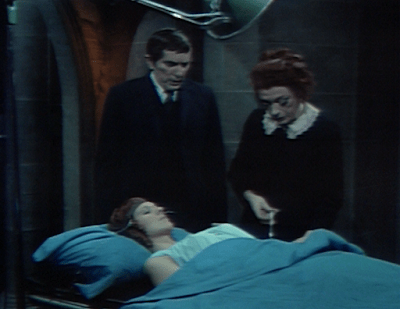
Julia runs the equipment. Roxanne’s condition does not change. Julia tells Barnabas that Angelique is expecting her back at the great house. In her absence, Barnabas takes Roxanne’s hand and stares at her. She opens her eyes and sits up. In the great house, Angelique weakens and collapses.
Many fans wonder where Julia could have got the “life force” equipment. In her own universe, she is a medical doctor and the head of a private hospital, so she could order anything she needed from a medical supply house. Here, her only identity is her imposture as Hoffman the housekeeper, who did not have a prescription pad.
I don’t see why people are so concerned with this. In 1968, the equipment originally belonged, not to Julia, but to another mad scientist, Dr Eric Lang. Barnabas and Julia simply stole it from Dr Lang’s house after he died. In this continuity, we haven’t heard about Dr Lang, but we hadn’t heard about him in the main continuity either until Barnabas fell into his clutches, at which point he already had all of his equipment. So we can presume Barnabas and Julia just found out when his counterpart would be out of the house and raided the place.
Will’s death marks his final appearance, but John Karlen will be back in a couple of months as Willie Loomis, the version of him we met in the main continuity. He will play other characters later, when the show will be set in other periods.
The whole idea of the supernatural is that what appears to be weak is able to overcome what appears to be strong. So, as far as we can tell the dead are infinitely weaker than the living, yet it is two dead characters, vampire Barnabas Collins and wicked witch Angelique Stokes Collins, who dominate all the living people they interact with today. Even dead characters who barely appear utterly outclass live ones. In the opening sequence, Barnabas and his blood thrall Will Loomis hear the voice of late housekeeper Julia Hoffman. Hoffman’s ghost does not manifest visibly; she is such a subtle presence that Will can’t tell the difference between her and a stray piece of purple cloth. Even so, he is helpless against the dead Hoffman. Only the equally dead Barnabas can talk her into getting out of their way.
As far as we can tell, people have more influence over each other when they are close together than when they are far away, and if one person is going to resuscitate another they have to be in physical contact. But Angelique’s father, a wizard known as Tim, somehow connected her to a girl named Roxanne when Roxanne was in the back room of his apartment and Angelique was sealed up in her tomb, miles away. That unexplained connection drained most of the “life force” from Roxanne into Angelique, allowing Angelique to move among the living and reducing Roxanne to a vegetative state. Roxanne must remain in precisely her current state of debility, or Angelique will die again. Whenever Roxanne regains even a minuscule amount of strength, Angelique collapses. If Roxanne were herself to die, the whole of the “life-force,” including the share which animates Angelique, would vanish. The first and third letters of Roxanne’s name specify what she is to Angelique, the ℞ prescribed for her.
As far as we can tell, the actions we take in our lives have consequences while the actions we do not take have none. But 13 weeks ago Barnabas crossed over into an alternate universe where counterparts of the people he knows are living with the consequences of actions he did not take when he met his universe’s counterpart of Angelique in the 1790s. In his life, Barnabas had an affair with Angelique, then spurned her when he found that the gracious Josette was available to him. In revenge, Angelique turned him into a vampire and brought death and misfortune to many others. In this continuity, Barnabas’ counterpart left Angelique alone, married Josette, lived a quiet life, and died a natural death.
Hoffman’s counterpart in Barnabas’ native universe is as devoted to him as Hoffman was to Angelique. This Julia Hoffman is a medical doctor and a mad scientist. She has crossed over to the current continuity, killed her counterpart, and assumed her identity. She is working with Barnabas against Angelique.
Barnabas and Will take Roxanne from Stokes’ apartment to Will’s house on the grounds of the estate of Collinwood. Barnabas wants to control Angelique by periodically stimulating Roxanne a little, knocking Angelique out each time he does so. His original plan was to revive her altogether, destroying Angelique, but he has decided that if he does this he will have less of a chance of proving that Angelique, not foul-tempered sourpuss Quentin Collins, was responsible for the death of a man called Bruno Hess. As far as we can tell, people who can move around and talk are better able to defend their reputations than are those who are rotting in their graves, but Barnabas seems to think that it is the other way around in Angelique’s case.
Julia has refused to aid Barnabas in this nonsensical scheme, but now that Roxanne is in the house she acquiesces. Before she can get to work, they hear a knock on the front door. Will leaves Julia and Barnabas with Roxanne in the secret room behind the bookcase in the front parlor. Angelique herself is the visitor, asking to see Barnabas. Will tells her that Barnabas is not in and that he won’t be back for some time. She goes to the bookcase and appears to be reaching for the lever that exposes the secret room, but simply takes a book. She sits down to read while she is waiting for Barnabas. Will claims that he has resolved to stop drinking and resume his work as a writer, and that he has to be alone to do so. Angelique can’t think of anything to say to that, so she goes.
Once Angelique has returned to the great house, Quentin’s young cousin Amy Collins comes to her in the drawing room to say that she saw a man scurry across the grounds and climb in through a window, and that a few minutes later she heard a man outside her bedroom door. She could not see the man, but thinks he might be Quentin. Angelique tries to persuade her she did not see what she saw. Amy has given up when Angelique grows faint, the result of what is happening to Roxanne. When Angelique’s head clears, she asks Amy in a very serious tone to repeat exactly what she told her. Any inclination the girl may have had to believe that she was mistaken vanishes with this.
We next see Amy exploring the long-disused west wing of the house. She hears someone moving around among the cobwebs and bric-a-brac. She does not find this person, but does discover the statuette Angelique used as a voodoo doll when she cast the spell that killed Bruno, Bruno’s scarf still tied around its neck.
Julia, masquerading as Hoffman, returns to the great house. Angelique scolds her for neither being at hand when she wanted her nor keeping close enough track of Barnabas to prevent him taking Roxanne away from her father’s apartment. Julia answers the first of these complaints by referring to her other duties. She answers the second by trying to say that another of Angelique’s enemies might have made off with Roxanne. Angelique has no patience with either of these statements.
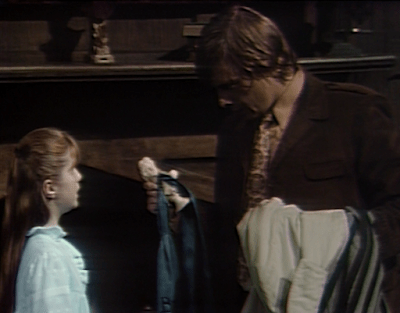
Will comes to the great house. Amy tells him about the man she saw on the lawn, says that she believes he was Quentin, and shows him the statuette with the scarf around its neck. Regular viewers not only remember Angelique using the statuette to strangle Bruno from afar, but will also remember that her counterpart in the main continuity used the same statuette in the same way to cast a choking spell on her husband Sky Rumson in #955, when Sky was trying to set fire to her (theirs was an imperfect marriage.) But out of that context, there does not appear to be anything sinister about the statuette. That isn’t a flaw in the prop- it’s the whole point. As a supernatural intervention, the voodoo doll is not supposed to look like it could have anything to do with the consequences of the spell it is used to cast.
Will recognizes the statuette as a voodoo doll, as his wife Carolyn had done when Maggie showed it to her the other day. That’s a breach of faith with the audience. Science fiction writer Arthur C. Clarke famously said that any sufficiently advanced form of technology is indistinguishable from magic. If the implements of witchcraft are things that could be sent off to the police lab for forensic analysis, they are not sufficiently advanced to stay outside the category of technology, and you are not telling a story about magic at all.
Will retraces Amy’s steps through the west wing, hoping to find Quentin and offer him his support. He makes his way to the tower room. The door opens, and he is startled to see who is entering.
Denise Nickerson was a splendid young actress. When she first joined the cast as Amy Jennings in the main continuity, she was central to the plot for months, and did a great job. We remember those days when she goes to the west wing looking for Quentin. It was Amy Jennings who, on her first night in the great house, entered the west wing and went straight to the room where the ghost of that universe’s version of Quentin was waiting for her. But she has been seen less and less. This is Nickerson’s first appearance in eight weeks, and it is hard to be optimistic that we will see much more of her in the future.
In 1967, vampire Barnabas Collins and mad scientist Julia Hoffman settled in on the estate of Collinwood, Barnabas as the master of the Old House on the grounds and Julia as a permanent guest in the great house. Now they have both crossed over to an alternate universe, which the show insists on calling “Parallel Time.” Barnabas has passed himself off to the residents of the great house on this universe’s version of Collinwood as their long-lost cousin from South America, as in the original continuity he persuaded their counterparts he was their cousin from England. He has bitten and enslaved the owners of the Old House, alcoholic writer Will Loomis and Will’s wife, the former Carolyn Collins Stoddard. Julia met her own counterpart, a Julia Hoffman who never became a doctor or got entangled with Barnabas. This Hoffman was the housekeeper in the great house, and as fanatically devoted to the undead Angelique as the original Julia is to Barnabas. Julia greeted Hoffman by beating her to death, stealing her French maid outfit, and assuming her identity.
Yesterday, Carolyn told Julia that she had realized who killed Angelique the first time. Today, she clams up and refuses to say who it is. Julia tells Barnabas about this. He suspects she is protecting Will. He questions Will, who says he is innocent. Barnabas’ power precludes Will from lying to him, so he turns his attentions to Carolyn. He forces her to say that she believes the killer to be her mother, Elizabeth Collins Stoddard. Barnabas knows Liz’ counterpart in his own continuity and cannot imagine that any version of her would commit such a crime. Carolyn’s reason for accusing her mother is that the murder weapon was one of her hatpins. Barnabas points out that anyone in the house could have stolen the pin.
Angelique has returned from the dead. Impersonating her identical twin sister Alexis, she is staying in the great house as the guest of her widower, sourpuss Quentin Collins. Quentin is missing at the moment, on the run from the police after being charged with a murder of which he is more or less innocent. Barnabas and Julia know who Angelique is and what she is up to.
Angelique is being maintained in the world of the living by a procedure her father, Tim Stokes, invented. Stokes is keeping a comatose young woman named Roxanne in the back room of his apartment. Stokes has somehow established a remote link between Roxanne and Angelique. This link drains most of Roxanne’s “life force” into Angelique. Roxanne must remain in precisely her current state of debility for Angelique to continue her existence. If Roxanne dies, the force will vanish altogether, taking Angelique with it. If Roxanne regains her strength, the link will be broken and the whole force will revert to her.
Barnabas has devised a cockamamie scheme to take Roxanne’s body from Stokes’ place, hide it somewhere, and have Julia bring her back to life. He reminds Julia that she performed a similar procedure when she cured him of his first vampire curse by constructing a Frankenstein’s monster named Adam. She responds that what Stokes has done is altogether different from what she did, and that she has no idea whether she will be able to figure it out. Barnabas, who has no scientific education beyond whatever he picked up as a boy in the eighteenth century, vows to revive Roxanne himself if Julia will not help.
Julia points out the many flaws in Barnabas’ plan. As she does so, Jonathan Frid’s delivery of Barnabas’ responses gets more and more uncertain. He’s been doing quite well in recent episodes, but he’s so bad in this scene that before long Grayson Hall can no longer keep track of Julia’s lines. When, on his way out of the house, he proclaims that he is ready to do battle with Angelique, he is proposing a two-front war. He is already engaged in desperate combat with the coat rack holding his cane. My wife, Mrs Acilius, said that Barnabas’ plan is so ridiculous it’s no wonder the actors can’t get the words out.
Barnabas takes Will to the Collins family mausoleum in the old cemetery north of town. He explains that there is a secret room there that was used to hide weapons from the British during the Revolutionary War. Will made a study of the Collins legends and is skeptical, but Barnabas opens the panel and ushers him in.
Once they are inside, it is Barnabas’ turn to be surprised. In his universe, he was locked in a chained coffin in the counterpart of this room, undiscovered for 171 years. But here, he finds furniture, a candelabra, a glass of fresh milk, and a drawing of Roxanne signed “Claude North.” Someone has been living there, someone connected with Roxanne. Will says out loud that they can’t keep her there. Barnabas says that they will find another place for her, and they carry on.
Barnabas and Will enter Stokes’ apartment. Will assures Barnabas that Stokes won’t come back until after closing time at the local tavern, but a moment later claims that he feels a presence. Barnabas looks around. No sooner had he declared that Will is wrong than the ghostly voice of the late Miss Julia Hoffman fills the room, forbidding them from proceeding with their mission.
Roxanne is played by Donna Wandrey, whose short red hair, pale complexion, and strong chin are reminiscent of Grayson Hall. When we first saw her, we wondered if it would turn out that Roxanne was Hoffman’s secret daughter. The ghostly voice adds substance to the idea that there was something important linking Hoffman with Roxanne.
Dark Shadows spent yesterday and the day before showing us how much her relationship with vampire Barnabas Collins has cost Dr Julia Hoffman. Once a superlatively capable, masterfully poised scientist, Julia has become so ragged and dependent that she reacts to the sight of Barnabas rising from his coffin with a puppyish delight. She has followed him into an alternate universe, cutting herself off from everyone she knows and everything she has. Once in that universe, her first act was to kill her own Doppelgänger, leaving her face to face with a dead version of herself. She has set out to gather intelligence that might help Barnabas in his madcap schemes by impersonating that Doppelgänger, who was the housekeeper at the great house of Collinwood. In that persona, she wears a French maid outfit and disclaims all of her professional and educational attainments. Yesterday, Barnabas was briefly impressed by how much Julia had sacrificed for him; for a second or two, it looked like her love for him might be requited, at least to the extent of one kiss. But he turned his attention elsewhere, and now they are busy on a monster-slaying expedition.
The monster is Angelique Stokes Collins, undead first wife of foul-tempered sourpuss Quentin Collins, master of Collinwood. Angelique’s father, a wizard known as Tim (but he’ll always be “Stokes” to us,) has somehow established an invisible connection between her and a woman he keeps in the back room of his apartment. We learn in the closing credits that this woman’s name is Roxanne. Roxanne is in a coma. Stokes has drained most of Roxanne’s “life-force” into Angelique. Occasionally Roxanne perks up a bit and regains some of her strength. When this happens, Angelique weakens. If Roxanne gets too vigorous, Angelique will die, but that will also happen if Roxanne herself dies. Stokes keeps busy trying to maintain Roxanne in her precise state of debility.
We find Julia and Barnabas in the room with Roxanne. They have learned the secret and come here to kill Roxanne, finishing off Angelique. They talk for a moment about Stokes, who is likely to find another way to revive Angelique if they kill Roxanne. They imply that they will kill him, too. That raises a question. Yesterday Julia saw Angelique collapse and become altogether helpless when Roxanne gained just a tiny bit of strength. If they are going to kill Stokes anyway, why not do that first? Then they can neutralize Angelique by giving Roxanne a little TLC and drop her off at the hospital on their way back to their native universe.
Barnabas doesn’t think of that, but neither does he go through with the murder. He sees Roxanne, raves about her looks, and says in a world full of ugliness they have no right to destroy such beauty. Julia just keeps insisting that they finish her off, and says that if they don’t the blood of Angelique’s future victims will be on Barnabas. That is further evidence of what Julia has lost in her time at Barnabas’ side. Up to this point, she has consistently shown reluctance when he was planning a murder.
Barnabas says that he has never seen a face like Roxanne’s. He’s the only one. With her short red hair, pale skin, and strong chin, Roxanne looks very much like Julia. Indeed, the fans sometimes refer to Donna Wandrey as “Grayson Hall, Junior.” When we see the two together, we wonder if it will turn out that Roxanne is the daughter of the late housekeeper Julia Hoffman. It would be typical of Barnabas to reward Julia’s extreme devotion to him by forgetting all about her and chasing after a girl whose mother she might have been.
Meet Junior.
There’s also a lot of business today about two minor villains, sleazy musician Bruno Hess and high-born ne’er-do-well Roger Collins. Michael Stroka and Louis Edmonds were always fun to watch, but Roger and Bruno are absent and unmentioned for such long stretches that it is hard to believe that anything important is at stake in what they do. Like most of the characters, Bruno believes Angelique’s cover story that she is her identical twin sister Alexis. Acting under this impression, he smacks her around a couple of times. So we can see that he is going to be dead soon, though she will likely make him wish it were a lot sooner.
Roger announces that he has been named executor of the estate of the late Dr Cyrus Longworth. This means he will be coming into some money and perhaps learning some secrets. Quentin’s current wife, the former Maggie Evans, is lonely because her husband is a hopeless jerk. She tries to be friendly to Bruno, and he gets fresh. While he is grabbing her, Roger enters and sneers at Maggie.
Julia Hoffman joined the cast of characters in the summer of 1967 as a supremely confident professional, a medical doctor doubly qualified as a psychiatrist and a blood specialist and the head of a private hospital. Julia came to the estate of Collinwood because she had figured out that Barnabas Collins, master of the Old House on its grounds, was a vampire. She had a plan for curing vampirism and believed that if she succeeded she would change the way science defines life and death, thereby revolutionizing medicine.
Julia’s plan was not successful. She came to be so closely entwined with Barnabas and so deeply complicit in his crimes that she could not hope for any future that did not revolve around him. She decided to make the best of this, and set about falling in love with Barnabas. At first he mocked her cruelly for this. Eventually his response to her signs of romantic interest softened into an embarrassed sympathy.
In #980, Barnabas crossed over into an alternate universe, hoping that he would escape his curse there. He found he was still a vampire, and that he was surrounded by strangers. He has now persuaded the Collinses in the great house at Collinwood that he is their long-lost cousin from South America. He has once more established himself in the Old House, this time by biting and enslaving its owners. He quickly made enemies, most notably the undead Angelique Stokes Collins. The housekeeper in the great house was Angelique’s most fanatical devotee and deadliest enforcer. Her name was Julia Hoffman.
Yesterday, Hoffman had learned that Barnabas was a vampire, found his coffin, placed a stake on his chest, and raised a hammer to drive it through his heart. At the last second, a blow was struck from behind, killing Hoffman and saving Barnabas. The killer was Julia, who had made her way into this universe to take her place at Barnabas’ side.
In #351, Julia offered to guard Barnabas during the day. Since Barnabas had previously given this task only to domestic servants, he was shocked to hear a medical doctor volunteer to perform it. Julia smiled and said “I am not offering to be your maid.” Now, Julia is wearing Hoffman’s French maid outfit and posing as her in an attempt to find out what Angelique is up to. Long before Julia killed Hoffman, she had destroyed her old self in the course of her relationship with Barnabas.
The joyous reunion.
Julia is waiting by Barnabas’ coffin when night falls. The lid opens, and she looks delighted. This image is hilarious, but again contrasts with her earlier behavior to show how ragged her personality has become after all this time as a vampire’s henchman. In #289, Julia made her way to Barnabas’ coffin during the day, opened it, looked inside, and staggered back, shivering with a mixture of terror and triumph. She was at once fantastically intrepid and apparently sane. We did not then know what her intentions were, but the daring action combines with Grayson Hall’s masterful performance to persuade us that Julia might be equal to almost any task.
Now, Julia has become so dependent on Barnabas that she neither sees the horror of the situation nor remembers that he is dangerous to her. The very first we saw of Barnabas was his hand darting out of his coffin to choke someone who woke him unexpectedly, and the second time someone did that, in #275, the choking was lethal. Moreover, Barnabas knew that Hoffman was his deadly foe, so even if he’d been up for a while he could be expected to kill Julia before she had a chance to utter a word if he found her in his hiding place dressed as she is.
Fortunately for Julia, Barnabas has developed a habit of standing around and pontificating before his murders. So she has a chance to explain who she is. She shows him the stake and hammer Hoffman was holding when she found her, and he is convinced. He seems impressed that she killed her Doppelgänger for his sake, and they look more like they are about to kiss than they ever have before.
Barnabas and Julia, sitting in a tree, K-I-S-S-I-N-G!
Julia goes to the great house to report to Angelique, who is staying there in the guise of her identical twin sister Alexis. Angelique irritably asks where Julia has been all day. Julia makes an excuse, and Angelique starts talking about the progress of her evil plans. Before she gets very deep into it, she has a seizure of some kind. Julia asks what she can do to help, and Angelique tells her that she knows very well what to do. The only useful information Julia can get out of her are the word “father” and the sentence “He is doing this!” She decides to call on Angelique’s father, Tim Stokes. She looks Stokes’ address up in the telephone directory, and sets out.
When Stokes answers his door, he expresses surprise, not that Julia is there, but that she bothered to knock before entering. He makes some remarks which Julia cannot even pretend to understand. He says that Angelique must surely have told her about the situation; she says that she did, but that she is very confused about all of it. Stokes ushers her into his back room to give his own explanation.
A blanket covers the body of a woman lying on a table in the back room. Stokes explains to Julia that the woman is not dead. He drained her “life force” to enable Angelique to transcend death, but she retains enough vitality that she keeps pulling that force back to herself from Angelique. That is what causes Angelique to have her seizures. The woman must remain in precisely her current state if Angelique is to exist in the world of the living. The more of her strength she regains, the weaker Angelique will become, and if she dies, Angelique will return to the grave. He has given the woman an injection; he tells Julia that when she returns to the great house she will find that Angelique has recovered.
Julia does indeed find this. She urges Angelique to have Stokes over and repair her relationship with him. Since everyone else is out of the house, tonight would be the perfect time for such a tête–à–tête. Angelique agrees.
While Angelique is mixing martinis for Stokes, Julia is with Barnabas. She goes to the Old House and tells him what she has discovered. He produces a short knife and says that it should take care of the matter. In Stokes’ apartment, he stops and talks about all the time he has spent trying to find Angelique’s vulnerabilities, and wonders that now they have found such a simple method for getting rid of her once and for all. It sounded to my wife as if he was upset that Julia had beaten him to the answer.
In the back room, Julia hands Barnabas the knife. He again goes into a pre-murder soliloquy. Julia peps him up by telling him that the woman isn’t really alive, and that her continued existence means death and destruction for many others. Barnabas agrees. He lifts the blanket and prepares to strike.
The first murder in which Julia participated directly was that of her onetime friend and medical school classmate Dr Dave Woodard in #341. Woodard had learned that Barnabas was a vampire and that Julia was helping him, and was going to expose them both. After resisting the idea for several days, Julia complied with Barnabas’ demand that she prepare a lethal injection for Woodard. She handed him the hypodermic then, as she hands him the knife now. In those days, Barnabas and Julia were not yet friends, and Barnabas replied that she would have to administer the shot herself. In the end, he wound up giving Woodard the fatal dose while Julia stood in the doorway and blocked their victim’s escape. Afterward, Barnabas taunted Julia with her new status as a murderer, making her miserable. Now, they like each other fine, and he accepts the weapon as a matter of course.
It is not surprising that Barnabas, confronted with a problem, chooses murder as the solution. That is always his Plan A, and usually his Plan B and Plan C as well. Indeed, when he wonders what Stokes will do when Angelique is dead he implies that he will murder him too, lamenting that “It never ends does it, when one begins to unravel evil?” Barnabas looks utterly hopeless when he says this. He always feels deeply sorry for himself when he thinks about killing someone.
But this is a new step for Julia. She usually puts up at least a show of reluctance when Barnabas is planning a murder, even if her immediate response when she finds a corpse in his vicinity is to arrange for its secret disposal. What Stokes told her about the “life force” logically entails that bringing the woman out of her coma would destroy Angelique as surely as killing her would. Their resources in this universe are so limited that this may not be a viable course of action, but on her previous form you would expect Julia at least to suggest it. We may wonder if something inside her finally broke when she looked at someone she had killed and saw her own dead face looking back at her.
In November 1967, well-meaning governess Victoria Winters participated in a séance. She came unstuck in time and found herself in the year 1795. For the next four months, Dark Shadows was a costume drama set in the late eighteenth century. Viewers made the acquaintance of wicked witch Angelique and learned how old world gentleman Barnabas Collins first became a vampire.
Vicki herself learned nothing from her trip back in time. She spent the first part of it telling the actors about the parts they had played in the first 73 weeks of the show. After that incredibly stupid habit had burned away any goodwill the audience had for the character, Angelique framed Vicki for her own acts of sorcery. Vicki at first refused to take these charges seriously, an inexplicable response given both her knowledge of the period in which she found herself and her extensive experience with the supernatural in her own time, then kept looking for the most idiotic possible means of defending herself until she was sent to the gallows. In the nick of time, she was whisked back to the séance and to the 1960s, rope burns already visible on her neck. Vicki never regained the audience’s sympathy, and was written out later that year. Maggie Evans succeeded Vicki both as governess at Collinwood and as the perpetually imperiled heroine.
Now Barnabas has traveled in time, not backward, but sideways. He is in an alternate universe, which the show insists on calling “Parallel Time.” Here, Maggie’s counterpart is married to foul-tempered sourpuss Quentin Collins, the master of Collinwood. Angelique’s counterpart is Quentin’s late first wife, returned from the grave and scheming to get Maggie out of the way so that she can remarry her widower. Angelique casts a spell today that leads Quentin to confront Maggie and announce that he is certain that she is a witch.
The 1790s segment was in some ways one of the show’s greatest triumphs, but nothing about Vicki’s part in it was very good. So seeing this Angelique reenact the story that culminated in the witchcraft trial will bring a sinking feeling to longtime viewers. It doesn’t help that Maggie has made a number of inexplicably foolish decisions and quailed in the face of opposition she would seem to be able to overcome easily.
Moreover, Quentin is such a miserable husband to Maggie that we have no rooting interest in their marriage. He is being relatively nice to her at the beginning of the episode, because she was just abducted and imprisoned by a madman, and he feels vaguely guilty that he had jumped to the conclusion that she left voluntarily and berated everyone who suggested she might be in trouble. But even in those nice moments he maintains a paternalistic, condescending tone towards Maggie. When she wonders aloud what other crimes her abductor might have committed, he insists that there could not have been any others and becomes exasperated with her for raising the topic. That led my wife to yell at the screen “Quentin, you are the worst husband! There may be others who are also the worst, but you are the worst!”
When Quentin so quickly flips from acting like he is indulging the moods of his silly child-bride to accusing Maggie of witchcraft, he not only confirms Mrs Acilius’ assessment that he is “the worst.” Coming so shortly after the abduction story, he seems to be a man blaming his wife for being raped. Indeed, the man who abducted her had in #1022 and #1023 jumped her and sexually assaulted her in a dark alley, and she explained her decision to keep quiet about that attack by saying she was afraid Quentin would blame her. This is an important theme, but it would be a tricky one to explore on a show about witches and vampires and time travel and parallel universes where the median viewer is about ten years old.
Perhaps it would have been possible to have another take on the themes of the 1790s segment that would not have led us to this particular dead end. I think of a comment left in 2017 on Danny Horn’s great Dark Shadows Every Day:
You know, [Parallel Time] might have had a very different feel with the following changes:
Alexandra [Moltke Isles] takes the role of Quentin’s evil first wife, Victoria Stokes Collins. There is no nice twin. She dabbles in “the black arts” but is not a full-on witch. She and Quentin have a son, David.
Lara Parker takes the role of Quentin’s new wife, Angelique “Angela” Evans. She’s kind-hearted and traditional and a romantic. She has no witchcraft powers. But not quite the pushover as time goes on.
And Kathryn Leigh Scott plays Margaret “Maggie” Evans still, but she’s now Angela’s sister and Cyrus’ lab assistant. She’s a modern woman — middle class, educated, confident, reluctant in matter of love.
Maggie and Angela are different — Maggie is the more confident, assertive, cynical of the two — but they are close and both “good” girls. Maggie doesn’t like Quentin.
Lisa Richards is looking for other work.
So in this version, there was a seance two years ago but instead of a murder, Victoria just simply vanished when the lights went out. They never learned what happened. There is no portrait. No one mentions her by name.
When Barnabas enters parallel time, Quentin has just brought Angela home, with Roger and Hoffman treating her like crap.
After about two weeks of establishing all these new relationships, they recreate the seance.
The lights go out, and when they come back on, there’s Victoria in clothing from the late 1700s. She has no memory of what happened — and doesn’t really care. She wants her rightful place as mistress of Collinwood back. (Explanation for her vanishing and returning: Daddy Stokes playing with I-Ching wands. Victoria kills her father when she learns he did that).
Can you imagine the shock for the audience to have “Vicky” just show up like that? And in the same manner RT Vicky did. And then to be evil?
That really could have been fun.
Comment left 29 July 2017 by “William” on “Episode 1056: The Parallel Sky,” Danny Horn, Dark Shadows Every Day.
I like this idea very much. When she played Angelique’s identical twin Alexis, Lara Parker created a character who was not murderous, but far from a naif, and it is easy to imagine that a person like that would have stood up well enough to the kind of stresses that the wicked witch would bring against her to keep the drama going for some time. And it would be a nice inversion, not only to see the evil Vicki persecuting the innocent Angelique, but also to have his unresolved feelings for Vicki render the time traveler Barnabas as clueless in the evil Vicki’s proper world as the well-meaning Vicki was in Barnabas’ native time.
Moreover, these last two weeks the barrier between the universes has been getting leaky. So when the evil Vicki is finally thwarted here, she might escape into the original continuity and wreak havoc there. That would pick up on a road not taken in #872, when sorcerer Count Petofi escaped from the year 1897 and made his way to the Collinwood of the present day, only to be snatched back to the past after a few minutes.
I can’t wish that all of “William’s” dreams had come true. I like Lisa Blake Richards, so I’d want to leave her in the Jekyll and Hyde story and come up with another storyline to feature Kathryn Leigh Scott, either as Maggie or as another character. And it is a gift to viewers who have been with the show from the beginning that David Henesy’s character in Parallel Time is called Daniel Collins rather than David Collins, the name of his part in the other continuity, since the point was made in #153 and referenced later that David’s name was the result of events that wouldn’t have happened here. And while the séance gimmick is too good not to do, I would still like to see Mrs Isles play twins- the evil Victoria and her non-evil sister Veronica.*
*Mrs Acilius doesn’t like the name “Veronica” for this character. She’d rather call her Vanessa or Vivian.
Housekeeper Julia Hoffman, fanatical devotee of the undead Angelique Stokes Collins, has discovered that Angelique’s enemy Barnabas Collins is a vampire. Hoffman is standing at Barnabas’ open coffin. In one hand she holds a stake on his chest, in the other a mallet upraised.
As Hoffman is about to rid the world of this loathsome abomination from beyond the grave, another woman strikes her dead. This woman appears to be Hoffman’s identical twin. Regular viewers know that she is another Julia Hoffman, a Doppelgänger intruding here from another universe. This Julia is a medical doctor by qualification and a mad scientist by vocation, and she is as committed to Barnabas as Hoffman is to Angelique.
Julia sees her own face on a corpse of her own slaying. She leaves the secret chamber and closes the panel that hides it. A man enters the house. He takes Julia to be Hoffman, and demands to know why she is there and why she is not wearing her French maid uniform. Julia says that she was running an errand, and that she is on her way into town. The man remarks that she does not seem like herself; she replies that “I am who I am.” The man does not give any sign that this assertion reminds him of either Popeye the Sailor or the God of the Book of Exodus. Longtime viewers will already have noticed more than a few parallels between Julia and each of these characters.
The man says he has come to the house to see its master, Will Loomis. He wants to ask Will for money so that he can leave town. When Julia says that Will is sleeping and may not be up for hours, the man turns his request to her. He says that he, Angelique, and others had paid her plenty over the years in return for her discretion, and he asks for $500. She says she doesn’t have any money with her. Indeed, she is not carrying a purse, and her bank account and other liquid assets are all located in a different universe. The man leaves.
Julia is back in the secret chamber trying to figure out what to do when Will comes home. He pulls a gun on her. He is one of Barnabas’ blood thralls, and is in charge of protecting him during the day. He knows that Hoffman and Angelique are Barnabas’ enemies. Thinking that Julia is Hoffman, he is prepared to kill her. She denies that she is Hoffman, and tells him that if he looks in the secret chamber he will know she is telling the truth. He does, and a look of recognition comes on his face. “You are Julia!” he says, delighted. Barnabas had told Will about her and others in his own universe, and he couldn’t be happier to meet her.
Julia decides to masquerade as Hoffman. She says that if she could fool the man who came by earlier, whose name is Bruno, she should be able to fool Angelique and the others. Will points out that fooling Bruno for a few minutes is not the same thing as fooling Angelique for an indefinite time, but Julia is nothing daunted.
Julia passes the first test. Angelique finds her in her room and demands where she has been all day. Julia says she was following Barnabas, as per her orders. That is the right answer. Angelique asks what she was talking about last night when she said on the telephone that she had discovered Barnabas’ big secret and would tell her what it was when they were face to face. Julia says that she thought she was onto something while following him around, but in the light of day it turns out to be pretty vague. Angelique is frustrated and orders her to resume snooping on Barnabas.
Meanwhile, Bruno has learned that his acquaintance Cyrus Longworth the mad scientist is dead. Cyrus had kidnapped Maggie Evans Collins, second wife of Angelique’s widower Quentin Collins. Barnabas killed Cyrus while rescuing Maggie.
Bruno knows that Cyrus kept a big wad of cash in the wall safe in his laboratory, in the sum of “thousands!” of dollars. He goes to the lab and rummages through the papers on the desk, certain that the combination to the wall safe is there. That seems like bad OpSec, but Cyrus wasn’t very shrewd, so it is no surprise that Bruno turns out to be right. He finds that the cash is gone. All that is in the safe is a notebook. Bruno is furious at the sight of the notebook, exclaiming “Why aren’t you money!?”
Bruno sees that the notebook is marked to be delivered unread to Quentin Collins in the event of Cyrus’ death. Bruno reads it and laughs joyously. He says that he was mistaken when he said there was no money in the safe. There is far more money than he hoped for.
Bruno telephones Angelique. Like almost everyone else, Bruno believes Angelique to be her identical twin sister Alexis. Angelique rose from the dead and murdered Alexis, who was already established as Quentin’s permanent guest in his home, the great house of Collinwood. Alexis was convinced that Angelique was murdered and was trying to investigate when Angelique killed her. For her part, Angelique knows she was murdered and very much wants to complete that investigation. Bruno happily tells “Alexis” that he knows who murdered Angelique.
Bruno’s claim that the notebook represents far more money than he had hoped for narrows the range of possible suspects to one. He hoped for thousands of dollars, so whatever message Cyrus wanted to deliver to Quentin must be something that can be leveraged for hundreds of thousands or millions. Quentin himself is the only person we’ve seen who has resources like that. He is too selfish to pay blackmail to conceal anyone else’s guilt, even that of his closest family members, so the notebook must contain an accusation against Quentin. Whether that accusation is correct, of course, remains to be seen.