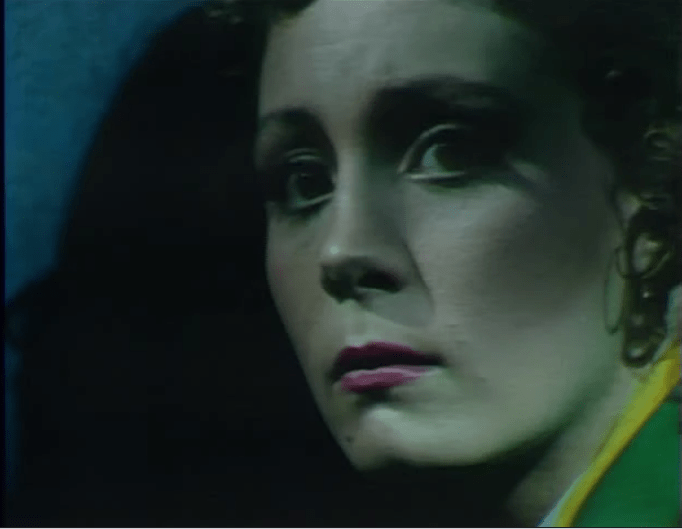
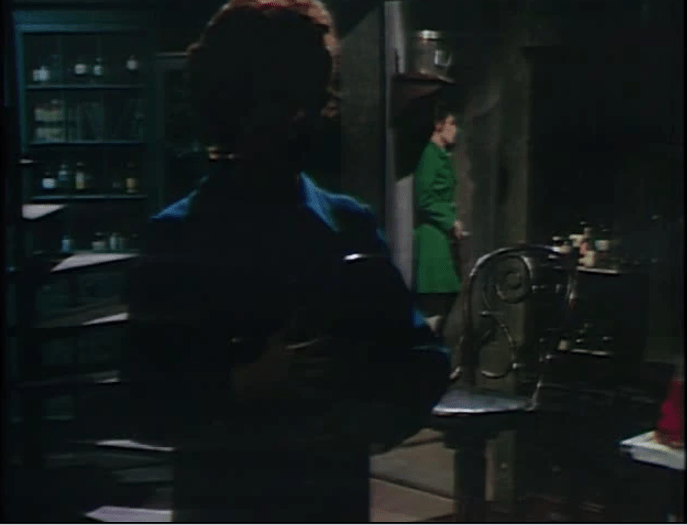
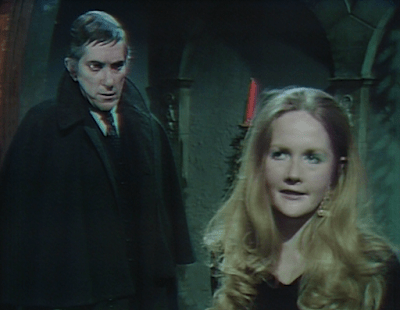
Wicked witch Angelique has returned from the dead, murdered her twin sister Alexis, and assumed Alexis’ identity. Angelique’s widower Quentin had already welcomed Alexis as a more or less permanent guest at the great house of Collinwood. Quentin’s new wife, the former Maggie Evans, has left him. Angelique wants Quentin back, but has decided that she cannot overcome his obsession with Maggie unless Maggie returns to Collinwood, where she will be able to fight her directly. So she has cast a spell on Quentin to inflame his feelings for Maggie. Angelique expects this will cause him to bring Maggie home. Once she is there, Angelique will be able to complete her evil plan, which the writers don’t seem to have come up with yet.
Angelique’s spell goes awry. At the beginning of the episode, Quentin slashes a portrait of Maggie; at the end, he believes he has killed her, and is getting ready to hang himself so that he can join her in death. In between, he goes off and tells his friend, mad scientist Cyrus Longworth, how miserable he is. Angelique and Cyrus have a conversation about how sad Quentin is.
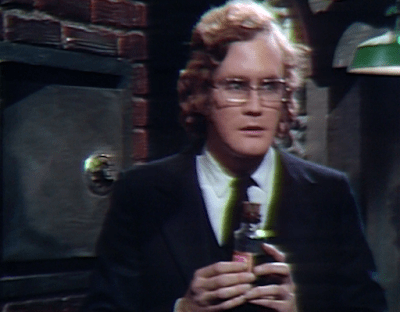
The performances are all good, but the only one that serves a purpose in the story is Christopher Pennock’s as Cyrus. Cyrus has devised a potion that changes his appearance so drastically that even the people who know him best do not recognize him when he is under its influence. This is supposed to be a Jekyll and Hyde story in which the innocent Cyrus is being consumed by his evil alter ego, “John Yaeger.” But it is all too obvious that Yaeger is just a disguise Cyrus puts on when he has decided to commit acts of rapine and slaughter. Today, Pennock really makes Cyrus seem like a well-intentioned nerd. When he puts the potion back in his safe and resolves never to become Yaeger again, we can believe that he is a better person when his hair is red than he is when it is dark.
Cyrus resolves to break his addiction to “Do Not Touch” juice. Screenshot by Dark Shadows Before I Die.
Also, he and Lara Parker have a fun moment when Cyrus and Angelique are talking about Quentin’s feelings. He gets carried away with a mad scientist rant about the horrible evil that dwells at the base of every human heart, prompting her to give him a puzzled look. It’s an effective comic take.
This episode marks the last appearance of Paula Laurence as Angelique’s aunt, Hannah Stokes. As Hannah, Laurence imitated some of the most recognizable mannerisms Parker incorporated in her portrayal of Angelique. This helped longtime viewers believe she was related to Angelique, and when she had scenes with Alexis the contrast showed us that Parker really was playing a different character. But the show isn’t big enough for two Angeliques, so Hannah’s days have been numbered for a while.
Since late March, Dark Shadows has been set in a universe parallel to the one we saw in the preceding 196 weeks. One of the most important characters in that original continuity was Angelique, a wicked witch who has been wreaking havoc on the estate of Collinwood at irregular intervals over the last 175 years. Angelique’s counterpart in this universe was born in 1939 in the village of Collinsport. She died in 1969, and came back to life in #1000, in April 1970.
This Angelique had an identical twin sister named Alexis. Alexis stayed at Collinwood as a guest of Angelique’s widower, gloomy sourpuss Quentin Collins, from #984. In #1001, Angelique murdered Alexis and took her place. Though Angelique had assembled a cult around herself, the most devoted members of which expected her to rise from the dead, she has disclosed her true identity only to her aunt, Hannah Stokes, whom she has used to do some of the dirtiest of the dirty work she has needed done these last three weeks.
Lara Parker played Angelique and Alexis, Paula Laurence played Hannah. Laurence’s approach to the part has involved an imitation of the mannerisms Parker brought to her portrayal of Angelique in the original continuity. Laurence even imitated the laugh Parker developed for Angelique. This helped us to believe that Hannah was a relative of Angelique, and it worked very well indeed when Hannah and Alexis were opposite each other. Longtime viewers could see that Parker really was playing a different character.
It was tricky when Angelique and Hannah had their first scenes together, in #1003. They pulled it off, because Angelique was pretending to be Alexis at the beginning of the first scene and Hannah was reeling in shock after she learned the truth. So Parker could dial down her Angelique-isms, and Laurence could dial up some non-Angelique-derived business she does. But today the two of them share a scene where they are arguing about a spell Angelique wants Hannah to help her cast, and neither Parker nor Laurence has any choice but to go all in on the most distinctive qualities of Angelique’s line delivery. The result is a few minutes of Dueling Angeliques, and it is embarrassing.
A climactic moment in the Angelique-off.
There are a couple of stories underway in this one. The spell Angelique wants to cast is one that will inflame Quentin’s love for his second wife, the former Maggie Evans. She wants Quentin to persuade Maggie to come back to Collinwood and live with him again. She has decided that as long as Maggie is living with her sister in New York, Quentin will be obsessed with her and she will never be able to win him away from her. Hannah points out some of the flaws with this plan, and indeed the episode ends with Quentin, under the influence of the spell, about to stab Angelique.
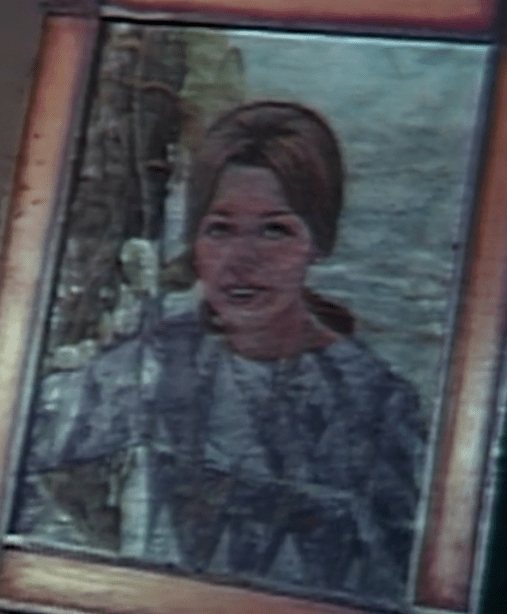
Maggie’s portrait arrives from Paris. This mirrors the arrival of the portrait of the gracious Josette from Paris in #402. Unfortunately, this portrait is far inferior, not only to the portrait of Josette, but to most of the paintings that decorate the set, including the portrait of Angelique Stokes Collins that is one of the major props in the current segment. It looks like it was done by some photo-transfer process. I think Dan Curtis Productions probably just overspent on the portrait of the first Mrs Quentin Collins, but it makes it look like Quentin didn’t care enough about Maggie to hire a real artist to paint her.
A portrait of the second Mrs Quentin Collins.
Vampire Barnabas Collins has crossed over from the main continuity. Today he runs into strange and troubled teen Daniel Collins, who suspects something is wrong with him and is about to go report to Quentin. Barnabas does a “Look into my eyes!” and makes him forget they met. There are a couple of infelicities with that scene. We see Barnabas’ reflection in a mirror. The show has made a big point of his inability to cast a reflection, so it’s always awkward when that happens. This one is especially bad, because Barnabas tells Daniel to examine his own reflection in his eye, putting the concept of reflections front and center. They’ve been stressing that we are in a “Mirror Universe” by cramming every vertical surface with mirrors, so we’re going to see Barnabas’ reflection again.
Also, Quentin and others are aware that there is another universe near them, that someone named Barnabas Collins went missing from it recently, and that that Barnabas is under a “terrible curse.” Had Barnabas used the power we saw earlier in the episode and vanished into thin air as soon as Daniel saw him, he could have used that as evidence that he was a different Barnabas. He could explain the vanishing by suggesting that Daniel had glimpsed the other universe just as the portal that allows people to see into it was closing. Since the scene takes place in the very room where the portal is visible, the audience may well have been expecting him to do something like that, and it certainly would have been interesting to see him play it out.
Vampire Barnabas Collins has escaped from the continuity in which Dark Shadows took place until late March 1970 and found himself in an alternate universe, which the show insists on calling “Parallel Time.” This universe is largely populated by people who remind Barnabas of their counterparts in his own world, but their personalities and relationships are very different from those he knew. His own counterpart is a case in point. That other Barnabas Collins never became a vampire, but lived a quiet life and died a natural death in 1830.
Barnabas’ first few weeks in Parallel Time were spent trapped in a coffin. Alcoholic novelist Will Loomis found out about Barnabas after he saw fang marks on the neck of his wife, the former Carolyn Collins Stoddard, and decided he could force Barnabas to give him a complete history of his career as a vampire. Will was under the impression this would make a good book. Will’s irresponsibility in keeping a vampire as a pet, his cruelty in exploiting a fellow creature for his own gain, and his lack of literary judgment in imagining that a recounting of the plot of weeks 43 through 196 of Dark Shadows would be both a bestseller and a critical favorite come back to bite him. More precisely, Barnabas comes to bite him when Will lets him out of his coffin and turns his back on him for a moment during their interview, taking the cross out of his sight and freeing Barnabas to attack.
Barnabas forces Will to burn all the pages he has already written. The idea of a book detailing Barnabas’ crimes featured in #326, #510, and #756, and may have planted the seed for the whole conception of Will Loomis.
Will and Carolyn live in the Old House on the grounds of the estate of Collinwood, which in the original continuity belongs to Barnabas. The pages are still in the fireplace when drunken sourpuss Quentin Collins, master of the great house of Collinwood and proprietor of the family businesses, bangs on the door and demands admittance.
Quentin interrogates Will. The name “Barnabas Collins” has been cropping up in the oddest connections lately, and Quentin is convinced Will knows why. Their exchange is getting quite warm when Barnabas enters and introduces himself.
Quentin is bewildered to see Barnabas. Through a time warp that occasionally manifests in the east wing of his house, he has caught a few glimpses of the original continuity, mostly in the form of people standing around talking about how Barnabas is missing and is under a terrible curse. So he is inclined to be leery of this fellow claiming to be a descendant of the Barnabas who died in 1830. Barnabas specifies that his great-grandfather was the son of that Barnabas, the son who went to Peru in the nineteenth century. Quentin had read that that son of Barnabas died while still in Peru. Barnabas says that he did not die in that country. He does not specify where his ancestor went after leaving Peru, but says he spent the rest of his life in poverty. He was so ashamed of this circumstance that neither he nor any member of his family could bear to reconnect with the rich Collinses in Maine. Barnabas claims that he has now made a fortune of his own, leading him to conclude that the time is right for a reunion. Barnabas invites himself to the great house in an hour. Quentin says that the morning would be better, to which Barnabas replies that he will not be free then. Quentin acquiesces.
Quentin exits, and Barnabas orders Will to accompany him to the grave of his counterpart. Longtime viewers will remember #660, when Barnabas managed to travel back in time by going to a grave and yelling at its occupant. Now he hopes to travel sideways in time, returning to his own universe, by the same technique.
Barnabas and Will enter a graveyard we have seen several times in the last seven weeks. It differs from the cemeteries we have seen in the original continuity in that none of the grave markers is in the form of a cross. Most of the graves in the cemetery from which Barnabas emerged were marked with crosses, and he strolled by them with perfect equanimity. The cemetery set was built for Barnabas, so evidently it was not the original plan that the cross would be formidable to him. It wasn’t until #450, 48 weeks after Barnabas debuted, that he was first held at bay with a cross. Even after that, he still strolled placidly through the field of crosses in Eagle Hill Cemetery. Now the apotropaic power of the cross is a major point, and they have designed the cemetery in this universe to accommodate Barnabas’ special needs.
Barnabas calls on his counterpart. He conjures up a spirit, but it is not that of Barnabas Collins (d. 1830.) It is Joshua Collins, father of that Barnabas. The sight prompts Barnabas to gasp “Father!” Joshua denies that Barnabas is any kin to him. Barnabas tries to explain that, while that is true, he is nonetheless Barnabas Collins, son of Joshua, eliciting an angry command “Do not profane those names!” Joshua tells Barnabas to take his vileness back where it came from. Before Barnabas can explain that is what he is trying to do, Joshua vanishes.
Joshua appeared to Quentin and Angelique in #1009. That turn was not particularly effective. The visual composition made it too clear that Louis Edmonds was standing in the same space as David Selby and Lara Parker for the actors to create any sense of the uncanny. And Joshua hung around too long and had too many lines for it to make sense that he couldn’t give any useful information. But this time Joshua is off to the side, lit by his own light, and he disappears after just a few seconds. It is a powerful scene, especially for longtime viewers who remember the relationship between Barnabas and Joshua we saw when the show was set in the 1790s from November 1967 to March 1968.
Will is terrified. The apparition leaves him trembling and speechless. So far Will has cut an arrogant, self-assured figure. He handled his encounter with the vampire with aplomb. Even after Barnabas bit him, his resistance to the command to burn the pages showed that self-assured personality is still partly functional. But the ghost of Joshua has blasted away the last of it.
Barnabas tells Will that he now has only one way back to his own universe, the way he came. There is a room in the east wing of the great house that is bare and vacant in Barnabas’ universe, but that is fully furnished, richly decorated, and brightly lit here. When Quentin’s wife Angelique Stokes Collins was alive, it was her bedroom. Now Quentin has given it to Angelique’s identical twin sister Alexis to occupy while she is his guest. The barrier between the universes is at its thinnest there. Barnabas could occasionally see into Angelique and Alexis’ room from the main continuity, and it was when he was looking through the doors to the room that Quentin has seen that other Collinwood. Barnabas was in the room when it changed, and found himself here. Now he wants to go back to the room, and make the opposite journey.
What neither Barnabas nor Quentin knows is that Angelique has returned from the dead and murdered Alexis. Angelique is now impersonating Alexis. In her life, Angelique had built a little cult of people who expected her to transcend death. The only one she has so far told that she has actually done so is her aunt, Hannah Stokes. Everyone else believes she is Alexis.
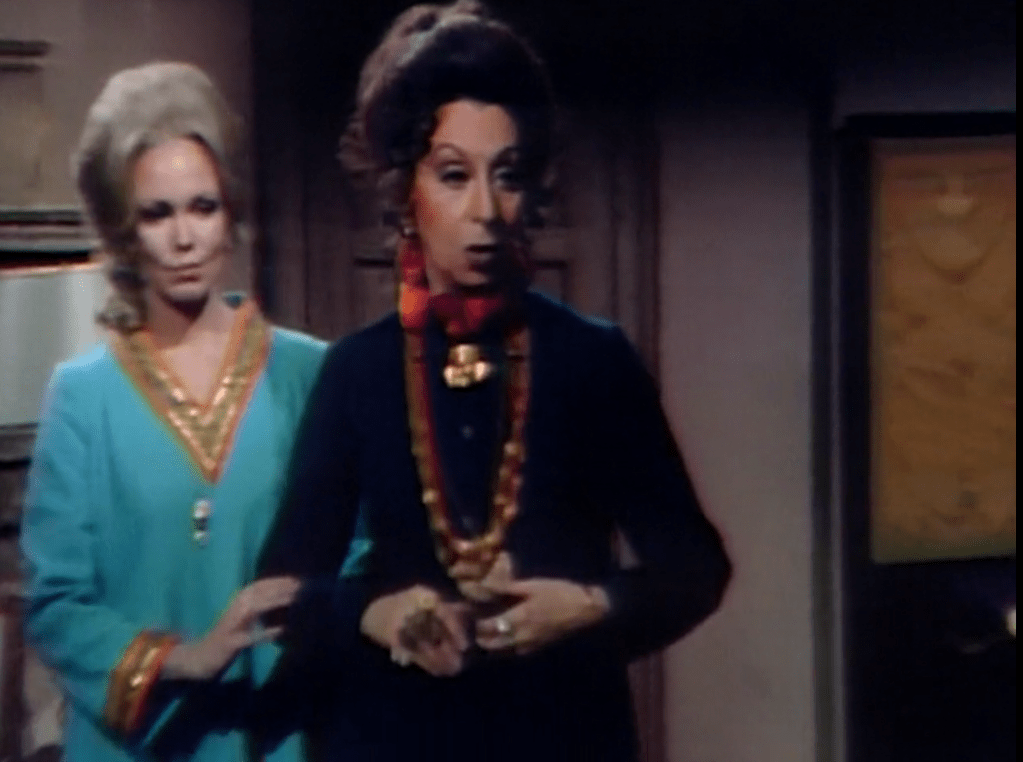
Barnabas enters the drawing room of the great house, where Quentin introduces him to “Alexis” and to housekeeper Julia Hoffman, the most devoted member of Angelique’s cult. Hoffman and “Alexis” had been talking about Barnabas before he arrived. Hoffman expressed certainty that Barnabas is a fraud. But after he and Quentin leave to examine the room where the Parallel Time phenomenon can sometimes be seen, she admits that his resemblance to the portrait of Barnabas is too strong to disregard. “Alexis” remembers what Quentin heard while he was watching the people in the room, and asks Hoffman if Barnabas looks like a man under a curse. She does not appear to have expected this question.
Quentin takes Barnabas to the room. Sure enough, the other continuity is visible. Barnabas’ best friend is there, talking to herself about how much she hopes to see him again. She is mad scientist Julia Hoffman, MD, counterpart of Hoffman. Julia is as devoted to Barnabas as Hoffman is to Angelique. Seeing her, we wonder how long Angelique can keep it a secret from her Julia Hoffman that she has returned.
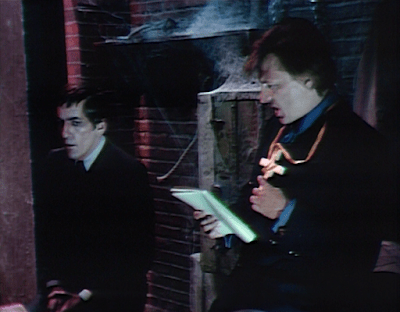
Mad scientist Cyrus Longworth has developed a potion that changes his appearance so drastically that even those closest to him cannot recognize him when he is under its influence. In this disguise, he calls himself “John Yaeger” and indulges his sadistic impulses. He has just committed his first murder, killing a man who had learned his secret. The potion he needs to restore his usual looks is in his lab, but he can’t get there without passing the police. So he has ordered Buffie Harrington, a young woman he has been terrorizing, to fetch it for him. He was waiting for Buffie in a cave on the beach near the estate of Collinwood when he saw the signs of a secret passage, and decided to see where it would lead him.
It has led him to the basement of the Old House on the estate, home of writer Will Loomis and his wife, the former Carolyn Collins Stoddard. We have known that this passage was here since #1003, when strange and troubled teen Daniel Collins suggested that his young cousin, Amy Collins, join him in opening it and exploring the basement. Amy refused to go there at night, prompting Daniel to taunt her as a scared-y-cat. We also know, if only because the opening voiceover has been telling us every day for the last five and a half weeks, that vampire Barnabas Collins is chained in a coffin in the basement. Will is holding him captive and forcing him to dictate his autobiography to him.
Barnabas is a visitor from a parallel universe. Longtime viewers are familiar with that universe; Dark Shadows was set there for its first 196 weeks. There is a tunnel between the beach and the basement there as well, and each time it has figured there has been a major development in the story. So when Cyrus, disguised as Yaeger, follows the tunnel and discovers Barnabas’ coffin, we can believe something big is about to happen. He starts to unchain the coffin; if he frees the vampire, that would certainly qualify.
Will and Carolyn are upstairs. She hears the sounds Cyrus is making in the basement and tells Will to go down and check. He takes this as an invitation to another of their drunken quarrels, in which he taunts her for being Barnabas’ victim. Eventually he does go downstairs, where he pistol-whips Cyrus into unconsciousness. He and Carolyn rather improbably manage to carry Cyrus up to the parlor.
When Cyrus comes to, he finds Carolyn aiming the pistol at him. He calls her by name. She does not recognize him, and asks how he knows her. He tells her that he makes it his business to know who all the attractive women are. He asks why Will isn’t there. She doesn’t answer the question. He sees that she is trembling so violently that she can barely keep hold of the pistol; he knocks it out of her hands and runs away. Later, he will meet Buffie in the cave, get the potion from her, and shed his disguise in time to get away with his crimes.
Will rejoins Carolyn in the parlor. He scolds her for letting the intruder escape; she says he was wrong to leave her alone with him. He says he was busy sealing up the panel so that no one else could come into the basement through the tunnel. He says that Barnabas’ coffin must be moved. His idea is to carry it up the stairs and hide it in a secret chamber behind the bookcase in the parlor.
This chamber, too, has its counterpart in the original continuity. We first saw it in December 1966, when crazed handyman Matthew Morgan abducted well-meaning governess Victoria Winters and planned to kill her there. After Barnabas joined the cast of characters in April 1967 and became the master of the Old House, he several times used the chamber as a hiding place. Matthew’s plans for Vicki backfired on him when the ghosts of Collinwood and scared him to death before he could carry out his fell design. None of the occasions when Barnabas used the chamber worked out very well for him. So longtime viewers may suspect that, even if Will and Carolyn can somehow transport Barnabas and his coffin up the stairs and into the hidden chamber, things will not go as they project.
Will and Carolyn let Barnabas out of his coffin. They wear large crosses around their necks, and hold them towards him when he looks at them. They get him up the stairs and into the secret chamber this way.
Once there, Will resumes interrogating Barnabas. Barnabas protests that Will has “enough story” and ought to set him free; Will disagrees. One wonders if Barnabas’ line represents Sam Hall’s feelings as one half of the two-man staff currently charged with writing five scripts a week for Dark Shadows.
Will’s counterpart in the original continuity is Willie Loomis, who was Barnabas’ sorely bedraggled blood thrall. In #326, Barnabas had framed Willie for some of his own crimes, and the police had obligingly shot him several times. Barnabas was worried that Willie was not dying quickly enough. He railed to his associate, mad scientist Julia Hoffman, that Willie continued to “cling to life with leech-like persistence!” When Julia assured him that Willie would probably die without regaining consciousness, Barnabas said that he might just as easily make a full recovery and set about “writing his memoirs!”
The show picked up on that line after it went back in time to the 1790s. We learned in #510 that Ben Stokes, the much-put-upon indentured servant who was Barnabas’ friend before and after he first became a vampire, did indeed write a memoir, and in #756 we learned that Ben’s memoir included the story of Barnabas’ curse. I wonder if Barnabas’ line to Julia about Willie writing his memoirs was the seed, not only of Ben’s memoirs, but of the whole story of Will Loomis.
Barnabas’ cartoonish villainy in #326 was hilarious, but his objections to Will’s behavior today are quite reasonable. Will would have been doing his civic duty had he staked Barnabas, and indeed Barnabas asked Will to let him die when he first found him in his coffin. Keeping him trapped in the coffin endangers the community irresponsibly, and when Will opens it night after night with Barnabas immobilized by the cross and forces him to produce an oral history he can use use as a source of material he is choosing to be as much of a parasite on Barnabas as Barnabas’ curse has forced him to be on his victims.
Moreover, when Will tells Carolyn today that the book he extracts from Barnabas will be “all true” and that “every critic” will hail it as “a classic,” he seems to be delusional. If it is “all true,” the book will be a novelization of the last 160 weeks of Dark Shadows. The show is fun to watch, but that’s largely because the writers know what kind of material the actors and directors can use to create exciting moments. I can’t imagine anyone looking at it as so much text sitting on the page and calling it “a classic.”
Will turns his back on Barnabas and takes a note. Seeing an opportunity, Barnabas grabs the cord by which the cross hangs from Will’s neck, choking him. Will falls to the floor, and Barnabas bares his fangs.
I haven’t read Anne Rice’s 1976 novel Interview with the Vampire. Ms Rice says she wrote a short story about a reporter taking an oral history from a vampire no later than 1969, the year before this storyline premiered. That story has never been published, but biographers of hers report having seen it and they accept the dating. She also says that she decided to turn it into a novel in 1973, not because she had seen Dark Shadows, but because her daughter had died and she thought it would be a way of exploring her grief. So, any similarities are mere coincidence. I bring it up here, because it represents the definitive refutation of Will’s expectation that “every critic” would hail his retelling of Dark Shadows from the time Barnabas debuted as “a classic.” Ms Rice was free to craft a story that would be right for a novel, unconstrained to copy material produced to keep a soap opera spinning, and most of the reviews she received were quite hostile.
Mad scientist Cyrus Longworth has devised a potion that alters his appearance so that even the people who know him best, including his fiancée Sabrina Stuart and his attorney Larry Chase, cannot recognize him. When he is thus disguised he calls himself “John Yaeger” and indulges his sadistic impulses. One of his favorite hobbies is beating and intimidating a woman named Buffie Harrington, who submits to his abuse for psychological reasons the show never explains, but for clues to which Elizabeth’s Eis’ performance keeps us watching closely. Buffie does not know that Yaeger is really Cyrus. As Sabrina and Larry have not recognized Cyrus when they saw him as Yaeger, so Buffie has not recognized Cyrus when she has met him undisguised.
The only person who has so far figured out Cyrus’ secret is chemist Horace Gladstone. Cyrus bought a vital ingredient for his potion from Gladstone, who knows that it can be used to change a person’s appearance. He has had dealings with Cyrus when he was presenting himself as Yaeger, has seen his handwriting in both states, and has questioned both Sabrina and Buffie. Combined with several other pieces of evidence, Gladstone was able to build an overwhelming case that Yaeger is merely Cyrus in disguise. Yesterday he demanded Cyrus pay him $10,000 in return for a continued supply of the ingredient and his silence. Cyrus responded by drinking the potion to assume his disguise, going to a dark alley where he had gleaned from an indiscretion on Larry’s part Gladstone would be waiting, and murdering him. Larry arrived at the scene a moment later and pursued “Yaeger” on foot from the alley to the courtyard behind Cyrus’ place. He saw “Yaeger” jump the fence into the courtyard.
As Yaeger, Cyrus enters his laboratory through the door in the courtyard. He is about to take the antidote to change his appearance back to normal when he hears Sabrina and Larry coming downstairs. He hastens out the way he came. Eavesdropping through the courtyard door, he is relieved to hear Larry say that he did not get a good enough look at him to be able to make a positive identification. He hears Larry place a call to the police, and exits.
Cyrus goes back to the alley where he killed Gladstone. Buffie enters, getting off her shift as a barmaid at the Eagle tavern. The tavern abuts the alley, but evidently the police didn’t think it was necessary to bother her with news of the murder. He demands she do him a favor. She says she is too tired to do anything tonight; he says it’s better to be tired than dead. Whatever it is that compels Buffie to keep coming back to Cyrus in his Yaeger form is strong enough that this death threat does not drive her away. She protests that she does not have a criminal record and wants to keep it that way; he tells her she won’t get caught. He gives her the keys to his lab and the combination to his safe and orders her to take the bottle containing the antidote. He tells her to bring the bottle to him in a cave on the beach below the estate of Collinwood.
Buffie goes to the courtyard door. She is about to open it when she hears Sabrina and Larry inside the lab, talking about Gladstone’s murder. When the name “John Yaeger” comes up as a suspect, she looks down. We can see a forlornness in her face. She is as much addicted to his hard domination of her as Cyrus is addicted to violence, but she still does not want to think of herself as a criminal, certainly not as an accessory to murder.
Buffie hears about Yaeger as a murder suspect. Screenshot by Dark Shadows Wiki.
When Sabrina and Larry go upstairs, Buffie lets herself in to the lab. She has removed the painting that covers the safe and is starting to turn the dial for the combination when she hears Sabrina tell Larry she has to go back downstairs to retrieve something she left in the lab. Buffie hides by the door while Sabrina collects her purse. The purse is right next to the painting, but the room is dark. We are in suspense whether Sabrina will see it. She doesn’t, she leaves, and Buffie gets the bottle.
In the cave, Cyrus notices footprints going up to a pile of stones that appear to be a natural part of the cave wall. He realizes that the stones must be hiding a secret passage. He is curious where it leads, and figures it will be at least half an hour before Buffie comes. So he starts pulling the stones down.
Cyrus follows the path into the basement of the Old House on the grounds of Collinwood. This house is currently occupied by writer Will Loomis and his wife, the former Carolyn Collins Stoddard. Cyrus realizes where he is, and finds a chained coffin. He wonders what secret Will might be hiding from the world. He decides that if the secret is shameful enough, it might come in handy. He breaks the first chain, intending to open the coffin.
The opening voiceover, delivered arrestingly by Eis, told us what is in the coffin. It is a visitor from a parallel universe. He is named Barnabas Collins, and he is a vampire. Will is holding Barnabas prisoner in the coffin and taking an oral history from him, which he plans to use as the basis of his next book. Longtime viewers of Dark Shadows are familiar with Barnabas’ native universe; the first 196 weeks of the show were set there. As Will put chains on Barnabas’ coffin in the hope of finding a fortune in his stories, Will’s counterpart, dangerously unstable ruffian Willie Loomis, took the chains off Barnabas’ coffin in hopes of finding a fortune in jewels. In his universe, Barnabas is the master of the Old House and he keeps his coffin in the space where Will has it here. It has occasionally been opened by intruders; the first time we saw that happen was in #275, when Willie’s sometime friend, seagoing con man Jason McGuire, lifted the lid at sunset, only to be greeted by Barnabas’ hand darting out and crushing his throat. If Cyrus gets the coffin open, Gladstone’s death might be avenged sooner than anyone could expect.
Gladstone’s death marks the final appearance of John Harkins. Harkins’ first appearance was in #174, in which he played Lieutenant Costa of the Arizona State Police. The most famous of his dozens of screen roles was in The Mary Tyler Moore Show, when he played the clergyman who officiates at the funeral of Chuckles the Clown. He also had a recurring role on Cagney & Lacey as Mansfield the drug kingpin. Harkins didn’t have any scenes with John Karlen, who was a regular both on that show and on Dark Shadows.
The Dark Shadows Wiki tells us that this is one of only six episodes with no cast member who appeared in 200 or more episodes. It lists the others as 168, 172, 180, 1141, and 1182. It also says that there is no one in it who joined the cast before David Selby’s debut as Quentin, but since Harkins was on almost two years before Mr Selby that is not so.
The name “Barnabas Collins” has been coming up in the oddest circumstances around the estate of Collinwood. The only person of that name known to drunken sourpuss Quentin Collins, the master of the great house, was an ancestor of his who lived a long dull life and died a natural death in 1830. Quentin has decided that it is time to ask Barnabas’ spirit what’s going on. He wants housekeeper Julia Hoffman to join him and his late wife Angelique’s identical twin sister, Alexis Stokes, in a séance.
Hoffman is reluctant to participate, and when the invocation prompts theremin music to start playing in the background she breaks the circle of fingers and runs out of the drawing room. But Hoffman is not the most problematic participant. Alexis is not in fact present. Angelique returned from the dead, murdered her, and took her place. Unknown to Hoffman or to Quentin, it is the undead Angelique who is at the table with them.
“Alexis” tells Quentin that she felt a presence before Hoffman broke the circle, but that it is gone now. Suddenly a figure appears in the corner of the room. He identifies himself as the ghost of Joshua Collins, father of Barnabas. Joshua addresses his remarks to Quentin, ignoring “Alexis.” He says that Quentin knows all he needs to know about his son Barnabas, but that there is another entity at Collinwood, an evil that is at once living and dead. “Alexis” looks shocked and says “Living and dead? How can that be possible?” I suppose we should praise Lara Parker for resisting the temptation to pad her part by visibly squirming and playing up the fact that this describes her character precisely. She is giving the audience credit for the brains needed to make that connection. But if I wanted a show that gave me credit for brains, I wouldn’t watch Dark Shadows every evening, so I’m disappointed. I wish she were tugging on her collar and fidgeting like a Hank Azaria character on The Simpsons.
Joshua can’t be any more specific. This might have been OK had he just flickered into view for a few seconds, uttered his vague warning, and flickered out. We would then be left thinking of the awe-inspiring improbability of even the most fleeting communication between the living and the dead. But as Joshua, Louis Edmonds stands there for several minutes, in the same light as the other actors. They’ve had trouble with one of the microphones lately, occasionally making one actor sound like they are far away from the person standing next to them, but that microphone isn’t used in this scene. Both the audio and the video make it clear Joshua is occupying the same space as Quentin and “Alexis.” The result is an embarrassment for which writer Gordon Russell and director Henry Kaplan must share the blame.
This embarrassment is particularly disappointing under the circumstances. The scene is Edmonds’ first appearance since going off to play his part in the feature House of Dark Shadows after #990, and the first appearance of this Joshua Collins. Edmonds played another version of Joshua from November 1967 to March 1968, when Dark Shadows was set in a different universe. That Joshua figured in a costume drama segment set in the 1790s. He emerged as the central figure in a tragedy in the course of which his son Barnabas became a vampire and he had to decide what to do about him.
This Joshua never dealt with such a curse. The audience knows, if only because the opening voiceover told us, that the vampire Barnabas has crossed over into this universe, into this year 1970, and that he is at present trapped in a chained coffin in the basement of the home where the Joshua we meet today raised that other, luckier Barnabas. We last saw the other Joshua in #623, and longtime viewers will be excited at the idea of seeing Edmonds reprise the character who was perhaps his greatest triumph. To see him in such a debacle lets us down hard.
After Joshua leaves, Quentin and “Alexis” talk for a moment. Then Quentin’s brother Roger enters. Roger is also played by Louis Edmonds, but neither Quentin nor “Alexis” notices that he looks like Joshua. This works well enough, since Edmonds takes a very different posture and tone as Roger than he had as Joshua. Joshua was erect and stentorian, Roger curls to his left as he sits on the couch and purrs about how tedious it is to read about the life of the late Barnabas.
Quentin exits, and Roger talks with “Alexis.” He says that despite her resemblance to her sister, he never for a moment thought she was Angelique. In fact, when he first met the real Alexis he was utterly shocked, certain she was Angelique, and she had to work hard to bring him around. But Angelique doesn’t know about that, and Roger doesn’t want to remember it, so she just looks at him placidly while he goes on and on about how unlike anyone else Angelique was and how he knew her more intimately than anyone else could, even though she was married to Quentin.
I suppose Russell may have been trying to make a point by juxtaposing Joshua’s long pointless speech in which he keeps referring to Quentin’s responsibilities as the master of Collinwood with Roger’s long pointless speech in which he keeps referring to his mystical connection with his brother’s late wife. We saw in the 1790s segment that the Joshua of the other continuity was the victim of his own virtues. A forceful, dynamic man devoted to his family and its honor, he became a tyrant in pursuit of his worthy goals, and saw everyone he loved destroyed in part because of his haughtiness. As generation followed generation, Joshua’s misguided strength and brittle courage would yield to ever weaker, ever-softer descendants. Perhaps in the contrast between this Joshua’s attempt to help his successor use the authority he once held when he cannot impart any useful information and Roger’s fatuous pretense to have known Angelique uniquely well when he cannot recognize that he is talking to her we can see the same decline in this iteration of the Collins family.
The Legal Eagle
Meanwhile, mad scientist Cyrus Longworth has a problem of his own. Cyrus has developed a potion which, when he drinks it, transforms his appearance so drastically that even those closest to him cannot recognize him. When thus disguised, he calls himself “John Yaeger,” spends a lot of money, and beats people up. This makes him very happy, but now chemist Horace Gladstone, his connection for one of the potion’s vital ingredients, has learned his secret. Gladstone will not supply him with more of the ingredient or keep his mouth shut about Cyrus’ crimes unless he gets $10,000 in cash.
Cyrus’ lawyer, Larry Chase, comes to his laboratory. On Cyrus’ instructions, Larry has drawn up a will naming “Yaeger” as the sole beneficiary of Cyrus’ estate. Larry has met “Yaeger” and been appalled by him. He urges Cyrus to reconsider. Cyrus signs the papers and invites Larry to a late supper. Larry declines, saying that Horace Gladstone called him earlier and wants to meet him outside the Eagle tavern at 10 PM.
Larry was in the drawing room at Collinwood going over some papers with Quentin when he got Gladstone’s call. Cyrus’ newly drafted will fell out of Larry’s briefcase, and Quentin read through it while Larry was looking for another document. Quentin asked some questions about the will. Larry responded to the first by saying that he couldn’t talk about it, but thereafter blabbed away, revealing everything Quentin could want to know. With that level of regard for a client’s confidential communications, we aren’t surprised when Larry tells Cyrus who he is going to meet at what time in what place.
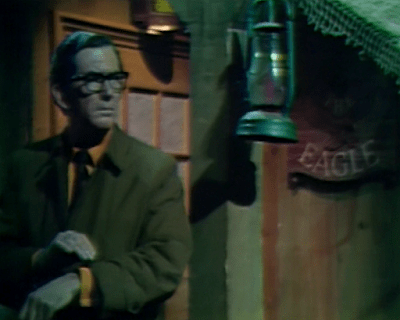
After Larry goes, Cyrus takes the potion, that is, puts on his disguise. He goes to the alley next to the Eagle, in which the sign for the Greenfield Inn hangs. He corners Gladstone there. He beats Gladstone to the pavement with his heavy cane. Gladstone begs for mercy, and Cyrus sneers at him. He releases the bayonet from inside the cane, stabbing Gladstone with it. The first time Cyrus took the potion, he had amnesia after he resumed his normal appearance, and we could believe that he was less than fully responsible for what he did while under its influence. But he has had his full memories on each subsequent occasion, and has shown pleasure when told of the harm “Yaeger” has done and the fear he inspires. By this point, we can classify Cyrus’ killing of Gladstone as nothing other than premeditated murder.
Cyrus doesn’t really surprise us by this act. It is Larry who does something we would not have expected. While Gladstone is in the alley, Larry is already in front of the tavern. We see enough of the set that we cannot believe he is more than 30 or 40 feet away from Gladstone, just around the corner. Gladstone cries out when “Yaeger” attacks him. We cut to Larry, and see him react to that cry and start towards the alley. “Yaeger” stands over Gladstone and pontificates for a minute or two before stabbing him. Even after that, “Yaeger” still has time to get most of the way out of the alley before Larry finally arrives. It took Joshua Collins less time to get from the abode of the dead to the drawing room at Collinwood than it takes Larry to walk the few steps from the sidewalk to the alley. Maybe he had to stop somewhere along the way to make some more announcements about a client’s business.
From the time he joined the cast of characters in April 1967, vampire Barnabas Collins has been the most famous thing about Dark Shadows. We haven’t seen him in over a month. He passed through a cosmic rift in #980, leaving his native universe behind and arriving in another “time-band” populated largely by counterparts of people he knew. In the original continuity, Barnabas was freed from his coffin when dangerously unstable ruffian Willie Loomis unchained it, believing he would extract from it a treasure in jewels that would make him rich. Here, Barnabas is trapped in his coffin when Willie’s counterpart, author William H. Loomis, chains it, believing he will extract a story from Barnabas that will make him rich.
We haven’t seen any of Will Loomis’ oral history sessions with Barnabas, since John Karlen and Jonathan Frid have both been in Tarrytown, New York. Along with many other key members of the cast, they have been filming their parts in the feature House of Dark Shadows. That production is nearing a wrap, and several other cast members have already come back. Today’s story is all about Barnabas’ impending return.
When Barnabas found himself in “Parallel Time,” the first person he met was Will’s wife, the counterpart of Barnabas’ distant cousin Carolyn Collins Stoddard. He told Carolyn that he was a descendant of the eighteenth century Barnabas Collins, of whom a portrait hangs in the foyer of the great house of Collinwood. In his own universe, that portrait does hang there, and it has been Barnabas’ letter of introduction to the Collinses more than once. But Carolyn told him there was no such portrait there or, so far as she knows, anywhere else. So he bit her and made her his blood thrall.
Indeed, the other day we saw the spot on the wall where Barnabas’ portrait hangs in the main continuity, and it was not there. Instead, there was a metallic decoration reminiscent of a coat of arms. That decoration hung there before Barnabas’ portrait first appeared in #204. So few of the people watching at this point in 1970 had been in the audience in early 1967, and so few of those would have made note of what was hanging on the walls, that I can’t imagine one viewer in ten thousand would have caught the reference during the first broadcast. None of the writers currently with the show was on staff then, nor was line producer Peter Miner. It’s one of those moments when I suspect director Lela Swift and art director Sy Tomashoff were decorating the set for their own amusement.
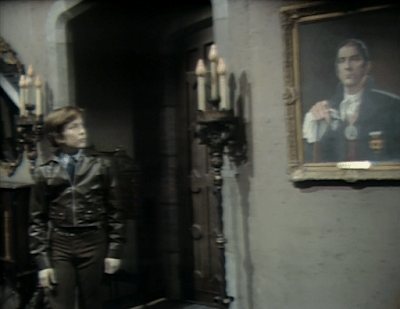
Today, a portrait of Barnabas has taken the place of the coat of arms. Children Daniel and Amy Collins found it in the attic of Will and Carolyn’s house, and for some reason housekeeper Julia Hoffman and butler Mr Trask decided to hang it up by the front door. It is a copy of the one we have seen over the last three years. It depicts Barnabas’ counterpart in this universe, a man who lived a quiet life and died a natural death in 1830.
The master of Collinwood, drunken sourpuss Quentin Collins, is shocked to see the portrait, and orders it to be removed immediately. Daniel’s counterpart, strange and troubled boy David Collins, had been the first to speak Barnabas’ name when he called Willie’s attention to the portrait in #205. Shortly after, Willie heard a heartbeat coming from the portrait, which led him to make his fateful trip to open the coffin. In this continuity, it is Daniel who hears the heartbeat, and he will today try to find and open the coffin.
Quentin has caught two glimpses of the other universe in the room in the east wing that was his late wife Angelique’s bedroom. Unknown to Quentin, Angelique has returned from the dead and murdered her identical twin sister Alexis. Quentin thinks that it is Alexis who is his guest in the great house, staying in her sister’s old room. When he tells her today what he saw, “Alexis” thinks he is losing his mind. But she then sees the phenomenon herself. She sees Hoffman’s counterpart calling for Barnabas, as Quentin had seen her talking about Barnabas’ “terrible curse.” “Alexis” and Quentin decide that they and Hoffman should have a séance to contact the spirit of the Barnabas Collins who died in their universe in 1830, the only Barnabas Collins they know of.
In the main continuity, séances are a frequent occurrence; we have seen fourteen of them there, and heard a detailed account of a fifteenth. In the early days, there was always one participant who tried to break the circle, only to be sternly reproved by the leader. The characters stopped doing that as they got to be familiar with the procedure, but séances are rarer in this universe. As things start to get interesting, Hoffman can’t take it anymore. She breaks the circle and runs out. “Alexis” says that the presence she felt is gone. But then a ghost materializes in the corner of the room.
Dark Shadows has taken us to a parallel universe where the A story is a mashup of Daphne Du Maurier’s 1938 novel Rebecca with Edgar Allan Poe’s 1838 story “Ligeia,” and the B story is a retelling of Robert Louis Stevenson’s 1886 novella Dr Jekyll and Mr Hyde. Today we also get a good look at the C story, another mashup. The ingredients in this one are Dracula and Who’s Afraid of Virginia Woolf.
Drunken novelist William H. Loomis and his disappointed wife, the former Carolyn Collins Stoddard, take the roles of George and Martha. The parts of Nick, of Honey, and of George and Martha’s imaginary son are combined in vampire Barnabas Collins.
Honey is present at two conversations with George and Martha. She flees from each, moved to vomit by their cruelties, and after the second is never seen again. One session with Will and Carolyn was enough for Barnabas. The circumstances of his exit were rather different from those of Honey’s. Barnabas did not become physically ill when he saw Will and Carolyn quarreling, and is willing to keep skulking in and out of their basement when he is not out preying upon the living. But Will has other ideas. He has chained Barnabas in his coffin in the basement of their house and is planning to force him to tell him his life story, which Will thinks he will be able to use as material for a book that will restore his fortunes. In this he is the mirror image of his counterpart in the main continuity, who broke the chains that held Barnabas in his coffin in his own attempt to get rich quick.
As Martha taunts George for the dead end his career has reached, Carolyn is in the habit of taunting Will with his inability to write new books of his own. As Martha flirts aggressively with Nick in front of George, so Carolyn wants Will to release Barnabas so that he can drink her blood again. As George and Martha’s son turns out to be imaginary, not part of their material reality, so Barnabas is a visitor from the main continuity, not a part of this universe. Inasmuch as Jonathan Frid is away for several weeks making the feature House of Dark Shadows, Barnabas is present only as a topic in Will and Carolyn’s quarrels.
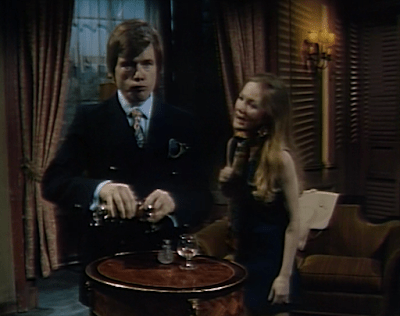
Will pours himself a glass of something, perhaps bergin and water. Screenshot by Dark Shadows Before I Die.
One might wonder if the idea of casting John Karlen as an analogue of George in an adaptation of Who’s Afraid of Virginia Woolf? occurred to the makers of the show around the time of #706. In that episode, Karlen played inveterate prankster Carl Collins, who held a gun at Barnabas’ head and threatened to shoot him. When he pulled the trigger, a flag labeled FIB! sprang out. George fires a rifle at Martha in Act One of the play, only to produce a similar effect with a Chinese parasol.
Later, Carolyn is eavesdropping outside the drawing room in the great house of Collinwood while Will is flirting with a lovely houseguest, a central character in the Rebecca/ Ligeia mashup. Carolyn stands in the doorway, in Will’s line of sight when he tries to make a date with the woman. Will has already rubbed Carolyn’s face in the intimate nature of her connection to Barnabas, and as his victim she can’t very well recreate Martha and Nick’s threat to cuckold George with any other male. So if we are going to have another scene built around that kind of insult, it will have to be Will who plays it with another woman.
Carolyn also spends some time with her friend Sabrina Stuart, who is part of the Jekyll and Hyde story. Sabrina is engaged to Dr Cyrus Longworth, the Jekyll character, and did not recognize him when last night he invaded her home and assaulted her in the persona of John Yaeger, the Mr Hyde character. Cyrus himself is puzzled when he comes to his laboratory in the morning and finds a terrible mess there, along with an IOU from Yaeger. A policeman shows up and asks him some questions, assuring him that he does not match the description of Yaeger. In his post about the episode on his great Dark Shadows Every Day, Danny Horn points out that this scene is recycled beat for beat from Dan Curtis’ 1968 TV movie adaption of Jekyll and Hyde.
Carolyn marches into Cyrus’ lab and tells him Sabrina is missing. She is angry with him for leaving Sabrina alone when the man who attacked her is still at large. He tries to assure her that Sabrina is in no danger, but since he cannot explain why he would believe that he only exasperates her further. She insists they go looking for Sabrina, and he acquiesces. It turns out Sabrina is in the great house of Collinwood, in a trance, trying to reenact the séance at which the Rebecca analogue died.
In the main continuity, Carolyn’s counterpart was married to someone whom she believed to be a man named Jeb. Like Cyrus, he was played by Christopher Pennock. Also like Cyrus, he was a shape-shifter who in his other form committed horrific acts of violence. Carolyn accepted Jeb’s refusal to tell him anything about himself, as Sabrina accepts Cyrus’ refusal to tell her anything that might lead her to suspect the nature of the potion he has developed. It is refreshing to see this Carolyn taking Sabrina’s side and insisting Cyrus do things a reasonable person might do.
In #210, dangerously unstable ruffian Willie Loomis found a coffin wrapped in chains in an old mausoleum and jumped to the conclusion that it was full of jewels. He broke the chains and opened the coffin, only to find that it actually contained vampire Barnabas Collins. Barnabas bit Willie and enslaved him.
Now, Barnabas has traveled to an alternate universe. In this “Parallel Time,” Willie’s counterpart is a writer, the author of several novels and of a biography of Barnabas’ own counterpart, who died a natural death in 1830. This Will Loomis lives in the Old House on the estate of Collinwood, which corresponds to Barnabas’ home in his own universe. Will’s wife, the former Carolyn Collins Stoddard, was the first person Barnabas met upon arriving in Parallel Time. Barnabas took Carolyn as his blood thrall, and he has shown her a room in the basement of the Old House that she never knew existed. He stashed a coffin there.
Three of Will’s novels were bestsellers made into feature films, but he and Carolyn are now acutely short of funds. We see why today. Carolyn explains to Barnabas that Will won’t be home until the Eagle closes. Barnabas asks what the Eagle is. He should know- that was the name of the tavern in his Collinsport in the 1790s and again in 1897, and he knew it in both eras. The same place was called the Blue Whale in the 1960s in the main continuity, but evidently it kept its old name here.
Will comes staggering home. He recognizes Barnabas’ profile from a sketch of the subject of the biography he wrote. Carolyn explains that Barnabas is that man’s descendant. When Barnabas says that he read Will’s book and admires it, Will brightens, as authors do, and says that the occasion calls for a drink. At first he insists on putting Barnabas up as a houseguest, free of charge, but Carolyn persuades him to let Barnabas pay rent. It’s anyone’s guess how Barnabas will be paying for anything- he stumbled into “Parallel Time” quite inadvertently, without stuffing his pockets or putting on a money belt or making any other preparations. But Will and Carolyn have an extensive discussion about charging Barnabas rent in this scene, and they bring it up again later. Evidently the writers want us to think about it.
The next day, Will suggests that he and Carolyn go to the great house on the estate to meet the new mistress, the bride of Carolyn’s uncle Quentin. Carolyn pleads a migraine, and Will goes by himself. Housekeeper Julia Hoffman is about to introduce him when he cuts her off. He tells the new Mrs Collins that he knew her father. She is the former Maggie Evans. The past tense about her father Sam is news to returning viewers- yesterday Sam was mentioned in terms that left it unclear whether he was still alive, and we might have hoped to see him. In the main continuity, Sam was killed by a Frankenstein’s monster in June 1968, but that monster would not have existed in this universe.
Will says that he and Sam spent many a night drinking together at the Eagle. The new Mrs Collins is not visibly pleased to be reminded of her father’s drinking habit. She offers Will a cup of tea, and he refuses. He avers that tannic acid is bad for the health. Hoffman is at hand with a glass of brandy, and she chuckles when she agrees with him that she can tell Maggie his views about beverages. Hoffman leaves, and Will urgently whispers to Maggie that he must not trust Hoffman.
Later, Maggie will go to Angelique’s old room in the east wing of the house and overhear Hoffman telling the portrait of Angelique that hangs there that she has her on the run. Hoffman cackles with glee at Maggie’s discomfort. Maggie opens the door and asks her what’s going on; Hoffman quickly composes herself and says that the staff hasn’t had a chance to tidy up the east wing sufficiently to welcome the new mistress.
Back in the Old House, Will wonders why Carolyn seems so weak. She passes out, and he sees the puncture wounds on her neck. At daybreak, Will waiting for Barnabas by the coffin. He holds him at bay with a large cross and forces him to explain who he is and where he came from. Barnabas tells Will to let him die. Will says he has other plans. He orders Barnabas to open the coffin. There is an even larger cross mounted inside the lid. He says that he will get a book out of Barnabas, and that that book will be his salvation. He makes Barnabas get in the coffin, and chains it shut. To the extent that this universe is a mirror image of the one we have known, we might have expected that Will would believe he could obtain a fortune by putting chains on the coffin, as Willie thought he could obtain one by smashing them off.
The scene between Will and Maggie brings out several of the problems with the current A story, a reworking of Daphne Du Maurier’s Rebecca in which Maggie is the second Mrs de Winter and Hoffman is Mrs Danvers. Maggie Prime has an iconography that goes back to #1, which makes it hard for us to believe that would be overwhelmed by the subtle intimidations that overwhelm Du Maurier’s anxiety-ridden heroine. When we met the Sam of the original continuity in June 1966, he was an alcoholic. Even after the story that was supposed to make Sam’s alcoholism interesting fizzled out and he was retconned as a social drinker, Maggie retained many Adult Child of an Alcoholic traits, such as beginning each utterance with an irrelevant laugh. So Maggie’s reaction to Will’s reminiscence about boozing it up with Parallel Sam goes a long way to confirming that this is the same ol’ Maggie we’ve known all along and leads us to expect her to be as capable as Maggie would be of meeting the challenges before her.
Also, while Kathryn Leigh Scott is a wonderful actress and a great asset to the show, she makes a bad choice in playing Maggie Collins. In the costume drama segment set in 1897, Miss Scott started out as neurotic intellectual Rachel Drummond. Rachel was terribly fragile, the survivor of an abusive childhood that left her with paralyzingly low self-esteem. Miss Scott went small as Rachel, taking a subtle approach that required us to watch her closely as we tried to figure out what she was feeling and thinking. But as Maggie Collins, Miss Scott cycles through five or six facial expressions per minute and crafts a distinctive emphasis on multiple syllables per sentence. The directors famously didn’t give the actors much guidance on Dark Shadows– John Karlen said that when he first took on the role of Willie, all Lela Swift told him was “Go!” But either Swift or today’s helmsman, Henry Kaplan, should have taken Miss Scott aside and told her she was overacting and giving Maggie Collins too vivid a personality.
Further, Will is only one of many allies who present themselves to Maggie in her showdown with the memory of Quentin’s first wife, the glamorous Angelique. The second Mrs de Winter feels herself all alone at the estate of Manderley, but Maggie can’t very well feel that way at Collinwood. Not only do people who live there keep making it clear they are on her side, she has a sister to whom she starts writing a letter today, who represents support from and connection with the outside world.
Worst of all, Hoffman is absolutely transparent. In the novel, it is not clear until the very end whether Mrs Danvers is even hostile to the second Mrs de Winter. Du Maurier keeps us guessing for 400 pages whether the whole thing is in the protagonist’s fevered imagination. But the cackling Maggie overhears when Hoffman is having her conversation with the portrait is not even the most flagrant sign she has so far given of her plans.
When Dark Shadows premiered in June 1966, it was supposed to bring the sensibility of the then-fashionable “Gothic romances” to the small screen. That did not prove to be much of a ratings draw, so six months later they introduced undead blonde fire witch Laura Murdoch Collins, who was at the center of a story that by March 1967 had swallowed up all of the major loose ends and committed the show to becoming a supernatural thriller.
Now, vampire Barnabas Collins has crossed over to an alternate universe. We have seen enough of “Parallel Time” over the last several episodes to know that it will feature a story derived from Daphne Du Maurier’s Rebecca, one of the foundational works of the “Gothic romance” genre. Viewers who have been with the show from the beginning will be intrigued at this return to its starting point.
The first person Barnabas meets is the counterpart of his distant cousin and onetime blood thrall, heiress Carolyn Collins Stoddard. This Carolyn finds him in a room deep in the great house of Collinwood and demands to know who he is and what he is doing there. He starts in on the “cousin from England” jazz that won him his place at Collinwood in the continuity we have been following so far. He cites the portrait of him that hangs in the foyer in the familiar timeline, only to be told that there is no such portrait in this house and that his story does not add up. Carolyn marches off to blow the whistle on the intruder, and Barnabas bites her. We can see that Parallel Time is going to move fast- it took Barnabas 28 weeks to attack Carolyn in the other universe.
This Carolyn is married to the counterpart of Barnabas’ servant Willie Loomis. While Willie is an uneducated ruffian, Will Loomis is the author of several books, including three bestselling novels and a biography of Barnabas’ late counterpart, who died a natural death in 1830. Will and Carolyn live in the Old House, which corresponds to Barnabas’ own house in the main continuity. Quentin Collins, another distant cousin, is the master of Collinwood here, and widower of Angelique, who corresponds to the wicked witch who made Barnabas a vampire in 1796 but was apparently a mortal woman and a native of the twentieth century here. Other characters we see today include: Julia Hoffman, in the other universe, a mad scientist and Barnabas’ best friend, but here a uniformed domestic and Angelique’s fanatical devotee, Mrs Danvers to her Rebecca; Carolyn’s mother Elizabeth Collins Stoddard, who is not the owner of Collinwood and the Collins family businesses but a guest in Quentin’s house; and Quentin’s new wife, Maggie Evans Collins. We also hear that Angelique’s father is “Tim Stokes,” the counterpart of Barnabas’ sometime ally, occult expert Timothy Eliot Stokes.
What we had seen of “Parallel Time” before Barnabas arrived let us know that Quentin was bringing a new bride home, much to the displeasure of Hoffman and Angelique’s other acolytes. We also knew about the Loomises. So that left us with two candidates to play the part of the intimidated, anxiety ridden “second Mrs de Winter.” Those were Kathryn Leigh Scott, who has been Maggie in the main continuity since episode #1 and has played other parts in time travel segments and as a ghost, and Lisa Blake Richards, who plays Sabrina Stuart, girlfriend of werewolf Chris Jennings.
I love Miss Scott, but I was hoping Miss Richards would be the overpowered new wife. Miss Scott has one of the deepest iconographies of any cast member. No matter how far Miss Scott dials down the big brassy Dark Shadows style of acting, regular viewers simply will not believe that she, answering to the name of Maggie, is going to be reduced to the position that the second Mrs de Winter finds herself in, where she is grateful to her own servants for allowing her a piece of bread and butter when she hasn’t eaten all day. It took all the abuse Barnabas could heap on her, supported by Julia’s magical powers of hypnosis, to break Maggie in 1967. Miss Scott was successful as neurotic intellectual Rachel Drummond when the show was set in 1897, but they went out of their way to show that Rachel was not Maggie. The second Mrs Quentin Collins not only has the same name as the wised-up representative of Collinsport’s working class whom we met long ago, we even hear today that her father was an artist who lived in the village, as our Maggie’s was.
Miss Richards, by contrast, would come in clean. Sabrina, stuck in a dead-end story where her character was a mute for a long time, has made relatively little impression. Miss Richards specialized in a very precise, understated approach. She would be the perfect choice to tackle the job Alfred Hitchcock gave Joan Fontaine in his 1940 feature adaptation of Rebecca and depict a character succumbing to obscure anxieties.
We hear today that this Maggie has a sister, which ours never did. Perhaps Miss Richards will appear as that character. We do not hear whether Sam Evans is still alive. He is dead in the main continuity, but that was the result of an attack by a monster who would not have existed in this one. Longtime fans might get their hopes up that we will see David Ford again as Sam’s counterpart. Carolyn Loomis tells Barnabas today that the idea of widowhood is not as unattractive to her as he seems to imagine; since Nancy Barrett had divorced Ford a few months before this episode was taped, bringing him back into the cast might have helped her add some zest to this aspect of her character.
The blocking does not always take into account the dimensions of the brief outfits Junior Sophisticates provided Miss Scott. So when Quentin carries Maggie into the great house today, the camera looks right up her miniskirt. The ratings were still high during this period, but you can tell no one was watching who worked for either ABC’s Standards and Practices Office or the Federal Communications Commission.