Gallant gentleman Barnabas Collins discovered that his wife, Angelique, was a wicked witch and a deadly threat to his true love, the gracious Josette. He did not tell anyone what he knew about Angelique, but did persuade Josette to flee. Today, Angelique discovers that Josette is beyond the range of her powers.
In her rage, Angelique takes a doll belonging to Barnabas’ little sister Sarah. She sticks pins in it; Barnabas has learned that this causes Sarah to become ill. Angelique is about to stick a pin into the doll’s heart when Barnabas takes a dueling pistol and shoots Angelique.
Angelique drops the doll; Barnabas takes the pins from it. Angelique presses her hand to her shoulder while delivering a long, bombastic speech. Barnabas has plenty of time to reload the pistol and shoot her again, but chooses just to stand there and listen to her. This turns out to be a bad decision when she ends the speech by placing a curse on him. He will spend all eternity unable to rest, and everyone who loves him will die. Having completed her death scene, she ostentatiously collapses.
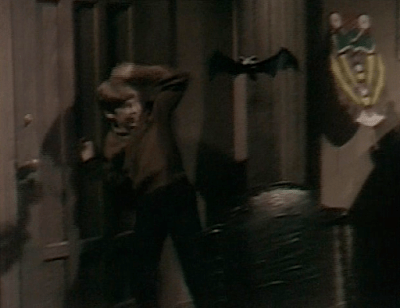
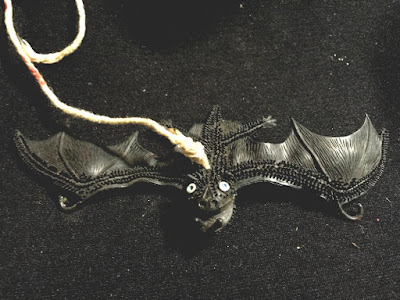
We hear a window smashing. A bat appears. It approaches Barnabas. He yells at it, flails his arms, and walks backward. This is an echo of #330, which ended with strange and troubled boy David Collins reacting the same way when the same puppet appeared in his bedroom. David was a neurotic and isolated pre-teen who had been through a lot of trauma, so that was an effective scene. Barnabas is a grown man who has been trying to function as an action hero. Seeing him as the equivalent of a cartoon lady standing on a chair screaming because she saw a mouse rather undercuts this. Anyway, the bat bites Barnabas on the neck, so now he’s going to be a vampire.
The bite. Not Barnabas’ cloak in the background, playing the role of The Grim Reaper. Screenshot by Dark Shadows Before I Die.
In #330, it was Barnabas who sent the bat against David. This is one of many indications that the vampire Barnabas we knew from April to November of 1967 was not only under Angelique’s curse, but that he was in some sense a manifestation of Angelique. Maybe when she casts a spell, she breaks off a chunk of herself and that chunk goes about the world pursuing its own objectives. The image of a supernatural being as a complex of vaguely related but independent phenomena has been standard in Dark Shadows since undead fire witch Laura Murdoch Collins first appeared on the show in December of 1966, so regular viewers are prepared to learn that the vampiric Barnabas is a subcategory of the syndrome known as “Angelique.”
This episode explains how a couple of the more important props got to be in the places we are used to seeing them. Early in the episode, Barnabas gives Josette a music box. This music box figured heavily in the story from May to August 1967 as a symbol of Josette and as a vehicle for some kind of magic spell that was supposed to turn other people into her. A bit later, we see that Barnabas has hung the portrait of Josette over the mantle in the front parlor of the Old House. It was there when we first saw the Old House in #70, and was the focus of all supernatural phenomena on the show from then until Barnabas reclaimed the Old House in #212.
When I was a kid in the 80s, a friend of mine liked watching syndicated reruns of the tongue-in-cheek Western series Alias Smith and Jones on Saturday afternoons. I didn’t much care for it, but sat through a few of them with him. Eventually they got to some episodes in which the actor who played the character with the alias “Smith” was replaced by a man who was always smiling as if he had just said something terribly clever, even if he hadn’t said anything at all. After a few minutes of that bozo’s inane mugging, my friend couldn’t stand it either, and we could go back outside and play. So that worked out to my benefit.
In those same years, I was a great fan of The Twilight Zone. The man whose pointless self-satisfied smile ruined Alias Smith and Jones for its fans showed up in one of those episodes, but he was used intelligently there. The episode was called “Spur of the Moment.” In it, a young woman has to choose between two lovers, one of them a prosperous fellow whom her father likes, the other a penniless dreamer whom the whole family hates. Any audience will have seen that story countless times and will assume that we are supposed to root for the penniless dreamer. But The Twilight Zone mixed that up for us by casting the likable Robert E. Hogan as daddy’s choice and the man with what we nowadays call an “instantly punchable face” as the poor boy. When the twist ending shows us that the woman was horribly wrong to marry the poor boy, it’s our dislike of the actor playing him that makes it a satisfying resolution.
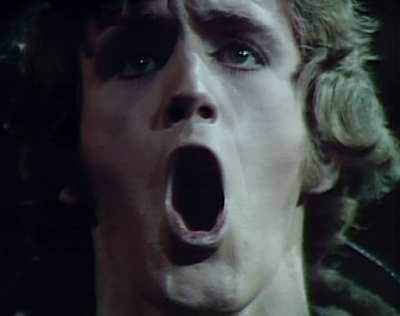
So, when I first saw this episode of Dark Shadows some years ago, it was with some apprehension that I met the sight of that same repellent man on screen. His name is Roger Davis. In later years, Joan Bennett would look back at her time on Dark Shadows and would refer to Mr Davis as “Hollywood’s answer to the question, ‘What would Henry Fonda have been like if he had had no talent?'” Mr Davis’ head is shaped like Fonda’s, and his character turns out to be a defense attorney, a common occupation among the roles Fonda played.
The first line addressed to Mr Davis is “I forgot you were here,” spoken by bewildered time-traveler Vicki. When his character Peter, a jailer who is reading for the bar, tells her that he can hear her in her cell at night, she tells him she didn’t know he was there. Vicki’s repeated failure to notice Peter’s existence may not sound like an auspicious start to what is supposed to be a big romance, but it isn’t as bad as what happens when he is escorting her back to her cell. He puts his hand on her elbow, and she reflexively recoils.
Mr Davis is just awful in his scene today. He spits each of out his lines as if they were so many watermelon seeds, stops between them to strike poses almost in the manner of a bodybuilder, and looks at the teleprompter. The last was a near-universal practice on Dark Shadows, but I mention it for two reasons. First, because this is his debut on the show- even Jonathan Frid, whose relationship with the teleprompter is the true love story of Dark Shadows, didn’t start reading from it until he’d been on the show for a week or two. Second, in his attempts to defend what he did on Dark Shadows, Mr Davis has many times claimed that he “always” knew his lines, that he “never” used the teleprompter.
Mr Davis is going to be a heavy presence on the show for what will seem like a very, very long time to come. He, more than anyone else, prompted me to make a habit of what I call “imaginary recasting.” When Joan Bennett was stuck playing a scene with him, she evidently made the experience endurable by thinking back to the days when she was a movie star playing opposite the original, talented Henry Fonda. When I am watching him butcher a scene, I think of other actors who actually appeared on Dark Shadows or who would likely have accepted a part on it if offered, and try to visualize what they would have done in his stead.
Harvey Keitel was a background player in #33, and surely he would have accepted a speaking role on the show at this point in his career. Mr Davis’ invariably, pointlessly belligerent tone of voice makes Peter seem like a guy with a lot of anger. Mr Keitel is of course a master of playing men who have issues with anger but are still deeply sympathetic. When it’s time to sit through one of Mr Davis’ scenes as Peter, I have enough fun imagining what Mr Keitel could have done with the part that I am not too sorely tempted to give up.
Closing Miscellany
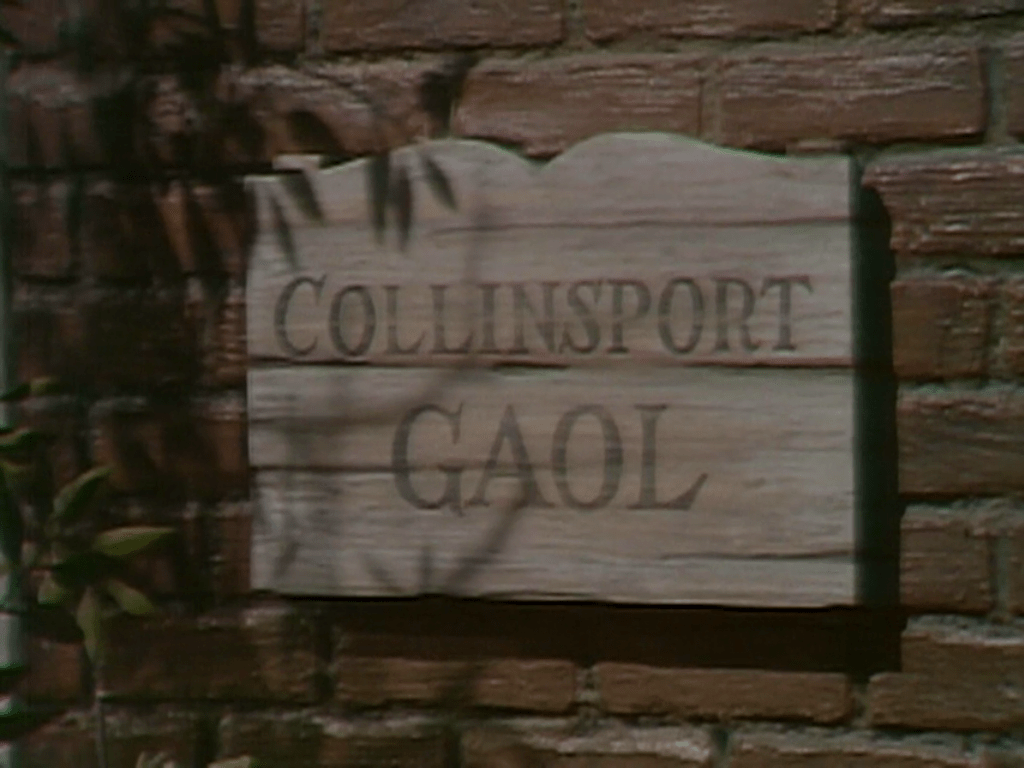
This is the first episode to show that the sign outside the town lockup is labeled, in a period-appropriate spelling, “Collinsport Gaol.”
Ballad of Collinsport Gaol.
The Bil Baird bat puppet appears in this episode, but is so close to the camera it looks like a felt cutout. Bit of a disappointment.
In his post about this episode on Dark Shadows Every Day, Danny Horn discusses the performance Addison Powell gives as a lawyer who meets with Vicki and decides he can’t take her case. He claims that Powell was THE WORST ACTOR EVER TO APPEAR ON DARK SHADOWS. Powell isn’t one of my favorites, but I don’t think he deserves that title. Of those we’ve seen so far, I’d say Mark Allen, who played drunken artist Sam Evans in the first weeks of the series, was the most consistently worthless performer, while Michael Hadge, who was motorcycle enthusiast Buzz for a while in 1967, was the most endearingly inept. Powell is awkward in his scene today, but Roger Davis is even more so, and he, unlike Powell, is so naturally unpleasant that he has to be flawless to earn the audience’s toleration.
In April 1967, Dark Shadows had the smallest audience of any of the 13 daytime serials on the three major broadcast networks in the USA. With cancellation looming and nothing to lose, the show introduced vampire Barnabas Collins to its cast of characters, and quickly jumped in the ratings, becoming the first genuine hit of any kind on ABC’s daytime schedule. Since Barnabas was the show’s one selling point, there were long stretches when he was in every episode, and almost every scene.
In November, the show went back in time to the year 1795, when Barnabas was alive and kindly. When the 1795 segment began, Barnabas was close to his uncle, the equally kindly Jeremiah Collins. Jeremiah was cleverer than Barnabas. So, while Barnabas merely showed a benign politeness to bewildered time-traveler Vicki, Jeremiah caught on that she was radically out of place and tried to coach her in the con games she would have to master to survive in her new surroundings. Even so, Jeremiah was dull, and were it not for our knowledge of what he was doomed to become, the living Barnabas would have been even duller. While in 1795, Dark Shadows has to explain not only how Barnabas falls under his curse, but also show how he becomes interesting.
Yesterday, we saw Barnabas in one of the modes in which he was most consistently interesting in 1967, that of comic villain. He’d found out that his wife Angelique was a witch and that by her evil spells she is the source of all the misery that has recently engulfed the great estate of Collinwood, and his response to that information was to make a series of farcically unsuccessful attempts to murder her. At the top of today’s episode, Angelique makes it clear that she is peeved with him about this, and she insists that he stop. She also makes it clear that she will use her magical powers to force him to spend the rest of his life being a dutiful husband, however much he hates her.
Outside the great house on the estate, feather-headed heiress Millicent is talking with caddish naval officer Nathan. It is late and Millicent is worried about the impropriety of being alone with Nathan. It is a charming scene, not least to regular viewers who remember the first months of the show, when the same actors were trapped in a pointless storyline as a couple who were so bored with each other they couldn’t muster the energy to break up. Millicent and Nathan, by contrast, are attracted to each other, zestful, and full of ideas. Millicent’s ideas are mostly silly and old-fashioned, while Nathan’s are mostly concerned with getting his hands on her money. Nancy Barrett and Joel Crothers make the most of these roles. As Nathan, Crothers plays a man who is pretending to be dashing and heroic, but who time and again betrays signs that he is cowardly and venal. As Millicent, Miss Barrett adopts an unmistakably stagy diction, articulating each word with great distinctness. Thus she tells us that Millicent has derived her ideas about life from watching melodramatic plays.
Barnabas comes upon Nathan and Millicent. Seeing him, Millicent exclaims “I’m ruined!” Neither man even acknowledges that she has said this. This is a laugh-out-loud moment, but Millicent is onto something- she really is a character in a melodrama.
Barnabas asks Millicent to help him meet Josette while Nathan and the Countess look on. Screenshot by Dark Shadows Before I Die.
Barnabas is desperate to confer with the gracious Josette. He was engaged to marry Josette until Angelique’s spell put them asunder. Josette’s aunt, the Countess DuPrés, is furious with Barnabas for trying to see her. He tells her that Josette is in great danger and will be safe only if she leaves Collinwood tonight. He refuses to explain the nature of the danger. It’s true Angelique threatened to kill Josette if Barnabas exposed her as the witch, but the warning he is already giving would by itself seem to be enough to provoke that. He might as well tell everything he knows- at least then there would be a chance he would persuade the countess and enlist her as an ally.
Again, regular viewers will see something in the exchange between Barnabas and the countess that those watching the show for the first time may miss. The countess is played by Grayson Hall, who in some of the parts of Dark Shadows set in the twentieth century plays mad scientist Julia Hoffman. Julia knows that Barnabas is a vampire, has made herself complicit in some of his crimes, and wants to be close to him. When we see Barnabas failing to make a connection with the countess, we are reminded that one of the most interesting things about him in 1967 was his relationship with Julia.
They didn’t have camera drones in 1795, so Angelique comes up with the next best thing- she casts a spell that causes a bat to watch Barnabas. The bat isn’t subtle- the sight of it alarms Barnabas and terrifies Millicent. But perhaps that’s the point- Angelique wants Barnabas to know he cannot escape her.
Dangerously unstable ruffian Willie Loomis spent a week staring at the eighteenth century portrait of Barnabas Collins in the foyer of the great house of Collinwood back in April, then tried to rob Barnabas’ grave. That turned out to be an awkward situation when Willie found that Barnabas wasn’t entirely dead. Barnabas was a vampire who bit Willie, turned him into his sorely bedraggled blood thrall, and had lots of conversations with him. Yesterday, Willie was written out of the show.
Today we open with strange and troubled boy David Collins staring at the same portrait. As Willie was obsessed with the idea that there were jewels hidden in the Collins mausoleum in the old cemetery north of town, where in fact Barnabas’ coffin was hidden, so David is preoccupied with the idea that Barnabas has something terrible stashed in the basement of the Old House on the estate, where in fact his new coffin is hidden. As Willie sneaked off to the cemetery on his ill-starred expedition, David will sneak off to the Old House today and try to search Barnabas’ basement.
Unlike Willie, David is not driven by greed. He is afraid of Barnabas, and his friend, the ten year old ghost of Barnabas’ sister Sarah, has told him that he must not go to the Old House. But his aunt Liz and his father Roger dismiss his attempts to warn them about Barnabas, and he thinks it is his duty to provide them with evidence. So he screws up his courage and makes his way across the property.
David lets himself into the Old House by opening the parlor window. Not only have we seen David do this before, but Willie’s sometime friend, seagoing con man Jason McGuire, got into the house the same way in #274. Barnabas would kill Jason when he reached the basement in #275, so you might think he’d have put a lock on that window by now.
Jason’s fate is certainly on the minds of returning viewers when David tries to open the basement door. It comes as a relief when he finds the door locked. Barnabas’ co-conspirator, mad scientist Julia Hoffman, catches him there.
Julia demands to know what David is doing in the house, and he tries to brazen it out. He claims that he has a right to be there, since it belongs to his Aunt Liz. This is a bit of a murky point- we never see Liz transfer title to Barnabas, but she and others act as if he owns the place and its contents. Julia doesn’t clarify it when she responds that Liz gave the house to Barnabas- she doesn’t deny that it still belongs to Liz, only says that it also belongs to Barnabas.
Back in the great house, Roger is banging away at the piano. We saw Liz play the piano in #47 and #91, a reference to the conception of her character writer Art Wallace developed in his original story bible, titled Shadows on the Wall, in which she, like similar characters in a couple of TV plays he wrote in the 1950s under the title “The House,” gave piano lessons. Since then, Liz’ daughter Carolyn tried her hand at “Chopsticks” in #119 and used the piano as a prop in a teen rebel scene in #258, and Jason poked at a few keys in #198. Roger isn’t exactly Vladimir Horowitz, but he’s the first one we’ve seen who actually achieves a melody.
Liz comes in and tells Roger that David isn’t in his room. They fret over David’s attitude towards Barnabas. Julia brings David home and tells Liz and Roger where she found him. After an angry scene between father and son, David goes upstairs, and Liz scolds Roger for his inept parenting. In these as in all of Liz and Roger’s scenes together, we see a bossy big sister who tries to govern her bratty little brother, but who ultimately abets all of his worst behavior.
In the Old House, Barnabas notices that Julia is troubled. He keeps asking what’s on her mind, and she has difficulty deflecting his questions. This is odd- Julia has been established as a master of deception, and Barnabas is the most selfish creature in the universe. All she has to do is start talking about something that does not affect him directly, and he will lose interest at once. Rather than talk about her personal finances, or the job from which she is apparently on an indefinite leave of absence, or some ache or pain she might have, or how sad she is to miss her Aunt Zelda’s birthday, she brings up Willie. That does get Barnabas’ mind off her tension, but it also reminds him of David. He thinks David knows too much about him, and is thinking of murdering him. Julia assures him that the boy doesn’t know so very much, that whatever he does know he hasn’t told anyone, and that if he does say something his reputation as an overly imaginative child will lead the adults to ignore him.
From the beginning of the series, we’ve heard people say that David is “imaginative.” The audience finds an irony in this, since we have never seen David show any imagination whatsoever. All his stories of ghosts are strictly literal accounts of apparitions he has seen. We’ve seen some drawings he has done and heard quotes from some essays he has written. Some of these are technically accomplished for a person his age, but they are just as literal as his ghost stories. And when he tells lies to cover his various misdeeds, he tells simple little tales that fall apart at once.
In #327, well-meaning governess Vicki became the first character to dissent from the “David is a highly imaginative child” orthodoxy. Liz and local man Burke Devlin were dismissing David’s laboriously accurate account of his latest encounter with Sarah as a sign of his “imagination,” and Vicki interrupted with “I don’t think it has anything to do with his imagination.” Now, Barnabas goes a step further. After pronouncing the word “imaginative” in a truly marvelous way that makes it sound like something I’ve never heard before, he tells Julia that she has given him an idea. Frightened, she asks what he means. All he will say is “You’ll see.”
Roger goes to David’s room and has a friendly talk with his son. Throughout the conversation and afterward, David is thinking intensely, trying hard to figure out what his next step should be.
Once he is alone in the room, the window blows open and a bat enters. More precisely, a bat-shaped marionette is brought in on clearly visible strings by a pole that casts a shadow we can see the entire time, but no one who has been watching the show up to this point will doubt for a second that David’s fear, as depicted by David Henesy, is fully justified. David tries to flee from the bat, but he cannot open the door to escape from his room. His back against the door, David slides onto the floor and screams as the bat comes near him.
When Barnabas is about to attack someone, dogs start howling. Sometimes this works to his advantage, but it so often puts his intended victims on their guard that it doesn’t really seem to be something he is doing on purpose. So this bat represents something new. Perhaps Barnabas is using magic to control a bat- if so, it marks the first time we have seen Barnabas use magic to project influence over something other than a human mind. Or perhaps he himself has assumed the form of a bat. If so, that is the first indication we’ve had that he has shape shifting powers. In either case, Barnabas’ powers have just gone up a level.
Closing Miscellany
The bat was created by famed puppeteer Bil Baird. Most famous today for the puppets he created for “The Lonely Goatherd” sequence in The Sound of Music, Baird was a frequent guest on television programs like The Ed Sullivan Show, and Jim Henson cited Baird’s own TV series, the short lived Life with Snarky Parker, as a major influence on the Muppets. In December 1966, Baird opened a marionette theater in New York City, at 59 Barrow Street in Greenwich Village; it operated until 1978, and many leading puppeteers, including dozens who would go on to work with Henson, were members of its company in those years.
This is the last episode to end with ABC staff announcer Bob Lloyd saying “Dark Shadows is a Dan Curtis production.” We do hear the announcement again in February of 1969, but that won’t be because Lloyd has returned- they used an old recording for the music under the closing credits that day, and they picked one with him on it.
Fans of Dark Shadows will often talk about “the early episodes” which ended with Lloyd making that announcement. So I suppose #330 is the last of “the early episodes.”
Danny Horn’s post about this one on Dark Shadows Every Dayincludes a morphology of episode endings. He divides them into five categories, Haiku,* Restatement of Threat, ** New Information,*** Crisis Point,**** and Spectacle.***** It’s an intriguing scheme, and he makes a good case for it.
*Danny explains that “Haiku” “aren’t necessarily recognizable as endings in the traditional sense, because nothing is resolved and no progress is made. It’s just a little moment when a character pauses, and possibly has a feeling about something… In some extreme cases, the audience may not realize that the episode is over until halfway through The Dating Game.”
**Restatement of Threat, at this period of Dark Shadows, usually means Barnabas looking at us through his window and saying that someone or other “must die!” Which of course means that you can safely sell a million dollar life insurance policy to that character.
***”A New Information ending provides an actual plot point, which either advances the story another step, or tells us something that we didn’t know.”
****”The Crisis Point cliffhanger is the big game-changer, and for best effect, it should come at the end of a sequence that’s been building up for a while. This is a big turn in the story, and it should feel satisfying and thrilling… The defining feature of a Crisis Point ending is that the resolution marks a change in the status quo, ending one chapter and setting up the next.”
***** “Obviously, plot advancement is always welcome, but every once in a while the show needs to set its sights a little higher. These are the moments when the show goes above and beyond, in order to surprise and dazzle you… The point of a Spectacle is: You can’t take your eyes off the screen. Housewives in the audience have put down the iron, and switched off the vacuum. Teenagers have stopped swatting at their siblings… A Crisis Point cliffhanger will bring you back for the next episode, because you want to see what happens next. But a Spectacle cliffhanger is bigger than that — you’ll be coming back for the next episode, but it’s because you can’t believe what you’re seeing, and maybe tomorrow they’ll do it again.”