Well-meaning governess Vicki is wrongly suspected of witchcraft and needs a place to hide. Young gentleman Barnabas takes her into his house. In her gratitude, Vicki tells Barnabas the truth about herself. She is a time-traveler, yanked back to this year 1795 from her native 1967 by forces she does not understand. Indentured servant Ben enters the room and Vicki leaves. Mystified by her story, Barnabas asks Ben if he thinks Vicki might be a witch after all.
It is exciting when Vicki starts confiding in Barnabas. She has utterly failed to adapt to her new environment, and has none of the abilities she would need to scam her way into a secure place there. She has ended up as an obstacle to story development and an irritating screen presence. If Vicki isn’t going to lie competently, she may as well tell the truth. But that turns out to be a dead end as well- there is no use for Barnabas to make of the information she has given him.
Barnabas doesn’t repeat Vicki’s story to Ben- he just reports that she said something utterly bizarre. What Barnabas does not know, but Ben does, is that there really is a witch in the house- it is Barnabas’ bride-to-be Angelique. Angelique has enslaved Ben, so if he found out Vicki’s secret she would as well, and would be able to use it against her as she frames Vicki for all of her own crimes. Ben proclaims to Barnabas his absolute certainty that Vicki is not a witch, but since he can’t tell anyone about Angelique, this only puzzles Barnabas. Barnabas is further baffled when Ben says he hopes that Barnabas’ marriage to Angelique brings an end to his troubles.
The other day, Angelique tried to solve a problem of her own by raising a corpse from its grave. This was the late Jeremiah Collins, uncle of Barnabas and his best friend until, under the influence of Angelique’s spell, he and Barnabas’ fiancée Josette eloped together. Barnabas responded to that by challenging Jeremiah to a duel. Conscience-stricken, Jeremiah decided to let Barnabas kill him and told Josette that she would be free to marry Barnabas once he was dead.
Angelique had ordered Jeremiah to plague Josette and Barnabas with angry demands that they stay apart. We could interpret that simply as puppetry on Angelique’s part. But today, Jeremiah is harassing Angelique and refusing her repeated commands to go back to his grave. He says he was at peace in the earth until Angelique disturbed him. He was content with his decision to forfeit his life, but now he has become something he didn’t bargain for. Maybe it’s the indignity of that change that accounts for his change of personality, or maybe he’s just cranky because he can’t get back to sleep.
Regular viewers will think of a third possibility. In the segments of Dark Shadows set in 1966 and 1967, we saw other supernatural beings, such as undead fire witch Laura Murdoch Collins and the ghosts of Josette and of Barnabas’ little sister Sarah. These beings looked at first glance like humans, but the more we learned about them the clearer it became that each was in fact a complex of multiple entities, some of which operated independently of and occasionally at cross-purposes with others. As a witch, Angelique might also be a composite being. Perhaps each time she casts a spell, she breaks off a little piece of herself and deposits it within the person she is trying to control. If so, the creature she is trying to send away is not simply Jeremiah, but the body of Jeremiah animated by a chunk of the spirit of Angelique. That would explain why the actions of the risen Jeremiah are characterized by three traits that were alien to the living man, but that Angelique has in abundance- single-mindedness, vengefulness, and ineffectiveness.
Barnabas, Ben, and a clergyman are in the front parlor, ready for the wedding. Angelique takes a long time to come downstairs. Barnabas goes up to her room to see what is keeping her. He finds her terribly upset, insisting that they have the ceremony somewhere else. Barnabas looks in her suitcase, which had a moment before held the clothes she removed to put on her bridal gown. Those clothes have vanished, and in their place Barnabas finds a doll belonging to his little sister Sarah and some pins. Had Barnabas ever seen a horror movie, he would know to interpret this as a clue from Jeremiah that Angelique had caused a recent illness of Sarah’s by sticking pins in her doll, but people didn’t get to the cinema in 1795, so it’s another dead end.
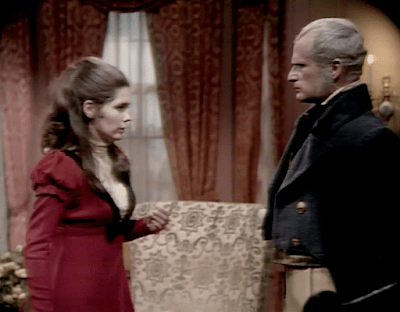
Angelique composes herself and says she will be right down for the wedding. Barnabas leaves the room. The door closes itself, and Angelique cannot open it. Jeremiah enters and tells Angelique she must be punished for disturbing the dead. He takes her to his grave, which is open. Angelique raised Jeremiah some days ago- if the grave has been open this whole time, you’d think someone would have noticed and people would be talking about it. Anyway, he puts her in the grave, and from her point of view we see him throwing dirt into it.
Jeremiah dropping dirt onto Angelique, from her point of view. Screenshot by
This is the first live burial we’ve seen on Dark Shadows. It’s true that the POV shot from inside the grave echoes a moment in #248 when Barnabas, who is in 1967 a vampire, shuts his prisoner Maggie Evans in a coffin and we see him through her eyes, but that coffin wasn’t in the ground.
Harking back as it does to that shocking moment from Barnabas’ early days on the show, the image of the reanimated Jeremiah dropping dirt in the grave invites us to make a comparison between Jeremiah and Barnabas. In life Jeremiah was a mild-mannered, good-hearted fellow, as is the living Barnabas. The destructive behavior he has exhibited since Angelique raised him from the dead is not only typical of her, but also of what we saw from the vampire Barnabas in 1967. Again, we wonder if the fate that awaits Barnabas is not only something Angelique will do to him, but if everything we saw of him in the months between April and November was what Angelique was doing disguised as him.
Closing Miscellany
Angelique’s repeated commands to Jeremiah today to “Go back to your grave!” find an echo in one of the great moments in the history of Dark Shadows conventions, when Lara Parker used that line to explain the Dark Shadows house style of acting:
“Go back to your grave!!!!!”
When Vicki tells Barnabas the truth about herself, the camerawork makes Alexandra Moltke Isles’ strabismus impossible to miss. Previously they had taken great care to photograph her from angles that would obscure this condition, but we’re going to get another clear look at it on Thursday. Combined with the lousy lines the scripts have given Vicki since the beginning of the 1795 segment, it is hard not to suspect that there was some kind of deliberate effort behind the scenes to push Mrs Isles aside.
This was the first episode of Dark Shadows broadcast in 1968. The copyright date printed on the screen at the end still says 1967. They were several months late before they stopped putting “1966” there, so I guess we shouldn’t be surprised they didn’t update it for an episode shown on New Year’s Day.
Like every other episode of Dark Shadows, this one opens with a voiceover delivered by a member of the cast. The voiceovers in the segment of the series set in the year 1795 usually begin thus:
A séance has been held in the great house of Collinwood, a séance which has suspended time and space and sent one girl on an uncertain and frightening journey into the past, back to the year 1795. There, each of the Collins ancestors resembles a present-day member of the Collins family. But the names and relationships have changed, and Victoria Winters finds herself a stranger in a sea of familiar faces.
The “sea of familiar faces” results from the same actors appearing in the parts of the show set in different periods. The emphasis the show places on this, both by the repeated use of “sea of familiar faces” in one opening voiceover after another and by the hapless Vicki’s (Alexandra Moltke Isles) exasperating habit of telling the characters that they are being played by actors who previously took other parts, gives the audience a reading instruction. Evidently we are meant to compare and contrast each actor’s twentieth century and eighteenth century roles.
The first face we see today is the only unfamiliar one that has bobbed to the surface of the 1795 sea. It belongs to wicked witch/ lady’s maid Angelique, played by Lara Parker. Angelique had a brief fling with young gentleman Barnabas Collins (Jonathan Frid) some time ago. They met when he first went to the island of Martinique and met her employers, the wealthy DuPrés family.
Barnabas had fallen in love with the gracious young Josette DuPrés (Kathryn Leigh Scott,) but was convinced Josette could never love him. Barnabas consoled himself in Angelique’s arms until he realized Josette did love him. Barnabas and Josette agreed to marry. Josette came to Collinwood for the wedding, accompanied by her father André (David Ford) and her aunt, the Countess DuPrés (Grayson Hall.) Angelique is the countess’ maid, but also attends Josette.
Angelique used her powers of black magic to make Josette and Jeremiah Collins (Anthony George,) Barnabas’ uncle, conceive a mad passion for each other. Josette and Jeremiah eloped, breaking Barnabas’ heart. Barnabas and Jeremiah fought a duel; consumed with remorse, Jeremiah let his nephew kill him. Even after all that, Barnabas realized he would always love Josette, a fact of which he apprised Angelique. Frustrated to find that she could never have Barnabas, Angelique yesterday announced in a soliloquy that she would punish him by forcing him to watch his beloved little sister Sarah (Sharon Smyth) suffer. At the top of the episode, Angelique is in her room in the servants’ quarters of Collinwood’s manor house with Sarah’s doll and some pins.
We cut to the front parlor, where Sarah is looking up adoringly at her mother Naomi Collins (Joan Bennett,) who is reciting a story. We cut back to Angelique, who drives a pin into Sarah’s doll. In the front parlor, Sarah clutches her chest and cries out in pain. Angelique sticks more pins into the doll, and Sarah cries out again.
In the parts of Dark Shadows set in the 1960s, Joan Bennett plays matriarch Elizabeth Collins Stoddard, owner of the great estate of Collinwood, of the Collins family enterprises, and of any other piece of property that they decide to tell a story about. In Liz’ time, the Collins family is much decayed from its eminence in 1795, but she is still the foremost figure in the town of Collinsport, and would have the authority to make just about anything happen. In fact, Liz can rarely bring herself to do very much that pertains to the plot, but when she does speak up we can see that she has great depths.
Naomi, by contrast, is utterly powerless, shut out by her husband, haughty overlord Joshua (Louis Edmonds) even from the management of the house. In today’s pre-title teaser, we see Sarah sitting on the floor of the front parlor, looking up adoringly while Naomi recites a story to her. That Naomi is reciting to Sarah rather than reading to her reminds us of what we learned when first we saw her in #366, that unlike most women in eighteenth century New England Naomi is altogether illiterate. Naomi occasionally bewails her inability to spend her time productively, and often drinks.
Sharon Smyth plays Sarah in 1795. In 1967, she was Sarah’s ghost, a frequent visitor to Collinwood and its environs. Sarah’s ghost was quite a different character than is the living Sarah. The little girl in the white bonnet who showed up in the oddest places and made the oddest remarks was only one aspect of a vast and mighty dislocation in time and space. It was Sarah’s ghost that started Vicki’s “uncertain and frightening journey into the past.”
Miss Smyth* nowadays describes her acting style when she was nine and ten saying “the first word that comes to mind is ‘clueless,'” but that works out surprisingly well for a ghost. It isn’t clear to us how the visible part of the Sarah phenomenon relates to the rest, much less how the whole thing works, and it can’t be clear- if a phenomenon stops being mysterious, it isn’t supernatural anymore. So it is gripping to see that the visible Sarah is herself in the dark about what she represents. That doesn’t work so well for living characters. When Miss Smyth can’t take her eyes off the teleprompter while delivering lines like “Help me, mother! It hurts!,” we can perhaps see one reason why the unfathomably mighty Sarah of 1967 was reduced to such a subordinate role in 1795.
But Miss Smyth’s limitations as a performer were not the only reason this development was inevitable. The whole idea of the supernatural is that something which appears to be very weak is in fact very strong. So children usually have fewer resources at their disposal than do adults, females are less likely to be found in positions of authority than are males, and the dead cannot rival the dynamism of the living. So the ghost of a little girl will of course be an immense force. The Sarah we see in 1795 is not yet a supernatural being, and so it would ruin the irony if even before her death she were already great and powerful.
In the part of the show set in 1967, Liz was one of the few major characters who never saw the ghost of Sarah. Liz was pretty firmly in denial about all reports of paranormal phenomena, and in #348 Sarah would declare that she could appear only to people who were prepared to believe in ghosts. So it is a bit startling for regular viewers to see these two actors together for the first time. Naomi is the same calm, indulgent presence to Sarah that Liz is to the children in her life, suggesting that though “the names and relationships have changed,” Liz and Naomi are two versions of the same person.
If the viewer’s main activity in watching the 1795 segment is contrasting the characters with those played by the same actors in the first 73 weeks, Angelique’s prominence is a puzzle. She is the only one who doesn’t fit into that scheme, yet she has driven all of the action so far. By the end of today’s episode, I think we can see a 1967 character with whom Angelique stands in juxtaposition. That character is Barnabas.
From April to November of 1967, Dark Shadows was largely the story of vampire Barnabas Collins (Jonathan Frid) and his attempt to impersonate a living man native to the twentieth century. It was so much fun to watch Barnabas scramble to keep this game going that the audience found it easy to put to one side the horrible evil he did and to look for reasons to think of him as good. But if we ever succeeded in doing that, Dark Shadows would be ruined. A deep-dyed villain allows a drama to be less serious overall than it might otherwise be, so that a thoroughly bad Barnabas lightens the tone. Make him relatable, or even forgivable, and everything gets terribly serious again. Yet a nonthreatening vampire is a purely comic character, like Count von Count on Sesame Street. So until they can establish another Big Bad, Barnabas has to be beyond redemption. If he is a lovable guy who just needs help dealing with his neck-biting problem, he has no place on the show, and it has no story left to tell. So they spent the fall systematically kicking away every possible mitigating factor and forcing us to behold Barnabas’ unrelieved evil.
The last hope of redemption for Barnabas in 1967 was his attachment to the late Sarah. Sarah had died when she was about ten, and her ghost started haunting the estate of Collinwood back in June, when Barnabas was holding Maggie Evans, The Nicest Girl in Town (Kathryn Leigh Scott,) prisoner in his basement. By November, many people had seen and talked with Sarah, but she had shunned Barnabas, even though he was desperately eager to reconnect with his baby sister. In his speeches about his longing for Sarah and in two moments when a suggestion he might see Sarah distracted him from a murder he was in the middle of committing, we saw the possibility that when Barnabas was finally reunited with her, he would change his ways.
That reunion finally took place in #364. Sarah walks in as Barnabas is strangling his only friend and sometime co-conspirator, mad scientist Julia Hoffman (Grayson Hall.) Barnabas does let Julia go, and has a heartfelt conversation with Sarah. Sarah says that she will not come back until Barnabas learns to be good. We can see just how long that is likely to be when, less than two minutes after Sarah has vanished, Barnabas tells Julia that, while he may not kill her tonight, her existence means no more to him than does that of a moth.
When even a direct encounter with Sarah cannot move Barnabas to find value in human life, we see that what Barnabas wanted when he was yearning for her to come near him was not to renew a relationship in which anything would be expected of him, but was something more like nostalgia. He has moved into the house where he spent his time when he was alive, and has restored it to its appearance in those days. He once persuaded his distant relatives, Liz and the other living members of the Collins family, to attend a party in that house dressed in clothing that belonged to their ancestors of his period and answering to their names. And he cherishes a fantasy that a young woman will discard her personality and replace it with that of Josette, then come to him and live out the life he had once believed he would have, long ago. His wishes for Sarah are of a piece with these attempts to recreate a past world. He wants to reenact the time he had with her, not to face the present alongside her. Barnabas is a damned soul, unable to love, unable to grow, unable to do anything for the first time.
Today, the show pushes Angelique into the same “Irredeemable” category where his reaction to Sarah’s visit had landed Barnabas. Again, it is an interaction with Sarah that represents the last straw. Josette and Barnabas made a sweet couple, but we knew before we ever saw them together that they were not fated to end up together. Jeremiah was likable enough, but we knew that he, too, had a sharply limited future. But Sarah is a child, a particularly adorable one, and is someone we have come to feel we know through her months as a ghost. When Angelique treats her so cruelly, we cannot imagine ever forgiving her.
And yet, there were times we felt that way about Barnabas, too. Angelique’s insane fixations are remarkably close to those vampire Barnabas exhibited in 1967, so much so that we keep wondering if whatever she does that turns Barnabas into a vampire will also put her personality into his body. We have come to be attached to the vampire; perhaps we will eventually discover it is Angelique we were watching until Vicki came to the past.
That isn’t to deny that the human Barnabas we have seen so far has points of contact with the ghoul from 1967. He was selfish enough to take advantage of a servant girl in Martinique when he didn’t think he could win the love of the grand lady he wanted and to discard her when he learned he could. He is cowardly enough that it never occurred to him to tell Josette that he had a past with Angelique at a time when doing so could have prevented Angelique casting the fatal spells on her and Jeremiah.
Real as these vices are, they are endemic to soap opera characters. Few daytime serials would have any stories to tell if they were about people who had a gift for monogamy, and we are supposed to find ourselves yelling at the screen “Just tell her!” and “Just tell him!” at regular intervals. Even the power differential between Barnabas the scion of the wealthy Collins family and Angelique the servant girl, problematic** as it would be in real life, is less troubling in the soaps, which take place in worlds where heirs and heiresses marry servants and their relatives all the time. Of course, most viewers know that Barnabas is destined to become a vampire, a metaphor for selfishness, and will be inclined to see in his use of Angelique the seeds of his subsequent damnation. And Angelique has enough lines about Barnabas’ selfishness that even viewers who joined the show during the 1795 segment can’t let him off the hook altogether.
Still, there is a great deal of good in the living Barnabas. We see him at Sarah’s bedside, consumed with worry for his beloved little sister. The doctor has been to see Sarah, and he has nothing to offer. Sarah asks to see her governess Vicki, who is in hiding because a visiting witch-hunter named Trask has blamed her for a series of inexplicable misfortunes that have befallen the house since she showed up in #366. It was Vicki’s own odd behavior that first made her a suspect, and Angelique has taken advantage of Trask’s foolishness to fabricate evidence against Vicki. She has gone into hiding, and Barnabas is helping her.
When Sarah keeps asking to see Vicki, Barnabas promises to bring her. Naomi is surprised to learn that Barnabas knows where Vicki is, and is not at all sure Trask isn’t right about her. But when she sees her daughter with Vicki, she is sure that she is innocent.
Vicki was the audience’s main point-of-view character throughout 1966 and well into 1967. Major story developments took place after Vicki found out what was going on. Vicki was the chief protagonist in the most important story of that period, the crisis represented by undead fire witch Laura Murdoch Collins. Vicki took charge of the household, organized a group to fight Laura, and rescued strange and troubled boy David from the flames when Laura tried to burn him alive. That intelligent, forceful character has been fading ever further into memory in recent months, and we haven’t seen a trace of her in the 1795 storyline. Sarah is happy to see Vicki and says she likes the stories she tells, but she is a passive witness to today’s events. She serves chiefly as a prop, used to demonstrate that the human Barnabas, whatever his faults, is capable of heroic action.
Barnabas’ compassion for Sarah and his valiant defense of Vicki do not negate his vices. As the heir to Collinwood, Barnabas can express his self-regard both by gratifying his urge to treat some women badly and by earning admiration for treating other women well. In her low station, the same trait leads Angelique directly to the “Dark Triad” of Narcissism, Manipulativeness, and Psychopathy. As a vampire, Barnabas will exhibit the same three qualities in abundance, but for now, we still have license to hope for better from him.
As it was so much fun to watch Barnabas trying to pass as a modern man that we wanted to like him even after he had been terribly cruel to Maggie, a character we like very much, it was so much fun to watch Angelique twist Trask around her finger that we wanted to like her. Besides, her desire to remake Barnabas as her lover is understandable for those who have been watching the show and wanting him to be something other than a heartless murder machine. So, perhaps we will wind up liking Angelique after all.
Angelique has bewitched indentured servant Ben Stokes (Thayer David) and forced him to act as her assistant. Ben is devoted to Barnabas and miserable that he has been the instrument of so much evil done to him, but has been powerless to resist Angelique’s commands. When he realizes that Angelique is causing Sarah to sicken and perhaps die, he goes to her room and demands that she stop. He threatens to kill her if she does not relent. In response, Angelique causes him to have a heart attack. She lets his heart start pumping again when he promises to be quiet.
This is the second heart attack a character of David’s has had on screen. The first also prevented a servant in this same house from killing a young woman. That came in #126, when crazed handyman Matthew Morgan had been holding Vicki prisoner here and was about to decapitate her. The ghost of Josette led several other supernatural presences who scared Matthew to death before he could complete his fell purpose. Matthew and Ben are both devoted to the Collinses, and both are led astray so that they become parties to terrible crimes. As the benevolent spirit of Josette put a stop to Matthew’s crimes, so the malign Angelique prevents Ben from putting a stop to her own.
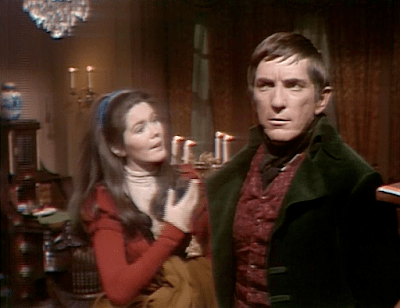
Barnabas drops by Angelique’s room to ask if she has seen Sarah’s doll, which she calls Samantha. He tells her that Sarah is very ill and has asked for the doll. It occurs to Angelique that she has some leverage over Barnabas. She says that she can brew a special kind of tea that might cure Sarah’s symptoms. He asks her to do so. She makes him promise to marry her if she does.
Several times, we have seen that Angelique is flying by the seat of her pants. She had no idea of using Sarah’s illness to gain a hold over Barnabas until he chanced to come into her room. Nor is she thinking ahead- as it stands, the witch-hunters have fastened on Vicki as their suspect, and are not thinking of her. If word gets out that she had the power to cure Sarah’s mysterious ailment and exercised it only after extorting Barnabas’ promise of marriage, that would seem to be proof positive that she is a witch.
In her own bedroom, Sarah sips the tea. At the same moment, Angelique, in the servants’ quarters, pulls the pins from the doll. How exactly Angelique got the timing just right isn’t exactly clear, but she must have had a way- she is perfectly confident when she tells the doll that it has served her well.
*Mrs Lentz now, but it’s strange to say “Mrs” when you’re talking about a ten year old.
**I know people don’t really say “problematic” anymore, but it seems to be the right word here.
Indentured servant Ben was unhappy enough when he was under the rule of haughty overlord Joshua Collins. He has now found himself doubly enslaved, still subject to the Collinses, but also under a spell cast by lady’s maid/ wicked witch Angelique that compels him to do her bidding. At least Joshua isn’t bothering him these days- Angelique has, for reasons of her own, turned him into a cat. In Angelique’s room, Ben wields a hatchet, gleefully preparing to decapitate the cat formerly known as Joshua.
Angelique interrupts Ben’s evil plan.
Angelique enters and forbids Ben from committing this act of felicide. Ben is disappointed. When his arguments make no impression on her, he whines “Ple-e-e-ase!” Thayer David gets the full comic value out of that, Mrs Acilius and I laughed out loud.
Angelique’s main business is preventing Joshua’s son Barnabas from marrying the gracious Josette. To that end, she orders Ben to steal some things. When he protests that it will be the end of him if he is caught, she tells him to see to it that he isn’t caught.
In the parts of the show set in 1967, Barnabas is a vampire. We have heard him use the very words Angelique uses here when telling people who were under his power not to be caught, most recently with his distant cousin/ blood thrall Carolyn in #362. The echo is so specific and of so recent an episode that we can’t help but wonder if Angelique’s witchcraft will not only turn Barnabas into a vampire, but will deposit her personality in his body.
Barnabas and Josette’s wedding is supposed to be held in the front parlor of the manor house. When the bride doesn’t come downstairs, her father, André DuPrés, asks his sister, the Countess DuPrés, if he should look for her. She agrees that he should. This is an odd little moment, suggesting that the Bossy Big Sister/ Bratty Little Brother dynamic we have seen among the Collinses of the 1960s may have been familiar in the House of DuPrés in 1795.
André goes up to Josette’s room. He shouts her name, looks for her in the linen chest at the foot of her bed, and shouts for her some more. He reports her absence to the party downstairs. Angelique lifts a flute of champagne, silently toasting her triumph.
Wicked witch Angelique is trying to prevent young gentleman Barnabas Collins from marrying his fiancée Josette. To that end, she has cast a spell on Josette and on Barnabas’ uncle Jeremiah, causing them to conceive a mad passion for each other. Jeremiah resists the feeling, and is resolved to leave town until Barnabas and Josette are safely wed.
Angelique decides that she will keep Jeremiah around by causing his brother, haughty overlord Joshua, to disappear. When she makes this decision, she is with Ben, an indentured servant of Joshua and bewitched thrall to Angelique. Ben is miserable when Angelique compels him to act against Barnabas, since Barnabas has always been most kind to him. However, Joshua treats Ben with relentless cruelty, and when Angelique announces that she will transform him into an animal, Ben is gleeful at the idea of the tyrant getting his comeuppance. Ben pleads with Angelique to make Joshua into a jackass, so that he can whip him while they plow the fields.
Angelique ignores Ben’s idea, and makes Joshua into a small cat instead. This transformation takes place while Joshua and Jeremiah are in the front parlor, arguing about Jeremiah’s plan to go away. Jeremiah turns to look out the window for a second, and when he turns back Joshua is gone and the cat is in his place.
When I was a graduate student in Classics lo those many years ago, I made a study of Apuleius’ Metamorphoses, more commonly known as The Golden Ass, an ancient novel about a man who trifles with a witch and is transformed into a jackass in consequence. So I was more interested than most would likely have been by Ben’s suggestion.
We can see why it had to be a cat rather than a jackass. For one thing, they didn’t have the budget to get a jackass into the studio at 433 West 53rd Street in Manhattan. But there are other reasons. A jackass is a large animal, not graced with the gift of stealth, and if one had materialized out of thin air in the front room it would have been obvious that magic was at work. That would have been bad for the plot, because the characters would have had no choice but to admit that witchcraft was a likely explanation. Even Jeremiah and Josette might well have realized that their sudden attraction was the result of a spell, and have set about fighting it directly. By contrast, a cat is a small creature, known for silence, and on a rolling estate bordering on the wilderness any number of them would be likely to slip into the manor house on a cold night. Its presence would attract little notice from anyone not already convinced witchcraft was in progress.
In addition to the plot trouble that would have resulted had Angelique turned Joshua into a jackass rather than a cat, there would also have been a tonal misstep. At this point they are still developing stories that show us what life was like around the Collins estate before Angelique came. Those are comedies of manners, tales of romance, melodramas about family tensions, and other genres that generate light amusement. That light amusement can keep going if the uncanny phenomena people see are little oddities that elicit impatient demands for a Logical Explanation, but if Angelique conjures up something as big and distinctive as a jackass the natural reaction would be terror, a strong enough feeling that everything else would feel irrelevant until it was resolved.
Also, jackasses have large, expressive eyes. It is difficult to look at the face of one and not to think you know how it is feeling. Joshua is enough of a villain that we simply laugh at the idea of him being put out of the way in this bizarre fashion, and the enigmatic face of a cat does not undercut this laughter. But if we look in the animal’s eyes and see longing and sorrow, which are always easy to find in the eyes of a jackass, we would feel pity for him. That pity would sound a discordant note at this point in the story, distracting us from the suspense about how Angelique’s evil plans will work and our interest in the other story elements we will be seeing.
It is true that there is nothing very catlike about Joshua. For Danny Horn, that is a flaw, one so severe that the whole story of Joshua’s catification “doesn’t work.” He writes:
The cat thing just doesn’t work. But it doesn’t work for interesting reasons, so let’s break it down a little…
A truly satisfying witch-vixen scheme needs to get two things right — it needs to make sense tactically, and it needs to be metaphorically coherent.
For example, spiking Josette’s rose water perfume with love potion totally works, on a strategic level. Josette and Jeremiah find themselves drawn to each other, but they have no idea why. There’s no evidence that leads back to Angelique; everybody just thinks they’re unable to control their forbidden attraction to each other…
And then there’s the cat. Tactically, this is another clear mistake. Yes, Angelique’s goal was to keep Jeremiah from leaving town, and striking Joshua down is an effective way of doing that.
But the actual circumstances don’t allow for any kind of cover story — Joshua apparently disappeared in the middle of a conversation in the drawing room. He wasn’t even walking in the woods, or alone in the basement. Jeremiah knows exactly where Joshua was at that moment, and there’s no way that he could have silently left the house, even if he had a reason to, which he didn’t. Again, this just puts everybody on guard, and hunting around for a malign influence.
And as a metaphor, it’s even worse… What does “cat” mean, in this context?
There’s no sense in which Joshua was a “cat”; the concept doesn’t connect to anything. There’s no symbolic resonance that would make it narratively satisfying, and so it just feels random and silly.
Danny Horn, “Episode 379: Nine Lives to Live,” Dark Shadows Every Day, 24 April 2014
I disagree. Jeremiah is the only person who knows that there is no possible way Joshua could have left, and Angelique’s plan is that he himself will soon run away with Josette, a circumstance which will render his testimony about anything suspect. Further, Joshua and Jeremiah’s sister Abigail and Josette’s aunt the Countess DuPrés are already “hunting around for a malign influence,” prompting everyone else to think they are being ridiculous. If those two seize on Jeremiah’s account of Joshua vanishing and being replaced by a cat, that division within the household will only deepen, bringing greater confusion and setting Angelique’s victims against each other.
The characters look at Joshua and see a tyrant who dominates their lives. We know enough about the major events upcoming to know that he will be utterly powerless to influence them in any way. So when we see his attempt to impose his will on his brother come to an abrupt end when he is reduced to the form of a furry little animal, we see the whole logic of the story in a nutshell.
Moreover, Joshua is played by Louis Edmonds, who in the parts of Dark Shadows set in the 1960s plays high-born ne’er-do-well Roger Collins. The contrast between Roger and Joshua marks the decline of the Collinses from the zenith of their power in the eighteenth century to its nadir in the twentieth. Roger has many of Joshua’s mannerisms, most of his sense of superiority, and all of his taste for expensive things and grand surroundings. But where Joshua is a dynamic businessman, a dominating patriarch, and a self-righteous advocate of Jeffersonian republicanism, Roger has squandered his entire inheritance, lives as a parasite upon his sister, and is frankly and shamelessly nihilistic. Joshua would be shocked if he were told that his commanding self-assurance was an outgrowth of narcissism; Roger cheerfully admits that he is utterly selfish. Joshua may see himself as the lion of upper New England; Roger endears himself to us with a talent for sarcastic remarks that might well be called catty. So when Angelique turns Joshua into a house cat, she is doing what we already know history will do to his descendants.
No two performers did more to pioneer what would become the Dark Shadows house style of acting than Thayer David and Lara Parker. When David first appeared as gruff groundskeeper Matthew Morgan in #38, he stood out in a cast of theater actors who tended to play their parts somewhat larger than life by his exceptional intensity. In the 1795 period piece, he brings the same quality to his portrayal of kindly indentured servant Ben Stokes. As wicked witch Angelique, Parker is the first member of the cast to find a kind of ferocity that outdoes even David. Today, the two of them are the main characters in the episode, yet each shows great restraint and understatement. Their performances are admirably precise.
Angelique is maidservant to Countess Natalie DuPrés, a French lady who took her to the island of Martinique when she fled the Revolution. The countess hasn’t been much in evidence, so that Angelique spends most of her time working for her niece Josette, fiancée of young gentleman Barnabas Collins. Before Barnabas and Josette became a couple, he had a brief affair with Angelique, to which Angelique attached great importance. When she finds that Barnabas does not love her and cares only for Josette, she sets about casting spells to ruin their happiness.
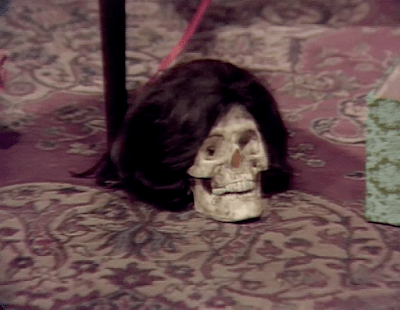
Today, Josette opens a gift box to find a skull wearing a wig. She is altogether undone by this. Barnabas confronts Angelique about it. While he does not seem to have any idea that Angelique is a witch, he is sure she is responsible for the nasty surprise. She denies everything, and he has no evidence against her.
Ben had tried to tell Barnabas and Josette about Angelique, but being under her power, he cannot. But Barnabas could tell Josette the truth about his past with Angelique. Because he does not, she goes on trusting Angelique, giving her full access to her things and to her person, enabling her to cast whatever spell she wishes. Had Barnabas trusted Josette with the truth, they might have been able to fight Angelique. Because he insists on hiding it from her, they are utterly helpless and will lose absolutely everything.
When Dark Shadows started, the 1960s version of the Collins family was isolated from the community, unable to make anything happen, and vulnerable to a wide variety of enemies, all because matriarch Liz and her brother Roger clung desperately to shameful secrets. When those secrets came to light, they lost nothing and found themselves with a new freedom. Now, in 1795, the Collinses are the lords of the town, running a dynamic business, and apparently unassailable in their wealth and prestige. But in Barnabas’ failure to come clean with Josette, we see the beginning of the process that will lead them to the precarious state in which they are trapped in 1966.
Today, Angelique completes a spell that causes Josette to conceive a mad passion for Barnabas’ uncle and best friend Jeremiah. After Josette sneaks into Jeremiah’s room and makes a fool of herself by propositioning him, she runs back to her own room and sobs on the bed. Angelique is there, feigning puzzlement and sympathy, quietly accepting the young mistress’ refusal to tell her what is wrong.
This is the first episode of the 1795 segment not to include time-traveling governess Vicki. While actors Kathryn Leigh Scott, Thayer David, and Anthony George all appeared in the main time frame (debuting in episodes #1, #38, and #262, respectively,) only Jonathan Frid, as Barnabas, is playing a character we had met there. There’s a heavy-handed moment of self-reference today when Josette tells Barnabas that sometimes he is “too modern,” and he thinks about it during a close-up. That close-up goes on so very long that there is no doubt they are giving us reading instructions, telling us that Barnabas, rather than Vicki, is now our point of view character.
Angelique, lady’s maid/ wicked witch, has cast a spell over kindly indentured servant Ben Stokes, making him her slave in an even deeper sense than he was already Joshua Collins’ slave. She gives Ben various tasks in support of her current project, black magic that will make the lovely Josette forget her fiancé Barnabas and conceive a mad passion for Barnabas’ uncle and dear friend Jeremiah. Most notably, she needs an unbroken spider web from an oak tree, and Ben brings her one.
Meanwhile, cousin Millicent Collins has come to the estate of Collinwood. Millicent is giggly, afraid of germs, and very, very rich. Joshua means for his bachelor brother Jeremiah to marry Millicent, a prospect that repels Jeremiah.
Time-traveling governess Vicki enters. When she sees Millicent, Vicki calls her “Carolyn,” because she is played by Nancy Barrett, who plays a character named Carolyn in the parts of Dark Shadows set in the twentieth century. The makers of the show wanted Vicki to keep the audience up to date on the cast members’ resumés, even though it makes all the other characters think she is a lunatic.
Alone with Vicki, Jeremiah confides that he does not want to marry Millicent. Vicki had studied Collins family history when she was living in the 1960s and has an idiotic compulsion to verbalize her every thought, so she declares that Millicent will never marry. Jeremiah remarks that she says the strangest things.
This scene is more tolerable than the others in which Vicki blurts out information she wouldn’t know if she belonged in 1795 because of the casting of Anthony George as Jeremiah. George was a cold actor who kept the audience guessing what was going on inside his characters’ heads. That made him a disaster as the second to play the hot-blooded Burke Devlin, but when we see him as Jeremiah we take his ready acceptance of Vicki’s bizarre behavior as a sign that he has something up his sleeve. If they can stop giving Vicki such tiresome lines, Jeremiah might be a promising love interest for her.
Time-traveling governess Victoria Winters sees a man fueling the fireplace in the front parlor of the manor house on the estate of Collinwood. As she has done several times since arriving in the year 1795, she jumps to the conclusion that he is the character the same actor played in the 1960s. In fairness to Vicki, a couple of the people are the same- young gentleman Barnabas Collins will become a vampire and meet her in her own time, and Barnabas’ ten year old sister Sarah will die soon and her ghost will haunt Collinwood and its environs in 1967. So it’s tricky to handle the repertory theater aspect of the rest of the cast, and, by having Vicki freak out and shout about the main time period every time she meets someone, the show has chosen the most irritating possible way of addressing this problem.
The man Vicki meets today is indentured servant Ben Stokes, and the man she mistakes him for is gruff groundskeeper Matthew Morgan. Since Matthew held her prisoner in this very house and tried to decapitate her here in 1966, her misidentification of Ben leads Vicki to scream and holler and bring the master of the house to ask what is going on. Ben responds that he did nothing at all, Vicki volunteers that it was all her fault and tries to explain.
The master, haughty overlord Joshua Collins, is ever mindful of Ben’s status as a felon entrusted by the state to his custody, and declares that Ben is forbidden to speak to any woman for any reason. Vicki is appalled by this, but as governess she is a servant herself, so Joshua orders her to be silent. Besides, her protestations don’t make any sense to anyone who didn’t see episodes #108-#126 of Dark Shadows. Since it is 1795, Joshua doesn’t have access to the show on streaming or even on cable. He tells Matthew he won’t get the day off he’d asked for tomorrow.
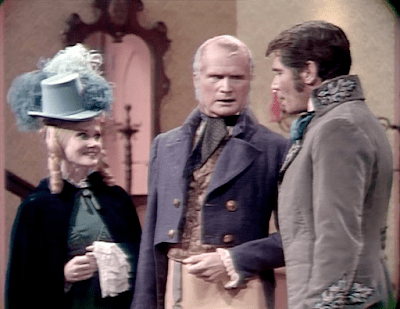
Before Joshua dismisses Vicki to return to her duties, he mentions that his second cousins Millicent and Daniel Collins will be arriving soon and staying for the month leading up to the wedding of Joshua’s son Barnabas to Josette duPrés. Daniel is a child the age of Joshua’s daughter Sarah, and will be joining Sarah as Vicki’s charge during his stay at Collinwood. Joshua mentions that Millicent is a lovely young woman, and that from her early childhood it had been understood that she would marry Joshua’s younger brother Jeremiah. Joshua is quite pleased with this prospect, not least because Millicent has inherited a considerable fortune.
Vicki’s compulsion to keep the audience up to date on the resumés of the actors is mirrored by a compulsion to blurt out information she knows only because she comes from 1967. She had studied the Collins family history, so when Joshua talks of Millicent’s prospective marriage to Jeremiah she shouts “Millicent never married!” Joshua is puzzled by this idiotic remark, but quick to accept Vicki’s explanation that she had read a novel about a spinster named Millicent and couldn’t help but yell about it.
During the first year of Dark Shadows, Vicki was, on balance, one of the smartest characters and was the one who made the most important things happen. So it is distressing to see her verbalizing her every thought, including irrelevancies about the actors’ other roles and information that would tend to expose her secret. If she is going to survive in this past world, she’s going to have to regain enough brain power to keep her mouth shut. Moreover, even when she was at her smartest Vicki was always a conspicuously inept liar. Joshua is fundamentally uninterested in a person of her apparently low social status, and so he accepted the story she made up to cover herself this time. But someone more willing to pay attention to her might very quickly conclude that Vicki is a strange and dangerous person.
Meanwhile, lady’s maid/ wicked witch Angelique is in the woods gathering noxious weeds to use in an evil potion. Ben catches her there, and warns her that the plants she has in her basket are poisonous. She drops them, thanks him, and strikes up a conversation. He tells her Joshua has forbidden him to talk to women. She says this is horribly cruel, and Ben agrees. He goes, and she picks the deadly leaves back up.
In the servants’ quarters, Vicki enters Angelique’s room. She sees some things of Barnabas’ that Angelique had used to cast a spell on him the other day. When Angelique comes in, Vicki tells her that Josette was asking for her. Vicki then asks how Barnabas’ things got to be in Angelique’s room. She says she doesn’t know, then puts the blame on Sarah. Vicki says she will scold Sarah for carrying Barnabas’ things around the house, and Angelique begs her not to. She says she is afraid that if she does, Sarah won’t visit her anymore.
Angelique has no way of knowing it, but this is the perfect lie to tell Vicki. For months before she left 1967, everyone was eager for Sarah’s ghost to come and visit them. Indeed, Vicki was at a séance called to contact Sarah when Sarah took possession of her, said through her that she would tell the “story from the beginning,” and yanked her back to this time. So, when Angelique presents herself as afraid that Sarah will stop visiting her, Vicki cannot refuse her request.
Angelique decides she needs a helper to keep herself from being suspected. We cut between the outdoors, where we see Ben chopping wood, and the servant’s quarters, where Angelique is mixing up a potion. Vicki comes to Ben, and we wonder which of them will be Angelique’s target.
Vicki apologizes to Ben. He just wants her to go away- he’s got into enough trouble for talking to her once, the last thing he wants is to be caught repeating the offense. She says that she knows that Joshua “can seem stern,” to which Ben reacts with disbelief. He says that Joshua is far worse than stern.
Again, this is Vicki failing to distinguish characters from the actors who play them. Louis Edmonds plays Joshua in 1795, and high-born ne’er-do-well Roger Collins in the parts of Dark Shadows set in the twentieth century. For the first 25 weeks of the show, Roger was the villain, and he tried to kill Vicki once or twice. By the time his ex-wife Laura went up in smoke in #191, Roger was no threat to anyone. When Sarah brought Vicki back here, Roger had long since been reduced to occasional comic relief.
Joshua is as selfish and cold as Roger at his worst, but where Roger is cowardly, weak, and shameless, Joshua is bold, imperious, and utterly convinced that he is right. Roger is what Joshua might become after a long period of continual degeneration and degradation, a grotesque parody of his ancestor. He has Joshua’s style, but none of his strength. He is reminiscent of the “Last Men” in Nietzsche’s Also Sprach Zarathustra, who were strangers to every consideration but their own immediate comfort. Even so, enough of Louis Edmonds’ wit and personality come through that we always enjoy seeing Roger, and we can understand why Vicki likes him. Edmonds is so good that we are sure we will enjoy watching Joshua as well, but he is clearly never going to become a lovable squish.
Ben is trying to orient Vicki to the current phase of the show when we cut to Angelique in her room. She calls Ben’s name. Suddenly Ben seems to have taken ill. He finally persuades Vicki to leave him alone before he gets caught talking to her again. Once Vicki is gone, he sees a vision of Angelique calling to him and sets off.
When Ben gets to Angelique’s room, he tells her he has no idea what he is doing there. She tells him he is there because she wanted him. This means only one thing to him, so he lifts his arms and steps forward, obviously intending to brighten the day with some rapid love-making. She pulls back and tells him to take a drink first. The beverage she offers him is readily identifiable to a modern audience as Coca-Cola.
In the 1960s, Coca-Cola may have been the pause that refreshes, but in 1795 it had more drastic effects. After Ben drinks it, he staggers back and Angelique tells him that he no longer has a will of his own and will be her slave forevermore. He doesn’t make love to her, either, so no matter how tasty the Coke was the visit would have to be reckoned a loss from Ben’s point of view.







 Dark Shadows Commentary