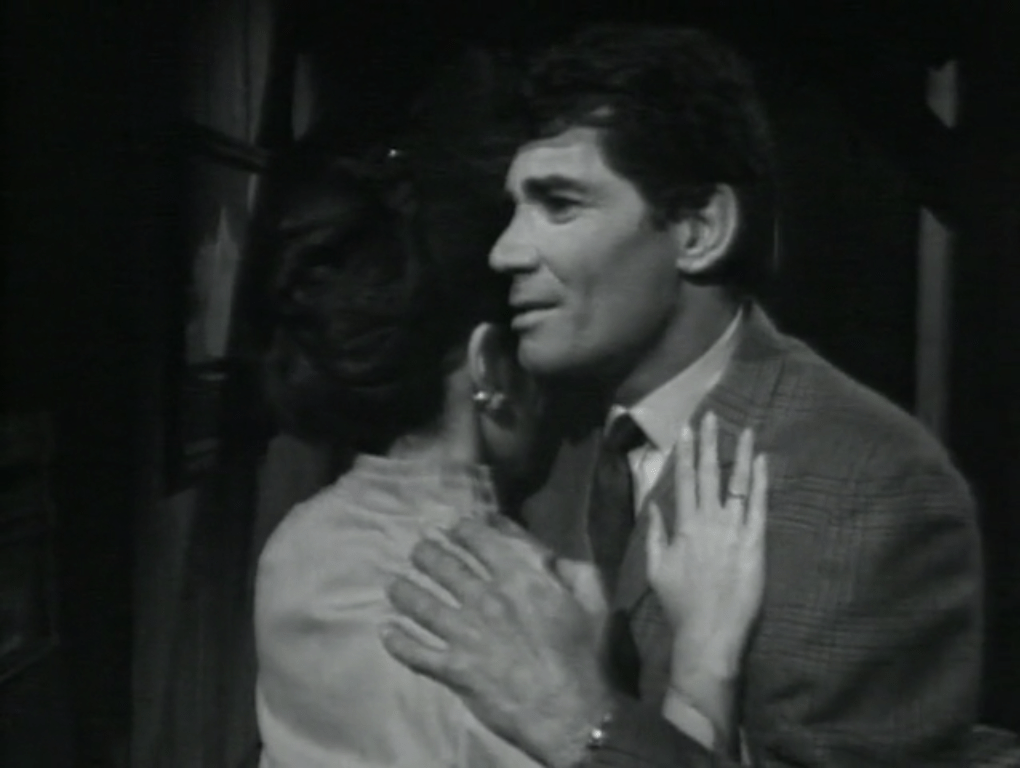
Episode 283: The shock of recognition

Four and a half weeks ago, Maggie Evans, The Nicest Girl in Town, escaped from vampire Barnabas Collins. Barnabas managed to scramble Maggie’s brains sufficiently that she has amnesia covering her time as his victim and much of the rest of her life as well. She is now a patient at a mental hospital called Windcliff, where her care is supervised by Dr Julia Hoffman.

Maggie’s family doctor, addled quack Dave Woodard, is an old friend of Julia’s. He had recommended Maggie be sent to Windcliff. He had also come up with a cockamamie scheme to protect her from her captor by hiding her there and telling everyone in and around the town of Collinsport that she was dead. If he had known that the captor was a vampire, this might have made some kind of sense- no character on Dark Shadows has ever heard of Dracula, so they don’t know how to fight against vampires. But he doesn’t know that, so his plan is just a way for the writers to stall while they try to come up with more plot points.

Today we open with Woodard in Julia’s office, complaining that she isn’t communicating with him about Maggie’s case. She tells him that there have been no developments worth reporting. Returning viewers know that this is a lie, because in a session we saw yesterday Maggie remembered a lot of sense impressions from her time of captivity and Julia told her that they represented tremendous progress. Woodard tells Julia that a lack of new information is no excuse for her failure to return any of his last six phone calls. He says that she seems to be intent on hoarding any information she may glean from Maggie as her own private possession, an impression he describes as frightening.

Julia responds to this characterization with a display of offense, and Woodard apologizes. She then brings up an idea that occurred to her at the end of yesterday’s episode. She says that Maggie’s memory might improve if she takes her to visit Eagle Hill Cemetery, where she was found wandering early in her illness. Woodard objects strongly that Maggie’s condition, as Julia has described it, is so delicate that such a visit might do her permanent harm. Julia retreats and promises she won’t actually take Maggie to the cemetery. This is such a flagrant lie that the camera momentarily goes haywire, focusing on Woodard’s chair rather than his face.

Woodard leaves, and Julia calls Maggie in. She’s already wearing her coat. She asks where Julia is going to take her, and she tells her not to worry about that.

On the great estate of Collinwood, well-meaning governess Vicki is staring vacantly into space while listening to an antique music box Barnabas gave her as part of his plan to subject her to the same treatment he inflicted on Maggie. A knock comes at the door. Vicki closes the music box and goes to answer it. It is her boyfriend, fake Shemp Burke Devlin.

Burke is waging a determined battle against the story, and he is fighting dirty. He doesn’t want Vicki to have anything to do with Barnabas, or with the ghost of Josette Collins. When Vicki says she wants to lay flowers on Josette’s grave in the cemetery, where we know she will cross paths with Maggie and Julia, he resists furiously. When she reminds him that she has had dealings with Josette’s ghost, he says “Or you think you have.” In previous episodes, including yesterday’s and Monday’s, he knew she had, and in an earlier period of the show he knew that several other characters, including some of the most level-headed ones, had also encountered Josette’s ghost. When he starts belittling Vicki for believing in “the spooks of Collinwood,” it therefore comes off as an especially crude instance of gaslighting. The Mrs and I aren’t much for profanity, but we both cussed at the screen when Burke was disgracing himself this way.

Julia and Maggie are in the cemetery. I believe it is the first time we’ve seen the set in a daylight scene. You can see the shadows of the foliage on the soundstage walls, and the corners where the walls meet. I can’t believe the director meant for us to see those things, but I kind of like it- the situation needs a touch of unreality, and the obvious falsity gives it the feeling of a black box theater.

Some of the shadows on the wall that Art Wallace spoke of
Corner of the soundstage

Maggie is agitated. Julia tells her to calm down and that everything is all right. I’m no expert, but I kind of doubt that talk therapy involves a lot of “Calm down!” and “Everything is all right!” It reminded me of this Saturday Night Live sketch from the 90s, in which Patrick Stewart plays “Phil McCracken, Scottish Therapist,” a psychologist who won’t stand for any emotionalism from his patients.

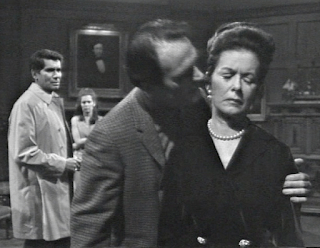
Vicki and Burke see Julia and Maggie in the distance. When Maggie turns to face them, Vicki recognizes her. Julia whisks her away before Burke can see her. When Vicki tells Burke she saw Maggie, he immediately unloads on her with the same garbage he handed her at Collinwood. He declares that Maggie is dead, that Vicki knows she’s dead, that she can’t possibly have seen her, that “there is a resemblance, THAT’S! ALL!” When he asks “What’s wrong with you?” I stopped the streaming and shouted at the screen “She’s wasting her time with you, you ******* ********, that’s what’s wrong with her!” To that, Mrs Acilius said that we should just restart the show and get through the scene.

Part of what makes Burke’s behavior so infuriating is the writer’s fault. A first-time viewer, unaware that what Burke is telling Vicki are delusions that suggest she is crazy are in fact things he knows to be true, might think that he is being reasonable in dismissing ideas about ghosts and the like. But even that viewer will realize that a person ought to be nicer about it. When Vicki says she saw Maggie, Burke could easily have suggested that they go up to the woman and introduce themselves, thinking that a closer look will disabuse her of the notion. But actor Anthony George must also bear part of the blame.

George C. Scott famously told Gene Siskel that there are three things to consider in evaluating an actor’s performance: first is to make the audience believe that the person they are looking at is the sort of person who might do the things the character does. This is in turn dependent on casting- put the wrong person in the part, and all is lost. Second are the choices the actor makes in the key emotional moments. Performers have any number of options as to how they will use their faces, voices, and limbs to show a character’s feelings, and those who make a lasting impression are those who make choices that are at once totally unexpected and perfectly logical. Third is the zest of performance, the actor’s joy in the opportunity to create a character. If that doesn’t come through, nothing else is worth much.

As Burke, Anthony George fails all three of these tests. Burke would have been a difficult part for anyone to take over, both because the originator of the role, Mitch Ryan, was so memorable, and because the character had lost all connection to any ongoing storylines by the time Ryan left. And by his own admission, George knew nothing about soap operas and had no idea how to play a romantic interest on one when he joined Dark Shadows. That’s where he fails the casting part of the believability test.

As for the skill part, George has something going for him. He is always mindful of his physicality, moving only those parts of his body he needs to show us who he is and keeping the rest of himself admirably still. He also keeps his voice remarkably consistent, both by holding a steady level of volume and maintaining a simple, precise pitch. In these and other ways, he shows impressive levels of technical proficiency as an actor, but the result is a mannered, unconvincing performance. His Burke doesn’t seem to be a real person. As a cardboard figure, he becomes an abstract symbol of whatever he’s doing, and when he’s doing something bad he’s hard not to hate.

Since he makes one choice for each resource available to him and sticks with it unvaryingly throughout the episode, he doesn’t give the audience any surprises. Nor does he yield anything to his scene-mates. They always know exactly what’s coming from him. George’s eyes are always watching another actor intently, as he watches Alexandra Moltke Isles intently today, but nothing in her performance can divert him from his plan, not in the smallest particular. When Burke isn’t listening to the other character, as he isn’t listening to Vicki, George’s disconnection from the other actors makes Burke seem like an irredeemable jackass.

Nor does George show any zest for the part. He covers his discomfort with soap acting by plastering on a smile whenever the script allows it, but he is stiff when Burke ought to be loose, cool when he ought to be warm, and loud when he ought to speak with a quiet, nuanced voice. The result is just sad and awkward. When Burke is being pleasant, we can feel sorry for George, but when he has to play the scenes like the ones Burke gets today we just want him to get off the screen and leave us alone.

Compare George’s Burke with Grayson Hall’s Julia, and you will see how an actor can determine an audience’s reaction to a character. Julia is a terrible therapist. She lies repeatedly to Woodard in the beginning, denying the severe breach of ethics and disturbing disregard of public safety involved in covering up what she knows and suspects about Maggie’s experiences and running an unconscionable risk with Maggie’s mental health by taking her to the cemetery. She lies again to Maggie at the end, promising that they will duck into the Tomb of the Collinses only for a moment and then refusing to let her leave there when she starts to show a violent emotional reaction. Her methods are so unorthodox and so harsh that we suspect she is not interested in helping Maggie at all. Because we have known Maggie since episode #1, and Kathryn Leigh Scott’s performance as Maggie renews our fondness for her every time she appears, we ought to feel deep hostility towards Julia.

But we don’t. In fact, Julia quickly becomes (almost) every Dark Shadows fan’s favorite character. The George C. Scott tests tell us why. Hall’s manner is so intense that we can believe her as a mad scientist; her uninhibited use of every facial muscle, of the full range of her vocal output, and of subtle tricks of movement she learned from choreographers when she appeared in musicals may have produced a style that no acting teacher could recommend as a model, but they do mean that every moment she is on screen she is doing something we wouldn’t have predicted; and she’s clearly having a blast. She can do things vastly worse than what makes us hate Burke today, and we will still want her to come back again and again.

Closing Miscellany

The opening voiceovers aren’t usually the best-written parts of the show, but there is a particularly bad bit in today’s: “Hidden deep in the cliffs of Collinwood, the majestic, ancient rocks that separate the Earth from the sea, there is a tiny cove carved by a long-ago sea. No one at Collinwood has seen it, and no one will ever see it.” If no one ever will see it, why bother telling us about it? The narrator tells us that it is because “the Earth knows how to hide its secrets well. Sometimes men, too, must hide secrets.” Does this mean that “no one ever will” discover the secrets the characters are hiding from each other? That isn’t a very promising thing to tell the audience of a soap opera, a genre which is all about unsuccessful attempts to keep secrets and their aftermath.

Maggie tells Julia that she doesn’t recognize the name Collins. She has lived her whole life in the town of Collinsport, where most people are employed by Collins Enterprises, which is owned by the Collins family who live at Collinwood. That’s some pretty widespread amnesia she has.

The show has been going back and forth on the dates when Barnabas and Josette Collins originally lived and died. Today we get a long look at Josette’s tombstone, giving her dates as 1800-1822, and another at the plaque on Barnabas’ little sister Sarah’s resting place in the mausoleum, with the dates 1786-1796. Those dates fit with a remark Barnabas made to his sorely bedraggled blood thrall Willie in #271, that Sarah lived long before he met Josette, but not with his remark in #281 that Josette had been dead for “almost 200 years,” much less with a book we saw in #52 that gave her dates as 1810-1834.

Josette’s tombstone
Sarah’s marker

Episode 281: All the unhappiness of all my ancestors

Vampire Barnabas Collins is giving a costume party in his home at the Old House on the great estate of Collinwood. His distant relatives, the living members of the Collins family, are dressed as their ancestors from Barnabas’ own time as a living being. The whole thing was impossibly dull until the mischievous and witty Roger Collins suggested they have a séance. Now well-meaning governess Vicki is in a trance, channeling the spirit of Josette Collins.

The last time Josette took possession of Vicki at a séance was in #170 and #171. At that time, Josette delivered her message in French. Since Vicki could not speak French (but Alexandra Moltke speaks it fluently,) that was evidence enough to convince even the most skeptical that something was going on. Today Josette speaks English. The characters are all sure that she is the one speaking, but it doesn’t have the same effect on the audience as did that earlier irruption of a language we had not expected to hear.

I do wonder if the decision not to use French came at the last moment. Even though Vicki/ Josette’s voice is loud and clear, the others make a show of struggling to understand what she is saying and seize on a word here and there (“Something about ‘run!'”,) as people do when they are listening to someone speak a language they don’t quite understand. Perhaps writer Joe Caldwell wasn’t quite up to writing in French, and the Writer’s Guild wouldn’t let Alexandra Moltke Isles or any other Francophones on set make a translation. Or maybe they thought that the switch to French wouldn’t be as effective the second time as it was the first.

Josette is telling the story of her death. A man was chasing her, and fleeing him she threw herself off the peak of Widow’s Hill to the rocks below. Barnabas interrupts and breaks Vicki’s trance.

When the others scold him for stopping Josette before she could reveal the name of the man who ran her off the cliff, Barnabas says that the name could not have been of any importance, since whoever it was who drove Josette to kill herself must have been dead for “almost 200 years.” The others do not suspect that he was that man. They do not know that he is a reanimated corpse; they think he’s just English.

When Dark Shadows started, the stories of the tragic death of Josette and of the building of the great house of Collinwood were set in the 1830s. In the weeks before Barnabas’ introduction in April of 1967, they implied that Josette’s dates were much earlier, sometime in the 18th century. Last week, they plumped for the 1830s again. But Barnabas’ line about “almost 200 years ago” puts us back to the 1700s.

After the séance ends, we have evidence that this bit of background continuity might start to matter. Vicki looks at the landing on top of the staircase and sees the ghost of Barnabas’ 9 year old sister Sarah watching the party.

Sarah watches the party. Screenshot by Dark Shadows Before I Die

It seems that when Barnabas was freed to prey upon the living, he unknowingly brought Sarah with him. Sarah has been popping in and out quite a bit the last few weeks, and she has already made some important plot points happen. We’re starting to wonder just how many more beings will emerge from the supernatural back-world into the main action of the show. The opening voiceover today tells us that “the mists that have protected the present from the past are lifting,” so perhaps they will have to nail these dates down sooner rather than later.

The whole party had accepted instantly that Vicki was channeling the spirit of Josette and none of them ever comes to doubt it. But when she says that she saw a little girl at the head of the stairs, they get all incredulous. By the end of the episode, Vicki will have encountered so much disbelief on this point that she herself will decide that she must have been hallucinating.

Back in the great house, Roger is still overjoyed that the séance turned out to be so exciting. His sister Liz and Liz’ daughter Carolyn consider this to be in terrible taste. But Roger won’t give an inch. He has some great lines, exiting with “I think that all of the unhappiness of all of my ancestors is my rightful heritage, and you shouldn’t try to keep it from me. Good night, ladies.” Both Patrick McCray, in his Dark Shadows Daybook post about this episode, and Danny Horn, in his Dark Shadows Every Day post, make insightful remarks as they analyze the fun Louis Edmonds has playing Roger.

Carolyn approaches Vicki to speak privately. She tells her that she isn’t bothered that fake Shemp Burke Devlin is dating Vicki. Vicki’s response to this is “What?” Carolyn reminds Vicki that she used to be interested in Burke and was initially jealous of Burke’s interest in her. But she assures her she doesn’t feel that way any longer. Vicki smiles, nods, and looks away. Carolyn then says “He’s really very nice!” Vicki answers “Who?” “Burke!” says Carolyn. Again, Vicki smiles, nods, and looks away.

This is probably supposed to tell us that Vicki is coming under some kind of spell associated with Barnabas, but in fact it is likely to suggest something quite different to the audience. Burke was originally a dashing action hero played by Mitch Ryan. Dark Shadows never really came up with very much for a dashing action hero to do, but Ryan’s skills as an actor and his charismatic personality always made it seem that he was about to do something interesting. Several weeks ago, Ryan was fired off the show after he came to the set too drunk to work.

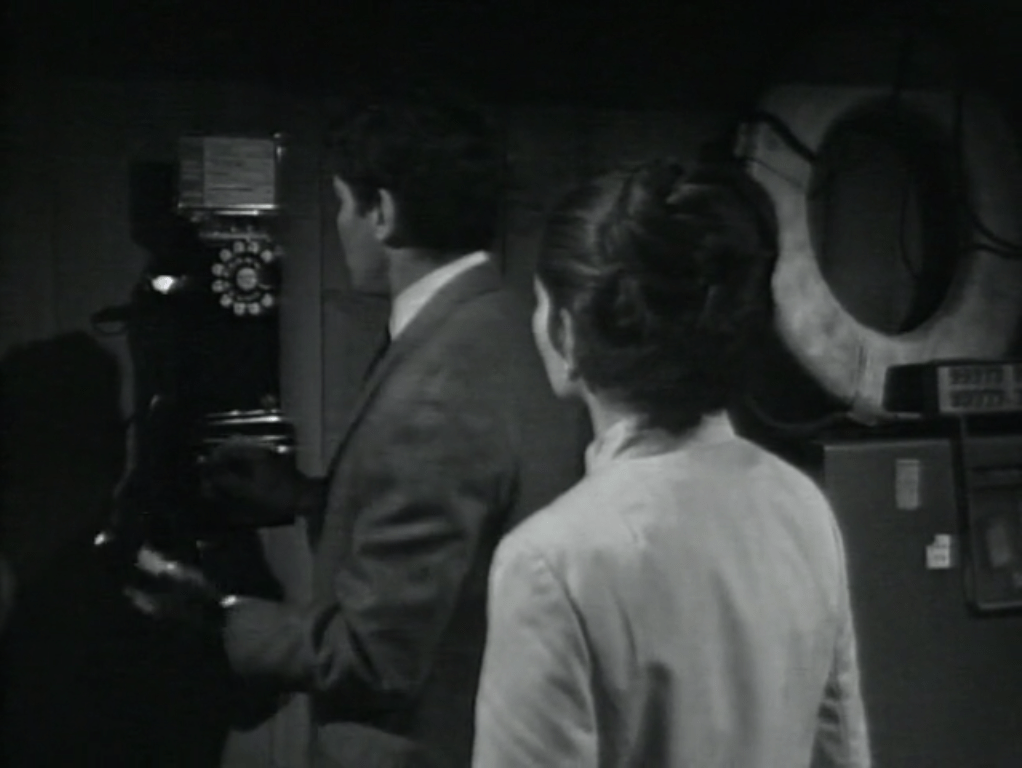
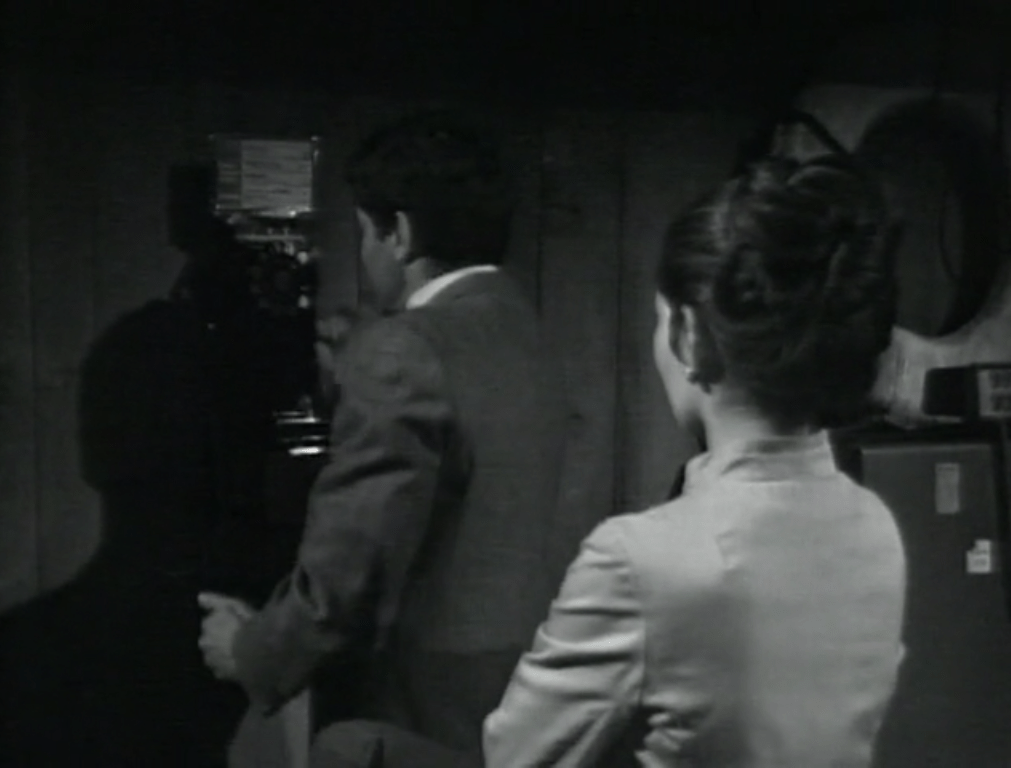
Since then, the part of Burke has been played by Anthony George. George was a well-trained actor with an impressive resume, and by all accounts was a nice guy. But he cannot dig anything interesting out of the character of Burke as he stands at this point in the series. The only scene in which George has shown any energy so far was in #267, when Burke had lost a dime in a pay phone. The rest of the time, he has blended so completely into the scenery that it is no wonder Vicki can’t remember him from one line to the next.

Back in the Old House, Barnabas talks to Josette’s portrait. In the months from #70 to #192, it was established that Josette can hear you if you do this. Several times she manifested herself either as a light glowing from the surface of the portrait or as a figure emerging from it. In #102, we saw strange and troubled boy David Collins having a conversation with the portrait- we could hear only his side of it, but it was clear that Josette was answering him.

The first time we saw Barnabas in the Old House, in #212, he spoke to the portrait. At that point, Josette was not yet his lost love. It seemed that she was his grandmother, and that she had sided against him in some terrible fight with his father Joshua. He ordered Josette and Joshua to leave the house to him. The next time David tried to talk to the portrait, in #240, it seemed that they had complied- David could no longer sense Josette’s presence in it.

Barnabas had spoken briefly to the portrait the other day, but today he makes his first substantial address to it since banishing Josette and Joshua in #212. Again he entreats her to go, but for a very different reason. Now he says that she is lost to him forever, and must allow him to live in the present. Since he has been scheming to capture a woman, erase her personality, replace it with Josette’s, and then kill her so that she will rise from the grave as a vampiric Josette, this sounds like he has decided to make a big change in his relations to the other characters.

It turns out that he hasn’t, but the writers have decided to change their relationship to their source material. Barnabas’ original plan was identical to that which Imhotep, the title character in the 1932 film The Mummy, had pursued in his attempt to replicate his relationship with his long-dead love Princess Ankh-esen-amun. Imhotep met Helen Grosvenor, whom he regarded as the reincarnation of Ankh-esen-amun because they were both played by Zita Johanns, and subjected her to the same treatment Barnabas first inflicted on Maggie Evans, The Nicest Girl in Town, and now plans to try on Vicki.

Maggie is played by Kathryn Leigh Scott. The audience in 1967 would not have known that Miss Scott also played the ghost of Josette in some of her most important appearances. However, they would have noticed when David saw Maggie dressed as Josette in #240 he assumed it was the ghost, because her face was “exactly the same” as it had been when she manifested herself to him previously. So we have the same reason to believe that Maggie is the reincarnation of Josette that Imhotep had to believe that Helen was the reincarnation of the princess, and we therefore assume that Barnabas, like Imhotep, was trying to take possession of both the ghost and the living woman.

But after Barnabas tells Josette to go away, he declares that if he is to have her, she must be someone from the present. This sequence of words is nonsensical in itself, but harks back to a theory he had laid out to his sorely bedraggled blood thrall Willie in #274: “Take the right individual, place her under the proper conditions and circumstances, apply the required pressure, and a new personality is created.” Jonathan Frid would always sound and move like Boris Karloff, but now his project of Josettery is inspired less by Imhotep than by the various “mad doctors” Karloff played in the 1940s. Of course, in the 1960s real-life mad scientists such as Stanley Milgram and John Money were performing experiments on human subjects for which Barnabas’ statement might have served as a motto. So Barnabas is coming to be less a merger of Dracula and Imhotep than of Dracula and Dr Frankenstein.

One of the devices by which Barnabas tries to place women “under the proper conditions and circumstances” for Josettification is a music box which he bought for the original Josette and may or may not have given her.* He gives this to Vicki. To his satisfaction, she is reduced to a complete stupor when she hears it play. She is in that state when the episode ends.

* In #236, he says he never had the chance to give it to her. In subsequent episodes, he implies the opposite.

Episode 279: That night must go nothing wrong

The living members of the ancient and esteemed Collins family have been invited to a party hosted by their not-so-living cousin, Barnabas Collins the vampire.* It will be a costume party, in which each adult Collins will dress as a counterpart from the era when Barnabas was human.

The show has been hinting from episode #1 that well-meaning governess Vicki is the illegitimate daughter of matriarch Liz, and today Liz’ daughter Carolyn tells her she “deserves to be a Collins.” From what we’ve seen of the Collinses, that’s hardly a compliment, but she is going to the party dressed as the legendary Josette Collins, to whom she refers as one of “our ancestors.”

Vicki and Carolyn confide in each other that they feel strange wearing the dresses. Vicki gets a strong sense of déjà vu when she wears Josette’s dress, and when Carolyn puts on Millicent’s she feels like an intruder.

Vicki’s boyfriend, fake Shemp Burke Devlin, shows up. Vicki tells him about the party. He expresses unease at the idea of her dressing as Josette. He brings up the séance in #170, when Josette spoke through Vicki. That was one of a great many contacts Vicki had with Josette’s ghost between episodes #126 and #192, but Vicki seems startled when Burke brings the matter up.

Vicki suggests that she might go to Barnabas and wangle an invitation to the party for him. He jovially responds that he would be out of place at a Collins family party. He makes it clear that he is not at all bothered to be left out, but Vicki insists. He drives her across the estate to Barnabas’ house and waits in his car while she goes inside.

Vicki lies to Barnabas, claiming she had a previous commitment to go out with Burke. This is only the second time Vicki has successfully told a lie. The first time, in #228, she told Liz something she so desperately wanted to believe that she ignored the fact that Vicki couldn’t look at her, or stand still, or maintain a normal conversational tone of voice. Now, she tells her lie smoothly and easily. Perhaps Carolyn was right, and Vicki has indeed earned the right to be a Collins.

Barnabas is initially disappointed that Vicki wants to bring a date, but brightens when he thinks of a role for Burke to play. Burke can wear the clothing of Jeremiah Collins. After Vicki leaves, Barnabas tells sorely-bedraggled blood thrall Willie that he hated Jeremiah and wanted to “destroy him.” He smiles and says that perhaps he will have that opportunity at the party. My wife, Mrs Acilius, was impressed with Jonathan Frid’s expression as he delivers that line. “Man, he knows how to do evil-face!”

Barnabas shows us his E-face. Screenshot by Dark Shadows Before I Die.

Barnabas had told Willie that he expected the party to be “the most important night of [his] life,” and now he thinks it might present him with opportunities to “destroy” the guests. I’ll admit that there have been times when I had unrealistic hopes for a party I was planning, but I can’t say I’ve ever raised my expectations quite to that level.

On his blog Dark Shadows Every Day, Danny Horn pokes fun at Barnabas for setting the bar so high. In a long comment, I tried to figure out what the writers might have been getting at by giving Barnabas these lines. I won’t copy it here, in part because it goes over material I’ve discussed repeatedly in earlier posts and in part includes spoilers for people who haven’t seen the rest of the series.

Closing Miscellany

Carolyn talks about the ancestors they will be impersonating as people who lived “over 130 years ago” and talks about “nineteenth century” styles. That fits with some references in the early months of the show to Josette having lived in the 1830s, and to the great house of Collinwood having been built in that decade by Josette’s husband Jeremiah Collins. The other day Barnabas said that his sister Sarah, whose ghost we have seen a number of times, lived long before he met Josette, and her dates have been established as 1786-1796. Apparently Barnabas and Sarah were both children when she died, and Barnabas was in his 40s when he knew Josette. Actor Jonathan Frid was in his early 40s when Dark Shadows was in production, so that would be plausible as the age at which Barnabas is frozen. Also, today a portrait of a man wearing a suit from the 1840s is identified as Joshua Collins, Barnabas’ father and a contemporary of Josette and Jeremiah.

This portrait usually hangs in the foyer, and I usually think of it as James K. Polk Collins. In #59, it was identified as Benjamin Collins, but today Vicki says it is Joshua. Screenshot by Dark Shadows Before I Die

At other times Jeremiah and Josette have been placed earlier, in the eighteenth century. It is unclear whether they have decided to stick with the 1830s as the time when Barnabas originally became a vampire, or if the date will shift again.

Burke asks Carolyn if her interest in motorcycling is a thing of the past. She says it is. This is the last reference we will hear to her onetime fiancé, biker dude Buzz. Buzz was hilariously out of place on Dark Shadows, and he will be missed as a source of comic relief.

When Burke was introduced in #1, he was a self-made millionaire planning to use his great wealth to take revenge on the Collinses. He gave up on his revenge in #201, and we haven’t seen much sign of his wealth lately. The last time a financial question was attached to him was in #267, when he was heartbroken because he had lost a dime in a pay phone. Today he shows up wearing a jacket that we’ve seen working class characters like Willie and hardworking young fisherman Joe wear. It might make the audience wonder if they are thinking of retconning his wealth away for some reason.

*They have no idea Barnabas is a vampire. They chalk his eccentricities up to being English.

Episode 269: To recognize hopelessness

Matriarch Liz stands at the edge of a cliff. Rather than let seagoing con man Jason McGuire blackmail her into marrying him, she has resolved to throw herself to her death on the rocks below. As she takes a running start, well-meaning governess Vicki grabs her. Vicki talks Liz out of killing herself, and Liz hugs her.

Liz hugs Vicki

In #140, Vicki had rescued strange and troubled boy David Collins, hauling him to safety as he hung from this same cliff. He too reacted by hugging Vicki. David had been impeding the progress of the story by refusing to spend time with his mother, undead fire witch Laura Murdoch Collins. Since Vicki is our point-of-view character, she represents the audience. To embrace her is to embrace the viewers, and to promise to do something we will find interesting, or at least intelligible. Laura’s arc consumed most of the non-paranormal story elements and committed Dark Shadows to become a supernatural thriller/ horror story.

The blackmail arc is meant to finish off the few daylight-world themes left unresolved and to complete that transformation. It has been slow and monotonous, taking a story that Art Wallace had to pad pretty heavily to fill a half hour in 1954 and stretching it over sixteen weeks. Liz’ suicidal moping has been terribly dull. As David’s embrace of Vicki at the cliff’s edge signaled that the real story of Laura and David could start and bring Dark Shadows 1.0 to its conclusion, so Liz’ embrace of Vicki signals that the she will now take action to get Dark Shadows 2.0 off the ground. That signal is amplified a moment later. Liz and Vicki are back in the drawing room, and Liz tells Vicki that she has made her want to live again.

Jason enters the drawing room. He presents Liz with a wedding ring and asks her to try it on. When she refuses to wear it before the wedding, he insists. Liz has already told Vicki about the terrible secret Jason is using to control her. Vicki offers to stay, and looks ready for a fight. The idea of a battle-royale among Vicki, Liz, and Jason is exciting, to the extent that anything within the blackmail story can be exciting, but it doesn’t come off. Liz looks confident and tells Vicki that she can handle the situation herself now. Vicki goes, and we have another dreary scene between Liz and Jason.

We cut to the Blue Whale tavern, where Vicki’s boyfriend, fake Shemp Burke Devlin, is using the pay phone. Burke is talking with a private investigator who has sent him a report about Jason. Seems like a call you’d want to take in a more private setting, but now that they have to keep the Old House set up all the time they no longer have the studio space to build the set for Burke’s hotel room. So Burke lives in the tavern now, and runs his business from there.

Vicki joins Burke. He shows her the report. Jason is wanted by the police in port cities around the world. In no country do the authorities have enough evidence against him to send an extradition request to the USA, but it does explain why he chose this time to put his sea papers away and try his luck with Liz.

Vicki and Burke go back to the house and show the report to Liz. She doesn’t care about it, and Burke admits that he has no means of fighting Jason. Jason kisses Liz, and Burke and Vicki see her recoil in disgust. If Liz has found the means to oppose Jason and break out of the dead end he has confined her to, neither they nor we can see what that means is.

Kissing the bride-to-be. Screenshot by Dark Shadows Before I Die.

Episode 267: No one has clearly defined death

Reclusive matriarch Liz is standing on the edge of a cliff, staring out to sea. Her distant cousin, Barnabas the vampire, comes up stealthily behind her. He grabs her, and she screams.

The vampire approaches the lady. Screenshot by Dark Shadows Before I Die

For months, Liz has been stuck in a go-nowhere storyline about blackmail. So it is exciting to see the beginning of a new story where she is under Barnabas’ power. Or it would be, if that were what was happening. Instead, we come back from the opening credits to find that Barnabas approached Liz that way only because he was afraid she might go over the cliff if he made a noise and startled her.*

As a result of the blackmail arc, Liz is suicidal. Barnabas fears that she may be trying to jump, and tries to cheer her up by spending several minutes delivering a semi-coherent oration about how wonderful it is to be dead.

The scene started with a disappointment, and the dialogue doesn’t make much sense, but it is always fun to see Jonathan Frid and Joan Bennett work together. Frid’s acting style was a bit of a throwback to the nineteenth century, which made him an ideal scene partner for a daughter of Richard Bennett.

In #264, Barnabas had made some remarks to Liz’ brother Roger about the importance of family. Barnabas had then gone on to bluster uselessly at Liz’ blackmailer, seagoing con man Jason. He later told his sorely bedraggled blood-thrall Willie that he might kill Jason soon. As a vampire, Barnabas is a metaphor for extreme selfishness, and his hostility to Jason fits into that- Jason does represent a possible inconvenience for him. But today, we see a hint that Barnabas might actually have some measure of concern for Liz and the rest of the Collinses. After he walks Liz home, he confides in the perpetually well-meaning Vicki that he was afraid Liz would jump off the cliff. He tells Vicki that she seems to be the person most able to help Liz.

Yesterday, housekeeper Mrs Johnson had grabbed Liz as she was about to plunge off the same cliff, and had told Vicki of the incident. But Mrs Johnson just thought Liz was fainting. Vicki had noticed yesterday that Liz was deeply depressed, but she is shocked and disbelieving when Barnabas breaks the news that she seems to be suicidal.

On his way into the house with Liz, Barnabas had seen strange and troubled boy David Collins. David had seen Liz, but Liz neither saw nor heard him- she walked silently away from him, even though he twice called out “Aunt Elizabeth!”

In #256, David had met a little girl wearing eighteenth century dress hanging around outside Barnabas’ house. Unknown to anyone but the audience, the little girl is the ghost of Barnabas’ sister Sarah. David told Willie about Sarah, and Willie himself saw her in #264 and told Barnabas about her. Today, Barnabas tells David that if he sees Sarah again he should tell her to stay away from his property.

Barnabas’ message to Sarah and David

David denies that Sarah is his girlfriend, and says that her habit of singing “London Bridge” gets on his nerves. Barnabas is startled by the mention of “London Bridge.” David says that he isn’t likely to see Sarah near the Old House again, because “I’m not allowed to play at the Old House.” He delivers this line with a pungency that led us to laugh out loud. The whole scene is a lot of fun.

“I’m not allowed to play at the Old House.” Screenshot by Dark Shadows Before I Die

Barnabas had turned his creepy, anachronistic charm on at full force when talking to Vicki, and was obviously disappointed when she told him she had a date with fake Shemp Burke Devlin. He politely responded to this news by describing Burke as “a very interesting man.”

We then go to the Blue Whale tavern, where we see that “very interesting man” drinking and smoking by himself for a minute and a half. He wanders from his table to the bar to get another drink, passing some people whom first-time viewers will believe to be suffering from spastic disorders, but whom regular viewers will recognize as Collinsport residents who think they are dancing.

Notice her right hand- she has her guard up in case the convulsions spread to his arms

Burke goes to the pay phone to call Vicki. She enters, and he tries to get his dime back. He takes the receiver off the hook, replaces it, probes around in the coin return, bangs the side of the phone, explores the coin return again, and sadly tells Vicki that he has lost his dime. She tells him that if the purpose of calling was to get her to show up, he got his money’s worth. He agrees, but keeps looking back at the phone with longing.

Burke and Vicki dance. She tries to take his mind off the lost dime by recapping the last couple of episodes, but too little of interest has happened to refocus his attention. Vicki gives up and says she’s going home. We don’t see Burke resume his battle with the coin return slot, I guess they decided they had already given us our thrill for the day.

Back in the house, Liz is sitting in front of a table on which there is an open book. She is staring blankly into space. David enters the room. He greets her. She smiles vaguely, mumbles “Oh, David,” then gets up to leave. When Vicki comes in and says hello, Liz mutters “Hi, Vicki,” but doesn’t turn her head to look at her.

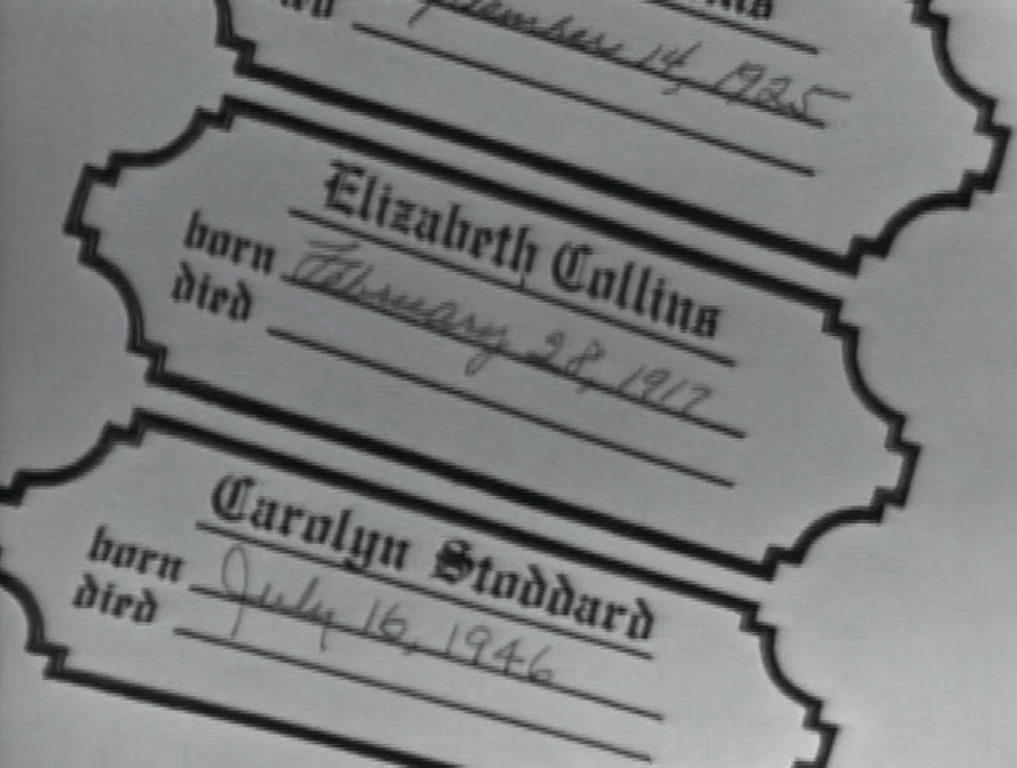
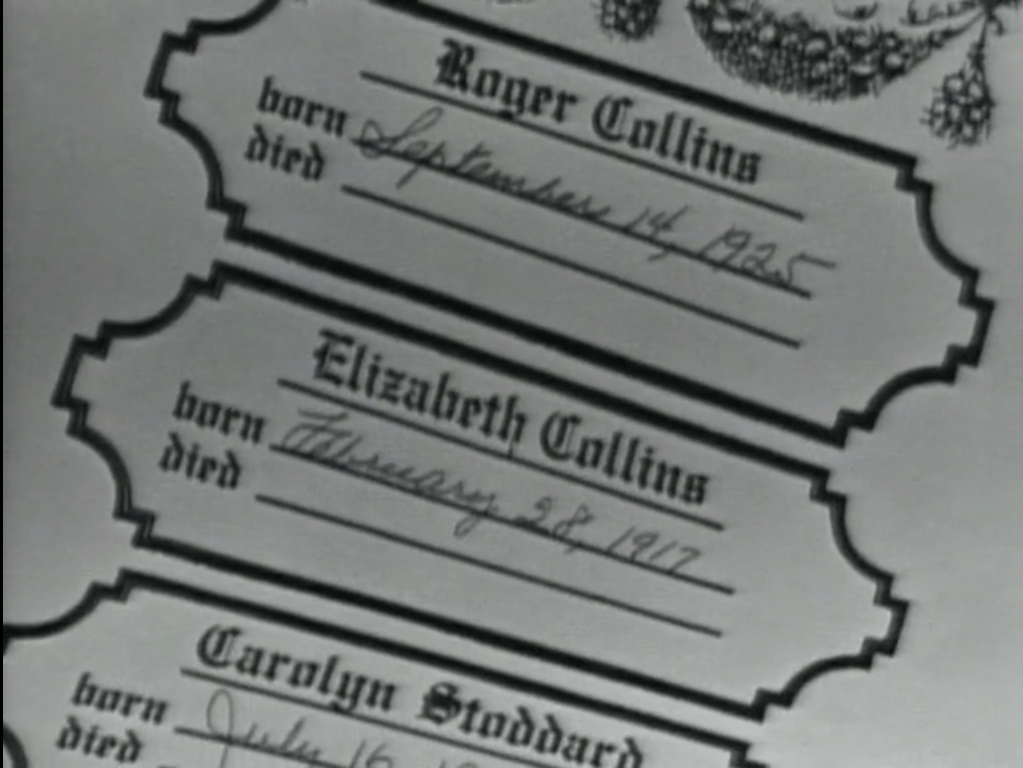
David calls Vicki’s attention to the book. It is the Collins family Bible, and was open to some plates that have been inserted bearing birth-dates for Liz and other members of the family. That’s the end of the episode. I must say, it’s quite an anti-climax after Burke’s attempt to retrieve his lost dime.

Closing Miscellany

Bob O’Connell is not on hand to play Bob the Bartender at the Blue Whale today. Instead, the bartender is Tom Gorman, who played the same role in #104 and will reprise it again in #607.

The birth-dates in the Collins family Bible are:

Roger Collins, 14 September 1925

Elizabeth Collins, 28 February 1917

Carolyn Stoddard, 16 July 1946

By comparison, the actual birth-dates of the actors were:

Louis Edmonds, 24 September 1923

Joan Bennett, 27 February 1910

Nancy Barrett, 5 October 1943

So it looks like they adjusted Edmonds’ and Bennett’s birth-dates by a few days plus a few years in setting their characters’ births, but ignored Miss Barrett’s actual birth-date in setting Carolyn’s. Maybe she refused to tell them what it was!

The show has been hinting heavily that Vicki is Liz’ biological daughter. A birth-date of 16 July 1946 for Carolyn would tend to pull against that- Vicki had apparently just turned 20 when the show started late in June 1966. Unless they were twins, one or the other of those characters is going to have to have her birth-date adjusted if they are going to resolve the question of Vicki’s origin that way.

*That’s a concern we’ve heard several times on this set- in #2, Roger introduced himself to Vicki by startling her as she stood at the edge of the cliff, and in #75 Vicki did the same thing to Roger. In #139, David was at the edge of the cliff when his mother, blonde fire witch Laura Murdoch Collins, surprised him; the episode ended with a literal cliffhanger after Laura made a move David wasn’t expecting. We’ve heard many times that the legendary Josette Collins was “the lady who went over the cliff,” as artist Sam Evans calls her in #185. It’s unclear why she did- maybe someone startled her.

Episode 264: In the shadows

In its first months, Dark Shadows spent a fair bit of time on the business interests of the ancient and esteemed Collins family. In those days, the Collinses were running out of money and their old nemesis, Burke Devlin, had come back to town with a plan to strip them of their remaining assets and drive them into poverty. The “Revenge of Burke Devlin” storyline never really took off, and was eventually subsumed into the tale of blonde fire witch Laura Murdoch Collins. Shortly after Laura disappeared, Burke formally gave up on his revenge. With that, the business stories ended, and there was no particular reason for Burke to stick around.

On Tuesday, Burke was recast. However little his character may have had to do on the show or however much he may have had to drink before he arrived at the studio, Mitch Ryan was always interesting to watch. Anthony George couldn’t match Ryan’s charisma, but by 1967 he had been a familiar face in feature films and primetime television for years. The original audience, even if they couldn’t remember George’s name, would have recognized him as a famous actor and assumed that his casting meant that something big was in store for Burke.

Today, we have two hints that business stories might be making a comeback as well. Seagoing con man Jason McGuire is blackmailing reclusive matriarch Liz into marrying him. Vampire Barnabas worries that the cozy little home he has made for himself in the Old House on the estate of Collinwood might be threatened if Jason takes control of the family’s holdings. He asks Liz’ brother, high-born ne’er-do-well Roger, to look at the original deeds for the Old House and the great house to see if there is some provision he might be able to use to defend his interests against Jason. That Barnabas asks about the deeds would suggest that he has acquired some form of ownership in the Old House. We’ve never seen him buy the house from Liz or receive it as a gift from her, but if both deeds are still in Liz’ name, he could hardly use their wording to claim a right to stay there. So when Roger goes off to look for the deeds, there is a chance he will come back with a story about real estate.

The second hint comes in Barnabas’ confrontation with Jason. Barnabas takes a very aggressive tone with Jason, who responds by asking Barnabas where he goes in the daytime and where his money comes from. “You have no accounts in the bank in town, and I know you don’t operate a business…” If Barnabas is going to be on the show for the long haul, as the ratings clearly indicate we should expect him to be, Jason will not be the last person to ask these questions. We might wonder how exactly he will forestall them.

If we have been watching from the beginning, the likeliest answer would involve Burke. When was a major character, Burke was presented as an inexhaustibly rich man who knew his way around some of the shadiest places in the world. If Burke happens upon Barnabas’ secret, we could expect Barnabas to bite him and thereby bring him under his power. With his money, Burke could set up plenty of bank accounts and businesses in Barnabas’ name. With his contacts in the demimonde, he could secure whatever papers Barnabas needs to establish his identity. Even a photo ID- Burke could easily hire a Barnabas lookalike to pose for a British passport.*

During the “Revenge of Burke Devlin” arc, Burke bought up a lot of Liz’ debts. In particular, he held enough notes payable on demand that she feared he might be able to put her out of business at any time. That hasn’t been mentioned for a long while, but if Barnabas takes control of Burke he could take those notes and exchange some of them for outright ownership of the Old House.

Barnabas could also compel Burke to fabricate some fraudulent papers that would make it look as if he were deeply in debt to Barnabas. When Barnabas got around to killing Burke, those papers would come to light. Liz and Roger would be grateful to Barnabas for taming their old adversary and clearing out some debts that posed a danger to their financial position, while well-meaning governess Vicki would be grateful to him for helping her boyfriend save his face after his business went south. As a result, his position at Collinwood would be unassailable.

Closing Miscellany

There is a location insert of Roger walking to the Old House, a flashlight in hand. I don’t think we have seen this footage before.

Screenshot by Dark Shadows Before I Die

Until today, Barnabas has tried to be very suave with everyone who doesn’t know that he is a vampire. Since he has nothing to say to Jason that will intimidate him, he might as well continue that approach in his scene with him, or at least play dumb. But instead, he is openly, and self-defeatingly, hostile. This will become a pattern in future episodes. Time and again, Barnabas will greet a potential adversary with an immediate declaration of war, often before the adversary even knows who he is, thereby forfeiting whatever element of surprise he might have on his side.

Barnabas catches a glimpse of the ghost of his sister Sarah. He only sees her as a figure moving in the distance as he is looking out the window, and has no idea who she is. But it does confirm that he is able to see her, something we had not known he could do.

*I laid all this out two years ago in a comment on Danny Horn’s Dark Shadows Every Day.

Episode 262: Hand the world over to madmen and murderers

On Thursday, reclusive matriarch Liz admitted to well-meaning governess Vicki that she is being blackmailed. Eighteen years ago, Liz killed her husband, Paul Stoddard. Seagoing con man Jason McGuire then buried Stoddard in the basement. Now, Jason is threatening to expose this secret unless Liz marries him.

Today, Liz asks Vicki to be the legal witness at her wedding to Jason. Vicki demurs, saying that she might be compelled to speak up when the officiant asks if there is anyone who present who knows why these two people should not be joined in matrimony. The conversation then shades off into Vicki urging Liz to share her secret with her daughter, flighty heiress Carolyn. Liz won’t look directly at Vicki when Carolyn’s name is mentioned.

Word is spreading that Maggie Evans, The Nicest Girl in Town, is dead. Vicki had just received that news when Liz brought up the wedding. Alexandra Moltke Isles does a fine job of expressing Vicki’s emotional tumult as she reels from one kind of shock to another. When Vicki breaks the news of Maggie’s death to Carolyn and then quarrels with Carolyn about her plan to marry motorcycle enthusiast Buzz, Mrs Isles reprises this transition from fresh bereavement to festering conflict, again quite effectively.

Carolyn goes out with Buzz, and Vicki goes for a walk on the beach with her boyfriend, Burke Devlin. Each episode begins with a voiceover which Mrs Isles delivers in character as Vicki. Typically, these consist of remarks about the sea and the weather which have some vaguely metaphorical connection to what’s happening on the show. While Vicki sits with Burke and stares out at the water, she launches into one of these monologues. In response, my wife, Mrs Acilius, started laughing so hard we had to pause the streaming. When Burke joins in with the observation that it is getting dark and “may get darker”- sometimes that happens as the evening goes on, seems to be some kind of pattern there- we both burst out laughing and had to pause it again. Before we restarted it that second time, Mrs Acilius asked “What does it say about us that we are sitting here watching this? That we choose to watch it when we’ve seen it before?” I’m not sure I want to know the answer to that one.

Vicki and Fake Shemp. Screenshot by Dark Shadows Before I Die

Vicki gets home shortly before Carolyn. Carolyn tells Vicki and Liz that after she saw Maggie’s boyfriend Joe walking down the street looking sad, she just wanted to go home and mourn. After Carolyn leaves them alone together, Vicki again urges Liz to tell her the truth. Vicki judges that Carolyn would listen to her sympathetically in the mood she is in now. Liz says she might tell Carolyn tomorrow, Vicki says that Carolyn might not be in the same frame of mind tomorrow, Liz says she can’t do it now.

In fact, Maggie is alive- her doctor decided to promote the story that she is dead as a lamebrained scheme to keep the person who tried to kill her from trying again. The blackmail plot, on the other hand, has barely shown a sign of life since it first arrived on the show ten weeks ago.

Jason is supposed to sweep away the last non-paranormal story elements left over from the period before Dark Shadows became a supernatural thriller/ horror story in December 1966. So far he has managed to disclose to the audience, but not to the other characters, why Liz hasn’t left home since the night Stoddard was last seen. That wasn’t an especially interesting question, as they have never shown us anyplace she would want to go, and it’s the only thing he has cleared up.

Another unanswered question is the one that led Vicki to come to Collinwood in the first place. She grew up in a foundling home, with no idea of who her parents were. The show has been hinting heavily that Liz is Vicki’s mother. Indeed, when Jason was brought on the show, the plan was that the grand finale of his storyline would confirm this. If that is still the plan, then the relationships among Vicki, Liz, and Carolyn are due for a drastic upheaval. That prospect lends a certain interest to the scenes among these characters today.

Closing Miscellany

This episode originally aired on 27 June 1967, the first anniversary of the broadcast of #1.

From #1 until #248, dashing action hero Burke Devlin was played by Mitchell Ryan. Ryan showed up at the set too drunk to work when they were supposed to tape #254 and was fired off the show. Today announcer Bob Lloyd tells us that “The part of Burke Devlin will be played by Anthony George.” There was never very much on Dark Shadows for a dashing action hero to do, and now that the most popular character on it is a vampire there isn’t going to be. It was only Ryan’s star quality that kept the character on the show so long.

Anthony George had appeared in feature films in the 1950s, had guest-starred in several prime-time shows, had been a regular cast member on the hit series The Untouchables, and had played one of the leads on a series called Checkmate. When the original audience saw him, many of them would have recognized him as a famous actor and would have expected the character to go on to do something important. Evidently they haven’t given up on Burke yet. But they had better come up with a story for him- George may have had a terrific resume, but he doesn’t have any fraction of Ryan’s charisma.

Unfortunately, they have given up on Buzz. He is on screen only briefly today, and we don’t see him again. Worst of all, while his first three episodes left us with the impression that he could not fail to be hilarious, he manages not to be even a little bit funny in this final appearance. He is just nasty and inconsiderate, demanding that Carolyn forget about whatever it is that’s bothering her and come to the loud party he’s planned.

Getting Buzz off the show the day Anthony George comes on as Burke does solve one problem. As of this episode, the three young women on Dark Shadows all have boyfriends. Maggie has Joe, played by Joel Crothers; Vicki has Burke, played by Anthony George; and Carolyn has Buzz, played by Michael Hadge. Those three actors were all gay. That wasn’t widely known at the time (except perhaps in the case of Mr Hadge, who really does not seem to be making an effort to keep the closet door shut while playing Buzz,) but now that everyone knows all about it, it does seem to be a sign that the show was spending a lot of energy on things that aren’t going anywhere.

Episode 223: She isn’t watching over us anymore

Strange and troubled boy David Collins is in the Old House on the estate of Collinwood with his aunt, reclusive matriarch Liz. David laments to Liz that he can no longer feel the tutelary presence of the ghost of their ancestor Josette Collins. For more than 24 weeks, from #70 when the Old House was introduced to #191 with the conclusion of the storyline centered on David’s mother, blonde fire witch Laura Murdoch Collins, the Old House had been Josette’s sanctuary. Now it is “a new house, a new place,” and she’s gone. David is particularly sad that the house’s new occupant, the newly arrived Barnabas Collins, has removed Josette’s portrait from its place above the mantle in the front parlor and plans to hang a portrait of himself there.

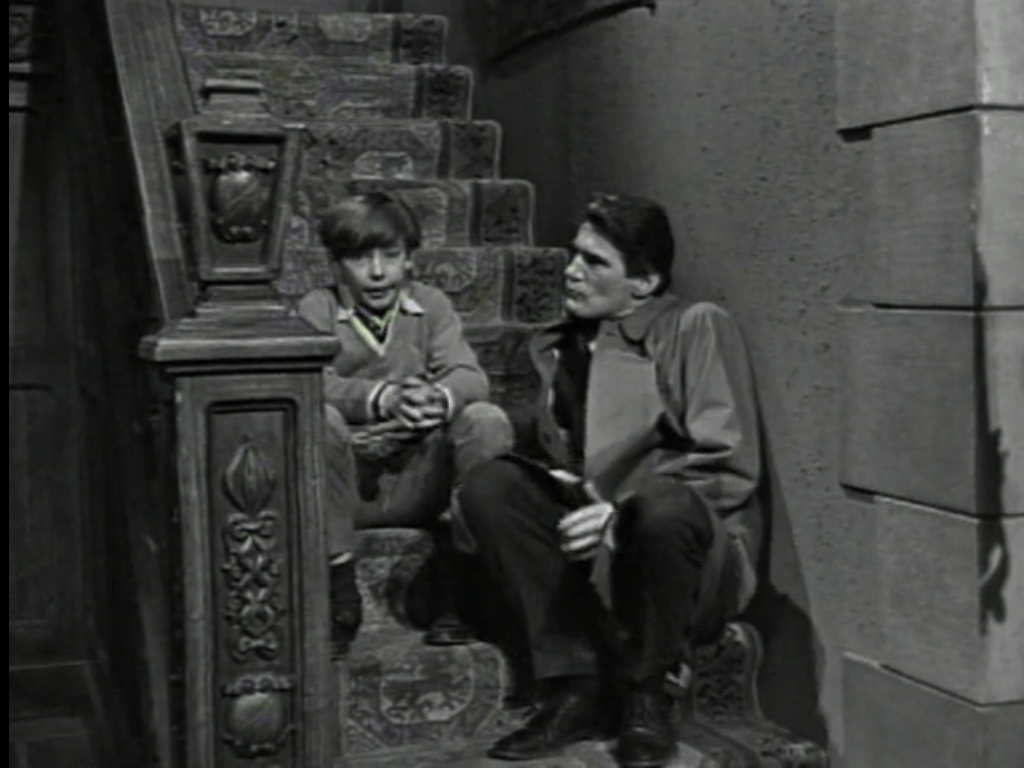
Back in the great house on the estate, David sees dashing action hero Burke Devlin. He sits on the stairs with Burke and talks about his feelings concerning Barnabas, Josette, the portrait, and the Old House. Burke suggests he ask Barnabas to give him the portrait. David is thrilled by this suggestion, and declares that he will go to the Old House at once to ask him. Burke points out that Barnabas probably isn’t home. That doesn’t make an impression on David, but he does stop before going out the door. Burke asks if he is afraid to go there alone, apparently preparing to volunteer to go with him. David says he isn’t afraid, but doesn’t explain what feeling he does have that is holding him back.

David and Burke talk it out

David goes to the Old House and calls to Barnabas. No one answers. The howling of dogs fills the air from every side, frightening David. He calls to Josette. He does not feel her presence. The doors slam shut on their own; when he runs to them, he cannot open them. We conclude with a closeup of his terrified face.

Those three scenes might have appeared in a good episode, but this is not that episode. In fact, it is a real stinker, very possibly the single worst we have seen so far. There is one funny line, when Liz remarks that Willie Loomis’ “illness appears to have caused him no end of convenience.” And the actors and director do what they can. But the script defeats them all.

As David Collins, David Henesy appears to be delivering the lines Ron Sproat actually wrote when he says things like “If I blame [Barnabas] for anything, it’s for changing things around [at the Old House]… I just hope he hasn’t changed [the Old House.]” Some of the words that come out of his mouth may be flubs, but most of it is of a piece with what the adult actors are saying in response to him, and nothing anyone says is close to intelligible. This is one of the rare episodes when Henesy winds up roaming about the sets declaiming like some kid actor in a 60s TV show.

As well-meaning governess Vicki, Alexandra Moltke Isles is trying so hard to remember her own pointless lines that she stands stiff as a board every time she is on camera. Vicki and David’s scenes were the heart of the first 39 weeks of the show, often in spite of writing nearly as bad as what the cast is stuck with today, but their conversation on the stairs today is terribly dull to watch.

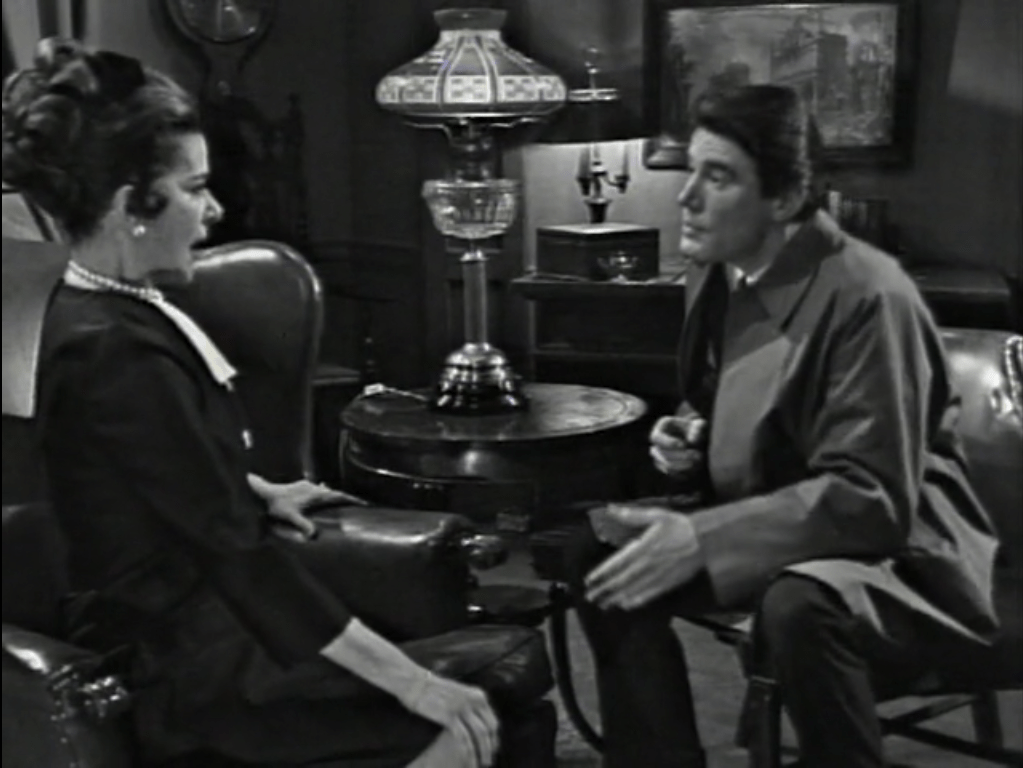
Joan Bennett and Mitch Ryan each had star quality in abundance, and so they manage to hold their scenes together. The opening scene between Liz and Vicki has some snap to it, David’s conversation with Burke is appealing, and when Liz and Burke have a scene in the study arguing about a business deal she made with a man called Hackett* things start to crackle. But even in that scene Bennett and Ryan stumble over Sproat’s awful dialogue and wind up in the ditch more than once. Her frequent glances at the teleprompter and a couple of alarmingly long pauses from him turn the crackle to a fizzle well before it is over.

Burke and Liz argue about the Hackett deal

The scene between David and Liz in the Old House is another defeat for Joan Bennett. David Collins’ nonsensical lines and David Henesy’s flailing attempts to find some kind of through line in them leave her standing in mid-air, and the scene goes on so long they repeat every point they have to make at least twice. By the third time through the sparse material they have to work with, not even she could make it interesting.

Moreover, regular viewers will be puzzled when Liz tells David over and over that the Old House and its contents belong to Barnabas. On Monday, in #220, Barnabas and Vicki had a conversation in the foyer of the great house about the fact that he was not going to own the Old House. There hasn’t been any indication of a change in that plan, but Liz goes out of her way to say three times, not that Barnabas is staying in the house, but that it is his. We are left wondering what she is talking about.

Burke and Vicki spend some time together. They stand in front of the portrait of Barnabas Collins in the foyer of the great house talking about Barnabas’ decision to hire Willie as his servant. Burke remarks that “Cousin Barnabas doesn’t seem too bright.” That’s a fun moment, but then Vicki sticks up for Barnabas and they have nowhere to go with it. The scene doesn’t end until they’ve spent a few more moments standing there jabbering.

Burke and Vicki sit on the sofa together in the drawing room. The nonverbal communication between them raises the question the show has been teasing for some time, whether Burke and Vicki are dating. As with Burke’s paternal moment with David, it shows that the actors and directors can create little stories to keep us interested when they can keep the dialogue out of the way.

Burke says he’s going to talk with Liz about a business matter that he can’t tell Vicki about. He then tells Vicki why he is concerned about the matter. These mutually contradictory lines are no better than David being upset that Barnabas has changed the Old House, and just hoping that he hasn’t changed the Old House. For a moment, friend Burke doesn’t seem too bright.

*A name we have never heard before on Dark Shadows.

Episode 221: A new Collins in Collinsport

Maggie Evans, The Nicest Girl in Town, is closing up shop in the restaurant at the Collinsport Inn. A stranger startles her. He is the mysterious Barnabas Collins. Barnabas recently left his long-time residence in the cemetery five miles north of town and has been hanging around the great estate of Collinwood, but this is the first time we’ve seen him in Collinsport proper.

In the opening months of Dark Shadows, the restaurant, like the rest of the inn, was coded as the base from which dashing action hero Burke Devlin mounted his campaign to avenge himself on the ancient and esteemed Collins family. As the Revenge of Burke Devlin storyline ran out of steam, the restaurant emerged as a neutral space where new characters could be introduced without defining their relationships to the established cast all at once. In that period, Maggie was Collinsport’s one-woman welcoming committee.

Now, even Burke has given up on his storyline. The only narrative element of the show with an open-ended future is Barnabas, and once the audience has figured out that he is a vampire there’s no such thing as a neutral space where he is concerned. So it is not clear what, if any, role the restaurant will have from now on.

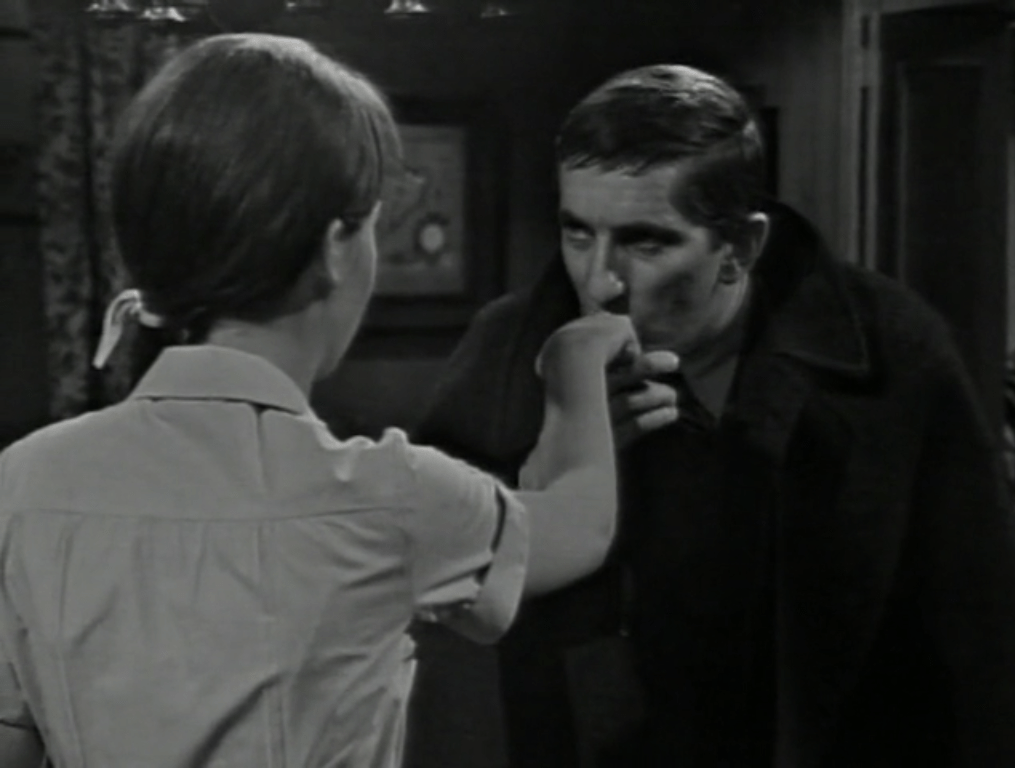
Barnabas asks if it is too late to get a cup of coffee. Maggie tells him it is, but relents after about a minute and reopens to serve him. She is charmed by his old-world manners and excited to learn that “there is a new Collins in Collinsport.” He tells her he is staying at the long-abandoned Old House on the grounds of Collinwood, prompting her to marvel at the idea of someone living in a dilapidated ruin that is probably haunted. When she admires his cane, he explains that it is not only quite valuable, but is also a family heirloom and on that account his most prized possession.

Barnabas appears to drink the coffee, as he appeared to drink the sherry his distant cousin Roger served him when he visited Collinwood in #214. Usually vampires are supposed to limit their diet strictly to human blood, but just a few weeks ago Dark Shadows wrapped up a long story about Laura Murdoch Collins, a humanoid Phoenix, who raised everyone’s suspicions by never being seen to eat or drink. So they may have thought that it would be repetitious to follow the Laura arc so closely with another undead menace who betrays himself with the same sign.

Barnabas kisses Maggie’s hand in farewell

Maggie’s boyfriend, hardworking young fisherman Joe, comes bustling into the restaurant seconds after Barnabas leaves. Maggie is surprised that Joe and Barnabas didn’t pass each other, and puzzled when Joe tells her there was no one in sight anywhere near the inn. Neither of them had heard of Barnabas before.

Joe tells Maggie that a woman named Jane Ackerman had an unpleasant run-in with a man she couldn’t see earlier in the night. The fellow retreated before doing her any serious harm, but Joe seems fairly sure that whoever it was is a real threat to the women of Collinsport. So he wants to keep Maggie company. Maggie doesn’t seem worried, either for her own sake or for Jane’s. She’s just happy to see Joe, and gladly agrees when Joe suggests they go to the local tavern, the Blue Whale.

As Dark Shadows’ principal representatives of Collinsport’s working class, Maggie and Joe illustrate the point the opening voiceover made when it said that people “far away from the great house” of Collinwood would soon be “aware of” Barnabas and of “the mystery that surrounds him.” As a name we have never heard before and are unlikely to hear again, “Jane Ackerman” reminds us that there is a whole community of people for Barnabas to snack on.

As Joe and Maggie are heading out of the restaurant, she notices that Barnabas left his precious cane behind. She wants to go straight to the Old House to return it to him. Joe would rather wait until morning, but Maggie explains that she doesn’t want to be responsible for it overnight. This is a bit odd- they are in a hotel, after all, a business that specializes in keeping valuable property safe while its owners sleep.

Perhaps Maggie wants to see the Old House. Joe has been there many times. When we saw him there with Burke, searching for well-meaning governess Vicki in #118, he mentioned that when he and flighty heiress Carolyn were children, they would occasionally play there. He returned there during the Laura storyline. Even Maggie’s father has visited the Old House, participating in a séance there in #186 and #187. Maggie has never been there at all. So perhaps she just feels left out.

Maggie and Joe knock on the doors of the Old House. No one comes. As they turn to go, there is a closeup of the door knobs turning. Maggie and Joe hear a door open, and go in. They don’t see anyone, but candles are burning and Joe remarks that the front parlor has been fixed up. Joe goes upstairs and leaves Maggie behind, explaining that he knows his way around the place and it isn’t safe up there for someone who doesn’t.

Once Maggie is alone, Barnabas appears next to her. She is startled and cannot see how he could have got there without her knowing. He apologizes for once more catching her unawares. He seems surprised that she is not alone. When Joe comes downstairs, he is exceedingly polite to both of them.

After Maggie and Joe excuse themselves, Barnabas’ blood-thrall, the sorely bedraggled Willie Loomis, appears. With obvious difficulty, Willie forces out one word after another, and manages to ask Barnabas what he plans to do to Maggie. Barnabas is displeased with Willie’s presence and with his presumption that he has the right to question him. He climbs the stairs and looks down at Willie, full of menace and demanding that he go out and do the work Barnabas has ordered him to do. Willie tries to refuse, but cannot stand the look Barnabas is giving him.

Barnabas gives Willie his orders

During this staring contest, Barnabas and Willie are standing on the spots where strange and troubled boy David Collins and Barnabas had stood when we first saw Barnabas in the Old House in #212. In that scene, David and Barnabas were more or less eye-to-eye, and for a moment it seemed that Barnabas was contemplating violence against David. In this scene, Barnabas shows how committed he is to violence. He has a power over Willie that he gained by the extreme violence of drinking Willie’s blood, and Willie’s inability to resist Barnabas’ stare shows that power in use. Willie’s horror at the task Barnabas has assigned suggests that it also is violent.

My wife, Mrs Acilius, believes that the confrontation between Willie and Barnabas solves one of the behind-the-scenes mysteries about Dark Shadows. Why was James Hall replaced by John Karlen in the role of Willie? She points out that Hall, while he is a fine actor, had a lot of trouble with Willie’s lines, particularly in the long he shared with Dennis Patrick’s Jason McGuire. By the time Willie was recast, Jonathan Frid had been attached to the role of Barnabas for some days, and Frid never made it a secret that he was a slow study. So if there were going to be a lot of long conversations between Willie and Barnabas, Willie had to be played by an actor who could get his dialogue letter perfect day after day. That was John Karlen.

After Willie scurries off to do whatever evil chore Barnabas has ordained for him, Barnabas wanders over to the window. On his way, we see that the portrait of Josette Collins is no longer hanging in the spot over the mantle where we have seen it since our first look at the Old House in #70. At the end of that episode, Josette’s ghost emanated from the portrait and danced around the outside of the house. From that point, the Old House was chiefly a setting for Josette. Crazed handyman Matthew Morgan learned that to his cost when he tried to hold Vicki prisoner there and Josette and other ghosts ganged up on him and scared him to death in #126. Laura knew that she was entering the territory of a powerful enemy when her son David took her to the Old House in #141, and when Vicki had formed a group to oppose Laura’s evil plans she and parapsychologist Dr Guthrie went there to contact Josette. In #212, Barnabas addressed the portrait and told Josette that her power was ended and he was now the master of the house. Removing the portrait tells us that Barnabas is confident that he is not only a new Collins in Collinsport, but that he is now the Collins at Collinwood.

Barnabas then does something Laura did several times- he stares intently out his window. When Laura stared out her window, David would be violently disturbed, no matter how far away he was or how many obstacles were between him and his mother. These incidents were a big enough part of Laura’s story that regular viewers, seeing Barnabas stare out the window, will expect someone at a distance from him to react intensely.

We cut from Barnabas to Joe and Maggie at her house. Joe asks what time he should pick Maggie up tomorrow, and Maggie suddenly becomes disoriented. Kathryn Leigh Scott has a sensational turn playing that moment of lightheadedness, creating the impression that she is having a scene with Barnabas. As she recovers, she explains to Joe that she has the feeling she is being stared at. Then we dissolve to Barnabas in his window. Barnabas may not be Maggie’s mother, but apparently there is some kind of link between them. Perhaps kissing Maggie’s hand in the restaurant was enough to give Barnabas the power to creep her out even when he is miles away from her.

Episode 206: Hey, it’s Big Man

Villains on soap operas can never be quite as destructive as they at first seem they will be, and heroes can never be quite as effective. To catch on, villains and heroes have to seem like they are about to take swift action that will have far-reaching and permanent effects on many characters and storylines. Yet the genre requires stories that go on indefinitely, so that no soap can long accommodate a truly dynamic character.

This point was dramatized in Friday’s episode. The chief villain of the moment, seagoing con man Jason McGuire, stood in front of some candles, placed to make him look like he was the Devil with long, fiery horns. Seconds after this image of Jason, his henchman Willie loses interest in him and wanders off, first listening to a lecture from a nine year old boy, then becoming obsessed with an oil painting. They aren’t making Devils the way they used to.

Jason and Willie look at the portrait of Jeremiah Collins

Today, dashing action hero Burke Devlin goes to the great house of Collinwood and confronts Willie. Well-meaning governess Vicki asks Burke why he wants to defend the ancient and esteemed Collins family from Willie and Jason if the Collinses are his enemies. He gives a flip answer to her, and is equally unable to explain himself to reclusive matriarch Liz. Regular viewers remember that the “Revenge of Burke Devlin” storyline never really led to anything very interesting, and that last week the show formally gave up on it. Without it, Burke has nothing to do. So, if the character can’t keep busy as the Collinses’ nemesis, he may as well try to justify his place in the cast with a turn as their protector.

In the foyer of Collinwood, Burke orders Willie to leave Vicki alone. Willie taunts him, and Burke picks him up and holds him with his back against the great clock. Vicki and Liz become upset, demanding that Burke let Willie go. Willie himself remains collected. After Burke releases him, Willie goes to his room, and the ladies scold Burke further. He doesn’t appear to have accomplished a thing.

Willie, off his feet but undisturbed

This is John Karlen’s first episode as Willie Loomis. His interpretation of the character is poles apart from that of James Hall, who played Willie in his previous five appearances. When I was trying to get screenshots to illustrate the moods of Hall’s Willie, I found that I had an extremely difficult task on my hands. His face would fluctuate wildly, showing a mask of calculated menace for a few seconds, then a flash of white-hot rage for a tenth of a second, then sinking into utter depression for a moment before turning to a nasty sneer. These expressions followed each other in such rapid succession it was almost impossible to catch the one I set out to get. The overall impression Hall creates is of a man driven by desperate, unreasoning emotions, lashing out in violence at everyone around him because of the chaos inside himself.

Karlen’s Willie is just as dangerous as Hall’s, but he is as composed as Hall’s Willie was frantic. At rise, he is staring at the portrait of Barnabas Collins, studying the baubles Barnabas is wearing. When housekeeper Mrs Johnson enters, Willie asks her about the Collins family jewels. When she uncharacteristically manages to be less than totally indiscreet, he shows considerably more cleverness and infinitely more calmness than Hall’s Willie ever did in maneuvering her to the subject again. If Hall’s Willie was a rabid dog charging heedless in every direction, Karlen’s is a deliberate hunter, acting coolly and undaunted by resistance.

Hall played Willie with a lighter Mississippi accent than he uses in real life, while the Brooklyn-born Karlen assumes a vaguely Southern accent in parts of this episode. That trace of Hall’s influence will remain for some months- eventually Willie will become a Brooklynite, but between now and then Karlen’s accent will go to some pretty weird places.

This was also the first episode of Dark Shadows which ABC suggested its affiliates broadcast at 3:30 PM. It would not return to 4:00 until 15 July 1968. When the core demographic of the show’s audience shifts from housewives and the chronically ill to school-age kids, as will happen quite soon, this earlier time slot will present a major problem. Those kids are now in their 60s, and they usually begin their reminiscences of Dark Shadows with “I used to run home from school to see it!” If school let out at 3:00 and the TV set at home took as long to warm up as most of them did in those days, you’d have to run pretty fast to be sure to catch the opening teaser even if you lived nearby.