Wicked witch Angelique made her first appearance in #368/369, set in the year 1795. We first saw Angelique when she entered the doors of the Old House on the estate of Collinwood, working as a lady’s maid and hiding her powers.
Today, it is 1970 and Angelique is back in the Old House. Her ex-husband, vampire Barnabas Collins, has summoned her and asked her to lift a curse she placed on Jabe, the husband of his distant cousin Carolyn. Barnabas tells Angelique that her quarrel was never with Jabe, but with suave warlock Nicholas Blair. Earlier in the episode we had seen Angelique and Nicholas having a discussion about how much they hate each other. He taunted her by claiming she has not changed in the last 200 years. When Barnabas invites Angelique to redirect her wrath towards Nicholas, she perks up. She orders Barnabas to fetch Carolyn’s husband and leave him alone in the Old House with her.
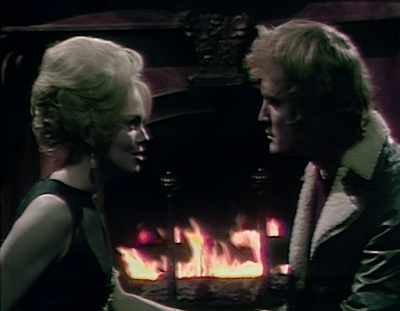
Angelique sits by the fire with Jabe and explains that she cannot simply liquidate the curse. It must end with someone’s death. But the good news is that it does not have to be his death. He can transfer it to someone else. He says he doesn’t want to kill anyone. She tells him that the person she has in mind is Nicholas. Suddenly he’s all ears as she explains the process for handing the curse over.
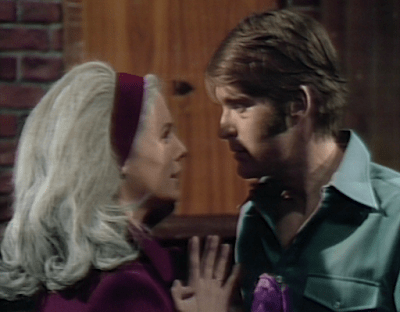
Angelique finds the limit of Jabe’s newfound reverence for life. Screenshot by Dark Shadows Before I Die.
Longtime viewers know that Nicholas was quite wrong to say Angelique has never changed. She was monomaniacal and utterly narcissistic in 1795. She wasn’t so very different when we next saw her in 1968, though the show’s pace was a bit slower at that point and so Lara Parker was free to play her with more nuance. That made a difference that the show underlined early in 1969, when Barnabas took a brief trip back in time to the 1790s and ran into Angelique as she was when first we knew her. Even though they were still enemies in 1968, they occasionally had to tell each other the truth, and occasionally had to leave each other alone to fight other adversaries. The unbending hostility the eighteenth century version of Angelique showed Barnabas startled him and us after we had seen the relatively circumspect approach she took to conducting a cold war against him.
Throughout most of 1969, Dark Shadows was set in 1897. Angelique showed up then, and she remembered the events of 1968. Barnabas and his friend, mad scientist Julia Hoffman, were there as time travelers. Julia actually befriended Angelique, and Angelique became Barnabas’ ally in the battles he attempted to wage in that period. Angelique even let go of her erotic obsession with Barnabas, transferring her affections to his distant cousin Quentin Collins.
After the show came back to contemporary dress, Julia stumbled upon Angelique. She found that Angelique had sworn not to use her powers, had married a man who made her happy, and had lost all interest in Barnabas or anyone else at Collinwood. She was as relaxed and attentive to others as in 1795 she had been frantic and self-absorbed. Only after it turned out the same supernatural enemies Barnabas and Julia were fighting had corrupted her husband did Angelique start casting spells again, and then in pursuit of more rational, identifiable goals than she had ever sought in the eighteenth century.
That arc of character development ends with this episode. We will see Lara Parker as several more characters up to and beyond the end of the series, some of them named Angelique, but none of whom went through the transformations we have seen.
Today also marks the final appearances of werewolf Chris Jennings and his girlfriend Sabrina Stuart. Evidently the makers of the show planned to bring them back in a few months, after an upcoming story plays out, but by that time actor Don Briscoe was unable to work. He had bipolar personality disorder and tried to self-medicate with street drugs.
Quentin was such a big hit in 1897 that they had a magic spell put on him that immunized him against aging and brought him intact to the contemporary setting. Today, Barnabas takes Quentin to a room in the long disused east wing of Collinwood where you can occasionally catch glimpses of an alternate universe. The effect manifests while they are looking in, then winks out, leaving the dark, bare room that is in that space in their universe. Once that happens, Barnabas announces “You have just seen Parallel Time.” Those of us who have been watching from the beginning know that he got the line wrong. You’re supposed to say “Parallel Time is a Dan Curtis Production.”
An information management day. Old world gentleman Barnabas Collins has told his distant cousin, Roger Collins, about a parallel universe that is occasionally visible in a room in the long disused east wing of the great house of Collinwood. Today, Roger tells his sister Elizabeth about the room. Liz owns the house. We might wonder if she will have questions about what effect the presence of a spare universe on the premises will have on her property taxes.
Roger talks about the phenomenon while standing in the room with permanent houseguest Julia Hoffman, MD. He is incredulous when he notices that Julia is not listening to him. She cannot tell him what has distracted her. Unknown to Roger and Liz, Barnabas is a vampire. Julia has devised a treatment that is supposed to put this curse in remission, but it is not working at all. She has given him the last of the injections, and the only difference in Barnabas is that he is getting sick and feeling an unusually intense bloodlust.
Caretaker Chris Jennings, another distant cousin, comes stumbling home to his cottage on the grounds of the estate. He finds his girlfriend and ex-fiancée Sabrina Stuart waiting for him. Chris is another patient Julia has been unable to help. He is a werewolf. There was a full moon last night. Sabrina tells Chris he killed a man named Bruno. Chris is distressed that he killed anyone, but Sabrina points out that Bruno knew of his secret and was trying to use him to kill others. He was holding her and a man named Rumson prisoner, and when the police searched Bruno’s premises after his death they found Sabrina and Rumson imprisoned there. Sabrina keeps telling Chris she wants to marry him. Most of the time they will live ordinary lives, but one night out of 28 she will just have to lock him up in a special cell. Chris won’t hear of this.
My wife, Mrs Acilius, is a great one for love stories and an admirer of actress Lisa Blake Richards. Chris and Sabrina have run out of road on Dark Shadows, and are obviously going to be written out soon. Mrs Acilius wishes they could ride off into the sunset accompanied by the sound of wedding bells. So when Chris refused to marry Sabrina, she exclaimed “Stupid man!” I pointed out something Chris knows but does not mention to Sabrina, that his curse is hereditary. Any male descendants he has will also be werewolves. Mrs A conceded that this does complicate matters.
Roger saw Chris at Bruno’s place when he rescued him and Carolyn shortly before moonrise last night. Chris was at that time in the throes that precede his transformation. Chris ran off before Roger or Carolyn could see what became of him. Roger comes to the cottage to check on him.
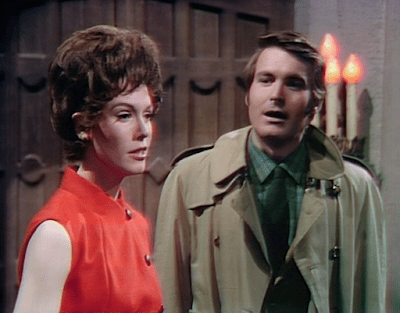
Chris is in the back changing out of his bloody clothes, so Sabrina answers the door. She tells Roger that Chris is there and that she was with him all night, watching over him because he was ill. After what he saw of Chris at Bruno’s, Roger has no doubt that Chris needed a nurse, and he tells Sabrina that he is glad he had such a charming one. The audience can understand that Sabrina wants to conceal Chris’ lycanthropy from Roger, but surely it cannot be wise for her to claim that she was in the cottage overnight. Not only are her true whereabouts known to everyone who was in or around the police station the night before, but since Roger was the one who found Bruno’s body and he found it on the grounds of Collinwood, even police as inept as the ones in Collinsport are likely to follow up with him. Besides, her imprisonment with Rumson is a sensational story, of interest to the press. Maybe we will move on to the next phase of the show before the facts come to light, but Sabrina can’t know that.
Sabrina is determined to persuade Chris to resume their engagement. She goes to the one person whose opinion Chris seems to respect, Barnabas. When she knocks on his door, Barnabas hides behind a partition. When Sabrina first arrived, she had seen Barnabas through the window of his front parlor, so she lets herself in. He finally gives up on hiding and pleads with her to leave. She ignores what he is saying and keeps talking. She plows ahead with her idea about how Barnabas can help her and Chris become a happy married couple. Barnabas struggles to resist his urge for blood, but cannot. He bites Sabrina, much to her surprise. Miss Richards’ understated exclamation of “Barnabas!” when he shows his fangs and goes for her neck is very nicely done, it really sounds like a woman puzzled that a trusted friend is violating her personal space.
Sabrina staggers back to Chris’ cottage. She collapses in his chair, and he sees the puncture wounds on her neck. They are much bigger than the marks we’ve seen on Barnabas’ previous victims. I suppose he really was a lot hungrier than usual. Chris doesn’t know that Barnabas is a vampire, and the cliffhanger leaves us wondering whether he can avoid finding out.
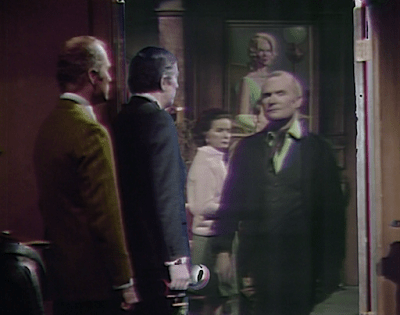
Probably the most memorable shot in the episode is a very impressive bit of videotape editing. Roger and Barnabas are standing at the door to the Parallel Time room, watching Roger’s counterpart interact with Liz’ and Chris’. Parallel Roger walks toward the door. He exits the room, not into the space Roger and Barnabas occupy, but into the hallway as it exists in Parallel Time. He vanishes from their view, and the effect also winks out in the room, leaving Roger and Barnabas looking into the bare, dark chamber it is in the house they know.
When Dark Shadows began, its most dangerous villain was high-born ne’er-do-well Roger Collins. Since the plan was to kill Roger off after his crimes were exposed, writer Art Wallace and actor Louis Edmonds were free to present him as gruesomely as they pleased. That turned out to be so much fun for all concerned that it soon became impossible to imagine the show without Roger, and the plan changed.
Once Roger was established as a permanent part of the ensemble, they toned his wickedness down. He still did and said awful things, but they would pull him back whenever he might risk alienating the audience. So, he at first openly expressed his hatred for his young son, strange and troubled boy David, and in #68 and #83 coldly exploited David’s mental health problems to manipulate him into trying to murder well-meaning governess Vicki. But when David got Vicki into a situation that might actually have resulted in her death, Roger rescued her. When Roger’s estranged wife Laura showed up and wanted to take David away with her, Roger was so delighted at the prospect of getting rid of the boy that he willfully ignored one sign after another that something was seriously wrong with Laura. But when Vicki finally proved to him that Laura was an undead fire witch who intended to incinerate David, Roger joined in the effort to save him, and was so shaken by the experience that he would never again be overtly hostile to David.
Nor was his attitude towards David the only sign of Roger’s pathological lack of family feeling. He had squandered his inheritance, selling his half of the family business to finance his extravagant lifestyle. His sister, reclusive matriarch Elizabeth Collins Stoddard, went deep into debt buying back what Roger had sold. When Roger ran out of money, Liz took him and David in at the great house of Collinwood. When in #41 Liz reproved Roger for the difficult position she had put him in, he proudly declared that he had “enjoyed” his inheritance, and twitted her for her dreary ways. Liz gave Roger a job in the business, but the only time we saw him visiting his office he answered his phone and told the caller that what he was asking was someone else’s job. When in #273 Roger found that seagoing con man Jason McGuire had tricked Liz into believing that she had a terrible secret that she could keep only by surrendering her whole fortune to him in blackmail payments, he admitted to his sister that if she had confided her troubles in him, he would probably have done the same thing.
When vampire Barnabas Collins succeeded Laura as Dark Shadows‘ supernatural Big Bad, Roger was pushed to the margins of the story. From that time on, he had two things to contribute. The first were sarcastic remarks, many of them very funny, that established him as the show’s sardonic gay uncle. The second, which gave him what little function he retained in the plot, were ostentatious refusals to believe the evidence piling up on all sides that the family was beset by a procession of bloodthirsty monsters. Since several other characters, Liz among them, also refused to face these facts, the show could go long periods of time without featuring Roger at all.
In November 1967, Vicki came unstuck in time and found herself in the year 1795. From then until March 1968, Dark Shadows was a costume drama set in that period. The segment was a hit in the ratings, and a triumph for Louis Edmonds, who was cast as haughty overlord Joshua Collins. Joshua was the opposite of Roger- as protective of the family’s position as Roger was careless of it, as committed to making money as Roger was thoughtless in spending it, as courageous in the face of physical danger as Roger was cowardly. The 1790s segment became The Tragedy of Joshua Collins, as we saw how Joshua’s best qualities led him to create the dark and twisted world in which his descendants would grow up to be weak, selfish men like Roger.
When the show came back from the 1790s, Roger was obsessed with a portrait painted in those days. The portrait’s subject was Angelique, the wicked witch who precipitated the disasters that annihilated Joshua’s family. Before long, Angelique herself returned, wearing a wig, using a false name, and married to Roger. The spell Angelique cast to win Roger occasionally caused him to think he was Joshua, and by the time that story ended Roger had become, if not the imperious tycoon Joshua was, certainly a hard-working, conscientious family man. He still had a languid manner and a way with a quip, but was otherwise unrecognizable as the show’s original Man You Love to Hate.
Evil spirits drove the Collinses out of the great house of Collinwood in #694. That episode marked the end of Roger’s function as one of the “There must be a logical explanation!” people. He was the last member of the family to insist that everyone else was being silly, but when he finally accepted the reality of the situation and was on his way out of the house, he turned to declare to the ghosts that the living would be back to reclaim what was rightfully theirs. From that moment on, Roger was no longer a narrative brake pad.
For most of 1969, Dark Shadows was set in 1897. In that year, we got to know Quentin Collins, who as a ghost would be chiefly responsible for the haunting that had driven the Collinses out of Collinwood. We saw that the living Quentin was a charming rogue, a spendthrift who cheerfully tells his sober-minded sister Judith that he can waste money faster than she can give it to him, inclined to violence when it serves his purposes and quick to run away when he is in danger of being called to account for his crimes. In short, he is what Roger originally was, only played by a younger, sexier actor, and with an unlimited future on a show that has discovered the characters won’t alienate the audience by being evil, only by being dull.
In the 1897 segment, Edmonds played Quentin’s brother Edward, who was not dull, but not evil either. Edward was stuffy and hypocritical. He was occasionally cruel, sometimes because of greed, sometimes because of prejudice, and sometimes because he flew into a panic in the face of an unexpected danger. But he was sincerely devoted to his children, and he had a sense of decency that would assert itself even after he had done awful things. For all his faults, Edward was ultimately one of the most lovable characters Dark Shadows ever created. If 1795 was The Tragedy of Joshua Collins, 1897 was largely the Comedy of Edward.
After 1897, Dark Shadows spent several months bogged down in an attempt to make a story out of some themes drawn from the tales of H. P. Lovecraft. Roger showed up in this part of the show just a few times. Quentin, brought into contemporary dress intact due to his great popularity in the 1897 segment, told Roger what was going on in #958. Rather than scoff as he would have in 1967 or 1968, Roger accepted Quentin’s account at once and helped him in the battle. Roger had by that point turned into Edward. His habit of denial was gone, and with it all of his languor and most of his wit.
Now the show is clearing out the last villains left over from the Lovecraft project and launching a story about a parallel universe that is occasionally visible through a doorway in the long-disused east wing of the great house. Roger is active in both of these plots today.
Even when he was a villain who cared nothing for his son, his sister, his family name, or Collinsport Enterprises, Roger very much enjoyed the company of his niece, Carolyn Collins Stoddard. On Friday, he was hugging Carolyn while she wept about the difficulties she was having in her new marriage; he called her “Kitten,” a term of endearment he has used with her since #4. In those early days, the show was heavy with hints that Roger and Carolyn’s relationship verged on incest. She often answered to “Kitten” in the moments when those hints were most insistent. But there was nothing unwholesome about Roger’s embrace of Carolyn on Friday, and he is irreproachably fatherly in his attitude towards her today.
At rise, Carolyn is in a trap. A man named Bruno, one of the leftover villains introduced while the show was dealing with the Lovecraft-derived material, has tricked her into entering a room where he has already imprisoned her old friend Chris Jennings. Bruno locked the door, and Carolyn saw that Chris was on the floor, writhing in pain. She asks him what is wrong, he won’t answer. Carolyn doesn’t know it, but Chris is a werewolf. The moon is rising, and his pains are the first stage of his transformation.
Bruno’s master wants Carolyn’s husband dead, and has decided that if the werewolf kills Carolyn he will lose the will to live. Since it would have been at least as easy to get the husband into the room as it was to get Carolyn there, and since one of the main things they have told us about the husband is that he is vulnerable to werewolf attacks, this scheme is unnecessarily complicated, marked for the audience as likely to fail. Indeed, since Bruno, his master, and Carolyn’s husband are all short-timers who don’t really need to be on the show anymore, while Carolyn has been a core member of the cast since #2, we can be quite sure it will fail, and if we have spent time over the weekend wondering about the cliffhanger, we’ve spent it wondering what will save Carolyn.
What saves Carolyn turns out to be well-timed intervention by her Uncle Roger. Roger was worried that she wouldn’t tell him why she was crying about her marriage, and followed her to Bruno’s place. He saw her enter, and after a few minutes let himself in. He confronted Bruno in his parlor, heard Carolyn and Chris in the back room, and found that the door to the back room was locked. When Bruno told him the door would stay locked, Roger hit him on the head with a candlestick, knocking him out. He took Bruno’s key, unlocked the door, and freed Carolyn. While Roger telephoned Collinwood to ask for permanent houseguest Julia Hoffman, MD, Chris jumped out of the back room’s window. Roger then decided that he and Carolyn should go home.
It may strike first-time viewers as odd that Roger calls Julia and not the police. Established fans will be unsurprised, knowing that the Collinsport Sheriff’s office is one of the world’s most useless organizations and that Julia is a mad scientist whose powers know few limits. Still, once Roger gets Carolyn home he does tell her they should call the sheriff. She refuses, and also forbids him to tell her mother Liz anything about what has happened.
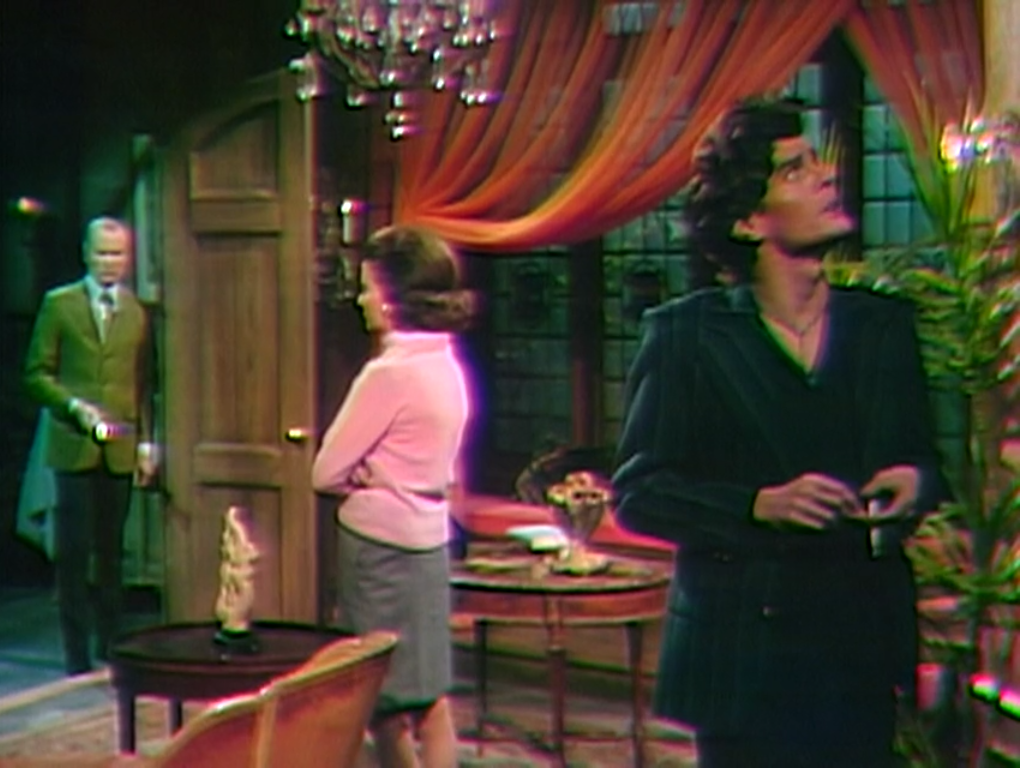
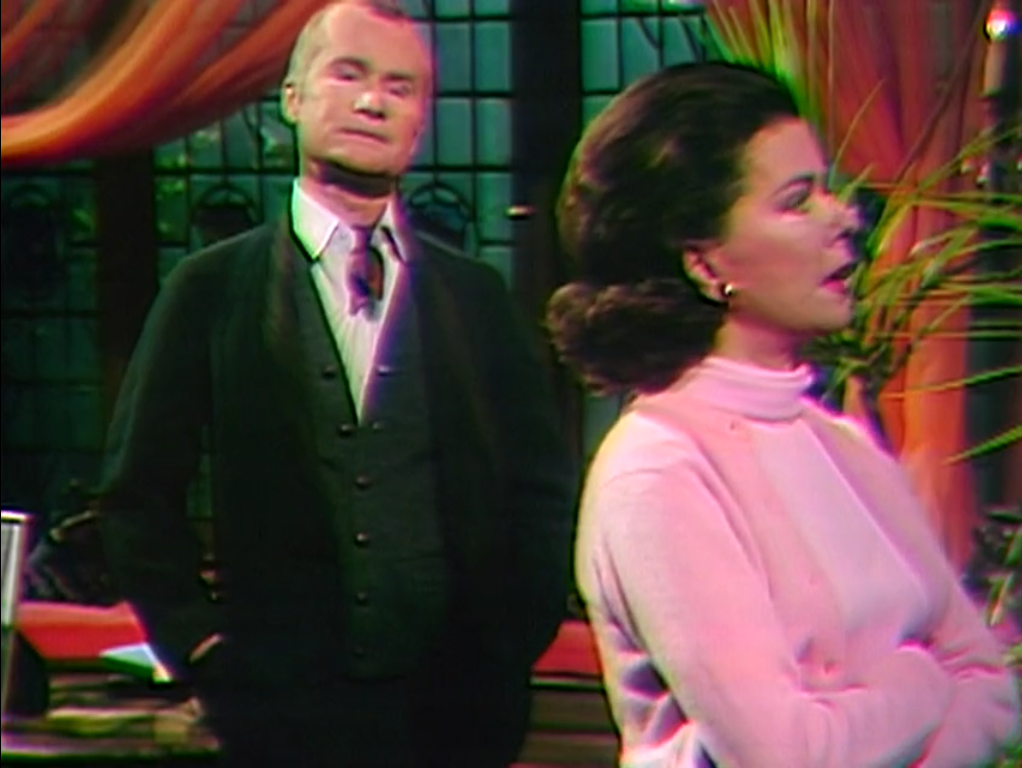
Roger finds Liz moping in the drawing room. He strikes up a conversation about Carolyn’s troubles. He says that he and Liz both made unhappy marriages, and that it is disappointing to see that the next generation seems determined to repeat their mistakes. He says that he wishes Carolyn would confide in one of them. Liz says that all she knows is that someone or something is threatening Carolyn’s husband, and that she refuses to discuss it. The camera pulls back, and we see that Carolyn is right there. Director Henry Kaplan was pretty bad at moving the actors around and even worse at figuring out where to point the camera, but he deserves credit for this shot. When we suddenly see Carolyn standing there, we realize that Roger and Liz are so deep in their worries that they are oblivious to their surroundings.
Carolyn insists on going to the carriage house on the grounds of the estate to see her husband. Since Bruno is at large, Roger objects. He can’t mention Bruno in front of Liz, since Carolyn has decreed that her mother must not be told what happened earlier in the evening, so he is powerless to stop her going.
Bruno does catch up with Carolyn, and he tells her he is going to kill her. Before he can do so, the werewolf springs out, pushes Carolyn aside, and slashes Bruno. She goes home and tells Roger and Liz what happened. From Carolyn’s description, Liz recognizes the werewolf as the same creature they encountered in late 1968 and early 1969, and Roger rushes out.
Roger finds Bruno on the ground. He tells Bruno he will call a doctor. Bruno says it’s too late. He says a few words (“animal… not an animal…”) and loses consciousness.
Back in the great house, Roger says that the police are searching the grounds for the werewolf. He says it’s terrible that Carolyn should have met with such an incident on top of what has already happened to her. Liz asks what he means, and Carolyn glares at him, appalled at his indiscretion. He stammers out something about how she’s having marital problems, then announces he has to go because he promised to do something for Barnabas.
Roger and Liz never have figured out that Barnabas is a vampire, and though Carolyn was briefly his blood thrall she’s forgotten all about it. So far as the Collinses are concerned, their distant cousin Barnabas is just a night person. Several times now, Barnabas has looked into a room in the east wing and has seen, not the dark space, bare floor, and sparsely decorated walls that are there in his universe, but an alternative version of the room, brightly lit, fully furnished, and heavily decorated. He has seen people with the same looks, voices, and names as people he knows, but with different personalities and relationships. He has reported this to Julia and her friend, Professor Timothy Eliot Stokes, who have explained to him the many-worlds hypothesis.
On Friday, Barnabas told Roger about the room and about Julia and Stokes’ theory. The Roger of 1967 and 1968 would have jeered at Barnabas before he had spoken five words, but in 1970 he believed him readily enough. Barnabas expressed surprise at Roger’s openness to his outlandish account, and Roger acknowledges that “a year ago” he would have dismissed it. It was thirteen months ago that Roger turned and told the ghosts that the living would someday reconquer the great house; when he says “a year ago,” perhaps Roger is rounding down. Roger agreed then to come back and check the room.
When Barnabas showed Roger the room on Friday, it was bare. When Roger goes there himself today, he finds that the parallel universe is there. He cannot pass the invisible barrier in the doorway to enter it, nor can he communicate with the people there, but he can see them and hear them.
The first resident of the parallel universe Roger sees is Bruno’s counterpart. Astonished, he exclaims “I just saw him die!” Parallel Bruno is looking at the portrait of Parallel Angelique that dominates the room and telling it that the music he wrote for her will make her immortal. Roger does not appear to recognize the portrait’s resemblance to his second wife, much less to remember that he himself used to carry on similarly one-sided conversations with her eighteenth century portrait.
Parallel Liz enters and demands to know what Parallel Bruno is doing in the room. He says he belongs there. She tells him he is the only one who thinks so. She tells him that the master of the house, who is Quentin’s counterpart, will be coming home soon, and that he will never tolerate Bruno’s presence. Bruno says that he has heard that Quentin has remarried. When Liz says this is so, Bruno declares that Angelique will never allow another woman in the house. Liz is exasperated that people keep talking about Angelique as if she were still alive. Bruno exits.
Stunned by what he has seen, Roger looks away for a moment. He thinks of going to fetch Barnabas. His attention returns when he hears a conversation between Liz’ counterpart and his own.
Barnabas saw Parallel Roger on Friday; he was talking to the portrait in a way that suggested an obsession not so different from the one which the eighteenth century portrait had inspired in the Roger we knew. Today, Parallel Roger talks to Parallel Liz about Parallel Bruno in an airy, superior manner quite out of keeping with what we have had from our Roger today, but which sounds exactly like him as he was in 1967 and 1968.
PARALLEL ROGER: Was that Bruno, the terrible-tempered boy wonder I saw just now?
PARALLEL LIZ: Yes, he’s come back.
PARALLEL ROGER: Back to compose more of his morbid music and bore us with his tiresome memories of her? Well… It’ll be worth seeing the look on Quentin’s face when he finds out, won’t it?
Alliterative series such as “terrible-tempered” and “more morbid music” were characteristic of the old Roger’s verbal cleverness, as sarcastic expressions like “boy wonder” and complaints of boredom were typical of his habit of advertising his contempt for everyone and everything. Even Parallel Roger’s closing hope of “seeing the look on Quentin’s face,” as opposed to any thought of action he might himself take, is of a piece with the old Roger’s cowardice and laziness. Our Roger is horrified by the sight of his double.
Evidently the makers of the show have decided that Roger’s development has brought him to a dead end, and they are going to use the journey into “Parallel Time” to reintroduce the original villain. That Parallel Roger shares a scene with Parallel Liz suggests that we will again see the dynamic that their counterparts in the main “time-band” pioneered on the show, the conflict between Bratty Little Brother and Bossy Big Sister. This type of conflict is still one of Dark Shadows‘ signature elements, represented most prominently by Barnabas and Julia. The 1897 segment benefited from a similar conflict between Quentin and Judith; the 1795 segment lacked such a conflict, and in its absence they had to lean pretty hard on stories that put individual characters into isolation from the rest of the cast, burning them up one by one. Perhaps they plan to use the old standoff between Bratty Roger and Bossy Liz to keep the Parallel Time story spinning if the overall narrative hits some rough patches.
This episode marks the final appearance of the main “time-band” version of Bruno; the werewolf really did kill him. It is also the last time we will see the werewolf. Alex Stevens was billed as “Stunt Coordinator” when he played the werewolf. He will stay with the show as a stuntman, but won’t get his name in the credits again.
The chief villain on Dark Shadows at the moment is a shape-shifting monster from beyond space and time who has decided the only shape he is interested in assuming is that of a tall young man. When he first appeared in this form, the monster asked people to “Call me Jabe.” Jabe is supposed to seize control of the Earth and eradicate the human race, but he couldn’t even get people to comply with this simple request. He’s been answering to “Jeb” for weeks now.
Several of Jabe’s followers, people who were completely down with the part about exterminating all humans, have found that his personality is just too much to put up with. Some of these are trying to destroy him. One of Jabe’s followers-turned-aspiring-assassins is a crazed sadist known only as Bruno. Yesterday, Bruno trapped Jabe with a werewolf, a creature to whom Jabe is vulnerable. Jabe escapes from the werewolf and confronts Bruno about his attempt to murder him.
Jabe is unconvinced by Bruno’s paper-thin excuses, but is shocked when Bruno tells him that Megan Todd, who was once Jabe’s foster mother and his most devoted follower, has been bitten by vampire Barnabas Collins and is now helping Barnabas in his own battle against Jabe. When Jabe finds a sleeping Megan calling out for Barnabas to summon her and sees the bite marks on her neck, he blames himself. Barnabas, too, used to be one of Jabe’s followers, and when he turned against him Jabe made him a vampire. He refuses to let Bruno kill Megan, and instead puts him in charge of keeping her away from Barnabas.
Regular viewers would likely not have been surprised that Jabe survived yesterday’s closing cliffhanger- once he is gone, the current story will end, and they don’t yet have anything ready to go when that happens. But we would have expected Jabe to kill Bruno. That he not only does not do this, but keeps him around, shows just how precarious Jabe’s position has become. He is surrounded by enemies, many of whom know all of his secrets, and several of whom have supernatural powers. His grip on his few remaining allies is uncertain, and he does not seem to have the tactical sense to use his own powers effectively. So the writers have to slow the story way down to keep from running out of road.
Meanwhile, the werewolf is prowling through the woods. He meets his great-grandfather, Quentin Collins. It was a curse Quentin brought on himself that made him and his male descendants werewolves. The same magic spell that put Quentin’s own lycanthropy into remission immunized him against aging. The werewolf recognizes Quentin as one of his own kind and won’t attack him. When the sun comes up, the werewolf collapses and reverts to the form of Chris Jennings, who resembles his great-grandfather in that each of them is twenty-nine years old.
Quentin tells Chris that he wants to help him; Chris says that he ought to, since it’s his fault that he’s a werewolf. Quentin doesn’t have anything to say to that, nor is he willing to give Chris the help he asks for, which is immediate death. He asks Chris what he remembers; he says that the night before, Bruno was holding him prisoner, aided by the reanimated corpse of Sheriff Davenport. Chris wonders if he killed Bruno.
Quentin and Chris go to the old crypt where Bruno and Zombie Davenport had kept Chris. They find the shredded remains of Davenport’s defiled corpse, but no trace of Bruno. Quentin tells Chris that he didn’t kill any living person, that he only returned to death something that had already died, and rightly so. He advises Chris to avoid zombies from now on. When we heard Quentin offer this great-grandfatherly guidance, Mrs Acilius laughed out loud- what does Quentin think, that Chris spends his nights hanging out at the zombie bar?
It turns out Chris will have more trouble following great-granddad’s counsel than he might have thought. At the end, Jabe stands in a cemetery, by a row of four fresh graves of men each of whom died in his thirties, and prays to the “god of the Underworld” to raise them so that he can use them to kill five other people and send their souls his way forever. Whichever god he reaches apparently likes the terms of this deal, because a hand pops up through the dirt.
This post is something of a private milestone for me. I was inspired to blog about Dark Shadows by Danny Horn’s great Dark Shadows Every Day.As the title would suggest, Danny’s original idea was to post about an episode a day, but as he went his posts got to be more and more ambitious and less and less frequent. He posted a review of #1170 in October 2019, then gave up altogether for several months, not posting again until July 2020. Danny started with #210; since the makers of the show skipped some episode numbers, #1170 was the 946th episode he had covered. I started at the beginning, so #962 is my 947th episode.
My project is in no way comparable to Danny’s. I have his blog to consult, as well as other fine sites, especially John and Christine Scoleri’s Dark Shadows Before I Die, while he was usually the first to review the episodes he dealt with. And my posts are nothing like as ambitious as were his. So, if I have only a few stray remarks to make about an episode, I just make those remarks and call it a day. In that situation, Danny would write a detailed review of a novel or a board game or something else related to the show, or analyze an historical event connected with it, or compose a stunning prose poem, then append his remarks about the episode as a postscript. But modest as my aims are, I’m still haunted by the fear that I’ll run out of steam, so it’s reassuring to me that I’ve maintained daily posting beyond the point at which he took his long hiatus.
I have my eye on a couple of upcoming Danny-derived benchmarks. He posted about a total of 1018 episodes; I’ll reach that number with #1033 on 10 June. And of course #1170 itself has a cursed aura, I’ll be glad to get beyond that. Once I do, I’ll probably be counting down by percentages until I reach the end of the series with #1245 in April 2027.
After April 2027, I plan to review the feature film Night of Dark Shadows* in a post to go up on the 56th anniversary of its release, 3 August 2027, and Tim Burton’s 2012 film Dark Shadows at some point thereafter. I’m leaning towards reviewing the series that aired on NBC in primetime in 1991 and the pilot that Dan Curtis shot for the WB network in 2004. If I do write about those things, the posts will go up sometime after the one about Night of Dark Shadows and before the one about the Tim Burton movie. I probably won’t cover any of the novels or comic books or newspaper strips or other spinoffs. I did review Dan Curtis’ TV movie of Frankenstein on a preemption day in 2024, and if I review any of his other standalone adaptations of material that Dark Shadows mined it will be on upcoming preemption days, not as posts that appear after I’ve finished the original series.
*House of Dark Shadows was released 28 October 1970, while the show was still on. My post about it should go live on 28 October 2026, the same day as the one about #1132.
The Leviathan People, a race of Elder Gods, are planning to retake the Earth from humanity. Like all stories of Elder Gods, this one raises the question of why they lost the Earth in the first place. The answer seems to be clear. The first Leviathan to manifest himself is a shape-shifting monster who spends most of his time in the form of a tall young man who, when we were introduced to him, asked to be called “Jabe.” No one would call him that, so he settled for “Jeb.” The Leviathans have assembled a cult of people to serve them; Jabe’s personality has alienated many of them already, and seems likely to alienate more.
Among the ex-followers who were glad to join a plot to exterminate homo sapiens but who found Jabe too obnoxious to stomach are vampire Barnabas Collins and a crazed sadist known only as Bruno. Jabe’s onetime foster mother, Megan Todd, lost her allegiance to the Leviathans after Barnabas bit and enslaved her. Since Barnabas’ current bout of vampirism is the result of a curse Jabe placed on him during a tantrum, the cult’s loss of Megan is another strike against Jabe.
The Leviathans have two principal vulnerabilities. They can be destroyed by ghosts or by werewolves. Since they have chosen to start their campaign on the great estate of Collinwood, which is the world capital of both ghosts and werewolves, this would suggest that they are as bad at strategic planning as Jabe is at team-building.
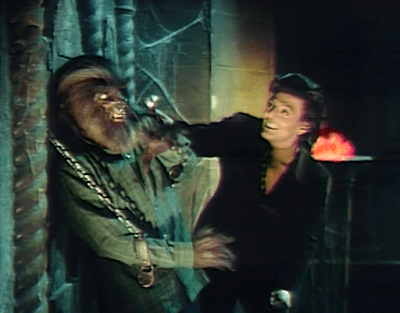
Bruno has captured the current werewolf and lures Jabe to him. He also discovers that Megan is Barnabas’ blood thrall. Everything else today is filler, but it does give the actors a chance to show off. Bruno beats the werewolf with a whip to ensure that he will be angry enough “to rip a man to shreds!” He’s a werewolf, the whole idea is that he’s already disposed to rip anyone he meets to shreds, but as Bruno Michael Stroka puts so much zest into the whipping scene that we forget how ridiculous the furry rig Alex Stevens is wearing looks and feels sorry for the poor widdle doggie.
Barnabas summons Megan to his house and gives her some instructions that don’t make sense and that she won’t have the chance to follow. While she is there, she says she just wants him to suck her blood. He does. Marie Wallace plays Megan in this scene as if she is having a sexy dream.
Bruno left the late Sheriff Davenport, whom Jabe killed and then brought back as a zombie slave, to guard the werewolf. To keep the zombie from getting in the way of his plan to use the werewolf against Jabe, he tricks him into letting the werewolf destroy him. Davenport is the most garrulous zombie of all time; in his first postmortem appearance, when Jabe set him to hold prisoner Maggie Evans, The Nicest Girl in Town, Davenport rambled on and on about everything he saw and heard, at one point launching into an explanation of some things his wife used to do that annoyed him. Today he has to argue with Bruno, demanding to know whether he has authorization from Jabe to leave the werewolf alive and giving his opinion that it isn’t a good idea to take too much initiative. Ed Riley does as much as anyone could to overcome the ludicrous overwriting of his part. No one could make a chatterbox like Zombie Davenport seem like a partially reanimated corpse, but when he isn’t saddled with excessive dialogue Riley manages to create the impression that he is at least somewhat weird. It’s too bad he won’t be back.
When Dark Shadows began in June 1966, its most dangerous villain was high-born ne’er-do-well Roger Collins. Roger had squandered his half of the Collins family’s wealth and put his sister, the reclusive Elizabeth Collins Stoddard, in a difficult position by selling his half of the family business to support his extravagant lifestyle. He now worked in the business as Liz’ employee and, with his son, strange and troubled boy David, lived in Liz’ house as her guest. Roger schemed to cover up his past crimes, and was quite willing to add murder to them if that was the only way to preserve his cushy circumstances.
As played by Louis Edmonds, Roger was too much fun to be killed off as the original story bible foresaw. The show had not in those early days committed itself to the all-villain cast that has come to define it, so they decided that they could keep Roger around only by nerfing him. He became a sardonic gay uncle, amusing, lovable, and harmless. He has been on the margins for years now, often absent for long periods. When Dark Shadows turned to time travel and began to feature extended costume drama inserts, they could make use of Edmonds’ talents by casting him as other characters. His turn as haughty patriarch Joshua Collins made him the star of the 1790s segment that ran from November 1967 to March 1968, and as the stuffy Edward Collins he was among the highlights of the 1897 segment that took up most of 1969. Now that the show has returned to contemporary dress, Edmonds is Roger again, and he is the same afterthought he has been for so long.
Today, a villain who introduced himself as Jabe but whom everyone calls Jeb walks into the house. Roger hears him, and protests that it is customary to knock. Jabe says that Liz gave him the run of the place, and tells Roger he has come to visit David. Roger forbids him to see David; Jabe says there is nothing he can do to stop him, and he goes upstairs to David’s room.
Roger picks up the phone and calls his distant cousin Quentin Collins. He tells Quentin he isn’t going to put up with any more of Jabe’s insolence, and that he doesn’t care how dangerous he is. He hangs up, and finds Jabe standing in front of him. Jabe asks if he is wondering how much he heard. Roger says that he doesn’t care if he heard all of it, that he wants him to leave the house at once. Jabe says that if it was Quentin he was talking to, he knows more about him than he had assumed. He also tells Roger that nothing Quentin may have told him about him and his associates was an exaggeration. If Roger defies them, he and everyone he loves will pay a terrible price.
When Roger was a villain, they sometimes made him sympathetic by having dashing action hero Burke Devlin threaten to take over the house and start ordering him around. Later, Liz was being blackmailed by seagoing con man Jason McGuire, who when he reached the zenith of his power acted like he owned the house and tried to order Roger around. Burke eventually peaced out, and Jason’s scheme led to his own death not long after he got openly aggressive towards Roger in the drawing room. So longtime viewers will look at this scene and find a reason to believe that Jabe’s menace is approaching its peak.
Jabe’s henchman Bruno has captured Chris Jennings, who is a werewolf. He has locked Chris up in the tomb of the Stockbridges, an old Collinsport family who are in a way related to Roger’s ex-wife. The full Moon will be rising tonight, and Bruno has chained Chris to a wall in the tomb. He has set the world’s most talkative zombie to guard Chris. The zombie was in life a law enforcement officer known as “Sheriff Davenport.” When Jabe raised him from the dead, we saw that his gravestone read “Sheriff Davenport,” so apparently “Sheriff” was his given name. Bruno gave Sheriff a revolver loaded with silver bullets and ordered him to shoot Chris if he started transforming.
Bruno went to Jabe to report that he had captured the werewolf. Before he could get a word out about that, Jabe was berating him about other matters. Jabe wound up hitting Bruno, then twisted his arm until he said that Jabe was born to lead and he was born to follow. After that, Bruno decided that he wouldn’t have Sheriff kill the werewolf after all. Rather, he would sic the werewolf on Jabe.
Jabe’s intolerable personality keeps alienating followers, and he has assembled an array of adversaries including not only people like Bruno who know all of his secrets, but also a vampire, a wicked witch, a mad scientist, and a man with a Dorian Gray-like magical portrait that gives him an immunity to physical harm. On top of all that, we saw yesterday and today that a ghost is after Jabe, and that Jabe is especially vulnerable to ghosts. Add the werewolf to that force, and it seems Roger will be sipping his brandy in peace any day now.
Heiress Carolyn Collins Stoddard talks her friend Sabrina Stuart into wearing a wig over her prematurely gray hair. Sabrina’s ex-fiancé Chris Jennings sees Sabrina with the wig and is suddenly attracted to her again. Sabrina knows that Chris is a werewolf. She disregards both Chris’ lycanthropy and the fact that he is more interested in her wig than in her and starts talking to him about renewing their engagement.
A villain named Bruno has evil plans for the werewolf. He knows that the werewolf is a man who is close to Sabrina, and when he sees her with Chris he realizes it is him. At the end of the episode, he abducts Chris at gunpoint.
Old world gentleman Barnabas Collins comes home shortly after dawn and finds that the window of his front parlor has been smashed in. Entering the house, he finds two young men passed out. He knows both of these men, and knows that neither is what he seems to be. The taller of them, who once asked to be called Jabe, is in his true form an indescribable monster from beyond space and time, the harbinger of the Leviathan People, a race of Elder Gods who mean to retake the Earth and destroy humankind. The other, Chris Jennings, is a werewolf. The Leviathans are vulnerable to werewolves, and Barnabas realizes that Chris reverted to his human form when the sun rose, just as he was about to kill Jabe.
Chris comes to, and Barnabas hustles him out of the house. He then wakes Jabe. He tells Jabe that he fought the werewolf off, killing it and saving Jabe’s life. Barnabas was the original leader of a cult devoted to serving the Leviathans, but has since become disaffected. Jabe had seen evidence of this, and set out for Barnabas’ house meaning to punish him for his disloyalty. But by the time the werewolf chased him into the house he was crying out for Barnabas to help him, so he is ready to believe the story. Taking credit for things he had nothing to do with is one of Barnabas’ core competencies, so it is no surprise to longtime viewers that Jabe decides that he can trust Barnabas after all.
Barnabas’ ex-wife Angelique is now married to a man named Sky Rumson. She does not believe that Sky knows anything about her past or about anything supernatural, but the audience has seen over the last few episodes that he is an agent of the Leviathans. Angelique put Barnabas’ distant cousin Carolyn up in a house she and Sky have on an island to help Barnabas in his fight against the Leviathans while Sky was away on a business trip. At the end of that trip, Sky called to ask Angelique to pick him up at an airport far from the island house. When she got to the airport, she found he had already left. She wound up spending several hours alone on the road. Returning viewers know that Sky’s call was a trick to get her away from the house so Jabe could come and have his way with Carolyn. We also know that Jabe chickened out of his evil plan when he actually saw Carolyn, and that she is fine now.
Angelique comes home from her long wild goose chase and asks Sky what happened. He said he had an important phone call coming at the house, so he had to leave early. Angelique accepts this surprisingly easily. Barnabas shows up to take Carolyn home. He and Sky meet. After Barnabas is gone, Sky asks what the deal is with Carolyn. He presses the point, and Angelique tells him everything she knows about Barnabas and the Leviathans, including that he is now “their most dedicated enemy and he means to use every power he has to stop them.”
This scene is bad news for Barnabas, but it is worse for the audience’s image of Angelique. She used to be a wicked witch of vast destructive power, and was supposed to be the ultimate Soap Opera Vixen. But you wouldn’t have to be a witch, or even a vixen, to avoid the situation Angelique puts herself in. Leaving the airport when he knew she was on the way was a colossal act of thoughtlessness, and no husband who committed it could expect to hear a word from his wife about anything else for at least a week. After that, there will be a long period when she will have an unanswerable source of material to keep him off his guard any time he tries to bring up topics she doesn’t want to discuss. By the time Sky is able to start asking questions about why Angelique had Carolyn spend the night, it will probably be another full moon.
That isn’t even the worst of it. Angelique believes that Sky is simply a denizen of the sunlit world known to us in our everyday experience and explained well by science, and she further believes that he sees her in the same way. That makes it all but impossible for her to tell him what she tells him here. She launches right in with “the Leviathans, they’re terribly dangerous creatures, completely evil and they mean to start a whole new society.” If he really were a total naïf in supernatural matters, this story would lead him to pick up the telephone and call the men in the white coats to come and take Angelique to a place where she could get a good long rest.
I don’t think Angelique’s scene with Sky could have worked in any case, but Geoffrey Scott’s limitations as an actor make it even worse than it had to be. He underacted so severely that he could hardly be said to be giving a performance at all. That makes a stark contrast with Lara Parker, who as Angelique fully embraced the hyper-intense Dark Shadows house style of acting, which, in honor of her own hilarious explanation of it, is sometimes known as “Go back to your grave!” That contrast is interesting at a technical level. It goes a long way towards explaining what Orson Welles meant when he said that hamminess was not overacting, but false acting. Parker goes as far over the top as she can, but there is rarely anything false about Angelique, while every tinny note Scott strikes in his flat recitation of his lines is thoroughly fake.
A charismatic actor might have been wasted as Sky, as Parker is wasted today. But the audience might have been able to meet the show halfway if we could believe that Sky was so fascinating to Angelique that she didn’t realize what she was saying. As it is, Scott looks so much like he is modeling menswear for the Sears catalogue that it is always a bit of a surprise when he moves and speaks. However much Angelique might enjoy Sky’s company, it never occurs to us that he would be a match for her in any sense.
Sky goes to Jabe and repeats what Angelique told him about Barnabas. There is an exchange which looks fine in print, but which Scott’s delivery makes sound like a blooper:
JABE: So everything he told me this morning was a lie! And I thought he had saved my life!
SKY: Evidently, everything he told you was a lie.
You would deliver Sky’s line with an emphasis on “everything,” as would I, as would anyone else. But Scott emphasizes “Evidently” and pauses slightly after “you,” making it sound as if he hadn’t heard Jabe. For a fraction of a second, you can see the amazement in Christopher Pennock’s face as he reacts to this clanger.
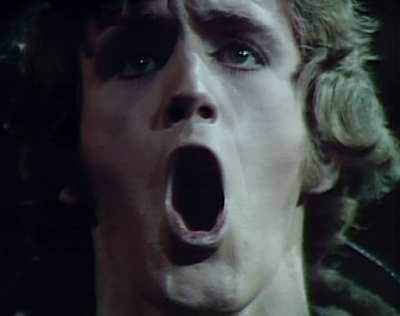
Jabe carries a cage with him as he goes to an old graveyard. The camera locks in on him in closeup as he shouts that, while death might be an adequate punishment for a mere murderer, Barnabas must suffer “More! MORE! MO-O-O-ORE!!!” More, more, more, how do you like it, how do you like it….
The first time I saw this scene, I regarded it as a low point- I imagined someone tuning in to Dark Shadows for the first time at that moment, and instantly turning it off, believing ever after that only people of an extremely low mentality could like the show. I still think it’s pretty embarrassing writing, but having seen him in other roles I’ve come to realize that Pennock was in fact a good actor and that as Jabe he was saddled with an impossible task. Also, I’ve seen video of him on panels of original cast members at Dark Shadows conventions, and it is obvious that he was as sweet as Jabe is vicious. So watching the scene today, I ignored Jabe and looked at Christopher Pennock, studying his face to see what he was thinking as he struggled to find a way to give the audience something worth their while.
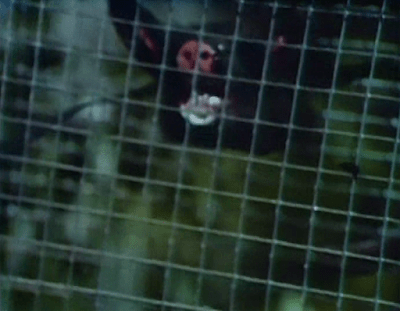
Jabe makes an incantation, and a bat comes flying to him. He catches it in the cage. We get a closeup of the bat puppet in the cage, which looks very much like a humane trap from Havahart. We know that Jabe plans to use the bat to make Barnabas back into a vampire, which he was for 172 years, but the realistic cage and the adorable little puppet prevent the situation from generating any terror. Dan Curtis said that when he was producing Dark Shadows, his young daughters used to urge him to make the show more frightening. When we were chuckling at the sight of the bat today, Mrs Acilius imitated a child saying “Make it scary, Daddy!”
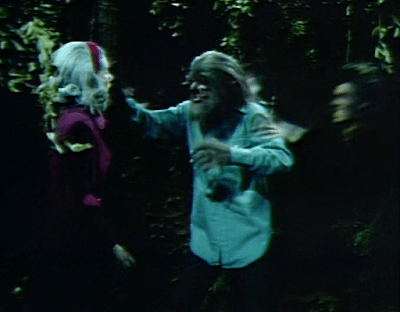
A werewolf is prowling through the woods on the great estate of Collinwood, and Sabrina Stuart, a young woman with white hair, sees him. She knows that when the moon is not full, the werewolf is her ex-fiancé Chris Jennings. She screams at the sight of him. This would be an understandable reaction if the werewolf were scary looking, but since he is a man whose face and hands are covered with hairy makeup appliances while the rest of him is wearing clothes, he is a just cute little doggie who might like a bickie. Television, they say, is a visual medium; that means that the images you put on the screen will stimulate the audience’s imaginations. If you are telling a story about a monster, you must show only enough of him to get them to wonder what terrible things he might do. Once you’ve shown so much that they start to laugh, you’re sunk.
Sabrina composes herself, and tries to reason with the werewolf. He stands there listening to her attentively, being the goodest little boy. This ends when a man emerges from the brush and jumps him. The man shoots the werewolf, who yips and runs away. Sabrina is upset with the man, who is surprised she does not regard him as her rescuer. She identifies herself by name.
The man’s name is Bruno, and he works for another monster, one whom we see only when he is masquerading as a young man. That monster once said he wanted to be called Jabe, but everyone very inconsiderately keeps calling him Jeb instead. Jabe has told Bruno that he is vulnerable to werewolves. Bruno disregarded Jabe’s report that only silver bullets can kill a werewolf, and fired regular ammunition. Jabe is upset about this.
Bruno tells him all is not lost. Since Sabrina was not afraid of the werewolf, his human form must be that of a man to whom she is close. Bruno says Sabrina has a brother, and thinks out loud that he ought to just go ahead and kill him. Regular viewers know that Sabrina’s brother, though he is not a werewolf, is a character played by Roger Davis, so we’re all for Bruno’s idea. But Jabe vetoes it, saying that if a werewolf is killed while in human form he will turn into the wolf and remain in that form forever. That’s new information on Dark Shadows, though there had been so many werewolf movies by 1970 I can’t imagine it was original.
Old world gentleman Barnabas Collins stops by the antique shop where Jabe lives. Barnabas had been the leader of the cult that serves Jabe, but has become disaffected. Jabe knows this. Each wants to kill the other, but neither has been able to make a substantive move. Jabe demands Barnabas do something about the werewolf, in the process exposing his vulnerability. Barnabas is friendly with Chris and knows all about him, so this exposure makes it possible for him and Jabe to join battle.
In the closing credits, writer Violet Welles’ name is misspelled “Wells.” Today’s script is not up to her usual standards; maybe “Violet Wells” was her guild-approved pseudonym.
Maggie Evans, governess in the great house on the estate of Collinwood, is being held prisoner in a big mausoleum somewhere. Her captor appears to be a young man, but is actually a monster from beyond space and time. He is associated with the Leviathan People, a race of Elder Gods who are planning to take the earth away from humankind with the aid of some people whom they control and whom they have formed into a cult. The cultists call the monster Jeb, even though when we first saw him he said he wanted to be called Jabe.
Jabe orders Maggie to open a wooden box and look inside. He makes it clear to her that she is supposed to be under his control after she has done this, so she plays along. He lets her go, with orders that she is to spy on old world gentleman Barnabas Collins, a leader of the cult who has become disaffected from it and is working against Jabe.
Back in the great house, Maggie tells Barnabas what happened. Barnabas’ best friend, mad scientist Julia Hoffman, enters; he tells Julia that Maggie is their new ally in the fight against the Leviathans. When Barnabas was still loyal to the Leviathans, he tried to absorb Julia into the cult. That effort failed, and Barnabas explained that “certain people” were immune from absorption because of their “genetic structure.” Since Julia is the only Jewish character on the show, this sounded jarringly like a claim that the Leviathans were a restricted club. Evidently Maggie is now among those “certain people.” Since Maggie has a Welsh name and is played by a Minnesota-born actress of Scandinavian descent, that retroactively takes some of the anti-Semitic edge off Barnabas’ earlier remark for viewers who remember that episode (unless she converted.)
Maggie had taken an apologetic tone when she told Julia she wanted to be alone with Barnabas; Julia is very circumspect when she comes in at the end of their conversation. For a long time now, the show has been working on the idea that Julia wants a romantic relationship with Barnabas and is sad that he does not share her desire; for the last couple of weeks, they have been hinting that Barnabas and Maggie are getting pretty cozy. Regular viewers will be interested to see Grayson Hall playing Julia being a good sport about losing Barnabas to Maggie, and Kathryn Leigh Scott playing Maggie wishing she didn’t have to hurt her friend’s feelings.
We learned yesterday that Jabe is vulnerable to werewolves. As luck would have it, there is a werewolf at large in the Collinsport area. He is Chris Jennings, and Barnabas and Julia have been trying to cure him of the effects of his curse. He had been spending the nights of the full moon in a cell at Windcliff, a mental hospital Julia is in charge of, but last month came back to the caretaker’s cottage on the grounds of Collinwood. He couldn’t stand being cooped up, and chose to go back to his old practice of killing someone at random every month.
Julia and Barnabas don’t know that Chris is a weapon they can use against Jabe, and they want him to go back to Windcliff. The moon will be full tonight, so they are particularly anxious. But his onetime fiancée, Sabrina Stuart, has a different idea. She has been in contact with an expert on lycanthropy, and he has shipped her the only surviving specimen of the Moon Poppy. She brings the potted plant to Chris and tells him that the flower will open when the moon starts to rise. If he eats it while it is blooming, he will be cured. Otherwise, he will lose his chance- the plant will be dead before morning.
Chris’ transformation begins with moonrise, and once he has become the wolf he has no will of his own. When Barnabas stops by to take him to Windcliff, he points this out to Chris. But Chris is determined to try Sabrina’s cure. He is like every addict who talks himself into believing that this time, it will be different. Of course his determination fails him at the last moment, and by the time he can reach for the opening flower, it is a hairy paw, not a hand, that stretches towards it.
The flower cure and Chris the unlikable protagonist are both borrowings from the 1941 film The Wolf Man. Jabe lives in an antique shop; there’s an antique shop in that movie, too. There were some hints early on that werewolves were a threat to the Leviathans; evidently they had planned to bring these two stories together all along.
Closing Miscellany
Sometimes the closing credits are on cards, one after another; other times, they are on a continuous roll. Through the first year of the show, when they were on a roll costume supplier Ohrbach’s would be misspelled “Orhbach’s.” We haven’t seen that misspelling for a long time, but it’s back today. It will keep cropping up for the rest of the series.
Barnabas and Julia find a fake letter from Maggie saying that she’s been away visiting her Aunt Louise in Quebec. This is the first time we’ve heard of any members of Maggie’s family other than her late parents. Since the letter is a phony meant to cover up her abduction and neither Julia nor Barnabas seems to have heard of Louise before, it is possible there is no such person. Still, Maggie has been a major character since the first episode, so it does get longtime viewers thinking about how little we know about her background.
This is only marginally relevant to the episode, but I can’t resist bringing it up. The other day, a Twitter user named Zach Wilson (whose bio describes him as “watcher of TV, all of it, one episode at a time”) posted an image of pages of TV Guide from 22 April 1966 with the question “What would you watch?” An Educational TV station in whatever market it was running a WGBH-Boston produced telecast of the Boston Theater Company’s production of Gertrude Stein’s “Yes is for a Very Young Man,” starring Lisa Blake Richards. The Harvard Crimson had reviewed the stage production in November 1965; they said that “the play was lousy,” but they praised the cast for making the most of a bad script, singling out Miss Richards for the “outstanding job” she did “with a whining, pathetic character.” Sabrina isn’t exactly Lady MacBeth, either, and Miss Richards had her work cut out for her finding a way to make us want to see more of her.

 Dark Shadows Commentary