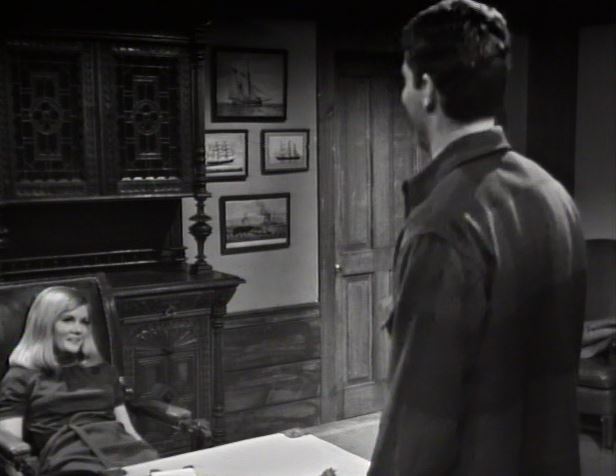
Episode 382: The devil sent one of his minions

Haughty overlord Joshua Collins, master of the estate of Collinwood in this year 1795, has gone missing. His sister, repressed spinster Abigail Collins, is convinced this is the result of witchcraft. One of the Collinses’ house-guests, the Countess DuPrés, agrees with Abigail, and like Abigail is sure that the witch is well-meaning governess Victoria Winters (whom we know as “Vicki.”) Abigail and the countess also blame Vicki’s black magic for the fact that Joshua’s brother Jeremiah and the countess’ niece Josette have apparently eloped, jilting Josette’s fiancé. That sad man is Jeremiah’s nephew and Joshua’s son, Barnabas Collins.

In fact, Vicki is the audience’s point-of-view character. One night in 1967, she was attending a séance, attempting to contact the ghost of Joshua’s ten year old daughter Sarah, when Sarah spoke through her, said she wanted to tell the whole story from the beginning, and yanked Vicki back through time to 1795, while her own governess Phyllis Wick took Vicki’s place at the table. Vicki can hardly tell this story, and the makers of Dark Shadows have decided not to show her being a con artist, or doing anything else interesting. So Vicki flails about, calling attention to the fact that she is profoundly alien to her surroundings.

If Sarah brought Vicki back to her own time so that she could see what happened then, Vicki’s failure to pick up where Phyllis Wick left off would seem to defeat her plan. Surely Phyllis didn’t go around telling everyone she met that they are being played by actors who had other parts in the first 73 weeks of the show, or constantly blurt out information that she learned from reading the Collins family history. Nor did she show up carrying a copy of that history and wearing clothes from 1967. In the first episode of the 1795 arc, we learned that Phyllis’ carriage overturned, that she is missing, and everyone else aboard is dead. If Vicki was going to become a part of what already happened, she should have been found at the scene of that accident, wearing Phyllis’ clothes and suffering a minor injury that left her unable to speak until she figured out when she was and that she had to pretend to be Phyllis.

Today, we begin with a shot of Vicki being silent while her voice plays in the background, thinking that she must somehow keep from verbalizing her every thought. This might not seem like a great challenge, but she hasn’t managed it yet. The countess enters and confronts Vicki about the evil she believes she has done. Vicki can only feign ignorance and run away.

We cut to the lady of the house, Joshua’s wife Naomi. Naomi is an alcoholic, a fact of which we are reminded when virtually every scene she is in begins with a shot of her alone, pouring herself a drink. This scene is no exception.

Naomi’s theme. Screenshot by Dark Shadows Before I Die.

Abigail enters. After nagging Naomi about her drinking, she denounces Josette for being French and Vicki for being a witch. Naomi likes Vicki and dismisses the idea that she is a witch. She also likes Josette, but can’t deny that she is French.

The countess joins them. She is just as French as her niece, but Abigail is willing to overlook that fault, since they share a desire to persecute Vicki. Naomi resists their arguments.
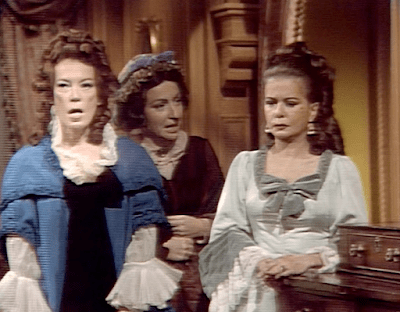
Abigail and the countess make their case to Naomi. Screenshot by Dark Shadows Before I Die.

Unable to persuade Naomi, Abigail goes on her own authority to Vicki’s room. She tells her Naomi wants to see her at once. Vicki asks her if she will be coming along. Abigail says she will stay in Vicki’s room. Vicki says she wouldn’t stay in Abigail’s room without her permission; Abigail replies “You don’t own this house. We do.” As the governess in the house in 1967, Vicki may have had an expectation of privacy in her room, but that is clearly not the case in 1795.

Vicki exits, and Abigail starts to rummage through Vicki’s things. Since she was looking through the family history right before Abigail came in, we expect her to find that book, which would be a pretty hard thing to explain. Before she can, a cat that had been squatting on Vicki’s bed disappears in a puff of smoke and Joshua takes its place.

Look who’s back. Screenshot by Dark Shadows Before I Die.

Returning viewers know that the wicked witch is the countess’ maid Angelique, and that Angelique turned Joshua into a cat last week for reasons of her own. Abigail doesn’t know anything about that, and she is so discombobulated by the experience that she calls her brother “Josh.. ua!” As soon as he stands up, she faints in his arms.

Back in Naomi’s room, she and the countess are questioning Vicki about her life before coming to Collinwood and her many strange utterances since. Vicki pleads amnesia about the first topic and makes feeble responses about the second. Even so, Naomi is satisfied. Then Abigail and Joshua enter.

Joshua remembers nothing about his time as a cat, and is shocked by the news about Jeremiah and Josette’s disappearance. He and Naomi send Victoria downstairs to do some chores, and excuse Abigail and the countess.

Abigail and the countess let themselves into Vicki’s room and start searching through her things. They find the clothes she was wearing when she showed up. In them they discover a charm bracelet. Among the charms is a cartoon devil.

Abigail and the countess find the evidence. Screenshot by Dark Shadows Before I Die.

The ladies are horrified by this blasphemous thing. Abigail says that she will write to a clergyman in Salem, Massachusetts, a Reverend Trask. The countess is glad to hear that the Reverend Trask has a way with witches.

We can only wonder whether Abigail and the countess called on the Reverend Trask to investigate Phyllis Wick in the original timeline, and if so, what it was about her that aroused their suspicions. Perhaps Angelique simply chose her as a convenient patsy. Or maybe Phyllis made some decisions that generated an interesting story leading up to it. Either way, it would have been significantly different from Vicki’s woeful blunderings.

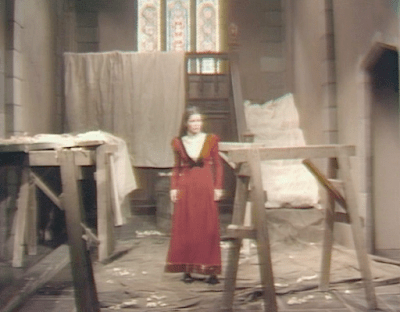
Episode 367: Good and evil vibrations

Episode #359 included a recreation of a shot from #69, harking back to a long-forgotten storyline in which housekeeper Mrs Johnson was a secret agent spying on the ancient and esteemed Collins family for their arch-nemesis, Burke Devlin. In #69, Mrs Johnson followed Burke’s orders and eavesdropped on a conversation between him and blonde heiress Carolyn Collins Stoddard. In #359, Carolyn herself is a secret agent, spying on the household for vampire Barnabas Collins. She follows Barnabas’ orders to eavesdrop on a conversation between him and mad scientist Julia Hoffman. The reference showed just how drastically both Carolyn and the show itself had changed from week fourteen to week seventy-two.

The puzzle is why writer Sam Hall watched #69. He wasn’t connected to Dark Shadows in those days, and it would be very far down the list of episodes you would watch in an attempt to get up to speed on what was happening when he came aboard. That puzzle is solved today.

As Mrs Johnson, Clarice Blackburn had a big turn in #69. Angrily denouncing the Collinses, she twisted up her face in a lunatic expression and loudly declared “I believe in signs and omens!” She appeared as the sworn enemy of the people we have been following all along, and as someone who is superstitious even by the standards of the haunted house where most of the action takes place.

Today, we and well-meaning governess Victoria Winters have been transported back in time to 1795. Blackburn reappears in the role she will be playing in the segment of the show set in that year- Abigail Collins, unmarried sister of haughty overlord Joshua. Abigail is a Puritan busybody out of Nathaniel Hawthorne by way of The Crucible. She renews the promise of all the mischief we had hoped Mrs Johnson would make when we first met her, long ago.

Vicki wakes up in the manor house and sees Abigail. She thinks Abigail is Mrs Johnson and is relieved that she has awakened from a nightmare. Abigail quickly makes it clear that the year is still 1795, that she is not “the friendly housekeeper,” and that she finds everything about Vicki to be appalling. She loses no time in declaring that Vicki is possessed by the Devil. Vicki denies this, but does not convince Abigail.

Abigail confronts Vicki. Screenshot by Dark Shadows Before I Die.

When Abigail leaves Vicki’s room, she locks the door from the outside. The rooms in the servants’ quarters are surprisingly large and well-appointed for the 1790s, but when we see that they can double as jail cells it offsets the apparent luxury. Vicki escapes through the window.

The great house of Collinwood, where Vicki lives in 1967, is under construction, and she goes there. Danny Horn, on his Dark Shadows Every Day, often said that the real subject of the series was the house. This scene corroborates his interpretation. When the ghost of little Sarah Collins said she would tell “the story from the beginning,” she sent Vicki back to the time when the great house was being built.

Construction site. Screenshot by Dark Shadows Before I Die.

Vicki finds a man in the foyer played by Anthony George. George had been the second actor to play the part of Burke. You might think her experience with Abigail would break Vicki of her habit of telling her cast-mates what characters they played in the 1960s part of the show, but no such luck. She reacts to George’s new character as if he were Burke. After a moment, she tells him that she can see he isn’t the same man. This is a riddle- if the characters played by the same actor look so much alike that it makes sense for Vicki to keep mistaking them for each other, what does she see in this Anthony George character that sets him apart from the other?

As it happens, George is playing Jeremiah Collins, builder of the great house and brother of Joshua. In #280, Barnabas had given a costume party and George’s Burke had attended it dressed as Jeremiah. Barnabas, a native of the late eighteenth century, had been thunderstruck by the sight of Burke in that costume, unable to do anything but say “Jeremiah!” and glare at him. So there is a strong resemblance, perhaps suggestive of some spiritual linkage between the two men. Vicki’s constant confusion of the actors with their roles indicates that such linkages are to be found throughout the cast. Having her babble about the resemblances out loud so frequently is the most annoying possible way to make this point. If Barnabas had kept mistaking the 1960s characters for their 1790s counterparts, it’s hard to imagine that they would have accepted him and certain that the audience would not have.

Vicki tells Jeremiah that Abigail thinks she is a witch. Jeremiah makes it clear that he finds Abigail’s hostility to be a strong recommendation, and the fact that Sarah is a fan of Vicki’s clinches the deal. He takes her back to the main house.

Once Vicki is back in her room, Jeremiah brings her 1967 clothes. He asks her why she wants them so much, telling her that they will bring nothing but trouble if they are found. She tells him that she will need them when she gets home. Combined with her habit of blurting out remarks that could only strike people in the 1790s as bizarre, Vicki’s attachment to her belongings from her own time suggests that she will very soon find herself in huge trouble. That’s unwelcome- this voyage to the past is shaping up to be interesting, and it would be nice to stay here long enough to get to know all of the characters. If Vicki keeps acting like this, she’ll get herself kicked out of 1795 and drag us back to the 1960s before Dark Shadows has had a chance to show us what they can do with a period piece.

Vicki tells Jeremiah that she has amnesia about her life until her arrival at Collinwood the day before. He tells her that she will have to make up a better story than that. She is shocked that he is telling her to lie, and he says that she will never find a place in the world if she doesn’t.

When Barnabas left 1795 and showed up in 1967, we didn’t see anyone patiently explaining to him that he would have to conceal his true identity and maintain a convincing cover story. He had figured that out by the time we met him. Most of the time he was on screen in those first months, he was trying to play the role of a modern man, a distant cousin from England whom the Collinses had forgotten about. It was fascinating to watch him essay that part. Occasionally he would stumble and blurt out information only someone from an earlier century would know; Vicki caught him doing that more than once, most notably in #233, when it seems for a moment that he might be thinking of killing her to cover his indiscretion. Other times he would face questions he couldn’t answer, and we would wonder what he would set in motion with his attempts to evade them. Quite frequently actor Jonathan Frid would have trouble with Barnabas’ lines, and it would seem that Barnabas, not he, was the one groping for words. When we first realized yesterday that Vicki was taking Barnabas’ journey in reverse, we might have hoped that it would be as interesting to watch her trying to pass as a native of the eighteenth century as it was watching Barnabas trying to pass as a native of the twentieth. That hope took a beating before the day was done, and her conversation with Jeremiah reduces it to a still lower order of probability.

Downstairs, Abigail is telling Joshua and his wife Naomi that they ought to turn Vicki over to “the authorities.” Jeremiah opposes this plan. Naomi makes a great show of screwing up her courage and “for the first time” speaks out against Abigail’s ideas.

This is quite a reversal from what we saw in the part of the show set in the 1960s. Joan Bennett plays Naomi here and matriarch Elizabeth Collins Stoddard there; Louis Edmonds plays Joshua here and Liz’ brother Roger there. But where Joshua is an iron-willed, self-assured tyrant and Naomi his cowed and isolated dependent, Liz is the mistress of Collinwood and Roger a shameless, sybaritic wastrel who lives as a guest in her house and collects a salary from her business. We saw yesterday that Naomi is entirely illiterate; we see today that this inability, though it is an anachronism in a wealthy New England lady of the 1790s, is of a piece with her cramped position in the world. Not only is she supposed to obey her husband; she is supposed to defer to his sister, and is sidelined even in the management of her own household.

The show has been hinting heavily from the first episode that Vicki, played by Joan Bennett lookalike Alexandra Moltke Isles, is Liz’ unacknowledged daughter. It’s certainly no surprise when Liz goes out of her way to stick up for Vicki. Regular viewers, connecting Bennett’s two characters, may not be surprised that Naomi also takes Vicki’s side, but she doesn’t really have much reason within the story to do so. It might have been better if they had given the two of them more time together before this scene, and shown us why Naomi would be especially well-disposed towards Vicki.

Naomi carries her point, and Joshua offers Vicki a position as Sarah’s governess. Vicki is surprised when he asks if she can read; he says that “Many people can’t, these days,” a reference to yesterday’s demonstration of Naomi’s illiteracy. She is startled by his offer of four dollars a week; he angrily asserts he could get someone else for less, and she remembers herself sufficiently to agree that the pay is ample. Joshua is very much the haughty overlord, but he does have some closeups in which we see him looking vulnerable as he tries to figure out who Vicki is and why his wife and brother have taken her side against Abigail. It is a strong scene, and it raises our hopes that Joshua will make exciting things happen.

Episode 339: Even greater fool

This episode was taped during a National Association of Broadcast Engineers and Technicians strike. While the camera operators picketed outside, network executives and other amateurs were handling the equipment. It shows. As the episode begins, there is a lot of chatter and miscellaneous noise off camera; none of the shots is properly focused; each zoom shot moves at alarmingly fast pace; and at one point the camera swings wild. Dark Shadows was produced under such poor conditions that any one of those things might have made its way even into an episode made by trained professionals, but today is the single roughest cut yet.

At least the technical incompetence of the suits has some funny results. That can’t be said of the work of the alleged actor scabbing in the role of Dr Dave Woodard. Robert Gerringer, who started playing Woodard in May, honored his union obligations and refused to cross the NABET picket line; the stooge replacing him is so monotonous in his delivery of dialogue and so undistinguished in his bodily movement that he is little more than a blank spot on the screen. Much of this episode is devoted to him rummaging around looking for some papers; it would take considerably more skill than non-Woodard ever displays to make that interesting to watch.

The actor is so dull that he ruins one of the major sources of suspense. We ought to be conflicted about Barnabas’ plan to kill Woodard, because while we want the story to advance and Barnabas to stay on the show, we don’t want the good guys to be killed. Moreover, Woodard is the only one now who fully understands and supports one of our favorite characters, strange and troubled boy David. We certainly shouldn’t want David to lose his only backer. But this guy is such a waste of screen space that it is fatally easy for us to root for the character’s death.

There are a few interesting moments scattered here and there in Ron Sproat’s script. Mad scientist Julia Hoffman tells vampire Barnabas Collins that she tried to quell Woodard’s suspicions by telling him Barnabas had a rare blood disease that she was trying to treat. In fact, Julia does believe that vampirism is a rare blood disease, and she is trying to cure Barnabas of it, so she wasn’t lying when she told him that. It’s always startling to find Julia resorting to the truth.

Julia also tells Barnabas that Woodard came up with an idea she has encouraged him to believe, that she is in love with Barnabas. Barnabas laughs at this notion, and Julia objects that it doesn’t seem so preposterous to her. An incredulous look on his face, Barnabas glances at her wig, then at her clothes. He has a point- it really does not look like an ensemble a woman would wear if she was into dudes.

Screenshot by Dark Shadows Before I Die.

Yesterday’s episode gave us several clues that Julia is in fact attracted to Barnabas. Today, she not only seems hurt when Barnabas laughs at the idea she might be falling for him, but she flashes a look of jealousy later when he says something extravagantly complimentary about well-meaning governess Vicki. As my wife, Mrs Acilius, pointed out, this makes it rather unsettling when Julia remarks that she had thought Barnabas was incapable of feeling any emotion, even fear. We know that Julia is a very strange person, but as we find out what she looks for in a partner we start to wonder just how strange she is.

Barnabas is bewildered by everything Julia says and does. When she says she is surprised that he is frightened by Woodard’s investigation into him, he says that of course he is frightened, as it could easily result in his extinction. When she goes on to say that she had thought him a totally unemotional being, he becomes for a moment the audience’s point of view character- he doesn’t say anything, just gives her a look as if she is completely nuts.

At the moment, Barnabas is especially vulnerable because Julia is keeping her notes on the experiment in a little box in her bedroom at the great house of Collinwood. That is an odd place for them. She presumably makes the notes while she is working in her laboratory in the basement of Barnabas’ house, and she consults them while she is there. The laboratory is well-hidden- Woodard and local man Burke Devlin searched the basement in #333, and found no trace of it. So it doesn’t make any sense to create another danger of exposure by keeping them anywhere but there. Of course Woodard sneaks into Julia’s room today and finds the notes.

Housekeeper Mrs Johnson is in this one, after fourteen and a half weeks away. In fact, it’s only her second appearance since #211, the episode in which she was the first character to exchange lines with Barnabas. It’s great to have her back, though of course it saddens me that Clarice Blackburn crossed a picket line.

Episode 189: Doodling around

Yesterday, the group trying to keep blonde fire witch Laura Murdoch Collins from immolating her son, strange and troubled boy David Collins, agreed on a plan. Dashing action hero Burke Devlin would take David away very early in the morning on a trip to a fishing cabin far to the north, near the border between Maine and Canada. David’s father, high-born ne’er-do-well Roger Collins, would evict Laura from the cabin where she has been staying on the great estate of Collinwood. This plan was unsatisfactory to well-meaning governess Vicki, who believed that the time of greatest danger to David was before dawn. So she sat in David’s room overnight and watched him sleep.

Today, David wakes up after dawn and Vicki urges him to go back to sleep. When he stays up, they spend the morning on lessons. When Burke finally shows up around lunchtime, he announces that come evening he will be taking Vicki to dinner at the local tavern, the Blue Whale. Apparently the fishing trip to the cabin far to the north has somehow morphed into a couple of hours in the afternoon on a boat nearby. This is such a jarring break in continuity that Mrs Acilius and I wondered if the writer of today’s episode, Ron Sproat, just hasn’t been watching the show.

Vicki agrees to go out with Burke on condition that the housekeeper, the wildly indiscreet Mrs Johnson, keep David in her sight at all times. When Mrs Johnson was hired, David took it for granted she would be his “jailer.” He used that word with his aunt, reclusive matriarch Liz, in #77, and again with Burke in #79. Today, it turns out he was right. At one point, Mrs Johnson picks up a chair, sets it between David and the door, and plants herself in it to keep him from getting out. Sproat may not know what happened in yesterday’s script, but he does manage to set up an echo with what was going on five months ago.

Jailer

The scenes between David and Mrs Johnson start off with some chuckles. David Henesy and Clarice Blackburn were both talented comic actors, and while they establish themselves as a restless boy and his irritable babysitter they seem like they are about to be funny. But they just don’t have the lines to keep us laughing. By the time Mrs Johnson tells David that she’s tired of watching him “doodling around,” we know the feeling- doodling around is all Sproat has to offer today.

At the Blue Whale, Vicki is too worried about David to keep her mind on Burke. Burke keeps trying to calm her fears. He saw Laura get on a bus out of town in the morning, and according to Vicki’s analysis it was last night that David was in the greatest danger. She still isn’t convinced.

Hardworking young fisherman Joe shows up. He tells them that he had looked at the nineteenth-century newspaper clipping that led Vicki to believe it was last night that Laura would make her move. Laura Murdoch Radcliffe, whom Vicki believes to have been an earlier incarnation of Laura Murdoch Collins, burned herself and her son David to death one hundred years before. Re-reading it, Joe realized that it was ambiguous whether last night was the anniversary of that event or tonight will be. So he went to the hall of records, and found that it was in fact one hundred years ago tonight that the Radcliffes burned.

Vicki wants to rush back to Collinwood at once to check on David. Burke suggests she telephone first and ask Mrs Johnson if he is all right. Vicki agrees.

This is one of the “Dumb Vicki” moments the writers make a disastrous habit of falling back on. When they can’t think of an interesting or even plausible way to get from one story point to the next, they have a character do something inexplicably stupid. Since Vicki is on screen more than anyone else, she is usually the Designated Dum-Dum.

At this point in the series, the only telephones in the great house of Collinwood are downstairs, one in the foyer, the other in the drawing room. Vicki has been living in the house since June, so she ought to know where the telephones are by now. Since David’s room is upstairs, the only way Mrs Johnson can answer a call is by leaving him unattended. Vicki knows that Laura’s power is so strong that she can do all sorts of bizarre things given a few seconds; it makes no sense at all that she accedes to Burke’s suggestion and gives Laura those seconds.

Mrs Johnson is reluctant to leave David alone, but he seems to be getting ready for bed. So she rushes down to get the phone. When Vicki asks her about David, she rushes back upstairs and finds that he has gone missing.

There are a couple of firsts in this episode. Burke has been trying to take Vicki out to dinner since the beginning of the series. They’ve had several near-misses, but this is the first time he buys a meal that she actually eats.

Burke first met Joe in #3, and within minutes he’d alienated him with an offer of a bribe. Joe found further reasons to dislike Burke as time went on. Those reasons have dissipated, and so today is the first time Joe greets cheerfully Burke and calls him by his first name. Joe and Burke were never particularly important to each other and there is no reason to expect they will become so now, but earlier this week we did see Burke and Roger, whose mutual hatred is a major theme in the show, act like friends for a little while. If Burke and Joe can make up, we might wonder if Burke and Roger’s brief détente might also point the way to some kind of reconciliation.

Episode 121: Ghosts and ghosts-to-be

Each of the 1225 episodes of Dark Shadows features one name under the credit “Written by.”* A total of nine names rotate in that spot. While we know that some episodes included writing from uncredited contributors, the only such contributors we can identify come from among that tiny group of eight men and one woman. For example, Malcolm Marmorstein, credited with today’s script, wasn’t officially named among the writers until #115, but he may well have written additional dialogue as far back as #46. Joe Caldwell’s name doesn’t appear on-screen until #245, but he will actually be writing some of the scripts attributed to Ron Sproat starting this month, maybe this week.

Opinions will of course vary as to which of the nine identifiable writers was better and which was worse. Few, however, will find a place for Marmorstein on a list of Dark Shadows’ eight best writers. Although he had extensive experience in the theater, Marmorstein had none of the sense of what actors can do that Art Wallace and Francis Swann brought to the first nineteen weeks of the show. Nor did he know how to structure a drama, write crisp dialogue, or invent fresh story points. Directors Lela Swift and John Sedwick collaborate with a uniformly strong cast to put Marmorstein’s scripts on such a strong footing that at moments they seem like they are about to be good. Those brief flashes of hope are invariably, cruelly, disappointed.

There are indeed some bright spots in today’s episode. Reclusive matriarch Liz is in the drawing room of the great house of Collinwood. Well-meaning governess Vicki and homicidal fugitive Matthew are both missing, and Liz is worried that Vicki may have fallen into Matthew’s hands. Wildly indiscreet housekeeper Mrs Johnson shares her conviction that Matthew has killed Vicki, and won’t stop talking about this belief even after Liz expressly orders her to do so. Clarice Blackburn plays Mrs Johnson as a woman with no self-awareness whatsoever, and no screen actor has ever had a more effective way of showing horror at displays of social maladroitness than did Joan Bennett. In their hands, this scene is laugh-out-loud funny.

A knock at the door rescues Liz from Mrs Johnson’s untrammeled morbidness. The sheriff has come to report to Liz on the state of the searches for Vicki and Matthew. Mrs Johnson answers the door and won’t let the sheriff see Liz until she’s given him a piece of her mind about the incompetence of his department. There aren’t any memorable lines in this exchange, but the contrast between Blackburn’s highly animated movements and Dana Elcar’s cheerful placidity is so obviously suitable for comedy that it feels funny.

Back in the drawing room, the episode starts to fall apart. Liz and the sheriff talk about the searches for Vicki and Matthew. The dialogue is full of repetition and wasted words. Liz asks if the sheriff has an idea where Matthew might be, to which he replies, “He could be anywhere, and everywhere.” Might he hurt Vicki? “He might, but on the other hand he might not.” After all, “he’s very unpredictable.” Then, “you know how unpredictable he is.” Yep, unpredictable, let’s repeat that word five or six more times, that’ll keep us busy until the commercial break.

They could have cut some of that smoke-blowing and replaced it with lines about what the sheriff has done. My wife, Mrs Acilius, wishes the sheriff had mentioned telephoning Vicki’s former residence, the Hammond Foundling Home, and asking people there about where Vicki might have gone and whom she might have tried to contact. That might not have led to any action, but at least it would invite us to imagine that something might be going on somewhere.

The scene between Liz and the sheriff does have an effective ending. She asks him if he holds out much hope for Vicki. He replies, “Frankly, no.” She turns to leave the room. We break for commercial on that downbeat, which lets the bleakness of the situation sink in.

Strange and troubled boy David Collins comes home. David is the one person who knows that Matthew is hiding in the long-abandoned Old House on the grounds of the estate. He has been delivering supplies to him. Even David does not know that Matthew is holding Vicki prisoner in a hidden chamber. David sees that the sheriff is in the house, and asks Mrs Johnson if the sheriff has any news about Vicki or Matthew. Mrs Johnson seizes this opportunity to resume denouncing the sheriff’s incompetence, saying that the only clue he can recognize one that tells him it is time to eat and make himself even fatter than he already is.

David is about to move on when Mrs Johnson questions him about the pack of cigarettes he stole from her earlier. She sets some punchlines up for David in this exchange. She mentions that she lit a cigarette while serving David his breakfast, to which David replies by asking if she is supposed to smoke while working. She says she knows that she set her pack of cigarettes on the table when she and David were alone in the kitchen, and that she hasn’t seen it since. He suggests it walked away by itself. She tells him he’s the only one who could have taken them; he says that if he wanted cigarettes, he wouldn’t steal them, he’d buy them. None of these lines is much on the page, but as delivered by Blackburn and David Henesy, they are genuinely funny.

Mrs Johnson looks for nicotine stains on David’s fingers. Screenshot by Dark Shadows Before I Die.

David goes into the drawing room and talks with the sheriff. Picking up on Mrs Johnson’s remark about the sheriff’s vigilant observation of meal-times, David asks him what it means when the whistle blows at the cannery. “Lunch,” says the sheriff. Again, not a world-class piece of comic material, but Henesy and Elcar make it land.

David then asks the sheriff for the details of his search for Matthew. The sheriff happily answers all of David’s questions in detail, as if he were giving a briefing to the state police. He tells David that anyone who might be hiding Matthew will go to jail.

This scene shows the limits of what a good actor can do with bad material. David is going to return to the Old House at the end of the episode. He will be prompted to go back there because he has learned information from the sheriff that Matthew will want to know. While there, he will set up suspense by revealing to Matthew that the sheriff has triggered his intense phobia of jail. That locks the sheriff into playing his scene with David as a babbling oaf.

In Elcar’s first episodes as the sheriff, he had made indiscreet remarks to David, but as we saw him observing the reactions those remarks elicited from David and others he seemed to be using them as ploys to advance his investigations. For example, in #59, he had given David some information that excites him and unnerves his father, high-born ne’er-do-well Roger Collins.

We can see how he might use similar tactics in this situation. After all, Vicki is David’s governess, and David has spent more time with her than has anyone else. Matthew had been the caretaker in the house where David lives, and David knows him quite well also. In this conversation, when the sheriff refers to Matthew as unlikable, David becomes very excited and exclaims “I like him! Er, I did like him, I mean.” If the sheriff knows his business he might well pay very close attention to everything David says, and keep encouraging David to say more. He will certainly notice David’s terrified reaction to the idea that someone helping Matthew will go to jail, and test his reaction to further comments on related themes. But if he takes any note at all of David’s attitude, the current storyline will end within minutes. So in this scene, Marmorstein leaves Elcar no way to play the sheriff as an intelligent character.

After the sheriff leaves, David and Liz have a scene in the drawing room that builds up to a tremendously frustrating moment. David keeps asking his aunt one question after another about Matthew and Vicki, Vicki and Matthew, does Matthew have Vicki, is Vicki in danger from Matthew, then without taking a breath “Do you know any secrets about the Old House?” Liz responds “I wish that someday you’d ask an important question.”

Granted, we know that Matthew is holding Vicki prisoner in the Old House and Liz does not, but it is hard to imagine anyone failing to see the connection between these two thoughts. Joan Bennett and David Henesy had a fine rapport that made the scenes between Liz and David Collins a delight, and you can see them trying to save this exchange. David is in a panic at the beginning of the scene and gets steadily more worked up as it goes along. We see Liz observing his agitated emotional state, paying such close attention to his facial expressions, tone of voice, and frantic bodily movements that she misses key elements of his words. It’s a valiant attempt on their part to make the scene work.

David wants to go to the Old House to see Matthew. In the foyer, Mrs Johnson again confronts him about the cigarettes. He yells at her to “Get off my back!” and runs out. This might have been an attempt to show that David feels his world closing in on him, but it doesn’t succeed. We’ve already seen those two characters say everything they had to say about that topic on that set. Repeating it just feels like filler.

*There are reference works that draw on the original paperwork produced by the makers of the show; even these list one writer per episode. That’s how the Dark Shadows wiki manages to list a writer for every episode, including those that don’t show writing credits on-screen.

Episode 113: I’ve got another contemplation

The writers didn’t always put a lot of effort into Dark Shadows’ opening voiceovers, but today’s is exceptionally dire:

My name is Victoria Winters. 

Collinwood is still living up to its name as a ghost-ridden house where deaths have gone unsolved. Except that in this case, the murderer is known. Only his whereabouts are unknown. But much like a wounded animal at bay, he has taken refuge in the one place where he thinks he will be safe. The Old House has already been searched thoroughly, so Matthew Morgan feels this is one place the police will not look again.

“Collinwood is still living up to its name”- it is still in the woods and is still occupied by people called Collins? No, “its name as a ghost-ridden house.” So, it is living up to its reputation, not to its name.

Then we get three short sentences beginning with “Except,” “But,” and “Only.” If the narrator has to issue three retractions in fifteen words, it’s difficult to be optimistic about what will happen when people start exchanging dialogue.

“But much like a wounded animal at bay, he has taken refuge in the one place where he thinks he will be safe.” How does that make him more like a wounded animal at bay than like any other creature who is aware of only “one place where he thinks he will be safe”?

“The Old House has already been searched thoroughly”- that sounds OK, until about 30 seconds into the episode, when Matthew lets himself into a secret chamber of the Old House that only he knows about. When you say a house has been searched “thoroughly,” I for one assume you mean that the searchers figured out how many rooms were in it.

This is the final script credited to Francis Swann. That sloppy, confused narration doesn’t sound like his writing. Maybe he was in such a rush to be done with Dark Shadows that he didn’t bother to take a second look at the opening voiceover once he’d pounded it out of his typewriter.

Or maybe he didn’t write it at all. Malcolm Marmorstein’s name will appear in the credits soon, and Marmorstein was eminently capable of writing something that lousy. The actors have an unusually hard time with their lines today, as if the teleplay got to them later than usual. Swann hasn’t written an episode since #106, and that one felt very much like his farewell. So it could be that Marmorstein was supposed to write this one, got stuck, and Swann came in to bail him out.

Further supporting that theory is a change of texture between the first half of the episode and the second half. After the prologue showing the fugitive Matthew hiding in the Old House, we go to the room in the Collinsport Inn occupied by dashing action hero Burke Devlin. Mrs Johnson, housekeeper at Collinwood and spy for Burke, visits him there. She recaps the last couple of episodes for him. The scene is listless and disjointed, in part because of the actors going up- at one point Clarice Blackburn actually prompts Mitch Ryan with Burke’s next line- but also because they have so little to work with when they do remember what they’re supposed to say.

After Mrs Johnson leaves Burke’s room, strange and troubled boy David Collins drops in on him. Mitch Ryan and David Henesy were always fun to watch together, and they manage to get a good deal of interest out of an opening exchange in which David tries to get Burke to admit that Mrs Johnson is his agent inside the Collins home. They then go into Burke’s kitchen, where they talk about their respective grudges against David’s father, high-born ne’er do-well Roger Collins. That’s an emotionally charged topic, and the kitchen is an intimate space. But the conversation is dull. The actors don’t look at each other very much- even when they aren’t reading off the teleprompter, they keep casting their eyes to the floor, as if they’re having trouble staying awake. You can’t blame them if they are sleepy- there’s nothing new in their lines.

The second half of the episode takes us back to Collinwood, and all of a sudden it comes to life. In the foyer, an authoritative-sounding Mrs Johnson scolds David for not hanging his coat up properly. He then puts her on the spot with his ideas about her and Burke. Once he has her good and nervous, he tells her he’s going to the Old House to talk to the ghosts. Mrs Johnson takes the supernatural very seriously, and responds to that idea with some words spoken in a deeply hushed tone. She finally dismisses him with a brusque command to be back for dinner. After the door closes behind him, she looks about for a moment, pensive. Taking Mrs Johnson through these moods, Clarice Blackburn traces a clear line of emotional development that gives the scene a healthy dose of dramatic interest.

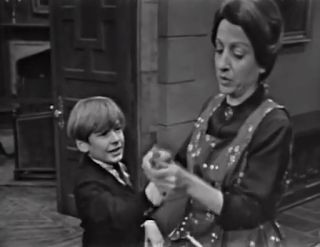
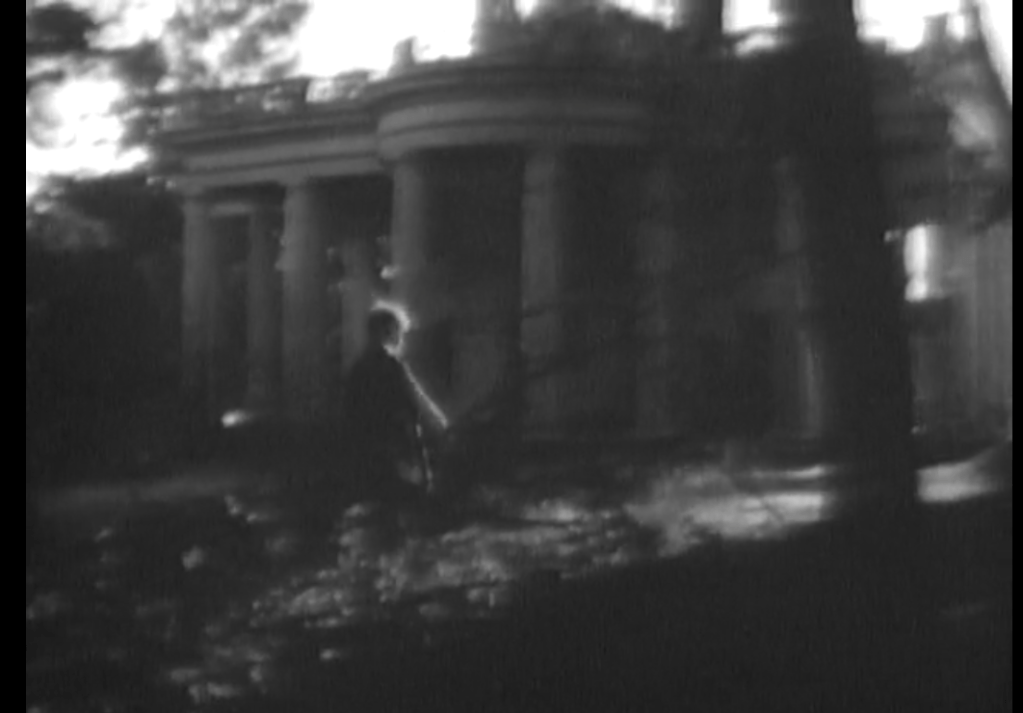
We are then treated to a previously unseen location insert in which David is skipping along the path to the Old House. It’s a lovely little scene, dreamlike and eerie:

David skipping on his way to the Old House

David stands before the portrait of Josette Collins and asks for information about Matthew. The portrait isn’t talking, but Matthew himself appears. David tells Matthew that he doesn’t believe he is a murderer, and that the two of them can investigate and prove his innocence. When David tells Matthew he has no choice but to trust him, Matthew asks “Ain’t I?” Returning viewers remember that in the previous two episodes, well-meaning governess Vicki and reclusive matriarch Liz both asked Matthew to trust them. In response, he tried to kill Vicki, and only his fanatical devotion to Liz kept him from doing the same to her. David’s blithe self-assurance stops Matthew this time, and he agrees to stay in the Old House and let David take care of him.

This episode is the first time we see the secret chamber off the parlor of the Old House. Much will happen there. Another first comes when Matthew is deciding whether to trust David or to kill him. He goes to the window of the parlor. We cut to the outside, and see him in the window thinking murderous thoughts. Many, many times next year and the year after we will see another character, one not yet introduced, in that window, vowing to kill someone or other.

The Old House isn’t the only place where today brings firsts. Up to this point the proper way for people to dispose of their coats when entering the great house of Collinwood has been to fold them and place them on a polished table in the foyer. But this time, David responds to Mrs Johnson’s reproof by taking his coat to a space next to the door where he mimes placing it on a hanger. In later years, we will actually see a set dressing there that can pass for a closet, but for now we just have to imagine one exists.

Episode 72: Whose eye is she after

Well-meaning governess Vicki sits placidly in her bedroom at the great house of Collinwood, sewing and looking out the window. Flighty heiress Carolyn comes in and loudly berates Vicki for spending the day away from her charge, problem child David. Carolyn saw Vicki coming home as a passenger in a car driven by the family’s arch-nemesis, dashing action hero Burke Devlin, and jumped to the conclusion that Vicki was both on a date with Burke and on Burke’s side in his conflict with her family. Vicki is at first bewildered by Carolyn’s rage, and then confronts her with her own record of infatuation with Burke.

This scene shows how well cast Nancy Barrett and Alexandra Moltke Isles were as Carolyn and Vicki respectively. Miss Barrett throws herself completely into whatever her character is supposed to be doing at any given moment, a perfect style for the role of someone who is stormy and unpredictable. Mrs Isles takes a very deliberate approach to her part, working her way from the center of Vicki’s thoughts out to whatever lines she has to deliver. That suits the role of someone who is often baffled by the strange goings-on around her and who gradually gathers the strength to stand up for herself.

Carolyn is on her way to the front door when her mother, reclusive matriarch Liz, asks her where she’s going. Still upset after her confrontation with Vicki, Carolyn snaps at Liz and gives sarcastic answers. Eventually she tells her that Vicki didn’t give David his lessons for the day, that she spent the day with Burke, and that she brought Burke home with her. Alarmed by this report, Liz heads upstairs towards Vicki’s room. Carolyn remembers her latest project, persuading her mother to take Mrs Sarah Johnson onto the domestic staff as a housekeeper. Liz cuts her off, saying that she has no time to think of hiring a housekeeper- all she can think about is firing a governess.

After Liz leaves the foyer to fire Vicki because Carolyn has led her to suspect she might be a spy for Burke, Carolyn picks up the telephone. She tries to call Burke. Evidently the infatuation Vicki had brought up to her is still driving Carolyn to inexplicable actions.

Mrs Johnson is in the restaurant at the Collinsport Inn. In fact, we first see her on the pay-phone there, talking to Burke about her plan to join the staff at Collinwood so she can work as a spy for him. Patrick McCray makes a nice remark about this on his Dark Shadows Daybook:

[P]lanting a spy for Burke Devlin is just the touch of espionage intrigue that Collinwood needs. Finally, someone can actually be the spy that Vicki is suddenly accused of working as. (In the same episode no less, with the irony and subtlety of an anvil landing in your lap.) That kind of duality — especially among the backstairs staff — is a concession to the dramatic thinking that DARK SHADOWS kinda lost over the years. The show gained plot, but it lost those opportunities for characters to reflect one another. As it reached a supernatural frenzy, this earlier, authorial delicacy was a necessary casualty. However, it’s vital to know that a sculpted duality like Mrs. Johnson and Vicki is an instinct buried in the program’s DNA.

I think he paints with a bit of a broad brush when he says that “this earlier authorial delicacy was a necessary casualty.” The frenzied pace of the later years didn’t stop Joe Caldwell or Violet Welles from crafting dramatic miniatures Art Wallace and Francis Swann would have been proud of. While Sam Hall and Gordon Russell were no miniaturists and did often value slam-bang story development over every other consideration, they did take time to show characters in each other’s reflections. Indeed, the whole “1970 Parallel Time” arc is months and months of nothing but “opportunities for characters to reflect one another,” and the actors could often make those reflections interesting (at least the first two or three times you saw them.) Of course, there are also large numbers of episodes written by Ron Sproat and Malcolm Marmorstein, but you can’t blame their shortcomings on excessively rapid pacing.

Mrs Johnson is a difficult customer for Maggie Evans, who runs the restaurant. She sends a sandwich back because she disapproves of the mayonnaise, and the look on Maggie’s face shows us that the cost of that sandwich is coming out of her paycheck. Mrs Johnson insists her meal be served in courses, demands that Maggie sit at her table, and gives her a tip of 10 cents (I checked- 10 cents in October 1966 would have the same purchasing power as 90 cents in October 2022. You could take that to your local hardware store, buy several nails, and still have enough left to operate a gumball machine.) She declares that the death of her late employer, beloved local man Bill Malloy, was no accident, and that according to the Bible someone will have to pay for it. When Carolyn comes into the restaurant, Maggie leaps at the opportunity to leave Mrs Johnson and wait on her.

Clarice Blackburn must have had tremendous fun playing Mrs Johnson in these sequences. The character is exaggerated almost to the level of what would become Dark Shadows’ Go back to your grave!” house style of acting, so that there is no need to worry about overacting. Besides, so many performers wait tables that one of the standard responses young people in Los Angeles get when they tell people they are actors is “Great! What restaurant?” So it must always be gratifying to play a character who will show the world what a bad restaurant customer looks like.

As Maggie, Kathryn Leigh Scott also has a juicy role today. We usually see her in one of two settings. Either she is in the restaurant, where she is required to be nice to everyone, or she is at home with her father, drunken artist Sam. As the adult child of an alcoholic, she has a thousand habits designed to keep the mood light. When she is dealing with Mrs Johnson, Miss Scott shows us what Maggie looks like when her Nicest Girl In Town persona is stretched to the max.

When she greets Carolyn, Maggie goes right into the chirpiest version of that persona. It’s a version that brings home the continuity between Maggie’s relationship to her father and her relationship to her customers. She speaks the first few syllables of each of her lines through a laugh. Many Dark Shadows fans complain about that as a habit of Kathryn Leigh Scott’s, but it’s a habit of Maggie’s. And if you start watching the series from episode 1, seeing all the scenes in the Evans cottage between Maggie and Sam, you’ll recognize it as something many adult children of alcoholics do. At the risk of giving away a spoiler, I’ll say that Sam will eventually cut back on his drinking, and some time after that will be written out of the show altogether. But Maggie’s character is formed in these weeks, when Sam is drunk all the time. Some of Miss Scott’s other characters on the show have similar habits, but those are the characters who are presented as Maggie Evans by other means, so they would have to be recognizable as her.

Carolyn tries to explain to Maggie, sotto voce, why Mrs Johnson is so upset, and Maggie drops her Nicest Girl In Town voice completely for a second- “I know who she is,” she rasps. Carolyn has been friendly to Maggie, and is equally friendly when she goes to sit with Mrs Johnson and tries to talk her into taking the job as housekeeper at Collinwood, assuming that her mother will offer it to her. After Mrs Johnson leaves, Maggie tells Carolyn that she has never been able to stand her- “She’s always given me the willies. I don’t know why,” she says, looking thoughtfully off into the middle distance.

Carolyn’s friendliness to the working class Maggie and Mrs Johnson is a welcome relief from her terribly snobbish sneer at Vicki as “Little Orphan Annie” who should “go back to your precious foundling home.” And it’s an opportunity for Nancy Barrett to take her performance from one emotional extreme to another within a single episode.

Back in the mansion, Liz confronts Vicki about not giving David his lessons. Vicki replies that Liz’ brother, high-born ne’er-do-well Roger, had said that he would tell Liz that he had taken Vicki on a tour of the cannery and had given David the day off. When Vicki hears Liz on the telephone confirming this with Roger, she blows up at Liz. She objects to being checked up on, she objects to being accused of lying, and, turning to look at the last spot where she had seen Carolyn, she objects to being accused of stealing people’s boyfriends. After she is done with her objections, she walks over to Liz. With their backs to the camera, the women quietly apologize to each other. Vicki explains that her protests mark the only way she can go on living in the house. Liz for the first time calls Vicki by her first name. Hearing this conversation when they are looking away from us is remarkably effective at creating a sense that they are sharing an intimate moment- more is happening between the two of them than even the audience can know.

Mrs Isles and Joan Bennett, as Liz, both play a wide array of emotions in their two scenes together, and do so brilliantly. It’s particularly interesting to compare Liz’ startled reaction to Carolyn’s snapping at her in the foyer when she asks her where she’s going to with her startled reaction to Vicki raising her voice at her in the drawing room when she’s been on the phone with Roger. They are two quite distinct startles. We see Liz from behind when Carolyn startles her. From that angle, we see the muscles in the back of her neck tense, signifying anger. That startle gives way to a parental sternness. The startle Vicki provokes is shown in profile. Liz pulls back a little, suggesting guilt. It leads to a rapid retreat.

Startled by Carolyn
Startled by Vicki

Episode 69: I believe in signs and omens

Mrs Sarah Johnson, longtime housekeeper to the late Bill Malloy, shows up in the hotel room of dashing action hero Burke Devlin. She tells Burke that she believes his enemy, high-born ne’er-do-well Roger Collins, killed Bill. Her principal evidence for this is the fact that Bill’s body washed ashore near Roger’s home on the estate of Collinwood, and “I believe in signs and omens!”

Mrs Johnson believing in signs and omens. Screenshot by Dark Shadows from the Beginning

This line is a bit of an omen itself- Clarice Blackburn will be an important part of the show, not only as Mrs Johnson, but as other characters who believe in signs and omens, and who make things happen in the name of that belief.

Meanwhile, hardworking young fisherman turned hardworking young clerk Joe Haskell is called into Roger’s office at the cannery. There, he finds flighty heiress Carolyn behind her uncle’s desk, looking seductive, or at least highly available.

Carolyn coming on to Joe. Screenshot by Dark Shadows from the Beginning

Nancy Barrett’s way of throwing herself completely into whatever her character is supposed to be doing at any given moment sometimes makes Carolyn seem even more scattered than her persona as Flighty Heiress required, but it does come in handy when the character is supposed to be sexy. That makes her stand out- even by the standards of an American television show of the 1960s, Dark Shadows is remarkably un-sultry. Sometimes it’s a marvel that they can put so many good-looking young people in close proximity to each other and still project an image of total chastity.

Joe and Carolyn kiss, and she asks him to go away with her. He tells her that he can’t just leave work in the middle of the day. She explains that she is troubled by the doings of Joe’s bête noire, Burke. This leads to a lively conversation, which in turn leads Carolyn to resume her attempts to persuade Joe to take the rest of the day off. When Joe’s boss calls for him, she offers to use her clout as the owner’s daughter to persuade him to let Joe go. He won’t let her do this. She leaves, frustrated by his refusal.

Back at the hotel, Burke and Mrs Johnson are devising a plan in which she will get a job at Collinwood and act as a secret agent for him. We get a glimpse of Burke’s persuasive abilities. When Mrs Johnson is showing reluctance to follow his plan, Burke mentions that well-meaning governess Vicki has given Roger an alibi. She immediately declares that Vicki is lying. Burke won’t agree, leading her to demand that he set aside his personal feelings and devote himself wholeheartedly to making the case against Roger. Not only does the audience see Burke showing kindly feelings towards Vicki, keeping the idea alive that they might become a couple, but we also see Mrs Johnson commit herself to going along with Burke’s plan. Whatever Burke’s actual feelings for Vicki, his emotional display at this moment is timed to lock Mrs Johnson into doing what he wants.

There is a knock on the door. It’s Carolyn. Mrs Johnson hides in Burke’s kitchen and listens as he gives Carolyn the idea of hiring her as housekeeper at Collinwood. This isn’t very hard- Burke simply mentions that Mrs Johnson needs a job, and Carolyn at once says that she will tell her mother to hire her as housekeeper at Collinwood. Even so, Burke’s skillful handling of Mrs Johnson is so fresh in our minds that we don’t need to see him actually do anything to enlist Carolyn in his scheme for this scene to reinforce his image as master manipulator.

Mrs Johnson listens in. Screenshot by Dark Shadows from the Beginning

The sight of Mrs Johnson lurking in the shadows, eavesdropping on Burke and Carolyn, further reinforces this image. A guileless woman comes into his room proclaiming her every thought at the top of her lungs, as she had done when she was introduced at the sheriff’s office in episode 67. We can hardly imagine so straightforward a personality becoming an effective undercover operative Yet within minutes of meeting Burke, he has her working as a spy.

Writer Francis Swann is credited with the script for today’s episode. He is particularly good with installments that, like this one, have only four characters. Swann’s ability to slip substantial amounts of plot exposition into natural-sounding dialogue makes a minimalist drama seem busy. In this one, it also helps us to feel that we have seen Burke perform great feats of persuasion. Burke may not have had to work very hard to plant ideas in the minds of Carolyn and Mrs Johnson, but we are aware that the scripted dialogue has planted ideas in our minds, and know that someone on the other side of the screen is good at subtle communication.

Swann and director Lela Swift also make effective use of the sets in today’s episode. This is our first look at the kitchen in Burke’s room. He’s gone in and out of there several times, most notably in episode 29 when he prepared a nonalcoholic mixed drink, the “Burke Devlin Special,” for Roger’s son, problem child David. Regular viewers might have started to wonder what it might look like, and might pay close attention when we get our first look at it. What we do see is a complex pattern of shadows that signals Mrs Johnson’s initiation into the world of film noir.

In today’s scenes with Carolyn and Joe, we spend as much time in Roger’s office as we have in any other episode. It’s the only part of the Collins’ business location we see, standing in for the whole enterprise. Played on that set, Carolyn’s flippant attitude towards Joe’s job and his mixed feelings about the demands she makes lead us to wonder if she’s going to wreck the whole business. Her persistent friendliness towards family nemesis Burke gives substance to that thought. Regular viewers will remember that Roger’s self-indulgent behavior nearly annihilated the business; seeing his favorite niece play-act as him in his office leads us to wonder if she will finish the job.

My usual themes: Gay subtext

In 281 of the posts that follow, I link to comments I made on Danny Horn’s blog, “Dark Shadows Every Day.”

Not all of these comments were absolutely unique. Several times, I picked up on one of Danny’s favorite topics, gay subtext in Dark Shadows. Usually I claimed that there was even more of this in the show than he identified.

Danny writes intricate, deeply considered analyses of episodes 210 through 1245 of Dark Shadows. He does not cover episodes 1-209, and frequently claims that there are many episodes among them he has never seen. He does refer several times to a plot point that stretched across many episodes in those 42 weeks, the story of Roger Collins and his obsessive interest in where Burke Devlin’s pen is. Burke has sworn to expose the nature of his former relationship with Roger, exposure which Roger fears will lead to his disgrace and imprisonment.

Driven by that fear, Roger alternately takes and loses Burke’s pen. He keeps returning to where the pen is, and his obsessive attention to the pen, moving it from one hiding place to another, holding it in his hands, staring at it, shifting it between his coat pocket and his pants pocket, dropping it out of his clothes to a place where people can see it, putting it in darkened corners of his house, burying it in the soil of the grounds of his home, digging it up again to put it in yet another place, leads directly to his arrest. Danny does not appear to find any gay subtext in this, even in the post in which he gives synopses of 21 episodes where Burke’s pen is the main theme. Instead, Burke’s pen is, for him, a symbol of the dangerous boring-ness of the first 42 weeks of the show. For an audience in 1966, watching what was at that point a rather ambitiously literate show and living in a country where Freudianism was enormously influential, I suspect a man obsessed with where another man’s pen is would have seemed likely to be dealing with psychological issues concerning male genitalia, even if he weren’t played by Louis Edmonds.

Though there may not be any posts about the first 209 episodes, the comment threads range over the whole series and over topics far beyond it. So, the Burke/ Roger relationship came up in a thread responding to Danny’s post on episode 1008. In response to that discussion, I wrote the following:

There is a dispute among the characters as to whether Burke or Roger was driving when the car hit Hanson. This hardly matters. It was Burke’s car, and even if he gave the keys to Roger, he would have done so knowing that Roger was as drunk and as unfit to drive as he was. A fact like that wouldn’t necessarily have kept Burke out of jail even if it were known at the time, and ten years later, after witnesses’ memories had faded, physical evidence had been lost, and statutes of limitations had expired, the whole basis of the “Revenge of Burke Devlin” storyline is sheer nonsense.

But let’s look at another question about the identities of the people in that car. The public story is that the three people in it were a pair of lovers and their friend, and that after the collision the lovers broke up and one of them ended up married to the friend. Maybe that’s true- but maybe the lovers were Roger and Burke, and Laura was the friend who was along for the ride. That’s the secret Roger is so desperate to cover up when Burke comes back to town.

It also explains why Burke “investigates” the matter personally, rather than handing it over to the high-priced private investigating firms the show goes out of its way to tell us he is in the habit of retaining. He isn’t trying to uncover established facts about the past- he’s trying to fabricate a new past, in which will stand a different sort of relationship than the one he and Roger actually shared. Perhaps, as a deeply closeted 1960s guy, Devlin has it in mind to remake the past so that he and Roger did not have a sexual relationship at all; by rewriting his history with Roger, he may hope to free himself of his same-sex desires and the threat they pose to his macho identity. Perhaps, at another level of his mind, he wants to free himself, not of his desires, but of that macho identity, and of the social norms and personal inhibitions that keep him from living openly as a gay man. In that way, Burke is the first of Dark Shadows’ would-be time travelers, embarking on a quest to erase a past he cannot tolerate and to replace it with one that will enable him to have a sustainable set of intimate relationships.

This would also explain Burke’s attitude towards other major characters. Carolyn and Laura are nothing to him but weapons to use against Roger and instruments to use in inscribing a new past. His relationship with Vicki doesn’t really get started until there’s no reason for either of them to be on the show anymore; it’s boring for that reason, but if we think of Burke using Vicki as a beard we can find an interest in its very lifelessness.

Moreover, we can connect Burke’s closeted homosexuality to his weirdly feckless efforts against Barnabas. He never figures out what Barnabas is, but he immediately sees what Barnabas is not- that is, he is not trying to be a perfect example of Heterosexual Male, 1960s edition. He responds to Barnabas with undisguised loathing, but not with any real jealousy about his attentions to Vicki. It’s Barnabas’ freedom from convention that he envies. Once we postulate a B/R sexual relationship before the crash that killed Hanson, we can draw a direct line from Burke’s return to town in episode 1 to the night he spent hiding behind a tree near the Old House waiting to see Barnabas come and go in episode 304.

I suppose there might be a reason they chose the name “Burke Devlin” for the character- not only was the actor who played “Burke Devlin” in the film “The Tarnished Angels” Rock Hudson, but that Burke Devlin is involved in a love triangle in which his strongest feelings seem to be for the husband of the woman with whom he is ostensibly involved. That Devlin is at first fascinated by the husband, has a falling-out with him, then turns his attentions to the wife.

Strong as the gay subtext in the whole development of Burke Devlin’s character is, there are other times when it is even closer to the surface. I wrote this about the beginning of the “Leviathans” storyline:

So far, this has been the gayest storyline the show has taken on yet.

In 899, the sailor offers to buy Paul a drink, and Paul shouts “I buy my own drinks!” This isn’t subtext- any man getting that reaction in a bar will know that the other fellow has interpreted his offer as including more than the drink. Paul apologizes and becomes friendly, indicating that he is willing to abandon that interpretation and set aside the hostility that accompanied it.

In this episode, we’re back in the same bar. Barnabas beckons Paul to his table with his index finger. I invite any man who doesn’t think we are intended to read this as a reference to a sexual come-on to try that move on a homophobic tough guy in a bar.

Paul’s face shows his inner struggle as he tries to resist Barnabas’ advances, but he can’t. Barnabas coaxes him into reminiscing about yet another night in the same bar, when a casual encounter with yet another guy led to something that seemed at the time like a little harmless tomfoolery, but that has now grown into a threat to his relationship with his family, his standing in the community, his physical well-being, and everything else.

Indeed, there are moments in the Leviathans story when the gay men in the cast seem to be having a bit of fun with the barely-coded gay themes:

Every time Barnabas addresses Philip as “Philip,” I see a little twinkle in Jonathan Frid’s eyes. By 1969, female impersonators had been imitating Bette Davis’ commands to Leslie Howard in OF HUMAN BONDAGE, where his character’s name is “Philip,” for thirty years. I knew gay men who were still making each other laugh as late as the 1980s by quoting lines beginning “Philip!” If Bernau hadn’t stayed so perfectly in character, I doubt Frid would have been able to keep from a giggling fit that would have brought the house down.

Christopher Bernau’s decision to play an antique dealer using a voice and mannerisms derived from a Jack Benny imitation led many of Danny’s commenters to bring up Bernau’s own sexuality and wonder whether he was simply incapable of staying in the closet. As it sometimes does in discussions of obviously gay actors playing men partnered with women on American TV in this period, The Paul Lynde Show (1972-1973) came up. I had altogether too much to say about this:

The reference to Paul Lynde in the original post reminds me of THE PAUL LYNDE SHOW, a sitcom which aired on ABC in the 1972-1973 season. It’s a fascinating artifact. Lynde’s character has a wife and two daughters. The opening sequence sets the tone- it flashes through several readily identifiable scenario (falling off a bicycle, etc) which end with Lynde falling into one or another kind of trap. Lynde plays each of those little vignettes with the same series of expressions on his face, the first a grim look of deep-seated misery, the last an explosion of panic. Each episode focuses on Lynde’s character stumbling into some kind of excruciatingly awkward situation, suffering through a rapidly escalating series of embarrassments, and finally escaping from it with his dignity annihilated but his wife and daughters feeling sorry for him.

It’s routine for people to cite that show as an example of how clueless the entertainment industry and the public who consumed its products were about gay people in the old days, but it is so plausible a version of what it might have been like for Paul Lynde to have married a woman that can’t imagine it wasn’t intentional on some level. You can read it as an exploration of a gay man and a woman who’ve ended up married to each other for whatever reason, and who have resolved to do what they can to make a marriage work. After all, they like each other, they want their daughters to know where home is, and they have a position to maintain within the community. They show the result as something that’s pretty nearly tolerable for all concerned, but at no point does it look like something great. Lynde’s daily frustrations, confusions, and humiliations are the basis of the comedy, but they could just as easily have been explored in a drama that makes their source explicit. It certainly gives academics interested in Queer Theory a lot to write about.

If the public wasn’t in fact as oblivious to gayness as is sometimes suggested, it would have been even more daring- or more clueless- to cast Christopher Bernau as a married man than you suggest. Especially so considering that he’s supposed to be an antique dealer, an occupation often stereotyped as a province of gay men. His performance in this episode is not as obviously gay as was his performance in episode 890- even if you were in an all-male porn video, it would be a challenge to be as obviously gay as Bernau is in episode 890- but it’s pretty darned flamboyant.

Maybe they had seen so many other gay actors play heterosexual characters convincingly enough that it didn’t occur to them that he would have a problem. Joel Crothers has been mentioned several times, but I would also bring up Louis Edmonds. As Edward Collins, he is perfectly credible in his scenes with Kathryn Leigh Scott’s Kitty Soames. And as Roger in 1966, he was credible both as a slimy guy coming on to Vicki and as the estranged husband of Laura.

The reference at the beginning of the last paragraph above to the late Mr Bernau having “a problem” is rather silly, and I regret it. It hadn’t struck me yet that he was doing a Jack Benny imitation, or that he would have expected a Jack Benny imitation to read in something like the way Jack Benny’s own performances did in his heyday. That the Jack Benny type shifted from an image of a rich, ineffectual man to an image of a gay man, and that Bernau was not thinking in terms of that shift at the end of the 1960s, is itself an interesting topic, far more so than my crude underestimate of Bernau’s acting ability (ability with which I was quite familiar!)

The Leviathans storyline was followed by the 1970 Parallel Time storyline, to which I usually refer as “Meet Another Angelique.” The A-story throughout that segment is an adaptation of Daphne Du Maurier’s Rebecca. I engaged in a bit of imaginary recasting concerning that story:

Daphne du Maurier was bisexual, and a lot of people have written a lot of criticism of REBECCA based on the idea that what drove de Winter to kill his wife was that she was sleeping with women as well as with other men.

I’m skeptical about that interpretation. Maybe du Maurier had planned to put that in the book, but once the story turned out to be about the second Mrs de Winter’s struggle with feelings of inadequacy, the events that actually took place between Rebecca and Maxim during their marriage are relegated to a secondary importance. As for Mrs Danvers, the most important thing about her in the novel is her ambiguity. The second Mrs de Winter is terrified of her, but she would be terrified of anyone. Since she is the narrator, we have no way of knowing what Mrs Danvers is actually thinking or doing.

Of course, Hitchcock and Judith Anderson made Mrs Danvers’ erotic attachment to Rebecca the central theme of the movie. The second Mrs de Winter finds that Maxim has become unavailable to her as soon as they arrived at Manderley. The only powerful emotion she encounters anywhere in her new environment is Mrs Danvers’ passionate attachment to Rebecca. That passion is just one more thing she can’t understand.

Grayson Hall is good as Hoffman, but I wish Clarice Blackburn had played the housekeeper. First, because she joined the cast thinking that Mrs Johnson would be based on Mrs Danvers, so that she had spent a few years preparing for the role. Second, she was in real life partnered with a woman, so it would have been good to see an actual lesbian play a homoerotic-inflected role.

My usual themes: Imaginary Recasting

In 281 of the posts that follow, I link to comments I made on Danny Horn’s blog, “Dark Shadows Every Day.”

Not all of these comments were absolutely unique. One of my most frequent themes was “Imaginary Recasting.” I explain what I mean by this in a comment on Danny’s post for episode 470:

During the slow moments, I recast the show in my head. Harvey Keitel was a background player on the show once, a dancer at the Blue Whale in #33. So I imagine him in Roger Davis’ place. And several Dark Shadows cast members (David Ford, Virginia Vestoff, and Daniel Keyes*) were in the original Broadway cast of 1776. So other members of that cast would have been available for parts on DS. I imagine Howard Da Silva in place of Addison Powell. With those changes, the version of the Jaff Clark**-Dr Lang scenes that plays in my head is quite good!

For the game to be fun enough to keep me going through the dire bits, it has to be plausible to me that the makers of Dark Shadows could actually have landed the actor in question. No doubt Laurence Olivier or Bette Davis or whoever would have been a valuable addition to the cast, but they were so unlikely to take such a part that I can’t make myself believe in the scenario strongly enough to distract from whatever it is I don’t like about what I’m actually watching.

The categories from which I draw imaginary cast members, then, include sometime non-speaking players like Keitel. In that group are also to be found Fredric Forrest, David Groh, Henry Judd Baker, and Susan Sullivan. A second category is people who appeared on the show in speaking parts but only briefly, such as Marsha Mason, Gail Strickland, Cavada Humphrey, Beverly Hope Atkinson, and Philip R. Allen. It’s easy enough to believe that people who accepted small parts on the show would also have taken bigger ones.

There are also several people who appeared on the show in major parts, but not enough for my liking. Among these I often mention Clarice Blackburn, Jerry Lacy, Alexandra Moltke Isles, Virginia Vestoff, and Robert Rodan.

There are also three categories of people who didn’t actually appear on the show, but who might well have. The first of these is the one I mention above, the cast of 1776. In addition to da Silva, I also mention Ken Howard, who was Thomas Jefferson in 1776 and who would have been an interesting choice for Morgan Collins in the dying days of Dark Shadows.

The other two categories each include just one person. If they could get Harvey Keitel and Fredric Forrest to dance in The Blue Whale, surely they could also have landed Robert de Niro to play a speaking role. I’m just as glad they didn’t- had he been cast as Carolyn’s motorcycle-riding boyfriend Buzz, the character might have been a big enough hit they would never have got round to making the spook show we all know and love.

The second one-person category is actors whom we know series creator Dan Curtis wanted to have in particular parts. The one person in that category is Bert Convy, Curtis’ first choice for the part of Barnabas Collins. I am glad Jonathan Frid was cast instead, but I do try to imagine what the show might have been like with Convy. I also try to imagine how Jonathan Frid might have done in Convy’s place as a game show host:

Which raises the further question of how Jonathan Frid would have done as the host of Tattletales. “Ladies, suppose you your fella, you- the two of you! Suppose you went to a kind of, well, a resort, a vacation place. And the beaches- multiple beaches, one of them as it happens a nude beach. A beach of nudeness! Suppose further that it was your choice and only yours- what I mean is, you must choose which beach to visit! The nude, or the other! Don’t give me your answer, you must not! But when I call for it, then, you will tell me which beach you choose!”

*I should also have mentioned Emory Bass and Peter Lombard

**For “Jaff,” read “Jeff,” not that it really helps