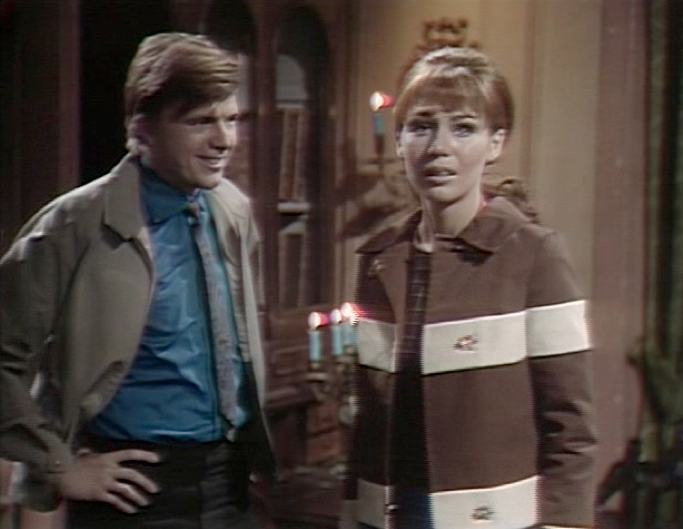
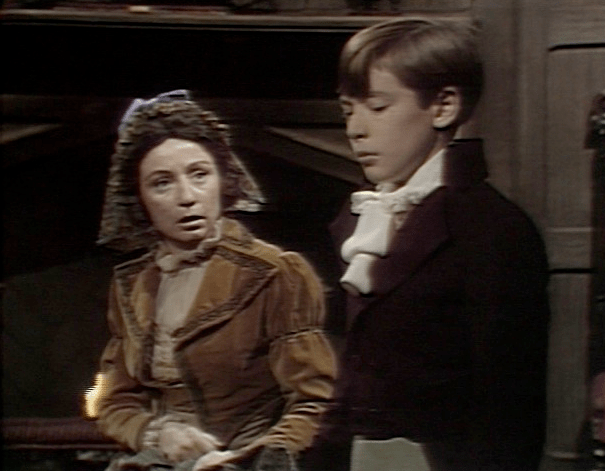
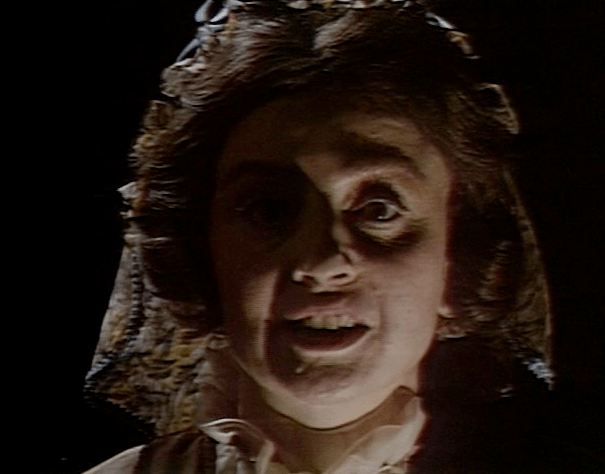
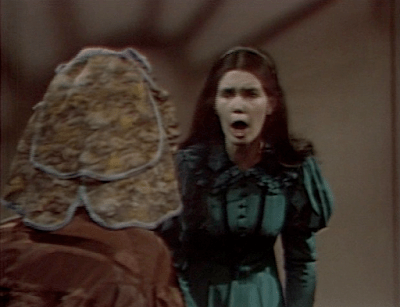
Episode 569: Call me a superstitious woman

When housekeeper Mrs Johnson was first on Dark Shadows in September 1967, she was hyper-intense, determined to exact vengeance on the ancient and esteemed Collins family for the death of her longtime employer, Bill Malloy. In #69, she told the Collinses’ nemesis, dashing action hero Burke Devlin, that “I believe in signs and omens!” and that the signs and omens she could see showed that reclusive matriarch Elizabeth Collins Stoddard and her family had Bill’s blood on their hands.
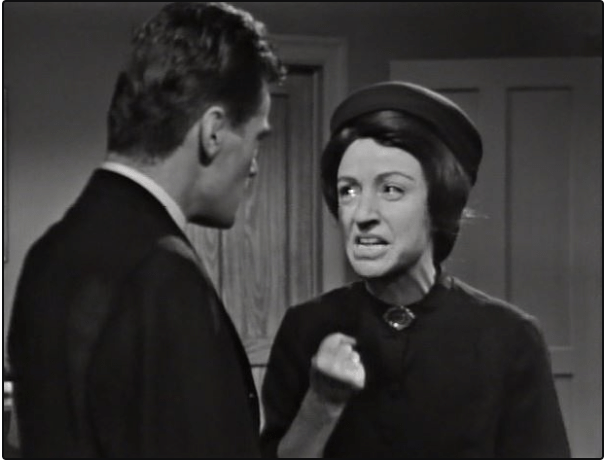
“I believe in signs and omens!” Mrs Johnson with Burke Devlin in #69.

As the storyline centered on Bill’s death petered out, Mrs Johnson forgot about her hostility to Liz and her family, and became their devoted retainer. Her new personality was that of a friendly old busybody who kept advancing the plot by blabbing all the information she has to whoever can use it to make the most trouble. Since Mrs Johnson opened the front door to the great house of Collinwood in #211 and admitted Barnabas Collins, she has become an intermittent presence on the show, but Clarice Blackburn plays her with so much style that her occasional appearances are always a highlight.

Today, Mrs Johnson lets suave warlock Nicholas Blair into the house. She informs Nicholas that Liz has escaped from Windcliff, the mental hospital where she has been staying for the last nine and a half weeks. She gets very worked up as she declares that Liz’ aberrations are no ordinary psychiatric problem, but are the product of a hostile supernatural force that plagues the Collinses. Her voice is fearful and she shies away from eye contact with Nicholas, a contrast with the anger and boldness she had shown with Burke Devlin 100 weeks ago, but she again underlines her point with exaggerated hand gestures and facial expressions.

Mrs Johnson tells Nicholas about the curse on the house. Screenshot by Dark Shadows Before I Die.

For regular viewers, it is surprising that Nicholas doesn’t seem to have known about the details of Liz’ trouble. His subordinate, the wicked witch known variously as Angelique and Cassandra, had sent Liz mad by placing a spell on her shortly before he arrived on the scene. He’s still keeping Angelique/ Cassandra around his house- he stripped her of her powers, turned her into a vampire, and has been using her to attack various men he wants to silence. You’d think he would at some point have asked her what happened to the lady who owns the town he has settled in. But, evidently his curiosity did not extend that far.

Liz’ brother Roger comes home and invites Nicholas to join him for a brandy. As they are headed for the drawing room, permanent houseguest Julia Hoffman enters. She is pale, unsteady on her feet, and talking with great distress about her inability to find Tom Jennings. Roger points out that Tom is dead, and Julia faints.

Nicholas carries Julia to the couch in the drawing room. While she lies on it unconscious, he sneaks a peek under her scarf and finds bite marks on her neck. Thus he learns that Tom, whom Angelique turned into a vampire at his direction, has been feeding on Julia.

Liz has not been an active part of any major storyline since #272, when it turned out that her belief that she had killed her husband was mistaken and she did not in fact have any terrible secrets to conceal. So Nicholas’ lack of interest in her might just be a sign that he doesn’t want to waste time on irrelevant details. But Julia is indispensable to Nicholas’ plan to found a new race of artificially constructed human beings. She is a medical doctor, and is the only person Nicholas can coerce into building a mate for the Frankenstein’s monster she recently helped bring to life. She hasn’t been able to work on the project since Tom bit her, and apparently won’t be able to resume work until she is freed of his influence. If Nicholas lets his projects get in each other’s way to this extent, one can draw no conclusion other than that he is a bad manager.

Julia recovers and refuses to see a doctor. She goes to bed, and Roger tells Nicholas he thinks Liz might be on the grounds of the estate. The two of them go out to look for her. Of course Liz is there; of course she sees Tom; of course it is only when Roger and Nicholas approach that Tom vanishes and she is spared his bite.

It has been established that Windcliff is about 100 miles north of Collinsport; in #294, the ghost of Sarah Collins performed one of the most stupendous of her many feats when she transported Maggie Evans, The Nicest Girl in Town, from Windcliff to Collinsport on foot in about an hour. Liz has had 24 hours since she went missing from her room, and people used to hitch-hike in those days, so it wouldn’t necessarily have required a supernatural agency to get her home in that time. It still would have been quite a trip for an escaped mental patient to make by herself, without bus fare, as the subject of a state police all points bulletin, on the roads running through the woods of central Maine.

Back in the house, Liz makes it clear that she is not herself when she only gradually recognizes Mrs Johnson. She is also obsessed with a fear of being buried alive. Roger concludes that she has to return to the hospital, and goes off to get the car. Julia comes downstairs, and Mrs Johnson asks her to keep an eye on Liz while she goes off to telephone the hospital.

Liz asks Julia, who is the nominal director of Windcliff and a qualified psychiatrist, to examine her and see that she is sane. As she is about to respond, Julia hears dogs howling outside and goes into a trance. She opens the window and stares out into the night, saying that the dogs are calling to her and that she must go to “him.” While she does this, Liz asks her what she’s talking about, but clearly still wants her to serve as the standard of sanity. The first time we saw Liz, in #1, she was standing where Julia stands in this shot, looking out the window with Roger behind her. Liz reprised that pose many times in the first year of the show, and it became her signature. It is incongruous to see Julia in Liz’ customary place as Liz looks on. The whole encounter is so funny that I suspect the humor must have been intentional.
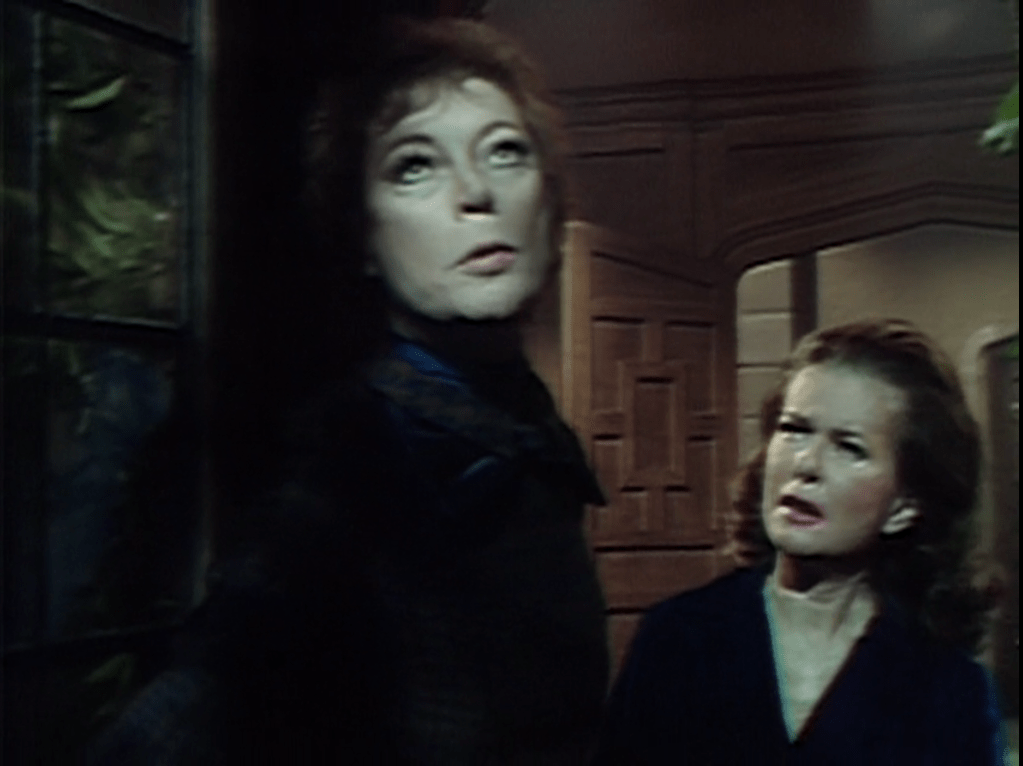
Liz begins to doubt that Julia will be able to help her.

Julia rushes from the house; Liz follows her out. Julia goes to the crypt where Tom’s coffin is kept; evidently Tom’s hunger is getting the better of him, and he has decided to DoorDash it tonight. Liz follows her in. Julia sees Liz and demands that she leave. Liz sees the coffin and asks if it the one in which she will be buried alive. Julia tells her it has nothing to do with her, and repeatedly yells at her to “Get out!” She complies. Tom appears, and opens his mouth to bite Julia.

Julia’s expulsion of Liz from the crypt is an effective turn, but it is also a sad one for longtime viewers. When Dark Shadows started, the presence of Joan Bennett in the cast was probably its single biggest ratings draw, and all the way through her name appears at the beginning of the credits under the word “Starring.” But for a year now, the show’s whole attitude towards Liz has been one of active hostility. They simply will not let her be involved in the action. When Julia shouts “Get out, get out, get out!,” she is speaking with the voice of the story conference.

Danny Horn’s post about this episode on Dark Shadows Every Day details how Liz has been pushed to the margins and kept there as the show has evolved. Danny makes a point of not discussing the first 42 weeks, when Liz was enough of a part of the action that Joan Bennett had some chance to show what she could do, but in this post at least he seems to realize that the makers of Dark Shadows were squandering a considerable resource.

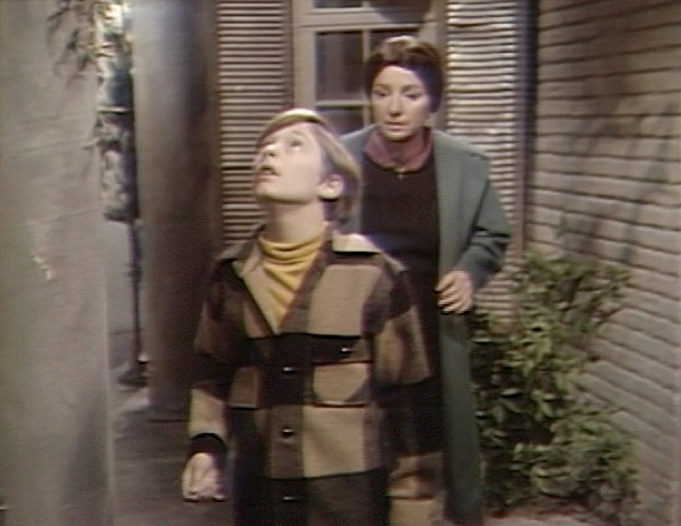
Episode 542: Henceforward in thy shadow

When Dark Shadows began, Carolyn Collins Stoddard was capricious, vain, and perverse. When her mother, reclusive matriarch Liz, was hospitalized in February and March of 1967, Carolyn had to take on responsibility for the family’s businesses and for the great house of Collinwood. With that, she matured dramatically, and she’s never been the flighty heiress since.

Now, Liz is back in the hospital. The show has long since stopped paying attention to the Collinses’ business interests, so we don’t know who’s running those, and the house just sort of takes care of itself while various hell-spawned abominations drop by and take up residence. So Carolyn is keeping herself busy by hiding the latest arrival, Frankenstein’s monster Adam, in the long-deserted west wing.

Carolyn and Adam in the west wing. Screenshot by Dark Shadows Before I Die.

This is the first we’ve seen the west wing in color. Strange and troubled boy David trapped well-meaning governess Vicki in a room there from #84 to #87, and Adam appears to be staying in the same room.

Adam, who didn’t know a single word of any language when he was brought to life in #490, has in nine and a half weeks acquired the ability to speak fluent, if grammatically unorthodox, English. He is also able to read. When he is alone, he whiles away the hours with the poetry of Elizabeth Barrett Browning. He asks Carolyn for an explication of Barrett Browning’s “Sonnet VI”:

Go from me. Yet I feel that I shall stand
Henceforward in thy shadow. Nevermore
Alone upon the threshold of my door
Of individual life, I shall command
The uses of my soul, nor lift my hand
Serenely in the sunshine as before,
Without the sense of that which I forbore—
Thy touch upon the palm. The widest land
Doom takes to part us, leaves thy heart in mine
With pulses that beat double. What I do
And what I dream include thee, as the wine
Must taste of its own grapes. And when I sue
God for myself, He hears that name of thine,
And sees within my eyes the tears of two.

Carolyn does not give the poem anything like the dramatic interpretation we would have expected had Nancy Barrett read it in her own person. Carolyn hastens through it, stumbling a bit over the enjambments, and gives only the most cursory explanations. Since Carolyn has to leave Adam alone so much of the time in order to keep the other residents of the house from suspecting that she is harboring him, it makes sense that she finds a piece about loneliness and separation upsetting. When she mentions that the poem is about a woman’s love for a man, Adam caresses her face, which she finds even more upsetting. He asks if she hates him, she tells him she does not, and she leaves as quickly as she can.

Housekeeper Mrs Johnson notices that someone has been stealing food from the kitchen. She suspects her son, ex-convict Harry. In fact, the culprit is Carolyn, who is gathering provisions for Adam. This harks back to #120, when David stole food from the kitchen to give to the fugitive Matthew Morgan. David was about nine years old, so it made sense that he could not get supplies for his friend any other way. But Carolyn is a grown woman, with money and a car. Even if she would be too conspicuous to go to the grocery store in the village of Collinsport without having to answer questions, she could easily drive to some town where she would not be so well-known and buy food for Adam there. In the last two episodes David seemed far less intelligent and capable than he was when the show began; when we hear that she has been sneaking food from the kitchen, it seems that Carolyn has lost a lot of ground as well.

This is the first we have seen Harry since he was introduced in #471. He stumbles upon Carolyn returning to the main part of the house from the west wing; she reacts by scolding him for being upstairs. When he tells his mother about it, she is frightened. She is still frightened when she talks with Carolyn about the incident. That will remind longtime viewers that in Liz’ absence, Carolyn is in charge of the house. Clarice Blackburn does such a fine job of acting that even first time viewers will understand that Carolyn has the power to fire Mrs Johnson if she wishes.

Craig Slocum is one of the least-loved actors in all of Dark Shadows; in truth, his performances usually are pretty painful to watch. He’s reasonably competent today, but since he shares his scenes with two actresses who would hold an audience’s attention even if they were playing opposite a hat-rack it takes a lot more than reasonable competence make Harry linger in our minds.

Episode 497: Acting like ourselves

Mrs Johnson, housekeeper in the principal mansion on the great estate of Collinwood, isn’t herself. She had a nightmare a week ago, and ever since has been plagued with a compulsion to tell its details to strange and troubled boy David Collins. She knows that if she does, David will have the same nightmare, the same compulsion to tell it to some third person, and that if he does that person will suffer the same complex. She doesn’t know that the nightmare is part of a curse sent by wicked witch Angelique, or that at the climax of the curse old world gentleman Barnabas Collins is supposed to revert to the vampirism that afflicted him from the 1790s until last month. But she does know that it is part of something horrible, and she has tried desperately to keep it from continuing.

Mrs Johnson spent a couple of days with her sister in Boston to stay far from David, but she kept having the nightmare there. She has given up, and has come back to Collinwood. She does not go straight home to the great house, but stops first at the Old House in the estate. Barnabas lives there, but it is Barnabas’ friend Julia Hoffman she sees. Julia had passed the dream to her. Julia urges Mrs Johnson not to tell David about it. She replies that she knows she should not tell him, but that she has no more choice in the matter than Julia had in telling her.

This scene will raise a question in the minds of regular viewers. Julia is a medical doctor doubly qualified in hematology and psychiatry; she also has developed a method of hypnosis so powerful that she can virtually rewrite a subject’s memory, confining even very intense recollections to the depths of the unconscious mind, sometimes after an acquaintance of only a few minutes. Why doesn’t she try to hypnotize Mrs Johnson into forgetting the dream? All she actually does is slap her and repeat her command to avoid David.

David turns up. His father has sent him to ask Julia to come to the great house at her convenience. Julia tries to manage the situation by sending Mrs Johnson home first and keeping David in the house for a while. After Mrs Johnson leaves, Barnabas’ servant Willie enters and tells Julia there is an emergency in the basement. David agrees to wait for her to come back, but once she is gone he shouts that he will be playing outside.

We follow David out the front door, and find that Mrs Johnson is there waiting for him. She comes up on him from behind and says she has something to tell him. This scene will startle regular viewers. For nineteen weeks, from #365 to #461, Dark Shadows was a costume drama set in the 1790s. In that period, Clarice Blackburn played repressed spinster Abigail Collins and David Henesy played Daniel Collins, heir to the Collins fortune. We first saw Daniel in #431, when his Aunt Abigail intercepted him on this very spot and scolded him for playing at the Old House. Abigail was enforcing rules and believed she was acting in Daniel’s best interests; now the same actors invert the scene, showing us Mrs Johnson doing something she knows to be wrong and harmful to David.

Mrs Johnson sneaks up on David. Screenshot by Dark Shadows Before I Die.

Maggie Evans, The Nicest Girl in Town, isn’t herself. Some emerald earrings mysteriously appeared in her purse the other day, and when she tried them on she got a faraway look on her face, began speaking in a voice different from her own, and a tinkling music played on the soundtrack. Today her boyfriend Joe tells her that he took the earrings and showed them to a jeweler and to the police. The jeweler valued them at $15,000* and the police said that they didn’t match the description of any jewelry that had been reported missing. Maggie was not only irked that Joe had taken the earrings without her permission, as anyone might be, but when he tries to get her to agree that such expensive things don’t just materialize out of thin air her usual level-headedness and cheerful disposition vanish and she becomes childishly defensive. Maggie does not know that Barnabas’ servant Willie placed the earrings in her purse as an attempt to reestablish the connection the two of them had when she was Barnabas’ prisoner in the Old House. As a result of Julia’s hypnosis, she does not even remember what Barnabas did to her. But after she runs Joe off, she is compelled to go to the Old House.

Again, regular viewers will recognize an echo of an earlier episode, in this case one that aired a year ago. When Maggie was Barnabas’ victim in May 1967, she snapped at Joe and drove him out of her house as she does today. Then too, she headed for Barnabas once Joe was gone.

Maggie doesn’t find Barnabas at the Old House. Instead, she sees Willie. Barnabas had framed Willie for his crimes against Maggie, and Willie was confined to the mental hospital Julia runs. Barnabas and Julia have brought him back to the Old House to help with their latest nefarious scheme. Willie had been Barnabas’ blood thrall; it is not clear to the audience just what effect it had on Willie when Barnabas’ vampirism went into remission. When we first see him today, he is playing with an unloaded rifle and grinning maniacally, reminding us of the dangerously unstable ruffian he was before Barnabas first bit him.

Maggie knocks on the door and asks Willie if she can come in. He falls over himself inviting her. He becomes the friend he tried to be to her during her imprisonment. She says she knows that he wasn’t the one who hurt her, and he is overjoyed. She seems blissful. He asks her out on a date; she says that Joe wouldn’t like it. Before Barnabas, Willie propositioned all the young women and threatened all their boyfriends, and at first this approach, like his gleeful handling of the rifle, suggests that dangerously unstable ruffian is back. He assures Maggie that he only wants friendship, but after she leaves he picks the rifle up again and says that Joe will be out of the way soon.

Maggie finds herself strangely at home. Screenshot by Dark Shadows Before I Die.

For her part, Maggie’s behavior does not represent a reversion to her time as Barnabas’ prisoner. Rather, the earrings seem to have done what Barnabas tried to do when he bit her, imprisoned her, and subjected her to a series of role-playing exercises. Her personality is showing signs of giving way to that of Barnabas’ lost love, gracious lady Josette. In #260, Barnabas told Maggie “You are Josette!”; in #370, we saw that he was right, inasmuch as Kathryn Leigh Scott played both characters, as Zita Johanns had played both Helen Grosvenor and Princess Ankh-Esen-Amun in the 1932 film The Mummy, from which Barnabas’ Josettification project was borrowed. The tinkling melody that plays on the soundtrack when Maggie wears the earrings is that of Josette’s music box; this could be a sign that her memory of what Barnabas did to her is coming back, since he forced her to listen to the music box for hours on end. But the voice she speaks in at those times is the voice Miss Scott used as Josette, and her blissfulness reminds us of Josette’s first scenes with her beloved Barnabas, not of Maggie’s captivity in the ghoul’s dungeon.

Back at Collinwood, Mrs Johnson watches David sleep. She tells him she is sorry for what she has done and for what he will suffer. Clarice Blackburn was always good, but she outdoes herself with this speech. It is a beautiful performance.

David has the nightmare. The first several dream sequences in the Dream Curse storyline ended with the dreamer opening a door, seeing something scary, and screaming. David’s goes a step further. There is a gigantic spider web behind the last door he opens. He not only sees it, but is tangled in it when he starts screaming. He awakes, still screaming, and Mrs Johnson holds him.

*Equivalent to $135,796.52 in 2024’s money, according to the CPI Inflation Calculator.

Episode 489: Ga-ZAY-bo

Wicked witch Angelique has cast a spell on lawyer Tony, compelling him to do her bidding. Today he calls on her at the great house of Collinwood. He is starting to remember some of the things he did for her. He can’t remember why he did them, and is troubled. She commands him to meet her at the gazebo on the estate. Up to this point in the series, Angelique and all other characters referring to this structure have spoken the word “gazebo” in its usual North American pronunciation, as /gəzɪ́jbəw/ (“ga-ZEE-bo.”) When Angelique tells Tony to meet her, she directs him to the /gəzējbəw/ (“ga-ZAY-bo.”)

In the gazebo, Tony shares his vague recollections with Angelique. He says that he does not understand why he would obey her commands. She tells him to look at her. When we heard this line, Mrs Acilius and I both laughed. Lara Parker delivers it with a little smile and a relaxed voice that made it sound like she was about to say “Of course you can’t resist me, I’m gorgeous!” Instead, she puts the zap on him and gives him more orders. But after she releases him from his trance, he again says that he doesn’t understand why he keeps coming to her, and she does in fact say that he’s falling in love with her. They kiss.

Angelique took up residence at Collinwood just a couple of weeks ago. She had cast a spell on sarcastic dandy Roger Collins and married him. Roger’s son, strange and troubled boy David, has been on a trip to Boston the whole time. David is about ten, but evidently he’s been incommunicado. He comes back today, and is surprised to find that he has a new stepmother. His surprise turns to alarm when he walks in on Tony and Angelique kissing. Later, he announces to Angelique that he will tell his father what he saw in the gazebo. He too pronounces it /gəzējbəw/. Evidently this bit of Collinsport English is taking root.

Angelique makes a bad impression at the ga-zay-bo. Screenshot by Dark Shadows Before I Die.

Angelique strikes David mute. The last time we saw her use her powers to silence a potential witness against her, Dark Shadows was a costume drama set in the 1790s, and her victim was indentured servant Ben. Ben was barely literate, but was able in #401 to write the letter A to indicate that she was the witch. Angelique has learned since then, and also prevents David from writing.

There are also two scenes where Angelique tries to find out if housekeeper Mrs Johnson has had a nightmare. Her motivation is to do with the Dream Curse, a dismal storyline I won’t explain, but the scenes are hilarious. Mrs Johnson is as commonsensical and down-to-earth as can be, while Angelique is as intense and melodramatic as can be. The two of them are naturally funny together, and these scenes leverage Clarice Blackburn’s gift for comedy of manners.

Episode 486: Endless corridors of trial and error

Today’s cast includes a vampire, a wicked witch, two mad scientists, a Frankenstein’s monster, and an irritable housekeeper. The deadly menace turns out to be the housekeeper.

In a laboratory in a house by the sea, mad scientists Eric Lang and Julia Hoffman are trying to transfer recovering vampire Barnabas Collins’ “life force” into the body of the creature Lang has built for the purpose, a creature Barnabas has named Adam. In the drawing room of the great house atop Widow’s Hill, wicked witch Angelique disrupts that attempt by sticking a pin into a clay figure that she addresses as “Dr Lang.” It is unclear how Angelique attached the clay figure to Lang, though since it has roughly the same acting ability as Addison Powell the pairing seems natural enough.

Lang gasps for air. Julia helps both him and Barnabas. Barnabas gets up from the operating table and declares he will go to the great house and stop Angelique. Lang tries to tell Julia how to carry on his work, but keeps breaking down. While Julia is out of the room getting some heart medicine, Angelique removes the pin from the clay figure. During that moment of relief, Lang is alone in the lab. He turns on his tape recorder and says that if both Barnabas and Adam live, Barnabas will be free of the vampire curse. Adam will drain it from him, but will not suffer from its symptoms. If Adam dies, Barnabas will revert to active vampirism.

Angelique resumes tormenting Lang as Julia returns to the laboratory. Lang cannot keep his breath long enough to tell Julia his message or make it clear that she should listen to the tape. Angelique says that Lang has suffered enough for tonight, and that she will put the pin away. As she is about to do so, the door to the drawing room opens and housekeeper Mrs Johnson comes in. Mrs Johnson startles Angelique, who inadvertently drives the pin through the clay figure, killing Lang.

This is the second death to which Mrs Johnson has contributed. The two cases are very similar. She unknowingly gave undead fire witch Laura Murdoch Collins the information she needed to cast the spell that killed parapsychologist Dr Peter Guthrie. Guthrie resembled Lang not only in holding a terminal degree, studying the uncanny, and doing battle with an undead witch, but also in his use of a tape recorder. In #170 and #171, Guthrie recorded the audio of a séance; in #172, Laura erased the recording and replaced it with the sound of fire; and in #185, he was on his way to get his tape recorder to use at another séance when Laura cast the spell that killed him. Mrs Johnson is a menace to a very specific kind of person.

Barnabas comes to the great house and threatens Angelique, calling her by the name “Cassandra,” the alias under which she has married sarcastic dandy Roger Collins and found a place in the house. At first he says he will burn her if Lang dies. She pretends not to know what he’s talking about, and says that she will expose him as a madman. He looks at her neck and leans in, a sign that his vampire urges are coming back. The telephone rings, and Mrs Johnson enters. Angelique/ Cassandra explains their compromising position by claiming that she was fainting; with that, she shows that her threat to air her complaints is a bluff, since she could easily have demanded Mrs Johnson call the police.

Barnabas is getting thirsty. Screenshot by Dark Shadows Before I Die.

Mrs Johnson says the call is for Barnabas. It is Julia reporting Lang’s death. Barnabas makes some grim remarks to Angelique/ Cassandra, then goes back to the laboratory and talks with Julia. She is distraught, but agrees to pick up where Lang left off.

We end with a dream sequence. Angelique has loosed a “Dream Curse” on the people of Collinsport. One after another, they have the same basic dream, in each case beginning with an appearance by the next person to have the dream beckoning them into a haunted house attraction and ending with a door opening to expose something the previous dreamers didn’t see. Julia’s dream begins with Mrs Johnson, telling us she will be the next up. It proceeds with her walking through a foggy room, including a clear shot of the fog machine. It ends with the sight of a skeleton wearing a wedding dress and the sound of Angelique’s distinctive laugh, telling us that the position Angelique has gained by marrying Roger is particularly dangerous to Julia. Since Julia lives in the same house as Angelique and they know all about each other, this is not exactly a major revelation.

Featuring a very special appearance by the fog machine. Screenshot by Dark Shadows Before I Die.

The dream involves the beckoner’s voice reciting a little bit of doggerel. As it goes on, some beckoners say “through endless corridors by trial and error,” others say “through endless corridors of trial and error.” I prefer “of trial and error.” That implies that the corridors are themselves made up of decisions people have made and of the consequences of those decisions. Saying that the characters are moving through the corridors “by trial and error” means that the corridors exist whether anyone engages with them or not. We saw Angelique start the curse, so we know it isn’t something that has been out there in reality all along, and it expresses itself in dreams, not in anything that persists when people stop paying attention to it. Besides, the whole idea of drama is to show decisions and their consequences, so “of trial and error” is better on every front.

Episode 471: Be quiet, Harry!

The opening teaser is a reprise of the last scene of Friday’s episode. Dr Eric Lang is trying to convince his patient, recovering vampire Barnabas Collins, to participate in an experiment he wants to start. He addresses him as “Barnabas Barnabas.”

It had been a quirk of Barnabas’ previous physician, Julia Hoffman, to repeat Barnabas’ first name, and as Julia, Grayson Hall manages to put a fresh inflection on “Barnabas, Barnabas” every time she says it. But as Lang, Addison Powell simply says “Barnabas Barnabas” without a pause, as if he were saying a compound name like “Jean-Claude” or “Jim Bob.” He even calls him “Mr Barnabas” at his exit, as if he thinks his full name was “Barnabas Collins Barnabas.” This is by no means the worst thing about Powell’s performance, but it is such an obvious contrast with Hall that it is as if the makers of Dark Shadows are sticking a thumb in our eye and taunting us with his inferiority to her.

As if that weren’t bad enough, Powell has competition for the title of worst actor in this episode. Craig Slocum washes up in the role of ex-con Harry Johnson. Well-meaning governess Vicki is the first to see Harry; she immediately screams in horror and starts to sob, the correct reaction to the sight of Slocum in any role.

At least there is a silver lining to Harry. He is the son of housekeeper Mrs Johnson, played by the estimable Clarice Blackburn. From November 1967 to March 1968, Dark Shadows was a costume drama set in the late eighteenth century, and Blackburn played repressed spinster Abigail Collins. Abigail was a triumph, an irresistible comic villain who was the highlight of every episode she was in. Mrs Johnson’s scenes today are the first we’ve seen of Blackburn since the show returned to contemporary dress, and she is razor-sharp. She is intriguingly sheepish when she asks matriarch Liz if her son Harry can stay with her for a little while, and alarmingly quick to assure Liz that Harry won’t make trouble. When she hears Vicki scream, Mrs Johnson comes hurrying in, is unsurprised to see that Harry is the source of Vicki’s panic, and cuts Harry off before he can offer a defense. She takes Harry into the drawing room while Liz calms Vicki upstairs, and tells him that he is one false move away from going back to prison forever.

Mrs Johnson reads Harry the Riot Act. Screenshot by Dark Shadows Before I Die.

Blackburn is so much fun as the unillusioned mother that it is a terrible shame Slocum never manages to read a line or move a muscle in a way that a living person might in the given situation. She gets laughs in spite of him, but with a competent actor in his part the scene where Harry faces his mother would be some of the best intentional comedy in the whole series.

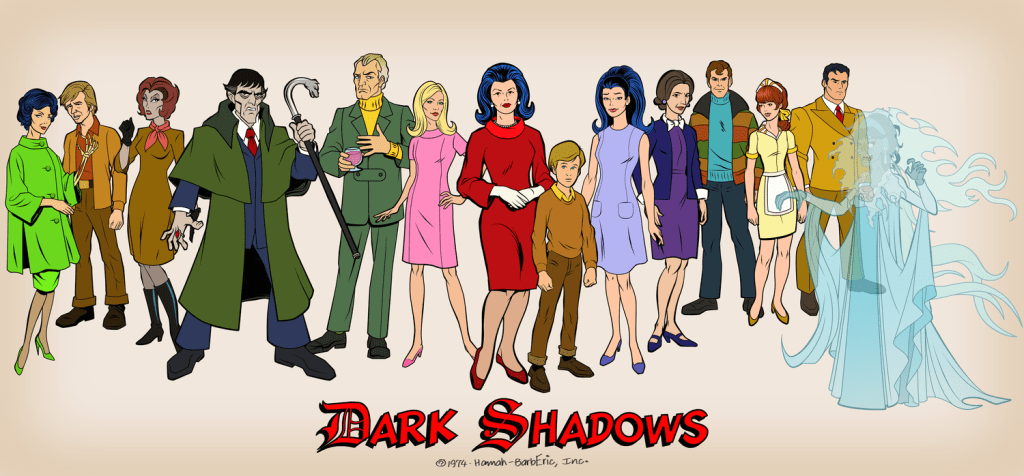
There is one other thing about Harry that makes me smile. On the blog of the Terror at Collinwood podcast, Danielle Gelehrter posted an article some time ago about some concept artwork Eric Marshall did for a hypothetical Dark Shadows animated show in the style of early 1970s TV cartoons such as Scooby Doo or Filmation’s adaptations of Star Trek or My Favorite Martian or Gilligan’s Island. The show Marshall imagines features Harry. Personally, I would have chosen motorcycle enthusiast Buzz, who dated heiress Carolyn for a couple of hilarious weeks in 1967, since his outlandish appearance makes him so much more obvious a choice for animation, but at least Harry’s presence suggests that had such a show been made Clarice Blackburn might have been in the cast and had the chance to do some comedic voice acting.

Eric Marshall’s proposed cast for an animated Dark Shadows that might have been made in the 1970- everyone but Harry. Posted at Terror at Collinwood.
Eric Marshall reminds us that Mrs Johnson’s first name is supposed to be “Sarah.” Posted at Terror at Collinwood.

There is some nice stuff in the drawing room between Barnabas and his sometime victim/ fiancée Vicki. Vicki has figured out that the spirit of wicked witch Angelique is once more at work in the great house of Collinwood and that it will take a great effort to stop Angelique from finishing the destruction of the Collins family that she began in the 1790s. If Vicki ever knew that Barnabas was a vampire, she has forgotten it, and Barnabas cannot confess it to her now. He certainly cannot tell Vicki that it was Angelique who made him one. So he listens to her report, but cannot accept her help in the battle against Angelique.

Quite the contrary. Barnabas looks at the spot on Vicki’s neck where he used to take his meals and feels the old hunger coming on. He says he must go to see Lang. Vicki protests that he should stay and let her tend him while they wait for Lang to come to them, but Barnabas insists.

Barnabas goes to Lang’s house. Lang tells Barnabas that if he participates in his experiment, he will not only be entirely free of the vampire curse, but that he might also have the physical appearance of Peter Bradford, alias Jeff Clark, an unpleasant young man who is more or less Vicki’s new boyfriend. This intrigues Barnabas, but Lang will not explain what he means. Since we know that Lang is a mad scientist who is forcing Peter/ Jeff to steal parts from newly interred bodies, we can assume that he will eventually be constructing a Frankenstein’s monster. Presumably he means that the finished product will look like Peter/ Jeff, and Barnabas will somehow live inside it. Since the creature is being built from parts, to look like Peter/Jeff it would have to be finished with salvage from Peter/ Jeff’s corpse. How Peter/ Jeff will be converted from his present state of living and obnoxious to dead and recyclable is what awaits explanation.

Episode 441: The subject of vicious gossip

When well-meaning governess Vicki came unstuck in time and found herself in the year 1795, regular viewers of Dark Shadows could expect certain plot points to be resolved before she returned to the 1960s. We would learn how Barnabas Collins became a vampire, and how he wound up trapped in a chained coffin in the secret chamber of the Collins family mausoleum. We would learn how Barnabas’ little sister Sarah died. We would see Barnabas’ lost love, gracious lady Josette, marry his uncle Jeremiah Collins. We would see Josette jump to her death from the precipice atop Widows’ Hill. And we would see Vicki escape from some dangerous situation and find herself back in her own time.

Now, the only items on that list left unresolved are Barnabas’ chaining and Vicki’s return. The show has made it clear to people paying close attention how each of those events will happen, and they could fit them both into one episode. Into any given episode, in fact- they’ve given us all the foundation we need for both stories.

But they aren’t going home to a contemporary setting quite yet. The eighteenth century segment has been a ratings hit, Dan Curtis Productions owns the period costumes, and several fun characters are still alive. So they have decided to restart some storylines they had shut down earlier and to build up some new ones.

The main thing that happens today is the first step towards restarting an apparently concluded story. Fluttery heiress Millicent Collins had shared a series of wonderful comedy scenes with untrustworthy naval officer Nathan Forbes, become engaged to him, and discovered that he was already married to someone else. Since that discovery, Millicent has been grimly determined to exact revenge on Nathan, and the rest of the Collins family has regarded him with icy disdain.

Nathan has made a discovery of his own. He has learned that Barnabas did not go to England, as his family has been telling everyone, but that he is still in Collinsport, and is the serial killer preying on the young women of the town. Last week, he made it clear to the audience he had a plan to turn this information into money, apparently by blackmailing the Collinses. Today, we learn that his plans are more complicated, and involve a renewal of his relationship with Millicent. Late at night, he shows up at the lodgings of a visiting witchfinder, the Rev’d Mr Trask. He asks Trask to take a letter to Millicent.

Trask does not want to let Nathan into his room, since the corpse of a prostitute is sprawled across his bed. She is Maude Browning. Barnabas murdered her in Friday’s episode. As part of his campaign to make life difficult for Trask, he deposited her remains at his place.

Nathan won’t take no for an answer, so Trask throws a blanket over Maude and lets him in. Nathan notices Maude’s arm sticking out from under the blanket and is delighted to think that Trask is not the fanatical ascetic he seems to be. Trask breaks down and starts telling Nathan what happened. He tells him that he was astounded to find Maude’s body on his bed, and he asks him to help get rid of it. Nathan agrees to do so on condition he deliver the letter to Millicent.

The scene is just marvelous. Danny Horn devotes most of his post about this episode on Dark Shadows Every Day to a rave review of it, to which I happily refer you.

We then cut to the great house at Collinwood, where Millicent is studying a layout of Tarot. All the Dark Shadows fansites point out that Millicent misidentifies the Queen of Cups as the High Priestess. This is not the fault it is often made out to be. On Dark Shadows Before I Die, Christine Scoleri reminds us that the Countess DuPrés made the same mistake in #368. Since the countess introduced the Tarot to Collinwood and presumably taught Millicent how to read the cards, it would have been a break in continuity had she called it anything else.

Millicent looks at the cards and addresses the absent Nathan, telling him that she is filled with hatred for him and that he faces certain destruction as punishment for his mistreatment of her. Naomi Collins, mistress of the house, enters and asks Cousin Millicent to whom she is speaking. When she answers that she is talking to Nathan, Naomi tells her Nathan is not there. Millicent replies that he does not need to be present to hear her voice. Since Barnabas was able to magically project his own taunting voice across space into Trask’s hearing in Thursday and Friday’s episodes, this claim of Millicent’s has a curious resonance for returning viewers.

Trask shows up with Nathan’s letter. He wants to meet with Millicent alone in the drawing room to give it to her, but Naomi insists on being present. They stay in the foyer. When Naomi forces Trask to tell them that the letter is from Nathan, Naomi takes it and tears it to pieces. Millicent says that she approves of Naomi’s action, but we can see a flicker in her eye and hear a quiver in her voice that suggest the hatred of Nathan she spoke of a few minutes before may not be quite so undiluted as she would like to believe. Trask leaves the house, Naomi leaves the foyer, and Millicent gathers up the shredded pieces of the letter.

Back in his room, Trask goes to sleep. He has a dream. The dream sequence begins with an image reminiscent of pieces moving in a kaleidoscope.

Trask goes into a dream world. Screenshot by Dark Shadows Before I Die.

That kaleidoscopic pattern was part of a visual effect we saw when Dark Shadows was still set in 1967. That effect introduced scenes that took place in #347, #352, and #354, when mad scientist Julia Hoffman hypnotized Vicki and took her to the Old House at Collinwood. At Collinwood, Barnabas’ helper Carolyn spotted Julia and Vicki, putting Julia in great danger.

The echo of those episodes is startling coming on the heels of the scene we just saw, in which Millicent figures as a student of the countess. Julia and the countess are both played by Grayson Hall, and Millicent and Carolyn are both played by Nancy Barrett. The relationships between their characters are different now, shifted as the colored pieces shift in a turning kaleidoscope. But remembering those earlier episodes, we might remember that what is seen in a semiconscious state might be a message sent to manipulate and deceive, and we certainly remember that people who go to the Old House are in danger from Barnabas.

Trask’s dream brings him face to face with the ghost of Maude, accusing him of having her remains dumped in the sea, so that she cannot rest. She predicts that everyone will learn that her dead body was in his bed. He denies both her accusation and her prediction, but does not convince either her or himself.

The ghost of Maude tells Trask the score. Screenshot by Dark Shadows Before I Die.

Another ghost then appears. It is that of Trask’s great supporter, repressed spinster Abigail Collins. Trask tries to tell Abigail that he is innocent of Maude’s charges, but she tells him she has no idea what he is talking about. She wants to tell him that there is a great evil he must destroy. Trask has a vision telling him the evil is lurking in the Old House. He resolves to go there.

All of the acting is excellent in this one. That’s no more than we would expect from most of the cast members we see today, but Vala Clifton’s two turns as the living Maude were pretty bad, so that it is a pleasant surprise that she is so good as Maude’s ghost. The physical space gives her a hard job. She is standing a very few feet in front of Jerry Lacy with only a couple of wispy stage decorations indicating that she is separated from him, but she strikes a pose and maintains a degree of stillness that really does create the sense that she is speaking to him from another realm. She also manages to keep up an ethereal quality while making it clear that Maude is determined to be avenged. I wonder what her first appearances would have been like if she had had more time to rehearse. If they had been as good as this one, Ms Clifton and Maude would be among the more fondly remembered parts of the eighteenth century segment.

Episode 432: Cousin Abigail’s religion

In the deserted Old House on the great estate of Collinwood, repressed spinster Abigail Collins has stumbled upon the coffin in which her nephew Barnabas spends his days. She arrives just as he is rising for the evening. Abigail knows that Barnabas is dead, but she has never heard of vampires, so she has no idea what to make of what she sees.

Barnabas taunts Abigail. When she cries that the Devil is trying to touch her, he cynically asks why she thinks that the Devil always wants to touch her. The broadcast date is 1968, when Freudianism was riding high in the circles frequented by the sort of people who wrote and produced Dark Shadows. The dramatic date is 1796, when that school of thought was undreamed of. Still, there were various strands of folk wisdom about the adverse psychological effects of celibacy, so Barnabas’ smirking comment undoubtedly means exactly what the original audience would have taken it to mean.

From the moment Barnabas saw Abigail at the end of yesterday’s episode, we’ve wondered how he would go about killing her. She is his aunt, after all; the vampire’s bite is so widely recognized a metaphor for the sexual act that we could hardly expect the ABC censors to have allowed him to make a meal of her. In the end, he simply bares his fangs and she dies of fright.

Barnabas scares Abigail to death. Screenshot by Dark Shadows Before I Die.

Abigail has been a villain; even the opening voiceover refers to her as “a woman who has been responsible for much grief.” During their confrontation, Barnabas tells Abigail many truths that, had she known them earlier, would have kept her from causing that grief. If she accepts them now, she will be remorseful. To the extent that we want Abigail to know what she has done, we identify with Barnabas during this scene. That might lead us to think that her death by fright is a way of letting us see Barnabas as the good guy, since he does not kill her by physical contact. But throughout the confrontation he has been telling her that she is about to die. Before he bares his teeth, he makes a dramatic announcement that clearly tells us that he is bringing matters to their climax, and when he sees her die he does not look the least bit unhappy. He seems to have known that the sight of his teeth had the power to kill his aunt, and to have deliberately used that power.

Abigail is the sister of Barnabas’ father, haughty overlord Joshua Collins. Before he even became a vampire, Barnabas killed Joshua’s brother Jeremiah in a duel. By his clumsiness, Barnabas inadvertently caused the death of his own sister, little Sarah Collins. Things are getting rather lonesome for Joshua.

In the great house on the same estate, young Daniel Collins is trying to slip out into the night. Yesterday, he arranged to meet secretly with much put-upon servant Ben so Ben could give him pointers on how to run away from this depressing house. The lady of the house, Joshua’s wife Naomi, intercepts Daniel. She asks if he plays whist, and he complains that he isn’t allowed to play cards because that is “against cousin Abigail’s religion.” Naomi says that so long as it isn’t against his religion, it’s no problem for her.

This isn’t the first indication that Abigail’s religion is different from that of the rest of the family. As rich New England landowners in the eighteenth century, we can assume they are all Congregationalists, but the loose polity of Congregationalism left room for a lot of variation from one congregation to another. She may well have attended a stricter meeting than did the other members of the family, though she seems to have taken her greatest satisfaction in imposing her austere ways on the other members of the household.

Naomi suggests that Daniel and his older sister Millicent might stay at Collinwood with her and Joshua indefinitely. Daniel is clearly not a fan of this idea, and struggles to find a polite way to say that he is desperate to go back home to New York City. He is still struggling when a knock comes at the door. It is the Rev’d Mr Trask, whom Abigail called in from out of town to find witches. Trask is currently prosecuting Victoria Winters, former governess to Daniel and the late Sarah. Abigail asked Trask to meet her because she thought she would find evidence against Vicki in the Old House. Since she found Barnabas instead, she will not be keeping the appointment.

While Naomi goes to look for Abigail, Trask takes the opportunity to work on Daniel. At first Trask seems to be far more agreeable than we have ever seen him before. So when Daniel apologizes for telling him that he looks like the Devil and that he sees no reason they should exchange any words, Trask smiles and calmly says that he appreciates his honesty. Trask holds Abigail up as an exemplar of Christian virtue; Daniel says that he cannot bring himself to want to emulate Abigail, since she “is always so, so unhappy, as if whatever she has eaten doesn’t agree with her.” Trask takes this remark in good turn.

Daniel keeps insisting that Vicki is not a witch, but is very nice. Trask takes everything he says as evidence against Vicki. For example, when he tells Trask that Vicki extolled the virtues of curiosity, Trask exclaims that “Curiosity is the Devil’s money! What you buy with it is disbelief in everything it is right to believe in!” Even in this portion of their encounter, Trask seems far smoother than the screaming fanatic we’ve seen up to now. Daniel complains that Trask keeps talking about the Devil when “I want nothing to do with him.” At that, Trask leans in and says that if Daniel feels that way, he can still be saved. When Daniel asks how he can be saved, we can see how Trask might have managed to win a new follower, if he hadn’t gone straight to a demand that Daniel testify against his friend Vicki.

Trask and Daniel have a man-to-man talk. Screenshot by Dark Shadows Before I Die.

Trask finally loses his temper. Naomi returns and is appalled when she hears Trask telling Daniel that he bears the mark of the Devil. Daniel runs out into the night, and Naomi tells Trask he is to blame for that.

Daniel wanders about in the woods, looking for Ben. He quickly concludes that he must have missed Ben, and he thinks of going back to the house. Remembering that Trask is there, he chooses to stay outside.

Naomi is in the woods looking for Daniel; Trask joins her, much to her displeasure. Daniel sees Abigail’s corpse propped against a tree. He shouts for Naomi. She and Trask come, and he points the corpse out to them.

Daniel shares his gruesome discovery. Screenshot by Dark Shadows Before I Die.

Abigail is the second character Clarice Blackburn has played on Dark Shadows. She joined the cast in #67 as housekeeper Mrs Johnson. In her first months on the show, Mrs Johnson was out to get revenge on the Collins family for their treatment of her former employer and the object of her unrequited love, the late Bill Malloy. Blackburn was told to think of the character as if she were Mrs Danvers, the terrifying housekeeper in Daphne DuMaurier’s Rebecca. After the Death of Bill Malloy storyline ended, Mrs Johnson transformed into a warm-hearted old biddy whose wildly indiscreet chatter gave the other characters just the information they could use to advance the plot.

Mrs Johnson was always fun to watch, and one of the reasons to look forward to the show’s return to a contemporary setting is that she is waiting for us in 1968. But after her first few weeks, her appearances were rare and usually brief. Abigail gave Blackburn her first chance to show viewers of Dark Shadows what she could do when she had the chance to work on a big canvas. In later storylines, she will have more such opportunities, but we will always miss Abigail.

Episode 431: Never learn to leave the past alone

In #70, the deserted Old House on the great estate of Collinwood was introduced as the favorite hangout of strange and troubled boy David Collins (David Henesy.) Several adult characters tried to keep him away from the house, notably crazed handyman Matthew Morgan (Thayer David,) and Willie Loomis, servant to David’s distant cousin, vampire Barnabas Collins. David’s visits to the house precipitated a number of crises, including one that began when he found that Barnabas and Willie kept the cellar door locked and became intensely curious as to why. We knew that they did this to conceal Barnabas’ coffin at the foot of the stairs. That was when the show was set in 1967.

Today, young Daniel Collins (David Henesy) is introduced as a boy whose favorite hangout is the deserted Old House on the great estate of Collinwood. He finds much put-upon servant Ben Stokes locking the cellar door. Ben is the friend and accomplice of Daniel’s second cousin, vampire Barnabas Collins. Daniel is intensely curious as to why Ben is locking the door. We know that it is to conceal Barnabas’ coffin at the foot of the stairs. Now the show is set in 1796.

Ben initially responds to Daniel’s curiosity with the same angry bluster Willie had used in his efforts to keep David away from the house. By the end of their scene together, he has engaged Daniel in conversation, as Matthew often did with David. Daniel confides in Ben that he is planning to run away. Ben points out that Daniel is in no way prepared to strike out on his own, and persuades him to go back to the great house and to make a list of the things he will need. Combining Willie’s responsibility for protecting Barnabas with Matthew’s ability to persuade a boy that he is his friend, Ben seems well-positioned to keep Daniel from coming into conflict with the vampire in the family.

Ben wins Daniel over. Screenshot by Dark Shadows Before I Die.

Back in the great house, repressed spinster Abigail Collins, Barnabas’ aunt, finds Daniel’s list and asks him what it is. He evades that question. As it happens, it is not the one she most urgently wants answered. She sits him down in the drawing room and asks him about a charm bracelet she had found somewhere around the house.

Daniel confirms that the bracelet belonged to Victoria Winters, the governess who used to teach him and Barnabas’ little sister Sarah. Vicki is now standing trial on charges of witchcraft. Sarah is dead, and Abigail is convinced that Vicki’s evil spells caused her death, among many other recent tragedies. The bracelet seems to Abigail to be evidence against Vicki. Abigail points to a charm in the shape of a devil and asks Daniel what Vicki told him about it. He says blandly that Vicki told him and Sarah that it was a devil. She asks him if Vicki instructed him and Sarah to fall to their knees and worship the Devil, and he reacts scornfully, asking who ever heard of worshiping a devil.

Daniel shocks Abigail. Screenshot by Dark Shadows Before I Die.

Abigail presses Daniel for more information about Vicki. He keeps talking about how much he and Sarah liked her, and tries to paint her in a favorable light. He tells Abigail that Vicki used to say that the day would come when people could fly through the air, covering hundreds of miles in a single hour, that there would be machines that would pick up voices traveling through the air and make them audible with the turn of a dial, and that other machines would be able to solve arithmetic problems. We know that Vicki is a time-traveler displaced from the 1960s and that she is describing airplanes, radio, and electronic calculators, and we further know that her time-travel was not the result of a spell she cast, but that Sarah’s ghost yanked her back in time. But Abigail interprets her stories as promises of rewards from the Devil, and most of those whom Vicki has told of her chronological dislocation have taken it to be a confession that she is a witch.

It dawns on Daniel that everything he is saying in his attempt to defend Vicki is making matters worse for her. David Henesy does a marvelous job showing us how miserable this makes Daniel. Abigail tells him he must go with her to Vicki’s trial tomorrow and repeat to the judges what he has told her. He resists the idea. She breaks off their conversation to announce she will go to the Old House. Daniel has told her that he saw Ben locking the cellar door, and she has jumped to the conclusion that he was hiding evidence against Vicki behind it. Daniel pleads with her not to go, but she insists.

We cut to the front door of the Old House, where Abigail encounters Ben. He begs her not to go in. She accuses him of being in league with Vicki and declares that his own trial will begin before long. Ben may have been able to soft-soap Daniel, but Abigail responds with hostility no matter what he says. Finally, he watches her go in. She has said that whatever happens to her inside will be her own responsibility; after she is gone, Ben echoes this statement, a savage note of satisfaction in his voice.

Abigail unlocks the cellar door, goes down the stairs, and sees the coffin. Of course, it is sunset; of course, she is just in time to see the coffin open and Barnabas rise. She watches in terror. Clarice Blackburn does an extraordinary job of acting in the closeup of Abigail’s reaction; she gives the purest possible look of fear, and her scream is perfectly open and smooth.

Abigail screams. Screenshot by Dark Shadows Before I Die.

Barnabas looks at her and asks “Abigail, what are you doing here?” The audience can’t be in much doubt how their reunion will end, though we will have to wait until tomorrow to see just what happens between them.

Dark Shadows was made with very little advance planning, though we do know that they had settled on the name “Daniel Collins” for David Henesy’s character well before the 1795 segment began. In #350, three full weeks before Vicki starts her uncertain and frightening journey to the past, heiress Carolyn slips and calls David “Daniel.” So it is inexplicable that they’ve waited until the segment has been going for more than thirteen weeks before bringing Daniel in. Vicki and David’s relationship was the only thing on the show that consistently worked in 1966, and David’s scenes with Sarah were among the highlights of 1967. So when in #372 haughty overlord Joshua tells Vicki that she will be tutoring both his daughter Sarah and his young cousin Daniel, the audience would have been excited to see the three of them together.

Presumably the makers of the show were unsure how long they would be able to stay in the eighteenth century before the ratings started to suffer and they came under pressure to get back to a contemporary setting. That might explain why they wanted to keep the number of characters to a minimum, so that they would be able to show the four necessary events- Sarah’s death, Barnabas’ transformation into a vampire, Josette’s leap from Widows’ Hill, and the chaining of Barnabas in his coffin- without starting a lot of threads they would have to hasten away and leave dangling. Even so, there were plenty of longueurs in the first weeks when they could have fitted in a few scenes of Daniel and Sarah together, if they had had the time to plan them.

As it happened, the ratings were great for the eighteenth century segment, so they were under no pressure at all to go back to the 1960s. But the breakneck pace of the early weeks and the lack of detailed planning has come back to haunt them. Three of the four big points have all been covered. All that is left is to chain Barnabas in his coffin and to send Vicki home, and they can do both of those things in any one episode. They are going to have their work cut out for them to fill the remaining time with stories that are anything like as interesting as some of those they passed up because they didn’t realize they would have time to tell them. The result will be that, while the last few weeks of the eighteenth century segment feature some great moments and several Genuinely Good Episodes, they also involve a lot of disappointment for the audience.

Episode 427: I object

The opening voiceover melds into a sequence in which we cut back and forth between repressed spinster Abigail Collins and the fanatical Rev’d Mr Trask standing in front of black backgrounds, looking directly into the camera, and declaring that the trial of bewildered time-traveler Vicki for witchcraft must begin at once.

Soap Opera Land famously does not observe the legal codes that prevail elsewhere. If that is going to bother you, you probably aren’t in the right frame of mind to enjoy the show at all. But there is an art to depicting a fictional trial. You can deviate as much as you like from the rules that prevail in the real world, but there have to be some kind of rules the audience can understand. We can either see those rules applied with the result that a disorderly world is reduced to order, or see them flouted so that our heroes’ hopes of justice are cruelly dashed. If we aren’t aware of any rules, there is no point in setting the play in a courtroom.

That’s the first problem with Vicki’s trial. Now and then her lawyer/ gaoler/ boyfriend/ etc Peter will object to some question or move that a statement be stricken, and once or twice the judges will agree with him. But they are just as likely to respond to identical protests by ordering him to stop interrupting. The witnesses respond to questions with extended free association sessions. Vicki herself interrupts testimony repeatedly, usually to make self-incriminating remarks, and no one tries to stop her. Trask is for some reason simultaneously the prosecutor and one of the witnesses. Opposing counsel periodically engage in shouting matches with each other while the judges watch. The whole thing is so chaotic that it may as well be taking place in a bar-room or at the county fair or on the waterfront after dark.

The second problem with the trial is that it requires Peter to raise his voice repeatedly. Actor Roger Davis can deliver dialogue more or less competently when he is speaking in a normal conversational tone, but his loud voice always tends toward an ugly snarl. This is a major limitation for any performer on a show as shouty as Dark Shadows, but the opposition of Peter to Trask puts Davis head to head with Jerry Lacy, who is a virtuoso of shouting. Next to Lacy’s, Davis’ shouting is not recognizable as a performance.

When I’m watching a scene on Dark Shadows that suffers because of an actor’s shortcomings, I sometimes try to make it bearable by imagining what it would have been like had someone else who may have been available for the part been cast instead. Harvey Keitel was an extra on the show in #33; no doubt he would have accepted a speaking part if offered. Roger Davis plays Peter as a deeply angry man, and Mr Keitel is one of the very best at making audiences empathize with such characters. So it’s interesting to try to picture him as Peter.

On the other hand, there’s nothing in the scripts that requires Peter to constantly seethe with barely contained rage. That was Mr Davis’ contribution. Had the show gone with a more amiable Peter, they might have been able to cast Frederic Forrest in the part. In #137, Forrest was a background player. While Forrest played his share of angry men over the years, he also excelled as goofily cheerful characters, most famously as Chef in Apocalypse Now. I would have liked to see Peter played that way. I think he would have had some real chemistry with Alexandra Moltke Isles’ Vicki, and that we would have had protective feelings for him as he went up against the formidable Trask.

There is a third problem with the trial that neither Harvey Keitel nor the late Frederic Forrest could have done any more with than could Mrs Isles. That is that Vicki and Peter are written as phenomenally stupid. Vicki hasn’t done a single intelligent thing since arriving in the late eighteenth century in November,* but she has become, if anything, even dumber since 1795 gave way to 1796. Peter’s behavior has also been deeply foolish, and today he hits rock bottom when he blurts out to the court that he abused his position as gaoler to help Vicki sneak out, to commit a burglary at the great house of Collinwood, and to steal evidence against her so that it could not be presented to the court. Even under Soap Opera Law, that’s three felonies.

Some claim that the phrase “Dumb Vicki” is ableist. I disagree. “Dumb” really does not mean “mute” anymore, so that using it isn’t ableist against people who do not have the power of speech. And the intelligence characters like Peter and this version of Vicki lack is not the intelligence that IQ tests are supposed to measure. One of the most interesting characters in the part of Dark Shadows set in the eighteenth century is fluttery heiress Millicent Collins, who would probably fall far short of a triple digit score on a Stanford-Binet scale, but whose behavior makes sense to us because we tell what she wants out of life and how she thinks her actions will help her get it. That’s really all we mean when we talk about a “smart character.” A well-crafted story about someone with profound developmental disabilities can depict that person as a smart character, in that sense, as easily as can one about a great sage or a brilliant scientist. Vicki and Peter are not smart characters, no matter how what kind of school we might suppose would best suit them as students, because there is nothing for us to learn by observing their behavior and no suspense as to what their several actions will add up to. They just do one damn thing after another.

Clarice Blackburn and Jerry Lacy do some fine acting today, as does Grayson Hall in a brief turn as the Countess DuPrés. The pre-title bit with Blackburn and Lacy in front of the black backgrounds is so specific to theater in the 1960s that I can’t help but smile at it, but I’m glad it’s there. It isn’t as though you could ever really forget that the show is 56 years old, and I like to see that they preserved something that would have been so typical of the off-Broadway productions that would have been such a big part of the working lives of the cast and other creatives in those days.

*In her testimony today, Abigail gives the dramatic date of Vicki’s arrival in the past as 12 October 1795. The episodes in which the events she describes happened were broadcast on 17 November and 20 November 1967. In the last few weeks, the show has explicitly told us that the day and month of the dramatic setting in 1796 is the same as the broadcast date in 1968, so it’s confusing.