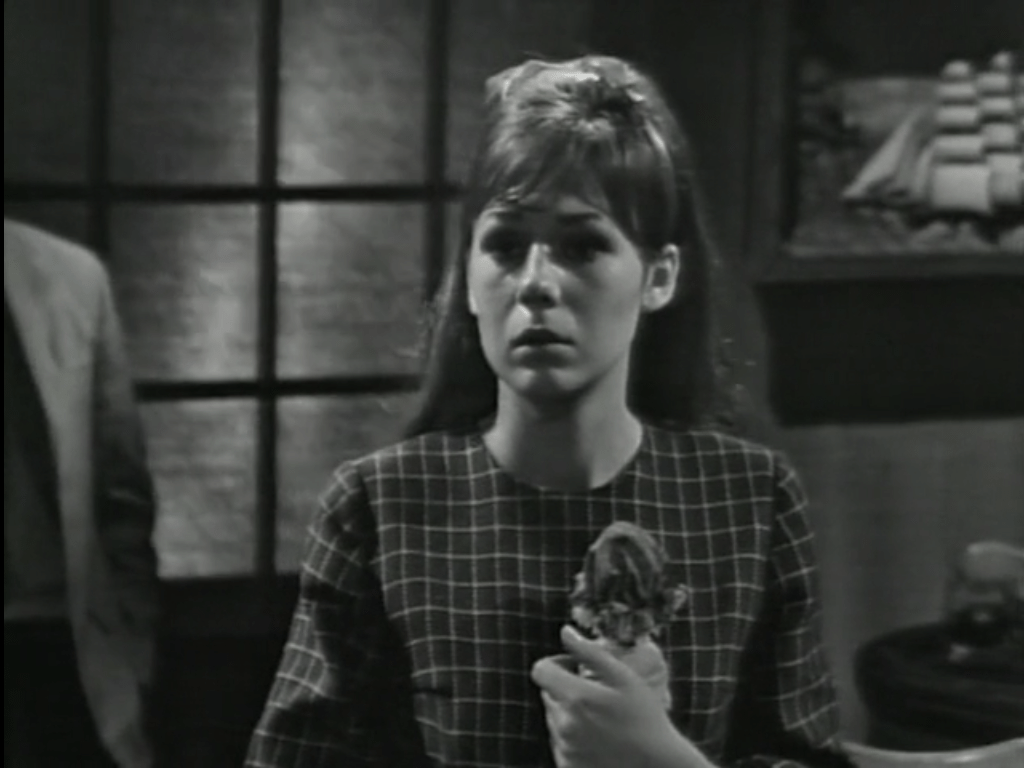
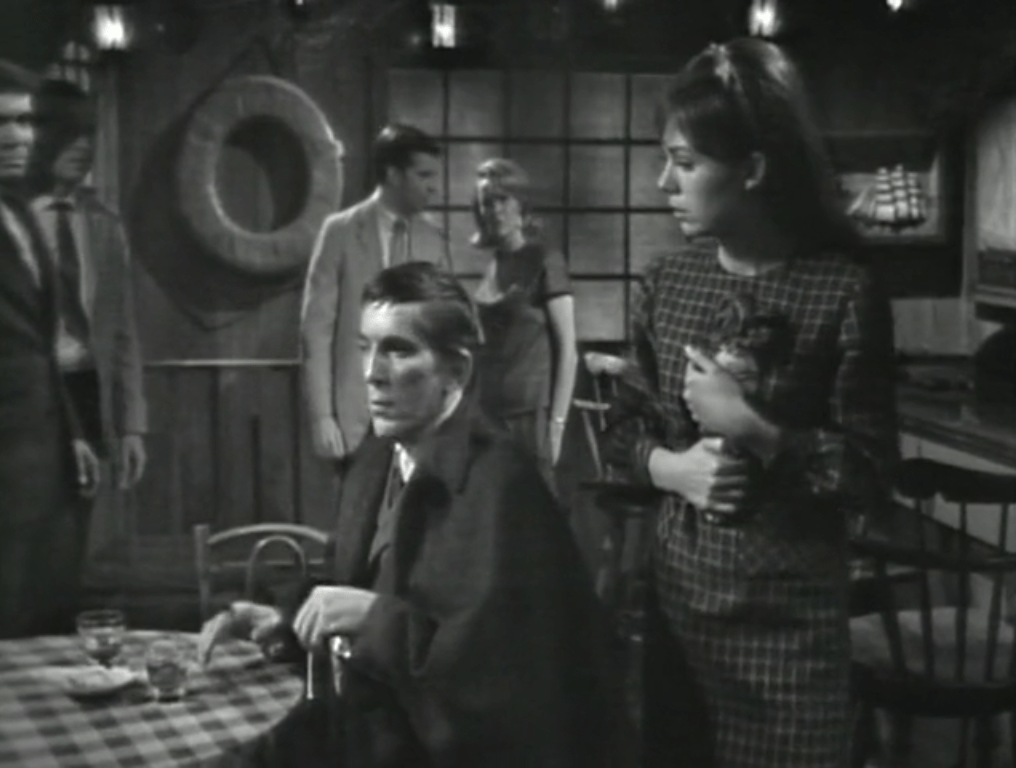
Episode 827: Magnificent, ain’t I?

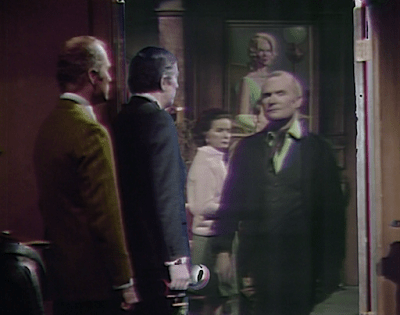
Rroma chieftain/ New England crime boss King Johnny Romana and his Afro-Romani henchman Istvan have cornered broad ethnic stereotype Magda Rákóczi on top of the cliff at Widows’ Hill. King Johnny declares that he will now kill Magda. She is a major character, it’s a Tuesday, and this is the resolution of yesterday’s cliffhanger, so we have three reasons for expecting her to survive.

However, none of the three reasons is as strong as it might at first appear. First, while Magda precipitated every major storyline in the segment of Dark Shadows set in the year 1897, none of those stories needs any further action from her to continue right now. We’ve also had an indication that Grayson Hall’s original character, Julia Hoffman, will soon be returning to the cast. Second, Dark Shadows never followed the traditional soap opera format in which important developments were reserved for week-ending finales. Third, while the great majority of episode-ending cliffhangers fizzled out in the opening seconds of the next installment, occasionally they did go ahead and resolve one with a death. Besides, as my wife Mrs Acilius points out, Magda laid her husband Sandor’s ghost to rest at the top of the episode, and it is called Widows’ Hill because widows go there to die. So there actually is some suspense as to whether King Johnny will make good on his threat.

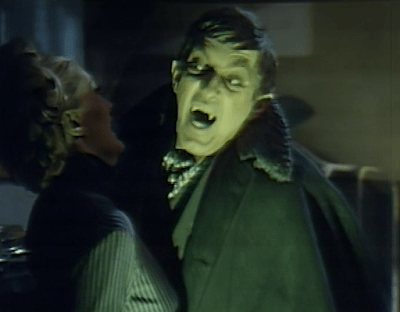
Time-traveling vampire Barnabas Collins shows up at the last moment and orders King Johnny to release Magda. King Johnny refuses and orders Istvan to throw Barnabas off the cliff. Barnabas looks into Istvan’s eyes, using his power of hypnosis. Once Istvan is under his control, Barnabas compels him to walk off the cliff. King Johnny then realizes who Barnabas is. He holds Barnabas at bay with a cross. Barnabas tells him that he can reclaim what Magda stole from him, but only if he lets her go. At that, King Johnny becomes cooperative. Too bad Barnabas didn’t open with that- Istvan could have lived. Fortunately for Barnabas and Magda, King Johnny forgets about Istvan instantly.

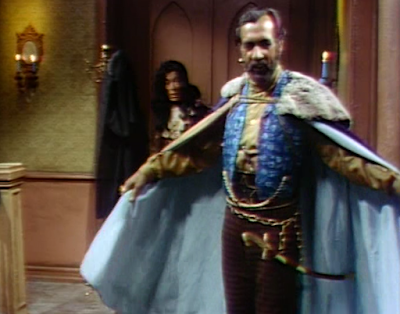
King Johnny shows off his hand-chopping clothes. Screenshot by Dark Shadows Before I Die.

For a hundred years, King Johnny’s tribe kept as its most prized possession The Hand of Count Petofi. This was literally a severed hand, cut from a Hungarian nobleman. Count Petofi was a sorcerer, and when nine Rroma men severed his right hand in a forest one night in 1797, most of his power went with it. Magda stole the Hand in hopes that she could use that power to undo a spell she herself had cast, but found that the Hand would not obey her. Now Count Petofi himself, 150 years of age, has reclaimed the Hand, and it is once more attached to his wrist. He is hugely powerful and a great problem for Barnabas.

Barnabas tells King Johnny what has happened. King Johnny turns out to be the one person in the world over whom Petofi has no power. In return for Petofi’s location, King Johnny agrees to return with the Hand and lift the curse Magda regrets. In his purple robe, King Johnny goes to Petofi’s hiding place. He and Petofi have a long and rather pointless conversation. Finally, Petofi is strapped to his chair and King Johnny raises his sacred scimitar, ready to re-sever the Hand.

This is a less suspenseful cliffhanger than yesterday’s. Petofi is still generating story; in fact, he is the only character who is. The hideout is Petofi’s territory; we have seen him thwarted there, but the defeats he suffered only confirmed that it is not a place where major changes take place in the direction of the narrative. And the meandering dialogue between Petofi and King Johnny deflates all the dramatic tension. Returning viewers have plenty of time to remember that, while Petofi’s magic may be useless against King Johnny, Petofi’s henchman Aristide is somewhere around, and he is quick with a knife. Without Istvan to run interference for him, King Johnny will be vulnerable to Aristide the whole time he’s dawdling around.

As King Johnny, Paul Michael has a very hard job. Not only is the character an egregious stereotype, but he really is scandalously ill-written. Violet Welles was far and away the best writer of dialogue on the show, and she manages to give a few glittering lines even to King Johnny. Still, he is ridiculous from beginning to end, a lot of menacing poses held together with a sinister laugh. That he is watchable at all is a tribute to Michael’s mastery of his craft. In his facial expressions and body language, we can see evidence of thought that is entirely absent from his words.

Episode 812: The back road to salvation

Denise Nickerson joined the cast of Dark Shadows in #632 as nine year old Amy Jennings, sister of the doomed Chris (Don Briscoe.) As Amy, Nickerson was central to the show for the next fourteen weeks. In #701 we traveled back in time and Dark Shadows became a costume drama set in 1897. In that year, Nickerson is Nora Collins. Nora was in 10 episodes in the first twelve weeks of 1897, and apart from a two episode stint in #782 and #783 has been unseen and very nearly unmentioned in the ten weeks since. The 1897 segment is packed with so many lively characters that even the best of them disappear for long periods, but the extended neglect of Nora is particularly disappointing. Nickerson was an outstanding young actress, brought out interesting qualities in her scene-mates, and had drawn a significant fan base among the show’s preteen viewers.

Nickerson is back today. In Act One, she walks in on her father Edward trying to strangle her Uncle Quentin. Nora’s scream distracts Edward and saves Quentin. When Nora asks Quentin what got into her father, he tells her that it’s something like a magic spell and will end soon. He refuses to explain further. It is unclear why Nora accepts this refusal. For our part, the audience accepts it because Edward’s attack on Quentin has nothing to do with today’s episode. It’s just left over from yesterday’s cliffhanger.

Don Briscoe is also back, after an absence of twelve episodes. In 1897, he plays Tim Shaw, persecuted schoolteacher turned adventurer. As Chris, Briscoe would do a little W. C. Fields imitation from time to time, occasionally ending a sentence with Fields’ signature inflections. This would raise a smile from other characters in 1969, when such a habit was relatively fashionable. Considering that Fields’ persona was that of a man who belonged in the Gay Nineties, we should have suspected when we first saw the date 1897 that Briscoe would have an opportunity to develop his Fields imitation in greater depth. Indeed, we see him today wearing a hat and coat that might have come from Fields’ closet, accompanied by exactly the sort of woman whom Fields’ characters reliably failed to impress.

I regret to inform you that Tim does not, at any point, address Amanda as “My little chickadee.”

Tim has been in New York, where he made a great deal of money in a very short time by means of something which he keeps in a small box. Returning viewers know that this thing is The Hand of Count Petofi, and that it is the object of a desperate search by many dangerous people, including Quentin. We also know that the Hand is not subject to anyone’s control. If it has made Tim rich, that is because it wanted to do so for purposes of its own, not because Tim had any skill in manipulating it. Tim has used his riches to purchase the companionship of Amanda Harris, a cynical young woman who is impatient with him and appalled at the smallness of the village of Collinsport.

Tim and Amanda are staying at the Collinsport Inn. The Inn was a very important part of the show for its first 40 weeks, when one of the principal storylines was The Revenge of Burke Devlin. Like Tim, Burke was a working class boy from Collinsport who was framed for a homicide of which he was only technically guilty, and who then went to New York City, made a huge amount of money in a very short time, and came back to his home town to even the score with those who set him up to take the blame for a crime for which they were even more responsible than he was. Burke lived at the Inn, and it represented his territory, in opposition to the great house of Collinwood where his adversaries lived. The Revenge of Burke Devlin storyline never really took off, and by #201 Burke himself lost interest in it. Since then, we have gone months at a time without seeing the Inn. We saw a guest room there in #698, but I can’t remember the last time we saw the lobby before today.

Tim orders Amanda to hide the box in her room, then sends her off to Collinwood to make a connection with the cruel and lecherous Rev’d Gregory Trask. Amanda tells Trask that she has been under the power of an evil man and that she wants to change her ways. Trask tells her that he will give her spiritual guidance. He has his back to her when he says that his plan requires that he provide her with “private instruction”; he isn’t looking at her when she rolls her eyes at this. Back in the Inn, Amanda tells Tim that he was right, Trask is despicable.

While Amanda and Tim are taking a stroll by the waterfront, Quentin ransacks Tim’s room looking for the Hand. Quentin hears them on their way back, and leaps out Tim’s window. They’ve gone out of their way to make it clear that Tim’s room is upstairs- we heard Tim on his telephone telling the front desk to send Amanda “up” to him, and we saw him and Amanda getting on the staircase to go to the room. So they are inviting us to wonder how Quentin climbs down the side of the building.

When Tim sees the shambles in his room, he sends Amanda to her room to make sure the box is still there. It is, but he decides that the Inn is not a safe enough place for the Hand. He takes the box to Nora in her bedroom at Collinwood. Regular viewers know that Tim was Nora’s teacher, and Nora considers him her friend. It may seem odd that the person Tim turns to when he needs help with such a sensitive matter is nine years old, but longtime viewers will again remember Burke. He had a way with children; he immediately won the devotion of strange and troubled boy David Collins, and Maggie Evans, The Nicest Girl in Town, remembered him very fondly from her own childhood. Burke and David trusted each other in delicate situations more than once, and we can see the same thing happening between Tim and Nora.

Nora promises to hide the box somewhere in the house and not to tell anyone about it. Tim leaves, and Nora puts the box in her armoire. Nora is a fairly responsible person, but she is nine, and the box is wrapped like a present. As we fade to the credits, she is opening the box.

This leaves us wondering not only how Nora will react to the sight of the Hand, which is a gruesome thing, but also what effect it will have on Nora’s own appearance. In #784, lawyer/ Satanist Evan Hanley looked at the Hand, and it responded to his gaze by disfiguring his face. A few days later, it disfigured Quentin as well. Evan and Quentin have both regained their good looks, frustratingly without explanation. But it would be intensely unpleasant to see little Nora’s face mangled, even temporarily, so this is quite an effective cliffhanger for viewers who have been watching for several weeks.

This episode not only features the welcome returns of Nickerson, Briscoe, and the Inn’s lobby after their absences; it brings an equally welcome newcomer. Amanda Harris is played by Donna McKechnie, six years before she originated the role of Cassie in A Chorus Line and thereby became a permanent star of Broadway. Reviewing TV episodes on the 56th anniversaries of their original airing, recent news about the cast is often sad. For example, Lara Parker died very shortly before the 56th anniversary of the first broadcast of an episode in which she appeared as wicked witch Angelique. I call the cast members by their surnames, and put courtesy titles in front of the surnames of living people. I could have cried when I had to call her simply “Parker.” But Miss McKechnie is alive and well. Just yesterday, I saw a YouTube video (one of two posted on 23 July) of a panel featuring Miss McKechnie at a Dark Shadows convention on 19 July with Kathryn Leigh Scott, Marie Wallace, Sharon Smyth Lentz, and Matt Hall.

Episode 768: Some kind of exhibit

For most of its run, Dark Shadows was made with severely limited access to videotape editing equipment. If something went wrong, the only way to fix it was to start over. So even spectacular mistakes stayed in, especially if they took place near the end of the episode. Today there is a blooper in the opening voiceover- yesterday’s episode centered on a prophetic dream that twelve year old Jamison Collins had about his future descendant David, but the narrator names the dreamer as “David.”

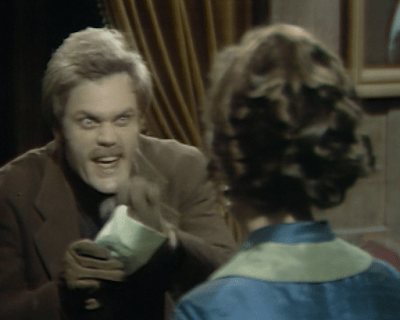
It doesn’t get much better from there. The episode is a showcase for the acting of Roger Davis as crazed groundskeeper Dirk. Unfortunately Mr Davis is the sort of actor who needs close guidance from a director, and the directors on Dark Shadows famously gave their male performers a great deal of latitude. So he hams up his every scene, often interrupting himself with sounds that are variously transcribed as “huh?” or “hyunh!” or “hyuk hyuk!” He ruins every shot he is in.

Roger Davis at his most understated. Screenshot by Dark Shadows Before I Die.

The only Davis-free scenes are interactions between maidservant Beth and the show’s two breakout stars, her boyfriend Quentin and her vampire master Barnabas. The writing staff has figured out a way to work around Terrayne Crawford’s limitations as an actress; Beth is always very earnest and straightforward. That is a great relief after the first weeks of the part of Dark Shadows set in 1897, when they gave Beth the same rich and complex motivations they lavished on everyone else and she fell disastrously flat every time. Still, Beth’s emotional transparency does not give David Selby or Jonathan Frid much for Quentin or Barnabas to play off of, so that they seem to be explaining the plot to her.

Quentin at one point slaps Beth in the face today. It used to be extremely rare for male character to slap female ones on the show, but these incidents are have started to come thick and fast since writer violet Welles joined the staff. Miss Welles was far and away the best writer of dialogue on Dark Shadows, and I suppose she must have had a reason for showing us all these women getting hit by men, but I for one am eager for it to stop.

Barnabas bit Dirk a while ago, but before he did that Dirk was already enslaved by undead blonde fire witch Laura. So rather than becoming a blood thrall, Dirk reacted to Barnabas’ bite by going nuts. At the end of today’s installment, Dirk is trying to kill Barnabas. Dirk has yet to find a task so simple he can succeed in it, so we leave without much suspense that he will manage to kill off the main protagonist. I suppose it will do for a Wednesday cliffhanger.

Episode 764: A primitive tribe

Odds and ends today:

The Kindest, Warmest, Bravest, Most Wonderful Human Being I’ve Ever Known in My Life

The show is doing an homage to The Manchurian Candidate this week, with schoolteacher Tim Shaw brainwashed into becoming an assassin when he sees the Queen of Spades. We open with the plan going awry. Lawyer/ warlock Evan Hanley did the brainwashing with the intention that Tim would kill someone else, but when he shows Tim the card, Tim tries to kill him. As Evan, Humbert Allen Astredo shows us a man suddenly becoming frightened and just as suddenly making up his mind to be brave. In other episodes, Astredo has already shown us Evan responding to fear in other ways. He really was a remarkably good actor, and it is a pleasure to see how much variety he can find in his parts.

Later, we see Judith Collins, the mistress of Collinwood, playing solitaire. Tim comes to the house. We know that each episode ends with a cliffhanger, and so this leads us to expect that we will end today with Tim’s hands around Judith’s throat. But that is a misdirection. In fact, Judith turns the Queen of Spades away from Tim at the last second, and he leaves the room without attacking her.

Slight Enough to Vanish, But Too Dense to Live

Tim’s brainwashing is a B-story on the show right now, and it would throw off the rhythm of the week to end two consecutive episodes with cliffhangers from it. The A-story is about the rakish Quentin Collins, who has been cursed to become a werewolf. There is a full moon tonight, and the sheriff’s department is roaming the grounds of the great estate of Collinwood with guns looking for the wolf who walks like a man. Joining in the search is Quentin’s distant cousin, Barnabas Collins, who is, unknown to all but a very few people, a vampire. Barnabas has traveled back in time to the year 1897, and among the things he is hoping to do is to learn how the werewolf curse that has afflicted his friend Chris Jennings in the 1960s first began.

Barnabas learned in 1969 that in 1897 Quentin and a woman named Beth Chavez paid a man named Ezra Braithwaite to make a silver pendant in the form of a pentagram and that a baby boy was buried in that year wearing that pendant. Tonight, Ezra telephones Barnabas at the great house of Collinwood and tells him that Beth just came in, ordered such a pendant, and told him to send the bill to Quentin.

Barnabas knows that the pentagram was an amulet meant to ward off werewolves. Beth is Quentin’s girlfriend, a fact that is no secret to anyone, not even Barnabas. So you might assume Barnabas would have figured out that Quentin is the werewolf. But apparently he has not. He materializes inside Beth’s room and demands she tells him who the werewolf is. When she refuses, he bites her. That bite is the cliffhanger.

Dear cousin Barnabas. Screenshot by Dark Shadows Before I Die.

Barnabas occasionally makes remarks about how he wants to keep the original timeline intact so that the people he knew in the 1960s will still be there when he gets back. But he’s been feasting on the people he meets in 1897 with abandon. Beth is the fourth resident of Collinwood he has bitten, and he has killed at least two young women in the village. Moreover, his approach to every problem he encounters or imagines is to confront the most powerful person associated with it and antagonize them immediately. It’s hard to see how he expects anything to remain unchanged after he inserts this rampage into the history of the late Victorian age.

But You Wouldn’t Know Anything About That

Judith tells Barnabas today that Beth came to Collinwood as a lady’s maid two years ago. Beth claims to have a cousin in town to Judith today while lying to cover up her trip to Braithwaite’s, and when Barnabas asks Judith if Beth is from Collinsport she mentions this cousin as her reason for believing that she is. Judith clearly knows very little about Beth, and cares less.

The lady who brought Beth as her maid was Quentin’s then-wife, Jenny, who was secretly a member of the Romani people. In #701 it was hinted that Beth was concealing a Romani origin of her own. Casting the tall, blonde, blue-eyed, pale Terrayne Crawford as Beth would seem to indicate that they were not committed to following up this hint, but in today’s scenes with Judith they do go out of their way to emphasize that Beth’s background is a mystery.

The Woman Who Never Left

Beth has been helping the family hide the fact that Jenny went mad and bore twins after Quentin left her. Quentin murdered Jenny in #748, eliminating the need for a servant to cover up her existence, and the twins, about whom Quentin does not know, are firmly ensconced in the care of a woman in the village named Mrs Fillmore. In #750, Judith fired Beth, but it didn’t take. Beth never left the house, and after a while the family started giving her orders again. Today Beth tells Judith that Mrs Fillmore reports that the boy twin is feverish, and asks to be kept on staff until he gets well. Judith agrees.

Judith tells Beth that she has decided to tell Quentin about the twins. She hopes that is what will prompt her brother to cast aside his selfish ways and become a mature adult. Beth is horrified and begs her not to do so. Judith, puzzled, says that Beth has always urged her to tell Quentin. She asks why she has changed her mind, and she makes up something obviously false about Quentin being unable to cope with the news that his son has a fever.

Yesterday, Beth learned that Quentin’s curse is hereditary. Returning viewers might wonder if she is afraid that Quentin will also learn that, and that if he does he might kill his children to prevent them passing it on. He does keep saying that he would rather be dead than have the curse, so he might talk himself into regarding such a murder as an act of mercy.

Featuring Edward Marshall as Ezra Braithwaite

Edward Marshall plays Ezra, a part played in #684 and #685 as an 87 year old man living in the year 1969 by Abe Vigoda (who was 48 at the time, but he and the makeup department both knew their business well enough that he was entirely convincing.) Mr Marshall appeared in #669 as unsightly ex-convict Harry Johnson, a part originally created by the not-always-stellar Craig Slocum. Mr Marshall gave Harry the same attitude and many of the same mannerisms Slocum had given him, but was so much more fun to watch that I wanted to see a lot more of him.

Parts of Harry’s costume and most of his surly demeanor are recycled in the 1897 segment in the character of dimwitted groundskeeper Dirk Wilkins, played by the repulsive Roger Davis. Whenever Dirk is on screen, I imagine Mr Marshall in Mr Davis’ place. I recommend that bit of mental recasting, it goes a long way towards making Dirk bearable. Unfortunately this is Mr Marshall’s final appearance on Dark Shadows.

Episode 330: bat by Bil Baird

Dangerously unstable ruffian Willie Loomis spent a week staring at the eighteenth century portrait of Barnabas Collins in the foyer of the great house of Collinwood back in April, then tried to rob Barnabas’ grave. That turned out to be an awkward situation when Willie found that Barnabas wasn’t entirely dead. Barnabas was a vampire who bit Willie, turned him into his sorely bedraggled blood thrall, and had lots of conversations with him. Yesterday, Willie was written out of the show.

Today we open with strange and troubled boy David Collins staring at the same portrait. As Willie was obsessed with the idea that there were jewels hidden in the Collins mausoleum in the old cemetery north of town, where in fact Barnabas’ coffin was hidden, so David is preoccupied with the idea that Barnabas has something terrible stashed in the basement of the Old House on the estate, where in fact his new coffin is hidden. As Willie sneaked off to the cemetery on his ill-starred expedition, David will sneak off to the Old House today and try to search Barnabas’ basement.

Unlike Willie, David is not driven by greed. He is afraid of Barnabas, and his friend, the ten year old ghost of Barnabas’ sister Sarah, has told him that he must not go to the Old House. But his aunt Liz and his father Roger dismiss his attempts to warn them about Barnabas, and he thinks it is his duty to provide them with evidence. So he screws up his courage and makes his way across the property.

David lets himself into the Old House by opening the parlor window. Not only have we seen David do this before, but Willie’s sometime friend, seagoing con man Jason McGuire, got into the house the same way in #274. Barnabas would kill Jason when he reached the basement in #275, so you might think he’d have put a lock on that window by now.

Jason’s fate is certainly on the minds of returning viewers when David tries to open the basement door. It comes as a relief when he finds the door locked. Barnabas’ co-conspirator, mad scientist Julia Hoffman, catches him there.

Julia demands to know what David is doing in the house, and he tries to brazen it out. He claims that he has a right to be there, since it belongs to his Aunt Liz. This is a bit of a murky point- we never see Liz transfer title to Barnabas, but she and others act as if he owns the place and its contents. Julia doesn’t clarify it when she responds that Liz gave the house to Barnabas- she doesn’t deny that it still belongs to Liz, only says that it also belongs to Barnabas.

Back in the great house, Roger is banging away at the piano. We saw Liz play the piano in #47 and #91, a reference to the conception of her character writer Art Wallace developed in his original story bible, titled Shadows on the Wall, in which she, like similar characters in a couple of TV plays he wrote in the 1950s under the title “The House,” gave piano lessons. Since then, Liz’ daughter Carolyn tried her hand at “Chopsticks” in #119 and used the piano as a prop in a teen rebel scene in #258, and Jason poked at a few keys in #198. Roger isn’t exactly Vladimir Horowitz, but he’s the first one we’ve seen who actually achieves a melody.

Liz comes in and tells Roger that David isn’t in his room. They fret over David’s attitude towards Barnabas. Julia brings David home and tells Liz and Roger where she found him. After an angry scene between father and son, David goes upstairs, and Liz scolds Roger for his inept parenting. In these as in all of Liz and Roger’s scenes together, we see a bossy big sister who tries to govern her bratty little brother, but who ultimately abets all of his worst behavior.

In the Old House, Barnabas notices that Julia is troubled. He keeps asking what’s on her mind, and she has difficulty deflecting his questions. This is odd- Julia has been established as a master of deception, and Barnabas is the most selfish creature in the universe. All she has to do is start talking about something that does not affect him directly, and he will lose interest at once. Rather than talk about her personal finances, or the job from which she is apparently on an indefinite leave of absence, or some ache or pain she might have, or how sad she is to miss her Aunt Zelda’s birthday, she brings up Willie. That does get Barnabas’ mind off her tension, but it also reminds him of David. He thinks David knows too much about him, and is thinking of murdering him. Julia assures him that the boy doesn’t know so very much, that whatever he does know he hasn’t told anyone, and that if he does say something his reputation as an overly imaginative child will lead the adults to ignore him.

From the beginning of the series, we’ve heard people say that David is “imaginative.” The audience finds an irony in this, since we have never seen David show any imagination whatsoever. All his stories of ghosts are strictly literal accounts of apparitions he has seen. We’ve seen some drawings he has done and heard quotes from some essays he has written. Some of these are technically accomplished for a person his age, but they are just as literal as his ghost stories. And when he tells lies to cover his various misdeeds, he tells simple little tales that fall apart at once.

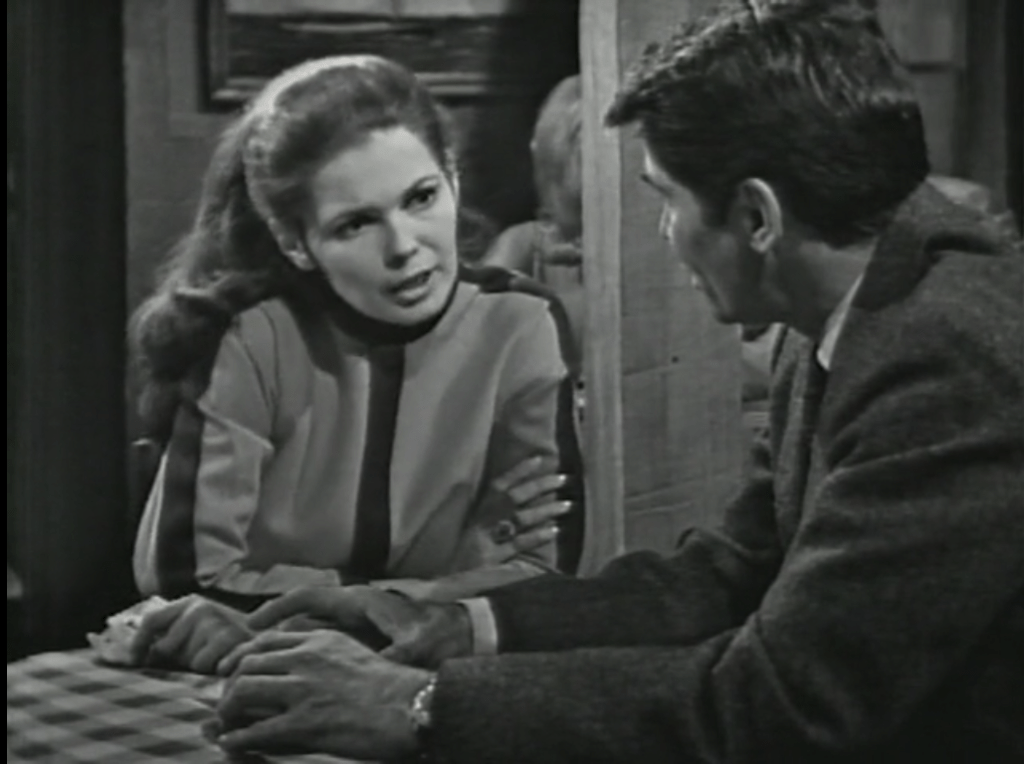
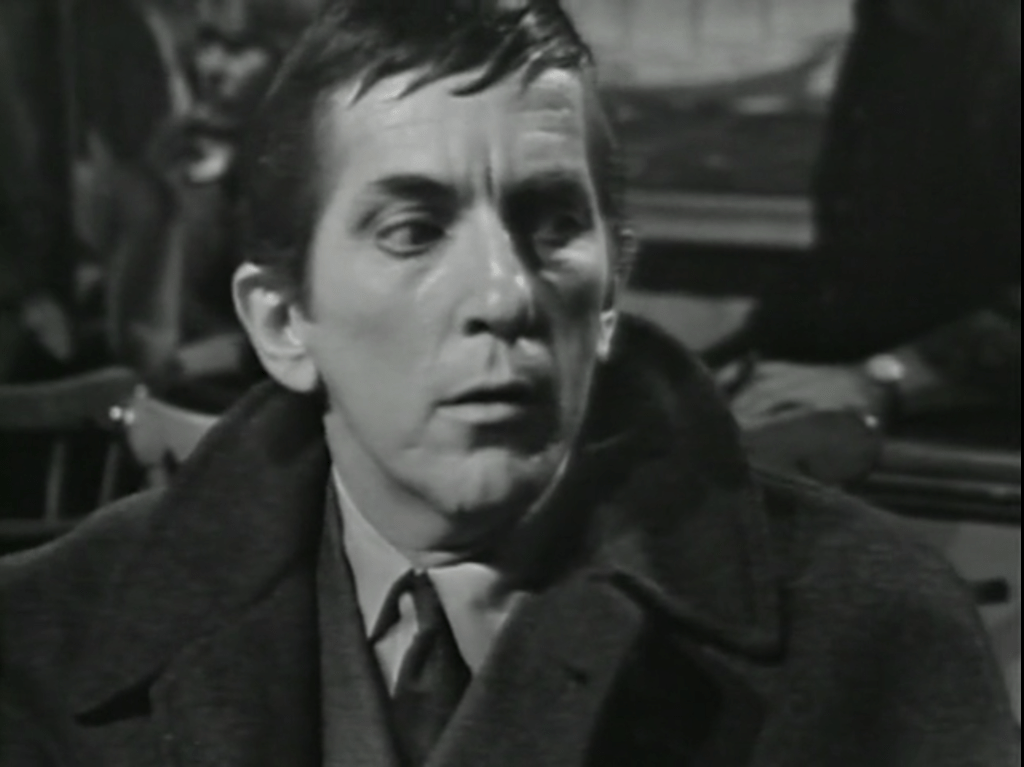
In #327, well-meaning governess Vicki became the first character to dissent from the “David is a highly imaginative child” orthodoxy. Liz and local man Burke Devlin were dismissing David’s laboriously accurate account of his latest encounter with Sarah as a sign of his “imagination,” and Vicki interrupted with “I don’t think it has anything to do with his imagination.” Now, Barnabas goes a step further. After pronouncing the word “imaginative” in a truly marvelous way that makes it sound like something I’ve never heard before, he tells Julia that she has given him an idea. Frightened, she asks what he means. All he will say is “You’ll see.”

Roger goes to David’s room and has a friendly talk with his son. Throughout the conversation and afterward, David is thinking intensely, trying hard to figure out what his next step should be.

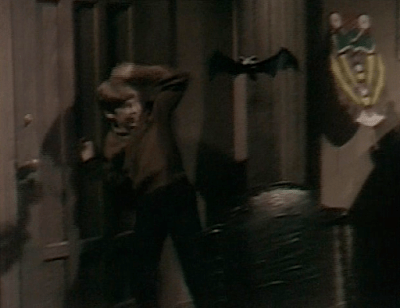
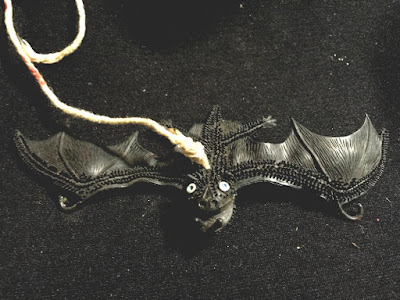
Once he is alone in the room, the window blows open and a bat enters. More precisely, a bat-shaped marionette is brought in on clearly visible strings by a pole that casts a shadow we can see the entire time, but no one who has been watching the show up to this point will doubt for a second that David’s fear, as depicted by David Henesy, is fully justified. David tries to flee from the bat, but he cannot open the door to escape from his room. His back against the door, David slides onto the floor and screams as the bat comes near him.

David finds that he cannot escape. Screenshot by Dark Shadows Before I Die.
David helpless before the bat. Screenshot by Dark Shadows Before I Die.

When Barnabas is about to attack someone, dogs start howling. Sometimes this works to his advantage, but it so often puts his intended victims on their guard that it doesn’t really seem to be something he is doing on purpose. So this bat represents something new. Perhaps Barnabas is using magic to control a bat- if so, it marks the first time we have seen Barnabas use magic to project influence over something other than a human mind. Or perhaps he himself has assumed the form of a bat. If so, that is the first indication we’ve had that he has shape shifting powers. In either case, Barnabas’ powers have just gone up a level.

Closing Miscellany

The bat was created by famed puppeteer Bil Baird. Most famous today for the puppets he created for “The Lonely Goatherd” sequence in The Sound of Music, Baird was a frequent guest on television programs like The Ed Sullivan Show, and Jim Henson cited Baird’s own TV series, the short lived Life with Snarky Parker, as a major influence on the Muppets. In December 1966, Baird opened a marionette theater in New York City, at 59 Barrow Street in Greenwich Village; it operated until 1978, and many leading puppeteers, including dozens who would go on to work with Henson, were members of its company in those years.

Bil Baird’s bat-credit. Screenshot by Dark Shadows Before I Die.
The original string wasn’t quite so conspicuous. Screenshot by Dark Shadows Before I Die.

This is the last episode to end with ABC staff announcer Bob Lloyd saying “Dark Shadows is a Dan Curtis production.” We do hear the announcement again in February of 1969, but that won’t be because Lloyd has returned- they used an old recording for the music under the closing credits that day, and they picked one with him on it.

Fans of Dark Shadows will often talk about “the early episodes” which ended with Lloyd making that announcement. So I suppose #330 is the last of “the early episodes.”

Danny Horn’s post about this one on Dark Shadows Every Day includes a morphology of episode endings. He divides them into five categories, Haiku,* Restatement of Threat, ** New Information,*** Crisis Point,**** and Spectacle.***** It’s an intriguing scheme, and he makes a good case for it.

*Danny explains that “Haiku” “aren’t necessarily recognizable as endings in the traditional sense, because nothing is resolved and no progress is made. It’s just a little moment when a character pauses, and possibly has a feeling about something… In some extreme cases, the audience may not realize that the episode is over until halfway through The Dating Game.”

**Restatement of Threat, at this period of Dark Shadows, usually means Barnabas looking at us through his window and saying that someone or other “must die!” Which of course means that you can safely sell a million dollar life insurance policy to that character.

***”A New Information ending provides an actual plot point, which either advances the story another step, or tells us something that we didn’t know.”

****”The Crisis Point cliffhanger is the big game-changer, and for best effect, it should come at the end of a sequence that’s been building up for a while. This is a big turn in the story, and it should feel satisfying and thrilling… The defining feature of a Crisis Point ending is that the resolution marks a change in the status quo, ending one chapter and setting up the next.”

***** “Obviously, plot advancement is always welcome, but every once in a while the show needs to set its sights a little higher. These are the moments when the show goes above and beyond, in order to surprise and dazzle you… The point of a Spectacle is: You can’t take your eyes off the screen. Housewives in the audience have put down the iron, and switched off the vacuum. Teenagers have stopped swatting at their siblings… A Crisis Point cliffhanger will bring you back for the next episode, because you want to see what happens next. But a Spectacle cliffhanger is bigger than that — you’ll be coming back for the next episode, but it’s because you can’t believe what you’re seeing, and maybe tomorrow they’ll do it again.”

Episode 294: The same way I got out

Maggie Evans, The Nicest Girl in Town, is a patient in a mental hospital run by a mad scientist who is in league with the vampire who kept her prisoner. So there are bars on the windows of her room, and a lock on the outside of the door. The vampire, Barnabas Collins, scrambled her memories before she escaped from him, and the mad scientist, Julia Hoffman, intends to keep her in her amnesiac state.

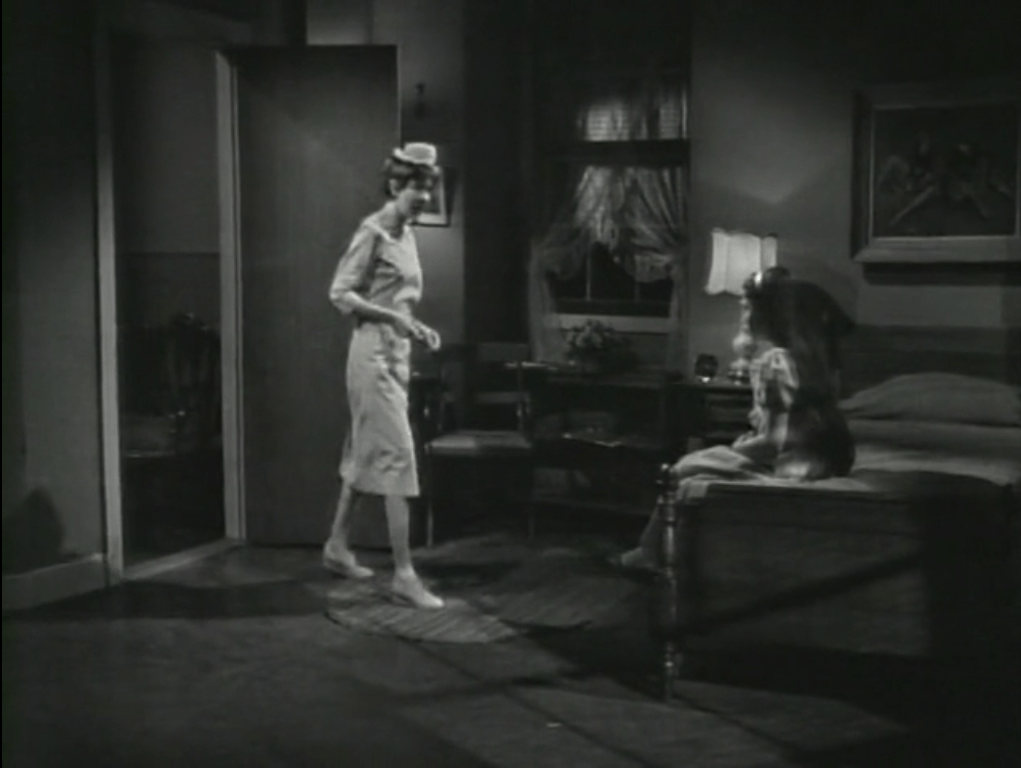
We see Maggie at the barred window, begging for someone to help her go home. At that, her friend, the ghost of nine year old Sarah Collins, materializes in the room. Maggie hugs Sarah, and Sarah apologizes for taking so long to find her. Sarah assures Maggie that she can help her get home, but tells her she will have to do what she says.

Sarah apologizes for taking so long to come

At Sarah’s direction, Maggie stands in the corner behind the door and calls the nurse while Sarah sits on the bed. The nurse opens the door and sees Sarah, but not Maggie. Maggie slips out and closes the door behind her, locking Sarah and the nurse in the room. The nurse tries the door, looks back, and sees that Sarah is nowhere to be found. The camera stays with her for a long moment as she looks around in bewilderment. As Nurse Jackson, Alice Drummond does a great job with this stage business.

Meanwhile, back in Collinsport, there is a misdemeanor in progress. Well-meaning governess Vicki, her depressing boyfriend Burke, and Barnabas are sneaking into an old vacant house that has captured Vicki’s fancy. Barnabas astounds Burke with his ability to see in the dark as he describes the “No Trespassing” sign, and refers to the same ability as he volunteers to explore the upper storey of the house while Burke and Vicki stand around on the ground floor.

Burke has taken Vicki’s interest in the house as a marriage proposal, and keeps talking about how they should furnish it when they live there together. The only thing he says that gets much of a reaction from her is a disparaging remark about Barnabas, which elicits flash of anger. Yesterday’s episode included a couple of clues that Vicki’s infatuation with “the house by the sea” might lead her, not to Burke and irrelevance, but to Barnabas and the center of the action. Her forceful response to Burke’s Barnabas-bashing renews those hopes.

Burke has spoken ill of Barnabas

Barnabas comes back from the upstairs with a handkerchief bearing the initials “F. McA. C.” He makes a present of it to Vicki. When she objects to this act of theft, he assures her that whoever it belonged to would want her to have it. That too picks up on hints from yesterday, when Barnabas indicated by his typical slips of the tongue that he had a connection to the house that he didn’t want the other characters to know about. We haven’t yet heard of anyone living or dead with the initials “F. McA. C.,” so presumably we are supposed to start waiting to hear a fresh story about Barnabas’ earlier existence.

Somewhere to the north, Maggie and Sarah are sitting in the woods. In recent days, we have heard several times that the mental hospital is a hundred miles from Maggie’s home in Collinsport, so if they are going to walk the whole way and take breaks it will be a while before they get back.

Maggie asks Sarah how she got into her room. “Do you really want to know?” Maggie says she does. “The same way I got out.” How did she get out? “The same way I got in!” At that, Maggie laughs. Sarah first met Maggie when she was Barnabas’ prisoner, and she remarks that this is the first time she has heard her laugh. She tells her she ought to do it all the time.

Apparently, an early draft of the script called for a truck driver to pick Maggie up and take her back to town. But that couldn’t be. How will Sarah get Maggie to Collinsport from the hospital? The same way she got to the hospital from Collinsport, of course.

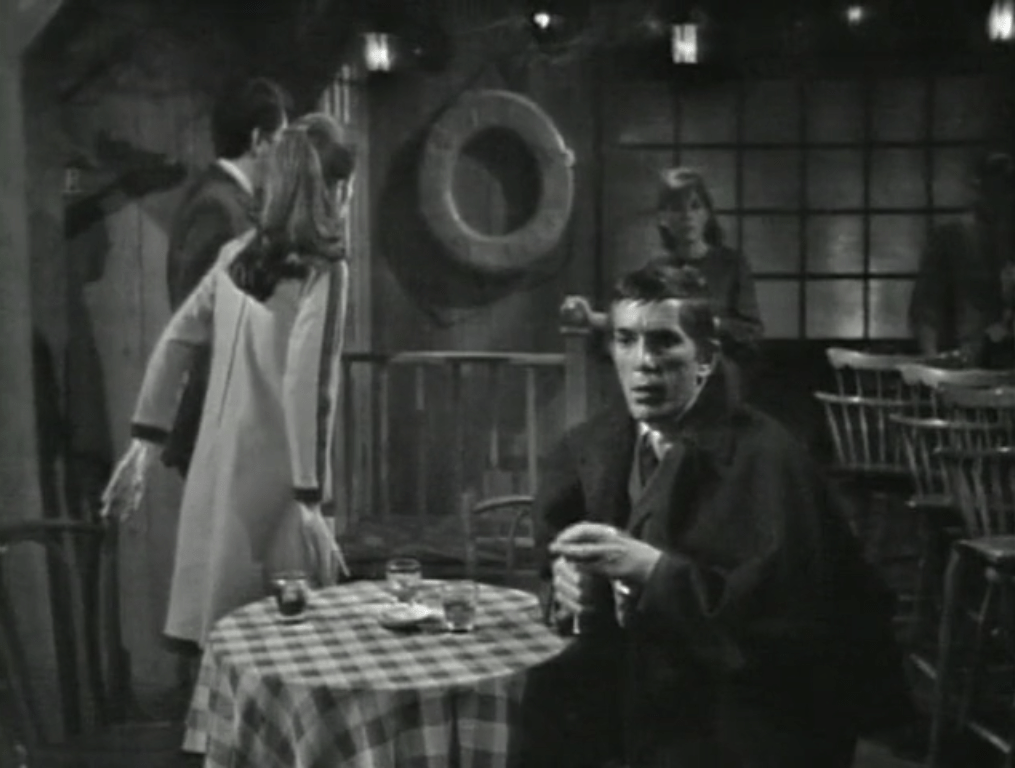
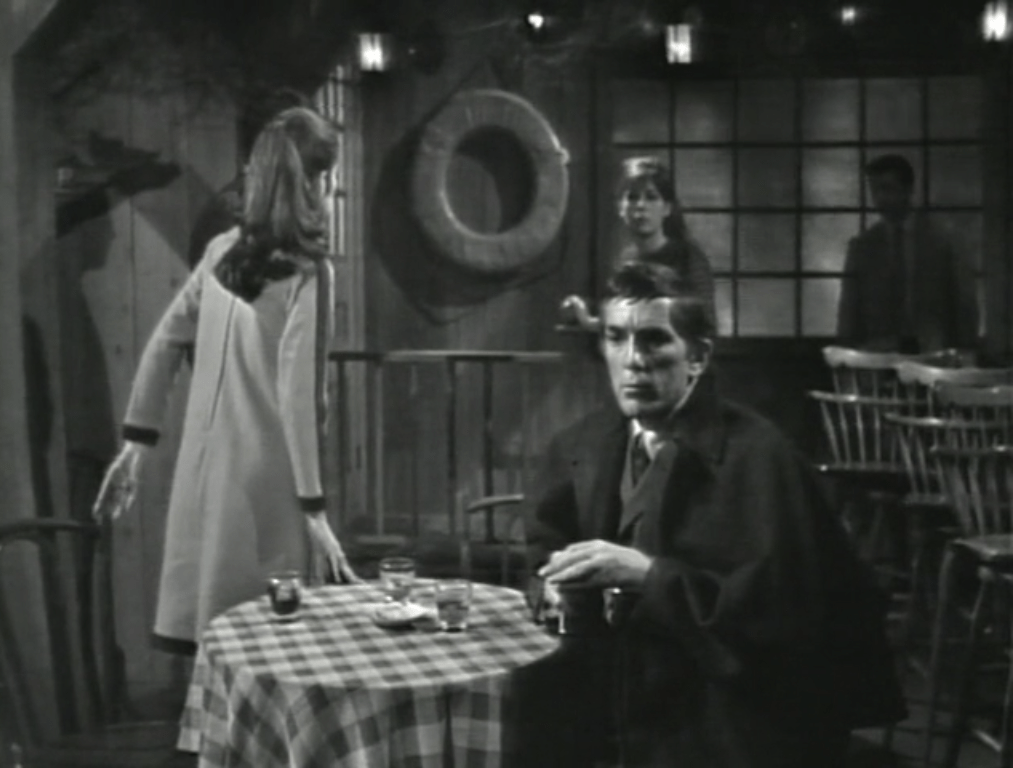
In Collinsport, Vicki, Burke, and Barnabas are sitting at a table in the Blue Whale tavern. While Barnabas gets the drinks, Vicki tells Burke that he and Barnabas are extraordinarily unalike. Burke says he takes that as a compliment, a remark to which Vicki reacts with displeasure.

Burke has repeated his offense

We can sympathize- sure, Barnabas is a vampire, and that is sub-optimal in a potential husband. But it doesn’t make him the opposite of Burke, who has been draining the life out of Vicki lately with his demands that she steer clear of anything that might be interesting to the audience and become as dull as he is. The real difference between Burke and Barnabas is that Barnabas drives one exciting plot point after another, while Burke makes nothing happen.

Barnabas comes back to the table, and the conversation returns to the “house by the sea.” Burke is about to propose marriage to Vicki. Suddenly, the jukebox stops playing and everyone falls silent. It is as if something has entered the room that everyone can feel but no one can see. The door opens, and in walks Maggie.

Vicki is the first to see her. She calls her name. Barnabas reacts with alarm. Maggie walks slowly towards their table. She approaches Barnabas, who tries to remain very still. She takes a long look at him, walking around to get the best angle. She touches her head, calls out “No!,” and faints. And that is what you call a “cliffhanger ending.”

Closing Miscellany

In a long comment on Danny Horn’s post about this episode on his Dark Shadows Every Day, I connected Sarah’s doings today with her overall development up to her final appearance. I won’t reproduce it here, it’s full of spoilers.

It was in that post of Danny’s that I learned about the draft including the truck driver. He read about it in a self-published book by Jim Pierson.

This is the final episode of Dark Shadows shot in black and white. Maggie’s collapse sends the first part of the series out on a bang.

Episode 139: Are you going to Madagascar?

High-born ne’er do-well Roger Collins walks in on his estranged wife, the mysterious and long-absent Laura, fending off an attempt by his arch-nemesis, dashing action hero Burke Devlin, to plant a kiss on her. Roger is equipped with a bolt action rifle.

Great emphasis is placed on the rifle. The most prominent set in all of Dark Shadows is the drawing room in the great house of Collinwood, and it was altered yesterday to put a gun rack on its wall. This will startle regular viewers who remember that in episode #118 reclusive matriarch Liz had to go to the back part of the house to dig up Roger’s almost-forgotten guns. Now, those guns are on display in the family’s main dwelling place and holiest shrine.

It is 1967 and everyone associated with the creative side of the show is connected with the NYC theater world, so there is approximately a 100% chance that we are intended to read these scenes in Freudian terms. The gun is a phallic symbol, but a corrupted, sickened one- it promises, not pleasure and the creation of new life, but pain and killing. In the context of Roger and Laura’s dead marriage, it demonstrates that Roger’s sexual frustration has warped him and led him to violence.

Roger declares that Burke is trespassing on his property and bothering his wife, and declares that no court in the world would convict him of anything were he to shoot Burke to death. He also says that killing Burke would give him great pleasure. Burke asks him why he doesn’t do it, and Laura wearily complains that she had enough of these sort of encounters between them ten years ago.

Laura’s remark comes as a jolt. Ten years ago, Roger and Laura were not a long-separated couple in the process of divorcing- they were not yet a couple at all. As far as the world was concerned, she and Burke were involved with each other, and Roger was a friend who sometimes tagged along on their dates. That was the situation until a fatal hit-and-run accident involving Burke’s car. This is the first time the three of them have been alone together since that night. After the accident, Laura and Roger testified against Burke. He went to prison and they married each other. When Laura says that the way Roger and Burke are carrying on now is the way they interacted ten years ago, she is saying that even when she was ostensibly Burke’s girlfriend the two men were more excited about each other than either was about her. Perhaps Laura was the one who tagged along on Roger and Burke’s dates.

Burke grabs the gun. He and Roger struggle for it. It fires into the ceiling, and Burke tears it from Roger’s hands, flinging it to the floor. Burke picks it up. Roger rants and raves, vowing to kill Burke. Yet he does not make any protest when Burke walks off with the rifle, even though the rifle is a valuable piece of property and a central feature of Collinwood’s decor. Roger can attempt to express his masculinity only in conjunction with Burke. When Burke removes the phallic symbol and silently leaves, Roger is struck mute.

After Burke leaves, Roger and Laura continue to develop the themes of powerlessness and sterility. Having none of the influence over her an ongoing sexual relationship might give him, he complains of her disloyalty to him and of his humiliation in the eyes of those who might see her socializing with Burke. He tries to assert power over her with threats of legal consequences if she goes along with Burke’s plan to reopen the hit-and-run case. Laura agrees that she cannot help Burke without losing the one thing she wants to gain, custody of their son, strange and troubled boy David. Roger completes the image of his own emasculation with a parting remark that he will be happy to see Laura leave with their son “if David is my son.”

There is something of a fault with the production. Neither Laura nor Roger is in a position to bring new life into the world, and we are in doubt as to whether Laura is, strictly speaking, alive at all. Yet as Laura, Diana Millay is quite visibly pregnant, and she will only get “pregnanter and pregnanter” as the story goes on. Her style of acting, her personality, and her looks are so perfect for the part that it is impossible to imagine anyone else playing it, but it was very confusing to present her as an avatar of death and the unreal past when she is such a strong visual symbol of life and the growing future.

After Roger flounces out of Laura’s cottage, she goes to the window and calls to David. We see David asleep in his room in the great house. He is writhing on his bed, hearing his mother’s voice and having a nightmare. Well-meaning governess Vicki wakes David, telling him that it is 10:30 AM.* David tells her that he had the same nightmare he did the night before, in which his mother beckoned him into a firestorm. Vicki tries to assuage his fears, purring lovingly at him, but he is still deeply disturbed.

Screenshot by Dark Shadows Before I Die

Roger enters and tells David to come along and see his mother. David flies into a tantrum, insisting that he will not see her and that no one can make him. When Roger threatens to beat him, David clings to Vicki and pleads with her to stop his father from hitting him. Vicki calmly states that “No one is going to hit you,” underlining Roger’s lack of authority in his relationships with both David and the hired help. David runs off.

Vicki sits on David’s bed and tells Roger that she has a theory about David’s behavior. She believes that he really wants to see his mother and that her love is tremendously important to him, but that he has worked himself into his current state because he is afraid she will reject him. This theory has a very substantial basis in fact. When Laura first came to the house in #134, David was extremely eager to meet her, until he suddenly asked Vicki “What if I do or say something to make her hate me?” From that moment on, he has become more and more reluctant to see Laura. Vicki tells Roger that she will work to arrange a meeting between mother and son in a situation where he will not feel pressured to perform in any particular way.

Vicki shows up at the cottage carrying a tray of tea things. Laura is impressed with the breakfast. Vicki shares her idea of arranging an apparently chance meeting during the walk she and David take around the grounds every afternoon beginning at 4:30.** Laura does not eat or drink anything during her breakfast with Vicki, but she does ask a series of questions about David. Vicki enthusiastically tells her every nice thing about him she can think of, leaving out such awkward incidents as his attempts to murder Roger and Vicki herself.

Laura chooses the top of Widow’s Hill for their “chance” meeting. This is rather an odd place considering that it is likely to be getting dark by 4:30 PM in early January in central Maine, and Widow’s Hill is a place from which people famously fall to their deaths. But, Laura is the boy’s mother. Besides, the other option was the greenhouse, and they don’t have a set for a greenhouse, so Vicki goes along with it.***

At the top of the hill, David asks Vicki why she wanted to go there, and starts talking about how dangerous it is. He noodles around at the edge of the cliff, alarming her, but he says he knows the ground so well it isn’t dangerous for him. After a minute, David says it’s boring there and he wants to leave. Vicki scrambles for a reason to stay, and finds a ship on the horizon. That catches David’s attention. He watches it, wanders ever closer to the precipice, and talks about sailing around the world.

That’s when Laura shows up. In episode 2, Roger introduced himself to Vicki by startling her while she stood on the edge of the cliff, nearly prompting her to fall to her death. In #75, Vicki returned the compliment. Now, Laura simply starts talking while David is on the precipice. Shocked to hear her voice, he jumps back.

Laura goes on about how David was always interested in exotic places when he was a little boy. He looks petrified, but does agree that he remembers those conversations. She reaches out and calls him to come to her. He recoils, slips, and ends up clutching the side of the precipice. That’s what’s known as a “cliffhanger ending.”

Screenshot by Dark Shadows Before I Die.

*In many markets, ABC affiliates ignored the network’s recommendation that Dark Shadows be broadcast at 4:00 PM and showed it at 10:30 AM. Hearing Vicki mention this hour makes me wonder if we are supposed to think of the action of a soap opera taking place, not only on the date of the original broadcast, but at the time.

**4:30 was the time when Dark Shadows ended in markets where the ABC affiliate went along with the network’s recommended schedule. Mustn’t have people outdoors between 4 and 4:30!

***Mrs Acilius pointed out this consideration when we were watching the episode.

Episode 61: A sandwich for a lonely man

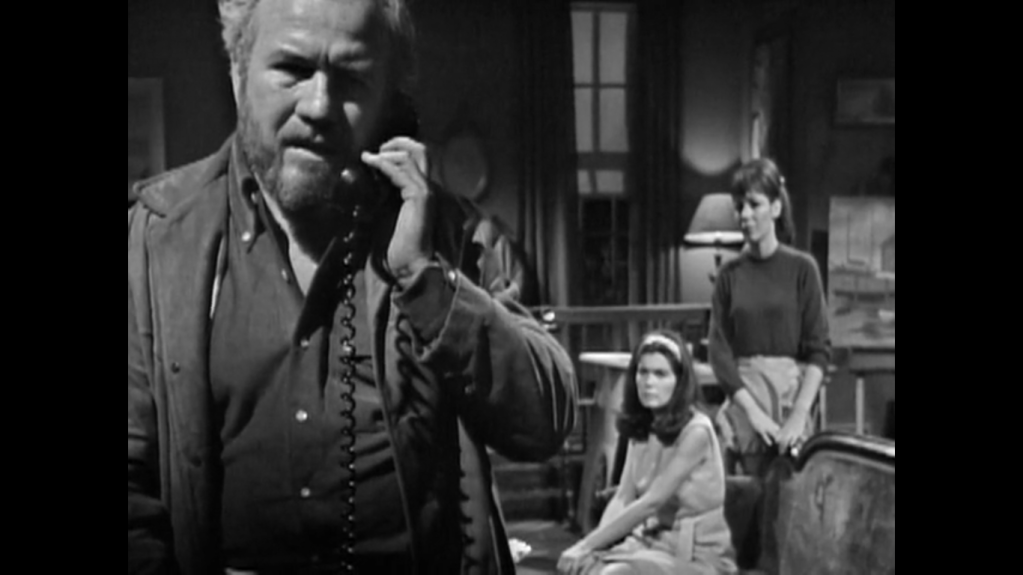
My wife, Mrs Acilius, pointed out that my post about episode 60 was unfair. She objected to the sentence “The Friday cliffhanger is Burke asking if he may join the Evanses and Vicki for dinner.” As she explained, that moment actually is an effective cliffhanger. I hadn’t mentioned that the sheriff had called drunken artist Sam Evans to warn him that dashing action hero Burke Devlin might be coming to his house, that he urged Sam to call back if Burke did come, and that actor David Ford played Sam’s reaction to this call with a convincing display of terror.

Sam on the phone
Sam trying to conceal his fear from the women behind him and the man on the other end of the call

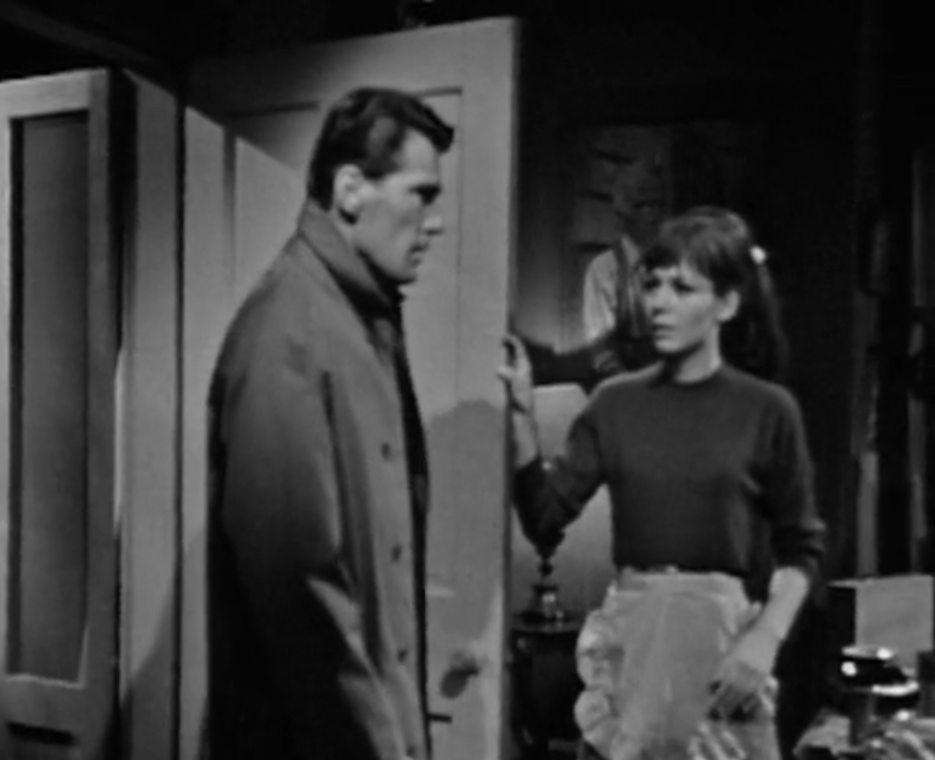
I also failed to mention the shot when Burke enters the room. Before Sam can get the words out to tell his daughter Maggie not to open the door, Burke has burst in. The scenes in the Evans cottage have been dimly lit, with all three figures moving before dark backgrounds. When the light colored door swings open, its relative brightness feels for a second like a flash, and when he stands in front of it Burke cuts a stark figure. We see him in contrast with Maggie, who stands against a dark background, wearing a dark top and a stunned expression:

Burke enters
Burke enters the Evans cottage

Throughout the episode, Sam had failed repeatedly to exercise any measure of control even in a social situation in his own home where the only other people are his daughter Maggie and well-meaning governess Vicki, the two kindliest characters on the show. The irruption of Burke into that setting is indeed a formidable moment for Sam.
So yes, that was a more plausible Friday cliffhanger than I allowed. Perhaps I was prejudiced against it because I remembered this episode. The purpose of a cliffhanger is to bring the audience back for the next installment. Typically, the next installment will begin by resolving the cliffhanger as quickly and unceremoniously as possible. But today, Burke’s intrusion into the Evans cottage drags on and on. In the process, it does serious harm to Burke’s character.

After rushing into the Evans cottage, Burke defies Sam and Maggie to say that he isn’t welcome. Maggie, unaware of the sheriff’s call urging Sam to let him know if Burke shows up, breaks down and says that of course Burke is welcome. Burke then tries to order Vicki and Maggie into the kitchen so that he can be alone with Sam. Neither woman is at all meek, however, and they stand up to Burke’s browbeating admirably.

Not so Sam. He takes the first opportunity to run away. We know that Sam has his guilty secrets, but he is a likable character, and it is hurts to imagine the pain that will await him the rest of his life whenever he remembers the night he left his daughter and her sweet young friend to face an angry man alone in his house. Sam doesn’t even call the sheriff. Instead, in his panic he goes to the hotel to try to retrieve a sealed envelope he had Maggie leave in the safe there. That gives us a scene with Conrad Bain as hotel manager Mr Wells. Bain is always a delight, and his little business about the envelope is certainly the most pleasant part of the episode. At the end of the episode, Sam will meet Burke at the hotel and ask to talk with him alone in his room, leaving us with the image of him trying to redeem himself in his own eyes.

Before that end comes, however, we have much, much more of Burke trying to bully the young women in the cottage. He won’t let them eat dinner. He harangues them about his manslaughter conviction. In the course of that harangue, it becomes clear that he isn’t thinking at all clearly. “I was drunk and don’t remember too much about that night, but I do remember Roger Collins taking over the wheel.” That’s just delicious- he was hopelessly drunk, blacked out in fact, but he’s pretty sure he remembers giving the keys to someone else before the fatal collision. The fact that his substitute driver was just as drunk as he was doesn’t seem to occur to him as a flaw in his “defense,” nor does the fact that this one convenient piece of information is the only thing to surface from his alcoholic stupor. That sort of thinking runs at such an oblique angle to reality that there would be nothing to say to Burke even if he were willing to listen to you. He goes on to suggest to Maggie that her father may have killed their old friend Bill Malloy, and refuses to leave the house when Maggie tells him to do so.

Burke’s abuse of Sam, Maggie, and Vicki makes it hard for us to like Burke as much as the show needs us to like him. We’re supposed to perk up when he’s on screen, not only because we don’t know what he might do next, but also because we don’t know whether we will approve of whatever surprising thing he makes happen. Even when he is trying to destroy the family to which our point of view character, Vicki, owes her loyalty, we’re supposed to want to see more of him. But when we see him treat Vicki and Maggie the way he does here, the image of him as a grinning thug sticks in the mind, and it is hard to want more of that.

All the more so, perhaps, because of his ineffectiveness as a thug. Our first concern with the show is that it should tell an interesting story, and Burke earns our attention by providing exciting story points. We can like even a very evil character who makes exciting things happen, but someone who simply shows up at your house when you’re about to eat, keeps you from your dinner, rambles on with a lot of nonsense, insults your father, and refuses to leave is just testing your patience for bad conduct.

We can compare Burke as the villain of this episode to another, more interesting villain. Throughout 1966, Mitch Ryan was not only playing Burke on Dark Shadows, but was also on Broadway in Wait Until Dark. In that play, he was one of the con men who, under the control of a mysterious figure calling himself Harry Roat, junior (and senior, but that’s another matter,) talk their way into a blind woman’s apartment and try, at first by trickery and then by threats of murder, to get her to hand over something valuable that she hadn’t realized she had in her possession. Like Maggie and Vicki, the heroine of the play stands up to Ryan’s character and the other villains. She ultimately triumphs over them. Unlike Burke, who is simply indulging on rage for its own sake and boring everyone as he does so, Roat has devised a brilliantly clever scheme to trick his victim, a scheme which fails only because she is his equal in brilliance and his superior in other ways. Wait Until Dark was a major hit in that original Broadway run, as was the movie version the next year and as many revivals of it have been in the years since. If Roat’s activities were as pointless in the play as Burke’s are in this episode, I very much doubt it would have been produced at all.