Vampire Barnabas Collins is giving a costume party using clothes that belonged to members of his family in the century when he was alive. It isn’t exactly a wild evening. Barnabas doesn’t appear to have planned any activities beyond mutual admiration of the costumes and a guided tour of his house. Moreover, four of the five guests live together and the fifth is fake Shemp Burke Devlin.
My wife, Mrs Acilius, said that the first time we watched the episode it was enough for her to see the actors dressed in antique clothes. But this time, she couldn’t help but notice their awkward pauses as they sit around with nothing to do.
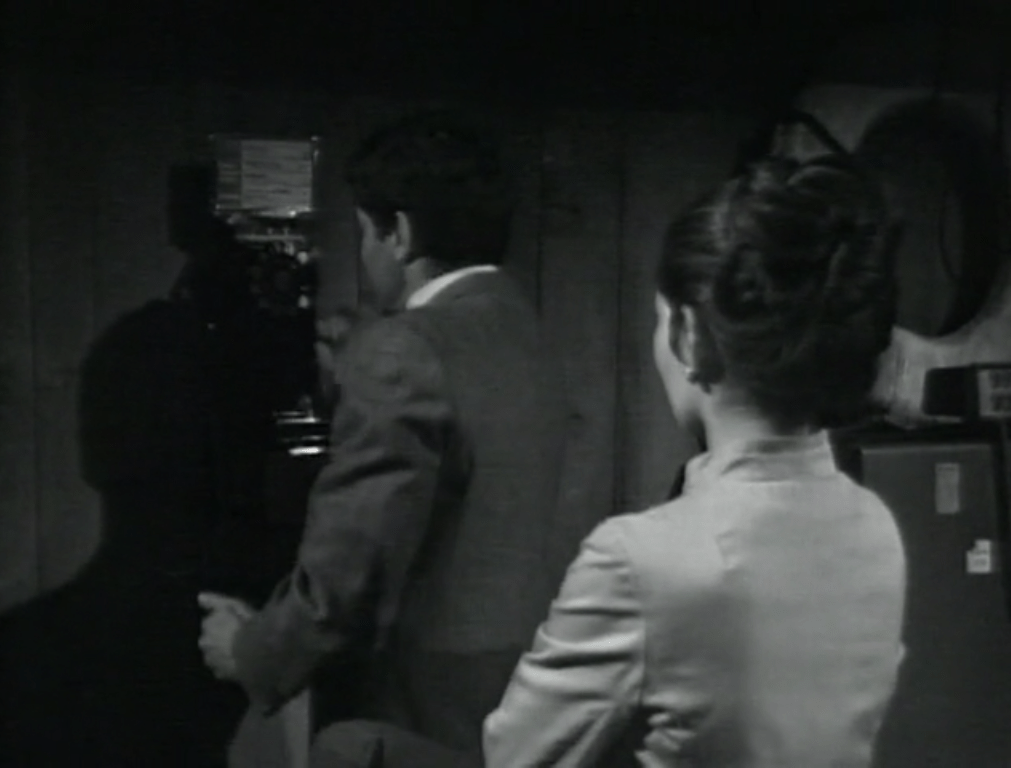
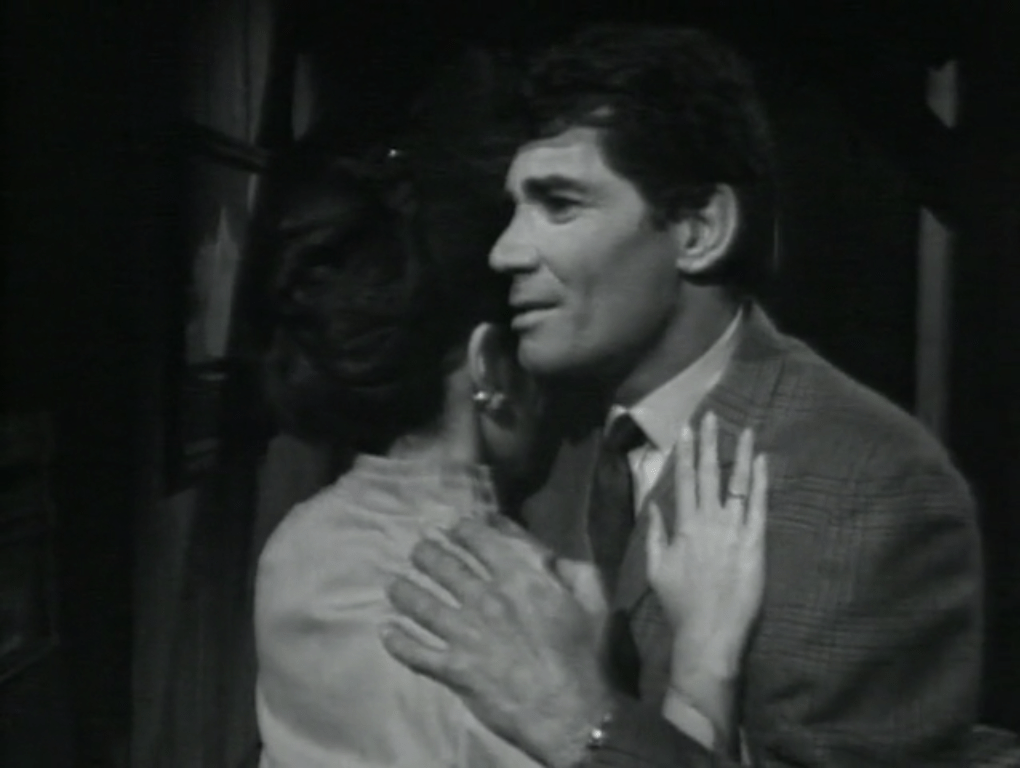
There are some red herrings that particularly bothered her. For example, when the other guests left for the party while well-meaning governess Vicki waited for Burke, the show dwelt on Vicki for quite some time, leading us to expect that her separation from the group would cause something dramatic to happen. When Vicki and Burke arrive shortly after the other guests, Barnabas is startled by the sight of Burke in his costume. For a moment it seems that this might be the dramatic thing we were led to expect, but Barnabas recovers his composure right away and Burke doesn’t seem to be offended. Everyone forgets about it instantly. Vicki and Burke might as well have come with everyone else.
Amid the boredom, the guests start to notice cold spots in the room and other traditional indications of ghostly presences. Roger Collins gets a bright idea. There is no electricity and are therefore no light bulbs in Barnabas’ house, so the idea is represented by a candle above his head.
Roger has an idea
Roger suggests they hold a séance to contact any ghosts who might be in the room. Everyone is reluctant, especially Barnabas, but Roger gets his way. After a lot of grumbling from around the table, well-meaning governess Vicki goes into a trance. Roger announces that a visitor from the world of the dead is about to deliver a message. The closing credits roll.
Closing Miscellany
This episode was taped on the Fourth of July. I can’t help but suspect that the characters’ impatience with Barnabas’ snoozer of a party may reflect the cast’s frustration at having to work on a holiday.
As the party begins, a bell tower strikes eleven. We’ve heard this chiming in Barnabas’ house before. Barnabas identifies it as the bells of “the chapel in the valley,” and matriarch Liz remarks that she hadn’t realized you could hear it so clearly in his house.
So much emphasis is placed on Liz’ resemblance to Barnabas’ mother and Vicki’s to Josette Collins that we wonder if Joan Bennett and Alexandra Moltke Isles will play their ghosts in upcoming episodes. Barnabas mentions that Roger doesn’t look as much like his father as Liz looks like his mother, so any plans they did have along those lines evidently did not include Louis Edmonds.
This is the third séance we’ve seen on Dark Shadows. In #170 and #171, the ghost of Josette spoke through Vicki, and in #186 someone named David Radcliffe spoke through strange and troubled boy David Collins. Roger had been a staunch opponent of those earlier séances, a fact he acknowledges in passing as he begins his pitch today.
The living members of the ancient and esteemed Collins family have been invited to a party hosted by their not-so-living cousin, Barnabas Collins the vampire.* It will be a costume party, in which each adult Collins will dress as a counterpart from the era when Barnabas was human.
The show has been hinting from episode #1 that well-meaning governess Vicki is the illegitimate daughter of matriarch Liz, and today Liz’ daughter Carolyn tells her she “deserves to be a Collins.” From what we’ve seen of the Collinses, that’s hardly a compliment, but she is going to the party dressed as the legendary Josette Collins, to whom she refers as one of “our ancestors.”
Vicki and Carolyn confide in each other that they feel strange wearing the dresses. Vicki gets a strong sense of déjàvu when she wears Josette’s dress, and when Carolyn puts on Millicent’s she feels like an intruder.
Vicki’s boyfriend, fake Shemp Burke Devlin, shows up. Vicki tells him about the party. He expresses unease at the idea of her dressing as Josette. He brings up the séance in #170, when Josette spoke through Vicki. That was one of a great many contacts Vicki had with Josette’s ghost between episodes #126 and #192, but Vicki seems startled when Burke brings the matter up.
Vicki suggests that she might go to Barnabas and wangle an invitation to the party for him. He jovially responds that he would be out of place at a Collins family party. He makes it clear that he is not at all bothered to be left out, but Vicki insists. He drives her across the estate to Barnabas’ house and waits in his car while she goes inside.
Vicki lies to Barnabas, claiming she had a previous commitment to go out with Burke. This is only the second time Vicki has successfully told a lie. The first time, in #228, she told Liz something she so desperately wanted to believe that she ignored the fact that Vicki couldn’t look at her, or stand still, or maintain a normal conversational tone of voice. Now, she tells her lie smoothly and easily. Perhaps Carolyn was right, and Vicki has indeed earned the right to be a Collins.
Barnabas is initially disappointed that Vicki wants to bring a date, but brightens when he thinks of a role for Burke to play. Burke can wear the clothing of Jeremiah Collins. After Vicki leaves, Barnabas tells sorely-bedraggled blood thrall Willie that he hated Jeremiah and wanted to “destroy him.” He smiles and says that perhaps he will have that opportunity at the party. My wife, Mrs Acilius, was impressed with Jonathan Frid’s expression as he delivers that line. “Man, he knows how to do evil-face!”
Barnabas had told Willie that he expected the party to be “the most important night of [his] life,” and now he thinks it might present him with opportunities to “destroy” the guests. I’ll admit that there have been times when I had unrealistic hopes for a party I was planning, but I can’t say I’ve ever raised my expectations quite to that level.
On his blog Dark Shadows Every Day, Danny Horn pokes fun at Barnabas for setting the bar so high. In a long comment, I tried to figure out what the writers might have been getting at by giving Barnabas these lines. I won’t copy it here, in part because it goes over material I’ve discussed repeatedly in earlier posts and in part includes spoilers for people who haven’t seen the rest of the series.
Closing Miscellany
Carolyn talks about the ancestors they will be impersonating as people who lived “over 130 years ago” and talks about “nineteenth century” styles. That fits with some references in the early months of the show to Josette having lived in the 1830s, and to the great house of Collinwood having been built in that decade by Josette’s husband Jeremiah Collins. The other day Barnabas said that his sister Sarah, whose ghost we have seen a number of times, lived long before he met Josette, and her dates have been established as 1786-1796. Apparently Barnabas and Sarah were both children when she died, and Barnabas was in his 40s when he knew Josette. Actor Jonathan Frid was in his early 40s when Dark Shadows was in production, so that would be plausible as the age at which Barnabas is frozen. Also, today a portrait of a man wearing a suit from the 1840s is identified as Joshua Collins, Barnabas’ father and a contemporary of Josette and Jeremiah.
This portrait usually hangs in the foyer, and I usually think of it as James K. Polk Collins. In #59, it was identified as Benjamin Collins, but today Vicki says it is Joshua. Screenshot by Dark Shadows Before I Die
At other times Jeremiah and Josette have been placed earlier, in the eighteenth century. It is unclear whether they have decided to stick with the 1830s as the time when Barnabas originally became a vampire, or if the date will shift again.
Burke asks Carolyn if her interest in motorcycling is a thing of the past. She says it is. This is the last reference we will hear to her onetime fiancé, biker dude Buzz. Buzz was hilariously out of place on Dark Shadows, and he will be missed as a source of comic relief.
When Burke was introduced in #1, he was a self-made millionaire planning to use his great wealth to take revenge on the Collinses. He gave up on his revenge in #201, and we haven’t seen much sign of his wealth lately. The last time a financial question was attached to him was in #267, when he was heartbroken because he had lost a dime in a pay phone. Today he shows up wearing a jacket that we’ve seen working class characters like Willie and hardworking young fisherman Joe wear. It might make the audience wonder if they are thinking of retconning his wealth away for some reason.
*They have no idea Barnabas is a vampire. They chalk his eccentricities up to being English.
Carolyn Collins Stoddard is moping at the bar in the Blue Whale tavern. Bob the Bartender tells her she’s had enough to drink and suggests she go home. Ignoring the suggestion, she plays a Tijuana Brass-style number on the jukebox, then stands in the middle of the floor as if she were about to dance.
Bob is the second person to try to throw Carolyn out of a place today. In the opening, seagoing con man Jason McGuire caught her going through his things in search of a clue as to what he is using to blackmail her mother, matriarch Liz, into marrying him. He told her that after the wedding this evening, he will expect her to move out of what will then be his house.
Carolyn is the only customer in the Blue Whale until her ex-boyfriend, hardworking young fisherman Joe, comes in. She tells Joe she is waiting for her fiancé, motorcycle enthusiast Buzz. The last time we saw Buzz, in #262, he seemed to be losing all patience with Carolyn, and he never does show up at the tavern. It’s starting to seem as if Carolyn will soon find herself with absolutely nowhere to go.
When Joe tells her that she can’t fight McGuire, Carolyn seems to get an idea. She says that maybe she won’t marry Buzz after all. When Joe insists on driving her home, she agrees, with a flourish. We then see her back in the mansion, taking a pistol from a drawer and putting it in her purse.
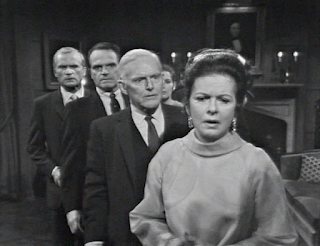
The wedding is to take place in the drawing room of the mansion. When the judge asks Liz if she will take Jason to be her lawful wedded husband, she declares that she cannot. In a beautiful piece of choreography, four actors fall into place behind her so smoothly that it looks natural for people to line up and look at each other’s backs while talking. Director Lela Swift deserves a lot of credit for finding a perfectly logical way to get people into this perfectly absurd position.
As the guests are absorbing Liz’ statement that she cannot marry Jason, she points at him and declares “I killed Paul Stoddard, and that man was my accomplice.”
Closing Miscellany
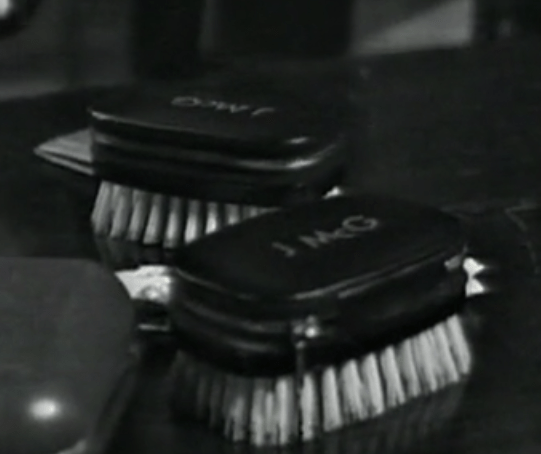
We see Jason’s initials on some shoe-brushes in his room.
Jason’s shoe brushes
We’ve seen Bob the Bartender mouthing words in the background in many of the 36 episodes he has appeared in so far, but his refusal to serve Carolyn is only the fourth time he has spoken on camera, after #3, #156, and #186.
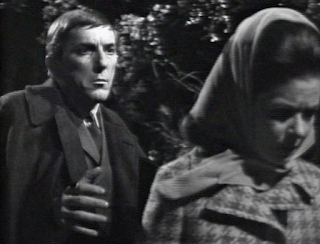
Reclusive matriarch Liz is standing on the edge of a cliff, staring out to sea. Her distant cousin, Barnabas the vampire, comes up stealthily behind her. He grabs her, and she screams.
For months, Liz has been stuck in a go-nowhere storyline about blackmail. So it is exciting to see the beginning of a new story where she is under Barnabas’ power. Or it would be, if that were what was happening. Instead, we come back from the opening credits to find that Barnabas approached Liz that way only because he was afraid she might go over the cliff if he made a noise and startled her.*
As a result of the blackmail arc, Liz is suicidal. Barnabas fears that she may be trying to jump, and tries to cheer her up by spending several minutes delivering a semi-coherent oration about how wonderful it is to be dead.
The scene started with a disappointment, and the dialogue doesn’t make much sense, but it is always fun to see Jonathan Frid and Joan Bennett work together. Frid’s acting style was a bit of a throwback to the nineteenth century, which made him an ideal scene partner for a daughter of Richard Bennett.
In #264, Barnabas had made some remarks to Liz’ brother Roger about the importance of family. Barnabas had then gone on to bluster uselessly at Liz’ blackmailer, seagoing con man Jason. He later told his sorely bedraggled blood-thrall Willie that he might kill Jason soon. As a vampire, Barnabas is a metaphor for extreme selfishness, and his hostility to Jason fits into that- Jason does represent a possible inconvenience for him. But today, we see a hint that Barnabas might actually have some measure of concern for Liz and the rest of the Collinses. After he walks Liz home, he confides in the perpetually well-meaning Vicki that he was afraid Liz would jump off the cliff. He tells Vicki that she seems to be the person most able to help Liz.
Yesterday, housekeeper Mrs Johnson had grabbed Liz as she was about to plunge off the same cliff, and had told Vicki of the incident. But Mrs Johnson just thought Liz was fainting. Vicki had noticed yesterday that Liz was deeply depressed, but she is shocked and disbelieving when Barnabas breaks the news that she seems to be suicidal.
On his way into the house with Liz, Barnabas had seen strange and troubled boy David Collins. David had seen Liz, but Liz neither saw nor heard him- she walked silently away from him, even though he twice called out “Aunt Elizabeth!”
In #256, David had met a little girl wearing eighteenth century dress hanging around outside Barnabas’ house. Unknown to anyone but the audience, the little girl is the ghost of Barnabas’ sister Sarah. David told Willie about Sarah, and Willie himself saw her in #264 and told Barnabas about her. Today, Barnabas tells David that if he sees Sarah again he should tell her to stay away from his property.
Barnabas’ message to Sarah and David
David denies that Sarah is his girlfriend, and says that her habit of singing “London Bridge” gets on his nerves. Barnabas is startled by the mention of “London Bridge.” David says that he isn’t likely to see Sarah near the Old House again, because “I’m not allowed to play at the Old House.” He delivers this line with a pungency that led us to laugh out loud. The whole scene is a lot of fun.
Barnabas had turned his creepy, anachronistic charm on at full force when talking to Vicki, and was obviously disappointed when she told him she had a date with fake Shemp Burke Devlin. He politely responded to this news by describing Burke as “a very interesting man.”
We then go to the Blue Whale tavern, where we see that “very interesting man” drinking and smoking by himself for a minute and a half. He wanders from his table to the bar to get another drink, passing some people whom first-time viewers will believe to be suffering from spastic disorders, but whom regular viewers will recognize as Collinsport residents who think they are dancing.
Notice her right hand- she has her guard up in case the convulsions spread to his arms
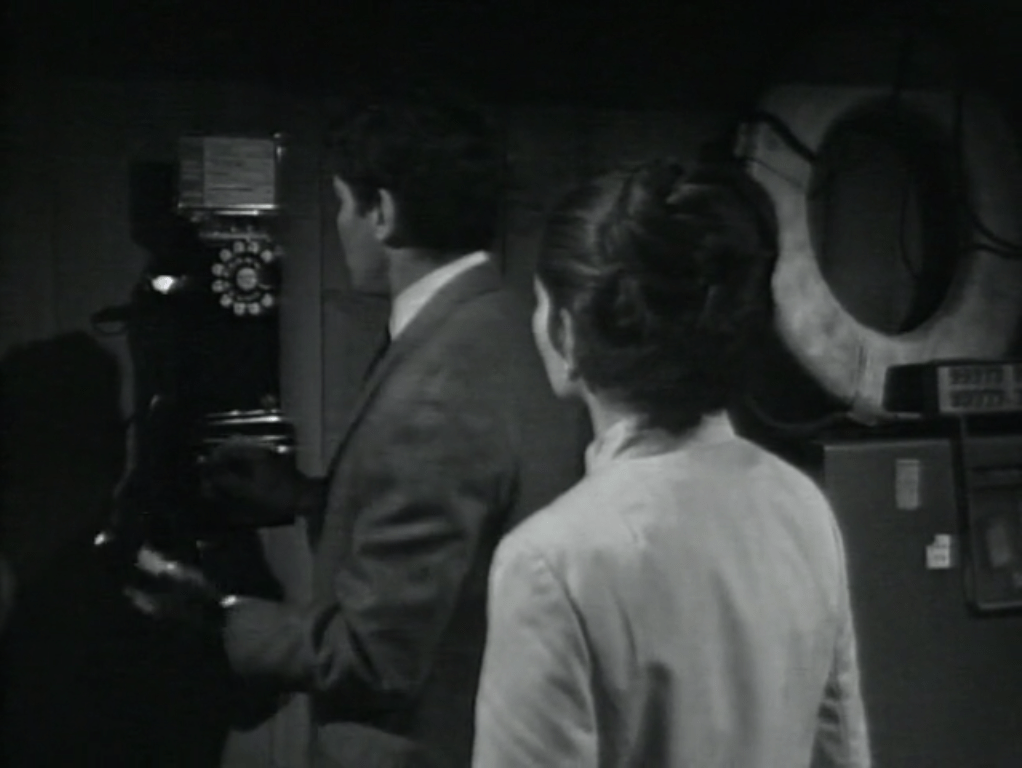
Burke goes to the pay phone to call Vicki. She enters, and he tries to get his dime back. He takes the receiver off the hook, replaces it, probes around in the coin return, bangs the side of the phone, explores the coin return again, and sadly tells Vicki that he has lost his dime. She tells him that if the purpose of calling was to get her to show up, he got his money’s worth. He agrees, but keeps looking back at the phone with longing.
Burke and Vicki dance. She tries to take his mind off the lost dime by recapping the last couple of episodes, but too little of interest has happened to refocus his attention. Vicki gives up and says she’s going home. We don’t see Burke resume his battle with the coin return slot, I guess they decided they had already given us our thrill for the day.
Back in the house, Liz is sitting in front of a table on which there is an open book. She is staring blankly into space. David enters the room. He greets her. She smiles vaguely, mumbles “Oh, David,” then gets up to leave. When Vicki comes in and says hello, Liz mutters “Hi, Vicki,” but doesn’t turn her head to look at her.
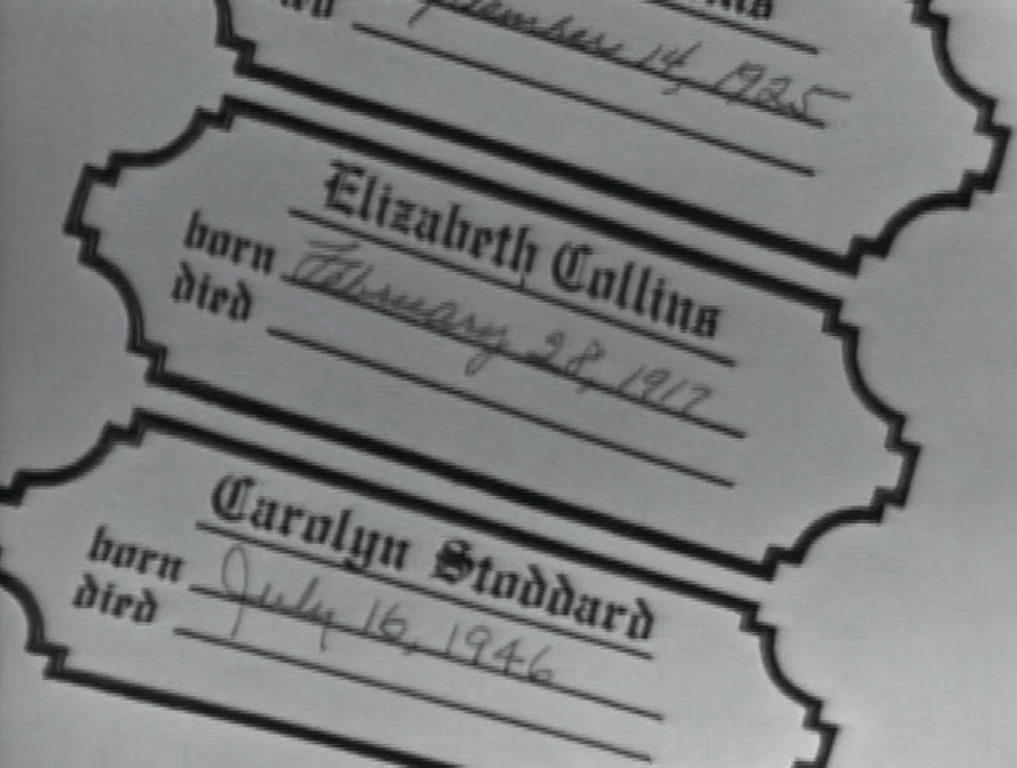
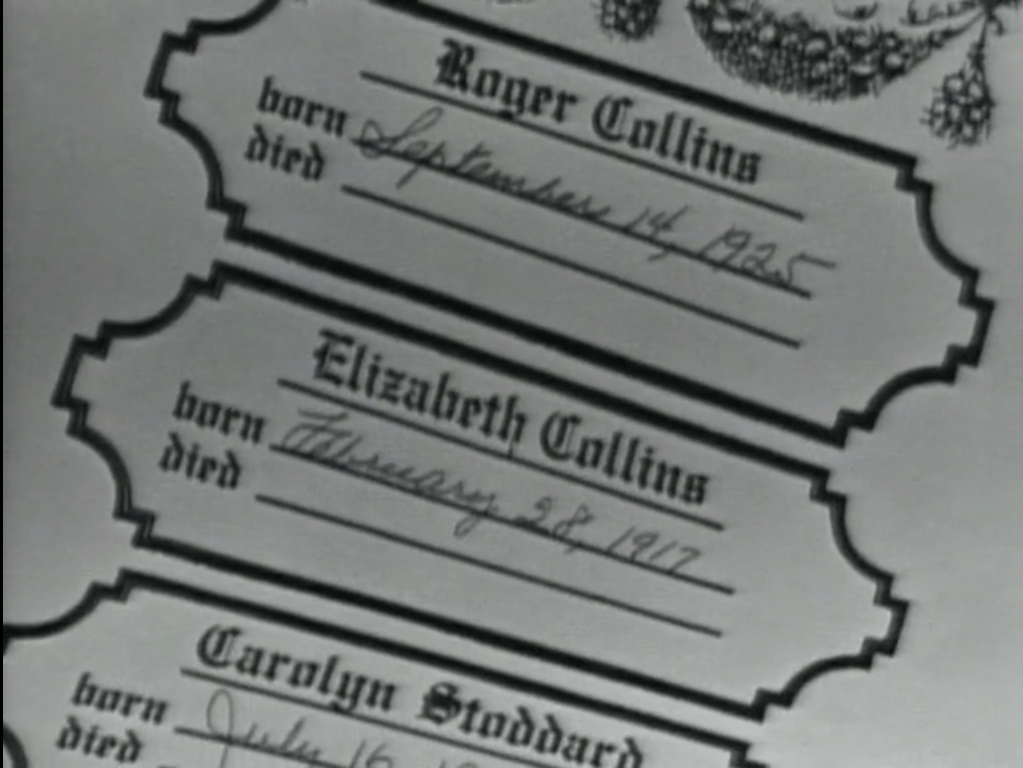
David calls Vicki’s attention to the book. It is the Collins family Bible, and was open to some plates that have been inserted bearing birth-dates for Liz and other members of the family. That’s the end of the episode. I must say, it’s quite an anti-climax after Burke’s attempt to retrieve his lost dime.
Closing Miscellany
Bob O’Connell is not on hand to play Bob the Bartender at the Blue Whale today. Instead, the bartender is Tom Gorman, who played the same role in #104 and will reprise it again in #607.
The birth-dates in the Collins family Bible are:
Roger Collins, 14 September 1925
Elizabeth Collins, 28 February 1917
Carolyn Stoddard, 16 July 1946
By comparison, the actual birth-dates of the actors were:
Louis Edmonds, 24 September 1923
Joan Bennett, 27 February 1910
Nancy Barrett, 5 October 1943
So it looks like they adjusted Edmonds’ and Bennett’s birth-dates by a few days plus a few years in setting their characters’ births, but ignored Miss Barrett’s actual birth-date in setting Carolyn’s. Maybe she refused to tell them what it was!
The show has been hinting heavily that Vicki is Liz’ biological daughter. A birth-date of 16 July 1946 for Carolyn would tend to pull against that- Vicki had apparently just turned 20 when the show started late in June 1966. Unless they were twins, one or the other of those characters is going to have to have her birth-date adjusted if they are going to resolve the question of Vicki’s origin that way.
*That’s a concern we’ve heard several times on this set- in #2, Roger introduced himself to Vicki by startling her as she stood at the edge of the cliff, and in #75 Vicki did the same thing to Roger. In #139, David was at the edge of the cliff when his mother, blonde fire witch Laura Murdoch Collins, surprised him; the episode ended with a literal cliffhanger after Laura made a move David wasn’t expecting. We’ve heard many times that the legendary Josette Collins was “the lady who went over the cliff,” as artist Sam Evans calls her in #185. It’s unclear why she did- maybe someone startled her.
In its first months, Dark Shadows spent a fair bit of time on the business interests of the ancient and esteemed Collins family. In those days, the Collinses were running out of money and their old nemesis, Burke Devlin, had come back to town with a plan to strip them of their remaining assets and drive them into poverty. The “Revenge of Burke Devlin” storyline never really took off, and was eventually subsumed into the tale of blonde fire witch Laura Murdoch Collins. Shortly after Laura disappeared, Burke formally gave up on his revenge. With that, the business stories ended, and there was no particular reason for Burke to stick around.
On Tuesday, Burke was recast. However little his character may have had to do on the show or however much he may have had to drink before he arrived at the studio, Mitch Ryan was always interesting to watch. Anthony George couldn’t match Ryan’s charisma, but by 1967 he had been a familiar face in feature films and primetime television for years. The original audience, even if they couldn’t remember George’s name, would have recognized him as a famous actor and assumed that his casting meant that something big was in store for Burke.
Today, we have two hints that business stories might be making a comeback as well. Seagoing con man Jason McGuire is blackmailing reclusive matriarch Liz into marrying him. Vampire Barnabas worries that the cozy little home he has made for himself in the Old House on the estate of Collinwood might be threatened if Jason takes control of the family’s holdings. He asks Liz’ brother, high-born ne’er-do-well Roger, to look at the original deeds for the Old House and the great house to see if there is some provision he might be able to use to defend his interests against Jason. That Barnabas asks about the deeds would suggest that he has acquired some form of ownership in the Old House. We’ve never seen him buy the house from Liz or receive it as a gift from her, but if both deeds are still in Liz’ name, he could hardly use their wording to claim a right to stay there. So when Roger goes off to look for the deeds, there is a chance he will come back with a story about real estate.
The second hint comes in Barnabas’ confrontation with Jason. Barnabas takes a very aggressive tone with Jason, who responds by asking Barnabas where he goes in the daytime and where his money comes from. “You have no accounts in the bank in town, and I know you don’t operate a business…” If Barnabas is going to be on the show for the long haul, as the ratings clearly indicate we should expect him to be, Jason will not be the last person to ask these questions. We might wonder how exactly he will forestall them.
If we have been watching from the beginning, the likeliest answer would involve Burke. When was a major character, Burke was presented as an inexhaustibly rich man who knew his way around some of the shadiest places in the world. If Burke happens upon Barnabas’ secret, we could expect Barnabas to bite him and thereby bring him under his power. With his money, Burke could set up plenty of bank accounts and businesses in Barnabas’ name. With his contacts in the demimonde, he could secure whatever papers Barnabas needs to establish his identity. Even a photo ID- Burke could easily hire a Barnabas lookalike to pose for a British passport.*
During the “Revenge of Burke Devlin” arc, Burke bought up a lot of Liz’ debts. In particular, he held enough notes payable on demand that she feared he might be able to put her out of business at any time. That hasn’t been mentioned for a long while, but if Barnabas takes control of Burke he could take those notes and exchange some of them for outright ownership of the Old House.
Barnabas could also compel Burke to fabricate some fraudulent papers that would make it look as if he were deeply in debt to Barnabas. When Barnabas got around to killing Burke, those papers would come to light. Liz and Roger would be grateful to Barnabas for taming their old adversary and clearing out some debts that posed a danger to their financial position, while well-meaning governess Vicki would be grateful to him for helping her boyfriend save his face after his business went south. As a result, his position at Collinwood would be unassailable.
Closing Miscellany
There is a location insert of Roger walking to the Old House, a flashlight in hand. I don’t think we have seen this footage before.
Until today, Barnabas has tried to be very suave with everyone who doesn’t know that he is a vampire. Since he has nothing to say to Jason that will intimidate him, he might as well continue that approach in his scene with him, or at least play dumb. But instead, he is openly, and self-defeatingly, hostile. This will become a pattern in future episodes. Time and again, Barnabas will greet a potential adversary with an immediate declaration of war, often before the adversary even knows who he is, thereby forfeiting whatever element of surprise he might have on his side.
Barnabas catches a glimpse of the ghost of his sister Sarah. He only sees her as a figure moving in the distance as he is looking out the window, and has no idea who she is. But it does confirm that he is able to see her, something we had not known he could do.
On Thursday, reclusive matriarch Liz admitted to well-meaning governess Vicki that she is being blackmailed. Eighteen years ago, Liz killed her husband, Paul Stoddard. Seagoing con man Jason McGuire then buried Stoddard in the basement. Now, Jason is threatening to expose this secret unless Liz marries him.
Today, Liz asks Vicki to be the legal witness at her wedding to Jason. Vicki demurs, saying that she might be compelled to speak up when the officiant asks if there is anyone who present who knows why these two people should not be joined in matrimony. The conversation then shades off into Vicki urging Liz to share her secret with her daughter, flighty heiress Carolyn. Liz won’t look directly at Vicki when Carolyn’s name is mentioned.
Word is spreading that Maggie Evans, The Nicest Girl in Town, is dead. Vicki had just received that news when Liz brought up the wedding. Alexandra Moltke Isles does a fine job of expressing Vicki’s emotional tumult as she reels from one kind of shock to another. When Vicki breaks the news of Maggie’s death to Carolyn and then quarrels with Carolyn about her plan to marry motorcycle enthusiast Buzz, Mrs Isles reprises this transition from fresh bereavement to festering conflict, again quite effectively.
Carolyn goes out with Buzz, and Vicki goes for a walk on the beach with her boyfriend, Burke Devlin. Each episode begins with a voiceover which Mrs Isles delivers in character as Vicki. Typically, these consist of remarks about the sea and the weather which have some vaguely metaphorical connection to what’s happening on the show. While Vicki sits with Burke and stares out at the water, she launches into one of these monologues. In response, my wife, Mrs Acilius, started laughing so hard we had to pause the streaming. When Burke joins in with the observation that it is getting dark and “may get darker”- sometimes that happens as the evening goes on, seems to be some kind of pattern there- we both burst out laughing and had to pause it again. Before we restarted it that second time, Mrs Acilius asked “What does it say about us that we are sitting here watching this? That we choose to watch it when we’ve seen it before?” I’m not sure I want to know the answer to that one.
Vicki gets home shortly before Carolyn. Carolyn tells Vicki and Liz that after she saw Maggie’s boyfriend Joe walking down the street looking sad, she just wanted to go home and mourn. After Carolyn leaves them alone together, Vicki again urges Liz to tell her the truth. Vicki judges that Carolyn would listen to her sympathetically in the mood she is in now. Liz says she might tell Carolyn tomorrow, Vicki says that Carolyn might not be in the same frame of mind tomorrow, Liz says she can’t do it now.
In fact, Maggie is alive- her doctor decided to promote the story that she is dead as a lamebrained scheme to keep the person who tried to kill her from trying again. The blackmail plot, on the other hand, has barely shown a sign of life since it first arrived on the show ten weeks ago.
Jason is supposed to sweep away the last non-paranormal story elements left over from the period before Dark Shadows became a supernatural thriller/ horror story in December 1966. So far he has managed to disclose to the audience, but not to the other characters, why Liz hasn’t left home since the night Stoddard was last seen. That wasn’t an especially interesting question, as they have never shown us anyplace she would want to go, and it’s the only thing he has cleared up.
Another unanswered question is the one that led Vicki to come to Collinwood in the first place. She grew up in a foundling home, with no idea of who her parents were. The show has been hinting heavily that Liz is Vicki’s mother. Indeed, when Jason was brought on the show, the plan was that the grand finale of his storyline would confirm this. If that is still the plan, then the relationships among Vicki, Liz, and Carolyn are due for a drastic upheaval. That prospect lends a certain interest to the scenes among these characters today.
Closing Miscellany
This episode originally aired on 27 June 1967, the first anniversary of the broadcast of #1.
From #1 until #248, dashing action hero Burke Devlin was played by Mitchell Ryan. Ryan showed up at the set too drunk to work when they were supposed to tape #254 and was fired off the show. Today announcer Bob Lloyd tells us that “The part of Burke Devlin will be played by Anthony George.” There was never very much on Dark Shadows for a dashing action hero to do, and now that the most popular character on it is a vampire there isn’t going to be. It was only Ryan’s star quality that kept the character on the show so long.
Anthony George had appeared in feature films in the 1950s, had guest-starred in several prime-time shows, had been a regular cast member on the hit series The Untouchables, and had played one of the leads on a series called Checkmate. When the original audience saw him, many of them would have recognized him as a famous actor and would have expected the character to go on to do something important. Evidently they haven’t given up on Burke yet. But they had better come up with a story for him- George may have had a terrific resume, but he doesn’t have any fraction of Ryan’s charisma.
Unfortunately, they have given up on Buzz. He is on screen only briefly today, and we don’t see him again. Worst of all, while his first three episodes left us with the impression that he could not fail to be hilarious, he manages not to be even a little bit funny in this final appearance. He is just nasty and inconsiderate, demanding that Carolyn forget about whatever it is that’s bothering her and come to the loud party he’s planned.
Getting Buzz off the show the day Anthony George comes on as Burke does solve one problem. As of this episode, the three young women on Dark Shadows all have boyfriends. Maggie has Joe, played by Joel Crothers; Vicki has Burke, played by Anthony George; and Carolyn has Buzz, played by Michael Hadge. Those three actors were all gay. That wasn’t widely known at the time (except perhaps in the case of Mr Hadge, who really does not seem to be making an effort to keep the closet door shut while playing Buzz,) but now that everyone knows all about it, it does seem to be a sign that the show was spending a lot of energy on things that aren’t going anywhere.
A mysterious little girl in eighteenth century garb shows up outside the dungeon cell where vampire Barnabas Collins is keeping his victim, Maggie Evans. The girl stands with her back to Maggie’s cell and sings a couple of verses of “London Bridge” over and over while tossing a ball. Maggie pleads with her to stop singing, to get away before Barnabas and his sorely bedraggled blood thrall Willie Loomis catch her, and to tell someone that she has seen her. The girl does not acknowledge Maggie in any way.
Seconds after the girl has strolled slowly away, Willie comes by the same path she had taken. Maggie is bewildered that Willie didn’t see her. She urges Willie to escape from Barnabas. Willie gives a big speech about how he thinks about escaping all the time, and that when he is in his car he has sometimes tried to keep driving. But Barnabas’ power keeps pulling him back. Regular viewers will be interested in this confirmation that Willie has a car.*
At the great house of Collinwood, strange and troubled boy David Collins is impatient with the geography lesson his governess Vicki is trying to give him. In the first 39 weeks of the show, the only set which consistently saw interesting scenes was David’s room, where he and Vicki became friends during his lessons. They don’t have the studio space to build that set today, so this lesson is conducted in the drawing room. When flighty heiress Carolyn comes into the room, Vicki sends David to play outside. Since the interrupted lesson was about Australia, he hops away kangaroo-style.
Vicki and Carolyn talk about Carolyn’s boyfriend, motorcycle enthusiast Buzz. Buzz is a refugee from Beach Blanket Bingo, so broadly comic a figure that he might have been too silly even for the biker gang in that movie and its sequels. Unfortunately, Buzz doesn’t show up today, and Vicki and Carolyn’s conversation is a pure specimen of old-time soap opera earnestness. There is an odd moment when Vicki asks Carolyn “How far do you intend to go with Buzz?” and Carolyn answers “All the way!” At the end of the scene, Carolyn uses the phrase “all the way” again. She’s talking about her plan to marry Buzz, but “all the way” was such a familiar euphemism for sexual intercourse in the 1960s that it is hard to imagine it wasn’t intentional on some level. When Carolyn tells Vicki that she and Buzz will go “all the way” while Vicki watches, we wonder what weddings are like in Collinsport.**
David has gone to the yard around Barnabas’ house. We see a location insert of him on the swing set there. This footage is reused from #130, when we discovered that he was being watched by his mother, blonde fire witch Laura Murdoch Collins. Laura had died sometime previously, but it didn’t take.
Now, he is being watched again. The mysterious little girl from the dungeon has made her way up to the porch and calls to him as “Boy!” When he tells her his name is David, she says “I know.” She gives her name as Sarah, and asks him to play with her. They toss her ball back and forth, and he finds fault with her fondness for “London Bridge.” She says she used to go to school, a long time ago. She lives around there, but everyone she lives with went away and left her all alone. She excuses herself to go look for them. Willie then comes out of the house. David tells him about Sarah, and Willie shoos him away.
Playing catch as best you can when you’re on a tiny set, photographed in 4X3. Screenshot byDark Shadows Before I Die
That Sarah can come and go from the dungeon without being seen shows that she is one of the ghosts who haunt the house. David has seen several of these, but does not recognize her. Her behavior in the opening scenes leaves us wondering if she is aware of Maggie’s presence; if not, she may simply be an apparition, unable to interact with the living characters.
When Sarah meets David, not only is she able to converse with him, but her ability to play catch with him using the ball she brought with her shows that she has a physical body and that she can manipulate material objects. That makes it all the more puzzling that she did not answer Maggie. Was she ignoring her, or was she somehow less capable in the dungeon than she is on the porch?
When Sarah uses the words “a long time ago,” we suspect that she knows she is a ghost and she has been displaced to a future century. But then she becomes confused as to where her people are, and is filled with a terrible urgency to go look for them. Again it is ambiguous just what sort of being Sarah is and what she can do.
There is always a vagueness about the supernatural- if you could explain a phenomenon fully in words and measurements, it wouldn’t be in that category at all. The key to holding an audience’s attention with a story about ghosts and such is to intrigue them with questions that seem like they might have answers and to use them to lead to another, equally imponderable set of questions before the first set gets old. So it is a promising sign that Sarah is introduced while we are still asking what Barnabas can do, what he wants to accomplish, what he needs for survival, and how he got to be the way he is.
That we see David in a lesson with Vicki and then hear him talking with Sarah about how neither of them goes to school anymore is also interesting to regular viewers. Dark Shadows is just about a year old. It started with Vicki’s arrival at Collinwood, where reclusive matriarch Liz had summoned her to teach David. David and his father, Liz’ impecunious brother Roger Collins, had been living at Collinwood for about a month. Before then, they had lived in Augusta, Maine, where David went to school.
When Vicki showed up, Roger objected that he knew nothing about her, and Liz refused to tell him or Vicki how she knew that she existed or why she chose her to be David’s governess. The show has been hinting very heavily that Vicki is Liz’ biological daughter and that Liz is desperate to keep that relationship secret. It is also clear that Liz wants above all for David to grow into her idea of a male Collins, an idea to which her bratty little brother Roger does not in any way conform.
Barnabas’ plan for Maggie is a ghoulish parody of Liz’ for David. He wants to erase her personality and replace it with that of his long-lost love, Josette Collins. Over the generations since her death, Josette has become the patroness of the Collins family and the emblem of its perfect female member. And of course Barnabas is as anxious to hide the secrets in his basement as Liz is to hide those in hers. That Sarah appears to both Maggie and David emphasizes that Barnabas is a funhouse mirror reflection of Liz.
Back in the great house, David hears Buzz’ motorcycle and tells Carolyn that he is there for her. She can’t quite bring herself to tell David that she and Buzz are planning to get married, but does encourage his interest in going for a bike ride with Buzz. As she leaves, he brilliantly mimes motorcycle riding.
David gives Vicki a detailed account of his encounter with Sarah. She is disappointed he didn’t bring her home. Though it is her job to be David’s only friend, Vicki is no more enthusiastic about his isolation from playmates his own age than Willie is about Barnabas’ treatment of Maggie.
Back in the dungeon, Willie finds that Maggie has not eaten. They share a sad moment. He leaves, and Sarah reappears. Maggie talks to her. At first, she doesn’t respond. But then she turns to her and says “If you see my big brother, don’t tell him you saw me. He doesn’t like anybody to come down here.” Then she leaves, a spring in her step.
The last time a ghost spoke to an imprisoned woman was in the same house, in #126. That time, Vicki was bound and gagged and hidden in a secret room on the main floor by crazed handyman Matthew Morgan. When Matthew had gone to get an ax with which to decapitate Vicki, the ghost of Josette had appeared to her and said, in a perfectly cheerful voice,*** “Do not be afraid.” Josette didn’t untie Vicki or anything, she just told her that and vanished. Later in the episode, she and some other ghosts scare Matthew to death before he can kill Vicki. When Sarah goes away from the stunned Maggie and skips along the floor, regular viewers might remember that event and see a promise that Sarah has something up her sleeve.
Closing Miscellany
Sarah is identified in the closing credits as “Sarah Collins,” the name given in #211 for Barnabas’ sister who died in childhood. That rather blunts the surprise of her closing reference to her “big brother.”
Sarah’s identity raises a couple of other questions. Barnabas’ house was the original Collins family home, and he and Sarah would have lived there. The cell in which he keeps Maggie is covered with cobwebs, evidently a feature of the house from its beginning. When she tells Maggie that her big brother “doesn’t like anybody to come down here,” she is speaking from experience- the adults don’t like it when you go near the jail cell in the basement.
Slavery was a legal institution in Massachusetts**** until 1783, and indentured servitude under conditions not so far removed from those to which slaves were subject continued long after. The Old House has been described as a “huge mansion,” so presumably its owners would have held people under at least one of these statuses. As a Collins of the eighteenth century, Sarah’s blithe attitude towards someone held in the cell would seem to be chillingly appropriate.
Sarah’s address to David as “Boy!” when she knows his name is also interesting coming from her. To be sure, if she had called him by name before they met, he would have known right away that there was something very strange about her. Since he has seen many ghosts and knows that ghosts congregate in and around the Old House, he may have identified her as one right away.
On the other hand, during the “Revenge of Burke Devlin” storyline that ran from #1-#201, there was considerable doubt as to whether David was Roger’s natural son or Burke’s. That doubt came to a head when Laura was on the show. Laura only left 13 weeks ago, and Burke is still hanging around. As far as we know, the question may come back up, and David Collins may turn out to be David Devlin. In that case, Sarah may have chosen to call him “boy” because she is a Collins and therefore better than everyone who is not.
I posted a couple of long comments about this episode on Danny Horn’s Dark Shadows Every Day. I won’t copy them here, because they contain spoilers for people who haven’t seen the whole series. But I’ll link to them- under the post about this episode, I argued that Sarah’s introduction was the most important plot development in the entire series; and under a post about a much later episode, I wish one of the words in her closing line had been different.
*Regular viewers are interested in some weird stuff, what can I say.
**My wife, Mrs Acilius, is very much taken with the actresses’ recollections of how Louis Edmonds, who played Roger, would make them laugh so hard during rehearsals that it was sometimes difficult for them to stay in character during filming. She says it is just as well that Roger wasn’t in this episode, because there is no way they could have got through this scene if he had been.
***Provided by Kathryn Leigh Scott, who also plays Maggie.
Frustrated that her mother, reclusive matriarch Liz, has decided to marry seagoing con man Jason McGuire, flighty heiress Carolyn spends the day and night with motorcycle enthusiast Buzz Hackett.
Buzz is modeled on the biker dude villains of Beach Blanket Bingo. Some of his mannerisms, such as speaking in a Beatnik slang that was a decade and a half out of date by 1967 and wearing sunglasses when he rides his motorcycle at night, would have been a little too broadly comic even for that movie, and are ludicrously out of place on the rather solemn Dark Shadows. The very sight of Buzz therefore raises a laugh.
I mean really
Nancy Barrett’s acting style was to throw herself unreservedly into whatever the script had her character doing that day, and seeing her present Carolyn as a newly minted biker mama is hilarious from beginning to end. When Carolyn and Buzz show up at the Blue Whale tavern, she’s already sloppily drunk. They see well-meaning governess Vicki and hardworking young fisherman Joe at a table, and Carolyn insists they go over and greet them. Vicki and Joe give Buzz and Carolyn frosty stares, which are of course the main ingredients of drawing room comedy.
If Vicki put on a police uniform, Carolyn wore a big feathered headdress, and Joe were a construction worker, they could make beautiful music together
As Danny Horn points out in his post about the episode on Dark Shadows Every Day, Buzz is actually pretty nice. That’s a good comic move- the obvious outsider is the one who knows enough to be uncomfortable, while the one who has been a central member of the cast from the first week is oblivious to the social awkwardness surrounding her. If it were the other way around, we might feel sorry for Buzz or be angry with him, but since we know that Carolyn’s place is essentially secure we can laugh at her uninhibited behavior, no matter how much it may make others squirm.
Buzz takes Carolyn home to the great house of Collinwood, parking his motorcycle a few feet from the front door. That isn’t a sign of inconsideration- there only are a few feet in front of the door, they’d be off the set if he parked any further away. It’s still pretty funny to see.
Buzz and Carolyn
Inside the house, Buzz jokes about riding his bike up the main staircase. Carolyn laughs, then urges him actually to do it. He refuses, clearly appalled that she would want such a thing.
Carolyn shocks Buzz
They go into the drawing room. Carolyn picks up a transistor radio and finds some dance music. Buzz is ready to dance, but takes a seat when Carolyn goes into the violent, rhythm-less jerks people in Collinsport do when music is playing. Buzz watches her, apparently ready to provide first aid.
As Carolyn’s performance of the Collinsport Convulsion ends with her falling face first, Liz comes downstairs. She protests against Carolyn and Buzz making so much noise at 3 AM. For the first time, Buzz is rude. He does not stand up when Liz comes into the room, and when Carolyn introduces her as “Mommy,” he greets her with “Hiya, Mommy!” Liz orders him to go.
Before Buzz has a chance to comply, Carolyn starts taunting her mother, yelling at her that her name will soon be “Mrs McGuire!” Liz retreats up the stairs as Carolyn taunts her with repetitions of this name. When Liz is on the landing, Carolyn and Buzz clench and kiss passionately. While they kiss, we see Liz above and behind them, trying to exit the scene. As it happens, the door she is supposed to go out is stuck, so she has to struggle with the knob until she’s out of the frame. Thus, the longest period of intentional comedy on the show ends, not with a break into angry melodrama, but with a huge unintended laugh. It is one of the few truly perfect things ever seen on television.
Door’s stuck
As Buzz, Michael Hadge really isn’t much of an actor- he shouts his lines and goes slack whenever he isn’t speaking. That doesn’t matter so much today. Nancy Barrett’s high-energy performance, the other cast members’ skill at comedy of manners, and the mere sight of Buzz combine to keep the audience in stitches throughout.
Still, I can’t help but wonder what might have been. Yesterday, vampire Barnabas Collins threatened to murder his blood thrall, the sorely bedraggled Willie Loomis. Viewers watching on first run might have wondered if Buzz was going to be his replacement. They might have, that is, if Buzz were played by an actor in the same league as John Karlen. With Mr Hadge in the role, that suspense never gets off the ground.
One of the little games I play in my head when the show gets boring is to ask who else might have taken a part and to imagine how it would have changed with that other actor in the cast. So, if Harvey Keitel was available to dance in the background at the Blue Whale in #33, then surely Mr Keitel’s friend Robert De Niro would have taken a speaking part in #252. Actors inspire screenwriters, and if Mr De Niro had played Buzz I would have wanted to write this line for him to speak to Liz: “Mrs Stoddard, you got me all wrong. You think I want to hurt you, or take something from you, but that’s not the way it is. Me and Carolyn, we’re just trying to have a good time.” Mr Hadge’s shouting wouldn’t have made much of a line like that, but delivered by Mr De Niro to Joan Bennett it could have started a scene between Buzz and Liz that would have expanded his role beyond comic relief and earned him a permanent place in the cast.
It may be for the best that it didn’t work out that way. A De Niro-Buzz might have been such a hit that Dark Shadows never would have got round to becoming the excursion into sheer lunacy that we know and love. And Martin Scorsese might never have been able to get soap opera star/ teen idol Robert De Niro to answer his phone calls.
Closing Miscellany
There are some other notable moments today. We might wonder why Vicki and Joe are sitting together in the Blue Whale, when Vicki has been dating dashing action hero Burke. In fact, the script originally called for Vicki to be out with Burke, but actor Mitch Ryan showed up too drunk to work the day they taped this one and was fired off the show. Burke gave up on his big storyline over ten weeks ago and there hasn’t been a reason for him to be on the show since. Besides, the same cast of characters cannot indefinitely include one whose type is “dashing action hero” and another whose type is “vampire.” The vampire is already pulling in bigger audiences than anything else they’ve done, so Burke has to go. Still, Ryan was such a charismatic screen presence that he was a high point in every episode he appeared in, so it’s sad we’ve seen him for the last time.
The bartender brings drinks to Vicki and Joe’s table and Joe calls him “Bob.” They have settled on this name by now. The same performer, Bob O’Connell, has been playing the bartender since the first week, but in the opening months of the show he had a long list of names. My favorite was “Punchy.”
There is some new music in the jukebox at the tavern and more new music while Carolyn and Buzz are outside the front doors of Collinwood. In the tavern we hear something with brass, and at the doors we hear a low-key saxophone solo.
The closing credits give Buzz’ last name as “Hackett.” We heard about a businessman named Hackett in #223, but Buzz doesn’t seem to be related to him. In the Blue Whale, Carolyn says that her mother has more money than Buzz will ever see, to which Buzz laughingly replies “That isn’t much!”
Seagoing con man Jason McGuire stands outside the drawing room of the great house of Collinwood, eavesdropping. The conversation is among heiress Carolyn, Carolyn’s uncle Roger, and well-meaning governess Vicki. Carolyn tells Roger and Vicki that she wants to stop Jason from blackmailing her mother, reclusive matriarch Liz, into marriage. She doesn’t know what hold Jason has over Liz, but is sure it has to do with something secreted in a locked room in the basement. Roger agrees to help Carolyn break into the room.
Jason reports this conversation to Liz and suggests they give Carolyn the key to the room. What Liz is desperate to hide is that Jason buried the body of her husband, Paul Stoddard, under the floor there eighteen years ago. Jason tells her that he sealed the floor up well enough that there is nothing to see unless you start digging. Liz is unsure, and Jason offers to go to the room and look.
First-time viewers may not make much of this, but those who have been watching from the beginning will be exasperated. Liz has gone into the room herself many times over the years; Vicki has even caught her coming out of it. When they take us to the room and show us that there is nothing interesting to see there, they are telling us that there was no point to any of the scenes where Liz gets frantic at the prospect of someone going into the room. It’s a slap in the face of the audience.
The cast assembles in the room and pokes around a little. They don’t open all the trunks and cases; there is a big barrel that could hold the remains of several missing husbands, and they never so much as look at that. After this has gone on for some time, Jason declares that it is “The most pitiful exhibition I’ve ever seen.” That’s good, it’s always fun when the villain has a chance to put the audience’s feelings into words. After they go back upstairs, Roger says that he’s never been more embarrassed in his life. Louis Edmonds delivers that line with tremendous feeling, it doesn’t sound like he had to act at all.
The whole miserable mess leads to Liz and Jason announcing their engagement, something Carolyn had been talking about when she lamented for “Poor mother- abandoned in her first marriage, blackmailed into a second.” But Carolyn, Roger, and Vicki all look shocked, a dramatic sting plays on the soundtrack, and the closing credits start to roll, as if this were some kind of news.
Closing Miscellany
On his great Dark Shadows Every Day, Danny Horn analyzes the action of the episode as a series of devices to prevent anything interesting happening. He also goes through much of the unbelievably repetitious dialogue that clutters it up. He’s hilarious, the post is highly recommended.
When Jason goes to the basement to make sure that there is nothing there worth looking at, he shines his flashlight directly into the camera several times. It’s a flashlight we haven’t seen before, with a bulb mounted on top of a box. I’ve never been a particular flashlight aficionado, but that prop is the most dynamic part of today’s show.
Flashlight mounted on a boxJason enters the basementLooking at an old shirt
For the first months of Dark Shadows, the ancient and esteemed Collins family of Collinsport, Maine was deeply in debt and running out of money. Their nemesis, dashing action hero Burke Devlin, had become a corporate raider and was back in town, determined to strip them of their assets and leave them in poverty.
Now, the “Revenge of Burke Devlin” arc has fizzled to nothing. Burke himself formally gave up on it in #201. So we don’t hear any more about the Collinses’ financial insecurity. Indeed, they are being retconned as terribly rich.
Seagoing con man Jason McGuire showed up in #193 and set about blackmailing reclusive matriarch Liz out of the Collinses’ great wealth. He threatens to tell the police that one night, eighteen years ago, Liz killed her husband, Paul Stoddard, and that he helped her bury Stoddard’s body in a locked room in the basement of the mansion. Liz hasn’t left home since that night, and she gives in to all of Jason’s demands. Now, he is demanding that she marry him, and it appears she is giving in even to that.
Jason is an in-betweener meant to sweep away the few non-paranormal storylines left since Burke’s peace-out. They have waited rather too long to introduce him. When the Collinses had a great name but little money, we could believe that Liz would be immobilized with fear of disgrace. But now, when we hear that she inadvertently hit Stoddard so hard he died, we just wonder why she didn’t immediately call a lawyer. People as rich as the Collinses are coming to seem call lawyers as often as the rest of us brush our teeth, and they get away with far worse deeds than one Jason is using to control Liz.
A lawyer does show up at the house today, but Liz isn’t telling him what happened that long ago night or what Jason has been doing for the last ten weeks. Instead, she asks to be formally divorced from Stoddard. Her brother, high-born ne’er-do-well Roger, realizes that this is a preliminary to marrying Jason, a prospect that horrifies him.
When Roger passes the news on to Liz’ daughter Carolyn, Carolyn confronts Liz and Jason in the drawing room. She tells Liz that she knows Jason is blackmailing her and that it is obvious that whatever secret he is threatening to expose has to do with something in the locked room. She demands Liz give her the key. Liz denies everything and flees. Jason tells Carolyn that he will try to persuade Liz to give her the key, to which Carolyn replies with contemptuous disbelief.
Closing Miscellany
There are a few moments when characters allude to other storylines, past and present. Roger, Carolyn, and well-meaning governess Vicki all talk about missing local girl Maggie Evans and the vampire attacks in Collinsport. When Liz first tells Roger she is getting a divorce, Roger says that neither of them was cut out for marriage. Roger does not mention the name of his ex-wife, blonde fire witch Laura Murdoch Collins, but regular viewers remember her well as the principal antagonist on Dark Shadows from #126-#191.
When people take off their coats in the foyer of Collinwood, they usually lay them on a polished table. Several weeks ago they introduced a coat closet, but not everyone has made the switch. Today, Liz’ lawyer puts his coat neither on the table nor in the closet, but flings it at Carolyn so that it lands on her shoulder. This is presented so blandly that I wonder if they are telling us that this is an accepted custom in-universe.













 Dark Shadows Commentary