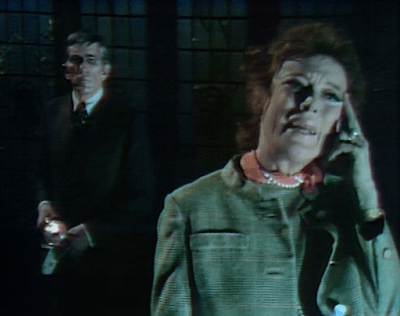
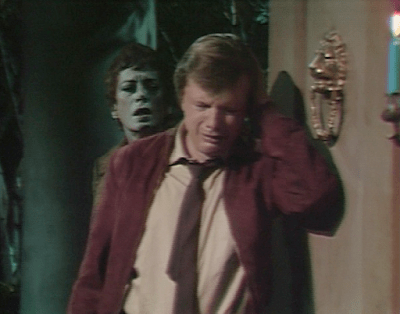
Today, everyone has the memory of a goldfish. Heiress Carolyn receives a telepathic message from her mother, the apparently-dead Liz, urging her to go home to the great house of Collinwood and stay inside in order to escape a terrible danger. A few minutes later, she has apparently forgotten the content of this message, as she goes back outside to check on Liz in her coffin.
During her brief stay in Collinwood, Carolyn talked with permanent houseguest Julia. Julia keeps telling her that Liz is dead and that the dead cannot communicate with the living, suggesting that she too has become a goldfish. Julia is a doctor, and Liz is entombed because she mistakenly declared her dead. She had made the same mistake about her several weeks before, and learned nothing from that experience. But she has also attended several séances, built two Frankenstein’s monsters, seen a number of ghosts, and spent a year and a half carrying on a one-sided romance with recovering vampire Barnabas. She also knows that in #592 and #593, Carolyn herself died and came back to life. So it is bizarre that she goes on about the finality of death and the impossibility of communication between the living and the dead.
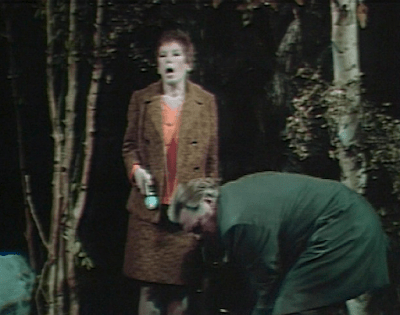
Carolyn goes back to her mother’s crypt and is attacked by a werewolf. Liz knew she would be buried alive, and so insisted her coffin be equipped with a button that would ring bells everyone at Collinwood could hear. While Carolyn is confronting the werewolf, Liz overcomes her paralysis sufficiently to push this button. That brings Barnabas and Julia.
The werewolf paused in his attack on Carolyn when he saw her silver bracelet; that gave Julia and Barnabas time to arrive while Carolyn was still alive. Barnabas strikes him with the silver head of his cane, causing him to run off. When Carolyn tells of the werewolf’s fascination with the bracelet, Barnabas mentions that the head of the cane is also silver; he grows very thoughtful, apparently realizing that silver has a power over the werewolf. Yet later, when he goes to hunt for the werewolf, he takes a gun but nearly leaves the cane behind. He finally takes it, but his long hesitation shows that he, too, is suffering from goldfishism.
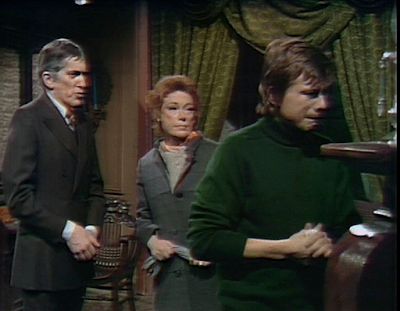
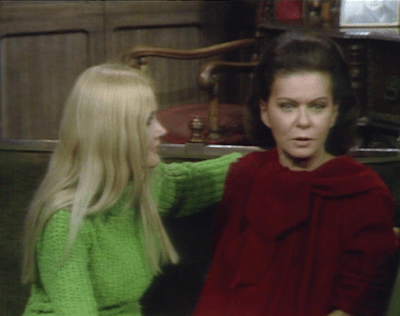
While still in the crypt, Julia had looked at Liz’ body and insisted she was dead. She wrote off the ringing of the bells as a coincidence, perhaps caused by some jostling during Carolyn’s encounter with the werewolf. Later, Liz gets out of the coffin and goes home to Collinwood. There, Julia, Barnabas, and Carolyn are astonished to see her. Julia examines her. After she finds that Liz has what is in Collinsport English called a “pulsebeat,” she seems willing to concede that she might be alive. She then starts giving orders which everyone willingly follows, because she is such a good doctor.
Liz is the one character whose brain seems to be in working order today. She can remember that her trouble started when her brother Roger’s wife Cassandra cast a spell on her. Barnabas and Julia know that Cassandra was in fact a wicked witch named Angelique, and that Barnabas has just returned from a trip back in time during which he destroyed Angelique. They assure her that Cassandra will never return. They can’t tell her why they are sure of this, because they, like the producers of Dark Shadows, have decided that Liz must never know what is really happening around her, lest she become an active participant in the plot. So all they can say is that they just know, and she is of course unconvinced.
It is a relief to wrap up the “Liz will be buried alive” storyline; that was dull from the beginning, and just got duller as it went. It didn’t help that we have seen Liz immobilized by depression twice before. This isn’t even the first time she has been rendered catatonic as the result of a curse placed by an undead blonde fire witch.
It’s also encouraging that Julia and Barnabas have met the werewolf and are engaged with him. They are the show’s chief protagonists, and nothing can really move without their involvement. Now that they are involved with the werewolf, we can stop spinning our wheels.
Frankenstein’s monster Adam has threatened to go on a murder spree unless old world gentleman Barnabas and mad scientist Julia build him a mate. He has further demanded that heiress Carolyn donate the “life force” that will animate his bride. We open today with a reprise of yesterday’s ending in which the experiment begins and immediately goes wrong. Julia announces that unless the mate comes to life in the next sixty seconds, Carolyn will die. They show us a clock. Sixty seconds pass, and the mate doesn’t come to life. So I guess Carolyn is dead now.
When we return from the opening titles, Adam insists on taking Carolyn from the laboratory. Julia says that Carolyn is in a bad way. Using a bit of Collinsport English, she says that Carolyn’s “pulsebeat” is decreasing. Alarmed, Barnabas asks if she might die. Julia reluctantly admits that it is possible. Evidently the opening titles wiped their memories clean of her earlier statement about the sixty seconds that would determine Carolyn’s fate.
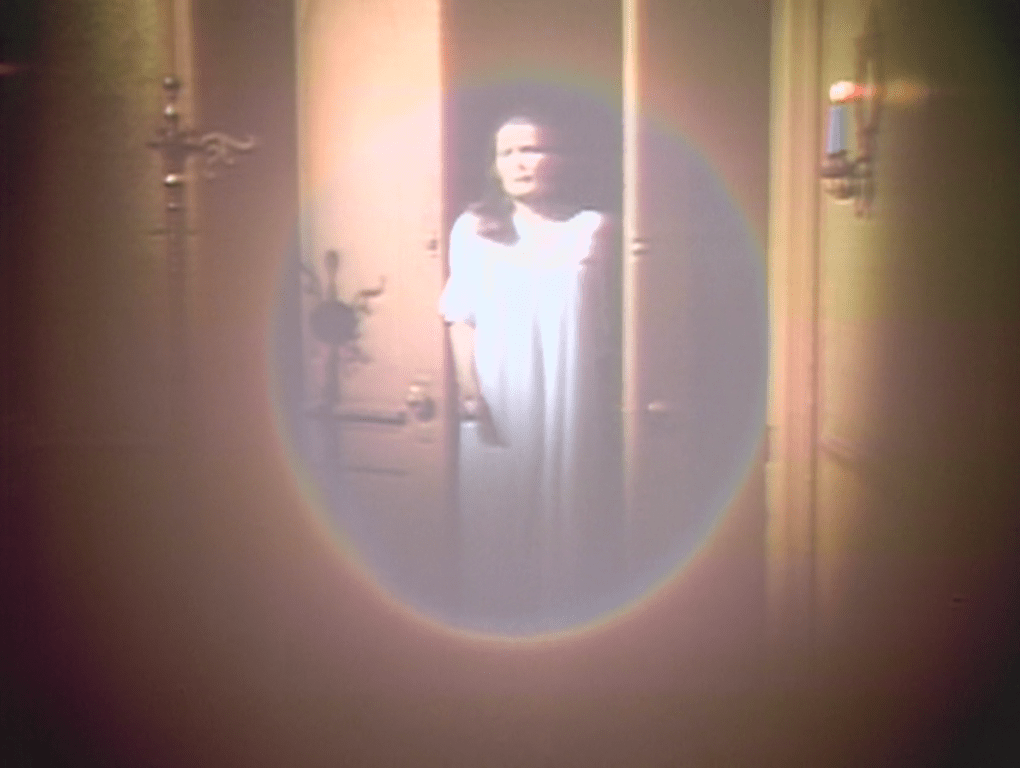
Adam and Carolyn share a scene in the upstairs bedroom. Robert Rodan and Nancy Barrett do a wonderful job of acting, enough to save the episode from the “Stinkers” label. As Carolyn describes what she saw while she was unconscious during the experiment, images of sculpted pieces depicting body parts are superimposed on the screen over her face. She says she “saw something in the fog… hazy forms, floating in the air. They began to take shape. A collection of dead things, disconnected, coming toward me, wanting something from me-wanting life. My life!” The superimposed images don’t lead to anything, anymore than anything else in the episode does. But they are typical of the bold visual artistry of director Lela Swift, and evocative of the sort of thing you would see in the more ambitious low-budget films of the period.
Carolyn loses consciousness just before Julia comes in with her medical bag. Julia pronounces Carolyn dead. Adam goes to the basement, where he tells Barnabas he is ready to start his murder spree. Barnabas tries to stop him, and Adam easily beats him down. Adam storms out of the house, passing Julia in the foyer on his way to the great house of Collinwood. Barnabas staggers upstairs and tells Julia what happened. She goes upstairs to retrieve her bag so she can treat his wounds, and finds that Carolyn’s body has vanished from the bed.
Professor Timothy Eliot Stokes, expert on the occult, finds himself laboring under the direction of Julia Hoffman, MD. Stokes does not understand why Julia insisted on leaving the long abandoned shack where a very tall, very mysterious man named Adam seemed to be suffocating, he does not understand why Julia has buried her friend Barnabas Collins in an unmarked grave in the woods, and does not understand why Julia has concluded that Barnabas is alive and they must dig him up. Julia tells Stokes she will answer his questions when the exhumation is complete. Stokes keeps digging. They reach a coffin. They open it to find Barnabas. Julia detects a faint “pulsebeat” in his wrist. Before Stokes can raise his questions, Julia says she wants to be alone with Barnabas and reminds Stokes that Adam needs attention.
Back in the shack, Stokes finds heiress Carolyn Collins Stoddard with Adam. Earlier, Carolyn was distraught, unable to find a “pulsebeat” in Adam’s wrist, but now he is up and moving, apparently quite well. Stokes says that Julia is on her way, and Adam becomes agitated. He hates Julia and Barnabas, but has never explained to Stokes or Carolyn why. Carolyn decides to hide him in the long-deserted west wing of her family’s home, the great house of Collinwood. Stokes sees many drawbacks to this plan, but can suggest no alternative.
Only Stokes is still in the shack when Julia comes. He will not tell her where Adam has gone, and she will not answer any of his questions. With a smile, he tells her that he looks forward to understanding Barnabas’ secret. At this, she looks uneasy, clearly not welcoming that prospect.
Barnabas was, for 172 years, a vampire. His curse went into remission earlier in 1968, and he has been virtually human since #490, when he took part in an experiment that brought Adam to life as a Frankenstein’s monster. Julia ordered Barnabas’ servant Willie to bury him the other day, because she was afraid he was about to become a vampire again, but yesterday she figured out that Adam’s existence was keeping that from happening.
When Barnabas is unearthed, he is afraid that he has reverted to vampirism. Julia shows him his reflection in her compact mirror, proving to him that he is still human. The first time they did the vampire/ mirror bit was in #288, when Julia saw that Barnabas did not cast a reflection in a compact mirror and thereby confirmed her suspicion that Barnabas was a vampire. That led him to try to kill her. Now they are fast friends, and the same gimmick, with the opposite result, brings them a moment of shared joy.
Barnabas goes to the great house, and sees wicked witch Angelique/ Cassandra standing on the terrace. She was the one who cast the spell that prompted Julia and Willie to think they ought to bury him, and Julia had told her that he was dead. She is rather surprised when he shows up. He taunts her with the failure of her attack on him, she pretends not to know what he is talking about, and he goes along his merry way. Alone, she vows that she will soon regain her power over Barnabas.
A magical bat has bitten recovering vampire Barnabas Collins on the neck and Barnabas appears to have died. Barnabas’ friend Julia and his servant Willie have a conference to discuss their next steps. Barnabas had expected such an attack, knowing that the witch who made him a vampire in the first place has been working to renew her curse. Willie laments the situation, crying out, “Aw, now we’re gonna hear the dogs howlin’ again!” Evidently that’s the bad part.
Barnabas had directed Julia and Willie to drive a stake through his heart once it had stopped beating. They can’t do it. They decide to bury him in the woods instead. Willie mentions a cross; a silver cross inside the lid of his coffin had kept Barnabas immobilized for the 171 years before Willie inadvertently released him to prey upon the living in April 1967, so perhaps that’s how they plan to show mercy to their friend.
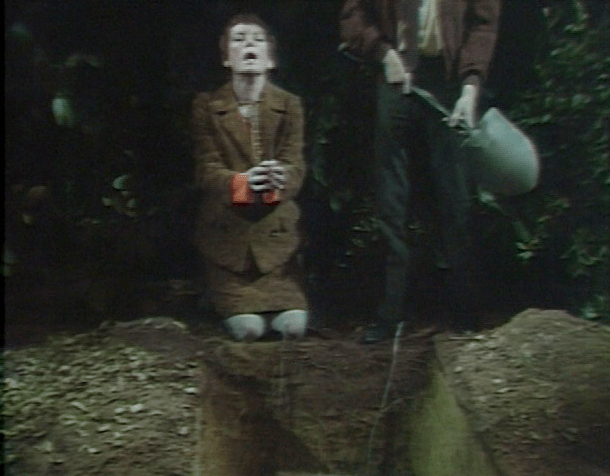
Once Willie has dug the grave and put Barnabas’ coffin in it, he and Julia decide to pray. She takes the lead, kneeling and throwing dirt, presumably including stones, onto the coffin. Dark Shadows avoided the topic of religion almost completely until repressed spinster Abigail Collins made her first appearance in #367; she and the Rev’d Mr Trask, introduced in #385, presented a wildly unfair, highly entertaining lampoon of eighteenth century New England Congregationalism. Recently the show has been lurching towards a vaguely friendly attitude towards Christianity. If Julia keeps strewing stones onto the grave once it is filled in, we might think that this friendliness extends to Judaism as well.
Meanwhile, a very tall man named Adam is having a bad time. Adam is a Frankenstein’s monster, and when he was created he drew the effect of the vampire curse from Barnabas. He does not feel the effects of that curse, but he does suffer pain when Barnabas is injured. When heiress Carolyn calls on Adam at the old shack in the woods where he is hiding, she finds that his neck hurts where Barnabas was bitten. When Julia declares Barnabas dead, we cut back to the shack, where Adam has stopped moving. Occult expert Timothy Eliot Stokes has joined Carolyn; he feels Adam’s wrist, and in a bit of Collinsport English that is becoming increasingly prominent on the show says that he can find no “pulsebeat.”
Barnabas was bricked up in a wall from #512 to #516, and Adam felt his pain during that period. So it is no surprise to returning viewers that Adam suffers along with Barnabas now. We also have heard countless repetitions of something neither Julia nor Willie has ever heard, an audiotape in which Eric Lang, the mad scientist who created Adam, explains that as long as Adam lives Barnabas will be free of vampirism. So we doubt that Barnabas’ curse will return, and hope that Adam’s suffering will be the clue that leads Julia and Willie to rescue Barnabas from being buried alive. Since Julia and Willie have no idea where Adam is and Adam hates them both, it’s as difficult to see how they could find out what he’s going through as it is to see how Barnabas could get out of the grave any other way. In that difficulty is the suspense with which the episode ends.
Yesterday, recovering vampire Barnabas opened the door to his closet. Hardworking young fisherman Joe fell out, and Barnabas saw Frankenstein’s monster Adam at the window, laughing menacingly. Adam has many reasons to hate Barnabas, and Barnabas concludes that Adam wants to frame him for the murder of Joe.
A commenter on John and Christine Scoleri’s Dark Shadows Before I Die, posting under the name “Grant,” pointed out that in Mary Wollstonecraft Shelley’s novel Frankenstein the Creature kills someone and frames one of Frankenstein’s closest friends for the crime. The reference seems to be pretty obvious.
Barnabas’ friend, mad scientist Julia, shows up. She finds that Joe is not dead. She says that he has, in a bit of Collinsport English we have heard once or twice before, “a pulsebeat.” She and Barnabas have a long conversation about a variety of topics, several of them highly incriminating, while Joe lies on the floor. Julia goes off to attend to another matter, and Barnabas’ servant Willie comes. Joe is still on the floor while Willie argues against Barnabas’ orders to take Joe to the hospital. Barnabas, who had told Julia that Adam must have “wanted Joe to be found here,” dismisses Willie as “absurd” when he says that Adam is trying to frame them.
When Willie was first on the show, he was a dangerously unstable ruffian who was determined to rape all the young women and beat up their boyfriends. In #210, he accidentally released Barnabas, who enslaved him and turned him into a nice guy. Now that Barnabas’ vampirism has gone into remission, Willie has taken several steps back to his old ways. He whines that if Joe dies, his fiancée Maggie might turn to him. Barnabas finds this idea “insane,” and Willie tells him that Maggie has recently stopped by the house and talked to him more than once. This is true, and Barnabas’ reaction makes it clear that it is the first time he has heard it. He responds that he is not interested in discussing Willie’s “mental aberrations,” and tells him that if Joe dies he will tell the police about Willie’s interest in Maggie. That leaves Willie no choice but to help get Joe to the hospital.
Julia has gone off to see well-meaning governess Vicki. Vicki is about to have a nightmare that is part of the “Dream Curse.” Three months ago, wicked witch Angelique decreed that one person after another would have the same dream. After Vicki has it, the dream will pass to Barnabas, and Angelique means for it to reactivate his vampirism. Vicki doesn’t seem to know that Barnabas was a vampire, though she has had many clues, as for example when he kept biting her and sucking her blood. I suppose she just thought he had a really aggressive make-out technique. But she does know that Barnabas is supposed to die if he has the dream.
Julia urges Vicki to come with her to Windcliff, a sanitarium she runs, and promises that she will get the best of care there. But she finds that Vicki is resigned to having the dream. Julia reports this to Barnabas, and tells him that she wants to go away with him, far away from Vicki. Vicki can’t pass the dream to Barnabas unless she describes it to him after she has it, and she won’t be able to do that if she can’t find him. Barnabas refuses to go, reminding Julia that those who have the dream suffer terribly until they pass it on to the next person. When he says “You know how I feel about Vicki,” Julia gets a brief closeup, and her reaction reminds us that she is supposed to be harboring an unrequited love for Barnabas. This is rather an easy point to forget. Barnabas and Julia spend all their time together and tell each other all their secrets. Since there doesn’t seem to be any such thing as sexual contact in the world of Dark Shadows, it’s hard to see how her feelings could be much more requited.
Julia urges Barnabas to run away with her.“You know how I feel about Vicki.”
Vampires are metaphors for extreme selfishness, and Barnabas usually plays to type. It is startling that he tells Julia that any part of his motivation for sticking around is his wish to spare Vicki suffering. But he also talks about his long vain struggle against Angelique in terms that immediately make it clear that whatever goodwill he might have for Vicki is a distant third behind his usual ruling passions, self-pity and laziness, but still, her well-being is among his considerations. That sets him apart from her ostensible boyfriend, a man variously known as Peter and Jeff. As Christine Scoleri points out on Dark Shadows Before I Die, Vicki might never have had the dream at all if Peter/ Jeff hadn’t refused to listen to her explanation of the curse and insisted that she stay where he could visit her easily, yet now that she is suffering from the dream and its effects he is nowhere to be seen. Christine speaks for all of us with her summary of Peter/ Jeff’s character- “What a louse!”
Vicki has the dream. Barnabas beckons her into the haunted house attraction where the bulk of it has always taken place before. She keeps telling him that she doesn’t want to have the dream, not for her sake, but for his. She opens three doors that show Halloween gimmicks we’ve seen before, then opens a fourth behind which she sees the Sun. The Sun shrinks into the distance, and she walks through the door, following it. Her face dissolves into an image of the Sun; the Sun dissolves to the exterior of Barnabas’ house. We cut to the interior, looking at the doors. A small dot of Sun appears there. It expands until it fills most of the screen. The doors open, and the Sun gives way to Vicki. She enters, and sees Barnabas lying on the floor by his desk. He is bleeding from two small wounds on his neck.
Part of the dream is a bit of doggerel that has never made much sense. The last lines are “Ahead a blazing light does burn, And one door leads to the point of return.” These lines are almost explained today. Each door exposes a symbol of something that is frightening either to the dreamer or to Barnabas or to both. Vicki isn’t afraid of the Sun, but she knows that Barnabas has a strange and intense relationship with it. In #277, he harangued her about his hatred for the Sun; in #347, he made plans with her to watch the Sun rise, plans which he had to break under very strange circumstances in #349. So now we know that the “blazing light” is the Sun, which vampires cannot withstand.
Of the ten characters who had the dream before Vicki, only strange and troubled boy David, her charge and dear friend, was able to walk through any of the doorways. In his case, he walked into a gigantic spider web and was caught there, just a few feet beyond the entry. But Vicki is on the path that “leads to the point of return,” and she goes to a different set altogether.
Had Barnabas’ introduction not brought a new audience to the show, Dark Shadows would probably have been canceled in June 1967. In that case, the final episode would have been #260, and it surely would have ended with Vicki, who was in those days the show’s main character, driving a stake through Barnabas’ heart. That she and the Sun overlap in the same space on the screen suggests that by passing the dream to Barnabas she will fulfill her original destiny and become his destroyer.
When Vicki looks into the parlor and sees Barnabas bloodied and lying on the floor by his desk, we are reminded of #405. In that episode, we saw that Angelique originally turned Barnabas into a vampire by sending a bat to bite him in this room. At that time, he fell, not by his desk, but by the staircase. That’s very close to where Joe was lying for the first half of the episode, so they have to do some rearranging to avoid suggesting an identity between them. Barnabas’ vampirism is so much the foundation of the show’s success that virtually everyone in the audience expects him to relapse sooner or later, but they are being careful not to raise the question of whether Joe will also join the ranks of the undead.
Until the dream, the episode is made up of long scenes with a great deal of dialogue. That isn’t unusual for Dark Shadows. It is unusual that the scenes play out with very little background music. I wonder if director Jack Sullivan decided that a spare sound design would set the right mood for the very ambitious dream sequence. I think it paid off- the dialogue scenes felt slow, but Vicki’s dream achieves the surrealistic quality it needs.
One of the main themes Danny Horn developed on his blog Dark Shadows Every Day was his ridiculously exaggerated impatience with the character of Vicki and his severe bias against Alexandra Moltke Isles’ acting. That gave me something to talk about in his comments section, and was part of the reason I started this blog. Danny’s post about this episode very nearly makes up for his incessant Vickiphobia. He alternates stills of Vicki with epigrams written in her voice, and the result is just magnificent, worth anyone’s while to read.
In his post about this episode on Dark Shadows Every Day, Danny Horn remarks on the recapping that permeates the dialogue and reckons it as writer Sam Hall’s critique of the ongoing storylines. That assessment will be familiar to those who, unlike Danny, have been watching the show from the beginning. When Ron Sproat joined the writing staff in October 1966, his first several scripts featured a systematic inventory of the available narrative material, with each plot very explicitly marked as suitable or unsuitable for further development.
In its first year, very little happened on Dark Shadows; now, it has swung to the opposite extreme, and there is a climax at every commercial break. But the result is oddly similar. They don’t take the time to explore the overall situation, so that little seems to be at stake even when a spectacular event takes place. No matter how much happens per minute of screen time, it feels like the pace is slow. We see suave warlock Nicholas in the gazebo on the grounds of the estate of Collinwood summoning his subordinate, the wicked witch known variously as Angelique and Cassandra, and hear him complain that she has spent weeks attempting to do what she should have accomplished in minutes. Thus Hall assures us that the pace will be picking up.
Angelique/ Cassandra comes to the gazebo, to which Nicholas refers as a “ga-ZAY-bo” in a bit of Collinsport English Angelique/ Cassandra herself introduced in #489. There, the two of them quarrel about her dilatory approach. They stand behind columns and look like debaters at podiums.
Maybe I’m reading too much into the set design, but in one of the photos Angelique and Nicholas are sperated by a statue of a Goddess (I assumed Venus). Wouldn’t it be awesome if it was Venus and that statue between them was to represent Angelique’s love for Barnabas blocking her efforts at villainy? More likely that the shot just looked better composed with the statue in the middle but how awesome if it was meant to be subtle symbolism! 🙂
“lakeplacidskater,” posted 25 February 2015 on Danny Horn, “Episode 528: This Tawdry Affair,” 21 November 2014.*
The statue appears to me to represent not Venus, but a harvest goddess. She is fully clothed, and there is a sack at her feet which seems to be full of grain. That makes a lot less sense than does the suggestion “lakeplacidskater” made. The Collinses derive their wealth from fishing and shipping, not from farming, so it is surprising that they would put a symbol of agriculture in such a prominent place. Perhaps she stands for wealth in general, but not for so much wealth that the family could afford to commission a statue of a sea goddess. And neither a bountiful harvest in particular nor wealth in general is any sort of obstacle between Nicholas and Angelique/ Cassandra. I suppose the visual metaphor might be emphasizing the image of the two of them as debaters, with the goddess serving as moderator.
Nicholas dominates Angelique/ Cassandra thoroughly and rather cruelly. Viewers who remember her from the portion of Dark Shadows set in the late eighteenth century may be taken aback by this. In those days, her power often seemed to be limited only by her own carelessness. That made for something of a shapeless narrative, since no one could oppose her effectively. Not only does Nicholas reduce her to a lowly state today, but he himself bungles a simple task when he sets out to do something nasty to well-meaning governess Vicki. Thus we see that the villains will have their work cut out for them.
Later, Vicki is in bed at her friend Maggie’s house. She has gone there to escape a curse Angelique/ Cassandra has placed that has caused several people to have the same nightmare. Since Maggie was at home when she was the first person to have the nightmare, and Vicki’s boyfriend Peter was sleeping there when he had it, it is hard to understand why Vicki thinks it is a place of safety.
We have several closeups of the face of the clock while Vicki goes to sleep. It’s an Ingraham eight day clock, apparently they wanted to make sure we knew that. When Vicki finally nods off, Angelique/ Cassandra materializes in the room with a jar of rose water that is supposed to make Vicki have the nightmare. Ever since the days when humanoid Phoenix Laura Murdoch Collins was on the show, we’ve been seeing undead witches materialize in people’s bedrooms while they sleep. This time, Maggie walks in and sees Angelique/ Cassandra. She screams at the sight. All of the women in the cast were required to scream frequently, so frequently that fans become connoisseurs of screaming. Kathryn Leigh Scott was one of the better screamers, not far behind Clarice Blackburn, so that makes for a satisfying ending.
*I can’t help but point that when “lakeplacidskater” left her post, all the members of the cast were still alive. Humbert Allen Astredo would die in 2016 and Lara Parker in 2023; Alexandra Moltke Isles, Roger Davis, and Kathryn Leigh Scott are still with us.
Wicked witch Angelique has cast a spell on lawyer Tony, compelling him to do her bidding. Today he calls on her at the great house of Collinwood. He is starting to remember some of the things he did for her. He can’t remember why he did them, and is troubled. She commands him to meet her at the gazebo on the estate. Up to this point in the series, Angelique and all other characters referring to this structure have spoken the word “gazebo” in its usual North American pronunciation, as /gəzɪ́jbəw/ (“ga-ZEE-bo.”) When Angelique tells Tony to meet her, she directs him to the /gəzējbəw/ (“ga-ZAY-bo.”)
In the gazebo, Tony shares his vague recollections with Angelique. He says that he does not understand why he would obey her commands. She tells him to look at her. When we heard this line, Mrs Acilius and I both laughed. Lara Parker delivers it with a little smile and a relaxed voice that made it sound like she was about to say “Of course you can’t resist me, I’m gorgeous!” Instead, she puts the zap on him and gives him more orders. But after she releases him from his trance, he again says that he doesn’t understand why he keeps coming to her, and she does in fact say that he’s falling in love with her. They kiss.
Angelique took up residence at Collinwood just a couple of weeks ago. She had cast a spell on sarcastic dandy Roger Collins and married him. Roger’s son, strange and troubled boy David, has been on a trip to Boston the whole time. David is about ten, but evidently he’s been incommunicado. He comes back today, and is surprised to find that he has a new stepmother. His surprise turns to alarm when he walks in on Tony and Angelique kissing. Later, he announces to Angelique that he will tell his father what he saw in the gazebo. He too pronounces it /gəzējbəw/. Evidently this bit of Collinsport English is taking root.
Angelique strikes David mute. The last time we saw her use her powers to silence a potential witness against her, Dark Shadows was a costume drama set in the 1790s, and her victim was indentured servant Ben. Ben was barely literate, but was able in #401 to write the letter A to indicate that she was the witch. Angelique has learned since then, and also prevents David from writing.
There are also two scenes where Angelique tries to find out if housekeeper Mrs Johnson has had a nightmare. Her motivation is to do with the Dream Curse, a dismal storyline I won’t explain, but the scenes are hilarious. Mrs Johnson is as commonsensical and down-to-earth as can be, while Angelique is as intense and melodramatic as can be. The two of them are naturally funny together, and these scenes leverage Clarice Blackburn’s gift for comedy of manners.
In a room at the Collinsport Hospital, very loud physician Eric Lang (Addison Powell) opens the curtains to show his patient, old world gentleman Barnabas Collins, that it is a sunny afternoon. It takes Barnabas a moment to realize that this is Lang’s way of showing him that he has cured him of his longstanding affliction, vampirism. Once he figures it out, Barnabas is very happy to be human again.
Barnabas talks with Lang about the origins of his vampirism. At one point Lang says “Ah, so a curse was responsible.” You know how doctors are, always coming out with the same cliches. Lang does say something novel when he remarks on Barnabas’ “pulsebeat.” That specimen of Collinsport English will be back.
In the great house of Collinwood, Barnabas’ distant cousins Roger and Liz are at odds. Roger keeps having conversations with a portrait, in the course of which he loses track of the time. The correct time is 1968, and he keeps thinking it is 1795. When he does that, he mistakes himself for his collateral ancestor Joshua Collins and his sister Liz for Joshua’s wife Naomi. Today, Liz has to slap Roger to get him back to himself. Louis Edmonds’ alternation between Joshua and Roger is masterful, one of the outstanding moments of acting in the whole series.
The portrait is of Angelique, the wicked witch who made Barnabas into a vampire in the first place. At the hospital, it becomes clear that Angelique’s spirit is controlling Roger through it. He is cold and distant, staring out the window when Barnabas tells Liz he wants to take up gardening, refusing to say a word when Lang enters the room. When he takes his leave, Roger looks at Barnabas and declares “It’s not this easy.” We realize that he is a puppet for Angelique. Roger steals Lang’s cartoonish mirror-bearing headpiece.
We cut back and forth between Barnabas’ hospital room and the drawing room at Collinwood. At Collinwood, Roger shows the headpiece to the portrait and explains that it was Lang’s. He starts to twist it. In the hospital, Lang suddenly leaps up with a splitting headache. Roger stops twisting, and Lang says he’s better. He resumes twisting, and Lang resumes suffering. Roger tells the portrait he cannot obey its command to put the headpiece in the fire, and throws it across the room. In the hospital, Lang suddenly recovers from his headache. Barnabas tells him it was Angelique’s doing, and says that he will have to become a vampire again to spare Lang her attentions.
On his blog Dark Shadows Every Day, Danny Horn identified Addison Powell as “THE WORST ACTOR EVER TO APPEAR ON DARK SHADOWS.” I don’t agree with that. In yesterday’s episode, for example, Powell attained a level that could fairly be described as “competent,” a label that forever eluded figures like Mark Allen (Sam Evans #1,) Michael Currie (Constable/ Sheriff Carter,) and Craig Slocum (Noah Gifford and, later, Harry Johnson.) And there will be times when his ludicrous overacting lends just the note of camp that turns a scene from a tedious misfire to an occasion for chuckling. But he is pretty bad today. When an actor gets to be depressing to watch, I sometimes make his scenes bearable by trying to imagine what it might have been like if, instead of casting him, they had chosen someone else who might have been available.
So many members of the original Broadway cast of the musical 1776 appeared on Dark Shadows at one time or another that I tend to assume that any of them would have accepted any part on the show. Howard da Silva played Benjamin Franklin in 1776, and he is my imaginary Dr Lang.
You can see da Silva’s Franklin in the 1972 movie version of 1776, where he plays the Sage of Philadelphia with frequent chortles that suggest a mad scientist gleefully working to release a murderous nightmare on the world, which is more or less the show’s vision of the founding of the USA. That isn’t Franklin’s only note- he has occasion to speak earnestly about the British Empire’s mismanagement of its North American possessions, and sorrowfully about the need to leave slavery alone while concentrating on the fight for independence. Those who have seen da Silva play subtle and powerfully compassionate men in his other work, for example as the psychiatrist in the 1962 film David and Lisa and as the defense attorney in the 1964 Outer Limits episode adapting Isaac Asimov’s story “I, Robot,” will hardly be surprised that he could be effective in those moments.
So when Powell overdoes the shouting, I imagine da Silva in his place, going through his bag of tricks to show us a man who might be taking a maniacal satisfaction in his blasphemous labors, who might be profoundly devoted to the relief of suffering, and who might be both at once. Sometimes I get a pretty clear image of what that would have been like, and when that happens the show in my head is hard to beat.
This one is an exercise in nostalgia for people who have been watching Dark Shadows from the beginning.
We remember the days when high-born ne’er-do-well Roger Collins was the show’s chief villain, a man with so little sense of family loyalty that he openly hated his own son. That son, strange and troubled boy David, repaid his father’s hatred by trying to murder him. Roger has been off-screen for over six weeks; when he comes back today, the first thing he sees is the sheriff’s car in the driveway, and the first thing he hears is that the sheriff has come about David. He stiffens, and in a voice dripping with distaste asks “What about David?” When well-meaning governess Vicki explains that David is not suspected of a crime, but is missing, Roger scolds her for failing to earn her pay by keeping track of the boy. He seems to be far more irked by the money wasted on Vicki’s salary than by David’s disappearance.
When heiress Carolyn and hardworking young fisherman Joe come to report on their fruitless search for David, Roger turns his disdain on them, berating them for letting him get away in the first place. Seeing Joe and Carolyn together brings back memories of the early months of the show, when the two of them were dating and there was a whole storyline about how bored they were with each other. For that matter, we were reminded of the first 40 weeks when Vicki hesitated to tell Roger that she had been on a date with her depressing fiancé Burke Devlin- Burke had been Roger’s sworn enemy until he decided to peace out in #201.
Roger agrees to go with Joe on a search of the countryside. When Vicki and Carolyn are left alone in the drawing room, they have a conversation about how tired they both are. Each of them urges the other to take a nap, and each responds that she can’t sleep. Writer Malcolm Marmorstein was fired off the show a few days ago; he was perfectly capable of taking a conversation like that and making a whole episode out of it. Today’s episode is filler from the point of view of the overall plot, but the ludicrous pointlessness of this conversation is a rarity in the post-Marmorstein era.
Roger and Joe’s search is represented in a couple of shots done in front of a green screen showing outdoor locations. That casts our minds back to the black and white episodes, which occasionally spliced in location inserts. Most of that footage was taken before the series started principal photography, and none of it can be reused now that the show is in color. The last of these inserts came in #275, when Carolyn took a walk on the beach. Now Dark Shadows is shut within the doors of 442 West 54th Street forever, and its only memory of the outside is in these green screen shots.
Roger continues his flagrant display of indifference to David throughout this sequence. When he sees men in blue uniforms searching for David, he makes some acerbic comments about the incompetence of the local police.* When Joe points out a nearby cemetery where odd events have been taking place of late, Roger remarks on its dreariness and on the generally low aesthetic standard of cemeteries in central Maine. When Joe suggests searching there, Roger is appalled, and joins him only with loud reluctance.
After Roger says “down” meaning “up,” which is a feature of Collinsport English we heard in #12, In the cemetery, we get another reminder of the show’s past. The Caretaker, a doddering old fool played hilariously by Daniel F. Keyes, had a significant part in the story of Roger’s ex-wife, undead fire witch Laura Murdoch Collins, appearing in #154, #157, #179, and #180, and appeared again in episodes #209 and #211, which dealt with the introduction of vampire Barnabas Collins.
When we find him today, the Caretaker is inspecting the area around the Tomb of the Collinses. Unknown to him, there is a secret chamber hidden inside this tomb. David is trapped in that chamber. The Caretaker opens the door to the visible part of the tomb and asks if anyone is there. He hears David’s voice calling for help from the other side of the wall, and jumps to the conclusion that he is hearing a bunch of ghosts. “There is no help for you!” he cries out. As he hurries away, he shouts, “You must rest!”
David is nothing if not obedient. A minute after the Caretaker told him he must rest, he sits down and falls asleep.
The Caretaker runs into Roger and Joe. He asks them if they are alive. As “You must rest!” harked back to his constant refrain in his previous appearances that “The dead must rest!,” so this greeting echoes his first line in his first scene, when he asked Vicki and her instantly forgettable boyfriend Frank if they were alive. Frank responded to that one calmly; with his personality, it was a question he probably got from a lot of people. By contrast, Joe is disbelieving and Roger scoffs.
When they tell the Caretaker they are looking for a boy named David, he replies “Yes, he is here,” then describes the death of a boy named David who is buried in one of the graves. His compulsion to tell us the circumstances of people’s deaths is another trait of his we remember from the Laura days, especially in his oft-repeated phrase “died by fire!”
The Caretaker tells them that he heard the voices of the dead in the tomb. He urges Roger and Joe to stay away from it. Roger tells him he will be happy to oblige, but Joe insists they search there. Roger declares that he is embarrassed by the very idea of going inside such a place, and says that if anyone finds out he did he will blame Joe. Again, Roger can barely restrain his eagerness to give up the search for David.
David is too deeply asleep to hear Roger and Joe in the outer chamber. Since they are there, Roger decides to take a moment and look at the plaques naming the people buried in the tomb. After all, they are his “incestors – incestors! I mean ancestors.” This is one of the most famous bloopers in the entire series. If Louis Edmonds hadn’t stopped, glanced back at Joel Crothers, repeated “incestors,” and corrected himself, I doubt many people would have noticed it. It was a suprisingly unprofessional moment, but who would have it otherwise? To the extent that the episode is a retrospective of Dark Shadows so far, it wouldn’t be complete without an attention-grabbing mess-up. If the camera isn’t going to drift away from the mark and show a crew member eating a sandwich, “incestors” is the least we can expect.
Since the episode is so much a review of the show’s bygone themes, it is understandable that some viewers are disturbed by a line in the first scene. Roger mentions to Vicki that, while he has just returned from a trip to Boston, matriarch Liz is staying on in that city a while longer. The Dark Shadows wiki objects: “Elizabeth has decided to stay in Boston. This is incredible, since she was still afraid to leave Collinwood a few weeks ago, even hesitant to go to the Old House.”
I don’t find it incredible. Liz’ hesitation about going out was last mentioned in #280, and by #298 she was not only quick to accept Burke’s suggestion that she go with him to inspect a property on the other side of town, but she was the one who talked Carolyn into coming along with them. Neither Carolyn nor Burke expressed surprise that Liz was the one who was enthusiastic about getting out of the house. With that, Dark Shadows told us that it had no further use for the “Liz is a recluse” theme. They may be taking us on a stroll down memory lane today, but they aren’t going to take us all the way to that particular dead end.
*In all fairness, the Collinsport police are exceptionally incompetent.
Friday’s episode ended with an important scene. Strange and troubled boy David Collins cheerfully escorted dangerously unstable ruffian Willie Loomis around the great house of Collinwood, giving him little lectures about the portraits of the Collins ancestors. David pointed to a portrait in the foyer and spoke a name we hadn’t heard before, identifying it as Barnabas Collins. Willie, then played by frenzied Mississippian James Hall, became fascinated with the jewels Barnabas wore, so much so that for the first time on Dark Shadows his thoughts became audible as a recording playing on the soundtrack. After Willie left the house, we heard a heartbeat coming from the painting and saw Barnabas’ eyes glow.
When Willie’s associate, seagoing con man Jason McGuire, first entered Collinwood in #196, an optical trick made it look like a portrait was hanging on the spot where Barnabas’ portrait is now. While the face on the painting would have to wait until the actor was cast, the rest of the work on it was already done at that point, so that trick, inconspicuous as it would have been to the audience, was a sign that the production staff had decided that Jason’s role on the show would be to precipitate the introduction of Barnabas. And the opening voiceover of #2o2, the episode in which Willie joins Jason as a houseguest at Collinwood, referred to Willie as “one who is to awaken and unleash a force that will affect the lives of everyone.” The special effects surrounding Willie’s first encounter with the portrait would suggest that Barnabas represents that force, and that the portrait is a means by which that force is expressed.
Today’s episode begins with Willie taking another look at the portrait, and will end with him staring at it again. In between these two sessions, we learn that among the many impulses Willie is unable to control is a fascination with shiny objects.
We also see the ninth and tenth iterations of Dark Shadows’ dreariest ritual, in which seagoing con man Jason McGuire makes a demand of reclusive matriarch Liz, Liz resists, Jason threatens to expose her terrible secret, and Liz gives in. The first time comes after the opening credits. In the pre-credits teaser, they raised our hopes that we might see a conversation between them which does not conform to this pattern. Liz tells Jason that Willie can no longer be a guest in the house, and Jason agrees. But as soon as we return, he demands that she give Willie a parting gift in the form of $1000 cash. She refuses, and says she will call the police rather than bribe Willie to leave her home. After Jason threatens to send her to prison and lowers his demand to $500, she capitulates.
When Jason breaks the news to Willie that he is to leave immediately and take $500 with him, Willie notices a diamond-encrusted emerald pin and slips it in his pocket. Minutes later, Liz finds the pin missing and tells Jason she will have to call the insurance company. Jason confronts Willie in the kitchen and demands he hand the pin over. After a tense moment, Willie admits that he took the pin, not because he thought he could get away with stealing it, but because it was so pretty. He goes on about how supremely beautiful fine jewels are, saying that he can judge the beauty of a gem simply by touching it. He begs Jason to let him touch the emerald again. After Jason leaves him alone in the kitchen, Willie looks like he has had a new idea and is resolved to act on it.
Willie’s compulsion to touch the emerald creeps Jason out
Willie starts the scene with angry defiance, proceeds to humiliated dependence, and ends with a look of brisk resolve. John Karlen takes Willie through all of these emotions without any apparent discontinuity of feeling. He is still the defiant man even while he is begging, and still the begging man even while he is making up his mind to follow his new plan. That is as different as can be from Hall’s interpretation of Willie, who frightened us largely because of his extremely mercurial temperament. His moods shifted so wildly from second to second that you had no idea what he might do. It is remarkable that two performances can be so utterly unlike each other in every way, yet be equally effective at conveying menace and equally exciting to the audience wondering what comes next.
Jason tries to convince Liz that Willie didn’t take the pin, but that it simply fell to the floor. This effort collapses immediately. Liz is no longer disposed to give Willie any money; she is planning to call the police and let the chips fall where they may. Jason does not believe Willie will go quietly unless he gets a substantial sum of cash, and is afraid of the trouble Willie can make. So he again threatens Liz, this time focusing on the effect of a potential scandal on her daughter Carolyn and on David. Liz looks away in despair, unable to refuse Jason’s demand.
Willie depresses some characters and enrages others. The only exception is David, who brightens and chatters gladly when he sees Willie. David leads Willie into the study, where he shows him pictures of the Collins family’s eighteenth century ancestors and goes on about their fabulous jewels. He identifies one ancestor as his “great-great-grand-uncle.” “Grand-uncle” is a bit of Collinsport English that we will hear again later in the series. David suggests that some very valuable items might be found buried in out of the way places around town. David’s tales send Willie back into the foyer to stare longingly at the jewels in Barnabas’ portrait.
As we heard Willie’s interior monologue on the soundtrack while he stared at the portrait Friday, so today we hear a recording of Willie’s speech to Jason about his love of jewels while he studies the jewelry in the portrait. As his words come to an end, the heartbeat plays again and the eyes glow again. This time, Willie sees and hears and reacts. He has found his destiny.