
In November 1967, well-meaning governess Victoria Winters came unstuck in time. She went to the year 1795, and took the audience with her. For the next four months, Dark Shadows was a costume drama set in the late eighteenth century. That segment was a triumph for the show, but a disaster for Vicki. She had left her brain in the 1960s. Her behavior was so idiotic that she drove the people of Collinsport to put her to death on a charge of witchcraft, even though the witchcraft laws had been repealed in 1735. She also found herself mired in a romance with an intolerable character called Peter Bradford, played by an intolerable actor named Roger Davis.
Vicki returned to her own time as the noose was being placed around her neck. Peter followed her there, calling himself Jeff Clark and suffering from amnesia. Jeff felt the same way about Vicki that Peter did, and had no memories of or connections to anyone but her, so there was no point at all in his continual insistence that “My name is Jeff Clark!” Nor was there any obstacle in the way of their desire to marry each other. In fact, there was no reason for either of them to be on the show at all by that point. Eventually, whatever supernatural force was keeping Peter/ Jeff in existence gave out, and in #650 he and Vicki disappeared into a time warp, returning to the 1790s.
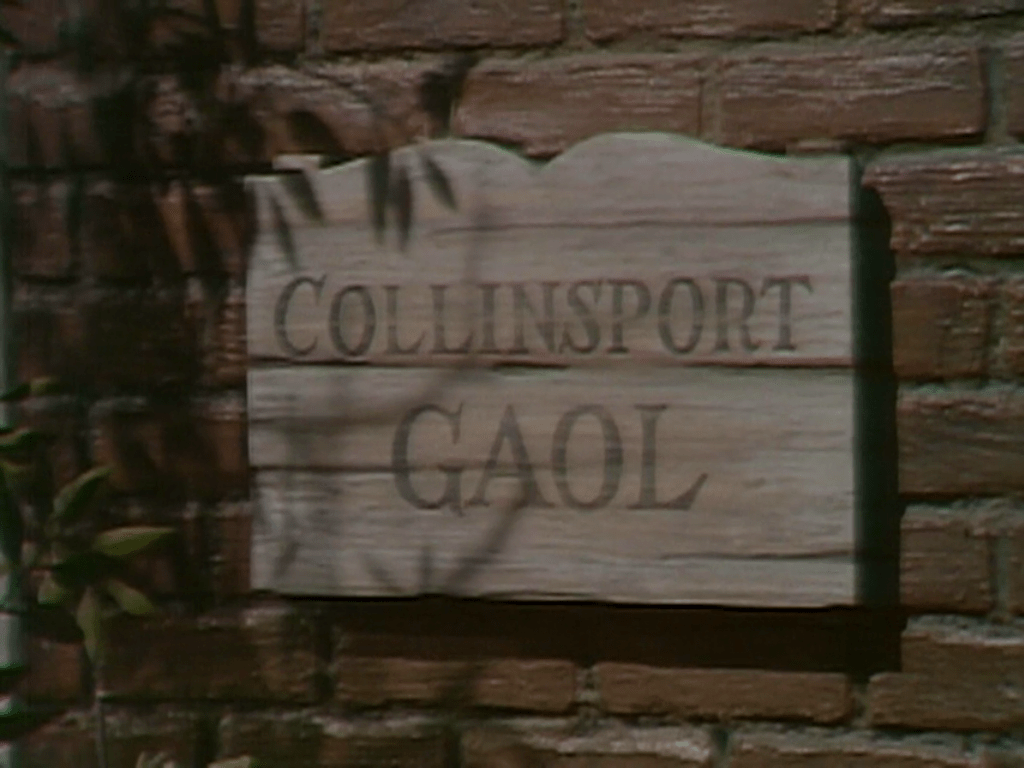
In January 1969, old world gentleman Barnabas Collins traveled back in time to 1796 to find that Vicki was back in the Collinsport Gaol, about to be hanged a second time. Barnabas rescued her, and she and Peter went out west to get married.
Longtime viewers may have been reminded of Vicki and Peter/ Jeff yesterday. The show formally gave up on an effort it had been making to plug the cast into some themes derived from the tales of H. P. Lovecraft and make a story out of it. One of the characters introduced during the Lovecraft segment is a tall young man who at his first appearance asked people to “Call Me Jabe.” In fact, Jabe is a monster from beyond space and time, and the tall young man is only a disguise he assumes. But he fell in love with heiress Carolyn Collins Stoddard and wanted to marry her, so he destroyed everything that gave the menace in that segment its power. When he had done so, he learned that his humanoid form cannot survive indefinitely without that power.
As Peter/ Jeff married Vicki when he was about to vanish from the visible world, so Jabe is frantically trying to persuade Carolyn to marry him tomorrow and run off with him. But a ghost keeps interfering. Today, he learns that the ghost is none other than Peter himself.
Peter tells Jabe that he hates him and will do anything to prevent him from finding happiness with Carolyn. His hatred dates from 1797. In that year, Jabe lured Vicki to kill herself by jumping off the cliff at Widows’ Hill. Peter then shoved Jabe off the cliff, causing him to drown. Peter was hanged for killing Jabe, and as a ghost he still wears a noose around his neck.
This makes zero sense. Jabe came into being only four months ago. He emerged as a whistling sound from a box which Barnabas brought back with him after another trip to the 1790s, but when that trip took place Vicki and Peter had not returned to Collinsport.
It’s even worse when Peter says that drowning is “the only way” Jabe can be killed. When Jabe was a monster, they made a big deal of his vulnerability to werewolves and also mentioned that ghosts could kill him. Granted, the estate of Collinwood is the world capital of both ghosts and werewolves, but it takes a bit of doing to get either of them to work on your schedule. Jabe’s enemies would feel pretty silly if they realized that they could at any point have thrown him in the water and had done with him. Now that his powers are gone, Jabe is going to vanish on his own before long, and if Peter wants the satisfaction of killing him himself he can open any drawer in any piece of furniture at Collinwood, take out a loaded revolver, and gun him down.
Before Jabe took his adult form, he manifested as a series of boys. Antique shop owners Megan and Philip Todd were under the psychic control of the forces Jabe represented, and they acted as his foster parents. Now Philip is in Vicki’s old cell at the Collinsport Gaol. He has confessed to three murders that Jabe committed. When Jabe destroyed the power of the paleogean menace, the control it had over people’s minds broke, and Philip does not remember the murders or why he confessed to them.
For her part, Megan has become a vampire. We find her with her blood thrall, a non-entity named Sky Rumson, who is pleading with her to stay. Her body is relaxed and her voice is dreamy, a mode absolutely new to Marie Wallace on Dark Shadows. In the three roles she has played so far, Miss Wallace has been the single most extreme exponent of the ultra-intense Dark Shadows house style of acting. This Zen version of Megan is refreshing, and disconcertingly sexy. She tells Sky she will call him when she needs him, and wafts away to visit Philip in his cell. She is just as relaxed with him as she was with Sky, and after a couple of minutes she bares her fangs and moves in for the bite.
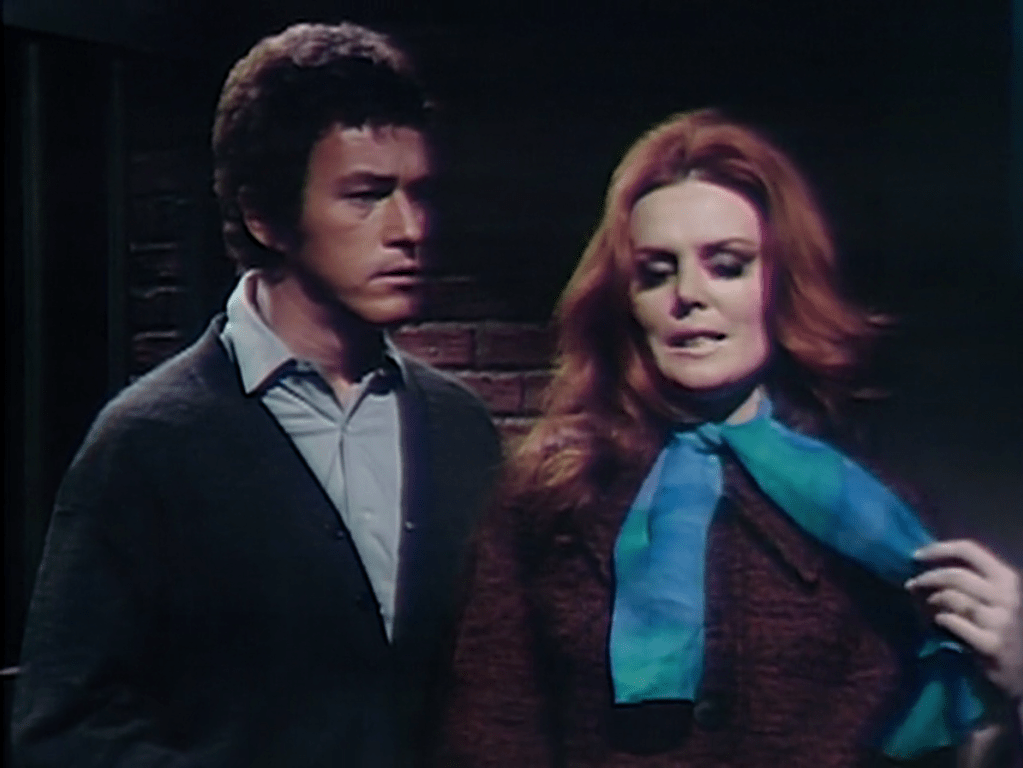
Peter also appears in Philip’s cell. He tells him that it is Jabe’s fault that Megan is a vampire. He breaks Philip out of gaol and invites him to take revenge.
Peter tricks Jabe into going to Widows’ Hill. There, he meets Philip. They wrestle. Evidently Philip is trying to push Jabe over the edge.
When Peter said that Vicki had gone over Widows’ Hill, he harked back to the earliest days of the show. She was standing at the edge of the cliff when high-born ne’er-do-well Roger Collins startled her in #2, and Carolyn told her in #9 that two governesses had already jumped to their deaths from there, and that legend said a third would someday follow. She stood on the edge of the cliff and thought about jumping in #641 and #642, but some people showed up and talked her out of it.
Presumably Peter’s appearance and his story about Jabe’s involvement with Vicki was originally meant to herald yet another return to the 1790s. But in just a couple of weeks, executive producer Dan Curtis will take most of the main cast out of NYC to start principal photography on the feature film House of Dark Shadows. Whatever comes next on the show will have to be written around the absence of the actors who will have major parts in the movie. Perhaps they had trouble writing the time travel segment without them.
Moreover, Vicki has been gone for over a year, and Alexandra Moltke Isles flatly refused to return to the role of Vicki, or to the show at all unless she could play a villain. Two other actresses had briefly taken the part after her departure, but neither of them made much of an impression. Even those who remembered the character would feel that they were watching a different show if yet another new actress were suddenly playing the imperiled heroine. So it isn’t much of a surprise that they did not go with the idea of an eighteenth century backstory connecting Jabe with Vicki and Peter.






 Dark Shadows Commentary