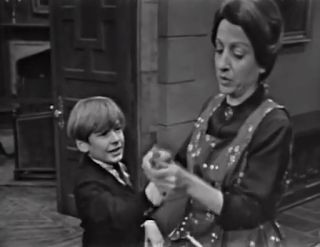
Episode 329: The truth about Willie

We open in the Old House on the great estate of Collinwood, home to courtly gentleman Barnabas Collins. In a bedroom there occupied by Barnabas’ servant Willie, Sheriff George Patterson and artist Sam Evans have found evidence that convinces them they have solved the case of the abduction of Sam’s daughter Maggie. They found Maggie’s ring hidden in a candlestick. The room is in Barnabas’ house and he has unlimited access to it. Further, the house is the only place Willie could possibly have kept Maggie if he had held her prisoner. But for some unexplained reason, they are sure that the ring proves that Willie and only Willie abducted Maggie. When Barnabas says that he feels somehow responsible, Sam rushes to tell him that he mustn’t blame himself.

The sheriff says that he will be going to the hospital, where Willie is recovering from gunshot wounds the sheriff’s deputies inflicted on him when they were looking for a suspect. Barnabas hitches a ride with him.

At the hospital, Willie’s doctor, addled quack Dave Woodard, is conferring with his medical colleague Julia Hoffman. When he steps out of the room for a moment, we hear Julia’s thoughts in voiceover. She is thinking about killing Willie before he can regain consciousness and tell a story that will make it impossible for her ever to practice medicine again. She thinks of Barnabas’ voice demanding that she kill Willie. She is reaching for the catheter through which Willie is receiving fluids when Woodard comes back in. She tells him she was checking it, and he is glad when she confirms it is working correctly.

Returning viewers know that Barnabas is the one who abducted Maggie and committed the other crimes of which Willie is suspected, that he is a vampire, that Julia is a mad scientist trying to cure him of vampirism, and that in pursuing her project she has become deeply complicit in Barnabas’ wrongdoing. We also know that she has several times told him that she will draw the line at killing anyone herself, but that she has involved herself in so many other evil deeds that it was just a matter of time before she found herself on the point of crossing that line.

Barnabas and the sheriff arrive at the hospital. In the corridor, Barnabas is bewildered to find that the sheriff will not allow him to be present while he questions Willie. The sheriff has been so careless about treating miscellaneous people as if they were his deputies- for example, enlisting Sam yesterday to help him search Willie’s room- that Barnabas’ puzzlement is understandable. The conversation goes on for quite a while.

Note the poster that reads “Give Blood.” That’s a message Barnabas could endorse. Screenshot by Dark Shadows Before I Die.

The sheriff enters Willie’s room, and greets Julia as “Dr Hoffman.” Woodard thinks Julia has come to Collinsport to investigate Maggie’s abduction, and so he has agreed to keep her professional identity secret from most people in town, including the sheriff for some reason. Therefore, she is startled at this form of address. Woodard explains that now that Maggie’s abductor has been identified, he doesn’t see a point in keeping law enforcement in the dark.

Julia meets Barnabas in the corridor. When she tells him that she didn’t kill Willie, he fumes and calls her a “bungling fool.” He says he will do the job himself, but Julia points out that Woodard and the sheriff are in the room with Willie now. They wind up staring at the clock for hours.

Willie regains consciousness. He doesn’t recognize Woodard. When the sheriff shows him Maggie’s ring, his eyes gleam and he claims that it is his. Returning viewers will remember that before Willie ever met Barnabas, he was obsessed with jewelry. He is terrified when he learns that it is night-time, and says that he knows why he is afraid.

The sheriff and Woodard go out into the corridor to talk with Julia and Barnabas. Woodard tells Julia that she was right- Willie is hopelessly insane. Apparently when they asked him what he was afraid of, he mentioned “a voice from a grave. Nothing else made more sense than that.”

Julia and Barnabas go into Willie’s room. He looks at Barnabas and asks “Who are you?” Barnabas shows surprise that Willie doesn’t know him. Willie asks if he is a doctor. “Yes,” replies Barnabas. “I am a doctor.”

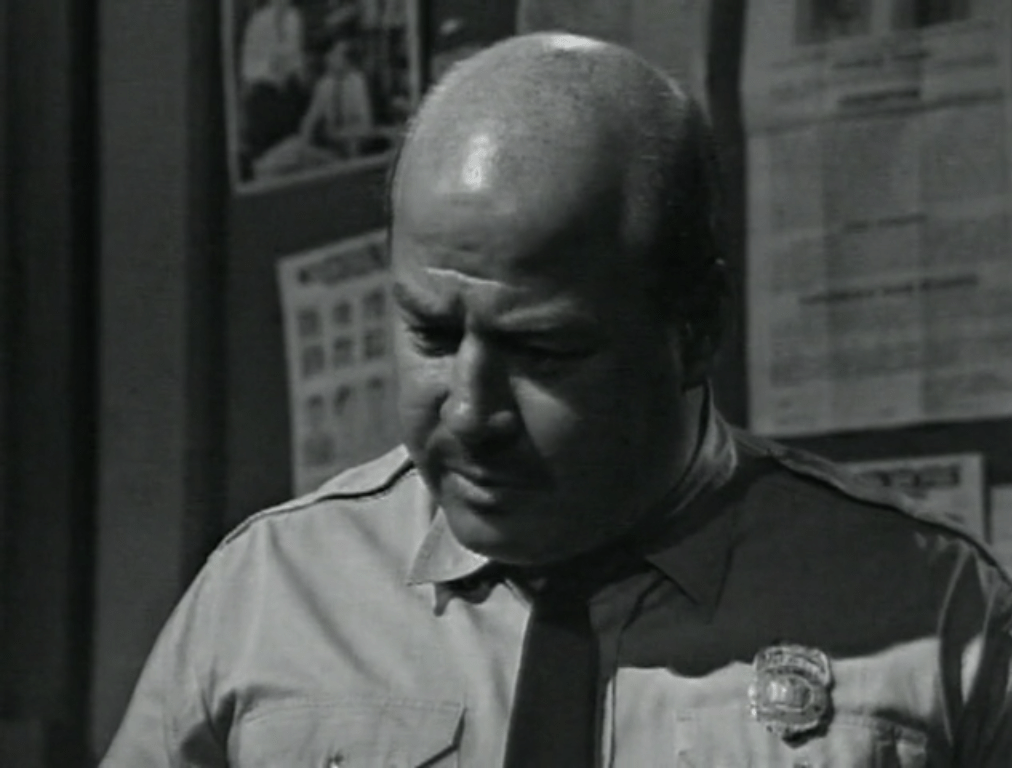
Sheriff Patterson is played by Dana Elcar today. It is Elcar’s 35th and final appearance on Dark Shadows. He would go on to become one of the busiest and most distinguished character actors of his generation.

Elcar had his work cut out for him with the part of Sheriff Patterson. If a police officer on the show ever solved a case, or followed any kind of rational investigative procedure, or interpreted a clue correctly, the story would end immediately. So all the sheriffs and constables and detectives have to be imbeciles. Elcar reached into his actorly bag of tricks almost three dozen times, and always came out with some way to make it seem as if something more was going on in Sheriff Patterson’s mind than we could tell.

My wife, Mrs Acilius, exclaimed “I’m so glad Dana Elcar is playing this scene!” when Barnabas and the sheriff had their long conversation in the hospital corridor. This week’s episodes were shot out of sequence, so yesterday’s was made after Elcar had left. It featured Vince O’Brien as Sheriff Patterson. O’Brien was by no means a bad actor, but he didn’t make the character seem any smarter than the script did. Elcar seems so much like he has something up his sleeve that Jonathan Frid’s insistent pleading makes sense as a cover for a mounting panic. Without Elcar to play against, it might just have come off as whining.

With the conclusion of Willie’s story, this is John Karlen’s last appearance for a long while. Beginning shortly after Barnabas’ introduction to the show in April, his conversations with Willie have been the main way we find out what he is thinking and feeling. More recently, Willie and Julia have been having staff conferences in which they come up with new ideas and add a new kind of flexibility and dynamism to the vampire storyline. From time to time, Willie’s conscience gets the better of him, and he adds an unpredictable element to the story as he tries to thwart one of Barnabas’ evil plans. For all these reasons, removing Willie from the show drastically reduces the number of possible outcomes in any situation they might set up involving Barnabas. His departure, therefore, seems to signal that some sort of crisis is at hand.

In fact, Karlen wanted to leave Dark Shadows because he had a better offer from a soap called Love is a Many Splendored Thing. But the producers knew that no one else could play Willie after the audience had got used to Karlen, and so they wrote the character out until they could get him back. Still, losing Willie puts Barnabas’ story on a much narrower track. So far, each development has led us to speculate about an ever-growing list of directions the story might possibly take. From now on, we are entering a phase where we will often be stumped as to what might be coming next.

Episode 259: Mustache, must tell

Elizabeth Collins Stoddard, matriarch of the ancient and esteemed Collins family of Collinsport, Maine, receives a telephone call. Her daughter Carolyn is in jail. Driving drunk, Carolyn barely missed a pedestrian, smashing instead into a tree. The almost-victim rescued Carolyn from the car moments before the fuel tank exploded, and Carolyn rewarded her with some nasty remarks. Liz is upset that her brother Roger isn’t available to pick Carolyn up from the police station.

Well-meaning governess Vicki suggests that Liz go to the police station herself. Liz hasn’t left home under her own power for eighteen years, and so reacts to this idea with dread. Vicki talks her into it, giving Alexandra Moltke Isles a chance to show that there is some substance to her character. Looking in through the front door, we see Liz taking a series of halting, forced steps to Vicki’s car.*

Seen in isolation from the rest of the series, Liz’ march is a poignant evocation of agoraphobia. But the Liz-is-a-recluse story is a dead end. They never showed us anyplace Liz would want to go, and the reason for her staying in the house was exposed in #249 as nonsensical. Still, they’ve been presenting Liz as a recluse from the beginning, so sending her into town feels like a promise that something big will happen.

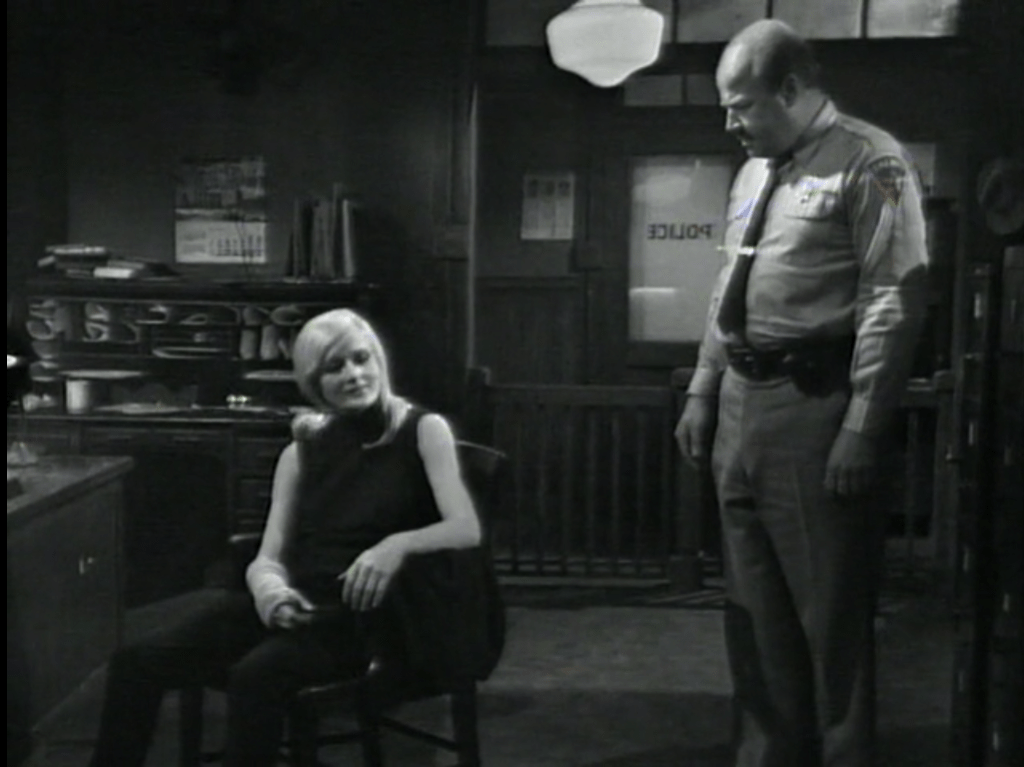
In the police station, we see that Sheriff Patterson has grown a mustache. He didn’t have one when last we saw him, in #248, and he won’t have one when next we see him, in #272. So this is our only chance to appreciate it.

Carolyn is doing a “teen rebel” bit. This would have been one thing earlier in the series, when she was supposed to be fresh out of high school and wildly capricious. But she took charge of the family business for a month early in the spring of 1967, and has been relatively level-headed since. When she makes sassy remarks to the sheriff, they are just throwing all that character development out the window.

Liz shows up, to the sheriff’s amazement and Carolyn’s. Carolyn recovers from the shock, and claims she is not impressed by Liz’ leaving the house. Liz supposedly stayed there for eighteen years waiting for Carolyn’s father, Paul Stoddard, to come back. Now she is divorcing Stoddard and marrying seagoing con man Jason McGuire. If Stoddard means nothing to Liz anymore, what’s the big deal about going into town? Carolyn then makes some superheated remarks about Liz’ disloyalty to Stoddard. Finally, she refuses to leave with Liz. She insists on spending the night in a cell.

In #244, Liz tried to tell Carolyn that her father was a terrible man who never loved anyone. Carolyn became upset and wouldn’t listen to her, then jumped to believe Jason’s stories that Stoddard was a fine fellow who doted on her. That was understandable as a first reaction to dismal news, but we’ve never seen any other indication that Carolyn is especially hung up on the father who disappeared from the house when she was an infant. All the shouting about “my father!” comes out of nowhere. The scene amounts to nothing.

Back in the drawing room, Liz has a conversation with Jason. She has agreed to marry him because he has threatened that if she does not he will reveal to the police that she killed Stoddard and he buried him in the basement. The blackmail plot has been dragging on for months, and we have yet to see anything happen between Liz and Jason that didn’t happen in the first five minutes they were on camera. At this point, scenes like this are just a test of the audience’s endurance.

Upstairs in Collinwood, Vicki hears sobbing in Liz’ bedroom. She calls to her, and lets herself in. She apologizes for urging her to see Carolyn. She suspects that Liz has something she wants to say, and gently presses her to say it. Liz finally confesses that she killed Stoddard. The whole scene is very effective, a strong conclusion to a weak outing.

*It became clear in #232 and #233 that Vicki has a car. How and when she came into possession of this vehicle has not been explained.

Episode 219: One look at the man

This teleplay badly needed another trip through the typewriter.

In the opening scenes, seagoing con man Jason McGuire demands his friend and former henchman, the sorely bedraggled Willie Loomis, leave the estate of Collinwood and the town of Collinsport. He mentions that he saw Willie’s car the night before at the cemetery. He then orders Willie to get on a bus and leave town. Then he starts talking about Willie’s car again. Does Willie have a car or not? They’ve gone back and forth on this from one episode to another, but today they can’t keep it straight from one line of dialogue to the next.

A doctor shows up to examine Willie. He tells Jason that Willie is not sick at all. The reason he is so weak is that he has lost “an enormous amount of blood.” What does the doctor think the word “sick” means if it doesn’t apply to a person who is doing badly because of an “enormous” loss of blood?

Whatever meaning the doctor attaches to “sick” apparently also applies to “ailment.” High-born ne’er-do-well Roger Collins asks what Willie’s ailment is, and the doctor says he has no ailment. He is simply immobilized due to an enormous loss of blood.

The doctor tells first Jason, then Roger, that Willie will be fine if he gets some rest and fluids and food. The idea of a blood transfusion doesn’t cross his mind, nor do Jason or Roger bring it up. It would be one thing if the doctor, Jason, and Roger were played by the Three Stooges, but there is no sign that we are supposed to think that they are a load of idiots.

An actor who has repeatedly triumphed over bad writing reappears after an absence of sixteen weeks. This is Dana Elcar as Sheriff George Patterson. The sheriff’s activities don’t always make a great deal of sense, but Elcar’s acting choices and his zest for performance make him a pleasure to watch no matter how dire the script he has to work with.

Today, the sheriff is telling Roger that a number of cows on the farms owned by the Collins family have been destroyed. A person or persons unknown somehow sucked every drop of blood out of these cows through small punctures in their hides. Roger is deeply unsettled by this strange news, and the sheriff sympathizes with him.

Roger repeatedly asks the sheriff why he is the one telling him about the cows. He says that he would have expected the veterinarian to call him. The sheriff says that the veterinarian called his office, because he determined that the cows were killed by someone’s deliberate act. That doesn’t explain why the veterinarian, whose bill the Collinses will presumably be paying, didn’t call him. We were so glad to see these fine actors working together that the senselessness of the scene didn’t bother us while we were watching it, but as soon as it was over we were left with a feeling of confusion.

Roger and the sheriff. Screenshot by Dark Shadows Before I Die

Regular viewers do wonder what farms the sheriff and Roger are talking about. The only previous reference to the word “farm” in connection with the Collinses was in #64, when Sheriff Patterson told their servant Matthew Morgan to “work their farm for them” and stay out of trouble. Today’s conversation repeatedly refers to “farms,” plural, more than one of which are big enough to have cows. That’s an operation much too complicated for Matthew, who had many other duties, to have handled by himself. Besides, Matthew left his job in #112 and was scared to death by ghosts in #126, and hasn’t been replaced. Whatever farm Matthew was working must have been so small that the Collinses can take care of it themselves in whatever time they can spare from their main occupation, keeping secrets and being sarcastic.

Writer Ron Sproat specialized in inventorying disused storylines and getting them out of the way. Back when Matthew was on the show, the Collinses were heavily in debt and running out of money. Dashing action hero Burke Devlin spent the first 40 weeks of the show trying to avenge himself on the Collinses by driving them into bankruptcy. All of that has gone by the boards, and we aren’t hearing any more about troubles concerning the business. So it’s time for Dark Shadows to reconceive the family as financially secure, indeed as imposingly rich. Talking about their many farms and the herds of livestock on them helps Sproat open up space in his narrative warehouse, but it doesn’t offer much to interest the audience.

My wife, Mrs Acilius, thought up a little fanfic that might have introduced the same points more intriguingly. The trouble with the cows first came up in #215. Hardworking young fisherman Joe Haskell told the story of a calf belonging to his uncle that was found drained of blood. That suggested that an evil has been loosed that is spreading throughout the town and beyond. Why not stick with Joe as the point of view character in connection with the mystery of the desiccated cows? Not only would that give a badly under-utilized character something to do, but would also give us the sense that the fate of a whole community is at stake in the action.

If they needed to connect the Collinses to the cow story, they could have come up with a way to oblige them to join with Joe to figure out what’s going on. That in turn would raise the prospect of a story structured like Bram Stoker’s Dracula, in which one character after another joins the team opposing the malign Count. The formation of the group that resisted blonde fire witch Laura Murdoch Collins in the months leading up to #191 very much followed the pattern set in Stoker’s novel. Of course, the ending could be modified. The Laura story ended, not with the triumphant team-work that defeats Dracula, but with well-meaning governess Vicki cut off from her allies and left to confront Laura alone. But the team-work leading up to that point was full of interest, as characters shared information with each other, reconfigured their relationships, and found themselves doing things neither they nor we would have expected. Simply reintroducing the topic of the cows and leaving Joe and the Collinses siloed off from each other is easy for the writers, but it doesn’t take the story anywhere.

Episode 121: Ghosts and ghosts-to-be

Each of the 1225 episodes of Dark Shadows features one name under the credit “Written by.”* A total of nine names rotate in that spot. While we know that some episodes included writing from uncredited contributors, the only such contributors we can identify come from among that tiny group of eight men and one woman. For example, Malcolm Marmorstein, credited with today’s script, wasn’t officially named among the writers until #115, but he may well have written additional dialogue as far back as #46. Joe Caldwell’s name doesn’t appear on-screen until #245, but he will actually be writing some of the scripts attributed to Ron Sproat starting this month, maybe this week.

Opinions will of course vary as to which of the nine identifiable writers was better and which was worse. Few, however, will find a place for Marmorstein on a list of Dark Shadows’ eight best writers. Although he had extensive experience in the theater, Marmorstein had none of the sense of what actors can do that Art Wallace and Francis Swann brought to the first nineteen weeks of the show. Nor did he know how to structure a drama, write crisp dialogue, or invent fresh story points. Directors Lela Swift and John Sedwick collaborate with a uniformly strong cast to put Marmorstein’s scripts on such a strong footing that at moments they seem like they are about to be good. Those brief flashes of hope are invariably, cruelly, disappointed.

There are indeed some bright spots in today’s episode. Reclusive matriarch Liz is in the drawing room of the great house of Collinwood. Well-meaning governess Vicki and homicidal fugitive Matthew are both missing, and Liz is worried that Vicki may have fallen into Matthew’s hands. Wildly indiscreet housekeeper Mrs Johnson shares her conviction that Matthew has killed Vicki, and won’t stop talking about this belief even after Liz expressly orders her to do so. Clarice Blackburn plays Mrs Johnson as a woman with no self-awareness whatsoever, and no screen actor has ever had a more effective way of showing horror at displays of social maladroitness than did Joan Bennett. In their hands, this scene is laugh-out-loud funny.

A knock at the door rescues Liz from Mrs Johnson’s untrammeled morbidness. The sheriff has come to report to Liz on the state of the searches for Vicki and Matthew. Mrs Johnson answers the door and won’t let the sheriff see Liz until she’s given him a piece of her mind about the incompetence of his department. There aren’t any memorable lines in this exchange, but the contrast between Blackburn’s highly animated movements and Dana Elcar’s cheerful placidity is so obviously suitable for comedy that it feels funny.

Back in the drawing room, the episode starts to fall apart. Liz and the sheriff talk about the searches for Vicki and Matthew. The dialogue is full of repetition and wasted words. Liz asks if the sheriff has an idea where Matthew might be, to which he replies, “He could be anywhere, and everywhere.” Might he hurt Vicki? “He might, but on the other hand he might not.” After all, “he’s very unpredictable.” Then, “you know how unpredictable he is.” Yep, unpredictable, let’s repeat that word five or six more times, that’ll keep us busy until the commercial break.

They could have cut some of that smoke-blowing and replaced it with lines about what the sheriff has done. My wife, Mrs Acilius, wishes the sheriff had mentioned telephoning Vicki’s former residence, the Hammond Foundling Home, and asking people there about where Vicki might have gone and whom she might have tried to contact. That might not have led to any action, but at least it would invite us to imagine that something might be going on somewhere.

The scene between Liz and the sheriff does have an effective ending. She asks him if he holds out much hope for Vicki. He replies, “Frankly, no.” She turns to leave the room. We break for commercial on that downbeat, which lets the bleakness of the situation sink in.

Strange and troubled boy David Collins comes home. David is the one person who knows that Matthew is hiding in the long-abandoned Old House on the grounds of the estate. He has been delivering supplies to him. Even David does not know that Matthew is holding Vicki prisoner in a hidden chamber. David sees that the sheriff is in the house, and asks Mrs Johnson if the sheriff has any news about Vicki or Matthew. Mrs Johnson seizes this opportunity to resume denouncing the sheriff’s incompetence, saying that the only clue he can recognize one that tells him it is time to eat and make himself even fatter than he already is.

David is about to move on when Mrs Johnson questions him about the pack of cigarettes he stole from her earlier. She sets some punchlines up for David in this exchange. She mentions that she lit a cigarette while serving David his breakfast, to which David replies by asking if she is supposed to smoke while working. She says she knows that she set her pack of cigarettes on the table when she and David were alone in the kitchen, and that she hasn’t seen it since. He suggests it walked away by itself. She tells him he’s the only one who could have taken them; he says that if he wanted cigarettes, he wouldn’t steal them, he’d buy them. None of these lines is much on the page, but as delivered by Blackburn and David Henesy, they are genuinely funny.

Mrs Johnson looks for nicotine stains on David’s fingers. Screenshot by Dark Shadows Before I Die.

David goes into the drawing room and talks with the sheriff. Picking up on Mrs Johnson’s remark about the sheriff’s vigilant observation of meal-times, David asks him what it means when the whistle blows at the cannery. “Lunch,” says the sheriff. Again, not a world-class piece of comic material, but Henesy and Elcar make it land.

David then asks the sheriff for the details of his search for Matthew. The sheriff happily answers all of David’s questions in detail, as if he were giving a briefing to the state police. He tells David that anyone who might be hiding Matthew will go to jail.

This scene shows the limits of what a good actor can do with bad material. David is going to return to the Old House at the end of the episode. He will be prompted to go back there because he has learned information from the sheriff that Matthew will want to know. While there, he will set up suspense by revealing to Matthew that the sheriff has triggered his intense phobia of jail. That locks the sheriff into playing his scene with David as a babbling oaf.

In Elcar’s first episodes as the sheriff, he had made indiscreet remarks to David, but as we saw him observing the reactions those remarks elicited from David and others he seemed to be using them as ploys to advance his investigations. For example, in #59, he had given David some information that excites him and unnerves his father, high-born ne’er-do-well Roger Collins.

We can see how he might use similar tactics in this situation. After all, Vicki is David’s governess, and David has spent more time with her than has anyone else. Matthew had been the caretaker in the house where David lives, and David knows him quite well also. In this conversation, when the sheriff refers to Matthew as unlikable, David becomes very excited and exclaims “I like him! Er, I did like him, I mean.” If the sheriff knows his business he might well pay very close attention to everything David says, and keep encouraging David to say more. He will certainly notice David’s terrified reaction to the idea that someone helping Matthew will go to jail, and test his reaction to further comments on related themes. But if he takes any note at all of David’s attitude, the current storyline will end within minutes. So in this scene, Marmorstein leaves Elcar no way to play the sheriff as an intelligent character.

After the sheriff leaves, David and Liz have a scene in the drawing room that builds up to a tremendously frustrating moment. David keeps asking his aunt one question after another about Matthew and Vicki, Vicki and Matthew, does Matthew have Vicki, is Vicki in danger from Matthew, then without taking a breath “Do you know any secrets about the Old House?” Liz responds “I wish that someday you’d ask an important question.”

Granted, we know that Matthew is holding Vicki prisoner in the Old House and Liz does not, but it is hard to imagine anyone failing to see the connection between these two thoughts. Joan Bennett and David Henesy had a fine rapport that made the scenes between Liz and David Collins a delight, and you can see them trying to save this exchange. David is in a panic at the beginning of the scene and gets steadily more worked up as it goes along. We see Liz observing his agitated emotional state, paying such close attention to his facial expressions, tone of voice, and frantic bodily movements that she misses key elements of his words. It’s a valiant attempt on their part to make the scene work.

David wants to go to the Old House to see Matthew. In the foyer, Mrs Johnson again confronts him about the cigarettes. He yells at her to “Get off my back!” and runs out. This might have been an attempt to show that David feels his world closing in on him, but it doesn’t succeed. We’ve already seen those two characters say everything they had to say about that topic on that set. Repeating it just feels like filler.

*There are reference works that draw on the original paperwork produced by the makers of the show; even these list one writer per episode. That’s how the Dark Shadows wiki manages to list a writer for every episode, including those that don’t show writing credits on-screen.

Episode 59: He sort of talked me out of it

Yet another G. G. E.- Genuinely Good Episode. There have been several of those this week.

The sheriff is in the big dark house on the estate of Collinwood, questioning high-born ne’er-do-well Roger about the mysterious death of plant manager Bill Malloy. Roger’s sister, reclusive matriarch Liz, joins them. They deny knowing anything, including things we’ve seen them find out in previous episodes. Much of the conversation is to do with drunken artist Sam Evans and the idea that Sam might be keeping a secret.

Roger’s son, nine year old problem child David, is all smiles when he drops in on his well-meaning governess Vicki. Convinced that she can befriend David, Vicki responds instantly to his smile. She asks why he’s so chipper. He says that it’s because he will never see his father again. The sheriff has come to arrest him for murder.

Vicki asks him if the sheriff said that he was going to arrest Roger, and David admits that he did not. But David is sure that he will. He is sure he is guilty. He lists the three sources of information he has that confirm for him that his father killed Bill- the ghosts of the Widows told him, he saw it in his crystal ball, and he used a tide table to calculate the spot at which Bill fell in the water. When Vicki insists that he doesn’t know what he’s talking about, he says she’s just refusing to face facts because she’s afraid his father will kill her, too. By the end of what had begun with the sound of a very cozy conversation, David tells Vicki that he might not be unhappy if his father does murder her.

Vicki keeps her eyes on David throughout this conversation, listens carefully even when he keeps talking after she’s told him to stop, and looks thoughtful after he leaves the room. As Vicki and David, Alexandra Moltke Isles and David Henesy play a wide enough range of emotions in this scene that we, in spite of the dialogue, can see why Vicki is still sure she and David will someday be friends.

Vicki trying to think of a way to reach David

David goes downstairs in time to see the sheriff leaving. He asks him if he’s arresting his father. The sheriff says he’d thought about it, but that Roger talked him out of it. That’s a pretty weird thing for a policeman to tell a boy, but Dana Elcar, as the sheriff, is such an engaging presence that we can accept it, somehow. I think it’s because he makes a show of choosing his words carefully and plays the scene with an eye on Roger, so that we can regard his strange words as a tactic to unsettle his suspect.

David gives the sheriff the book of maps and tide tables, open to the page where he marked the spot at which he believes Bill went into the water. The sheriff thanks David and tells him to keep up the detective work. David and Roger stare daggers at each other. In this staring match, David Henesy and Louis Edmonds, as Roger, do such a compelling job of embodying filial hate that the audience can respond in only one of two ways- either it will send a chill down your spine, or you’ll laugh out loud. This time we laughed, because we’ve seen so much of the show we feel we know the actors and know that they had great fun with scenes like this. I think we were chilled the first time through, though.

David and Roger stare at each other
Staring contest

After the sheriff leaves, Liz tells Roger that she has now lied to the sheriff for him, and demands that he tell her the truth. Roger says that he, not dashing action hero Burke Devlin, was responsible for a killing ten years ago, that his testimony at the trial that sent Burke to prison was a lie, and that he murdered Bill because he was afraid Bill would expose that lie. Liz trembles, sits down, says “It can’t be true,” then Roger bursts out that of course it can’t be true, not one word of it is true. Having heard the story out loud, Liz is happy to disbelieve it.

David listened to this conversation through the keyhole. When Vicki catches him listening, David declares that he had heard his father admit his crimes. He heard the denial as well, but that did not make the impression on him that it made on his aunt. He is as highly motivated to accept the confession as Liz is to reject it.

After David is sent to his room, Liz and Roger ask Vicki what he told her he heard. Vicki says it was nothing- “His imagination.” She is on her way into town to have dinner with friends. Liz asks who those friends are. Vicki tells her they are Maggie Evans and Maggie’s father.

Vicki leaves, and Liz asks Roger if Maggie Evans’ father is Sam Evans. Yes, says Roger. Why does that bother you, asks Liz. Roger denies that it bothers him, and stomps away up the stairs. Liz looks thoughtful, much as Vicki had looked thoughtful when David talked about her as a potential murder victim and walked out of her room.

Liz wonders about Roger

Denial, the psychological defense mechanism, presents a rich challenge to an actor. Liz cannot allow herself to believe that Roger is guilty of the crimes that have been discussed in this episode, and so she gladly accepts his declaration that “not one ugly word” of his confession to her was true. Yet Liz is an intelligent woman, and she knows her brother extremely well. She certainly knows him well enough to know that he is a scoundrel through and through, and it is obvious he has a great deal to hide in connection with these events. So as Liz, Joan Bennett has to play a person who simultaneously rejects an idea and accepts it. That’s a challenge to which she rises brilliantly.

The comparison between Vicki’s pensive moment after David leaves her room and Liz’ pensive moment after Roger leaves the foyer highlights the similarities between Roger and David. Those similarities are prominent this week. In yesterday’s episode, David was cool as a cucumber while others stormed and raged. Today, Roger plays it cool while confessing to a list of serious crimes, some of which he actually committed, and then exposes that list as a tactic to force Liz to deny his guilt. When David is in Vicki’s room, Vicki compares him to his father, to which David replies that he never killed anyone. If she were less concerned with winning David’s friendship, Vicki could have told him it wasn’t for lack of trying- he did tamper with the brakes on his father’s car and cause him a serious wreck, after all.

We can only assume that Roger has always been like this, that he once was what David is, and that unless something changes David will someday be what Roger is. Vicki’s pensiveness is all about the future, about the difference she might be able to make for David. Liz’ reaches into the past, back to all the times she, as Roger’s bossy big sister, tried to keep her bratty little brother out of trouble, and to cover up for him when he slipped beyond her influence. Whatever approach Vicki comes up with in her quest for David’s friendship, then, will have to be different from the approach Liz took to Roger throughout their early days.

Episode 54: A proper charge

At the end of yesterday’s episode, dour caretaker Matthew admitted to reclusive matriarch Liz that he had found a drowned man on the beach, that the man was missing plant manager Bill Malloy, and that he had pushed the body out to sea and watched it float away. Liz then called the sheriff.

As today’s episode opens, Liz’ ne-er-do-well brother Roger doesn’t know about Matthew’s confession. We see him in his office, countermanding orders Bill Malloy had given and acting like he has Malloy’s job. On his blog Dark Shadows from the Beginning, Marc Masse interprets this as an indication of guilty knowledge on Roger’s part:

Roger has evidently just implemented a new system that has effectively replaced Bill Malloy’s previous methods for operations at the plant. This indicates that Roger knows for certain that Malloy will not be returning as plant manager, which enshrouds him with an additional layer of suspicion given how as of the close of episode 53 only two people knew for certain that Bill Malloy was in fact dead: Matthew Morgan and Elizabeth Stoddard, and as of today’s episode the sheriff. Roger will be informed of Malloy’s demise later on that day when his sister calls him away from the office to have him return to Collinwood, and Roger will feign surprise upon hearing the news, but it’s evident from his phone conversation above that he was somehow already aware of Malloy’s fate.

That’s a possible interpretation, and I certainly thought of it the first time I saw the episode. On the other hand, Malloy has been missing for more than a day, and was last seen drinking in a bar. So even if he were to walk in the door in prime physical condition at this very moment, he would be in a poor position to defend himself in workplace politics. Roger could easily claim that he was simply moving to fill a vacuum. The show is keeping Roger viable as a suspect, but is not committing itself to the idea that he is the guilty party.

Whatever Roger knows about the situation, dashing action hero Burke knows less. But Burke seems to think of himself as very knowledgeable. He storms into Roger’s office and confronts him with the fact that Malloy was trying to prove that Roger, not Burke, was responsible for the killing that sent Burke to prison years before. Burke makes many accusations against Roger, some of which the audience knows to be true, but none of which he is yet in a position to prove.

The scenes in Roger’s office are intercut with scenes in the drawing room in the mansion at Collinwood. There, the sheriff is talking with Liz and Matthew about Matthew’s confession. Matthew asks the sheriff if he will be arrested now. To which the sheriff replies, “I can’t think of a proper charge.” He jokes about “burial without a license,” then goes on to warn Matthew that he has laid himself open to suspicion.

This is a moment when you can tell you’re watching a show made in 1966. Seven years later, coverage of investigations into the Watergate affair would give the American public an intensive eighteen-month tutorial in criminal law concerning obstruction of justice and related offenses. Ever since that time, residents of the USA have known that you are risking jail any time you make things difficult for the police. Prior to that, however, this was not well-known even among lawyers who practiced in areas other than criminal law.

Watergate itself illustrated this. Several of the major figures in that matter were lawyers, and many of them, including Richard Nixon himself, genuinely did not know that it was an offense for a person who had not been involved in a crime to cover that crime up. You can hear Nixon on the White House tapes telling his legal aide John Dean that because Dean didn’t know about the Watergate burglary in advance, the things Dean had done to hinder the investigation of the burglary can’t possibly put him in danger of prosecution. In his memoirs, Dean admits his own ignorance of the relevant law, confessing that he first read the federal statutes on obstruction of justice not when he was in law school, not when he was studying for the bar, not when he was a staffer for a commission tasked with rewriting the federal criminal code, but in his office at the White House, after he’d been running the Watergate cover-up for nine months. He reports in that same book that several other White House staffers who were lawyers shared his ignorance. Many of them would go on to confirm this aspect of his account.

In light of the legal education that Watergate provided the people of the USA, the sheriff sounds like an idiot. That same education ruined other old shows. Perry Mason, for example- ridiculous as it is that every episode ends with the guilty party jumping up in court and shouting “I did it!,” if you’re into the story you feel enough poetic justice in those endings that they don’t really bother you. But Mason himself can hardly make it through five minutes without committing every crime with which Haldeman, Ehrlichman, Mitchell, and Dean would be charged and a few more besides. Perry Mason broadcast its final episode in May of 1966, so that show, not the Watergate news, was the law school the original audience had attended.

Miscellaneous:

The episode opens with footage of Louis Edmonds walking around outdoors on a waterfront. They play some nice sound effects of sea-birds over it.

The sheriff we see in this episode is Sheriff Patterson, the first of that name. He is played by Dana Elcar, a fine actor who would be ubiquitous on American television and cinema screens in the 1980s. If we’re heading into a major story arc dominated by a mystery story, it’s a relief to know that the policeman role will be in such trustworthy hands. The part will be re-cast many times in the years to come, and never again as well. Then again, none of the subsequent Sheriffs Patterson will be as important as is this first.

Since there is a good deal of overlap between fans of Star Trek and fans of Dark Shadows, I might mention that this was the episode that aired on the day Star Trek premiered.

There was a great deal of Anglophilia involved in the making of Dark Shadows: the mid-Atlantic accents, the plots lifted from English literature, etc. So it may not be a coincidence that a dark-haired, small-chinned matriarch named Elizabeth presides over the family at the center of it. Indeed, Joan Bennett looked enough like the northern European royals that when they wanted to cast an actress who resembled her closely enough to set the audience wondering how their characters were related, they settled on the daughter of a Danish count. So I might also mention that I am writing this on the day Britain’s Elizabeth II died.

There are two big flubs. At one point when they’re about to cut from the drawing room back to the office, we hear a loud noise and some garbled voices in the background. My wife, Mrs Acilius, wondered if this was Josette Collins trying to make herself heard.

At the very end of the episode, as announcer Bob Lloyd is intoning “Dark Shadows is a Dan Curtis production,” a figure walks in front of the camera. You can just see the top of his head. The Dark Shadows wiki refers to the figure as “a crew member.” Marc Masse says it’s probably Mitch Ryan. John and Christine Scoleri speculate on their blog Dark Shadows Before I Die that it might be Dan Curtis himself. To me it looks like more the hairdo Thayer David is wearing as Matthew Morgan than like either Ryan’s hairdo as Burke or Dan Curtis’ hair- there seems to be some grey in it, and it looks to be more matted than either wavy or curly.