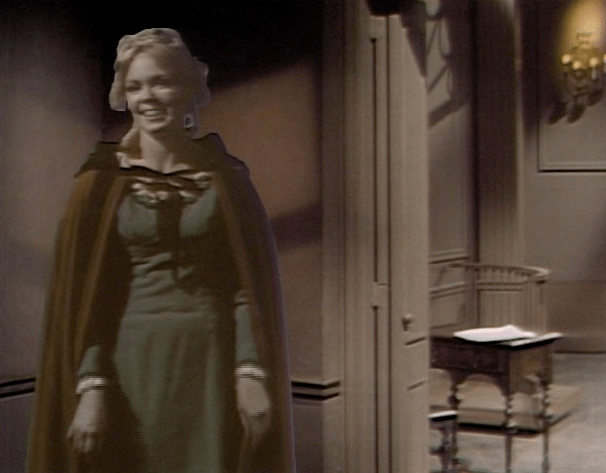
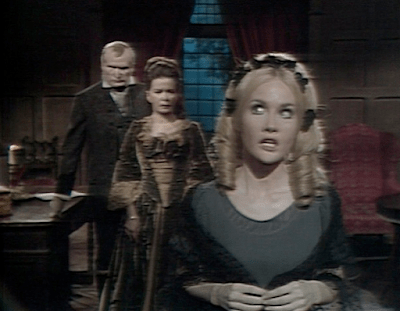
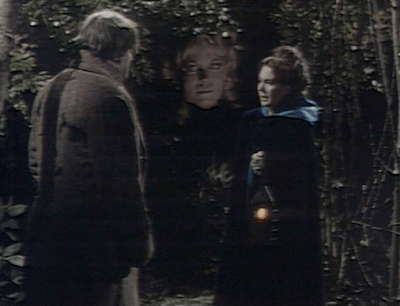
Episode 446: You have given me nothing I can understand

Haughty tyrant Joshua Collins goes to the basement of the Old House on his estate and finds his son Barnabas rising from a coffin. Barnabas explains to his father that he has become a vampire.

Joshua and Barnabas in the coffin room. Screenshot by Dark Shadows Before I Die.

This scene prompts considerable discussion in fandom about gay subtext. In his post about the episode on Dark Shadows Every Day, Danny Horn points out that actors Jonathan Frid and Louis Edmonds were both gay, and speculates that this fact might have had some influence on the way they play Barnabas’ coming out to his father. “I’m not suggesting that this situation is intended to be a metaphor for a gay child talking to his father about his terrible, shameful secret life… But the ‘keep the secret, don’t tell my mother’ part — there’s some resonance, isn’t there? At least, it’s a hook into the story that helps us to get closer, and really feel some of the horror of this moment. A father hands a gun to his son, and says, Kill yourself, so that your mother never finds out.”

Even this tentative raising of the question, with its “I’m not suggesting” and “some resonance” and “at least,” is too much for Patrick McCray. In his Dark Shadows Daybook post about #446, he concedes that “homosexuality is the obvious choice” for an interpretive lens through which to read the scene, but goes on to flatly assert that “this isn’t a veiled metaphor for something like homosexuality.” For him, as for Danny, Barnabas figures in the scene as a murderer first and last, and Joshua as a man finding himself irrevocably severed from the world of rationally explainable phenomena.

For my part, I think that we have to remember that intentionality is always a more complicated thing in a work of art than it is when lawyers are interpreting a contract or cryptographers are cracking a cipher. Certainly the scene is not simply a coming-out scene played in code. Barnabas’ murders do not map onto any metaphor for sexual encounters. While the vampire’s bite is often a metaphor for the sexual act, Barnabas presents his acknowledgement in this scene that he has murdered three women in terms of the secrets he calculated he could keep by killing them and maintains a cold, matter-of-fact tone while doing so. When in the course of the scene Barnabas exasperates Joshua by attempting to murder him, there is nothing erotic between the men. No doubt the scene is at one level meant to be what Danny Horn and Patrick McCray say it is, the point when Joshua realizes he is part of a supernatural horror story and the audience realizes that Barnabas is a cold-blooded killer. As such, it is one of the key moments that defines the 1795 flashback as The Tragedy of Joshua Collins.

But there are other levels of intentionality here as well. One has to do with the word “vampire.” When Barnabas is trying to tell his story to Joshua, his first approach is to give him the facts and leave it to him to apply the correct label. But the facts are so alien to Joshua that they only deepen his confusion. Seeing his father’s bewildered reaction, Barnabas’ frustration mounts until he finally shouts “I am a vampire!”

We have heard this word only once before on Dark Shadows, when wicked witch Angelique mentioned it in #410, but it figured in the show as a metaphor for outness long before it was spoken. In #315, Barnabas’ associate, mad scientist Julia Hoffman, urges him not to murder strange and troubled boy David Collins. She catches herself, breaking off after saying that David deserves better than “to die at the hands of a-” Barnabas grins and teases her, asking “At the hands of a what, doctor?” He dares her to say the word and taunts her for her faux pas in coming so close to using it. Julia and Barnabas have a tacit understanding that they will discuss his vampirism only in euphemisms and circumlocutions. To say the word would be to push beyond the limits of Barnabas’ outness to Julia.

When he tries to avoid calling himself a vampire, Barnabas is trying to establish a relationship in which his father will know enough that he is no longer inclined to ask questions, but not enough to achieve any real understanding of his feelings. When he realizes that he cannot keep from using the embarrassing, ridiculous, utterly necessary word, Barnabas is forced to come out to Joshua in a way he had desperately wanted to avoid.

Moreover, Jonathan Frid’s performance as Barnabas departs starkly from anything else he does on Dark Shadows. After he calls himself a vampire, Frid’s whole body relaxes. His neck, shoulders, and hips are looser than we have ever seen them; even his knees bend a little. His voice shifts a bit away from the old-fashioned mid-Atlantic accent he typically uses as Barnabas, a bit toward twentieth century Hamilton, Ontario. At that point, he is not playing a murderer or a creature from the supernatural or an eighteenth century aristocrat- he is playing himself, enacting a scene from his own life.

Barnabas’ coming out to his father is not today’s only story about information management. Joshua rules his corner of the world by parceling out just that information he thinks people ought to have. We have seen this habit lead to disaster after disaster. In his scene with Barnabas, we see another such instance. Joshua has come to the basement because naval officer/ sleazy operator Nathan Forbes told him that he had seen Barnabas at the Old House, and that Barnabas had attacked Joshua’s second cousin Millicent. After Barnabas admits to his various murders, Joshua brings up the attack on Millicent. Barnabas denies that he had any involvement in that attack, sparking an angry response from Joshua. When Barnabas later asks Joshua why he came to the basement, he swears that Barnabas will never know why.

Had Joshua told Barnabas that Nathan sent him to the basement, the two of them might have figured out that Nathan faked the attack on Millicent as part of his scheme to trick her into agreeing to marry him and to blackmail Joshua into consenting to the marriage. That in turn might have helped Joshua find a way to prevent Nathan from carrying out his evil schemes. But his parsimony with information leaves Joshua believing Nathan’s story about the attack, and therefore puts him and the rest of the Collinses entirely at Nathan’s mercy. When we see the effect that the radical honesty of coming out as a vampire had on Barnabas, we can’t help but wonder how many misfortunes the Collinses might have avoided if they had not lived according to Joshua’s code of truthlessness.

A voice comes from the upstairs. Naomi Collins, wife to Joshua and mother to Barnabas, has entered the house. Joshua leaves his gun with Barnabas and tells him to do the honorable thing, then hastens up to meet her.

Naomi tells Joshua that she he came to the Old House because Nathan told her he had gone there. She insists that Joshua explain what is going on; he pleads with her not to ask. She tells him to think of her; a quiver in his voice, he says “I am thinking of you now.” Naomi is as mystified and as frustrated by Joshua’s refusal to explain himself as Joshua had been with Barnabas’ story, but even as she plays these reactions Joan Bennett also shows us Naomi softening towards her husband. She catches a glimpse of the lover hidden beneath the lord of the manor, peeking out from below the massive superstructure of his pride.

Back in the great house, Nathan is sprawled on the sofa, his boots resting on a polished table, guzzling the Collinses’ fine liqueurs. When Joshua and Naomi return, Nathan offers Joshua a snifter of brandy and invites him to drink it with him in the drawing room. Joshua reacts indignantly, protesting that he is not accustomed to a guest offering him the hospitality of his own house.

This exchange is familiar to longtime viewers. From March to June of 1967, when Dark Shadows was set in contemporary times, the great house was dominated by seagoing con man Jason McGuire, who was blackmailing reclusive matriarch Liz. Several times, most notably in #200 and #264, Jason poured himself a drink and invited Liz’ brother, high-born ne’er-do-well Roger Collins, to join him. Roger would protest that he was not accustomed to being offered a drink of his own brandy in his own house, often drawing the rejoinder that it was Liz’ brandy and Liz’ house, and that he was as much her guest as Jason was.

Roger and Joshua are both played by Louis Edmonds. Roger represents the final stage of decay from the height Joshua represents. He has squandered his entire inheritance, committed acts of cowardice that cost the lives of two men, and let a more or less innocent man go to prison in his place. In #4 he tried to sneak into well-meaning governess Vicki’s room while she slept, and when Liz caught him he told her he didn’t want to be lectured on his “morals,” leaving no doubt that he was looking for some kind of cheap sexual thrill at Vicki’s expense. He openly scorns his responsibilities as a father, cares nothing for the family’s traditions, and the one time we see him working in his office at the headquarters of the family’s business all he does is answer the telephone and tell the caller to contact someone else instead. He drinks constantly, is always the first to give up on a difficult task, makes sarcastic remarks to everyone, and backs down whenever he faces the prospect of a fair fight. In #273, he even admitted to Liz that, had he known what Jason knew about her, he probably would have blackmailed her too.

Joshua’s relentlessly dishonest approach to life may be rooted in fear, and it is never difficult to see that its end result would be to produce a man as craven as Roger. But Joshua himself is as strong as Roger is weak. It is impossible to imagine Roger shaking off an attempt on his life as Joshua shakes off Barnabas’ attempt to strangle him today. While Roger is prepared to sacrifice any member of his family for his own convenience, Joshua will go to any lengths to protect Naomi from the truth of Barnabas’ horrible secret. Nor does Joshua take the easy way out even when he is knuckling under to Nathan. In their scene today, Nathan makes it clear that he is willing to accompany Joshua back to the Old House. Had Roger known what Joshua knows about that basement, he would never have missed an opportunity to send Jason there and let Barnabas do his dirty work for him. But Joshua cuts Nathan off the moment he raises the subject.

Joshua does go back to the coffin room, and he finds Barnabas standing around. He is disappointed that his son has not killed himself. Barnabas tries to explain that he cannot die by a gunshot, but Joshua dismisses his words. He takes the gun himself and, with a display of anguish, shoots Barnabas in the heart. Only thus, he believes, can he keep the unbearable truth from coming to light.

Episode 442: For the love of God, Montresor!

When vampire Barnabas Collins rose from his grave to prey upon the living in April 1967, he was a bleak, frightening presence. As the show went on, we saw him spend a great deal of time ruminating on murders he might like to commit, but he had few opportunities to act on those thoughts. By November, when well-meaning governess Vicki came unstuck in time and wound up in the year 1795, Barnabas had killed only two people, only one of them with premeditation. Both of those victims, seagoing con man Jason McGuire and addled quack Dave Woodard, had long since lost their relevance to the plot, and neither has been mentioned more than a few times since his death. As a result, Barnabas’ talk of killing comes to seem like nothing more than a series of hostile fantasies.

Soon, Dark Shadows will have to return to a contemporary setting. It was the frightening impression Barnabas created in his first weeks that made Dark Shadows a hit, and to keep it going the show will have to make him seem dangerous again. In the fifteen and a half weeks they have been in the 1790s, he has killed at least six people, including his uncle, his aunt, his wife, two streetwalkers, and a woman named Suki. That’s an adequate rate of murders to reestablish Barnabas as a fiend, but volume will only get you so far. They need to give us some shocking images of cruelty, preferably as the result of crimes committed with slender motives, to get him back in place as a truly scary creature.

Today, the show addresses both that need and the need to give a fitting sendoff to a character who has been one of the standouts of the eighteenth century flashback. The Rev’d Mr Trask, visiting witchfinder, was, along with repressed spinster Abigail, one of the two bright lights of the show’s otherwise dreary reworking of Arthur Miller’s The Crucible. Now the witch trial is over, Vicki has been convicted, and she is waiting to be hanged. In #437, Vicki gave a speech which left little doubt that at the moment appointed for her execution she would return to the 1960s and the costume drama period would end. Therefore, Trask can hardly reopen the case without confusing the whole plot. As a personality totally warped by fanaticism, he can’t very well branch out into other kinds of stories without a long buildup, much longer than they are likely to stay in the 1790s. Yet Trask has been so much fun that the audience would feel cheated if he simply went back where he came from.

So Barnabas lures Trask to his basement, ties him to the ceiling, and seals him up behind a brick wall. Unfortunately, this homage to Edgar Allan Poe’s “Cask of Amontillado” does not adapt the most celebrated line of that story and have Trask cry out “For the love of God, Mr Collins!”

Barney’s bricklaying project. Screenshot by Dark Shadows Before I Die.

Closing Miscellany

In a moment of black humor, the closing credits run over an image of the completed brick wall. We might imagine Jerry Lacy still dangling from the ceiling behind the wall. Mr Lacy was often a model of an actor’s devotion to his craft, but I very much doubt that even he took matters that far.

Hey Jerry, you OK in there until tomorrow? Screenshot by Dark Shadows Before I Die.

A recording of Jonathan Frid reading “The Cask of Amontillado” made in the spring of 1992 can be found on YouTube, posted by Frid’s longtime business partner Mary O’Leary.

In #264, high-born ne’er-do-well Roger Collins visited Barnabas at home. When it was time for a drink, Barnabas offered him a glass of amontillado. Poe’s story is so famous and amontillado is such an unusual variety of sherry that it must have been a deliberate reference. Perhaps the idea of Barnabas sealing someone up behind bricks was floating around among the writing staff for months and months.

Several fansites label it a continuity error that Trask reacts to the sight of Barnabas by exclaiming that he is dead. The family has been covering up Barnabas’ death, putting word about that he went to England. Many think Trask should not be among those privy to the Collinses’ secret. But as Danielle Gelehrter points out in a comment on Danny Horn’s Dark Shadows Before I Die, Trask and the gracious Josette discussed Barnabas’ death in #412.

I am writing this post on 19 February 2024. In a bit of synchronicity, yesterday, I saw this post on the site that all normal people still call Twitter:

Episode 441: The subject of vicious gossip

When well-meaning governess Vicki came unstuck in time and found herself in the year 1795, regular viewers of Dark Shadows could expect certain plot points to be resolved before she returned to the 1960s. We would learn how Barnabas Collins became a vampire, and how he wound up trapped in a chained coffin in the secret chamber of the Collins family mausoleum. We would learn how Barnabas’ little sister Sarah died. We would see Barnabas’ lost love, gracious lady Josette, marry his uncle Jeremiah Collins. We would see Josette jump to her death from the precipice atop Widows’ Hill. And we would see Vicki escape from some dangerous situation and find herself back in her own time.

Now, the only items on that list left unresolved are Barnabas’ chaining and Vicki’s return. The show has made it clear to people paying close attention how each of those events will happen, and they could fit them both into one episode. Into any given episode, in fact- they’ve given us all the foundation we need for both stories.

But they aren’t going home to a contemporary setting quite yet. The eighteenth century segment has been a ratings hit, Dan Curtis Productions owns the period costumes, and several fun characters are still alive. So they have decided to restart some storylines they had shut down earlier and to build up some new ones.

The main thing that happens today is the first step towards restarting an apparently concluded story. Fluttery heiress Millicent Collins had shared a series of wonderful comedy scenes with untrustworthy naval officer Nathan Forbes, become engaged to him, and discovered that he was already married to someone else. Since that discovery, Millicent has been grimly determined to exact revenge on Nathan, and the rest of the Collins family has regarded him with icy disdain.

Nathan has made a discovery of his own. He has learned that Barnabas did not go to England, as his family has been telling everyone, but that he is still in Collinsport, and is the serial killer preying on the young women of the town. Last week, he made it clear to the audience he had a plan to turn this information into money, apparently by blackmailing the Collinses. Today, we learn that his plans are more complicated, and involve a renewal of his relationship with Millicent. Late at night, he shows up at the lodgings of a visiting witchfinder, the Rev’d Mr Trask. He asks Trask to take a letter to Millicent.

Trask does not want to let Nathan into his room, since the corpse of a prostitute is sprawled across his bed. She is Maude Browning. Barnabas murdered her in Friday’s episode. As part of his campaign to make life difficult for Trask, he deposited her remains at his place.

Nathan won’t take no for an answer, so Trask throws a blanket over Maude and lets him in. Nathan notices Maude’s arm sticking out from under the blanket and is delighted to think that Trask is not the fanatical ascetic he seems to be. Trask breaks down and starts telling Nathan what happened. He tells him that he was astounded to find Maude’s body on his bed, and he asks him to help get rid of it. Nathan agrees to do so on condition he deliver the letter to Millicent.

The scene is just marvelous. Danny Horn devotes most of his post about this episode on Dark Shadows Every Day to a rave review of it, to which I happily refer you.

We then cut to the great house at Collinwood, where Millicent is studying a layout of Tarot. All the Dark Shadows fansites point out that Millicent misidentifies the Queen of Cups as the High Priestess. This is not the fault it is often made out to be. On Dark Shadows Before I Die, Christine Scoleri reminds us that the Countess DuPrés made the same mistake in #368. Since the countess introduced the Tarot to Collinwood and presumably taught Millicent how to read the cards, it would have been a break in continuity had she called it anything else.

Millicent looks at the cards and addresses the absent Nathan, telling him that she is filled with hatred for him and that he faces certain destruction as punishment for his mistreatment of her. Naomi Collins, mistress of the house, enters and asks Cousin Millicent to whom she is speaking. When she answers that she is talking to Nathan, Naomi tells her Nathan is not there. Millicent replies that he does not need to be present to hear her voice. Since Barnabas was able to magically project his own taunting voice across space into Trask’s hearing in Thursday and Friday’s episodes, this claim of Millicent’s has a curious resonance for returning viewers.

Trask shows up with Nathan’s letter. He wants to meet with Millicent alone in the drawing room to give it to her, but Naomi insists on being present. They stay in the foyer. When Naomi forces Trask to tell them that the letter is from Nathan, Naomi takes it and tears it to pieces. Millicent says that she approves of Naomi’s action, but we can see a flicker in her eye and hear a quiver in her voice that suggest the hatred of Nathan she spoke of a few minutes before may not be quite so undiluted as she would like to believe. Trask leaves the house, Naomi leaves the foyer, and Millicent gathers up the shredded pieces of the letter.

Back in his room, Trask goes to sleep. He has a dream. The dream sequence begins with an image reminiscent of pieces moving in a kaleidoscope.

Trask goes into a dream world. Screenshot by Dark Shadows Before I Die.

That kaleidoscopic pattern was part of a visual effect we saw when Dark Shadows was still set in 1967. That effect introduced scenes that took place in #347, #352, and #354, when mad scientist Julia Hoffman hypnotized Vicki and took her to the Old House at Collinwood. At Collinwood, Barnabas’ helper Carolyn spotted Julia and Vicki, putting Julia in great danger.

The echo of those episodes is startling coming on the heels of the scene we just saw, in which Millicent figures as a student of the countess. Julia and the countess are both played by Grayson Hall, and Millicent and Carolyn are both played by Nancy Barrett. The relationships between their characters are different now, shifted as the colored pieces shift in a turning kaleidoscope. But remembering those earlier episodes, we might remember that what is seen in a semiconscious state might be a message sent to manipulate and deceive, and we certainly remember that people who go to the Old House are in danger from Barnabas.

Trask’s dream brings him face to face with the ghost of Maude, accusing him of having her remains dumped in the sea, so that she cannot rest. She predicts that everyone will learn that her dead body was in his bed. He denies both her accusation and her prediction, but does not convince either her or himself.

The ghost of Maude tells Trask the score. Screenshot by Dark Shadows Before I Die.

Another ghost then appears. It is that of Trask’s great supporter, repressed spinster Abigail Collins. Trask tries to tell Abigail that he is innocent of Maude’s charges, but she tells him she has no idea what he is talking about. She wants to tell him that there is a great evil he must destroy. Trask has a vision telling him the evil is lurking in the Old House. He resolves to go there.

All of the acting is excellent in this one. That’s no more than we would expect from most of the cast members we see today, but Vala Clifton’s two turns as the living Maude were pretty bad, so that it is a pleasant surprise that she is so good as Maude’s ghost. The physical space gives her a hard job. She is standing a very few feet in front of Jerry Lacy with only a couple of wispy stage decorations indicating that she is separated from him, but she strikes a pose and maintains a degree of stillness that really does create the sense that she is speaking to him from another realm. She also manages to keep up an ethereal quality while making it clear that Maude is determined to be avenged. I wonder what her first appearances would have been like if she had had more time to rehearse. If they had been as good as this one, Ms Clifton and Maude would be among the more fondly remembered parts of the eighteenth century segment.

Episode 435: No next witness

For the second Friday in a row, the identity of the actress delivering the opening voiceover ruins what is supposed to be the big surprise at the end of the week. Last Friday, we were supposed to be shocked when the ghost of gracious lady Josette appeared at the end, but when we heard Kathryn Leigh Scott at the beginning we knew she was coming. Today, we are supposed to be surprised that a phantom of wicked witch Angelique manifests at the trial of bewildered time traveler Vicki, but when Lara Parker gives the narration we know she will be along.

Until #274, all the opening voiceovers were delivered by Alexandra Moltke Isles in character as Vicki. From #275, other actresses would deliver them if Mrs Isles was not in the episode, and they were usually given in the third person. Mrs Isles lost her place as the show’s default narrator starting with #332, in which she appeared but which Grayson Hall narrated. Not until #459 will a man read the opening voiceover. Vicki and Angelique are both in this episode; Mrs Isles does sound like she has a cold, but surely it would be better to have her deliver the introduction even if she were struggling than it is to spoil the surprise by giving it to Parker.

Angelique shows up at Vicki’s trial to undercut a witness for the defense. Much put-upon servant Ben Stokes, once Angelique’s unwilling catspaw, has testified that he knows Vicki is not a witch, because he saw Angelique casting the spells for which Vicki is being blamed. He explains to the court that he went along with Angelique because he was himself subject to one of her spells. When he is asked why he is free of her power now, he finds himself in a tricky position. Ben knows that Angelique is dead. Barnabas Collins killed Angelique when he realized she had turned him into a vampire, and as Barnabas’ loyal friend Ben buried her body. Ben doesn’t want to expose Barnabas, so he can’t tell that story. He says that he supposes that he is free of her because she “went away.”

Angelique materializes outside the courtroom and enters. Shocked to see Angelique, Ben points at her and shouts that she is dead. She takes the stand as a witness for the prosecution and recaps some plot points from the episodes where Vicki was arrested. Everything she says is true, and she shows no animus towards Vicki, but her appearance both discredits Ben and adds to the case for the prosecution. She leaves the room and dematerializes. When everyone is gone, she rematerializes and laughs merrily.

Angelique takes satisfaction in a job well done. Screenshot by Dark Shadows Before I Die.

When Angelique was alive, she never took much interest in Vicki. It wasn’t even her idea to frame Vicki for her crimes- Vicki stumbled into the witchcraft charge by her own foolish behavior, and Angelique just helped the prosecution along a couple of times. So it is a bit odd that she bothers to come back from the dead, however briefly, to ensure Vicki’s conviction. No doubt we are supposed to think she is doing it because Barnabas wants Vicki to be acquitted, and she wants to deny Barnabas any happiness. But a more intriguing interpretation is possible. In a comment on Danny Horn’s post about this episode on Dark Shadows Every Day, “Jason” writes:

I don’t really understand the confusion over Angelique”s motive. This Angelique is from the future. She knows that Barnabas is in love with Victoria in 1967. In fact I would argue that is the entire reason Vicki went back in time. Angelique orchest rated it to get rid of Vick either as part of curse or to get Barnabs when she return’s to 1968.

Comment by “Jason,” left at 12:30 AM Pacific time 10 September 2019 on Danny Horn, “Episode 435: Next Stop Kansas,” Dark Shadows Every Day

This idea was enlarged in a followup comment, apparently by the same person:

The reason it has to be Angelique from the future is this never happened the first time. So obviously thI’d Angelique is from the future. The only way this storyline makes sense!

Comment by “Jas,” left at 12:36 AM Pacific time 10 September 2019 on Danny Horn, “Episode 435: Next Stop Kansas,” Dark Shadows Every Day

When Vicki went back in time in #365, the ghost of Barnabas’ little sister Sarah was speaking through her at a séance, saying that she ought to “tell the story from the beginning.” In the months leading up to that episode, we had seen that Sarah was the face of an enormously powerful complex of supernatural phenomena, so it made sense that she would be the one to rend the fabric of time and space and turn the show into a costume drama set in the late eighteenth century. But we won’t be seeing Sarah again, not least because the actress isn’t ten years old anymore and ghosts aren’t allowed to grow up. So we’re going to tend towards other ways of thinking about the temporal disruptions. Angelique can stick with the show for the long term, and she’s already been built up as the biggest of all the Big Bads. So “Jason’s” theory is likely to become more appealing as we go.

Episode 429: Dark conquest of the grave

Viewers who have been with Dark Shadows for some time will remember that in May and June of 1967 vampire Barnabas Collins imprisoned Maggie Evans, The Nicest Girl in Town, in an effort to erase her personality and replace it with that of his lost love, the gracious Josette. When Maggie escaped, he planned to repeat the experiment with a new subject, well-meaning governess Victoria Winters.

Now Vicki has traveled back in time to the late 18th century and taken us with her. We have seen Barnabas become a vampire and Josette die. Today, much put-upon servant Ben Stokes is busily digging Josette’s grave. At the top of the episode, he urges his friend Barnabas not to come out of the secret chamber where his coffin is hidden. Barnabas is grumpy about the fact that Josette is dead, and expresses his unhappiness by choking Ben. He lets Ben go without seriously harming him. At the end of the episode, Barnabas tells Ben that he does not know what powers he acquired when he was cursed to become a vampire, but that he will use them to raise Josette from the dead.

When Barnabas vowed to do that, my wife, Mrs Acilius, said that he had reached the absolute nadir of selfishness. Barnabas has every reason to suppose that Josette is resting in peace, and he knows that his own existence is utterly miserable. He claims that love for Josette is his deepest feeling, yet he is determined to inflict his own curse on her. He is now unmistakably the annihilating ghoul who made the show so memorably bleak at the beginning of the summer of 1967.

In between the scenes with Barnabas and Ben, we see the fanatical Rev’d Mr Trask, visiting witch-hunter. Trask meets with repressed spinster Abigail Collins in the drawing room of the great house of Collinwood. They discuss ways to speed up the witchcraft trial of the hapless Vicki. Trask and Abigail are great fun to watch together; during this episode, Mrs Acilius said she wished the two of them had got married. That’s a thought to hold onto…

Trask and Abigail light up the screen. Screenshot by Dark Shadows Every Day.

Abigail and Trask come up with a plan to exploit the Collins family’s position in the community to bring the trial to a speedier conclusion. Abigail leans on Ben to testify against Vicki, telling him he could be sent back to prison at any moment if he displeases the Collinses. Trask goes to Vicki’s defense attorney, Peter, and tells him that he will never rise above his present poverty if he goes on making enemies of the mighty Collins family. Neither man gives them what they want.

Peter is hiding a book Vicki brought with her from the 1960s, and he knows it will seal her fate if it is found. During his scene with Trask, he scrambles to keep it buried under his coat. After Trask leaves, he thinks of throwing it in his fireplace, but instead goes to the cemetery to bury it within sight of the grave Ben is digging. He catches Barnabas’ attention and nearly discovers Barnabas; Ben intercepts him, shoos him off, then persuades Barnabas not to kill him.

We can be sure the book will be found. Buried in a cemetery near the graves of so many of the people Vicki is accused of having killed, it will be even more damning than it would be were it found anywhere else. Not for the first time or the last, it occurs to us that Peter is not a very good lawyer. Vicki probably would have had a better chance of acquittal if Ben had stepped aside and Barnabas had killed Peter.

In a comment on Danny Horn’s Dark Shadows Every Day, Park Cooper lists a number of direct references to Hamlet in the dialogue of this episode. Before he played Barnabas, Jonathan Frid was best known for his work as a Shakespearean actor, so he has fun with those lines.

Episode 426: Men change, and seldom for the better

For months now, fluttery heiress Millicent Collins has been staying at the great house of Collinwood as the guest of her cousin Joshua and Joshua’s wife Naomi. Tonight, she returns to the drawing room after a moonlight stroll and makes a series of statements that bewilder Joshua and Naomi.  

Joshua and Naomi wonder what Millicent could possibly be talking about. Screenshot by Dark Shadows Before I Die.

Millicent tells her hosts that she has seen their son Barnabas. Joshua and Naomi are shocked to hear this, because they know that Barnabas has died. Believing that Barnabas died of the plague and that this news would scare the workers away from the family’s shipyard, Joshua put the word out that Barnabas went to England. Millicent saw Barnabas standing in the graveyard, near the secret chamber where his coffin is hidden. This further shocks Joshua and Naomi.

Millicent says that she needs Barnabas. He is the only member of the family who has fought a duel, and there is a family matter that can be settled only by dueling. Joshua and Naomi have no idea what she is talking about. She tells them she has learned that naval officer Nathan Forbes, to whom she recently became engaged, was already married. That hits them so hard they almost embrace her, something characters on this show do not do. They are supposed to be New Englanders, after all. She shies away from them.

What neither his parents nor Naomi know is that Barnabas rises from the dead by night and walks the earth as a vampire. The only living person privy to this secret is Barnabas’ friend, much put-upon servant Ben Stokes.

Ben saw Millicent at the graveyard, moments after Barnabas vanished into thin air. He tried desperately to convince her that she did not see Barnabas, repeating Joshua’s story that he has gone to England. He tried to bargain with her, promising to look for Barnabas and tell her if he finds him. His insistent denials that she saw what she knows she saw frustrated her. She told him that she wants to be buried in the mausoleum, and that she thinks of herself as already dead, dead as of today, no matter how long her body may survive. She told him her grave marker should reflect this date of death. He begged her to let him walk her back to Collinwood. Irritated with him, she allowed him only to follow her at a distance.

Millicent complains to Joshua and Naomi that Ben kept telling her that Barnabas had gone to England. She says that he must be punished. Joshua has been telling Millicent she is ill, and he wants Ben to stick to the official story. But he is such a tyrant that he cannot help but warm to the idea of punishing Ben. He ends the episode by expressing his vigorous agreement with Millicent.

Ben and Millicent are both wonderful today. Millicent has dozens of lines, all of them quotable, and most of them quoted in Danny Horn’s post about this episode. Nancy Barrett developed a deliberately stagy style for Millicent that always works, and today it reaches its summit.

As Ben, Thayer David has a subtler part to play, and he does it perfectly in this one. In an opening scene with Barnabas, he begins with a gruff expression of distaste for the horrible things Barnabas does, and before we know it is pleading with him not to allow himself to be destroyed. In a tiny bit of time, with only a few lines to speak and only a few opportunities to show his face, he takes us from loathing for the vampire to devotion to his friend, and at no point does the transition feel forced.

Naomi and Joshua have recently lost both of their children, among other loved ones, and there doesn’t seem to be any end to the death that surrounds them. Joan Bennett and Louis Edmonds fully connect us to their grief today. Dark Shadows too rarely gives these two extraordinary actors a chance to show what they can do, and both of them make great use of this opportunity.

Barnabas’ part is somewhat ridiculous. Today, he outdoes himself in narcissism, describing the death of his true love Josette solely as a thing that happened to him. But we know going in that that’s his deal- as a vampire, he is a metaphor for selfishness, and he was pretty self-centered even when he was alive. By this time, Jonathan Frid’s performance has made this preposterous creature into a major phenomenon of the era’s pop culture, and when he is this deep in his wheelhouse he does not disappoint. The result is a surprisingly strong entry in the series.

Episode 420: A man’s position in society

One of the most story-productive relationships in the first 40 weeks of Dark Shadows was that between reclusive matriarch Elizabeth Collins Stoddard and her brother, high-born ne’er-do-well Roger Collins. Having squandered his entire inheritance, Roger lived as a guest in Liz’ house and drew a salary from her business. She tried to order him to rein in his bad behavior, but time and again wound up shielding him from accountability. When she does that, she reduces herself from authoritative to bossy.

In the summer of 1967, the relationship between mad scientist Julia Hoffman and vampire Barnabas Collins began to follow the same dynamic of Bossy Big Sister/ Bratty Little Brother. Appealing to her professional standing as a medical doctor doubly qualified in hematology and psychiatry and to her situational awareness as a native of the twentieth century, she makes efforts to convince him that not every problem has to be solved by murder. When he disregards her advice and kills people anyway, she covers up for him. Realizing that she is stuck with Barnabas for the rest of her life, Julia tries to drum up a romantic relationship with him, but he is not interested. Eventually, she will come to be “like a sister” to him in more senses of that phrase than she would like. In the years to come, we will even see storylines in which the two of them explicitly masquerade as siblings.

Dark Shadows took a break from its contemporary setting and began an extended stay in the late 18th century beginning in November 1967. We’ve already caught a glimpse of the Bossy Big Sister/ Bratty Little Brother dynamic in this period, when haughty overlord Joshua Collins found himself taking orders from his sister, repressed spinster Abigail. Today, we take a bit of a self-referential turn as a character decides to deliberately mimic this trope.

Caddish naval officer Nathan Forbes has talked fluttery heiress Millicent Collins into marrying him. Millicent is very rich and beautiful, Nathan is charming and handsome, and there are many reasons to think they might make a happy couple. There is one small problem. A very small problem, really; not more than five feet tall and well under 100 pounds. It is Nathan’s current wife, Suki. Suki has found out what Nathan is up to, and wants a cut of his take. To his surprise and discomfort, she shows up today at the great house of Collinwood and introduces herself to Millicent as Nathan’s sister.

The Millicent/ Nathan story has been a lot of fun so far, and Suki is just fantastic. Actress Jane Draper gives a performance as big as her body is small, and Suki instantly sees through Nathan’s every lie, which is to say his every utterance. She dominates every scene she is in.

Suki has Nathan where she wants him. Screenshot by Dark Shadows Before I Die.

Yesterday, Suki walked in on Nathan at The Eagle tavern and took charge of the place. Today, she is in command of the drawing room at Collinwood. Nathan and Millicent serve up one straight line after another, every one of which Suki answers by saying something unexpected and exciting.

Suki looks out the window and sees Barnabas looking in. She doesn’t know who he is, much less that he is a vampire, but she can recognize a miserable creep when she sees one. He throws her off her form, and we dissolve to an upstairs bedroom.

The rest of the episode is a scene where Barnabas lets himself into the bedroom occupied by his ex-fiancée, the gracious Josette. He tells Josette they can never be together again, but won’t explain why. She says she wants to be with him no matter what. He bites her. They’ve been telegraphing this scene all week. It’s a complete anticlimax, and it does nothing to make up for Barnabas interrupting our time with Suki.

For a show that plundered story ideas from virtually everywhere, Dark Shadows was remarkably wary of lifting anything from the Bible. Suki’s claim to be Nathan’s sister is something of an exception. It reminds us of Abraham, who twice in Genesis passes off his wife Sarai/ Sarah as his sister and then recommends that his son do the same with his wife Rebecca. The 1795 flashback is supposed to explain the origin of the accursed Collins family for us, to answer the question “Who are Barnabas’ kin?” as Genesis answers the question “Who are Joseph’s kin?” So Suki is in tune with the rationale of the segment when she draws on that book. While Genesis explains and justifies a patriarchal order of society, so that Sarah and Rebecca just go along with Abraham’s loony schemes, daytime serials are aimed at a mostly female audience and need self-starting female characters. So it is only to be expected that the gimmick will be at Suki’s initiative this time.

Episode 419: Collins as in Collinsport?

When gallant gentleman Barnabas discovered that his wife Angelique was a wicked witch who had been casting spells to ruin the lives of everyone he knows, she forbade him to disclose this information. If he did, she would kill his true love, the gracious Josette.

Now, Angelique has turned Barnabas into a vampire. When he found out about this, he killed her. Sadly, that didn’t take. For the last few days Angelique’s disembodied head has been floating around foiling all of Barnabas’ attempts to contain the damage he has been doing.

Today, we open in the Collins family mausoleum. Barnabas’ coffin is hidden in a secret chamber inside the mausoleum. He and Josette are in the publicly-known outer chamber, where she found him yesterday. He pleads with her to leave him and forget she ever knew him, but will not tell her why. Angelique has made it obvious that she is already working to kill Josette, so obvious that Barnabas and his friend Ben were talking about it yesterday. So Barnabas has no reason to withhold any information from Josette, and every reason to tell all. But he continues to keep everything back that might persuade her to flee from him. This does fit with his pattern of behavior- half the reason they are in this situation is that Barnabas wouldn’t tell Josette that he and Angelique had had an affair long ago. But it is still frustrating.

Back in the great house of Collinwood, Josette runs into the two characters who have been keeping the show watchable for the last couple of weeks, fluttery heiress Millicent Collins (Nancy Barrett) and caddish naval officer Nathan Forbes (Joel Crothers.) After a series of delightfully played comedy scenes, Millicent and Nathan have become engaged. They break their happy news to Josette. She is so preoccupied with her encounter with Barnabas that she barely reacts.

Nathan leaves. In the drawing room, Josette tells Millicent that she saw Barnabas tonight. Millicent knows that, according to Barnabas’ parents, Barnabas has gone to England. She is therefore certain that Josette could not have seen Barnabas, and she patiently explains this impossibility to Josette. The difficulties Millicent knows about are nothing to what Josette knows- she saw Barnabas die.

Millicent lost at the threshold of thought. Screenshot by Dark Shadows Before I Die.

In the parts of Dark Shadows set in the 1960s, Nancy Barrett plays another heiress, Carolyn Collins Stoddard. In those same parts of the series, Joel Crothers plays hardworking young fisherman Joe. In 1966, Carolyn and Joe were dating each other for no reason they could discern, and the audience was afflicted with scene after scene of them out on dates staring at each other in boredom. Millicent and Nathan are as much fun to watch together as Carolyn and Joe were dull. They are pursuing objectives we can understand, and we can also be sure that their plans will not work out as they expect.

Nathan is clever, charming, and unscrupulous. He was uninterested in Millicent until he found out she was rich, then immediately began an assiduous pursuit of her hand and her inheritance. In addition to greed, he has also shown a keen eye for opportunities to bed the women on the household staff. When his naval career is threatened by the villains, he shows no sign of courage. Yet we have also seen him behave admirably, even heroically, in trying to help bewildered time-traveler Vicki. And when Barnabas was alive, Nathan was a trustworthy friend to him. So for all we know, by the time he gets his hands on Millicent’s money, this complex man might have fallen in love with her and made up his mind to be a good husband.

Millicent is not a “smart character” in an IQ-test sense, but her limitations translate into an accidental wisdom. Her ideas of life have been shaped by plays she has seen and novels she has read, leading her to think she is a character in a florid melodrama. But of course that is exactly what she is, and so her behavior is, if anything, more situationally appropriate than are the actions of the more superficially rational people around her. Certainly it is jarring when Josette starts telling Millicent about Barnabas, when she knows that Barnabas wants to keep his presence secret. Considering what will happen to Josette if she keeps approaching Barnabas, Millicent does quite the sensible thing when she insists on leaving the official story alone.

Nathan has gone to the local tavern. In the 1960s, this same set will be a tavern known as The Blue Whale. Joe will be a regular customer, and the man who will preside behind the bar is played by actor Bob O’Connell. In #319, a character pretending to be drunk called the bartender “Bob-a-roonie,” leading fans of the show to call the character “Bob Rooney,” a name never used in the series.

Now, in 1796, the tavern is called The Eagle. Bob O’Connell again plays the man who pours the drinks. His name is Mr Mooney. “Mooney” sounds enough like “Rooney” that I wonder if the “Bob Rooney” gag circulated among the production staff. Mr Mooney gets more lines today than Bob the bartender ever did, and his name is listed in the credits for the first time at the end of his 57th episode.

O’Connell did a lot of very good work in those first 56 appearances. He was especially good with facial expressions that showed he had overheard enough of a conversation to think he ought to be more aggressive about refusing to serve drinks to customers before they lose all sense, but not enough to have anything substantial to report to the police. I’m sorry to say that his delivery of dialogue today is not on that level. Partly that’s because he has to put on some kind of Anglo-Celtic accent that he is none too sure of. But that isn’t the only problem. He delivers his lines much too fast and too loud, and does not modulate his voice in response to anything his scene-mates do. He isn’t interacting with the others at all, just waiting for his cues and making sure the microphone picks up the words. His scene is a major letdown for Bob the bartender fans everywhere. O’Connell’s previous successes as a working guy who knows more than others assume he does leave me wishing they could have done another take of the scene with some fresh guidance from the director.

Fortunately, the same scene introduces one of the most magnificent characters in all of Dark Shadows. She walks in, tells Mr Mooney she’s with Nathan, and gives her name as Suki Forbes. That’s Forbes as in “Mrs Nathan Forbes.”

Suki takes command. Screenshot by Dark Shadows Before I Die.

Nathan tries out a series of lies on Suki, each of which she bats away effortlessly. He offers to pay her to leave town; she lets him go collect his money, while she stays in the tavern and gets all the relevant information from Mr Mooney. Nathan has been away for about ten seconds by the time Suki finds out he plans to marry into the family that owns the town. She is quite pleased by the prospects this introduces.

Suki thinks of how much she might earn by pimping Nathan out. Screenshot by Dark Shadows Before I Die.

Our hopes that Nathan would eventually make Millicent happy are thus reduced to a very low order of probability. Regular viewers are again reminded of Carolyn, in this case of Carolyn’s absentee father Paul Stoddard. Paul was a charming, dishonest, and cruel man who married Carolyn’s mother Elizabeth only for her money.

We haven’t seen Paul, and know very little about his background. What we do know is that he was not from the village of Collinsport, had no money of his own, and that his best friend was a merchant seaman named Jason McGuire. We got to know Jason quite well when he showed up and blackmailed Liz for a long dull stretch of the show. Poor men would have few opportunities to meet young women of Liz’ lofty station, and even fewer means of persuading them they were acceptable marriage partners. Since the marriage took place in 1945 or 1946, when a sizable fraction of American men were on active duty in the armed forces, and since Paul was connected to Jason and therefore to the sea, it would seem likely that Paul was a Navy officer. After all, an officer’s uniform can get a man admitted to any social circle, as Nathan illustrates. So the miserable marriage that Liz endured might have echoed a similarly ill-conceived match a collateral ancestor of hers made in the late 18th century.

Suki is played, sensationally, by Jane Draper. In his June 2014 post about #420, Danny Horn wrote that Ms Draper was “a bit mysterious.” The lady herself saw that post and commented on it in August 2020. She wrote:

Hi
I am the Jane Draper who played Suki on Dark Shadows! Thought I’d be on it longer but got killed off by Barnabas. I worked on Broadway, film and this soap opera. Now, I play Bluegrass, always my passion, on guitar and upright bass. Born in Illinois, grew up mostly in Southern Indiana and moved to NYC in my teens.

thank you for your kind words.

Jane Draper, comment left 13 August 2020 on “Episode 420: The Stalking Dead,” Dark Shadows Every Day.

Episode 418: Wind in the woods

In yesterday’s episode, Barnabas Collins extracted a promise from his friend, much put-upon servant Ben Stokes. Barnabas had decided that the curse that has made him a vampire and condemned whoever loves him to death must end. Ben reluctantly agreed to come back after dawn to the secret chamber in the Collins mausoleum where Barnabas’ coffin is hidden and drive a stake through his heart.

The curse was the work of wicked witch Angelique. Eight minutes after Barnabas discovered he was a vampire, he killed Angelique. But when Ben was about to keep his promise and end Barnabas’ curse, her disembodied head appeared before Ben’s eyes, her voice resounded in his ears, and the mallet and stake vanished from his hands. Angelique declared that the curse would be fulfilled in its entirety, and ordered Ben to take that word to Barnabas after dusk.

Every viewer who has seen even one episode of Dark Shadows knows that Barnabas will react to this news by choking Ben. If we’ve been watching the 11 weeks so far that the show has been set in the years 1795 and 1796, we know that he won’t kill Ben or seriously injure him, since that would leave the main character without anyone to talk to. So there is no need for today’s opening scene, in which Ben gives Barnabas the news, he chokes him for a little bit, then lets him go.

After Barnabas leaves Ben alone in the secret chamber of the Collins mausoleum, Angelique’s disembodied head floats into view again. The floating head gag was reasonably effective when it was used for undead fire witch Laura Murdoch Collins in late 1966 and early 1967, because there were so few special effects of any kind on Dark Shadows at that time that associating one with Laura set her apart from the other characters and showed that she was an invader in the world in which they operated. But double-exposures and Chromakey and puppetry and other gimmicks have become routine these last several months, so it isn’t very impressive now. It certainly isn’t powerful enough to justify its use in three scenes today.

While still with Ben in the secret chamber, Angelique says that she will cause the gracious Josette to go to Barnabas so that Barnabas may be the death of her. She starts calling Josette’s name, and her voice morphs into Barnabas’. They do an impressive job syncing her lips with his voice. We dissolve to Josette’s bedroom, where the voice of Barnabas continues to call her name. Then all of a sudden we hear Angelique’s laugh. Does Josette hear that part too? It messes up the only really effective part of the episode.

Angelique’s floating head appears again and gives an intricate explanation of a dream Josette is about to have. This echoes the sequences we saw in 1967 in which mad scientist Julia Hoffman hypnotized imperiled heroines and made them forget information that might have led to the exposure of the many crimes she and Barnabas have committed. After Angelique’s long preface, Josette finally has the dream. It is shown to us in a luridly colored sequence, and in it Angelique shows Josette the mausoleum where Barnabas’ coffin is hidden.

Apricot dream. Screenshot by Dark Shadows Before I Die.

As we might have predicted, Josette goes to the mausoleum when she wakes up. Just as predictably, she meets Ben on the way, and he tries to talk her out of going there. Of course Angelique’s floating head appears yet again and forces Ben to scurry off.

The floating head of Angelique silences Ben. Screenshot by Dark Shadows Before I Die.

We’ve known since #5 that Josette will die by jumping off the precipice known as Widow’s Hill. In #185, we learned that in the 1960s she was still famous in the village of Collinsport as “the lady who went over the cliff.” In #233, Barnabas revealed that she jumped because he frightened her while she was up there. So when Barnabas finds Josette in the outer room of the mausoleum and tells her that she is in grave danger, there is no real suspense- we know that she is not going to die this way. Like everything else we see today, it is filler.

Frustrated by the failure of the episode to advance the plot, Danny Horn devotes his post about it to a discussion of the 1845-1847 serialized novel Varney the Vampire. I sympathize; I toyed with the idea of posting a two-sentence summary of the action followed by an essay about the greatest of all moving pictures about a floating head, John Boorman’s 1974 masterpiece Zardoz. But I don’t want to work that hard. Danny may have called his blog Dark Shadows Every Day, but he lavished so much effort on each post that they were often separated by weeks or months. I want the episode commentaries here to appear on the 56th anniversary of their original broadcast, and so I’m not going to do the kind of extra work Danny used to do.

Episode 417: Distant laughter

The terrace at the great house of Collinwood is a set where characters often behave as if things are possible that the audience knows won’t happen. Couples make dates we know they will never keep and talk about weddings we know one of them won’t live to see. Today, much put-upon servant Ben sees grand lady Josette there. He urges her to leave Collinwood, and she says she is planning to do so. Ben is overjoyed. He, and he alone, knows that Josette’s lost love Barnabas has become a vampire and is obsessed with her. When Josette talks about leaving, Ben hopes she will escape from the danger Barnabas represents.

The placement of this scene at the terrace is one of several pieces of evidence that Ben’s hopes will be dashed. We have known since #5 that Josette is fated to jump to her death from the precipice known as Widow’s Hill. We learned in #233 that she did this because she saw Barnabas up there and was horrified by what he had become. Josette’s death is such an important part of the show’s backstory that we are sure she will not escape her doom. Moreover, we have seen bewildered time-traveler Vicki try to persuade Josette to go away before it is too late. Everything Vicki has done since arriving in the year 1795 has backfired, so that is another sign that Josette will not leave.

Toward the end of the scene on the terrace, Josette asks Ben if he can hear a sound of distant laughter. He says that he didn’t hear it, and neither did she. He urges her to get some sleep, and they go their separate ways.

After sunrise, Ben goes to the secret chamber in the Collins family mausoleum where Barnabas’ coffin is hidden. Obeying Barnabas’ command, he has brought a stake made of holly wood and a mallet. When he was alive, Barnabas had been a friend and benefactor to Ben. Ben finds it difficult to stake him, but is just about to do so when a loud sound of laughter, punctuated by sharp intakes of breath, comes on the soundtrack. The head of wicked witch Angelique floats onto the screen. This visual effect had been a signature of undead fire witch Laura Murdoch Collins when she was on Dark Shadows late in 1966 and early in 1967; it is the first time we have seen it since Laura went up in smoke in #191.

Floating head. Screenshot by Dark Shadows Before I Die.

It was Angelique who cursed Barnabas to become a vampire. As her head floats in front of Ben, we hear her recorded voice telling him her curse will be fulfilled. When Ben says she can’t stop him, she points out that the stake and mallet have vanished from his hands. She orders him to leave the chamber. He is to come back tonight and tell Barnabas that they will never escape her power.

In his post about this episode on Dark Shadows Every Day, Danny Horn argues that since Barnabas just killed Angelique in #411, she hasn’t been gone long enough to make her return particularly effective. I agree. Even if the scene were well-conceived and well-executed in every other way, that alone would make it disappointing. But there are some other substantial problems. Angelique regretted the curse she put on Barnabas, and her last mortal act was to try to stake him to keep him from rising as a vampire. Nothing she says today explains the reversal of her attitude.

The repetition of the effect from the Laura story isn’t much of a problem, not only because it has been a long time since they’ve used it, but also because the show had such low ratings when Laura was on that most viewers watching now never saw it then. What is a problem is the execution of the effect. Angelique’s voice is a tinny recording that sounds very bad when she laughs, and they keep sliding the floating head around in the frame trying to square it with Ben’s line of sight. So far from terrifying us, the result simply irritates.