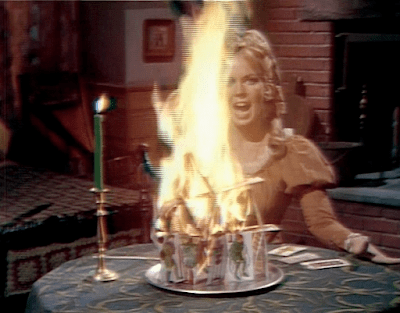
Episode 389: Samantha

Like every other episode of Dark Shadows, this one opens with a voiceover delivered by a member of the cast. The voiceovers in the segment of the series set in the year 1795 usually begin thus:

A séance has been held in the great house of Collinwood, a séance which has suspended time and space and sent one girl on an uncertain and frightening journey into the past, back to the year 1795. There, each of the Collins ancestors resembles a present-day member of the Collins family. But the names and relationships have changed, and Victoria Winters finds herself a stranger in a sea of familiar faces. 

The “sea of familiar faces” results from the same actors appearing in the parts of the show set in different periods. The emphasis the show places on this, both by the repeated use of “sea of familiar faces” in one opening voiceover after another and by the hapless Vicki’s (Alexandra Moltke Isles) exasperating habit of telling the characters that they are being played by actors who previously took other parts, gives the audience a reading instruction. Evidently we are meant to compare and contrast each actor’s twentieth century and eighteenth century roles.

The first face we see today is the only unfamiliar one that has bobbed to the surface of the 1795 sea. It belongs to wicked witch/ lady’s maid Angelique, played by Lara Parker. Angelique had a brief fling with young gentleman Barnabas Collins (Jonathan Frid) some time ago. They met when he first went to the island of Martinique and met her employers, the wealthy DuPrés family.

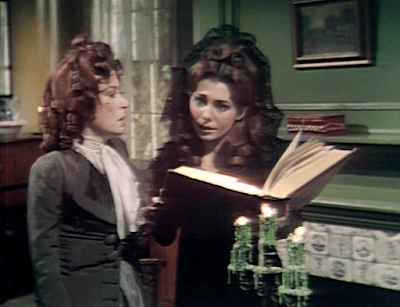
Angelique and Samantha. Screenshot by Dark Shadows Before I Die.

Barnabas had fallen in love with the gracious young Josette DuPrés (Kathryn Leigh Scott,) but was convinced Josette could never love him. Barnabas consoled himself in Angelique’s arms until he realized Josette did love him. Barnabas and Josette agreed to marry. Josette came to Collinwood for the wedding, accompanied by her father André (David Ford) and her aunt, the Countess DuPrés (Grayson Hall.) Angelique is the countess’ maid, but also attends Josette.

Angelique used her powers of black magic to make Josette and Jeremiah Collins (Anthony George,) Barnabas’ uncle, conceive a mad passion for each other. Josette and Jeremiah eloped, breaking Barnabas’ heart. Barnabas and Jeremiah fought a duel; consumed with remorse, Jeremiah let his nephew kill him. Even after all that, Barnabas realized he would always love Josette, a fact of which he apprised Angelique. Frustrated to find that she could never have Barnabas, Angelique yesterday announced in a soliloquy that she would punish him by forcing him to watch his beloved little sister Sarah (Sharon Smyth) suffer. At the top of the episode, Angelique is in her room in the servants’ quarters of Collinwood’s manor house with Sarah’s doll and some pins.

We cut to the front parlor, where Sarah is looking up adoringly at her mother Naomi Collins (Joan Bennett,) who is reciting a story. We cut back to Angelique, who drives a pin into Sarah’s doll. In the front parlor, Sarah clutches her chest and cries out in pain. Angelique sticks more pins into the doll, and Sarah cries out again.

In the parts of Dark Shadows set in the 1960s, Joan Bennett plays matriarch Elizabeth Collins Stoddard, owner of the great estate of Collinwood, of the Collins family enterprises, and of any other piece of property that they decide to tell a story about. In Liz’ time, the Collins family is much decayed from its eminence in 1795, but she is still the foremost figure in the town of Collinsport, and would have the authority to make just about anything happen. In fact, Liz can rarely bring herself to do very much that pertains to the plot, but when she does speak up we can see that she has great depths.

Naomi, by contrast, is utterly powerless, shut out by her husband, haughty overlord Joshua (Louis Edmonds) even from the management of the house. In today’s pre-title teaser, we see Sarah sitting on the floor of the front parlor, looking up adoringly while Naomi recites a story to her. That Naomi is reciting to Sarah rather than reading to her reminds us of what we learned when first we saw her in #366, that unlike most women in eighteenth century New England Naomi is altogether illiterate. Naomi occasionally bewails her inability to spend her time productively, and often drinks.

Sharon Smyth plays Sarah in 1795. In 1967, she was Sarah’s ghost, a frequent visitor to Collinwood and its environs. Sarah’s ghost was quite a different character than is the living Sarah. The little girl in the white bonnet who showed up in the oddest places and made the oddest remarks was only one aspect of a vast and mighty dislocation in time and space. It was Sarah’s ghost that started Vicki’s “uncertain and frightening journey into the past.”

Miss Smyth* nowadays describes her acting style when she was nine and ten saying “the first word that comes to mind is ‘clueless,'” but that works out surprisingly well for a ghost. It isn’t clear to us how the visible part of the Sarah phenomenon relates to the rest, much less how the whole thing works, and it can’t be clear- if a phenomenon stops being mysterious, it isn’t supernatural anymore. So it is gripping to see that the visible Sarah is herself in the dark about what she represents. That doesn’t work so well for living characters. When Miss Smyth can’t take her eyes off the teleprompter while delivering lines like “Help me, mother! It hurts!,” we can perhaps see one reason why the unfathomably mighty Sarah of 1967 was reduced to such a subordinate role in 1795.

But Miss Smyth’s limitations as a performer were not the only reason this development was inevitable. The whole idea of the supernatural is that something which appears to be very weak is in fact very strong. So children usually have fewer resources at their disposal than do adults, females are less likely to be found in positions of authority than are males, and the dead cannot rival the dynamism of the living. So the ghost of a little girl will of course be an immense force. The Sarah we see in 1795 is not yet a supernatural being, and so it would ruin the irony if even before her death she were already great and powerful.

In the part of the show set in 1967, Liz was one of the few major characters who never saw the ghost of Sarah. Liz was pretty firmly in denial about all reports of paranormal phenomena, and in #348 Sarah would declare that she could appear only to people who were prepared to believe in ghosts. So it is a bit startling for regular viewers to see these two actors together for the first time. Naomi is the same calm, indulgent presence to Sarah that Liz is to the children in her life, suggesting that though “the names and relationships have changed,” Liz and Naomi are two versions of the same person.

If the viewer’s main activity in watching the 1795 segment is contrasting the characters with those played by the same actors in the first 73 weeks, Angelique’s prominence is a puzzle. She is the only one who doesn’t fit into that scheme, yet she has driven all of the action so far. By the end of today’s episode, I think we can see a 1967 character with whom Angelique stands in juxtaposition. That character is Barnabas.

From April to November of 1967, Dark Shadows was largely the story of vampire Barnabas Collins (Jonathan Frid) and his attempt to impersonate a living man native to the twentieth century. It was so much fun to watch Barnabas scramble to keep this game going that the audience found it easy to put to one side the horrible evil he did and to look for reasons to think of him as good. But if we ever succeeded in doing that, Dark Shadows would be ruined. A deep-dyed villain allows a drama to be less serious overall than it might otherwise be, so that a thoroughly bad Barnabas lightens the tone. Make him relatable, or even forgivable, and everything gets terribly serious again. Yet a nonthreatening vampire is a purely comic character, like Count von Count on Sesame Street. So until they can establish another Big Bad, Barnabas has to be beyond redemption. If he is a lovable guy who just needs help dealing with his neck-biting problem, he has no place on the show, and it has no story left to tell. So they spent the fall systematically kicking away every possible mitigating factor and forcing us to behold Barnabas’ unrelieved evil.

The last hope of redemption for Barnabas in 1967 was his attachment to the late Sarah. Sarah had died when she was about ten, and her ghost started haunting the estate of Collinwood back in June, when Barnabas was holding Maggie Evans, The Nicest Girl in Town (Kathryn Leigh Scott,) prisoner in his basement. By November, many people had seen and talked with Sarah, but she had shunned Barnabas, even though he was desperately eager to reconnect with his baby sister. In his speeches about his longing for Sarah and in two moments when a suggestion he might see Sarah distracted him from a murder he was in the middle of committing, we saw the possibility that when Barnabas was finally reunited with her, he would change his ways.

That reunion finally took place in #364. Sarah walks in as Barnabas is strangling his only friend and sometime co-conspirator, mad scientist Julia Hoffman (Grayson Hall.) Barnabas does let Julia go, and has a heartfelt conversation with Sarah. Sarah says that she will not come back until Barnabas learns to be good. We can see just how long that is likely to be when, less than two minutes after Sarah has vanished, Barnabas tells Julia that, while he may not kill her tonight, her existence means no more to him than does that of a moth.

When even a direct encounter with Sarah cannot move Barnabas to find value in human life, we see that what Barnabas wanted when he was yearning for her to come near him was not to renew a relationship in which anything would be expected of him, but was something more like nostalgia. He has moved into the house where he spent his time when he was alive, and has restored it to its appearance in those days. He once persuaded his distant relatives, Liz and the other living members of the Collins family, to attend a party in that house dressed in clothing that belonged to their ancestors of his period and answering to their names. And he cherishes a fantasy that a young woman will discard her personality and replace it with that of Josette, then come to him and live out the life he had once believed he would have, long ago. His wishes for Sarah are of a piece with these attempts to recreate a past world. He wants to reenact the time he had with her, not to face the present alongside her. Barnabas is a damned soul, unable to love, unable to grow, unable to do anything for the first time.

Today, the show pushes Angelique into the same “Irredeemable” category where his reaction to Sarah’s visit had landed Barnabas. Again, it is an interaction with Sarah that represents the last straw. Josette and Barnabas made a sweet couple, but we knew before we ever saw them together that they were not fated to end up together. Jeremiah was likable enough, but we knew that he, too, had a sharply limited future. But Sarah is a child, a particularly adorable one, and is someone we have come to feel we know through her months as a ghost. When Angelique treats her so cruelly, we cannot imagine ever forgiving her.

And yet, there were times we felt that way about Barnabas, too. Angelique’s insane fixations are remarkably close to those vampire Barnabas exhibited in 1967, so much so that we keep wondering if whatever she does that turns Barnabas into a vampire will also put her personality into his body. We have come to be attached to the vampire; perhaps we will eventually discover it is Angelique we were watching until Vicki came to the past.

That isn’t to deny that the human Barnabas we have seen so far has points of contact with the ghoul from 1967. He was selfish enough to take advantage of a servant girl in Martinique when he didn’t think he could win the love of the grand lady he wanted and to discard her when he learned he could. He is cowardly enough that it never occurred to him to tell Josette that he had a past with Angelique at a time when doing so could have prevented Angelique casting the fatal spells on her and Jeremiah.

Real as these vices are, they are endemic to soap opera characters. Few daytime serials would have any stories to tell if they were about people who had a gift for monogamy, and we are supposed to find ourselves yelling at the screen “Just tell her!” and “Just tell him!” at regular intervals. Even the power differential between Barnabas the scion of the wealthy Collins family and Angelique the servant girl, problematic** as it would be in real life, is less troubling in the soaps, which take place in worlds where heirs and heiresses marry servants and their relatives all the time. Of course, most viewers know that Barnabas is destined to become a vampire, a metaphor for selfishness, and will be inclined to see in his use of Angelique the seeds of his subsequent damnation. And Angelique has enough lines about Barnabas’ selfishness that even viewers who joined the show during the 1795 segment can’t let him off the hook altogether.

Still, there is a great deal of good in the living Barnabas. We see him at Sarah’s bedside, consumed with worry for his beloved little sister. The doctor has been to see Sarah, and he has nothing to offer. Sarah asks to see her governess Vicki, who is in hiding because a visiting witch-hunter named Trask has blamed her for a series of inexplicable misfortunes that have befallen the house since she showed up in #366. It was Vicki’s own odd behavior that first made her a suspect, and Angelique has taken advantage of Trask’s foolishness to fabricate evidence against Vicki. She has gone into hiding, and Barnabas is helping her.

When Sarah keeps asking to see Vicki, Barnabas promises to bring her. Naomi is surprised to learn that Barnabas knows where Vicki is, and is not at all sure Trask isn’t right about her. But when she sees her daughter with Vicki, she is sure that she is innocent.

Vicki was the audience’s main point-of-view character throughout 1966 and well into 1967. Major story developments took place after Vicki found out what was going on. Vicki was the chief protagonist in the most important story of that period, the crisis represented by undead fire witch Laura Murdoch Collins. Vicki took charge of the household, organized a group to fight Laura, and rescued strange and troubled boy David from the flames when Laura tried to burn him alive. That intelligent, forceful character has been fading ever further into memory in recent months, and we haven’t seen a trace of her in the 1795 storyline. Sarah is happy to see Vicki and says she likes the stories she tells, but she is a passive witness to today’s events. She serves chiefly as a prop, used to demonstrate that the human Barnabas, whatever his faults, is capable of heroic action.

Barnabas’ compassion for Sarah and his valiant defense of Vicki do not negate his vices. As the heir to Collinwood, Barnabas can express his self-regard both by gratifying his urge to treat some women badly and by earning admiration for treating other women well. In her low station, the same trait leads Angelique directly to the “Dark Triad” of Narcissism, Manipulativeness, and Psychopathy. As a vampire, Barnabas will exhibit the same three qualities in abundance, but for now, we still have license to hope for better from him.

As it was so much fun to watch Barnabas trying to pass as a modern man that we wanted to like him even after he had been terribly cruel to Maggie, a character we like very much, it was so much fun to watch Angelique twist Trask around her finger that we wanted to like her. Besides, her desire to remake Barnabas as her lover is understandable for those who have been watching the show and wanting him to be something other than a heartless murder machine. So, perhaps we will wind up liking Angelique after all.

Angelique has bewitched indentured servant Ben Stokes (Thayer David) and forced him to act as her assistant. Ben is devoted to Barnabas and miserable that he has been the instrument of so much evil done to him, but has been powerless to resist Angelique’s commands. When he realizes that Angelique is causing Sarah to sicken and perhaps die, he goes to her room and demands that she stop. He threatens to kill her if she does not relent. In response, Angelique causes him to have a heart attack. She lets his heart start pumping again when he promises to be quiet.

This is the second heart attack a character of David’s has had on screen. The first also prevented a servant in this same house from killing a young woman. That came in #126, when crazed handyman Matthew Morgan had been holding Vicki prisoner here and was about to decapitate her. The ghost of Josette led several other supernatural presences who scared Matthew to death before he could complete his fell purpose. Matthew and Ben are both devoted to the Collinses, and both are led astray so that they become parties to terrible crimes. As the benevolent spirit of Josette put a stop to Matthew’s crimes, so the malign Angelique prevents Ben from putting a stop to her own.

Barnabas drops by Angelique’s room to ask if she has seen Sarah’s doll, which she calls Samantha. He tells her that Sarah is very ill and has asked for the doll. It occurs to Angelique that she has some leverage over Barnabas. She says that she can brew a special kind of tea that might cure Sarah’s symptoms. He asks her to do so. She makes him promise to marry her if she does.

Several times, we have seen that Angelique is flying by the seat of her pants. She had no idea of using Sarah’s illness to gain a hold over Barnabas until he chanced to come into her room. Nor is she thinking ahead- as it stands, the witch-hunters have fastened on Vicki as their suspect, and are not thinking of her. If word gets out that she had the power to cure Sarah’s mysterious ailment and exercised it only after extorting Barnabas’ promise of marriage, that would seem to be proof positive that she is a witch.

In her own bedroom, Sarah sips the tea. At the same moment, Angelique, in the servants’ quarters, pulls the pins from the doll. How exactly Angelique got the timing just right isn’t exactly clear, but she must have had a way- she is perfectly confident when she tells the doll that it has served her well.

*Mrs Lentz now, but it’s strange to say “Mrs” when you’re talking about a ten year old.

**I know people don’t really say “problematic” anymore, but it seems to be the right word here.

Episode 388: Someone else you love

Gracious lady Josette DuPrés left her home on the island of Martinique to marry her fiancé, young gentleman Barnabas Collins. She is Mrs Collins now, but not Mrs Barnabas Collins.Her aunt’s maid, Angelique, is a wicked witch who wants Barnabas for herself. To that end, she cast one spell to cause Josette to conceive a mad passion for Barnabas’ uncle and dearest friend, Jeremiah Collins, and another to cause Jeremiah to reciprocate her feelings. On what was supposed to be the night of Josette’s wedding to Barnabas, she ran off with Jeremiah. The two of them married. When they returned to the estate of Collinwood, Barnabas challenged Jeremiah to a duel. Remorseful, Jeremiah let Barnabas shoot him. Now, he is hovering at the point of death.

We open with Angelique in Barnabas’ room, massaging his forehead. She wants him to say that he hates Josette. He says “I hate her!,” but can’t bring himself to say “I hate Josette.” He kisses Angelique and agrees to visit her room in the servants’ quarters later.

The results of Angelique’s magical activities have not gone unnoticed. Some members of the household believe there is a witch at work among them, and have called a professional witch-hunter named the Rev’d Trask to conduct an investigation. No one suspects Angelique- Trask and his supporters have fastened on recently arrived governess Victoria Winters. Vicki is in hiding, and Barnabas and his friend, caddish naval officer Nathan Forbes, have been helping her.

Downstairs in the manor house, Trask is questioning Josette. When he raises the possibility that she may have been the victim of demonic influence and therefore not responsible for her recent actions and their tragic consequences, she is intrigued. But she cannot take the escape he offers. She insists that she is responsible for her actions. Even so, she allows Trask to begin an exorcism.

Barnabas interrupts the ceremony. He makes no secret of his contempt for Trask. When Trask tells him that Josette has been under the control of forces alien to herself, Barnabas demands Josette tell him what she did that she did not want to do. She will not say anything to suggest disloyalty to Jeremiah. “He is my husband, and he is dying. That is all that matters.” When Barnabas asks if she loves him, she says yes. He asks if she married him because she loved him, again she says yes. She says she wishes things had been different; he asks what she could wish different, if she has married the man she loves. She cannot answer.

Barnabas is back in his room, looking depressed. Angelique enters and asks why he didn’t come to her. He says that it can’t work between them. He still loves Josette, in spite of everything. She asks what Josette told him to make him feel that way. He says that all she said was that she is married to Jeremiah and loves him.

Angelique is devoted to manipulating people, and cannot believe Josette did not somehow trick Barnabas into loving her. But we can see that Barnabas is responding to Josette’s attempt to do her duty to Jeremiah. He does not believe in magic, and is convinced that Josette and Jeremiah willfully betrayed him. But he knows virtue when he sees it, and in Josette’s attempt to be a good wife to the dying Jeremiah he recognizes the trustworthy partner with whom he had expected to share his life.

Barnabas asks Angelique if it is still possible for them to be friends. She notices a doll on a shelf, a favorite plaything of Barnabas’ ten-year old sister Sarah. She takes the doll, saying she will return it to Sarah.

Angelique finds the doll. Screenshot by Dark Shadows Before I Die.

Back in her room, Angelique talks to herself. She says that she will punish Barnabas for spurning her. This time, she will not cast a spell on Josette. Instead, she will use her powers to make Sarah suffer. Barnabas will watch Sarah suffer, Angelique proclaims, and that will be the hardest experience of his life.

Angelique is a fun character, and up to now the roots of her behavior in her unrequited love for Barnabas have made it possible for us to sympathize with her. But we’ve known Sarah since she first showed up as a ghost in #255, back in June. She is adorable, and the doll Angelique is planning to use against her was something she used in lifesaving good deeds back in the summer. There is nothing sympathetic about a threat to hurt her. With her final scene today, Angelique crosses into very dark territory.

Episode 387: Just how does one go about sensing an evil spirit?

Lady’s maid Angelique is keeping busy, even though none of the ladies is on the show today, by carrying tea trays in and out of the front parlor of the manor house on the great estate of Collinwood. As she does so, she hears the Rev’d Mr Trask, a professional witch hunter visiting from Salem, Massachusetts, lay out his plan for uncovering what he believes to be a coven of witches operating in the house. Since Angelique spends her non-tea related time being a wicked witch and causing all the suffering that everyone has undergone on the show since we arrived in this year 1795, it is unsurprising that she reacts to Trask’s plan with concern.

We see the servants’ entrance to the manor house. Not only is this a new set, it is a new kind of set for Dark Shadows. So far, we have seen at most one entrance for any building. Since we are in the middle of the 78th week, we have come to expect that’s all we ever will see, so it comes as a bit of a jolt to see this doorway.

Angelique sees caddish naval officer Nathan Forbes coming out of the servants’ entrance. She remarks that the family and their guests never use it; he jokes about breaking rules. She asks what he has in his hands; he asks what hands she means, then admits that he stole some food from the kitchen. He claims to be on his way to a picnic, and invites her to join him. He is typically uninhibited in his dealings with young women, and he certainly doesn’t try to keep Angelique from thinking that if she accepts his invitation she will have her work cut out for her if she wants to remain fully clothed. She declines, insisting that she has duties to attend to.

Angelique sees through Nathan. Screenshot by Dark Shadows Before I Die.

She watches him go, and in a soliloquy says that she sees through him. He is taking the food to Victoria “Vicki” Winters, governess to young Sarah Collins and Trask’s prime suspect, who is in hiding. Perhaps Nathan was leveraging his reputation as a lecher by presenting his invitation to Angelique in terms he knew she would have to decline.

Back in the front parlor, Trask is asking the master of the house, haughty overlord Joshua Collins, why Angelique did not report when the servants were summoned for his questioning. Joshua replies that she is not the Collinses’ servant, but that she belongs to their house-guests, the DuPrés family. Trask rails against the DuPrés, and Angelique enters, meekly saying that her mistress told her she was wanted.

Even though Angelique was bustling around the room in the opening teaser, Trask does not recognize her. It may not have been customary to take much notice of servants in the eighteenth century, but Angelique is rather a hard person to miss. For one thing, she looks exactly like Lara Parker. A person would have to be pretty intensely focused not to notice someone who was so obviously meant to be a movie star.

Trask asks Angelique where she was when the other servants came. When she tells him she was walking alone in the woods, he asks if she went there to meet with someone- “perhaps the DE-VIL!!!” Jerry Lacy is an accomplished sketch comic, and the laughs he raises when Trask shouts about “The DE-VIL!!!” and “THE ALMIGHTY!!!!” must be intentional.

Trask questions Angelique closely, and for a fraction of a second it seems like he might know what he is doing. That produces mixed feelings in the audience- if he exposes Angelique, he will save Vicki and other characters we care about from the terrible fates that are apparently in store for them. On the other hand, Dark Shadows might then become The Adventures of the Heroic Reverend Trask, and that would be so ridiculous that no writing staff in the world could possibly keep it going for more than a few episodes.

Angelique sees through Trask as easily as she had seen through Nathan. She falls to her knees and claims to be having a vision. She hams it up shamelessly.

At first Trask says that she is either a complete charlatan or is speaking under divine inspiration; before Joshua can express a doubt as to which it is, he proclaims it genuine. She has claimed to hear the voices of a man and a woman speaking in a large new house that is otherwise vacant. Trask and Joshua decide it is the new house under construction on the estate, and rush off. We see Angelique with a weary look on her face, as if she can’t believe she is up against such a load of idiots.

In the drawing room of the new house, Vicki is eating the food Nathan has brought. She starts talking about her situation. As it happens, Vicki is not native to 1795 at all. She was thrust back to that year from a séance she was attending in 1967, after Sarah’s ghost took possession of her and said she wanted to tell “the story from the beginning.” Vicki hasn’t told anyone about this, but she is continually saying and doing things that make it obvious she doesn’t belong in this world. She tells Nathan that “In order to get here, I had to transcend time and space.” Nathan says he doesn’t know what she’s talking about, but that if she keeps saying things like that even her friends will think she’s a witch.

Vicki natters away. Screenshot by Dark Shadows Before I Die.

There was a time when Vicki was an intelligent, dynamic character. Apparently she left her brain in 1967, because what Nathan says comes as news to her. A few days after Vicki arrived, kindly gentleman Jeremiah Collins befriended her; when she answered his questions about her past by claiming to have amnesia, he bluntly told her she would have to make up a better story than that. Someone who needs advice at that level is not likely to do well in a situation where only a con artist could survive.

Vicki and Nathan hear voices in the foyer. Trask and Joshua have arrived. Nathan goes out to meet them, claiming to have come to inspect the architecture of the house. Joshua is appalled that Nathan has not asked his permission to enter the house, and Trask is sure he has come to visit Vicki.

Trask, Joshua, and Nathan go into the drawing room. Vicki is not there. A window is open, and there is a piece of fresh food wrapped in a cloth on a crate. Nathan doesn’t claim that he opened the window or that he was eating the food; Trask and Joshua are left to conclude that Vicki had been there.

Episode 386: Innocent until proved innocent

For the first nine months it was on the air, Dark Shadows was the story of well-meaning governess Vicki Winters and her efforts to befriend her charge, strange and troubled boy David Collins. That phase of the show reached a climax with the story of David’s mother, blonde fire witch Laura Murdoch Collins, who was on from December 1966 until March 1967. Vicki rallied the regular characters in opposition to Laura’s evil plans for David, and when Laura went up in smoke David found refuge in Vicki’s arms. He had exchanged his destructive, death-oriented mother for the loving, life-affirming Vicki. At that moment, Dark Shadows version 1.0 ended.

Now, Vicki has been thrust back in time to the year 1795. Vicki has managed to get another job as governess on the great estate of Collinwood, supervising the education of ten year old Sarah Collins and her second cousin once removed, the visiting (but so far unseen) Daniel Collins. There is a blonde fire witch here as well, the mysterious Angelique. Viewers who have been with the show from the beginning will remember Vicki’s leadership of the campaign against Laura, and are waiting to see how she will take charge of the effort to defeat Angelique.

It’s already been a long wait. Vicki has not adapted her thinking at all to her new surroundings. Angelique’s spells have wrought considerable havoc, and members of the Collins household have begun to wonder whether a witch might be at work among them. Angelique hasn’t lifted a finger to deflect suspicion to Vicki, but Vicki’s own behavior has been so bizarre that she is the obvious suspect. As we open today, she has been tied to a tree by the Rev’d Mr Trask, a visiting witch-hunter from Salem, Massachusetts.

Vicki’s ineptitude is particularly frustrating to watch because the major theme of Dark Shadows 2.0, which ran from Laura’s immolation in March to Vicki’s temporal displacement in November, had been a brilliantly successful deception by a different sort of time-traveler. Vampire Barnabas Collins presented himself to the Collinses and their neighbors, not as a blood-sucking ghoul native to another century, but as a distant cousin from contemporary England. Barnabas made plenty of slips and raised miscellaneous suspicions in the minds of various people, but he played his part well enough that the Collinses let him take possession of a house on their estate, the people of Collinsport accepted him as a member of the local aristocracy, and in one way or another he made himself indispensable to everyone around him. We began this version 3.0 expecting to see Vicki do in 1795 something like what Barnabas had done in 1967, and instead we see her as a tedious dingbat.

Barnabas is alive and benevolent in 1795. He and his friend, caddish naval officer Nathan Forbes, are men of the Enlightenment who are appalled that there are still people who believe in witchcraft. They hold Trask in contempt and are committed to saving Vicki from him. Barnabas and Nathan ask the Collins family’s house-guest, the Countess DuPrés, what Trask has done with Vicki. The countess had originally believed Vicki to be a witch, but after seeing Trask’s lunatic behavior while interrogating her came to regret her involvement in bringing him to Collinwood. She tells them that Trask tied Vicki up and took her out of the house, whither he would not say.

Outraged, the men head out of the house. They meet Trask coming in. He refuses to tell them where he has left Vicki. Barnabas thunders that “[I]t perhaps has escaped your memory that we have just fought a war recently-a war to establish certain rights. And I am defending the right of this girl to be judged innocent until she is proved innocent. I am sure that this idea is a little complicated for your mind to absorb.” He’s probably right about that, I certainly find it difficult to absorb.

“Innocent until she is proved innocent!” Screenshot by Dark Shadows Before I Die.

Once Barnabas and Nathan are on their way to look for Vicki, Trask tells the countess he has tied her to a tree somewhere in the woods and that if she is a witch, the tree will be dead by morning. Angelique’s regular job is as the countess’ maid. She is in the room with a tea tray when Trask says this, and she smiles delightedly when she hears it. Later, she will sneak out of the house to go searching for Vicki herself.

Barnabas and Nathan find Vicki and untie her. They decide to hide her in the great house of Collinwood. The great house is Vicki’s home in the 1960s, and is under construction in 1795. They set off, and Angelique comes to the tree.

Once she is alone, Angelique takes a cutting from the tree and sets fire to it. This causes the tree itself to burn. It is not entirely clear why she doesn’t just set fire to the tree, since the cutting she has taken is the greenest and least flammable part of it, but witches gonna witch, I guess.

Building a fire the witchy way. Screenshot by Dark Shadows Before I Die.

The next morning, Trask goes to the tree. The countess insists on accompanying him. They find that Vicki is gone and the tree is a hunk of scorched timber. Trask triumphantly silences the countess’ doubts.

In our time-band, the last witchcraft trial in the English-speaking world was held in Scotland in 1727. The Westminster Parliament finally abolished all laws against witchcraft in 1736, including those still on the books in Massachusetts* and some other British colonies in North America. Had they lived in our 1795, Barnabas and Nathan could have gone to the constable and reported that Trask had abducted Vicki, bound her, and left her outside. The constable would help them find her, arrest Trask, and that would be it. But of course Dark Shadows takes place in a world that differs from ours in many respects, not least in regard to the legal history of Massachusetts.

As the countess, Grayson Hall has been doing an excellent job establishing a character who is distinct from mad scientist Julia Hoffman, the role she plays in the segments of Dark Shadows set in the twentieth century. But as my wife, Mrs Acilius, points out, Hall does lapse into Julia a few times today. When she gasps in horror, she makes a little clicking noise in the back of her throat that is one of Julia’s most recognizable mannerisms. Julia is deeply entangled with Barnabas’ activities, and has developed an emotional attachment to go along with her inability to get away from him; shortly before Vicki took us with her to 1795, we heard Julia address him with a deeply felt “Barnabas, Barnabas.” The countess barely knows Barnabas, but in an anguished moment today, she says “Barnabas, Barnabas” to him. Hall does return to being the countess before the episode is over, but there is a weird little visit from Julia in the middle of it all.

Vicki went back to the past after Sarah’s ghost took possession of her at a séance and said she was going to “tell the story from the beginning.” Vicki has traded places with Sarah’s original governess, a woman named Phyllis Wick. Presumably Angelique chose Phyllis as a patsy, and she wound up as Trask’s target. Maybe Angelique did this simply because Phyllis was new to the house and had no old friends to object that she couldn’t possibly be a witch, but maybe it was because she had caught on to Angelique.

It would make it all the more exciting to see Vicki catch on to Angelique and do battle with her. We’ve already seen Smart Vicki defeat one blonde fire witch, so if we see her try to fight another, we will hope that she might win again. Only when we saw the attempt end in disaster would we realize that everything we’ve seen Vicki doing is what Phyllis Wick did the first time around, and that her intervention won’t have changed a thing. That would be a powerful twist ending to the whole 1795 flashback. Instead, we are subjected to Dumb Vicki doing things neither Phyllis nor anyone else who belonged in 1795 could possibly have done, and we end up wondering what she is doing in this story.

*Collinsport is in Maine, which until 1821 was part of Massachusetts.

Episode 385: How long have you been in league with the devil?

Repressed spinster Abigail Collins has invited a visitor to the great estate of Collinwood. He is the Reverend Mr Trask. It’s 1795, so the Rev’d Mr T missed the big excitement in his hometown of Salem, Massachusetts by 103 years, but he’s trying to make up for it by hunting witches elsewhere.

Enter Trask. Screenshot by Dark Shadows Before I Die.

Both caddish naval officer Nathan Forbes and young gentleman Barnabas Collins are appalled by Trask, and each of them wants to defend the target of Abigail’s suspicions, governess Victoria Winters. They are powerless to do much for her. Barnabas cannot overrule his father, haughty overlord Joshua Collins, who is the master of the house and has given Abigail “full rein” in re Vicki. And Nathan cannot persuade Vicki to run away with him, because she distrusts his intentions and cannot believe that she is really in danger.

Unknown to any of the other characters, Vicki is a time-traveler displaced from 1967 by the ghost of Sarah Collins, who is now alive and studying under her direction. Vicki has been making one inexplicably foolish mistake after another since she began her uncertain and frightening journey to the past four weeks ago, and now they are all catching up with her.

It is hard to imagine what the writers were thinking when they made Vicki do such dumb things. Today, Trask, accompanied by his supporters Abigail and house-guest the Countess DuPrés, confronts Vicki in her room. At first, her behavior in that scene makes sense. He keeps putting his hands on her, prompting her to object; he asks her leading questions based on the assumption that she is guilty of witchcraft, to which she reacts with disbelief. But she has been in 1795 for nearly a month, and that whole time she has been a servant in the house of the tyrannical Joshua. She must know that she is subject to arbitrary exercises of power.

Further, we have seen Vicki in 1966 teaching history to her charge, strange and troubled boy David. You would think that she would have some appreciation of social context and would make some effort to play along with people who are native to the setting in which she finds herself. When Trask tells her to kneel and pray, he’s giving her the option to get out of trouble by doing something she wouldn’t have any reason to find objectionable. But she just gets angrier. She and Trask take turns slapping each other, and Abigail helps him bind and gag her.

Vicki slaps Trask. Screenshot by Dark Shadows Before I Die.

Later, Abigail and the countess are in the front parlor of the manor house. The countess has been pushing hard for action against Vicki, but she recoils from Trask’s methods. She tells Abigail that she wishes she knew where Trask had taken Vicki. Abigail reproves her, shocked that she would second-guess “a man of God!” The countess is played by Grayson Hall, who in the parts of Dark Shadows set in the twentieth century plays mad scientist Julia Hoffman. Like the countess, Julia is fascinated with the occult. Julia has expert knowledge that leads her to draw correct conclusions about this subject. Perhaps the countess’ misgivings about Trask show that she, too, is smart enough to see through the charlatans. Maybe Vicki will find herself with a more formidable ally than the irresponsible Nathan or the bumbling Barnabas.

Trask has tied Vicki to a tree deep in the woods. He tells her that if she is guilty of witchcraft, the tree will be dead by morning. He asks her to renounce Satan. In another Dumb Vicki moment, she refuses simply to say “I renounce Satan and all his works.” He leaves her tied up.

Trask leaves Vicki tied to a tree. Screenshot by Dark Shadows Before I Die.

Jerry Lacy joined the cast in #357 as lawyer Tony Peterson. In his performance as Tony, Mr Lacy did his famous Humphrey Bogart imitation. Bogart slips out once or twice today; when Trask looks away from Vicki and goes into monologues, he does sound like he is about to start explaining how he will find out who stole the strawberries from the officers’ mess. But what’s more important about his performance is how very far he goes over the top. Lara Parker famously described the Dark Shadows house style of acting by talking about the hyper-intense manner in which she was expected to deliver the line “Go back to your grave!”; Mr Lacy’s performance today is as intense as any we will ever see.

As Vicki, Alexandra Moltke Isles is usually one of the quietest and most interior-directed members of the cast. In Vicki’s scenes with Trask today, she shows that she can shout with the best of them. If Vicki had taken her brain with her to 1795, it might have been fun to see what Mrs Isles could do with the part under the new regime.

Mr Lacy wasn’t the first shouty actor to share a scene with Mrs Isles. For the first several weeks of the show, the cast included a man named Mark Allen. In alternate episodes, Allen either shouted all his lines or whined all of them. Mrs Isles responded to that memorably in #20 by growing ever more still and quiet as he bellowed at her. But while Allen’s shouting was simply a sign of incompetence, Mr Lacy’s is textured, nuanced, and funny. When other actors shouted back at Allen, the result was a lot of noise. When Vicki shouts back at Trask, she comes to life.

I do wonder about Trask’s name. Just a few days ago, I was looking through a book about Marvel Comics in the 1960s, and learned that a villain named Bolivar Trask was introduced in The X-Men in 1965 and was a big deal in several Marvel titles for the next few years. The writers, producers, and directors of Dark Shadows were all middle-aged, and it is unlikely that they were reading comic books for pleasure. But they had shown engagement with comics before- a graveyard scene in #209 includes a rather clear echo of the visual style of the horror comics EC was putting out fifteen years or so earlier. Since that is part of the lead-up to the vampire story, the directors would have been making an obvious move had they sent a production assistant to a flea market to look for some old horror comics to which they could slip in an homage.

Besides, Dark Shadows itself had been licensed to Dell for comic books by this time. It would only have been natural for people involved with the show to have been curious what might come of that. Maybe they were browsing through Marvel’s output to get a sense of what was going on in that medium.

Or an influence could have come through an even less unusual vector. Several members of the production staff had children who were teenaged and younger, as did writer Sam Hall. Those children might well have been fans of Marvel’s in those days. So it is possible that someone behind the scenes might have heard the name “Trask” mentioned around the house as a good one for a villain.

Episode 384: What is the truth, Barnabas?

It is 1795, and we are on the great estate of Collinwood. Under the influence of wicked witch Angelique, the kindly Jeremiah and the gracious Josette have eloped, breaking the heart of Josette’s fiancé, Jeremiah’s nephew and best friend Barnabas Collins. Barnabas, up to that point an idealistic man of the Enlightenment, responded by going against his beliefs and challenging Jeremiah to a duel.

Angelique is a lady’s maid. She was introduced as maid to Josette’s aunt, the Countess DuPrés, but today it seems she is Josette’s maid. She comes to Barnabas’ room. He demands to know why her mistress has sent her, meaning Josette, to which she replies she has come on her own account.

Angelique asks Barnabas why he has challenged Jeremiah to a duel, since he has never fought a duel or even seen one before. He explains that he could not stand being an object of pity- “I couldn’t be poor Barnabas.” In 1967, Barnabas will be a vampire. We saw him in that year, in #345, telling his sometime associate mad scientist Julia Hoffman the story of his relationship with Josette. The story he told was different from other versions he had told previously, for example in #233 and #236, and radically different from what we have seen play out in this extended flashback. In the story he told Julia, as in all other versions we had heard before coming to 1795, Josette was originally Jeremiah’s fiancée. One theme developed that resonates here was that all he could be to Josette was a faithful friend, and that he found that role humiliating. He was “poor Barnabas” in that version of the story, and he implies that it was to escape from that identity that he did whatever it was that made him the undead monster he became.

Angelique cast her spell on Josette and Jeremiah because she wanted Barnabas for herself. Now that she sees that he is likely to get himself killed before she can make her play for him, she asks him to wear a medallion of hers, one which she says will bring good luck. In the 1960s, a portrait of Barnabas hangs in the foyer of the great house of Collinwood. He is wearing a medallion in that portrait. Is Angelique’s medallion the one in the portrait? We can’t be sure.

Josette and Jeremiah have a conversation. They try to figure out what came over them. They don’t love each other, and regret hurting Barnabas. As their conversation goes on, Josette realizes that Jeremiah regrets it so deeply that he is planning to let Barnabas kill him in the upcoming duel. She is horrified by this. She doesn’t want anyone to die, and has accepted the fact that Jeremiah is the only husband she’s got. Nevertheless, she cannot dissuade him.

Josette’s father arranges for Jeremiah to have a final talk with Barnabas. Barnabas accuses Jeremiah of lusting for Josette all along, saying that “you wanted her the moment you saw her.” This is not true of Jeremiah, but in #345 it is exactly what Barnabas tells Julia he himself did. In that version, he conceived a wild passion for Jeremiah’s bride-to-be the moment he first saw her.

Barnabas tells Jeremiah “You must have hated me all your life.” As we have seen over these last few weeks, Jeremiah and Barnabas have been dear friends all their lives. But from his early days on the show in the spring of 1967 until we left for our voyage to the past in #365, Barnabas consistently said that he hated Jeremiah from his earliest days. The overall effect of comparing Barnabas’ various accounts of the past with each other and with what we are seeing in this flashback is something like reading the accounts of the patient’s memories in a case study by Freud. Not only does the order of the events jumble as retcon follows retcon, but guilt floats from one person to another and back again.

When Jeremiah tries to explain how he and Josette found themselves stricken with intermittent attacks of intense desire for each other and how they struggled against those attacks during the intervals between them, Barnabas asks “Why didn’t you come to me then?” That’s a good question, and it suggests another, equally good question. Angelique is casting spells because she and Barnabas had a brief affair before he became engaged to Josette. Why hasn’t he come clean to Josette about his past? If he had, Josette would not have put herself so completely in Angelique’s hands that she could bind her with her spells at leisure.

Jeremiah and Barnabas have their duel. We see them back to back, getting ready to pace off the prescribed distance. On Jeremiah’s face, we see his resolution to let Barnabas kill him.

Resigned to his fate. Screenshot by Dark Shadows Before I Die.

The men are in place when Josette comes running up, pleading with them to stop. She arrives just in time to see Barnabas shoot Jeremiah. Some say they hear only one shot, but I hear two. I think Jeremiah deloped.

Josette goes to Jeremiah’s crumpled body and shouts at Barnabas. “You monster! You madman! You killed the only man I ever loved!” She claims that she and Jeremiah were happy together, and that in his pride Barnabas could not let them be happy. She refuses Barnabas’ offer to help move Jeremiah and get a doctor for him.

Angelique had rubbed Josette’s forehead with some of the rose water in which she had put her love potion not long before this, so Josette’s declarations that Jeremiah is “the only man [she] ever loved” and that they were happy together could be a sign of that influence. It could also be rooted in Josette’s realistic assessment of her situation. Earlier, she had told Jeremiah that she would never again allow herself to say that she loved Barnabas, and when Jeremiah said that his own death would make her a free woman she rejected the idea. Whatever the circumstances that led to the marriage, she is Jeremiah’s wife, and if she becomes his widow she will have an obligation to keep up certain appearances.

This was Anthony George’s last episode. George was woefully miscast when he first joined the show in #262 as the second actor to play Burke Devlin. Writers Ron Sproat and Malcolm Marmorstein kept writing Burke as if he were still being played by the explosively exuberant Mitch Ryan. George’s style was the exact opposite of Ryan’s. He was a cold actor whose characters keep us guessing as to their motives and intentions. He was utterly lost as the hot-headed Burke.

When Gordon Russell joined the writing staff in #292, things looked up for George. Russell understood what actors could do, and gave George some scenes he played very well indeed. In Jeremiah Collins, Russell and Sam Hall created a character who was perfect for George. It’s fascinating to watch Josette scrutinize Jeremiah until she gradually realizes that he has decided to throw his life away to do penance for the offense he and she have committed against Barnabas. It is also credible that, while we can see what Jeremiah is doing, Barnabas, who has known him all his life, would not catch on. George was so bad as Burke in the Sproat/ Marmorstein era that it seemed anything that got him off the show would be welcome. But Russell and Hall know so well how to take advantage of his strengths that it is sad to see him go.

All of the actors have trouble with their dialogue today, even the usually reliable Kathryn Leigh Scott and Lara Parker. Jonathan Frid always struggles, but is especially rough this time, and as for David Ford, what can we say. He mangles virtually every line. His character is supposed to be French; he doesn’t sound French, but doesn’t exactly speak English, either. Danny Horn transcribes many of Ford’s flubs in his post about the episode on Dark Shadows Before I Die, but you really have to hear it for yourself to absorb the sheer bizarreness of the speechlike sounds that come out of Ford’s mouth. I always enjoy watching Ford, and I think he made a major contribution to Dark Shadows‘ acting style when he first came on the show, but when he is off he is way, way off.

Episode 383: Between men now

In 1966 and the early weeks of 1967, the Collinsport Inn was an important place on Dark Shadows. The restaurant there, presided over by Maggie Evans (Kathryn Leigh Scott,) The Nicest Girl in Town, was a place where people could meet each other unexpectedly and characters new to town could be introduced. Dashing action hero Burke Devlin (Mitch Ryan) lived in a suite at the inn, and the place often represented his territory, the base from which he conducted his war against the ancient and esteemed Collins family.

The sign. Screenshot by Dark Shadows Before I Die.

We haven’t seen Burke’s room since #206, at which point he had given up his vendetta against the Collinses and proceeded far down the road to irrelevance. We haven’t seen the restaurant since vampire Barnabas Collins (Jonathan Frid) met Maggie there in #221. By the time Anthony George took over the part of Burke in #262, Burke seemed to live in the Blue Whale tavern. He made business calls from the pay phone there, and in one episode apparently stayed behind when the bartender locked the place up for the night.

The inn makes a return appearance at the top of today’s episode. It is 1795, and Jeremiah Collins (Anthony George) is sharing a suite with Josette DuPrés (Kathryn Leigh Scott.) They are on their honeymoon.

Jeremiah and Josette eloped from the estate of Collinwood on the night when Josette was supposed to marry Jeremiah’s nephew, kindly gentleman Barnabas Collins (Jonathan Frid.) Josette truly loved Barnabas and Jeremiah was his dearest friend, but they were under a spell cast by wicked witch Angelique, who wanted Josette out of the way so she could have Barnabas for herself. The power of the spell waxes and wanes. When Josette and Jeremiah are in the grip of it, a trident shaped mark appears on their hands; when they return to their senses, the mark disappears.

Tridents showing. Screenshot by Dark Shadows Before I Die.

When the episode begins, the tridents are showing, and the newlyweds are inflamed with passion. Shortly after, Josette’s mark is gone, Jeremiah’s still showing. She is filled with regret, he is still ardent.

Back in the manor house of Collinwood, Barnabas has a conversation with Josette’s father André and his own father Joshua. He resists André’s suggestion that Josette and Jeremiah must have left together, and resists even more strenuously Joshua’s declaration that they did so because they are the victims of witchcraft. Joshua says that his sister Abigail and André’s sister, the Countess DuPrés, found a blasphemous trinket in the quarters of governess Victoria Winters, and that a witch-hunting divine, the Reverend Trask, is coming to investigate the matter. Barnabas is appalled at the notion of an inquiry into witchcraft, and vows to defend Victoria if Trask comes. Joshua forbids him to do so.

Barnabas’ reaction to the idea of a witchcraft trial, coupled with what we have seen of him so far in the 1795 segment, looks like a retcon. In #358, only a week and a half before we began this uncertain and frightening journey to the past, vampire Barnabas told a story about studying witchcraft under a warlock on Barbados who taught him “the secret magic number of the universe.” Events are moving so fast that it doesn’t look like Barnabas will have time to sail to the Caribbean before he becomes a vampire, and he won’t be crossing any waters after that. But now he is a man of the Enlightenment, who scoffs at the idea of witchcraft today as he scoffed at the tarot when the countess introduced him to it in #368/369.

Jeremiah returns to the house. There is an exquisite little scene with a servant, Riggs, who is uncomfortable at the sight of the disgraced Mr Jeremiah. Riggs stands in for the establishment of Collinwood and the whole working class of the town of Collinsport, and in his reaction we see the disquiet that bad news from the big house on the hill would spread among the people whose livelihoods are at stake when trouble comes to the family there. Riggs makes haste when Jeremiah tells him to go out and fetch Joshua.

When Riggs is gone, Josette enters. The audience sees that the mark is gone from Jeremiah’s hand, and Josette can tell that his passion for her is gone. She tells him that he no more loves her than she loves him. He begins with a protest against this remark, but ends by saying that they must be kind to each other.

Joshua and André enter. André embraces his daughter and tells her everything will be all right; Joshua looks at his brother with distaste and demands an explanation.

Jeremiah says that he and Josette are married. He further says he realizes they are not welcome, and that they will return to the inn. This raises the prospect of a recreation of the early days, with the inn as a territory separate from and opposed to Collinwood. Joshua rejects the idea at once. He will not have the scandal of Jeremiah and his new wife living in town because they have been estranged from the rest of the Collinses. He decrees that they will live at Collinwood and put on a happy face for the townsfolk.

Barnabas enters. Joshua tells him that Jeremiah and Josette are married. He refuses to believe it until Josette confirms it herself. He takes the glove from Jeremiah’s hand and slaps him in the face. He gives him a choice of weapons.

Dueling may have been as alien to the ideals of the Enlightenment as were Barbadian warlocks, but so too is Joshua’s plan of forcing the whole family to commit itself to a massive lie in order to preserve its hereditary privileges. Joshua, the proud apostle of Jeffersonian republicanism, is simply being a hypocrite, but Barnabas is a more complicated figure. Seeing his every hope turned to dust before him, his ideals have become useless. He has only a moment to choose among the evils the Enlightenment had promised to stamp out, and he chooses the most macho one available.

Joshua forbids the duel, but Barnabas disregards his father’s authority and insists on it. In 1795 and for some time after, dueling was widely practiced in much of the United States, and particularly in the South and West a gentleman lost face if he refused a challenge. No such stigma attached in New England, where dueling was condemned by law and religion. Had Joshua or Jeremiah gone to the police, Barnabas would have been arrested. In 1719, Massachusetts, of which Maine was a part until 1821, passed a law making it an offense punishable by a fine of £100 (equivalent to about $7000 today) to challenge someone to a duel. Massachusetts law already considered it murder to kill someone in a duel, and prescribed death by hanging as punishment. Of course, Joshua’s declaration that Jeremiah and Josette will live in the house and the family will present a “united front” to deter scandal makes it clear he will never turn his son over to the police, and the pattern of cover-up with the support of law enforcement we saw among the Collinses in 1966 and 1967 leads us to doubt that anything a member of the family does will ever be a matter for the courts to judge.

There is a missed opportunity in the show’s lack of interest in Massachusetts’ actual laws about dueling. The 1719 law was amended to be even stricter in 1730. Among the provisions added to the law at that time was a requirement that anyone who had either been killed in a duel or been put to death for winning a duel would “be given an unchristian burial at a gallows or crossroads, with a stake driven through their body.” Since the audience knows that Barnabas is fated to become a vampire, there is a chilling irony in seeing him volunteer for a staked burial.

Episode 382: The devil sent one of his minions

Haughty overlord Joshua Collins, master of the estate of Collinwood in this year 1795, has gone missing. His sister, repressed spinster Abigail Collins, is convinced this is the result of witchcraft. One of the Collinses’ house-guests, the Countess DuPrés, agrees with Abigail, and like Abigail is sure that the witch is well-meaning governess Victoria Winters (whom we know as “Vicki.”) Abigail and the countess also blame Vicki’s black magic for the fact that Joshua’s brother Jeremiah and the countess’ niece Josette have apparently eloped, jilting Josette’s fiancé. That sad man is Jeremiah’s nephew and Joshua’s son, Barnabas Collins.

In fact, Vicki is the audience’s point-of-view character. One night in 1967, she was attending a séance, attempting to contact the ghost of Joshua’s ten year old daughter Sarah, when Sarah spoke through her, said she wanted to tell the whole story from the beginning, and yanked Vicki back through time to 1795, while her own governess Phyllis Wick took Vicki’s place at the table. Vicki can hardly tell this story, and the makers of Dark Shadows have decided not to show her being a con artist, or doing anything else interesting. So Vicki flails about, calling attention to the fact that she is profoundly alien to her surroundings.

If Sarah brought Vicki back to her own time so that she could see what happened then, Vicki’s failure to pick up where Phyllis Wick left off would seem to defeat her plan. Surely Phyllis didn’t go around telling everyone she met that they are being played by actors who had other parts in the first 73 weeks of the show, or constantly blurt out information that she learned from reading the Collins family history. Nor did she show up carrying a copy of that history and wearing clothes from 1967. In the first episode of the 1795 arc, we learned that Phyllis’ carriage overturned, that she is missing, and everyone else aboard is dead. If Vicki was going to become a part of what already happened, she should have been found at the scene of that accident, wearing Phyllis’ clothes and suffering a minor injury that left her unable to speak until she figured out when she was and that she had to pretend to be Phyllis.

Today, we begin with a shot of Vicki being silent while her voice plays in the background, thinking that she must somehow keep from verbalizing her every thought. This might not seem like a great challenge, but she hasn’t managed it yet. The countess enters and confronts Vicki about the evil she believes she has done. Vicki can only feign ignorance and run away.

We cut to the lady of the house, Joshua’s wife Naomi. Naomi is an alcoholic, a fact of which we are reminded when virtually every scene she is in begins with a shot of her alone, pouring herself a drink. This scene is no exception.

Naomi’s theme. Screenshot by Dark Shadows Before I Die.

Abigail enters. After nagging Naomi about her drinking, she denounces Josette for being French and Vicki for being a witch. Naomi likes Vicki and dismisses the idea that she is a witch. She also likes Josette, but can’t deny that she is French.

The countess joins them. She is just as French as her niece, but Abigail is willing to overlook that fault, since they share a desire to persecute Vicki. Naomi resists their arguments.

Abigail and the countess make their case to Naomi. Screenshot by Dark Shadows Before I Die.

Unable to persuade Naomi, Abigail goes on her own authority to Vicki’s room. She tells her Naomi wants to see her at once. Vicki asks her if she will be coming along. Abigail says she will stay in Vicki’s room. Vicki says she wouldn’t stay in Abigail’s room without her permission; Abigail replies “You don’t own this house. We do.” As the governess in the house in 1967, Vicki may have had an expectation of privacy in her room, but that is clearly not the case in 1795.

Vicki exits, and Abigail starts to rummage through Vicki’s things. Since she was looking through the family history right before Abigail came in, we expect her to find that book, which would be a pretty hard thing to explain. Before she can, a cat that had been squatting on Vicki’s bed disappears in a puff of smoke and Joshua takes its place.

Look who’s back. Screenshot by Dark Shadows Before I Die.

Returning viewers know that the wicked witch is the countess’ maid Angelique, and that Angelique turned Joshua into a cat last week for reasons of her own. Abigail doesn’t know anything about that, and she is so discombobulated by the experience that she calls her brother “Josh.. ua!” As soon as he stands up, she faints in his arms.

Back in Naomi’s room, she and the countess are questioning Vicki about her life before coming to Collinwood and her many strange utterances since. Vicki pleads amnesia about the first topic and makes feeble responses about the second. Even so, Naomi is satisfied. Then Abigail and Joshua enter.

Joshua remembers nothing about his time as a cat, and is shocked by the news about Jeremiah and Josette’s disappearance. He and Naomi send Victoria downstairs to do some chores, and excuse Abigail and the countess.

Abigail and the countess let themselves into Vicki’s room and start searching through her things. They find the clothes she was wearing when she showed up. In them they discover a charm bracelet. Among the charms is a cartoon devil.

Abigail and the countess find the evidence. Screenshot by Dark Shadows Before I Die.

The ladies are horrified by this blasphemous thing. Abigail says that she will write to a clergyman in Salem, Massachusetts, a Reverend Trask. The countess is glad to hear that the Reverend Trask has a way with witches.

We can only wonder whether Abigail and the countess called on the Reverend Trask to investigate Phyllis Wick in the original timeline, and if so, what it was about her that aroused their suspicions. Perhaps Angelique simply chose her as a convenient patsy. Or maybe Phyllis made some decisions that generated an interesting story leading up to it. Either way, it would have been significantly different from Vicki’s woeful blunderings.

Episode 381: Of his own will

In 1795, wicked witch Angelique, spurned by rich young gentleman Barnabas Collins, has made Barnabas’ fianceé Josette and his uncle/ best friend Jeremiah fall in love with each other. This was supposed to be Barnabas and Josette’s wedding night; instead, Josette put on her bridal gown and ran off with Jeremiah.

Angelique has also used black magic to subject indentured servant Ben Stokes to her will. Ben is miserable to be part of Barnabas’ misfortune. He asks Angelique why, if she can force people to fall in love with each other, she doesn’t just force Barnabas to fall in love with her. She is appalled at the idea, and explains that it wouldn’t be the same. He must come to her of his own will. This was Barnabas’ constant refrain in episodes #262 through #365, when he was a vampire living in 1967 and was toying with the idea of seducing well-meaning governess Vicki. His blood thrall Willie and his accomplice, mad scientist Julia, both asked him why he didn’t just bite Vicki, to which he always answered that she would soon come to him of her own accord. This similarity is strong enough and strange enough that we suspect that Angelique will at some point cast a spell that replaces Barnabas’ personality with her own, so that what we have actually been watching since April is Angelique inhabiting Barnabas. That might explain why Barnabas has been so peculiarly diffident in his approach to women- Angelique may have been stuck in a male body for a long time, but she is still a heterosexual woman at heart, and she can’t bring herself to seduce Vicki.

My wife, Mrs Acilius, says that for her the major through-line of the episode is Josette’s father André and his perception of the Collins family. He has come from the Caribbean isle of Martinique in late autumn to central Maine, where it is dark at 2:30 PM. There, he has found that the family his daughter is supposed to marry into is headed by Joshua Collins, a tyrannical man who has vanished into thin air, and Joshua’s wife Naomi, who is an alcoholic. Joshua’s sister is a religious fanatic who is quick to accuse people of witchcraft, his brother has apparently run off with Josette, his daughter is a nine year old girl who takes more naps than the average newborn, and his cousin Millicent is permanently out to lunch. Also living in the house is a governess who just showed up one day and can’t explain where she came from, a Navy lieutenant who is flagrantly out to get every woman he meets into bed, and a convict whose work often takes him near the ladies’ bedrooms. Tonight,André accompanies Barnabas into the woods, where he finds him firing his pistol at a figure only he can see and carrying on a loud conversation with a voice only he can hear. If the dramatic date were somewhat later, he might also have been distressed to hear Barnabas mispronouncing Josette’s name as “Joan Jett.” He asks Barnabas if he is all right, and is not at all reassured when he screams that he is fine. It’s a wonder he doesn’t pack the whole family up and take the next ship back to the sunny south.

One of several times André wonders what is wrong with his prospective son-in-law. Screenshot by Dark Shadows Before I Die.

Mrs Acilius points out that the sanest adult André has met at Collinwood is Naomi. Perhaps this may have led him to think the root of the trouble is something wrong with the water- Naomi never touches that stuff.

Episode 378: Cat got your tongue

Wicked witch Angelique is trying to prevent young gentleman Barnabas Collins from marrying his fiancée Josette. To that end, she has cast a spell on Josette and on Barnabas’ uncle Jeremiah, causing them to conceive a mad passion for each other. Jeremiah resists the feeling, and is resolved to leave town until Barnabas and Josette are safely wed.

Angelique decides that she will keep Jeremiah around by causing his brother, haughty overlord Joshua, to disappear. When she makes this decision, she is with Ben, an indentured servant of Joshua and bewitched thrall to Angelique. Ben is miserable when Angelique compels him to act against Barnabas, since Barnabas has always been most kind to him. However, Joshua treats Ben with relentless cruelty, and when Angelique announces that she will transform him into an animal, Ben is gleeful at the idea of the tyrant getting his comeuppance. Ben pleads with Angelique to make Joshua into a jackass, so that he can whip him while they plow the fields.

Ben gleefully suggests Joshua be made into a jackass. Screenshot by Dark Shadows Before I Die.

Angelique ignores Ben’s idea, and makes Joshua into a small cat instead. This transformation takes place while Joshua and Jeremiah are in the front parlor, arguing about Jeremiah’s plan to go away. Jeremiah turns to look out the window for a second, and when he turns back Joshua is gone and the cat is in his place.

The cat formerly known as Joshua. Screenshot by Dark Shadows Before I Die.

When I was a graduate student in Classics lo those many years ago, I made a study of Apuleius’ Metamorphoses, more commonly known as The Golden Ass, an ancient novel about a man who trifles with a witch and is transformed into a jackass in consequence. So I was more interested than most would likely have been by Ben’s suggestion.

We can see why it had to be a cat rather than a jackass. For one thing, they didn’t have the budget to get a jackass into the studio at 433 West 53rd Street in Manhattan. But there are other reasons. A jackass is a large animal, not graced with the gift of stealth, and if one had materialized out of thin air in the front room it would have been obvious that magic was at work. That would have been bad for the plot, because the characters would have had no choice but to admit that witchcraft was a likely explanation. Even Jeremiah and Josette might well have realized that their sudden attraction was the result of a spell, and have set about fighting it directly. By contrast, a cat is a small creature, known for silence, and on a rolling estate bordering on the wilderness any number of them would be likely to slip into the manor house on a cold night. Its presence would attract little notice from anyone not already convinced witchcraft was in progress.

In addition to the plot trouble that would have resulted had Angelique turned Joshua into a jackass rather than a cat, there would also have been a tonal misstep. At this point they are still developing stories that show us what life was like around the Collins estate before Angelique came. Those are comedies of manners, tales of romance, melodramas about family tensions, and other genres that generate light amusement. That light amusement can keep going if the uncanny phenomena people see are little oddities that elicit impatient demands for a Logical Explanation, but if Angelique conjures up something as big and distinctive as a jackass the natural reaction would be terror, a strong enough feeling that everything else would feel irrelevant until it was resolved.

Also, jackasses have large, expressive eyes. It is difficult to look at the face of one and not to think you know how it is feeling. Joshua is enough of a villain that we simply laugh at the idea of him being put out of the way in this bizarre fashion, and the enigmatic face of a cat does not undercut this laughter. But if we look in the animal’s eyes and see longing and sorrow, which are always easy to find in the eyes of a jackass, we would feel pity for him. That pity would sound a discordant note at this point in the story, distracting us from the suspense about how Angelique’s evil plans will work and our interest in the other story elements we will be seeing.

It is true that there is nothing very catlike about Joshua. For Danny Horn, that is a flaw, one so severe that the whole story of Joshua’s catification “doesn’t work.” He writes:

The cat thing just doesn’t work. But it doesn’t work for interesting reasons, so let’s break it down a little…

A truly satisfying witch-vixen scheme needs to get two things right — it needs to make sense tactically, and it needs to be metaphorically coherent.

For example, spiking Josette’s rose water perfume with love potion totally works, on a strategic level. Josette and Jeremiah find themselves drawn to each other, but they have no idea why. There’s no evidence that leads back to Angelique; everybody just thinks they’re unable to control their forbidden attraction to each other…

And then there’s the cat. Tactically, this is another clear mistake. Yes, Angelique’s goal was to keep Jeremiah from leaving town, and striking Joshua down is an effective way of doing that.

But the actual circumstances don’t allow for any kind of cover story — Joshua apparently disappeared in the middle of a conversation in the drawing room. He wasn’t even walking in the woods, or alone in the basement. Jeremiah knows exactly where Joshua was at that moment, and there’s no way that he could have silently left the house, even if he had a reason to, which he didn’t. Again, this just puts everybody on guard, and hunting around for a malign influence.

And as a metaphor, it’s even worse… What does “cat” mean, in this context?

There’s no sense in which Joshua was a “cat”; the concept doesn’t connect to anything. There’s no symbolic resonance that would make it narratively satisfying, and so it just feels random and silly.

Danny Horn, “Episode 379: Nine Lives to Live,” Dark Shadows Every Day, 24 April 2014

I disagree. Jeremiah is the only person who knows that there is no possible way Joshua could have left, and Angelique’s plan is that he himself will soon run away with Josette, a circumstance which will render his testimony about anything suspect. Further, Joshua and Jeremiah’s sister Abigail and Josette’s aunt the Countess DuPrés are already “hunting around for a malign influence,” prompting everyone else to think they are being ridiculous. If those two seize on Jeremiah’s account of Joshua vanishing and being replaced by a cat, that division within the household will only deepen, bringing greater confusion and setting Angelique’s victims against each other.

The characters look at Joshua and see a tyrant who dominates their lives. We know enough about the major events upcoming to know that he will be utterly powerless to influence them in any way. So when we see his attempt to impose his will on his brother come to an abrupt end when he is reduced to the form of a furry little animal, we see the whole logic of the story in a nutshell.

Moreover, Joshua is played by Louis Edmonds, who in the parts of Dark Shadows set in the 1960s plays high-born ne’er-do-well Roger Collins. The contrast between Roger and Joshua marks the decline of the Collinses from the zenith of their power in the eighteenth century to its nadir in the twentieth. Roger has many of Joshua’s mannerisms, most of his sense of superiority, and all of his taste for expensive things and grand surroundings. But where Joshua is a dynamic businessman, a dominating patriarch, and a self-righteous advocate of Jeffersonian republicanism, Roger has squandered his entire inheritance, lives as a parasite upon his sister, and is frankly and shamelessly nihilistic. Joshua would be shocked if he were told that his commanding self-assurance was an outgrowth of narcissism; Roger cheerfully admits that he is utterly selfish. Joshua may see himself as the lion of upper New England; Roger endears himself to us with a talent for sarcastic remarks that might well be called catty. So when Angelique turns Joshua into a house cat, she is doing what we already know history will do to his descendants.