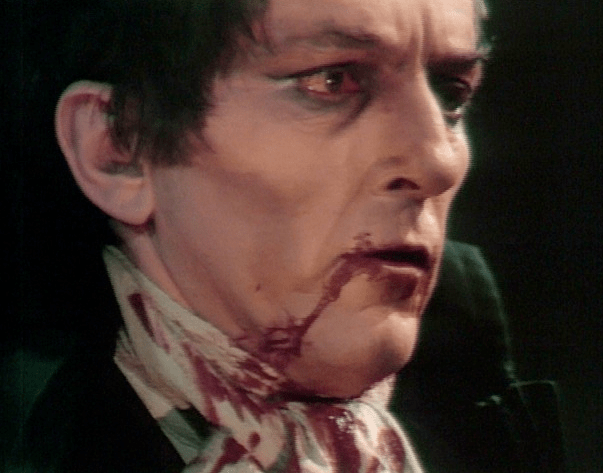
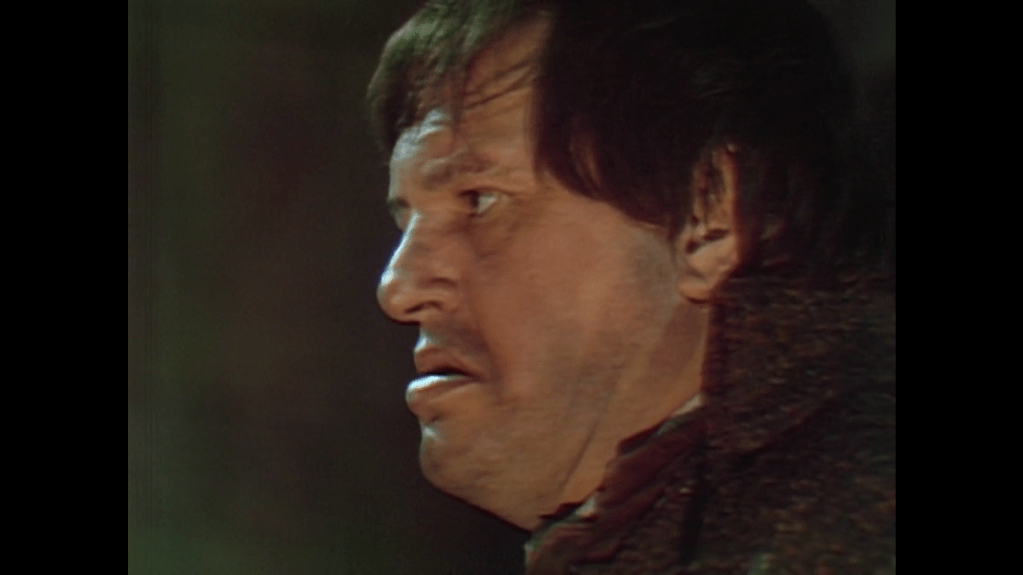
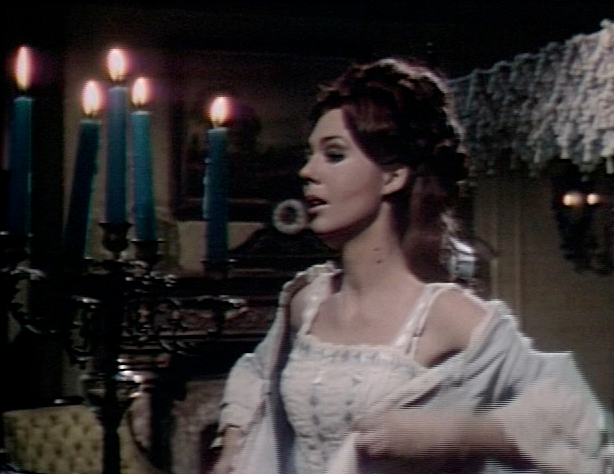
Nathan Forbes, naval officer and scoundrel, goes to the Old House on the great estate of Collinwood and finds his estranged wife Suki dying. With her last breath, Suki gasps out the name “Barnabas Collins.”
Nathan goes to the great house and informs the master of the estate, haughty tyrant Joshua Collins, of what he has found. Joshua accompanies Nathan to the Old House. Suki told the Collinses that she was Nathan’s sister, lest she disrupt Nathan’s engagement to fluttery heiress Millicent Collins, a second cousin of Joshua. Suki had planned to force Nathan to divert a large percentage of Millicent’s vast wealth to her. Unaware of the true nature of Suki’s relationship to Nathan, Joshua is only mildly suspicious that Nathan might have murdered her.
Nathan brings up the fact that in her dying words Suki named Joshua’s son. This irritates Joshua, who reminds Nathan that Barnabas has gone to England. Nathan tells Joshua that he thought he saw Barnabas the other night, from a distance, in the dark. Considering that the most Nathan could have been sure he saw under those conditions was Barnabas’ coat, no one would be impressed by such an account. It’s an unusual coat, but there’s nothing to prove Barnabas didn’t get rid of it and wear a new one to England. Joshua is particularly bland about Nathan’s thought that he may have seen Barnabas, since he made up the story that Barnabas went to England to conceal the fact that he died. Joshua believes that Barnabas died of the plague, and that if that news got out the men wouldn’t show up to work at the family’s shipyard. So he does not share Nathan’s suspicion that Barnabas may have had something to do with Suki’s death.
What we know that Joshua does not is that after his death, Barnabas became a vampire. Suki discovered him in the Old House, and he was indeed the one who murdered her. But so far as anyone can tell, Nathan is the only suspect, and whoever learns that Suki was actually his wife will have to regard him as something more than a suspect.
Joshua and Nathan are about to search the house when the gracious Josette comes staggering downstairs. Josette had come to Collinwood to marry Barnabas, had been put under a spell that caused her to marry Barnabas’ uncle Jeremiah instead, and was miserable when both Barnabas and Jeremiah were dead. Now Barnabas has bitten Josette and is planning to kill her and raise her as his vampire bride.
When Suki was killed, everyone around the estate was involved in a search because Josette had gone missing. Joshua and Nathan are shocked to find her here, and even more shocked by her physical condition. She reaches the foot of the stairs, says Barnabas’ name, and collapses.
Joshua and Nathan bring Josette back to the great house. Joshua orders his wife Naomi to look after Josette; Nathan tells Millicent that Suki is dead. When Naomi asks Joshua if Josette said anything when they found her, he lies, concealing Barnabas’ name. Naomi knows as much about Barnabas’ death as Joshua does; that he lies to her suggests that he himself is unsure what to make of the situation.
Millicent decides to make herself useful. She goes through Suki’s papers, looking for the address of the maiden aunt in Baltimore whom Suki told her was the only living relative she and Nathan had. While Nathan tries frantically to stop her, Millicent finds Suki and Nathan’s marriage certificate. She bursts into tears and runs away. The comedy portion of the Millicent and Nathan story has ended.
As Josette, Kathryn Leigh Scott has some scenes in bed today, adding to many such scenes she has already had. Her character in the parts of Dark Shadows set in the 1960s is Maggie Evans, The Nicest Girl in Town. Maggie also spends a lot of time in bed. In their post about this episode on Dark Shadows Before I Die, John and Christine Scoleri speculate that Miss Scott must have been the best-rested member of the cast, and append an album of screenshots from 22 scenes we have seen so far where Miss Scott was in bed to substantiate their case.
Yesterday, 5 February 1796, the Countess DuPrés visited suspected witch Victoria Winters in the Collinsport gaol. The countess begged Vicki to lift the spell that she believes to be causing her niece, the gracious Josette, to behave strangely. Vicki responded that she had cast no spell on Josette or anyone else. She claimed that she was not a witch at all, but an unwilling and well-meaning time traveler displaced from the year 1968. As it happens, this is true.
Vicki told the countess that according to the history and legend she learned in the 1960s, Josette will soon die. The last events leading to her death will be triggered when she loses a ring with a black onyx stone. Vicki’s remarks settled any lingering doubts the countess may have. She is now certain that Vicki is a witch, and that when she claims to be warning people against upcoming dangers she is in fact taunting them with her own cruel plans.
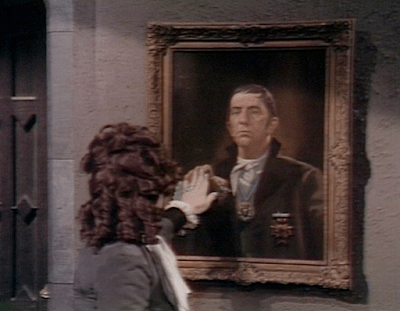
In Josette’s room, the countess discovers that Josette has somehow come into possession of just such a ring as Vicki described. Josette refuses to tell her where it came from. Later, the countess stands in the foyer of the great house of Collinwood, studying the portrait of the late Barnabas Collins that hangs there. She recognizes Josette’s new ring as the one in the portrait. Well might she recognize it- she knew Barnabas well, he died only a couple of weeks before, and he wore the ring all the time. He and Josette had been engaged to marry each other, and never gave up their passionate attachment even after they married other people. It is hard to think of a reason why the countess would not have thought of Barnabas at the moment Vicki began describing the ring, much less as soon as she saw it on Josette’s finger.
Barnabas’ father, haughty overlord Joshua, asks the countess what she finds so interesting about the portrait. She asks if the ring was part of a set; he answers that it was unique. He begins to reminisce about Barnabas’ great fondness for the ring. His warm look of recollection gives way to an expression of deep pain, and he stops himself as he is about to say that he left it on Barnabas’ finger when he buried him. He refuses to say any more about Barnabas.
The countess and Joshua do not like each other very much, but they are of one mind about Vicki. It is inexplicable that the countess does not tell Joshua about Vicki’s prediction and about the fact that Josette now has Barnabas’ ring. Her reticence sets up a dramatic moment, when Josette comes downstairs, faints, and Joshua finds the ring on her finger. But that moment would only have been more dramatic if it had also been the first time the countess saw Josette with the ring. Vicki’s description of a ring should have been more than enough to prompt her to study the portrait and ask Joshua about Barnabas’ ring, but perhaps not enough to embolden her to say much to Joshua. The scene in Josette’s room makes a hash of the countess’ motivations here, and leaves Joshua’s discovery of the ring as a pointless repetition.
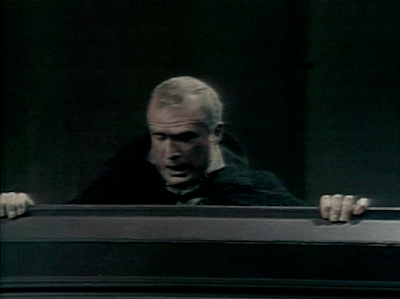
Joshua goes to Barnabas’ coffin, hidden in a secret chamber of the family mausoleum. He talks to Barnabas for a while. He admits that he was a cold and distant father, but vows to take a terrible revenge on anyone who might have disturbed his rest. He opens the coffin and finds that it is empty. His shock is chiefly to do with the disappearance of the body, but can only be sharpened when he realizes that instead of delivering his heartfelt confession to his son’s corpse he was in the somewhat ridiculous position of delivering it to a piece of furniture. This is a characteristic situation for Joshua- when he is ready to open up about his feelings, he finds that no one is there who can even appear to be listening.
Returning viewers know that no one robbed Barnabas’ grave. He has become a vampire. He gave Josette the ring himself, after biting her and telling her she would become his undead bride. All of this has been concealed from Joshua, the countess, and Vicki. Barnabas shows up today and has a forgettable scene with Josette. They get involved with the secret passage leading out of her bedroom.
Josette’s room will be Vicki’s in the 1960s, when she is the governess at Collinwood, and we saw in #412 that she knows about the secret passage. There is one other thing you would expect Vicki to have known. Barnabas returned to prey upon the living in April of 1967; Vicki knew him from then until she came unstuck in time in November of that year, though she thought he was alive. He wore the ring with the black onyx stone all the time in 1967, just as he did in 1795. Vicki was familiar with the portrait, which still hung there in her time. She believed its subject to be the ancestor of her acquaintance, knew that it was the same ring, and knew that the “original” Barnabas had been Josette’s lover. So if Vicki read a book or heard a legend that described the ring in connection with Josette, you would think she would have put one and one together and come up with two.
The Countess DuPrés (Grayson Hall) complains to her niece, gracious lady Josette (Kathryn Leigh Scott,) that life on the great estate of Collinwood is nothing but “a series of prepared speeches.” It’s hard to top that for commentary on this episode, but I do have a couple of things to add.
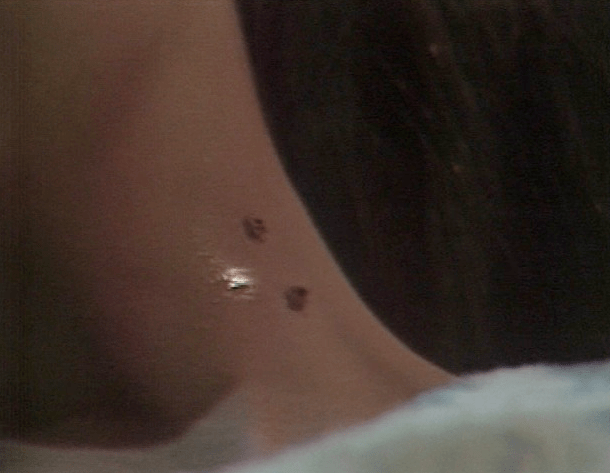
Josette has been seeing her lover and onetime fiancée, the late Barnabas Collins. Since his death, Barnabas has become a vampire. On Friday, he bit Josette. Now, she is trying to conceal her neck wounds from her aunt.
Josette, her neck wounds visible. Screenshot by Dark Shadows Before I Die. These wounds are a single piece of makeup. Kathryn Leigh Scott still has it, she showed it in a Dark Shadows cast reunion on Zoom in 2020. The other cast members didn’t know why she wanted it any more than I do. Screenshot by Dark Shadows Before I Die.
Those who have been watching Dark Shadows for a while will find this story all too familiar. Until #365, the show was set in contemporary times, 1966 to 1967. Since then, it has been set in the years from 1795 to 1796. In the segments set in the 1960s, Miss Scott plays Maggie Evans, The Nicest Girl in Town, and Hall plays mad scientist Julia Hoffman. Maggie was Barnabas’ victim in May and June of 1967, and after she escaped from him, Julia was her psychiatrist. The countess is different enough from Julia that Hall has a lot of room to maneuver. But there are only so many ways an actor can convey the idea that her character is in a daze and alternately blissful and defensive. So Miss Scott winds up recycling the performance she gave as Maggie, and the result is pretty stale.
We traveled back to the 18th century with well-meaning governess Vicki. Vicki has not in any way adapted to her new environment, with the result that she is now in gaol on charges of witchcraft. When the countess visits her today, Vicki tells her that she is from the 1960s and that in that period she had learned from history and legend that a grim fate awaits Josette. The countess concludes from Vicki’s presentation that she is indeed a witch, and that she is not giving her warnings, but is cruelly gloating over the evil spells she has cast.
Vicki is accompanied by her gaoler/ defense attorney/ boyfriend, Peter. Peter had tried to stop her blabbing to the countess, and asks her why she did it. Vicki says that she is counting on the idea that if she keeps telling the truth, people will have to believe her. Peter asks her to think of how she would react if someone from the 21st century traveled to 1968 and went around telling everyone how and when they were going to die. At this, Vicki’s eyes widen. “Oh, Peter, what a fool I’ve been!”
At that, we can hear the sound of the viewing public giving up on Vicki once and for all. Peter isn’t even the first person to try to explain her situation to her. Both kindly gentleman Jeremiah Collins and caddish naval officer Nathan Forbes gave her explicit instructions about her need to lie and scam her way through her predicament, and neither of them made any impression on her. Movie reviewer Roger Ebert famously described stories that work only because the characters do things the average member of the audience would be too smart to do “idiot plots”; for the last eleven weeks, Vicki has been the Designated Dum-Dum at the heart of the most irritating idiot plot imaginable.
There actually is a very sweet little scene between Vicki and Peter right after that low point. She tells him about airplanes and other features of twentieth century life, and he tries to figure out what she’s talking about. Almost all of the anger we feel towards Vicki for being written so badly and towards Peter for being played by Roger Davis melts away by the end of that scene.
One of the most story-productive relationships in the first 40 weeks of Dark Shadows was that between reclusive matriarch Elizabeth Collins Stoddard and her brother, high-born ne’er-do-well Roger Collins. Having squandered his entire inheritance, Roger lived as a guest in Liz’ house and drew a salary from her business. She tried to order him to rein in his bad behavior, but time and again wound up shielding him from accountability. When she does that, she reduces herself from authoritative to bossy.
In the summer of 1967, the relationship between mad scientist Julia Hoffman and vampire Barnabas Collins began to follow the same dynamic of Bossy Big Sister/ Bratty Little Brother. Appealing to her professional standing as a medical doctor doubly qualified in hematology and psychiatry and to her situational awareness as a native of the twentieth century, she makes efforts to convince him that not every problem has to be solved by murder. When he disregards her advice and kills people anyway, she covers up for him. Realizing that she is stuck with Barnabas for the rest of her life, Julia tries to drum up a romantic relationship with him, but he is not interested. Eventually, she will come to be “like a sister” to him in more senses of that phrase than she would like. In the years to come, we will even see storylines in which the two of them explicitly masquerade as siblings.
Dark Shadows took a break from its contemporary setting and began an extended stay in the late 18th century beginning in November 1967. We’ve already caught a glimpse of the Bossy Big Sister/ Bratty Little Brother dynamic in this period, when haughty overlord Joshua Collins found himself taking orders from his sister, repressed spinster Abigail. Today, we take a bit of a self-referential turn as a character decides to deliberately mimic this trope.
Caddish naval officer Nathan Forbes has talked fluttery heiress Millicent Collins into marrying him. Millicent is very rich and beautiful, Nathan is charming and handsome, and there are many reasons to think they might make a happy couple. There is one small problem. A very small problem, really; not more than five feet tall and well under 100 pounds. It is Nathan’s current wife, Suki. Suki has found out what Nathan is up to, and wants a cut of his take. To his surprise and discomfort, she shows up today at the great house of Collinwood and introduces herself to Millicent as Nathan’s sister.
The Millicent/ Nathan story has been a lot of fun so far, and Suki is just fantastic. Actress Jane Draper gives a performance as big as her body is small, and Suki instantly sees through Nathan’s every lie, which is to say his every utterance. She dominates every scene she is in.
Yesterday, Suki walked in on Nathan at The Eagle tavern and took charge of the place. Today, she is in command of the drawing room at Collinwood. Nathan and Millicent serve up one straight line after another, every one of which Suki answers by saying something unexpected and exciting.
Suki looks out the window and sees Barnabas looking in. She doesn’t know who he is, much less that he is a vampire, but she can recognize a miserable creep when she sees one. He throws her off her form, and we dissolve to an upstairs bedroom.
The rest of the episode is a scene where Barnabas lets himself into the bedroom occupied by his ex-fiancée, the gracious Josette. He tells Josette they can never be together again, but won’t explain why. She says she wants to be with him no matter what. He bites her. They’ve been telegraphing this scene all week. It’s a complete anticlimax, and it does nothing to make up for Barnabas interrupting our time with Suki.
For a show that plundered story ideas from virtually everywhere, Dark Shadows was remarkably wary of lifting anything from the Bible. Suki’s claim to be Nathan’s sister is something of an exception. It reminds us of Abraham, who twice in Genesis passes off his wife Sarai/ Sarah as his sister and then recommends that his son do the same with his wife Rebecca. The 1795 flashback is supposed to explain the origin of the accursed Collins family for us, to answer the question “Who are Barnabas’ kin?” as Genesis answers the question “Who are Joseph’s kin?” So Suki is in tune with the rationale of the segment when she draws on that book. While Genesis explains and justifies a patriarchal order of society, so that Sarah and Rebecca just go along with Abraham’s loony schemes, daytime serials are aimed at a mostly female audience and need self-starting female characters. So it is only to be expected that the gimmick will be at Suki’s initiative this time.
When gallant gentleman Barnabas discovered that his wife Angelique was a wicked witch who had been casting spells to ruin the lives of everyone he knows, she forbade him to disclose this information. If he did, she would kill his true love, the gracious Josette.
Now, Angelique has turned Barnabas into a vampire. When he found out about this, he killed her. Sadly, that didn’t take. For the last few days Angelique’s disembodied head has been floating around foiling all of Barnabas’ attempts to contain the damage he has been doing.
Today, we open in the Collins family mausoleum. Barnabas’ coffin is hidden in a secret chamber inside the mausoleum. He and Josette are in the publicly-known outer chamber, where she found him yesterday. He pleads with her to leave him and forget she ever knew him, but will not tell her why. Angelique has made it obvious that she is already working to kill Josette, so obvious that Barnabas and his friend Ben were talking about it yesterday. So Barnabas has no reason to withhold any information from Josette, and every reason to tell all. But he continues to keep everything back that might persuade her to flee from him. This does fit with his pattern of behavior- half the reason they are in this situation is that Barnabas wouldn’t tell Josette that he and Angelique had had an affair long ago. But it is still frustrating.
Back in the great house of Collinwood, Josette runs into the two characters who have been keeping the show watchable for the last couple of weeks, fluttery heiress Millicent Collins (Nancy Barrett) and caddish naval officer Nathan Forbes (Joel Crothers.) After a series of delightfully played comedy scenes, Millicent and Nathan have become engaged. They break their happy news to Josette. She is so preoccupied with her encounter with Barnabas that she barely reacts.
Nathan leaves. In the drawing room, Josette tells Millicent that she saw Barnabas tonight. Millicent knows that, according to Barnabas’ parents, Barnabas has gone to England. She is therefore certain that Josette could not have seen Barnabas, and she patiently explains this impossibility to Josette. The difficulties Millicent knows about are nothing to what Josette knows- she saw Barnabas die.
In the parts of Dark Shadows set in the 1960s, Nancy Barrett plays another heiress, Carolyn Collins Stoddard. In those same parts of the series, Joel Crothers plays hardworking young fisherman Joe. In 1966, Carolyn and Joe were dating each other for no reason they could discern, and the audience was afflicted with scene after scene of them out on dates staring at each other in boredom. Millicent and Nathan are as much fun to watch together as Carolyn and Joe were dull. They are pursuing objectives we can understand, and we can also be sure that their plans will not work out as they expect.
Nathan is clever, charming, and unscrupulous. He was uninterested in Millicent until he found out she was rich, then immediately began an assiduous pursuit of her hand and her inheritance. In addition to greed, he has also shown a keen eye for opportunities to bed the women on the household staff. When his naval career is threatened by the villains, he shows no sign of courage. Yet we have also seen him behave admirably, even heroically, in trying to help bewildered time-traveler Vicki. And when Barnabas was alive, Nathan was a trustworthy friend to him. So for all we know, by the time he gets his hands on Millicent’s money, this complex man might have fallen in love with her and made up his mind to be a good husband.
Millicent is not a “smart character” in an IQ-test sense, but her limitations translate into an accidental wisdom. Her ideas of life have been shaped by plays she has seen and novels she has read, leading her to think she is a character in a florid melodrama. But of course that is exactly what she is, and so her behavior is, if anything, more situationally appropriate than are the actions of the more superficially rational people around her. Certainly it is jarring when Josette starts telling Millicent about Barnabas, when she knows that Barnabas wants to keep his presence secret. Considering what will happen to Josette if she keeps approaching Barnabas, Millicent does quite the sensible thing when she insists on leaving the official story alone.
Nathan has gone to the local tavern. In the 1960s, this same set will be a tavern known as The Blue Whale. Joe will be a regular customer, and the man who will preside behind the bar is played by actor Bob O’Connell. In #319, a character pretending to be drunk called the bartender “Bob-a-roonie,” leading fans of the show to call the character “Bob Rooney,” a name never used in the series.
Now, in 1796, the tavern is called The Eagle. Bob O’Connell again plays the man who pours the drinks. His name is Mr Mooney. “Mooney” sounds enough like “Rooney” that I wonder if the “Bob Rooney” gag circulated among the production staff. Mr Mooney gets more lines today than Bob the bartender ever did, and his name is listed in the credits for the first time at the end of his 57th episode.
O’Connell did a lot of very good work in those first 56 appearances. He was especially good with facial expressions that showed he had overheard enough of a conversation to think he ought to be more aggressive about refusing to serve drinks to customers before they lose all sense, but not enough to have anything substantial to report to the police. I’m sorry to say that his delivery of dialogue today is not on that level. Partly that’s because he has to put on some kind of Anglo-Celtic accent that he is none too sure of. But that isn’t the only problem. He delivers his lines much too fast and too loud, and does not modulate his voice in response to anything his scene-mates do. He isn’t interacting with the others at all, just waiting for his cues and making sure the microphone picks up the words. His scene is a major letdown for Bob the bartender fans everywhere. O’Connell’s previous successes as a working guy who knows more than others assume he does leave me wishing they could have done another take of the scene with some fresh guidance from the director.
Fortunately, the same scene introduces one of the most magnificent characters in all of Dark Shadows. She walks in, tells Mr Mooney she’s with Nathan, and gives her name as Suki Forbes. That’s Forbes as in “Mrs Nathan Forbes.”
Nathan tries out a series of lies on Suki, each of which she bats away effortlessly. He offers to pay her to leave town; she lets him go collect his money, while she stays in the tavern and gets all the relevant information from Mr Mooney. Nathan has been away for about ten seconds by the time Suki finds out he plans to marry into the family that owns the town. She is quite pleased by the prospects this introduces.
Suki thinks of how much she might earn by pimping Nathan out. Screenshot by Dark Shadows Before I Die.
Our hopes that Nathan would eventually make Millicent happy are thus reduced to a very low order of probability. Regular viewers are again reminded of Carolyn, in this case of Carolyn’s absentee father Paul Stoddard. Paul was a charming, dishonest, and cruel man who married Carolyn’s mother Elizabeth only for her money.
We haven’t seen Paul, and know very little about his background. What we do know is that he was not from the village of Collinsport, had no money of his own, and that his best friend was a merchant seaman named Jason McGuire. We got to know Jason quite well when he showed up and blackmailed Liz for a long dull stretch of the show. Poor men would have few opportunities to meet young women of Liz’ lofty station, and even fewer means of persuading them they were acceptable marriage partners. Since the marriage took place in 1945 or 1946, when a sizable fraction of American men were on active duty in the armed forces, and since Paul was connected to Jason and therefore to the sea, it would seem likely that Paul was a Navy officer. After all, an officer’s uniform can get a man admitted to any social circle, as Nathan illustrates. So the miserable marriage that Liz endured might have echoed a similarly ill-conceived match a collateral ancestor of hers made in the late 18th century.
Hi I am the Jane Draper who played Suki on Dark Shadows! Thought I’d be on it longer but got killed off by Barnabas. I worked on Broadway, film and this soap opera. Now, I play Bluegrass, always my passion, on guitar and upright bass. Born in Illinois, grew up mostly in Southern Indiana and moved to NYC in my teens.
thank you for your kind words.
Jane Draper, comment left 13 August 2020 on “Episode 420: The Stalking Dead,” Dark Shadows Every Day.
In yesterday’s episode, Barnabas Collins extracted a promise from his friend, much put-upon servant Ben Stokes. Barnabas had decided that the curse that has made him a vampire and condemned whoever loves him to death must end. Ben reluctantly agreed to come back after dawn to the secret chamber in the Collins mausoleum where Barnabas’ coffin is hidden and drive a stake through his heart.
The curse was the work of wicked witch Angelique. Eight minutes after Barnabas discovered he was a vampire, he killed Angelique. But when Ben was about to keep his promise and end Barnabas’ curse, her disembodied head appeared before Ben’s eyes, her voice resounded in his ears, and the mallet and stake vanished from his hands. Angelique declared that the curse would be fulfilled in its entirety, and ordered Ben to take that word to Barnabas after dusk.
Every viewer who has seen even one episode of Dark Shadows knows that Barnabas will react to this news by choking Ben. If we’ve been watching the 11 weeks so far that the show has been set in the years 1795 and 1796, we know that he won’t kill Ben or seriously injure him, since that would leave the main character without anyone to talk to. So there is no need for today’s opening scene, in which Ben gives Barnabas the news, he chokes him for a little bit, then lets him go.
After Barnabas leaves Ben alone in the secret chamber of the Collins mausoleum, Angelique’s disembodied head floats into view again. The floating head gag was reasonably effective when it was used for undead fire witch Laura Murdoch Collins in late 1966 and early 1967, because there were so few special effects of any kind on Dark Shadows at that time that associating one with Laura set her apart from the other characters and showed that she was an invader in the world in which they operated. But double-exposures and Chromakey and puppetry and other gimmicks have become routine these last several months, so it isn’t very impressive now. It certainly isn’t powerful enough to justify its use in three scenes today.
While still with Ben in the secret chamber, Angelique says that she will cause the gracious Josette to go to Barnabas so that Barnabas may be the death of her. She starts calling Josette’s name, and her voice morphs into Barnabas’. They do an impressive job syncing her lips with his voice. We dissolve to Josette’s bedroom, where the voice of Barnabas continues to call her name. Then all of a sudden we hear Angelique’s laugh. Does Josette hear that part too? It messes up the only really effective part of the episode.
Angelique’s floating head appears again and gives an intricate explanation of a dream Josette is about to have. This echoes the sequences we saw in 1967 in which mad scientist Julia Hoffman hypnotized imperiled heroines and made them forget information that might have led to the exposure of the many crimes she and Barnabas have committed. After Angelique’s long preface, Josette finally has the dream. It is shown to us in a luridly colored sequence, and in it Angelique shows Josette the mausoleum where Barnabas’ coffin is hidden.
Apricot dream. Screenshot by Dark Shadows Before I Die.
As we might have predicted, Josette goes to the mausoleum when she wakes up. Just as predictably, she meets Ben on the way, and he tries to talk her out of going there. Of course Angelique’s floating head appears yet again and forces Ben to scurry off.
We’ve known since #5 that Josette will die by jumping off the precipice known as Widow’s Hill. In #185, we learned that in the 1960s she was still famous in the village of Collinsport as “the lady who went over the cliff.” In #233, Barnabas revealed that she jumped because he frightened her while she was up there. So when Barnabas finds Josette in the outer room of the mausoleum and tells her that she is in grave danger, there is no real suspense- we know that she is not going to die this way. Like everything else we see today, it is filler.
Frustrated by the failure of the episode to advance the plot, Danny Horn devotes his post about it to a discussion of the 1845-1847 serialized novel Varney the Vampire. I sympathize; I toyed with the idea of posting a two-sentence summary of the action followed by an essay about the greatest of all moving pictures about a floating head, John Boorman’s 1974 masterpiece Zardoz. But I don’t want to work that hard. Danny may have called his blog Dark Shadows Every Day, but he lavished so much effort on each post that they were often separated by weeks or months. I want the episode commentaries here to appear on the 56th anniversary of their original broadcast, and so I’m not going to do the kind of extra work Danny used to do.
The terrace at the great house of Collinwood is a set where characters often behave as if things are possible that the audience knows won’t happen. Couples make dates we know they will never keep and talk about weddings we know one of them won’t live to see. Today, much put-upon servant Ben sees grand lady Josette there. He urges her to leave Collinwood, and she says she is planning to do so. Ben is overjoyed. He, and he alone, knows that Josette’s lost love Barnabas has become a vampire and is obsessed with her. When Josette talks about leaving, Ben hopes she will escape from the danger Barnabas represents.
The placement of this scene at the terrace is one of several pieces of evidence that Ben’s hopes will be dashed. We have known since #5 that Josette is fated to jump to her death from the precipice known as Widow’s Hill. We learned in #233 that she did this because she saw Barnabas up there and was horrified by what he had become. Josette’s death is such an important part of the show’s backstory that we are sure she will not escape her doom. Moreover, we have seen bewildered time-traveler Vicki try to persuade Josette to go away before it is too late. Everything Vicki has done since arriving in the year 1795 has backfired, so that is another sign that Josette will not leave.
Toward the end of the scene on the terrace, Josette asks Ben if he can hear a sound of distant laughter. He says that he didn’t hear it, and neither did she. He urges her to get some sleep, and they go their separate ways.
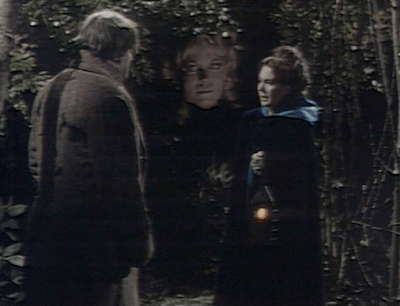
After sunrise, Ben goes to the secret chamber in the Collins family mausoleum where Barnabas’ coffin is hidden. Obeying Barnabas’ command, he has brought a stake made of holly wood and a mallet. When he was alive, Barnabas had been a friend and benefactor to Ben. Ben finds it difficult to stake him, but is just about to do so when a loud sound of laughter, punctuated by sharp intakes of breath, comes on the soundtrack. The head of wicked witch Angelique floats onto the screen. This visual effect had been a signature of undead fire witch Laura Murdoch Collins when she was on Dark Shadows late in 1966 and early in 1967; it is the first time we have seen it since Laura went up in smoke in #191.
It was Angelique who cursed Barnabas to become a vampire. As her head floats in front of Ben, we hear her recorded voice telling him her curse will be fulfilled. When Ben says she can’t stop him, she points out that the stake and mallet have vanished from his hands. She orders him to leave the chamber. He is to come back tonight and tell Barnabas that they will never escape her power.
In his post about this episode onDark Shadows Every Day, Danny Horn argues that since Barnabas just killed Angelique in #411, she hasn’t been gone long enough to make her return particularly effective. I agree. Even if the scene were well-conceived and well-executed in every other way, that alone would make it disappointing. But there are some other substantial problems. Angelique regretted the curse she put on Barnabas, and her last mortal act was to try to stake him to keep him from rising as a vampire. Nothing she says today explains the reversal of her attitude.
The repetition of the effect from the Laura story isn’t much of a problem, not only because it has been a long time since they’ve used it, but also because the show had such low ratings when Laura was on that most viewers watching now never saw it then. What is a problem is the execution of the effect. Angelique’s voice is a tinny recording that sounds very bad when she laughs, and they keep sliding the floating head around in the frame trying to square it with Ben’s line of sight. So far from terrifying us, the result simply irritates.
When Dark Shadows first aired in June 1966, it kept hinting that behind the action we saw there was a back-world of supernatural presences some of whom might eventually interact with the characters. Often these hints occurred in conversations between a character native to the village of Collinsport and newly arrived governess Vicki. The local would use the word “ghost” metaphorically to refer to unresolved conflicts around the estate of Collinwood, Vicki would shriek “You don’t mean you believe in ghosts!?,” and the other would say that he damn well did believe in ghosts and that if Vicki stuck around long enough she would, too.
The first ghost whose name we heard was Josette, mentioned in #5 as a grand lady from France who came to town to marry Jeremiah Collins, was unhappy with him, and threw herself to her death from the precipice known as Widows’ Hill. Josette manifested herself on camera in #70 and rescued Vicki from murderous groundskeeper Matthew Morgan in #126. In that climactic encounter, we saw Josette and a group of other wraiths. Joining the ghosts of women who jumped from Widows’ Hill at various points in the 19th century was the ghost of Bill Malloy, who had been a living character in the first ten weeks of the show and had shimmered into view as a ghost and sang a song in #85. This assemblage suggests that the spectres haunting Collinwood know each other and act with a common purpose at least occasionally.
The first supernatural menace to appear on the show was undead fire witch Laura Murdoch Collins, mother of strange and troubled boy David. Josette warned several characters of the threat Laura posed to David. Josette herself was unable to fight Laura directly. In #165, she manifested in the room where Laura held the sleeping David, but had to retreat when Laura ordered her to go. Thereafter it was up to Vicki, advised by Josette, to organize the opposition to Laura. If #126 showed that the benevolent spirits can act together to defeat a threat from a mortal man, #165 and its aftermath showed that they must withdraw into the back-world when the enemy is of an uncanny nature.
In April of 1967, vampire Barnabas Collins succeeded Laura as the show’s new danger from beyond the grave. In #212, Barnabas went to the Old House at Collinwood, the place where Josette is most present, and told her portrait above the mantel that her power was at an end. In #223 and #240, Josette’s friend David felt her absence from the Old House and lamented that the family had lost its tutelary spirit. With that, we bid farewell to the wispy presences we had seen in #126. A vampire is too dynamic an adversary for them. It seemed for a period that the show had simplified its ontology- there are those who live by the laws of nature we know, there is Barnabas, and that is that.
That period ended in #255. Barnabas has passed himself off as a cousin from the Collins family’s long-lost English branch and settled in to the Old House. He is keeping Maggie Evans, The Nicest Girl in Town, as a prisoner in a barred cell in the basement. Maggie looks out her window and sees a little girl in 18th century garb sitting in the corridor. The girl is holding a doll and singing “London Bridge.” She does not respond to Maggie’s attempts to get her attention.
In the next several episodes, we learn that the little girl’s name is Sarah, that she has a big brother, and that she can’t find anyone she knows. Even if the closing credits hadn’t immediately given away the fact that she is the ghost of Barnabas’ little sister, we would be able to gather that she is a supernatural being who was pulled out of the back-world when Barnabas rose from the grave. For the next 22 weeks, Sarah keeps popping up in the world of 1967. We wonder what she will do next, when she and Barnabas will confront each other, and what other paranormal beings are waiting to erupt into the visible world.
In #365, the major characters held a séance to contact Sarah and ask her what she was trying to tell them. Sarah spoke through Vicki and said that she would not appear to them again. She also said that she wanted to “tell the story from the beginning.” With that, Vicki vanished from the table and a woman in an 18th century dress appeared in her place. The woman identified herself as Phyllis Wick, governess to Sarah Collins, and demanded to know where she was. Meanwhile, Vicki found herself in the year 1795, in Phyllis’ place. At a stroke, the back-world and the foreground are interchanged.
Now it is 26 January 1796, Sarah’s eleventh birthday. She is not having a happy one. Last night she found Barnabas in the family mausoleum with blood smeared on his face. She may not know that he has become a vampire, but she knows that something has gone horribly wrong with him. She runs off and hides behind a tombstone. By the time faithful servant Ben finds her and carries her home, she is severely weakened by exposure. She cannot speak, but mouths Barnabas’ name and looks distressed. Her mother Naomi and cousin Millicent keep vigil at her bedside.
Night falls; Barnabas rises again, and Ben tells him that Sarah is gravely ill. Barnabas resolves to visit her. Unable to talk him out of this plan, Ben offers to help him get into her room unobserved.
Ben relieves Naomi and Millicent, then ushers Barnabas into the room. Barnabas tries to reassure Sarah. Eventually she warms to him. She regains the power of speech, and with her first words she asks her brother to hold her. He does. She tells him she will always love him, then dies in his arms.
This is Sharon Smyth’s last appearance on Dark Shadows. As a child, she had some rather obvious limitations as an actress, a fact Sharon Smyth Lentz cheerfully acknowledges nowadays. During her first 22 weeks, she was playing a ghost, so there were many scenes where all she had to do was seem vague and detached and she could be effective. The story moved very slowly during that period, giving the writers and directors time to figure out her strengths. Near the end of it, she excelled in two scenes with a lot of dialogue. In #348 she had a complicated, serious conversation with heiress Carolyn Collins Stoddard, and in #364 she had her confrontation with Barnabas. Supported by Nancy Barrett and Jonathan Frid, she executed those scenes very well indeed.
In 1795, Sarah is alive and the plot moves at a breakneck pace. Under those conditions, it would have taken intricate advance planning to craft scenes that would have been in Sharon Smyth’s range. But the writers of Dark Shadows rarely had time to do any advance planning. When the show was moving slowly enough, they could usually hit all the major points the audience would expect to see, but there are some glaring omissions in 1795. Young Daniel Collins will be played by David Henesy, who also plays David Collins. Since the relationship between Vicki and David had been the core of the first 39 weeks of the show and the relationship between Sarah’s ghost and David had been one of the most intriguing elements of the 22 weeks she was haunting Collinwood, it is particularly disappointing that we barely see Vicki with Sarah and never see Sarah and Daniel together at all.
I first saw Dark Shadows on the SciFi Channel, as it was then called, in the 1990s. I saw a handful of episodes on random mornings when I happened to be off work. They whetted my curiosity about the show, but I left it to chance until I saw an episode with Sarah’s ghost. Then I decided to set my VCR and watch regularly until I found an explanation for what was going on with her. The whole idea of supernaturalism is that there are phenomena which defy explanation, so of course I never reached that point. Naturally, I got hooked on the show within a couple of weeks.
On his Dark Shadows Every Day, Danny Horn rather unfairly, albeit hilariously, griped that “Sharon stopped acting after Dark Shadows, or possibly during.” When she looks back on her days as a child actress, Mrs Lentz talks about how excited her mother was to meet show biz celebrities, and says that her main gratification was in pleasing her. But she has fond memories of many castmates, and says that her favorite person to run lines with was Jonathan Frid. So there is something sweet about her ending her time on the show in his arms.
There was a lunar eclipse on the night of 24 January 1796; it reached its maximum at 10:09:20 Eastern time. In our time-band, that eclipse was not easily visible in central Maine, but in this episode we see that in the universe of Dark Shadows, it was spectacular there. Caddish naval officer Nathan Forbes and fluttery heiress Millicent Collins come inside from the terrace of the great house of Collinwood after watching the eclipse.
In the drawing room, Nathan proposes marriage to Millicent. She gladly accepts. Matriarch Naomi Collins enters. Millicent is worried Naomi will disapprove of them being alone together so late, while Nathan wants to tell her of the engagement. Before they can say anything, Naomi tells them that her daughter Sarah, whose eleventh birthday is day after tomorrow on the 26th, has gone missing. Nathan volunteers to take charge of the search parties.
Sarah had been looking for her big brother Barnabas. Unknown to her, Barnabas has become a vampire and has been snacking on the women who frequent the waterfront of the village of Collinsport. In yesterday’s episode, Sarah caught a glimpse of Barnabas, followed him to the cemetery, and wound up in the outer room of the family mausoleum, near the secret panel behind which Barnabas’ coffin is hidden. At the top of today’s episode, the door out of the mausoleum slams itself shut and Sarah is unable to open it.
That moment suggests a solution to a riddle that has been part of Dark Shadows ever since Barnabas joined the cast of characters in April 1967, when the show was set in contemporary times. Doors in structures associated with Barnabas would close themselves and trap people. Sometimes this advanced Barnabas’ objectives, but just as often it was an inconvenience to him. Today, he most definitely does not want Sarah to be in the mausoleum. Part of the curse that made Barnabas a vampire is that everyone who loves him will die. Barnabas has killed the malign Angelique, the witch who placed the curse on him, but he is still a vampire- the curse lives on. So perhaps the curse itself has a power that makes the doors slam shut, keeping Sarah in this cold room until she falls ill.
At the waterfront, Barnabas meets a woman named Ruby Tate. Ruby is fashion-forward, to say the least; her outfit would become stylish nearly a century later. It’s the sort of thing that might have been admired by the women Jack the Ripper killed in the Whitechapel section of London in 1888-1891. Indeed, this foggy scene is a fairly obvious reference to the Whitechapel murders.
Barnabas is alarmed when Ruby recognizes him and calls him by name. He is befuddled when she tells him she had heard that he went to England- he doesn’t know that his father Joshua is spreading that story to conceal his death, which Joshua believes to have been the result of the plague. Ruby keeps saying that the other girls will be jealous when she tells them she spent the night with Mr Barnabas Collins, alarming him further.
In the early months of the show, the story of Burke Devlin’s quest for revenge on the Collinses had occasionally brought up the contrast between the working class village of Collinsport and the lordly family on the estate of Collinwood and suggested class conflict as a theme. Those suggestions were never very richly developed, and lately we have spent so much time holed up with the Collinses in their mansions that it is startling to see them through the eyes of the villagers. Ruby’s excitement at pairing off with one of the area’s grand aristocrats reminds us that the curse threatens the future of more than one family.
Ruby promises Barnabas not to tell anyone about him, but does notice him looking at her strangely. Something clicks, and she cries out “It’s you!” Barnabas draws closer. Fleeing him, she falls into the water. Barnabas calls Ruby’s name, but cannot stop her drowning.
Apparently Barnabas found someone else to attack after Ruby drowned, because his face is smeared with blood when next we see him. He returns to the mausoleum. Sarah sees him. He keeps his face turned away from her while she pleads with him to take her home. He keeps telling her to go without him. He finally turns to look at her. She sees the blood and shouts “You’re not Barnabas! You’re not, you’re not!” She runs out of the mausoleum, and dawn breaks.
Ruby Tate is played by Elaine Hyman. Hyman was busy as an actress in New York for decades before her death in 2020. She was in three plays that made it to Broadway, and her TV credits included episodes of The Sopranos, Broad City, and several iterations of the Law and Order franchise. She’s a sensation as Ruby, it’s a shame this is her only appearance on Dark Shadows.
At the top of the episode, wicked witch Angelique is in the secret chamber hidden inside the Collins family mausoleum. She is standing before the open coffin of Barnabas Collins, a stake in one hand and a mallet in the other. The sun is setting; once it does, Barnabas will rise as a vampire. She would drive the stake through his heart to prevent this outcome, but she is moving in time with the background music, and it is too slow. Barnabas awakes, knocks the equipment from her hands, and grabs her throat.
In 1967, throat-grabbing was Barnabas’ reflex when someone opened his coffin at dusk. The character first appeared in #210 as a hand darting to the throat of would-be grave robber Willie Loomis; Barnabas would bite Willie and enslave him. In #275, seagoing con man Jason McGuire opened the coffin; again the hand darted to the throat, and in #276 we learned that Jason was dead. That was the first time in 1967 Barnabas killed someone.
Now it is 1795. When we return from the opening title sequence, Barnabas has let go of Angelique. He has questions, and she is trying to avoid answering them. He realizes that she is afraid of him. When he figures out that she has turned him into a monster, he strangles her. In 1967, thirteen weeks separated Willie’s freeing of Barnabas from the death of Jason; this time, Barnabas chokes the life out of Angelique only eight minutes after he first awakens as a vampire.
Barnabas opens the door to the outer part of the mausoleum. The mechanism that opens this door is hidden inside one of the stairs leading out, and the camera lingers on it long enough to show that Barnabas must already be very familiar with the room to have gone directly to it. Returning viewers will remember that Angelique seemed unable to find it yesterday, and committed fans will remember that strange and troubled boy David Collins spent a whole week trapped in the secret chamber in September 1967 because it was so well hidden. The ghost of Barnabas’ little sister Sarah had to manifest to David in #315 and show him the door opener before the plot could move forward.
In the outer part of the mausoleum, Barnabas finds much put-upon servant Ben. Ben had been Barnabas’ devoted friend, but Angelique cast a spell on him and forced him to do her evil bidding. He is glad to hear Angelique is dead, and pledges to help Barnabas. As a living man, Barnabas had always gone out of his way to reciprocate Ben’s friendship, but throughout their conversation in the mausoleum he keeps telling Ben about the reasons he has to kill him. Only when Ben points out that he will need someone to protect him during the day does Barnabas agree to let him live. This was the same appeal that mad scientist Julia Hoffman made to Barnabas in #351. Since Barnabas was busily preparing to kill Julia a few episodes after that, this echo does not inspire much hope for Ben’s future.
Barnabas and Ben are having a little talk about how to dispose of Angelique’s corpse when they hear someone approaching the mausoleum. Barnabas hustles back into the secret chamber. Ben turns to the entrance, an appropriately helpless expression on his face.
Ben faces the darkness, waiting for whatever fresh hell may be approaching.
Haughty overlord Joshua Collins enters. Joshua is Barnabas’ father and Ben’s legally recognized master. Joshua accuses Ben of coming to rob Barnabas’ grave. Ben denies it. Joshua demands to know who he was talking to a moment before. Ben says that he was praying and that the only way out of the chamber is the way Joshua came. Joshua says that it is not the only way- Ben’s confederate could have gone into the secret chamber. Joshua opens the secret chamber, looks inside, and sees only Barnabas’ coffin. He is about to close the panel again when a bat flies out and flusters him. After the bat is gone, he agrees to let Ben stay and say more prayers for Barnabas.
Ben is in the graveyard when Barnabas materializes in front of him. Barnabas tells Ben that his new existence has brought him new powers. When the two of them return to the mausoleum, Ben sees that Barnabas’ face is streaked with blood. Barnabas tells him that he has discovered that along with his new powers, he has a new need- he must drink other people’s blood in order to survive. Tomorrow, Ben will hear of an unfortunate woman in the village killed by a wild animal. Barnabas says that he should have let Angelique destroy him; Ben protests that he oughtn’t say things like that. Evidently Ben is going to stick with Barnabas no matter how gruesome his deeds become.