Vampire Barnabas Collins has decided that he will eventually kill his sometime accomplice turned bête-noire, mad scientist Julia Hoffman. Julia has decided that her only possible helper is the ghost of Barnabas’s ten year-old sister, Sarah.
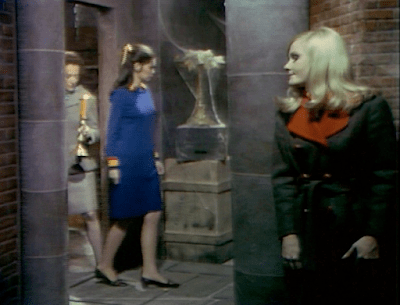
Julia goes to Sarah’s grave in the Tomb of the Collinses and calls to her. She hears the strains of “London Bridge,” then sees Sarah. Sarah tells Julia that she will not help her, because she killed someone she liked, Dr Dave Woodard. Julia tries to put the blame for that crime on Barnabas, but Sarah declares that she helped him. We heard “London Bridge” in the background during the murder scene in #341, so we know that Sarah saw the crime and Julia will not be able to deceive her.
In this scene, Sarah says that she cannot act directly against Barnabas. This is a striking moment, because it is the first time Sarah has spoken her brother’s name out loud. Sarah’s statement explains why she watched as Barnabas and Julia killed Woodard, and also why so many of her attempts to protect her friends from him have ended up with them in worse shape than before and Barnabas insulated from all accountability.
When Julia was working with Barnabas, she too made desultory attempts to restrain his worst tendencies, while always protecting him from the consequences of his actions. The dynamic between them mirrored the Bossy Big Sister/ Bratty Little Brother pattern that matriarch Liz and her brother Roger have been modeling from the first day of the series. Seeing Julia with Barnabas’ literal sister, we see that this dynamic has defined the Collinses for centuries.
Carolyn Collins Stoddard has been a spoiled heiress all her life, and now is settling into a new role as blood thrall to her distant cousin, vampire Barnabas Collins. Carolyn is trying her level best to comply with Barnabas’ command to seduce lawyer Tony Peterson so that she can steal the notebook mad scientist Julia Hoffman entrusted to him. She is on a date with Tony, and they are starting to do some serious kissing.
No matter how well Carolyn serves him, Barnabas can’t keep himself out of her way. When Barnabas is upset, nearby hound-dogs start baying; Danny Horn calls the dogs Barnabas’ “backup singers.” When Carolyn hears them, her face goes blank and she forgets about Tony. Tony becomes irritated and ends their date abruptly.
Later, Julia goes to Barnabas’ house. Carolyn is there; Barnabas sends her into the next room to eavesdrop on their conversation. The shot of Carolyn in that room recalls a similar shot of housekeeper Mrs Johnson eavesdropping on Carolyn and local man Burke Devlin, on Burke’s instructions, in #69. That shot marked the beginning of the career of the previously guileless Mrs Johnson as a secret agent Burke employed to spy on the Collinses.
As Mrs Johnson once listened to Burke pretending to a romantic interest in Carolyn, so Carolyn today listens as Barnabas pretends to a romantic interest in Julia. Julia realizes that she is unlikely ever to get Barnabas out of her life, and for a time she tried to make the best of the situation by falling in love with him. In his show of contrition and gallantry, she sees a glimmer of hope that he will reciprocate this love. Julia has seen too much to be as taken with Barnabas as Carolyn was with Burke, but she does give serious consideration to the idea that Barnabas might have given up on killing her and might be thinking of becoming her boyfriend instead.
After Julia leaves, Carolyn comes back into the room. She objects that Barnabas was being cruel by raising Julia’s hopes that way. Again, this echoes #69. Mrs Johnson came back into Burke’s room after Carolyn left, and asked him if he thought “the girl [was] involved” in the wrongdoing they thought had taken place at the great house of Collinwood. When Burke replied that anyone in the house was “fair game,” Mrs Johnson asked “Even the girl?” To which Burke replied “Anyone!” That marked the end of the episode, so we didn’t hear how Mrs Johnson reacted to that pronouncement. But she did go on working for Burke, so apparently it didn’t bother her too much.
Barnabas calls Carolyn to him, looks into her eyes, and tells her she is tired. She smiles, and agrees that she is tired. Evidently he used his supernatural influence over Carolyn to erase her misgivings about his treatment of Julia. He hadn’t done anything supernatural to quiet Carolyn’s predecessor, the luckless Willie, on any of the countless occasions when he acted as Barnabas’ external conscience; he usually just hit him in the face with his cane. Barnabas has been picking up lots of new powers lately, gaining the ability to transform into a bat, to materialize inside closed rooms, and to cast magic spells, so it shouldn’t be much of a surprise that he now has greater control over his blood thrall than he had before.
Barnabas Collins is a vampire, but he rarely bites anyone. He spends most of his time pursuing an acting career. His role is that of Living Man Born in the Twentieth Century, and his audience is almost everyone he meets.
Jonathan Frid often has trouble with Barnabas’ lines, but usually he manages to make it seem that it is Barnabas, not he, who is scrambling to keep his performance on track. His posture and facial expression project whatever emotion Barnabas is supposed to be feeling, and the words rarely get in the way.
As my wife, Mrs Acilius, pointed out, there is a moment today when he simply falls out of character. Barnabas is telling his distant cousin and blood thrall, Carolyn, that he is going to cast a spell that will bring madness upon his co-conspirator turned bête-noire, mad scientist Julia Hoffman. Barnabas has been acquiring new powers lately, and this is the first time we hear that he knows how to cast spells. Apparently this case of power creep was too much for Frid. While telling Carolyn about the “secret magic number of the universe,” he drifts from Barnabas’ voice into his own, looks down, then breaks off and stares mutely, not at Carolyn, but at Nancy Barrett struggling valiantly to keep a straight face. He then has to stand up and do a little dance while wearing a green dressing gown. The ridiculousness of it, for once, overwhelms him.
Mad scientist Julia Hoffman must hide her notebook from vampire Barnabas Collins and Barnabas’ blood thrall, his distant cousin Carolyn. The notebook documents Barnabas’ vampirism, and he does not want it to fall into the hands of the authorities. Once he gets hold of it, he plans to kill Julia.
The last time Dark Shadows devoted as much story time to attempts to hide and find an object as they have to this notebook was when high-born ne’er-do-well Roger Collins was frantically trying to hide local man Burke Devlin’s filigreed fountain pen, a story that dragged on from August to November of 1966. Few remember that storyline fondly, but at least the pen was a unique piece of evidence that might connect Roger to a homicide. The notebook is less satisfactory as a focus of attention, since there is nothing unique about it- Julia could easily have written a hundred documents detailing Barnabas’ secret and stashed them all over the world, and for all Barnabas knows she may have done. There are several strong episodes during this period, but the inadequacy of the notebook as a MacGuffin, combined with the fact that Julia could at any moment hop in her car and drive someplace where Barnabas wouldn’t be able to hurt her, prevents any momentum carrying over from day to day.
There are two important things about this installment. It is the first episode written chiefly by Sam Hall,* who will become far and away the most important member of Dark Shadows‘ writing staff. Hall would write hundreds of episodes, right up to the final one, would write the two theatrical features based on the show that were produced in the early 1970s, and would stick with producer Dan Curtis for years afterward, even contributing a script to the ill-fated 1991 primetime reboot of Dark Shadows. The husband of Grayson Hall, who played Julia, he would develop the show into something as different from its November 1967 incarnation as that version is from the show that premiered in June 1966.
On his blog Dark Shadows Every Day, Danny Horn argued that Hall’s contribution was to see Dark Shadows as, first and foremost, a “mashup” of various stories. The example he gives in his post about this episode are the scenes in the office of Tony Peterson, a local attorney whom Julia has hired to keep the notebook locked up in his safe. Tony is played by Jerry Lacy, who in the 1960s and 1970s was chiefly known for his Humphrey Bogart imitation. He would do that imitation on Broadway in 1969 in Woody Allen’s Play It Again, Sam and again in the 1972 film version of that play; here he is doing it in a 1980 commercial for the Long Beach California Press-Telegram.
In the scenes Danny focuses on, Mr Lacy imitates Bogart as Sam Spade or Philip Marlowe meeting a succession of mysterious women in his office. Grayson Hall plays Julia as a frightened and barely coherent client and Nancy Barrett plays Carolyn as the blonde you’d be a fool to trust, even if she does have a pair of gams that won’t quit. They’re all having a great time with their pastiche of The Maltese Falcon, The Big Sleep, and other staples of the Late Late Show.
I do have to demur from Danny’s claim that Hall pioneered Dark Shadows as a mashup. It was that from #1, when Jane Eyre met the Count of Monte Cristo and they both found Art Wallace trying to remake a script he’d already sold to television twice. Nor is he the first to mash up disparate genres. The story of Burke’s fountain pen led into a police procedural that merged with a ghost story; Burke’s typically soapy conflict with Roger dissolved into the story of Roger’s ex-wife, undead fire witch Laura Murdoch Collins, a story which was Dark Shadows’ first and most detailed adaptation of Dracula. The difference in Hall’s approach to mashups is that always before, one of the genres was Gothic melodrama. Today, a vampire story is meeting a film noir, and there are some elements of conventional daytime soap opera in the margins. Hall is letting go of Dan Curtis’ original idea of chasing viewers who read Gothic romances.
We get a clue as to what that might mean for the existing characters when Tony asks Julia if she is afraid of Roger Collins. Julia laughs loud and long at the idea that Roger is any kind of danger. For the first 25 weeks, Roger was indeed a deadly menace, but ever since Laura came through he has been reduced to occasional comic relief. Viewers who find a reminder of Burke’s fountain pen in the business with the notebook will see that even the villainous early Roger is a minor threat compared to the supernatural force Barnabas represents. So we are not to assume that any character or theme surviving from the show’s original conception is safe.
*The credits on screen say Gordon Russell wrote it, but evidently the paperwork from the show demonstrates that Hall did. Also, some of last week’s episodes sounded and felt as much like Hall’s work as this one does, but none of the experts tries to credit him with those, so I’ll defer to the consensus and say that while his influence may have been visible some days ago, this one marks his debut on Dark Shadows as the principal author of a teleplay.
Yesterday, mad scientist Julia Hoffman discovered that vampire Barnabas had sent his distant cousin and devoted blood thrall Carolyn to steal the notebook in which she recorded Barnabas’ secrets. Julia knew that this meant Barnabas had decided to kill her, and that only by keeping the notebook hidden could she save herself.
At the beginning of today’s episode, Julia hides the notebook inside the clock in the foyer of the great house of Collinwood. At the end, Carolyn notices that the clock has stopped chiming. The foyer clock is a very impressive piece of property, and it’s always nice when it gets screen time.
Yesterday’s episode ended with vampire Barnabas Collins telling his distant cousin and newly acquired blood thrall Carolyn that he would punish his associate Julia Hoffman. Carolyn smiled delightedly when she asked “Are you going to kill her?”
Today begins with a reprise of that scene. But there is a difference. Now, it is Barnabas who brings up the idea of killing Julia. Carolyn reacts with horror, tries to talk him out of it, says she won’t be part of a murder, and only reluctantly yields to him.
This instant retcon is disappointing to regular viewers for four reasons. First, while we can accept the show changing course from time to time, we do expect the story to build on itself as a reward to us for watching every day. If they’re going to pull a U-turn as abruptly as this, it may as well be an anthology series. Second, Carolyn’s reluctance to go along with Barnabas’ evil plans is nothing new to us- even her lines are recycled from objections her predecessor Willie and Julia herself had made to Barnabas’ earlier declarations that he intended to kill someone or other. Third, Nancy Barrett was tremendously fun to watch as a happy assistant murderer. She was nowhere near done exploring the possibilities of that persona.
The fourth disappointment goes deeper. It’s easy enough to see why the writers wouldn’t want Carolyn to rejoice in her situation for an indefinitely long period. As Stephen Robinson put it in a comment on Danny Horn’s Dark Shadows Every Day, “There’s no conflict [if] Barnabas’s partner in crime is a fully willing psychopath. They would just stand around going bwah-ha-ha.” But the excitement in the first four episodes of this week came from that very lack of dramatic possibility. It was so clear Carolyn’s relationship to Barnabas could not stay as it was for very long that we’re waiting for some big event to change it at any moment. When they slide back to the same old stuff we’ve already been through with Willie and Julia, that excitement gives way to the sinking feeling that nothing much is going to change in the foreseeable future.
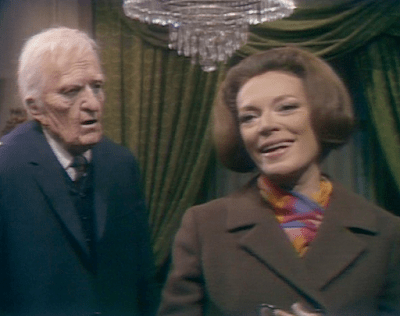
Matriarch Liz and her brother Roger come to the drawing room of the great house of Collinwood. They have news for Liz’ daughter Carolyn. Roger’s son, strange and troubled boy David, will be going to Boston for a few days with his well-meaning governess Vicki. Liz and Roger suggest Carolyn go with them. She refuses, but cannot give a reason. They tell her about the wonderful parties full of men her own age “Aunt Catherine,” a person we have never before heard mentioned or hinted at, will give for her in the city, and point out that she has no social life at all around Collinwood. Carolyn continues to refuse, and leaves the room.
Liz and Roger talk about how uncharacteristically Carolyn has been behaving of late, and Roger hopes there isn’t anything wrong with her. What they don’t know but returning viewers do is that Carolyn was recently bitten by a vampire and is now his eagerly devoted blood-thrall. They don’t even know that there is a vampire, much less that it is their distant relative and close neighbor Barnabas. But Carolyn’s demeanor has changed so drastically since she fell under Barnabas’ power that everyone has been remarking on it.
The only resident of the great house who knows what has happened to Carolyn is permanent house-guest Julia Hoffman. Liz and Roger think Julia is an historian researching the old families of New England, but in fact she is a mad scientist who has come to the estate to attempt to cure Barnabas of vampirism. He has given up on her treatments, but has agreed that she might stay on to help guard him during the day.
Carolyn has discovered that Julia is working at cross-purposes with Barnabas. He wants to win Vicki as his bride. In episodes #347 and #352, Julia hypnotized Vicki, took her to Barnabas’ house, and showed her items that suggest the grisly fate that Barnabas has in store for her. Vicki does not consciously remember these trips, but she has begun to react to Barnabas with fear.
Today, for the third time in two weeks, we see Julia hypnotize Vicki. Again she shows Vicki the same pieces of antique crystal; again she tells her to “find the center” of the crystal; again we hear a tinkling sound and see a kaleidoscope-like image; again she takes her to Barnabas’ house; again she does a show-and-tell, this time with the coffin Vicki will spend her days in when she and Barnabas are resting up from their nights together preying upon the living; again she takes Vicki back to the drawing room, and says “You will never remember.” This ritual stretches out over a period of several minutes.
The difference is that this time, Carolyn has followed them to Barnabas’ house and eavesdropped on their entire conversation.
When Carolyn reports Julia’s actions to Barnabas, he says that Julia must be punished. Carolyn brightens and with a big smile asks “Are you going to kill her?” He says that he might do something to her that will be far worse than that. Unfortunately, we don’t see Carolyn’s reaction to this news.
It is rather odd that Julia wasn’t on the lookout for Carolyn. Yesterday the two of them clashed repeatedly as Carolyn made it clear she did not think Julia was sufficiently subservient to Barnabas, and in Act One of today’s episode Julia accuses Carolyn of following her. All Carolyn does to throw Julia off her trail is say that she is going into town for a couple of hours. Julia simply takes that at face value- she doesn’t even bother to see if Carolyn’s car is gone before she takes Vicki to Barnabas’ house.
This blitheness is not typical of Julia, who is one of the smartest and most cunning characters on the show. Still, it may make sense to viewers who have been with Dark Shadows from the beginning. Neither the flighty heiress we saw in 1966 nor the determined if feckless protector of family we have known since February of 1967 is the sort of person Julia would be inclined to take seriously. Julia is a medical doctor fully qualified in two unrelated specialties, hematology and psychiatry, and when we first saw her she was the director of a sanitarium. In the eyes of someone with such a formidable professional background, a young woman with a fashionable hairdo, a big wardrobe, and no formal education who has never lived anywhere but in a country house outside a fishing village in central Maine must be easy to underestimate. This pretty little hick might be the doctor’s undoing.
The reference to “Aunt Catherine” is a bit of a riddle. We have never heard of any member of the Collins family who lives anywhere but Collinwood, and considering that both Liz’ marriage and Roger’s ended in something rather more disturbing than a run-of-the-mill homicide, neither is likely to have kept in touch with the former in-laws. If the writers and producers were not intending to bring Aunt Catherine on screen or to mention her again, as they do not in fact do, then it would have been just as easy to make up some name that a rich Bostonian might have and say that the glamorous parties and eligible bachelors are waiting for Carolyn at Mrs Broadbottom’s house. So Aunt Catherine joins the “House by the Sea” in the “I wonder where that was supposed to lead” category.
Blonde heiress Carolyn Collins Stoddard is under the power of her distant cousin, Barnabas the vampire. She begins today’s episode in the foyer of the great house of Collinwood. She stares at Barnabas’ portrait, lifting her scarf to bare the marks of his fangs to it. She is eager to comply with Barnabas’ commands. He has ordered her to do two things- stop strange and troubled boy David Collins from sounding the alarm about him, and induce well-meaning governess Vicki to become his bride.
Ever since she stopped being a vicious narcissist in February, Carolyn has spent her time trying to protect her family members against threats she didn’t quite understand. She’d been trying to protect David, a first cousin who has come to be something like a little brother to her, when she stumbled upon Barnabas in his lair and became his slave. Her glad willingness to help Barnabas do whatever it takes to silence David shows how complete her subjection to him is.
Today, Carolyn wakes David before 6 AM. David asks “Are you sick or sum’thin?” David Henesy had a real gift for comedy, and Mrs Acilius and I laughed out loud at this line. Carolyn tells David that she does not believe any of the things he has been saying about Barnabas, that she never saw the ghost of ten year old Sarah Collins, and that if he keeps talking about supernatural menaces he will have to be sent to a mental hospital.
David’s reaction will puzzle regular viewers. Last Wednesday, in #348, Carolyn told David she had seen Sarah and was inclined to believe him about the other things. He was horrified. He said that local physician Dr Woodard saw Sarah, believed him, and died as a result. He begs Carolyn to say that she doesn’t believe him and that she didn’t see Sarah, and when she can’t he sobs in her arms. On Friday, David overheard matriarch Liz telling Carolyn he might have to be sent away to an institution, to which Carolyn responded that she had seen Sarah and did not think David was mentally ill. Afterward, David invited Carolyn to believe that he was crazy rather than accept the stories he had told before Woodard’s death. So when Carolyn shows up and tells David that she has decided to disbelieve the things he was desperate she disbelieve, and that the only danger will come if he repeats stories he wasn’t going to repeat anyway, he ought to be happy.
But David goes to pieces. He is as upset by Carolyn’s newfound disbelief as he was a few days ago by her belief. The actors do such a good job with the material that I am reluctant to complain about it, but if people are going to be watching the show every day the writers really should keep track of what’s in each other’s scripts.
As David is the functional equivalent of a brother to Carolyn, so Vicki is the equivalent of a sister. In fact, Art Wallace’s original story bible for Dark Shadows, titled “Shadows on the Wall,” called for a story that would climax with the revelation that Vicki was Carolyn’s half-sister, the daughter of Carolyn’s father Paul Stoddard. Well before the show went into production, the part of Vicki had been cast with Joan Bennett-lookalike Alexandra Moltke Isles, setting up the hints that run heavily throughout the first 92 episodes that Vicki is Liz’ daughter by some man other than Paul. Whichever half of her genealogy Vicki has in common with Carolyn, Liz has been tacitly treating her as a daughter all along. Liz has referred to Vicki and Carolyn as “the girls” for a long time, and now she is even encouraging Vicki to restore the west wing of the great house, which sounds very much like a project a person undertakes on something she is set to inherit. For a time Carolyn showed some resentment and jealousy towards Vicki, but the last clear indication of that was in #263. Since then, Carolyn has been treating Vicki as if she had always known her as a sister.
The enthralled Carolyn is as happy serving Vicki up to Barnabas as she was betraying David for his sake. Or she would be, if she had the chance.
Barnabas’ co-conspirator, mad scientist Julia Hoffman, is staying in the house. Julia has been passing herself off as an historian studying the old families of New England while secretly trying an experimental treatment meant to cure Barnabas of vampirism. That treatment reached an impasse before Barnabas bit Carolyn, and he has decided to discontinue it. Yesterday, Julia persuaded Barnabas to let her stick around to help guard him when he lies in his coffin during the day.
A few days ago, in #347, Julia hypnotized Vicki and showed her Barnabas in his coffin. By a post-hypnotic suggestion, she kept Vicki from consciously remembering what she had seen, but left her with an emotional aversion to Barnabas. That hypnosis gag is reenacted today, with Julia taking Vicki to the room in Barnabas’ house which he has prepared for her when she becomes his bride. There, she tells Vicki the details of Barnabas’ plans for her. Again, she gives a post-hypnotic suggestion confining this knowledge to her subconscious mind.
The difference between #347 and today is that Carolyn is working for Barnabas now. In that one, Julia had free rein to take hypnotized governesses in and out of Barnabas’ house all day long, without a care in the world. But now, Carolyn is watching. Even before Julia did her thing with Vicki, Carolyn confronted her and asked a series of pointed questions. That scene set up an interesting take on the whole idea of a relationship triangle- Carolyn and Julia are in conflict over Barnabas’ attentions, though neither is going to be his lover in any conventional sense. Triangles are so important in soap operas that this clash calls our attention to how Dark Shadows is rewriting the rules of the genre.
Carolyn sees Vicki and Julia leave the house. After they have returned, she asks Vicki about the walk she and Julia took. Vicki doesn’t know what she’s talking about. Carolyn says that she saw them down by Barnabas’ house, implying that she followed them. Vicki is still baffled. In a recorded voiceover monologue, Carolyn wonders why Vicki would lie. She concludes that she wouldn’t, and that Julia must be up to some kind of hocus-pocus.
Carolyn then asks Julia about her walk with Vicki. Julia feigns ignorance. Carolyn says she saw them leave the house together. Julia is defensive, but Carolyn waits patiently for an answer. Julia claims that they just stepped outside the door for fresh air, and Carolyn leaves it at that. Julia exits, and Carolyn ends the episode as she began- staring at the portrait of dear cousin Barnabas.
Nancy Barrett’s acting style is to throw herself unreservedly into whatever the script calls for her character to be doing on any given day, without regard for what the character may have done in past storylines. This turns out to be the perfect approach to playing Carolyn Collins Stoddard. In the first months of the show, flighty heiress Carolyn was fickle, capricious, and self-centered, traits that were all the more disturbing in someone who never showed any particular awareness of what she had said or done as recently as the day before.
That all changed when Carolyn shouldered responsibility for the Collins family business while her mother, matriarch Liz, was away for several weeks in February and March of 1967. After that period, her chief motivation was an earnest concern for the family’s well-being, and her chief difficulty was incomplete information. In her frustration, she tried to save her loved ones by doing just the wrong thing. So when Liz was going to marry seagoing con man Jason McGuire, Carolyn figured out that Jason was blackmailing Liz into the marriage. She also deduced that Liz’ fear was that her secret, if exposed, would ruin Carolyn’s chance at happiness. But Carolyn did not know what the secret was. So, she first tried to ruin her own happiness by dating motorcycle enthusiast Buzz, then when the prospect of Buzz as a son-in-law did not suffice to prompt Liz to stand up to Jason, Carolyn brought a gun to the wedding and planned to shoot Jason dead while he was saying his vows.
By Friday, Carolyn’s concern centered on her young cousin, strange and troubled boy David Collins. David was in touch with the supernatural, and had said that distant relative Barnabas Collins was an undead creature who posed a terrible threat to everyone. Carolyn thought Barnabas a fine and pleasant fellow, but she knew that much of what David had said was true. Though the boy kept pleading with her to forget everything he has said lest she die as the previous adult to believe him, Dr Dave Woodard, died, Carolyn could not do so. She decided to slip into Barnabas’ house to investigate David’s claims. There, she found Barnabas’ coffin. When he bit her and sucked her blood, she learned that he was a vampire.
Miss Barrett’s style usually produces a hot performance, in which she flings the character’s emotions directly before the audience. Today, though, she is playing a vampire’s newly acquired blood thrall. That is a part for a cold actor, one who keeps the audience guessing at the character’s feelings and intentions. On Friday, Barnabas told his co-conspirator, mad scientist Julia Hoffman, that if he bit her she would no longer have a will of her own; having heard that line, returning viewers are supposed to be unsure whether Carolyn even has an inner life now.
Miss Barrett rises to the challenge admirably. In her scenes with Julia at Barnabas’ house and with her mother and her uncle Roger at the great house of Collinwood, she manages to sound faraway and disconnected without seeming bored or confused; in her scenes with Barnabas, she sounds a note of unquestioning devotion without seeming robotic. All of the actors have been doing exceptional work the last few days, and with this eerie turn Miss Barrett is on a par with the very best.
Barnabas gives Carolyn two instructions. First, he tells her to convince everyone that David is mentally ill and that everything he has said should be disregarded. Carolyn smiles readily and says that this will not be difficult to accomplish. Since we have over recent months come to know Carolyn as the determined if maladroit protector of her family, and since she has been so focused on helping David, this easy acquiescence in Barnabas’ wicked plans for David comes as a heartbreak to regular viewers.
Barnabas’ second command is for Carolyn to encourage well-meaning governess Vicki to discard her personality, replace it with that of his long-lost love Josette, and come to him willingly as his bride. Carolyn is a bit puzzled by the Josettification project, but just a couple of days ago Vicki was telling her that she is “more than fond” of Barnabas. Besides, Vicki really is fascinated with Josette, and her current personality hasn’t given her much to do on the show lately. So Carolyn smiles again and says that she will see to it that Vicki comes to Barnabas.
The original videotape of this episode is lost, and the kinescope is particularly gray and scratchy. That is a happy accident. The very cheapness of its look adds to the Late Late Show quality of a story about a beautiful young blonde under the power of a vampire. The abstractness of black and white imagery also takes us out of the literal, workaday world of color pictures, into a realm of dreams and fables where we might expect to encounter vampires.
Most important, the kinescope makes a sharp contrast with images we saw last week. In #348, we got a look at Carolyn’s bedroom. It was the most brightly decorated set we have seen so far on Dark Shadows, so much so that I had to squint for a second when Carolyn switched a lamp on. In color, Barnabas’ house is drab enough, but in black and white it is so severely bleak that the idea of the resident of that glowing bedroom ending up there should give us a shudder. While Barnabas is on his way upstairs to see Carolyn, the camera lingers a bit on this shot of melted candles; for me, that was the moment that particular shudder comes hardest.
Smoldering in the ruins
Of course, a vampire’s bite is a metaphor for rape; of course, Barnabas’ investment in presenting himself as a member of the Collins family makes his attack on Carolyn a metaphorical incest. Every other Dark Shadows blogger who has posted about this episode has explored that theme- Danny Horn (and several of his commenters) here; Patrick McCray and Wallace McBride here and here; and John and Christine Scoleri here. All I have to add to that chorus of voices is that Carolyn’s role as doughty if misguided protector of her kindred makes her a particularly poignant victim of an incestuous assault.
Things have been happening fast on Dark Shadows for the last several days, and writer Ron Sproat was always aware of the need to let new viewers catch up. This is the first chance Sproat has had to write a Friday episode in some time, and since some people would watch daytime soaps only on Fridays, he goes in today for some extra heavy recapping about doings at the estate of Collinwood.
As a result, the first half of the episode is confusing to viewers who have been watching regularly. In recent days, the ghost of ten year old Sarah Collins gave a toy soldier to strange and troubled boy David to keep with him as a talisman against evil; David had a premonition that his cousin, heiress Carolyn, was in danger, and passed the toy soldier on to her; Carolyn saw Sarah, and gave the toy soldier back to David; and as we begin today, David brings the toy soldier back to Carolyn. David catches a glimpse of an extremely old man peering in through the window of the drawing room; he is gone by the time Carolyn turns to look. They talk about ghosts and visions, reenacting in one scene Carolyn’s whole progression from total rejection of David’s claims about the supernatural to total openness to them, and David’s from a desperate need to be believed to an even more desperate fear that Carolyn will be killed unless he can convince her he was lying about everything.
Carolyn tells her mother Liz that she doesn’t think David is lying, and decides to confront Liz’ aversion to the topic of ghosts and tell her that she has seen Sarah. Liz says she thinks David is mentally disturbed and must be sent away to an institution; eavesdropping, David reacts with horror. He meets Carolyn in the foyer afterward. He asks her if she thinks he is crazy. When she says she doesn’t, he says that maybe he is. He pleads with her to reject his stories as either delusions or lies.
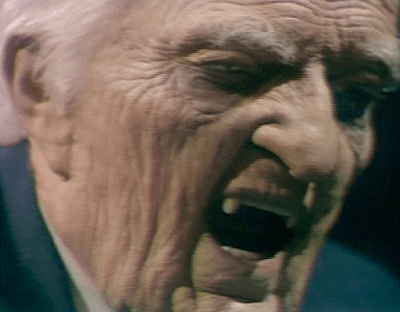
The old man David saw looking at Carolyn is their distant cousin Barnabas, who is, unknown to them and the other residents of the great house on the estate, a vampire. Mad scientist Julia Hoffman has been trying to cure Barnabas of vampirism, but she inadvertently restarted the aging process which his condition had arrested. No longer does he look like a man in his forties- now he appears to be about ninety. He fears that if he does not start sucking people’s blood again tonight, he will soon turn into the pile of dust he would have been long ago were it not for his curse.
In Barnabas’ home at the Old House on the estate, we see him talking with Julia. His peeping at Carolyn might suggest that he has her in mind as his victim, but he does not mention her. Instead, he says he will go out into the town of Collinsport and find a stranger. Julia is disappointed that Barnabas is not planning to bite well-meaning governess Vicki, with whom she had hoped never to have another conversation. So she offers herself as a victim instead.
This offer stuns Barnabas so deeply that, for the first time, he addresses Julia by her first name. She smiles when he does this. He seems sincerely dismayed by the thought of enslaving Julia. When he tells her that if he bites her, she will have no will of her own, she smiles even more brightly. Evidently Julia believes that would be a price well worth paying if it kept Vicki from talking to her.
Julia contemplates enslavement. Screenshot by Dark Shadows Before I Die.
Barnabas declines the offer, saying that he might need to call on Julia for medical treatment at some point in the future and that as a blood thrall she wouldn’t be able to function as a doctor. Julia is hurt by Barnabas’ refusal, and asks him if the only reason he won’t enslave her is that he wants to use her professional services, and he assures her that it is.
Back in the great house, Carolyn stands in the foyer under the gaze of Barnabas’ portrait. She looks at the toy soldier and wonders about David. She decides to go to Barnabas’ house and look for evidence of the things David had claimed to see there. Oddly, she sets the toy soldier on the table and leaves without it.
Carolyn lets herself into Barnabas’ house, goes to his basement, and finds his coffin. Julia sees her there and tells her to leave immediately, “before it’s too late.” We hear Barnabas’ voice announcing “It is already too late.” Carolyn is baffled by Barnabas’ aged appearance. He moves in, bares his fangs, and bites her.
Barnabas’ old man makeup is phenomenally good, as all the Dark Shadows blogs mention. The show was very lucky to land Dick Smith, one of the pre-eminent makeup artists of all time, to do it. But I would add that Jonathan Frid’s acting takes Smith’s appliances and turns them to the best possible advantage. It is utterly absorbing to watch him as a man suddenly thrust into extreme old age, trying to figure out how to move his newly enfeebled limbs. In Frid and Smith, two artists at the top of their form collaborated to create a remarkable turn.