Another action-packed episode from writer Francis Swann. His new colleague Ron Sproat seems to have given him a jolt of energy.
High-born ne’er-do-well Roger Collins has been Dark Shadows‘ foremost villain so far. This week’s theme is that well-meaning governess Vicki suspects Roger of murdering beloved local man Bill Malloy. She is terrified of what Roger might do to her, and Roger is terrified she might go to the sheriff. Vicki and Roger scramble to keep up with each other, and draw the other characters into their frantic activity.
Today we divide our time between the great house of Collinwood, where Roger and Vicki live and play their high-stakes game of cat and mouse, and the Blue Whale, a tavern in the village of Collinsport where we see the consequences of their actions ripple out into the broader community. In yesterday’s episode, Vicki and Roger had a talk in which he told her that he did see Bill the night he died, but that he was already dead when he found him. That accounted for the evidence Vicki found, but only increased the tension between them.
We begin and end today in Vicki’s bedroom. In the opening teaser, Roger knocks on her door and lets himself in when she doesn’t answer him. In the closing scene, Vicki’s door is unlocked and opens while she is in bed. This prompts her to scream. When she does, the door quickly closes. Roger comes in seconds later, and implausibly denies that he opened it until after she screamed.
In between, we see Vicki in the tavern, telling Roger’s arch-nemesis, dashing action hero Burke Devlin, what Roger told her yesterday. Burke is incredulous that Vicki seems willing to believe that Roger might be telling the truth this time. She responds “I know you think I’m an idiot, but I can’t help it!” Maybe Bill wasn’t pushed to his death- maybe he was just clumsy and fell without anyone’s intervention. Burke does not contradict Vicki when she tells him he thinks she is an idiot. He urges her to leave town, since Roger might kill her at any time. She insists on staying at Collinwood.
Vicki and Burke leave the tavern. Drunken artist Sam Evans and his daughter Maggie Evans, The Nicest Girl in Town, enter. Maggie tells Sam that she talked to Vicki yesterday. Vicki told her almost everything, holding back Roger’s name but making it clear she can’t be thinking of anyone else. Maggie sees that the idea of the investigation into Bill’s death being reopened and connected with the incident that sent Burke to prison ten years ago disturbs Sam intensely. When Sam answers one of her questions with a lie, she asks “Haven’t you thought of a better one than that?” He mumbles a response, but won’t tell his daughter what he has to be afraid of.
Maggie calls Collinwood. Roger answers, and Maggie asks to speak to Vicki. Returning viewers will remember that when Burke called Vicki in yesterday’s episode, Roger was in the room. Vicki concealed the fact that she was talking to Burke by pretending she was talking to Maggie. Maggie’s call tips Roger off to Vicki’s lie. He tells her that Vicki isn’t home. She tells him that the Evanses are at the Blue Whale, that they haven’t been home all evening, and that they haven’t seen Vicki.
Vicki comes home. She tells Roger she was visiting Maggie at her house. Roger plays along and encourages Vicki to elaborate on this story. At the tavern, Burke had told Vicki she was a bad liar. She proves him right, giving Roger one falsifiable detail after another about her time at the Evans cottage.
After the affair of the door, Roger sees Vicki’s frank disbelief that he will not admit that he unlocked and opened it. Facing her unspoken accusation that he is brazenly lying to her, he casually mentions Maggie’s call. He suggests Vicki call her tomorrow, so that the two of them can get their story straight. He saunters away, having deflated her righteous indignation about his apparent lies.
As Vicki, Alexandra Moltke Isles was one of the cast members who delivered her lines with the fewest stumbles. She has a doozy today, though. When she returns from her conference with Burke, Roger sees her climbing the stairs and calls out to her: “Vicki!” She replies: “Rodgie!” A man you address as “Rodgie” is not someone of whom you are deathly afraid. They have done such a good job building up an atmosphere of tension between Vicki and Roger that this slip is one of the most breathtaking bloopers in the entire series. It’s still a Genuinely Good Episode, but that moment does make you wish for a videotape editor.
A deluxe episode today- multiple location inserts, three sets, six credited actors, several extras, music we haven’t heard before, and a special effect. By Dark Shadows standards, that’s a spectacular.
At the end of yesterday’s episode, high-born ne’er-do-well Roger Collins had sneaked up on well-meaning governess Vicki from behind, seized her, covered her mouth with his hands, and ordered her to be silent. Since Vicki is convinced Roger is a murderer and is afraid he will murder her to protect his secrets, that was quite a cliffhanger.
As we open today, Roger makes Vicki promise she won’t scream if he lets her go. He explains that when he decided to forcibly silence her, Maggie, keeper of the Collinsport restaurant and The Nicest Girl in Town, might still have been within earshot of a scream. So he “had to do that.” Otherwise, Maggie, to whom he contemptuously refers as “that little countergirl,” might have intruded on their private conversation. Now, they are all alone in the house.
Vicki does not find Roger’s explanation of his assault on her any more satisfactory than we might expect. She moves about the room keeping her eyes on him, her weight on her toes, and a clear line between her and the exit. Roger asks if she thinks he killed beloved local man Bill Malloy. She answers “I don’t think anything.” He asks her to listen to the whole story. She hears him out, but doesn’t let her guard down for a second.
Roger admits that he did see Bill the night he died. That involves admitting that he tricked Vicki into thinking he left home later than he in fact did, and thereby into giving him a false alibi in a statement to the sheriff. Roger ignores Vicki’s shocked reaction to this, and goes on to explain that Bill was already dead when he saw him. They had arranged to meet atop Lookout Point, but when Roger arrived he saw a body face-down on the beach below. He hurried down, and saw that it was Bill. Vicki asks if he looked like he’d been dead long. Not long, Roger says; he must have fallen off the cliff, been knocked unconscious, and drowned in the two or three feet of water on the beach just moments before.
Roger says he left Bill without calling for help or reporting the accident because he was afraid people would think he murdered him. “After all, I had motive, as they say.” Roger’s motive would be that Bill was trying to prove that he, not dashing action hero Burke Devlin, was responsible for a fatal hit-and-run accident ten years before. “Even you don’t believe me, do you?” he asks Vicki. Vicki says she doesn’t know what to believe, and edges closer to the door.
Returning viewers know that Roger is Dark Shadows’ most clearly defined villain, and have seen him frantically trying to conceal or destroy evidence relating to Bill’s death. Any story the makers of the show want us to consider accepting will have to give him some share of guilt. In this story, he is admitting to leaving the scene of a fatal accident. That is the very crime Bill was trying to prove that he, not Burke, committed ten years before. Since Roger is not a doctor, he is not competent to make a determination as to whether an unresponsive person is dead. For all he knows, Bill might have been saved had he gone for help. If we’ve been paying attention to the “Revenge of Burke Devlin” story, we should be wondering whether the account Roger has given Vicki will itself be enough to send him to prison. If so, we will wonder what Roger has up his sleeve to keep her quiet.
At the long-abandoned Old House, Roger’s son, strange and troubled boy David Collins, is talking to the portrait of his ancestor Josette. He asks Josette why she won’t “come down like you usually do” and talk to him. We don’t hear an answer, but David says “Well, I suppose you know what’s best.”
David tells the portrait that his governess Vicki knows that his father murdered Bill Malloy. He asks Josette if Bill’s ghost is with her and the other ghosts. Apparently she doesn’t answer him. He says that if his father finds out what Vicki knows, he will murder her, and then probably go on to murder him as well. David hears sounds outside the Old House. He puts out his candle and hides behind a chair.
Gruff caretaker Matthew enters. He announces to the dark room that he saw a light through the window, so there’s no point hiding. David comes out from behind the chair. He tells Matthew that he is visiting his friends- the ghost of Josette, of another woman similar to her, and of a younger woman, one about Vicki’s age. Matthew dismisses the topic of ghosts. David tells him that Vicki knows who killed Bill Malloy. As he has done each time Bill’s death has been mentioned, Matthew becomes agitated.
This time, Matthew’s agitation takes the form of a solicitous curiosity. David declares that his father is the murderer. “Did Miss Winters say that?” Matthew asks. No, David allows, but that’s what she meant. He asks Matthew to help him protect Vicki from Roger. Matthew mutters that he wouldn’t want any harm to come to Vicki.
Matthew’s agitation redirects our attention to the opening voiceover. Each episode starts with a brief monologue. For the first 55 weeks, all of these are delivered by Alexandra Moltke Isles in character as Vicki. Usually, they are not very informative. They are more about setting a vaguely anxious mood than about giving us specific facts about what’s going on in the story. Usually, whatever factual claims they do make are true. The only clear exception we’ve seen to that pattern so far came in #15, when Vicki says in the opening voiceover that she has made friends with David, a claim utterly belied by all the events that follow. Today, Vicki says in the opening that Roger is “the one person I have reason to fear.” That may also be false. Early on, reclusive matriarch Liz warned her that Matthew is a “strange and violent man,” and his unease about the death of Bill suggests that she might do well to keep an eye on him.
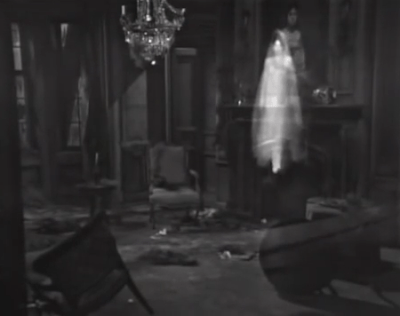
After David and Matthew have left the house, we see a replay of a bit of video from episode 70. The portrait of Josette glows, and her transparent figure walks down invisible stairs from the mantelpiece to the floor, then turns and looks back at the portrait. When David asked Josette to “come down like you usually do,” evidently he was referring to this manifestation.
Josette’s apparition has a different resonance for viewers today than it would have had for most viewers in 1966. The devices on which we see the show now have bigger screens and far clearer pictures than almost anyone would have had in those days. So it is easy for us to recognize a fact of which almost no members of the original audience would have been aware- the ghost of Josette is played by Kathryn Leigh Scott, the same actress who plays the Maggie whom Roger disdained as “that little countergirl.” Social class is a major concern of the show in the first 42 weeks, and the contrast between high-status and low-status characters is especially vivid today. That a character whose station is so lowly Roger cannot even bring himself to mention her name is played by the same person who plays a personage so lofty that she has a mansion to herself more than a century after her death gives a special punch to that contrast.
Meanwhile, flighty heiress Carolyn is on a date with Burke in the local tavern, The Blue Whale. Carolyn and Burke are well-dressed, as are the several extras at the other tables. They have china plates in front of them, and there is a more upscale type of background music playing than we usually hear at The Blue Whale. The show is at pains to establish that the tavern is a place for a nice date, rather than the waterfront dive it often appears to be. If that isn’t enough to set up an expectation that Burke and Carolyn’s date will be an important one, he says he plans to take her to another, even nicer, place later on for dancing and drinks.
Carolyn tells Burke she thinks that Vicki and Roger are becoming a couple. He is surprised. As she is explaining what has led her to this theory, she mentions that she told Roger something which Burke knows will reveal that Vicki suspects him of killing Bill. Burke excuses himself, saying that he is supposed to telephone his lawyer. He calls Vicki, and tells her he’s sending a taxi to take her away from Roger. She agrees to meet it.
Back at the table, Burke abruptly terminates the date. He explains to Carolyn that he has an urgent business meeting in ten minutes. She takes the news with uncharacteristically good humor.
Vicki slips out the back door of the house. The episode closes with a new location insert, a shot of her outdoors in the dark.
This may sound like a lot of talk, much of it recapping, but when you watch it the whole thing feels like it’s packed with high-stakes action. The actors are all in good form today, and, as usual, Francis Swann’s script gives them the opportunity to show what they can do. It is strong from beginning to end, well worth the extra expenditures they devoted to it.
Well-meaning governess Vicki has found what she believes to be evidence that beloved local man Bill Malloy was murdered by high-born ne’er-do-well Roger Collins. She fears that if Roger knows what she has found, he might kill her next. Since Vicki and Roger live in the same house, she has to be careful.
At the end of yesterday’s episode, Vicki had gone to town. In today’s opening scenes, Roger talks with his niece, flighty heiress Carolyn. Carolyn doesn’t know what’s on Vicki’s mind, and has blithely told Roger the vital information. When Roger finds out Carolyn doesn’t know where Vicki is, he asks his son, strange and troubled boy David. David strings his hated father along for a bit with unsatisfactory answers, all the while inviting him to contemplate a drawing of a man being hanged for the murder of Bill Malloy.
After Roger leaves the house, David opens the doors to the drawing room. He lets Vicki out. This is not only the first time in this episode we know that she was in the house. It is also the first time in any episode we see Vicki and David acting in concert as friends. Vicki’s attempt to befriend David has been the one story on the show that has worked every time we’ve seen it. Now that they are working together, that story has kicked onto a higher gear.
A knock comes at the front door. It’s Maggie, The Nicest Girl in Town. Maggie is bringing Vicki’s purse. Vicki is astounded- she hadn’t even missed it, much less realized she left it at the restaurant Maggie operates. Maggie insists that Vicki tell her what is bothering her. After a show of reluctance, Vicki tells her that she has found evidence that Bill Malloy was murdered, that she knows who the murderer is, and that if the murderer knows that she knows of his guilt he will be a threat to her. She therefore dare not share her knowledge with Maggie, lest she expose her to the same danger.
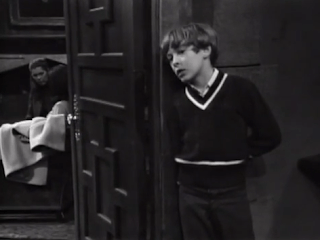
Maggie reacts sharply to this. Her father was suspected of killing Bill until the coroner ruled the death an accident, and her reflex when that ruling is challenged is to defend him. She tells Vicki that “I don’t understand you. You pussyfoot around pretending to be so friendly with everyone, and all you succeed in doing is stirring up trouble. As a matter of fact, all the trouble in Collinsport started the day you arrived.” These are startling words for The Nicest Girl in Town to address to our point of view character. But we don’t see her say them, or Vicki react to them. Instead, the camera is on David, eavesdropping at the door. That the show directs our attention to David even when Vicki and Maggie are having such a dramatic moment leaves no doubt that he is at the center of the most important events going on right now.
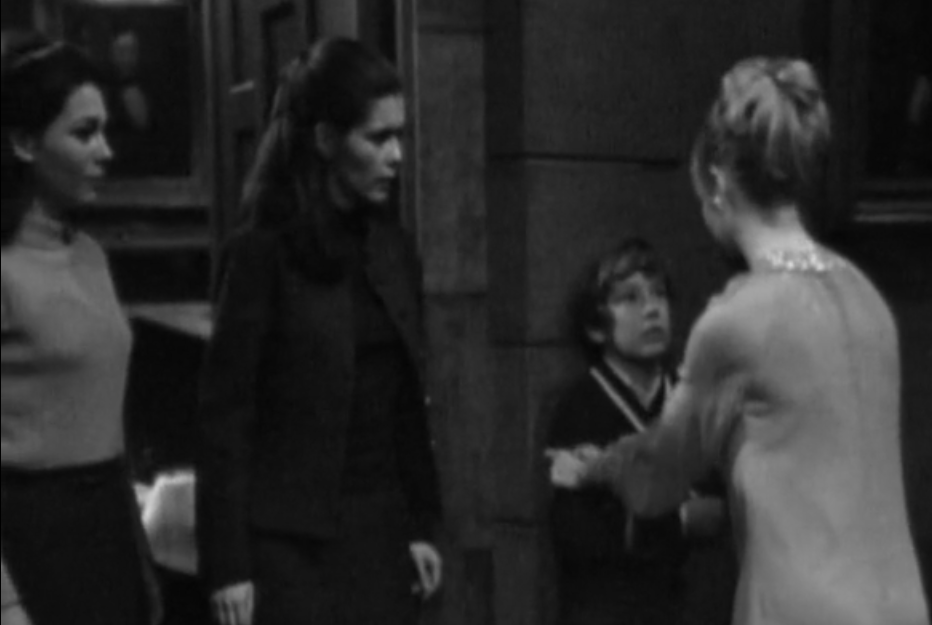
While we hear Vicki trying to defend herself, Carolyn catches David spying on them. Vicki and Maggie come out to watch her rough him up.* David runs off, and Carolyn leaves for a date.
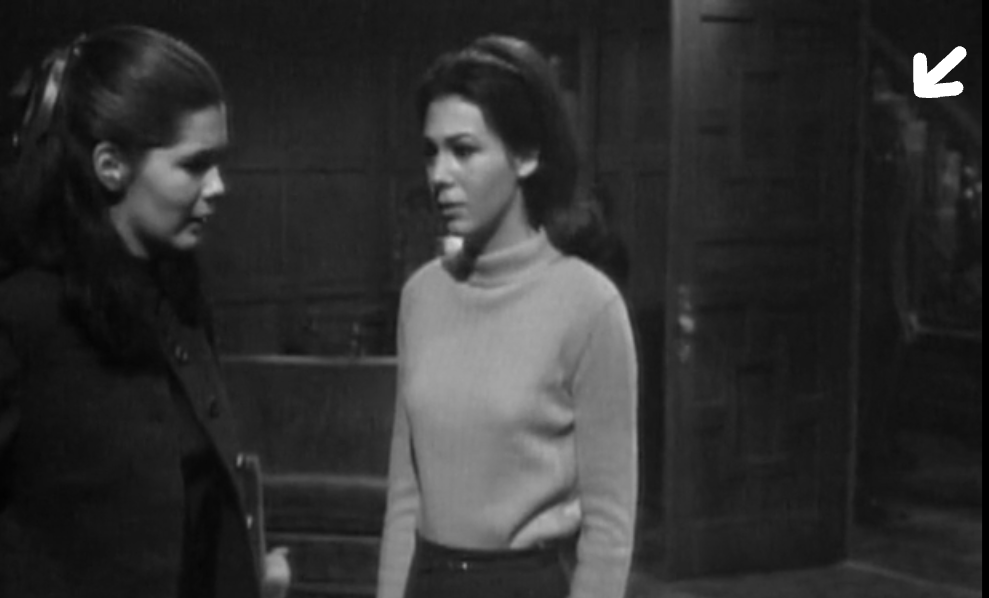
Afterward, Maggie presses Vicki for more information. She offers to take her home to spend the night with her and her father, Sam- “unless he’s the one you’re talking about.” Vicki tells her not to be silly. Maggie relaxes. Having ruled Sam out, Vicki makes a remark that also rules out dashing action hero Burke Devlin. Since Sam, Burke, and Roger were the three suspects everyone in town was talking about before the coroner’s ruling, that shouldn’t leave Maggie much difficulty guessing who Vicki thinks killed Bill or why she is uncomfortable in the house.
Francis Swann wrote this one, and he often plays up the similarities between Roger and David. While Vicki, having at first told Maggie she couldn’t possibly tell her anything, is telling her everything, Roger enters from the same door David had used a moment before, and stands at the same spot where David had listened to them.
Like son, like father
When Vicki shows Maggie out and declines her repeated offers to stay with her or to take her home, Roger hides in the shadows of the foyer, as we have seen David do many times. He waits by the door until Vicki comes back in.**
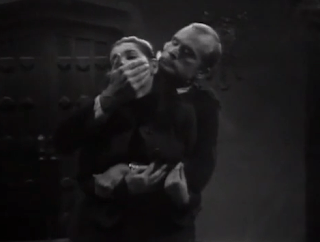
Once Vicki is alone, Roger creeps up on her. He grabs her from behind, covers her mouth, and orders her to keep quiet. Roll credits!
After a few episodes written by Ron Sproat, it is refreshing to get back to one by Swann. Sproat has been good so far at keeping the actors busy, but he doesn’t really understand their craft. Working from a script by Swann, each member of the cast can trace a line of development through the episode that gives the story structure and its events significance. Sproat’s first episodes have had some exciting moments, but the characters in them are just pieces being moved around a board. The excitement, when it comes, is that of watching a well-played chess match. Today, we have people to care about, not just the game the writer has devised for himself to play.
*This sequence is the first time we see all three young women in the same shot. With David Henesy, it also features four cast members all of whom are, as of November 2022, still alive.
Carolyn grabs David
**This is the first we see the wall extending from the door toward the front of the set. It is decorated with a metallic device. The theme of the house would lead us to expect a portrait of an ancestor on a spot like that…
This is the fourth episode credited to writer Ron Sproat. Sproat is making an inventory of the narrative elements available to him, and labeling each one with his plans for it.
In his first episode, #94, Sproat put two of Dark Shadows’ original storylines into a box marked “To Be Discarded.” Those were the quest well-meaning governess Vicki is on to discover her birth family and the relationship between flighty heiress Carolyn and hardworking young fisherman Joe. He put Vicki’s relationship with bland young lawyer Frank and Joe’s with Maggie, The Nicest Girl in Town, into the box marked “For Future Development.”
In #95, he put the whodunit surrounding the death of beloved local man Bill Malloy in the “For Future Development” box. He also noted the idea of a relationship between Vicki and high-born ne’er-do-well Roger Collins as a long-term possibility, depending on the outcome of the Bill Malloy story.
Yesterday, in #98, he reimagined Roger’s son, strange and troubled boy David Collins, not as the frantic and needy victim of his father’s abuse he has been hithertofore, but as an ice-cold sociopath who manipulates the adults around him. If he keeps that personality, David will be able to drive the story for longer periods than he has been able to do so far. We were also reintroduced to a ghost we haven’t heard from in months, suggesting that the supernatural themes will be getting a more detailed treatment.
Today, Sproat continues making his catalog. Dashing action hero Burke Devlin, sworn enemy of the Collins family, is key to the stories Sproat processes this time out. We see most of the events through the eyes of Burke’s secret agent in the great house of Collinwood, housekeeper Mrs Johnson. Using the housekeeper as the point of view character, Sproat suggests that his task in these episodes is primarily one of housekeeping.
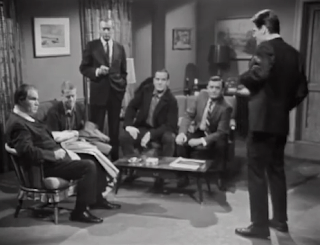
In the middle of the episode, we have a couple of scenes about Burke’s attempt to hire staff away from the Collins cannery and fishing fleet. In #89, that attempt set up a visually interesting scene, where a larger than usual group of featured background players gathered in Burke’s hotel room to hear his plans. But the story about them never seemed likely to go anywhere. Today, actor Dolph Sweet appears as the spokesman for the loyal employees who refuse to leave the Collinses. Sweet brings a raw, immediate style to the part that makes a powerful impression. His job today is to drop the story point into the “To Be Discarded” box, and he does it memorably.
Carolyn has long been obsessed with Burke and jealous of Burke’s interest in Vicki. The episode opens with Carolyn making snide remarks to Vicki about a ride Burke gave her to the town of Bangor, Maine. Vicki, under the impression that a pen she has found is evidence pointing to Burke’s involvement in Bill’s death, tells Carolyn that Burke is the very last man in the world a woman should want to be involved with. Vicki has promised Roger not to mention the pen to anyone, so she can’t explain her feelings to Carolyn.
Vicki and Carolyn discuss Burke while Mrs Johnson listens in the background. Screenshot by Dark Shadows Before I Die.
At the end of the episode, Burke has called Carolyn and made a date with her. Elated, Carolyn apologizes to Vicki and is her best friend again. Vicki tries to talk her out of seeing Burke without mentioning the pen. That effort gives way to a conversation in which Carolyn mentions that Burke gave her a pen, that she gave the pen to Roger, and that Roger lost the pen the night Bill Malloy died. Hearing this and remembering Roger’s behavior when they were alone together in episode 96, Vicki concludes that Roger, not Burke, killed Bill.
These scenes mark Carolyn’s fixation on Burke and her fluctuations between unrestrained hostility and unreserved solicitude towards Vicki as themes that will continue. The ending of course advances the Bill Malloy story, and sets up a conflict between Vicki and Roger.
Dark Shadows tells the story of the great house of Collinwood and its residents, the ancient and esteemed Collins family. From the first episode, some of the most important elements of the house’s visual impact are the portraits of the Collins ancestors that decorate its drawing room and foyer.
The foyer is dominated by a portrait identified as Benjamin Collins. In episode 2, well-meaning governess Vicki feels so intimidated by Benjamin’s portrait that she looks at it, says “Boo!,” and runs away:
The drawing room is home to several portraits. The two that have been most frequently discussed so far on the show are those of Isaac Collins, which moves around a bit but usually hangs by the piano, and of Jeremiah Collins, which has a secure home above the mantle. Reclusive matriarch Liz used the portrait of Isaac as a visual aid in a lecture about family history that she delivered to her nephew, strange and troubled boy David, in episode 17:
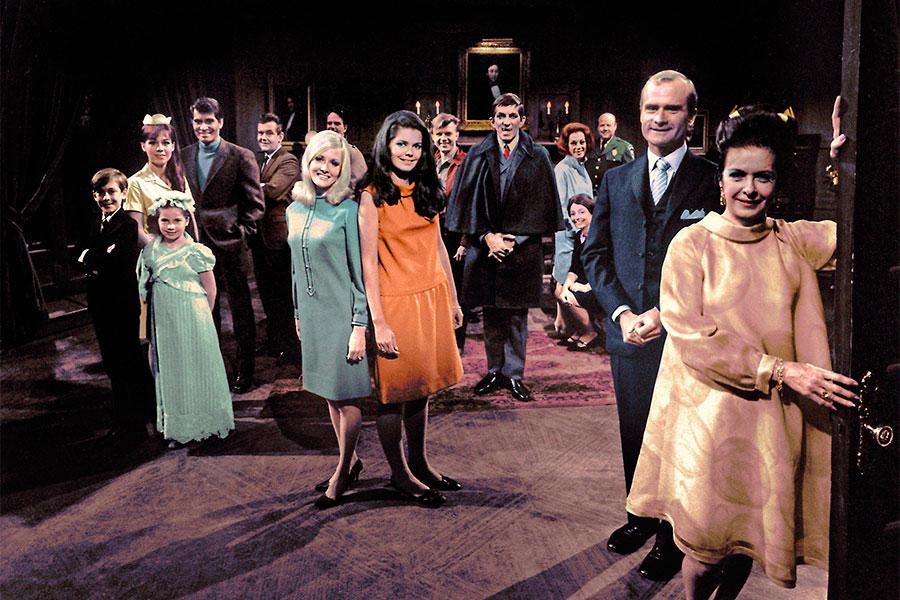
The portrait of Jeremiah features prominently in almost every scene in the drawing room. Since the drawing room is the single most important set in the series, that makes the portrait one of its stars. It’s only appropriate that it looked over this June 1967 publicity photo of the cast:
By November of 1966, we have seen three stories about portraits. The first starts in episode 22 and drags on for quite a while. Dashing action hero Burke Devlin calls on drunken artist Sam Evans and commissions him to paint his portrait, specifying that it is to be the same size and style as the portraits in Collinwood. Burke is scheming to take the house away from the Collinses, and to hang a portrait of himself in one of its most conspicuous spots. For about six weeks, high-born ne’er-do-well Roger Collins frantically tries to bully Sam into canceling the commission. Roger doesn’t care about Burke’s plans for the house. He is just afraid that in the course of the sittings Burke will learn a dark and terrible secret he and Sam share.
Another story takes place within a single episode, episode 70. We get our first look at The Old House and the portrait of Josette Collins that presides over its parlor. After everyone has left, the portrait begins to glow, and the ghost of Josette comes walking out of the portrait:
Today’s major theme is a story that began in episode 60. Visiting the Evans cottage, Vicki found a portrait that she herself strongly resembles. Sam told her that he painted it 25 years ago, and that the model was a local woman named Betty Hanscombe. This excited Vicki, who grew up a foundling and is on a quest to find out who her birth parents were. Vicki wondered if Betty Hanscombe might be her long-lost mother, or if some nearby relative of hers might be. Sam disappointed Vicki’s hopes as soon as he had raised them, telling her that Betty died before Vicki was born and that she has no relatives in the area. Since then, Vicki’s interest in the portrait has been revived. She learned that there was once a butler at Collinwood called Hanscombe. She has formed a vague hope that one of her parents was a member of a central Maine family named Hanscombe, and she is trying to track them down.
Today, Vicki goes back to the Evans cottage and asks Sam for another look at the portrait of Betty Hanscombe. Sam is in a good mood; before Vicki shows up, he’s singing, and his baritone voice sounds like he’s ready to appear in musicals on Broadway. Uncharacteristically, he is sober, a fact demonstrated by his almost successful attempt to thread a needle. He gives Vicki a courtly reception, recaps what he told her about Betty Hanscombe and the painting seven and a half weeks ago, and when she persists in showing interest makes a gift of the portrait to her. She’s flabbergasted by his generosity, though considering that he painted it twenty five years ago and hasn’t sold it yet he may as well be generous.
While Vicki is at the Evans cottage, Liz summons her brother Roger to the drawing room. She has deduced that Vicki is not going to forget about Betty Hanscombe or her portrait, and instructs Roger that their goal is to stuff those topics into the deepest possible obscurity.
Vicki returns with the portrait and shows it to Liz and Roger. Roger watches Liz and listens to her declare that it looks nothing like Vicki. Liz then directs Roger to look at the painting, and he dutifully echoes her statement. Since it is in fact a painting of Alexandra Moltke Isles, we can sympathize with Vicki’s disbelief at the position they are taking. She seems to be about to give up when flighty heiress Carolyn walks into the room, looks at the painting, and asks Vicki when she had her portrait done. “It looks exactly like you!” It’s a terrific ending for the episode, and leaves us wondering what will come of the Betty Hanscombe story.*
High-born ne’er do-well Roger Collins is desperate to get rid of his son’s governess, the well-meaning Vicki, before she discovers his dark deeds. Sometimes he’s simply unpleasant to her. Twice he’s offered to bribe her to leave. Once he pretended to be a ghost in order to scare her off, not knowing that she had just seen a real ghost who warned her to leave the house before she was killed. Occasionally he turns on his very considerable charm in his efforts to convince her that she ought to leave; she usually sees through these efforts quickly, and he is left in a weaker position than he was before.
Yesterday, Vicki was in Bangor, Maine, fifty miles from her home in the great house of Collinwood. While waiting for dashing action hero Burke Devlin to give her a ride home, she realized that the pen she found on the beach some weeks ago must have belonged to Burke, and jumped to the conclusion that Burke dropped it there while murdering beloved local man Bill Malloy. Frightened, she called Roger to come and get her.
Today, Roger is driving Vicki home in a heavy rainstorm. Returning viewers know that Roger was in possession of such a pen, that he lost it the night Bill died, and that he is terrified the pen Vicki found will lead to disaster for him. We also know that he is a vicious man who will stick at nothing to protect himself.
Vicki knows none of these things, but she does know that Roger and Burke are sworn enemies. Therefore, she is surprised when Roger tells her that the pen isn’t really evidence of anything. After all, it was two days after Bill’s death that she found it- Burke could have dropped it there after Bill went into the water, or long before. She is even more surprised when he urges her to forget the whole matter and never again to mention the pen to anyone. Roger can imagine a scenario in which Burke might have killed Bill, and even says that he thinks it is likely, but he tells her that with no more evidence than she has there is nothing to be gained by challenging the coroner’s verdict that Bill’s death was an accident.
When Vicki asks Roger why he is leaving the main road in the midst of the storm, we might wonder if he has laid some dastardly plot. On the dark, flooded back way, they quickly find themselves trapped. Roger leaves Vicki in the car while he takes his flashlight to look for shelter. He returns and describes an abandoned shack he claims to have spotted just then. His description of it is so detailed that we cannot help but suspect that he has been there before, and that it figures in an evil plan of his. Roger defuses that suspicion, though, when on his own initiative he leaves a note inside the windshield of the car directing any passersby to the shack.
When they enter the shack, Roger teasingly says “I should have carried you over the threshold.” Vicki instantly responds “But you are married.” With a sour look, he answers “If you can call it that.” After a bit of conversation about Roger’s unhappy domestic situation, they sit close together. Vicki tells Roger that she wonders if his son, strange and troubled boy David, got his unscrupulousness from his mother. “You’re nothing like that,” she says. While they huddle together, Vicki asks Roger to tell her all about himself.
Despite her previous wariness of him and her prompt reminder to him today of his marital status, it would seem that Roger could make quite a bit of progress with Vicki if he were to forget his other methods of persuasion and concentrate on charm. In episode 78, Roger even took Vicki on a date. That didn’t amount to much, but at the end Roger promised to take Vicki out again and she seemed interested. Watching them together in this one, we wonder if they might at some point get together. Vicki the foundling-turned-governess is obviously modeled on Jane Eyre, and Roger is not only her charge’s father, but the name “Roger” even sounds like “Rochester.” A relationship with Roger wouldn’t involve living happily ever after, but that’s a difference of genre- characters in novels might get happy endings, but characters on soap operas don’t get any endings at all, not unless they’re killed off the show.
In Art Wallace’s original story bible for Dark Shadows, called Shadows on the Wall, Roger was supposed to be killed off early on, while trying to murder Vicki to prevent her exposing a crime of his. It was also supposed to be revealed that Vicki was the illegitimate daughter, not of any member of the ancient and esteemed Collins family, but of the estranged husband of Roger’s sister Liz. That wouldn’t make much sense- the Collinses are the center of the show, and Vicki is the main character. If she’s going to be anyone’s long-lost love child, it should be Liz’. And indeed, Alexandra Moltke Isles and Joan Bennett look very much alike, a resemblance the camera work often emphasizes. But, if Roger isn’t going to die soon, establishing that Vicki is not a blood relative would leave the path open to a marriage between them.
Of course, if Liz is secretly Vicki’s mother, that would be the perfect background for a soap opera engagement between Vicki and Roger. Liz would find herself forced to choose between revealing her terrible secret or allowing her daughter to marry her own uncle. In a later decade, a show might let the characters get married and reveal the family relation years later, but I don’t think ABC’s Standards and Practices department would have signed off on that one in the 1960s.
If there is going to be a Vicki/ Roger romance, it isn’t going to start today. Roger answers Vicki’s question about what he wants in life by saying that at the moment he only wants two things- for them to be rescued, and for her to leave Collinwood. He tells her that he is worried that she is in mortal danger if she stays. David has tried to kill her; he’s tried to kill Roger too, come to that. Previously, Roger has urged her to get away before he succeeds. But today, she isn’t thinking of David. She asks if Roger really thinks Burke is a deadly threat to her. He pauses long enough to make us wonder if he’d been planning to talk about David, then decides to run with what Vicki’s given him. He dwells on Burke’s temper as Vicki has witnessed it and tells her that he has seen even worse displays. When she says that she finds it difficult to believe that Burke would kill her, he says that he’s sure Bill Malloy found that difficult to believe as well. This gets her back to the idea of telling the police about the pen. When she protests that not telling them would be withholding evidence, his charm breaks down and he shouts “Then withhold it, you little idiot!”
His previous attempts at suavity had also ended in name-calling. On those occasions, he could only apologize while Vicki regarded him coolly. This time, he bounces back and continues to press Vicki with claims that he’s thinking of her safety. She is looking very doubtful, though, as if something is dawning on her. After a moment, the sheriff appears at the door. He tells Roger that he and his men were in the area, noticed Roger’s car, and followed the directions on the note he left in the windshield. He notices that Vicki is deep in thought. He asks her what’s on her mind. After a long hesitation, she gives a meaningless response, telling him nothing about the pen. But we know that she has asked herself a question, and that the answer is going to mean trouble for Roger.
This is the first episode credited to writer Ron Sproat. Before long, Francis Swann will leave Dark Shadows, and for several months the only credited writers will be Sproat and Malcolm Marmorstein. Marmorstein will write 82 episodes and leave in August of 1967. Sproat will write hundreds and will stay with the show until 1969.
Today’s setup might remind us of the show’s first writer, Art Wallace. It’s shaped like one of Wallace’s diptych episodes, intercutting between two contrasting groups of characters. This time, we cut back and forth between, on the one hand, a dull but pleasant dinner date between well-meaning governess Vicki and instantly forgettable lawyer Frank at a restaurant in Bangor and, on the other hand, an extremely uncomfortable dinner date between hardworking fisherman Joe and flighty heiress Carolyn at the Blue Whale in Collinsport.
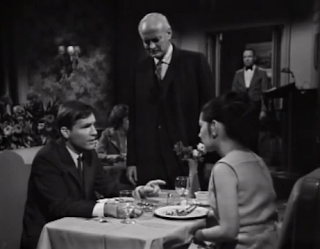
In Bangor, Vicki and Frank smile at each other while Vicki tells the sorts of stories she’s been telling all along. Vicki hopes Frank will be able to aid her in her effort to learn the identity of her birth parents, a quest she has been on since episode 1. Frank’s father Richard briefly joins him and Vicki at their table. Amid good wishes for the two of them, Richard delivers a cautionary message about Vicki’s research. Later, he talks privately with Frank. He strongly approves of Vicki as someone to date, but is chary of many aspects of the research Frank has volunteered to do for her.
In Collinsport, Joe and Carolyn are bickering about Carolyn’s obsession with dashing action hero Burke Devlin when Maggie Evans, The Nicest Girl in Town, enters the tavern with her father, drunken artist Sam Evans. Carolyn invites the Evanses to join them at their table. Carolyn eventually starts talking about Burke again, prompting Joe to ask her to dance. Away from the Evanses, Joe tells Carolyn he is tired of her falling bacxk on him when Burke isn’t available. Carolyn storms out. Joe takes her home, then returns to the tavern, and he and Maggie start a conversation they both seem to be enjoying hugely.
By intercutting scenes, Wallace’s diptychs usually achieve a contrast that brings into focus details of the psychology of the characters and their relationships to each other that we might not have thought about had we watched the scenes straight through. In Sproat’s hands, today’s episode doesn’t do that so much as it comments his own position as a new writer joining an established show.
Vicki has learned nothing about her origins since episode 1, and there is no prospect she ever will. In Frank, she has found a potential boyfriend. In the ears of the audience, Richard’s advice to Frank to pursue Vicki energetically but to pursue her inquiries only circumspectly is a recommendation that the show drop an old, unproductive old storyline and to develop a new one.
Carolyn and Joe’s relationship is another story element that has been in place from the beginning and that has not advanced in any way. We have never seen any reason for them to be a couple, and are simply impatient with scenes where they sit around and make each other miserable. Joe recently had a date with Maggie, and it was sweet to watch those two having fun together. So today’s scenes in the Blue Whale make it emphatically clear that the time has come to drop the Carolyn and Joe story and move on to a new phase where Maggie and Joe are together.
Sproat not only makes himself visible in this episode, he also provides mirrors for critics and commentators. When Richard shows up and interrupts the ten thousandth* sad story the audience has heard about the Hammond Foundling Home, Frank and Vicki seem to be having a pleasant enough time with each other. It is possible that viewers who weren’t watching on many of the days when Vicki told those previous stories are having a pleasant enough time with the episode. But on any given day, only so much of your audience will consist of new viewers and people with short-term memory loss. A time will come when you have to move on to something new, and Richard is the in-universe representative of those who would say that time is already upon us.
In the Blue Whale, the Evanses represent the critics. Joe and Carolyn leave the table twice to dance. The first time, they look happy, and Sam tells Maggie that there is no chance of Joe and Carolyn splitting up. Sam is a chronic pessimist. If he makes a prediction, we take it that it would be bad news for that prediction to come true. In this context, to say that Joe will never break it off with Carolyn is to say that the show will never become more interesting. The second time Joe and Carolyn dance, they are obviously giving up on each other. Maggie, almost as much the optimist as her father is a pessimist, gives a little smile. Joe and Carolyn’s quarrel is embarrassing for her to watch, but it’s good news for her that she’s getting a boyfriend, and maybe a storyline. It’s also good news for us that the show is open to exploring fresh topics.
I don’t think that Richard and the Evanses are so much Sproat’s attempt to impose particular readings on the audience as they are the results of his analysis of the reactions thoughtful viewers are likely to have. If so, I have one data point in support of his theory. In their discussion about this episode on their blog Dark Shadows Before I Die, John and Christine Scoleri actually find themselves playing the roles of optimistic and pessimistic critic as Sproat scripted them for the Evanses. Here are John as Maggie and Christine as Sam:
John: Have we finally seen the end of the Joe/Carolyn relationship? Now that it’s clear to Joe that Carolyn only comes running to him when she’s jealous, I think he’s had enough of her. The only offenses on Maggie’s record are the bad blonde wig she started with, and calling Vicki a jerk when they first met. But other than that, she’s far less maintenance than Carolyn, so hopefully the change will do Joe some good, provided his job working for the Collins fishery isn’t in jeopardy…
Christine: It’s a soap opera, so I expect the relationship to go through its death throes before the last gasp. Joe’s a glutton for punishment, so I don’t think it’s over yet.
The Scoleris always do a good job of pretending not to know what’s coming next even when they demonstrably do know. So there is a bit of role-playing to start with. But they are such patient and insightful critics that I don’t think they would just start imitating the characters, certainly not unintentionally. It’s more likely that this exchange represents evidence that Sproat was right about the ways people were likely to read the episode.
*A rough approximation. Could be the twelve thousandth, I haven’t counted.
Well-meaning governess Vicki, fresh from imprisonment at the hands of strange and troubled boy David Collins, gets a few days off work to visit Bangor, Maine. Flighty heiress Carolyn had agreed to drive her to the bus station in the town of Collinsport. Carolyn doesn’t have a job, go to school, or seem to have anything else to do, so why she and Vicki don’t just take a road trip together is unclear.
They wait for the bus at the local restaurant. From there, Carolyn telephones dashing action hero Burke Devlin, her family’s arch-nemesis and the object of her own obsessive crush, and invites him to join the two of them at their table.
Carolyn tells Burke that Vicki has recently seen the ghost of beloved local man Bill Malloy. Vicki tries not to give Burke any additional information. When Burke learns of Vicki’s plans, he volunteers to take her to Bangor in his car. She declines, but he won’t take no for an answer. I don’t drive, and I admire the way this scene shows how hard it can be for a non-driver to decline a ride.
When Burke leaves to get Vicki’s bags, Carolyn blows up at her. Carolyn tells Vicki that she must have known she came to town hoping to see Burke and spend the evening with him. Vicki did not know any such thing. After all, Burke has openly declared his intention of forcing Carolyn’s entire family into bankruptcy and disgrace, and she has expressed remorse for her infatuation with him. When Carolyn makes it clear she is still chasing Burke, Vicki doesn’t know what to say.
The Collinsport Historical Society says that Carolyn spends this week alienating the audience, and her passive-aggressive behavior towards Vicki is indeed exasperating. Watching the scene in the restaurant, it makes perfect sense that Vicki would decide that escaping Carolyn is worth the risk of getting in trouble with her employers by spending an hour with Burke.
Back home at the great house of Collinwood, Carolyn hears her mother, reclusive matriarch Liz, playing the piano. She makes a lot of noise when she comes in, ensuring that her mother will call her into the drawing room. Once there, Carolyn puts on a great show of being upset. She gives partial, teasing answers to each of her mother’s questions, drawing her in as best she can. She finally declares that Vicki is not to be trusted. She reveals that Vicki is in a car with Burke, probably telling him everything she knows about the Collinses and Collinwood. We then cut to Vicki and Burke in the car, where she is telling him everything she knows about her recent sighting of Bill Malloy’s ghost in the house.
Again, the scene in the restaurant explains Vicki’s behavior. Carolyn had told Burke so much about it that it would be hard for Vicki or anyone else to see much point in trying to keep the rest of the story from him. When Burke wants her to say that the ghost accused someone in the house of murder, she insists that it only said it was someone in Collinsport, not Collinwood.
Carolyn has always been tempestuous, and Vicki has always been quick to forgive her. Perhaps now that the relationship between Vicki and David is about to enter a quieter, more complicated phase, the makers of the show wanted to ensure that there would be a continual source of conflict within the house. That might explain why they have chosen to feature Carolyn’s nastier side so heavily this week.
In these early months of Dark Shadows, we hear that all the money made in the town of Collinsport finds its way to the old dark house on the top of the hill, where it does nobody any good.
The house itself is full of examples of wealth going to waste. Each of the last few episodes have involved long treks through abandoned corridors and visits to forgotten rooms. Everywhere you turn in these dank spaces, years of accumulated dust bury vases, paintings, antique furniture, oriental rugs, and other apparently valuable objects.
The Collins family is headed by a woman who hasn’t left the house in eighteen years. Reclusive matriarch Liz shares her home with her brother Roger, a spectacularly irresponsible man who squandered his entire inheritance and now holds a position in the family business which seems to involve little or no work. It is difficult to imagine that they run a dynamic enterprise that is taking advantage of the economic boom of the 1960s.
At the same time, Liz seems to have a vigilant concern for the security of her employees. Her only household servant, gruff caretaker Matthew, often brings up the fact that she gave him a cottage on the grounds of the great estate and assured him he would have it for the rest of his life. When plant manager Bill Malloy comes to the house to ask Liz to approve the acquisition of some new machinery for the cannery, her first question is how many men will lose their jobs as a result of it. Only when he assures her that the answer is zero does she agree to the purchase. So we might imagine that the attitude of local wage-earners towards the Collinses will be two-fold- on the one hand, gratitude that they go out of their way to ensure that the people working for them keep what they have, but on the other frustration with their failure to create opportunities for them to move ahead at a time when working people everywhere else in the USA were experiencing the fastest rise in real incomes in the nation’s history.
The relationship between hardworking young fisherman Joe and flighty heiress Carolyn occasionally seems like it will dramatize this situation. Joe is a local boy, and like everyone else in town, he works for the Collinses. Liz has taken a liking to him, and wants him to marry her daughter and have a career as an executive with the firm. He would be glad to marry Carolyn, but is not interested in that career- he wants to buy his own fishing boat and build his own business around it. Liz keeps trying to pull him deeper into her family’s firm, but he keeps insisting on his plan to go his own way. Joe mentions a friend with whom he wants to go into partnership. We never see this friend or anyone else who is working with Joe, and Carolyn doesn’t show the slightest interest in Joe’s plans. Since he doesn’t have anyone to talk to about his ideas, beyond a couple of scenes when he shakes his head at Liz and says “I’m sorry, Mrs Stoddard, but my mind’s made up,” the story of his attempt to diversify Collinsport’s economy doesn’t go anywhere. Earlier this week, the Joe/ Carolyn relationship met its long-awaited demise.
Joe has moved on to a relationship with Maggie Evans, The Nicest Girl in Town. The daughter of drunken artist Sam Evans, Maggie runs the restaurant in the Collinsport Inn. She and Joe are representatives of Collinsport’s working class. During their first date, Maggie demonstrated an encyclopedic knowledge of sail-rigging, which may not be the most useful thing for a commercial fisherman in the age of diesel, but her interest in the sea raises our hopes that she might be a partner to Joe in his ambitions. Together, they might show us what it has meant for the town that the Collinses control so much wealth and do so little with it.
In a comment on Danny Horn’s blog Dark Shadows Every Day, I mentioned another way the show could have done more with this theme. I imagined that they might have expanded the part played by the only African American actor to deliver lines on Dark Shadows, Beverly Hope Atkinson.
The opportunities they missed came into view in episode 563, when Beverly Hope Atkinson appears as the unnamed nurse who keeps Nicholas Blair out of Joe’s hospital room but lets Maggie in. Unnamed Nurse lights up when she sees Maggie and greets her by name; they seem to be old friends.
In the first 42 weeks of the show, when the supernatural was in the background and the stories were slow, it would have been easy to have a couple of tea party scenes at the Evans cottage where Maggie and her lifelong friend, Unnamed Nurse, recap whatever is going on. Those scenes could have led to a whole exploration of the tension between the working-class people in the village and the jerks in the big house on the hill. That in turn could have led to the introduction of Unnamed Nurse’s family, headed by Unnamed’s parents, Mr and Mrs Nurse, including her brothers, Young Mr Nurse and Master Nurse, and her sister, Miss Nurse. We could then have seen the ancestors of the Nurse family in each of the flashback segments and analogues of them in Parallel Time.
I try to keep my contributions to Dark Shadows fanfic modest, so I didn’t try to think up a new name for Unnamed Nurse. My point is that the makers of the show did not need any more sets or many more characters to create a much more spacious world in the imaginations of the audience. The Evans cottage by itself, as an instance of a working-class home in Collinsport, is almost enough to make us think of a whole town of people teeming with ambitions, resentments, plans, and frustrations. Just a few small scenes there shedding light on some underused themes could have got us the rest of the way.
Another character who brings the Collinses’ deficiencies as commercial leaders of Collinsport into view is dashing action hero Burke Devlin. Himself born into Collinsport’s poorest class, Burke has gone away and somehow made himself very rich. The whole time he was in Collinsport he was penniless. He left town when he was sent to prison. Only five years after his release from prison, he is a millionaire many times over, in a position to buy up the Collinses’ debts and claim all of their assets. The show has dwelt on this timeline often enough that they have started making awkward attempts to explain how he got so rich so quickly. But it seems that we are supposed to feel that it was simply getting clear of Collinsport that opened the doors to wealth for him. He went to South America, he went to New York, he went to an oil field, he went someplace, but all that really matters is that he went far from the stifling influence of the Collinses and their gloomy house.
Now, Burke is moving to destroy the Collinses and supplant them at the head of local industry. Today, he and his lawyer meet with some of the key men from the Collins cannery and fishing fleet. He wants to recruit them to work for a competing firm he is buying. When the lawyer tells him the men may be too loyal to Liz to take his offer, Burke recites a list of the tired cliches that wealthy villains spout when boasting to their henchmen of the power their money gives them: “Money talks. Money buys loyalty. Everyone has their price. Name it and you can buy them. Some just come a little higher than others, that’s all, but everyone is for sale.” Too bad Cabaret didn’t get to Broadway until three weeks after this episode was broadcast, or he might have closed with a few bars of “Money Makes the World Go Around.”
The men are offended when Burke says he wants them to leave the Collinses and come to work for him. They pride themselves on their loyalty to the Collinses. If they feel that way, it’s a mystery why they agreed to come to a meeting with Burke in the first place- everyone in town knows about his vendetta against the Collinses. They start to leave, but stay long enough to hear Burke offer them higher wages than the Collinses can pay, and a profit-sharing plan.
The most senior of the men present, Amos Fitch, stops by the house to tell Liz and Roger about the meeting. Apparently the other men are more rational economic actors than Amos, and they are considering Burke’s offer.
After the meeting has broken up, Burke spends a few more minutes expounding to his lawyer on his theme that anyone will do anything if you dangle enough money in front of them. He interrupts himself before he can literally say that all people are whores and gives the lawyer a check, telling him that it’s always good to have some extra loyalty around. Apparently he decided that leaving a two-dollar bill on the night-stand might be too subtle. The lawyer reacts with distaste to Burke’s crassness, but takes the check.
Burke’s first attempt to buy someone’s loyalty took place all the way back in episode 3. He met Joe in the local tavern and offered him enough money to buy a fishing boat in return for information on the Collinses. When Joe refused, Burke told him that he himself got his start when a strange man approached him in a sleazy bar and offered him a lot of money to do something he wasn’t very specific about. He accepted, and that led him directly to great riches. That’s wonderful career advice, “A guy in a bar flashes some dough, you don’t ask no questions, honey, just leave with him.” Sounds like a guaranteed path to success. Anyway, it’s obvious in that one that Burke is trying to lure Joe into something dishonorable. We already care about Joe, so if he were to be tempted we would be in suspense until he proved his uprightness.
Contrast Burke’s attempt to buy Joe’s services back then with today’s attempt to hire this group. We’ve never seen or even heard of any of the men whom Burke is trying to lure. So if the conflict over control of the sardine-packing business is a test of their moral rectitude, it’s none of our concern. On the other hand, if it were a choice between a prosperous future for the town that does not include the Collins family or a stagnant future that does, there might be real suspense.
The Collinses are our point of view characters and the story cannot continue if they are thoroughly defeated, so if we enjoy watching the show we will root for them no matter how strong a case their antagonist may make for his position. On the other hand, we do care about Maggie and Joe, and are ready to care about characters who are friends of theirs. Therefore, if we see that a plan will be good for the working people in town, it won’t be easy for us to hope Liz and Roger will foil it. If the show can put us in that situation, we will feel suspense as we watch the events of the story and look for a way to resolve the tension that our mixed feelings have created. That’s how every thriller works- we may want the good guy to beat the bad guy eventually, but not until we’re done enjoying the contest between them.
Think again about Burke’s temptation of Joe in episode 3. Joe earns a few points with the audience by rejecting Burke’s offer out of hand. If he’d considered it, we would have paid attention to him until he made his decision, but only to him- a temptation story works only if the person or people being tempted find themselves isolated from everyone else. If he ultimately rejected the offer, the story ends and leads nowhere. If he’d accepted it, we would be disappointed in him and lose interest in his subsequent doings. He wouldn’t become interesting again until he either went through a redemption story, which would again tend to isolate him from the rest of the cast, or became a villain, which isn’t what they want the character for right now. But if, instead of a moral test, he had been presented with a plausible business decision, we could have had a story that would have given us a virtual tour of Collinsport and given us a feeling that we know the place, even if we didn’t actually see any new sets.
So that’s why I wish Dark Shadows had done more with the relationship between the Collinses and the rest of Collinsport. Not that I suppose the writers had deep political and sociological insights that I long to have heard, but that putting your characters in a bigger world allows you to tell bigger stories.
Well-meaning governess Vicki and flighty heiress Carolyn are in the drawing room at the great house of Collinwood, talking about Vicki’s recent experience of imprisonment. Vicki’s charge, strange, troubled boy David, lured her to a room in the abandoned west wing of the house and locked her in. As Vicki declares that she saw the ghost of beloved local man Bill Malloy in the room, reclusive matriarch Liz appears in the doorway and reacts with shock.
Liz protests that the idea of ghosts is nonsense. Vicki says she’d always believed that, but that what she saw has convinced her otherwise. Liz repeats to Vicki what her brother, high-born ne’er-do-well Roger, has told her. Roger found Vicki locked in a room in the west wing where David, his son, had left her as a kind of prank. Vicki protests that it was no prank, that she believes David wanted to kill her, and that the time has come for her to leave her position as his governess. Roger comes in, and heartily endorses Vicki’s plan to go away.
Liz sends Vicki and Carolyn out of the room, and quizzes Roger about how he found Vicki. In yesterday’s episode, it seemed that Carolyn does not know about the secret passage from the drawing room to the west wing. Today, Roger lies to Liz to conceal the fact that he used that passage. We’re left wondering if even Liz, who owns the house and has lived there all her life, might not know that it is there. Roger is clearly not inclined to build anything; it must be an old feature of the house that he somehow learned about. If, as Liz’ younger brother, he knows about it and she does not, he must have decided to keep it a secret from her. How he learned about the passage, why he decided to hide it from Liz, what use he may have made of it in the past, and what plans he may yet have for it in the future would all seem to be fruitful questions to build stories around.
Upstairs, Carolyn pleads with Vicki to stay. After Carolyn keeps steering the conversation back to her own problems and Vicki’s usefulness to her, Vicki asks in exasperation “Didn’t anybody miss me?” Less than a minute later, Carolyn is talking about her boyfriend troubles again, giving Vicki a clear answer to that question.
Liz asks Roger if he’s ever seen a ghost in Collinwood. Roger is startled by the question. He says he isn’t sure. He’s seen too many inexplicable things there to be sure that none of them were ghosts, and he tells Liz that he knows she can’t say anything different about her own experience. This is the most candid conversation the two of them have had up to this point, and by far the most candid either of them has been about the supernatural side of the household. We’d better enjoy it while it lasts- when Ron Sproat and Malcolm Marmorstein take over the writing duties in a few weeks, the idea of either Liz or Roger talking openly about ghosts will become unthinkable.
At Roger’s suggestion, he and Liz make their way to the room where David trapped Vicki. They find some things of David’s strewn about, confirming that he knew the room well and deliberately set out to confine Vicki there. Roger airily says that “I suppose it’s a horrible thing for a father to say about his own son, but I think that David is an incipient psychopath.” Roger has been saying equally horrible things about David from the first episode on, so this isn’t an especially dramatic thing for returning viewers to hear. Liz listens to him intently, asking if this is why he believes Vicki ought to leave the house. He says that yes, on the pattern of David’s previous behavior he expects him to continue to pose a danger to Vicki.
They also find evidence confirming Vicki’s story about the ghost of Bill Malloy. She had said that the spirit appeared dripping water and seaweed on the floor; Liz finds wet seaweed there, apparently convincing her that Vicki’s story is true and Bill’s spirit is roaming about trying to set an injustice right.
Back in the drawing room, Liz makes some general remarks about ghosts. Carolyn and Vicki come in. Carolyn asks Liz to talk Vicki into staying. Liz says that she would like for Vicki to stay, but that she won’t try to influence her decision. Roger urges her to go. Vicki says that she wants to know why David hates her, and that her decision depends on her next conversation with him.










 Dark Shadows Commentary