It’s chiasmus week on Dark Shadows. Chiasmus is when the last thing that happens in a story resembles the first thing that happened. Usually that causes the audience to look back on that first thing in a new light. Sometimes chiasmus gets very detailed, and the first several things are mirrored by the last several things.
On Wednesday, we began with well-meaning governess Vicki asleep in vampire Barnabas Collins’ house on the estate of Collinwood. Barnabas crept into her bedroom and stood over her, but did not bite. Then it was morning, and Barnabas’ sorely bedraggled blood thrall Willie delayed Vicki as she was leaving the house. Vicki took our point of view with her to the great house on the estate, where we started to see events through the eyes of visiting mad scientist Julia Hoffman. That episode ended with Julia going to Barnabas’ house. Willie delayed Julia entering the house, and Barnabas and Julia met. Their scene was tense, but Barnabas did not use any of his powers against Julia. That chiasmus marked the transition from Vicki to Julia as the audience’s main character to identify with.
On Thursday, we began with Barnabas spying on Vicki through her window, then entering her bedroom and standing over her while she slept. He again left the room without harming her. We ended with Julia spying on Barnabas through his window, then entering his house, opening his coffin, and looking at him. The parallel is completed when we see today that she left the coffin room without harming Barnabas. That chiasmus showed that Julia is capable of turning the tables on Barnabas.
Today’s episode begins with a reprise of yesterday’s cliffhanger, showing Julia gasping when she opens the coffin. So returning viewers suspect that it is likely to end with Barnabas in Julia’s room, and the suspense comes as we try to figure out how he will get there and how she will escape his malign power.
We see Julia in the drawing room of the great house talking to her friend, addled quack Dave Woodard. Dr Woodard says that her failure to report to him on the progress she has made with their common patient, Maggie Evans, The Nicest Girl in Town, coupled with her presence at Collinwood, a hundred miles from the hospital where Maggie is, has forced him to remove Maggie from her care. Julia lies to him, claiming that she has no progress to report and that the whole thing is impossibly boring. This somehow convinces Dr Woodard to leave Julia on the case.
Julia is at Collinwood pretending to be an historian studying the old families of New England, and Vicki has volunteered to help her in her research. Now Vicki is terribly afraid that if she gets involved in what Julia is doing, she will become involved in things that are too interesting for her to handle, and she wants to withdraw before she forever loses contact with tedium and drabness.
Barnabas tells Vicki that she has nothing to fear from “the past,” which at this point on Dark Shadows means the plot. While he is reassuring her, the set catches fire. We hear fire extinguishers and other noises in the background, but Jonathan Frid and Alexandra Moltke Isles don’t break character for an instant. The scene is a dreary one, marking as it does the doom of Vicki as a major part of the show, and the lines are poorly written, but they are absolutely committed to their work.
Barnabas does not believe Julia’s cover story, and is quite sure she represents a threat to him. He meets with her in the drawing room to reiterate his refusal to cooperate with her project. When Julia says that she is particularly interested in his “namesake”- actually himself- Barnabas airily asserts that he was by all accounts a dull fellow. Julia may have been able to sell that line to Dr Woodard on this same set a few minutes ago, but Barnabas doesn’t make any impression on Julia with it. The two of them continue to argue as they pass from the drawing room through the foyer. The dialogue isn’t really any better than what Barnabas and Vicki had in the previous scene, but because Frid and Grayson Hall have a lively relationship to depict- two people who each of whom knows more about the other than they are willing to say, and each of whom knows that the other knows much of what they are holding back- they make their whole sparring match seem to glisten with wit and style.
Barnabas agrees to meet Julia at his house the next evening. After he leaves, Julia tells his portrait that she can’t wait that long for their next encounter, and she knows he can’t, either.
We cut to Julia in her bedroom. Vicki pays a visit, during which we hear another depressing conversation about Vicki’s newfound fear of narrative relevance. Julia assures her that “There is nothing for you to fear.” After Vicki leaves, Julia looks at her clock and sees it is a quarter to one in the morning. We dissolve to the foyer, where the hall clock reads 2:00. Barnabas appears in Julia’s bedroom and approaches the bed, where he prepares to uncover Julia. We then hear Julia greeting Barnabas by name. She emerges from the shadows on the other end of the room, and tells Barnabas she has been waiting for him a long, long time.
Vampire Barnabas Collins spends most of his time on screen doing a job of acting. He is playing the role of a present-day gentleman from the long-forgotten English branch of the ancient and esteemed Collins family of Collinsport, Maine. His performance has been convincing enough that the Collinses have entrusted him with the long-abandoned Old House on the great estate of Collinwood. He and his sorely bedraggled blood thrall Willie reside there and have restored it to the condition it was in when Barnabas was alive.
Today, another actor comes to Collinwood. She is mad scientist Julia Hoffman. By profession, Julia is a medical doctor with specialties in psychiatry and hematology. She is treating Maggie Evans, The Nicest Girl in Town, who is in a state of complete mental collapse after months as Barnabas’ victim. After Maggie escaped from Barnabas, her family doctor, addled quack Dave Woodard, decided to tell everyone in town that she was dead and send her to Julia’s mental hospital so long as her captor was unknown and at large. So when Julia figures out that the person responsible for Maggie’s woes is an undead monster who dwells at Collinwood, she has to conceal her identity from everyone there and in Collinsport.
In the drawing room of the great house at Collinwood, Julia tells well-meaning governess Vicki and Vicki’s charge, strange and troubled boy David Collins, that she is an historian writing a book about the Collinses. David immediately exposes a fatal flaw in Woodard’s cockamamie plan when he mentions a girl named Sarah whom he has seen near the Old House. Julia knows that Maggie saw Sarah when she was imprisoned and that Sarah visited Maggie’s father Sam and told him where to find her. If that information had been made public, Vicki and David would have been able to connect Sarah with the Old House, and the police would have suspected Barnabas weeks ago. Returning viewers know that Sarah is the ghost of Barnabas’ sister, a fact onto which Julia cottoned yesterday and of which she finds corroboration today.
Vicki tells Julia how elusive Sarah is
We also know that Barnabas wants Vicki to become his next victim, and that she is already under his influence to a substantial degree. When she and Julia are talking in the drawing room, Vicki waxes enthusiastic about how Barnabas has recreated a past world and committed himself to living in it, and says that this is a fine thing for him. “But not for you?” asks Julia. Vicki looks down, and with a troubled expression says that she supposes not.
When Julia asked “But not for you,” she drew a reaction from my wife, Mrs Acilius. Mrs Acilius said that while Julia may not seem like any kind of therapist in the sessions we’ve seen her have with Maggie, her delivery of that question sounds exactly like every therapist she’s ever had. With Maggie, the mad scientist is very much on the surface of Julia’s manner, but when she is playing the role of Miss Hoffman the historian she can draw on her profession to make herself appealing.
Vicki takes Julia to the Old House and shows her the restored bedroom of Josette Collins. Vicki says that she could stay in that room forever, which is as a matter of fact precisely what Barnabas has in mind for her. Julia feels a chill as the sun sets. Perhaps this is the result of Barnabas coming back to life and rising from his coffin in the basement of the house, or perhaps it is Sarah or another friendly ghost* trying to warn her to get out before the vampire finds her. Whatever its cause, Vicki doesn’t feel it. Again, we don’t know whether this is because Barnabas already has a strong enough hold on Vicki that she is insensitive to warnings about him, or if it is a message specifically for Julia.
Julia wants to leave the room, but Vicki insists on lighting a candle so that they can see it as Josette did. The candle burns long enough for Julia to make the appropriate comments, and then something we cannot see blows it out while Julia feels another chill. The cold still doesn’t reach Vicki.
Julia returns to Woodard’s home office,** where she has stashed Maggie. Maggie has the doll Sarah gave her when she visited her in Barnabas’ dungeon. Julia takes the doll from Maggie, much to Maggie’s displeasure. She holds the doll and says she wants her to listen for the doll’s name. Maggie furrows her brow and asks “Doll talk?” Maggie has been speaking in complete sentences lately, but apparently Julia’s latest antics have been too much for her and she has lost some ground.
Julia orders Maggie to listen and says the names of some of the people at Collinwood. Maggie doesn’t react until she gets to “Barnabas Collins,” at which point Maggie freaks out. Julia holds her and repeats “It is the wrong name” until Maggie stops crying and starts singing “London Bridge.” She then looks away and says “The wrong name for the doll… but the right name for… something else.”
*Sarah’s little cousin, Caspar Collins?
**An exact replica of his office in the hospital as we saw it in #242. Man knows how he likes to have things set up.
Four and a half weeks ago, Maggie Evans, The Nicest Girl in Town, escaped from vampire Barnabas Collins. Barnabas managed to scramble Maggie’s brains sufficiently that she has amnesia covering her time as his victim and much of the rest of her life as well. She is now a patient at a mental hospital called Windcliff, where her care is supervised by Dr Julia Hoffman.
Maggie’s family doctor, addled quack Dave Woodard, is an old friend of Julia’s. He had recommended Maggie be sent to Windcliff. He had also come up with a cockamamie scheme to protect her from her captor by hiding her there and telling everyone in and around the town of Collinsport that she was dead. If he had known that the captor was a vampire, this might have made some kind of sense- no character on Dark Shadows has ever heard of Dracula, so they don’t know how to fight against vampires. But he doesn’t know that, so his plan is just a way for the writers to stall while they try to come up with more plot points.
Today we open with Woodard in Julia’s office, complaining that she isn’t communicating with him about Maggie’s case. She tells him that there have been no developments worth reporting. Returning viewers know that this is a lie, because in a session we saw yesterday Maggie remembered a lot of sense impressions from her time of captivity and Julia told her that they represented tremendous progress. Woodard tells Julia that a lack of new information is no excuse for her failure to return any of his last six phone calls. He says that she seems to be intent on hoarding any information she may glean from Maggie as her own private possession, an impression he describes as frightening.
Julia responds to this characterization with a display of offense, and Woodard apologizes. She then brings up an idea that occurred to her at the end of yesterday’s episode. She says that Maggie’s memory might improve if she takes her to visit Eagle Hill Cemetery, where she was found wandering early in her illness. Woodard objects strongly that Maggie’s condition, as Julia has described it, is so delicate that such a visit might do her permanent harm. Julia retreats and promises she won’t actually take Maggie to the cemetery. This is such a flagrant lie that the camera momentarily goes haywire, focusing on Woodard’s chair rather than his face.
Woodard leaves, and Julia calls Maggie in. She’s already wearing her coat. She asks where Julia is going to take her, and she tells her not to worry about that.
On the great estate of Collinwood, well-meaning governess Vicki is staring vacantly into space while listening to an antique music box Barnabas gave her as part of his plan to subject her to the same treatment he inflicted on Maggie. A knock comes at the door. Vicki closes the music box and goes to answer it. It is her boyfriend, fake Shemp Burke Devlin.
Burke is waging a determined battle against the story, and he is fighting dirty. He doesn’t want Vicki to have anything to do with Barnabas, or with the ghost of Josette Collins. When Vicki says she wants to lay flowers on Josette’s grave in the cemetery, where we know she will cross paths with Maggie and Julia, he resists furiously. When she reminds him that she has had dealings with Josette’s ghost, he says “Or you think you have.” In previous episodes, including yesterday’s and Monday’s, he knew she had, and in an earlier period of the show he knew that several other characters, including some of the most level-headed ones, had also encountered Josette’s ghost. When he starts belittling Vicki for believing in “the spooks of Collinwood,” it therefore comes off as an especially crude instance of gaslighting. The Mrs and I aren’t much for profanity, but we both cussed at the screen when Burke was disgracing himself this way.
Julia and Maggie are in the cemetery. I believe it is the first time we’ve seen the set in a daylight scene. You can see the shadows of the foliage on the soundstage walls, and the corners where the walls meet. I can’t believe the director meant for us to see those things, but I kind of like it- the situation needs a touch of unreality, and the obvious falsity gives it the feeling of a black box theater.
Some of the shadows on the wall that Art Wallace spoke ofCorner of the soundstage
Maggie is agitated. Julia tells her to calm down and that everything is all right. I’m no expert, but I kind of doubt that talk therapy involves a lot of “Calm down!” and “Everything is all right!” It reminded me of this Saturday Night Live sketch from the 90s, in which Patrick Stewart plays “Phil McCracken, Scottish Therapist,” a psychologist who won’t stand for any emotionalism from his patients.
Vicki and Burke see Julia and Maggie in the distance. When Maggie turns to face them, Vicki recognizes her. Julia whisks her away before Burke can see her. When Vicki tells Burke she saw Maggie, he immediately unloads on her with the same garbage he handed her at Collinwood. He declares that Maggie is dead, that Vicki knows she’s dead, that she can’t possibly have seen her, that “there is a resemblance, THAT’S! ALL!” When he asks “What’s wrong with you?” I stopped the streaming and shouted at the screen “She’s wasting her time with you, you ******* ********, that’s what’s wrong with her!” To that, Mrs Acilius said that we should just restart the show and get through the scene.
Part of what makes Burke’s behavior so infuriating is the writer’s fault. A first-time viewer, unaware that what Burke is telling Vicki are delusions that suggest she is crazy are in fact things he knows to be true, might think that he is being reasonable in dismissing ideas about ghosts and the like. But even that viewer will realize that a person ought to be nicer about it. When Vicki says she saw Maggie, Burke could easily have suggested that they go up to the woman and introduce themselves, thinking that a closer look will disabuse her of the notion. But actor Anthony George must also bear part of the blame.
George C. Scott famously told Gene Siskel that there are three things to consider in evaluating an actor’s performance: first is to make the audience believe that the person they are looking at is the sort of person who might do the things the character does. This is in turn dependent on casting- put the wrong person in the part, and all is lost. Second are the choices the actor makes in the key emotional moments. Performers have any number of options as to how they will use their faces, voices, and limbs to show a character’s feelings, and those who make a lasting impression are those who make choices that are at once totally unexpected and perfectly logical. Third is the zest of performance, the actor’s joy in the opportunity to create a character. If that doesn’t come through, nothing else is worth much.
As Burke, Anthony George fails all three of these tests. Burke would have been a difficult part for anyone to take over, both because the originator of the role, Mitch Ryan, was so memorable, and because the character had lost all connection to any ongoing storylines by the time Ryan left. And by his own admission, George knew nothing about soap operas and had no idea how to play a romantic interest on one when he joined Dark Shadows. That’s where he fails the casting part of the believability test.
As for the skill part, George has something going for him. He is always mindful of his physicality, moving only those parts of his body he needs to show us who he is and keeping the rest of himself admirably still. He also keeps his voice remarkably consistent, both by holding a steady level of volume and maintaining a simple, precise pitch. In these and other ways, he shows impressive levels of technical proficiency as an actor, but the result is a mannered, unconvincing performance. His Burke doesn’t seem to be a real person. As a cardboard figure, he becomes an abstract symbol of whatever he’s doing, and when he’s doing something bad he’s hard not to hate.
Since he makes one choice for each resource available to him and sticks with it unvaryingly throughout the episode, he doesn’t give the audience any surprises. Nor does he yield anything to his scene-mates. They always know exactly what’s coming from him. George’s eyes are always watching another actor intently, as he watches Alexandra Moltke Isles intently today, but nothing in her performance can divert him from his plan, not in the smallest particular. When Burke isn’t listening to the other character, as he isn’t listening to Vicki, George’s disconnection from the other actors makes Burke seem like an irredeemable jackass.
Nor does George show any zest for the part. He covers his discomfort with soap acting by plastering on a smile whenever the script allows it, but he is stiff when Burke ought to be loose, cool when he ought to be warm, and loud when he ought to speak with a quiet, nuanced voice. The result is just sad and awkward. When Burke is being pleasant, we can feel sorry for George, but when he has to play the scenes like the ones Burke gets today we just want him to get off the screen and leave us alone.
Compare George’s Burke with Grayson Hall’s Julia, and you will see how an actor can determine an audience’s reaction to a character. Julia is a terrible therapist. She lies repeatedly to Woodard in the beginning, denying the severe breach of ethics and disturbing disregard of public safety involved in covering up what she knows and suspects about Maggie’s experiences and running an unconscionable risk with Maggie’s mental health by taking her to the cemetery. She lies again to Maggie at the end, promising that they will duck into the Tomb of the Collinses only for a moment and then refusing to let her leave there when she starts to show a violent emotional reaction. Her methods are so unorthodox and so harsh that we suspect she is not interested in helping Maggie at all. Because we have known Maggie since episode #1, and Kathryn Leigh Scott’s performance as Maggie renews our fondness for her every time she appears, we ought to feel deep hostility towards Julia.
But we don’t. In fact, Julia quickly becomes (almost) every Dark Shadows fan’s favorite character. The George C. Scott tests tell us why. Hall’s manner is so intense that we can believe her as a mad scientist; her uninhibited use of every facial muscle, of the full range of her vocal output, and of subtle tricks of movement she learned from choreographers when she appeared in musicals may have produced a style that no acting teacher could recommend as a model, but they do mean that every moment she is on screen she is doing something we wouldn’t have predicted; and she’s clearly having a blast. She can do things vastly worse than what makes us hate Burke today, and we will still want her to come back again and again.
Closing Miscellany
The opening voiceovers aren’t usually the best-written parts of the show, but there is a particularly bad bit in today’s: “Hidden deep in the cliffs of Collinwood, the majestic, ancient rocks that separate the Earth from the sea, there is a tiny cove carved by a long-ago sea. No one at Collinwood has seen it, and no one will ever see it.” If no one ever will see it, why bother telling us about it? The narrator tells us that it is because “the Earth knows how to hide its secrets well. Sometimes men, too, must hide secrets.” Does this mean that “no one ever will” discover the secrets the characters are hiding from each other? That isn’t a very promising thing to tell the audience of a soap opera, a genre which is all about unsuccessful attempts to keep secrets and their aftermath.
Maggie tells Julia that she doesn’t recognize the name Collins. She has lived her whole life in the town of Collinsport, where most people are employed by Collins Enterprises, which is owned by the Collins family who live at Collinwood. That’s some pretty widespread amnesia she has.
The show has been going back and forth on the dates when Barnabas and Josette Collins originally lived and died. Today we get a long look at Josette’s tombstone, giving her dates as 1800-1822, and another at the plaque on Barnabas’ little sister Sarah’s resting place in the mausoleum, with the dates 1786-1796. Those dates fit with a remark Barnabas made to his sorely bedraggled blood thrall Willie in #271, that Sarah lived long before he met Josette, but not with his remark in #281 that Josette had been dead for “almost 200 years,” much less with a book we saw in #52 that gave her dates as 1810-1834.
Vampire Barnabas Collins is giving a costume party in his home at the Old House on the great estate of Collinwood. His distant relatives, the living members of the Collins family, are dressed as their ancestors from Barnabas’ own time as a living being. The whole thing was impossibly dull until the mischievous and witty Roger Collins suggested they have a séance. Now well-meaning governess Vicki is in a trance, channeling the spirit of Josette Collins.
The last time Josette took possession of Vicki at a séance was in #170 and #171. At that time, Josette delivered her message in French. Since Vicki could not speak French (but Alexandra Moltke speaks it fluently,) that was evidence enough to convince even the most skeptical that something was going on. Today Josette speaks English. The characters are all sure that she is the one speaking, but it doesn’t have the same effect on the audience as did that earlier irruption of a language we had not expected to hear.
I do wonder if the decision not to use French came at the last moment. Even though Vicki/ Josette’s voice is loud and clear, the others make a show of struggling to understand what she is saying and seize on a word here and there (“Something about ‘run!'”,) as people do when they are listening to someone speak a language they don’t quite understand. Perhaps writer Joe Caldwell wasn’t quite up to writing in French, and the Writer’s Guild wouldn’t let Alexandra Moltke Isles or any other Francophones on set make a translation. Or maybe they thought that the switch to French wouldn’t be as effective the second time as it was the first.
Josette is telling the story of her death. A man was chasing her, and fleeing him she threw herself off the peak of Widow’s Hill to the rocks below. Barnabas interrupts and breaks Vicki’s trance.
When the others scold him for stopping Josette before she could reveal the name of the man who ran her off the cliff, Barnabas says that the name could not have been of any importance, since whoever it was who drove Josette to kill herself must have been dead for “almost 200 years.” The others do not suspect that he was that man. They do not know that he is a reanimated corpse; they think he’s just English.
When Dark Shadows started, the stories of the tragic death of Josette and of the building of the great house of Collinwood were set in the 1830s. In the weeks before Barnabas’ introduction in April of 1967, they implied that Josette’s dates were much earlier, sometime in the 18th century. Last week, they plumped for the 1830s again. But Barnabas’ line about “almost 200 years ago” puts us back to the 1700s.
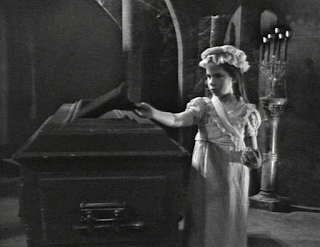
After the séance ends, we have evidence that this bit of background continuity might start to matter. Vicki looks at the landing on top of the staircase and sees the ghost of Barnabas’ 9 year old sister Sarah watching the party.
It seems that when Barnabas was freed to prey upon the living, he unknowingly brought Sarah with him. Sarah has been popping in and out quite a bit the last few weeks, and she has already made some important plot points happen. We’re starting to wonder just how many more beings will emerge from the supernatural back-world into the main action of the show. The opening voiceover today tells us that “the mists that have protected the present from the past are lifting,” so perhaps they will have to nail these dates down sooner rather than later.
The whole party had accepted instantly that Vicki was channeling the spirit of Josette and none of them ever comes to doubt it. But when she says that she saw a little girl at the head of the stairs, they get all incredulous. By the end of the episode, Vicki will have encountered so much disbelief on this point that she herself will decide that she must have been hallucinating.
Back in the great house, Roger is still overjoyed that the séance turned out to be so exciting. His sister Liz and Liz’ daughter Carolyn consider this to be in terrible taste. But Roger won’t give an inch. He has some great lines, exiting with “I think that all of the unhappiness of all of my ancestors is my rightful heritage, and you shouldn’t try to keep it from me. Good night, ladies.” Both Patrick McCray, in his Dark Shadows Daybook post about this episode, and Danny Horn, in his Dark Shadows Every Day post, make insightful remarks as they analyze the fun Louis Edmonds has playing Roger.
Carolyn approaches Vicki to speak privately. She tells her that she isn’t bothered that fake Shemp Burke Devlin is dating Vicki. Vicki’s response to this is “What?” Carolyn reminds Vicki that she used to be interested in Burke and was initially jealous of Burke’s interest in her. But she assures her she doesn’t feel that way any longer. Vicki smiles, nods, and looks away. Carolyn then says “He’s really very nice!” Vicki answers “Who?” “Burke!” says Carolyn. Again, Vicki smiles, nods, and looks away.
This is probably supposed to tell us that Vicki is coming under some kind of spell associated with Barnabas, but in fact it is likely to suggest something quite different to the audience. Burke was originally a dashing action hero played by Mitch Ryan. Dark Shadows never really came up with very much for a dashing action hero to do, but Ryan’s skills as an actor and his charismatic personality always made it seem that he was about to do something interesting. Several weeks ago, Ryan was fired off the show after he came to the set too drunk to work.
Since then, the part of Burke has been played by Anthony George. George was a well-trained actor with an impressive resume, and by all accounts was a nice guy. But he cannot dig anything interesting out of the character of Burke as he stands at this point in the series. The only scene in which George has shown any energy so far was in #267, when Burke had lost a dime in a pay phone. The rest of the time, he has blended so completely into the scenery that it is no wonder Vicki can’t remember him from one line to the next.
Back in the Old House, Barnabas talks to Josette’s portrait. In the months from #70 to #192, it was established that Josette can hear you if you do this. Several times she manifested herself either as a light glowing from the surface of the portrait or as a figure emerging from it. In #102, we saw strange and troubled boy David Collins having a conversation with the portrait- we could hear only his side of it, but it was clear that Josette was answering him.
The first time we saw Barnabas in the Old House, in #212, he spoke to the portrait. At that point, Josette was not yet his lost love. It seemed that she was his grandmother, and that she had sided against him in some terrible fight with his father Joshua. He ordered Josette and Joshua to leave the house to him. The next time David tried to talk to the portrait, in #240, it seemed that they had complied- David could no longer sense Josette’s presence in it.
Barnabas had spoken briefly to the portrait the other day, but today he makes his first substantial address to it since banishing Josette and Joshua in #212. Again he entreats her to go, but for a very different reason. Now he says that she is lost to him forever, and must allow him to live in the present. Since he has been scheming to capture a woman, erase her personality, replace it with Josette’s, and then kill her so that she will rise from the grave as a vampiric Josette, this sounds like he has decided to make a big change in his relations to the other characters.
It turns out that he hasn’t, but the writers have decided to change their relationship to their source material. Barnabas’ original plan was identical to that which Imhotep, the title character in the 1932 film The Mummy, had pursued in his attempt to replicate his relationship with his long-dead love Princess Ankh-esen-amun. Imhotep met Helen Grosvenor, whom he regarded as the reincarnation of Ankh-esen-amun because they were both played by Zita Johanns, and subjected her to the same treatment Barnabas first inflicted on Maggie Evans, The Nicest Girl in Town, and now plans to try on Vicki.
Maggie is played by Kathryn Leigh Scott. The audience in 1967 would not have known that Miss Scott also played the ghost of Josette in some of her most important appearances. However, they would have noticed when David saw Maggie dressed as Josette in #240 he assumed it was the ghost, because her face was “exactly the same” as it had been when she manifested herself to him previously. So we have the same reason to believe that Maggie is the reincarnation of Josette that Imhotep had to believe that Helen was the reincarnation of the princess, and we therefore assume that Barnabas, like Imhotep, was trying to take possession of both the ghost and the living woman.
But after Barnabas tells Josette to go away, he declares that if he is to have her, she must be someone from the present. This sequence of words is nonsensical in itself, but harks back to a theory he had laid out to his sorely bedraggled blood thrall Willie in #274: “Take the right individual, place her under the proper conditions and circumstances, apply the required pressure, and a new personality is created.” Jonathan Frid would always sound and move like Boris Karloff, but now his project of Josettery is inspired less by Imhotep than by the various “mad doctors” Karloff played in the 1940s. Of course, in the 1960s real-life mad scientists such as Stanley Milgram and John Money were performing experiments on human subjects for which Barnabas’ statement might have served as a motto. So Barnabas is coming to be less a merger of Dracula and Imhotep than of Dracula and Dr Frankenstein.
One of the devices by which Barnabas tries to place women “under the proper conditions and circumstances” for Josettification is a music box which he bought for the original Josette and may or may not have given her.* He gives this to Vicki. To his satisfaction, she is reduced to a complete stupor when she hears it play. She is in that state when the episode ends.
* In #236, he says he never had the chance to give it to her. In subsequent episodes, he implies the opposite.
The living members of the ancient and esteemed Collins family have been invited to a party hosted by their not-so-living cousin, Barnabas Collins the vampire.* It will be a costume party, in which each adult Collins will dress as a counterpart from the era when Barnabas was human.
The show has been hinting from episode #1 that well-meaning governess Vicki is the illegitimate daughter of matriarch Liz, and today Liz’ daughter Carolyn tells her she “deserves to be a Collins.” From what we’ve seen of the Collinses, that’s hardly a compliment, but she is going to the party dressed as the legendary Josette Collins, to whom she refers as one of “our ancestors.”
Vicki and Carolyn confide in each other that they feel strange wearing the dresses. Vicki gets a strong sense of déjàvu when she wears Josette’s dress, and when Carolyn puts on Millicent’s she feels like an intruder.
Vicki’s boyfriend, fake Shemp Burke Devlin, shows up. Vicki tells him about the party. He expresses unease at the idea of her dressing as Josette. He brings up the séance in #170, when Josette spoke through Vicki. That was one of a great many contacts Vicki had with Josette’s ghost between episodes #126 and #192, but Vicki seems startled when Burke brings the matter up.
Vicki suggests that she might go to Barnabas and wangle an invitation to the party for him. He jovially responds that he would be out of place at a Collins family party. He makes it clear that he is not at all bothered to be left out, but Vicki insists. He drives her across the estate to Barnabas’ house and waits in his car while she goes inside.
Vicki lies to Barnabas, claiming she had a previous commitment to go out with Burke. This is only the second time Vicki has successfully told a lie. The first time, in #228, she told Liz something she so desperately wanted to believe that she ignored the fact that Vicki couldn’t look at her, or stand still, or maintain a normal conversational tone of voice. Now, she tells her lie smoothly and easily. Perhaps Carolyn was right, and Vicki has indeed earned the right to be a Collins.
Barnabas is initially disappointed that Vicki wants to bring a date, but brightens when he thinks of a role for Burke to play. Burke can wear the clothing of Jeremiah Collins. After Vicki leaves, Barnabas tells sorely-bedraggled blood thrall Willie that he hated Jeremiah and wanted to “destroy him.” He smiles and says that perhaps he will have that opportunity at the party. My wife, Mrs Acilius, was impressed with Jonathan Frid’s expression as he delivers that line. “Man, he knows how to do evil-face!”
Barnabas had told Willie that he expected the party to be “the most important night of [his] life,” and now he thinks it might present him with opportunities to “destroy” the guests. I’ll admit that there have been times when I had unrealistic hopes for a party I was planning, but I can’t say I’ve ever raised my expectations quite to that level.
On his blog Dark Shadows Every Day, Danny Horn pokes fun at Barnabas for setting the bar so high. In a long comment, I tried to figure out what the writers might have been getting at by giving Barnabas these lines. I won’t copy it here, in part because it goes over material I’ve discussed repeatedly in earlier posts and in part includes spoilers for people who haven’t seen the rest of the series.
Closing Miscellany
Carolyn talks about the ancestors they will be impersonating as people who lived “over 130 years ago” and talks about “nineteenth century” styles. That fits with some references in the early months of the show to Josette having lived in the 1830s, and to the great house of Collinwood having been built in that decade by Josette’s husband Jeremiah Collins. The other day Barnabas said that his sister Sarah, whose ghost we have seen a number of times, lived long before he met Josette, and her dates have been established as 1786-1796. Apparently Barnabas and Sarah were both children when she died, and Barnabas was in his 40s when he knew Josette. Actor Jonathan Frid was in his early 40s when Dark Shadows was in production, so that would be plausible as the age at which Barnabas is frozen. Also, today a portrait of a man wearing a suit from the 1840s is identified as Joshua Collins, Barnabas’ father and a contemporary of Josette and Jeremiah.
This portrait usually hangs in the foyer, and I usually think of it as James K. Polk Collins. In #59, it was identified as Benjamin Collins, but today Vicki says it is Joshua. Screenshot by Dark Shadows Before I Die
At other times Jeremiah and Josette have been placed earlier, in the eighteenth century. It is unclear whether they have decided to stick with the 1830s as the time when Barnabas originally became a vampire, or if the date will shift again.
Burke asks Carolyn if her interest in motorcycling is a thing of the past. She says it is. This is the last reference we will hear to her onetime fiancé, biker dude Buzz. Buzz was hilariously out of place on Dark Shadows, and he will be missed as a source of comic relief.
When Burke was introduced in #1, he was a self-made millionaire planning to use his great wealth to take revenge on the Collinses. He gave up on his revenge in #201, and we haven’t seen much sign of his wealth lately. The last time a financial question was attached to him was in #267, when he was heartbroken because he had lost a dime in a pay phone. Today he shows up wearing a jacket that we’ve seen working class characters like Willie and hardworking young fisherman Joe wear. It might make the audience wonder if they are thinking of retconning his wealth away for some reason.
*They have no idea Barnabas is a vampire. They chalk his eccentricities up to being English.
For the first 54 weeks of Dark Shadows, reclusive matriarch Liz was paralyzed by the fear that someone would enter the locked room in the basement of the great house of Collinwood and find the murdered body of her husband Paul Stoddard buried there. For the last 16 of those weeks, seagoing con man Jason McGuire exploited that fear to blackmail Liz.
It turned out that Liz didn’t actually kill Stoddard and there never was a corpse hidden in the basement of the great house. There is, however, a corpse hidden in the basement of another house on the same estate. During the daytime, Liz’ distant cousin Barnabas Collins is a dead body resting in a coffin in the basement of the Old House. He gets up at night to feed on the blood of the living, lure the unwary to their damnation, and deliver rambling monologues about how sorry he feels for himself. Unlike Stoddard’s supposed grave in the great house, Barnabas’ coffin is not kept in a locked room, so the parallel has been incomplete.
Today, Barnabas decides to complete it. Trying to find and steal Barnabas’ jewels, Jason had broken into the Old House. He made his way to the basement, where he stumbled upon the coffin. He opened it, and Barnabas strangled him. Now, Barnabas orders his sorely bedraggled blood thrall Willie to help him carry Jason’s body to the secret room in the mausoleum where Barnabas himself was imprisoned and undiscovered for “nearly 200 years.”
Before they leave the basement, Barnabas tells Willie about his sister Sarah, who died when she was very young and innocent. After they leave, Sarah’s ghost appears and puts Jason’s sea cap on Barnabas’ coffin.
Episodes #1-#274 had all opened with voiceover narrations delivered by Alexandra Moltke Isles in character as well-meaning governess Vicki. Starting Friday, they gave the opening monologues to one of the actresses who happened to be in the episode to deliver as an unnamed external narrator. Today, this spoils a surprise. We haven’t seen Maggie Evans, The Nicest Girl in Town, for a while, and aren’t sure when we will see her again. When Kathryn Leigh Scott delivers today’s opening voiceover, we know we will see Maggie today.
Barnabas had held Maggie prisoner for several weeks. He had borrowed a plan from the 1932 Universal film The Mummy. He would erase Maggie’s personality and replace it with that of his long lost love Josette. Once he had done that, he would kill her and she would rise from the dead as a vampiric version of Josette. Maggie did not go along with the plan, and Sarah’s ghost helped her to escape. Barnabas managed to scramble Maggie’s memory before her father found her, and she is now in treatment at a sanitarium called Windcliff.
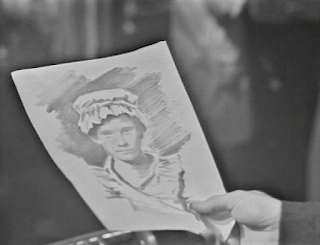
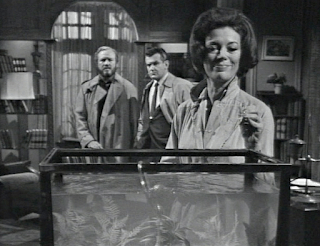
Maggie’s hometown doctor, addled quack Dave Woodard, is visiting the director of Windcliff, Dr Julia Hoffman. Woodard wants to show Maggie a sketch Maggie’s father, artist Sam Evans, made when the ghost of Sarah visited him to tell him where to look for Maggie. Julia resists, Woodard insists. While Julia delays, she feeds the fish in the aquarium in her office. We see enough of the aquarium to suggest that Julia is the keeper of a world within a world, a little enclosure with its own rules.
Woodard shows Maggie the sketch. After a moment, she says “Sarah.” She tells them that Sarah visited her in the room where she was confined, that she told her a riddle that showed her how to escape. She becomes too upset to talk. She starts miming her search for a loose brick in the wall of the cell, then sings a verse of Sarah’s signature tune, “London Bridge.” She is shouting words from “London Bridge” when the nurse drags her down the hall, back to her room. Julia declares that the whole thing was a waste of time, a judgment in which Woodard does not concur.
Sam’s sketch of Sarah. Apparently the drawing was done before Sharon Smyth was cast as Sarah, when they planned to give the part to Harvey Keitel in drag. Screenshot by Dark Shadows Before I Die
Meanwhile, Barnabas and Willie take the body of Jason to the tomb of the Collinses and bury it in the secret room. They talk about the people buried in the part of the structure known to the public- Barnabas’ parents and his sister Sarah. Barnabas confirms that Sarah is the one he was telling Willie about in the basement, the friend he knew long before he met Josette. He reminisces about repairing a doll of hers the night before she died. We see the plaque giving her dates as 1786-1796, implying that Barnabas met Josette after 1796. They leave, and Sarah appears.
Liz had last seen Jason the night she thought she killed Stoddard; his reappearance would lead to the opening of the locked room and the exposure of its secret. Barnabas last saw Sarah in 1796; her reappearance, today’s events suggest, might lead to the opening of all the rooms Barnabas wants to keep closed and to the exposure of all his secrets.
Each of the episodes of Dark Shadows from #1 to #274 began with a voiceover narration delivered by Alexandra Moltke Isles in character as well-meaning governess Victoria Winters. The implicit promise of these little bits of prose was that Vicki would eventually find out about whatever was happening in the episode we were about to see.
Now, vampire Barnabas Collins is a permanent addition to the cast of characters. If Vicki finds out what Barnabas is up to, she will work to destroy him as she worked to destroy the show’s previous undead menace, blonde fire witch Laura Murdoch Collins. If she succeeds, the show will lose the only ratings-maker it has ever had. If she fails, Barnabas will have to kill her and who knows how many other characters, requiring them to start all over with a new cast. So Vicki has to move off the center of the stage.
Today’s opening voiceover is delivered by Nancy Barrett, not in character as heiress Carolyn, but as an unnamed external narrator. The pattern will be that a female member of the day’s cast will play that role. Mrs Isles still does it when she is in the episode, but if she isn’t they give it to another woman. Eventually they will start letting the men do it, and down the line there will be episodes in which Mrs Isles appears but which she does not narrate. Sometimes they are careless and give the voiceover to an actress whose character’s presence in the episode was supposed to come as a big shock, spoiling it for us.
Part Two. “All those years… there was nothing there.”
Matriarch Liz spent the last eighteen years on the great estate of Collinwood. Ostensibly this was because she was afraid that if she left, someone might wander into the locked room in the basement where the remains of her ex-husband Paul Stoddard were buried, and once there would discover that she had killed him.
This never made much sense-the estate is supposed to stretch for miles in every direction, and she roams all over it. If she is spending a day in the gardens by the groundskeeper’s cottage, she is no more guarding the locked room than she would be if she were skiing in the Alps. It made even less sense when we learn, in #249, that nothing untoward can be seen in the room, which Liz has frequently visited over the years, because the tile flooring over Stoddard’s grave had been replaced and cleaned up. It made the least sense of all when we learned in #271 and #272 that Liz herself must have been the one who replaced and cleaned it.
In #259, Liz confided her terrible secret in Vicki. She told Vicki that she had to keep the secret at all costs, not because she feared prison, but because she feared that her daughter Carolyn would hate her if she found out she had killed her father. Now the secret has been revealed and Liz has discovered that she never actually killed anyone. Seagoing con man Jason McGuire helped Stoddard fake his death, buried an empty trunk in the basement, and told Liz she had killed him. Liz never had anything to hide from either the police or her daughter.
Today, Liz is in bed. She appears to be ill, but it turns out the doctor just overdid it a bit with a sedative, she’s fine.
Carolyn left the house before the truth came out, and thinks her mother killed her father. Liz is distraught. We hear her thoughts in a taped voiceover. She is horrified that Carolyn is under this impression and urgently wonders where she is. We fade to a location insert of Carolyn walking along the beach, she’s fine also.
Her shoes aren’t even sandy.
Carolyn comes to Liz’ room and tells her that she was silly to run- she’s sure that whatever Liz did, she did because she had no choice. She vows to stand by her throughout the trial and what may come after, and mentions that after all, she never really knew her father. Liz then tells her there won’t be a trial, because she didn’t actually kill Stoddard.
On his Dark Shadows Every Day, Danny Horn expresses his exasperation with this extreme anticlimax:
So, you know that blackmail storyline where Liz had to do everything that Jason said, because otherwise she’d go to prison and her daughter would hate her forever?
Well, guess what? Liz finally told everybody that she killed Paul, and now she’s going to prison, and her daughter hates her forever.
But not really. It turns out that Liz never killed Paul in the first place, and Carolyn would have forgiven her even if she had.
Carolyn spent the night wandering around outside, in clear violation of Collinsport’s recent curfew. She’s given it a lot of thought, and now she’s ready to stand by Liz through the trial. Except there won’t be a trial, because there was no murder, and the entire four-month storyline was a complete waste of time.
Liz then explains that Jason won’t stand trial either. She isn’t going to press charges for the blackmail because she just wants to forget the whole thing. An understandable desire, to be sure. Carolyn says she hopes Jason has gone a million miles away, two million miles away, even further. “I hope he’s gone to the end of the Earth.”
Part Three. He gets what he came for.
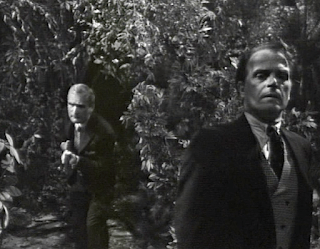
Carolyn gets her wish. As it happens, the end of the Earth is conveniently located right there on the grounds of Collinwood. It is the Old House, where Liz’ distant cousin Barnabas and his sorely bedraggled blood thrall Willie are in residence. Jason broke into the Old House at the end of yesterday’s episode, and is searching the front parlor for a box of jewels he had earlier seen through the window.
Willie catches him there. Willie was once Jason’s henchman, and still has friendly feelings towards him. Willie tries to warn Jason that he is in danger, and even after Jason hits him and twists his arm he resorts to the extreme expedient of telling him the truth- “Barnabas, he isn’t alive. He can walk at night, but he’s dead.” Jason doesn’t believe him.
Jason keeps telling Willie that he is determined to get enough money to start over. The way he expresses it is “I need a stake.” Little does he know how right he is!
Jason forces Willie to accompany him to the basement. He sees Barnabas’ coffin there, and is convinced it is full of treasure. Willie makes one more effort to save his former friend, taking a handful of jewels from a table near the coffin and offering them to Jason if he will leave at once. Jason scoffs at him, and Willie backs sadly away. Jason opens the coffin. A ringed hand shoots out and chokes him. So long, Jason! We can’t say it hasn’t been weird.
Comeuppance
This is only the second on-screen killing we’ve seen on Dark Shadows, after Laura murdered Van Helsing-equivalent Dr Guthrie in #185. Moreover, it’s the first time Barnabas has killed anyone on the show. It’s kind of odd to have a vampire around for thirteen weeks before the first fatality is recorded. We might wonder if he will pick up the pace as he goes on.
Reclusive matriarch Liz has spoiled her wedding to seagoing con man Jason by telling everyone that she was only marrying him to keep him from telling that she’d murdered her first husband and he’d buried the body in the basement. Fake Shemp Burke has found a gun and points it at every other character.
Jason denies Liz’ story, knocks the gun out of Burke’s hand, and runs out of the house. Burke runs after him and fires a couple of shots at a figure he assumes to be Jason, though it could be the sheriff or a small child or some other target of convenience for all he knows. The original Shemp Howard might have thought that last display of stupidity was a bit over-the-top for the Three Stooges. On Dark Shadows Every Day, Danny Horn has a bit of fun with Burke’s carelessness. His whole post about this episode is funny.
Out in the woods, Liz’ brother Roger looks directly at Jason, fails to see him, and moves on.
The sheriff comes and tells Liz that he is very sorry for bothering her with all of this, and assures her that his men will do everything they can to catch Jason and make things as easy for her as they can. Meanwhile, he needs some help digging up the body buried in her basement.
Liz has loudly refused to talk to her lawyers, a wildly bad move in our world, but under Soap Opera Law she has every reason to believe that, as a good person who has already suffered for her deeds, all she has to do is to tell the authorities about a bad person who has profited from his iniquity. The sheriff’s attitude confirms this assessment.
Liz tells well-meaning governess Vicki that she often went into the room where Paul is buried and cried. Vicki had heard sobbing coming from that room several times in the early days of the show, as had housekeeper Mrs Johnson on her first night in the house. At first, the show was equivocal as to whether it was Liz crying or a ghost. That equivocation fit with the show’s initial attitude towards the supernatural, which was to hint that there might be literal ghosts in the background, but to use the word “ghost” primarily as a metaphor for unresolved conflicts based on past events. Eventually, they showed us the door to the room locked from the outside while sobbing came from the inside, confirming that it couldn’t have been Liz. This week the show is committing totally to stories of the paranormal, yet they retreat to the idea that The Sobbing Woman was Liz all along.
Maggie Evans, The Nicest Girl in Town, has escaped from vampire Barnabas Collins, but not before Barnabas put the zap on her brains. She is being treated at Windcliff Sanitarium, under the care of Dr Julia Hoffman.
Dr Hoffman’s old acquaintance Dr Dave Woodard shows up with Maggie’s father Sam and boyfriend Joe. Woodard and Hoffman are Dark Shadows ‘ current versions of Bram Stoker’s Dr John Seward and Professor Abraham Van Helsing. As Seward called Van Helsing in when he needed help solving the mystery he encountered treating the victims of Count Dracula, so Woodard has called the expert Dr Hoffman in to help him solve the mystery he has encountered treating Barnabas’ victims. As Van Helsing refuses to answer any of Seward’s questions when they first start working together, so today Dr Hoffman refuses to answer any of Woodard’s questions about the case. There is one departure, in that Dr Hoffman combines Seward’s occupation as chief physician at a sanitarium with Van Helsing’s role as mysterious expert from out of town.
Dr Hoffman tells Dr Woodard that she believes it will be bad for Maggie to see Sam and Joe, but she consents to the visit as a way of discouraging them from trying to come back. When Sam and Joe join them in her office, she attends to her aquarium. In the post about this episode on Dark Shadows Before I Die, Christine Scoleri points out that this is a rather direct way of telling us that there is something fishy about Dr Hoffman.
When Sam and Joe go to Maggie’s room, she has a mad scene. She starts singing “London Bridge,” gets to an obscure verse running “Take the key and lock her up,” and starts screaming “Lock her up!” over and over. It’s magnificently terrifying.
In his post on Dark Shadows Every Day, Danny Horn raves about Grayson Hall’s performance as Julia Hoffman. Rightly so, she will quickly make herself indispensable to the series. He includes a lot of screenshots of her face, showing the wide variety of expressions she uses. I have a more complicated response to this aspect of her style.
As many screenshots as Danny gives of Grayson Hall’s face in his post, I presented even more screenshots of Lovelady Powell’s face in my post about #193, where Powell plays art dealer Portia Fitzsimmons. What impressed me about Powell’s performance is that she takes one of the most basic rules of screen acting- choose one of your eyes and look at your scene partner only with it- and builds a whole character around it. Her left eyelid is all she needs to command the stage and leave an indelible impression.
Hall was at the opposite extreme. She ignores the one-eye rule, and virtually every other piece of guidance professionals give about how to create a character on camera. She uses every muscle at every moment. Her broad, stagy approach works well for Dark Shadows, and the three actors with whom she shares her shots today stay out of her way. Still, she does make me miss Powell’s dominating simplicity.
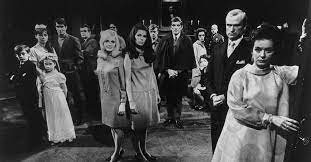
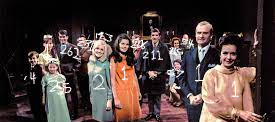
With Julia’s introduction, all of the actors in the photo I use as the header for this blog have joined the cast of Dark Shadows. There is also a version of the picture where the actors are frowning.
Gloom in the shadows
Here’s the smiley version. I’ve marked each player with the number of the first episode in which s/he appeared:
In its first months, Dark Shadows spent a fair bit of time on the business interests of the ancient and esteemed Collins family. In those days, the Collinses were running out of money and their old nemesis, Burke Devlin, had come back to town with a plan to strip them of their remaining assets and drive them into poverty. The “Revenge of Burke Devlin” storyline never really took off, and was eventually subsumed into the tale of blonde fire witch Laura Murdoch Collins. Shortly after Laura disappeared, Burke formally gave up on his revenge. With that, the business stories ended, and there was no particular reason for Burke to stick around.
On Tuesday, Burke was recast. However little his character may have had to do on the show or however much he may have had to drink before he arrived at the studio, Mitch Ryan was always interesting to watch. Anthony George couldn’t match Ryan’s charisma, but by 1967 he had been a familiar face in feature films and primetime television for years. The original audience, even if they couldn’t remember George’s name, would have recognized him as a famous actor and assumed that his casting meant that something big was in store for Burke.
Today, we have two hints that business stories might be making a comeback as well. Seagoing con man Jason McGuire is blackmailing reclusive matriarch Liz into marrying him. Vampire Barnabas worries that the cozy little home he has made for himself in the Old House on the estate of Collinwood might be threatened if Jason takes control of the family’s holdings. He asks Liz’ brother, high-born ne’er-do-well Roger, to look at the original deeds for the Old House and the great house to see if there is some provision he might be able to use to defend his interests against Jason. That Barnabas asks about the deeds would suggest that he has acquired some form of ownership in the Old House. We’ve never seen him buy the house from Liz or receive it as a gift from her, but if both deeds are still in Liz’ name, he could hardly use their wording to claim a right to stay there. So when Roger goes off to look for the deeds, there is a chance he will come back with a story about real estate.
The second hint comes in Barnabas’ confrontation with Jason. Barnabas takes a very aggressive tone with Jason, who responds by asking Barnabas where he goes in the daytime and where his money comes from. “You have no accounts in the bank in town, and I know you don’t operate a business…” If Barnabas is going to be on the show for the long haul, as the ratings clearly indicate we should expect him to be, Jason will not be the last person to ask these questions. We might wonder how exactly he will forestall them.
If we have been watching from the beginning, the likeliest answer would involve Burke. When was a major character, Burke was presented as an inexhaustibly rich man who knew his way around some of the shadiest places in the world. If Burke happens upon Barnabas’ secret, we could expect Barnabas to bite him and thereby bring him under his power. With his money, Burke could set up plenty of bank accounts and businesses in Barnabas’ name. With his contacts in the demimonde, he could secure whatever papers Barnabas needs to establish his identity. Even a photo ID- Burke could easily hire a Barnabas lookalike to pose for a British passport.*
During the “Revenge of Burke Devlin” arc, Burke bought up a lot of Liz’ debts. In particular, he held enough notes payable on demand that she feared he might be able to put her out of business at any time. That hasn’t been mentioned for a long while, but if Barnabas takes control of Burke he could take those notes and exchange some of them for outright ownership of the Old House.
Barnabas could also compel Burke to fabricate some fraudulent papers that would make it look as if he were deeply in debt to Barnabas. When Barnabas got around to killing Burke, those papers would come to light. Liz and Roger would be grateful to Barnabas for taming their old adversary and clearing out some debts that posed a danger to their financial position, while well-meaning governess Vicki would be grateful to him for helping her boyfriend save his face after his business went south. As a result, his position at Collinwood would be unassailable.
Closing Miscellany
There is a location insert of Roger walking to the Old House, a flashlight in hand. I don’t think we have seen this footage before.
Until today, Barnabas has tried to be very suave with everyone who doesn’t know that he is a vampire. Since he has nothing to say to Jason that will intimidate him, he might as well continue that approach in his scene with him, or at least play dumb. But instead, he is openly, and self-defeatingly, hostile. This will become a pattern in future episodes. Time and again, Barnabas will greet a potential adversary with an immediate declaration of war, often before the adversary even knows who he is, thereby forfeiting whatever element of surprise he might have on his side.
Barnabas catches a glimpse of the ghost of his sister Sarah. He only sees her as a figure moving in the distance as he is looking out the window, and has no idea who she is. But it does confirm that he is able to see her, something we had not known he could do.







 Dark Shadows Commentary