Episode 8: The famous ghosts of Collinwood

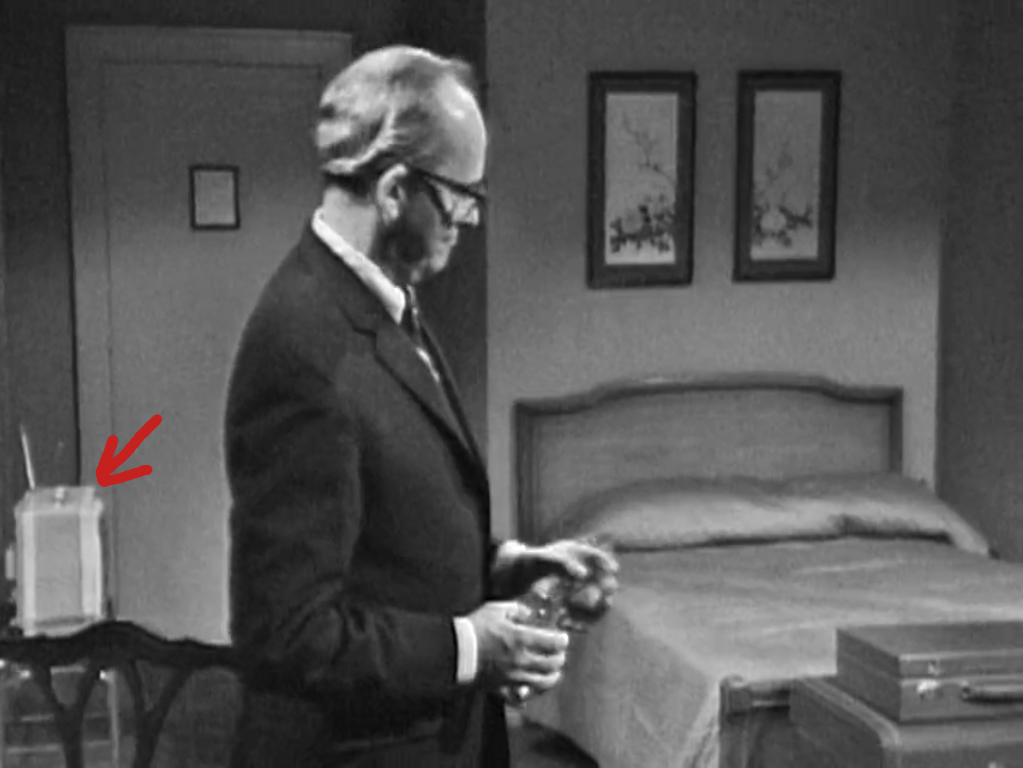
Vicki calls the Hammond Foundling Home in an attempt to verify Liz’s claim that someone there recommended her for the job. We see Ms Hopewell, director of the home, in her office. The office is a nice glimpse of the world Vicki left to come to the house, and of the show’s idea of what was going on in the buildings around the NYC studio where it was produced.

Liz frets over Carolyn’s reluctance to marry Joe, Joe frets over the idea that his recent promotion was arranged to ease that reluctance, and everyone frets over Burke’s latest doings. Liz blames Carolyn’s hesitancy, and perhaps all the rest of her woes, on “the famous ghosts of Collinwood.” Like everyone else in these early episodes, she uses the word “ghost” figuratively, but with the door conspicuously open to the possibility that we will be hearing literal ghost stories later on.

Episode 7: Nowhere- Everywhere- Perhaps I was here.

Vicki and Burke run into each other at the Collinsport Inn where Maggie serves them coffee, Roger lets himself into the Evans cottage where he makes demands of Sam, Maggie tells Roger that Burke and Vicki are sharing a table and he runs away.

In these interactions, we see Burke using his considerable charm to try to get information out of Vicki, Roger using his social position to try to bully Evans the father while Evans the daughter exposes his cowardice, Sam wallowing in self-pity, Maggie letting information out indiscriminately, and Vicki taking it all in, cautiously.

Marc Masse’s post about this episode on his Dark Shadows from the Beginning has some interesting stuff. Both Mitch Ryan as Burke and Mark Allen as Sam are required to talk with their mouths full; both of them have mishaps, which he records with gifs showing matter falling out of their mouths. He also has these intriguing paragraphs about the character of Sam Evans:

One thing about the Evans cottage you notice in this episode is that when Sam walks in the door you can see houses across the street, a setting that would suggest a quiet, cozy cul-de-sac near the waterfront. Sam has neighbors, but none ever come calling. One gets the impression that Sam is troubled about something and just wants to be left alone, but time and again unwanted trespassers will just keep barging in, like this nervous, frightened man who lives in a mansion on the hill who busts in to order him around and warn him to keep certain information secret that might be damaging to the both of them. There will at one point be a cannery plant manager who just walks in without knocking while he and Roger are arguing about Burke Devlin, the plant manager telling Sam that if he wants privacy he should keep his door locked. But even that wouldn’t work, because as time goes on the trespassers will only become more aggressive: a fire goddess who, by staring into a blazing fireplace miles away, can make Sam fall asleep on the sofa with a lit cigarette to ignite a nearby newspaper so that he burns his hands badly enough that he can no longer paint; a newly risen vampire who sneaks in through the French windows to make a blood bank of his daughter; a Frankenstein monster who lets himself in for food and shelter and who knows where the cutlery is kept; a werewolf that doesn’t even bother with locked doors and just crashes in through the nearby window. The Evans cottage is a hub of activity for invasive beings with criminal intent.

But now, in the relatively sane and quiet summer of sixty-six, all Sam Evans has to do for a little peace of mind is assure his unwanted patrician visitor that he will not do or say nothing to jeopardize the agreement the two apparently made that ties them together like conspirators – because that’s what they represent to the viewer, two people who keep information away from others, information the viewer at this point is also not fully privy to.

But the one salvation for Sam Evans is that, unlike Roger Collins, he does seem to have some remnant of a conscience about whatever unsavory information ties these two unlikely co-conspirators together, and therefore a soul that may be worth saving.

Marc Masse has more use for Mark Allen’s acting than I do- I would say that he tends to be monotonous, his voice either a constant whine or a series of bellows. So I find it difficult to think of Sam Evans #1 as a soul worth saving. But this is a most insightful passage.

Episode 6: “Winters! Victoria Winters!”

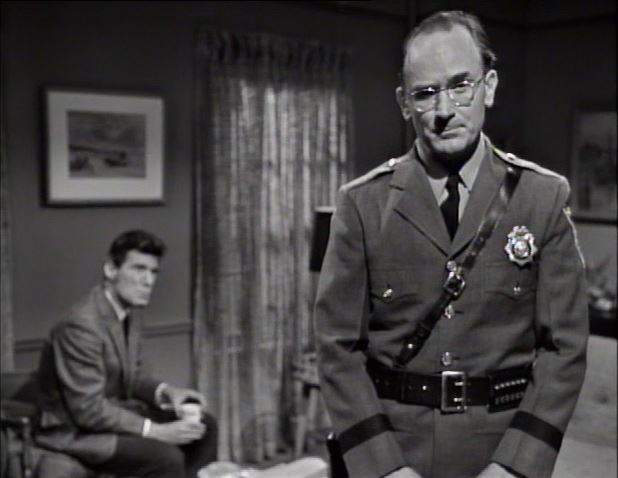
Looking for David in the basement of Collinwood, Vicki encounters caretaker Matthew Morgan. No one has bothered to tell Matthew that a new person will be coming to the house, so he assumes she is a burglar and confronts her accordingly. Liz shows up, telling Matthew that Vicki belongs in the house and telling Vicki that she doesn’t belong in the basement.

In week one, Liz refused all requests for information about who Vicki was and why she hired her to be David’s governess. But at least she had told the other members of the household that Vicki would be coming. She hasn’t told even that to Matthew, notwithstanding the fact that, as she will explain to Vicki in this episode 13, Matthew is a “strange and violent man.” By taking the job and living in the house, Vicki, our point of view character, has made herself dependent on Liz; we the audience are also dependent on Liz, in that the stories in these first months all revolve around actions Liz will or won’t take. So it’s doubly unnerving that she is so very stingy with information.

George Mitchell, who plays Matthew here and in his next few appearances, is the sort of actor we often see in the first 42 weeks of the show. He is essentially a miniaturist, who builds a character one finely etched mannerism at a time. His successor in the role, Thayer David, worked at the opposite extreme, becoming the first exponent of the Dark Shadows house style of acting (often called “Go Back to Your Grave!” because of Lara Parker’s explanation of it.) Without that style, the show wouldn’t have become what it did in the period which people remember, so I can’t regret the recasting. But I do wish we could somehow see what it would have been like had George Mitchell carried the character through his whole arc of development. He could have played something I think Art Wallace could have written, a closely observed, sensitively explored psychological study.

There’s another what-might-have-been moment when Vicki tries to make friends with Matthew. He introduces himself to her with a gruff “Morgan! Matthew Morgan!” To which she replies, mimicking his down-east accent, “Wintahs! Victoria Wintahs!” It isn’t much of a joke, and Matthew isn’t amused. But it’s hard not to wonder what Vicki might have become if she’d been allowed to make the occasional joke as the series went on.

Episode 5: Good morning, you lovely people

This episode features the first appearance of one of my favorite sets, the kitchen at Collinwood. There’s an intimacy to hanging out in the kitchen, whether you’re actually sharing a meal or not, that makes it a natural place for people to exchange information.

Vicki and Carolyn do share a great deal of information with each other during their breakfast. By the end of it, we know everything Vicki knows about her origins, and enough about what was happening at Collinwood during her infancy to see the possible resolutions to the mystery about her.

David Henesy also has a heavy load of acting to do in this one as David Collins packs Vicki’s bags and calls for his mother. The script doesn’t give him much help in making these actions compelling, but Henesy’s face projects such intense emotions that his scenes move the audience powerfully.

Episode 4: Frightening a new friend

Here’s the comment I left on the Scoleris’ Dark Shadows Before I Die blog entry about this episode:

Interesting how the early episodes tiptoe towards the supernatural. Burke, Roger, and Carolyn all use the word “ghost” metaphorically, to refer to unresolved conflicts from the past that are still causing problems in the present. Liz and Vicki, each in her turn, responds by saying there are no such things as literal ghosts, only to hear the first person assert that there absolutely are. Giving this same little conversation to both Liz and Vicki is one of the ways the show tries to establish Liz and Vicki as mirrors of each other, of presenting Liz’s current life as a possible future for Vicki and of Vicki as a revenant of Liz’s past.

The sobbing sounds Vicki hears in this one are the first occurrences that would have to be explained as the act either of a ghost or of someone trying to make Vicki believe there are ghosts. The next such moment will come in episode 14, and there will be several more in the weeks and months ahead. This tiptoeing is what the Dark Shadows wiki on fandom tracks as “Ghostwatch.”

In view of the near-sexlessness of the later years of the show, it’s striking how frank this one is. Roger’s aggressiveness towards Victoria is plainly sexual. Liz catches him trying to sneak into Victoria’s bedroom, he derides her attempt to regulate his “morals.” He offers Victoria a drink, they talk about pleasure and pain in words that so clearly about sex that they barely qualify as sens double. Indeed, that is the only moment in the whole series when Victoria seems like what she’s supposed to be, a street kid from NYC. And the flirtation between Uncle Roger and his niece Carolyn is so blatant that it’s a wonder how Louis Edmonds and Nancy Barrett keep the scene from making the audience either laugh or feel ill.

Episode 3: Open your door!

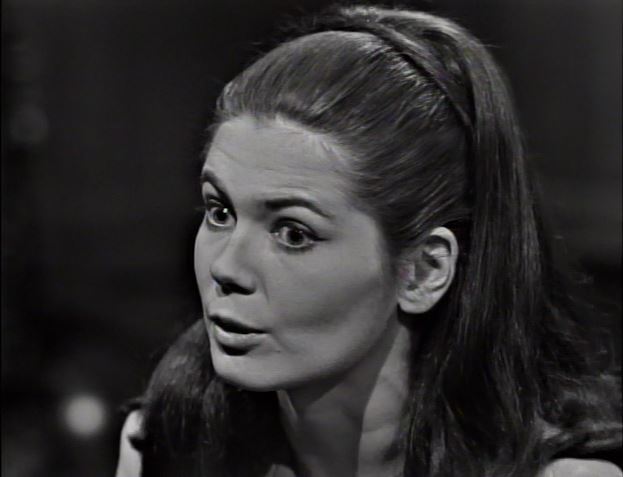
Episode 3 of Dark Shadows is remembered chiefly for two things. It’s the one where Carolyn and Vicki first meet, and Carolyn introduces herself by going on at alarming length about her crush on her Uncle Roger. Vicki’s quiet reaction is just what you’d expect from a new member of the household staff discovering that a member of the family is a raving loon.

It’s also the one that opens with Roger pounding on the door to the Evans cottage and shouting “Open yer doah, ya drunken bum!”:

There is more to it. At the Blue Whale, Burke tries to enlist Joe in his intelligence-gathering operation, an attempt Joe virtuously rebuffs. Bill Malloy confronts Burke, showing that he, like Joe, is devoted to protecting the Collinses.

Art Wallace, the author of the show’s story bible and sole credited writer for its first eight weeks, specializes in a diptych structure, building an episode by interweaving two parallel scenes. That structure leads us to compare and contrast characters with each other in a wider variety of ways than we might if the scenes followed each other in succession. In this one, we see Joe and Bill faithfully standing up to Collins family foe Burke, while newcomer Victoria tries to assume the persona of a loyal retainer in her response to Carolyn’s bizarre talk.

Episode 2: Wouldn’t be the first, you know

Marc Masse’s Dark Shadows from the Beginning is in one of its accessible phases now, and his discussion of episode 2 includes some interesting comparisons between the finished episode and Art Wallace’s story bible for the series, Shadows on the Wall. For example:

Here is Art Wallace’s introductory description of Joe in Shadows on the Wall: “Joe Haskell is twenty-one. A rugged New Englander with a deep love of the sea, Joe is a young man of natural dignity and quiet ambition.”

But the viewer’s first impression of Joe Haskell is that of a sap, cuckolded into brooding over a mug of beer while his date plays the field before his very eyes.

And:

During the scene with Elizabeth and Carolyn in the drawing room, episode writer Art Wallace lifts two of Carolyn’s lines directly from his story outline in Shadows on the Wall. These are: “Besides, how do you expect me to go away and leave you alone in this beautiful nuthouse?” and “All I can say for her, mother, is she must be out of her mind.” In the story outline, the lines are written as “Besides, how do you expect me to get married and go off and leave you alone in this beautiful nuthouse.” and “All I can say for her is she must be out of her mind.”

The scene at the Blue Whale and Carolyn’s mood when she arrives home and the topic of discussion with her mother coincide exactly as given by Art Wallace in Shadows on the Wall: “Carolyn’s in a vile mood. The boy she’d been with had been a dud….had started an argument in the juke joint. There’d been a free-for-all, and her evening had been ruined.”

Then:

In this episode Elizabeth is seen playing the piano in the drawing room. The reason for there being a piano in the drawing room comes from the character of a previous work by Art Wallace, which he drew on when creating the character of Elizabeth Stoddard. In The House, a one-hour production for NBC-TV’s Television Playhouse broadcast on September 8, 1957, Caroline Barnes is a wealthy recluse in a New England fishing village who occupies her time as a piano teacher.

In Art Wallace’s story outline for Shadows on the Wall, when Victoria Winters arrives at Collinwood it is the month of October.

In later posts, Masse will clarify that the 1957 version of The House was actually Wallace’s second treatment of the story that would later give rise to the characters of Elizabeth and Carolyn Stoddard. Three years before, a thirty-minute anthology series called “The Web” had broadcast his first version of it. That version, as shown at a Dark Shadows convention, has been posted on YouTube:

Episode 1: Who’s talking?

In 281 of the posts that follow, I link to comments I made on Danny Horn’s great blog Dark Shadows Every Day. Danny starts with episode 210 and makes only a handful of remarks, most of them highly disparaging, about the first 42 weeks of the show. As a particular fan of that period of the show, that distressed me when I first started reading him, but I found that it gave me an opportunity to make substantial contributions to the comment section. I could always find something in those early stories that gave extra depth to whatever was going on in the later installments.

Now, Mrs Acilius and I are watching the show through a second time, again starting with episode 1. I’d so much enjoyed commenting on Danny’s site when we were watching 210-1245 from March of 2020 to April of 2021 that I decided to start commenting on a blog that covered the first 42 weeks. So I’ve left many comments on John and Christine Scoleri’s Dark Shadows Before I Die.

The Scoleris haven’t assembled the kind of community that made Danny’s comment section a big party. I still get responses to comments I left on Danny’s site, almost a year and a half after his final post. I have yet to get a reaction to any of my comments on Dark Shadows Before I Die. So I’m thinking of just recording my thoughts here.

The Scoleris aren’t the only bloggers who discuss the first 42 weeks of the show. There’s also Marc Masse, a.k.a. Prisoner of the Night, whose (fiercely controversial) Dark Shadows from the Beginning is occasionally viewable, usually private. And of course Patrick McCray, whose Dark Shadows Daybook set the standard for online commentary on the show. Neither of those sites has an open comments section, which is why I’ve been contributing to the Scoleris. There are also podcasts, Facebook groups, Reddit threads, etc, but I’m not into any of those.

Asking who to talk to and how to get through to them brings episode 1 to mind. Vicki comes to an unfamiliar town, and the audience comes to an unfamiliar show. She’s a stranger looking for someone to talk with; we’re viewers of a daytime soap, a genre that consists almost entirely of conversation. Everyone Vicki meets is talkative enough, but most of their talk is about how they aren’t speaking. The lady sitting next to her on the train goes on about what a nasty place Collinsport is. The fellow who gives her a ride from the train station responds to the innkeeper’s warm greeting with an ostentatious refusal even to acknowledge that he knows him, let alone to engage in conversation. The server at the lunch counter announces to Vicki, before she’s had a chance to say two sentences, that she regards her as a “jerk.” The family she will be working for is represented by a lady who won’t answer her brother’s questions as to who Vicki is and why she hired her, a reticence that is made all the more ominous when a private investigator reports on their strange, unfriendly ways. Dark Shadows fandom is far less forbidding than the situation Vicki faced!

The Back-Worlds

In 281 of the posts that follow, I link to comments I made on Danny Horn’s blog, “Dark Shadows Every Day.”

I added most of these comments in the months between the shutdown of live theater in March of 2020 and the completion of the blog in April of 2021. But I have added some since.

In the last few days, I’ve added four. They all discuss on the way the show shifts its focus, once the vampire story becomes a hit, in the direction that will come to define it as the months and years go on. The first three of these comments are on posts discussing episodes where Barnabas the vampire is holding Maggie the lovable girl prisoner and trying to brainwash her into becoming his late love Josette, so that he can kill her and turn her into a vampire. This comment is on the post for episode 253, in which the boy David has broken into Barnabas’ house and had a shouting match with Barnabas’ servant Willie:

The scene between David and Willie marks a definitive break from the pre-Barnabas show. David’s great concern is that Barnabas and Willie are “hurting Josette.” By which he means that he can no longer sense the presence of the ghost of Josette. On the contrary, the name “Josette” now refers to something horrible and that horrible thing is a part of Barnabas’ story.

In the first 42 weeks, the ghost of Josette had been the principal supernatural element in the show. Serene, mysterious, uncanny, the ghost fit perfectly into that series, which was something like 99% atmosphere and 1% story. And Josette came out of the background at two key moments, leading the rescue of Vicki from Matthew in 126 and informing the family of the danger Laura represents to David in 149 and 170. And of course when Barnabas first meets David in 212, David tells him that Josette protects the family.

So when Barnabas starts his rampage, regular viewers would at first be waiting for the ghost of Josette to make its move and stop him. By the time David sees the Josette-ified Maggie in 240 and 241, we know that the imperturbable Josette of the first 42 weeks is not coming back. If we do see Josette’s ghost again after we’ve seen Maggie in her wedding dress, it could not have the lightly amused smile in its voice with which it told Vicki not to be afraid of Matthew; it could return only as a terrifying spirit of vengeance. By the time David and Willie finish their confrontation in this episode, the show has told us that the protecting ghost won’t return at all.

This one is on the post for 255, in response to a comment from someone wondering what Barnabas was planning to do if he had succeeded in his evil plan for Maggie. How could he have gone on presenting himself to the rich Collinses as their long-lost cousin from England?:

I think we have to assume that all the “cousin from England” stuff would have gone by the boards if Barnabas had succeeded with Maggie. When they revisited Barnabas’ Josettifying project in HOUSE OF DARK SHADOWS, they had to ask what would come next, and the answer was “He kills everyone and turns the estate into an impenetrable outpost of Hell.”

Some time after they came back from making that movie, the show would send Barnabas and Julia on a two-week visit to the future, to the far-off year 1995, where they find that most of the family is dead, the rest of them are hopelessly insane, and no one dares go to the estate, all because of hideous supernatural doings that took place there a quarter century before. Those two weeks are sensational, the last genuinely great phase of the show, and part of what makes them so great is that they are a logical sequel to the part of the show everyone remembers most clearly.

This one is on the post for 256. In that episode, the hapless Maggie has seen a mysterious little girl playing outside the cell in which Barnabas keeps her. The girl’s name turns out to be Sarah:

I’d say Sarah’s introduction is the single most important moment in the whole show, more important than Barnabas coming out of the box, more important even than Barnabas’ first decision not to kill Julia.

From the beginning they’d been playing with the idea that there was another cast of characters hidden behind the characters we’ve been watching, supernatural characters who can make their influence felt at certain moments. The most prominent of these was the ghost of Josette…

So the show has discarded the old supernatural realm of Josette and the widows, a realm that was, as you say, never more than slightly accessible. With Sarah’s appearance, we are introduced to an entirely new part of the show. Once again we have a set of characters hidden in the supernatural background, but they can interact with the characters from the main continuity more directly and at greater length than Josette and the widows ever could.

The puzzle of Sarah’s connection to Barnabas, and her talk about looking for the members of her family, indicates that this new order of supernatural beings have complex and unsettled relationships with each other, and that characters from the main continuity can have an influence on those relationships. We will have to figure those relationships out in the weeks and months to come, but as soon as Sarah demands Maggie not tell her big brother that she saw her, we know that they might come to enmesh the living beings. Every scene with Sarah, then, is a step leading directly to the time-travel and parallel universe storylines that will come to define the show.

This one, on the post for 279, sums up the major points of the three comments above. It regards an episode in which Barnabas and Willie are planning to host a costume party in which members of the present-day Collins family will come dressed as their forebears from Barnabas’ time, the late eighteenth century. Barnabas has rather surprisingly claimed that this party will be “the most important night of [his] life”:

‘Dude… you rose from the dead. I think the prize for “most important night of my life” is pretty much taken.’

I think he has a point, though. While it is undoubtedly true that the writers, producers, and other creatives never had an elaborate plan that they had agreed on and that they would stick to regarding the future storylines of the show, they did have some memory of the storylines they had already developed. They spent the first 25 weeks building up the ghosts of Josette and of The Widows as presences in the show, a whole second cast of characters existing in a back-world behind the one in which the events we see take place…

Once the vampire story gets going, Josette and the Widows can’t come back. Their distant, mysterious, impassive qualities suited the slow, atmospheric early months of the show, but once you have a ghoul rampaging about sucking people’s blood there’s no place for remote and uncanny presences. To hold the stage while that’s going on, you need to be a dynamic character…

So the old supernatural order of Josette and the Widows is gone. But the idea of a second cast of characters, mostly invisible to us, properly associated with the distant past, but still wielding powerful influence over the events on screen. is stronger than ever. Barnabas had been hidden away, he belongs dead, yet he has irrupted into the present and taken over the story. Sarah is a denizen of the same back-world, she has broken through with Barnabas, and is steadily pulling aside the curtain that conceals their realm from that in which the established characters live and which the audience sees. The audience is going to have to be introduced to more characters from Barnabas and Sarah’s world, and the party is going to serve that function.

Once we’ve learned their names and how they relate to each other, the back-world characters and their time will have to become a concrete part of the show in a way that Josette and the Widows never could. In retrospect, the only way that could end is with an extended flashback. So the party does turn out to be a solid candidate for ‘the most important night of Barnabas’ life’, in that it is a major step towards the time-travel and parallel-universe stories that would come to define the show.

The time-travel and parallel-universe stories put the back-worlds into the foreground and the usual continuity into the background. Those reversal may not have been the only way to resolve the crisis they created by introducing Barnabas and Sarah, but certainly some kind of radical change in the relationship of back-world and usual continuity was unavoidable.

I’d like to say one more thing about a point I make in that final comment. “While it is undoubtedly true that the writers, producers, and other creatives never had an elaborate plan that they had agreed on and that they would stick to regarding the future storylines of the show, they did have some memory of the storylines they had already developed.” Throughout the blog, Danny repeatedly claims never to have seen most of the episodes from the first 42 weeks of the show. At times this claim seems like it must be an exaggeration- for example, at one point he catalogs all 21 episodes (between #42 and #108) which revolve around the questions of what kind of physical contact had with Burke Devlin’s pen and where Burke’s pen is, a catalog that could only have been made by someone who had seen all of those episodes and all those between. Be that as it may, he does vociferously disclaim any interest in the show as it was before the vampire comes along. Which is his privilege, Dark Shadows was a very different show pre-Barnabas and post-Barnabas and there is no reason to assume that a person who likes one of those shows will like the other.

He also stresses the point that there was no advance planning in the writing of the show, that they were making it all up from week to week, often dropping one story abruptly and expanding another just as abruptly as soon as the ratings came in. That should be obvious to anyone who watches the show for any length of time.

However, it can be misleading to stress the impromptu nature of the stories while ignoring the first 42 weeks, especially when you’re considering the period of the show immediately after those weeks. No one knew what was coming, but the producers, the directors, most of the writers, and many of the actors had been with the show from the beginning and knew exactly where they had been. So the idea of a ghostly back-world and the difficulties that come when you have to define the relationship of back-world to main world were very familiar to them, and it would have been clear that redefining that relationship would have major implications for the future of the show.

Another weakness of Danny’s is a tendency to both emphasize intentionality (a fine thing in itself!) and to reduce intentionality to what “the writers” had in mind. In my comments I usually play along with the focus on intentions, even though I don’t tend to favor that myself. -If it were just me, I wouldn’t be so concerned with proving that anyone associated with the show was thinking about the relationship of back-world to main-world in the summer of 1967- it would be enough that the logic of the show leaves them nowhere else to go. But Dark Shadows Every Day is Danny’s blog, so when I’m there I want to play his game as much as possible.

Where I can’t follow is with his tendency to reduce “intentionality” to “the writers.” A TV series has lots of creators- in addition to writers, there are producers, directors, actors, set designers, costumers, camera people, executives representing networks, executives representing studios, etc, etc. Each of those people has to make contributions, and each has a whole bunch of things to think about at any given time. So there’s always a multitude of intentions, and many levels of intentionality, to be considered.

Dark Shadows and the legends of the Holy Grail

In 281 of the posts that follow, I link to comments I made on Danny Horn’s blog, “Dark Shadows Every Day.”

I added most of these comments in the months between the shutdown of live theater in March of 2020 and the completion of the blog in April of 2021. But I have added some comments since. Yesterday, I read Julius Evola’s The Mysteries of the Grail (translated by Guido Stucco; Rochester, Vermont, 1997.) Evola is not someone I agree with about things, to put it mildly, but that book describes dozens of moments from legends about the Quest for the Holy Grail that may have been in the minds of people making Dark Shadows.

In this long comment on Danny’s post about episode 559, I collect various moments in the medieval romances concerning the quest for the Holy Grail that may have inspired story points on Dark Shadows. The whole thing starts as a response to Danny’s exasperated remark about the apparently uncharacteristic infatuation of evil wizard Nicholas Blair for nice girl Maggie Evans, an infatuation that will lead to Nicholas’ downfall. I do not claim that the show does a good job of fitting this relationship into the story, but I do use it as a jumping-off point for a long catalog of similarities:

“Also, Nicholas is in love with Maggie.

“Sorry to spring it on you like that, but it’s that kind of storyline. Nicholas Blair is some kind of evil wizard man, and so far we haven’t had any indication that he’s looking for a girlfriend. In fact, he’s been mocking Angelique relentlessly for having human emotions. And yet, here we are.”

I think there’s a possible explanation for this. By the end of the 1960s, the legends of King Arthur, the Knights of the Round Table, and the Holy Grail had been in vogue for decades. New York theater people like those involved in Dark Shadows would of course have been keenly mindful of Lerner and Loewe’s CAMELOT, which was a hit on Broadway from 1960 to 1963 and which appeared as a feature film in 1967. As part of that fashion, bookstores generally would carry paperback translations of Thomas Malory’s 1453 LE MORTE D’ARTHUR and of selections from the romances about the Holy Grail written in the years 1175-1225 on which the legends of Arthur and his group were based.

Nicholas is a representative of the Devil. In Malory (especially Book 14, verses 9 and 10,) we see a theme that recurs in several of the Grail romances, that Lucifer fell from Heaven because he had conceived a passion for a mortal woman.

In fact, many of the themes of the Grail romances show up in DARK SHADOWS. The title of the novel on which the musical CAMELOT was based is THE ONCE AND FUTURE KING, harking back to a legend that King Arthur only appears to be dead- he is in suspended animation, confined to a coffin in a hidden tomb, awaiting a hero who will revive him and restore his dynasty. There are many many such figures in the Grail romances and in similar legends in Norse and Celtic myth. Obviously vampires like Dracula, Barnabas Collins, and Mamuwalde* represents a dark inversion of this legend, as do figures like The Mummy of the Universal and Hammer horror movies.

One of the more interesting of the Hidden Kings in the Grail romances is Amfortas. As the tale is told in Heinrich of Turlin’s THE CROWN, Amfortas was a king who was wounded, paralyzed and confined to a hidden coffin because of a wound he received from a sorceress he disappointed in love, the mighty Orgeluse. Sir Gawain found Amfortas and restored to him both his strength and his ability to die. Barnabas’ transformation into a vampire at the hands of Angelique recalls the wounding of Amfortas; his reemergence as a mortal man under the ministrations of Dr Lang recalls Amfortas’ restoration by Gawain.

After he is restored, Amfortas yields his kingdom to Sir Percival, marking the end of the original dynasty of the Grail. Barnabas’ attempt to replace himself with Adam, whether Adam has the face he actually has or Peter/Jeff’s face, an attempt which will eventually lead Adam to ask him “How can you hate yourself so much?,” brings this self-effacement to mind.

After his abdication, Amfortas’ wound reappears and seems to make him a leper. Again, Barnabas’ eventual return to vampirism, accompanied as it is by all the Grail-inflected imagery of the Leviathans, may have echoes of this story.

The dynasty of the Grail appears in several of the romances in connection with the figure of Joseph of Arimathea. This Joseph of Arimathea is very different from the man of the same name who appears in the New Testament. There he is a Jewish elder, a member of the Council, and a secret disciple of Jesus. In the Grail legends, Joseph is a pagan knight, who was never Jewish and is never quite Christian. He comes to be associated with Simon Peter and with Jesus’ other fisherman followers, and is known as The Rich Fisherman or the Fisher King. His dynasty rules over the Grail itself and all of its heads are known by these same titles. Again, that the Collinses are supposed to have derived their wealth from the Atlantic fisheries of Maine is not only historically plausible, since the first prosperity of upper New England came from the cod industry, but also mythically resonant, as it would make them a line of Rich Fishermen.

There is more. For a series of writings that appeared in northwestern Europe around the turn of the twelfth century, the Grail romances are startlingly cool to the whole idea of Christianity. There are no good guy priests, and the Christian imagery overlaid on the stories is so inconsistent with the traditions of the church that it must be deliberately opposed to it. Indeed, Sir Percival explicitly renounces the whole idea of serving God on his way to attain the highest honors. For its part, the church repaid the compliment by declaring that there was no such thing as the Holy Grail and denouncing the whole cycle of the romances. That the only identifiable representatives of organized Christianity in the show are the Reverends Trask, and that it is in general, as Danny says, “one of your more Satan-friendly TV shows,” is at least consistent with a connection to the Arthurian stories.

Also, when the various knights are initiated into the mysteries of the Grail, their first response is usually an overwhelming sense of nostalgia. Again, this connects us to DARK SHADOWS, where most of the characters seem to be torn between a desire to return to the past and a desire to reinvent it.

*Also known as “Blacula.”

I considered adding one more point. Throughout the Grail romances, there are moments when knights and kings fail in their missions because they fail to ask a crucial question- usually, “Where is the Grail?” Time and again watching Dark Shadows, we find ourselves frustrated with the characters for their failure to communicate with each other. This could be a sign that the writers, producers, and others were not reading the Grail romances while they were creating the show.

They may not have had to read them, or works derived from them, at all to achieve the similarities noted above. As I said, the stories were prominent enough in the English-speaking world in the twentieth century, and certainly in the New York theater world in the 1960s, that a group of creative people could be influenced by them at second-hand or third-hand. It’s a shame, though- if they’d read Wolfram of Eschenbach calling Sir Percival a tool of the Devil for his failure to ask the right question, they may have seen a way to convert the characters’ taciturnities into productive story points.