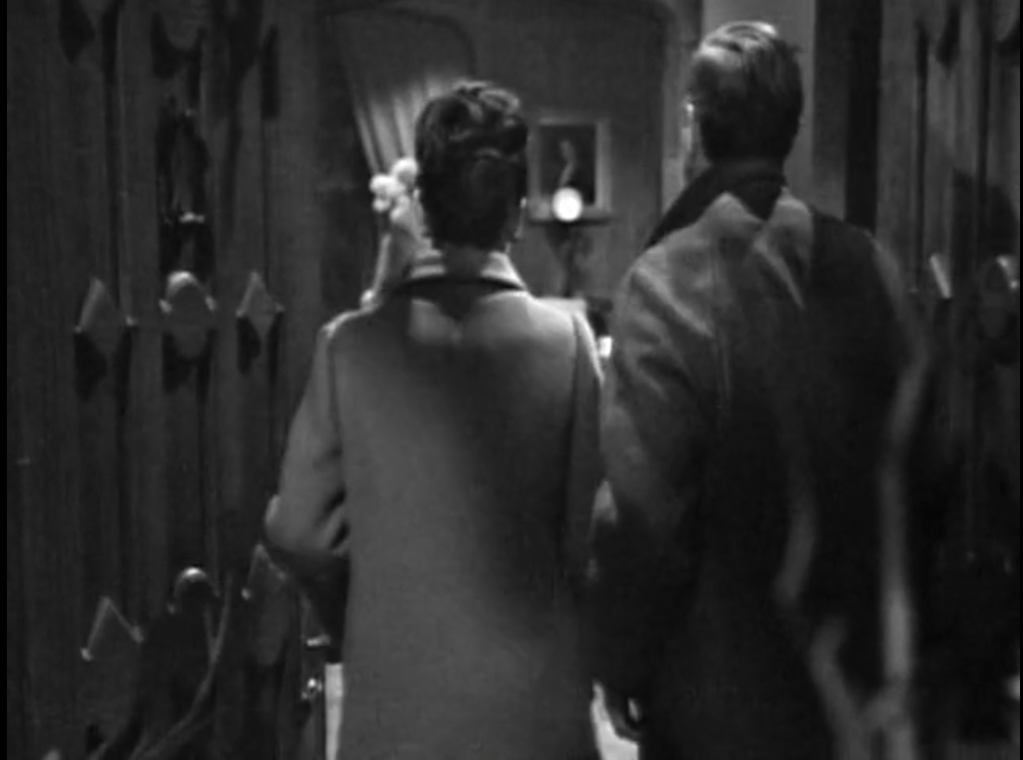
In the first few months of Dark Shadows, events moved along at a leisurely pace. When writers Ron Sproat and Malcolm Marmorstein took over the scripting, that pace slowed further. Yesterday, the story ground to a complete halt, and all twenty-two minutes were taken up with conversations recapping previous episodes. We are still stuck in place today. Not only is it nothing but recapping, the recaps are embedded in reprises of conversations we have already seen.
In the drawing room in the great house of Collinwood, well-meaning governess Vicki tells visiting parapsychologist Dr Guthrie about the relationship between strange and troubled boy David and the ghost of Josette Collins. This is all recycled from conversations Vicki has had with her boyfriend, instantly forgettable young lawyer Frank.
In a cottage elsewhere on the estate, David is talking with his mother, blonde fire witch Laura. They are having the latest in what is coming to be a long series of conversations about whether David wants to go with her or stay at Collinwood with his father. They just review facts already familiar to us.
David returns to the great house and meets Dr Guthrie. They talk about the ghosts David has seen. Dr Guthrie is the first character to react to David’s stories calmly and without disbelief from the beginning. Still, we’ve heard David tell all these stories before. Vicki now matches Guthrie’s attitude completely, and his way of putting questions to David is the same as that of wildly indiscreet housekeeper Mrs Johnson.
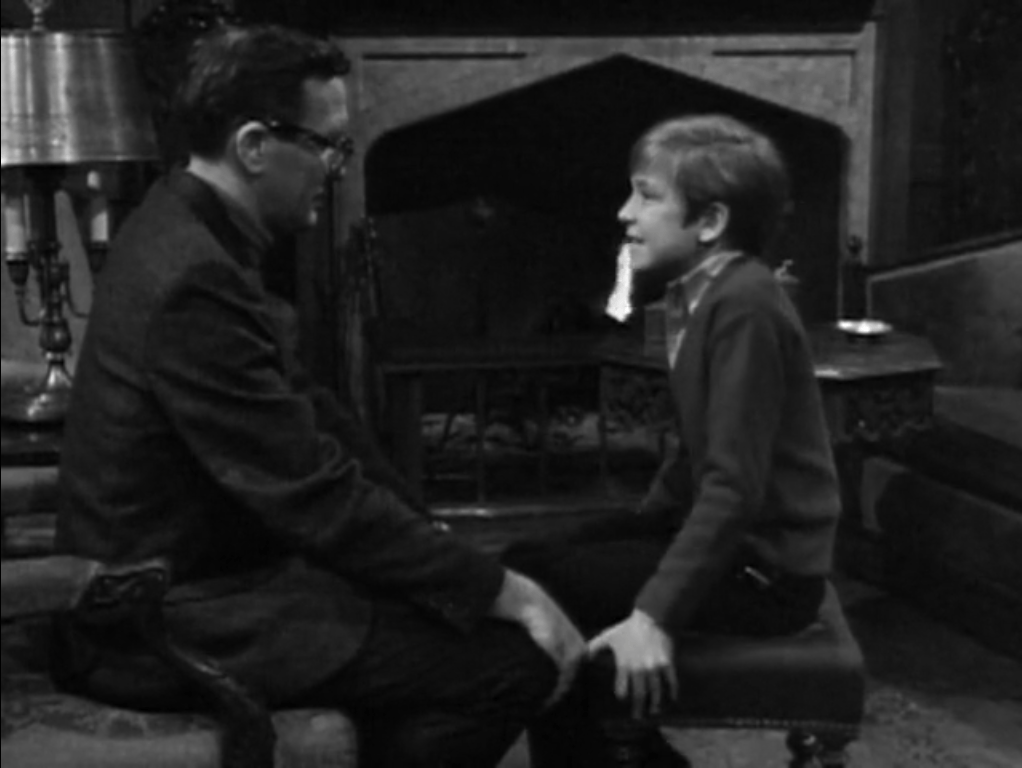
If the episode has a high point, it comes in the middle of this conversation. When David first meets Dr Guthrie, he stands stiffly in front of him. Indeed, throughout the episode the actors are quite stiff, determined to stay afloat when they know the script hasn’t given them a drop of water. When it becomes clear to David that Guthrie is going to take him seriously, he relaxes. He grabs a footstool, sits in front of Guthrie, and starts gabbing away. At that moment, the actor David Henesy transforms into the character David Collins.*
David tells Guthrie all
Vicki goes to visit Laura in the cottage. For the last few days, Vicki has been in control of the house, control she has maintained in part by lying to everyone. Lying is what protagonists do in soap operas, and Vicki has risen to the occasion admirably. At first she tries to lie to Laura, telling her that she isn’t trying to keep David away from her, but only insisting that he stay current with his studies. Laura bats that story away easily. Vicki is pretty sure that Laura is a creature of the supernatural, and apparently concludes that there isn’t much point trying to lie to her. So she tells her part of the truth, which is that her boss, reclusive matriarch Liz, has ordered her to keep David away from her. This was a fairly interesting scene the first time they played it in #152, and not entirely without interest when they revisited it in #159. This third time, Laura ends the conversation with an overt threat. That adds to a long list of indications we’ve already seen that Laura is at once growing in power and running out of time.
David took Vicki to the Old House on the estate to see the ghosts in episode 70, and took his mother there to see them in #141. So he takes Dr Guthrie there today. In #70, we saw that Josette’s portrait above the mantelpiece in the Old House glows when her ghost is present, and in #141 David explained that Josette appears to only one person at a time. Today, both Vicki and David explain this same point to Dr Guthrie. He leaves David alone with the portrait. David has a conversation with the portrait modeled on the one he had with it in #102. The portrait does start to glow, and transforms into the painting of David and his mother immersed in flames that dominated the show for a couple of weeks. Evidently Josette is still trying to warn David about the danger his mother represents.
The portrait transformed
By the standards of the first year of Dark Shadows, the transformation of the portrait is a major special effect. Coming as it does at the end of an entire episode spent reworking scenes that weren’t exciting the first time we saw them, it shows the limits of what special effects can do to make up for bad writing. In a suspenseful installment, even an effect as modest as a spotlight shining on the portrait while the theremin plays can be effective. This time, we’re left waiting to see if Josette has any more slides to show David.
This episode consists entirely of conversations in which the characters recap events we have already seen. To the extent that it has a point, it is that while flighty heiress Carolyn seems to be in charge of the house, well-meaning governess Vicki actually is. Vicki made her boyfriend, instantly forgettable young lawyer Frank, take the idea of the supernatural seriously enough to call in an expert on the subject, Dr Peter Guthrie of Dartmouth College. Vicki then made Dr Guthrie agree to conceal from everyone else information he would normally share freely. She has made Carolyn go along with Dr Guthrie’s activities. Today, Carolyn’s uncle, high-born ne’er-do-well, Roger, asks Carolyn about Dr Guthrie. Carolyn tells Roger that it was her idea to call Dr Guthrie in. She directs Roger to cooperate with Dr Guthrie, not mentioning Vicki, but invoking the authority her ailing mother, reclusive matriarch Liz, has entrusted to her.
To explain how the performances and the visual composition keep it from being excruciatingly dull, you’d have to go over the whole thing frame by frame and analyze each of hundreds of decisions the actors and director made that held the episode together. Impressive as their efforts were, the result is far from exciting. So even if I had the expertise to provide that kind of commentary, I would not for a moment consider doing it.
One thing I will mention is that we see a lot of the kitchen at Collinwood in this episode. Usually this set is one where the characters exchange story-productive information. No such information is exchanged today. The scenes play out in a way to soften that disappointment for us.
The kitchen is typically a small space where the characters share a meal, giving rise to a natural intimacy. There’s no meal today- Vicki and Carolyn are sitting in front of the coffee things, but it isn’t until Dr Guthrie enters that it becomes clear that there is any coffee. There certainly isn’t any food to be had. Nor does the space seem particularly small. The plants are as extravagant as we ever see them, creating a sense of luxuriant growth. In the course of her conversation with Vicki, Carolyn manages to move around the room so much that she gives us the feeling of a large space. Even for someone as short as Nancy Barrett, there are very few patterns of movement that can leave us with that impression. She and the director* worked out one such pattern, and she executes it flawlessly.
Carolyn among the plantsVicki and Carolyn in the jungleBy the pantryLong shot
*There seems to be some question as to who directed this episode. John Sedwick has the credit on screen, but the Dark Shadows wiki says it was Lela Swift. Sometimes the wiki is edited by people who have seen the original paperwork from the making of the show, so occasionally it is right and the credits are wrong.
Reclusive matriarch Liz is in a catatonic state, and her doctor is at a loss to explain why. Well-meaning governess Vicki has confided in her boyfriend, instantly forgettable young lawyer Frank, that she thinks Liz is the victim of blonde fire witch Laura. Frank has sent for a Dartmouth psychology professor, Dr Peter Guthrie, whose research concentrates on reports of paranormal phenomena.
Keeping vigil in Liz’ room, Vicki tells Liz’ daughter, flighty heiress Carolyn, that she and Frank have sent for another doctor. When Carolyn asks what Dr Guthrie specializes in, Vicki claims not to know. A few minutes later, Dr Guthrie shows up and has a brief conversation alone with Vicki. He asks her if she knows what he specializes in, and she immediately gives the correct answer. Now that the audience knows without doubt that Vicki was lying to Carolyn, she asks Dr Guthrie what she should tell the others in the house if they ask about him. He says that he is in fact a psychologist who studies psychosomatic ailments, so she can tell them that. When he says that he is uncomfortable with secrecy, Vicki asks him if he understands why absolute secrecy is necessary in this case. She doesn’t leave him much choice but to agree.
Dr Guthrie takes his first look at the drawing room
The whole episode is very awkwardly written. There’s so much repetition, unnecessary dialogue, and unexplained change of attitude from scene to scene* that it’s hard to avoid the conclusion that it could have been five minutes long. But the actors make me glad it went the full twenty-two minutes. It’s interesting to see Vicki manage Dr Guthrie in the same way Liz manages everyone- at first she is understated and demure, and before you know it she is so fully in command that you would feel like a ruffian if you were to disobey her.
John Lasell’s performance as Dr Guthrie is tremendous. He disappears into the character- I’ve never had a harder time recognizing the same actor in two roles than when I found out that the same man who played the quiet, methodical, entirely trustworthy scientist from upper New England in Dark Shadows also played the floridly romantic, flamboyantly sinister, and emphatically Southern John Wilkes Booth in the Twilight Zone episode “Back There.” Every fine muscle of his face and eyes represents a well-thought-out acting choice. When it is Lasell’s turn to take the spotlight, he not only commands the screen, but creates a whole new atmosphere- when he’s on, the show suddenly feels like a primetime broadcast or a feature film. And when he’s around, the whole cast, even Joan Bennett who spends the entire episode being absolutely still, is obviously having fun giving a performance.
*For example, a few minutes after acquiescing in Vicki’s insistence on secrecy, Guthrie demands of the apparently reluctant Vicki and Carolyn that they maintain secrecy. In the interval, we saw Guthrie so absorbed in his examination of Liz and the young women so distraught about her condition that it doesn’t feel like a contradiction, but that’s a credit to the actors, not to the script.
Strange and troubled boy David has tried to murder his father, is in danger because of his fascination with his mother, and has dreams which, if interpreted correctly, will explain his problems. Today, his mother tells him with coquettish gestures and a purring voice that a man should know how to tend a fire, and tells him he can put a log in her fireplace any time he wants. There is something somehow familiar about this storyline, as if it were making a reference to a theory that was influential among highly literate New Yorkers in 1967.
By the fire
The episode begins with well-meaning governess Vicki and her boyfriend, instantly forgettable young lawyer Frank, recapping recent events that suggest to them that David’s mother, blonde fire witch Laura, is a creature of the supernatural. Frank thinks of Dr Peter Guthrie, a professor at Dartmouth College who specializes in the paranormal. He identifies Dr Guthrie as a parapsychologist, suggesting that he would be housed in Dartmouth’s Department of Psychology and Brain Science. Evidently that department was known in those days for its faculty members’ adherence to the thought of someone called Sigmund Freud. I suppose I should look that Freud fellow up and see what his ideas were.
As Conard Fowkes plays him, Frank is utterly believable as someone you would meet in a lawyers’ office in central Maine in the mid-1960s. He is so much a citizen of the daylight world of facts and logic and the recognized laws both of nature and of the state that it is surprising that he is willing to acknowledge evidence suggesting that he is in the presence of supernatural forces. Surprising, but not interesting- Fowkes shows us Frank simply accepting the facts once he has seen them and agreeing with Vicki’s interpretations once he has heard them. He does nothing to suggest that any particular emotional process is making it difficult for Frank to take a place in a world with ghosts and witches, still less that there is any unknown side of his personality that has prepared him for this information. In the hands of a livelier actor, the fact that Frank has the name and phone number of a parapsychologist at his fingertips would be a revelation that would leave us wanting to know just what else Frank knows that Vicki might find exciting. As it is, Frank generates all the dramatic interest of a search through the Yellow Pages.
Blonde fire witch Laura Murdoch Collins has returned to Collinsport, Maine, after a long absence. She wants to divorce her husband, high-born ne’er-do-well Roger Collins, and to go away with their son, strange and troubled boy David. Roger is delighted by this prospect, but he is dependent for his living on his sister, reclusive matriarch Liz, and Liz is adamant that David must stay with her in the great house of Collinwood.
Last week, things came to a head between Laura and Liz. Liz declared that she would never let Laura take David, and Laura responded by casting a spell on Liz. As a result of the spell, Liz is bedridden and given to bouts of confusion.
Well-meaning governess Vicki suspects that Laura is connected with the supernatural. Yesterday, Vicki and her boyfriend, instantly forgettable young lawyer Frank, came across some documents that she interpreted to support this suspicion. Frank is one of Liz’ attorneys and Vicki is for all intents and purposes a member of the Collins family. Further, the ghost of Josette Collins has intervened a number of times to guide Vicki to become the protagonist in the story about the dangers Laura poses. So it would seem that a potent alliance is taking shape against Laura.
Today, another member seems to be joining this force. Liz’ only acknowledged child, flighty heiress Carolyn, initially reacts to the doctor’s recommendation that her mother be moved to a hospital in Boston by agreeing to talk her into it. Then it dawns on her that it would be very convenient for Roger and Laura if Liz were away from the house. She makes some pointed remarks to each of them in turn. She does not say that she thinks Laura is responsible for what happened to Liz, but she is hostile enough that she is unlikely to discourage Vicki’s efforts.
As Liz, Joan Bennett has a lot of screen time today, all of it in bed. You can see why she was such a big movie star in her youth- all she really has to work with are her eyes, and with those alone she holds what could have quite a dreary episode together.
Liz looking at Roger with alarm
Liz considers the idea of going to the hospital, and tells first Carolyn, then Vicki, to stand up to Laura. When each points out in her turn that, as David’s parents, Laura and Roger have certain legal rights to which they must yield, she declares that they are too young to fill in for her in her absence, and resolves to stay in the house.
Vicki leaves the room and Laura appears, sitting on the foot of Liz’ bed. Liz is outraged and demands to know who let her in the house. Laura assures her that no one else knows she is there. The first time Laura insinuated herself into the house, lighting effects made her look like a ghost. She interacted only with David, in circumstances that suggested the whole thing might be a dream he was having, then vanished. Now she is very corporeal, and after her talk with Liz she heads downstairs to talk with Roger and Carolyn in the drawing room. She seems to be gaining strength, becoming able to sustain her form and assert her personality for longer periods. The alliance forming against her will have its work cut out.
Carolyn goes up to Liz’ room while Roger and Laura talk about what Liz’ absence might mean for their divorce. Roger says that as long as Liz can speak, she can keep them from getting what they want. Laura says that may not be as much of a problem as he thinks. At that, they hear Carolyn scream. Roger runs up to Liz’ room and finds that she is catatonic. In the drawing room, Laura smiles.
In episode 10, reclusive matriarch Liz had napped in a chair in the drawing room of the great house of Collinwood. Her sleep was troubled by unpleasant dreams; we saw her shifting in the chair and heard her muttering about ghosts. Strange and troubled boy David awakened her when he came in, having just sabotaged his father’s car in an attempt to murder him.
Liz’ troubled sleep in episode 10
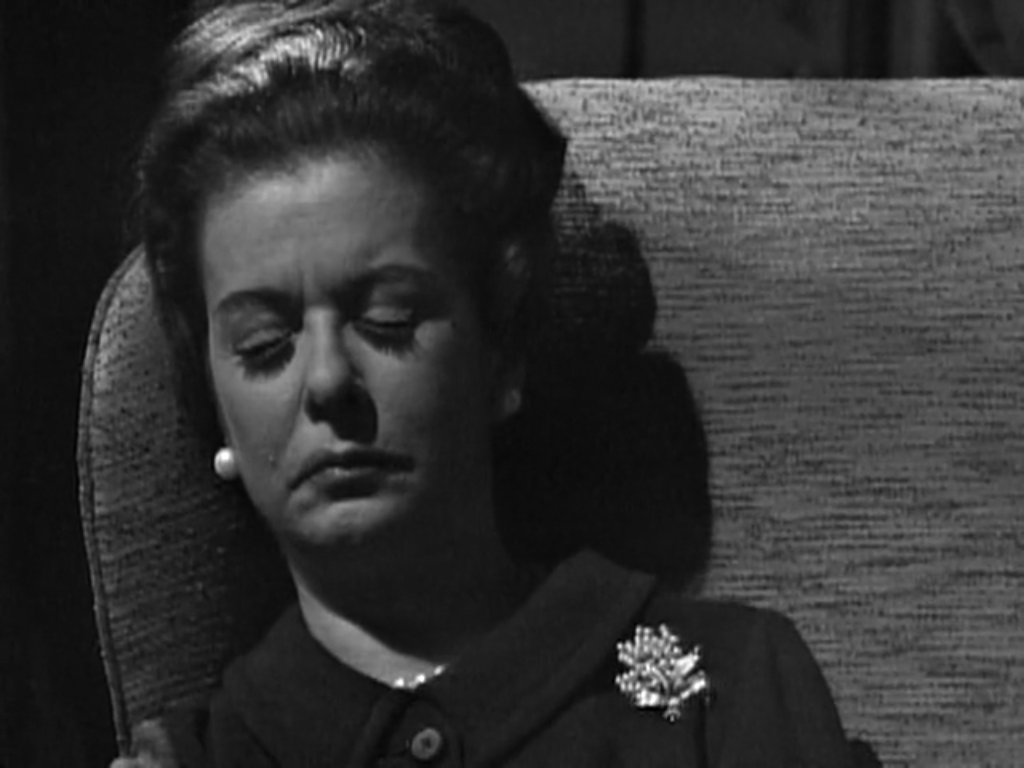
Today, we open with well-meaning governess Vicki sleeping in the same chair, showing the same signs of discomfort, and muttering in her sleep words she had heard Liz say in a mad scene at the end of yesterday’s episode: “fire… stone… bird…”
Vicki’s troubled sleep in episode 157
Vicki awakens, not to find David returning from a homicidal errand, but to be overwhelmed by the presence of the ghost of Josette Collins. She smells Josette’s jasmine perfume, and the picture is out of focus. She walks around the room talking to Josette, whom we can neither see nor hear. She agrees to some instruction from Josette only she can hear.
Vicki’s boyfriend, instantly forgettable young lawyer Frank, shows up. He is complaining that Vicki called him at 5 AM, asked him to come over at once, and still won’t explain why.
Liz’ brother, high-born ne’er-do-well Roger Collins, appears at the top of the stairs and demands to know what Frank is doing in the house. Vicki claims that she wants Frank to take her for a drive in the country to help her clear her head. This makes sense to Roger. Liz is in a very bad way, for no reason the doctors can determine, and it has been a rough night in the house. Roger tells Vicki that he thinks it would be a good idea if she and Frank did take a drive. He is going to need a lot of help today, and the more relaxed Vicki is, the better able she will be to provide it.
The audience knows what Vicki has come to suspect, that Roger’s estranged wife Laura is a blonde fire witch who is responsible for Liz’ condition. Laura is staying in the cottage on the estate and she and Roger have begun the process of divorce. Laura and Liz clashed about guardianship of David, and Laura responded by casting a spell on Liz. With something like this in mind, Vicki wants Frank to take her back to a cemetery where they found some clues about Laura last week.
It is interesting to see Vicki with Frank in this episode. She is usually very demure, rarely looking anyone directly in the eye and consistently using a soft, delicate voice. She is that way today when Roger is around. But she looks straight at Frank and tells him in a crisp, candid tone just what they are going to do and why they are going to do it. That’s one of the reasons I keep wishing someone other than Conard Fowkes had played Frank. Fowkes is so dull that he simply could not survive on a show like Dark Shadows, but Frank is a character who gives us a chance to see a seldom-glimpsed side of Vicki.
Frank and Vicki visit the Caretaker of the cemetery outside town. In the archives of his building, Vicki smells jasmine and feels Josette’s presence. The Caretaker catches a distant whiff of jasmine too, but only Vicki’s nose can lead her to where Josette wants her to go. Josette pushes a book off a shelf and opens it to a page about a Laura Murdoch Radcliffe, who died by fire in Collinsport in 1867. Since they already know of another Laura Murdoch who died by fire there in 1767 and of someone who is medically indistinguishable from Laura Murdoch Collins who died by fire in Arizona earlier this year (1967,) Vicki finds great significance in the interval of 100 years. She tells Frank that the Laura Murdochs who died in Collinsport in 1767 and 1867 and the woman who died in Arizona this year are parts of the same corporate entity that is represented by the woman staying in the cottage.
Patrick McCray and Wallace McBride of “The Collinsport Historical Society” gave up writing daily episode commentaries around the time Ron Sproat joined the writing staff of Dark Shadows, but McCray does have a post about this episode. As usual, his remarks are thought-provoking:
We are about fifty episodes away from the introduction of Barnabas Collins, and you can feel the show straining with the need for it. We are at least watching a supernatural show, now. Going back to something less exotic will take the charm of a Dennis Patrick to pull off. He and Laura have something new that they are bringing/will bring to the show. One of the problems with the first six months of the show is how sad it is. The villains are wracked with guilt, somewhat grating in their personalities, and driven by necessity. Laura changes that. Her contribution to the show is less supernatural than philosophical. She likes who she is. She likes what she’s doing. She is demented enough to see that burning David alive is just dandy. Contrast this with Roger. He just wanted to be left alone, like a quietly queeny, ineffectual Hulk.
I’m not at all sure Laura “likes what she’s doing.” Most of the time, what she’s doing is sitting motionless by the fire. She is stirred from that position only when someone calls for her, and then only with difficulty.
The only times happiness registers on Diana Millay’s face are when Laura is talking to David and telling him about the blissful life that awaits in the fantastic realm she comes from, not about the path she must take to approach that realm. At other times, her dominant mood is weariness and her manner is so distant as to be inscrutable. With characters other than David, she is energetic and immediate only when she flies into a rage.
We don’t even know how many of her there are. Vicki tells Frank at the end of today’s episode that Laura seems to be made up of four components, but the audience also knows of ghostly apparitions that seem to travel with those corporeal Lauras and to be at least partly independent of them. Maybe somewhere in that complex there is a spirit that delights in the idea of taking David into a pyre, but we don’t see that delight.
McCray goes on:
Burke? He just wanted to even the odds. I get that. But his victory would mean shutting down Collinwood, and that gives any viewer mixed feelings. As much as I like Burke, his storyline misfired because you’re left with nobody to root for. If Burke wins, the show has to end, and that’s not going to happen. For Burke to lose, justice must elude him once more, and a character we like goes away. I suppose that the show originally was so Vicki-centric that we weren’t supposed to care for either Team Burke or Team Collins compared with Team Winters. With the arrival of Laura, all of this changes. (I say this because Matthew was a loon and couldn’t take pride in his wrongdoing.) Like Burke and Roger or not, everyone is pitted against/used by the first in a series of Gloucesters employed by the series to delight viewers.
Ibid
McCray is exactly right that Burke’s original storyline could never be resolved. The character had an even bigger problem that prevented the writers from coming up with a new storyline for him. That problem is his type. As a dashing action hero, sooner or later he’s going to have to rescue someone. Yet he never gets to save anyone from anything.
The first three rescues on the show are all rescues of Vicki. David locks her up and leaves her to die in the abandoned part of the great house of Collinwood. Burke doesn’t have access to that part of the house, so she ends up being rescued by Roger, of all people. That adds some complexity to Vicki’s attitude to Roger, keeps her from catching on to some plot points she isn’t supposed to understand yet, and most importantly enlarges the obstacles keeping her from befriending David, thereby enriching the one narrative arc that works every time we see it.
Next, gruff groundskeeper Matthew tries to break Vicki’s neck in the cottage. Liz saves her that time. It would have to be her, since she is the only person Matthew listens to. That’s the in-universe reason. Also, Joan Bennett is the biggest star on the show, the origin of the relationship between Liz and Vicki is supposed to be the biggest secret in the show, and the mostly-female audience of a daytime soap might be interested in a scene where a female character saves the day. So it is more satisfying all around to have Liz rescue Vicki from Matthew than it would have been to have Burke barge in.
When Matthew is holding Vicki prisoner in the Old House on the estate and is about to swing an ax at her head, Burke is in the area looking for her. But it is the ghosts of Josette and the Widows, accompanied by the ghost of beloved local man Bill Malloy, who rescue Vicki then. Burke and Roger show up after the fact and walk her home. The show has spent so much time building up the ghosts and the supernatural back-world behind the continuity in which the characters operate that it would be a cheat if they did not come forward at this point and bring a story to its climax. Again, Burke is left on the outside looking in.
Now David needs rescuing, but since the show’s most reliably interesting storyline has been the budding friendship between David and Vicki, she is the only one who can be his rescuer. Burke is got out of the way by having Laura entrance him with the memory of their old love. Since the threat to David is supernatural, this is also an opportunity to bring the ghosts back into play.
When the vampire story begins, Burke will become entirely superfluous. A dashing action hero can’t allow a bloodsucking fiend to run amok. But stop the vampire, and you stop the first ratings generator the show has ever had. So that will finish Burke once and for all.
Further:
I may be so-so on the Phoenix as a big bad on the show, partly because she was such an out-there villain, grounded in an unclear mythology. Nonetheless, she ushered in a sentient, supernatural threat and a new school of evil that finally gave viewers a moral compass to lead them through Collinsport.
Ibid.
It may be pedantic to point this out, but it is the nature of supernatural mythologies to be unclear. Once you pass the point where the laws of nature that we can examine out in the open apply, it’s up to the audience to guess at what the alternative structure of cause and effect might be. The storytellers can guide our guesses. Vicki’s discovery that the three Laura Murdochs died by fire in 1767, 1867, and 1967 leads her to tell us that the hundredth anniversary of the previous fire has the power to cause the next one. The power of anniversaries will indeed become a major part of Dark Shadows’ cosmology, coming up in several future storylines, and is the inspiration for my posting these blog entries at 4:00 pm Eastern time on the 56th anniversary of each episode’s original broadcast.
When you get to vampires and witches and Frankensteins and werewolves and other relatively familiar monsters, you can draw on horror movies produced by Universal Studios in the 1930s and endlessly shown on television since the 1950s, and beyond those on the plays, novels, and folklore from which those movies derived some of their imagery. That reduces the amount of explaining the protagonist has to do. We all know what blood and bats and wooden stakes and crosses and mirrors and daylight signify in connection with vampires, for example. That creates an impression that there are clear and logical rules, but when you hang out with the vampire for a thousand episodes you start to realize just how little sense any of those rules really make.
Laura is interesting precisely because she starts without any of that unearned sense of clarity. The show has to build her up to the point where she makes enough sense that we are in suspense, but not to go beyond that point and explain so much that we can’t avoid realizing how disconnected she is from the world we live in. I’d say they strike that balance quite well.
Moreover, because we have so little information about Laura, she is the perfect adversary for the supernatural beings we have met so far on the show. The ghosts of Josette and the Widows are definitely around, but they are deep in the background, seldom seen, even more seldom heard, and when they do intervene in the visible world their actions are brief and the consequences of them ambiguous. These vague, distant presences are credible as a counterforce to a figure as undefined as Laura, but have to evaporate when a menace appears that calls for a dynamic response sustained over a long period. Since the show has spent so much time hinting around about Josette and the Widows, it would be a shame if they hadn’t come up with a supernatural adversary for them to engage.
Back to McCray:
This episode is rich in atmosphere and menace, but anything involving the mysterious Caretaker will do that. It serves up Collins history as a net that strangles generation after generation… and the place where the answers to today’s mysteries will be found. The show has always been about the past… Paul Stoddard, the car accident, Vicki’s parentage… but (Widows notwithstanding) never beyond the lifetimes of the protagonists. By having our heroes deal with ancient dangers that still long to cause harm, DARK SHADOWS truly begins.
Ibid.
I demur from lines like “Dark Shadows truly begins” at some point other than episode 1. The whole wild ride of improvisation and reinvention is what I find irresistible. Each period of the show has some connections to the one immediately before it, but as time goes on there is absolutely no telling where they will go. Watching this part, the so-called “Phoenix” story, you can just about see how it follows from the moody, atmospheric showcase that Art Wallace and Francis Swann’s scripts provided for fine acting, ambitious visual compositions, and evocations of Gothic romance in the first 20 weeks of the series. And you can just about see how the period of the show that comes after it is resolved follows from the Phoenix. But when you look at the stories they will be doing in 1968 and later, all you can do is ask how they could possibly have found their way from here to there. Going along for that chaotic, meandering journey is the fun of it, and you deny yourself a little bit of that fun every time you ignore or downgrade an episode.
I also have reservations about the remark that “This episode… serves up Collins history as a net that strangles generation after generation.” The 1767 incarnation of Laura Murdoch married into the Stockbridge family, and the Caretaker told us they were great and powerful. The 1867 version of her married into the Radcliffes, and the Caretaker is shocked to find that her parents are not listed in his records- the Radcliffes were so high and mighty that none of them would ever have married someone whose parents were not known. So the history that strangles generation after generation is not the history of a single family, but something about the part of central Maine where Collinsport is. “Laura Murdoch” is a curse that falls on each prominent family in the region in its turn.
At the end of Friday’s episode, we saw reclusive matriarch Liz start to fall down the stairs, then saw her sprawled on the floor below. Today begins with a recreation of that scene, but instead of merely starting to fall, actress Joan Bennett tumbles far enough forward that she must really have gone down. It’s an impressive stunt.
Dark Shadows first stunt performer: Joan Bennett
Most of the episode is taken up with Liz’ demented condition and the reactions of the members of the household to it. The audience knows that Liz’ troubles are the result of a spell cast on her by blonde fire witch Laura. At moments Liz is almost able to figure that out herself, but no one else has a clue what is going on. The whole episode is full of standout moments for Liz. If there had been Daytime Emmy Awards in 1967, this would have been the episode Dan Curtis Productions would have sent to the voters to get Joan Bennett her Best Actress award.
At one point, Liz begins to recover her memory and is about to take action against Laura. Before she can reach anyone, a ghostly figure appears in her room. Afterward, she has a mad scene, indicating that she has been rendered powerless.
The ghostly sighting raises some questions about Laura. Is it Laura’s ghost she sees? Or another ghost allied with Laura? Or has her abuse of Liz’ brain led it to produce this hallucination on its own? The show is very indefinite about what exactly Laura is and how she operates, giving us the chance to have a lot of fun speculating about her.
This episode is replete with notable firsts. In addition to the first real stunt of the series, it features the first scene in which Bob O’Connell, as the bartender in The Blue Whale, has lines to deliver.
In that same scene at The Blue Whale, we hear music coming out of the jukebox that we haven’t heard before. It is a medley of Lennon-McCartney tunes rendered in “smooth jazz” style by Bud Shank.
It’s also the first time a conversation on the landing at the top of the stairs leading up from the foyer is photographed straight-on. Several times, we had seen characters talking to each other up there, but always before the camera had been angled up from the floor below. That had created the sense that the conversation was removed from the main course of the action. Today, it’s just another part of the set.
It is the first time we see Liz’ room. Two notable firsts take place there. A favorite prop of Dark Shadows fandom, the so-called “Ralston-Purina lamp,”* has been seen several times in the Collinsport Inn. In Liz’ room today, it makes the first of many appearances in the great house of Collinwood.
The Ralston-Purina lamp
The ghostly figure in Liz’ room is played by Susan Sullivan, who has been acting in primetime on network television more or less continuously for the last 55 years. During the other hours, she writes plays and performs in Dark Shadows audio dramas.
A play she wrote under the title “What Friends Do” was produced by Smartphone Theater and posted on Youtube. The cast is made up of Dark Shadows alums Susan Sullivan, Kathryn Leigh Scott, Mitch Ryan, and David Selby. It’s about four friends in a retirement community during the Covid pandemic, and it’s terrific. The Q & A after includes a lot of stuff that Dark Shadows fans will find irresistible, including a little bit about today’s episode.
The voice that says “Dark Shadows is a Dan Curtis production” at the end of the closing credits does not sound like ABC staff announcer Bob Lloyd. It’s higher-pitched and faster than his delivery, and the vowels are flatter than he articulates them. Perhaps it’s a tape fault distorting Lloyd’s voice, or perhaps he had a cold that day. If it was someone else, it’s another first. The Dark Shadows wiki doesn’t say anything about it, so I assume the surviving records and the published books that use them don’t say it was someone else.
*So-called because its red-and-white checked pattern looks like the logo of the Ralston-Purina animal food company.
We open in the hotel suite occupied by dashing action hero Burke Devlin. Burke is getting a briefing from a paid agent of his whom he placed in the home of his enemies, the ancient and esteemed Collins family. This agent is wildly indiscreet housekeeper Mrs Johnson.
Mrs Johnson has come to report on a conversation between high-born ne’er-do-well Roger Collins and Roger’s estranged wife, the mysterious and long-absent Laura. Mrs Johnson overheard Laura telling Roger that she is keeping Burke pacified by pretending that she will testify on his behalf in a retrial of a long-ago criminal case. When Mrs Johnson relays this to Burke, he flies into a rage. He demands to know who is paying her to defame Laura. Mrs Johnson stands up to his abuse, and he apologizes.
Mitch Ryan and Clarice Blackburn were outstanding actors, and it’s always fun to see them play a scene together. But this doesn’t really make much sense. Whatever Laura’s plans, it is hardly likely that she would advance them by telling Roger that she is going to side with Burke. Since this is a conversation Burke is having with a secret agent in his employ, the audience would expect him to understand deception.
Meanwhile, Laura is in the cottage where she is staying on the grounds of the great estate of Collinwood. She has a visitor- her son, strange and troubled boy David. The head of the Collins family, reclusive matriarch Liz, has forbidden Laura to see David and ordered her to leave the estate. Laura repeatedly urges David to keep his visit to her a secret. She gives him a music box, reminding him to hide it from everyone in the great house.
Moments after David gets home, Liz catches him with the music box. She recognizes it as Laura’s and scolds him for visiting her. She tries to explain why he can’t see his mother. David takes this badly, shouting at her that he doesn’t love her. When she objects that this is a terrible thing to say, he tells her he hates her.
Liz sets out for Laura’s cottage. Laura is there, but she is not alone. Burke has come to ask about the conversation Mrs Johnson overheard. Several days ago, Burke had asked her about her relations with Roger, naming well-meaning governess Vicki as his source. Today, Laura asks if Vicki has been talking again. Thoughtlessly, Burke won’t answer, further convincing Laura that Vicki is her enemy.
Laura starts crying. Burke’s anger evaporates. He embraces her and kisses her. At that moment, Liz enters.
Burke, whom we first saw today in his role as spymaster, tells Liz he’s glad that happened because he likes to have everything out in the open. Liz, who has sealed up most of her house and hasn’t left the estate in eighteen years because she is trying to cover up some hideous secret, says that she also likes that. Burke leaves.
Liz demands Laura leave the estate no later than tomorrow morning, and vows that she will never have custody of David. Laura says that no power on earth can keep her from her son, and tells Liz she will learn to her cost what she is capable of.
Back in the house, Laura’s face is superimposed over the screen as Liz grows faint. Liz starts climbing the stairs. She calls for help, naming Roger and well-meaning governess Vicki. We see her start to fall. Then we see her sprawled at the bottom of the stairs.
The process shot makes it clear that Laura is using witchcraft to control Liz. Burke’s behavior is also uncharacteristic, but it is an open question whether it is the result of Laura casting a magic spell on him, of his own emotions leading him to make a fool of himself, or of sloppy work on the part of the writers.
Eventually, Dark Shadows became the kind of pop culture phenomenon that even people who never saw the show couldn’t really avoid. Most such things spawn catchphrases that become widely familiar and remain so for years. Think of Star Trek with “Beam me up!” or “Warp speed.” To my knowledge, Dark Shadows was an exception to that, with no phrases or expressions spreading beyond its fans. But if it had already been a hit when today’s episode aired, I think a character we meet in it would have been the source of two catchphrases. That character is Cemetery Caretaker, played by DanielF.Keyes.
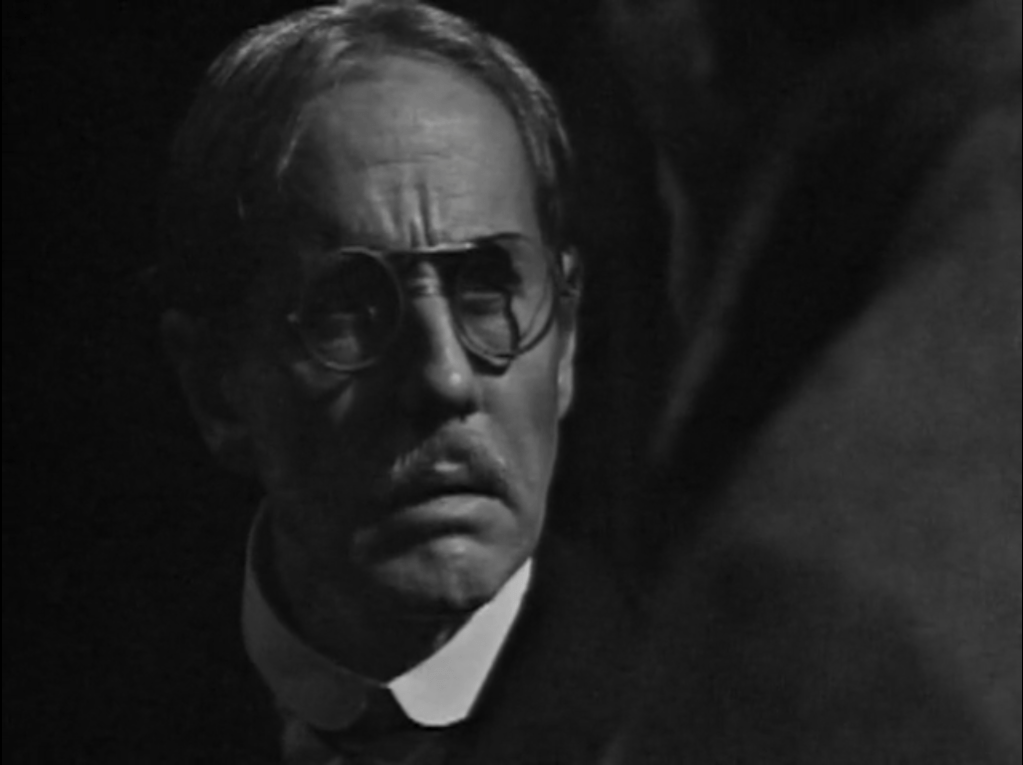
Under the influence of the ghost of Josette Collins, well-meaning governess Vicki has ordered her boyfriend, instantly forgettable lawyer Frank, to take her to a graveyard out in the country someplace. Vicki knocks on the door of a building there, and at length an aged figure in a celluloid collar and wire-frame glasses opens the door. He stands mute for the first minute Vicki and Frank talk to him. When he finally starts speaking, he asks them if they are alive.
Guy’s got star quality
Frank doesn’t show any surprise at the question. You wouldn’t really expect him to- with his personality, he must get that a lot. He assures the caretaker that yes, he and Vicki are alive. The caretaker explains that he often hears knocking at the door, but it is usually the unquiet spirits of the dead.
Some months from now, the caretaker will introduce his second memorable phrase, “The dead must rest!” At this first appearance, we learn why they must. If the dead aren’t resting, they’re going to be keeping him awake all night, and he has things to do in the morning.
Frank tells the caretaker that they are lost. Vicki contradicts him and insists that this is where she is supposed to be. Frank apologizes for bothering him and tries to go; Vicki insists on staying. The caretaker lets them into the building.
Inside, Vicki and Frank find a strange combination of archive and mausoleum. By the standards of Dark Shadows, it’s a big, elaborate new set, a definite sign that something important is happening.
The front room of the caretaker’s buildingVicki examines one of the bookcasesEntering the archive areaIn the archive area
Vicki keeps talking about how fresh the air is, and how full of the scent of jasmine. The caretaker is bewildered by her words, and Frank says the only scents he can detect are must and mold. The audience knows that the scent of jasmine is a sign that the ghost of Josette Collins is trying to attract a character’s attention.
Vicki declares that the source of the scent is in a connected room. The caretaker is reluctant to let Vicki and Frank into that room. He says that it is the final resting place of those members of the illustrious Stockbridge family* who died particularly gruesome deaths. Vicki pleads with him, and he gives in. He does insist that while in the crypt, they must be very quiet- “So quiet, even they can’t hear.”
Entering the crypt areaExamining a plaque
The caretaker talks in a not-particularly hushed stage voice the entire time they are in the crypt, so he must not think the dead have such great hearing after all. He tells the stories of the crimes and accidents that took the lives of each of the people whose remains lie behind the large stone plaques on the wall. When he comes to the last of them, L. Murdoch Stockbridge, Frank interrupts him. “L. Murdoch! I’ve seen that name on legal documents around the office a hundred times!” Frank is handling the divorce of high-born ne’er-do-well Roger Collins from his mysterious and long-absent wife, Laura Murdoch Collins.
Examining THE plaque
Frank asks about L. Murdoch Stockbridge. The caretaker doesn’t know what the L. stood for. He does know that she was a woman, and he can describe the circumstances of her death. One night in 1767, a candle set the curtains around her bed ablaze, and she burned to death. Such remains as are in the niche are little but ashes. He says, and then repeats, “L. Murdoch Stockbridge died by fire! L. Murdoch Stockbridge died by fire!” Once Vicki learns about L. Murdoch Stockbridge, the scent of jasmine disappears and she is in the same dank musty space as Frank and the caretaker.
I heard she died by fire
It’s been three years since Mrs Acilius and I first saw these episodes, and I can still make her laugh by putting on an old man voice and saying “Died by fire!” Sometimes we find ourselves in situations where everyone is being very serious, and someone mentions that a person “died by fire.” I glance at her, and find her biting her lip to keep from laughing out loud. That’s why I say that if Dark Shadows had been at the peak of its popularity in January of 1967, “Died by fire!” would have been one of the great pop culture catchphrases of the period.
Back at the great house of Collinwood, wildly indiscreet housekeeper Mrs Johnson comes into the drawing room while Roger is at his usual station, leaning on the cabinet where the brandy is kept and draining a snifter. She asks him if she can bring him anything. Those are the words, but the voice spells out a stern sermon about the evils of alcohol. Roger goes to sit down, saying nothing of consequence but saying it in a way that makes clear he dislikes and resents her.
Laura enters. Roger sends Mrs Johnson off to make coffee. Alone in the drawing room, Roger and Laura argue about all the things they have been arguing about since she returned from her long absence. There is no new information in the dialogue, but it is good to see another side of Roger. Lately we’ve seen him almost exclusively as the bratty little brother of reclusive matriarch Liz, and his interactions with other characters are dominated by the narcissism that is most fully expressed in his scenes with Liz. When he is the unloving father of strange and troubled boy David, the unsettlingly flirtatious uncle of flighty heiress Carolyn, the cowardly foe of dashing action hero Burke Devlin, or the malign co-conspirator of drunken artist Sam Evans, we see vices that we can trace back directly to his certainty that Liz will always shelter him from the consequences of his actions, whatever they may be. When he stands up to Laura in this scene, we see that there is a semi-functional adult somewhere inside Roger.
Roger and Laura realize that Mrs Johnson has been eavesdropping on their conversation. They are worried about what she might have heard. They do not know what regular viewers know, that she is a paid agent of Roger’s enemy Burke, placed in the house to spy on the Collinses. They do know that she has a big mouth, though, and since the last words they spoke were about a crime they want to keep covered up that’s enough to give them pause.
Frank brings Vicki home to Collinwood. Standing outside the front door, they remark on the caretaker’s frequent muttering of “died by fire! Died by fire!”
Reviewing their visit to the caretaker
Vicki reviews all of the strange occurrences that have taken place since Laura’s return. She sums up the whole course of any story about people investigating the supernatural- “It seems connected- and yet so unconnected.” By the laws of nature as science describes them, by the ordinary logic of waking life, none of the events she lists means anything. It’s only after you accept the idea that uncanny forces are at work that they form a pattern pointing to Laura. The audience can accept that, because we can hear the theremin on the soundtrack. Vicki and Frank have a harder time.
Frank tells Vicki he has to get home. She invites him in for a drink. He replies “You make it a stiff one, and you’re on!” That’s what you need before a long drive on dark, winding roads, to get tanked up on a lot of booze. They open the doors and walk into the house. The camera dwells on them as they make this procession. As they had gone through doors that led to L. Murdoch Stockbridge, now they go through the doors that lead to L. Murdoch Collins.
Entering the house
Vicki and Frank join Roger and Laura in the drawing room. The men drink brandy, the women sip coffee. Vicki asks Laura about her family background, claiming that David is curious about it. Laura responds merely that her family is a distinguished one and had been in the area for a long time.
Roger tells Frank that he will be hearing from Lieutenant Riley of the state police tomorrow. Laura objects that she doesn’t want to talk about Riley’s message, Roger says there won’t be any conversation- he will simply announce the lieutenant’s laughable news. The authorities in Phoenix, Arizona are convinced that a charred corpse found in Laura’s apartment there is hers, and that she died when the apartment building burned to the ground. Vicki looks at Laura, and with a strange smile says “Laura Murdoch Collins died by fire.”
“Laura Murdoch Collins died by fire”
*The caretaker was deeply versed in the lore of the Stockbridge family, and told Vicki and Frank that most of the graves in this eighteenth century cemetery were theirs. Yet he showed no glimmer of recognition when Vicki mentioned Josette Collins to him. That suggests that the Stockbridges were leading citizens of the area before the Collinses rose to prominence.
It might be interesting if someone would write a story in which the first Collinses were servants of the Stockbridges who got rich by doing their dirty work. Maybe the first and darkest shadow of all was that some colonial Collins scabbed on his fellow employees when they were trying to get a fair deal from the Stockbridges. I’m not up on Dark Shadows fanfic, for all I know there may be whole novels out there on this theme.
High-born ne’er-do-well Roger Collins had some bad news several weeks ago when he learned that his estranged wife, the mysterious and long-absent Laura, had come back to town. His consternation turned to joy when he learned that Laura wanted to divorce him and leave with their son, strange and troubled boy David.
The one obstacle in the path of the divorce is Roger’s sister, reclusive matriarch Liz. Roger has squandered his entire inheritance and has no inclination to make himself useful enough to anyone to earn a living. He therefore lives as a parasite on Liz, living as a guest in her house and drawing an income from a sinecure with her business. Liz distrusts Laura and sees in David the only hope that the family name will continue. She is determined to prevent Laura from taking David, and Roger has to appease her.
Today, Liz is disturbed that the authorities in Phoenix, Arizona keep insisting that Laura is dead. She lived in an apartment there which burned to the ground. The medical examiners in Arizona have now inspected the charred remains of a woman found inside, and the dental records are a perfect match for Laura’s. Lieutenant Dan Riley of the Maine state police shows up to inform everyone of this fact and to convey Arizona’s request that Laura submit to a physical.
Riley has some rather peculiar mannerisms. When Roger answers his knock to let him into the great house of Collinwood, he finds him standing at the door, staring off into space at a right angle to him. I’ve answered many a door in my day, and I don’t believe I have ever found anyone on the other side presenting his profile to me in this way. It is truly an odd thing to see. I suppose director John Sedwick must have told him to do that in order to make some kind of point, but I can’t for the life of me imagine what that point might be.
Lt Riley presents his profile to Roger
Roger is dismayed that the bizarre situation created by Arizona’s insistence that his wife is dead threatens to postpone his final farewell to Laura and David, but he does see the funny side of it. He and Liz take Riley to the cottage where Laura is staying. Before Riley can start talking, Roger asks Laura how it feels to be dead. The show has been giving us lots of clues that Laura is a revenant of some kind, and both Liz and David’s well-meaning governess Vicki have taken note of some of these clues. Laura’s shock when Roger puts that question to her strikes her silent for a whole commercial break. When they come back and we find him teasing her with the news from Phoenix, we might wonder if she’s about to betray herself- “I haven’t been dead for weeks, not altogether anyway!” But instead she just sputters and postures, behaving as if offended. Roger is puzzled by this reaction, and asks what happened to her sense of humor. Apparently his comments are the sort of joke that used to make her laugh.
Riley does not doubt that the Arizona authorities have made a mistake and that Laura in fact is the person everyone in the town where she grew up, including her husband, her ex-fiance, her disapproving sister-in-law, and the sheriff, has taken her to be. He simply asks them to play along and help his colleagues in Arizona to complete the routine tasks required of them. Among the questions she answers correctly is that it was her idea to name her son “David Theodore Collins.” Roger had wanted to name him “Charles Andrew Collins,” after some of his ancestors, but she insisted on calling him “David,” a name no previous Collins had ever borne. At Roger’s instance, Laura agrees to go to a doctor so that Riley will be able to send the Arizona officials the paperwork they need.
After Liz and the policeman have left Laura alone, Roger asks her what she isn’t telling about the fire in Phoenix. She is alarmed that he might attach some weight to the identification of the body as hers. He at once dismisses that as too ridiculous for words, but says that he is sure she knows more about the dead woman than she is telling. She won’t budge from her denials, and he tells her that while he will be glad to publicly support any lie it might be useful for her to tell, they really ought to share the truth in private.
That evening, Vicki is on a date with Roger’s lawyer, instantly forgettable young Frank Garner. She tells Frank she is glad that David is warming to Laura. He says that there are so many unanswered questions about Laura that he fears Vicki’s attitude towards her is excessively charitable. He does not think that Vicki or anyone else really knows enough about Laura to be sure that she ought to be trusted with David’s care.
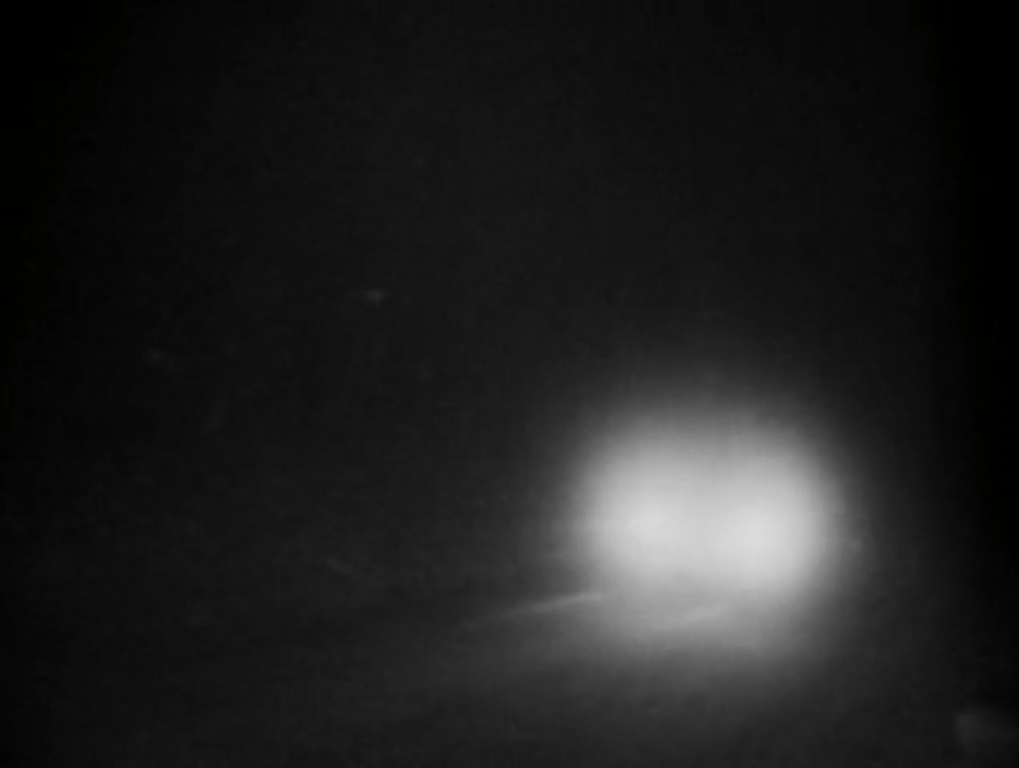
After dinner, Vicki is a passenger in Frank’s car. We are introduced to this fact by a shot of a car’s headlights coming at us, a shot previously used in an early promo for Dark Shadows.
Car
While Frank is droning on about who knows what,Vicki looks off in the distance and smiles broadly. Frank sees this big smile, recognizes that nothing he is saying could elicit so vivid a reaction, and objects to her ignoring him. She says that the scent of jasmine is all around. He says he doesn’t smell anything.
The scent of jasmine has been established as the sign that the ghost of Josette Collins is present. Josette has been trying to warn everyone that Laura poses a threat to David, and Vicki is especially susceptible to communication from her. So regular viewers will know that Vicki is now acting under instructions from Josette.
Vicki starts issuing commands. She orders him to take the next right turn, then a left, and finally to stop in the middle of a field. When Frank asks whether she has ever been there before, she says no. When he asks if she knows where they are, she says no. When he asks why she keeps giving these orders, she says that “It is where I am supposed to be.” He realizes that they are in a cemetery.
Vicki jumps out of the car and runs up to the door of a small building. She knocks furiously at the door. Frank comes running after her, asking her what she is doing. Again, she will only say that it is where she is supposed to be. When she knocks, he tells her no one can possibly be in there. It is a chapel or some other kind of public building, there is no public event taking place in the cemetery, and it is long after regular business hours. Vicki listens to him and starts to move away from the door. Then, she sees the door handle turn. She and Frank watch as the door opens.
Vicki arrives at the buildingWhere she is supposed to be
Dark Shadows never had much of a budget for sets. Every time we see a new one, even one as modest as this, it is a sign that something important is about to happen.