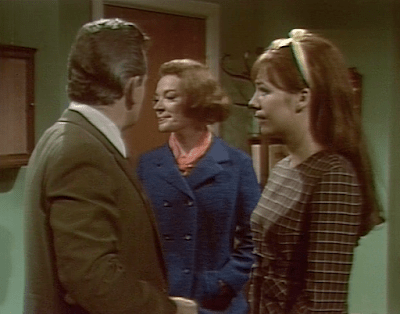
Episode 481: Every time, it will be the same story

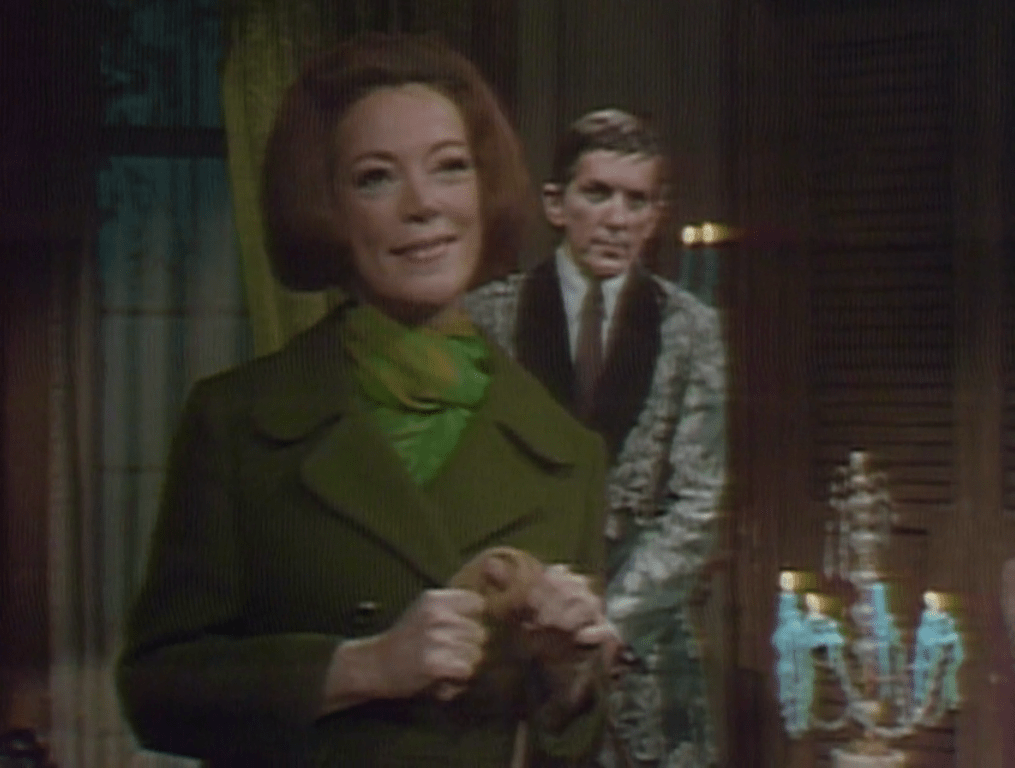
Dr Julia Hoffman is in the front parlor of the house of her fellow mad scientist, Eric Lang. She is on the telephone, asking the operator to connect her with the police. Even though she has lived in the Collinsport area for months now, she is still surprised that the sheriff’s office doesn’t have an emergency number.

Julia locked the door to the parlor; Lang is outside it with a gun, and recovering vampire Barnabas Collins is knocking and calling her name. They want to stop her reporting to the police that Lang is building a Frankenstein’s monster with body parts retrieved from the cemetery, and that he was planning to cut a living man’s head off to use as the last piece of the creature. Lang plans to bring the body to life by draining Barnabas’ “life-force” into it. Barnabas hopes this will free him of the vampire curse once and for all, and is desperate to complete the experiment.

Barnabas shouts that Julia should remember “someone.” When he can’t come up with the name, Lang prompts him with a yell of “Dave Woodard!” Barnabas and Julia killed local physician Dave Woodard in #341; Julia hangs up the phone, realizing that if the operator ever does manage to find a police officer any investigation of Lang would likely expose her as a murderer.

Barnabas has told Lang a great deal about himself. For example, in #467, Lang was the first person Barnabas told that his vampirism was the result of a curse placed on him by wicked witch Angelique. So returning viewers can believe that Barnabas might have confided in Lang about the murder of Dr Woodard. But it would be strange for him to have done so off-screen. And just Friday, Barnabas explained to Lang that the reason he thinks Julia can be trusted with the secret of the experiment is that she has a crush on him.* He hasn’t had much time to share more information with Lang since then, and if Lang had already known that Julia couldn’t call the cops without exposing herself to a murder charge Barnabas wouldn’t have needed to mention her crush on him. The likeliest explanation is that the loud and clear exclamation of “Dave Woodard!” is not Lang prompting Barnabas at all; rather, it was Addison Powell prompting Jonathan Frid. The result is a blooper that seriously confuses the relationships among Lang, Barnabas, and Julia. It’s early enough in the episode that it really is odd they didn’t stop tape and start over.

At any rate, they never mention Woodard again. He was introduced early in the vampire storyline. He was the counterpart to Dr John Seward, the physician in Dracula who realizes that all the patients who are suddenly showing up with puncture wounds on their necks and massive blood loss need care he is not trained to provide, and calls in his old med professor, Dr Van Helsing. Julia was the Van Helsing analogue, but she wound up siding with the vampire and killing her onetime friend. It is appropriate that the last reference to Woodard comes in this, the second episode of Dark Shadows with no cast members introduced before Barnabas. From now on, the daylight world Woodard represented and tried to restore is no longer present even as a memory.

Julia lets Barnabas and Lang into the parlor, and asks Lang to promise that he won’t kill anyone. He gives such a promise. She is unconvinced, but agrees not to call the police. She also tells Lang she will continue to oppose the experiment.

On the terrace of the great house of Collinwood, Barnabas and Julia talk about Lang’s experiment. Angelique, wearing a black wig and calling herself Cassandra, lives in the house as the wife of sarcastic dandy Roger, and the terrace is surrounded by trees, fences, and other prime screens for eavesdroppers. Barnabas and Julia know this well, as each of them has eavesdropped on important conversations here themselves.

Of course Angelique/ Cassandra comes by and hears everything. Barnabas does catch her, grab her, call her by her right name, and vow that she won’t stop him. After he lets her go, he moans to Julia that it was foolish of them to discuss their plans there. That underlines the foolishness of an idea key to the plan, that after Lang’s creature has been animated Angelique will never realize that Barnabas is dwelling within it and place a fresh curse on it. Barnabas assumes that Angelique, who has transcended time itself to pursue him, will just give up and go away once she sees that his original body is dead, and won’t have any questions about the new guy living at his doctor’s house.

Angelique summons her new cat’s paw, lawyer Tony Peterson. Jerry Lacy plays Tony. From #365 to #461, Dark Shadows was a costume drama set in the 1790s. In that phase of the show, Mr Lacy played the Rev’d Mr Trask, a fanatical witchfinder who inadvertently gave Angelique a great deal of assistance in her campaign to destroy the Collins family and those close to them. Most of the characters in the 1790s segment represent a commentary of some kind on the characters the same actors play in the parts of Dark Shadows set in the 1960s. Tony and Trask have seemed to be an exception. In 1967, Tony was introduced through his profession and served mainly as an instance of Mr Lacy’s famous Humphrey Bogart imitation. Trask did end up functioning as a lawyer in a witchcraft trial, and his lunatic shouting about “THE ALMIGHTY!!” and “THE DE-VILLLL!!!!” were occasionally suggestive of what Bogart might have ended up doing if Captain Queeg’s testimony before the court-martial in The Caine Mutiny had gone on for nineteen weeks. Otherwise, there didn’t seem to be any fruitful points of comparison between the two.

Angelique tells Tony that the reason she chose him as her servant was that he reminded her of Trask. She orders him to go to Lang’s and steal a talisman that can guard against witches. At that, Tony shouts “Against you!,” and he sounds very much like Trask. Perhaps we are to think that a secular education and a steady diet of Hollywood movies could have turned the farcically warped Trask into a basically reasonable fellow like Tony, but that there is no strength in those things to stand up to a force like Angelique.
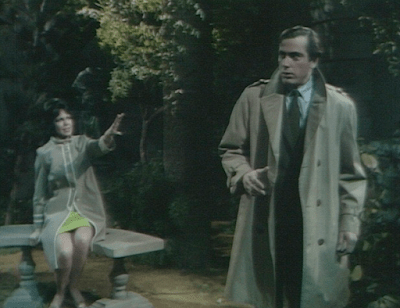
Angelique zaps Tony. Screenshot by Dark Shadows Before I Die.

The talisman was a gift to Lang from Barnabas. Lang refuses to keep it on his person, even though it saved his life to clutch it when Angelique was making his heart beat so fast it was about to burst. Lang shows up at Barnabas’ house, under the false impression he received a telephone call from Barnabas. Barnabas, who has no telephone in his house, explains to Lang that Angelique has lured him away. When he learns that Lang has left the talisman in his desk drawer at home, he insists on accompanying him back there.

It is too late. Tony has already stolen the talisman and delivered it to Angelique. She looks at it and says that Lang will not be able to save either Barnabas or himself. Presumably, not even by reminding him of his lines.

*My wife, Mrs Acilius, pointed this out.
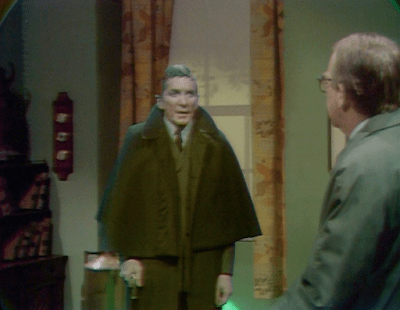
Episode 340: Medical silence

Dave Woodard, MD, has learned that Barnabas Collins is a vampire and mad scientist Julia Hoffman is his co-conspirator. We see Barnabas at home, pressuring Julia into helping him murder Woodard before he can go to the authorities. After a great show of reluctance, Julia prepares a hypodermic of some potion or other that will induce cardiac arrest. When Barnabas insists she administer the lethal injection herself, Julia resumes her attempt to find a way out. Barnabas finally allows her to go to Woodard and tell him that his only options are to cooperate with them and make a great contribution to medical science, or to go out into the night and suffer an unimaginably horrible death when Barnabas catches him.

Julia does go to Woodard’s office, and does deliver this message. Woodard replies that he doesn’t have to go anywhere to tell the sheriff about Barnabas and Julia. He picks up his telephone and starts dialing. High-pitched sounds play, and Woodard sees the shadow of a bat at his window. Yesterday we heard that Julia considered Woodard the most brilliant student in their medical school class, and we can see why- even though this was decades before Covid-19 or Nipah or other bat-borne viruses were in the news, he is transfixed by the outline of the squeaky little guy.

Perhaps Woodard is less prescient about bats as vectors for disease than he is mindful of the experiences of his young friend, strange and troubled boy David Collins. In #330, Barnabas sent a large bat to frighten David in his bedroom. Today, Barnabas materializes inside Woodard’s office after the bat has done its thing outside. This is the first indication we have had that Barnabas has the power to transport himself through walls.

Unfortunately, the National Association of Broadcast Engineers and Technicians were on strike during principal photography for this episode. No doubt the process shot of Barnabas’ materialization was added after they came back to work, but they could do only so much with the footage that the network executives and other amateurs had left them. The Barnabas who appears in Woodard’s office today is about three feet tall and is missing a chunk of his head.

That mini-Bar doesn’t stock anything you want to drink. Screenshot by Dark Shadows Before I Die.

Mini-Bar may be the funniest consequence of this attempt at strikebreaking, but there is another that isn’t amusing at all. Woodard is played by some stooge who took over the part when Robert Gerringer, who has been struggling valiantly since May to find something interesting to highlight in a character who usually doesn’t know anything and isn’t allowed to advance the plot, honored the NABET picket line. The scab annoys the audience every time he opens his mouth today, breathing directly onto his microphone, getting tangled up in trivial lines, and veering between a barking tone and a whine as high-pitched as the sounds the bat makes.

The result of his incompetence is that a conflict the audience is supposed to be experiencing as suspense does not come off. We’re supposed to be torn as Julia is torn, wanting Woodard’s threat to the continuation of the story to be removed, but feeling horror at the thought that he will be killed. Gerringer could have made us feel those incompatible desires, but this alleged actor makes us want nothing but that he be removed from our television screens as soon as possible and by any means necessary. So we find ourselves cheerfully rooting for the vampire and the mad scientist to get on with murder.

Episode 339: Even greater fool

This episode was taped during a National Association of Broadcast Engineers and Technicians strike. While the camera operators picketed outside, network executives and other amateurs were handling the equipment. It shows. As the episode begins, there is a lot of chatter and miscellaneous noise off camera; none of the shots is properly focused; each zoom shot moves at alarmingly fast pace; and at one point the camera swings wild. Dark Shadows was produced under such poor conditions that any one of those things might have made its way even into an episode made by trained professionals, but today is the single roughest cut yet.

At least the technical incompetence of the suits has some funny results. That can’t be said of the work of the alleged actor scabbing in the role of Dr Dave Woodard. Robert Gerringer, who started playing Woodard in May, honored his union obligations and refused to cross the NABET picket line; the stooge replacing him is so monotonous in his delivery of dialogue and so undistinguished in his bodily movement that he is little more than a blank spot on the screen. Much of this episode is devoted to him rummaging around looking for some papers; it would take considerably more skill than non-Woodard ever displays to make that interesting to watch.

The actor is so dull that he ruins one of the major sources of suspense. We ought to be conflicted about Barnabas’ plan to kill Woodard, because while we want the story to advance and Barnabas to stay on the show, we don’t want the good guys to be killed. Moreover, Woodard is the only one now who fully understands and supports one of our favorite characters, strange and troubled boy David. We certainly shouldn’t want David to lose his only backer. But this guy is such a waste of screen space that it is fatally easy for us to root for the character’s death.

There are a few interesting moments scattered here and there in Ron Sproat’s script. Mad scientist Julia Hoffman tells vampire Barnabas Collins that she tried to quell Woodard’s suspicions by telling him Barnabas had a rare blood disease that she was trying to treat. In fact, Julia does believe that vampirism is a rare blood disease, and she is trying to cure Barnabas of it, so she wasn’t lying when she told him that. It’s always startling to find Julia resorting to the truth.

Julia also tells Barnabas that Woodard came up with an idea she has encouraged him to believe, that she is in love with Barnabas. Barnabas laughs at this notion, and Julia objects that it doesn’t seem so preposterous to her. An incredulous look on his face, Barnabas glances at her wig, then at her clothes. He has a point- it really does not look like an ensemble a woman would wear if she was into dudes.

Screenshot by Dark Shadows Before I Die.

Yesterday’s episode gave us several clues that Julia is in fact attracted to Barnabas. Today, she not only seems hurt when Barnabas laughs at the idea she might be falling for him, but she flashes a look of jealousy later when he says something extravagantly complimentary about well-meaning governess Vicki. As my wife, Mrs Acilius, pointed out, this makes it rather unsettling when Julia remarks that she had thought Barnabas was incapable of feeling any emotion, even fear. We know that Julia is a very strange person, but as we find out what she looks for in a partner we start to wonder just how strange she is.

Barnabas is bewildered by everything Julia says and does. When she says she is surprised that he is frightened by Woodard’s investigation into him, he says that of course he is frightened, as it could easily result in his extinction. When she goes on to say that she had thought him a totally unemotional being, he becomes for a moment the audience’s point of view character- he doesn’t say anything, just gives her a look as if she is completely nuts.

At the moment, Barnabas is especially vulnerable because Julia is keeping her notes on the experiment in a little box in her bedroom at the great house of Collinwood. That is an odd place for them. She presumably makes the notes while she is working in her laboratory in the basement of Barnabas’ house, and she consults them while she is there. The laboratory is well-hidden- Woodard and local man Burke Devlin searched the basement in #333, and found no trace of it. So it doesn’t make any sense to create another danger of exposure by keeping them anywhere but there. Of course Woodard sneaks into Julia’s room today and finds the notes.

Housekeeper Mrs Johnson is in this one, after fourteen and a half weeks away. In fact, it’s only her second appearance since #211, the episode in which she was the first character to exchange lines with Barnabas. It’s great to have her back, though of course it saddens me that Clarice Blackburn crossed a picket line.

Episode 338: Suspicion itself

Dr Dave Woodard is onto vampire Barnabas Collins’ terrible secret. Woodard doesn’t think he can share his suspicions with the sheriff or a medical colleague or an expert in the supernatural or with any of his friends. Still, he has to tell someone. So he has gone to Barnabas and told him all about it. Barnabas tells him he’s crazy and orders him out of his house.

On his way out, Woodard crosses paths with his medical school classmate and onetime friend Julia Hoffman. He had introduced Julia to the case of Barnabas’ victim Maggie Evans, The Nicest Girl in Town, hoping that her dual qualification as an expert in psychiatry and hematology meant that she would be the perfect person to find out what happened to Maggie. He knows now that Barnabas was the source of Maggie’s troubles, and that Julia has gone over to Barnabas’ side. The doctors engage in a brief verbal sparring match, then Julia goes into the house. Woodard pretends to leave, then crouches by the window where we have already seen several people eavesdrop on Barnabas’ conversations. Even though Julia herself is one of those people, neither she nor Barnabas thinks to look out the window before they launch into a hugely incriminating conversation.

Among the more important pieces of information Woodard learns are that Julia is performing an experiment on Barnabas, that she is keeping notes on that experiment, and that she keeps those notes in a box in her room at the great house of Collinwood. For some unaccountable reason, she thinks that no one will look for them there.

Barnabas demands that Julia find out how much Woodard knows. He butters her up a bit, telling her that while she has said that Woodard was the most brilliant student in their medical school class, he is sure he can’t have been more than the second most brilliant. He even calls her “my dear,” the first time he has addressed her as anything more affectionate than “doctor.” She is facing away from him when he says all this, and we see her brighten. By the time she exits, she looks positively blissful.

Julia thrills to Barnabas’ non-hostile talk.

Perhaps this suggests that Julia is falling in love with Barnabas. She does get carried away with sympathy for him earlier in the scene, when he is whining about his situation and she exclaims “Poor Barnabas!” Perhaps it’s just that she has been spending all her time with him for months and is relieved to get some friendly attention. Whatever the cause of it, her excitement must be considerable- she even allows herself to bring up a topic to which she has never before so much as alluded, and says that “They didn’t take me as seriously as they should have because I’m a woman.”

Julia calls on Woodard at his office. She tries to sell him on an idea he himself had in #324, that she’s hanging around because she’s fallen in love with Barnabas. He confronts her with a list of the medical supplies she has ordered recently. She ignores the list and keeps saying that she is just a woman in love. Woodard isn’t having it, and she ultimately resorts to warning him that for his own good, he must stop asking questions.

Meanwhile, there is some activity at the great house. Well-meaning governess Vicki receives a visit from her depressing fiancé Burke. The two of them had hoped to buy a “house by the sea” that turned out to be unsaleable because of provisions in an old Collins family will. Matriarch Liz eavesdrops as they talk about this, then enters the room and offers to let them live in the long-abandoned west wing of Collinwood until the house they want becomes available. Vicki loves the idea, Burke is hesitant.

Liz eavesdrops on Burke and Vicki.

This echoes a theme of the first few months of the show, when Burke wanted to take possession of Collinwood and throw the Collinses out. In response, Liz vowed that Burke would never spend a night under its roof. This offer shows viewers who have been watching from the beginning how far we have come since those days.

I wonder if that vase is full of Cheetos

Episode 337: Disowned

We open on a set we haven’t seen since #180, the archives of the old cemetery north of town. There, a scene plays out between two actors who aren’t really on the show. Daniel F. Keyes created the role of the Caretaker of the cemetery; Robert Gerringer took over the role of Dr Dave Woodard some months ago and did as much with it as anyone could. But neither of those men was willing to cross a picket line and break the National Association of Broadcast Engineers and Technicians strike, and so they were replaced with a couple of stooges.

The stooges are both terrible. Patrick McCray, Danny Horn, and John and Christine Scoleri all go into detail documenting non-Woodard’s incompetence, but the non-Caretaker is just as bad. Patrick McCray memorably described the Caretaker, in Keyes’ realization, as a “refugee from the EC comics universe.” This fellow has none of Keyes’ zest or whimsy; he simply recites his lines.

At one point, the non-Caretaker tells non-Woodard that it will take some time for him to locate the document he is asking about. Non-Woodard replies “Take your time!” We then have about ninety seconds of the non-Caretaker sorting through papers. The show is moving away from the real-time staging that had often marked its earlier phases, so this comes as a surprise.

The episodes in which the archive set was introduced included a lot of talk about the geography of the cemeteries around the town of Collinsport. They told us that the old cemetery north of town was the resting place of the Stockbridges, Radcliffes, and some other old families, but that most of the Collinses were buried in their own private cemetery elsewhere. They also mentioned a public cemetery closer to town where the remains of less aristocratic Collinsporters might be found. In today’s opening scene, non-Woodard tells the non-Caretaker that they had met previously in Eagle Hill Cemetery. Eagle Hill is the name now associated with the old cemetery north of town. So perhaps this building, which also houses a tomb in which several of the Stockbridges were laid to rest, is not in Eagle Hill Cemetery, but one of the others.

Reading room
Stacks
The Tomb of the Stockbridges.

In his last few episodes, Robert Gerringer had a couple of scenes in which he and David Henesy established a close relationship between Woodard and strange and troubled boy David Collins. Today, non-Woodard sits on the couch in the drawing room at Collinwood and tells David he has come to believe everything he has been saying, including the stories that have led the other adults to call in a psychiatrist. As my wife, Mrs Acilius, pointed out, that would have been a great payoff from Gerringer’s earlier scenes if he had been in it. It might have been effective enough if any competent actor had played the part of Woodard. Certainly Mr Henesy’s performance gives non-Woodard plenty to respond to. But he barks out his lines as if they were written in all-caps with randomly distributed exclamation points. It is a miserable disappointment.

There is also a scene where David’s father, high-born ne’er-do-well Roger, tries to convince his sister, matriarch Liz, that they ought to send David to military school. This both harks back to the first 39 weeks of Dark Shadows, when Roger openly hated his son and jumped at every chance to send him away, and illustrates the changes that have taken place since then, as Liz acknowledges that Roger is motivated by a sincere concern for David’s well-being. The scene is intelligently written and exquisitely acted. The high caliber of their work makes it all the more distressing to see Joan Bennett and Louis Edmonds on a scab job. David Henesy was ten years old, and had a stereotypical stage mother, so you can excuse his presence and marvel at his accomplished performance. But these two old pros don’t have any business on the wrong side of a strike.

Nor does Jonathan Frid. When non-Woodard goes to confront Barnabas, there are moments when Frid seems to be showing his own irritation with his scene-mate more than his character’s with his adversary. As well he might- neither man knows his lines particularly well, but even when Frid stops and looks down he expresses emotions Barnabas might well be feeling, and he is fascinating to watch. When non-Woodard doesn’t know what words he’s supposed to bark, he drifts away into nothing. But it serves Frid right to have to play off this loser- by this point, he knows full well that without him the show wouldn’t be on the air. He had no excuse at all for crossing that picket line.

The cemetery’s combination archive/ tomb was a prominent part of the storyline of undead fire witch Laura Murdoch Collins. That storyline approached its climax in #183 when Peter Guthrie, PhD, confronted Laura in her home about being “The Undead,” prompting her to kill him. An episode beginning on that set and ending with someone holding a doctoral degree confronting an undead menace would seem to be an obvious callback to that story. Guthrie’s confrontation had a point- he wanted to offer to help Laura find a place in the world of the living if she would desist from her evil plans, an idea which Woodard’s old medical school classmate Dr Julia Hoffman picked up in her quest to cure Barnabas of vampirism. By contrast with Guthrie and Julia, Woodard is just being a fool.

Episode 335: The imaginary Barnabas

Gordon Russell’s script contains an interesting scene. A psychiatrist brought in to examine strange and troubled boy David Collins gives a little speech attributing David’s fear of his cousin Barnabas to various unresolved traumas he has recently experienced. This speech sounds very plausible to the adults who listen to it, and might go some way towards explaining the appeal of Dark Shadows to its audience. But we know that David’s fears are entirely rational and that Barnabas really is a vampire. When the psychiatrist mentions that Barnabas had fangs in one of David’s dreams, family doctor Dave Woodard catches up with us and realizes that Barnabas really does have fangs and that he used them to inflict bite marks on some of his patients.

Episode 335 of Dark Shadows was a scab job done during the October 1967 National Association of Broadcast Employees and Technicians strike. In March of that year, at a time when Dark Shadows was at rock bottom in the ratings, the actors stayed out in support of the announcers and newscasters when they went on strike, and the show survived even though it went dark by the time the strike ended. Now, the vampire story is pulling in more viewers every week, making it a valuable property to ABC. But it is at this time that executive producer Dan Curtis told the cast that he would pay their union fines if they crossed the NABET picket line, and most of them did, with network executives and their stooges handling the equipment.

Sad to say, only two cast members did the right thing by the technicians. Robert Gerringer, who played Woodard, was one of those. Even if he had been a good actor, the scab stealing food from the mouths of Robert Gerringer’s children wouldn’t have been able to deliver on the moment when Woodard figures out that Barnabas is a vampire- we need Gerringer for that. He is the person we’ve grown used to seeing in the part, and his self-consciously soap operatic style of acting sets him apart from the rest of the cast and highlights the weirdness of this story playing out on a daytime serial in 1967.

But the scab isn’t a good actor. His most memorable moment comes when Joan Bennett, as matriarch Liz, bobbles a line, and he corrects her. She flashes a look of anger, but what does she expect? What she is doing is no better than what he is- if anything, it’s worse, because she was a big star and could have called a halt to the whole filthy disgrace if she’d lived up to her obligations as a member of AFTRA.

I’m writing this in September 2023, month three of the SAG-AFTRA actors’ strike and month five of the Writer’s Guild of America strike, so I’m even angrier about the whole thing than I usually would be. But I always find it hard to watch material produced under these conditions.

The character of Maggie Evans wasn’t in any of the episodes produced during the strike, so Kathryn Leigh Scott wasn’t involved in breaking it. She is walking a picket line today, and in her column she wrote about the particular issues at stake in the 2023 strikes. Different matters hung in the balance in 1967, but it’s always true that we live in a society, for the love of God, and if working people don’t stick together they don’t have anything.

Two actors who were too young to know better. Screenshot by Dark Shadows Before I Die.

Episode 333: Why are you lying?

A few days after Dark Shadows began, we learned that high-born ne’er-do-well Roger Collins had squandered his entire inheritance. He and his son, strange and troubled boy David, then moved into Roger’s childhood home, the great house of Collinwood. The house belongs to Roger’s sister Liz. Roger lives there as her guest, and draws a salary from her business as an employee.

Time and again, Liz tells Roger that he must behave himself; time and again, she shields him from the consequences of his actions. Liz may want to believe that she is a model of adult authority, but in fact their relationship is one of Bossy Big Sister and Bratty Little Brother.

Liz extends that enabling behavior to the rest of the family. In episode #10, David overheard Roger in the drawing room, telling Liz that he wanted to send him away to school. Liz refused, because she saw that as Roger’s attempt to resign his responsibilities as a father. For his part, David reacted by tampering with the brakes on Roger’s car so that they would fail when he was driving down a steep hill and kill him. His murder plan failed. When Liz discovered it in #32 she lied to the sheriff in order to keep the whole thing quiet, and a few days later she ordered the family’s handyman to take the blame for the crash.

David had no big sister. Liz’ daughter Carolyn would later become a surrogate sister to him, but through the first months of the show she took no interest at all in her cousin. David spent his time with his well-meaning governess, Vicki. David was certainly bratty towards Vicki, trying to frame her for his attempt on Roger’s life in #27, and making an attempt on hers in #84. But while Vicki was glad to be sisterly towards David, she did not fall into the same pattern with him that traps Liz and Roger. She listened to him patiently, and enforced rules firmly. In response, David not only stopped committing crimes against Vicki, but when his mother, undead fire witch Laura Murdoch Collins, tried to claim him, he chose life with Vicki over death with her. Episode #191, the last installment of Dark Shadows 1.0, ends with David in Vicki’s arms, his new mother consoling him for the loss of his original mother.

Roger and Liz are minor characters in Dark Shadows 2.0, and Vicki is fast fading into the background as well. But #332 and #333 take us back to the first weeks. Yesterday, David again overheard his father in the drawing room saying he wanted to send him away to “a special school” where psychotherapy can cure him of his weird ideas. But Vicki’s influence has realigned David from evil to good, so that instead of trying to kill his father, he tries to collect evidence that his ideas are not a product of mental illness. In that effort, he went to the Old House on the estate and came upon the coffin in which his cousin Barnabas Collins, a vampire, rests during the day. Barnabas found him there and was closing in on him when mad scientist Julia Hoffman came into the house.

“Are you afraid of me?”

Julia and Barnabas are at the center of the show now, and they reproduce Liz and Roger’s Bossy Big Sister/ Bratty Little Brother dynamic. When Barnabas announces that someone or other “must die!,” Julia talks him out of doing anything to bring that death about. Sometimes she threatens to expose him, sometimes she promises to cure him of vampirism, sometimes she wears him down with lists of the practical difficulties of the murders he would like to commit.

But Julia also conceals and destroys evidence of Barnabas’ crimes. She induces grave amnesia in his victim Maggie Evans, and lets his sorely bedraggled blood thrall Willie Loomis take the blame for abducting Maggie. In fact, she very nearly killed Willie when it looked like he might not go down quietly. She may have rescued David today, but she protects Barnabas all the time, and it seems to be just a matter of time before she becomes an active participant in a murder for his sake.

Back in the great house, local man Burke Devlin is conferring with Dave Woodard, MD. Burke says that he is worried about David’s “fantasies,” to which Woodard replies “If they are fantasies.” Woodard is coming to believe that Barnabas is an uncanny being responsible for Maggie’s abduction and the other troubles the town of Collinsport has seen recently, and he takes everything David says very seriously. When David comes home and announces that he found the coffin, that Barnabas tried to kill him, and that Barnabas is a dead thing that can move around at night, Woodard listens intently.

Julia comes in, as does Roger. Julia dismisses all of David’s assertions. She claims to have seen Barnabas’ basement, and to know that there is no coffin there. David looks at Julia, and asks in an oddly calm voice “Why are you lying?” Roger is appalled at this question, but Woodard studies David carefully as he asks it and studies Julia’s reaction just as closely afterward.

“Why are you lying?”

In #331, Woodard gave David a sleeping pill and asked him questions about the strange goings-on. Robert Gerringer and David Henesy played that scene marvelously. Gerringer showed Woodard’s struggle, as a man of science, to come to terms with a set of facts that made logical sense only in a world where supernatural forces are at work, while Mr Henesy showed David’s desperation to find a responsible adult who will listen to what he knows. Gerringer also showed Woodard’s tender affection for David, tugging the covers of his bed over him when he fell asleep. As Woodard watches David today, we see the same intellectual crisis and the same tenderness that he played then.

Roger demands David apologize to Julia. He will not. Woodard says they ought to go look at Barnabas’ basement and see if there really is a coffin there. Roger is horrified by the implied insult to his cousin, and forbids any such thing. Burke points out that Roger is in no position to forbid it, and accompanies Woodard to the Old House.

There, Barnabas presents himself as shocked that Burke and Woodard want to search his basement. Woodard is polite about the whole thing, but Burke is an utter swine, declaring that they won’t leave until Barnabas submits to their demand. This is not the first time returning viewers have seen Burke impose himself as an unwanted house-guest, and it doesn’t get more attractive the more we see it. When Barnabas orders them to leave, Burke says they will come back “with a search warrant!” Even under the law codes of soap opera land, this would seem to be an empty threat- neither of them is a police officer, and while it may be eccentric to keep a vacant coffin in your basement I can’t think of a reason to suppose it would be a crime. Watching this scene, my wife, Mrs Acilius, said that Burke is so obnoxious that he makes us root for Barnabas despite everything we know.

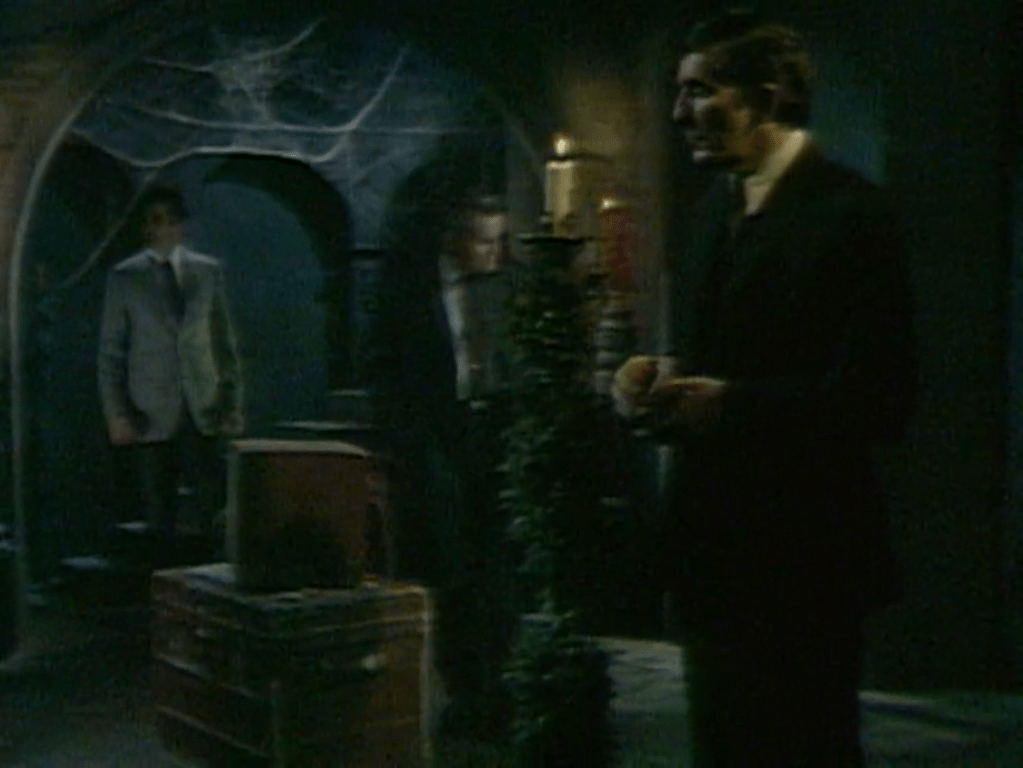
Burke and Woodard start to go, and Barnabas relents. He takes them to the basement. The coffin is usually in the main area at the foot of the stairs, but when the three of them get there some crates and a trunk are stacked up on that spot.

No coffin.

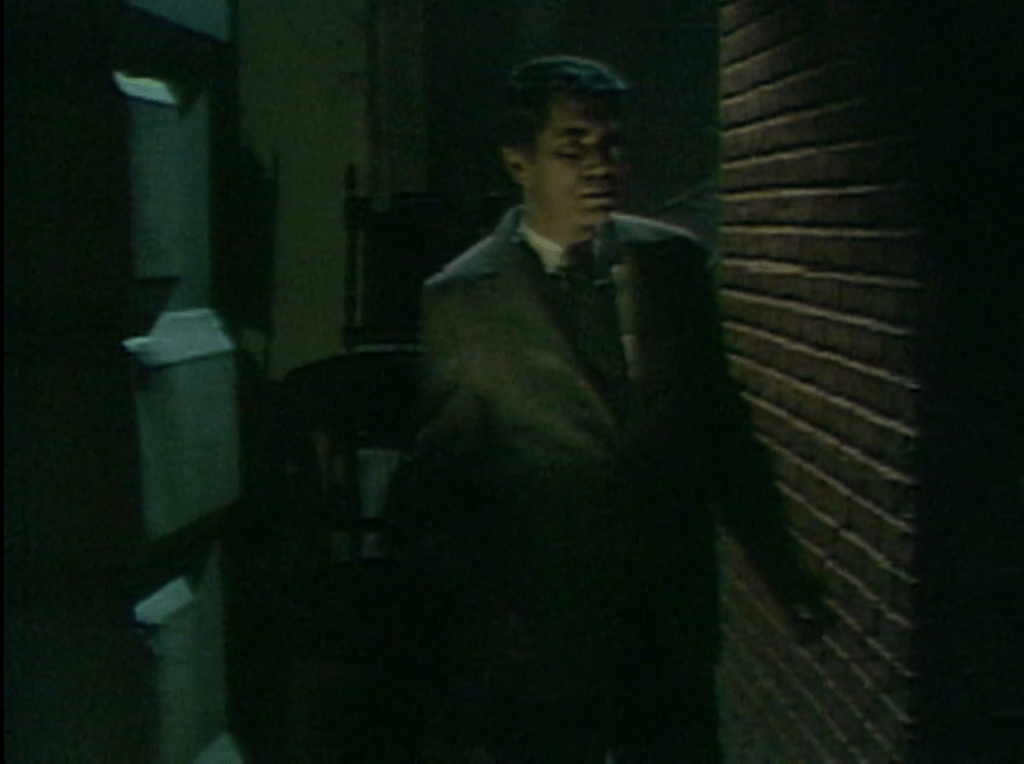
Burke goes down a little corridor and sees nothing there, either.

Burke in the corridor.

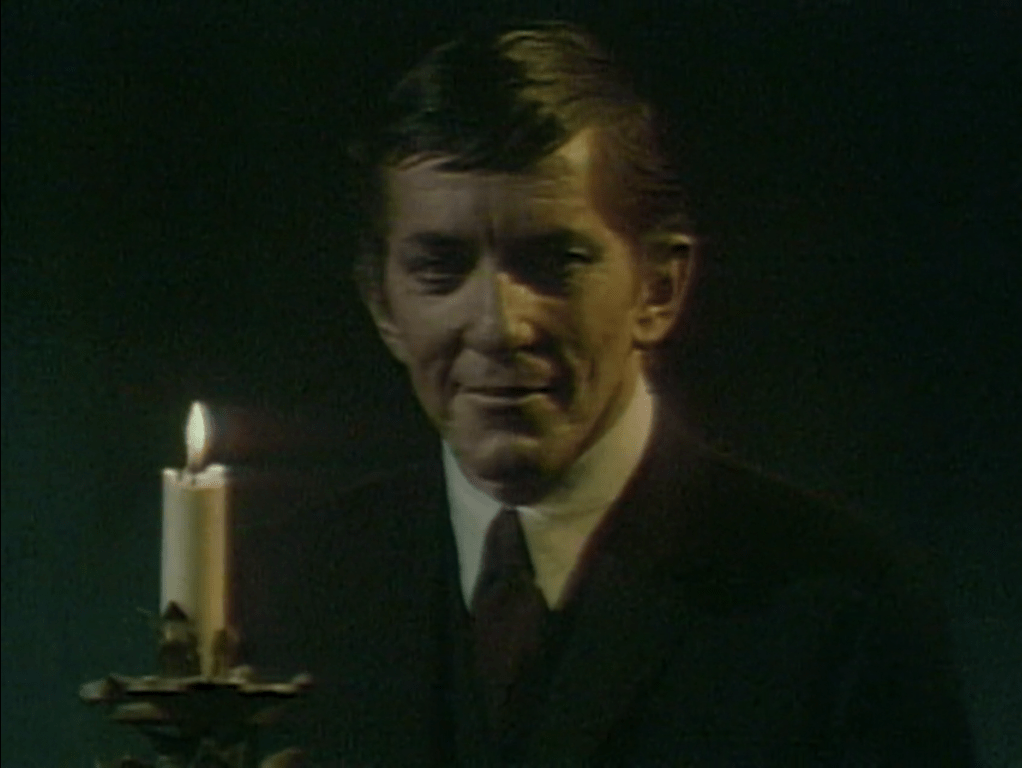
Burke and Woodard are embarrassed, and Barnabas grins. We know that he had moved the coffin so that when someone came to check out David’s story they would see nothing, and that his resistance to Burke and Woodard’s requests to search was put on for effect. Barnabas spends most of his time with other people pretending to be a living man born in the twentieth century; his grin is that of an actor who finds he has given a particularly convincing performance.

Receiving his ovation.

We had seen corridors in the basement when Barnabas was holding Maggie prisoner there. We saw them most prominently in the episode that ended with her escape, #260. In that one, they looked very extensive. He had kept Maggie in a prison cell at the end of one of those corridors. That cell had been there since Barnabas’ time as a living being in a previous century, but none of the many people who had visited the basement before Barnabas moved in, including Burke in #118, had seen the cell. So there must be quite a bit of space down there that only Barnabas knows about, but he has chosen to put his most embarrassing possession in the one place no one coming to the basement could fail to notice. It’s like the old days, when you’d go to visit a single guy at home and find that he had left sexually explicit magazines or videos on his coffee table.

Episode 314: Bordering on the supernatural

Willie Loomis, sorely bedraggled blood thrall of vampire Barnabas Collins, is in the woods looking for strange and troubled boy David Collins. The strains of “London Bridge” play on the soundtrack, announcing the presence of Barnabas’ little sister, the permanently nine year old ghost of Sarah.

Sarah and Willie look at the Old House. Screenshot by Dark Shadows Before I Die.

Sarah and Willie have a friendly little chat. He tells her that everyone wants to see her, which comes as news to her. He tells her that Barnabas is particularly eager to see her. This is the first time we have seen Sarah hear Barnabas’ name. She excitedly says that she wants to see him, too.

Willie offers to take her to Barnabas, but she says that she has to look for someone else. Willie asks if she is looking for David Collins. This is the first time we have seen Sarah hear that David’s last name is the same as hers. She replies, “Yes, David.”

Sarah explains that she doesn’t quite know where David is. This is surprising- he is trapped in the secret chamber of the Tomb of the Collinses, a chamber she herself showed him in #306 and where in #311 he heard the strains of “London Bridge” after realizing he had gotten locked in.

Willie asks if David is a good friend of hers, and she says they like each other and both know a lot of games. She also says that she tells David her secrets. “Big secrets, little secrets.” She alarms Willie when she adds that she has told him the biggest secret she knows. Willie fears that she means that she told David that Barnabas is a vampire. He presses her with more questions. She refuses to answer and protests that she doesn’t like questions. She tricks him into looking away from her for a few seconds, and when he looks back she is nowhere to be found.

Danny Horn devotes a sizable portion of his Dark Shadows Every Day post about this episode to complaining about what Sarah doesn’t know:

This is basically a repeat of what Sarah said when Maggie was taken away to Windcliff Sanitarium. At the time, she told David, “Sometimes I almost know where she is, but then it all fades away, and I begin to cry again.”

That scene actually meant something — Maggie was quickly spirited away, far outside Sarah’s usual territory. You could imagine Sarah standing near the Old House, listening, trying to tune into some kind of psychic radio signal from far away.

But you can’t just take that scene and copy it into a new episode like this, because she knows exactly where David is. She has to. If we’re really supposed to believe that Sarah can’t find David — in her own crypt, where she left him — then this is all mouth noises and nothing but.

Sarah’s character has never been particularly well-developed, but these days it’s flying to pieces every time she opens her mouth.

Danny Horn, “Episode 314: A Logical Explanation,” Dark Shadows Every Day, 23 January 2014

I don’t entirely disagree with his critique of Sarah’s lines, but I can’t go along with a complaint that her “character has never been particularly well-developed.” She’s a ghost, after all- the whole idea is that her existence is an intermittent thing. She doesn’t relate to time or space as we do. We don’t know what, if anything, her intentions are, and we can never be quite sure what she remembers from one apparition to the next. It’s true that the more we see of her, the more she tends to assimilate to the human characters. That happened during the 14 weeks of the storyline centering on undead fire witch Laura Murdoch Collins, when both Laura herself and her great adversary, the ghost of Josette Collins, began as wispy, diffuse presences and ended with recognizable personalities. Sarah is some way down that road, but they’ve still managed to keep us guessing.

In particular, when Sarah told David “the biggest secret” she knows, she told him that there was a secret chamber in the tomb, how to get into it, and that the coffin there once had a body in it, but that the body “got up and left.” At times she has thwarted Barnabas’ evil plans, suggesting that she knows all about him. But only suggesting it- she didn’t name Barnabas when she told David about the coffin, which would seem to be a bigger secret than any she shared. And when Willie tells her that he represents Barnabas, she responds far more merrily than we would expect if she knew he was the servant of a vampire.

The scene between Sarah and Willie reminds me of a video clip in which Sharon Smyth Lentz reminisces about John Karlen sitting down with her one day in the studio. He wanted to talk to her about her process in developing a character. At nine, she had no idea what he was talking about. Sarah doesn’t have a process either, and she is great on the show as long as they don’t put her in a position where she would need one.

Willie rushes to the great house of Collinwood, where he has an emergency conference with Barnabas’ co-conspirator, mad scientist Julia Hoffman. He tells her that if Barnabas finds out that Sarah has been telling David her secrets, he will kill the boy. Julia frets that such a murder would “ruin everything” she is trying to accomplish by trying to cure Barnabas of vampirism, and commands Willie to lie to his master.

Soon Julia has another emergency meeting. Her old acquaintance, addled quack Dave Woodard, has shown up with a doll Sarah left behind. He tells her that he now believes Sarah is a supernatural being, because the doll is in mint condition even though it is of a type that has not been manufactured in over 150 years. To which I say, so what? They know that Sarah’s clothes are in equally an pristine state even though they are extremely old-fashioned; Sarah’s bonnet was in the house for a while, where Julia and well-meaning governess Vicki examined it and concluded that it must have been handcrafted as a replica of a period piece. So that would seem to be an equally likely explanation for the doll. That makes Woodard’s declaration that the doll is in an old style but a new condition into a thudding anticlimax.

Episode 295: A special kind of music

Maggie Evans, The Nicest Girl in Town, has come back to Collinsport. This is a surprise to everyone. Months ago, Maggie had escaped from an unknown captor who drained her blood and deranged her mind. Maggie’s family doctor, addled quack Dave Woodard, had persuaded her father and her fiancé to join him in telling everyone that she was dead and to lock her up in a mental hospital a hundred miles north of town. Evidently, Woodard thought that if the captor believed he had got away with his crimes, he would turn into a solid citizen and a good neighbor.

The mental hospital where Woodard sent Maggie was administered by Dr Julia Hoffman, an MD whose specialties in psychiatry and hematology made her seem like the perfect person to oversee Maggie’s care. Unfortunately for Maggie, Julia is also a mad scientist. She has for years dreamed of finding a vampire on whom she can try an experimental treatment that will turn him back into a human. Julia quickly recognized Maggie’s condition as a symptom of vampire attacks, and eventually identified Barnabas Collins as the vampire who held Maggie prisoner. She has now met Barnabas and promised to keep Maggie in a state of amnesia so long as he cooperates with her experiments.

Yesterday, the ghost of Barnabas’ nine year old sister Sarah liberated Maggie from Julia’s hospital and transported her back to Collinsport. This had such a great effect on everyone that the show is now in color.

Barnabas goes to the great house of Collinwood and tells Julia that Maggie has come back. He declares that he will have to kill her. Julia forbids him to kill Maggie, on the grounds that doing so would ruin years of her work. Talented a liar as Julia is, she comes up with this so quickly and in such a tense situation that it is hard to believe it is not her true reason for wanting to leave Maggie alive.

Barnabas clarifies the matter further when he says that he will kill Julia first. He follows Julia around the drawing room, apparently thinking of strangling her then and there. She keeps talking, and he can’t resist responding. The telephone rings, and she answers. It is Woodard, calling her to come to his office and take over treatment of Maggie. Julia triumphantly assures Barnabas that once she has done her work, Maggie will never remember what he did to her.

In Woodard’s office, Maggie’s memory is rushing back. She tells her friend Vicki that when she was being held prisoner she spent time in a special room where she smelled a sweet, powerful fragrance and heard a special kind of music. She had told Julia about those sense impressions in a session in #282, and when in #289 Vicki told Julia about a special room in Barnabas’ house where there was a jar of jasmine perfume and an antique music box, Julia had reconstructed Barnabas’ entire plan. When she hinted to Vicki that Barnabas was trying to recreate the late Josette Collins, Vicki had become defensive and stormed off, indicating that Julia is casting an unflattering light on something Vicki has been looking at through a romantic lens.

The camera is tight on Vicki’s face when Maggie mentions the room, the fragrance, and the music. Vicki’s face darkens in response to each point, a little bit more each time. She seizes on the key word of each statement, rephrasing it as a question- “Special room?… Special scent?… Special music?” So far on Dark Shadows, every plot has come to its climax as a result of Vicki figuring out what’s going on. So each of these reactions generates its own little jolt of suspense.

Special room?
Special scent?
Special music?

By the time Julia gets there, Maggie is saying that she remembers everything. Julia hustles Woodard out of the room, and is alone with Maggie when Maggie says that Barnabas Collins was her captor. She describes him as a creature from the world of the dead. She allows that this description is difficult to believe, but Julia assures her that she believes everything she tells her. Julia then tells her that they must stabilize her memory so that she will not regress to the miserable state she was in when first they met. She takes out a jeweled medallion and hypnotizes Maggie.

Woodard waits outside his office while Julia works on Maggie. Finally, Julia opens the door and asks if he would like to see the change in her. Woodard eagerly goes into his office.

He asks Maggie how she is. As she answers, she sounds just like she did before she fell into Barnabas’ clutches. She has regained her Adult Child of an Alcoholic habits of advertising her happiness by starting every utterance with a laugh in her voice and putting exaggerated stress on almost every syllable with a rising pitch. She tells him that “Apparently, there was something wrong with my memory, but I’m fine now.” He asks what happened to her when she was gone, and she has no idea what he means. She remembers falling asleep in her own bed, and then she found herself here with Dr Hoffman. If he could just tell her what happened in between, she’s sure she will be just fine.

Woodard is shocked, but Julia flashes a look of glee. She does remember to put on her worried face after Woodard looks at her, but the smile never really leaves her eyes.

Julia suppressing a cackle. Screeenshot by Dark Shadows Before I Die.
Julia concerned. Screenshot by Dark Shadows Before I Die.

That Julia was able to achieve so precise and extensive a mutilation of Maggie’s memory in so short a time would suggest that she spent the whole period Maggie was under her care laying the groundwork for it. That would in turn tend to confirm that her only interest in Maggie is as a tool to gain access to Barnabas as a subject for her experiment.

Closing Miscellany

As the opening title sequence begins, an ABC staff announcer says he brings “Good news! This program, Dark Shadows, is now being presented in color.”

Opinions may vary as to how good this news was. In the 1960s and 1970s, most television sets in the USA did not receive in color. So even programming that was made in color had to be composed first to look good in black and white. It took a big budget and a relaxed production schedule to make a show that would also benefit from color, and Dark Shadows never had either of those things. When a sense of atmosphere is especially important, as it usually is early in a storyline, it is best to watch the show with the color turned off.

Still, directors Lela Swift and John Sedwick were ambitious visual artists, and before long there will be some moments when they find ways to turn the muddy, cruddy TV colors of the era to their advantage. The camera operators will learn their craft even more quickly. Today, only a few closeups really meet broadcast standards, while every other shot is badly out of focus. There aren’t many other episodes like that, at least not until the woeful Henry Kaplan becomes one of the directors in December 1968.

This is not only the first color episode, but also the first one where the words “Dark Shadows” swoop and swirl around on the screen during the opening titles. I’m sure that was a very impressive effect in 1967.

When we saw Julia hypnotize Maggie in their sessions in the hospital, she shone a penlight in her eyes. This is the first time she uses the medallion. That is an example of the use of color- the medallion wouldn’t have been anything special in black and white.

Julia’s medallion. Screenshot by Dark Shadows Before I Die.

Episode 292: I know who’s dead and who isn’t

Mad scientist Julia Hoffman is hanging around her new base of operations, the Old House on the great estate of Collinwood. She is getting ready to perform an experiment which, if successful, will convert vampire Barnabas Collins into a real boy. She learned of Barnabas’ existence when treating his former victim Maggie Evans, The Nicest Girl in Town. Julia answers a knock on the front door, and sees her old acquaintance, addled quack Dave Woodard.

Woodard has no idea what Julia is up to. So far as he knows, she is still on board with his own idiotic scheme, in which he, along with Maggie’s father Sam and her fiancé Joe, has told everyone in town that Maggie is dead in hopes that her captor would forget about imprisoning girls and draining their blood. In fact, Julia has told Barnabas that Maggie is alive and has lured him into cooperating with her project by promising to keep Maggie in a state of amnesia so that she will not represent a threat to him.

In yesterday’s episode, Sam and Joe called on Woodard and complained that Julia is staying at Collinwood while Maggie is a hundred miles away. They demanded that Woodard take her out of Julia’s care. Woodard tells Julia today that her conduct is growing “more and more unethical.”

Last week, Julia was able to forestall Woodard’s threat to take her off the case by playing dumb. This time, she has to take him partly into her confidence, telling him that Maggie encountered the supernatural and that her case represents an opportunity to find a crossing point on the boundary between life and death. She dangles the possibility of great fame before him, saying that the doctors who make the breakthrough she sees coming will go down in history. When he presses for details, she says that there is great danger in what she already knows, and that she must not tell him more.

Woodard has been on the show for months, and has been stuck in just two modes the whole time. When he’s with a patient, he makes a show of brisk dissatisfaction, as if trying to convince them that they oughtn’t to take their disease so seriously that they give up. This mode was as far as Richard Woods, the first actor to play Woodard, got in his two appearances (in #219 and #229.) When he is talking with someone else, Woodard struggles to find the words to express his bafflement at the terrible case he is treating. These two modes didn’t make Woodard a source of suspense. They were just filler between his announcements of what the script called for him to do next.

When Julia asks Woodard if, when he was in school, he dreamed of making a major contribution to the science of medicine, he gets a thoughtful look and says “Well, of course.” This is the first moment we have seen Woodard outside his two modes. When Julia tempts him with the idea that he will go down in history as the co-discoverer of the most fundamental truth imaginable, he displays an emotion that might lead to him to any of a number of exciting, story-productive actions. The first scene in the first episode credited to writer Gordon Russell manages the astounding feat of turning Dr Woodard into an interesting character.

We cut to the woods on the estate. We see the ghost of Barnabas’ nine year old sister Sarah sitting on a rock crying. All of Sarah’s previous scenes started with some other character on camera, then proceeded to Sarah making a mysterious entrance. That’s what we would expect of a ghost, after all. This time, Sarah is all by herself at rise. The first time we saw a ghost was in #70, when the ghost of Josette Collins emerged from her portrait and danced around the columns of the Old House. That was a solo appearance as well, but people had been in the Old House talking about Josette immediately before, so she was manifesting herself in response to attention from the living. Here, we see a ghost on her own, processing her emotions, hoping someone will come and hang out with her.

Strange and troubled boy David Collins shows up and asks Sarah why she is crying. She says she can’t find Maggie. David breaks the news to her that Maggie is dead. Sarah laughs, and assures David that she is still alive. When David insists that Maggie is dead, Sarah tells him that he may know “about leaves and everything,” but she knows “who’s dead, and who isn’t.”

Sarah laughs at the idea that Maggie is dead. Screenshot by Dark Shadows Before I Die.

Less than a week ago, in #288, David saw a portrait of Sarah and wondered aloud if the girl he has met is her ghost. In the first 39 weeks of the show, he was on intimate terms with Josette and some of the other ghosts. When he first met Barnabas in #212, he asked him if he were a ghost, and was disappointed to hear that he was not. So returning viewers expect David to ask Sarah the same question. Indeed, David has always interacted with ghosts as if they were people with whom he could pass the time of day, share thoughts and feelings, and get to know better from one encounter to the next. Seeing Sarah crying by herself should validate this attitude. But instead, David has developed Soap Opera Goldfish Syndrome, forgetting information which everything we have seen has led us to expect he will remember.

David insists Sarah come home with him to the great house of Collinwood and have dinner with the family. She tries to decline politely, but he will not take “I’ve been dead for centuries” for an answer. He gets Sarah into the foyer, then goes to the drawing room to announce her presence. He finds Julia there, with well-meaning governess Vicki and Vicki’s depressing boyfriend, fake Shemp Burke Devlin. By the time David gets the adults into the foyer, Sarah has disappeared.

Vicki is suffering from an even more frustrating version of Soap Opera Goldfish Syndrome. She had had extensive dealings with the ghosts of Collinwood on many occasions between #85 and #191, and that had been the basis of her bond with David. Vicki’s interactions with the supernatural reached a climax when she led the opposition to David’s mother, undead fire witch Laura Murdoch Collins, from #126 to #191. Since then, Josette has spoken through Vicki at a séance and she has seen Sarah.

But lately, Vicki has started to deny that there are ghosts. This is in response to Burke’s demands. Burke lost his connection to the story months ago, and he’s been trying to gaslight Vicki into dismissing all of her spectral encounters as signs of mental illness so that she will join him on the show’s discard pile of useless characters. In Friday’s episode, Vicki had apparently decided to give in to Burke and make herself believe that there were no supernatural beings at work around Collinwood. As a result, her scenes in that episode were unbearably dreary.

Before David brought Sarah home, Vicki had been dreary again. She’s excited about some old house she saw, and wants Burke to go look at it with her. As David’s governess, Vicki’s compensation consists largely of room and board, so as long as she has her job her interest in any particular piece of real estate isn’t going to lead to story development. If she quits the job and marries Burke, she will be giving up on ever being part of the action again. So her rambling about “the house by the sea” is suspenseful only to fans of Vicki who are afraid she will vanish into the background of the show.

When David starts telling the adults about Sarah, Vicki launches into the same garbage Burke has been giving her, talking down to him about imaginary friends and insinuating that anyone who believes in ghosts is soft in the head. Burke, who had previously been David’s great friend, joins in this abusive behavior. After David indignantly stalks away, Julia gets very uptight and lectures Vicki and Burke about the need to stifle David’s imagination and discourage him from telling them things they don’t already know. This scene is effective, but the effect is claustrophobic- by the end of Julia’s little speech, we feel like the mad scientist is holding us prisoner.

Vicki and Burke decide to leave to look at the house, and Vicki finds Sarah’s cap on the floor. That’s such a great moment that not only do we leave the episode no longer disappointed in David’s goldfish memory, we can even forgive Vicki’s.

The closing credits run over an image of the foyer with Sarah’s cap on the table. My wife, Mrs Acilius, thought it would have been hilarious if Sarah had marched in and taken the cap while the credits were rolling. I’d have liked to see that too, especially if, after putting it back on, Sarah had turned to the camera and put her finger to her lips, telling the audience to keep quiet about what we had seen.

Sarah’s cap on the foyer table. Screenshot by Dark Shadows Credits.