The reigning chief villain on Dark Shadows is a shape-shifting monster from beyond space and time. He refuses to shift his shape, since he likes being a tall young man. He isn’t interested in any part of space or time not connected with heiress Carolyn Collins Stoddard, with whom he has fallen in love. He can’t persuade anyone to call him by his preferred name, “Jabe,” so has resigned himself to going by “Jeb.”
As we open, Jabe is raising four men from the dead. That he can do such a thing might suggest that he is a formidable menace, but the introductory voiceover explains that he has no choice about it, since he is “unable to trust one living human being.” Whatever powers he may have, Jabe is surrounded by enemies whom he can battle only by resorting to the most desperate means. We are left wondering how much longer the show can keep the storyline going if it depends on such a feeble menace.
Jabe and one of the zombies are peeking through the window of the Old House on the estate of Collinwood, home to vampire Barnabas Collins, a distant cousin of Carolyn’s. Jabe sees Barnabas’ best friend, mad scientist Julia Hoffman, giving him an injection. He realizes that Julia is trying to treat Barnabas’ vampirism.
Jabe goes to the great house on the estate and orders Carolyn’s mother, matriarch Elizabeth Collins Stoddard, to keep watch over Barnabas’ blood thrall Megan Todd. Liz is one of Jabe’s few remaining followers. He is crude and abusive towards her; she protests that they are in her house, and when he responds to this with a sneer she gives him a look of disbelief. First-time viewers can understand how Jabe came to be so isolated.
When Barnabas was first on the show, from April 1967 to March 1968, Liz never figured out that he was a vampire. The show depended on keeping Liz in the dark about Barnabas’ curse, because she was too civic-minded to let him stay in a house on her estate if she had known that he was an abomination risen from the depths of Hell to prey upon the living, even if he was her cousin. In those days, the show seemed determined to keep Liz on the shelf lest she be stained by contact with the main story, and so they took care to give Barnabas’ adversaries reasons to keep from telling Liz about him.
Now, Liz is under the control of the forces Jabe represents. She is already hostile to Barnabas, and has told Jabe she would try to evict him from Collinwood if that is what he wants her to do. Jabe does not have any reason to withhold from her the fact that his enemy is a vampire.
Moreover, Liz is no longer the symbol of lawful goodness she was two years ago. In #956, she told eleven year old Amy Jennings that she hoped Jabe wouldn’t murder Maggie Evans, The Nicest Girl in Town. Her first reason for not wanting this to happen was that it would remind people of the other murders Jabe has committed. The second, and more important, was that it would tend to exonerate the person they have framed to keep the heat off Jabe. It seems likely that Jabe will soon defeated and Liz will be released from the spell under which she has been laboring, but if she comes out of that remembering what Barnabas is she will also remember that she herself is complicit in some pretty serious felonies, all of them well-known to Barnabas. Since Liz knows that Barnabas is invested in her position in the community and puts a high priority on protecting it, the show wouldn’t have a hard time explaining why she keeps him around, and she would be available to take part in whatever stories they might have going.
Liz is sitting with Megan. She can see that Megan is ill and goes to fetch her a glass of water. When she returns, Megan has gone. We see Megan at Barnabas’ house. Barnabas is intensely hungry. But he does not want to bite her. He knows that if he does so, she will die. She insists, and he gives in.
Julia enters and pronounces Megan dead. Barnabas is in a panic; he had earlier lied when Julia asked him if he had bitten anyone, and he flies directly into hysteria, accusing Julia of implying that he acted deliberately. She keeps her cool and assures him she does not see it that way. Usually Julia’s quickness to make excuses for Barnabas’ murders is an opportunity for Grayson Hall to amaze us with the spectacle of a brilliant woman rationalizing the behavior of a hopelessly evil man, but this scene is a showcase for Jonathan Frid. So they have taken care to establish that Barnabas was overpowered by the need for blood and have shown him taking steps to avoid biting Megan, allowing us to take Julia’s behavior more seriously and focus on Barnabas’ panic.
Barnabas tells Julia that to prevent Megan rising as a vampire they will have to drive a wooden stake through her heart. Previously Barnabas has simply strangled his victims or broken their necks after they died, and that has kept them from coming back. He did this as recently as #951, when he fed on Jabe’s would-be devotee Nelle Gunston. Regular viewers will know that the trip he and Julia make to the basement to fetch a stake is just a setup for them to return and find Megan already gone. Before that happens, there is a strange moment when Barnabas and Julia have the stake and are talking about driving it through Megan’s heart. Barnabas wants to spare Julia that horror, but she smiles warmly as if assuring him that it is her pleasure to join in the act.
Jabe dispatches his four zombie henchmen into the great house, saying that he has given them their orders and now it is time to “Carry them out!” Julia lives in the great house, and is working with some test tubes in her bedroom. It’s the first time we’ve seen Julia’s room in years, and the first time we have seen scientific apparatus of any kind there. One of the zombies knocks on her door, another emerges from behind the curtains, and a third comes up and slaps her in the face. Perhaps remembering Jabe’s words as he sent them into the house, they carry her out.
One of the zombies is named Thomas Findley. Longtime viewers will remember Madame Janet Findley, a psychic who made a big impression in three episodes in December 1968, and Margaret Findley, who was one of the ghostly Widows who were prominent in the show’s supernatural back-world in its first 26 weeks. Another zombie is a large bald man who will remind many viewers of Tor Johnson in Plan 9 from Outer Space.
Danny Horn’s post about this one at his great Dark Shadows Every Day is a fascinating comparison of the episode with four issues of Gold Key’s Dark Shadows comic book. Other commentators have mentioned that the graveyard scenes often evoke the sensibility of EC Comics, particularly in the character of The Caretaker, but Danny’s in-depth discussion of what this episode has in common with those four issues is far and away the most substantive analysis I have seen of the overlap between the visual grammar of Dark Shadows and that of comic books.
Today we see Willie Loomis, much-put-upon servant of old world gentleman Barnabas Collins, for the first time since #696. We have heard no explanation of where he has been during the year in between. Long before his absence began, in #537, Barnabas’ friend Julia Hoffman had offered Willie a job at Windcliff, a mental hospital which she controls and where he was once a patient. Maybe he went off to work there.
Willie makes his first entrance today in conversation with Amy Jennings, a child who was herself a patient at Windcliff until she moved to the great house on the estate of Collinwood in #639. Willie knows Amy and expects her to know him, presumably from the time they overlapped on the estate, though perhaps they may have met at the hospital as well. Amy lets Willie in the house, but is in a hurry to go outside. He asks where she is going at such a late hour; she says that she left her bicycle outside and has to put it away before it starts raining.
Next we see Willie, he is on the telephone, making kissing noises. “Oh, oh, well you know, I can’t help it, precious. Oh, I mean your ol’ William, he wants to be with you so bad, but I just gotta wait. Well, sure I’ll hurry, I’ll get back as soon as I can.” Willie has always been much given to referring to himself in the third person, even in his first week on the show, when he was played by James Hall. This is the first time he has called himself “William,” and the first time we have had evidence that there is a woman anywhere in the world who reciprocates his romantic feelings.
Matriarch Elizabeth Collins Stoddard enters. Liz had unpleasant dealings with Willie in his early days, and like most other people in and around Collinsport believes that he abducted Maggie Evans,The Nicest Girl in Town, and held her prisoner in May and June of 1967. She is disgusted to see him in her house. He tells her that Barnabas and Julia asked him to come to Collinwood. He says that he went to the Old House on the estate, where Barnabas lives, and that he is not at home. He asks if Julia still lives in the great house; Liz says that she does, but that she isn’t in at the moment. Maggie is the governess at Collinwood now, and is in the minority of Collinsporters who don’t believe Willie was her kidnapper. She doesn’t know what happened to her in that period, since Julia used her magical power of hypnosis to wipe Maggie’s mind clear of the memories of the period to cover up the fact that Barnabas was the guilty party. Nonetheless, she is sure Willie was not to blame, and she considers him a friend. Willie asks to see Maggie, and Liz says that she, also, is out. He tells Liz he is getting married; she could not be less interested.
Liz and Amy meet in the drawing room and confer about Maggie. They have locked her in the room on top of the great house’s tower, because she is opposed to a conspiracy they are involved in. Amy says that she has told their leader about Maggie, and that he is on his way to take care of Maggie. The leader is a shape-shifting monster. Liz says she hopes he won’t come in the form he assumes when he is in his room, because that would involve killing Maggie. They have managed to frame someone else for the murders the monster has already committed, so if he kills Maggie it will reveal that that man is innocent.
Willie overhears the end of this conversation, and Liz and Amy realize he has overheard them. He sneaks up to the tower room to free Maggie. He gets into the room, but Amy closes and locks it, trapping them inside. Amy makes her signature move, looking directly into the camera and smiling at the audience. We hear the monster approaching, and Willie and Maggie clutch at each other.
Denise Nickerson was good at lots of things, especially playing Creepy Little Kid.
A woman is in a bedroom, packing a bag. A man bursts in with a flaming torch. She exclaims:
Sky, what are you doing?
SKY: I wanted it to work out. I really wanted you to be with me, and I’m sorry you can’t. Goodbye Angelique.
Sky then charges at Angelique with the torch, and we break for the opening title. When we return, Angelique is dodging the flames and they are quarreling. She takes a statuette and tightens a cloth around its neck. Sky begins choking. Angelique orders him to put the torch in the fireplace. He does. She continues tightening the cloth, and he collapses. The actions combine with the eerie music on the soundtrack to tell us that Angelique is casting a spell on Sky. Angelique kneels over Sky and talks about how their marriage was all wrong from the beginning. She takes on a calm tone while allowing that they are equally at fault really; “We both kept from each other our darkest secrets.” She tells Sky she really did love him and wishes it could have worked out between them. All the while she delivers this speech in her mature, thoughtful voice, she is pulling the cloth ever tighter, apparently strangling Sky to death.
We cut to a terrace, where a sinister looking man is silently calling for someone named Maggie to come to him. A young woman comes and tells the sinister looking man she felt she had to come to that spot. She is Maggie, and she calls him Barnabas. She says he doesn’t look like himself, and asks if he has been ill. He is distressed at her questions. She says that sometimes he seems very warm, and other times it seems she doesn’t know him at all. He gives her a ring, and tells her it is very dear to him and a token of their deep friendship. They embrace. He looks at her neck and opens his mouth. His canines are unusually long. A young man calls out a sharp “Excuse me!”
The young man marches up, addresses Maggie as “Miss Evans,” and apologizes for interrupting the moment. He insists on talking with Barnabas alone. When Maggie Evans has left them, the young man sternly observes that “I don’t have to ask what would have happened if I hadn’t arrived when I did.” He tells Barnabas that he must stay away from Maggie, because “In your present state you can only hurt her, you know that.” He says that it is almost sunup. Because someone named “Julia” has been unable to locate someone named “Willie,” he will accompany Barnabas home and will spend the day there.
We cut to the young man dozing in a chair. He is awakened by a knock at the door. He answers it, and finds Angelique. He reacts to the sight of her with shock. She greets him with “Well, don’t just stand there, Quentin. Kiss me.” After a commercial break, she repeats the command. Quentin gives a tiny smooch to a spot of air a few inches in front of Angelique’s lips, prompting her to remark that “You never meant it before, but you used to do a lot better than that.”
Angelique tells Quentin that since they last saw each other, “We’re both a great deal older, and I hope one of us at least is wiser.” Neither of them looks to be much more than 30, so one might assume that by “a great deal older” she means that they are in very different stages of life than they were in the few years of their separation. Quentin tells Angelique that “Barnabas said you hadn’t grown any older, and he was right.” She responds that he also looks exactly the same as when last they met. Since we saw in the first scene that Angelique has the power to cast magic spells, this exchange raises the possibility that they may be much older than they look.
Quentin wonders why Angelique has come back. She says “Oh, Quentin, don’t look so apprehensive. Actually, I came here hoping that I’d be able to see Barnabas, that I’d be in time, but obviously, I’m not.” Quentin guardedly asks “What do you mean obviously?” She says that she knows what has happened. Barnabas went to her house the previous evening and told her that her husband had betrayed him to someone called “Jeb Hawkes.”
Quentin is startled to hear this about Sky. Angelique explains. “Barnabas has told you all about the Leviathans, hasn’t he?… Sky was one of them, before I met him. I left him tonight and I’m never going back to him.” Whatever the Leviathans are, it seems genuinely to sadden Quentin that Angelique found out she had unknowingly married one. He asks if there is anything he can do to help her.
Angelique tells him there is nothing he can do. She goes on to explain: “The truth is my interest in you in the past was never more than a device intended to upset Barnabas. I was very good at devices, always have been. Perhaps, in spite of my feelings for Sky, Barnabas has always been my one true love.” Since Quentin was so unhappy to see Angelique and she told him that his kisses were never sincere, it is not too surprising that this confession does not seem to wound his ego in any way. He tells her that he is sorry it is too late for her to see Barnabas, and he sounds like he means it. He is quick to agree when she says she wants to spend the day in the house, and he suggests she take a nap in an upstairs bedroom.
Angelique says that “It feels good to be back in this house.” She reminisces about a time when she lived there and was happy. She says “I’ll sleep in Ang-… I’ll sleep in Josette’s room.” It sounds like the name she checked herself partway through saying was her own. Since she did live there, it would make sense that there would be a room that others would call “Angelique’s room,” but she does not refer to herself in the third person at any other point in the episode, so we are left wondering if the actress just slipped.
The next scene takes place in the same room. Again Quentin is by himself, this time reading the newspaper. Again he is disturbed by a knock on the front door. He gets up, mutters “All right,” and opens it. To our surprise, he finds Sky. It had looked like Angelique killed Sky in the first act, but here he is, without so much as a frog in his throat to show that he was strangled nearly to death this morning.
Sky tells Quentin that he believes his wife is in the house, and asks if he may come in. Quentin says that he would of course let him in if his wife were there, and before he can deny that she is, Angelique comes downstairs. Quentin asks Angelique if she wants him to stay; she says he can go.
Sky tells Angelique that he has spent the day with someone named “Nicholas Blair.” This Nicholas told him all of Angelique’s secrets. Angelique says Nicholas would have done better to tell Sky about her “before you almost got yourself killed.” Sky ignores this and says that things haven’t really changed between them- he still loves her. She points out that just a few hours ago, she had to choke him out to stop him killing her, not a common event in happy marriages. He says that Nicholas has agreed to let them live together if “you become one of us.” Evidently Nicholas, too, is a “Leviathan,” and is inviting Angelique to become one. She rejects this, saying that she wants nothing to do with Nicholas or the Leviathans and would be interested in Sky only if he broke free of them. They part.
Barnabas enters, a tense expression on his face. He tells Angelique that Quentin told him she was there. Angelique praises Quentin for his kindness and understanding and tells Barnabas that he was right about everything. Calling herself a fool, she says that what has happened to him is her fault. She thought she could trust Sky with Barnabas’ secret, and it was Sky’s betrayal that brought his current misfortune upon Barnabas.
Barnabas relaxes, and tells Angelique that she didn’t hurt him deliberately. She concedes this point, but says that she did do so “the first time.” He says that was long ago and is best forgotten. She embraces him, then says that it is “ironic, how it happened in the same identical way.” The more she talks about whatever it is she is referring to, the more visibly uncomfortable Barnabas grows. Finally she says that maybe this means that “we could become closer friends than we were before… Perhaps it means that we can start again. Start at the beginning as we did the first time.” That’s too much for him, and he turns away from her. She keeps going on about how they are “both outcasts,” and he looks like he wants to run screaming into the night.
She mentions Nicholas, and suddenly Barnabas’ eyes are fixed on her again. She hadn’t known he hadn’t known Nicholas was involved. He declares that he must tell Maggie that Nicholas has returned, because when Nicholas was around before he tried to kill Maggie. Barnabas tells Angelique to wait for him, and rushes out to tell Maggie about the new danger she is in. Angelique gives snippy responses to each mention of Maggie’s name, and looks jealous when Barnabas leaves.
Back on the terrace, Barnabas tells Maggie about Nicholas in a quiet, urgent voice. She assures him she knows how to take care of herself. He tells her that “you mean far too much to me” for him to be happy when she is in the kind of danger Nicholas represents. We see Angelique eavesdropping from the shadows, fuming.
In the next scene, Angelique is still on the terrace, still eavesdropping, but Maggie is inside the house with Quentin. They address each other as “Miss Evans” and “Mr Collins.” Quentin Collins is urging Maggie to stay away from Barnabas “for your own good and for his.” He tells her that “the people he was involved with” are “out to kill him,” and that “if they know you are seeing him, they may do it through you,” by using her as the bait for a trap. Maggie will not agree to stop seeing Barnabas.
At this confirmation that Maggie and Barnabas have been “seeing each other,” Angelique turns to the camera. “You asked if there was any way you could help me, Quentin. Well, there is. Only, you’ll never be aware of it. I am what I was and what I shall always be. I call upon the powers of darkness to help me once again. Make a flame where there was no flame before and let that flame transmit the power of love to those who look into it.” The fireplace in the room where Maggie and Quentin are talking to each other flares up and they look into it. Angelique does some more spellcasting, and all of a sudden Maggie and Quentin are calling each other by their first names, embracing, and talking about their mad love for each other. They look at their hands and notice each of them now sports a trident-shaped symbol that had not been there before.
What a Longtime Viewer Might See
Barnabas’ trouble, unspecified in today’s dialogue, is that the Leviathans have turned him back into what he was from the 1790s until March 1968, a vampire. Barnabas was one of the pop culture crazes of the 1960s, and Dark Shadows was known to millions who never saw a second of the show as the soap opera with a vampire. So even first time viewers were unlikely to need an explanation. But not mentioning it will bring fond memories back for some longtime fans, since Barnabas had been on the show for 40 weeks before the word “vampire” was uttered.
Maggie is the governess to the children at the great house of Collinwood. In 1967, Barnabas abducted her, tortured her, and tried to erase her personality and replace it with that of his lost love Josette. Her memory of that experience has been wiped several times, once by Nicholas, and now she thinks Barnabas is just peachy. They’ve been getting very cozy for the last several weeks. The ring that he gives her today is Josette’s.
Considering their past, it’s pretty weird Barnabas has a shot with Maggie, but it wouldn’t be any less weird if Angelique had a shot with Barnabas. Not only did she kill him and raise him from the dead as a vampire, she was also responsible for the deaths of the people he cared most about, including Josette, his mother, and his little sister. Her approach to him today reminds us that they have so much in common that it often seems as if Barnabas were not only cursed by Angelique, but possessed by her.
Maggie’s predecessor as governess was the well-meaning Victoria Winters. Vicki was Dark Shadows‘ original audience identification character, and drove most of the action in the 42 weeks before Barnabas debuted in April 1967. When Barnabas replaced Vicki as the show’s big attraction, she kept putting herself in situations where it would be difficult for him not to bite her. It was as if Vicki knew that she was a character on a show of which Barnabas was the star, and she was working to establish herself in the A story. The terrace set made its first appearance in one of those situations, in #299. Vicki hugs Barnabas and moves her neck as close as she can get it to his fangs, before a friend shows up and interrupts him, pushing Vicki back out of the plot. Quentin’s interruption brings that scene back to the minds of those who saw that episode.
Angelique and Quentin got to know each other when Barnabas had traveled back in time to 1897 and the show was, for eight months in 1969, a costume drama set in that year. By the end of that period, she was as monomaniacally fixated on Quentin as she had previously been on Barnabas. She didn’t even care that Barnabas was off chasing another woman. So we might wonder if she is putting on a brave face when she tells Quentin that she merely used him as a means of getting Barnabas’ attention.
From November 1967 to March 1968, Dark Shadows was set in the 1790s. That segment introduced Angelique as the witch who first made Barnabas a vampire. The spell she casts on Maggie and Quentin today is identical to one she cast on Josette and Barnabas’ uncle Jeremiah in 1795, right down to the tridents on their hands. Since Maggie and Josette are both played by Kathryn Leigh Scott, the connection will be hard for longtime viewers to miss.
First time viewers might be puzzled by Maggie and Quentin’s protestations that their attraction to one another does not make sense. Even if Maggie has been “seeing” Barnabas, she and Quentin are such a gorgeous pair of young people that it would be weird if they didn’t get together sooner or later. But those who saw #691 will remember that at that point, Quentin was a ghost who tried to strangle Maggie. During the 1897 storyline, history was changed so that Quentin didn’t die, but after the manner of time on Dark Shadows that difference only took effect on the anniversary of the event. The haunting still took place, and Maggie and the others affected by it remember vividly what Quentin’s ghost did.
For most of 1969, Dark Shadows was a costume drama set in the year 1897. In that year, we got to know rakish libertine Quentin Collins, who brought upon himself and his male descendants the curse of the werewolf. For reasons of his own, sorcerer Count Petofi ordered one of his underlings, a repellent little man named Charles Delaware Tate, to paint a portrait of Quentin. As long as the portrait is intact, Quentin is immune from the effects both of the curse and of aging.
Now the show has returned to a contemporary setting. Quentin has come back to the village of Collinsport, still alive, still youthful, still human on nights of the full moon. However, he suffers from total amnesia, and is unwilling to listen to anyone who tells him that he is 99 years old and is enmeshed in a long line of supernatural occurrences.
Mad scientist Julia Hoffman, MD, knows all about Quentin, in part because she traveled back in time from September 1969 to September 1897 and befriended him then. Julia has been trying to help Quentin’s great-grandson Chris Jennings to overcome his own lycanthropy, and when a couple of weeks ago she learned that Tate was still alive she hoped he would be able to paint a portrait that would do for Chris what Quentin’s portrait did for him. Tate refused. Chris subsequently went to Tate’s house on a day when the moon was full enough to turn him into the wolf. He locked himself in a room with Tate and ordered him to start painting. If he finished the painting before sunset, perhaps Chris would not become the animal and Tate would escape the murder he is threatening to commit.
When the 1897 segment ended in #884, Petofi appeared to have died. It was unclear what this meant for the spells he had cast. That his portrait has continued to protect Quentin would suggest that at least some of his powers have lived after him. Perhaps Tate, too, will prove to have kept the ability Petofi gave him to work magic by painting portraits.
But this turned out not to have been so. At the end of yesterday’s episode, Tate had completed a picture of Chris, but come nightfall Chris turned into the wolf and slashed him. Today, Quentin comes into Tate’s studio, finding the artist bleeding to death and the beast still in the room. Looking for a weapon, he turns from a heavy bronze statue to a small silver candlestick. The wolf runs away.
Tate calls Quentin by name and pleads with him for help. Tate doesn’t want him to leave, but Quentin points out that he cannot do anything for him himself. Since Tate has no telephone, he will have to go to a neighbor and call a doctor from there.
Quentin was not the only beneficiary of Tate’s magical paintings whom we met in 1897. Tate had painted many pictures of his ideal woman. Unknown to him, these paintings had caused the woman to pop into existence one day in 1895. The woman took the name Amanda Harris and found her way to Collinsport shortly after Tate took up residence there. When he met Amanda, Tate became obsessed with her and kept shouting in her face that she was his property and must come away with him. Amanda also met Quentin, who is not all that great a person but who is a lot easier to take than Tate, and she fell in love with him. The two of them were going to run off together to New York City, but when Quentin could not find his portrait he had to stay in Collinsport. In #884, we saw a brief encounter between Quentin and Amanda in NYC, during which he told them they could not be together until he found the portrait.
Now Amanda, too, has come back to Collinsport. She has been using the name Olivia Corey, and has become a big star on Broadway. Amusingly, she is played by Donna McKechnie, who would a few years later actually become a big star on Broadway. One wonders if Miss McKechnie felt she had to model herself on Amanda/ Olivia when she achieved that success.
Julia and Amanda met because they have both been collecting paintings by Tate in hopes that they will lead them to Quentin. Julia recognized Olivia as Amanda right off when she met her, rather oddly since they never met when they were both in 1897. We see Julia visiting Amanda in her suite at the Collinsport Inn, getting impatient with her continued refusal to admit her identity, when the phone rings. It is Quentin, asking Julia to come to Tate’s. Amanda volunteers to go along with her, which Julia says is a very good idea. Julia pauses to tell Amanda the alias Tate has been using in recent years, Harrison Monroe.
When Julia and Amanda arrive at Tate’s, Julia takes Quentin aside and very ostentatiously whispers in his ear. He replies that he does not understand what she has in mind, but that he will follow her directions anyway.
Julia goes to Tate. She asks him to tell her where Quentin’s portrait is; he says he will do so only if she saves his life. She looks sad, and he says that if she cannot do that, she has nothing to offer him in exchange for what she wants. She then calls Amanda in, and tells her to address “Harrison Monroe” by his first name- Charles. When he hears her voice and sees her face, he calls her Amanda, and says that she has come back to him. Before he can turn his attention back to Julia, he loses consciousness.
Julia pronounces Tate dead. Julia is in some ways the ablest doctor who ever lived- she has built Frankenstein’s monsters, cured vampirism, etc. But her death pronouncements are so often inaccurate that longtime viewers will expect Tate to spring up and contradict her. Only the fact that the opening voiceover said in so many words that Tate “has no future” allows us to believe that we really won’t be seeing him again.
Overwhelmed by emotion, Amanda bolts out Tate’s door and wanders into the woods. The werewolf comes at her; for some reason that is apparently none of the audience’s business, he decides not to attack her.
Back in Amanda’s suite, Quentin tells Julia that he reached for the small silver candlestick rather than the heavy piece of metal when confronted with the wolf. Julia declares that this proves his identity. Somewhere in his mind, beneath the amnesia, he knows that werewolves are averse to silver. He can’t disagree.
Later, Amanda returns to the suite and gives a soliloquy. Julia emerges from the bedroom where she has been eavesdropping. Amanda briefly protests at the invasion of her privacy, then admits her identity. She tells Julia a story about the last time she and Quentin saw each other in the nineteenth century.
When Amanda gets to the meat of her story, we zoom in on her face for an extreme closeup. An iris wipe starts from her left eyelid, growing into a stage set representing a bridge in New York City. She and Quentin have a conversation that covers the same ground as the one we saw in #884, and he leaves her alone on the bridge.
A man we have not seen before enters and tells Amanda that she ought not to jump from the bridge. He says that she is very beautiful, and that other men will love her. He says that “If I were… different… I’d love you myself.” The words of this kindly confirmed bachelor mean nothing to Amanda, who throws herself off the bridge.
The wipe does not fill the entire screen; the edges of the main image are covered with flickering little blue squares, and we can make out an image of Amanda’s suite on the right-hand side of the screen. This effect becomes distracting while the confirmed bachelor is talking to Amanda, when they are adjusting the camera for the shot that will follow the end of the insert. Not only does the image of the suite wobble jerkily, but it continues as we cut from the two shot to a closeup on the man, taking our attention away from his face at a crucial moment.
Amanda tells Julia that after she jumped off the bridge, she found herself in a hotel lobby. The confirmed bachelor, whom she calls “Mr Best,” met her there and explained that he wants her to live out the long life that she was originally destined to have. He says that she will have all of those years, and will remain young throughout them. If she can find Quentin again before she reaches the time she was meant to die, the two of them will go on living forever. If not, he will return for her at the appointed time. Julia leaves, determined to cure Quentin of his amnesia and return him to Amanda. A moment later, a knock comes at the door. It is Mr Best, telling Amanda her time is up.
A few days ago, Julia brought Amanda one of Tate’s portraits of her. She made no effort to buy it, saying it was of no interest to her. The story of Mr Best explains this indifference. Amanda believes that her supernatural youth is due to his intervention, not to the portrait. She does not know why Quentin has remained young, and has no reason to connect her situation with Tate’s works.
Mr Best is played by Emory Bass, who was at this time playing James Wilson in the original Broadway production of 1776. That cast, to be reunited in the 1972 film version of the musical, also featured Dark Shadows alums David Ford (Sam Evans #2, Andre DuPrés) as John Hancock, Daniel F. Keyes (Cemetery Caretaker) as Josiah Bartlett, Peter Lombard (Oberon) as a stage manager and understudy for the parts of Thomas Jefferson and Stephen Hopkins, and Virginia Vestoff (whom we will see several months from now as Samantha Collins) in the major role of Abigail Adams. With all that overlap, I tend to think of the whole cast of 1776 as having been available for parts on Dark Shadows, and vice versa. Whenever I get unhappy with a cast member, I wonder who from 1776 could have done a better job. Bass was great in 1776, and his arrestingly deliberate phrasing is perfectly suited to an angel of death, especially one like Mr Best who has far more discretion and a more idiosyncratic personality than do the angels described in the orthodox theological statements of the great monotheistic traditions.
Episodes 1 through 274 of Dark Shadows opened with voiceovers by Alexandra Moltke Isles, usually in character as well-meaning governess Victoria Winters. What followed was therefore in some sense a story told by Vicki, implying that she would eventually learn everything that happened in it. Indeed, this was the case for the first 39 weeks of the show. Vicki represented our point of view, and nothing remained secret from her for long.
That changed after vampire Barnabas Collins joined the cast in #211. Originally it seemed that Barnabas would be merely the second in a series of supernatural Big Bads, and that like his predecessor, undead blonde fire witch Laura Murdoch Collins, he would meet with defeat after Vicki caught on to his true nature and rallied the other characters against him. But Barnabas drew a whole new audience to the show. After a few weeks, he had raised Dark Shadows from its place at the bottom of the daytime ratings; by the summer, the show was a sort of hit. It was out of the question to destroy him. They had to find a way to keep him on the show indefinitely. Since the core of Vicki’s character was her trustworthiness, she could not possibly know about a vampire and fail to destroy him. So she ceased doing the narrations, ceased functioning as the audience’s representative, and after a while ceased to have any reason to be on the show at all. Vicki was written out late in 1968, and is now almost entirely forgotten.
Mrs Isles’ final episode as Vicki was #627. In our last glimpse of her, she was talking with Julia Hoffman, a permanent houseguest in the mansion of Collinwood. That shot represented the hand-off from one audience point of view character to another.
Julia first joined the show in the summer of 1967 as a psychiatrist treating one of Barnabas’ victims, then came to Collinwood to join forces with Barnabas as she left psychiatry to pursue her true calling as a mad scientist. Julia soon knew everything about the horrors Barnabas and the other monsters who joined the cast perpetrated. As deceptive as Vicki was truthful, as incriminated as she was pure, Julia was perfectly at home in the all-villain cast that is the hallmark of the show’s strongest periods.
Julia was absent from the show for most of 1969, when Dark Shadows was a costume drama set in 1897. She traveled back in time to that year and took part in the action for much of September, but for the other seven months we were in suspense as to when she would find out what had happened and what she would do with the news. When her friend Barnabas returned to 1969 from his long stay in 1897, she expected him to bring her up to date. We knew that he had come under the influence of a mysterious group and was likely to be distant towards her, but were still shocked when he refused to tell her anything at all.
Today, Julia’s function as the character who knows what the audience knows is dramatized when matriarch Elzabeth Collins Stoddard and her brother Roger are in the drawing room at Collinwood having a conversation about Roger’s son David. Julia is on the stairs in the foyer, heading to her room, when she sneaks back down and places her ear to the door. In no way does this conversation concern Julia; she eavesdrops only to reassure us that she will know what is happening.
Julia’s friendship with Barnabas has been her starting point in most of the stories so far. She is so well established on the show that she doesn’t really need him, but she does need someone to talk to about her investigations and discoveries. A flunky who will follow her orders will suffice to serve that purpose for now, and so she has taken troubled drifter Chris Jennings on in that capacity.
When Vicki was leading the fight against Laura, she needed a flunky. So they gave her a boyfriend named Frank Garner. Every character has to have some connection to the ancient and esteemed Collins family; Frank and his father were the lawyers representing the family in its business dealings. Long before they were introduced, the show had moved on from the business stories of its first months. By that time, all we hear about the Collinses’ money is that they have an inexhaustible supply of it, and it occasionally attracts unwelcome attention. Conard Fowkes was a capable actor and did what he could with the part, but there was so little to it that he wound up doing a very convincing imitation of a person you might meet in a law office in Bangor, Maine in 1966, with no more entertainment value than you might expect such a person to offer.
Chris gives the writers far more to work with than Frank ever did. He is related to the Collinses through his great-grandfather Quentin Collins, and like Quentin is a werewolf. Chris and heiress Carolyn Collins Stoddard dated before his lycanthropy took hold, and they still have not resolved their feelings for each other. His little sister Amy lives at Collinwood, and is often involved in the stories. He hopes that Julia will be able to cure him of his curse.
Julia’s plan for accomplishing this goal centers on a man named Charles Delaware Tate. When Julia was in 1897, she befriended Quentin and learned that Tate had painted a portrait of him. On nights of the full moon the portrait becomes that of a wolf while Quentin remains human. In fact, Quentin himself came back to Collinsport a few days ago, still alive and to all appearances 28 years old. He has amnesia and refuses to believe any of the preposterous facts Julia tells him about himself, but is quite obviously Quentin. Julia has found two almost identical paintings done in recent years, one signed “C. D. Tate” and the other “Harrison Monroe.” Julia has tracked Monroe down in the hope that he really is Tate and that he will be able to paint a portrait that will do for Chris what was done for Quentin.
Yesterday, Julia had told Chris she wanted to go to Monroe’s place to see if he was Tate. Later, we simply cut to her in front of the door. She rang the doorbell, and a voice from a loudspeaker mounted above the door-frame told her to go away. She said she had a message from “Delaware Tate,” and the door drifted open. She entered the door as the episode ended.
Today’s opening reprise recreates the scene at the door, with a different voice coming through the loudspeaker and Grayson Hall remembering to put the “Charles” in front of “Delaware Tate.” When we come back from the main title sequence, she is wandering around inside a darkened house while a voice from another loudspeaker gives her directions.
Julia makes her way into a room where a young man sits at a desk. The room is as dark as the rest of the house, but she can see him clearly. She recognizes him as Tate, his appearance unchanged from what we saw in 1897. It is not entirely clear how she knows who he is- she and Tate did not meet during her sojourn in the past- but viewers who are faithful enough to know this also know that she represents our point of view. Since we saw far more of this unappealing character than we wanted, we are untroubled that Julia knows him.
The mysterious group that has coopted Barnabas is generating a story based on H. P. Lovecraft’s novella The Dunwich Horror. Fans of Lovecraft who are happy about this will recognize the shadowy figure in a corner of a room who speaks through an electronic amplifier as an homage to his The Whisperer in Darkness, throughout which the protagonist consults with a man who meets that description. Julia and we get a much closer look at Tate today than Professor Albert Wilmarth gets of Henry Wentworth Akeley until the conclusion of the story, at which point Akeley’s true appearance represents a twist ending.
Tate looks down throughout their conversation and keeps shouting at Julia that she should go away. His mouth moves in time with the words booming from the loudspeaker. He responds to everything she says with an announcement that it is of no interest to him. When she mentions that she has “transcended time” and compares that feat with Tate’s apparent success at finding “a way to suspend time,” he is as gruffly indifferent as if she had said she had washed her car and he has changed the oil in his. She tells him what he did for Quentin; he shouts that the story is “only a legend.” Finally, Tate looks up, he laughs, the lights flicker, a noise sounds, and he looks back down. Julia takes this as her cue to leave.
Accompanied as it is by the sound and lighting effects that precipitate Julia’s exit, I take it that the laugh is supposed to be maniacal or unearthly or something. Roger Davis had extensive training as an actor and has had a huge career on screen, so one supposes he could deliver such an effect had he chosen to do so. Instead, what he actually does is stick out his upper lip and emit a throaty guffaw, sounding very much like the Disney character Goofy.
“Hyuck-hyuck!”
I was left wondering why Julia left this meeting while still holding the strongest card in her hand. Quentin is not the only person who has come to town recently whom Tate knew in 1897. A woman calling herself Olivia Corey is actually Amanda Harris, who popped into existence one day in 1895 when Tate was painting a portrait of his ideal woman. Like Quentin, Amanda appears to be the same age she was when she was in Collinsport in 1897. Tate was obsessed with her then, but she and Quentin fell in love with each other. She still loves Quentin, and has now met him and set about trying to restore his memory. Julia knows all about Amanda, and has even come into possession of one of the portraits Tate painted of her. Had she said that she knew where he could find Amanda Harris, Julia could have expected a strong reaction from Tate. I suppose we can expect to see Julia team up with Amanda and then pay another visit to Tate.
The Whisperer in Darkness is not the only work of fiction Julia’s meeting with Tate recalls. It will also remind longtime viewers of #153 and #154, when Vicki and Frank went to a building in the old cemetery north of town and met the cemetery’s caretaker. Much of #153 was taken up with what writers call “shoe leather,” material showing how characters get from one scene to another. There was a whole act about Vicki and Frank setting out on a date for dinner in a restaurant, riding in his car, and her developing a vague sense they should go somewhere else instead. They quarrel about her vague sense, then he capitulates and takes a series of turns she dictates. It gradually dawns on her that the ghost of Josette Collins is feeding the directions into her mind. They find themselves in the cemetery, and Vicki relays further directions from Josette until they find themselves at the door. They knock, wait around, and are about to leave. Then, the door drifts open. They stand there staring inside. That’s the end of the episode.
Vicki and Frank were still at the front door in the reprise that opened #154. They were met there by the caretaker of the cemetery, who asked them if they were ghosts. The conversation got weirder from there, but he did let them into the building. Frank faded into the background during that scene, but his unfailingly rational, serviceably masculine presence did rule out any possibility that Vicki would be in any serious danger during the scene. Had Vicki been alone with the caretaker, there would have been some suspense as to what would happen between them. The setting is eerie enough that he might turn out to be a ghost himself, or some other kind of being who will be a threat to her. As it is, he is labeled a harmless old crank from the first moment we see him.
Yesterday’s episode dispensed with all of #153’s shoe leather. We’ve heard Julia wants to visit Monroe, we cut to her pressing a doorbell, and we assume that she drove to Monroe’s house. The door drifted open at the end of yesterday’s episode just as it did at the end of that one, but Julia actually went inside. She goes alone, so that she will not have anyone to help her fight any enemy she may find there or to corroborate her version of whatever events she may witness.
In those ways, these two episodes are an improvement over what we saw in #153 and #154. There is another way, however, in which they are a deep step down. The doddering old caretaker, played by Daniel F. Keyes, was hilarious, a refugee from EC Comics who got laughs every minute he was on screen. Tate, like other Roger Davis characters, elicits impatience at best and revulsion all too often. Julia, and we, deserve better than to have to see him again.
In December 1968, children David Collins and Amy Jennings explored the long-deserted west wing of their home, the great house on the estate of Collinwood. They stirred up the ghost of Quentin Collins, who turned out to be David’s great-great uncle and Amy’s great-grandfather. For the next several weeks, Quentin steadily gained power and wrought ever graver havoc, until by the end of February the great house had become uninhabitable and David was hovering between life and death. At that point, David and Amy’s distant cousin Barnabas Collins did some mumbo-jumbo to try to contact Quentin’s ghost, only to come unstuck in time and find himself in the year 1897, when Quentin was a living being.
For the next eight months, Dark Shadows was primarily a costume drama set in 1897. Occasional glimpses of 1969 showed us that the haunting was continuing. In #839, we saw David lying dead before his father Roger, finally having succumbed to the effects of the haunting. But while Roger was lamenting him, David came back to life. The events in the part of the episode set in 1897 had changed the future, so that the ghost of Quentin found peace and Collinwood returned to its usual condition. But that took effect as of the anniversary of the change. Everyone’s memories of the ten months of Quentin’s haunting and of the eight months of Barnabas’ absence in the past are intact.
Not only is Quentin no longer a ghost, he isn’t even dead. In the altered version of 1897 that we saw, an artist named Charles Delaware Tate painted a portrait of Quentin that had the same magical effects on him that Dorian Gray’s portrait had in Oscar Wilde’s novel. Quentin looks, moves, and sounds exactly like he did when he was 28 years old. He has recently returned to Collinsport, and has amnesia. He was found carrying identity papers in the name of Grant Douglas. He’s open to the possibility that that may not be his right name, but when he finds Dr Julia Hoffman, MD trying to convince him he is the 99 year old Quentin, he is incredulous.
At Collinwood
We open today in Quentin’s old room in the west wing. Julia has persuaded Quentin to sit there and listen to his record player. In the unaltered timeline, he was obsessed with a sickly little waltz, listening to it over and over in 1897 and inflicting it on Collinwood when he was a ghost. Julia plays the record, and it doesn’t mean a thing to him. She becomes frustrated and accuses him of lying when he says that he doesn’t remember that he is Quentin.
The music does ring a bell for someone else in the house. The sound of it reaches David and wakes him. Alarmed, he makes his way to Quentin’s room. By the time he gets there, Quentin is hiding behind a curtain. Julia tells David she went in to look for a painting, and that she thoughtlessly started the record player. He accuses her of hiding Quentin. While she is denying it, he sees Quentin’s shoes sticking out from under the curtain.
Quentin’s shoes, as seen by David.
In 1963, philosopher Edmund Gettier published a little paper about the traditional definition of knowledge as “justified true belief.” He gave several examples of justified true beliefs that most people would not regard as knowledge. His examples were kind of far-fetched, but it is easy to come up with more plausible instances. For example, I first read Gettier’s paper when I was in college, and at the same time I was reading Anthony Trollope’s novel The Eustace Diamonds. The main point of that novel is that everyone believes that Lizzie Greystock has stolen some diamonds from her late husband’s estate. She has in fact done so, and they have good reason for believing that she did so, but those reasons are so mixed up with misunderstandings of Lizzie’s motives and other circumstances that we wouldn’t say any of them really knows anything about her. My epistemology professor was excited when I told her about the novel, since the example she gave to our class to show that Gettier’s contrivances were not the only cases illustrating his point was something overly elaborate about believing that you have recognized someone whom you have partially seen while he is hiding most of himself behind a curtain.
David’s claim that Julia is hiding Quentin is another Gettier case. He believes it, the sight of Quentin’s shoes in Quentin’s room provides compelling justification for believing it, and it is true. Yet the Quentin whom Julia is hiding does not have any of the characteristics that give David’s belief the significance that he draws from it. His presence is not a sign that the haunting has resumed and that David is back in mortal danger. He is not a ghost at all and is not a threat to David or anyone else in the house. So while David has a justified true belief that Julia is hiding Quentin, that belief is so deeply entangled with a severe misunderstanding of the situation that we wouldn’t count it as knowledge.
Once David is gone, Quentin emerges and demands answers from Julia. She tells him something about Quentin’s ghost; he already finds her insistence that he is 99 years old to be so preposterous that the additional detail that he used to be dead prompts a merry laugh. By the time he is at the front door ready to leave, he is stern and telling Julia that he expects a “full explanation” tomorrow. Lotsa luck on that- ghosts, time travel, magical portraits, and a universe where the present is a stew made up of the consequences of several mutually incompatible pasts? And those are just the elements you can’t avoid in the executive summary of the situation. A “full explanation” involves werewolves, vampires, a humanoid Phoenix bent on incinerating her children, demons conjured from the depths of Hell, a sorcerer who still misses his pet unicorn, and about a thousand other fantastical topics.
David eavesdrops on Quentin and Julia’s parting conversation. When he was a ghost, we never heard Quentin speak- he communicated telepathically with David and Amy, and they could apparently hear his voice on a particular telephone, but he never stood around and talked with anyone like this. So the mere fact of the conversation undermines David’s belief that the man he is looking at is Quentin’s ghost. When David hears Julia call Quentin “Mr Douglas,” he can see that whoever this person may be, he is not exactly Quentin, not as he knew him. He does recognize the name “Mr Douglas” as that of a man his cousin Carolyn Stoddard met at the antique shop in the village where she works and whom she visited in the hospital when he first had amnesia, so his attitude towards him changes.
In the Antique Store
Unknown to Julia or Carolyn, David has been assimilated to a cult that serves unseen supernatural beings known as the Leviathans. Carolyn’s mother, Elizabeth Collins Stoddard, has also been absorbed into the cult, as has Barnabas. Megan and Philip Todd, the owners of the antique store, are members too, and they are fostering a mysterious creature who currently appears to be an eight year old boy and answers to the name Alexander. Liz takes David and Amy to the antique store, where they interrupt an uncomfortable conversation between Alexander and Julia.
Liz suggests to Julia that they should leave Amy and David in the store to play with Alexander. Julia doesn’t think this is such a hot idea, but Liz insists.
We then have the first scene on Dark Shadows populated by three child actors. It was a breakthrough when the ten year old David played with the ghost of nine year old Sarah Collins in the spring and summer of 1967; their scenes, the first interaction between children on Dark Shadows, advanced it towards becoming a kids’ show. David had up to that point been the only child on the show. He was first a homicidal monster who threatened the adults, then a figure threatened by his mother Laura and in need of rescue. When we saw him with Sarah, the two of them built a relationship that was of importance in itself and that had consequences which grew to dominate the story, leading directly to the show’s first time travel segment in November 1967. In David and Sarah, the fans running home from elementary school to watch the show could see characters their own age driving the action.
The current phase has been very heavy in adult interest. This first three-scene among children might be expected to take us back to territory Sarah and David did so much to open, but it does nothing of the kind. The three children do not really interact with each other at all. David is under the control of the Leviathans, Alexander is a manifestation of their power, and Amy is at a loss to figure out what’s going on. The forces motivating the action are not on screen, any more than they would be if the boys’ parts were played by marionettes.
David, Amy, and Alexander
Amy finds that Alexander has a photograph of Carolyn as she was when she was eight. She realizes that he stole it from a photo album at Collinwood. She declares that she will take it back to the house. Alexander forbids her to do so, and David takes his side. Amy is puzzled by David’s attitude. David threatens to sic Quentin on her. That shakes her up, but she says that Quentin is gone. David says he isn’t, and he and Alexander force her to play hide and seek. Once she is out of the room, David tells Alexander to keep her away for a couple of minutes. He telephones “Grant Douglas” and asks him to come to the shop to pick up a book he left there.
Amy comes back just in time to see and recognize Quentin. She runs upstairs and goes into the room which belongs to Alexander. She hears a heavy breathing there and sees something that terrifies her. Returning viewers know that what she saw was some inhuman thing that is of the Leviathans.
For his part, David is quite calm with “Grant.” Though we saw at the beginning that his connection to the Leviathans has not removed his fear of Quentin, he has reached the conclusion that he doesn’t need to be afraid of “Grant Douglas.” Maybe he thinks that someone using the names of two such prominentCanadians can’t be all bad. He gives Quentin the book and assures him Amy will be all right.
Quentin accepts David’s assurance, but we cannot. Amy is absent from the cast for long periods, and is usually unmentioned during those intervals. The same was true of Nora Collins, the character Denise Nickerson played in the 1897 segment. The show seems to be deliberately telling us not to get used to having this fine young actress in the cast. And the Leviathans haven’t done anything truly horrible yet- they are due to murder a character we really like. So it is quite possible we will tune in tomorrow and find that Amy is dead. Again, the contrast with the David and Sarah story is telling. David Henesy was a core member of the cast from the first week of the show, and the ghost of Sarah was a key part of the show for months. Dark Shadows was as much their show as it was that of any of the adults on screen. Keeping both Amy and Denise Nickerson at the margins, they make it clear that the kids are going to be taking a back seat.
David Henesy and Denise Nickerson were both highly capable performers, but eight year old David Jay just stands on his mark and shouts his lines. That need not have been a problem. Alexander has only been in human form for a week or two, so we don’t expect subtlety from him, and to the extent that he sounds like a real child he is supposed to be a vicious little bully trying to figure out what he can get away with. Such children often do put on acts and sound awkward, so Mr Jay’s professional ineptitude dovetails with the requirements of his part. That’s similar to the way Sharon Smyth’s limitations fit with the part of Sarah. We were supposed to be unsure whether Sarah knew that she was a ghost, whether she knew what year it was, and what if anything she remembered from one appearance to the next. Since Miss Smyth* was, as she says now, “clueless” about the craft of acting, she did a great job keeping us guessing. Later we saw Sarah as a living being, and Miss Smyth’s performance was less satisfactory. We know that Alexander is likely to transform into a shape that is not compatible with David Jay soon, so his shortcomings aren’t a particular concern. But again, the fact that Alexander comes with an expiration date keeps us from regarding him as one of the main characters.
The Store Room
While the kids were alone in the antique shop, Liz took Julia to a store room in the west wing of Collinwood to show her some photographs she had been asking about. While there, they come upon a painting. Liz says that she bought it about a year before at a charity auction, and that when her brother Roger saw how lousy it was he said he hoped that it was a worthy cause. She took it directly to the store room. It is signed “Harrison Monroe” and dated 1968. We will learn tomorrow that it depicts a place called Indian Hill. Julia recognizes the painting as extremely similar to an equally undistinguished landscape she bought a few weeks ago.
Detail from “A View of Indian Hill,” Harrison Monroe, 1968.
That painting was the work of Charles Delaware Tate, executed about 20 years previously. That Tate had been alive and working as recently as that gave Julia the hope that he might still be around and able to help a friend of hers who has problems. Yesterday, an expert called on to remove the landscape and reveal the portrait underneath it said that Tate died in 1959. But this painting is apparently the product of the same hand. Julia hopes that “Harrison Monroe” is a pseudonym of Tate’s.
It has been clear to the audience ever since Julia found the first painting that Tate would be back. That can’t be welcome news to many people. Like all characters played by Roger Davis, Tate is a loathsome man who shouts his lines and assaults his scene partners. So this pseudonym, as strongly redolent of oldVirginia as “Grant Douglas” is of twentieth century Canada, will bring a sinking feeling to much of the audience. Our reprieve that began when we left Tate in the nineteenth century five weeks ago cannot last much longer.
*Her name is Mrs Lentz nowadays, but that’s an odd title to give a nine year old. So I refer to her as Miss Smyth.
The current storyline on Dark Shadows revolves around the evil machinations of a cult that serves mysterious supernatural beings known as the Leviathan people. We haven’t seen the Leviathans themselves, and the humans who make up the cult have not yet done anything spectacularly destructive.
The vagueness of the Leviathans’ threat is lampshaded a couple of times today. We open with old world gentleman Barnabas Collins, a leader of the cult, standing over the hospital bed of his distant cousin Quentin Collins. He tried to kill Quentin, but managed only to give him a head wound resulting in massive amnesia. In our world that would represent an extremely severe injury, but in Soap Opera Land everyone gets amnesia from time to time. It’s like the common cold, only with a more definite prospect of complete recovery. Now he is thinking of finishing the job. He decides that since Quentin once saved his life, he will take a pass on killing him for now. We hear his thoughts as he counts that a payment in full of his debt to Quentin. Evidently he now considers himself free to kill Quentin at his next chance. That anticlimax sums up the whole story so far- lots of ominous suggestion, no resolutions.
The Leviathan cult has been menacing Paul Stoddard, a shady fellow who, in the late 1940s, married heiress Elizabeth Collins, sired her daughter Carolyn, and deserted the family after he realized he wouldn’t be getting his hands on Liz’ money. The night he ran off, he unwittingly made a Faustian bargain with a representative of the cult, handing Carolyn over to them. It is unclear why they have been so unpleasant to him lately, since he made his agreement twenty years before.
Now, Liz has been absorbed into the Leviathan cult. She has taken Paul back into her home, the great house on the estate of Collinwood. She told him yesterday that she wanted him close to her so that they could work together to fight his unseen enemies, but it dawns on him today that this is not her intention. She tells him that she and Carolyn have concluded that he is mentally ill and they want to get him help. He goes to telephone the police. Liz asks what crime he will report to them, and he realizes that he knows of none that has been committed.
Paul catches permanent houseguest Julia Hoffman, MD, eavesdropping on his conversation with Liz. He angrily accuses her of being “one of them.” Since Liz is talking about treating Paul as a mental patient and Julia is a psychiatrist in residence at Liz’ house, this is a natural assumption on his part. Before long, he realizes that Julia is in fact his likeliest ally. Between the summer of 1968 and the autumn of 1969, Julia and Barnabas were inseparably close friends. His absorption into the Leviathan cult put a stop to that, and now he can barely tolerate her presence. She does not know what is going on, but is avidly interested in whatever suspicions Paul can share concerning the change in Barnabas. Before they can get very far, Barnabas enters and Paul runs off. Julia faces Barnabas down, then goes after Paul.
Kitty Soames, a young American woman who is the dowager Countess of Hampshire, is gradually turning into Josette DuPrés, who has been dead for 101 years. Kitty is staying at the great house on the estate of Collinwood. Also among the houseguests is Angelique, the immortal, time-traveling wicked witch who was responsible for Josette’s death.
Kitty has been getting information about Angelique, apparently from Josette’s ghost. She interrogates Angelique’s fiancé, rakish libertine Quentin Collins. Quentin does not give her any useful information about Angelique. When Kitty asks if Angelique has ever lived in England, Angelique herself enters and says that she has not. Kitty asks Angelique if she was ever a servant. Angelique made it quite clear yesterday that she knows perfectly well what is happening to Kitty, but she regards the transformation as a nuisance and does not want to help it along. She chooses to pretend that Kitty is being a snob, and says that Quentin is not marrying beneath his station. With that, Kitty has nowhere to go but back to her room.
Angelique has made an alliance with Julia Hoffman, MD, a fellow time-traveler from the late 1960s. Julia followed her friend and the object of Angelique’s lunatic obsessions, vampire Barnabas Collins, to 1897. Barnabas is now believed to have been destroyed, but we’ve already seen that Julia is continuing work replicating the experimental procedure that put his vampirism into abeyance for a little while in the spring of 1968. Today, Angelique brings some medical supplies to Julia in her hiding place, and Julia asks if she can come a little earlier the next day.
The two women sit down and have a friendly chat. Longtime viewers will find this breathtaking. Angelique was at Collinwood in 1968, wearing a black wig, calling herself Cassandra, and functioning as Julia and Barnabas’ bitterest enemy. Now that Angelique has turned to Quentin and has let go of her drive to dominate Barnabas, she and Julia have made an alliance against sorcerer Count Petofi. Their animosity set aside, they can commiserate about the difficulty of a life yoked to Barnabas.
“Ugh, vampires, all the good ones are either obsessed with recreating their dead ex or gay.” Screenshot by Dark Shadows Before I Die.
Angelique wants to liberate Quentin, whom Petofi has enslaved. Julia is horrified today when Kitty, in Josette mode, bursts into her hiding place and demands to see Barnabas. Quentin follows her in and hears her ask why she is keeping Barnabas in the next room. Neither Kitty nor Quentin believe Julia when she keeps insisting that Barnabas is no more. If Quentin knows that Barnabas is still around, Petofi will soon know it as well, and that can only be bad news.
Petofi is not content keeping Quentin as a slave. He wants to abuse him even more totally. We saw the other day that Petofi wants to swap bodies with Quentin as his means of escaping from his deadly enemies, the Rroma people. Petofi visits Quentin in the drawing room at Collinwood this evening and gives him a scalp massage. Quentin notices Petofi’s ring, and agrees that he would like a new life. He falls asleep, then wakes up to find Petofi’s ring on his finger. To his alarm, he cannot take it off. My wife, Mrs Acilius, called out to the screen to suggest he spray some Windex on his finger, but that wasn’t invented until 1933 and the dramatic date is 1897. Presumably the transfer of the ring is the first step towards Quentin’s eviction from his own body and his replacement in it by Petofi.
Closing Miscellany
Danny Horn’s post about the episode at his great Dark Shadows Every Dayis a study of Kathryn Leigh Scott’s facial expressions. His thesis is that Miss Scott is imitating Grayson Hall, who plays Julia. Later in the series there will be a moment when Miss Scott imitates Hall in a scene they play together; Hall’s reaction then will be hilarious.
Kitty sees the portrait of Barnabas Collins hanging in the foyer on the spot by the front door. She Josettifies and becomes fascinated by it. Stuffy but lovable Edward Collins had the portrait removed when Barnabas was exposed as a vampire some time ago, and is shocked to find that it has returned. Presumably whatever supernatural agency is Josettifying Kitty put it there. Longtime viewers, who remember how active Josette’s own ghost was at Collinwood before Barnabas first appeared on the show, will think she is the likeliest suspect.
When Kitty/ Josette is kneeling beside the grave of Josette’s husband Jeremiah Collins (spelled “Jerimiah” on the marker,) Edward shows up and tells her that she was married, not to Jeremiah, but to the late Gerald Soames Earl of Hampshire. That was the first time it dawned on me that both Josette and Kitty married guys named Jerry.
Angelique’s intrusion into the scene between Quentin and Kitty might have been more effective if the camera hadn’t swung wide and shown her standing outside the door waiting to make her entrance. We don’t see Angelique eavesdropping, but Lara Parker standing well upstage waiting to make her entrance.
Stuffy Edward Collins arrives at the cottage in the village of Collinsport which artist Charles Delaware Tate is currently occupying. He has come in response to an invitation apparently from Tate.
Tate lets Edward into the cottage, but he cannot explain what occasioned the invitation. Another man enters and says that it was he, not Tate who sent the invitation. Edward is visibly displeased.
Edward once knew the man as Victor Fenn-Gibbon, friend of the English aristocracy, but subsequently learned that he was actually Count Andreas Petofi, Hungarian nobleman and reputed sorcerer. When Edward tells Petofi that his brother Quentin Collins told him that he was the cause of the spells that have recently been cast on many members of the Collins family, including himself and his son, Petofi asks him if he believes everything Quentin says. That earns him a hearing.
Petoi tells Edward that he knows the greatest threat to the Collinses is one of their own number- Barnabas Collins. Edward insists on playing dumb, and Petofi has to say out loud that Barnabas is a vampire. We see Tate eavesdropping on this conversation, and wonder what effect it will have on the story that he now knows Barnabas’ secret.
Edward agrees to work with Petofi to find and destroy Barnabas. Meanwhile, we see that Barnabas is hiding out under Edward’s own roof, in the great house of Collinwood. He and broad ethnic stereotype Magda Rákóczi are in Quentin’s room. They know that Quentin is a werewolf, Quentin and Magda know that Barnabas is a vampire, and all of them are working together to frustrate justice and keep the show fun.
Barnabas and Magda see a portrait that Tate painted of Quentin. There is a full Moon tonight; Quentin did not change. But the portrait did. The year is 1897, and The Picture of Dorian Gray has been in the bookstores for seven years. Moreover, Barnabas is a time traveler from the 1960s, so he had even more opportunity to read it. He catches on right away, and explains to Magda that from now on it will be the portrait that changes, while Quentin remains the same.
Barnabas made his voyage from 1969 by accident. Collinwood was uninhabitable because Quentin’s ghost was haunting it so aggressively that everyone was dying. Barnabas went to Quentin’s old room, and found some I Ching wands. Under the guidance of occult expert Timothy Eliot Stokes, he cast the wands, meditated on them, and his “astral body” found itself animating the physical body that lay in a hidden, sealed coffin in 1897. Now Barnabas looks through the room again, searching for the wands. He finds them, and with Magda goes to the basement of the Old House on the estate. He explains that this is where he did his thing in 1969, and that he will do the same thing on the same spot in order to contact Quentin’s ghost in 1969 and ask him what’s going to happen next. He also says that his physical person will be sitting there motionless, perhaps for several days. Since Edward and Petofi are on their way, and they both know that the basement of the Old House is Barnabas’ very favorite hangout, this would seem to be rather a hazardous plan.
The dramatic date is 28 August 1897. On 23 July, in #803, sorcerer Count Petofi cast a spell on stuffy Edward Collins. Ever since, Edward has believed he was a valet recently separated from the service of the Earl of Hampshire. This led Edward’s brother, the rakish Quentin, to follow the Collinses’ long-established procedure for responding to mental illness and lock him up in the room on top of the tower in the great house of Collinwood.
In #816, broadcast on 11 August 1969 and therefore set on 11 August 1897, Petofi brought something even stranger on Edward’s twelve year old son Jamison. He called the spirit of Jamison’s grandson David to project itself from 1969 and to take possession of Jamison. In 1969, David is deathly ill because Quentin’s ghost had besieged him and everyone else at Collinwood. Now, Jamison too is dying, and in the moments he has been able to speak he has let the living Quentin in on the fact that he will eventually become a family-annihilating ghost.
Wicked witch Angelique has made a bargain with Quentin. She will try to restore Jamison and Edward to their usual selves, and if she succeeds Quentin will marry her. We see her beside Jamison, talking earnestly with him, praying loudly to “the Master of Darkness” to cure him and Edward so that she and Quentin can devote themselves to the service of that supernatural personage. In 1968, when the show was in contemporary dress, Angelique and others used a lot of euphemisms like “Master of Darkness,” but lately the ratings are high enough that the ABC network’s office of Standards and Practices has been letting them say the name “Satan.” I suppose Angelique’s persistence in the former phrasing shows that she’s still devoted to the old time religion.
Satan comes through, and Jamison and Edward are freed. This leads to a bit of awkwardness in each case. Quentin and Edward’s step-niece Charity Trask has lost her personality as the result of another of Petofi’s spells, and is now hosting that of the late Pansy Faye, Cockney showgirl and onetime fiancée of Quentin and Edward’s late brother Carl. Charity/ Pansy is exploring the great house when she comes to the locked door of the tower room. She hears Edward inside calling for help. He is still in his valet persona, and he is delighted with her when she promises to get a key and let him out. Edward returns to himself, with no memory of anything that has happened since 23 July, while Charity/ Pansy is away. When she comes back up and opens the door, she finds that he is in a foul mood and that he disapproves of her intensely. She is understandably miffed at his apparent fickleness and ingratitude.
For his part, Jamison’s quite different experience has left him with some memories. He tells Angelique of images that are floating around in his mind. She recognizes them as things associated with Petofi, and is distressed. She tells him he is better off not knowing what they are. Quentin is more distressed when Jamison looks at him and asks why he is trying to kill David Collins. Jamison can’t explain who David Collins is or how he learned that Quentin was trying to kill him, but this does confirm everything Quentin has gathered about his post-mortem destiny.
While Edward comforts Jamison in the study, Quentin and Angelique meet in the drawing room. She asks if he will honor his end of their deal; he says that he will, though he makes abundant protests about his reluctance to do so. Charity/ Pansy eavesdrops at the door. She has decided that she will marry Quentin, and is horrified to hear this conversation.
Edward enters and asks Angelique to excuse him and his brother. She exits, and Edward declares that the first order of business must be to hunt and destroy vampire Barnabas Collins. Quentin is appalled at this. He tries to tell Edward that Petofi is their most immediate threat; after he explains who Petofi is, Edward agrees that they will get around to fighting him at the appropriate time, but he insists that Barnabas is their main concern.
Edward exits, and Charity/ Pansy enters. She tells Quentin that she overheard his conversation with Angelique. She says that he will not marry Angelique. Quentin bitterly responds that he will, and that there is nothing she can do to stop it. At this, Charity/ Pansy picks up a knife and tries to stab Quentin. Quentin holds her at bay, and Edward enters in time to see what is happening and to get Charity/ Pansy off of Quentin. Quentin says that Charity/ Pansy’s condition is further evidence of the need to focus on fighting Petofi, but Edward will not swerve from his determination to concentrate on Barnabas. Moreover, he decides that he will now quiet Charity/ Pansy himself. He sends Quentin out of the room and prepares to give Charity/ Pansy a stern talking-to.
Charity/ Pansy’s attempt to prevent Quentin’s marriage to Angelique by stabbing him is of a piece with her attempt to break up Quentin’s relationship with maidservant Beth in #823/824 by poisoning Beth’s brandy. The original Pansy, whom we saw as a live person in #771, was not exactly nice. She was cold, hard, and cynical, trying to exploit the childlike Carl. But she didn’t seem to be bent towards physical violence. That appears to be Charity’s contribution to the composite being that the two of them now make up.
Before Edward can deliver whatever lecture he had planned to give Charity/ Pansy, she goes into a trance. The live Pansy had done a stage act as a “mentalist” and fortune teller, and was astonished in #771 when she tried to do her act at Collinwood and found herself actually channeling spirits from the great beyond. Now Charity/ Pansy routinely acts as a medium.
Charity/ Pansy announces that something terrible will happen on 10 September. Countdowns don’t usually work as a source of suspense on soaps. They might be all right in a play or a feature film, where we know that there will be a final curtain or a last frame after which the imaginary universe will cease to exist, but so long as the series is scheduled to come on every weekday at 4 PM, we know that there is always going to be room to move any deadline a little further out. Besides, since Dark Shadows was done virtually live to tape, they could rarely predict with any accuracy just how many ticks of the clock it would take to get all the movements made and dialogue spoken before the crisis is supposed to be reached. But “10 September” is in a slightly different category. Quentin explicitly says on screen that today is 28 August, which was indeed the original broadcast date in 1969. And when Edward says that his last memories are of 23 July, he is indeed referencing the original broadcast date of #803. So when Charity/ Pansy says “10 September,” she is committing the show to something in the real world. We may well sit up and take notice.
Charity/ Pansy has a vision of what will happen on that date. She sees Angelique looking at a portrait of Quentin in the drawing room. Red paint is dripping from the figure’s chest into a pool on the floor. That pool is next to a trail of other drops of red. In her mind’s eye, Charity/ Pansy follows the drops into the foyer, up the stairs, and into the tower. There, she sees Angelique opening the door to the tower room and finding Quentin sprawled, a sheet of red plastic, or perhaps construction paper, on his chest. Charity/ Pansy screams and runs out. From the dramatic music and Charity/ Pansy’s agitated reaction, I take it the object lying on Quentin’s chest is meant to suggest blood.
The acting is all very strong today. I was fascinated with Nancy Barrett’s use of her face to highlight Charity/ Pansy’s makeup. She relaxes her jaw muscles slightly more than usual, causing the dark treatment around her eyes to stand out. That in turn creates a visual metaphor labeling Charity/ Pansy a “painted lady.”
My wife, Mrs Acilius, was particularly impressed with Louis Edmonds’ realization of Edward. When the spell breaks and he becomes himself again, Edward is alone in an empty room. He has no dialogue, no props, and no scene partner to work with. Yet he instantly conveys what has happened. Even first time viewers will understand that the obliging servant has now become a stuffy authority figure.
Edward’s towering indignation when Quentin first tells him he was the one who locked him in the tower room gives way instantly when Quentin explains that he was under a delusion at the time. Edmonds executes that transition so smoothly that first time viewers will not notice the oddness of it, but longtime fans who remember the many previous occasions when the Collinses locked each other there as a response to mental illness will chuckle.
One of the prominent features of Edward’s personality is his warm relationship with his children. This sets him apart from the first two characters Louis Edmonds played on the show, high-born ne’er-do-well Roger Collins and haughty overlord Joshua Collins. Edward’s dialogue in his scene alone with Jamison involves several discrete points of information, and it would have been understandable if the affection he displays for Jamison while he getting all of those words across had been either perfunctory or mawkish. But he and David Henesy get the emotions exactly right while also delivering the lines very clearly.
Edward’s preoccupation with Barnabas is a delicious little bit of commentary on the show itself. Dark Shadows‘ ratings, chronically low during its first 42 weeks on the air, perked up when it added Barnabas to the cast in April 1967. That summer, schoolkids curious to see a vampire on daytime TV made it into a hit, and not long after Barnabas became one of the pop culture sensations of the 1960s, instantly recognizable to many millions of people who never watched the show. To this day, people who have heard of Dark Shadows are likely to refer to it as “the vampire soap opera from the 60s.” It was Barnabas who took us with him to 1897, when he traveled back in time in the course of his attempt to rescue David from Quentin’s ghost, and for the first months of the 1897 storyline he was the only character who knew what was at stake for the 1969 version of the Collinses in the events going on around him.
But now Barnabas is on the fringes of the story, and Quentin, Angelique, and Petofi all know about 1969. Edward’s idea that the action has to focus on Barnabas is evidence that he hasn’t been watching the show. Petofi is the principal antagonist now, Quentin the chief protagonist, and Barnabas can be absent for weeks at a time while they and others find all sorts of things to do. This represents, not Barnabas’ failure, but his ultimate success. Before he was introduced, every story revolved around well-meaning governess Vicki, the main character. A soap opera can’t really have a main character. It needs to keep multiple storylines running at once, occasionally intersecting with each other, often running for long periods with little or no interaction. When one person had to be at the center of every development, the result was slow and claustrophobic.
Barnabas blew that confining structure open, because as a vampire his function in the story was not to solve problems, but to create problems for other people to solve. So no matter how much time they spent focusing on him, he always directed our attention towards everyone else. We wondered who would catch on to his secret, who would fall victim to his malign intentions, who would find a way to fight him, etc. When a mad scientist managed to free Barnabas of the effects of the vampire curse, he retained his function as a problem-maker, even when he set out to be a problem solver. Every time he announced that he had a plan, we looked forward to seeing how the rest of the cast would react to that plan’s rapid and catastrophic collapse.
Barnabas is as hapless in 1897 as he has been in every other time period, as witness the fact that he has been exposed as a vampire and driven into hiding. But he isn’t even the show’s Screw-Up-in-Chief now. That title belongs to broad ethnic stereotype Magda Rákóczi. In #807, Petofi compelled Magda to review the preceding 22 weeks of the show and admit that she had precipitated every plotline. The first of those was the release of Barnabas into the world of 1897, so that his crimes and misadventures are just a subcategory of hers. Since Magda is played by Grayson Hall, who in her original role of Julia Hoffman is waiting for us in 1969, we can be confident she won’t be coming back to contemporary dress with us, but for the moment she has relegated Barnabas to the status of a secondary character.

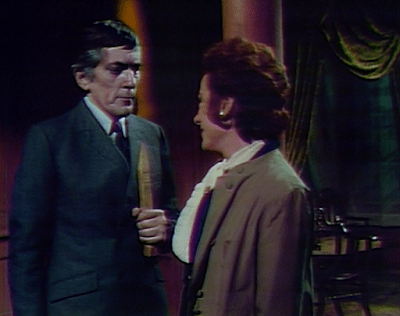
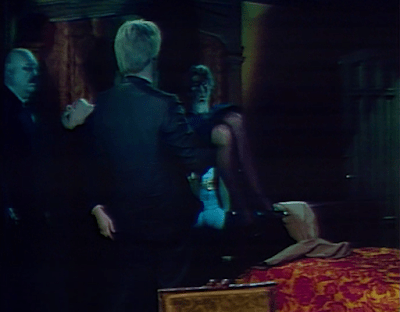
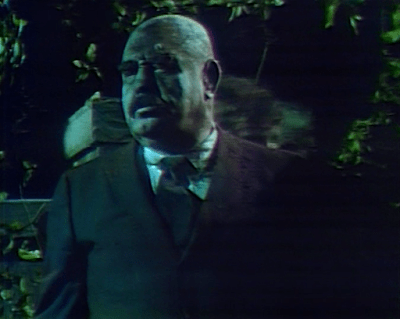
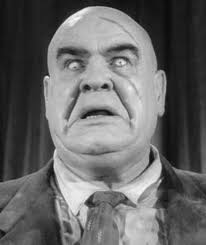
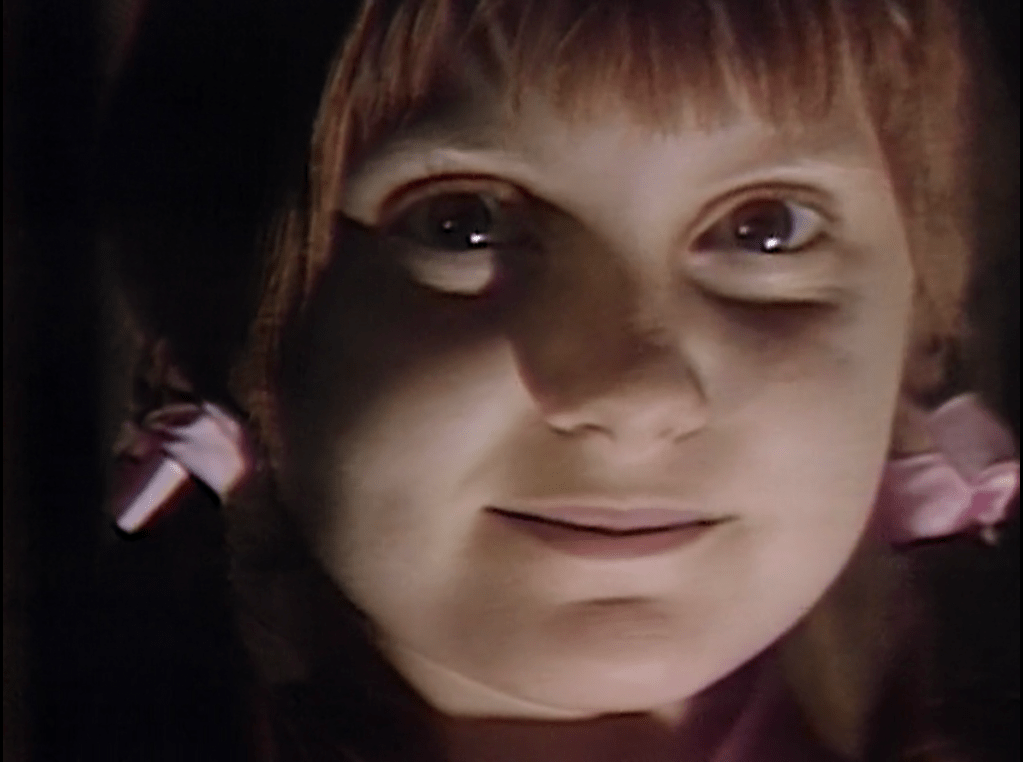
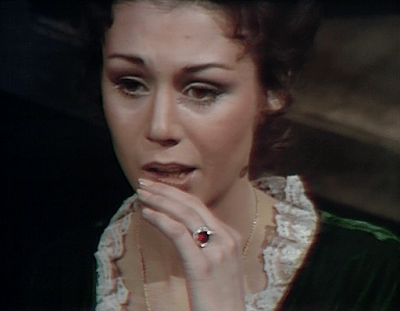

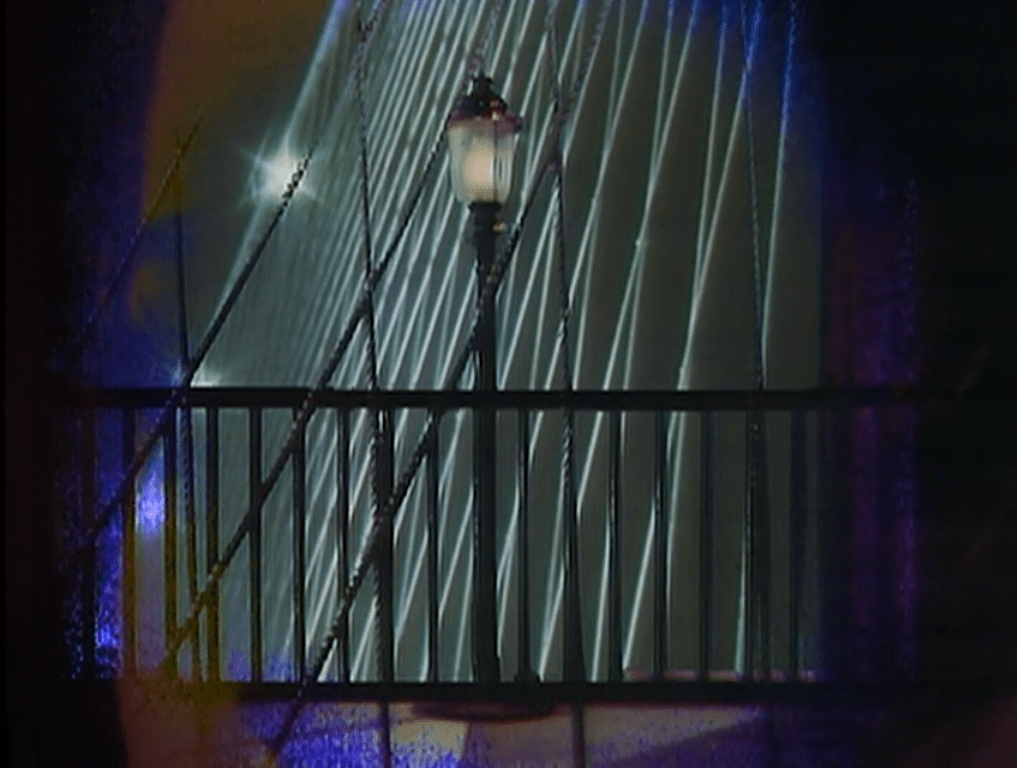
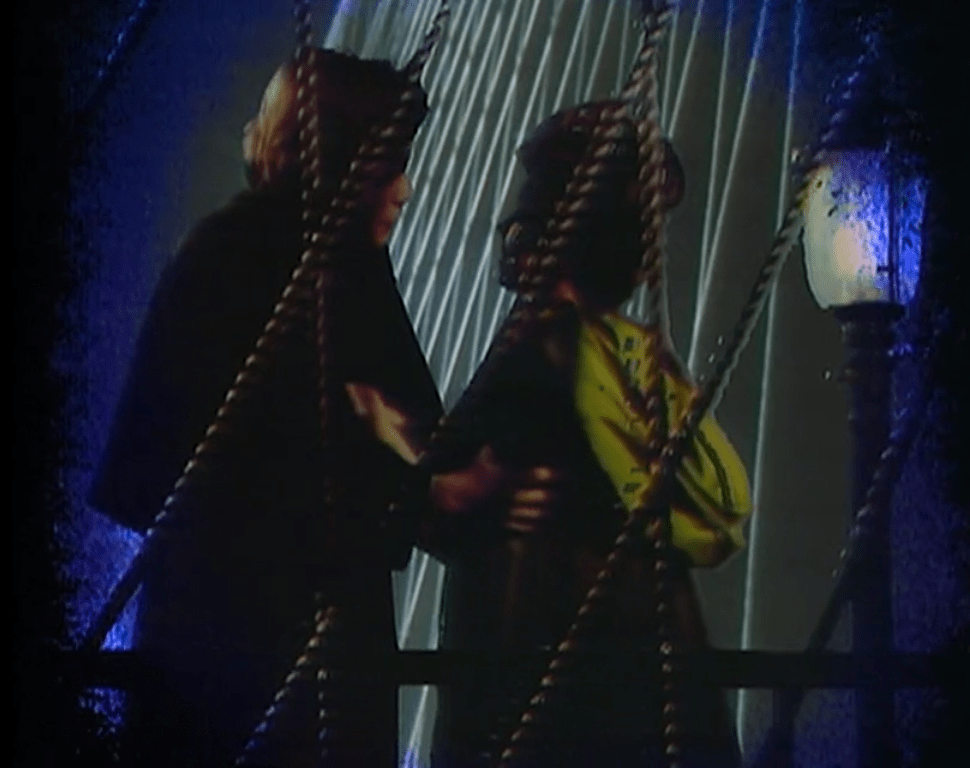
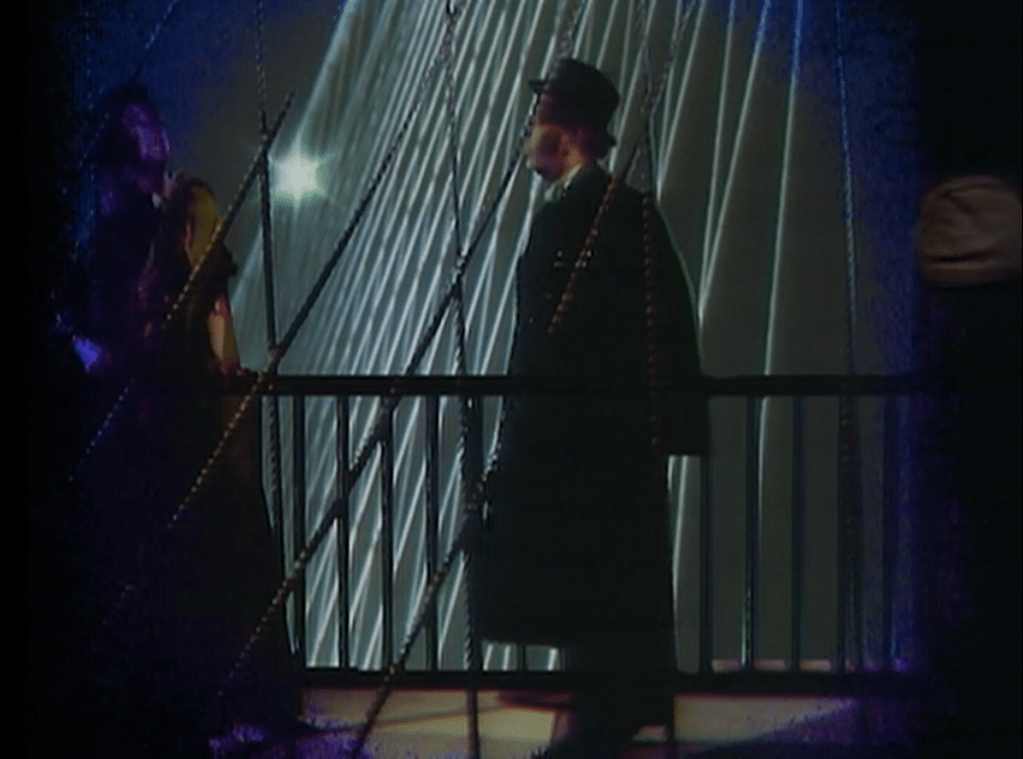
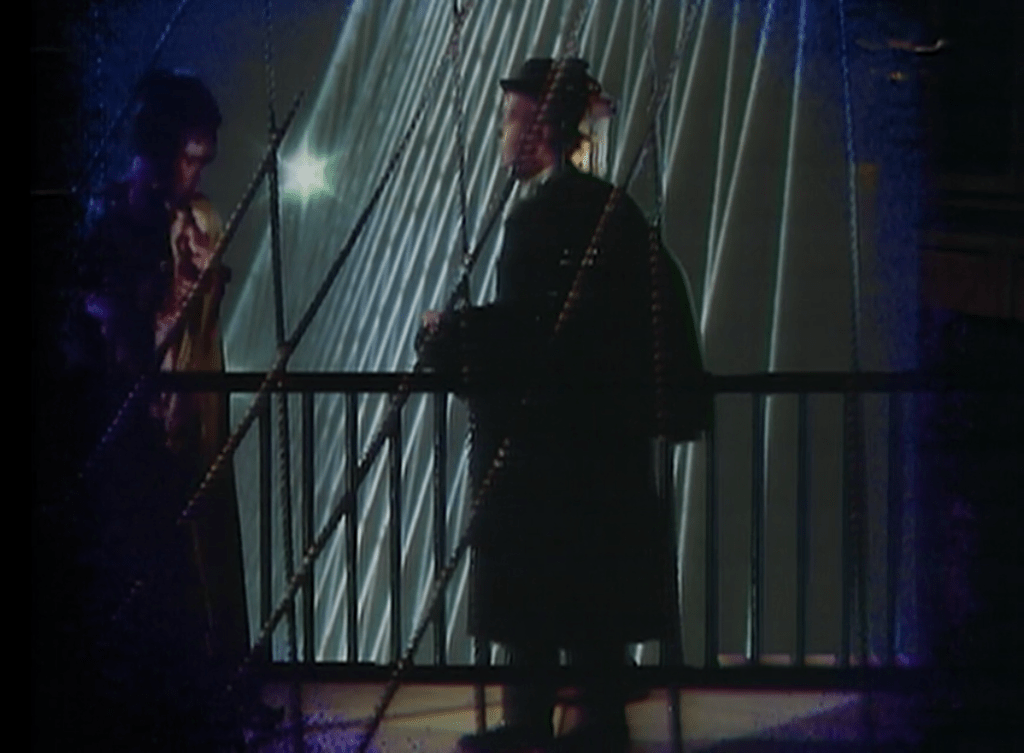
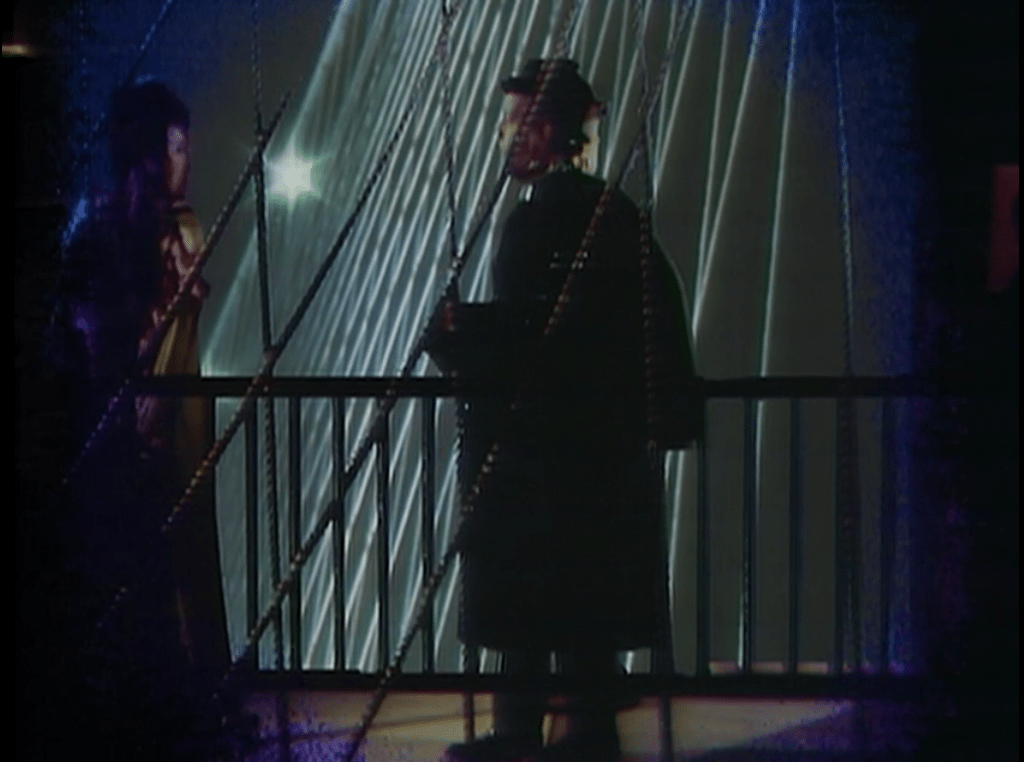

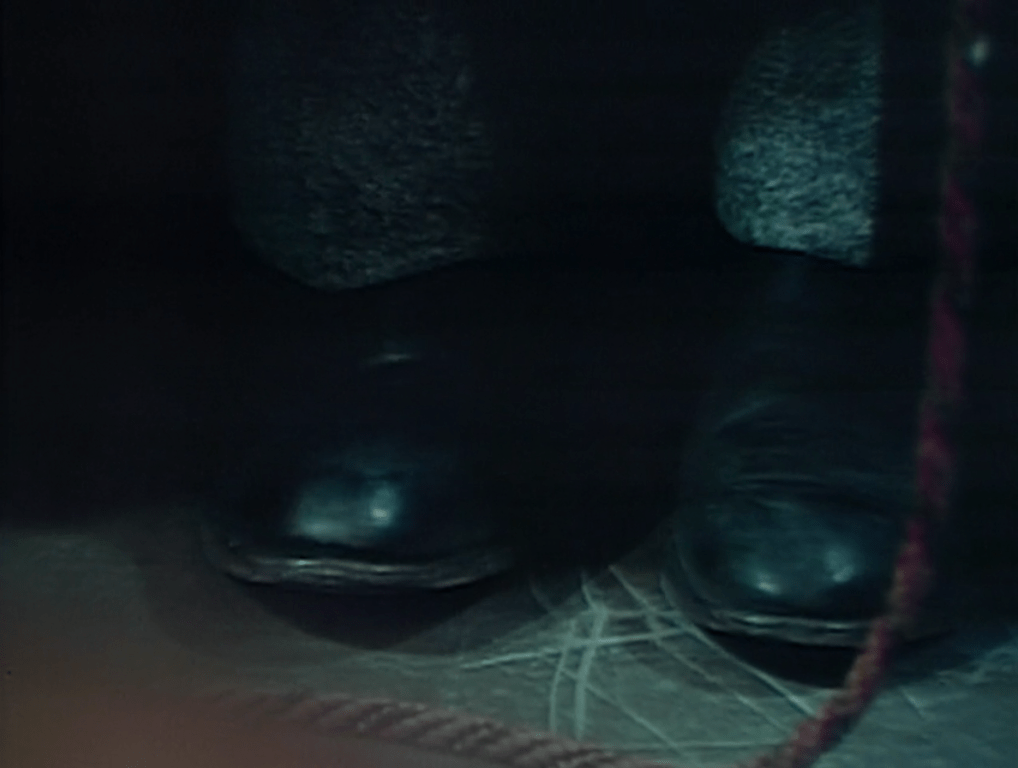
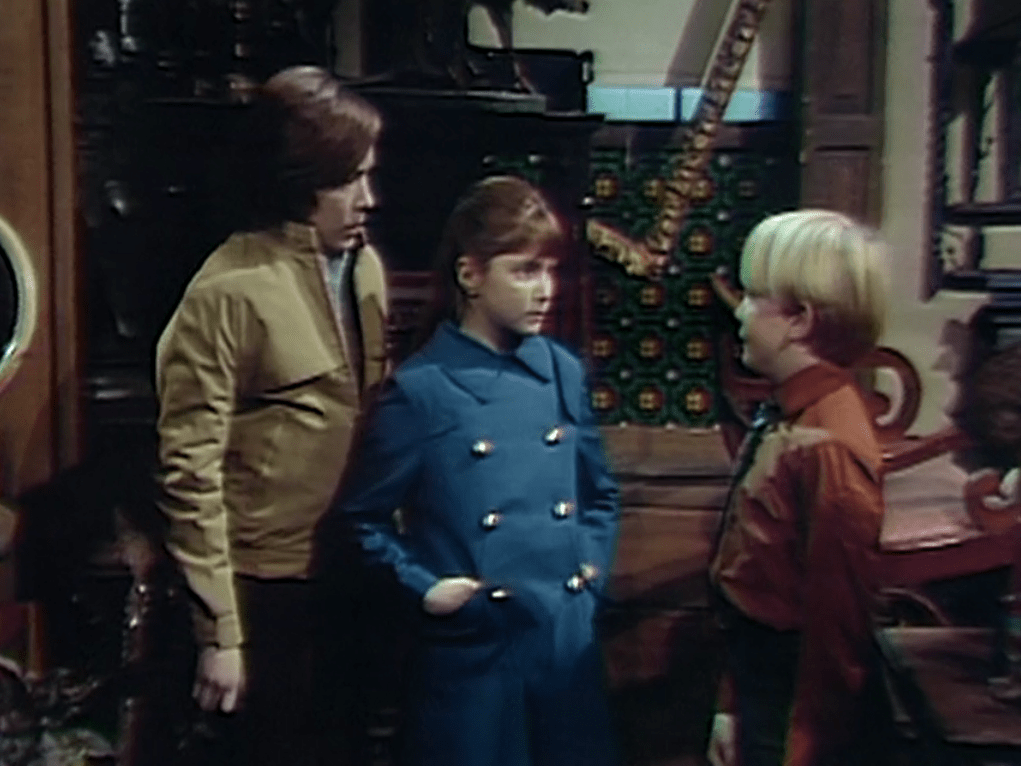
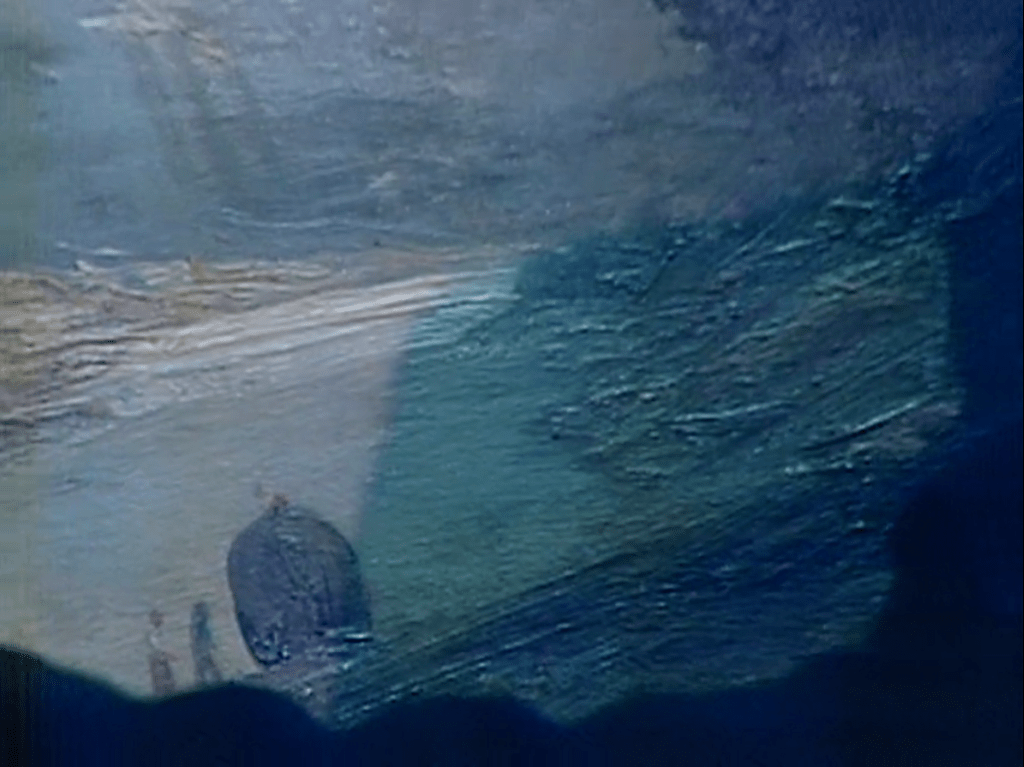


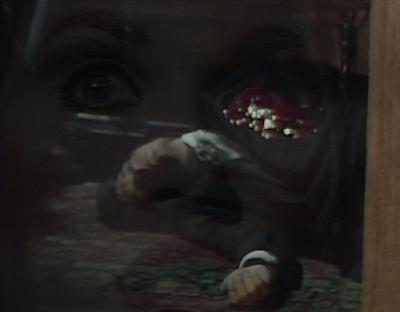
 Dark Shadows Commentary