In 281 of the posts that follow, I link to comments I made on Danny Horn’s blog, “Dark Shadows Every Day.”
Not all of these comments were absolutely unique. A number of times I argued that Danny and other contributors to the discussion threads were unduly harsh in their assessments of various actors on Dark Shadows, especially Alexandra Moltke Isles (who played Victoria Winters) and David Henesy (who played David Collins and various other members of the Collins families.)
I argue that Mrs Isles and Mr Henesy were the best thing about the first 42 weeks of the show:
I always liked Alexandra Moltke Isles; her scenes with David are not only the only things that work in the first two hundred episodes, they are also the purest example in the whole series of performers overcoming weak writing. Even when the scene begins with David accurately describing something that we, and Vicki, saw happen a few moments before and Vicki replying “That’s! Not! True!,” the two of them still manage to display deep enough emotions to carry us through. Her relatively quiet style doesn’t give her much scope as the show goes on and the “Go back to your grave!” school of acting becomes mandatory, but she always makes the most of whatever chances she has.
Nor are her performances in the first 42 weeks of the show all I find to praise in Mrs Isles’ work. I say that she made the most of the few opportunities the scripts gave her in the period of the show I call “Monster Mash” (episodes 466-626):
I’m not at all sure you’re being fair to Alexandra Moltke. She turns in some nice little performances in her scenes in this part of the series. She’s arrestingly fierce in her confrontations with Cassandra-lique, and in the confusion of her references to what she kind of remembers from 1795 she finds a kind of music. Each time she brings up her half-memory that the original Barnabas never went to England, but died in 1795, it’s a theme that resonates a little differently with everything else around it. Yes, Vicki was a dead-end character after the end of the Phoenix storyline, but I do wish the Countess had done a bit more screen acting.
Furthermore, I wish Vicki and Adam had a number of scenes together. The only thing that worked in the first 209 episodes was the relationship between Vicki and David, a theme crowned by the Phoenix storyline. Alexandra Moltke Isles and David Henesy made it work because they are both actors who excel at precisely crafted, quietly realized little scenes, and it was in scenes of that sort that the story of David learning to trust Vicki moved forward. When the vampire comes in and the overwrought style of acting (“Go back to your grave!”) takes over, the show doesn’t have room for many scenes like that. So often Isles and Henesy seem like chamber violinists trying to accompany a heavy metal band. Robert Rodan is of the same type.
As I say above, I believe Isles found a way to have an impact on a heavy metal concert with her chamber violin, and the others did as well. But it would have been satisfying in a different way if the chamber musicians had been paired with each other on a regular basis. Scenes with Vicki helping Adam could have been as compelling as the first season scenes of Vicki giving David his lessons were, as could scenes of David interacting with Adam.
I amplified my point about the Phoenix storyline (a.k.a. “Meet Laura,” episodes 126-192) here:
I liked the original Phoenix storyline… it was the payoff of the only thing that worked in the first 210 episodes, which was the development of a friendship between Vicki and David. The scene on the cliff, when David is clutching Vicki while Vicki urges him to go to Laura, is among the most emotionally powerful in the whole series because it shows us how far this development has come.
I wasn’t Mrs Isles’ only defender in the comment threads. Another commenter suggested a doozy of a rewrite of the “Meet Another Angelique” storyline (episodes 969-1060, also known as “1970 Parallel Time) in which Mrs Isles would play the villain and Lara Parker the damsel in distress, reversing their roles from the original “Meet Angelique” storyline (episodes 365-466, set in the year 1795.) Several people, including me, replied to that suggestion, all of us with an enthusiasm that showed our certainty that Mrs Isles could play the part brilliantly.
Like Mrs Isles, Mr Henesy was ill-served by the scripts and the house acting style that prevailed after the vampire was introduced (the “Go back to your grave!” style.) That ill service created a major problems later in the series. The “Haunting of Collinwood” storyline (episodes 639-700, which I usually group as part of the “Meet Amy” segment) turns on complex feelings of anxiety and dread that grip David Collins and Amy Jennings (played by Denise Nickerson.) The scenes between David and Amy work well enough; these two young actors not only convey the intricate malaise of people driven by obsession and fear, but even manage to find unexpected humor in their roles, turning into a grumpy old married couple after a few scenes together. But when Mr Henesy plays opposite an adult actor he often finds himself in an impossible situation. I give an example in this comment on episode 680:
This episode shows what Joel Crothers was talking about when he said he was glad to leave Dark Shadows because they had started spending so much time setting up special effects that the actors could no longer rehearse properly. You see it in the confrontation between David and Maggie, after he finds her waiting for him in his room. Kathryn Leigh Scott doesn’t have many lines, and only one emotion to express, sternness. She does a great job. But David Henesy has lots of complicated lines, and is trying to show us a character who is lying and who feels conflicted about lying. It would take a lot of practice for any actor to figure out a way to get all that across, and he doesn’t seem to have had the chance for it. Compare that scene with the many times he and Alexandra Moltke Isles overcame the drab dialogue they had to work with in their scenes together in the same setting, and it’s hard not to lament the missed opportunity.
Things got even worse for Mr Henesy when he was cast as Tad Collins in the 1840 segment of the show, for reasons I try to explain:
The writing isn’t the whole problem with Tad.
David and Vicki becoming friends is the only story that works in the first 42 weeks of the show, and it works in spite of the fact that the writers give the actors nothing at all to work with. We cut from a drawing room scene where Roger loudly declares to Vicki that “Yes, I’ve always HATED David!” to a scene where David looks up from his desk and tells Vicki “My father hates me,” and she responds “David, THAT’S! NOT! TRUE!” But whatever idiotic lines the script may require them to speak to each other, the body language and tone of voice between David Henesy and Alexandra Moltke Isles gets steadily warmer as the weeks go on, and you really believe that they are learning to care about each other. By the time Laura shows up, it makes perfect sense that Vicki is the referee between David and his mother, and it is inevitable that Vicki will be the one to pull him out of the burning shack.
As Tad, Henesy didn’t have the screen time it took to triumph over the writing like that, and frankly neither Kathleen Cody nor Kate Jackson was the sort of partner he needed to pull it off. Alexandra Isles worked very much from the inside out, feeling her way into the character’s emotions and letting them out through whatever parts of her were on camera, while the two K’s worked outside in, starting with the dialogue and putting the words on display. That may have made them a more natural fit for the Dark Shadows house style of acting (“Go back to your grave!”,) but it left everyone high and dry when the scripts stank.
For all that was against him, Mr Henesy did manage to create some bright spots in the later episodes. For example, his performance as evil sorceror Count Petofi speaking through the body of young Jamison Collins features some terrific moments, as I note in this comment on episode 803:
Much is asked of David Henesy in this episode. There are moments when he has to do a Thayer David impression. Those he carries off splendidly- “mineral water, for the digestion.”
At other moments, Petofi is tricking people into thinking that Jamison is free of his influence. That requires him not only to show the other characters a convincing likeness of Jamison, but also to show the audience the wheels turning in his devious mind. Sometimes that works- when he tricks Edward into letting him kiss him, he does create suspense as we wait to see his evil plan work itself out. Other times it doesn’t. When he tells Beth that “I just want people to like me,” he sounds so much like David Collins circa December 1966 that it just seems like he’s forgotten that he’s supposed to be possessed.
From time to time I spoke up in favor of other much-maligned cast members. In addition to the favorable reference to him above, I several times listed Robert Rodan among those I wished we had seen more on the show, and those references sometimes brought enthusiastic agreement from other commenters, suggesting that the negative remarks others made about him had more to do with the dead-end his character, the Frankenstein’s monster-like Adam, found himself written into than with the late Mr Rodan’s interpretation of the role.
Other actors may have left something to be desired from time to time, but did turn in good performances. I tried to call attention to those positive moments when others were venting about the less successful ones. For example, Lisa Blake Richards’ turn as Sabrina Stuart before and after the 1897 storyline is not widely admired, but I thought she was a substantial asset to the show in the “Meet Another Angelique” period.
Terry Crawford’s turn as Beth Chavez during the 1897 storyline is the object of a great deal of very harsh criticism, most of it justified. How many women could there have been who could not convince an audience that they were attracted to the young David Selby? But she did have one or two good moments then, and when she returned as Edith Collins in the 1840 segment she was very nearly competent.
Kathleen Cody also gets a lot of grief. I grant that Ms Cody was bad in the first episode in which she had lines to deliver (#1071,) but say that she was OK after that, and attribute the hostility to her to a mix of that bad first impression with a general distaste for the last 150 episodes of the show.
An actress who tends to be, not indeed denounced, but simply overlooked, is Elizabeth Eis. That puzzles me; I think she was phenomenal in all three of the parts she played. She had a one-episode spot as a devotee of the sinister Leviathan cult in #951; the character isn’t much, a cliched hillbilly teenager cribbed from Tobacco Road, and her main function is to serve as breakfast for the vampire. But in Elizabeth Eis’ hands, she bursts off the screen.
In “Meet Another Angelique,” she plays Buffie Harrington, a woman so lonely that she owns a television set (the only one we see in the entire series) and submits to life as a slave of the evil half of the Dr Jekyll/ Mr Hyde character. In that role, the late Ms Eis is so magnetic she makes a love scene with Jonathan Frid seem sexy.
In her final role, as jailer Mildred Ward in the 1840 segment, Ms Eis earned a spot in the Dark Shadows Hall of Fame by excelling in one of the show’s characteristic parts:
And another fine moment from Elizabeth Eis. Quentin, who is in jail on suspicion of strangling someone, grabs the constable’s wife through the bars of his cell and starts strangling her. The part of “person being strangled” isn’t an easy one to play, as Dark Shadows shows us two or three times a week, and she does it as well as any of them. You can see her cycle through about a half dozen emotions while she’s struggling for breath.
A few episodes later, Ms Eis reprised the role of Person-Being-Strangled, and she outdid even her previous performance:
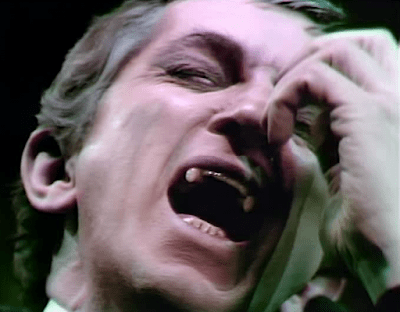
Compare her scene getting strangled by Gerard in this episode with her scene getting strangled by Quentin last week… In the scene with Quentin, she cycles through a half dozen emotions while being choked; in this one, she digs down deep and shows a very specific form of terrified disbelief.

 Dark Shadows Commentary