Judith Collins Trask, owner of the estate of Collinwood and all the Collins family businesses, has returned home after more than thirteen weeks confined to a sanitarium. Her return is supposed to be a big shock, but they spoil it by having Joan Bennett do the opening voiceover. They really should have paid more attention to that sort of thing.
Judith’s husband, the odious Gregory Trask, gaslighted her into the sanitarium, and has been exercising control over the Collins family’s wealth ever since. Today, Judith tells her stuffy but lovable brother Edward that Trask never visited her during her time as a mental patient. Edward is surprised, telling her that Trask left the house for an overnight stay every week during that period, and presented these absences as visits to her. In fact, he is on such a trip now. She does not want to hear any more, and says she will give Gregory a chance to explain himself when he comes back to Collinwood.
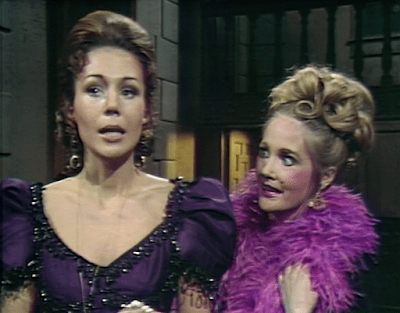
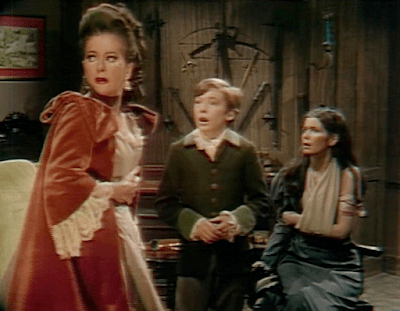
Judith claims to be entirely herself. That puts her in the minority today. When she left Collinwood in July, Judith had a stepdaughter named Charity Trask. When she enters today, she sees someone who is to all appearances Charity leading Edward and a lady named Kitty Soames in a séance. The body is indeed Charity’s, but sorcerer Count Petofi erased Charity’s personality in #819 and replaced it with that of the late Pansy Faye, a Cockney showgirl and “mentalist” whom Judith met in #771, when Judith’s late brother Carl brought her to Collinwood as his fiancée. Pansy noticed Judith’s disapproval of her when she was alive, and is quite indignant about it now. That Judith keeps live-naming her, calling her “Charity,” doesn’t help.
Judith does manage to do something Edward failed to do a while ago, and talks Pansy into moving back into the great house of Collinwood. She agrees to give up the apartment she rented in the village of Collinsport after she took a job doing her old act at the local tavern, the Blue Whale. We saw her at the Blue Whale in Friday’s episode; it was shortly before nine PM, and she was the only person in the place. So perhaps her income as a cabaret performer is not particularly lavish, and the mansion is a more appealing place to live than the apartment that job would pay for.
For her part, Kitty is still, most of the time, the dowager countess of Hampshire. But the ghost of Josette Collins has been possessing her off and on ever since she arrived at Collinwood in #844, and the trend is definitely towards “on.” In Friday’s scene at the Blue Whale, Kathryn Leigh Scott played Kitty quietly and let Nancy Barrett’s Pansy provide the scene with all its Crazy Lady Energy; today, it is Miss Barrett’s turn to stand back and let Miss Scott show that Kitty is Pansy’s match in that department.
Crazy Lady Energy, also known as “CLE,” the main driving force of Soap Opera Land. Screenshot by Dark Shadows Before I Die.
Judith and Edward’s brother Quentin is in an even stranger predicament than are Pansy and what’s left of Kitty. Between #854 and #856, Petofi forced Quentin to swap bodies with him, so that David Selby now plays Petofi and Thayer David plays Quentin. I call Mr Selby’s portrayal of Petofi “Q-Petofi,” and Thayer David’s portrayal of Quentin “P-Quentin.”
The initial shock of finding himself estranged from his own body and trapped in Petofi’s left P-Quentin bewildered. All he could do was go to one person after another and tell the true story of what had happened, which produced only a widespread belief that Count Petofi had gone mad. Now he is starting to figure out how to use his resources.
P-Quentin’s first attempt to take advantage of the fact that everyone thinks he is Petofi was not successful. In #859, he exploited Kitty’s fear of Petofi and threatened to make her vanish if she did not bring him a portrait of Quentin later that night. Kitty tried to comply, but failed, and now it is long past the deadline. Soon she will realize that his threat was an empty one, and so far from being useful to him as a cat’s paw, she will be in a position to expose him as powerless.
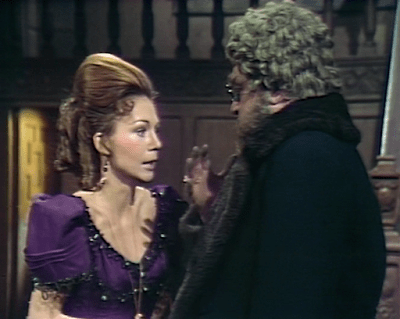
Today, P-Quentin runs a smarter game. He introduces himself to Judith as Petofi, and claims to have psychic abilities. He pretends to read her palm, and tells her a story from their childhood that very few people could know. She is delighted, and decides that Count Petofi is someone she wants to see more of.
In her bedroom upstairs at Collinwood, Kitty has another fit of Josettification. She opens the trunk at the foot of her bed and finds Josette’s wedding dress. She puts it on and wraps a red cloak around it. She goes to the top of Widow’s Hill, the cliff from which Josette jumped to her death in the 1790s. The ghost of Josette’s husband Jeremiah appears to her.
The show is set in 1897 now. It was set in the 1790s from November 1967 to March 1968. Miss Scott played Josette then, and for most of the segment Anthony George played Jeremiah. After Jeremiah’s death, Timothy Gordon played his ghost in a memorable part of the 1790s story. Gordon made two appearances as the ghost after the show returned to contemporary dress, playing him in #462 and #512. This is Jeremiah’s first appearance in 1897, and the second time, after #462, that Gordon’s name appeared in an on-screen credit on Dark Shadows.
The evil Gregory Trask coerced lawyer/ Satanist Evan Hanley into helping him murder his wife, Minerva, so that he could marry wealthy spinster Judith Collins. Now Trask and Evan have conjured up a magical simulacrum of Minerva and caused it to hang around Judith. They claim they can’t see it, which, coupled with some other troubles Judith has had, leads her to believe that she has lost her mind. Trask and Evan strong-arm Judith into signing a paper, Trask locks her up in the tower room, and Evan makes the simulacrum disappear.
Meanwhile, Judith’s brother Quentin is at large. Quentin is a werewolf, and when he returned to human form this morning his face was disfigured. This worked to his advantage. He was in jail at the time, and he was being watched. The sheriff’s deputy had not recognized Quentin’s brother Edward when he came to jail that night, so it isn’t so surprising he doesn’t recognize Quentin, even though he is six foot four, has a distinctive hairdo and prominent mutton chop sideburns, and is wearing the same blue suit with a frock coat that he always wears. It is surprising that Edward doesn’t recognize him either, but this may be the result of a congenital problem the Collinses have. Not only was Quentin himself stumped when the equally identifiable Evan had a similar glob of makeup on his face recently, but Judith fails to recognize Quentin today when he comes to the drawing room. When Judith found him, Quentin was listening to his favorite record and reciting its lyrics in his unaltered voice, and he identified himself to her by name. Still, she couldn’t see it.
Quentin bursts into Evan’s room shortly after he finishes dissolving the simulacrum of Minerva. He sees that Evan’s face is no longer disfigured, and assumes that he used the magical Hand of Count Petofi to restore his appearance. Evan tells him he did not- he can’t explain why his face reverted, it just did so on its own. This does not satisfy Quentin, and it will not satisfy returning viewers. We saw Evan struggle to fix his problem for some time, and when he found himself in a crisis situation he suddenly turned up looking like his old self. So we’ve been in suspense for several days wondering what the explanation would be for his cure, and we are no more inclined to settle for a non-explanation than is Quentin.
Quentin knocks Evan out with a candlestick; the background music is a cue we have previously heard during on-camera murders, leading us to wonder if Evan will survive the blow. Quentin rummages around for a moment and finds the hand. He is looking at it, wondering how to use it to restore his appearance, when a man in a wool cap enters and orders him to surrender the hand at once.
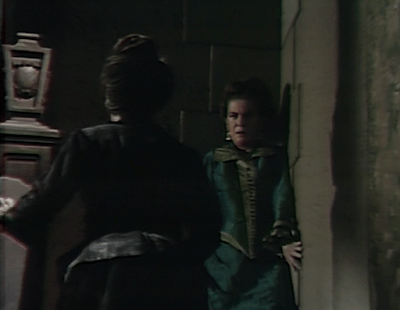
This episode features one of Dark Shadows‘ all-time great goofs. When Evan is casting the spell to dissolve the simulacrum, a black-clad figure dashes past in front of him. A voice can be clearly heard exclaiming “Jesus, Lacy!” Evidently actor Jerry Lacy was in such a hurry to get from one set to another that he didn’t realize he was crossing a live camera.
The evil Gregory Trask orchestrated a plot to murder his first wife, Minerva, and has married wealthy spinster Judith Collins. Now he and his accomplice, lawyer/ Satanist Evan Hanley, have conjured up a simulacrum of Minerva to hang around Judith and drive her insane. Once Judith is safely confined to the nearest high-class asylum, Trask will enjoy Judith’s riches, minus only whatever percentage Evan squeezes out of him.
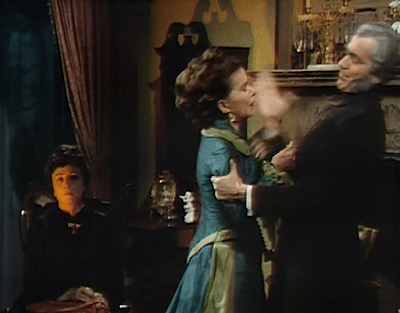
Today, Judith stands in her bedroom in the great house on the estate of Collinwood. She isn’t ready to go to bed, and the simulacrum of Minerva is sitting in the rocking chair, sewing. Trask pretends he cannot see the simulacrum, and forbids Judith to leave the room. When Judith becomes upset, he slaps her. This slap occurs on the soundtrack and in our imaginations. What we see on screen some time before the slapping sound effect plays is Jerry Lacy waving his hand a considerable distance short of Joan Bennett’s face. The two of them do such a good job of acting that this failure of blocking does nothing to undercut the oppressive atmosphere. For her part, Clarice Blackburn plays the pseudo-Minerva with just enough animation that we cannot predict what she will do. These performances take a sequence which may not have seemed like much on the page and make it into one of the most frightening scenes on Dark Shadows. When Judith lies to Trask and says that she does not see Minerva, it’s enough to produce a shudder.
Downstairs, Trask answers a knock at the door and broad ethnic stereotype Magda Rákóczi enters. Regular viewers know that Judith despises Magda and Magda hates her, and so it is surprising when we hear that Judith has sent for Magda. Trask blocks her way upstairs. Magda is defiant towards Trask; she knows what he did to Minerva, and is using that knowledge to force him to let her and her husband stay in the Old House on the grounds of Collinwood. But Trask has a new threat to make.
Trask knows that Magda is the sister of the late Jenny, who married Judith’s brother Quentin. He also knows something that not even Quentin knows, that Jenny bore twin children to Quentin after he left her. He threatens to send Jenny’s children away from the village of Collinsport. Evidently Magda wants the children to stay where they are, in the care of a woman named Mrs Fillmore. It is unclear why this would matter to her; we have had no indication that she has met Mrs Fillmore, much less visited the children at her house. But it is important enough to her that they not be moved that Magda responds to Trask’s threat with “What do you want me to do to her?”
We cut to Judith’s room. Magda enters. Judith tells her that the ghost of Mrs Trask vanished a few minutes ago, after sitting in the rocking chair for hours. Judith asks if she thinks she sounds mad, to which Magda replies there is nothing so strange about a simple ghost. The simulacrum reappears, and Judith asks Magda if she sees it. Magda says she does not.
Back downstairs, Magda tells Trask that he is a swine. She spits on the floor next to him and stalks off. Much as Magda hates Judith and many as are the crimes in which she is implicated, she is a warm-hearted sort, and Trask’s bloodless cruelty is not to her liking. Indeed, it is strange she did not tell Judith of Trask’s attempt to extort her complicity and make an alliance with her against him.
Meanwhile, Quentin is being held in the jail. When Magda realized that he murdered Jenny, she turned Quentin into a werewolf. She did not then know about the twins, and so she made the curse hereditary. Once she found out that her own kin were in line to become monsters, she started looking for a way to undo the curse.
The police captured Quentin the night before, while he was in his lupine form. As a result of Magda’s latest futile attempt to cure him, Quentin emerged from his bout of lycanthropy with his face disfigured and his memory a blank. Though his clothing and his hairstyle are so highly distinctive that virtually everyone who has seen the show before can tell that the man in the cell is Quentin, the Collinses suffer from a peculiar form of blindness that keeps them from recognizing people with globs of makeup on their faces, so his brother Edward is at a loss as to who he could be.
Magda is working with time-traveling vampire Barnabas Collins, distant cousin of Quentin, Edward, and Judith, who has set out on a mission to set the events of the year 1897 right so that Quentin will not become a malign ghost ruining things for everyone at Collinwood in 1969. Unfortunately, vampires are not problem-solvers; their function in a story is to create problems. Since coming to 1897, Barnabas has been responsible for at least six homicides. He has wrought a great deal of havoc even beyond those killings. For example, it was as a direct result of his actions that Judith and Trask got together in the first place. Today, Magda goes to Quentin’s cell and tries to tell him that Barnabas will come to him after nightfall and take him to the Old House.
We do not see Barnabas. We are watching Quentin in his cell when we hear a bat squeaking outside the jail. Barnabas can materialize wherever he chooses; he does not choose to materialize in the cell, where Quentin is alone and unattended, but goes into the outer office in his bat form. We hear a deputy in that office talking to the bat affectionately, asking him where he came from. We haven’t seen the deputy before this episode, but one suspects that a fellow who sees a bat in his office and strikes up a friendly conversation with it must have an extremely sweet personality. We then hear the deputy make a horrified exclamation, and the doors to Quentin’s cell and to the world outside open by themselves. As Quentin walks out, we see the deputy slumped at his desk, two bleeding wounds on his neck.
We cut to the darkened interior of the great house at Collinwood. Quentin comes ambling in. Biting the deputy was certainly not part of any plan Barnabas made with Magda, but it isn’t completely surprising- he hadn’t had a square meal for quite a while. But even for Barnabas, it shows an unusually low degree of operational competence to let Quentin wander off by himself when the whole idea is to get him to the Old House.
In the drawing room, we hear Quentin’s thoughts as he dwells on his amnesia. He does not know who he is, where he is, or why he has come. He sees his gramophone, and starts playing his only record. That brings him back to himself.
Judith enters. Quentin is not only wearing his usual suit and his distinctive hairstyle, he is listening to the music he has been playing obsessively for months and reciting the lyrics to it. As if that weren’t enough, his voice is quite outstanding- he must be the only senior member of an aristocratic Maine family with a West Virginia accent. Yet Judith not only fails to recognize her brother, she refuses to believe him when he identifies himself to her by name.
The simulacrum of Minerva enters, holding a letter opener above her head. Earlier this week, Minerva’s actual spirit had possessed Judith, and under her power Judith had held that same letter opener in that same position as she confronted Evan and accused him of her murder. Judith does not remember that, and she screams at the sight.
In #762, the Rev’d Mr Gregory Trask walked in on lawyer Evan Hanley and handsome rake Quentin Collins as they were performing a Satanic rite. Trask’s response was to blackmail Evan. Trask wanted his wife Minerva out of the way so that he could marry rich spinster Judith Collins, Quentin’s sister. Threatened with exposure, Evan cast a spell on an unfortunate young man named Tim Shaw. He brainwashed Tim into reenacting the plot of The Manchurian Candidate, with Trask in the Angela Lansbury role and Evan as the People’s Republic of China. As Evan and Trask planned, Tim killed Minerva. Shortly after, Trask married Judith.
On their wedding day, Judith saw Minerva’s ghost in the corner of the drawing room in the great house of Collinwood. In yesterday’s episode, Minerva’s ghost took possession of Judith, and the closing cliffhanger showed the possessed Judith about to stab Evan with a letter opener to avenge Minerva’s death. As we open today, Judith’s brother Edward enters and prevents the stabbing, and Judith is released from possession. She can remember nothing that happened while she was under Minerva’s power, and Edward is convinced that she has gone mad.
Edward takes Judith to her room, and Trask enters. Evan tells him that Minerva’s ghost has been in touch with Judith. The ghost knows what they did, and if the contact continues Judith will know as well. Trask demands that Evan do something to prevent that, and Evan says that he can cast a spell that may turn the haunting to their advantage and neutralize Judith permanently.
The plan turns out to be the creation of a “black ghost.” The only Black actor to have had a speaking part on Dark Shadows was Beverley Hope Atkinson, who played an unnamed nurse in one scene in #563, almost a year ago. Humbert Allen Astredo, who plays Evan, was also in that scene, playing suave warlock Nicholas Blair. Atkinson was terrific, and it would be great to see her again, but it turns out that the “black ghost” is not actually black. Nor is it a ghost. This misnamed entity is a simulacrum of Minerva, a kind of supernatural hologram that Evan will fabricate and that will appear when Judith is around. This will lead Judith to believe that she is insane, thereby causing her actually to become insane and to cease to be an obstacle to Trask’s enjoyment of her wealth.
The simulacrum first shows up in a transparent form in Judith’s bedroom. Judith screams. In the drawing room, Trask and Edward hear her scream and break off a conversation in which Edward has been urging Trask to agree to annul his marriage to the obviously disturbed Judith. Judith comes downstairs. She is reluctant to explain why she screamed, and tells Edward and Trask that nothing is wrong. She and Trask go to the drawing room and talk privately. He has to prod her a bit before she will admit she saw Minerva. He tells her it was just her imagination. She considers this; after all, she was in bed when she saw the image, so it may have been a dream. But then the simulacrum appears in the drawing room, near the spot where she saw Minerva’s ghost on her wedding day. Judith sees Minerva sitting quietly and sewing. Trask pretends he does not see anything; after a bit, Judith pretends she can’t see the image either. Trask leaves Judith alone with the simulacrum. Judith goes upstairs, and the simulacrum follows her. When they reach the top of the staircase, Judith cries out in fear and tells the simulacrum to stay away from her.
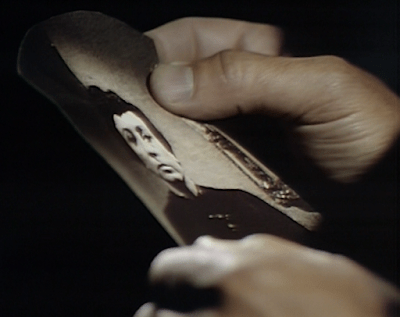
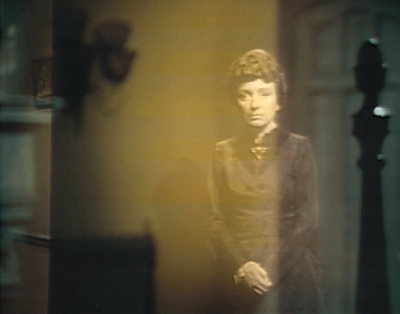
Though it is disappointing to be reminded that Beverley Hope Atkinson isn’t coming back, it is always good to see Clarice Blackburn. In her interviews with the authors of the book Barnabas and Company, Nancy Barrett said that Blackburn was the best performer in the entire cast of Dark Shadows. She doesn’t have a lot to do today- she delivers the opening voiceover, we see a snapshot of her, and as the simulacrum she stands motionless in a corner, sews placidly, then is seen from behind as she follows Judith up the stairs. But if there ever was a case to prove the old cliche that no part is small when a big enough actor plays it, Blackburn makes each of these little turns into a moment viewers will remember.
Screenshots by Dark Shadows Before I Die.
As Judith, Joan Bennett also deserves a great deal of credit for getting the gaslighting plot off to a good start. For example, there is an embarrassingly ill-written scene when Judith is in her room, pacing back and forth while some vibes play on the soundtrack. A knock comes at the door, and the music stops. Judith opens the door, and no one is there. The music resumes, and she starts pacing again. There is another knock. Again the music stops, again Judith opens the door, and again no one is there. The music resumes, and she’s back to pacing. The knock comes a third time. A third time the music stops, and a third time Judith turns to the door. This time she asks who’s there. It’s Trask. She lets him in, and he denies having knocked before. Knocking on doors and running away is a pretty crude tactic even on a show with an audience consisting largely of kids aged twelve and under, and the apparent complicity of the music in Trask’s plot is the kind of thing they ridiculed in Looney Tunes cartoons. But Bennett’s soulful performance holds our attention throughout.
This is the second time Dark Shadows has shown us an adventurer trying to gaslight his new wife so that she will go away and give him unfettered access to her fortune. The first time was in March 1968, when the show was set in 1796. Naval officer/ sleazy operator Nathan Forbes had married fluttery heiress Millicent Collins. Nathan discovered that Millicent had transferred all her assets to her little brother Daniel. Nathan then set about driving Millicent out of her mind so that he could take her place as Daniel’s legal guardian. That plot also featured some weak writing, but Joel Crothers and Nancy Barrett were so irresistible as Nathan and Millicent that it hardly mattered. Perhaps the writers wanted to revisit the gaslighting theme to show that this time they could consistently write scripts worthy of their outstanding cast.
A showcase for the actors today. We begin in the room on top of the tower at the great house on the estate of Collinwood. Madwoman Jenny Collins, who has been locked up in that room for some time, is threatening to stab her sister-in-law Judith with a large pair of scissors. Judith and her brother Edward have been hiding Jenny and trying to keep the rest of the family in the dark about her presence in the house. For services to this secret, they have been paying maidservant Beth Chavez and, we heard in #707, someone named Mrs Fillmore. Beth comes in just in time to distract Jenny with talk about her “babies,” and thereby to prevent her from killing Judith. Jenny turns to some baby dolls, and cuddles them happily.
Judith goes downstairs and encounters newly hired governess Rachel Drummond. Rachel has caught on the someone is living in the tower room, and the other day sneaked up there and let Jenny out. Judith reprimands Rachel for seeing and hearing things that don’t exist. Rachel is a neurotic intellectual. Her insecurities compelled her to investigate the question of the tower room, and also make it plausible that she might eventually cave in to Judith’s attempt to gaslight her into believing that she didn’t really see what she saw.
Rachel goes out, and Beth enters. Judith shows how frustrated she is with the whole situation. This scene is a bit of a letdown. As Judith, Joan Bennett was brilliant opposite Marie Wallace’s Jenny, and brilliant again opposite Kathryn Leigh Scott’s Rachel. But she falls to pieces alone with Terrayne Crawford as Beth. So many of the fansites feature so much grousing about Miss Crawford’s literalist style of acting that I hate to pile on, but it is true that she did not give Bennett anything to play off of. When Miss Crawford delivers a line, its meaning is the dictionary meaning of the words that compose it, no more and no less. She never leaves you wondering what else is going on in Beth’s mind. Sharing a scene with her would be like sharing a scene with a sign labeled “No Right on Red.” Later, Miss Wallace will have a two-scene with Miss Crawford, but as a character in a psychotic state she doesn’t need support. Her lines in that scene are flowery gibberish that don’t work at all, but neither actress is to blame for that.
The master class in acting resumes as we cut to the Old House on the estate. The mysterious Barnabas Collins has recently arrived at Collinwood and is staying in the Old House as the guest of his distant cousins in the great house. Rachel and Barnabas are attracted to each other, and she tells him what has happened. He says that he believes her, and goes on to say that no one at Collinwood is what they seem. She pleasantly replies “Except for you!” He hesitates before agreeing.
More than meets the eye.
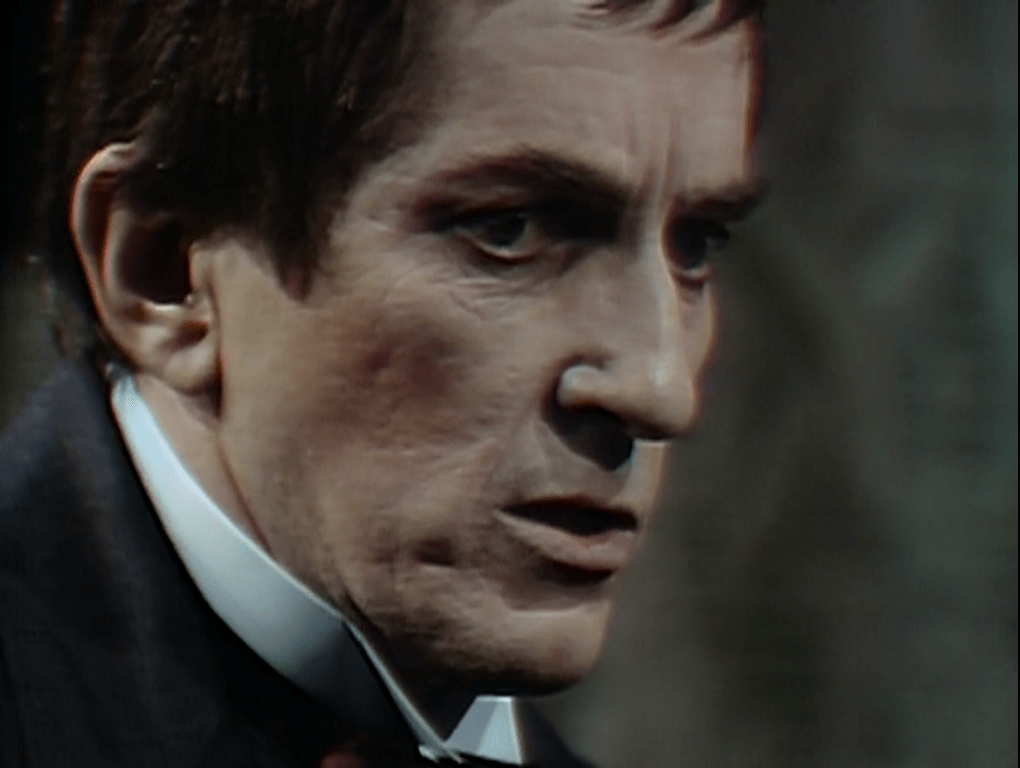
In fact, Barnabas has more than five hundred episodes of secrets he is keeping from Rachel and everyone else. Jonathan Frid’s work prior to Dark Shadows was almost entirely on stage, but he used his face like a movie actor, keeping every part of it but his eyes virtually immobile. With that, he can isolate emotions, playing just one feeling at a time. All anyone can see by looking at him in his scenes with Rachel today is that he is anguished. Rachel interprets that anguish as a sign that he cares about her, and she is delighted to think that she has such a straightforward and reliable friend.
Returning viewers know that Barnabas is in fact the most dangerous person Rachel has ever met. That knowledge on our part frees Miss Scott to play Rachel’s relief at Barnabas’ friendliness as broadly as she likes. Her unrestrained display of good cheer brightens the episode’s otherwise somber emotional palette, but the irony the audience finds in a woman having this reaction to Barnabas keeps the dramatic tension high.
Barnabas walks Rachel back to the great house. They have made a plan that she will bring him the key to the tower room and he will go up there to investigate. She impulsively kisses him on the cheek. Rachel goes in the house and finds to her surprise that Judith is still awake. Judith detains Rachel in the drawing room with a glass of sherry and a lot of disconnected talk. Judith doesn’t make eye contact with Rachel during this scene; she doesn’t want a conversation. She is simply enjoying her new position as head of the household. Rachel cannot get away until Beth enters and Judith abruptly dismisses her.
Barnabas has been watching the windows of the tower room and has seen lights go on and off. Nervous, he considers letting himself into the room without a key; he has the means to do that, but he would like to keep Rachel from knowing about his abilities, and so he resolves to wait for her.
After Rachel brings Barnabas the key, he goes to the tower room and uses it to let himself in. No one is there. He picks up the damaged, severed head of a doll, one of Jenny’s “babies.” Suddenly, he hears someone enter. He turns, and reacts with shock.
In 1966, the well-meaning Victoria Winters (Alexandra Moltke Isles) came to the great house of Collinwood to be governess to strange and troubled boy David Collins (David Henesy.) Throughout the first 25 weeks of Dark Shadows, Vicki gradually learned that David’s stories of ghosts and other paranormal phenomena were not signs of a disordered imagination, but were simple statements of fact. Once she came to terms with that reality, Vicki and David became the closest of friends.
Now it is 1796. Vicki has come unstuck in time. For a brief period she served at Collinwood as governess to the children there, including Daniel Collins (David Henesy,) with whom she became the closest of friends. Vicki’s signal failure to adapt to her new surroundings soon led her to be convicted of witchcraft and sentenced to death. She escaped from gaol and found a hiding place in the secret room of the Collins family mausoleum. Daniel joined her there.
Daniel, too, had been fleeing for his life. An unsightly man had abducted him. Daniel got away from him and made his way to the cemetery, where he had earlier seen Vicki duck into the mausoleum. When Daniel went out again, the man appeared and tried to strangle him. Vicki found out what was going on and shot the man to death.
Daniel and Vicki then left the cemetery and went to the great house. The lady of the house, Naomi Collins, believes that Vicki is innocent. Daniel is sure Naomi will help her.
Today, Daniel and Vicki arrive at the house, and Naomi does indeed hide them. The three of them are in the study when Daniel’s brother-in-law, naval officer/ sleazy operator Nathan Forbes, knocks on the door. Naomi hustles Vicki into a closet and lets Nathan in. Nathan dismisses Daniel’s claim that he was attacked, but when Daniel gives a description of his assailant Naomi realizes that it matches a man she saw Nathan with earlier. She is convinced that Nathan tried to do away with the boy.
She is correct. Nathan wooed Daniel’s sister Millicent for her money, only to discover after they were married that she had signed all of it over to Daniel. If Daniel dies, it reverts to her, which is to say to her husband. So Nathan set about scheming to have Daniel killed. As it was always dangerous to disbelieve David, so it would be dangerous to disbelieve Daniel.
When Naomi tells Nathan that the authorities will investigate Daniel’s story, he warns her against attracting the attention of the constable. He can see that she doesn’t know what he’s talking about. So he tells her that it is to do with her son Barnabas. Naomi declares that Barnabas is in England, repeating a lie that her husband Joshua commanded her to propagate. Nathan says that isn’t true. “So you know Barnabas is dead,” replies Naomi. Nathan denies that as well, and says that Barnabas has recently been murdering people in the town of Collinsport.
Naomi was in the house when Barnabas died and saw him in his coffin afterward, so she is not inclined to accept Nathan’s assertion. But Millicent keeps saying that she has seen Barnabas, Naomi thought she heard Barnabas’ voice the other day, and Joshua is obviously keeping some secret from her. So when Nathan tells her that Barnabas is in the room on top of the tower attached to the house, she can’t resist going up there to see for herself. At the end of the episode, Naomi is in the tower room, opening Barnabas’ coffin.
In the parts of Dark Shadows set in the 1960s, Grayson Hall plays mad scientist Julia Hoffman, sometime confidant of ancient vampire Barnabas Collins. Now it is 1796, Barnabas has only recently become a vampire, and Hall is the Countess DuPrés. Like Julia, the countess is deeply versed in the supernatural, and like her she is a long-term guest at the great house on the estate of Collinwood.
Barnabas’ father Joshua has learned of his son’s curse, and is desperate to find a way to free him of it. Today, we open in the Old House on the estate. Joshua has summoned the countess to meet him there. Joshua brings the countess up to date about Barnabas’ condition. He also informs her that the one who played the curse was not the luckless Victoria Winters, who is currently in gaol awaiting execution on charges of witchcraft, but was in fact the countess’ one-time maid Angelique. At this, the portrait above the mantel vanishes and is replaced with one of Angelique.
This is the first we have seen the portrait of Angelique. As Danny Horn points out in his post about this episode on Dark Shadows Every Day, it is a message to the audience. Barnabas killed Angelique weeks ago, and her ghost, which was pretty busy on the show for a little while after that, has not been prominent lately. They are running out of unresolved storylines, and will be returning to the 1960s soon. When they show us that they have commissioned and paid for a portrait of Angelique, the makers of Dark Shadows are telling us that she will be back when they return to a contemporary setting.
Joshua asks the countess if she can help lift the curse. At first the countess shows incredulity that Joshua thinks she can “provide a witch” who will counteract Angelique’s spell, but she immediately follows this display by announcing exactly how they will go about summoning such a person.
Back in the great house, naval officer/ sleazy operator Nathan Forbes is continuing with his efforts to drive his new wife Millicent insane so that he can get his hands on her share of the Collins family fortune. Millicent has seen a light in the room on top of the mansion’s tower. Nathan denies having seen the light, and Millicent takes his denial, not as a sign that his vision is failing, but as a reason to fear that she is hallucinating. Nathan insists that she go to the tower room and prove to herself that no one is there.
Returning viewers will be startled by this insistence of Nathan’s. Nathan has deduced that Barnabas is in the tower room. He does not know that Barnabas is a vampire, but does know that he is responsible for the many killings that have taken place in the area recently. When he presses Millicent to go to the room, he is not only trying to unhinge her mind, but is sending her to surprise a crazed murderer in his lair.
Perhaps Nathan hopes only that Millicent will be shocked to see her cousin. But he has been using his knowledge of Barnabas’ presence on the estate to blackmail Joshua. Millicent is a compulsive talker. If she learns that Barnabas is at home, it will only be a matter of time before she tells everyone about it, making Nathan’s information worthless as leverage over Joshua. Unless Nathan does in fact calculate that Barnabas will kill Millicent, it is hard to see what he thinks will happen when Millicent goes to the room.
Joshua and the countess return to the great house. Joshua hustles everyone out, commanding them to go into town to attend a speech by the governor of Massachusetts.* Nathan resists; alone with Joshua, he asks if Barnabas will still be in the tower when everyone gets back. Joshua refuses to discuss the matter.
Joshua and the countess begin their summoning ceremony in the drawing room. Nathan eavesdrops at the door. Joshua finds him there and drives him from the house; the ceremony begins again.
Millicent goes to the tower room. She lets herself in. Barnabas confronts her. He tells her that he will let her go if she will promise never to tell anyone she saw him there; she cannot do that. Patrick McCray puts it well in his post on The Dark Shadows Daybook: “Millicent’s tragedy is that her nature compels her to tell the truth. She knows it will kill her and she knows that she is consigned to it. She is addicted to chatter and chatter will kill her. When she screams at Barnabas’ attack, I think she’s not so much screaming at the terror of the vampire as she is screaming at herself.”
In the drawing room, the countess and Joshua continue the ceremony. We hear the wind. One draft blows out the candle; another blows open the door. An old woman appears in the doorway. She enters the foyer, and says that it is too late- the man they have summoned her to help has already gone.
*In our time-band, Samuel Adams held that office in 1796. We might imagine that Adams had a counterpart in the universe of Dark Shadows. If so, it would have struck people odd that Joshua was not already committed to attending the speech, and indeed that he had not invited Governor Adams to spend the night at Collinwood. When Joshua first met the countess, he proudly claimed that the French Revolution was an imitation of the USA’s War of Independence; by that point in history, such a claim marked its maker as a supporter of the faction in American politics that the governor represented, the more militant wing of Thomas Jefferson’s party. In fact, much later in the series we will see a portrait of Jefferson prominently displayed at Collinwood. Joshua must surely have been the richest and most eminent Jeffersonian in the region, so much so that even though his family was in mourning they would still have been expected to host the governor in their mansion.
Naval officer/ sleazy operator Nathan Forbes has succeeded in his scheme to marry fluttery heiress Millicent Collins, only to discover that Millicent has signed her vast fortune over to her little brother Daniel. Nathan comes up with a Plan B. Millicent is Daniel’s legal guardian, and he is Millicent’s husband. So if she is declared insane, he will be able to get his hands on the money.
From her first appearance, Millicent has been established as an extremely fragile person. So Nathan’s gaslighting project doesn’t take much work. She makes a remark in a calm voice, and he expresses dismay that she is so upset. Rather than dismiss this as a tiresomely dimwitted joke, Millicent becomes very agitated. She mentions that there is a light in a window across the way; Nathan denies that he sees it. Rather than wondering if his eyes are going bad, she is reduced to tears by the thought that she might be hallucinating. The whole process takes about three minutes. It’s fine for viewers who have been watching Millicent all along and know how precarious her mental balance is, but people tuning into Dark Shadows for the first time would probably think the scene was pretty silly.
For the last eight weeks, Dark Shadows has been presenting a riddle about strange and troubled boy David Collins. In #288, he wondered if mysterious little girl Sarah might be a ghost. Since then, he has seen her several times, and every time she has given fresh evidence to corroborate that hypothesis. When he isn’t with Sarah, David is either looking for her or fielding questions from adults who are anxious to make contact with her, and in the course of every search and every question he finds still more reason to suppose that she is a ghost. David had always been the first character to believe in ghosts, yet he kept resisting the obvious conclusion that Sarah was one.
Friday, David had a dream in which Sarah told him that she died when she was ten years old. In that same dream, David saw his cousin Barnabas rise from a coffin, greet Sarah warmly, and threaten him with his cane. Yesterday, David woke up and told his well-meaning governess Vicki that he now understood everything about Sarah, because he knew that she was a ghost. Vicki listened carefully to his dream. Much to his frustration, she tried to talk him out of taking it literally. But today, when David is out of earshot, Vicki twice shows the other adults that she regards David’s dream with the utmost seriousness.
In the drawing room of the great house of Collinwood, mad scientist Julia Hoffman tries to hypnotize David so that he will stop making trouble for her co-conspirator Barnabas. Before she can induce the trance, David recognizes her medallion as the one a faceless woman held before his face in the dream. He flees from Julia and calls out for Vicki.
Vicki and matriarch Liz ask Julia what happened. Julia tries to play dumb, but Vicki recognizes her medallion both as the one David described when he was telling her about his dream and as the one Julia showed her and Maggie Evans, The Nicest Girl in Town, when she dropped in on them at Maggie’s house in #298. During that visit, Vicki briefly left Julia and Maggie alone together. Before she left the room, Maggie was about to remember who abducted her and held her prisoner; after she came back, Maggie’s amnesia had returned in full force. During the interval, Julia had used the medallion to do a little emergency hypnosis, restoring the memory block that keeps Maggie from identifying Barnabas as her captor and as a vampire. Julia has reason to squirm when she realizes that Vicki has connected the medallion both with that incident and with David’s dream.
Vicki goes to David’s room to again try to talk him out of a supernatural reading of his dream. She finds him gazing into his crystal ball, looking for Sarah. He pleads with her to allow him to go look for Sarah. She resists, but he tells her that he saw Sarah in the crystal ball and that it won’t take him long to find her. He promises to tell Vicki what he and Sarah talk about. She lets him go, on condition that he be back within an hour.
The riddle of David’s long refusal to acknowledge that Sarah is a ghost is matched by the riddle of Vicki’s attitude. She has seen and interacted with ghosts on many occasions, a fact that is no secret from David. Both her recognition of Julia’s medallion and her acceptance of David’s claim to have seen Sarah in the crystal ball show that she knows she is operating in a world where supernatural forces are at work. Yet she keeps urging David back into “logical explanation”-land. Perhaps she has read Henry James’ “The Turn of the Screw,” and doesn’t want there to be any ambiguity about whether the boy saw the ghosts himself or his crazy governess put the idea into his head.
David goes to the woods, hears the familiar strains of “London Bridge,” and sees Sarah. She tells him that she knows he saw her in his crystal ball. When he asks how she knows he was looking into his crystal ball, she answers only “I know lots of things.” He asks her about his dream; apparently that is not among the things she knows about, because it all comes as news to her. David tells her that in his dream, she told him that she was very sick when she was ten years old. She excitedly replies “That’s true!” He then says that she told him she died of that sickness. Even now, after the dream, after telling Vicki that Sarah is a ghost and shouting with frustration when she won’t agree, he follows up the idea that Sarah has died with “That isn’t true, is it, Sarah?”
Before Sarah can answer, Vicki’s depressing boyfriend Burke lumbers onto the scene. He hears David and Sarah’s voices and shouts “David!” Sarah then becomes alarmed and declares she has to go away. David asks her to stay, and goes to tell Burke to wait. By the time they turn around, Sarah has vanished.
Burke used to be an interesting character, back when he was a dashing action hero played by the charismatic Mitch Ryan. In fact, he was the one who gave David the crystal ball in the first place, back in #48. But he hasn’t had much to do on the show since his major storyline evaporated in #201, and now he is played by Anthony George, an actor whose cool, understated approach was the exact opposite of Ryan’s tendency to red-hot, larger than life reactions. In the scripts written by Ron Sproat, the part of Burke still depends on Ryan’s strengths, and George is entirely at sea with it. Today, Gordon Russell’s script takes advantage both of George’s actual abilities and of the dimwitted impression he has made previously.
David tells Burke that he doesn’t think Sarah will talk to anyone other than him from now on, not because she is shy, but because she doesn’t want anyone else to know that she is a ghost. Burke gives David a smug little speech about how foolish it is to believe in ghosts. David asks how Sarah got away so fast. Burke admits he doesn’t know. David gives Burke some details about Sarah’s way of vanishing into thin air, and he is left speechless.
Back in the drawing room, Burke tells Vicki and Liz that David thinks Sarah is a ghost. Liz reflexively asks if he ought to be taken to a doctor. Burke suavely says that he doesn’t believe it is as serious as all that, that David is just letting his imagination run away with him.
Vicki speaks up. She says that she disagrees with Burke on two points. First, she thinks the matter is very serious. Second, she doesn’t believe it has anything to do with David’s imagination. Sarah really is a ghost.
Burke starts giving another sanctimonious speech about how one oughtn’t to believe in ghosts. Some weeks ago, Sproat and recently-departed, never-lamented writer Malcolm Marmorstein had given Burke some angry speeches in which he demanded Vicki stop taking the supernatural seriously. Those speeches would have marked Burke as bad news had Mitch Ryan delivered them, but at least they might have suggested that he was going to become an interesting villain- coming from an actor as cold as Anthony George, they were just pointless nastiness. Vicki’s attempts to comply with Burke’s gaslighting campaign also did a lot of damage to her character in the audience’s eyes, presenting her as weak-willed and empty-headed.
But today, Gordon Russell doesn’t write Burke as a loudmouth or Vicki as an aspiring doormat. Instead, he lets George make a reasonable-sounding case in the quiet, detached manner in which he excelled, and he has Vicki surprise him with an equally quiet but unyielding disagreement. She tells Burke to hire all the private investigators he likes to use and tell them to search for Sarah. If they can produce the girl in the flesh, she will admit that she is mistaken. But she tells Burke that won’t happen, because “David is right- that little girl is a ghost.”
If we remember Vicki’s earlier attempts to submit to Burke’s gaslighting, this scene answers the riddle about her. She knows that there are a lot of Burkes and a lot of Lizzes in this world, and that if you want to get along with them you have to be able to present yourself as someone who doesn’t believe in ghosts. She is trying to teach David how to play the role of the practical-minded fellow who takes it for granted that what we can see in the plain light of day is all we have to concern ourselves with. If she and the other adults can shelter him from enough of the uncanny doings that she knows full well are afoot all around them, perhaps he might get through his childhood actually being something like that fellow. It worked out that way when David’s mother, undead fire witch Laura Murdoch Collins, came to Collinwood to claim him- the storyline around her drew him deeper and deeper into the world of the occult, but once Vicki had rescued him and it was all over he didn’t remember anything about that side of it.
Upstairs, David is trying to sleep. Sarah appears in the corner of his room, lit from below. Laura stood on the same spot, in the same lighting, when she visited David while he slept in #150. His mother had called his name in a whispering voice and had a subtle message for him, but Sarah yells “David!” and says she’s ready to answer more questions.
David doesn’t ask her if she died. Perhaps when he told Burke that she doesn’t want anyone to know that she is a ghost, he meant that he has realized it is a sensitive subject for her. He does ask about the coffin he saw in his dream. She says she doesn’t know what he’s talking about. He says it was in a room that he felt he’d been in before, and she says maybe it was. He says he doesn’t know where it is, and she tells him that’s good- she doesn’t want him going anywhere near it.
David keeps talking about the coffin, and it dawns on him that it is in the basement of Barnabas’ house. She insists that he stay away from Barnabas’ house, that it isn’t safe for him there. She won’t answer any of his questions about that, but she keeps insisting that he stay away from Barnabas’ house.
David asks Sarah if Barnabas’ servant Willie really was the man who abducted Maggie, as the police think. Sarah answers, “Oh no, poor Willie only went to Maggie’s house to warn her.” David asks what he was trying to warn Maggie of, and Sarah says that she has to go away. She repeats that he must stay away from Barnabas’ house. He pleads with her to stay, but she dematerializes in front of him. This is the first time we’ve seen a ghost vanish in this way since #85, when the ghost of Bill Malloy appeared to Vicki, sang a sea shanty, and then disappeared. It’s also the first time Sarah has let David see her dematerialize. Evidently, she’s more relaxed about these things now that she’s out to him.
Closing Miscellany
There is a particularly funny blooper 14 minutes and 20 seconds into the episode, when Burke comes out of the door that leads to the bedrooms at Collinwood, an off-camera voice calls out “Go in!,” he turns around, goes back in the door, then comes out again with exactly the same expression on his face.
Burke and Vicki have a little conversation about why Julia spends so much time at Barnabas’ house. Burke guesses Julia might have “a mad crush on Barnabas.” Vicki reacts as if this is absurd. The same idea had occurred to Julia’s old acquaintance Dave Woodard, MD, in #324, and Julia had been delighted to find that she had inadvertently acquired a cover story. That Burke came up with the notion independently leads us to wonder if we will be hearing more about it, and that Vicki regards it as so self-evidently preposterous reminds us of the times she has seemed more interested in Barnabas than in Burke. Perhaps the Vicki/ Burke/ Barnabas love triangle has a future after all.
When new writers start working on Dark Shadows, they do some inventorying of ongoing and disused storylines. When Ron Sproat came aboard in November of 1966, he contrived a lot of scenes that served to mark storylines as “To be developed” or “To be discarded.” Now Gordon Russell has begun to be credited with scripts. He addresses continuity questions with brief lines of dialogue.
For example, for the last forty weeks the show has been equivocating about when it was that Barnabas Collins lived as a human being. Sometimes they say that he died and became a vampire in the 1830s. That fits with the original idea that Jeremiah Collins built the great house of Collinwood for his bride Josette in that decade, because Barnabas is supposed to have loved Josette and hated Jeremiah. At other times, they have pushed Barnabas, Josette, and Jeremiah back into the eighteenth century.
Now Barnabas has risen from the grave. Mad scientist Julia Hoffman has developed a series of injections to cure him of vampirism and turn him into a real boy. When Julia finds that Barnabas has heard the ghostly voice of his sister, nine year old Sarah, she declares that “The injection can wait!” and wants to talk all about Sarah. When Barnabas tries to avoid the subject, saying that Sarah has been dead for nearly 200 years, Julia replies “So have you.” That would seem to nail down that continuity question.
Julia speculates that Barnabas has subconsciously willed Sarah to return to the living, because she symbolizes the kindly side of his nature. There have been a bunch of possible explanations for why Sarah emerged shortly after Barnabas did; evidently this is the one we will be going with, at least for a while.
Barnabas has been looking through an album of family portraits, Sarah’s among them. He tells Julia that he is particularly intrigued by another portrait in the same volume, that of Jeremiah. He says that Burke Devlin, depressing boyfriend of well-meaning governess Vicki, bears a striking resemblance to Jeremiah. This point was first made in #280, when Burke came to a costume party at Barnabas’ in Jeremiah’s clothing and Barnabas was shocked by the resemblance. Barnabas says that he will be a happy man when Burke is as dead as Jeremiah. This tells us, not only that Barnabas is serious about his hostility to Burke, but also that we can expect some connection between Jeremiah and Burke to be developed.
Julia chases Barnabas around his living room until he hangs his head and mutters a promise not to hurt anyone, not even Burke, as long as there is a chance the injections will work. This helps both to explain why Barnabas has been so harmless lately and to reinforce the Bossy Big Sister/ Bratty Little Brother dynamic that is forming between him and Julia.
Julia goes to the great house. Matriarch Liz is under the impression that Julia is an historian writing a book about the old families of New England, and letting her stay in the mansion on the understanding that she is doing research into the Collinses. Liz asks about Julia’s previous books. Julia evades the question, saying that only scholars have ever heard of them. Liz mentions that she was a recluse for eighteen years, during which time she read so widely that she became aware of many scholarly books. Julia seizes on Liz’ reference to her time as a recluse, and asks a series of questions about it. Observing Julia’s facility at deflecting questions she doesn’t want to answer, Liz says that “If you are as nimble with the written word as you are with the spoken, you must be a very interesting writer.” This conversation not only marks Liz’ period of seclusion as an extinct topic, but also shows that Julia’s cover story is not going to be solid enough to cover her operations indefinitely. Moreover, it gives Joan Bennett a chance to show what Liz sounds like when she is smart.
Vicki meets Burke in the courtyard of the great house. She asks him why he’s late. He says he had a meeting with his lawyer, James Blair (a character we last saw in #95 and last heard mentioned in #133.) The reference to Blair tells regular viewers that Burke’s business interests may have something to do with an upcoming storyline.
Vicki asks what the meeting was about. Burke says it was to do with a message from London, then declares he didn’t come to talk about business. At the end of yesterday’s episode, Burke placed a call to London to initiate an investigation of Barnabas, so we know that he has already received some information about him. We also know that he is keeping the investigation secret from Vicki.
Burke brings up the marriage proposal he made to Vicki when last they saw each other. She says that she doesn’t know enough about him to be comfortable making a decision. In particular, she doesn’t know how he made his money or who his business associates are. In response to that, he launches into a speech dismissing those concerns as matters of “the past,” saying that he wants her to think only about “the future.” Considering that Burke won’t even tell Vicki what business he was conducting twenty minutes ago, “the past” that is off limits to her stretches right up to the present. This tells even first time viewers that Burke is a secretive and untrustworthy man likely to drag a wife into some shady enterprises.
It rings even louder warning bells for regular viewers. At this point in Dark Shadows, “the past” is how the characters refer to the vampire arc, which is the only ongoing storyline. Several times, Burke has angrily demanded Vicki renounce interest in “the past,” by which he means her attempts to stay relevant to the plot. As he has made those demands, he has accused her of being crazy when she told him that she saw and heard phenomena that we also saw and heard, in some cases phenomena that Burke himself is in a position to know are real. On Thursday, Burke enlisted Julia’s support in his effort to gaslight Vicki; in that conversation, Julia asked Burke if, when he said Vicki must “live in the present,” he meant that she must live with him, and he confirmed that he did. So Burke’s evasiveness in this scene shows that he is likely to be an abusive husband who will devote himself to controlling Vicki and stifling her contributions to the story.
The show is making something of an effort to launch a storyline in which Vicki and Burke will get married and move into a long-vacant “house by the sea” that has some kind of association with Barnabas and therefore with the supernatural. So the parade of red flags that Burke sends marching in front of his proposal may tell us to expect a story in which Vicki, the long-suffering wife confined to a haunted house, loses contact with the world of the living.
Perhaps that is where we will see Burke’s connection to Jeremiah. Maybe Burke will be possessed by the spirit of Jeremiah, and under that possession his abuse of Vicki will intensify. It is also possible that Burke will be revealed as a descendant of Jeremiah. On Friday, the story of Burke’s childhood was retconned, introducing the idea that his father left the family when Burke was nine. Perhaps it will turn out that he did this after he found out that Burke was the product of an extramarital dalliance with a Collins. That in turn might revive another paternity question concerning a nine year old boy. For months, the show hinted that Burke, not Liz’ brother Roger, was the father of strange and troubled boy David Collins. If Burke is a Collins bar sinister, then David can be his natural son and still retain his symbolic importance as the last in the male line of the family.
Whatever the nature of Burke’s connection to Jeremiah, Vicki’s eventual flight from him might lead her into the vampire story. Since Barnabas thinks he wants Vicki to be his next victim, he has been solicitous towards her, and she regards him warmly. My wife, Mrs Acilius, points out a sort of visual pun implicit in the prospect of Vicki choosing Barnabas over Burke. As played by Anthony George, Burke is an astonishingly poor kisser. As a vampire, Barnabas gives what might be called “the kiss of death.” A woman might prefer a single kiss of death to a lifetime of the impossibly awkward kisses of George.
Vicki caves in and agrees to marry Burke, even though he won’t answer any of her questions. They go into the drawing room and announce this ominous news to Liz, Barnabas, and Julia. Barnabas responds by looking off into space and exclaiming “Jeremiah!” Again, whatever relationship develops between Burke and Jeremiah, we know that Barnabas is committed to resisting its influence on Vicki.
Barnabas cannot conceal his dismay. He and Julia leave, explaining that they had planned to spend the evening together in town. Liz remarks that Barnabas was happy when he came, and sad when he left. Still, the idea that he and Julia might be going on a date is enough to keep Burke smiling.
In the courtyard, Barnabas tells Julia that he will give her his full cooperation as she tries to cure him of vampirism. He explains he wants to become human again so that he can prevent Vicki from marrying Burke.
This is rather alarming for the viewers. Dark Shadows became a hit when a vampire joined the cast. If the Burke/ Vicki/ Barnabas story is going to be just another daytime soap love triangle among humans, you may as well watch The Guiding Light. The foreboding dun dun DUNN! that ends each episode has rarely seemed more apt than it does coming on the heels of this grim prospect.






 Dark Shadows Commentary