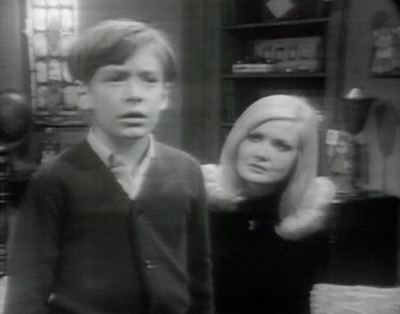
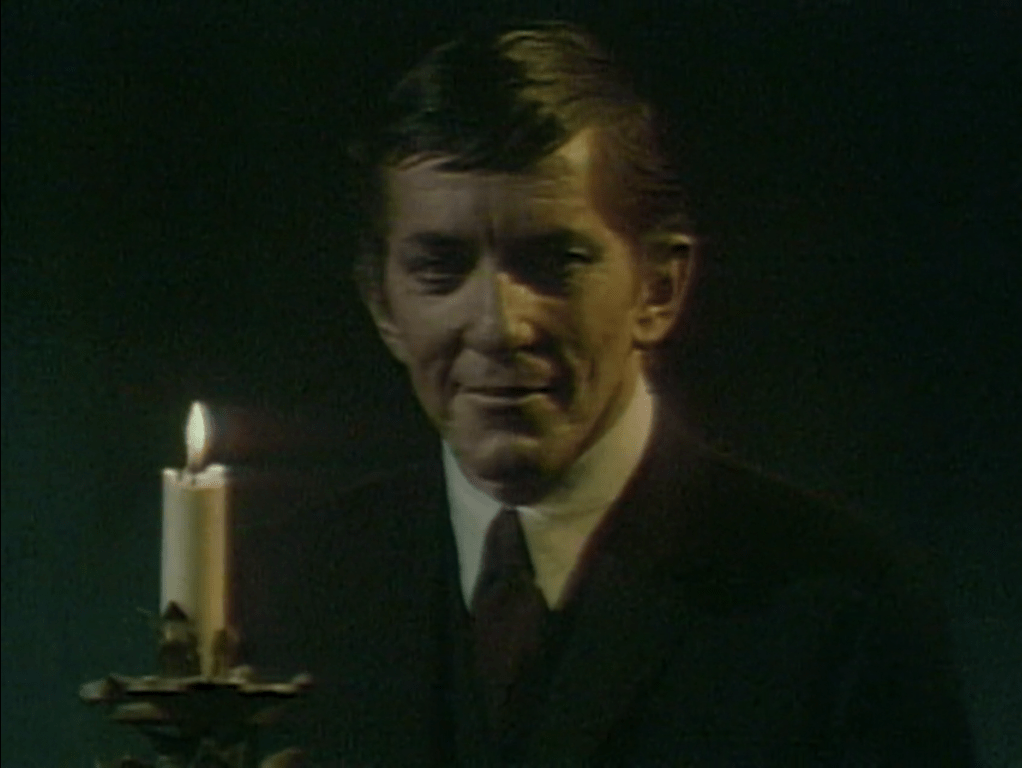
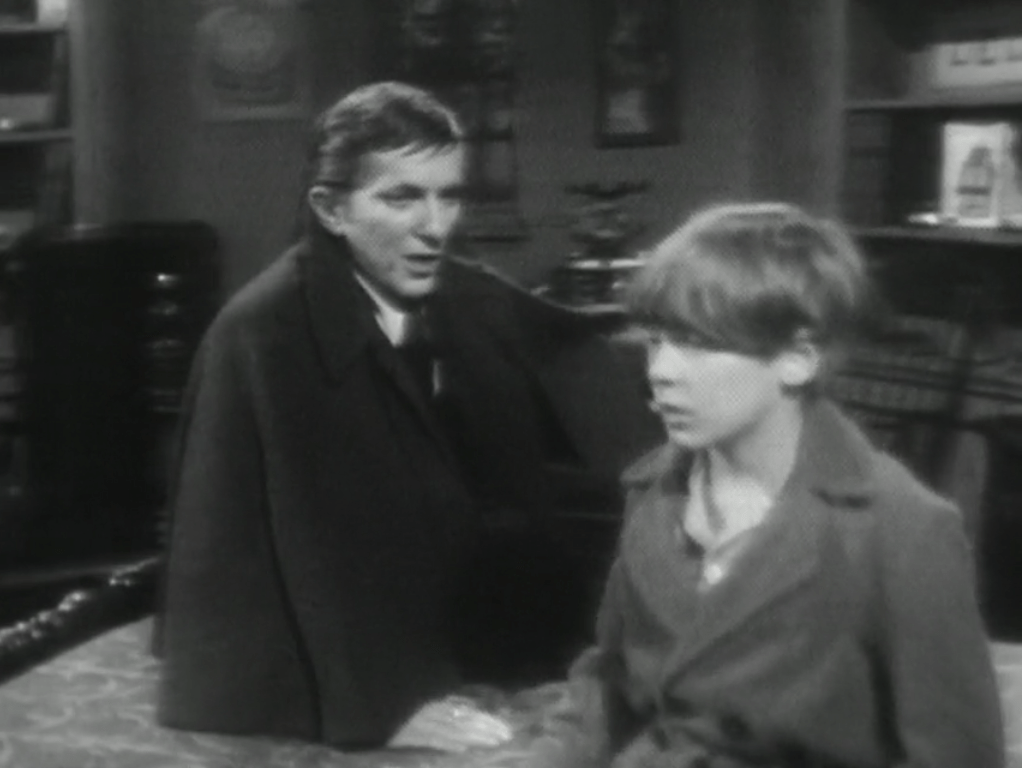
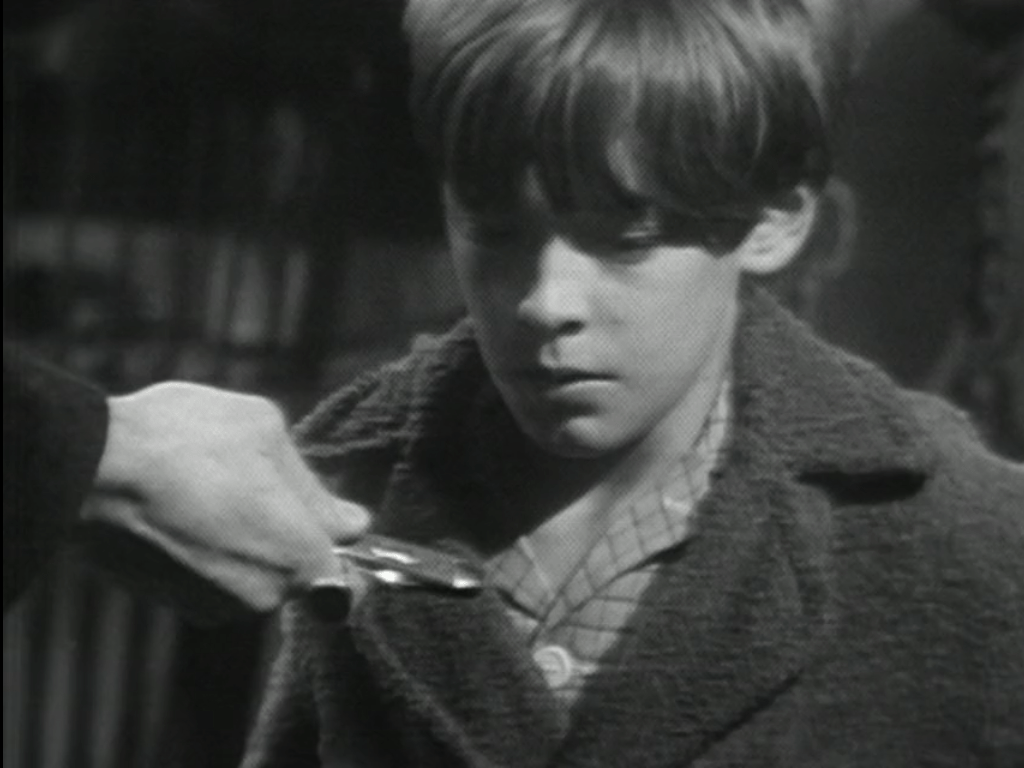
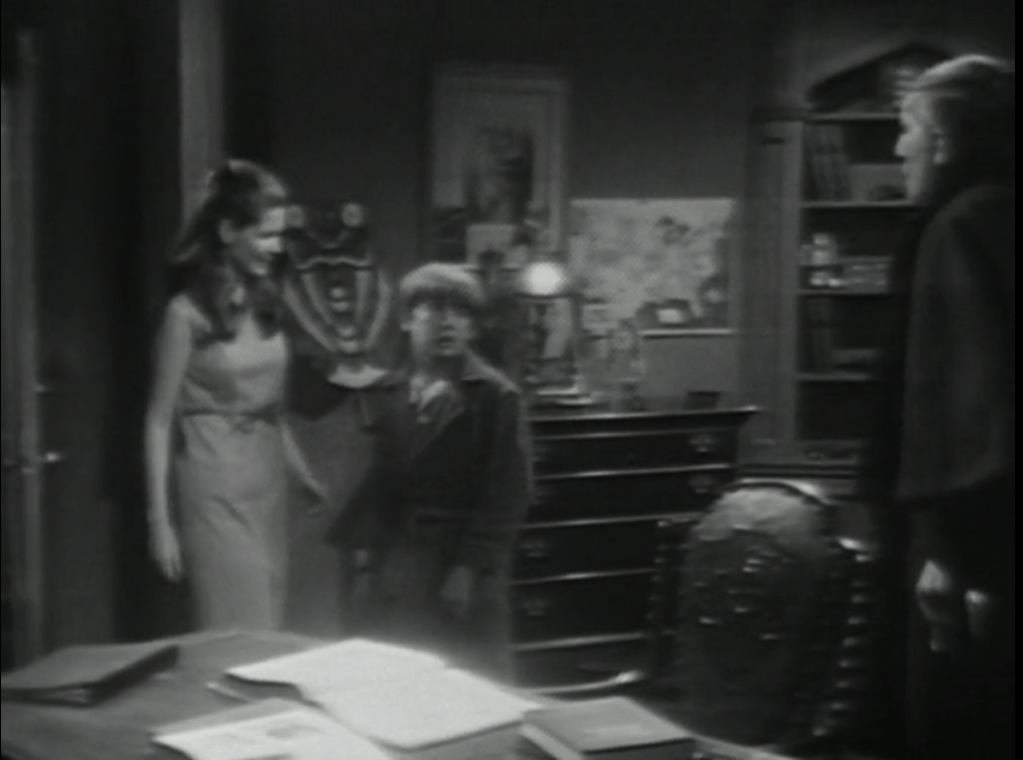
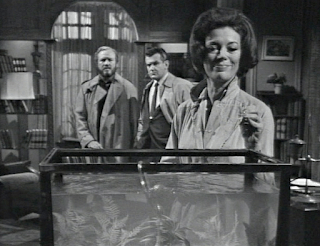
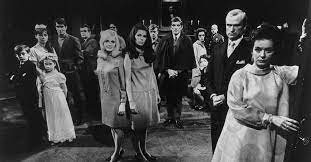
Episode 351: Like ice

Nancy Barrett’s acting style is to throw herself unreservedly into whatever the script calls for her character to be doing on any given day, without regard for what the character may have done in past storylines. This turns out to be the perfect approach to playing Carolyn Collins Stoddard. In the first months of the show, flighty heiress Carolyn was fickle, capricious, and self-centered, traits that were all the more disturbing in someone who never showed any particular awareness of what she had said or done as recently as the day before.

That all changed when Carolyn shouldered responsibility for the Collins family business while her mother, matriarch Liz, was away for several weeks in February and March of 1967. After that period, her chief motivation was an earnest concern for the family’s well-being, and her chief difficulty was incomplete information. In her frustration, she tried to save her loved ones by doing just the wrong thing. So when Liz was going to marry seagoing con man Jason McGuire, Carolyn figured out that Jason was blackmailing Liz into the marriage. She also deduced that Liz’ fear was that her secret, if exposed, would ruin Carolyn’s chance at happiness. But Carolyn did not know what the secret was. So, she first tried to ruin her own happiness by dating motorcycle enthusiast Buzz, then when the prospect of Buzz as a son-in-law did not suffice to prompt Liz to stand up to Jason, Carolyn brought a gun to the wedding and planned to shoot Jason dead while he was saying his vows.

By Friday, Carolyn’s concern centered on her young cousin, strange and troubled boy David Collins. David was in touch with the supernatural, and had said that distant relative Barnabas Collins was an undead creature who posed a terrible threat to everyone. Carolyn thought Barnabas a fine and pleasant fellow, but she knew that much of what David had said was true. Though the boy kept pleading with her to forget everything he has said lest she die as the previous adult to believe him, Dr Dave Woodard, died, Carolyn could not do so. She decided to slip into Barnabas’ house to investigate David’s claims. There, she found Barnabas’ coffin. When he bit her and sucked her blood, she learned that he was a vampire.

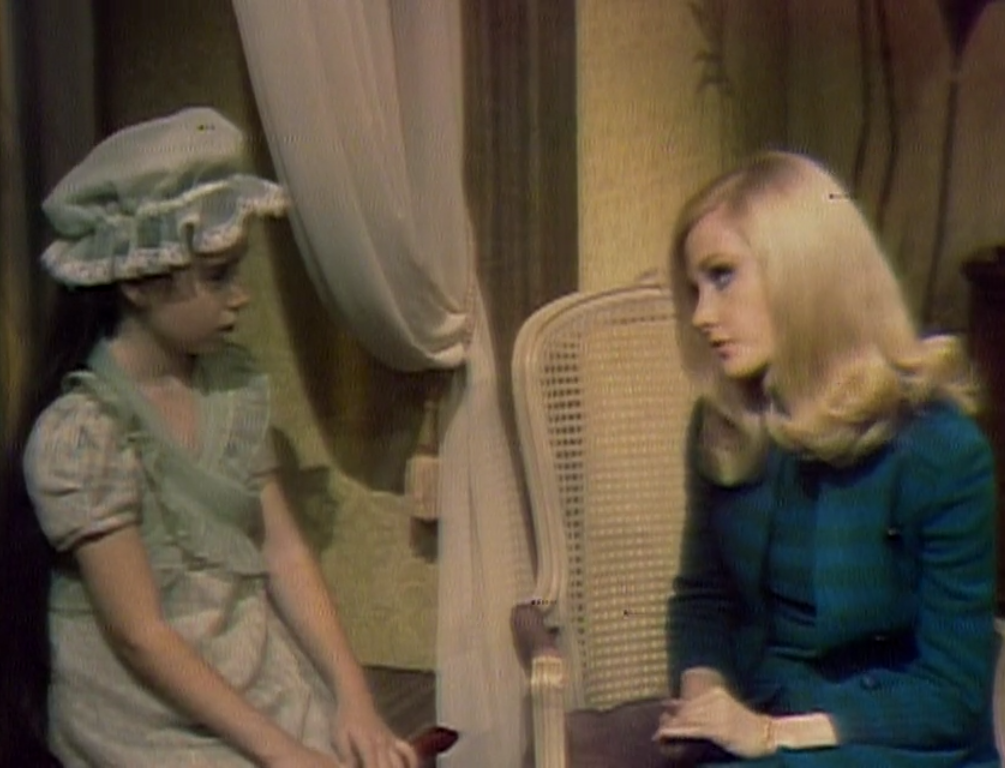
Miss Barrett’s style usually produces a hot performance, in which she flings the character’s emotions directly before the audience. Today, though, she is playing a vampire’s newly acquired blood thrall. That is a part for a cold actor, one who keeps the audience guessing at the character’s feelings and intentions. On Friday, Barnabas told his co-conspirator, mad scientist Julia Hoffman, that if he bit her she would no longer have a will of her own; having heard that line, returning viewers are supposed to be unsure whether Carolyn even has an inner life now.

Miss Barrett rises to the challenge admirably. In her scenes with Julia at Barnabas’ house and with her mother and her uncle Roger at the great house of Collinwood, she manages to sound faraway and disconnected without seeming bored or confused; in her scenes with Barnabas, she sounds a note of unquestioning devotion without seeming robotic. All of the actors have been doing exceptional work the last few days, and with this eerie turn Miss Barrett is on a par with the very best.

Barnabas gives Carolyn two instructions. First, he tells her to convince everyone that David is mentally ill and that everything he has said should be disregarded. Carolyn smiles readily and says that this will not be difficult to accomplish. Since we have over recent months come to know Carolyn as the determined if maladroit protector of her family, and since she has been so focused on helping David, this easy acquiescence in Barnabas’ wicked plans for David comes as a heartbreak to regular viewers.

Barnabas’ second command is for Carolyn to encourage well-meaning governess Vicki to discard her personality, replace it with that of his long-lost love Josette, and come to him willingly as his bride. Carolyn is a bit puzzled by the Josettification project, but just a couple of days ago Vicki was telling her that she is “more than fond” of Barnabas. Besides, Vicki really is fascinated with Josette, and her current personality hasn’t given her much to do on the show lately. So Carolyn smiles again and says that she will see to it that Vicki comes to Barnabas.

The original videotape of this episode is lost, and the kinescope is particularly gray and scratchy. That is a happy accident. The very cheapness of its look adds to the Late Late Show quality of a story about a beautiful young blonde under the power of a vampire. The abstractness of black and white imagery also takes us out of the literal, workaday world of color pictures, into a realm of dreams and fables where we might expect to encounter vampires.

Most important, the kinescope makes a sharp contrast with images we saw last week. In #348, we got a look at Carolyn’s bedroom. It was the most brightly decorated set we have seen so far on Dark Shadows, so much so that I had to squint for a second when Carolyn switched a lamp on. In color, Barnabas’ house is drab enough, but in black and white it is so severely bleak that the idea of the resident of that glowing bedroom ending up there should give us a shudder. While Barnabas is on his way upstairs to see Carolyn, the camera lingers a bit on this shot of melted candles; for me, that was the moment that particular shudder comes hardest.

Smoldering in the ruins

Of course, a vampire’s bite is a metaphor for rape; of course, Barnabas’ investment in presenting himself as a member of the Collins family makes his attack on Carolyn a metaphorical incest. Every other Dark Shadows blogger who has posted about this episode has explored that theme- Danny Horn (and several of his commenters) here; Patrick McCray and Wallace McBride here and here; and John and Christine Scoleri here. All I have to add to that chorus of voices is that Carolyn’s role as doughty if misguided protector of her kindred makes her a particularly poignant victim of an incestuous assault.

Episode 348: A matter of fact

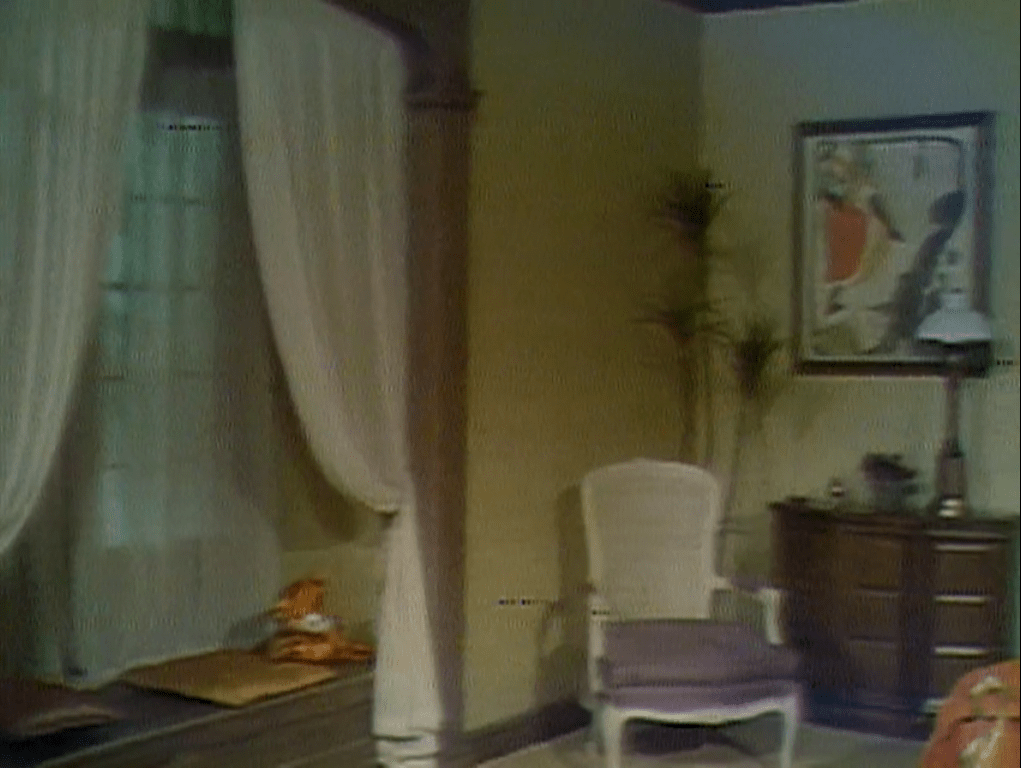
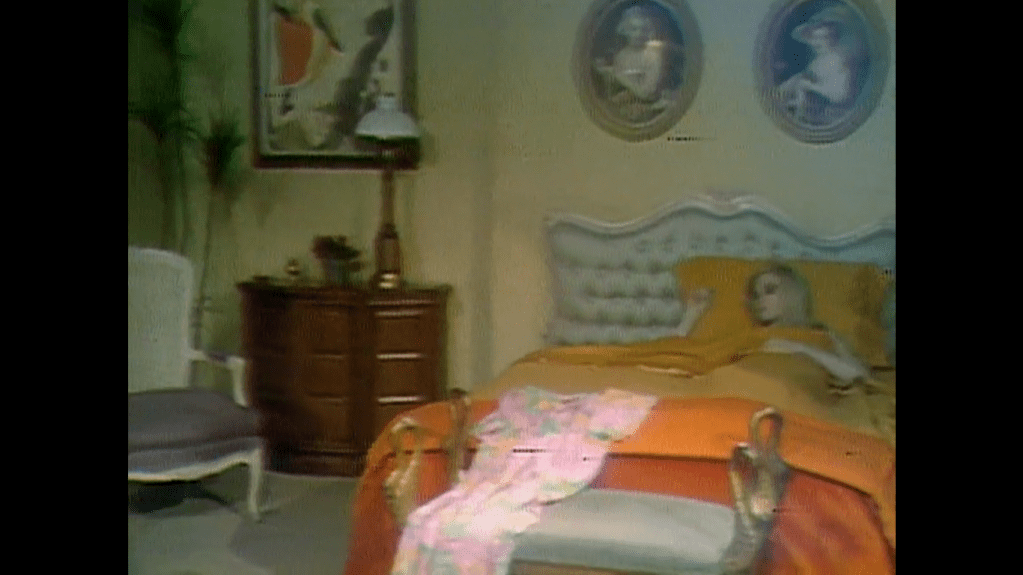
We open on a new set, the bedroom of heiress Carolyn Collins Stoddard in the great house of Collinwood. Dark Shadows has been in color since #295 in August. Though directors Lela Swift and John Sedwick were both ambitious visual artists, they haven’t been able to do much with color so far. With Carolyn’s bedroom, Swift and the staging team have accomplished one of their first real essays in color. It is composed mostly of shades of yellow, pink, and orange.

The color schemes of the other interiors we’ve seen up to this point run the gamut from sedate to subdued to drab to dank, so we already know we are in a unique space. The only other room in Collinwood that might have matched this one for brightness was the kitchen, but we haven’t seen that since #208.

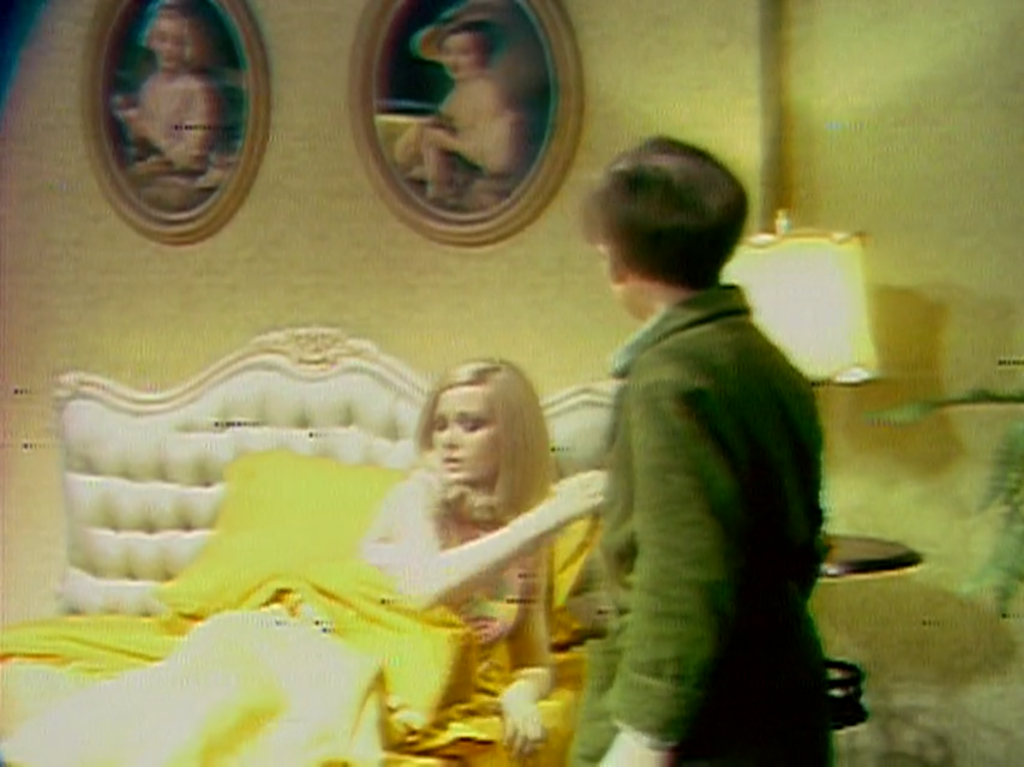
Carolyn’s young cousin, strange and troubled boy David, lets himself into her room. He touches her, and she awakes with a scream. He explains that he just dropped in to make sure she wasn’t dead. When she turns on the light, the screen is so bright that I reflexively squinted, a reaction I’d never before had to an image on Dark Shadows.

Bright room.

David can’t quite explain why he was afraid Carolyn might be dead, but he does insist that she take an antique toy soldier, saying that she will be safe if she keeps it with her. Carolyn’s mother, matriarch Liz, comes into the room to investigate Carolyn’s scream. Liz wonders what David is doing there. Carolyn hastens to say that he was just making sure she was all right.

David goes, and Carolyn tells Liz she doesn’t think anything can be done for him at home. Liz is reluctant to send him away. Regular viewers will not be surprised by this. We know that Liz took David and his father, her ne’er-do-well brother Roger, into Collinwood at the beginning of the summer of 1966 and summoned her unacknowledged daughter, well-meaning governess Vicki, to come look after David starting with #1 on 27 June 1966, so that her conviction that the family ought to look after him got the whole show started. Nonetheless, Liz is so disturbed by David’s unusual statements and depressive affect that she agrees that he needs residential care.

We cut to the Old House on the estate. Vampire Barnabas Collins is sitting in a basement room where mad scientist Julia Hoffman maintains a laboratory. The room is full of electrical equipment, a bit odd since the Old House has no electricity; the laboratory itself is lit by flaming torches. But if we’ve ever seen a Universal Studios production from the 1930s, we know that where you find a mad scientist, you will find electrical currents, so naturally things start buzzing when Julia flips a switch.

Barnabas confined

Julia is trying to implement a medical cure for Barnabas’ vampirism. In the first shot of this scene, we see a visual metaphor for that project. Barnabas, an uncanny being, is confined to a small space in the middle of an elaborate collection of technology. If Julia succeeds, the supernatural will be vanquished altogether and scientific rationality will fill the whole world. The color scheme emphasizes the contrast between Julia’s optimistic goal and the terrain on which she operates. The walls and floor are dominated by the grays and browns of the basement, but the frames and tubing of her equipment are a bright metallic hue, light plays on the glass components, and the intense greens, reds, and blues of the potions are distributed in a slightly unbalanced, lively pattern. The irregular shapes of the frames and tubing emphasize this pattern, and contrast with the solid gray of the floor and the even grid of the brickwork on the walls.

This image not only represents Julia’s plans, but also one of the major themes the show is exploring at this period. Too many characters have encountered too much evidence of supernatural forces and beings for anyone to simply deny that such things exist. But even those who have been most heavily exposed to them keep reverting to a naturalistic frame of reference. Sure, Julia spends all her time hanging around with a vampire and has encountered a couple of ghosts, but she’s determined to ring all of those phenomena around with scientific explanations and technological interventions until they yield to rational control.

Julia’s project has hit its first major setback, as the latest treatment led Barnabas’ hands to age dramatically. He expresses the fear that time will catch up with him, and his apparent age will soon catch up with his actual age, something like 200 years. Julia’s hope that her experiment will not only free Barnabas of his curse, but found a new kind of medicine that will free everyone else of aging and death, will thus be defeated.

Barnabas gives a remarkable little speech about the situation he finds himself in:

I’ve been granted privileges given to few other men… For most men, time moves slowly, so very slowly. They don’t even realize it. But time has revealed itself to me in a very special way. Time is a rushing, howling wind raging past me, withering me in one relentless blast and then continues on. I have been sitting here passively, submissive to its rage, watching its work. Listen. Time, howling, withering.

Writer Joe Caldwell has a fine sense of what actors can do, and this odd little bit of purple prose is right in Jonathan Frid’s wheelhouse. It doesn’t make a whole lot of sense, but the sound of his voice delivering it is so gorgeous it may as well be Shakespeare. Well, maybe not Shakespeare, but Ben Jonson at least.

It is possible to read this speech as a programmatic statement. Daytime soap operas of the 1960s were famously slow-paced; the old joke was that a viewer saw an episode that ended with a character hearing a telephone ring, missed four months of the show, and tuned back in to see the episode that started with the same character saying “Hello.” Even by the standards of the period, the first months of Dark Shadows were notoriously leisurely, with action often as not playing out in real time. When we are watching the 21 episodes centering on Roger’s attempts to find a fountain pen he misplaced, it is indeed the case that “time moves slowly, so very slowly.” But those days are behind us. The show is whipping through plot points at a pace that many prime time series contemporary with it would have had a hard time matching.

If the speech is programmatic, it is also autobiographical on the part of the screenwriter. A fast pace promises excitement for the viewers, but makes life hard for a writing staff that never numbered more than three. Indeed, this is the last episode Joe Caldwell will write for two and a half years. Perhaps he felt the demands of the new pace as “a relentless blast” withering his talents, and had to bow out.

We return to Carolyn’s room. She is in front of her mirror, contemplating the toy soldier. She hears the strains of “London Bridge” playing on a wooden flute, which she has learned is a sign that the ghost of ten year old Sarah Collins is present. Carolyn grew up in this haunted house, so it may not be entirely surprising that her response is to lean back and enjoy the music. But she sits up when Sarah manifests herself in visible form.

Ghost in the mirror

Sarah speaks, and Carolyn sees her reflected in her mirror. The following scene is so extraordinary I’m going to transcribe all of the dialogue:

Sarah: David must have given you that.

Carolyn: Sarah!

Sarah: He told you my name.

Carolyn: Sarah, how did you get in here?

Sarah: Didn’t David tell you?

Carolyn: Tell me what?

Sarah: All about me.

Carolyn: I’m not sure I understand.

Sarah: I think I’m a ghost. Matter of fact, I’m sure I am.

Giving the facts

This is the first time Sarah has described herself in any terms, certainly the first time she has called herself a ghost. Her coyness about herself had left David confused about what she was; it was not until #325 that he finally concluded that she was a ghost. After that, she became more forthright with him. When he wasn’t sure what she was, she would wait until she was out of his line of sight to appear and disappear. But in #327, she fades away while he’s looking right at her.

Coming out to David not only allowed Sarah to relax around him, but has led her to discard her coyness altogether. She is startlingly blunt with Carolyn as this conversation goes on:

Carolyn: B-but- I don’t believe in-

Sarah: Yes you do. Or I wouldn’t have been able to come here. You’re not afraid of me, are you?

Carolyn: No…

Sarah: If you are, I understand.

This is the first confirmation that Sarah can appear only to those who are prepared to believe in her. It’s true that most of the people who have seen and heard her- David; Maggie Evans, The Nicest Girl in Town; Maggie’s father Sam; Vicki; Barnabas; Julia; Barnabas’ sometime blood thrall Willie; and local physician Dave Woodard- have either had extensive contact with the supernatural or had reasoned their way to the conclusion that she existed. But she also showed herself to Maggie’s nurse at the mental hospital Julia runs, and we don’t know anything about her background or beliefs. And local man Burke Devlin heard Sarah when she and David were talking in #327. While Burke has had plenty of contact with supernatural beings and in the early days of Dark Shadows, when he was fun, was willing to believe in them, he was at that point tearing around bellowing that there were no such things as ghosts. So this is new and unexpected information.

Carolyn’s denial that Sarah frightens her is given in a trembling voice that shows it to be a lie. Still, she isn’t as frightened as she might be. The other day, in #344, Carolyn was in David’s room when Sarah manifested there, not in the visible form of a little girl, but as the sound of “London Bridge” and as information appearing in David’s mind about Burke’s imminent death. Carolyn was terrified of Sarah when she came that way.

Carolyn: Well, what do you want?

Sarah: Don’t send David away.

Carolyn: How do you know about that?

Sarah: I don’t know, I just do.

At this point, we see Carolyn’s fear fading. She is starting to react to Sarah as if she really were a ten year old girl.

Carolyn urging Sarah to be reasonable.

Carolyn: But Sarah, we have to send David away. It’s the only way we can help him.

Sarah: But if you send David away, I won’t have anyone to play with.

Carolyn: Well, maybe it isn’t good for David to play with you.

Sarah: Why do you say that?

Carolyn: Because it leads him into believing all sorts of things that aren’t true.

Sarah: How do you know they’re not true?

Carolyn: Well, they’re just not, they couldn’t be.

Sarah: He wasn’t lying about me, was he?

Carolyn: No.

Sarah: Well.. then maybe David is acting the way he is because no one will believe him.

Carolyn: But… it isn’t possible.

Sarah: People say I’m not possible, but I am. Why doesn’t that make the rest possible?

Carolyn: Sarah, maybe you don’t know the stories David’s been telling!

Sarah: Why do you think that?

Carolyn: Because they’re too fantastic! And besides, they’ve all been proved false.

Sarah: How do you know they’ve been proved false?

Carolyn: Sarah, are you trying to tell me that Barnabas actually slee-

This exchange is the ultimate example of a character accepting the existence of a particular supernatural being and then snapping back into a frame of reference that does not allow for supernatural beings. Carolyn knows that Sarah is a ghost, and starts arguing with her about how fantastic the world is permitted to be.

There comes a knock at the door. Carolyn turns away from Sarah to look at the door, and when she looks back, Sarah has vanished. Regular viewers know that Sarah was Barnabas’ little sister, that she wants to keep him from doing horrible things to people she likes, but that she will not say anything against him. So when Carolyn says Barnabas’ name, we know that Sarah is about to vanish.
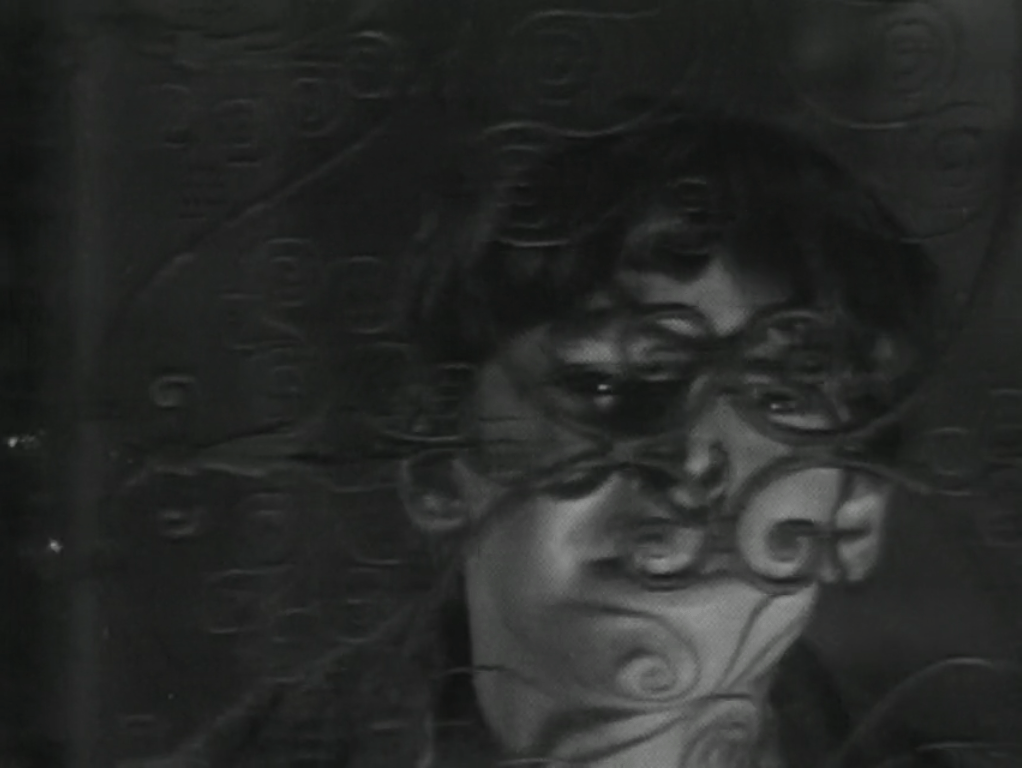
Sarah’s part is an outstanding example of writing to an actor’s abilities, even more so than was Barnabas’ speech. Caldwell knew that Jonathan Frid had a flair for making flowery gibberish appealing, because that is what he has been doing the whole time he’s been on Dark Shadows. What Sharon Smyth has been doing well as Sarah is being a cutie pie and creating a vague and mysterious impression. When she has more than a few lines to deliver, things tend to get very wobbly. Today, she has to maintain a commanding tone and an adult demeanor throughout an extended patch of rapid-fire dialogue. Absolutely nothing we have seen on screen would suggest that she could handle that. But she pulls it off, more than competently. There are a few glances at the teleprompter, but at no point does she break out of the patient and authoritative manner she has to adopt. It is an impressive job of acting by any standard.

The person at Carolyn’s door is Liz. Liz is Dark Shadows‘ queen of denial. Viewers who have been with the show from the beginning have seen a few cracks in her facade of disbelief in the supernatural. In #10, she dozed off in the drawing room and started talking in her sleep about ghosts. When Vicki insisted to her in #127 that she had seen a ghost, Liz said she believed her. And in #280 and #281, Liz reluctantly agreed to participate in a séance, and afterward agreed that Vicki had been possessed by a spirit. But even in those moments Liz was fighting to keep the topic of ghosts at bay, and the rest of the time she has presented a blank wall to any attempt to face facts about the strange goings-on. So it is not surprising that Carolyn tells her mother she was talking to herself while tidying up her room.

Having talked Liz into sending David away, she now has to talk her back out of it. She manages to get her to agree to wait a few days. “London Bridge” plays. Carolyn reacts to it, Liz does not.

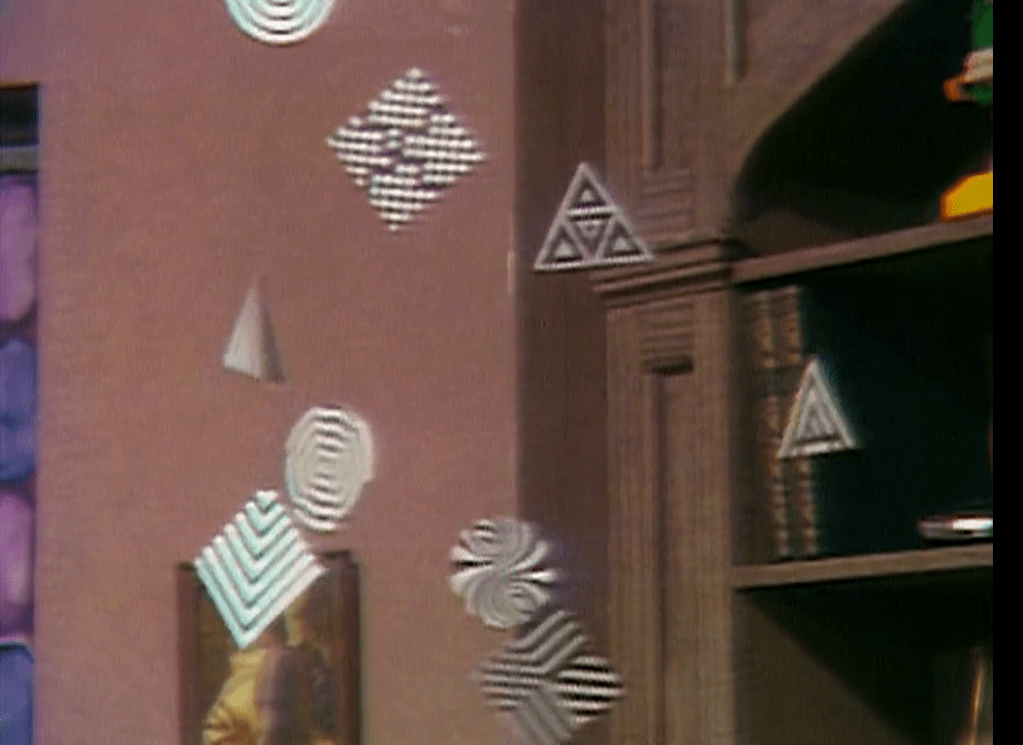
In his room, a distraught David is looking at a mobile. Its whimsical black and white markings suggest a puzzle and make a stark contrast with the vivid colors around them.*

Puzzling shapes.
Back to the wall.

Carolyn comes in. She brings the toy soldier and tells David she doesn’t think she will need it. He insists that she will, but she explains that Sarah visited her and now she believes him and knows how to help him. David is horrified by this. He says that Sarah visited Dr Woodard, that Woodard believed him, and that led to his death. He begs Carolyn not to believe him and claims to have been lying. He sobs and clutches her.

Anguished embrace.

Back in the Old House, Julia prepares to give Barnabas another treatment. He snaps at her. She tells him that whatever happens, she wants him to know that she always wished him well. That prompts him to unload a further stream of sour remarks about her competence and intentions. Julia carries out the treatments, only to find that the aged appearance of Barnabas’ hands has spread to his head.

In his post about this episode on Dark Shadows Every Day, Danny Horn puts it well when he says that “This is just good soap opera construction. People that we care about, facing terrible danger, and desperate to help each other.” He’s referring specifically to the scenes between David and Carolyn and Liz, but it applies to everyone. We care not only about the good people in the great house (well, they’ve been relatively good, lately,) but also about Barnabas and Julia, evil people who are the terrible danger David and Carolyn and Liz are facing, but who make the show fun to watch. We care about Sarah too, and she’s desperately trying to accomplish exactly the result we most want to see, an outcome in which David, Barnabas, and everyone else we enjoy watching stays on the show.

*Evidently this mobile was a commercially produced item. One of the commenters on Danny Horn’s Dark Shadows Every Day reports having had one like it as a child.

Episode 345: That place in Brazil

In Dark Shadows #3, man of mystery Burke Devlin mentioned that he started on the path to riches when he was in a bar in South America. Since then, he has mentioned his business interests on that continent several times, and the old standard “Brazil” has emerged as his informal theme song. Yesterday’s episode, one of the finest in the series, called back to the early days of the show several times, and today they close the loop on Burke’s connection to Brazil. His plane crashes in that country, and he dies there.

We learn of Burke’s fatal accident when housekeeper Mrs Johnson tells her employer, Elizabeth Collins Stoddard, that she has heard a radio report of an aviation disaster in Brazil. Mrs Johnson first came to work in Liz’ home, the great house of Collinwood, in #81. At that time Burke had sworn to wreak a terrible vengeance on the Collinses and Mrs Johnson was his secret agent. Burke renounced his quest for vengeance in #201, which was just as well, since it was never very interesting anyway. But they never told us that he had stopped paying Mrs Johnson or that she had stopped funneling information to him. So viewers who have been watching all along may wonder if she really did just happen to be listening when the radio announced that a Varig flight had gone down outside Belém. Maybe she was in touch with some associate of Burke’s who told her more than she could repeat to Liz. Or maybe not, but in any case it is satisfying to be reminded of the connection.

Burke was engaged to marry one of Collinwood’s residents, well-meaning governess Vicki. When she is told that Burke is missing and presumed dead, Vicki declares that she is certain he will come back. Vicki was originally the audience’s point of view character, an outsider to whom everything we did not know had to be explained. We now know many things she does not, but in this declaration she once more seems to be closer to us than to the other characters in her knowledge. She knows, as we do, that she lives in a soap opera and no major character is likely to stay dead permanently, especially not when his death is supposed to be the result of a plane crash in a faraway jungle.

On the other hand, Burke has been fading in importance for a long time. After his revenge story fizzled, he never really found a new reason to be on the show. His relationship with Vicki might have made things happen when he was still in conflict with the Collinses. She would then have found herself torn between her lover and the family that had all but adopted her. But once Burke and the Collinses patched things up, there was no obstacle between him and Vicki. In the last few days, it has seemed that she might even be able to stay in the house and keep her job after marrying him. There has been a theme where Burke tried to gaslight Vicki out of believing in supernatural phenomena that he himself had plenty of evidence to suppose were real, but that was less a storyline than a speed bump. Burke’s part was recast after the charismatic Mitch Ryan showed up for #252 too drunk to work; since then he has been played by the woefully miscast Anthony George, and it has been obvious that the character needed to be written out of the show before he did permanent damage to George’s career. So maybe Burke won’t come back after all.

Meanwhile, in the Old House on the same estate, vampire Barnabas Collins is moping around while mad scientist Julia Hoffman works on her notes about her attempt to turn him into a real boy. When she asks if there is anything she can do to lighten his mood, he sarcastically suggests that they play a game of cards or of cribbage. She’s up for either one, but he says that he won’t be happy until Vicki comes to him. He doesn’t know about Burke’s accident, but has somehow convinced himself that Vicki’s personality will eventually disappear and be replaced with that of his long-lost love Josette, and that as Josette she will be his bride. Barnabas goes on so long about how wonderful it will be when the Josettified Vicki is in the house that we start to wonder just how the two of them will pass the time. The day may come when Barnabas is glad of a cribbage board.

Julia only recently committed her first murder. She and Barnabas killed her old medical school classmate Dave Woodard a week ago, and she is still reeling from the shock of it. One thing she has settled on is the fact that she is going to be linked to Barnabas for the rest of her life. It doesn’t seem likely that she will ever be able to tell anyone else about Woodard, and being a murderer is, like it or not, an important part of her identity. So no one other than Barnabas can ever really know her. She’s making the best of this by trying to fall in love with him, but his sick obsession with reenacting the plot of the 1932 film The Mummy with himself in the Boris Karloff role and a woman in her early twenties in Zita Johanns’ double role as the dead princess and her reincarnation would seem to leave her at an impasse.

Julia presses Barnabas about his relationship with Josette. When he keeps insisting that the Josettified Vicki will come to him of her own free will, she asks if the original Josette ever did that. Barnabas’ silent grimace answers her question. She goes on to ask why Josette is so important to him if he was never very important to her. He says he will explain it all to her, but that they must have the proper setting. He leads her to the place of Josette’s death, the cliff at Widows’ Hill.

Barnabas has given us at least two versions of his relationship with Josette. In #212, he gave a speech to her portrait which implied that she was his grandmother, and that she sided with his father her son when he and Barnabas had a fateful clash. Soon after, Josette was retconned into Barnabas’ lost love. In #236, Barnabas was trying to brainwash Maggie Evans, The Nicest Girl in Town, into thinking that she was Josette. He told her then that he had sailed with Josette from her home in the French West Indies to Collinwood, where she was to marry his uncle Jeremiah Collins. It was his task to teach her English on the voyage. Aboard ship, they fell in love. This reenactment of the tale of Tristan and Isolde ended as sadly as did the original, though the particulars of the story were not the same.

Now, Barnabas tells Julia that he met Josette for the first time when she arrived at Collinwood. He had taken no interest in his uncle’s betrothed until he saw her, but was stunned by her beauty and quickly fell in love with her. He found himself compelled to be “her good and faithful friend Barnabas,” a position he found humiliating. As a vampire, Barnabas is a metaphor for selfishness and cruelty, and so it is hardly surprising that he confines Julia to the same position with regard to himself and that he openly delights in her humiliation. It is a bit dizzying that she expresses so much sympathy for him, telling him in this scene that he never seems more human than when he talks about Josette.

In telling this latest version of the story, Barnabas says that as Josette came to feel that her youth was wasted on the elderly Jeremiah, it dawned on him that there was a way he could offer her eternal youth. This harks back to #233, when Barnabas told Vicki and Liz’ daughter Carolyn the story of Josette’s death, that she leapt off the cliff because she was being pursued by her lover. So we are to assume that Josette killed herself rather than let Barnabas turn her into a vampire. But it might suggest more than that. Whenever Barnabas met Josette, and whether it was aboard ship or on her arrival, he was not yet a vampire. We have not heard how he turned into one. Perhaps he involved himself in some kind of black magic in an attempt to keep himself and Josette young forever, and as a result he became a vampire and she fled from him to her death.

Vicki shows up and tells Barnabas and Julia about Burke. They are stunned. Julia’s reflex is to lean in and touch Vicki’s arm, Barnabas’ is to stagger back.

Shocked.

Barnabas quickly senses opportunity, and he shoos Julia away. He says that she was complaining of the cold and that for the sake of her health she ought not to stay. She is so obviously humiliated that only Vicki’s absorption in her own distress keeps her from noticing.

Barnabas plays the “good and faithful friend,” and Vicki looks over the edge of the cliff. She talks about the widows who have thrown themselves to their deaths from it over the years. She says that she had at first assumed that they were just “make-believe creatures,” but that if she thought Burke were really gone she would throw herself after them. Barnabas grabs her and urges her to stop such talk.

As this goes on, we hear the “Widows’ Wail,” a sound effect prominent in the early months of the show that the uninitiated mistake for wind, but that indicates something terrible is about to happen. When Vicki and Burke had their final conversation yesterday, they heard it, and he refused to admit its meaning. Vicki and Barnabas hear it now. The Widows bewail upcoming disasters, and Burke is already dead. Barnabas tells Vicki that she will be a bride very soon, and she nods and repeats, “A bride… very soon.” As she does, the Wail sounds louder than before.

“A bride… very soon.”

Closing Miscellany

This episode includes one of the most famous bloopers in the entire series. When Liz is on the telephone getting the news about Burke’s plane crash, she refers to “That place in Brazil… (long pause)… (separate, equally long pause)… (fidget)… (different kind of pause)… Belém!” It is a wonder to behold.

This episode was taped on 16 October 1967. On the 28th of that month, Alexandra Moltke married Philip Isles. So, whether or not Vicki was going to become “a bride very soon,” her player was. The wedding announcement in The New York Times doesn’t mention Dark Shadows; it does mention that “Mrs David Ford” was part of the bridal party. That Mrs David Ford was Nancy Barrett, who played Carolyn, and her Mr Ford played Maggie’s father Sam.

From The New York Times, 29 October 1967

Neither Mrs Isles’ marriage to Philip nor Miss Barrett’s to David Ford lasted very long. Mrs Isles is still known as Mrs Isles, even though she was married to a doctor named Alfred Jaretzki for 33 years, ending with his death in 2014. By the time she met Jaretzki, she was a nationally known documentary filmmaker, and there is her son Adam Isles, the father of her three grandchildren and a former high official of the US government. So I suppose it made sense to stick with that name. In any case, I doubt very much that the widows were wailing for her.

My wife, Mrs Acilius, mentioned that even though we have seen the whole series before, she fully expected Barnabas to push Julia off the cliff. The episode pulled her in so completely that she didn’t stop to tell herself that she would have remembered if he’d done that.

Episode 344: Listen to the music, listen!

Strange and troubled boy David Collins is sitting on his bed. The ghost of his cousin Sarah is with him, playing “London Bridge” on her flute. She has told him that local physician Dave Woodard is dead, and he is depressed. She explains that she thought she had to tell him.

Sarah says she thinks that Woodard’s death was a terrible one and that it shouldn’t have happened. She denies knowing any more than that, and when David presses her for further information she becomes uncomfortable and vanishes.

David’s aunt, matriarch Liz, comes into his room to break the news to him about Woodard. She is startled to find that he already knows. She is distressed at his attitude of complete resignation. Woodard was the only adult who believed all of the facts about the supernatural menace looming over the great estate of Collinwood and the town of Collinsport that David and Sarah have shared with each other, and when David last saw him Woodard was trying to do something about that menace. David takes Woodard’s death as the end of all hope.

Downstairs, Liz meets her daughter Carolyn and well-meaning governess Vicki. She tells them how sad David is, and Carolyn goes up to see him. She starts talking about imaginary friends, and David asks if she means Sarah. Carolyn says that she doesn’t think Sarah is imaginary, and David replies “You don’t have to pretend. I don’t care.” He isn’t the least bit angry with her- he means exactly what he says when he tells her he doesn’t care how she feels about him.

Viewers who have been with the show from the beginning could see that reaction coming. For the first 24 weeks or so, Carolyn was a flighty heiress, a self-centered young woman who took no interest at all in her little cousin. Since then they have discarded that theme and Carolyn has become a mature and caring person. She and David have had some moments where she has seemed like a big sister. Still, she is still far less involved with him than is Vicki, and David doesn’t have any hopes that even Vicki will listen to him when he tells the truth about the strange goings-on. So when David says “I don’t care,” Carolyn is hit by a freight train that we’ve seen coming for a long time.

This new Carolyn won’t give up on David. She confides that when she was nine years old, she had a friend named Randy, a little boy who always wore a red sweater and who may or may not have existed. Carolyn admits that Randy may have been a ghost, and there is a moment when, as Danny Horn puts it on his Dark Shadows Every Day, “David stands up, and he looks at her, as if they’re really seeing each other for the first time in a long while.” The first time ever, I’d say- David and his father Roger only moved into the house a month or so before the show started, and by that time Carolyn was the character we first saw.

This isn’t the first time the audience has seen this side of Carolyn. In the opening weeks of Dark Shadows, she was one of several characters who had brief conversations with Vicki about the legendary ghosts of Collinwood, and she was the most persistent about laughing those legends off. But before the show had been on the air for five weeks, Carolyn admitted to Vicki that the legends were all true, and that she had tried to downplay them only because she liked Vicki and wanted her to stay.

That development is recapitulated in this scene. Where Vicki had reacted with confusion, telling herself that she ought to be concerned about Carolyn’s mental health but unable to quash a sickly feeling that she might be right, David reacts with wonderment. He is beyond trying to do anything about the horrors that he knows are in progress, let alone appealing to anyone to join him in fighting them, but we can see him absorbing the information that Carolyn is not at all the person she had led him to believe she was.

Once Carolyn stops pretending she does not believe in ghosts, we see why she and the other adults in the family are so insistent about keeping the door shut on the supernatural back-world behind the main action. “London Bridge” starts playing on the soundtrack; Carolyn and David can both hear it. As it goes on, David declares that something terrible is about to happen. It will be an accident- no one will cause it, no one wants it to happen. But it can’t be stopped. Carolyn asks how he knows, and he says he just does.

David communes with the spirits. Screenshot by Dark Shadows Before I Die.

The little girl we saw in the opening is Sarah, but in this moment we realize she is not the whole of Sarah. The girl is only one manifestation of an unfathomably vast complex of phenomena. The world in which the action appears to be taking place is a tiny, fragile thing by comparison with forces like Sarah. If the characters stray from their little paths of denial and evasion the whole thing may at any moment dissolve altogether, thrusting the back-world into the foreground and leaving them adrift. After a few minutes of David’s soothsaying, Carolyn protests that “None of this is real, it can’t be!” But it’s too late- she knows that it is all too real, and the world of love affairs and hotels and motorcycles and dress shops and restaurants in which she has spent the last 69 weeks trying to find a place is a dream from which she is already starting to awaken.

Meanwhile, Vicki and her depressing fiancé Burke have declined Liz’ offer to live in the west wing of Collinwood when they are married. Liz had hoped to keep Vicki around so that she could help with David. When Burke asks if he should talk to David, Liz tells him not to bother. Carolyn already talked to him, Liz explains, and so far from calming David down she got herself upset too.

That response would suggest that Liz wants to tranquilize David, not to communicate with him. On the heels of the scene between David and Carolyn, it tells us more. Liz has lived in Collinwood longer than anyone, and she has struggled harder than anyone to keep the non-supernatural fore-world in operation. After Carolyn’s experiment in facing facts comes so close to sweeping the “logical explanations” away once and for all, we can see what Liz is trying to protect by keeping David quiet.

Burke is leaving the house, about to go on a business trip to South America, when David emerges from his room and says goodbye. David’s tone makes it clear that it is a final farewell. Burke keeps telling David that he will come back, but David is certain that Burke will die. Burke is shocked by David’s attitude, and says that perhaps they should live in the west wing after all. Vicki is thrilled by the idea.

Burke and Vicki go to a terrace outside the house. There, they hear the wind whistling through the rocks along the shore. On Vicki’s first night in the house, she heard from Liz’ brother Roger the legend of “The Widows’ Wail,” according to which this sound is a warning from the spirits of the widows who haunt the area. In those days, Vicki had little patience for ghost stories, and the “Widows’ Wail” seemed to be the easiest of all the legends to dismiss. But the wind blows every night, and she’s only heard it make that sound on a handful of occasions, usually right before something terrible happens. She’s also seen multiple ghosts, done battle with a humanoid Phoenix, and encountered what anyone with access to old movies would recognize as evidence that a vampire is operating in the vicinity. So she hears the Widows’ Wail the same way regular viewers of the show do, as the sound of the supernatural back-world blasting through and knocking everything else down.

Vicki hears the Widows’ Wail. Screenshot by Dark Shadows Before I Die.

When Vicki pleads with Burke not to go to South America, he replies “Don’t tell me you’re starting to believe all that stuff!” For months now, Burke has been gaslighting Vicki, pretending that she is crazy for believing in supernatural phenomena, including phenomena he himself witnessed and previously acknowledged. But hearing the Widows’ Wail, which was a prominent topic in the early days, and seeing the black and white imagery of the kinescope, we can remember a more appealing version of Burke. Back then, Burke was one of several longtime residents of Collinsport who used the word “ghost” figuratively in conversation with Vicki, each time prompting her to exclaim “Surely you don’t believe in ghosts!?,” to which he would reply that it was entirely possible that there were literal ghosts at Collinwood. For a moment, we see that Burke, and forget the gaslighting abuser. That moment lasts just long enough that we can share David’s sorrow and Vicki’s terror at Burke’s imminent death.

Episode 333: Why are you lying?

A few days after Dark Shadows began, we learned that high-born ne’er-do-well Roger Collins had squandered his entire inheritance. He and his son, strange and troubled boy David, then moved into Roger’s childhood home, the great house of Collinwood. The house belongs to Roger’s sister Liz. Roger lives there as her guest, and draws a salary from her business as an employee.

Time and again, Liz tells Roger that he must behave himself; time and again, she shields him from the consequences of his actions. Liz may want to believe that she is a model of adult authority, but in fact their relationship is one of Bossy Big Sister and Bratty Little Brother.

Liz extends that enabling behavior to the rest of the family. In episode #10, David overheard Roger in the drawing room, telling Liz that he wanted to send him away to school. Liz refused, because she saw that as Roger’s attempt to resign his responsibilities as a father. For his part, David reacted by tampering with the brakes on Roger’s car so that they would fail when he was driving down a steep hill and kill him. His murder plan failed. When Liz discovered it in #32 she lied to the sheriff in order to keep the whole thing quiet, and a few days later she ordered the family’s handyman to take the blame for the crash.

David had no big sister. Liz’ daughter Carolyn would later become a surrogate sister to him, but through the first months of the show she took no interest at all in her cousin. David spent his time with his well-meaning governess, Vicki. David was certainly bratty towards Vicki, trying to frame her for his attempt on Roger’s life in #27, and making an attempt on hers in #84. But while Vicki was glad to be sisterly towards David, she did not fall into the same pattern with him that traps Liz and Roger. She listened to him patiently, and enforced rules firmly. In response, David not only stopped committing crimes against Vicki, but when his mother, undead fire witch Laura Murdoch Collins, tried to claim him, he chose life with Vicki over death with her. Episode #191, the last installment of Dark Shadows 1.0, ends with David in Vicki’s arms, his new mother consoling him for the loss of his original mother.

Roger and Liz are minor characters in Dark Shadows 2.0, and Vicki is fast fading into the background as well. But #332 and #333 take us back to the first weeks. Yesterday, David again overheard his father in the drawing room saying he wanted to send him away to “a special school” where psychotherapy can cure him of his weird ideas. But Vicki’s influence has realigned David from evil to good, so that instead of trying to kill his father, he tries to collect evidence that his ideas are not a product of mental illness. In that effort, he went to the Old House on the estate and came upon the coffin in which his cousin Barnabas Collins, a vampire, rests during the day. Barnabas found him there and was closing in on him when mad scientist Julia Hoffman came into the house.

“Are you afraid of me?”

Julia and Barnabas are at the center of the show now, and they reproduce Liz and Roger’s Bossy Big Sister/ Bratty Little Brother dynamic. When Barnabas announces that someone or other “must die!,” Julia talks him out of doing anything to bring that death about. Sometimes she threatens to expose him, sometimes she promises to cure him of vampirism, sometimes she wears him down with lists of the practical difficulties of the murders he would like to commit.

But Julia also conceals and destroys evidence of Barnabas’ crimes. She induces grave amnesia in his victim Maggie Evans, and lets his sorely bedraggled blood thrall Willie Loomis take the blame for abducting Maggie. In fact, she very nearly killed Willie when it looked like he might not go down quietly. She may have rescued David today, but she protects Barnabas all the time, and it seems to be just a matter of time before she becomes an active participant in a murder for his sake.

Back in the great house, local man Burke Devlin is conferring with Dave Woodard, MD. Burke says that he is worried about David’s “fantasies,” to which Woodard replies “If they are fantasies.” Woodard is coming to believe that Barnabas is an uncanny being responsible for Maggie’s abduction and the other troubles the town of Collinsport has seen recently, and he takes everything David says very seriously. When David comes home and announces that he found the coffin, that Barnabas tried to kill him, and that Barnabas is a dead thing that can move around at night, Woodard listens intently.

Julia comes in, as does Roger. Julia dismisses all of David’s assertions. She claims to have seen Barnabas’ basement, and to know that there is no coffin there. David looks at Julia, and asks in an oddly calm voice “Why are you lying?” Roger is appalled at this question, but Woodard studies David carefully as he asks it and studies Julia’s reaction just as closely afterward.

“Why are you lying?”

In #331, Woodard gave David a sleeping pill and asked him questions about the strange goings-on. Robert Gerringer and David Henesy played that scene marvelously. Gerringer showed Woodard’s struggle, as a man of science, to come to terms with a set of facts that made logical sense only in a world where supernatural forces are at work, while Mr Henesy showed David’s desperation to find a responsible adult who will listen to what he knows. Gerringer also showed Woodard’s tender affection for David, tugging the covers of his bed over him when he fell asleep. As Woodard watches David today, we see the same intellectual crisis and the same tenderness that he played then.

Roger demands David apologize to Julia. He will not. Woodard says they ought to go look at Barnabas’ basement and see if there really is a coffin there. Roger is horrified by the implied insult to his cousin, and forbids any such thing. Burke points out that Roger is in no position to forbid it, and accompanies Woodard to the Old House.

There, Barnabas presents himself as shocked that Burke and Woodard want to search his basement. Woodard is polite about the whole thing, but Burke is an utter swine, declaring that they won’t leave until Barnabas submits to their demand. This is not the first time returning viewers have seen Burke impose himself as an unwanted house-guest, and it doesn’t get more attractive the more we see it. When Barnabas orders them to leave, Burke says they will come back “with a search warrant!” Even under the law codes of soap opera land, this would seem to be an empty threat- neither of them is a police officer, and while it may be eccentric to keep a vacant coffin in your basement I can’t think of a reason to suppose it would be a crime. Watching this scene, my wife, Mrs Acilius, said that Burke is so obnoxious that he makes us root for Barnabas despite everything we know.

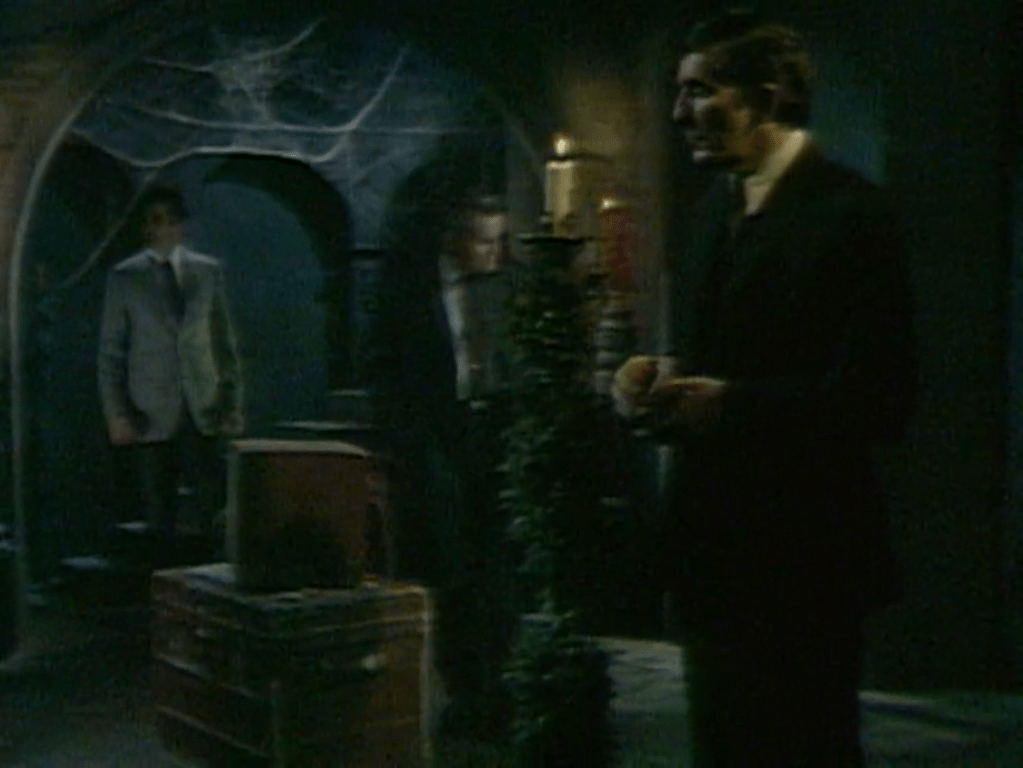
Burke and Woodard start to go, and Barnabas relents. He takes them to the basement. The coffin is usually in the main area at the foot of the stairs, but when the three of them get there some crates and a trunk are stacked up on that spot.

No coffin.

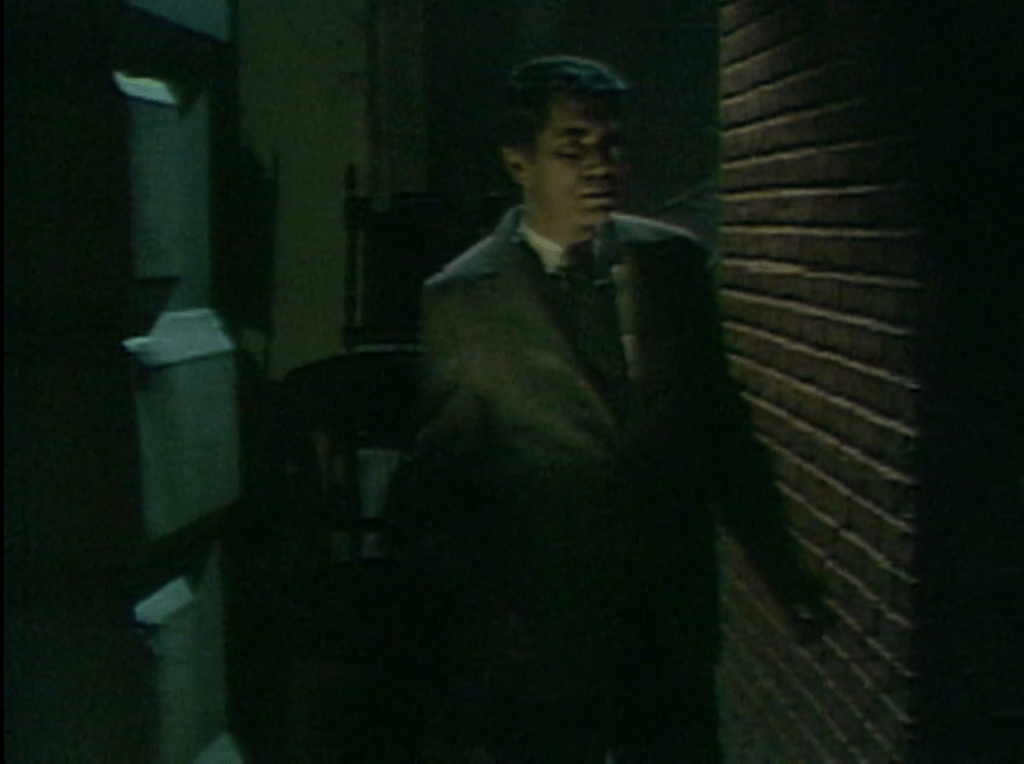
Burke goes down a little corridor and sees nothing there, either.

Burke in the corridor.

Burke and Woodard are embarrassed, and Barnabas grins. We know that he had moved the coffin so that when someone came to check out David’s story they would see nothing, and that his resistance to Burke and Woodard’s requests to search was put on for effect. Barnabas spends most of his time with other people pretending to be a living man born in the twentieth century; his grin is that of an actor who finds he has given a particularly convincing performance.

Receiving his ovation.

We had seen corridors in the basement when Barnabas was holding Maggie prisoner there. We saw them most prominently in the episode that ended with her escape, #260. In that one, they looked very extensive. He had kept Maggie in a prison cell at the end of one of those corridors. That cell had been there since Barnabas’ time as a living being in a previous century, but none of the many people who had visited the basement before Barnabas moved in, including Burke in #118, had seen the cell. So there must be quite a bit of space down there that only Barnabas knows about, but he has chosen to put his most embarrassing possession in the one place no one coming to the basement could fail to notice. It’s like the old days, when you’d go to visit a single guy at home and find that he had left sexually explicit magazines or videos on his coffee table.

Episode 327: Snap! Like that.

For the last eight weeks, Dark Shadows has been presenting a riddle about strange and troubled boy David Collins. In #288, he wondered if mysterious little girl Sarah might be a ghost. Since then, he has seen her several times, and every time she has given fresh evidence to corroborate that hypothesis. When he isn’t with Sarah, David is either looking for her or fielding questions from adults who are anxious to make contact with her, and in the course of every search and every question he finds still more reason to suppose that she is a ghost. David had always been the first character to believe in ghosts, yet he kept resisting the obvious conclusion that Sarah was one.

Friday, David had a dream in which Sarah told him that she died when she was ten years old. In that same dream, David saw his cousin Barnabas rise from a coffin, greet Sarah warmly, and threaten him with his cane. Yesterday, David woke up and told his well-meaning governess Vicki that he now understood everything about Sarah, because he knew that she was a ghost. Vicki listened carefully to his dream. Much to his frustration, she tried to talk him out of taking it literally. But today, when David is out of earshot, Vicki twice shows the other adults that she regards David’s dream with the utmost seriousness.

In the drawing room of the great house of Collinwood, mad scientist Julia Hoffman tries to hypnotize David so that he will stop making trouble for her co-conspirator Barnabas. Before she can induce the trance, David recognizes her medallion as the one a faceless woman held before his face in the dream. He flees from Julia and calls out for Vicki.

Vicki and matriarch Liz ask Julia what happened. Julia tries to play dumb, but Vicki recognizes her medallion both as the one David described when he was telling her about his dream and as the one Julia showed her and Maggie Evans, The Nicest Girl in Town, when she dropped in on them at Maggie’s house in #298. During that visit, Vicki briefly left Julia and Maggie alone together. Before she left the room, Maggie was about to remember who abducted her and held her prisoner; after she came back, Maggie’s amnesia had returned in full force. During the interval, Julia had used the medallion to do a little emergency hypnosis, restoring the memory block that keeps Maggie from identifying Barnabas as her captor and as a vampire. Julia has reason to squirm when she realizes that Vicki has connected the medallion both with that incident and with David’s dream.

Vicki goes to David’s room to again try to talk him out of a supernatural reading of his dream. She finds him gazing into his crystal ball, looking for Sarah. He pleads with her to allow him to go look for Sarah. She resists, but he tells her that he saw Sarah in the crystal ball and that it won’t take him long to find her. He promises to tell Vicki what he and Sarah talk about. She lets him go, on condition that he be back within an hour.

The riddle of David’s long refusal to acknowledge that Sarah is a ghost is matched by the riddle of Vicki’s attitude. She has seen and interacted with ghosts on many occasions, a fact that is no secret from David. Both her recognition of Julia’s medallion and her acceptance of David’s claim to have seen Sarah in the crystal ball show that she knows she is operating in a world where supernatural forces are at work. Yet she keeps urging David back into “logical explanation”-land. Perhaps she has read Henry James’ “The Turn of the Screw,” and doesn’t want there to be any ambiguity about whether the boy saw the ghosts himself or his crazy governess put the idea into his head.

David goes to the woods, hears the familiar strains of “London Bridge,” and sees Sarah. She tells him that she knows he saw her in his crystal ball. When he asks how she knows he was looking into his crystal ball, she answers only “I know lots of things.” He asks her about his dream; apparently that is not among the things she knows about, because it all comes as news to her. David tells her that in his dream, she told him that she was very sick when she was ten years old. She excitedly replies “That’s true!” He then says that she told him she died of that sickness. Even now, after the dream, after telling Vicki that Sarah is a ghost and shouting with frustration when she won’t agree, he follows up the idea that Sarah has died with “That isn’t true, is it, Sarah?”

Before Sarah can answer, Vicki’s depressing boyfriend Burke lumbers onto the scene. He hears David and Sarah’s voices and shouts “David!” Sarah then becomes alarmed and declares she has to go away. David asks her to stay, and goes to tell Burke to wait. By the time they turn around, Sarah has vanished.

Burke used to be an interesting character, back when he was a dashing action hero played by the charismatic Mitch Ryan. In fact, he was the one who gave David the crystal ball in the first place, back in #48. But he hasn’t had much to do on the show since his major storyline evaporated in #201, and now he is played by Anthony George, an actor whose cool, understated approach was the exact opposite of Ryan’s tendency to red-hot, larger than life reactions. In the scripts written by Ron Sproat, the part of Burke still depends on Ryan’s strengths, and George is entirely at sea with it. Today, Gordon Russell’s script takes advantage both of George’s actual abilities and of the dimwitted impression he has made previously.

David tells Burke that he doesn’t think Sarah will talk to anyone other than him from now on, not because she is shy, but because she doesn’t want anyone else to know that she is a ghost. Burke gives David a smug little speech about how foolish it is to believe in ghosts. David asks how Sarah got away so fast. Burke admits he doesn’t know. David gives Burke some details about Sarah’s way of vanishing into thin air, and he is left speechless.

“You don’t know much about Sarah, do you?” Screenshot by Dark Shadows Before I Die.

Back in the drawing room, Burke tells Vicki and Liz that David thinks Sarah is a ghost. Liz reflexively asks if he ought to be taken to a doctor. Burke suavely says that he doesn’t believe it is as serious as all that, that David is just letting his imagination run away with him.

Vicki speaks up. She says that she disagrees with Burke on two points. First, she thinks the matter is very serious. Second, she doesn’t believe it has anything to do with David’s imagination. Sarah really is a ghost.

Burke starts giving another sanctimonious speech about how one oughtn’t to believe in ghosts. Some weeks ago, Sproat and recently-departed, never-lamented writer Malcolm Marmorstein had given Burke some angry speeches in which he demanded Vicki stop taking the supernatural seriously. Those speeches would have marked Burke as bad news had Mitch Ryan delivered them, but at least they might have suggested that he was going to become an interesting villain- coming from an actor as cold as Anthony George, they were just pointless nastiness. Vicki’s attempts to comply with Burke’s gaslighting campaign also did a lot of damage to her character in the audience’s eyes, presenting her as weak-willed and empty-headed.

But today, Gordon Russell doesn’t write Burke as a loudmouth or Vicki as an aspiring doormat. Instead, he lets George make a reasonable-sounding case in the quiet, detached manner in which he excelled, and he has Vicki surprise him with an equally quiet but unyielding disagreement. She tells Burke to hire all the private investigators he likes to use and tell them to search for Sarah. If they can produce the girl in the flesh, she will admit that she is mistaken. But she tells Burke that won’t happen, because “David is right- that little girl is a ghost.”

If we remember Vicki’s earlier attempts to submit to Burke’s gaslighting, this scene answers the riddle about her. She knows that there are a lot of Burkes and a lot of Lizzes in this world, and that if you want to get along with them you have to be able to present yourself as someone who doesn’t believe in ghosts. She is trying to teach David how to play the role of the practical-minded fellow who takes it for granted that what we can see in the plain light of day is all we have to concern ourselves with. If she and the other adults can shelter him from enough of the uncanny doings that she knows full well are afoot all around them, perhaps he might get through his childhood actually being something like that fellow. It worked out that way when David’s mother, undead fire witch Laura Murdoch Collins, came to Collinwood to claim him- the storyline around her drew him deeper and deeper into the world of the occult, but once Vicki had rescued him and it was all over he didn’t remember anything about that side of it.

Upstairs, David is trying to sleep. Sarah appears in the corner of his room, lit from below. Laura stood on the same spot, in the same lighting, when she visited David while he slept in #150. His mother had called his name in a whispering voice and had a subtle message for him, but Sarah yells “David!” and says she’s ready to answer more questions.

“You said you had more questions to ask me.” Screenshot by Dark Shadows Before I Die.

David doesn’t ask her if she died. Perhaps when he told Burke that she doesn’t want anyone to know that she is a ghost, he meant that he has realized it is a sensitive subject for her. He does ask about the coffin he saw in his dream. She says she doesn’t know what he’s talking about. He says it was in a room that he felt he’d been in before, and she says maybe it was. He says he doesn’t know where it is, and she tells him that’s good- she doesn’t want him going anywhere near it.

David keeps talking about the coffin, and it dawns on him that it is in the basement of Barnabas’ house. She insists that he stay away from Barnabas’ house, that it isn’t safe for him there. She won’t answer any of his questions about that, but she keeps insisting that he stay away from Barnabas’ house.

David asks Sarah if Barnabas’ servant Willie really was the man who abducted Maggie, as the police think. Sarah answers, “Oh no, poor Willie only went to Maggie’s house to warn her.” David asks what he was trying to warn Maggie of, and Sarah says that she has to go away. She repeats that he must stay away from Barnabas’ house. He pleads with her to stay, but she dematerializes in front of him. This is the first time we’ve seen a ghost vanish in this way since #85, when the ghost of Bill Malloy appeared to Vicki, sang a sea shanty, and then disappeared. It’s also the first time Sarah has let David see her dematerialize. Evidently, she’s more relaxed about these things now that she’s out to him.

Closing Miscellany

There is a particularly funny blooper 14 minutes and 20 seconds into the episode, when Burke comes out of the door that leads to the bedrooms at Collinwood, an off-camera voice calls out “Go in!,” he turns around, goes back in the door, then comes out again with exactly the same expression on his face.

Burke and Vicki have a little conversation about why Julia spends so much time at Barnabas’ house. Burke guesses Julia might have “a mad crush on Barnabas.” Vicki reacts as if this is absurd. The same idea had occurred to Julia’s old acquaintance Dave Woodard, MD, in #324, and Julia had been delighted to find that she had inadvertently acquired a cover story. That Burke came up with the notion independently leads us to wonder if we will be hearing more about it, and that Vicki regards it as so self-evidently preposterous reminds us of the times she has seemed more interested in Barnabas than in Burke. Perhaps the Vicki/ Burke/ Barnabas love triangle has a future after all.

Episode 325: Such pretty flowers

Strange and troubled boy David Collins was, for the first 39 weeks of Dark Shadows, the character most intimately connected to the supernatural back-world of ghosts and uncanny phenomena that would occasionally peek through the main action of the show. That changed in #191, when he chose life with well-meaning governess Vicki over death with his mother, humanoid Phoenix Laura Murdoch Collins. After that, he had little memory of his mother, and none at all of the paranormal experiences he had during her time with him on the great estate of Collinwood.

Not that David lost his connection to the supernatural all at once. When he first met his cousin Barnabas in #212, he cheerfully asked him if he was a ghost, and was disappointed to hear that he wasn’t. In #288, he speculated that his friend, mysterious little girl Sarah, might be a ghost, and he has taken it in his stride every time he has seen Sarah do something only a ghost could do. In #310, he took out his crystal ball, a gift he had received in #48 and hadn’t used since #82, and peered into it to try to find Sarah. He did see her in it, too.

Yet David seems to be resisting the idea that Sarah is a ghost, and indeed to be shying away from the whole concept of the supernatural. When she led him to the secret chamber in the Collins mausoleum in #306, she told him that the empty coffin there once had a body in it, but that the body got up and left. David objected that the dead don’t walk away, and was incredulous when she assured him that sometimes, they do. When David was trapped in the chamber in #315, Sarah materialized there and showed him how to get out. He had called on her to come, and was facing away from the only door when he did so, indicating that he knew she could pass through the walls. Yet when she did, he demanded a naturalistic explanation for her entrance, and when she vanished he asserted that she must be hiding in the chamber somewhere.

Now, David is terrified of Barnabas, much to the puzzlement of the adults he lives with. In the opening scenes, he is staring at the portrait of Barnabas in the foyer of the great house, and we hear Barnabas in voiceover, delivering the lines with which he frightened David in #315. He screams with terror, bringing his aunt Liz. She sees that David is upset, but he hurries away from her, upstairs to his bedroom.

There, we hear his thoughts in another voiceover. He remembers the events of #310, when he discovered that Barnabas and his servant Willie knew about the secret chamber in the mausoleum. In his agitation, he calls out to Sarah. He hasn’t admitted to himself that Sarah is a ghost, but evidently he expects her to materialize out of thin air. Sarah doesn’t come, but Vicki does, asking who he was talking to.

After David says he wants to work on his stamp collection, Vicki goes downstairs and finds Liz putting her coat on. She says that David is afraid of Barnabas for some reason, and that she is going to Barnabas’ house to ask him to help put the boy’s fears to rest. She says that David is more disturbed than he has been since his mother Laura was around; this is the first direct reference to Laura in months.

There is a knock on the front door. It is Barnabas, saving Liz the trip. Liz and Vicki explain how fearful David is, and Barnabas offers to have a talk with him.

Liz ushers Barnabas into David’s room. Once the door is closed on the two of them, Barnabas questions David aggressively about Sarah and the secret chamber in the mausoleum. He asks him if Sarah told him about her family, twice mentioning her brother. When David says that Sarah hasn’t told him anything about herself, Barnabas accuses him of lying. He sits next to David on his bed. David doesn’t know that Barnabas is a vampire, but if he did he couldn’t look much more uncomfortable than he does when Barnabas assumes this position.

Barnabas sitting with David on his bed.

Barnabas tells David repeatedly that he knows he was in the secret chamber. David denies it, Barnabas again tells him he is lying, and to prove it shows him the knife he left there.

Barnabas confronts David with his knife

A knock comes at the door. It is Vicki. Vicki adores Barnabas, and the smile she wears when she enters the room shows her certainty that a heart-to-heart talk with him will have relieved David’s anxiety.

Smiling Vicki, sure everything will be all right

Vicki sees that David is still frightened, and her smile gives way to a look of confusion. Vicki was originally the audience’s point-of-view character; the audience is now composed chiefly of people who have tuned in wanting to see how they were going to fit a vampire into a daytime soap opera, and so of course she has to be Barnabas’ biggest fan at Collinwood. She and Barnabas leave David’s room together, and Barnabas wishes David “Pleasant dreams…”

We see David tossing in bed. He is talking in his sleep, calling out to Sarah. In yet another voiceover, we hear his dream. It is a bit of conversation from #306, when Sarah told him about the empty coffin.

We then see the beginning of another dream. It takes place amid a composite of decorations from the cemetery set and from the set representing Barnabas’ basement. David at first appears in a corridor like the ones we saw in the basement in #260.

The fog machine is working hard today.

He then encounters a faceless woman whom regular viewers will recognize as Barnabas’ co-conspirator, mad scientist Julia Hoffman.

David sees the faceless woman.

We see that she is wearing Julia’s wig and frock and holding the jeweled medallion she uses to hypnotize people:

Julia’s identifying marks.

David flees from the faceless woman, saying he has to find Sarah. He finds himself behind a grating like the one on the door to the Collins mausoleum:

Entering the tomb

He walks up a few stairs, and sees Sarah.

David finds Sarah

When David tells Sarah that she is hard to find, she denies it, saying that she is easy to find if you know where she is. David does not respond to this characteristically cryptic remark, but complains that she won’t tell him anything about herself. She asks what he wants to know, and says he wants to know who she is and where she comes from. She tells him:

Sarah: That’s easy. I was born the same place you were. I lived in a house on a hill until I was nine years old. Then I got very sick. Everyone came to see me, and they were very sad.

David: Because you were sick?

Sarah: No, because I died. I died, and everyone brought such pretty flowers.

“I died that time. I died, and everyone brought such pretty flowers.”

When David asks why she is around now if she died then, she tells him she doesn’t really know. All she knows is that she is looking for someone. David asks who that might be, and Sarah says she will show him. Suddenly he becomes frightened and does not want to go with her. She insists. She takes his hand and leads him.

Sarah leading David to her secret

The camera follows the children on their journey across the set. At first Sarah takes David down some stairs, leading him from depths to depths:

Sarah leads David down into the depths

The set is now unmistakably Barnabas’ basement, though with more candelabra casting more intricate shadows on the walls than we have seen there:

Vergil and Dante, junior edition

At last Sarah stops and looks straight ahead. They have reached their destination.

David is bewildered by the sight.

They see a coffin. David asks if this coffin is empty, as was the one in the secret chamber. Sarah tells him no. This one has a body in it. The lid starts to open. David points in astonishment, while Sarah looks on serenely.

The lid begins to open.

Barnabas rises from the coffin.

Barnabas rises.

David recognizes Barnabas and is stunned. Sarah has eyes only for her big brother.

David stunned.

Barnabas stands. He turns, and sees Sarah. He is glad to see her.

David watches Sarah’s reunion with Barnabas.

Barnabas notices David. He turns to follow him.

Barnabas blocks David from our view and from Sarah’s.

As Barnabas follows David, Sarah simply watches.

Sarah watching big brother.

Barnabas follows David through another corridor. The shadows on the wall and floor form a design suggesting David is caught in a web. Readers of Gold Key comics’ Dark Shadows series will recognize the bend of Barnabas’ knees and the angle of his cane in this shot as their usual depiction of him:

David caught in Barnabas’ web.

David’s back is to the wall and Barnabas closes in on him.

Cornered.

Barnabas raises the cane he used to block David’s escape in #315 and which regular viewers several times saw him use to beat Willie. We zoom in on the wall, where we see the cane’s shadow rise and fall while we hear David cry out in distress.

Sarah’s fixation on Barnabas and her passivity when Barnabas follows David mark a pivotal moment in her development. She looks and sounds like a friendly little girl, and we have seen her rescue people from danger. She usually seems like a cross between Caspar the Friendly Ghost and the Powerpuff Girls. But she is not that at all. She is a symptom of the same curse that has brought Barnabas forth to prey upon the living, and she is leading David ever deeper into a world where only the dead belong. The show has given us no reason at all to think that she can bring him back to the realm of the living.

Even if Sarah wants to save David, she may still represent a deadly threat to him. We saw this in the Laura story. When Laura tried to lure David into the flames, she told him that he, like her, would rise from the ashes and live again. We had heard her say things like this before, and she may well have believed it to be true. But unknown to her, we saw a séance in which David spoke with the voice of a son Laura had in one of her previous incarnations. She had burned him with her, but while she gained a new life in the flames, he had become one of the unquiet spirits of the dead. Perhaps Sarah, too, is unwittingly leading David to his death.

Closing Miscellany

When Liz leads Barnabas into David’s room, she tells David that “Unc- Cousin Barnabas” wants to have a man-to-man talk with him. In later years, Jonathan Frid would refer to his character as “Uncle Barnabas” when he talked with interviewers about how the Collinses responded to him. I wonder if Joan Bennett’s blooper is a sign that he was already calling him that at this time.

There is a slight puzzle in Sarah telling David she was “born in the same place” he was. We’d heard in the early episodes that Laura and Roger never spent a night together in Collinwood as man and wife- the day of their wedding, they went to their new home in Augusta, Maine, and David was born a few months later. Perhaps Sarah’s remark is a retcon, and we are now to think of David as having been born at Collinwood. Or perhaps Sarah really was born where Augusta would stand- we know that her birth year was 1786, and that was the year the settlement that would become Augusta saw the establishment of its first public whipping post. Maybe her parents wanted to go there to celebrate the occasion.

When Sarah tells David she lived on the hill until she was nine, she interrupts herself and shouts “Ten!” This is an odd little blooper. Just a few days ago, David told Barnabas that Sarah was ten, and Barnabas jumped down his throat asking if she wasn’t “almost ten?” Now Sharon Smyth has been on the show long enough to have celebrated a birthday, and they aren’t done with Sarah yet. So they are retconning Sarah as having made it to ten.

Episode 318: What can a little girl know?

In the outer room of the Tomb of the Collinses, Sam Evans and Dr Dave Woodard recap the story so far. In the hidden chamber on the other side of the wall, vampire Barnabas Collins and mad scientist Julia Hoffman eavesdrop on their conversation. When they hear how close Evans and Woodard have come to discovering their terrible secrets, Julia squirms and Barnabas looks shocked.

Busted.

When Dr Woodard mentions that Julia had used the word “supernatural” in a conversation with him, Barnabas nearly blows their cover. He grabs Julia by the throat and she lets out a yelp. Sam hears this, Woodard does not. Woodard suspects that there are ghosts at work in the area, but he cannot believe that Sam’s hearing is better than his, so he dismisses the idea.* He notices the plaque marking the burial site of Sarah Collins, 1786-1796, and says out loud that the little girl named Sarah whom everyone has been looking for lately is the ghost of that Sarah.

Evans and Woodard leave the tomb, and Barnabas resumes raging at Julia. He opens his old coffin and pushes her head into it, asking if she wants to spend eternity confined there. She talks him down with warnings of what would happen were he to kill strange and troubled boy David Collins.

Woodard goes to the great house of Collinwood, where he questions David. Woodard is much more forthcoming with what he knows than he has been in any previous conversation. David listens closely, trying to find out what he knows. But Woodard’s questions are all about David’s friend, Sarah. David doesn’t know that answers to many of Woodard’s questions, and Sarah has sworn him to secrecy about much of what he does know. So the only new piece of information Woodard learns from David is that Julia was lying to him the other day when she said that she hadn’t given much thought to Sarah. David tells him that she asks him about her all the time.

Julia comes in and tries to stop Woodard questioning David. He ignores her and asks another question, then warns him to stay away from the Tomb of the Collinses. When he tells David that whatever secret Sarah told him about the tomb is also known to someone else, and that that other person is very dangerous, David is horrified. When he was trapped in the hidden chamber last week, Barnabas and his servant Willie entered. David hid from them in Barnabas’ old coffin and eavesdropped on a conversation in which Barnabas dropped a huge number of clues about his secrets. Since Woodard started his questioning of David with a reference to the unknown person who has been terrorizing the area since April, David now has reason to believe that Barnabas is that person.

David leaves the room, and Woodard asks Julia what she was trying to prevent him from finding out. She refuses to answer any of his questions. She hears the sound of dogs howling, and knows that it means Barnabas is getting ready to kill someone. Knowing that she has very little time to try to prevent David’s murder, she cannot focus on Woodard’s questions. For once, she can’t think of any lies that will hold him off. Her reason for being in town, so far as Woodard is concerned, is that she is a doctor treating Sam Evans’ daughter Maggie, Barnabas’ former victim. When she won’t answer his questions, he takes her off Maggie’s case.

Julia goes to Barnabas’ house. She finds him on his way out the door, on a mission to kill David. She opposes him, and he declares that nothing can stop him. At that, the wind blows the doors open. It extinguishes some of the candles in the room. The strains of “London Bridge” begin playing, and Barnabas and Julia realize that Sarah, who in reality is the permanently nine year old ghost of Barnabas’ little sister, is in the room. Barnabas cannot leave. Julia says with satisfaction that nothing can stop him- “except one little girl.”

The whole episode is very strong from beginning to end. Julia is usually so much in charge that the only suspense is what she will choose to do, but throughout this one she is scrambling to bring Barnabas under control. When her final attempt fails, Sarah’s intervention comes as a thrilling surprise.

The performances of both Jonathan Frid and Grayson Hall stand out today. Hall is as powerful a presence playing a character who controls nothing as she usually is playing a character who controls everything. And few could match Frid’s ability to appall us with Barnabas’ plan to kill a ten year old and seconds later to elicit tears by calling out to his beloved little sister.

*My wife, Mrs Acilius, put it that way.

Episode 265: Unusual as doctors go

Maggie Evans, The Nicest Girl in Town, has escaped from vampire Barnabas Collins, but not before Barnabas put the zap on her brains. She is being treated at Windcliff Sanitarium, under the care of Dr Julia Hoffman.

Windcliff Sanitarium. Screenshot by Dark Shadows Before I Die

Dr Hoffman’s old acquaintance Dr Dave Woodard shows up with Maggie’s father Sam and boyfriend Joe. Woodard and Hoffman are Dark Shadows ‘ current versions of Bram Stoker’s Dr John Seward and Professor Abraham Van Helsing. As Seward called Van Helsing in when he needed help solving the mystery he encountered treating the victims of Count Dracula, so Woodard has called the expert Dr Hoffman in to help him solve the mystery he has encountered treating Barnabas’ victims. As Van Helsing refuses to answer any of Seward’s questions when they first start working together, so today Dr Hoffman refuses to answer any of Woodard’s questions about the case. There is one departure, in that Dr Hoffman combines Seward’s occupation as chief physician at a sanitarium with Van Helsing’s role as mysterious expert from out of town.

Dr Hoffman tells Dr Woodard that she believes it will be bad for Maggie to see Sam and Joe, but she consents to the visit as a way of discouraging them from trying to come back. When Sam and Joe join them in her office, she attends to her aquarium. In the post about this episode on Dark Shadows Before I Die, Christine Scoleri points out that this is a rather direct way of telling us that there is something fishy about Dr Hoffman.

Fishy doctor. Screenshot by Dark Shadows Before I Die

When Sam and Joe go to Maggie’s room, she has a mad scene. She starts singing “London Bridge,” gets to an obscure verse running “Take the key and lock her up,” and starts screaming “Lock her up!” over and over. It’s magnificently terrifying.

In his post on Dark Shadows Every Day, Danny Horn raves about Grayson Hall’s performance as Julia Hoffman. Rightly so, she will quickly make herself indispensable to the series. He includes a lot of screenshots of her face, showing the wide variety of expressions she uses. I have a more complicated response to this aspect of her style.

As many screenshots as Danny gives of Grayson Hall’s face in his post, I presented even more screenshots of Lovelady Powell’s face in my post about #193, where Powell plays art dealer Portia Fitzsimmons. What impressed me about Powell’s performance is that she takes one of the most basic rules of screen acting- choose one of your eyes and look at your scene partner only with it- and builds a whole character around it. Her left eyelid is all she needs to command the stage and leave an indelible impression.

Hall was at the opposite extreme. She ignores the one-eye rule, and virtually every other piece of guidance professionals give about how to create a character on camera. She uses every muscle at every moment. Her broad, stagy approach works well for Dark Shadows, and the three actors with whom she shares her shots today stay out of her way. Still, she does make me miss Powell’s dominating simplicity.

With Julia’s introduction, all of the actors in the photo I use as the header for this blog have joined the cast of Dark Shadows. There is also a version of the picture where the actors are frowning.

Gloom in the shadows

Here’s the smiley version. I’ve marked each player with the number of the first episode in which s/he appeared:

Episode 260: One, two, away they flew

Maggie Evans, The Nicest Girl in Town, has been a prisoner of vampire Barnabas Collins for a long time now. Barnabas is planning to kill her tonight. We spend the opening scene with Barnabas’ sorely bedraggled blood thrall, Willie Loomis. We hear Willie’s thoughts as he does the housekeeping. Willie wishes he could save Maggie, but Barnabas has too much power over him. The most he can do is bring her a poisoned glass of milk and invite her to drink it if she wants to die an easy death.

Willie is not Maggie’s only friend. The ghost of Barnabas’ nine year old sister, Sarah, materializes in Maggie’s cell. Sarah asks Maggie why she is crying. Maggie tells her that if she doesn’t get out of the cell very soon, she will die. Sarah is distressed to hear this- “You mustn’t die- I don’t want you to die.”

Maggie hasn’t figured out that Sarah is a ghost, and keeps asking her how she manages to get in and out of the cell. Sarah usually evades this question, but now she says that there is a way. She came upon it accidentally, long ago, and her father ordered her not to tell anyone, not even her brother. She will be punished if she tells. If her father put her in the prison cell in their basement intentionally, Sarah’s fear of punishment is quite understandable.

Sarah overcomes her fear sufficiently to share a riddle with Maggie which she says will give her the answer:

One, two, away they flew.

Three, four, by the door.

Five, six, count the bricks.

Seven, eight, the clue is “grate.”

Nine, ten, home again.

Maggie asks Sarah to repeat the riddle, and she says she can only say it once. Maggie tells her where to find her own father, Sam Evans, and asks her to tell Sam that she has seen her. Sarah disappears.

Sarah’s fear of punishment will ring a bell for regular viewers. Strange and troubled boy David Collins is so intensely afraid that his father, high-born ne’er-do-well Roger, will punish him by sending him away to a boarding school or a jail that he tried to murder Roger. Later, David left his favorite person, well-meaning governess Vicki, to be decapitated by crazed handyman Matthew Morgan because he was afraid that if he helped Vicki his father would find out he had earlier defied him and would punish him. Now, Maggie is in mortal danger because another Collins child, one who lived in a previous century, has a similar fear of punishment. The cell in the basement of the Old House was there before slavery was abolished in the area in 1783; perhaps Sarah’s fear and David’s are a bequest from the slaves and indentured servants whom their forebears locked up in it.

We cut to the Evans cottage. Sam is an artist, and is working. Sarah materializes in the living room. Sam had locked the door and Sarah won’t explain how she got in, but he seems to be delighted with her anyway. She is impressed with his paintings and asks him to paint a picture of her. He offers a drawing instead. When she agrees, he picks her up and sets her on a stool. She flashes a grin at being picked up. She asks if she can keep the drawing when he is done with it.

The most fun Sarah has had the whole time she’s been dead

Sam tells Sarah that her dress is very pretty. He then mentions that you don’t see many dresses in its style. She asks if that means he doesn’t like it. When Sam says that all he means is that it isn’t the sort of thing other little girls wear, she says she doesn’t play with other little girls so she doesn’t care what they wear. She seems to be getting worked up about this, so Sam calms her down with, “All right, all right, I see.” This little exchange gave my wife, Mrs Acilius, a laugh. Sarah may have been born in the same year as Jacob Grimm, but she is very much a nine year old girl.

While Sam draws Sarah, she steers the conversation to Maggie. She asks Sam if he looked for Maggie on the beach under Widow’s Hill. He says he’s looked everywhere he could. She repeats her suggestion that he look for her on the beach. He says he is sure he won’t find her there. She responds “You might, if you go there tonight.” Disturbed by this, Sam looks up, and finds that Sarah has vanished.

This surprises us almost as much as it surprises Sam. Sarah had made it clear that she very much wanted to keep the drawing, yet she disappears before Sam is finished. Evidently, it wasn’t within her power to stay.

Back in the cell, we see Maggie and hear her thoughts as she tries to remember Sarah’s riddle. Like Willie’s voiceover internal monologue in the opening scenes, Maggie’s goes on too long. We can see that Maggie is in an upsetting situation and understand why Sarah’s presence confuses and distracts her. That makes it clear she would have difficulty remembering the exact wording of the riddle, but we really don’t need to hear her go over every part of it.

By the time Maggie finds the loose brick that triggers the opening of the secret panel, Barnabas is already rising from his coffin. We cut between Barnabas walking through the basement and Maggie struggling to open the panel. It may sound like we’re describing filler when we say that we see Barnabas traversing three distinct corridors between his coffin and Maggie’s cell, but it doesn’t feel that way. Not only do these shots build suspense as we wonder if Maggie will get out before he reaches her, but in Barnabas shown as a hunched, solitary figure in narrow spaces sketched in shades of gray we see the representative of a world bleak beyond endurance. We can see why the first serious feature film about a vampire, F. W. Murnau’s Nosferatu (1922), devoted so much screen time to showing Count Orlok skulking about the corridors of his castle.

First corridor
Second corridor
Third corridor

Maggie crawls into the secret passage. She doesn’t close the panel behind her. Not only doesn’t Maggie know that Sarah is a ghost, she doesn’t know that Barnabas is Sarah’s brother. When Sarah says that not even her brother knows about the secret panel, she is telling us, but not Maggie, that Barnabas is unfamiliar with this way. We know that if Maggie had closed the panel, Barnabas wouldn’t have known where to look for her, and so we might yell at the screen urging her to do that. But since it is his house, she has to assume that he does know about the panel, and she knows that he might be at the door any second. So it is rational for her to forget the panel and use all of her time moving forward.

The gap between Maggie’s knowledge and ours again adds to the suspense as we watch her flee from Barnabas through the twisting passages beyond the panel. We only see one path, but the looks on the actors’ faces as they look from side to side tell us that there are several. Maggie is moving cautiously, choosing her way with care, the sensible thing to do if Barnabas is familiar with the passages. Since we know that it is new to him as it is to her, we want her simply to pick a path and run.

Maggie beholding the paths before her

Maggie finds two heavy doors, both of them apparently stuck. Barnabas looks around, seems bewildered, and takes a breath. He shouts a speech at Maggie, claiming that she has no chance of escape because he can hear her. He can’t hear much while he’s shouting, so we want her to take advantage of that and bash away at one of the doors during his speech.

Barnabas wondering at part of his house he never knew existed
Maggie with two closed doors in front of her and an angry vampire behind her

This episode ends the 52nd week of Dark Shadows. When ABC* picked the series up in 1966, it gave executive producer Dan Curtis a 26 week commitment, carrying production to #130. After that, the network renewed it for the then-standard 13 week period. The first renewal carried them to #195, the second to this episode. Until just a couple of months ago, the ratings were so low that no one thought it was likely that it would get a third renewal. When the vampire was introduced in April, viewership started to pick up, preventing cancellation and requiring them to come up with a story that they could keep telling.

I do think we can see traces here and there of the original plan. The first part of the plan seems to have been to copy Bram Stoker’s Dracula far more thoroughly than they wound up doing.

The two female characters on the show who had or were about to have boyfriends when Barnabas was introduced were Maggie and Vicki, who are both seeing men who are cut out to be stout-hearted action heroes. The two female characters in Bram Stoker’s Dracula who had boyfriends were Lucy Westenra and Mina Murray, who were both seeing men who emerge as stout-hearted action heroes. Dracula feeds on Lucy, prompting several other people to band together to try to save her. Dr John Seward, MD, contacts his old Professor, the brilliant Abraham Van Helsing, to advise the group. Despite their best efforts, Lucy dies and rises as a vampire, the “Bloofer Lady” who feeds on the children of east London. Lucy’s boyfriend has to destroy her body to free her soul of the vampire curse.

If the show was about to be canceled, it would have been a favor to Kathryn Leigh Scott to have Maggie suffer Lucy’s fate. Going out with a splash like that would certainly have given her something to lead with as she looked for her next job. But once it was decided that the show would continue beyond #260, it was out of the question to lose a character as popular and versatile as Maggie. When the network ordered 65 more episodes, Maggie had to be saved.

The Van Helsing analogue was actually named on screen. In #242, the show’s equivalent of Dr John Seward, addled quack Dr Woodard, said that he was going to call in a specialist to consult on Maggie’s case, a Dr Hoffman, who is “one of the best men in the field.” We haven’t heard about this man since Dan Curtis found out the show was going to be renewed, suggesting that they’ve abandoned the idea to hew quite so closely to Dracula.

In Stoker’s novel, once Van Helsing has corrected the group’s knowledge deficits concerning vampires, Mina emerges as its leader. Attempting to be gallant, the men cut Mina out of their operations, with the result that Dracula escapes them and bites her. Mina is able to resist his influence so far that she can play a pivotal role in the Count’s final destruction.

The first time Dark Shadows modeled a storyline on Dracula, the menace was not a vampire, but undead fire witch Laura Murdoch Collins. In that arc, the men formed a group of stout-hearted heroes advised by Dr Peter Guthrie and led by well-meaning governess Vicki. Guthrie and Vicki were plainly Van Helsing and Mina. Laura killed Guthrie, so he can’t come back to help in the fight against Barnabas, but Vicki is still around, still the chief protagonist, and still the one likeliest to lead the opposition to a villain.

Indeed, Barnabas has expressed interest in Vicki as a replacement for Maggie, and in #233 he blurted out an obvious threat when he realized she was getting uncomfortably close to figuring out the truth about him. So, had Dark Shadows ended with this episode, it is likely that it would have ended with Vicki overcoming Barnabas’ power and driving a stake through his heart.

Of course, the vampire is the source of the ratings, and Vicki and Maggie are needed for future story development. So the makers of the show can’t use any of those plot elements. What in the world they can do is a question that does not, as yet, have a clear answer. So they have been stalling and stalling. Sooner or later, the stalling will have to end.

*The American Broadcasting Company, that is, not the Australian Broadcasting Corporation.