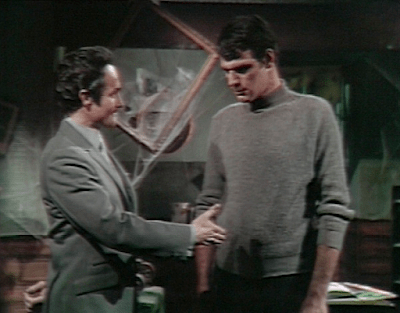
Suave warlock Nicholas Blair has learned that Frankenstein’s monster Adam is hiding in a room in the long-deserted west wing of the great house of Collinwood. He materializes there and talks as if he’s trying to recruit Adam into a self-esteem cult. He says “You mustn’t worry about what other people think, Adam. And you needn’t always do what other people want you to do. You must learn to be a strong-willed individual.” In response, Adam carefully articulates the new vocabulary item: “In-di-vi-du-al.” It sounds like the big guy will be signing up for courses at the Nathaniel Branden Institute in no time.
Later, we see Adam in the main part of the house. He has let himself into the bedroom where his patroness Carolyn Collins Stoddard, the acting mistress of Collinwood, is sleeping. He wakes her and tells her of Nicholas’ visit. Carolyn tells him to wait there while she goes to the drawing room and scolds Nicholas for wandering into parts of the house he had no permission to explore. Nicholas apologizes, and tells Carolyn her secret is safe with him.
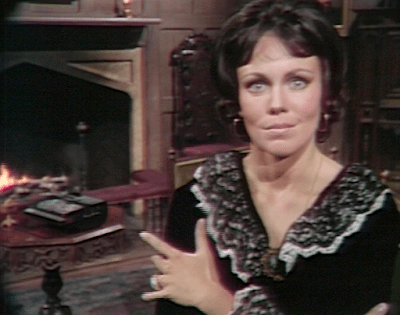
In the final part of the episode, the wicked witch known variously as Angelique and Cassandra makes her way to Adam’s room in the west wing. She finds his door locked, and makes a graceful little hand gesture to magically open it. Standing over Adam while he sleeps, she decides that she cannot use magic to kill him, since Nicholas wants Adam to live and she would like him to believe that a human committed the murder. Therefore, she lifts an ax and is ready to chop into him when the episode ends. The ax wasn’t there earlier and she didn’t conjure it up; presumably she found it in “hammerspace,” the dimension where fans of animated cartoon say characters find whatever tools they need to do whatever the script calls for them to do at any given moment.
Adam’s residence in the west wing is a drab storyline, but longtime viewers will notice that it marks a change in the geography of Collinwood. The west wing was introduced as an area separated from the rest of the house, not only by a locked door, but some kind of metaphysical rift. In #14, well-meaning governess Vicki Winters saw the locked door inexplicably open and close itself; that was the clearest indication up to that point that in Collinwood, the word “ghost” referred to something more than unresolved conflicts among people. A reminiscence of that moment in #27 reinforced the suggestion that there was something supernatural about breaching the barrier between that wing and the main part of the house.
From #84 to #87, Vicki’s charge, strange and troubled boy David Collins, locked her up in a room in the wing; that was such an isolated place that it seemed Vicki might die before the family found her. Again, the distance was not only physical- while in captivity there she saw a full fledged ghost, a glowing figure dripping seaweed and singing to her. When sarcastic dandy Roger went to look for Vicki in #87, we saw him open the first of Dark Shadows‘ secret panels, a bit of the wall in the drawing room that opens to a long, dusty passage leading to the west wing. That was startling to see then, and we haven’t had a look at it since. Viewers who remember it have been looking at that spot on the wall ever since, wondering what worlds lie behind it.
Adam’s presence in the west wing fits in with its unearthly character, as do Nicholas and Angelique/ Cassandra’s activities there. But since those two witches live at Collinwood, the rest of the house has taken on that character as well. The separation of the west wing from the main part thus comes to lose its significance. Why shouldn’t Adam be able to visit the rest of the house, and why shouldn’t he know his way around well enough that he goes directly to Carolyn’s bedroom? Why shouldn’t unlovely ex-convict Harry Johnson, the most mundane character on the show now, have adventures in the west wing?
Angelique, the camera in front of her, the secret panel to the west wing behind her. Screenshot by Dark Shadows Before I Die.
For nineteen weeks from November 1967 to March 1968, Dark Shadows was a costume drama set in the late eighteenth century. Among the more interesting characters introduced in that period were fanatical witchfinder the Rev’d Mr Trask; roguish naval officer Nathan Forbes; fast-talking con artist Suki Forbes; and streetwalkers Ruby Tate and Maude Browning. All five of these characters were murdered by vampire Barnabas Collins, and all five of them are among those who return today for an impromptu trial of Barnabas.
Barnabas killed Trask by luring him to his basement and bricking him up in an alcove, as Montresor did to Fortunato in Edgar Allan Poe’s 1846 story “The Cask of Amontillado.” Some other characters invited themselves to the basement yesterday and held a séance there. As a result of the séance, the bricks fell away and Trask came back to life. Now, Trask has confined Barnabas to the same alcove. He declares that he will give him a trial before he bricks him up.
In the eighteenth century, Trask was the prosecutor in the trial of time traveling governess Vicki Winters. Victoria was convicted of witchcraft and sentenced to death. Vicki’s trip from the 1960s to the 1790s inverted Barnabas’ displacement in time; as Vicki’s witchcraft trial was so chaotic it did not seem to follow rules of any kind, neither does the murder trial Trask improvises for Barnabas fit any conceivable model of procedure. Vicki’s trial stretched over two weeks, from #427 to #437; Barnabas’ begins and ends today, during the second half of the episode.
Trask conjures up Nathan, Suki, Ruby, Maude, and Barnabas’ first homicide victim, his uncle Jeremiah, to serve as a jury; he conjures up a man named Ezra Simpson, of whom we have never previously heard, to act as judge. Trask is the prosecutor, and Nathan is his sole witness. This court of “the damned!,” as Trask calls them, recalls the rogues who confront Jabez Stone as jurors and judge in Stephen Vincent Benét’s 1936 story “The Devil and Daniel Webster.” Unlike Jabez Stone, however, Barnabas does not have a right to counsel.
Trask asks Nathan how he died. After Nathan says that Barnabas strangled him, Trask asks him how Suki died. Barnabas objects that Nathan shouldn’t be allowed to speak for others; regular viewers sympathize with this, since Suki, played today as she was originally by Jane Draper, was sensational every second she was on screen, and when we saw Miss Draper again we were happy to think that she would have another chance to show what she could do. Barnabas also shouts at one point that he is innocent; this is less likely to attract the audience’s sympathy. Mrs Acilius and I certainly got a good laugh from it.
Barnabas asks to be allowed to present a defense. Trask invites him to question Nathan. He is about to do so when Nathan smiles at him, turns around, and vanishes. Trask explains that Nathan has already said all that needs to be said. Later, Trask looks at the recompleted wall and laughs with vicious glee, delighted at what is behind it.
Barnabas has neither the powers nor the limitations of a vampire now. The effects of the curse went into remission when mad scientists Eric Lang and Julia Hoffman created a man from parts scavenged from the cemetery and connected Barnabas to him as they electrified him and brought him to life. Barnabas named this man Adam.
Now Adam has escaped from the horribly abusive home Barnabas and Julia provided for him. He has found a friend in Sam Evans, an artist who was blinded when Barnabas enlisted him in one of his hare-brained schemes. Sam is teaching Adam to speak, and is so impressed with his ability to learn that he wonders aloud if he will be able to teach him to paint professionally.
Adam develops a sudden pain in his wrists. He moans “Barnabas! Hurt!” A shot of Barnabas hanging by his wrists in the basement alcove is laid over a closeup of Adam. Evidently the bond between them is such that Adam can sense Barnabas’ pain, even though they are miles apart. Apparently it is mid-1840s day on Dark Shadows; the scene in Barnabas’ house recalls “The Cask of Amontillado,” and the scene at Sam’s house is based on Alexandre Dumas’ 1846 novella The Corsican Brothers. “The Devil and Daniel Webster” was set in that decade or a bit earlier, and while Frankenstein was written in 1818 many adaptations of it, including the one Dark Shadows creator Dan Curtis would make in 1973, are set in the 1840s.
Adam becomes agitated. He cannot explain what is happening to him, no matter how patiently Sam asks. Sam’s son-in-law-to-be Joe Haskell comes in; Adam brushes against Joe as he runs out the door. Though Joe is a tall and sturdy man, Adam is so tremendously strong that this casual contact sends him flying.
It dawns on Joe that Adam is the man who abducted heiress Carolyn Collins Stoddard and then fell from the cliff on Widows’ Hill. Sam calmly replies that he had already figured that out. Joe is shocked that Sam hasn’t called the police; Sam replies that Adam is as disabled as he is, and that he means no one any harm. Joe is not at all convinced of the second of these points, and worries that “Barnabas! Hurt!” might not have reflected a fear that Barnabas is hurt, as Sam thinks it does, but might rather express Adam’s resolution to hurt Barnabas. Joel Crothers and David Ford bring out the full comic value of this scene; Mrs Acilius laughed at the blandness with which Ford’s Sam confirms that he knows who Adam is.
Joe goes to Barnabas’ house to warn him, but finds it locked and apparently empty. Later, Julia goes there too. She has a key, and lets herself in. She doesn’t see any evidence that Barnabas is or has been home; she goes downstairs, and is mystified to see that the alcove wall, which was broken when she was there for the séance, is now bricked up again.
Several times, Dark Shadows has contrasted Barnabas’ home, the Old House on the great estate of Collinwood, with the Evans cottage, a working class residence in the village of Collinsport. Today they draw this contrast in sharp relief. The basement of the Old House is always dark, but even the upstairs is lit by candles today; the scenes in the Evans cottage, taking place at the same time, are sunlit. The basement is the most haunted part of the most haunted house on the haunted estate, and eight characters in costume dress materialize from thin air there; the Evans cottage is a part of the modern world where Sam and Joe can use reason to arrive at agreement about facts, even if they make different judgments about the significance of those facts. When Julia and Joe go to the Old House, each wanders about alone, finding no one to talk to; at the Evans cottage, even Adam is able to have a conversation, and while there he can receive a message from Barnabas by some mysterious means. Trask seizes control of the basement of the Old House to make a parody of the criminal justice system and enact his vengeance on Barnabas; in the Evans cottage, Sam refuses to call the sheriff because he wants to shield Adam from punishment for the crimes he inadvertently committed.
From #133, artist Sam Evans was compelled to paint a series of pictures that explained the evil intentions of undead blonde witch Laura Murdoch Collins, estranged wife of sarcastic dandy Roger Collins. In #146, Laura put a stop to Sam’s work by starting a fire that burned his hands so badly it seemed for a time he might never be able to paint again.
Sam shares his home, the “Evans cottage,” with his daughter Maggie, who is The Nicest Girl in Town and a waitress at the diner in the Collinsport Inn. Between her earnings there and the paintings Sam sells, the Evanses make a living, but it isn’t such a grand living that he can turn down any commissions, even very eccentric ones. Moreover, his work space entirely dominates the interior of the cottage. In the early days of the show, Sam’s old friend Burke Devlin often stopped by, and the conversation always turned to reminiscences of Burke’s youthful days of honest poverty. Nowadays the most frequent visitor is Maggie’s fiancé, hardworking fisherman Joe Haskell. Sam is delighted with the prospect of this upwardly mobile laborer as a son-in-law. When a representative of the moneyed world visits Sam or Maggie at home, as New York art dealer Portia Fitzsimmons did in #193 and old world gentleman Barnabas Collins did in #222, the contrast between their manner and the humble surroundings is meant to jolt us. The Evans cottage is therefore our window on the working class of Collinsport. When the troubles of the ancient and esteemed Collins family have an effect there, Dark Shadows is telling us that the whole town is dependent on the businesses they own and suffers as a result of their problems.
Yesterday, Barnabas came back to the cottage and brought Sam a very odd commission indeed. He presented a painting of a lovely young woman in eighteenth century garb and offered Sam $500* to paint over the image so that before morning the woman would look to be “about 200 years old.” Sam wasn’t in a position to refuse that much money, even though Barnabas wouldn’t explain why he wanted him to do such a thing.
If Sam knew what the audience knows, he would likely have turned the job down even if Barnabas had offered $500,000,000. The woman in the portrait is Angelique, and like Laura she is an undead blonde witch. In the 1790s, Angelique cursed Barnabas and made him a vampire. In #466, Barnabas’ vampirism went into remission. Shortly thereafter, the portrait made its way to the great house of Collinwood, where Roger became obsessed with it. In #473, Roger returned from an unexplained absence with a new wife. She is Angelique, wearing a black wig and calling herself Cassandra. From #366-#461, Dark Shadows had been a costume drama set in the 1790s; during this segment, we saw that Angelique was a far more dynamic and brutal menace than Laura ever was. Sam would hardly want to involve himself in a battle with this wiggéd witch.
For his part, Barnabas first appeared on camera in #210 and #211. But his portrait was first seen hanging in the foyer at Collinwood in #205, having been prefigured in #195. Dangerously unstable ruffian Willie Loomis became obsessed with the portrait of Barnabas. Willie could hear a heartbeat pounding from the portrait in #208 and #209, and followed its sound to the crypt where Barnabas was trapped in his coffin. As Roger’s obsession with Angelique’s portrait would bring her back to the world of the living, so Willie’s obsession with Barnabas’ portrait led to his return.
In the opening teaser, we see Sam working on the painting. He tells it that he can’t understand why Barnabas would want to disfigure such a pretty face, then resumes his task. The camera zooms in on the painting, as it had zoomed in on Barnabas’ portrait in #208 and #209, and the soundtrack plays the same heartbeat. Sam doesn’t react- he can’t hear it. It is addressed to the audience, especially to those members of the audience who remember the show as it was 13 months ago.
Angelique/ Cassandra is in the gazebo on the grounds of Collinwood. She is wearing a hooded cloak to conceal the aging she has already experienced as a result of Sam’s work. Her cat’s paw Tony Peterson, a local attorney, shows up, responding to her psychic summons. She entrances him with a flame and he tells her that the artist who has been in touch with the Collinses most frequently of late is Sam Evans. From this she concludes that Sam is aging her portrait at Barnabas’ bidding. Before Angelique/ Cassandra and Tony can go their separate ways, heiress Carolyn Collins Stoddard comes upon them.
Tony and Carolyn met in #357. In that episode, he was an instance of Jerry Lacy’s Humphrey Bogart imitation. A hard-boiled materialist, Tony had grown up in Collinsport as a working-class boy. He resented the Collinses and attributed all of their unusual characteristics to their wealth and social prominence. At that time, Barnabas was still a vampire and Carolyn was under his power. As a blood thrall, she knew that there was more to life than could be explained by Tony’s reductive logic, but she wasn’t free to offer any explanations. When Tony saw Barnabas biting Carolyn in #463, he interpreted their embrace as a sign of a sexual relationship.
Now their roles are reversed. It is unclear what Carolyn remembers from her time under Barnabas’ control; Nancy Barrett often plays the character as if she remembers everything, but the dialogue doesn’t give her much support for that, and in this scene she is as this-worldly as Tony was in the Autumn of 1967. She interprets Tony and Angelique/ Cassandra’s meeting at the gazebo as proof positive of an adulterous liaison, and declares she will report it to Roger. When Tony tells her that Angelique/ Cassandra has some mysterious power, Carolyn is dismissive, declaring that the Collinses are the ones who have all the power in this town. Tony tries to explain that the power Angelique/ Cassandra has is of an entirely different order from the power their ownership of capital gives the Collinses, and Carolyn responds with unconcealed contempt.
Angelique/ Cassandra knocks on the door of the Evans cottage. Sam opens the door. She ignores his objections and enters. While he keeps ordering her to get out of his house, she stands next to the portrait as he has aged it and points out her resemblance to it. He is astounded, but keeps telling her to leave. She says that she has no grievance against him and that no harm will come to him if he hands the painting over to her. He refuses. She heads out.
Angelique/ Cassandra has barely closed the door behind her when Sam has trouble seeing. After a moment, he realizes he has been struck blind. She comes back in, takes the painting, tells him she warned him, and leaves.
Over the years, several members of the cast said on the record that Sam’s blindness was actor David Ford’s idea. He thought that if he could wear dark glasses it wouldn’t bother the audience that he read all his lines off the teleprompter.
In 2022, a commenter on Danny Horn’s post about this episode on his blog Dark Shadows Every Day identified the portraits of Angelique as the work of ABC Art Department specialist Joseph Guilfoyle:
You asked if anyone knew who painted these portraits. I can verify that the portraits of Angelique were painted by Joseph Guilfoyle. He was an artist in the Art Department at ABC. He was my Godfather and his daughter remembers this very well as it made her a bit of a celebrity at the time. Portraits were not commissioned out but instead were created in the Art Department as it was filled with many talented artists.
Also worthy of note are the two facial makeups representing Angelique’s aging. It’s no wonder they didn’t have the personnel to make David Ford’s fake mustache look convincing when they were lavishing all the work on turning Lara Parker into two quite distinct old crones.
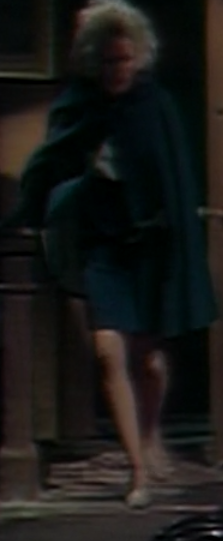
The costumers were involved in a famous production error in the final scene. Angelique/ Cassandra’s hooded cloak cuts off above her knees. There is no old age makeup on her legs, which are featured from every angle, making a ludicrous contrast with her face and wig.
In April 1967, dangerously unstable ruffian Willie Loomis inadvertently freed vampire Barnabas Collins to prey upon the living. Barnabas made Willie his blood thrall, and reduced him to a sorely bedraggled state. As spring turned to summer, Barnabas added Maggie Evans, The Nicest Girl in Town, to his diet. When Barnabas first held her captive in his house, Maggie was dazed and submissive, but as he tried to brainwash her so that her personality would disappear and that of his lost love Josette would take its place, she began to rebel. Maggie and Willie formed a strange friendship as he did what he could to protect her from Barnabas. Eventually she escaped, and mad scientist Julia Hoffman erased her memory of what Barnabas did to her. When Willie tried to warn Maggie that Barnabas might attack her again, the police jumped to the conclusion that it was he who had abducted her. They shot him. He was declared insane and sent to Windcliff, a mental hospital of which Julia is the director.
A few weeks ago, another mad scientist, Eric Lang, gave Barnabas a treatment that put the symptoms of his vampirism into remission. At the time he was feeding on two women, heiress Carolyn and well-meaning governess Vicki. When Barnabas gained the ability to go around in the sunlight, cast a reflection, and eat solid food, Carolyn and Vicki’s bite marks disappeared. It is unclear whether either of them remembers that Barnabas was a vampire, but their personalities certainly went back to what they were before he bit them. That leaves us wondering about Willie. When Barnabas responded to Lang’s treatment, did Willie revert to the violent personality he had in his first full week on the show, when on Tuesday he menaced Maggie in a barroom, on Wednesday he cornered Vicki in the study at Collinwood, and on Thursday would have raped Carolyn if she hadn’t drawn a gun on him? Did he become some version of the deeply troubled young man who was desperate to help Maggie but powerless to resist Barnabas? Or did he become something else entirely?
Today, in furtherance of Lang’s evil plans, Barnabas wants to free Willie from Windcliff and bring him back to his house on the great estate of Collinwood. Julia has become Barnabas’ best friend, but she is firmly opposed to his association with Lang. So Barnabas lies and tells her that he wants to free Willie because his conscience is plaguing him. Julia knows that isn’t true, and points out that he never visited Willie at Windcliff. Barnabas replies that when he was in the full grip of the curse, he could move about only after dark, and says that he could hardly show up at the hospital to visit Willie in the middle of the night. Julia says that she would have arranged it had he asked. He doesn’t have an answer to this, and she doesn’t fall for any of Barnabas’ other fabrications. But she can’t figure out what he really is doing. She plays along with him, and the two of them go to see Willie at Windcliff.
This is the first time we have seen Barnabas outside of a little orbit composed of Collinwood, the village of Collinsport, and the cemetery north of town. Not only was Barnabas’ ability to travel limited while the symptoms of the curse were manifest, he often lost interest in people when they left the area. So in the fall of 1967 he was obsessively hostile to strange and troubled boy David and obsessively indecisive about Vicki until the two of them went to Boston, at which point he seemed to forget they existed. It’s too bad the set representing the waiting area at Windcliff isn’t more visually striking- Barnabas’ first trip out of the Collinsport area marks a significant change in the character’s possibilities, and it would be good if it came with an image that would stick with us.
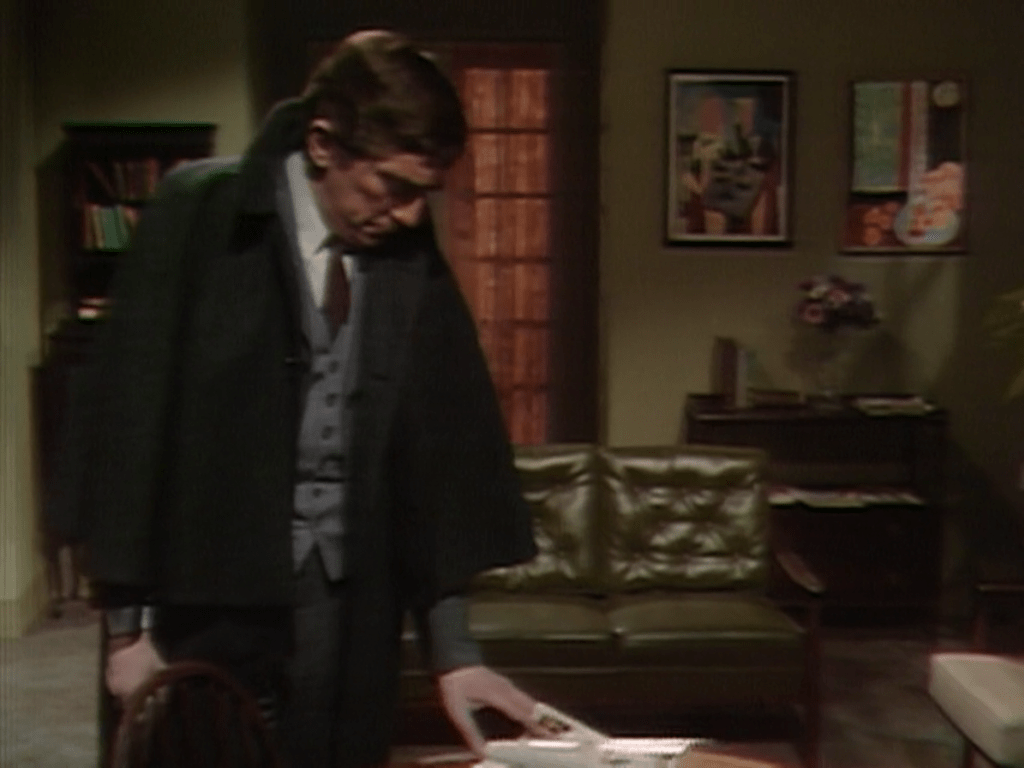
While Barnabas waits, a glossy magazine catches his attention. He picks it up and leafs through it. Since we are about to see Willie for the first time in several months, there is a good chance that this little bit of stage business will remind regular viewers of a peculiar remark Barnabas made shortly before the last time we saw Willie. Shifting the blame for his own crimes onto Willie, Barnabas planted Maggie’s ring in Willie’s room. When he came up with this plan, Barnabas remarked that the cheaper sort of tabloids say that criminals sometimes hold onto morbid mementos of their crimes, prompting us to picture Barnabas reading a cheap tabloid. That incongruous image comes to life here:
Julia joins Barnabas in the waiting room. They talk for a moment, then a nurse ushers Willie in.
At first, Willie is silent, a confused look on his face. He walks slowly towards Barnabas. Barnabas asks Willie if he recognizes him. In this moment we pick up exactly where we left off in #329, when Willie was a patient in another hospital and did not remember who Barnabas was.
This time Willie does recognize Barnabas. But as he did at the end of #329, he seems happy and untroubled. He is positively childlike in his eagerness to go back to Barnabas’ house and work for him again. He says that he and Barnabas were friends and that he always enjoyed their time together, a statement that dumbfounds Julia, as it dumbfounds anyone who remembers the show from April to September 1967. Even when Barnabas wasn’t bashing Willie across the face with his cane, Willie was miserable beyond words and hated everything Barnabas forced him to do.
Julia sends Willie back to his room, and Barnabas proclaims that Willie is entirely cured. Julia sarcastically thanks him for his diagnosis, calling him “DOCTOR Collins!” This too harks back to #329, which ended with Willie asking Barnabas if he were a doctor, to which Barnabas replied, “That’s right. I am a doctor!”
Barnabas takes Willie back to his house and tells him that for the time being, he must not so much as go outside by himself. Willie accepts Barnabas’ explanation that many people in the area will have to be prepared for his return before they see him. Willie gladly agrees to stay in the house. Barnabas leaves him alone, and he immediately slips out. He is heading for Maggie’s place.
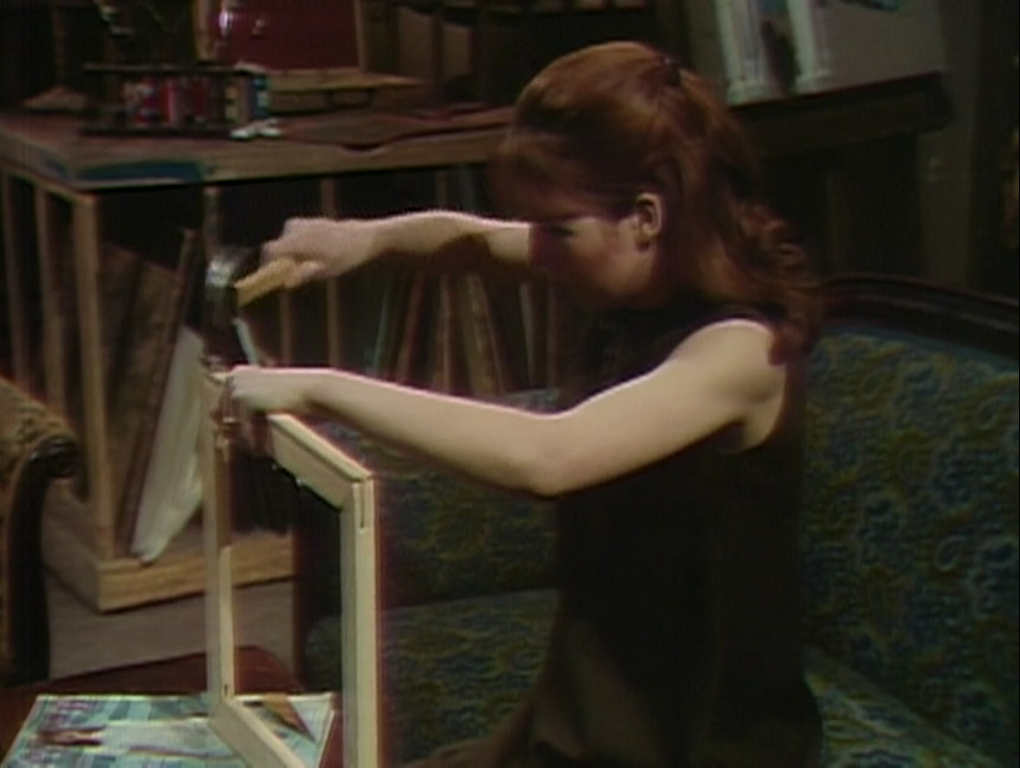
Maggie’s father Sam is a painter, a fact advertised by the canvases around the cottage they share. When we cut to the cottage, she is making a frame. This is rather an obvious visual metaphor. The last time Willie came to the cottage, he inadvertently framed himself for Barnabas’ crimes against Maggie.
Of course Maggie is horrified to see Willie at the door; of course she demands he leave; of course she threatens him with her hammer when he insists on staying and telling her he is innocent; of course she cries for help when her boyfriend Joe comes to the door; of course Willie runs off when Joe enters. Willie puts himself in the frame again, this time as an ongoing threat to Maggie and all the women of Collinsport.
Joe goes to Barnabas’ house and demands to see Willie. At first Barnabas plays dumb, but Joe doesn’t give an inch. Barnabas then admits that he persuaded Julia to let Willie out of the hospital, but assures Joe that Willie is no longer dangerous and tells him that he will see to it that Willie behaves himself. Joe says that Barnabas has already failed in his responsibility, since Willie just went to Maggie’s house and scared her. Joe says that he will kill Willie if he goes near Maggie again. He repeats that assurance, and his voice is pure steel.
Joe exits the house. We see him outside, walking away. Willie emerges from the shadows with a rifle. He takes aim at Joe and squeezes the trigger. The gun isn’t loaded, so Willie makes nothing more than a click. Apparently that was enough for him. He grins maniacally.
On their Dark Shadows Every Day, John and Christine Scoleri point out that the the gleeful face Willie flashes after he clicks his rifle at Joe is the same expression he showed in the frenzied crimes he committed before he came under Barnabas’ power. They back this observation up with a pair of screenshots, one of Willie immediately after he pretended to kill Joe, one from his last moment before he released Barnabas and lost his freedom:
Indeed, the whole episode replays Willie’s character arc from April to September in reverse. He starts as the crushed little thing we had seen at the end of #329, becomes Maggie’s tormented and misunderstood would-be protector, then ends as the dangerously unstable ruffian who followed seagoing con man Jason McGuire to town. If the episode were a few minutes longer, John Karlen might have had to take a break and let James Hall play the last scene. This recapitulation heightens the initial suspense generated by the question of how Willie would be after Barnabas had lost his vampire powers. Whatever effect the change in Barnabas has had on Willie has certainly not made him less complex or more predictable. We can’t tell when he is being sincere and when he is faking. Based on what we see today, it’s possible he is being sincere the whole time, but that he is just extremely impulsive, and equally possible that everything he does and says is a fake meant to cover up something we don’t yet know enough to guess at.
The actors are uniformly excellent today. John Karlen has to recreate the three faces of Willie in quick succession, and executes each of them clearly and memorably. Almost all of Grayson Hall’s dialogue is expository, but while delivering it she shows us all of Julia’s complicated feelings about Barnabas and lets us into her attempt to solve the riddle of his plans for Willie. Kathryn Leigh Scott is only on screen for a few minutes, beginning with her absorbed in carpentry and proceeding directly to screaming and running around and clutching at her male scene partners, but still makes it clear that Maggie is a strong and level-headed person who has been forced into frantic behavior by circumstances no one should have to face.
In the confrontation with Barnabas, Joel Crothers shows us a new side of Joe. Always loyal, always honest, always hardworking, Joe has up to this point been soft-spoken and self-effacing, deferential towards members of the ancient and esteemed Collins family. The only time he broke that deference was when he spoke some harsh words to matriarch Liz in #33, and he had to get thoroughly drunk to manage that. There is no trace of drink in him now, and he does not regard himself as anything less than Barnabas’ equal. For the first time since Burke Devlin lost his connection with the plot and shriveled so drastically that he ceased to be Mitch Ryan and became Anthony George, Dark Shadows has a plausible action hero in its cast.
The part of Barnabas is especially challenging today; he tries and fails to fool Julia in the beginning and Joe at the end, and in between may or may not have fooled Willie. So Jonathan Frid must show us what it looks like when Barnabas does an unsuccessful job of acting. He chooses to do that by having Barnabas overact. My wife, Mrs Acilius, pointed out that Frid’s own performance in the role of a man who is severely overacting is in fact exceptionally restrained and precise. Frid bobbles his lines as he usually does, but never makes a wrong physical move, and not for one second does he miss the perfect tone for Barnabas’ lines. The result is simply outstanding.
In 1966 and the early weeks of 1967, the Collinsport Inn was an important place on Dark Shadows. The restaurant there, presided over by Maggie Evans (Kathryn Leigh Scott,) The Nicest Girl in Town, was a place where people could meet each other unexpectedly and characters new to town could be introduced. Dashing action hero Burke Devlin (Mitch Ryan) lived in a suite at the inn, and the place often represented his territory, the base from which he conducted his war against the ancient and esteemed Collins family.
We haven’t seen Burke’s room since #206, at which point he had given up his vendetta against the Collinses and proceeded far down the road to irrelevance. We haven’t seen the restaurant since vampire Barnabas Collins (Jonathan Frid) met Maggie there in #221. By the time Anthony George took over the part of Burke in #262, Burke seemed to live in the Blue Whale tavern. He made business calls from the pay phone there, and in one episode apparently stayed behind when the bartender locked the place up for the night.
The inn makes a return appearance at the top of today’s episode. It is 1795, and Jeremiah Collins (Anthony George) is sharing a suite with Josette DuPrés (Kathryn Leigh Scott.) They are on their honeymoon.
Jeremiah and Josette eloped from the estate of Collinwood on the night when Josette was supposed to marry Jeremiah’s nephew, kindly gentleman Barnabas Collins (Jonathan Frid.) Josette truly loved Barnabas and Jeremiah was his dearest friend, but they were under a spell cast by wicked witch Angelique, who wanted Josette out of the way so she could have Barnabas for herself. The power of the spell waxes and wanes. When Josette and Jeremiah are in the grip of it, a trident shaped mark appears on their hands; when they return to their senses, the mark disappears.
When the episode begins, the tridents are showing, and the newlyweds are inflamed with passion. Shortly after, Josette’s mark is gone, Jeremiah’s still showing. She is filled with regret, he is still ardent.
Back in the manor house of Collinwood, Barnabas has a conversation with Josette’s father André and his own father Joshua. He resists André’s suggestion that Josette and Jeremiah must have left together, and resists even more strenuously Joshua’s declaration that they did so because they are the victims of witchcraft. Joshua says that his sister Abigail and André’s sister, the Countess DuPrés, found a blasphemous trinket in the quarters of governess Victoria Winters, and that a witch-hunting divine, the Reverend Trask, is coming to investigate the matter. Barnabas is appalled at the notion of an inquiry into witchcraft, and vows to defend Victoria if Trask comes. Joshua forbids him to do so.
Barnabas’ reaction to the idea of a witchcraft trial, coupled with what we have seen of him so far in the 1795 segment, looks like a retcon. In #358, only a week and a half before we began this uncertain and frightening journey to the past, vampire Barnabas told a story about studying witchcraft under a warlock on Barbados who taught him “the secret magic number of the universe.” Events are moving so fast that it doesn’t look like Barnabas will have time to sail to the Caribbean before he becomes a vampire, and he won’t be crossing any waters after that. But now he is a man of the Enlightenment, who scoffs at the idea of witchcraft today as he scoffed at the tarot when the countess introduced him to it in #368/369.
Jeremiah returns to the house. There is an exquisite little scene with a servant, Riggs, who is uncomfortable at the sight of the disgraced Mr Jeremiah. Riggs stands in for the establishment of Collinwood and the whole working class of the town of Collinsport, and in his reaction we see the disquiet that bad news from the big house on the hill would spread among the people whose livelihoods are at stake when trouble comes to the family there. Riggs makes haste when Jeremiah tells him to go out and fetch Joshua.
When Riggs is gone, Josette enters. The audience sees that the mark is gone from Jeremiah’s hand, and Josette can tell that his passion for her is gone. She tells him that he no more loves her than she loves him. He begins with a protest against this remark, but ends by saying that they must be kind to each other.
Joshua and André enter. André embraces his daughter and tells her everything will be all right; Joshua looks at his brother with distaste and demands an explanation.
Jeremiah says that he and Josette are married. He further says he realizes they are not welcome, and that they will return to the inn. This raises the prospect of a recreation of the early days, with the inn as a territory separate from and opposed to Collinwood. Joshua rejects the idea at once. He will not have the scandal of Jeremiah and his new wife living in town because they have been estranged from the rest of the Collinses. He decrees that they will live at Collinwood and put on a happy face for the townsfolk.
Barnabas enters. Joshua tells him that Jeremiah and Josette are married. He refuses to believe it until Josette confirms it herself. He takes the glove from Jeremiah’s hand and slaps him in the face. He gives him a choice of weapons.
Dueling may have been as alien to the ideals of the Enlightenment as were Barbadian warlocks, but so too is Joshua’s plan of forcing the whole family to commit itself to a massive lie in order to preserve its hereditary privileges. Joshua, the proud apostle of Jeffersonian republicanism, is simply being a hypocrite, but Barnabas is a more complicated figure. Seeing his every hope turned to dust before him, his ideals have become useless. He has only a moment to choose among the evils the Enlightenment had promised to stamp out, and he chooses the most macho one available.
Joshua forbids the duel, but Barnabas disregards his father’s authority and insists on it. In 1795 and for some time after, dueling was widely practiced in much of the United States, and particularly in the South and West a gentleman lost face if he refused a challenge. No such stigma attached in New England, where dueling was condemned by law and religion. Had Joshua or Jeremiah gone to the police, Barnabas would have been arrested. In 1719, Massachusetts, of which Maine was a part until 1821, passed a law making it an offense punishable by a fine of £100 (equivalent to about $7000 today) to challenge someone to a duel. Massachusetts law already considered it murder to kill someone in a duel, and prescribed death by hanging as punishment. Of course, Joshua’s declaration that Jeremiah and Josette will live in the house and the family will present a “united front” to deter scandal makes it clear he will never turn his son over to the police, and the pattern of cover-up with the support of law enforcement we saw among the Collinses in 1966 and 1967 leads us to doubt that anything a member of the family does will ever be a matter for the courts to judge.
There is a missed opportunity in the show’s lack of interest in Massachusetts’ actual laws about dueling. The 1719 law was amended to be even stricter in 1730. Among the provisions added to the law at that time was a requirement that anyone who had either been killed in a duel or been put to death for winning a duel would “be given an unchristian burial at a gallows or crossroads, with a stake driven through their body.” Since the audience knows that Barnabas is fated to become a vampire, there is a chilling irony in seeing him volunteer for a staked burial.
We open on a set we haven’t seen since #180, the archives of the old cemetery north of town. There, a scene plays out between two actors who aren’t really on the show. Daniel F. Keyes created the role of the Caretaker of the cemetery; Robert Gerringer took over the role of Dr Dave Woodard some months ago and did as much with it as anyone could. But neither of those men was willing to cross a picket line and break the National Association of Broadcast Engineers and Technicians strike, and so they were replaced with a couple of stooges.
The stooges are both terrible. Patrick McCray, Danny Horn, and John and Christine Scoleri all go into detail documenting non-Woodard’s incompetence, but the non-Caretaker is just as bad. Patrick McCray memorably described the Caretaker, in Keyes’ realization, as a “refugee from the EC comics universe.” This fellow has none of Keyes’ zest or whimsy; he simply recites his lines.
At one point, the non-Caretaker tells non-Woodard that it will take some time for him to locate the document he is asking about. Non-Woodard replies “Take your time!” We then have about ninety seconds of the non-Caretaker sorting through papers. The show is moving away from the real-time staging that had often marked its earlier phases, so this comes as a surprise.
The episodes in which the archive set was introduced included a lot of talk about the geography of the cemeteries around the town of Collinsport. They told us that the old cemetery north of town was the resting place of the Stockbridges, Radcliffes, and some other old families, but that most of the Collinses were buried in their own private cemetery elsewhere. They also mentioned a public cemetery closer to town where the remains of less aristocratic Collinsporters might be found. In today’s opening scene, non-Woodard tells the non-Caretaker that they had met previously in Eagle Hill Cemetery. Eagle Hill is the name now associated with the old cemetery north of town. So perhaps this building, which also houses a tomb in which several of the Stockbridges were laid to rest, is not in Eagle Hill Cemetery, but one of the others.
Reading roomStacksThe Tomb of the Stockbridges.
In his last few episodes, Robert Gerringer had a couple of scenes in which he and David Henesy established a close relationship between Woodard and strange and troubled boy David Collins. Today, non-Woodard sits on the couch in the drawing room at Collinwood and tells David he has come to believe everything he has been saying, including the stories that have led the other adults to call in a psychiatrist. As my wife, Mrs Acilius, pointed out, that would have been a great payoff from Gerringer’s earlier scenes if he had been in it. It might have been effective enough if any competent actor had played the part of Woodard. Certainly Mr Henesy’s performance gives non-Woodard plenty to respond to. But he barks out his lines as if they were written in all-caps with randomly distributed exclamation points. It is a miserable disappointment.
There is also a scene where David’s father, high-born ne’er-do-well Roger, tries to convince his sister, matriarch Liz, that they ought to send David to military school. This both harks back to the first 39 weeks of Dark Shadows, when Roger openly hated his son and jumped at every chance to send him away, and illustrates the changes that have taken place since then, as Liz acknowledges that Roger is motivated by a sincere concern for David’s well-being. The scene is intelligently written and exquisitely acted. The high caliber of their work makes it all the more distressing to see Joan Bennett and Louis Edmonds on a scab job. David Henesy was ten years old, and had a stereotypical stage mother, so you can excuse his presence and marvel at his accomplished performance. But these two old pros don’t have any business on the wrong side of a strike.
Nor does Jonathan Frid. When non-Woodard goes to confront Barnabas, there are moments when Frid seems to be showing his own irritation with his scene-mate more than his character’s with his adversary. As well he might- neither man knows his lines particularly well, but even when Frid stops and looks down he expresses emotions Barnabas might well be feeling, and he is fascinating to watch. When non-Woodard doesn’t know what words he’s supposed to bark, he drifts away into nothing. But it serves Frid right to have to play off this loser- by this point, he knows full well that without him the show wouldn’t be on the air. He had no excuse at all for crossing that picket line.
The cemetery’s combination archive/ tomb was a prominent part of the storyline of undead fire witch Laura Murdoch Collins. That storyline approached its climax in #183 when Peter Guthrie, PhD, confronted Laura in her home about being “The Undead,” prompting her to kill him. An episode beginning on that set and ending with someone holding a doctoral degree confronting an undead menace would seem to be an obvious callback to that story. Guthrie’s confrontation had a point- he wanted to offer to help Laura find a place in the world of the living if she would desist from her evil plans, an idea which Woodard’s old medical school classmate Dr Julia Hoffman picked up in her quest to cure Barnabas of vampirism. By contrast with Guthrie and Julia, Woodard is just being a fool.
Three locations on the great estate of Collinwood have featured prominently in two or more storylines on Dark Shadows: the great house, the long-abandoned Old House, and the cottage. The great house is the only permanent set, and is the site of most of the action. The cottage has been vacant since blonde fire witch Laura left the show in March, and came to be so strongly associated with her that it will likely remain vacant until the audience doesn’t expect her to come back. As the abode of ghosts and ghouls, the Old House is likely to become central to the show as it takes its turn to the paranormal. And indeed, in his first full episode, the mysterious Barnabas Collins had gone to the Old House and announced to its invisible occupants that he was claiming it as his own.
The physical condition of the Old House evokes an extinct storyline. When the series began, the Collinses were running out of money, and their vengeful foe Burke Devlin had vowed to use his own great wealth to ruin them completely. Now Burke has lost interest in vengeance, and the business stories have vanished altogether. If we aren’t going to be hearing about the Collinses’ precarious financial position, we won’t be able to explain why they have let a huge mansion on their property go completely to ruin. Even if the locals are too afraid of the place to do any work there, a family rich enough to have a secure grip on the assets we hear about would be rich enough to hire an out-of-town crew to fix the place up, or tear it down, or at least clear it out and seal it off. So the Old House is going to have to be transformed to get the last of the narrative clutter left over from the first 39 weeks out of the way.
Today, Barnabas asks reclusive matriarch Liz and her brother, high-born ne-er-do-well Roger, if they will let him live in the Old House and use his own funds to rehabilitate it. Liz is stunned by the idea and doesn’t know what to say. When Barnabas offers to pay whatever rent they might wish to charge, Roger exclaims that they wouldn’t dream of charging him anything at all. At that, they cut to a startled reaction shot from Liz. Regular viewers will find this reaction hilarious. Liz owns the place; Roger owns nothing and is staying there as her guest. Liz is quite surprised at Roger’s generosity with her property.
Liz reacts to Roger’s generosity with her property
Jonathan Frid is excellent in this scene. Barnabas is at once faultlessly well-mannered and entirely relaxed, gentle with Liz’ unease and warm to Roger’s enthusiasm. Everything they can see suggests to Liz and Roger that Barnabas would be a valuable addition to any household.
We, of course, know that Barnabas is an undead creature released from a coffin to prey upon the living. Watching the scene with that knowledge, we are in suspense as to Barnabas’ intentions. It seems clear that he wants Liz and Roger to like him now and to voluntarily give him what he wants. We do not know if he will go on wanting that for any length of time, nor do we know how he will respond if they oppose him in any substantial way. Because Barnabas stays entirely in character as the human he is pretending to be, we have no clue as to how far the act he is putting on diverges from his true motives. For all we know, Liz and Roger’s oh-so-courtly, oh-so-amiable cousin may be planning their deaths at this very moment.
Before he leaves the house, Barnabas has a conversation with seagoing con man Jason McGuire. Jason is blackmailing Liz, and has forced her to accept him as her house-guest. He is a throwback to an earlier period of the show, an in-betweener brought on the day after Laura left to clear away the last non-paranormal plot elements and to help introduce Barnabas.
Jason is clueless that the show changed its genre from the noirish crime drama it more or less was in the fall of 1966 to the supernatural thriller/ horror story it has been since. That cluelessness was illustrated in the opening of the episode, when he has followed his friend and sometime henchman, the sorely bedraggled Willie Loomis, to the Tomb of the Collinses. He has figured out that Willie tried to rob the graves in the tomb, but cannot imagine what he actually found there. Today, Jason looks around the interior of the tomb, baffled that Willie seems to have disappeared, and wanders off helplessly. Barnabas then appears and watches him go, the future of the show seeing off an emissary from its past.
Jason wants to know more about the legends that Barnabas’ relatives were buried with their jewels, the legends that gave Willie the idea of robbing their graves and thereby led to Barnabas’ release from his coffin. Barnabas tells Jason those legends are false, and rehearses his whole “cousin from England” bit. Not much happens. Still, the conversation is fun to watch, because the actors are both on top of their game and the characters represent different directions Dark Shadows might have taken at different points in its development.
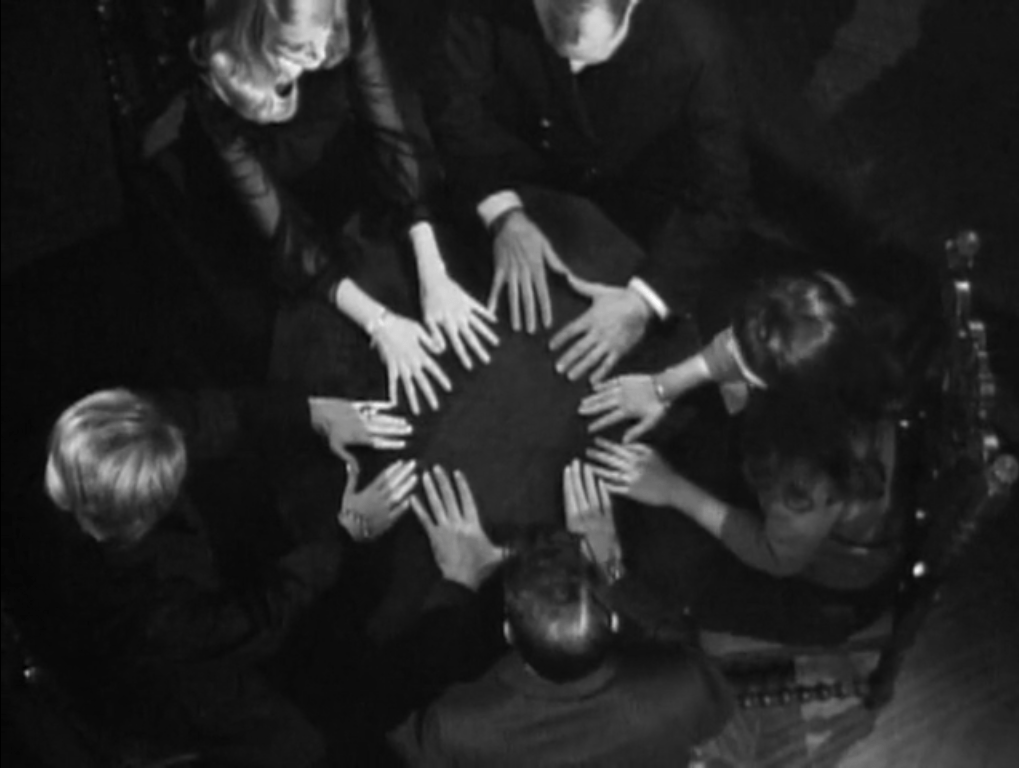
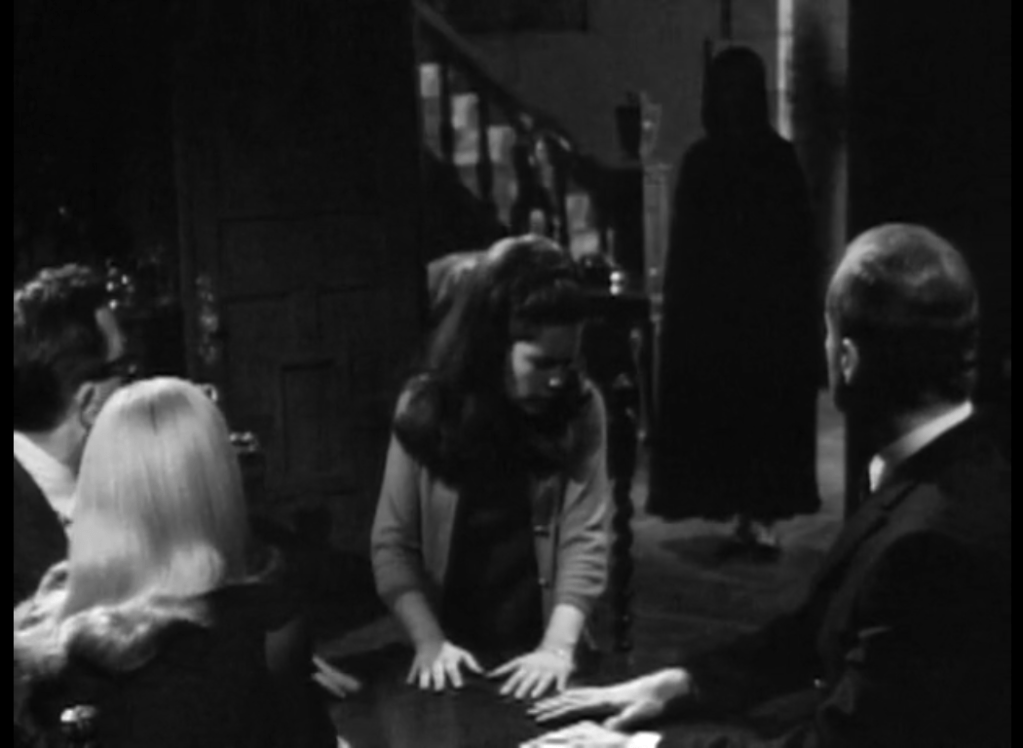
Visiting parapsychologist Dr Guthrie and well-meaning governess Vicki have persuaded flighty heiress Carolyn and high-born ne’er-do-well Roger to join them in the drawing room of the great house on the estate of Collinwood for a séance. Their goal is to contact the ghost of Josette Collins. The table is photographed by a camera pointing straight down, a first for Dark Shadows.
Gathering for the first attempt at a séance
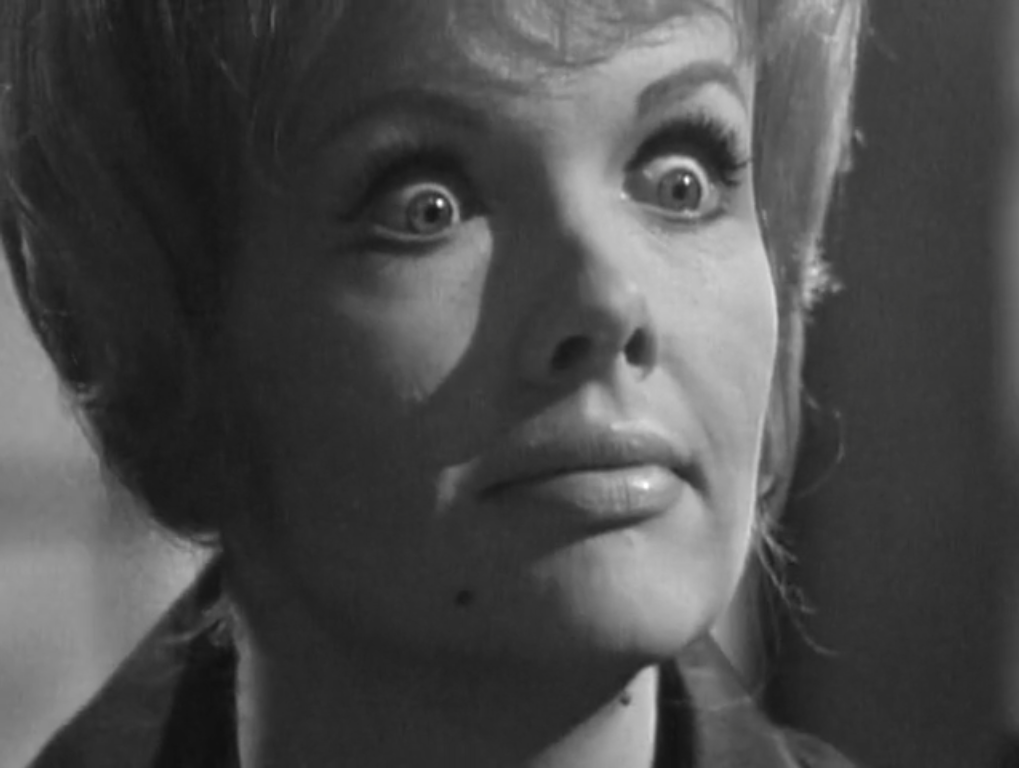
As Vicki starts moaning, the doors to the room fly open and a shrouded figure appears. After a commercial break, the figure is revealed to be Roger’s estranged wife, blonde fire witch Laura. Laura says that she has changed her mind, and decided to accept Guthrie’s earlier invitation to join the séance.
Séance, take two
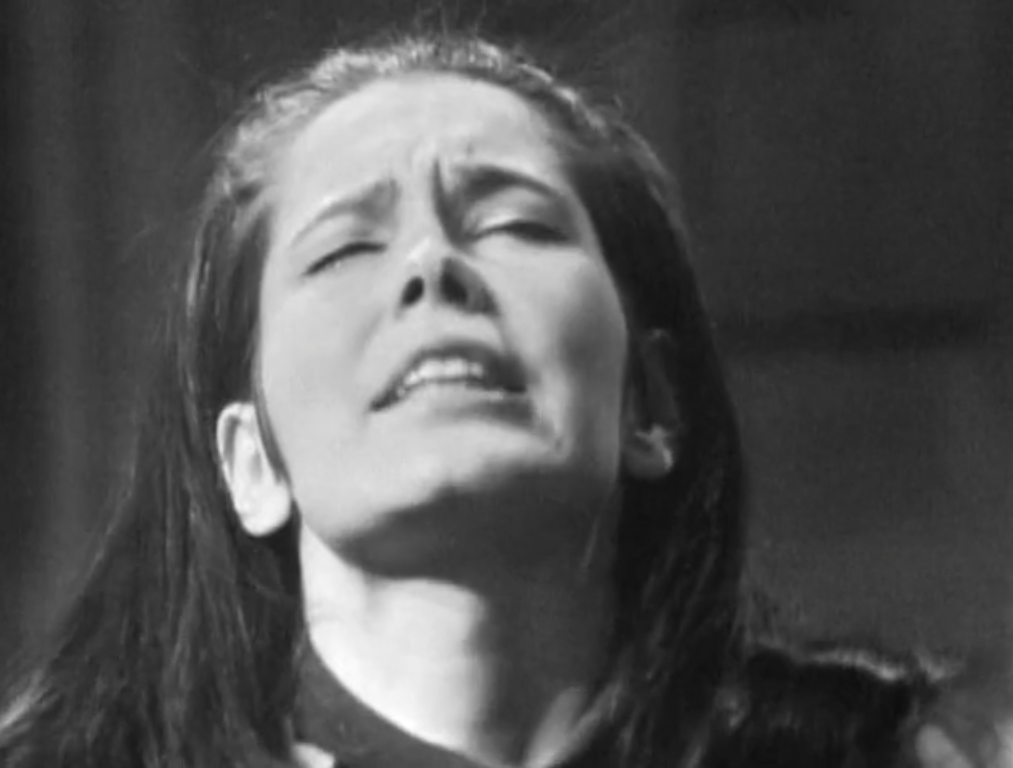
The five gather, and after a moment Vicki resumes moaning. She utters a series of words in French, most of them disconnected. Laura glares at Vicki, and it seems to be a great struggle for Vicki.
Laura glaresVicki struggles
Carolyn says that Vicki doesn’t speak French. Since Josette was originally French, they conclude she is the one speaking to them. Regular viewers know that Laura and Josette are enemies, and that Laura forced Josette to retreat the other day. So when we see Laura making this odd face at Vicki, we know that Laura is using black magic to frustrate Josette’s attempt to speak through Vicki. Through Vicki, Josette manages to force out the French for the words reclusive matriarch Liz repeated after she fell ill a few weeks ago- bird, fire, stone. She says that a stranger is present, that a small boy is in extreme danger, that the stranger is both dead and not dead, mentions an empty tomb, and describes flames rising to the sky. She twice struggles to say “The name of this person is” before Vicki screams and collapses face first onto the table.
Alexandra Moltke Isles strains every muscle to depict the intensity of Josette’s battle with Laura. She is convincing enough that her final scream and collapse don’t seem at all exaggerated. Unlike Vicki, Mrs Isles is a fluent French speaker, and her superb accent enables her to craft a distinct character for Josette in these few gasping words.
Laura’s arrival will raise a question for those who have been keeping track of the show from its beginning. The first time we saw the drawing room doors fly open was in #30. That was also the first time we saw the room lit by candlelight during a thunderstorm, as we again see it today. On that occasion, Vicki saw a silhouetted figure there.
Episode 30
It is never made clear who this figure is. The only living person in the house with Vicki is Roger, and unless he was wearing a wig it can’t have been him.
Compare that silhouette with what we see when the doors fly open this time:
Laura stops by
Are those of us who have been watching from the beginning supposed to make the connection and wonder if the figure Vicki saw in #30 was Laura? That was an episode at the climax of the story that began when Laura and Roger’s son, strange and troubled boy David, tried to murder his father. When he made that attempt in #15, we saw David saying “He’s going to die, mother, he’s going to die!” There was a suggestion then that David was in psychic contact with his mother, and since then we have learned that Laura is able to materialize across distances. Perhaps she already had this ability last summer.
Vicki saw the ghost of Josette in #126. At that time, the ghost spoke to her in English, in a clear, calm voice, and used complete sentences. They’ve spent a lot of time in recent weeks explaining that it is difficult for Josette to appear to more than one living person at a time, but I think we are to assume that her struggles communicating today are less a consequence of that limitation than they are the result of Laura’s interference.
Two actresses share the part of Josette in this episode. Mrs Isles is her voice at the séance. We also cut away from the séance to the long-abandoned Old House on the grounds of the estate. There, we see footage that originally appeared in #70, where Josette (played by Kathryn Leigh Scott) takes shape in front of her portrait above the mantelpiece and walks down to the floor. This effect introduces a more intense phase in the séance. One of the major themes of supernaturalism is that there is a geography of mysterious connections among particular places, and seeing an instantaneous reaction in the drawing room of the great house to an apparition in the parlor of the Old House directs our attention to arcane geography.
One of the moments that does not work so well comes in between the two attempts at séance. Before the first, Roger had been harshly skeptical, deriding Guthrie as a quack and taking every opportunity to show his exasperation with Vicki and Carolyn for playing along with him. When Guthrie invites Laura to join their second attempt, Roger says, with evident sincerity, that he is no longer skeptical. What has changed his mind?
During the first attempt, even before Vicki started to make sounds, Carolyn and Guthrie said that they felt a ghostly presence approaching. When the doors fly open and a figure is seen in silhouette, they react as if that figure might be a ghost. When they see that it is Laura, the audience suspects they may have been right, but they behave as if she were a living human being. Roger certainly does not regard Laura as anything other than the wife whom he is so eagerly trying to divorce. If Roger did feel an eerie presence, as Carolyn and Guthrie did, it must have been a remarkably strong feeling for his skepticism not to return when he sees that the figure was Laura.
This leaves Roger looking like a cardboard character with no real motivation of his own. That could easily have been avoided. The séance doesn’t begin until the episode is half over. Everything up to then is a total waste. Add a few moments to the séance, and you’d have plenty of time to show that Roger is experiencing something he won’t be able to shake. As it stands, we can assume that something of that sort happened, but we shouldn’t have to make that assumption. Something should have been shown to us that would explain the point and advance Roger’s characterization.
Considering that the only sign of the séance’s success we saw before Roger’s change of mind were the first few seconds of Vicki’s channeling Josette, we might imagine Laura going into disdainful ex-wife mode and making a salty wisecrack. Something to the effect that all a woman has to do is moan a couple of times and Roger thinks he’s done something great. It’s just as well she doesn’t say this, but it is too bad the episode sets itself up to be deflated so readily.
In the great house on the estate of Collinwood, reclusive matriarch Liz and instantly forgettable young lawyer Frank worry about where well-meaning governess Vicki has got to. Since Vicki is a witness in the investigation of the death of beloved local man Bill Malloy, and she has been the target of at least two attempted assassinations in the last 24 hours, the sheriff and his men are searching the grounds of Collinwood looking for her.
As it happens, gruff caretaker Matthew is holding Vicki prisoner in his cottage on the estate. Matthew had blurted out a confession that he killed Bill, and has now decided he must kill Vicki to keep her quiet. Vicki tries to persuade Matthew that he will be better off with her alive, but he will not change his mind. As he is putting his hands around her neck with the stated intention of breaking it, the door opens. Liz enters. Startled, Matthew unhands Vicki. She tells Liz that Matthew killed Bill and is about to kill her.
Art Wallace’s original story bible for Dark Shadows, which circulates under the title Shadows on the Wall, had called for Liz’ brother, high-born ne’er-do-well Roger, to be exposed as a murderer and a deadly threat to Vicki. Roger would fall to his death in the course of his final attempt on Vicki’s life. That was still possible a week ago.
Now that we’ve heard Matthew’s confessions, we know that Roger isn’t going anywhere. Not only does that keep one of the show’s most engaging actors, Louis Edmonds, in the cast; it also opens a long list of story possibilities. Perhaps Roger and Vicki will reenact the climax of Jane Eyre, and the dark-haired governess will marry her charge’s father. Perhaps the horrendous relationship between Roger and his son, strange and troubled boy David, will improve in some way, or perhaps David will make another attempt to kill his father. Certainly we can expect more scenes between Roger and Liz, as the show plays out the first of its signature relationships between Bossy Big Sister and Bratty Little Brother.
Further, Liz tells Frank and the sheriff that there are three residences on the estate- the great house, the Old House, and the caretaker’s cottage. One of Matthew’s previous attacks on Vicki took place at the Old House, and we’ve twice seen a ghost there who is clearly marked as someone who will be coming back again. Vicki is trapped in the caretaker’s cottage now, and the great house is the main setting for the series. By listing the three locations in this way, Liz is telling the audience to expect to see more of each of these sets, not just in this storyline but in the stories to come.
Friday’s episode ended, not with a cliffhanger, but with a visitation from the supernatural, as we saw the ghost of Josette Collins descend from her portrait and pirouette around the columns of the mansion she haunts. Today, Roger and Vicki sit in the diner, where he gives her a lecture about the sardine-packing business.
The apparition of Josette was the climax of an episode featuring more exterior footage than we have seen thus far. Today, we have several more location inserts, as we see Roger and Vicki walking around the village of Collinsport. As that one came to a climax with a new set- the Old House- this one also ends with our first look at a new set- the outside of the front doors of the great house of Collinwood.
These attention-getting moves prompt us to look for something big. The makers of the show tell us in so many words that the business story isn’t it.
After Roger has told Vicki a few facts about the sardine industry, she asks how the fishermen know where to look for sardines. He makes it clear that he has reached the limit of his willingness to discuss the topic with a dismissive, “Oh… luck. And experience.” Only when his enemy Burke comes in and he wants to look busy does Roger return to the subject with gusto. After Vicki has toured the cannery, Burke asks if Roger showed her “the place where they cut the heads off the fish.” Neither of those characters would watch a show about the sardine industry, or expect anyone else to do so. When they tell us that the business Burke is scheming to seize from Roger’s family doesn’t seem like exciting narrative fodder even to the two of them, the makers of Dark Shadows are telling us to forget about the business stories and focus on the sort of thing we saw at the end of Friday’s installment.
There is one bit of trivia that I hold onto from this episode. Vicki mentions to Roger that she finds it amusing that the family’s wealth began with the whaling industry and now comes from sardines- from the greatest giants of the sea to some of the tiniest fish in the ocean. An origin as whalers fits with the idea they have at this period of the show, that the Collins family first became wealthy in the 1830s.
Later, they will push them back in time, and present them as having already been rich long before then. That would rule out whaling as the first source of the Collinses’ riches. The New England whaling industry was a creation of the nineteenth century. The region’s wealth prior to that time was founded on cod fishing.
One of the major themes of the show in this period is that the Collinses are much less rich and operate on a much smaller scale than they did in the past. The transition from whales to sardines is an obvious metaphor for that decline. So obvious, in fact, that Vicki’s remark is rather a tactless one.









 Dark Shadows Commentary