Episode 884: Departure date

It is November 1897, and time traveler/ recovering vampire Barnabas Collins is searching through the burned remains of a cottage recently occupied by famed artist/ criminal lowlife Charles Delaware Tate. Barnabas finds a pair of glasses just outside the front door and a length of chain just inside. The glasses belonged to Tate’s master, evil sorcerer Count Petofi, the chain to a creature named Garth Blackwood whom Petofi and Tate summoned from the depths of Hell. When Barnabas was last in the house, Blackwood had taken Petofi prisoner there and announced his intention to kill him. Petofi couldn’t get far without his glasses, and the chain was Blackwood’s very favorite murder weapon. So Barnabas has reason to believe both of them died in the fire.

Tate shows up. Barnabas demands he paint another portrait of Quentin Collins to replace the one destroyed in the fire. Quentin is Barnabas’ friend and distant cousin, and, because of some magical powers Petofi long ago gave Tate, the portrait kept Quentin from turning into a werewolf. Tate is a jerk about Barnabas’ demands, as he is a jerk about everything, but finally says he will comply. He tells Barnabas to come back to the ruins of the cottage at 10 PM to pick up the portrait. Barnabas is surprised to hear that Tate can work so quickly, and Tate does not explain why he needs so little time. But after all, the important thing is simply that the magic spell is renewed- the portrait doesn’t have to have any particular aesthetic quality. Perhaps a simple sketch will serve that purpose as effectively as did the full oil painting Tate did previously.

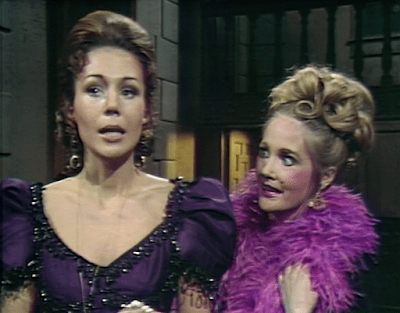
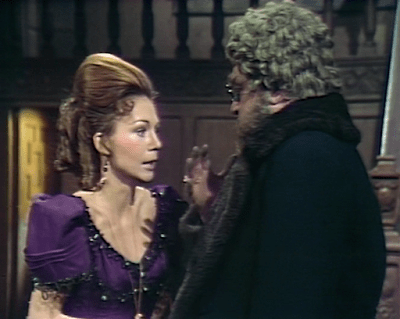
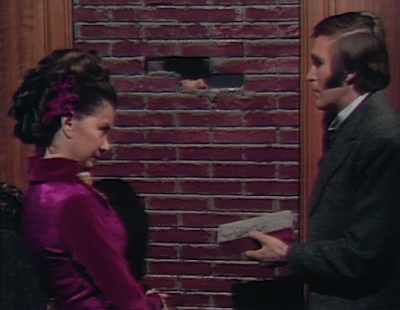
Meanwhile, back at the great house of Collinwood, Quentin’s sister Judith is busy with a project of her own. She is torturing her husband to death. He is the odious Gregory Trask, so she has the audience’s sympathy, at least up to a point. She has had Trask bricked up in Quentin’s old room. There is a telephone there which can receive incoming calls, but not make outgoing calls. Judith has been using it to torment Trask. Today, she directs Trask’s attention to two objects which he has somehow overlooked in his time in the room. One is a portrait of Amanda Harris, a woman he tried to seduce while he had Judith imprisoned in a sanitarium. The other is a loaded gun. When she calls him for the last time, she does not receive an answer, evidently because he has shot himself to death.

Judith is the third role Joan Bennett played on Dark Shadows. In the parts of the show set in the 1960s, she plays matriarch Elizabeth Collins Stoddard. Liz is a depressive personality who keeps trying to kill herself. When from November 1967 to March 1968 the show was set in the 1790s, she played Naomi Collins, Barnabas’ mother, who actually did kill herself when she found out that her son was a vampire. Now she plays someone who, though she was introduced as a psychologically fragile individual, does not kill herself, but drives one of the major villains to commit suicide. Judith’s method of disposing of Trask is not morally defensible, but it is interesting to see Bennett playing a more assertive character.

Trask’s discovery of the portrait of Amanda leads to an interlude in New York City, a place the show hasn’t taken us since #8. Quentin is in a hotel lobby there, waiting for Amanda. She is surprised to see him. They had been lovers, and had planned to leave Collinsport together. He did not meet her at the train station. She had told him that if he did not, she would understand that he had given up on their relationship, so she had gone ahead without him. She says she is so overjoyed at the sight of him that she won’t ask for explanations, but he gives one anyway. He tells her about the portrait. Since she herself came to life as the result of another of Tate’s magical paintings, she can’t very well dismiss the story out of hand. He says that because he does not know where the portrait is, he cannot be sure he won’t become a mindless ravening beast at the next full moon, so he will have to leave her.

Oddly, Judith takes time out from her torture of Trask to perform the same function of motherly talk-to that Liz and Naomi often served. Kitty Soames, the dowager countess of Hampshire, has been staying at Collinwood for the last eight weeks, and is engaged to marry Judith’s stuffy but lovable brother Edward. Contrary to what her title would suggest, Kitty is an American woman in her twenties. Judith sees Kitty coming downstairs with two leather overnight bags. Kitty explains that she will be leaving at once and never returning. She has realized that she cannot marry Edward. She says that she has not told Edward this. Judith says that she is disappointed that they will not be sisters, but that she admires her for facing the truth and doing something about it.

Later, Barnabas comes to the great house. He finds Judith worried that Kitty’s bags are still in the foyer, though she has been gone for hours. He says that he knows where she is. She is waiting for him. They will be married later tonight. Judith is bewildered by this. Barnabas says that they will come back after their wedding and tell Edward what they have done, and that they will then leave Collinwood forever. She is sad to think that they will be going.

In fact, Kitty is two people at once. The young dowager shares her body with the soul of the late Josette DuPrés, whom Barnabas loved when he was a living being in the 1790s and whom he tried to recreate when he was a vampire in the 1960s. Ever since Kitty arrived at Collinwood in #844, Josette has been forcing her way into her conscious mind, triggering psychotic episodes and from time to time pushing Kitty aside and living through her body. Now Kitty is in the bedroom once meant for Josette in the Old House on the grounds of the estate. Josette’s voice keeps speaking to Kitty through the portrait of her that hangs there, urging her to let go and accept her place as part of a combined entity that will love Barnabas and live with him in the bonds of matrimony. Kitty struggles against the voice. For a time she hopes Barnabas will help her thwart Josette’s attempt to come back to life and take the leading part in their symbiotic existence, but when he enters he urges her to give up the fight and become Josette.

Kitty is alone in the room when she suddenly finds herself wearing Josette’s white dress. She floats off the floor and into the portrait. Barnabas enters just in time to see Kitty merge with the portrait. He reaches up to the Kitty/ Josette entity in the frame above the mantel, and he and Kitty both disappear from the screen at the same time.

Josette puts Kitty in the picture. Screenshot by Dark Shadows Before I Die.

Josette was first mentioned in #5 as the lady who went over the cliff at Widows’ Hill, and her ghost emerged as the tutelary spirit of Collinwood in the months that followed. In #70, our first view of the Old House involved the first truly ambitious special effect, when Josette’s ghost, who was Kathryn Leigh Scott in a veil and a white dress, emanated from the portrait and took three steps from it down to the floor. When Miss Scott’s Kitty rises up into the same portrait today, longtime viewers will see that momentous little journey in reverse.

Barnabas was not dreamed of until long after Josette’s ghost emerged. When we first saw him in the Old House in #212, he delivered a speech to her portrait telling her that her power on the estate was ended, and for several weeks afterward strange and troubled boy David Collins, who had been the ghost’s close friend, lamented that he could no longer feel her presence. In those days it sounded like Josette was Barnabas’ grandmother, and she had sided with his father in the fateful conflict that led to his becoming a vampire.

Later, Josette was retconned as Barnabas’ lost love. In a plot borrowed from the 1932 film The Mummy, Barnabas decided that Maggie Evans, The Nicest Girl in Town, was Josette’s reincarnation, and he tried to torture her into accepting this fact. Maggie resisted Barnabas. She ultimately escaped, only to have her memory of his abuse wiped clean by her psychiatrist, Barnabas’ accomplice and future best friend Julia Hoffman, MD.

Maggie was another Kathryn Leigh Scott character. When Miss Scott played Josette in the 1790s segment, the show was sticking to its source material, in which Zita Johanns played Imhotep’s victim Helen Grosvenor in the contemporary sequences and his lost love, Princess Ankh-Esen-Amun, in the flashback to ancient Egypt. It also left us with the uncomfortable feeling that perhaps Barnabas was onto something when he devised his horrifying program of cruelty towards Maggie. Sure, his methods were wrong, but if she “really” was Josette, he wasn’t just crazy.

With Kitty, they take us a step further. Barnabas’ attempt to Josettify Maggie made the show so bleak for so many weeks that longtime viewers will flinch at the thought that Kitty would be right to yield to Josette’s importunings, and even more at the idea that this will lead to a happy marriage between the Kitty/ Josette symbiont and Barnabas. Yet within the context of what we have seen in the 1897 segment, these would seem to be plausible conclusions. The body they share is as much Josette’s as it is Kitty’s, and Kitty has nothing to lose by merging fully into the being who lurks in the substrata of her mind.

For his part, Barnabas’ relationship to Kitty represents almost as drastic a departure from the personality he showed in his relationships to Miss Scott’s previous characters as the reinvention of Josette as his lost love rather than his estranged grandmother did in his early days on the show. He does not abduct her, torture her, or even give her Josette’s hypnotic music box. It is Josette’s ghost, always before shown as a benevolent force, that keeps pressing the transformation on Kitty. Barnabas is a gentle and considerate lover to the Josette part of the Kitty/ Josette complex, and is solicitous to the Kitty part. When Barnabas disappears with Kitty, we reverse not only the walk Josette’s ghost took in #70, but also the speech he gave in #212. So far from wanting to expel Josette from the world of the living as he did then, or turn her into his vampire bride as he tried both with Maggie in 1967 and with the living Josette in 1796, he wants to revive her as herself.

Barnabas’ function on the show, both when he is an outright villain and when he is trying to be the good guy, is to create problems that other characters will have to solve. So this moment of benevolence and rationality cannot last. It is the ultimate indication that the 1897 segment has indeed ended. But it is a beautiful little thing, for the few minutes it lasts.

This episode marks the final appearance of Trask and of Judith. We will see Kitty again tomorrow, but only in a reuse of today’s closing scene. After that she will only be implied as a feature of Josette’s unconscious mind.

Episode 880: I like all of my stories to have endings

Collinwood: Judith, Trask, Beth, Quentin

In November 1897, wronged woman Judith Collins Trask has had her husband, the odious Gregory Trask, bricked up in her brother Quentin’s bedroom. While Gregory is taking this in, the ghost of another wronged woman appears to him. She is Quentin’s ex-fiancée Beth Chavez. Beth is looking for Quentin. Trask is initially frightened, but then urges Beth to go to Quentin and tell him to come up to the room.

Quentin is in the drawing room, and Beth does appear to him. She says that she cannot rest in peace until she has given him a message. We wonder if she is about to tell him about Trask, but no such thing. Instead, she tells Quentin she forgives him. Then she vanishes, and he shouts that he can’t forgive himself.

We first saw Beth and Quentin at the same time, when their ghosts appeared to children David Collins and Amy Jennings in Quentin’s room in #646. That was broadcast and set in December 1968. Since the show went to 1897 in March, the living beings Quentin and Beth have attracted very different responses from the audience. Quentin has become a huge breakout star, while Beth has faded into the background. She died Monday; this is her first return as a ghost, and her final appearance overall. It rounds things off nicely that her departure begins in the room where we first saw her.

Quentin’s skeleton had been in the room in late 1968. David and Amy removed it and buried it on the grounds. Now history has been changed. Trask’s skeleton may take its place when the show returns to contemporary dress, behind a brick wall there that wasn’t there before. In #839, we saw that while the changes in 1897 have brought peace to the ghosts of Quentin and Beth in 1969, the characters in that year still remember the haunting. So you’d expect the wall to be a puzzle to them, and if they tear it down the skeleton will be as well.

Judith enters and tells Quentin that he can’t go to his room, or to any other room in the west wing of the house. She explains that it cost a fortune to keep that wing open, so she has had it sealed off. She has moved all of his things to a bedroom in the main part of the house. Quentin asks Judith where Trask is; she claims he ran out in pursuit of two violent men who forced their way into the house and hasn’t been seen since, and asserts that she is terribly worried about him. She sounds sincere, but Quentin isn’t fooled. He smiles and asks if he is right to believe that Trask’s story is ended. Judith says that it isn’t, not quite.

Collinwood is supposed to be an immense house, literally. After the first year of Dark Shadows, when a story about the Collinses running out of money was complemented with some specifics about the size of the place,* they have been making it out to be unknowably large. So it seemed inexplicable yesterday that Judith would choose Quentin’s room as Trask’s place of immurement. We learn what her plans were today. There is a telephone in the room; that telephone had been important during the Haunting of Collinwood story. Evidently Judith has rigged it to receive incoming calls only. It rings, and Trask can hear her taunting him. He cannot call out to summon help.

In the first 55 weeks of Dark Shadows, Joan Bennett’s character Elizabeth Collins Stoddard was a recluse who hadn’t left Collinwood in 18 years, believing that she had killed her lousy husband and that his body was buried in a locked room in the basement. It turned out that she hadn’t killed him at all, and the whole recluse theme, and the blackmail plot that it led to, were just one big dead end. As Judith, Bennett is making up for Liz’ lost time.

Outside: Petofi, Aristide, Garth Blackwood, the Widow Romana**

Sorcerer Count Petofi has tired of his unreliable servant, a bungling sadist named Aristide. He has conjured up the ghost of the man Aristide most fears, a jailer named Garth Blackwood whom Aristide killed while escaping from Dartmoor Prison. Blackwood is now hunting Aristide. Blackwood and Aristide were the two violent men who surprised Judith in her bedroom, though Trask never went in pursuit of them.

Aristide ducks into an abandoned mill on the old North Road where he and Petofi had squatted. He hears someone hiding in the back room. A woman jumps out with a knife. Aristide disarms her. He realizes she is the widow of King Johnny Romana, a Rroma chieftain/ organized crime boss whom he killed in #827. Rather than killing her with her own knife, Aristide offers to betray Petofi to the Widow Romana if she will let him join her tribe. He gives her directions to Petofi’s current location. On her way there, she crosses paths with Blackwood, who kills her. Blackwood then makes his way to the mill, where we see him grabbing Aristide.

Aristide draws a map for the Widow. Screenshot by Dark Shadows Before I Die.

When King Johnny died, we learned that in a few days another Rroma somewhere would inherit his immunity to Petofi’s spells and his mission to kill him. That was eleven weeks ago, and we’ve been waiting. The Widow Romana’s appearance today is a gesture towards tying up that loose end.

*In #2, Liz tells well-meaning governess Vicki that there are a total of 40 rooms, most of them in the closed-off parts of the house; in #87, the opening voiceover says that there are 80 rooms.

**Her name is given in the credits as “The Widow Romano,” but “Romana,” which we had heard as King Johnny’s surname in earlier episodes, is a likelier Romany name.

Episode 879: A room of one’s own

The odious Gregory Trask is plotting to murder his fabulously wealthy wife, the former Judith Collins, before she can change her will. He has made an arrangement with Aristide, a sadist who is fleeing a demon his former master conjured up from the depths of Hell to stalk him. He promises to lay the demon to rest once Aristide has murdered Judith.

For her part, Judith has made an arrangement of her own with a man named Tim Shaw. Tim is not appreciably more scrupulous than Aristide, and he hates Trask with a passion. He is also free of the time constraints that the stalking demon imposes on Aristide.

Judith goes upstairs to her bedroom, where Aristide is lurking behind the curtains. The scene looks rather like that in the 1954 film Dial M for Murder, in which a man hides behind curtains while waiting to murder a woman whose husband is blackmailing him into the crime. It is likely that Dial M for Murder was on the minds of the makers of Dark Shadows at this time, since star Jonathan Frid had just missed four and a half weeks while playing the lead in a stage production of it in the Chicago area.

In Dial M for Murder, the wife survives the attempt, killing the would-be assassin. Judith also survives, but not through her own action. Instead, the demon, whose name is Garth Blackwood, bursts into the room. Aristide escapes through the window. Trask enters and finds Blackwood still in the room. Blackwood menaces him with a heavy chain he carries, then leaves in pursuit of Aristide.

Judith persuades Trask to join her in a glass of brandy. He takes a sip, she does not. He passes out, and Tim enters. When Trask awakens, he finds himself in a room in the west wing of the house. Tim is with him in the room. Tim tells Trask goodbye, then springs out the door and locks it behind him. When Trask opens the door shortly after, he finds that Tim and Judith are bricking him in.

So long, Gregory. Screenshot by Dark Shadows Before I Die.

It’s rather much to ask us to believe that the mortar dries instantly, leaving Trask unable to push the wall down. To be bricked up in Collinwood is the fate of all Trasks- Gregory’s ancestor, the original Reverend Trask, was bricked up in an alcove in the basement of the Old House on the estate in #442 by the vengeful Barnabas Collins. Barnabas chained that Trask up, giving the mortar time to set. Moreover, Barnabas chose a dark little out-of-the-way spot in a vacant house. This is in a bedroom suite that Judith’s brother Quentin uses. Most of Quentin’s stuff is out of the room, but there is still some furniture in there and a bunch of candles. You have to wonder what she will tell Quentin when he comes home. For some time they’ve been going on about how vast the great house is, at one point saying that no one had ever counted the number of rooms in it, so it is just bizarre that Judith picked a room that someone is on his way to sleep in.

Episode 869: The man who walks in the day

In October 1897, the hypocritical Rev’d Mr Gregory Trask is married to the vastly wealthy Judith Collins, owner of the estate of Collinwood and of the Collins family businesses. For more than thirteen weeks, everything seemed to be going Trask’s way. He had gaslighted Judith into a mental hospital and had almost free rein over all of her assets. In her absence, he invited the lovely and mysterious Amanda Harris to stay in the great house on the estate, and set out to seduce her.

Piece by piece, Trask’s little corner of paradise fell apart. First, 150 year old sorcerer Count Petofi orchestrated a series of events that led Trask to sign a confession to the murder of his first wife, and no matter how many times he destroyed the confession new copies of it kept materializing. Then Petofi erased the personality of Trask’s daughter and enforcer Charity, replacing it with that of late Cockney showgirl/ mentalist Pansy Faye. Later, Amanda fell in love with Judith’s brother Quentin, told Trask off, and wound up leaving for New York by herself. Now, Judith has returned from the mental hospital, all sane and deeply suspicious.

The front door of the great house is Trask’s enemy today. No sooner does he enter it than he finds Pansy in the foyer, singing her song. He demands she stop and tells her he is her father. She laughs at this claim, and reminisces about the late Bertie Faye. Trask goes into the drawing room, and to his horror sees a large oil painting of Amanda on an easel. We saw Pansy setting it up earlier in the episode, and saw her buy it a few days ago. But Trask didn’t see those things, and when she tells him she doesn’t know anything about it, he seems to accept her denials. She exits upstairs.

The front door opens again, and Judith’s brother Edward enters with two other men. One appears to be Quentin, but is in fact Petofi in possession of Quentin’s body. The other appears to be time-traveling vampire Barnabas Collins.

Trask and Edward both believe that Petofi is Quentin; since he is played by David Selby, I call him Q-Petofi. The man who appears to be Barnabas is very weak. He says that his name is indeed Barnabas Collins, but that he is not the vampire. He claims to have arrived from England, to have been attacked by a vampire who looked just like him, and to have little memory of what happened after.

In #845, Pansy went into a cave and found a coffin containing what appeared to be Barnabas. She drove a stake through his heart. When Edward and Q-Petofi met this weak Barnabas yesterday in the doctor’s office, they were skeptical of his story. They took him to the cave, opened the coffin, and saw the body Pansy had staked inside, the stake still lodged in its heart. Since they could see the two of them side by side, Edward could only conclude that the weak man is different from the vampire, and that his story is therefore true. Q-Petofi, well aware of the many magical and science-fictional entities in Barnabas’ orbit, is not at all convinced.

Trask sees the weak Barnabas and is enraged that Edward and Q-Petofi have brought the vampire back from the dead. While Q-Petofi takes the weak Barnabas upstairs to a bedroom, Edward tries to reason with Trask. This is seldom a fruitful exercise. When Edward finally points out that it is broad daylight and the weak Barnabas is alive and moving, Trask is left speechless.

Alone with the weak Barnabas, Q-Petofi tries to trick him into believing that he is Quentin and that he can trust him. When Q-Petofi goes on about all the secrets that Barnabas and Quentin have shared, the weak Barnabas responds only with bewilderment.

Q-Petofi goes back to the cave and sets the coffin on fire, acting on the hypothesis that the destruction of the staked Barnabas will have some kind of effect on the weak Barnabas. We cut back to Collinwood and see that it has none. Trask lets himself into the bedroom. After some small talk, he thrusts a large wooden cross at the weak Barnabas’ face and stands silently for a moment. The weak Barnabas looks up from his bed and asks if Trask is all right. He hurriedly says that he only brought the cross to help him pray for his recovery. The weak Barnabas observes that this is very kind, and closes his eyes while Trask kneels beside the bed.

My wife, Mrs Acilius, points out that not only the actor Jerry Lacy, but the character Gregory Trask, seems to enjoy himself very much when there is something to be righteously indignant about. Not only does Trask have a whole set of self-aggrandizing mannerisms and techniques for silencing everyone else when he is furious, but as a con man an atmosphere of crisis provides him with an opportunity to think on his feet and devise new schemes for bilking people out of whatever they have that he wants. Mr Lacy’s joy in performance runs throughout the whole episode, but Trask’s goes through wild fluctuations, peaking each time he thinks he has found a new way to present himself as the champion of The Almighty and plummeting each time his understanding of the situation is deflated. In his first several appearances, Trask was so overwhelmingly evil and so frequently successful that he was hard to watch. When we see him repeatedly brought up short in an episode like this, all of the discomfort of those early days pays off.

In the drawing room, Edward tells Pansy that there is a sick man in a bed upstairs who looks like the vampire Barnabas and is named Barnabas Collins, but is not the man she staked. She is horrified at the thought. Barnabas was indirectly responsible for the death of Pansy as a physical being, and later murdered her fiancé, the childlike Carl Collins. He also took Charity as one of his victims for a time. Besides, in her manner of dress, quantity of makeup, working-class accent, and brashly friendly manner Pansy is the representative of all the “girls at the docks” upon whom Barnabas has fed down the centuries. So no one has more reason to fear Barnabas than does Pansy in the form of Charity. Edward reassures her as best he can, then goes up to look in on the patient.

Pansy absorbs the news that another Barnabas Collins is in the house.

The scene between Pansy and Edward will remind longtime viewers of the characters the same actors played between November 1967 and
March 1968, when Dark Shadows was set in the 1790s. Nancy Barrett was fluttery heiress Millicent Collins, while Louis Edmonds was haughty overlord Joshua Collins. In #450, Millicent had discovered the horrible truth about Barnabas and it had proven to be too much for her rather fragile grip on sanity. She decided that the vampire was not her cousin, but an impostor, and she told Joshua that it was wrong of him to have “That man who says he is Barnabas” in the house.

Not only is Pansy’s horror at the thought of a man who says that he is Barnabas staying at Collinwood reminiscent of Millicent, but her relationship to Charity also reflects the development of Millicent throughout the 1790s segment. Millicent’s transformation from a lighter-than-air comedy character to a darkly mad victim, first of her wicked husband Nathan, then of Barnabas, marked the transition to the climactic phase of the 1790s segment. Charity’s replacement by Pansy in #819 came at a time when the show was flashing many signals that the 1897 segment was nearing its end. Those signals may well have reflected an earlier plan, but 1897 was such a hit that they kept passing by the off-ramps back to the 1960s and restarting the uncertain and frightening journey into the past. Now it seems they really are getting ready to move on, and Pansy’s prominence reminds us of just how radically different a place Collinwood is now than it was when we arrived in this period in #701, at the beginning of March.

Pansy is still quaking at the thought of another Barnabas Collins when Q-Petofi enters and closes the doors of the drawing room behind him. Pansy hasn’t quite figured out his true identity, but she knows that he is not really Quentin, and that he does not mean her well. She is terrified and says she will scream unless he opens the doors.

Regular viewers have reason to believe Pansy will do more than scream. In #829, she tried to stab Quentin. And those who have been with the show for a long time will remember what happened in #204, broadcast and set in April 1967. Heiress Carolyn Collins Stoddard, another Nancy Barrett character, found herself in the drawing room with dangerously unstable ruffian Willie Loomis. When Willie closed the doors and refused to open them, Carolyn didn’t bother screaming- she pulled a loaded gun on him.

Q-Petofi has magical powers that neither Quentin nor Willie could match, so he is not in mortal jeopardy as they would be were they to put themselves in his position. But he has created a volatile situation, and unless he resolves it within a few seconds he is likely to find himself with a huge mess on his hands. Rather than falling back on his occult talents, Q-Petofi takes a page from Quentin’s book and charms Pansy into cooperating. He tells her that he is as frightened of Barnabas as she is. That intrigues her sufficiently that she starts listening to him. He tells her that only she can discern whether the man in the sick bed upstairs is what he claims to be. A moment later, Q-Petofi has persuaded Pansy to go with him to see the weak Barnabas. The episode ends with Pansy looking at the weak Barnabas lying in bed, her eyes widening in a strong but unspecified reaction. We will have to wait until tomorrow to find out whether she is terrified at the sight of her nemesis or amazed to see an innocent man wearing the hated face.

Episode 863: Homecomings

In episodes #853-#856, Sorcerer Count Petofi (Thayer David) used his powers to force the devastatingly handsome Quentin Collins (David Selby) to trade bodies with him. Ever since, Quentin (Thayer David) has been trying to persuade someone to believe his story about Petofi (David Selby.) For the duration of the switch, I shall refer to Thayer David’s version of Quentin as P-Quentin, and David Selby’s version of Petofi as Q-Petofi.

Yesterday, P-Quentin persuaded his old friend and fellow Satanist, Evan Hanley, of what had happened. Evan agreed to conduct a ceremony to call upon their dark lord and ask for the transfer to be broken. They trick Q-Petofi into coming to Evan’s house and knock him out with chloroform. Then Evan begins an odd incantation:

Oh, Lucifer…

Great God of man and beast, look upon us with favor. Help us correct this evil which has been done in defiance of you.

Renew our bondage as your servants. Grant us the power we need this night, and we will be yours for eternity.

For Baal, who guides your mind.

For Beelzebub, who rules your spirit.

The robber of a soul must not be spared. The robbed must be avenged.

I exorcise thee.

Oh, impure spirit, who is the mind of the enemy, by the holy rite of Hecate, I conjure thee that thou do immediately hear and obey my command. Leave this man’s body, that he may return… Oh, yes, spirits of invisibility, I conjure and constrain thee herewith to consecrate this ceremony. So that surely and without trickery, thou may return each, to the body of [its] origin.

So be it.

Oh, Lucifer, so be it.

So be it…

I charge thee. I conjure thee. I command thee. Answer my demand.

Depart from these alien bodies and return to those from whence you came.

Depart.

So be it.

So be it.

So be it.

Oh, Lucifer, we give thee thanks.

Evan and P-Quentin seem to have the wrong guy. Whatever Satan’s powers may be, undoing evil, restoring property to its rightful owners, and enforcing justice are not exactly among the old fellow’s core competencies. Of course the ceremony fails. Q-Petofi wakes up from the chloroform, tells Evan he has made the greatest and last mistake of his life, and puts the zap on his brain. The next we see him, Evan is digging a grave, refusing P-Quentin’s offer to help him, and listening to Q-Petofi announce that he is about to be buried alive.

Q-Petofi’s announcement is the closing cliffhanger, suggesting that Evan has a somewhat longer life expectancy than we might have imagined when the ceremony fell apart. But once in a while cliffhangers really are resolved with the death of the character who is in peril, and that would seem to be a possibility in this case. Yesterday was Evan’s first appearance after an absence of more than eleven weeks, and he is not associated with any major loose ends in the plot. His alliance with the odious Gregory Trask, husband of Judith Collins Trask, may have given him a foothold now that Judith is back from her own long absence and is looking on Trask with suspicion, but yesterday he seemed to back off from siding with Trask in whatever fight might be coming up. So if the makers of the show are thinking it’s time for Q-Petofi to confirm his credentials as a major villain by killing a familiar character, Evan would be the obvious choice.

Judith confronts Trask today. He lies to her to cover up his misdeeds during the more than thirteen weeks she was confined to a mental hospital. She does not contradict all of his lies, and invites him to embrace her. He seems to think he has regained his control over her, but she tells him two things that make him uncomfortable. First, she says that she has persuaded his daughter to leave her apartment in the village and move back into the great house of Collinwood. When he protests that “She is not my daughter!,” Judith calmly replies that she is, closing the subject and leaving him looking like a petulant child. She also says that she hopes he has not bought or sold any stocks in her name lately, since she has revoked his power of attorney over her holdings. Again, he can say nothing in response.

Judith’s brother, the stuffy but lovable Edward, does not hear the details of this conversation. After Judith leaves the drawing room, Edward enters and tells Trask that he has won again. Trask perks up at this, and becomes his usual overbearing self. But he is just as quickly deflated when Edward tells him that he is looking into what he has been doing for the last thirteen weeks, and that when he finds out he will make a full report to Judith.

When Dark Shadows first became a costume drama set in 1897, Edward assumed he was to inherit the estate of Collinwood and all the family’s businesses. He was haughty and commanding, and Judith was a fragile spinster. But then their grandmother died, and the will left everything to Judith. She fell victim to Trask’s machinations and married him; he gaslighted her into the madhouse. Now that she has come home, Judith has found a new strength, sufficient to hold her own in the household if not to uphold justice and right on the scale which her position in the community would seem to demand. Edward’s dependent financial position, coupled with the many supernatural horrors he has witnessed, have gradually reduced him to a childlike state. In their scenes today, we see that the two of them have come to embody that signature dynamic of Dark Shadows, the relationship between Bossy Big Sister and Bratty Little Brother.

Episode 861: Complete control of my faculties

Judith Collins Trask, owner of the estate of Collinwood and all the Collins family businesses, has returned home after more than thirteen weeks confined to a sanitarium. Her return is supposed to be a big shock, but they spoil it by having Joan Bennett do the opening voiceover. They really should have paid more attention to that sort of thing.

Judith’s husband, the odious Gregory Trask, gaslighted her into the sanitarium, and has been exercising control over the Collins family’s wealth ever since. Today, Judith tells her stuffy but lovable brother Edward that Trask never visited her during her time as a mental patient. Edward is surprised, telling her that Trask left the house for an overnight stay every week during that period, and presented these absences as visits to her. In fact, he is on such a trip now. She does not want to hear any more, and says she will give Gregory a chance to explain himself when he comes back to Collinwood.

Judith claims to be entirely herself. That puts her in the minority today. When she left Collinwood in July, Judith had a stepdaughter named Charity Trask. When she enters today, she sees someone who is to all appearances Charity leading Edward and a lady named Kitty Soames in a séance. The body is indeed Charity’s, but sorcerer Count Petofi erased Charity’s personality in #819 and replaced it with that of the late Pansy Faye, a Cockney showgirl and “mentalist” whom Judith met in #771, when Judith’s late brother Carl brought her to Collinwood as his fiancée. Pansy noticed Judith’s disapproval of her when she was alive, and is quite indignant about it now. That Judith keeps live-naming her, calling her “Charity,” doesn’t help.

Judith does manage to do something Edward failed to do a while ago, and talks Pansy into moving back into the great house of Collinwood. She agrees to give up the apartment she rented in the village of Collinsport after she took a job doing her old act at the local tavern, the Blue Whale. We saw her at the Blue Whale in Friday’s episode; it was shortly before nine PM, and she was the only person in the place. So perhaps her income as a cabaret performer is not particularly lavish, and the mansion is a more appealing place to live than the apartment that job would pay for.

For her part, Kitty is still, most of the time, the dowager countess of Hampshire. But the ghost of Josette Collins has been possessing her off and on ever since she arrived at Collinwood in #844, and the trend is definitely towards “on.” In Friday’s scene at the Blue Whale, Kathryn Leigh Scott played Kitty quietly and let Nancy Barrett’s Pansy provide the scene with all its Crazy Lady Energy; today, it is Miss Barrett’s turn to stand back and let Miss Scott show that Kitty is Pansy’s match in that department.

Crazy Lady Energy, also known as “CLE,” the main driving force of Soap Opera Land. Screenshot by Dark Shadows Before I Die.

Judith and Edward’s brother Quentin is in an even stranger predicament than are Pansy and what’s left of Kitty. Between #854 and #856, Petofi forced Quentin to swap bodies with him, so that David Selby now plays Petofi and Thayer David plays Quentin. I call Mr Selby’s portrayal of Petofi “Q-Petofi,” and Thayer David’s portrayal of Quentin “P-Quentin.”

Kitty with P-Quentin. Screenshot by Dark Shadows Before I Die.

The initial shock of finding himself estranged from his own body and trapped in Petofi’s left P-Quentin bewildered. All he could do was go to one person after another and tell the true story of what had happened, which produced only a widespread belief that Count Petofi had gone mad. Now he is starting to figure out how to use his resources.

P-Quentin’s first attempt to take advantage of the fact that everyone thinks he is Petofi was not successful. In #859, he exploited Kitty’s fear of Petofi and threatened to make her vanish if she did not bring him a portrait of Quentin later that night. Kitty tried to comply, but failed, and now it is long past the deadline. Soon she will realize that his threat was an empty one, and so far from being useful to him as a cat’s paw, she will be in a position to expose him as powerless.

Today, P-Quentin runs a smarter game. He introduces himself to Judith as Petofi, and claims to have psychic abilities. He pretends to read her palm, and tells her a story from their childhood that very few people could know. She is delighted, and decides that Count Petofi is someone she wants to see more of.

P-Quentin and Judith. Screenshot by Dark Shadows Before I Die.

In her bedroom upstairs at Collinwood, Kitty has another fit of Josettification. She opens the trunk at the foot of her bed and finds Josette’s wedding dress. She puts it on and wraps a red cloak around it. She goes to the top of Widow’s Hill, the cliff from which Josette jumped to her death in the 1790s. The ghost of Josette’s husband Jeremiah appears to her.

The show is set in 1897 now. It was set in the 1790s from November 1967 to March 1968. Miss Scott played Josette then, and for most of the segment Anthony George played Jeremiah. After Jeremiah’s death, Timothy Gordon played his ghost in a memorable part of the 1790s story. Gordon made two appearances as the ghost after the show returned to contemporary dress, playing him in #462 and #512. This is Jeremiah’s first appearance in 1897, and the second time, after #462, that Gordon’s name appeared in an on-screen credit on Dark Shadows.

Episode 857: Champagne for Wanda

Sorcerer Count Petofi is wearing the body of rakish libertine Quentin Collins as a disguise, while Quentin is trapped in Petofi’s own aging and pudgy form. I will call the villainous Petofi played by David Selby Q-Petofi, and the forlorn Quentin as played by Thayer David P-Quentin.

We open with Q-Petofi at the front door of the great house of Collinwood. Yesterday we saw P-Quentin on the same spot, and heard David Selby’s voice articulating the miserable thoughts that showed on Thayer David’s face. Today the roles are reversed, and we see Mr Selby looking exultant while the voice of Thayer David talks about the glories of his situation.

We see that Q-Petofi is accompanied by his henchman, Aristide. He dismisses Aristide’s fear that he will somehow reveal his true identity to the occupants of the great house. He twits Aristide for a little while, pretending that he will use him as a guinea pig in a dangerous experiment he has planned for later in the evening, then sends him off to find someone else to serve that purpose.

Q-Petofi walks in on an argument in the drawing room between stuffy Edward Collins and the overbearing Gregory Trask. Trask is in charge of the house while his wife, Edward’s sister Judith, is in a mental hospital. Trask is going over the household accounts and complaining that Edward is spending too much on his houseguest, Kitty Soames, the dowager countess of Hampshire. Edward asks Q-Petofi to explain Collinwood’s tradition of hospitality to Trask, setting Trask off with a rant about Quentin’s relationship with Trask’s own former houseguest, the lovely and mysterious Amanda Harris. Q-Petofi’s indifference to the whole discussion strikes both Trask and Edward as odd, but it really is quite typical of the old Quentin.

After Trask exits, Edward tells Q-Petofi that he thinks he can subdue Trask by marrying Kitty. He says that it takes money to run Collinwood, and the late Earl’s estate gives Kitty ownership of half the county of Hampshire. Returning viewers know that the Earl died bankrupt, and so far from owning great swathes of southern England Kitty doesn’t even have train fare to get from Collinwood in central Maine to her mother’s house in Pennsylvania. So we have confirmation that Kitty has been less than fully honest with Edward. On the other hand, Kitty is under the impression that Edward is rich, while in fact their grandmother left every penny to Judith. So neither is leveling with the other about their financial status. Q-Petofi knows all of this, but it has nothing to do with his plans, and so he struggles to feign interest.

For his part, P-Quentin is sitting in the caretaker’s cottage on the estate. It seems right to longtime viewers that a character played by Thayer David should seek refuge here. When we first saw the cottage, it belonged to handyman Matthew Morgan, who was at that time played by George Mitchell. In #38, Mitchell was replaced in the part of Matthew by Thayer David, in the first of the many roles he would play on Dark Shadows. When Matthew had to leave the cottage for the last time in #112, his whole world fell apart. So when Aristide comes in and brutally evicts him, we can feel the full weight of the disaster that has befallen P-Quentin.

With nowhere else to go, P-Quentin returns to the great house. Once again it is Thayer David’s turn to look soulfully at the camera while David Selby’s voice speaks desperate words in voiceover. He tells himself that his brother Edward will have to believe him when he tells him the truth.

As it happens, Edward likes Petofi and is glad when he believes he is receiving a visit from him. Based on Edward’s earlier remarks about Collinwood’s tradition of hospitality, we could be quite sure that if P-Quentin presented himself as Petofi, Edward would be glad to offer him a place to stay. But P-Quentin plunges right in and tries to tell Edward the whole story. Of course Edward is not convinced. He treats it as a joke in questionable taste, and offers P-Quentin a brandy. When P-Quentin tells him to forget the brandy, he says that if he really were Quentin, he would never forget the brandy.

P-Quentin insists on going ahead with the lunatic tale, and keeps clutching at Edward’s arm. Edward finds the whole experience revolting, and firmly escorts him to the door. If it has occurred to P-Quentin to tell Edward any of the little stories of childhood that only he and Edward would know, it is too late now to do so. Edward orders P-Quentin to stop talking and go home. Little does he know that P-Quentin has no home to go to.

At the waterfront, the fog machine is working overtime, and so is one of the locals. In a comment on Danny Horn’s post about the episode at his great Dark Shadows Every Day, user “Goddess of Transitory” remarks:

I was remarking to my husband about the really remarkable size and relative wealth of the hooker population of Collinsport. They may hang at the docks (makes sense in a port town–you troll for lonely sailors) but they all have really nice clothes and jewelry and no matter how many of them Barnabas et al. tear through, there’s always more.

Makes you wonder what modern day Collinsport’s main economic generator really is…

Comment by “Goddess of Transitory,” left 7 April 2021 on Danny Horn, “Episode 857: All of Him,” 5 May 2016, Dark Shadows Every Day.

We find today’s well-bathed, well-coiffed, well-made-up young woman of professionally agreeable disposition drinking from a flask. Aristide emerges from the fog and takes the flask from her. When she protests, he says that if she follows him, she will be drinking champagne, and her protests subside. Her name is Wanda Paisley.

Aristide takes Wanda to the cottage, where Q-Petofi is waiting. Wanda is quite pleased at the prospect of sharing her favors with two handsome young men at once, but less pleased when Q-Petofi says that before the festivities get underway she will have to throw some I Ching wands and meditate on them. He assures her that she will be well paid for whatever services she may render, and asks her to agree that this is what really matters. Wanda’s agreement is not forthcoming. When Q-Petofi keeps yammering on about the wands and the hexagrams and the trance and the doors, it dawns on Wanda that this evening is not going to be what she signed up for, and she gets up to leave. Aristide grabs her, and Q-Petofi uses his magical powers to coerce her into cooperating.

Wanda casts the wands and meditates on them. She has a vision of a skeleton with big plastic eyeballs reaching its arm bones out to her. She screams. Where she had been sitting is another skeleton with big plastic eyeballs, this one also wearing a dress and a wig. Q-Petofi tells Aristide that “beyond the door anything is possible.”

Her turn as Wanda today marks Karen Lynn’s only appearance on Dark Shadows. She’s very good, it’s a shame they couldn’t find more for her. Her only other screen credit is a 1963 feature called The Orgy at Lil’s, which an IMDb reviewer says made history as “the first roughie.” I don’t know what a “roughie” is, and based on the description of The Orgy at Lil’s I rather doubt that my education in cinematic history would be significantly deepened by finding out. At any rate, it sounds like Miss Lynn was well-prepared to portray Wanda’s enthusiastic response when Q-Petofi first joined her and Aristide.

I made a contribution of my own to the comment thread on Danny’s post:

This has to be the archetypal Dark Shadows episode. It has Jerry Lacy modeling the style of acting he and Lara Parker invented for the show, Louis Edmonds being sarcastic, a squabble about control of Collinwood, people drinking brandy, a prostitute picked up on the docks while the [fog] machine runs, several kinds of supernatural mumbo-jumbo presented as if we will of course understand them, a dream sequence, and a skeleton in a wig. The next episode opens with a grave-digging scene, which is pretty nearly the only thing missing from this one.

Comment left by “Acilius,” 3 December 2020, on Danny Horn, “Episode 857: All of Him,” 5 May 2016, Dark Shadows Every Day.

It’s true no actors blow their lines, none of the boom mic shadows obstruct our view of anything crucial, and there is only one audible cough from a crew member, so it is an unusual episode in some ways. But I could have mentioned another very typical thing- a practical effect they try for the first time. I believe the split screen shot of Q-Petofi in the drawing room and P-Quentin at the cottage is the first time the show has used this device. It doesn’t work very well, but they were always pushing to do something new:

P-Quentin (Thayer David) and Q-Petofi (David Selby.) Screenshot by Dark Shadows Before I Die.

Episode 850: That’s your train, lady

In June 1966, Dark Shadows opened with a train carrying well-meaning governess Victoria Winters and dashing action hero Burke Devlin from New York City to Collinsport, Maine. Vicki and Burke first met at the train station in Collinsport. When she found that no one was waiting to take her to the great house of Collinwood, Burke volunteered to drive her there. We haven’t seen the train station since, and all subsequent references to mass transit to and from Collinsport in the 1960s have been about buses. That is to some extent an adjustment to real-world history. In our universe, passenger train service to central Maine had already stopped by 1966.

Now, the show is set in 1897. Devastatingly handsome reprobate Quentin Collins has talked the lovely and mysterious Amanda Harris into joining him on the 6 PM train from Collinsport to NYC. Amanda and Quentin will remind viewers who have been with the show from the beginning of Vicki and Burke. Quentin is no hero, but he serves the plot function Burke did in those early days, antagonizing all the authority figures and fascinating all the women and children. Amanda takes part in some sleazy schemes, while Vicki was eventually forced to be an impossibly stainless model of virtue. But as Vicki was on a quest to learn the truth about her biological parents and felt she could know nothing about herself until she found out who they were, Amanda is tormented that she has no memories and no information about herself dating beyond two years into the past. And as in the first week Vicki was a savvy New York street kid who could keep smiling while she fended off the indecent advances of the lecherous Roger Collins, so Amanda sees right through the equally lecherous but toweringly hypocritical Rev’d Mr Gregory Trask.

Quentin and Amanda agree to meet at the train station. Amanda has to hide from Trask and from a repulsive little man named Charles Delaware Tate, and so she will spend the afternoon in a vacant house on Pine Road where a friend of Quentin’s is squatting. Quentin will settle his affairs at Collinwood. When they made this plan, my wife, Mrs Acilius, said that Dark Shadows has so consistently shown that when its characters leave separately they do not meet each other at their intended destination that it would be a surprise if they get on the train together. Indeed, from the time Amanda leaves Collinwood the suspense is not about whether their reunion will be thwarted, but how.

Tate steals a portrait of Quentin. He knows that the portrait has magical powers and is of the utmost importance to Quentin. Quentin discovers that the portrait is missing. He writes a note saying that he may not be able to get to the train station by 6 PM and asks his nine year old niece, Nora Collins, to take it to Amanda at the house on Pine Road. Nora agrees to do so.

Quentin goes to Tate’s and demands he give the portrait back. They get into a fistfight. Quentin knocks Tate out and searches the house.

Trask catches Nora on her way to the house on Pine Road. He forces her to give him the note. He reads it, and goes to the house himself. He and Amanda have a confrontation. She tells Trask that she first approached him as part of a con game she was ashamed to take part in, but when she saw him leering at her she decided that he deserved to be cheated. He furiously denies being a lecher and she calls him a liar. Trask can intimidate most people into silence, so much so that his scenes are often suffocating to watch, and it is glorious to see Amanda dump the whole truth on him and not back down.

Trask does get in one more lie. He claims that he just saw Quentin getting ready to go out on a date with his other fiancée, Angelique. Amanda doesn’t believe him but she does know about Angelique. She also told Quentin that she wasn’t convinced she was right for him, and that if he didn’t show up she would understand that he had decided they didn’t have a future together after all. So when at the conclusion the conductor sees Amanda standing on the platform by herself and tells her that it’s time to get on the train, we are to assume that she thinks it is over between her and Quentin.

All aboard. Screenshot by Dark Shadows Before I Die.

Episode 833: We don’t have any secrets in Collinwood

There once was a woman named Miss Charity Trask. Charity was desperate to please her father, the hypocritical and overwhelmingly evil Rev’d Mr Gregory Trask. She faced the world as Trask’s enforcer, and was herself so fiercely repressed that she drained the joy out of every group she joined.

There is no longer such a person as Miss Charity Trask. Sorcerer Count Petofi caused the spirit of the late Pansy Faye, Cockney showgirl and fake psychic, to take up residence in Charity’s body. Charity/ Pansy still lives in the great house of Collinwood, of which Trask has established himself as master, but since her only functioning mind is that of the deceased Pansy, she doesn’t understand why people insist on livenaming her.

Charity/ Pansy enters the drawing room and finds Amanda Harris. Amanda greets her as “Miss Trask,” alienating her at once. Charity/ Pansy demands to know what Amanda is doing at Collinwood. Amanda says that she lives there as Trask’s guest. Charity/ Pansy calls for Trask. She leans out the door of the drawing room and in the loudest, harshest voice Nancy Barrett could manage shouts “Hey, Trask! Trask!” It takes Trask a moment to answer, perhaps because Jerry Lacy had the same trouble we had while watching and couldn’t stop laughing. It is one of the top ten intentional comedy moments in the series, maybe top five.

“Hey TRA-A-ASK! TRASK!

Charity/ Pansy can see that Trask has designs on Amanda, as can everyone else. But she doesn’t care about that. She is convinced Amanda has come to the house to seduce rakish libertine Quentin Collins, whom she herself is determined to marry.

Amanda had no such plans when she first came to the house, but she meets Quentin today, and a few minutes later they are locked in a passionate kiss. Trask surprises them, and declares that he will protect Amanda from her weaknesses.

For his part, Quentin is busy trying to figure out what is happening to him. He is a werewolf, and there is a full Moon tonight, yet he did not transform. He finds a portrait in his room. It bears a plate with his name and the current year- “Quentin Collins, 1897.” But it depicts him as he is when he is in his lupine form. He knows that it is the work of artist Charles Delaware Tate, and goes to confront Tate in his studio in the nearby village of Collinsport.

Quentin handles Tate roughly and demands to know why he painted a wolf on the canvas with his nameplate. Tate says that Charity saw the painting and thought it looked like a wolf, but that when he looked at it himself he saw only Quentin’s face. Quentin takes Tate to his room and shows him the painting; Tate is shocked to see that it is, indeed, the wolf.

Tate gets another shock before he leaves the house. He meets Amanda, and Trask asks him to paint her portrait. Tate has never seen Amanda before, but he has painted her many times. Returning viewers know that Tate’s painting abilities are a gift from Petofi, and that with them comes the power to conjure into existence that which he paints. Amanda is Tate’s creation.

Tate doesn’t want to accept this fact, and so he flees the house. He rushes back to his studio, and tries to take his mind off what is happening by sketching a still life. He adds an imaginary vase to the arrangement of fruit on the table before him. To his dismay, the vase materializes.

Tate painted Amanda into existence two years prior, and has been working steadily as a visual artist since. So you might wonder why he is only now noticing that things pop into being when he draws or paints them.

One possible explanation that comes to mind is about Petofi, the source of Tate’s abilities. Petofi’s right hand was cut off a hundred years ago, in 1797, and most of his power went with it. He was just recently reunited with the Hand. It once more grows from his wrist, and he is restored to his former might. Perhaps when Petofi first gave Tate his abilities, he could give him just enough to create Amanda and a great deal of commercial success. But now he is stronger, and perhaps Tate is stronger too. Petofi had better hope Tate doesn’t think of painting a picture of an avenger putting him to death for the many crimes he has committed against the Rroma people.

Episode 832: The stamp of Petofi

As the full Moon is about to rise, hypocritical Rev’d Gregory Trask is standing outside the prison cell in the basement of the great house of Collinwood. He is taunting its inmate, rakish libertine Quentin Collins. Trask knows that Quentin is a werewolf, and is reveling in the prospect of watching him transform, then going to the police.

To Trask’s great disappointment, Quentin stays human. Once the Moon has been up for a while, Quentin grows jubilant. He threatens to contact the police himself, and points out that Trask is committing a number of felonies by holding him in the cell. With singularly poor grace, Trask lets him out. The scene between them is hilarious.

In the foyer, Quentin meets 150 year old sorcerer Count Petofi. He grabs Petofi by the neck, trying the old fellow’s patience. Petofi says that it is quite silly of Quentin to behave as if he can do him physical harm, and that he ought to learn to curb his temper. “But you’re also rather charming, which means there’ll always be somebody who’ll help you.” Of course Quentin is enormously charming- he is played by David Selby. When we first met him, Quentin was a ghost who never spoke but spent months abusing children, murdering day players, threatening to kill our favorite characters, and bringing every storyline screeching to a halt. Still, enough of Mr Selby’s inherently adorable personality came peeking through that Quentin was already a fan favorite long before he delivered a word of dialogue.

Something similar is going on with Amanda Harris, who is an oil painting come to life. Amanda is much nicer than the ghost of Quentin was, but she is a bit shaky in execution. Future Broadway star Donna McKechnie admits nowadays that, while she was a highly trained dancer and singer by 1969, she was still something of a beginner at acting, and that does show when Amanda has a lot to say. But her limited skills really don’t matter at all. Even when Miss McKechnie looks at a scene partner, takes a deep breath, and shouts a whole speech, she is so appealing that your only question is why Amanda acts that way. Maybe that’s how all oil paintings behave two years after they’ve come to life.

In her two-dimensional form, Amanda was the product of Charles Delaware Tate, an artist who received great talents as the result of a Faustian bargain with Petofi. Tate is in the village of Collinsport now. Petofi summoned him to paint a portrait of Quentin. We’ve had many heavy-handed clues that the portrait would function like the picture of Dorian Gray, and that on nights of the full Moon it would transform and leave Quentin as a human. Today Quentin finds the portrait in his room, and it indeed looks like the werewolf. Unfortunately for the show, the werewolf is a cute doggie who wears a tidy little suit, and unless you see him in the act of killing someone it is impossible for us to be afraid of him. As a painting, he wouldn’t pass muster as a set decoration for the walls of an ostensibly haunted house on Scooby Doo Where Are You.

You must answer me- who is the goodest boy? Who!? Screenshot by Dark Shadows Before I Die.