Episode 900: Precious possession

We open with the sight of a man (Dennis Patrick) sitting nervously on a chair placed in the middle of a pentagram marked on a rug. At each point of the pentagram there is a candle. The man is Paul Stoddard.
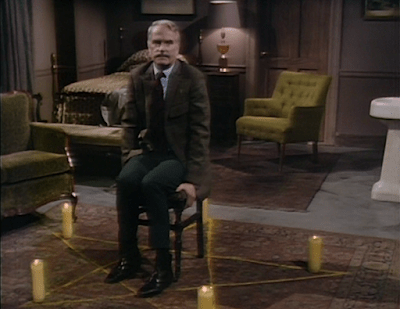
Paul’s precarious pentagram perch. Screenshot by Dark Shadows Before I Die.

Regular viewers will remember #752, in which Quentin Collins was told to sit on a chair in the middle of a similar pentagram. Quentin’s friend, amateur warlock Evan Hanley, told him that by doing this he could keep from turning into a werewolf. Paul isn’t afraid of turning into a werewolf, and he doesn’t have a friend like Evan. His worry is vague, but urgent- he knows that someone is after him, that if that someone catches up to him they will do something horrible, and that whoever it is keeps sending him messages that it is time for him to pay his debt. But he has no idea who that is, what they will do, or what the debt they are talking about. Sitting in the pentagram was a suggestion that came from a sailor who cruised him in a gay bar met him in a local tavern.

Paul’s pursuers are a cult associated with mysterious beings known as “the Leviathan people.” It has been made clear to us that both Paul and his daughter, heiress Carolyn Collins Stoddard, are, unknown to themselves, part of its orbit. In #888, Paul and Carolyn ran into each other at a cairn that is the cult’s ceremonial center and looked at it. Carolyn had been on its site many times, and could not understand why she had not seen it before. In #894/895, the cult’s acting leader, Carolyn’s distant cousin Barnabas Collins, took antique shop owner Philip Todd to the cairn. Philip told Barnabas he had walked past the site a few days before and that the cairn was not there then; Barnabas explained that only those connected with the Leviathan cult can see it. Barnabas has also been highly solicitous of Carolyn’s well-being since he became part of the cult, and he keeps telling her that he knows she has an extraordinary future ahead of her. So we know that the cult has plans for her, and Paul’s distress suggests that they have less attractive plans for him.

Paul sees the doorknob turning. He is terrified. Instead of the enemy Paul expects, Carolyn enters. He yells at her to leave. She stays. When he is unable to explain what he is afraid of, but that the pentagram on the floor will protect him, she notices that it is the same as the symbol she has been wearing on a chain around her neck. Barnabas gave it to her some days ago and urged her to wear it always. The audience knows, but she does not, that he intends it to protect her from the local werewolf. When she sees the similarity, the show invites us to wonder what the Leviathans have to do with werewolves. Carolyn tells Paul that if the symbol will protect him from his enemies in the form of chalk or gaffer tape on the floor, it will also protect him when it is composed of a silver pendant. He puts the pendant on and declares that he feels much better. He can no longer hear the voices that have been telling him his payment is due immediately. He embraces Carolyn and tells her he trusts only her.

When Carolyn mentioned Barnabas to Paul, he responded “Who is Barnabas?” Carolyn seems surprised he does not know, since she saw him near Barnabas’ house. Indeed, we saw him enter Barnabas’ house and wander through it the night he first returned to Collinwood, after an absence of twenty years. But he doesn’t remember anything about that.

Not that Carolyn’s own long acquaintance with Barnabas is all that enlightening to her just now. Ever since the Leviathans adopted him as one of their own, he has not been himself at all. We see him in his front parlor with mad scientist Julia Hoffman, who has for a year and a half been his inseparable best friend. She is trying to interest him in some information she has gathered about another storyline, and he makes it clear he could not be less interested in it or in her. She demands to know what he is interested in, and he refuses to answer. Carolyn enters, and suddenly Barnabas is all ears. Julia, frustrated, snaps that now she can see what he does care about.

In the autumn of 1967, Barnabas was a vampire and Julia had failed in an attempt to make him human again. He bit Carolyn and made her his blood thrall. He also decided that he would kill Julia to prevent her exposing him. Julia soon learned that Carolyn was both a wily operator and a most devoted servant. Julia had already realized that she was in so deep with Barnabas that she would be unlikely ever to make a life with anyone else, and so she conceived an unrequited love for him. In her dealings with Carolyn in those days, terror mingled with jealousy. Her bitter remark when she sees that Barnabas, who has been so dismissive of her, is now so concerned with Carolyn, reminds longtime viewers of that jealousy. Combined with the story of a daughter reunited with her long-absent and none too respectable father, this faint suggestion of a love triangle is enough to remind us that we are watching a daytime soap.

For her part, Carolyn was freed of her subservience to Barnabas as soon as he was freed of the effects of the vampire curse in March 1968. For some time, Nancy Barrett went out of her way to play Carolyn in a way that left us wondering if Carolyn remembered her time in his power. The scripts didn’t give her a lot of support in that endeavor, but the closeness she feels towards him combines with Julia’s jealousy to bring it back to our minds.

Carolyn has come to ask Julia to help Paul. Julia is back in the great house of Collinwood getting her medical bag to take to Paul’s hotel room when Paul himself bursts in. He demands to see Carolyn. Julia tells him that she left a little while ago to go to his hotel, and is probably there now. The telephone rings. Julia answers it, and tells Paul it is for him. This doesn’t strike her as odd, even though he hasn’t set foot there in twenty years, not since the night he left his wife Liz thinking she had killed him. Julia hands the phone to Paul. He expects to hear Carolyn, but instead hears the same voice that has been taunting him, saying that his bill is due now. He hangs up, and it starts ringing again. He forbids Julia to answer it, and runs out. We cut to his hotel room, and see that this time it is Carolyn trying to reach her father. Later, Carolyn will come home and Julia will tell her that Paul doesn’t seem to want help, however much he may need it.

Paul goes back to his room, and hears the phone there ringing. Terrified, he runs out, returning to the bar where he’d picked up trade met a new friend the night before. He sees another stranger sitting at a table, looking him over and beckoning him by rolling back one finger. The stranger is Barnabas.
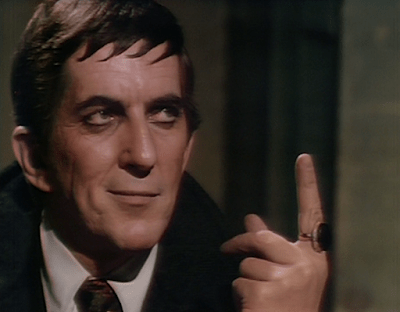
Barnabas beckons Paul. Screenshot by Dark Shadows Before I Die.

Paul reluctantly goes to the table, and Barnabas introduces himself. Paul says he doesn’t know Barnabas, but Barnabas makes it clear he knows all about Paul. He asks him to think back to the night he left Collinwood in 1949. We dissolve to a flashback.

Paul is at the bar, and another strange man strikes up a conversation with him. The man encourages him to assume that he has the power to grant any wish Paul might make in return for a price they would agree on. Paul says that in that case, he will ask for twenty years of boundless prosperity. At the end of those twenty years, Paul will give up anything he has, even his “most precious possession.” They shake hands on this deal. Paul laughs, and says he has won the game. He said that he would surrender anything he has, present tense- not anything he might gain in the course of his successful future, but anything he has as of 4 December 1949. On that date, Paul assures the man, he has nothing anyone could possibly want. The man laughs, and wants to drink to congratulate Paul on his cleverness.

Back in the present, Barnabas is laughing as heartily as the other man did twenty years before. He finds it preposterous that Paul could have forgotten such an important encounter. Paul can’t see anything important in it- it was just a silly little game, and its only consequence was that a strange man bought him a drink. Barnabas says that on the contrary, the bargain he struck was quite real. The Leviathans kept their side of it by giving him the success he has had over the last twenty years. Now that the twenty years are up, the time has come for them to claim the most precious possession he had the night he fled Collinwood.

Paul says that he supposes Barnabas is talking about his soul. He laughs heartily at that, and tells Barnabas that he is welcome to it. He is telling Paul that that is not what he meant as Carolyn enters. Paul is still laughing, and is delighted to see his daughter. She says she is relieved that the two of them found each other, and he tells her everything will be all right now. Barnabas says that Carolyn is her father’s most precious possession.

The scenes of Paul rushing around in a steadily mounting panic he is unable to explain are highly reminiscent of The Twilight Zone. The last line is a twist worthy of that classic series, especially as delivered by Jonathan Frid. His icy performance as Barnabas in these early episodes of the Leviathan arc not only recalls the malign representatives of alien powers on that show, but is superb in itself. He stumbles a little over his words in Barnabas’ scene with Julia, but is perfectly composed otherwise, and the effect is quite frightening.

I remarked on the gay subtext of the barroom scenes in the comment thread on Danny Horn’s post about the episode at his great Dark Shadows Every Day:

So far, this has been the gayest storyline the show has taken on yet.

In 899, the sailor offers to buy Paul a drink, and Paul shouts “I buy my own drinks!” This isn’t subtext- any man getting that reaction in a bar will know that the other fellow has interpreted his offer as including more than the drink. Paul apologizes and becomes friendly, indicating that he is willing to abandon that interpretation and set aside the hostility that accompanied it.

In this episode, we’re back in the same bar. Barnabas beckons Paul to his table with his index finger. I invite any man who doesn’t think we are intended to read this as a reference to a sexual come-on to try that move on a homophobic tough guy in a bar.

Paul’s face shows his inner struggle as he tries to resist Barnabas’ advances, but he can’t. Barnabas coaxes him into reminiscing about yet another night in the same bar, when a casual encounter with yet another guy led to something that seemed at the time like a little harmless tomfoolery, but that has now grown into a threat to his relationship with his family, his standing in the community, his physical well-being, and everything else.

Comment by “Acilius,” left 12 December 2020 on Danny Horn, “Episode 900: The Long Con,” posted on Dark Shadows Every Day, 18 July 2016.

In response to someone who said some kind words about that comment, I made a remark that I no longer think is very good:

Thanks! It’s a bit of a puzzle- so far as I know, none of the writers on the show at this time was gay, so I’m not sure why they decided to go so deep into these themes just then.

Comment by “Acilius,” left 11 April 2021 on Danny Horn, “Episode 900: The Long Con,” posted on Dark Shadows Every Day, 18 July 2016.

What I think now, and probably would have thought then if I had stopped and considered it for a minute before I hit “Post Comment,” is that the writing staff’s sexuality has nothing to do with it. They were worldly, sophisticated people with long experience in the theatrical profession in New York City. They all probably had many gay friends, and when they are called upon to write a story about people being drawn into a secret underworld and learning uncomfortable truths about themselves in the process their minds will naturally turn to themes having to do with closeted homosexuality. Granted, that doesn’t fully account for Christopher Bernau’s decision to play Philip as a much queenier version of Paul Lynde, but it is hardly a “puzzle” that the writers would draw on motifs suggestive of the closet when that’s the story they have to work with.

The man who met Paul in the bar in 1949 is unnamed in today’s dialogue, but will later be referred to as Mr Strak. Strak is played by John Harkins, who appeared in #174 as Lieutenant Costa of the Arizona State Police and in #878, 879, 880, 881, and 883 as Garth Blackwood, formerly the keeper of England’s Dartmoor Prison, and by that time a creature raised from Hell to wreak vengeance on an escaped prisoner and anyone else who caught his attention.

Strak’s name may remind longtime viewers of another minor character whom we saw in episodes #1 and #2, Wilbur Strake, private eye. We saw Strake in this same bar, where he gave reports about Carolyn and other members of the Collins family to his employer, Burke Devlin. Like Strak, Strake was a rather smug, sardonic sort. Add to this the rarity of the names “Strak” and “Strake” and the fact that they sound so much alike, and it seems obvious that there is an intentional reference of some kind. Paul’s presence in this storyline is the result of the writers reaching back to the show’s early days to find a loose end they could attach to this storyline to incorporate it into the Collins family saga, so they probably were looking through the scripts from the first week. Still, I can’t imagine they thought many people would remember Wilbur Strake by this point. Likely the reference is an inside joke, but who was on the inside and what the point of the joke was, I can’t begin to guess.

I wasn’t writing detailed posts with background information when I covered the first weeks of the show, so I will mention here Strake was played by Joseph Julian, who later became a regular on Somerset, a soap that aired on NBC opposite Dark Shadows for the last year of its run. The cast of Somerset included several Dark Shadows alums, including Dennis Patrick, Joel Crothers, and Christopher Pennock in major roles, and, as day players, Dolph Sweet and Humbert Allen Astredo.
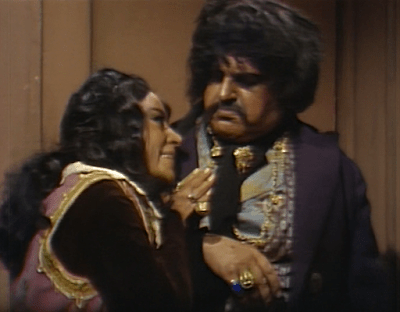
Episode 735: Defenseless souls

The highlight of today’s episode is a confrontation between two of Dark Shadows‘ most effective villains.

Laura Murdoch Collins (Diana Millay) was on Dark Shadows from December 1966 to March 1967, when the show took place in a contemporary setting. She emerged from the supernatural back-world behind the action, and at first she was as vague and indefinite as are the beings who lurk out of our sight there. Eventually she took on a forceful enough personality that Diana Millay could display her gift for dry comedy, but that personality was only a mask that Laura wore. The real Laura was something entirely different, unreachable, unknowable. The visible Laura marks the boundary between the world we can hope to understand and one where humans would find no points of reference, no standards of comparison. As such, she represents the danger that we might lose our way and find ourselves in a place where our minds will be useless to us. That is to say, she inspired the fear that comes from a well-told ghost story.

Now the dramatic date is 1897, and another iteration of Laura is the mother of twelve year old Jamison and nine year old Nora. Laura’s estranged husband, the stuffy Edward Collins, and Edward’s sister, spinster Judith, have sent Jamsion and Nora to Worthington Hall, a boarding school which doubles as a particularly cruel cult. Laura’s plans for Nora and Jamison require them to be home on the estate of Collinwood, and so she sets out to release them from Worthington Hall.

The headmaster/ cult leader of Worthington Hall is the vile Gregory Trask (Jerry Lacy.) Trask is at the opposite pole from Laura. She is terrifying because we can never understand her or the realm whose existence she implies; he is an overpoweringly oppressive presence because he is so thoroughly comprehensible. It is perfectly obvious what Trask has done, what he plans to do next, and why he wants to do it, but knowing all that is of absolutely no use in stopping him.

In today’s opening scene, Trask confronted fugitive teacher Rachel Drummond, whom he is extorting into coming back to work at Worthington Hall. He kept sidling up to Rachel and touching her, telling her that perhaps the two of them were destined to change each other. He could not make it clearer that he wants to exploit his power over Rachel to coerce her, not only into returning to her old job, but into a sexual relationship.

Trask has been in a position of authority over Rachel since she was a small child, suggesting that his unrelentingly punitive approach to his students and the undisguised joy he takes in being cruel to them are also sexual in their origin. Rachel even used the word “sadist” to describe Trask the other day, a word coined only in 1892. Someone using it in 1897 would certainly have seen it in its original clinical context, and the neurotic intellectual Rachel undoubtedly understood it very well in its technical sense.

We see Laura on a dark set. She looks at a candelabra. She points at its three candles, one by one. As she points at each candle, it lights. Thus first time viewers learn that Laura is a supernatural being with a relationship to fire.

At Worthington Hall, Nora wanders into a room where a fireplace is alight. Nora can hear her mother’s voice urging her to look into the flames, but cannot see her. She is afraid until she looks into the flames and sees Laura’s face. Nora begins to enter a deep trance. Before she can, a teacher finds her and interrupts her. We cut back to Laura, who is pleading with Nora not to look away from the fire. Nora does, and the candles on Laura’s candelabra go out.

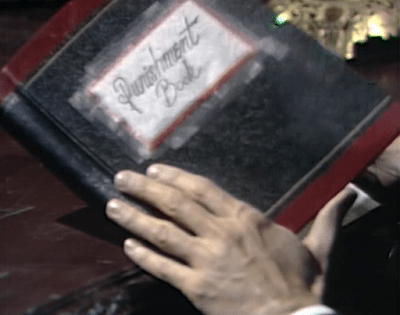
We see Trask in his study, browsing through a Bible. He returns that to his bookshelf and finds more congenial reading. He picks up a ledger and brightens. We see its cover, on which is taped a label reading “PUNISHMENT BOOK.” Trask smiles blissfully and sits down to examine its contents.

The volume that takes Trask to his happy place. Screenshot by Dark Shadows Before I Die.

A knock comes at the door, pulling Trask out of his sun-kissed dream of past cruelties. Irritated, he demands to know who it is, but receives no answer. When the knocking continues, he opens the door and sees Laura.

LAURA: Are there no servants at Worthington Hall? I’m not accustomed to letting myself in.

Longtime viewers will remember that when Laura was first on the show, they made a big deal out of the fact that she never ate or drank. So much so that they had the next uncanny menace, Barnabas Collins, drink a cup of coffee in #221. Even though Barnabas was a vampire and Laura was not, they had used up the traditional indicator of vampirism. non-consumption of food or drink, on Laura. Laura’s inability to open the door herself may be another borrowing from the same stock of imagery, from the idea that the vampire cannot cross a threshold without being invited.

TRASK: Who are you?

LAURA: I am Laura Collins and I come for my children. You are Mr. Trask, of course.

TRASK: Reverend Trask!

LAURA: Anyone can call themselves anything. I knew a woman in Brooklyn, once. Insisted she was a countess.

This is an inside joke. There was quite a well-known fashion correspondent-turned-executive in Brooklyn in 1969 named Mabel Wilson Gross. Mrs Gross’ first husband was a Danish nobleman named Count Carl Adam von Moltke, known to his friends as “Bobby.” Mrs Gross was known professionally as “Countess Mab Moltke.” She and “Bobby” were the parents of Alexandra Moltke Isles, who appeared in 333 episodes of Dark Shadows as well-meaning governess Vicki. I don’t believe Mrs Isles has ever used the title “Countess” herself, though under the laws of Denmark she would have the right to do so. Since it was Vicki who led the battle against Laura in 1967, a remark from Laura twitting Mrs Isles and her family might raise quite a laugh from longtime viewers who get the reference.

LAURA: (Goes to Trask’s desk and leafs through the “Punishment Book.”) But you are Trask. Yes, there’s no doubt about that.

TRASK: But you could be anyone as far as I’m concerned, anyone at all. I have too much respect for the defenseless souls in my charge.

LAURA: Oh, please, don’t be dreary.

TRASK: Dreary, Madam?

LAURA: Surely you know the word. Simply have my children brought down here, if there’s anyone to bring them.

TRASK: And how am I to know that you are their mother?

LAURA: Oh, what a trusting man you are.

TRASK: There is no question of the children leaving the school.

LAURA: Jamison possibly. Nora will leave here tonight. I’m willing to take them one at a time.

TRASK: As far as I know, Madam, their mother is away.

LAURA: You should keep more in touch.

TRASK: My wife returned from Collinwood this afternoon. She made no mention of your return.

LAURA: Hmm. How odd. I thought her a great gossip.

TRASK: Minerva? Madam.

That Minerva appeared to be “a great gossip” will also amuse longtime viewers. She is played by Clarice Blackburn, who in the parts of Dark Shadows set in the 1960s played housekeeper Mrs Johnson. After a brief period in which Mrs Johnson was supposed to be a spy planted in the house by an enemy of the Collins family, she settled into the role of a benevolent but excitable woman whose chief function was to blab everything she knew to the character likeliest to use the information to advance the plot.

LAURA: Now, will you have Nora sent down.

TRASK: I will not. Not without proper orders from Miss Judith Collins or Mr. Edward Collins. I shall call Collinwood and verify your strange appearance.

LAURA: Do.

(TRASK picks up the telephone receiver. Shows pain and drops it.)

LAURA: What’s wrong, Mr. Trask?

TRASK: It burned my hand.

LAURA: I’ve always thought the telephone an instrument of the devil, haven’t you?

TRASK: I have not!

Many times on Dark Shadows, as recently as this week, we have seen men forcibly intervene to stop a woman from talking on the telephone. I believe this is the first time we have seen a woman turn the tables and do this to a man.

TRASK: What a ridiculous conversation. I don’t know what I could have been thinking of to call Mr. Edward Collins. We have rules at Worthington Hall, Madam.

LAURA: Ah, rules are made to be broken.

TRASK: Not here. The children are asleep. They shall remain asleep. We do not encourage visits even from members of the immediate family unless of course it’s an emergency.

LAURA: Then you won’t reconsider?

TRASK: No.

LAURA: Not wise. Not wise at all.

TRASK: Are you threatening me?

LAURA: My children will not spend one more night in this school.

Laura remains perfectly calm throughout this conversation. Even her closing threat is delivered in a light tone, with an easy smile. Trask is agitated at the outset, and becomes ever more so as he realizes he cannot intimidate Laura. Since Diana Millay and Jerry Lacy are two of the most capable comic actors on Dark Shadows, the result is hilarious.

We first saw the effect of Laura’s imperturbability on an earnest interlocutor in #183 and #184, when she confronted a profoundly different character. In those installments, visiting parapsychologist Peter Guthrie called on Laura at the same cottage where she is staying in 1897. He introduced a new word to Dark Shadows‘ lexicon when he told her that he had concluded that she was “The Undead.” He said that he knew of her evil intentions, and said that if she abandoned them and turned to good, he would make every effort to help her live a different kind of life. Guthrie’s offer meant exactly nothing to Laura, and she responded to it with the same sardonic indifference Trask elicits from her today. Her next act was to cast a spell that caused Guthrie to crash his car and die in a ball of flame.

Trask gets off easier. Laura just sets his school on fire. The closing shot shows Nora apparently surrounded by flames. Laura does not want to burn Nora to death, at least not yet, but she is not one of your more detail-oriented otherworldly menaces. It will not surprise longtime viewers that she is blithely assuming that her children will somehow escape alive from the blaze she has started.

Episode 724: There has to be truth to make a story

Ethnic stereotype Magda Rákóczi is at home in the Old House on the great estate of Collinwood when Rachel Drummond, governess to the children in the great house on the same estate, comes to the door. Rachel says that the late Quentin Collins has risen from the dead and attacked her. Quentin was about to bury Rachel in his own disused grave when Magda’s husband Sandor showed up. Sandor fought Quentin, enabling Rachel to escape. Rachel cannot satisfactorily answer Magda’s questions about whether Sandor survived the fight, and Magda will not honestly answer Rachel’s questions about how Sandor knew to come to her aid.

Sandor makes his way back. Magda is overjoyed to see him and throws herself at him with undisguised affection. He responds with his usual grumpiness. At the end, she remembers that they are not alone, and she reverts to their usual form of pretend-quarreling. Their dialogue is great fun, and Grayson Hall and Thayer David make the most of every laugh line:

Magda overjoyed to be reunited with Sandor. Screenshot by Dark Shadows Before I Die.

Magda: Oh, the hero!

Sandor: I am all right.

Magda: Oh, my big, bad, bold hero.

Sandor: Oh, shut up. I cannot hit you. My arm is too sore.

Magda: Oh, what a brave man you are.

Sandor: Yes.

Magda: What a brave man to fight a zombie, a brave, foolish man.

Rachel: He is a brave man. Thank you, Sandor.

Sandor: I don’t like to see a beautiful lady getting buried before her time.

Magda: But you could have been killed.

Sandor: Yes, that at least would have made you cry. Get me some hot water. My wrist is beginning to swell.

Magda: Oh, so now, I have to nurse you. It is better he should have finished you!

Sandor and Magda are the first happily married couple we have seen on Dark Shadows, and this scene shows them at their very happiest. It is not only a good bit of comedy, it is quite lovely.

Rachel is bookish and intellectually ambitious, very much the sort of young lady you might expect to find in charge of the education of the children in a wealthy family in the late Victorian age. She tells Sandor that she cannot accept that Quentin has risen from the dead and is roaming about as a zombie, even though she has encountered as much evidence of the fact as anyone could want. When Sandor urges Rachel to believe what she has seen, she asks what she will have to believe in next- “Ghosts? Witches? Werewolves?” Sandor affirms that he believes in all of those things, and Rachel replies that she cannot.

Well might Sandor believe in such beings. He is under the power of the new master of the Old House, Barnabas Collins, a vampire. Barnabas rises from his coffin in the basement at dusk, when Rachel is upstairs sleeping. Barnabas knows that Angelique, the same witch who made him into a vampire in the 1790s, is controlling Quentin and persecuting Rachel. When Quentin turns up in the basement, Barnabas remembers a ceremony he saw on Angelique’s home island of Martinique that reunited a zombie’s soul with his body and made him once more a living man. He sends Sandor to the attic to retrieve a packet of letters he wrote to his uncle Jeremiah in those days, describing the ceremony.

Jeremiah’s name will jolt longtime viewers. Angelique raised Jeremiah from his grave as a zombie in #393. Over the next five episodes he initially did Angelique’s bidding, then turned on her. They never did tell us that Jeremiah had returned to his grave, in spite of Angelique’s phenomenally vehement exhortations to him to do so. It’s too bad Barnabas didn’t remember these letters then, he might have been able to un-kill Jeremiah.

Or perhaps not. The ceremony is a total failure today, so maybe Barnabas just doesn’t have what it takes to reunite a soul with a body.

When Sandor and Quentin are fighting in the graveyard, we see a tombstone labeled “Laura Murdoch Radcliffe, born 1840.” The Oxford English Dictionary doesn’t have any examples of the phrase “Easter Egg” meaning hidden content of special interest to devotees until 1986, and for that matter this episode aired a few days before Easter began in 1969. So it is doubly premature to call this an Easter Egg. We learned in #181 that a woman named Laura Murdoch Radcliffe died (by fire!) in 1867, with her young son David in her arms; other Laura Murdochs have died that way in other years, and in #187 the residents of the great house decide that Laura Murdoch Collins is likely to take her own young son David to the same fate. The show has been dropping reminders of the Laura story lately, and any longtime viewers who can read this tombstone will appreciate the reference.

I suspect that the original audience for this particular Easter Egg was pretty nearly limited to the set decorators. The inscription is on screen for less than a second, and it is as clear as it is in the capture above for only a small fraction of that time. It’s hard to see even on a modern television; on a 1960s-vintage TV set tuned to an ABC affiliate, many of which had the worst reception in their markets, it must have been totally illegible to something like 99% of the audience. Moreover, it comes at the end of the fight scene, when most eyes were focused on Sandor’s falling figure. Not very many of the few thousand people who might have had a good enough picture to read the inscription would have been looking at it. And most of the audience who were tuning in at this point had joined the show after Barnabas was introduced, the month after Laura went up in smoke, her name unmentioned since. But in the age of streaming and DVDs, we can all appreciate the reference.

Episode 679: Your make-believe people

The spirit of the late Quentin Collins is taking possession of children Amy Jennings and David Collins, and they now realize that Quentin’s plans for them are evil. David despairs of resisting Quentin; Amy tries to tell matriarch Elizabeth Collins Stoddard what is going on, but Quentin appears to Amy and stops her before she can say anything useful. I have some miscellaneous observations to make:

Quentin scares Amy and stops her telling Liz what is happening. Screenshot by Dark Shadows Before I Die.
  1. In a comment on Danny Horn’s post about this episode at Dark Shadows Every Day, I pointed out that it is unnecessary to call the story a “metaphor for child abuse” or “allegorical child abuse.” When adults terrorize kids into harming their loved ones, that simply is child abuse. Quentin is abusing David and Amy by means that don’t seem to exist in our world, but it is very definitely abuse and it can be expected to have the same consequences that would follow if he were using more realistic methods.

2. When Quentin interrupts Amy’s attempt to tell Liz what has been going on, the show is repeating a structure it used just a few days ago, in #675. Amy’s big brother Chris was about to confess to the sheriff that he was a werewolf when a telephone call from recovering vampire Barnabas Collins gave Chris an alibi and ended the sheriff’s interest in anything he might say. In each case a confession comes right to the point of terminating one of the two major ongoing storylines and is interrupted before it can do so.

3. Liz catches David twisting Amy’s arm, covering her mouth, and yelling at her. After Liz scolds David and sends him to his room, she tells governess Maggie Evans to discipline David by any means necessary. Several times in the last couple of weeks, the show has gone out of its way to demonstrate that Maggie is a hopelessly lax disciplinarian, no obstacle at all to Quentin’s designs on Amy and David. Now we see that even the other characters have started to catch on to this fact.

4. There are a couple of sequences of coming and going from David’s room. These feature a good deal of camera movement from the inside to the hallway outside. The show has been giving us a lot more of this kind of thing lately, laboring to suggest spaces connecting one room to another. There used to be scenes set in the village of Collinsport, and characters who lived there. Maggie lived in town then, and her house was a frequent set. But now she lives in the great house on the estate of Collinwood, and the only regular character who does not live somewhere on the estate is Professor Timothy Eliot Stokes, whom we have not seen since #660. If all the action is going to shrink to Collinwood, and most of it to the great house, it makes sense they would develop a strategy to make that house seem like a bigger place.

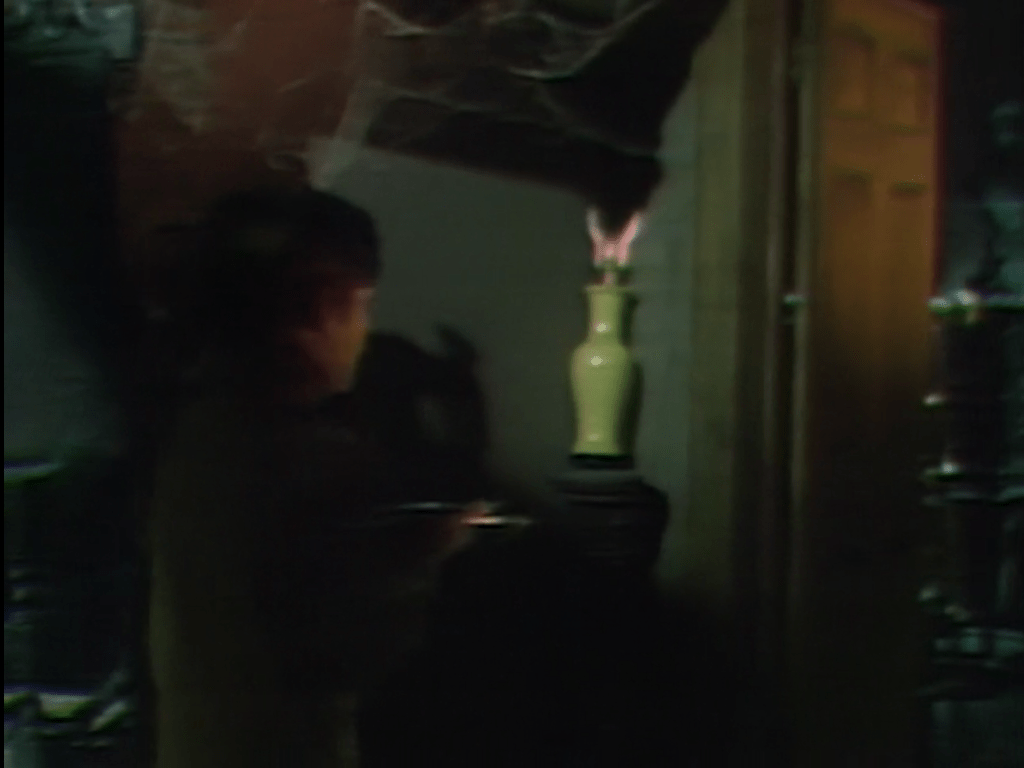
5. The show has a fondness for a particular shade of bright green at this point. You will notice it in the clothes that both Amy and Liz are wearing in the screenshot above. It also shows up towards the end of the episode. Maggie follows David into the long-deserted west wing of the great house; he is sneaking off to visit Quentin in his stronghold, a dusty little room there. The sequence again places an emphasis on the corridors. We have seen the west wing corridors several times. As before, they are draped with elaborate cobwebs but chock-full of objets d’art. There is a new one on display today, a lamp in that same bright green. It is in the center of the shot while David makes his way to the room. That helps to make the space seem bigger, as we measure David’s progress not by he slowness of his steps but by his steadily changing relationship to the lamp. The corridor is dark enough that only a brightly colored object could serve this function, but it is in focus for so long that we are left with a feeling that it must have some significance of its own.

The lamp gets its star turn.

6. When David is lying to Liz to keep her from making sense of what little Amy was able to tell her, he claims to have an imaginary friend named “Lars,” a giant who lives in “the house by the sea.” Collinsport is a coastal village, so there are lots of houses by the sea there, and for much of 1968 suave warlock Nicholas Blair lived in what was always called “a house by the sea.” But only one place has been called “the house by the sea,” a Collins family property that has been vacant since the 1870s. Well-meaning governess Victoria Winters and her fiancé Burke Devlin were interested in buying that house in September and October of 1967, but for legal reasons the sale turned out to be impossible. The business about The House by the Sea seemed very much like it was going to lead to a ghost story that would bring into view another branch of the Collins family and involve Burke and Vicki being possessed by evil spirits. Perhaps that was the intention when it was first dreamed up in the flimsies six months before, but it never went anywhere and was forgotten completely the minute it ended. This is the first reference to the house since #335. If that were at one time the plan, bringing up “The House by the Sea” today might be a way for the writers and producers to remark to each other on the fact that they are now making a story like the one they dropped back then.

Episode 298: You will remember nothing

The only story on Dark Shadows at this point is the one about vampire Barnabas Collins. They’re trying to get a second one off the ground, about an old vacant house that has caught the fancy of well-meaning governess Vicki. Vicki’s depressing boyfriend Burke has interpreted her interest in the place as a marriage proposal. He wants to buy the house and live in it with her.

Today, we find out that the house is the property of the ancient and esteemed Collins family. That isn’t a big surprise, since Barnabas clearly knew something about it from his time as a human. It does suggest a partial answer to a question Vicki had when she, Burke, and Barnabas visited the house on Thursday. Barnabas found a handkerchief there bearing the initials “F. McA. C.” and gave it to Vicki. She expressed a determination to find out what those initials stood for. Now she should be able to look at the family’s records and search for a Mrs Collins whose maiden name had the initials “F. McA.”

Burke asks matriarch Liz if she is willing to sell the house to him, and she is perfectly agreeable. Liz’ daughter Carolyn joins them for a tour of the house. There is some startlingly sloppy writing in this scene. Carolyn remarks that the house has a special warmth and speculates that it is the result of so much light reflected into its windows from the sea nearby. A couple of minutes later, Liz complains that the house is terribly cold, and Carolyn says that’s because it is so close to the sea.

Both Liz’ glad willingness to sell the house to Burke and her trip to it signal that storylines from the first year of the show are now behind us once and for all. Burke was introduced in episode 1 as a dashing action hero returning to his home town to wreak vengeance on his old persecutors, the Collins family. The “Revenge of Burke Devlin” arc consisted so largely of talk about people, places, and events we never saw that it didn’t amount to much, and by the time Burke formally renounced his revenge in #201 it had long since fizzled. That left some chance it would flare back up, so in #223 Liz vowed she would never sell Burke any property at any price, but now the door is firmly closed on that old theme.

When Dark Shadows started, Liz was a recluse who hadn’t left home in eighteen years. Since they never showed us anyplace Liz might want to go, that story was an even more total dud than was The Revenge of Burke Devlin. Even after the reason for Liz’ seclusion was exposed as fraudulent in #273, she still made a show of reluctance when her brother Roger suggested she go to town in #277. Now she doesn’t hesitate to hop in a car and go to the house by the sea. In fact, she is the one who urges Carolyn to get out of the house. So that sends another non-starter to the narrative junk yard.

In this episode, the characters refer to “the house by the sea” as “Seaview.” That was an inside joke. The Newport, Rhode Island mansion used in the exterior establishing shots of the great house of Collinwood was known as Seaview Terrace. In 1974, Martin and Millicent Carey bought the house, and it came to be known as the Carey Mansion.

Meanwhile, Vicki is visiting Maggie Evans, The Nicest Girl in Town. Maggie has amnesia, a condition induced by her doctor, mad scientist Julia Hoffman. Julia is in league with Barnabas, and has damaged Maggie’s memory to keep her from recalling that Barnabas abducted her and tried to replace her personality with that of his lost love Josette. Vicki is trying to help Maggie regain her memory.

There is another instance of distressingly sloppy writing in this scene. Vicki tells Maggie that she thought she saw her in Eagle Hill cemetery during the period she cannot recall. She tells Maggie that Burke tried to convince her that she can’t have seen her. In response, Maggie asks if Burke saw her, and Vicki again says Burke tried to convince her she hadn’t seen her.

Vicki tells Maggie that she and Burke had gone to the cemetery to lay flowers at Josette’s grave. Maggie reacts strongly to Josette’s name, and Vicki starts telling her about Josette. When she mentions that Barnabas has restored Josette’s room, a light comes on in Maggie’s eyes and she grows very animated. She is about to say something when a knock comes at the door. It is Julia.

There is a strange blooper in the conversation between Vicki and Julia at the door. Julia asks “Would it be all right if I came in and waited?” Vicki responds “Not at all.” My wife, Mrs Acilius, is usually very forgiving of bloopers, but she laughed out loud at this one.

It could be that Julia’s line was “Would you mind if I came in and waited?” Alexandra Moltke Isles was famously accurate with her line delivery, even when her scene partners bobbled, and it could be that she just went ahead and said what Vicki was supposed to say even though it didn’t make sense. In view of Carolyn’s self-contradictory lines about the temperature of the house and Vicki’s repetitious lines about Burke’s attempt to gaslight her, both of which were obviously scripted, it could also be that the actors are working from Ron Sproat’s unrevised first draft.

While Julia looks at some of Maggie’s father’s paintings, Vicki sits back on the couch with Maggie. Julia hears Maggie exclaim “Barnabas!” and get very agitated. It seems she is about to tell Vicki all about what happened when she was missing.

Maggie, remembering

Julia swoops in, asking if they like antiques. Vicki looks bewildered at the interruption, but answers with a polite yes.

Julia interrupts

Julia presses her jeweled medallion on her. Vicki passes it to Maggie, and Julia asks for a cup of tea. Maggie volunteers to make the tea, but Vicki insists on doing it. In #143, the living room and kitchen in the Evans cottage were two parts of an undivided space, but now we hear Vicki close a door when she goes to make tea. Not only is that confusing to viewers who remember the earlier episodes, but since Vicki goes in the direction of the front door it seems for a moment that she is leaving the cottage altogether.

While Vicki is out of the room, Julia hypnotizes Maggie. She commands her to forget everything that happened while she was missing. When Vicki returns, Maggie has indeed forgotten everything.

Maggie under hypnosis