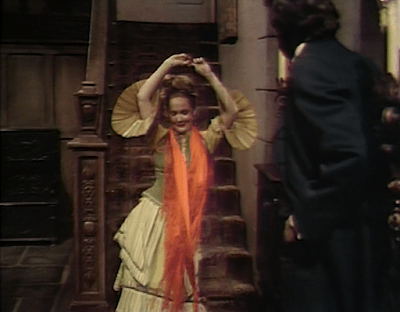
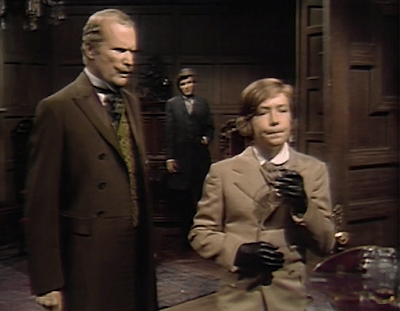
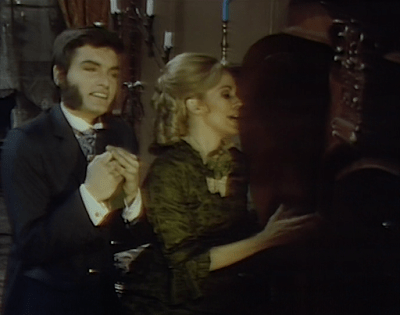
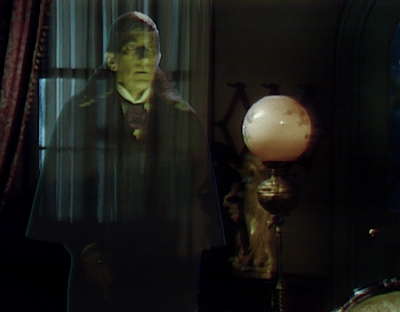
Episode 807: An award-winning performance, wouldn’t you say?

From #1 to #274, each episode of Dark Shadows began with a voiceover narration by Alexandra Moltke Isles, usually in character as well-meaning governess Vicki. This identified Vicki with our point of view and suggested that she would sooner or later learn everything we knew.

Jonathan Frid joined the cast as vampire Barnabas Collins in #211, and quickly became the show’s great breakout star. If the upright Vicki found out what we knew about Barnabas, one of them would have to be destroyed. Vicki was the favorite of longtime viewers and Barnabas was attracting new ones, so that was out of the question. Therefore, other members of the cast started taking turns reading the voiceovers, and doing so not as their characters, but in the role of External Narrator.

Today marks the first time Frid himself reads the narration. His training first in Canada, then at Britain’s Royal Academy of Dramatic Arts, and later at Yale School of Drama prepared Frid well in the art of dramatic reading, and in later years he would concentrate on that aspect of his craft. Several of his colleagues are his equals in these voiceovers- I would particularly mention Kathryn Leigh Scott, whose conception of The Narrator is always arresting, and Thayer David, who could consistently achieve the most difficult of all effects in voice acting, a perfectly simple reading. So I can’t say I wish Frid had done all of them, but he is always good, and today’s performance is among his most gorgeous.

The action opens on a set known to longtime viewers as the Evans cottage, where from 1966 to 1968 artist Sam Evans and his daughter Maggie served as Dark Shadows‘ principal representatives of the working class of the village of Collinsport. In those days, it was on this set that we saw how the misdeeds of the ancient and esteemed Collins family had consequences that spilled out of the estate of Collinwood and warped the lives of people trying to make a more or less honest living nearby.

Now the dramatic date is 1897, and Sam hasn’t been born yet. But the cottage is already an artist’s studio. It is temporarily occupied by the nationally famous Charles Delaware Tate, who is painting a portrait of rakish libertine Quentin Collins at the behest of evil sorcerer Count Petofi. Charity Trask, a resident of the great house of Collinwood, is visiting Tate in the cottage when she sees the face in the portrait change from that of Quentin. It takes on a great deal of fur and long fangs, and reminds Charity of a wolf.

By the time Tate looks at the painting again, it has resumed its normal appearance. He tells Charity that the transformation must have been in her imagination. She is willing to consider the possibility, but we know better. Quentin is a werewolf, a condition Petofi knows how to cure. Portraits on Dark Shadows have had supernatural qualities at least since #70, including portraits we saw Sam execute on this set in 1966, 1967, and 1968, and the show has borrowed from The Picture of Dorian Gray before. Moreover, Tate’s reaction to Charity is one of barely controlled panic. Nancy Barrett has to ramp up Charity’s own emotional distress to the limit to make it plausible she would not notice Tate’s extreme agitation. Perhaps if Tate were played by a better actor than the ever-disappointing Roger Davis, his response might have been ambiguous enough that Miss Barrett could keep the tone a bit lower, but his unequivocal display of alarm leaves her nowhere to go but over the top.

Mr Davis was under no obligation to play the scene transparently, since Tate later goes to Petofi’s henchman Aristide and lays out in so many words his precise relationship to Petofi’s operations and his knowledge of them. Tate’s career is his reward for selling his soul to Petofi, and he has already experienced great sorrow as a result of that bargain. Tate knows that the portrait changed to reflect the full Moon’s influence on Quentin and that Petofi is currently in possession of twelve year old Jamison Collins. Aristide tells us that Petofi’s own body is in suspended animation while he acts through Jamison. He also says that it was in 1797 that Petofi’s right hand was cut off, and that if he does not reclaim the hand in a few weeks, by the date of the one hundredth anniversary of the amputation, he will die and so will Tate.

Jamison/ Petofi is in the prison cell in the basement of the Old House on the estate of Collinwood. Barnabas has traveled back in time from the 1960s with some vaguely good intentions and is hanging around 1897 causing one disaster after another. Now, he is doing battle with Petofi and has locked him, in the form of Jamison, in the cell. Barnabas’ reluctant sidekick, broad ethnic stereotype Magda Rákóczi, guards Jamison/ Petofi during the day. Early in the episode, Jamison/ Petofi calls Magda and pleads with her to release him. He tells her that he is “just a little boy” and that she is a “rather heartless creature.” She says she wishes he were a little boy again, but that she isn’t stupid and he won’t fool her. Indeed, the phrase “rather heartless creature” and Jamison/ Petofi’s manner in delivering it sound so much like Thayer David as Petofi that they hardly count as an attempt to deceive Magda.

Later, Jamison/ Petofi casts a spell to summon Aristide, then calls to Magda again. When Magda arrives, Jamison/ Petofi gives himself a better script than the one from which he had acted in his previous scene with her. He pretends not to remember how he got into the cell and to be shocked that Magda knows he is there. Perhaps the utter transparency of his earlier pleadings was an attempt to get Magda to underestimate his abilities as a trickster.

In #803, we saw that when Petofi took possession of him Jamison’s right hand disappeared from his wrist, matching Petofi’s own mutilated condition. When Jamison/ Petofi feigns the amnesia that might come upon recovery from possession, we might therefore expect Magda to demand that he remove his gloves to prove that he is himself again. But he plays the part of Jamison so convincingly that we are not really surprised he does fool Magda. She goes into the cell, embraces Jamison/ Petofi, and he kisses her on the cheek. It is this kiss that spreads his magical power, and she realizes too late that she has been had.

Aristide arrives a moment later, and Jamison/ Petofi calls his portrayal of an innocent boy “an award-winning performance.” Indeed, if there had been daytime Emmys in 1969, David Henesy might have won one for his portrayal of Thayer David playing Petofi playing Jamison.

Aristide wants to kill Magda; Jamison/ Petofi forbids this. Under his power, she announces that she is responsible for all the evil that has happened in 1897. She was responsible for releasing Barnabas and therefore for all the murders and other harm he has done; she made Quentin a werewolf, and is to blame for his killings in his lupine form and for the curse his descendants will inherit; she stole Petofi’s severed hand and is at fault for the deaths of Rroma maiden Julianka and of her own husband Sandor that resulted from the hand’s presence. She even takes the blame for Quentin’s murder of her sister Jenny, the act for which the werewolf curse was meant as vengeance. Magda says she must be punished. Jamison/ Petofi tells her that he is not interested in punishing her. He has another use in mind for Magda She will lead him and Aristide to Barnabas’ coffin today, and they will destroy him.

Longtime viewers will perk up twice when Aristide says that Petofi lost his hand in 1797 and that he has exactly one hundred years to recover it. From December 1966 to March 1967, Dark Shadows’ first supernatural menace was undead blonde fire witch Laura Murdoch Collins, who at intervals of exactly one hundred years incinerated herself and a young son of hers, who was always named David, in an unholy ceremony that renewed her existence, but not that of the Davids. Since the usual laws of nature don’t apply, the show needs some other causal mechanism to create suspense, and anniversaries will do as well as anything else. Another iteration of Laura was on earlier in the 1897 segment. It was fun to see her again, but they could shoehorn her into that year only by retconning away the one hundred year pattern in her immolations. It’s reassuring in a way to see that Petofi is bringing centenaries back.

The date 1797 is also significant. It was in 1796 that Barnabas died and became a vampire. We flashed back to that period for the show’s first costume drama segment in November 1967 to March 1968, and Barnabas went back to 1796 for a week in January 1969. So we may go back again some day, and if Petofi was alive and in his prime in 1797, we might run into him there.

Barnabas and Petofi are not the only characters from the 1790s who might be on the minds of attentive longtime viewers. Barnabas’ little sister Sarah died in 1796, and as a ghost was an extremely important part of the show from June to November 1967. We’ve been getting reminders of Sarah for the last several days. In #792 wicked witch Angelique produced a toy soldier of Barnabas’ that Sarah gave to strange and troubled boy David in #331. In #805, Charity found Sarah’s recorder, a prop that often served as Sarah’s calling card in 1967, and talked about learning to play it. And today, we see a portrait standing on the floor of the Evans cottage, a set which Sarah visited in #260, depicting a girl wearing a bonnet very much like the one Sarah wore as a ghost in 1967 and a pink dress just like the one she wore when we saw her as a living being in the flashback to the 1790s.
Portrait at the cottage.

I wonder if, when they were making up the flimsies for this part of the show, they had thought of reintroducing Sarah. That would have required a recasting of the part- Sharon Smyth was noticeably older when we saw Sarah die in January 1968 than she was when Sarah was a ghost in June 1967, and by now we would wonder what she has been eating in the afterlife that has made her get so much taller. Besides, Miss Smyth* had stopped acting by this point.

The process of planning the stories was in two stages, a rough sketching of themes six months in advance, and a capsule of each episode written thirteen weeks ahead of time. There was a lot of flexibility when it came to putting those plans into effect. Some stories that were supposed to end within thirteen weeks were extended over years, while others that were expected to be a big deal petered out before they got going. In an interview preserved by Danny Horn at his great blog Dark Shadows Every Day, writer Violet Welles said that many of the moments on the show that made the least sense were those written when the plans hadn’t worked out: “toward the end of the cycle, you’d have characters who were really not a lot of interest who had to play scenes with other characters who really didn’t have a lot of interest, dealing with things that basically didn’t concern them. Those were hard to write.”  

This episode was taped on 25 July 1969; thirteen weeks before that was 21 May. Six months before was 25 January. By 25 January, Denise Nickerson had been on the show for two months as Amy Jennings. Nickerson was actually born on 1 April 1957, but they several times say that Amy is nine years old. When the show goes to 1897, Nickerson plays Nora Collins, who is also nine. On 19 May, Nickerson taped #761, the last episode she would appear in until #782. She is currently in the middle of a second long absence from 1897, unseen between #783 and #812. Her characters were so important in the months leading up to the 1897 segment and she played them so well that we wonder what they were thinking leaving her in the background so long.

Maybe they were thinking of bringing her back as Sarah. Nickerson didn’t look all that much like Sharon Smyth, and was a far more accomplished young actress than was Miss Smyth, but she did have brown hair, and the show prioritized hair color above all else in recasting parts. For example, two actresses followed Mrs Isles in the role of Vicki, neither of whom had much in common with her either in acting style or in looks, but who both had black hair. So perhaps there was a time when they intended to travel between 1897 and the 1790s and to meet Sarah, played by Denise Nickerson. If Nickerson were still alive, perhaps someone would ask her if she posed for the portrait that is standing on the floor of the Evans cottage today.

*She’s been using her married name for decades now, but when talking about her as a child it’s pretty weird to refer to her as “Mrs Lentz.” Since I use surnames for people associated with the making of the show and attach courtesy titles to surnames of living people, I have to call her “Miss Smyth.”

Episode 806: You’re not thinking of the foolish things

Charity Trask walks into the drawing room of the great house on the estate of Collinwood and finds a paper on the desk. It is a full confession to the murder of her mother, the late Minerva Trask, signed by her father Gregory and by Collins family attorney Evan Hanley. It also bears a red seal.

Trask enters and Charity tells him what she has read. He rants and raves for a while, claiming that she must be under the Devil’s power if she believes the confession. He forces her onto her knees and orders her to pray, then tries to destroy the paper.

Charity prays. Screenshot by Dark Shadows Before I Die.

Later, Gregory Trask is alone in the drawing room. It goes dark, a violent storm suddenly breaks out, the windows blow open, and the flames surge much higher in the fireplace than we have ever seen them. Trask cries out for Minerva to leave him alone. When he calls himself an innocent man, the storm rages more fiercely than ever.

The storm ends as quickly as it began, and a man appears in the doorway. He asks who Trask was talking to, and Trask denies that he was talking to anyone. Trask mentions the storm, and the man says there hasn’t been a bit of wind all day. Trask turns and sees that the window is closed and there is no sign of a storm outside.

The man identifies himself as Charles Delaware Tate. Trask recognizes the name as that of a nationally famous painter. Tate explains that the late Edith Collins commissioned him to paint a portrait of her grandson, Quentin Collins, but that Quentin has refused to sit for him. He asks Trask for a photograph of Quentin. Trask remembers that there is such a photograph in a drawer in the desk. When he opens the drawer, the confession falls out, undestroyed.

Returning viewers know that Tate is associated with a 150 year old sorcerer known as Count Petofi. We also know that Petofi is currently residing in the body of twelve year old Jamison Collins and is casting spells to expose the secrets of various people connected with Collinwood. Jamison’s distant cousin Barnabas Collins the vampire is doing battle with Petofi, and has locked Jamison/ Petofi in the prison cell in the basement of the Old House on the estate. That has done little to curb his power; from the cell, he was able to project himself into a dream of Evan’s, cast a spell on him, and compel him to draw up the paper Trask keeps trying to destroy. Jamison/ Petofi does seem anxious to get out of the cell, however. He offers to cure Quentin of lycanthropy if he lets him out. When broad ethnic stereotype Magda Rákóczi talks Quentin out of accepting the offer, Jamison/ Petofi growls a threat at her.

We do not know why Petofi wants Tate to paint a portrait of Quentin, but we get a clue at the end of the episode. Tate has rented a house which longtime viewers will recognize as the Evans cottage. For the first two years of the show, the Evans cottage was a frequent set. It was home to artist Sam Evans and his daughter Maggie, The Nicest Girl in Town. In December 1966 and January 1967, an unseen force compelled Sam to paint portraits of undead blonde fire witch Laura Murdoch Collins. Those portraits had supernatural powers. They were not alone. Portraits have been a prominent part of the show’s set decoration from the very beginning, and have been a gateway between the world of the living and the world of the dead since #70. We may well assume, then, that Tate’s portrait of Quentin will also have uncanny powers.

Charity is visiting Tate in the cottage and looking at the portrait. He has only been working for a day or two, and he says it will take him about two weeks to finish. Yet the figure is almost finished now. As Charity studies it, Quentin’s face turns into that of the werewolf. In May and June of 1968, they did a story partly based on Oscar Wilde’s The Picture of Dorian Gray, and in #701, the very first episode in which he could speak, Quentin compared pictures and people, saying that one changes while the other stays the same. So we are prepared to see Quentin’s curse transferred from his body to his portrait.

Episode 805: The shocking condition of your face

The 150 year old evil sorcerer Count Petofi has taken possession of twelve year old Jamison Collins. Jamison/ Petofi has been casting spells to make the various residents of the estate of Collinwood reveal their true selves. Jamison’s distant cousin, Barnabas the vampire, has locked Jamison/ Petofi in the prison cell in the basement of the Old House on the estate. When Barnabas says that he will let Jamison out once Petofi has vacated his body, Jamison/ Petofi replies “If that is what you intend to do, Mr Collins, I’m afraid that you are stupid and incompetent.” There is no need to cast a spell on Barnabas- Maker of Stupid and Incompetent Plans is his true self, and we love him for it.

The great house on the estate is currently under the legal authority of the evil Rev’d Gregory Trask, husband of Judith Collins, who is a patient in a mental hospital. Jamison/ Petofi’s spell has caused Trask’s daughter Charity to be intermittently possessed by the spirit of Cockney showgirl Pansy Faye. Trask is horror-stricken by the makeup, clothes, and hairstyle Charity wears when Pansy is in charge of her, and her East London accent, insouciant attitude towards him, and tendency to sing and dance escalate this horror further. Nancy Barrett and Jerry Lacy are both talented comic actors, and their scenes as Charity/ Pansy and Trask are hilarious.

Trask is appalled to see Charity/ Pansy. Screenshot by Dark Shadows Before I Die.

Collins family lawyer Evan Hanley is at home. Barnabas appears in Evan’s drawing room and asks for some information which Evan denies having. Evan tells Barnabas he has renounced his former interest in black magic and Satanism. Barnabas is skeptical, and Evan replies that his latest forays resulted in a gruesome disfigurement of his face. This disfigurement was later relieved, how we (frustratingly) do not know. But he wants nothing more to do with the occult, since he values the ability to look at himself in the mirror. Barnabas reminds Evan that he cannot see himself in a mirror, implying that he will use his vampire powers against him if he does not cooperate.

Trask comes to Evan’s house. He asks him to draw up papers that will complete his plan to seize control of all the Collins family’s assets. He mentions in passing that Jamison thinks he is Petofi. Evan knows enough about Petofi to be terrified. He tells Trask that neither of them has a chance in a battle with Petofi, and refuses to draw up the papers. Trask responds contemptuously.

Alone in the cell, Jamison/ Petofi decides to have some fun with Evan. We see Evan dozing in his armchair. He has a dream in which Jamison appears. Jamison kisses him; it is by his kisses that Petofi spreads the “true self” spell. Later, Evan goes to the great house at Collinwood and presents Trask with a paper to sign. Trask signs it eagerly, assuming it is the document he asked Evan to bring him. Instead, Evan has prepared a full confession to the murder of Trask’s first wife Minerva. The two of them plotted this murder together, and Trask is horrified when he sees his signature on it. He throws the paper in the fire; after he leaves the room, it rematerializes on the desk, complete with signatures.

During Trask’s confrontation with Charity/ Pansy Faye, the picture suddenly changes from color to sepia tone. After about a half a minute, it changes back. Evidently there was a fault in the videotape master at this point, and an excerpt from the kinescope was used to patch it. The color comes back right after Trask slaps Charity/ Pansy, causing Pansy to release Charity for a bit. It creates the eerie feeling that Trask somehow fixed our TV set by slapping her.

Dark Shadows continually comments on itself as it goes along. In the early days, all the episodes were scripted by Art Wallace. Wallace’s favorite method of composition was a sort of diptych, in which two sets of characters faced similar situations and responded to them differently, highlighting the contrast between their personalities. Petofi’s “true self” spell is of course another way of creating similar contrasts between characters played by the same actor.

As the show came to focus on time travel stories, they could cast actors as characters who represent alternative versions of parts they played in other periods, again putting characters played by the same actors in contrast with one another. And as Wallace would juxtapose similar situations within a single episode, the multiple times periods allowed them to take themes that had been developed in one way in a story set in one year and develop them differently in a story set in another. So Jamison/ Petofi’s contagious curse is a reworking of the “Dream Curse,” which dragged on from April to July 1968. The Dream Curse involved a lot of repetition and very little variety of tone. Jamison/ Petofi’s spells all get right to the point, and are sometimes scary, sometimes bizarre, and often quite funny. So the second time is definitely the charm here.

At one point Charity holds a recorder and tells her father she wants to learn how to play it. The first time we saw this prop was in #260. That episode was set in 1967, and Barnabas was holding Maggie Evans, The Nicest Girl in Town, prisoner in the cell where Jamison/ Petofi is today. The ghost of Barnabas’ little sister Sarah befriended Maggie, and materialized in the cell playing “London Bridge” on that recorder. Over the next several months, the recorder came to be a symbol of Sarah, one that she occasionally left behind as a sign that she had been in a place. Longtime fans will likely remember that, and see it as an indication that what is happening to Charity is going to have permanent consequences, as Sarah’s haunting had permanent consequences.

Episode 804: He is a gem, isn’t he

The evil Count Petofi, a 150 year old sorcerer, has taken possession of twelve year old Jamison Collins and is wreaking havoc in the great house of Collinwood. Due to Petofi’s spells, Jamison’s father Edward thinks he is a valet recently separated from the service of the Earl of Hampshire. Edward’s brother Quentin tries to explain to him what is actually going on, but Edward merely concludes that he is Quentin’s valet now. When Quentin follows the Collinses’ long-established protocol for dealing with mentally ill family members and locks Edward in the tower room, Edward bangs on the door and protests that he won’t be able to do his job if he is locked up. “And I will do it!” he vows.

Charity Trask, disastrously uptight step-daughter of Quentin and Edward’s sister Judith, falls under Petofi’s influence and is possessed by the spirit of Cockney showgirl Pansy Faye. Pansy was on the show briefly in June. The childlike Carl Collins, brother to Judith, Edward, and Quentin, was engaged to marry Pansy before she was killed by vampire Dirk Wilkins. Pansy and Charity never met; when Carl asked Charity if she had seen Pansy, the scene was staged to make it seem absurd that the two women could exist in the same universe. Now, they exist in the same body.

Ta Ra Boom De Ayyyy… Screenshot by Dark Shadows Before I Die.

If Petofi has caused startling changes in Jamison, Edward, and Charity, the change in Quentin is perhaps the most jarring of all. He has been a ghost, a homicidal maniac, a Satanist, a zombie, and a werewolf, but always and everywhere a source of total chaos, who destroys all recognized order and is perfectly at home in the midst of sheer madness. Today, Quentin keeps making earnest attempts to restore everyone to their right minds and reestablish the proper and respectable relations within the household.

First time viewers will immediately catch on that the preteen David Henesy is not the actor who would usually play a 150 year old Hungarian nobleman, and when Nancy Barrett suddenly takes on an East London accent and enters wearing a garish costume and doing a dance with lot of hip shaking and pelvic thrusts, they will know that Charity is turning into someone else. The dialogue in the scenes involving Edward explains what is happening to him. They may not know that Quentin is not supposed to be the defender of the status quo. That information is supplied in two scenes. Charity/ Pansy receives a psychic message from the world beyond telling her that Quentin was involved in the murder of Carl, and she announces this information. Also, Quentin calls for help, and the helper who materializes is his distant cousin, Barnabas Collins the vampire.

At the end of the episode, Barnabas lays hold of Jamison/ Petofi and drags him into the secret passage leading from the drawing room to the west wing. It is usually bad news when a vampire abducts a child and shoves him into a dark space, but David Henesy brings such joy to the role of Jamison/ Petofi that we can hardly doubt that what comes next will be equally fun to watch.

Meanwhile, a painter named Charles Delaware Tate has presented himself. Tate’s first appearance will cause a sinking sensation in longtime viewers; he is played by Roger Davis, a terrible actor who delivers much of his dialogue by shouting while clenching the sphincter muscles in his buttocks, and who routinely assaults the women and children in the cast while on camera. We may have hoped we had seen the last of Mr Davis when his most recent character, Dirk, was destroyed shortly after murdering Pansy. But evidently Pansy’s return in the form of another actress has come at the price of Mr Davis’ return in the guise of another character.

For much of 1968, Mr Davis played a man known variously as Peter Bradford and Jeff Clark. His approach to characterization consisted of shouting “My name is Jeff Clark!” When this technique was played out, he took to shouting “My name is Peter Bradford!” He doesn’t shout today, mercifully. But he does say the name “Charles Delaware Tate” quite a few times.

Today’s story about Tate is potentially interesting. Jamison/ Petofi finds him when he answers the front door. Tate asks to see Jamison Collins; Jamison/ Petofi confirms that despite his appearance, he is indeed the person Tate has come to see. Tate accepts this with a blandness that suggests that he knows he is dealing with a magical personage.

Jamison/ Petofi gives Tate a photograph of Quentin and says that he wants a portrait of him. When Quentin comes to the drawing room and finds Tate sketching, he asks who he is. Again, Quentin adopts a stern tone which suits someone defending the sanctity of private property against an unknown intruder. Tate introduces himself and shows him a handwritten letter which Quentin instantly accepts as the product of his grandmother Edith. He tells Tate that Edith has been dead for some time and that he is not interested in a portrait of himself. Tate says that he has already accepted the commission and the money that Edith sent with it, and so he will rent lodgings in the village of Collinsport and finish the job regardless. Quentin does what viewers have hoped everyone who shared a scene with one of Mr Davis’ characters would do, and throws him out.

The forged letter is a fascinating touch for returning viewers. Petofi made himself welcome as a guest at Collinwood by showing Edward forged papers creating the impression that he shared Edward’s friendship with the Earl of Hampshire. That he has also created papers that Quentin immediately accepts as coming from Edith, who died long before Petofi had any reason to come to Collinwood, suggests that his powers of forgery are very extensive indeed.

Tate not only seems to know that Petofi has magical powers; he also shows an acquaintance with Petofi’s henchman Aristide.* When Tate mentions Aristide, he calls him “Aristeedy,” a sort of pet name with a diminutive suffix. This is probably just a blooper on the part of Mr Davis, but since Petofi is continually telling Aristide how lovely he is and how he is more attractive when he doesn’t speak, it does remind us of the gay subtext that runs through their scenes together. We might suspect that Petofi and Aristide’s sexuality is in one way or another one of the reasons they are connected to Tate.

The script opens all of these questions about Tate. Had he been played by an actor who was capable of depicting depth and highlighting ambiguity, it could have been a lot of fun to speculate about just what their answers might be. In #137, future movie star Frederic Forrest was a featured extra on the dance floor at The Blue Whale tavern; it’s easy to suppose he would have taken a speaking part. So when the show puts Mr Davis in front of us, I like to make the time a little more tolerable by imagining what Forrest might have brought to the role of Tate.

*His name is spelled “Aristede” in the closing credits, but it was “Aristide” in the original scripts.

Episode 803: As soon as you’re finished with the mumbo-jumbo

The spirit of evil sorcerer Count Petofi has taken possession of twelve year old Jamison Collins, much to everyone’s consternation. David Henesy spends most of the episode mimicking Thayer David’s Petofi, with hilarious results.

Jamison/ Petofi sipping a glass of “mineral water… for the digestion.” Screenshot by Dark Shadows Before I Die.

We see Jamison’s favorite uncle, Quentin the Satanist, trying to cast a spell to break Petofi’s possession of Jamison. As he always does when he is calling on the dark powers of the unseen realms, Quentin gets very fervent. We pan to Jamison/ Petofi, standing next to Quentin in a state of utter boredom, asking if Quentin will bring him a glass of mineral water once he’s “finished with all the mumbo-jumbo.”

Twice, Jamison/ Petofi pretends he is not possessed, but is his usual preteen self. He does this in order to trick people into letting him kiss them, which is how Petofi’s power spreads to them. This gives Mr Henesy the challenge of showing how Thayer David would play Petofi playing Jamison. That’s the sort of thing an actor needs a director’s help to pull off. Unfortunately, the woeful Henry Kaplan was at the helm today, so we discover that Petofi’s imitation of Jamison sounds exactly like the original, who is in turn uncannily like Jamison’s grandson David Collins and his great-great-grandfather Daniel Collins, who are also played by Mr Henesy.

Those whom Jamison/ Petofi kisses reveal their “true selves.” So maidservant Beth reveals that she was under the power of Jamison’s distant cousin, vampire Barnabas Collins. When Jamison’s father Edward passes this word along to Quentin, Quentin tells him is going to confront Barnabas. Edward has been hunting Barnabas, and by saying this Quentin implies that he knows where Barnabas is and that he has been helping to hide him. For some reason, Edward only smiles in response to this revelation.

Petofi wears a prosthesis in place of his right hand; Edward finds that Jamison’s right hand has also been replaced with a prosthesis. After this horrifying discovery, Jamison/ Petofi kisses Edward. Quentin returns shortly after, and finds that Edward does not recognize him or know the name of the house. Edward identifies himself as a newcomer to the area, and says that he would be glad of any work the family might hire him to do. Evidently his “true self” is a guy who needs a job. Since he has not inherited any assets or accumulated enough to live on, I don’t suppose we can disagree with whatever force it was that declared this to be Edward’s reality.

Episode 801/802: Ignore the truth whenever you can

In the Old House on the estate of Collinwood, broad ethnic stereotype Magda Rákóczi accuses a man who calls himself Victor Fenn Gibbon of being Count Petofi, a sorcerer who, a hundred years before, was cured of lycanthropy at the price of his right hand and most of his magical powers. Fenn Gibbon denies the charge, and fills the awkward silence with a story that Petofi’s saddest morning came when he awoke to find that his pet unicorn was dead, killed by the wolf. Also in the room is the desperately handsome Quentin Collins, who is himself a werewolf. Quentin says that after they return to human form, werewolves do not remember what they did the night before. Since Fenn Gibbon’s story reveals his knowledge of that fact, Quentin takes it as confirmation that he is indeed Petofi.

Petofi’s severed hand is still in existence, and still carries with it great power. Magda stole the hand from Romani tribal leader/ New England crime boss King Johnny Romana several weeks ago in hopes that she could use it to lift the werewolf curse from Quentin. Since then it has been stolen by one person after another, none of whom has much benefited from it. Now schoolteacher-turned-adventurer Tim Shaw has taken the hand and skipped town. Petofi threatens to use his remaining powers to harm Quentin and Magda unless they find the hand and return it to him by morning; they have to admit they have no idea where it is.

At the end of the episode, we are in the great house on the estate. Petofi makes a series of ominous remarks to Magda and Quentin as he takes his suitcase and goes out the front door. Quentin’s twelve year old nephew Jamison appears at the top of the staircase. He is speaking in a raspy voice, continually suppressing a chuckle at his own witty remarks, and squinting by tightening his eyelids in the middle. He addresses Quentin as “Mr Collins,” says he is not in the habit of being interrupted, and walks downstairs with a slow gait, raising himself slightly from the hips as he comes to each step. We recognize an imitation of Petofi, and Magda declares that the boy is possessed.

David Henesy as Count Petofi. Screenshot by Dark Shadows Before I Die.

Regular viewers will be intrigued to see Jamison as a medium for Petofi. Jamison is played by David Henesy, who in the parts of Dark Shadows set in the 1960s plays strange and troubled boy David Collins. In #186, David Collins participated in a séance during which he channeled the spirit of David Radcliffe, a boy who was burned alive by his mother in March 1867, exactly one hundred years before. In December 1968, David Collins was intermittently possessed by the ghosts of Quentin and Jamison, and when Quentin was temporarily dead and his body was a zombie in April 1969 Quentin possessed Jamison. So by this time Mr Henesy has substantial experience playing a boy who is being used as the vehicle for another spirit.

Mr Henesy is also deeply familiar with the style and manner of Thayer David, who plays Petofi. Thayer David’s first role on the show was crazed handyman Matthew Morgan, who had many scenes with David Collins, and his second was much-put-upon indentured servant Ben Stokes, who when the show was set in the 1790s shared screen time with Mr Henesy’s character Daniel Collins. Thayer David’s third role, Ben’s descendant and occult expert Timothy Eliot Stokes, crosses paths with David Collins only occasionally, but he was on so much that all Mr Henesy would have to do to keep up his status as an expert on Thayer David would be to watch the show on his days off. So it is exciting to see what Mr Henesy’s interpretation of Thayer David’s Petofi will be.

David Collins is always on the minds of longtime fans when Mr Henesy appears, and is especially so today. Magda has a crystal ball into which she occasionally peers; she gets melodramatically frustrated with it shortly before we cut to Jamison and Petofi today. This ball originally belonged to David Collins. He received it as a gift from dashing action hero Burke Devlin in #48, and thereafter used it several times to get information to advance the plot and to establish himself as a link between the visible action of the show and the supernatural forces which at that point lurked in an unseen back-world. Magda’s failed attempt at scrying today may seem like a throwaway to relatively recent fans, but when those who have been with the show from the beginning see the ball and then see Jamison so shortly afterward, they will know that something spooky is coming.

Thayer David might never have been cast on Dark Shadows if he had acted under the name he was given at birth. He was originally called David Thayer Hersey. It’s hard to imagine a producer adding David Thayer Hersey to the cast of a show that had already for eight weeks featured David Thomas Henesy.

Episode 770: We must give him a vampire

Vampire Barnabas Collins first appeared on Dark Shadows in #210 and quickly became the show’s main character and star attraction, but the word “vampire” was not uttered on-screen until #410, and thereafter was used quite sparingly for a long while. Those days are definitely behind us now; the characters say “vampire” eight times in this one.

Barnabas has traveled back in time to the year 1897, and is embroiled in a great many storylines, none of which he fully understands or has any idea of changing for the better. Yesterday, crazed groundskeeper Dirk Wilkins told twelve year old Jamison Collins (David Henesy) that Barnabas was a vampire, and Jamison, checking on his story, found an empty coffin in Barnabas’ basement. Today, Jamison tells his father, the stuffy Edward (Louis Edmonds,) what Dirk said and what he saw.

Edward comes to Barnabas’ house, repeats Jamison’s story, and asks to see the basement. Barnabas has hidden the coffin, but Edward tells him that he cannot dismiss the story so easily. A few weeks before, Edward discovered that Jamison’s mother Laura was an undead blonde fire witch bent on incinerating her children to renew her own existence; since that experience, he can no longer disregard claims about the supernatural. There have been a number of attacks on the estate of Collinwood and in the village of Collinsport which have left victims drained of blood and showing bite marks on their necks; he must take Jamison’s claims seriously. He is alone with Barnabas in his basement while explaining this to him, rather a foolhardy position in which to lay out to a man one’s grounds for suspecting that he is a vampire.

Edward, unfrightened. Screenshot by Dark Shadows Before I Die.

Edward leaves. Barnabas is in a bind. Jamison’s children will be the adults at Collinwood in the 1960s, and they are the ones who accept Barnabas’ story that he is their distant cousin from England and give him the Old House on the estate to live in. If Jamison knows about him, it will hardly be likely that his children will be so welcoming. Even if he can reverse his journey through time, there will be no future for him to go back to. So he tells his blood thrall, maidservant Beth, that they must provide a vampire to take the blame for his earlier deeds and allay Jamison and Edward’s suspicions.

Barnabas thinks that he has already arranged a solution to this problem. He bit Dirk in order to shut him up and bring him under control, but apparently he over-ate. Dirk is not going to live through the night. When he dies, he will rise as a vampire. Barnabas and Beth will see to it that Dirk is caught and that he takes the fall for Barnabas’ crimes.

Barnabas has stashed Dirk in a secret room off the parlor of the Old House, a space behind the bookcase in the front parlor. Barnabas opens this space, intending to sit by Beth until they see Dirk die, only to find that it is too late- Dirk has wandered off.

Longtime viewers will find satisfactions in the reflections of earlier characters that run throughout this episode. The secret chamber in which Barnabas tried to keep Dirk is not a place which he has used before, but it first appeared on the show long before he did. In #115, another crazed servant, handyman Matthew Morgan, locked well-meaning governess Vicki up in the chamber, eventually attempting to kill her there. When Barnabas suddenly thinks of that chamber, he is emphasizing the echo of Matthew in Dirk’s rampage.

Edward’s fearlessness in standing alone before Barnabas in his basement and telling him that he suspects he may be a vampire is also something we have seen before. From November 1967 to March 1968, when Dark Shadows was set in the 1790s, Louis Edmonds played haughty overlord Joshua Collins. In #446, Joshua found his son Barnabas rising from his coffin in this same basement and confronted him about his bad behavior. When Barnabas moved to kill him, Joshua glared at him and Barnabas slunk away in shame. Edward is quite different from Joshua; on the one hand he lacks the earlier man’s sense of enterprise and drive for power, while on the other he is far more loving towards his children and quicker to set aside his individual pride for the sake of family unity. But we can see that he does share his kinsman’s ability to fend off vampire attacks by insisting on good manners.

The most fully developed echo is of #333. In that episode, set in contemporary times, strange and troubled boy David Collins (David Henesy,) had seen a coffin in Barnabas’ basement. Connecting that with an abundance of other readily available evidence, David concluded that Barnabas was a vampire. David’s father, high-born ne’er-do-well Roger Collins (Louis Edmonds,) refused to consider such a notion. When local men Burke and Dave went to Barnabas’ house and demanded to search the basement, he initially resisted. At length he led them downstairs. The coffin was not there. Burke and Dave went back to the great house of Collinwood, and Roger crowed with triumph that they had been so silly as to take David’s story seriously. Embarrassed, Burke and Dave asked David if he might have made the whole thing up.

Barnabas may have had this incident in mind, and with it a hope that by showing Edward the empty basement he would embarrass him as he had embarrassed Burke and Dave, perhaps turning him into the same kind of ally that Roger was in 1967. But Edward is made of sterner stuff, and he sheds light on what was in the minds of the makers of the show.

Laura was another iteration of the show’s first supernatural menace. From December 1966 to March 1967, we learned that David’s mother, Laura Murdoch Collins, was a humanoid Phoenix who had returned from the dead to incinerate him along with herself and thereby renew her existence. Roger eventually came face to face with that fact and made himself marginally useful in the effort to stop her. Afterward, he was shocked out of his habit of openly expressing hatred for David, and eventually even showed a modicum of affection and concern for the boy. But he quickly snapped back into the Collins family’s traditional attitude of denial that the supernatural could have any role in human events, and he would not be budged from this denial.

The Laura we saw in 1897 was a violent retcon of many of the most important features of the story we saw in 1966 to 1967, and as Jamison’s mother she implies that Roger married his own grandmother. So it seemed inexplicable that the makers of the show would choose to introduce her. It is when Edward explains that his experience with Laura has opened his mind to the possibility of dangers intruding from the world of the supernatural, that we understand why they did it. They are showing us that Edward is on a continuum about halfway between Joshua and Roger.

Joshua was in a way too strong for his world to support, so that he defeated his own aims and produced tragedies for all those he meant to elevate. By contrast, Roger is like one of Nietzsche’s “Last Men,” what nowadays some call “cage-stage,” a person who is so degenerated he cannot exist on his own or create anything lasting but can be happy in captivity. Edward does not have Joshua’s anomalous strength; like Roger, he lives in his sister’s house as her guest and works for her business as an employee. But neither does he have Roger’s cowardly inability to face facts or his vicious glee in the humiliation of others. He is brave enough and strong enough and fair-minded enough to represent a grave threat to Barnabas.

Episode 767: Birthdays are for people who get older

For the first several months of Dark Shadows, heiress Carolyn Collins Stoddard made no attempt to conceal her loathing of her young cousin, strange and troubled boy David Collins (David Henesy.) That changed at the beginning of 1967, during the storyline centered on David’s mother, undead blonde fire witch Laura Murdoch Collins. Laura cast a spell that caused Carolyn’s mother, reclusive matriarch Liz (Joan Bennett,) to enter a catatonic state. When that happened, Carolyn assumed responsibility for the family’s properties and enterprises. In that position, Carolyn took on a new maturity, and the capricious and often thoughtlessly cruel character we knew in the early days was gone forever.

Laura went up in smoke in March 1967, and the next month vampire Barnabas Collins succeeded her as the show’s supernatural menace. The adults in the great house of Collinwood- Liz, Carolyn, David’s father Roger, and well-meaning governess Vicki- were all taken with Barnabas. Liz gave him the Old House on the estate to live in, and none of them could see the abundant evidence that their distant cousin was a bloodsucking ghoul from beyond the grave. But the ghost of Barnabas’ nine year old sister Sarah appeared to David and led him to suspect that something was off about the new arrival. By late September, David had all but solved the puzzle, and was trying to get the grownups to see the obvious.

In #335, broadcast in October 1967, a psychiatrist named Dr Fisher came from Boston to examine David. Dr Fisher explained Sarah as an imaginary friend David had created in his attempt to control the fear of death he had developed after seeing his mother burn up, and his claim that Barnabas was an undead monster as that fear reasserting itself. We know that this is entirely wrong as far as David goes, but it does go a long way towards explaining the appeal Dark Shadows has for its audience.

In November 1967, Vicki came unstuck in time and Dark Shadows turned into a costume drama set in the late eighteenth century. When she came home and the show returned to contemporary dress in March 1968, David’s understanding of Barnabas and the resulting danger Barnabas would kill David, which had been the chief driving force of the action when she left, had been forgotten. Later that month Barnabas was freed from the effects of the vampire curse, and he set about fighting other uncanny monsters.

Now we are in the fourteenth week of the show’s second major costume drama segment. In late 1968 and early 1969, the malign ghost of Quentin Collins ruined things for everyone. David was under his possession and on the point of death when Barnabas decided the time had come to sit in his basement, throw some I Ching wands, and meditate on them. As a result, he found himself in the year 1897, when Quentin was a living being.

Barnabas has again managed to install himself as master of the Old House, though the Collinses of 1897 are a much less trusting lot than are their descendants in the 1960s. Barnabas and Quentin are becoming friends, but Quentin is increasingly irritated with Barnabas’ refusal to tell him anything about himself beyond the cover story that he concocted when he arrived. The owner of the house, spinster Judith Collins (Joan Bennett,) is more or less satisfied with that story, but her nephew and presumptive heir, twelve year old Jamison Collins (David Henesy,) has come to share Quentin’s belief that there is far more to Barnabas than meets the eye.

Today, Judith approaches Barnabas with a question. She says that Jamison has awoken from a terrible nightmare, and that while he was thrashing about in bed he called out “David Collins is dead!” This comes as a shock to Barnabas, suggesting a message from the future that he has already failed in his weird mission.

Judith has never heard of anyone named “David Collins” and can find no record of such a person, and asks Barnabas if he, who seems to know so much about the family history, has ever heard of an ancestor with that name. This will be of interest to longtime viewers. In #153, it was established that David was the first of his name in the Collins family, and that his mother, undead blonde fire witch Laura, had insisted on calling him that. This would eventually become evidence that Laura’s evil plans for David were in place long before he was born. But in #288, David would see a portrait of a long-forgotten ancestor named “David Collins” in an old volume, and would wonder if he was named for him. The name “David” had such a profound significance in the Laura story that it seemed like a major retcon when David delivered the line, but nothing came of it. Another iteration of Laura was on the show recently, and it seems we are back to the original understanding of how David got his name.

Shaken, Barnabas says that “David Collins is no one who exists!” Judith reacts to his obvious shock and his odd phraseology with the suspicion you would expect it to elicit, but still urges Barnabas to talk with Jamison. By the time she gets the boy to the drawing room, Quentin has joined Barnabas there and is sniping at him about his interest in the family. When Barnabas asks Judith and Quentin to leave him alone with Jamison, Quentin resists, demanding to know why they can’t stay. Barnabas doesn’t give much of an explanation, and it seems to be only Judith’s unwillingness to let Quentin win any argument that leads her to insist that Barnabas get his way.

As it turns out, the reason Judith and Quentin had to leave is that the dream will be played for us as a flashback, and Joan Bennett and David Selby feature in it. We have seen a great many dream sequences on Dark Shadows, but this is the first time one has been presented in retrospect while the dreamer is telling us about it. All previous dream sequences have begun with a character in bed and have shared that character’s experience with us. Several times, including the countless sequences during the “Dream Curse” storyline of April to July 1968, there was a vague possibility that the person would either die during the dream or wake from it irreversibly changed. So even longtime viewers might be surprised when Jamison sits down with Barnabas, starts talking, and we find ourselves in his dream.

Jamison doesn’t know it, but his dream is set in 1969. After Quentin’s ghost made the great house uninhabitable, the family took refuge in the Old House. Jamison goes to its basement, where he sees Barnabas immobilized before the I Ching wands. Unable to get his attention, he goes upstairs to the front parlor, where Carolyn, Liz, and Roger are preparing a birthday party for David. Carolyn is opposed to the exercise. She manipulates a hand puppet while making unpleasant remarks in a high-pitched voice, and says that “Birthdays are for people who get older!” Evidently time is passing in 1969 while Barnabas is struggling with his mission in 1897.

When Vicki was in the 1790s from November 1967 to March 1968, we did not catch any glimpses of the period she had left. Only for a few minutes immediately after she vanished and a few more immediately before she reappeared did we see the drawing room at the great house, and those minutes represented the whole passage of time the contemporary characters experienced during the four months of Vicki’s absence. We’ve already been in 1897 longer than we were in 1795-1796 then, and Jamison’s dream suggests that contemporary time is passing more rapidly now. Since David was within hours of death when Barnabas departed so many weeks ago, his prognosis would seem grim.

The dream is one longtime viewers can imagine David having. Carolyn has been friendly to her little cousin since early 1967, but she was so nasty to him in 1966 that he might well imagine her being impatient with his failure to finish dying sooner. Roger was even more openly hostile to David in those days, and only began to show normal fatherly feeling for him after he realized that he had narrowly escaped death at Laura’s hands. But even though David returned Roger’s open hatred and tried to kill him, he did after all retain a wish for a healthier relationship with him, and so it is not surprising that Roger would appear in a dream of his as someone wishing him well.

David wonders where Barnabas and Quentin are. The adults say that Barnabas is away, but do not recognize Quentin’s name. Roger looks Quentin up in a volume of family history, and finds that there is no entry for him. He declares that this means that there can never have been any such person. Again, if we think of this as a dream of David’s that has intruded itself onto Jamison’s consciousness, it makes sense that Roger, and for that matter Liz and Carolyn, are clueless about what is really going on around them.

Roger can find no reference to Quentin in the family history. Screenshot by Dark Shadows Before I Die.

Quentin appears, at first as the unspeaking ghost he was in when we first saw him from December 1968 to March 1969. Roger, Liz, and Carolyn vanish, and David talks with Quentin. Quentin says that the Roger, Liz, and Carolyn could not see him because he is dead, and that David can see him because he will soon be dead.

Quentin tells David that his own death was preceded by three events, and that if he had understood the significance of any of those events at the time he might have survived. The first event was the discovery of a silver bullet at Collinwood. The second was the murder of someone who might have been able to help him. The third was the turning of the one person he truly loved against Quentin; when that happened “there was almost no time left for Quentin Collins.”

Jamison asks Barnabas what the dream means. Barnabas claims not to know. Jamison replies that he thinks Barnabas knows exactly what it means, and is very upset with him for refusing to share his knowledge. In #660, David had said that “Barnabas knows lots of things he doesn’t tell anyone”; Jamison has already caught on to this same fact.

One of the people with whom Barnabas will not share his knowledge is Quentin. Even though Quentin’s ghost explicitly said in Jamison’s dream that his own demise could have been prevented, and Barnabas’ mission therefore completed, had he known about the three upcoming events, Barnabas flatly refuses to tell Quentin about them. Even when the silver bullet is discovered at Collinwood at the end of the episode, Barnabas still will not pass the dream’s warning on to Quentin.

Instead, Barnabas reenacts Dr Fisher’s part from #335. He seizes in Jamison’s description of the 1960s wardrobe he saw David, Roger, Liz, and Carolyn wearing, and says that it is the key- it shows that the whole scene is a masquerade. As Dr Fisher had said that Sarah Collins was an imaginary figure David had fabricated to contain the fear of death that had afflicted him since he saw his mother Laura die, so Barnabas claims that David Collins is a figure Jamison has fabricated to contain the fear of death that had afflicted him since he saw his mother Laura die. As Dr Fisher’s interpretation was all wrong in-universe but was quite plausible as an explanation of the audience’s responses to the show, so Barnabas’ interpretation is a grotesque lie in-universe but is quite plausible as writer Violet Welles’ description of the creative process that led to the decision to reuse Laura in the 1897 segment of the show. It allows them to pair David with Jamison and Roger with Edward, comparing and contrasting their personalities.

Episode 758: Strangled on her stories

Undead blonde fire witches Laura and Angelique are trying to destroy each other, using Laura’s son Jamison and Jamison’s uncle Quentin as their cat’s paws. At the beginning of the episode, it looks like the spell Angelique and Quentin are casting is about to incinerate Laura; at the end, it looks like the spell Laura is casting is incinerating Angelique. In between, Quentin’s sister Judith notices that something is wrong with Jamison, and suspects that whatever Quentin and Angelique are up to is the cause.

Quentin and Laura get all religioused-up asking the gods of ancient Egypt to help them against Laura. Screenshot by Dark Shadows Before I Die.

Laura is just about out of story, so we can see that she will be leaving the show soon. She has important relationships to all the characters on the show right now, so her departure will kick this segment of Dark Shadows, a costume drama set in the year 1897, into a new phase. Today’s episode is too deeply involved with the back and forth in the battle of the witches to give much indication as to what that next phase will be, but Judith’s perceptiveness suggests that whatever it is will keep up the rapid pace set in the first twelve weeks of the flashback, unencumbered by characters who slow things down by refusing to face facts.

Longtime viewers will be intrigued by variations on some familiar themes. Angelique orders Quentin to bring her a mirror and then leave the Old House on the great estate of Collinwood. Obviously she is going to use it to cast a spell that will protect her from Laura, but she refuses to tell Quentin the particulars. We know well how powerful reflections are in the universe of Dark Shadows; Wallace McBride of the Collinsport Historical Society made some very penetrating observations about how that motif was already in place in episode #1 in his 18 April 2020 post on that treasured, but now only intermittently available, site.

Later, Laura is in the drawing room at the great house on the estate about to tell Judith the secret of the mysterious Barnabas Collins, but Angelique enters, makes googly eyes at Laura, and thereby robs her of the power to speak. When the show had its first séance in #170 and #171, it was held in this room and another iteration of Laura was in attendance. It was that Laura who looked at the medium with bulging eyes when she began to speak, and that medium struggled to speak just as Laura does now. So today we see the tables turned on Laura.

Quentin and Angelique are alone for a moment in the foyer of the great house. He backs her against the portrait of Barnabas that hangs there and asks why she prefers Barnabas to him. That is a question that will have occurred to the audience. The two of them look great together and have a lot of fun together, while Barnabas hates Angelique. All she does is kill his family and friends to punish him for refusing to love her. She brushes Quentin off and orders him to go back to the Old House.

In the final scene, Quentin returns to the Old House and is baffled to find that Angelique not only got there before him, but that she has had time to play a long game of solitaire since returning from the great house. She dismisses his questions and tells him that she wants him to be with her when “it happens.” Before he can find the words to ask what she is expecting, she bursts into flames.

It seems that Angelique is in two places at once. More precisely, it seems that there are two of her, one that Quentin left in the great house, and another who was in the Old House all along waiting to be incinerated by Laura’s spells. Presumably the one in the Old House is a Doppelgänger that Angelique used the mirror to create. Nowadays, the idea of a home-made Doppelgänger fabricated to serve a specific purpose will remind many people of the 2017 season of Twin Peaks, with its concept of a “tulpa.” The Buddhist concept of the tulpa was indeed in circulation in the USA in the 1960s; Annie Besant had introduced it to the Theosophist movement, which had many followers in the Midwest, where writer Sam Hall was born. But Besant and her fans seem to have used the word in a sense closer to its original, in which people attaining Buddha-hood have the power to send copies of themselves back into the world to teach others pursuing enlightenment. Later heirs of Theosophy have tried to develop a non-Buddhist meaning for the word tulpa, but using it to refer to a lookalike that some practitioner of black magic can whip up to do a job appears to be the intellectual property of Lynch/ Frost Productions.

Be that as it may, we have seen ever since Laura was first on the show from December 1966 to March 1967 that each of the supernatural beings on Dark Shadows is a complex of related but independent phenomena, some of which may work at cross-purposes with each other. Angelique in particular seems to create another version of herself and send it out into the world each time she casts a spell. Since others of Angelique’s creatures have gone on to defy her, even trying to kill her, it must have come as a relief to know that this time the Doppelgänger would be going up in flames by nightfall.

Episode 754: A place with special people

Twelve year old Jamison Collins has run away from the unspeakably horrible boarding school where he has been imprisoned, and erstwhile lady’s maid Beth Chavez thinks he might be in the woods on the grounds of the great estate of Collinwood. Beth knows that her boyfriend, Jamison’s uncle Quentin, is in those woods. She also knows that Quentin is a werewolf, so she has gone out with a gun to protect Jamison from him. She does not know that the gun will stop a werewolf only if it fires silver bullets, so she is in trouble when she comes face to face with Quentin in his lupine form.

Luckily for Beth, Jamison’s father, the stuffy Edward, and his distant cousin, the mysterious and recently arrived Barnabas, happen by. They distract the werewolf, and Barnabas beats him with the silver head of his cane. The werewolf runs off, and Barnabas gives chase. Edward calls him back. Edward tells Barnabas he will need a gun to fight the werewolf, and Barnabas replies that the head of the cane will be enough. Edward demurs, saying that will work only once. Barnabas can’t very well tell the quotidian Edward that silver is the only weapon that is effective against werewolves, still less that he learned this while fighting a werewolf in the year 1969 and that he has traveled back in time to 1897 to stop the werewolf curse at its origin. Even if he somehow convinced Edward of this lunatic story, he would only increase the likelihood that a further uncanny truth would be revealed, namely that he himself is a vampire. So Barnabas helps Edward carry Beth back to the great house on the estate.

There, Barnabas decides that Jamison has probably gone to visit his mother Laura, who is staying in the groundskeeper’s cottage due to her estrangement from Edward. Indeed, we have seen Jamison there, talking with Laura about going away from Collinwood with her. Barnabas suspects what the audience is in a position to know, that Laura is an undead blonde fire witch who periodically incinerates herself and her children so that she, but not they, may rise and live again as a humanoid Phoenix. Another iteration of Laura was on Dark Shadows from December 1966 to March 1967, when the show took place in a contemporary setting. When Laura tells Jamison about the place to which she will take him, longtime viewers will hear echoes of what that other Laura told her son David in #140 about a land that “some call Paradise.”

A bat squeaks outside the window of the cottage, and Barnabas materializes inside. They haven’t tried this effect in quite a while. When they did it in #341, they superimposed the image of Barnabas in the wrong place on the screen, so that he looked like he was about four feet tall. That Mini-Bar was not very intimidating. But they get it right this time, and it makes for an effective moment.

Barnabas materializes inside the cottage. Screenshot by Dark Shadows Before I Die.

Laura emerges from the bedroom, and is indignant to see Barnabas. He bluntly tells her that he knows she is a mortal threat to her children, Jamison and his sister Nora. He tells her he will take them from her. She says she is sure that he is capable of “tricks,” but says that she has some of her own. She causes him to suffer intense heat. He recovers, and a groggy Jamison comes staggering out of the bedroom. Barnabas grabs Jamison and sets out for the great house. When Laura again mentions her “tricks,” he replies menacingly that “You have not known mine!” Laura vows to have her revenge.

The original 1966-1967 Laura story was the first plot on Dark Shadows to be driven by a supernatural character from beginning to end, and it did involve some confrontations between Laura and the ghost of the gracious Josette. But it was nearly as slow-paced, understated, and heavily atmospheric as were the relatively naturalistic stories that preceded it. That other Laura was the right menace for a show like that. She did not come with the established imagery of familiar movie monsters like vampires and werewolves, nor was there any reason to expect her to generate a lot of violent confrontations or special effects. Despite her association with fire, Laura was a cool presence on screen. She fit with a sedate tone and appealed to an adult audience interested in the long arcs of character development. When the 1897 Laura zaps a vampire who himself just fought a werewolf, there is no coolness anywhere. The show is meant primarily for children now, and they want the heat action and imagery generate when they are packed tight into each minute. Diana Millay is certainly up to the job, though it is a shame she doesn’t have the same opportunities she had in early 1967 to display her gifts for dry comedy and subtle psychological drama.