Episode 317: Other voices, other tombs

When Dark Shadows began, one of the most important relationships was that between matriarch Elizabeth Collins Stoddard and her brother, high-born ne’er-do-well Roger Collins. Liz and Roger each had a terrible secret to hide. In the work of hiding, they embodied opposite extremes. Liz was motivated to conceal her secret by a fear that she would damage the reputation of the Collins family and the fortunes of its members. Her morbidly intense concern for the family’s position both made her a prisoner in her home and gave her a certain air of nobility. Roger’s motives for hiding his secret were wholly selfish, and he was a symbol of lack of family feeling. So much so that he squandered his entire inheritance, jumped at a chance to sell the ancestral seat to his sworn enemy, and openly hated his own son.

Since Roger was living in Liz’ house as her guest and working in her business as an employee, it fell to her to rein in her impossibly irresponsible younger brother. But the very quality that led her to try to exercise authority over him undercut her efforts to do so. Liz’ devotion to the Collins family compelled her to try to keep Roger on the strait and narrow path, but that same devotion prevented her from taking any action against him so harsh that it might actually deter him from misconduct. Further, her own secret compromised her moral authority and kept her from engaging with anyone outside the family. So she wound up less as a commanding matriarch than as a bossy big sister.

Liz and Roger both let go of their secrets, Roger in #201, Liz in #270. Roger is still far from heroic, but he no longer gives Liz the nightmares he once did. Liz is still mindful of the family’s good name, but there is nothing keeping her from following through on whatever orders she might give. So Liz and Roger’s Bossy Big Sister/ Bratty Little Brother dynamic is no longer a productive story element.

Now, the show is reintroducing the same dynamic with another pair of characters. Mad scientist Julia Hoffman is conducting an experiment which she hopes will turn vampire Barnabas Collins into a real boy. When Barnabas threatens to murder her, she becomes impatient and tells him to stop being ridiculous. When he threatens to murder other people, she threatens to discontinue the experiment unless he starts behaving. He usually responds to Julia’s orders by pouting, sulking, and giving in to her.

In the opening scene, Julia was in Barnabas’ house. He told her that he was likely to kill Roger’s ten year old son David because he thinks David might know that he is a vampire. Julia demanded that he leave David alone, prompting him to walk out of his own house. She then followed him to the old cemetery north of town, where Barnabas heard her footsteps in the distance and she hid behind a tree.
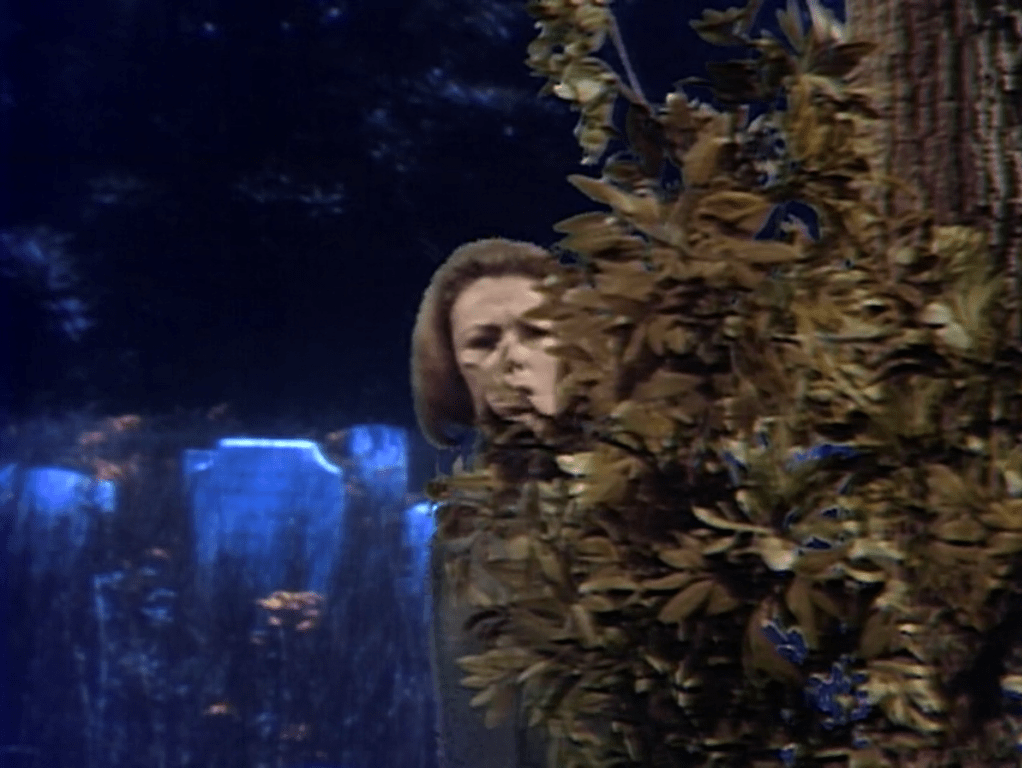
This woman holds a medical doctorate and is qualified in two unrelated specialties.

Barnabas enters the Tomb of the Collinses. Julia confronts him there, insisting he tell her what secret about the place he is keeping from her. He demands that she leave and threatens to kill her if she does not. He tells her that he ought to stash her corpse nearby, “along with”- then interrupts himself. Regular viewers know that Barnabas killed seagoing con man Jason McGuire in #275 and buried him in the secret chamber inside the tomb in #276. Jason has barely been mentioned since, not once in any scene featuring Julia. When she asks Barnabas what he is talking about, he says “Never mind.”

Julia presses Barnabas with “You’ve shared all your other secrets with me. You have no choice but to share this one with me too.” The logic of this statement eludes me, but all Barnabas can do when Julia has made it is to walk backward away from her, staggering into a corner and pouting at her.

Barnabas, stunned by the force of Julia’s reasoning.

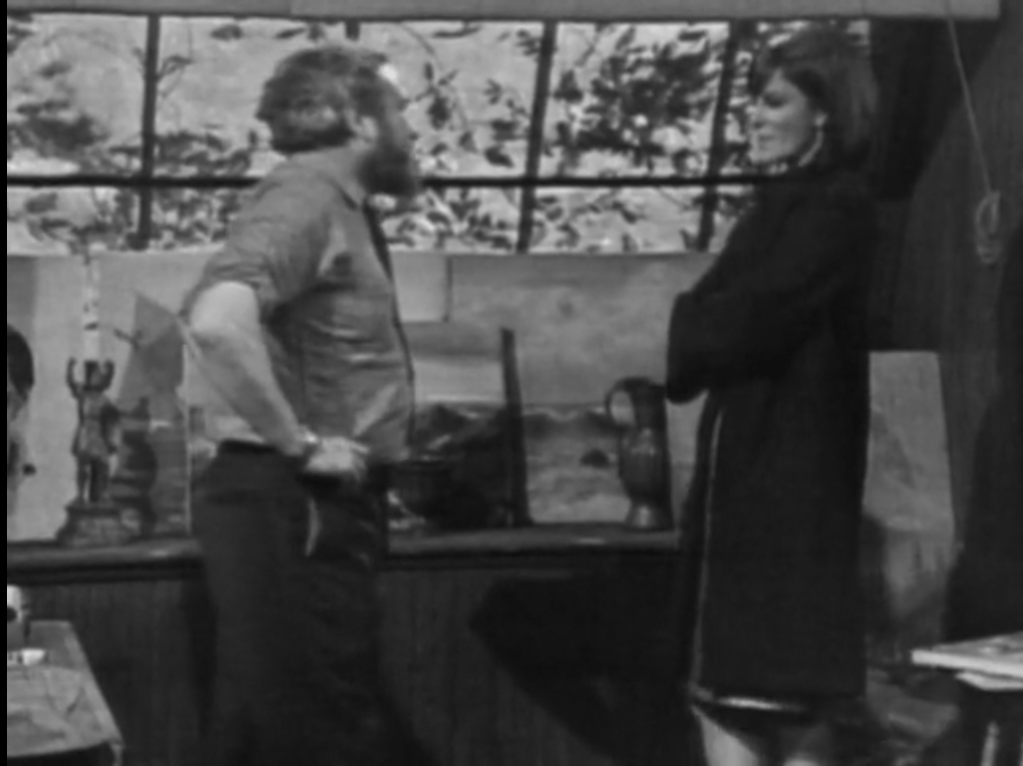
Meanwhile, Sam and Dave are walking through the cemetery.

No, not that Sam and Dave. Local artist Sam Evans and addled quack Dr Dave Woodard have noticed that a series of odd occurrences have taken place in the vicinity of the tomb lately and have come to the cemetery to investigate. They run into the old caretaker, who delays them with his usual warnings about the unquiet spirits of the dead.

Alas, the final appearance of Daniel F. Keyes as the Caretaker.

Back in the tomb, Barnabas is telling Julia everything she wants to know. He lets her into the secret chamber and explains that he was imprisoned there in a coffin for many years, freed only when the luckless Willie Loomis accidentally released him to prey upon the living. Julia listens, showing pity as Barnabas recounts his woes.

Barnabas finds David’s pocket knife, proving that the boy was in the chamber and convincing Barnabas that he must kill him. He takes the knife close to Julia in a gesture that might be threatening, were its blade intact. The broken blade negates the threat and emphasizes Barnabas’ powerlessness before Julia. Since 1967 was the heyday of Freudianism in the USA, it is likely that many in the original audience would have seen it not only as a useless tool, but also as a phallic symbol. As such, not only its brokenness, but also the fact that it was made to be carried by a little boy, would make the point that Barnabas brings no sexual potency to his relationship with Julia. Her own behavior towards him may be childlike, but in her eyes he is a smaller child than she is.

Julia protests, claiming that someone else might have left the knife there. Barnabas dismisses her assertions, but does not regain control of the situation. As they prepare to leave the chamber, he kneels and she stands over him, watching him open the panel.
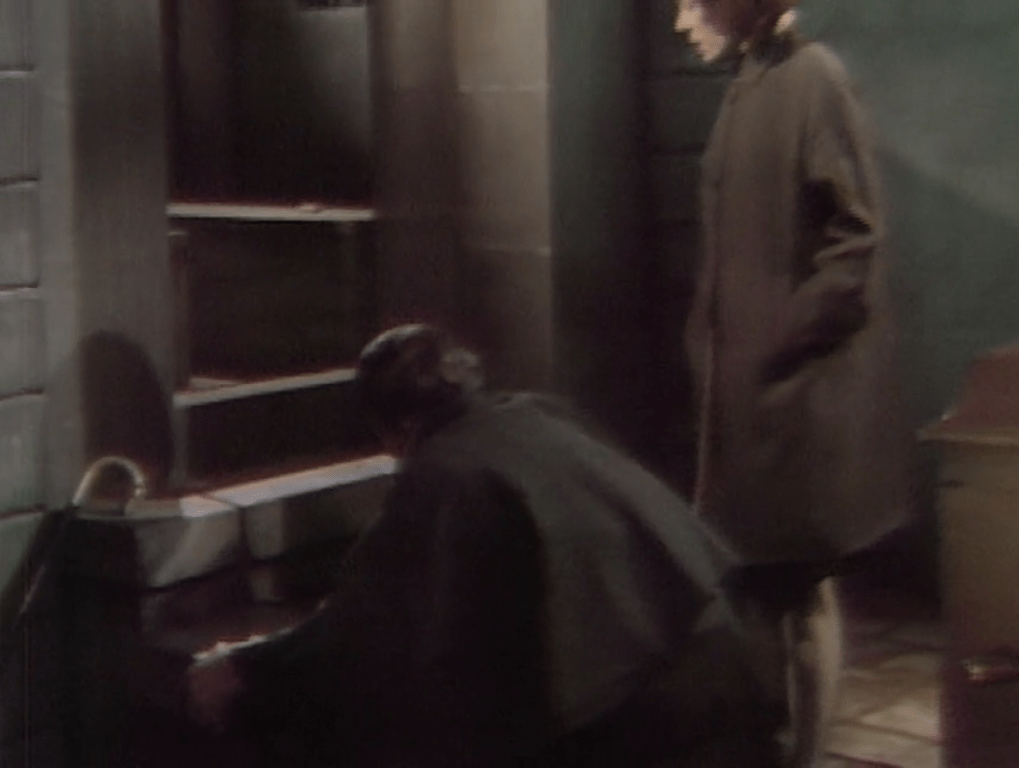
On his knees before her.

They hear Sam and Dave approach. (Still not the cool ones.) They scurry back into the secret chamber, as David had done when he heard Barnabas and Willie approaching the tomb in #310. They listen to the men discuss the facts that have brought them to the tomb, and grow steadily more alarmed as they realize how close they are to discovering Barnabas’ terrible secret.

This is the first episode not to include any actors who were signed to the show at the time production began. The character of Sam Evans was at that time played by a loud man called Mark Allen; Allen’s last episode was #22, taped on 12 July 1966, and David Ford’s first was #35, taped on 29 July. The Caretaker was introduced in #154, Barnabas in #210,* Dave Woodard in #219,** and Julia in #265.

*As the hand of stand-in Alfred Dillay- Jonathan Frid wouldn’t appear until #211. Though the portrait he sat for was on screen in #204, and was identified as that of Barnabas Collins in #205.

**Played by Richard Woods. Robert Gerringer took over the part in #231.
Episode 311: Attached to children

Both Danny Horn and Patrick McCray wrote fine blog posts about this episode. I have a few things to add to what they’ve said.

When vampire Barnabas Collins and his sorely bedraggled blood thrall Willie approach the Tomb of the Collinses, strange and troubled boy David hears them talking about mysterious little girl Sarah. Since Sarah had made him promise to keep her connection to the place secret, he opens the panel to the concealed chamber she had shown him and hides there. To his horror, he hears Barnabas order Willie to open the panel. Still trying to keep Sarah’s secret, he hides in the coffin in the center of the chamber while Willie and Barnabas walk around it. He hears them talk about Barnabas’ relationship with Sarah and Willie’s discomfort with the chamber.

They don’t mention that Barnabas is a vampire, or that he was the one who imprisoned Maggie Evans, The Nicest Girl In Town. But they say enough that David should be able to figure out all of Barnabas’ secrets. Once he has heard Barnabas say that he was left to comfort Sarah after their dog was put down, it isn’t much of a leap to conclude that Sarah is his little sister. And once he’s heard Barnabas ask Willie if he is frightened by the “contents” of the chamber, he should know that there is something in there more than can be seen at a first glance.

In episodes #301 and #306, we were reminded of Jason McGuire, whom Barnabas killed and forced Willie to bury in the floor of this chamber. We also saw the chamber itself in #306, so that regular viewers would be sure to think of Jason’s grave. If David should repeat Barnabas’ comment about the chamber’s “contents” at the right time, Jason might yet be exhumed. So Barnabas has created an extreme danger to himself with his big mouth. Since it does not seem that Dark Shadows could continue if either Barnabas or David were to destroy the other, we are in suspense as to how they will get out of this situation.

After Barnabas and Willie leave, David gets out of the coffin and finds he cannot open the panel from the inside. Willie had used a gadget hidden in the stairs to open it, the first time we have seen this device. As David starts to panic, he hears the strains of Sarah’s signature tune, “London Bridge.” He turns away from the panel, looks at the blank walls of the chamber, and starts calling on Sarah.

In his post, Danny Horn asks “Has David just figured out that Sarah’s a ghost?” I think it’s more complicated than that. In #288, David happily considered the possibility that Sarah might be a ghost, and throughout the series he has been on easy terms with several ghosts. So I think he has assumed she was a ghost all along, and was just too tactful to bring it up when he was talking with her.

Back in the great house of Collinwood, well-meaning governess Vicki is on the terrace, worried about David’s disappearance. Barnabas peeks at her through the gate, as he would do if he were not allowed to look at her. Then he just walks up and starts a conversation with her, leaving us to wonder what the whole peeping-Tom act was about.

Vicki is so concerned for David that she starts crying. Barnabas tells her to put her head on his shoulder, which she does. He seems to be trying to restrain himself, but she has such a long, pretty neck, and it’s right there, and he’s so very thirsty…

Snack time. Screenshot by Dark Shadows Before I Die.

Patrick McCray says of this moment:

As Barnabas lunges in to bite her, my concern and sympathy is challenged as I ponder her almost athletic lack of awareness. Of course, I’ll inevitably side with the person getting her throat ripped out… but it won’t stop me from wondering why she’s practically painting a landing strip on her neck. Vicki? You have a generation of young people idolizing you.

Today, the discussion isn’t even a metaphor. No, she’s not asking for it. No one is. So, what is the message that we’re supposed to take away from a dangerous conversation like this? For a person constantly asking questions about everything — and never understanding what she hears — Vicki is the picture of unawareness. Evil is evil. An attack is an attack. And awareness is power. Ironic that her would-be attacker, Barnabas, is frequently even more unaware than is she. However, if anyone on a soap paid attention at all, the stories would last ten minutes. But that’s the point. The more the characters lack focus, the more we learn its value. David is the most aware character on the show, and in this episode, he learns the most he ever will in one night. Pity it’s from inside a coffin.

That part of the discussion is too much metaphor to ignore.

Patrick McCray, “The Dark Shadows Daybook: August 22,” The Collinsport Historical Society, 22 August 2018.

Again, I think it’s a more complicated. I think we have to analyze Vicki’s behavior at three levels of intentionality. First, there’s the in-universe level, the sort of analysis of her motives another character in the same story might give if they had the same information we do. If that character saw Vicki’s depressing fiancé Burke angrily telling her she was crazy for saying that she had seen and heard things that we have also seen and heard, refusing to give her even the most basic information about himself and airily dismissing her questions as a morbid preoccupation with “the past,” and telling other people that her imagination will “run wild” unless he monitors and controls her, they might very well think that Vicki is tired of Burke’s abusive ways. To that character, there would be nothing “athletic” about Vicki’s failure to suspect Barnabas- it is perfectly natural for her to want to think the best of a man who has always been pleasant and respectful to her, unlike the blatant villain she is supposed to marry.

The second level of intentionality is of Vicki’s usual function in the narrative. Up to this point, every storyline has come to its climax when Vicki found out what was going on. She is still the audience’s main point of view character, and as such she naturally tends towards the center of the action. All of the action lately has been in the vampire story, so we expect her to involve herself deeply in it. In the first weeks, when it was possible that Barnabas, as the second in a parade of supernatural nemeses, would be destroyed and make way for a third as undead fire witch Laura Murdoch Collins had made way for him, we expected Vicki to be the one who drive the stake into his heart. Now that it is clear he is on the show for the long haul, we are expecting Vicki to become his victim, and presumably to become a vampire herself. As the protagonist, she is actively working to get more deeply involved with Barnabas. She hasn’t yet resorted to “painting a landing strip on her neck,” but she did invite herself to spend the night at Barnabas’ house in #285 and #286, and it wasn’t her fault she left in the morning still having all her blood.

Vicki the unappreciated fiancée wants only a friend who will respect her; Vicki the protagonist wants to be part of the main story. The tension between the incompatible goals of these two aspects of Vicki is expressed in the third level of intentionality, which Alexandra Moltke Isles expresses in the choices that make up her performance. Mrs Isles takes every opportunity to show that Vicki is more strongly drawn to Barnabas than to anyone else, most definitely including Burke. That attraction brings the character back to life. After a few days when she was trying to submit to Burke’s abuse and ignore “the past,” Barnabas asks her to intercede with Burke on his behalf and she comes roaring back, an assertive character who will not give an inch even when Burke makes some good points.

It is the sight of this strong Vicki that introduces a conflict into the audience’s feelings. On the one hand, we don’t want to lose her, and if she does not become a vampire, it’s hard to see a future for her on the show. On the other, it would be a terrible betrayal for Barnabas to repay her trust in him by doing such a thing to her. All the more so because we’ve spent so much time seeing Vicki become close to David, and if she follows the pattern set in Bram Stoker’s Dracula, vampire Vicki will be a threat to all children.

Our sadness at that betrayal would be a deep emotion of exactly the kind soap operas are supposed to create. That so shocking a crime would lead to a more meaningful and more suspenseful story and a richer part for our favorite character would guarantee that we would surprise ourselves by forgiving Barnabas for it and cheering when he and Vicki become a couple. So, I think a savvy audience watching Dark Shadows up to this point would have to expect to see just that story play out.

Episode 278: If you become Josette

The first major villain on Dark Shadows was high-born ne’er-do-well Roger Collins, played by Louis Edmonds. Edmonds was a master of the sarcastic remark, so that Roger was often funny. But no matter how often he made the audience laugh, Roger was never a comic villain. That requires a character we can empathize with as we watch them scheme and plot, scramble and improvise, in pursuit of goals that could not be achieved without ruining all the fun. We laugh when we recognize our own foibles in an outlandish character, and laugh again when we realize that our ability to feel with others encompasses even those whose feelings have led them to do dastardly deeds.

Roger’s personality was too cold, his motives too contemptible for us to empathize with him. Where a comic villain thinks fast and puts himself in ridiculous situations, Roger stuck with his fixed ideas, using the same tactics time and again to bully his unwilling co-conspirator Sam to stick with their plan. Even when he bumbled about with a damning piece of evidence, a fountain pen left at a crime scene, he was never the coyote caught in his own over-elaborate trap, but a criminal in a police procedural. He was a melodramatic villain who was only incidentally funny.

The first supernatural menace on the show was Roger’s ex-wife, undead fire witch Laura Murdoch Collins, played by Diana Millay. Millay was hilarious, every bit as funny as Louis Edmonds. It was a shame the two of them didn’t play a married couple in a long-running comedy. They could have raised sarcasm to heights previously unknown to humankind. But while Millay gets laughs every time the script gives her the least chance, Laura was even less of a comic villain than Roger.

It is clear that Laura is a malign presence from beyond the grave and that, if she is not stopped, she will burn her young son David to death. But everything else about her is an impenetrable mystery. She is not part of a familiar mythology, and even the most basic questions about her remain unanswered. We cannot empathize with her motives, since we cannot begin to guess what her motives are or even be sure if she has motives.

The first comic villain on Dark Shadows was seagoing con man Jason McGuire, played by Dennis Patrick. Jason had his first comic turns only after he had been on the show for weeks, during which time we had been subjected to many iterations of a dreary ritual in which he made a demand of reclusive matriarch Liz, Liz resisted, he threatened to expose her terrible secret, and she capitulated. When his henchman Willie slips out of Jason’s control and he starts scrambling to contain the damage Willie is doing to his plan, Patrick finally gets a chance to play Jason as a comic villain, and the result is very engaging. But those scenes are scattered too thinly through Jason’s long-running, relentlessly monotonous storyline to make him a success as a comic villain.

Now, the show has struck gold. Vampire Barnabas Collins is becoming a pop culture phenomenon and bringing the show the first good ratings it has ever had. They have to keep Barnabas on the show indefinitely, and he has to be the most important character. That presents a practical difficulty. Vampires usually figure in folklore and fiction as unstoppable killing machines. Daytime soap operas explore the shifting relationships among large casts of characters. It’s going to be hard to maintain that cast if Barnabas sets about murdering everyone. To square the circle, they try to redefine Barnabas as a comic villain.

Barnabas is giving a costume party for his distant cousins, the living members of the Collins family. He has invited well-meaning governess Vicki to attend and to wear the dress of the legendary Josette Collins. In the first 39 weeks of Dark Shadows, Vicki had developed a close friendship with Josette’s ghost, so she is excited about this. For his part, Barnabas has borrowed an evil scheme from the 1932 film The Mummy. He will erase Vicki’s personality and replace it with Josette’s, then kill her so that she will rise as a vampiric Josette. So he is glad she likes the dress.

Barnabas asks Vicki to come to his house and help him pick out the antique clothes that the family will wear at the party. She enthusiastically agrees, saying that she loves to go through trunks full of old clothes. The clothes are in a trunk in Josette’s old room, which Barnabas has restored.

In the room, we see the ghost of Barnabas’ 9 year old sister Sarah sitting on the trunk. She vanishes a second before Barnabas and Vicki enter. Both of them have a strong feeling that someone just left the room. Barnabas tries to dismiss the sensation as nervousness, but Vicki has had too much experience with ghosts to be put off so easily.

Vicki has been our point of view character for most of the series. At first, that was because she was a newcomer to the great estate of Collinwood and the nearby town of Collinsport, and so we would learn everything we needed to know as we listened to people explain things to her. Later, it was because she was the key protagonist in the stories, so that the action got going once she knew what was going on. So when Barnabas equals Vicki’s sensitivity to Sarah’s presence, he is presented to us as another possible point of view character.

Barnabas keeps talking about the Collinses’ eighteenth century ancestors in terms that make it obvious that he knew them, so that he more than once has to clean up after himself with remarks like “I would imagine.” He does alarm Vicki when he blurts out something about what will happen to her should she “become Josette.” He hastens to say that he means that Vicki will become her for the duration of the party.

“Become Josette?”

Vicki goes back to the great house and talks with Liz about the party. Liz smiles happily, the first time we’ve seen this expression on her face in the whole run of the series.

Happy Liz

Vicki goes on about Barnabas’ connection to the past, saying that he gives the impression of someone who really is misplaced in time. She has the feeling that he needs to recreate a bygone era, and that he is doomed to be unhappy because of the impossibility of traveling backward in time. Vicki does not know what Barnabas’ plans for her are, but she understands his motives perfectly and empathizes with him deeply. That Vicki, Barnabas’ intended victim, can feel this way suggests that we can, too.

Back in Barnabas’ house, Sarah reappears in Josette’s room and sees her blue dress. She is excited to find it. She looks at her reflection in the mirror and smiles. Her good cheer is emphasized when her musical cue, an excerpt from “London Bridge,” is for the first time played in a major key.

Sarah’s reflection looks like it has never seen a ghost before

The minor key was appropriate during Sarah’s previous appearances. The first several times we saw her, Sarah was associated with Barnabas’ imprisonment of Maggie Evans, The Nicest Girl in Town. Maggie was the victim of Barnabas’ first mad attempt at Josettery, and Sarah intervened just in time to keep Barnabas from killing her. The other day, Barnabas killed Jason, and we saw Sarah when Barnabas was forcing Willie to help him hide his old friend’s corpse. Barnabas isn’t killing anyone today, so Sarah can be a bit more cheerful.

Sarah helps to establish Barnabas as a comic villain. As the ghostly sister who returned to the upper world when Barnabas was loosed to prey upon the living, Sarah and he are part of the same eruption from Dark Shadows‘ supernatural back-world into its main continuity. Perhaps she personifies his conscience, certainly she gives him an occasion to make schmaltzy speeches about his days as a human. More important than either of these, when we see that Barnabas’ 9 year old sister is his most powerful adversary, we begin to wonder just how seriously we should take him.

Closing Miscellany

Yesterday and today, Alexandra Moltke Isles delivered the recorded voiceover monologue at the beginning of the episode. The first 270 times she did this, it was in character as Vicki. Now, they’ve given up the idea that Vicki or any other one character will eventually find out about everything that we see on screen, so the openings are delivered by whatever actress is available as a nameless external narrator.

In those first 270 outings, Mrs Isles sounded like Vicki. She adopted Vicki’s distinctive way of speaking, carefully articulating one word at a time and often ending sentences with surprising little inflections- a curl of uncertainty here, a touch of breathy optimism there, a falling note of despair in another place. The voiceovers were usually remarks about the weather or the sea that were supposed to involve some vague metaphor for events in the story, so that it is open to question whether it was really worth Mrs Isles’ time to put so much effort into creating a character with them. But I guess a pro is a pro, and it was a matter of course that she would do her best no matter how little she had to work with.

In these last two, she has used a relatively flat voice, with none of Vicki’s particular vocal traits. The pacing has been structured, not around sentences, but around an attempt to convey an overall sense of urgency. They sound very much like The Narrator. I wonder what Mrs Isles would have made of The Narrator if the voiceover passages had extended beyond the opening moments and run through the episodes.

There is a famous production error under the closing credits, when a stagehand shows up in the window, realizes he’s on camera, and makes himself all the more conspicuous when he tries to escape from his predicament.

From PostImages

Episode 218: Crime encouraged

Three locations on the great estate of Collinwood have featured prominently in two or more storylines on Dark Shadows: the great house, the long-abandoned Old House, and the cottage. The great house is the only permanent set, and is the site of most of the action. The cottage has been vacant since blonde fire witch Laura left the show in March, and came to be so strongly associated with her that it will likely remain vacant until the audience doesn’t expect her to come back. As the abode of ghosts and ghouls, the Old House is likely to become central to the show as it takes its turn to the paranormal. And indeed, in his first full episode, the mysterious Barnabas Collins had gone to the Old House and announced to its invisible occupants that he was claiming it as his own.

The physical condition of the Old House evokes an extinct storyline. When the series began, the Collinses were running out of money, and their vengeful foe Burke Devlin had vowed to use his own great wealth to ruin them completely. Now Burke has lost interest in vengeance, and the business stories have vanished altogether. If we aren’t going to be hearing about the Collinses’ precarious financial position, we won’t be able to explain why they have let a huge mansion on their property go completely to ruin. Even if the locals are too afraid of the place to do any work there, a family rich enough to have a secure grip on the assets we hear about would be rich enough to hire an out-of-town crew to fix the place up, or tear it down, or at least clear it out and seal it off. So the Old House is going to have to be transformed to get the last of the narrative clutter left over from the first 39 weeks out of the way.

Today, Barnabas asks reclusive matriarch Liz and her brother, high-born ne-er-do-well Roger, if they will let him live in the Old House and use his own funds to rehabilitate it. Liz is stunned by the idea and doesn’t know what to say. When Barnabas offers to pay whatever rent they might wish to charge, Roger exclaims that they wouldn’t dream of charging him anything at all. At that, they cut to a startled reaction shot from Liz. Regular viewers will find this reaction hilarious. Liz owns the place; Roger owns nothing and is staying there as her guest. Liz is quite surprised at Roger’s generosity with her property.

Liz reacts to Roger’s generosity with her property

Jonathan Frid is excellent in this scene. Barnabas is at once faultlessly well-mannered and entirely relaxed, gentle with Liz’ unease and warm to Roger’s enthusiasm. Everything they can see suggests to Liz and Roger that Barnabas would be a valuable addition to any household.

We, of course, know that Barnabas is an undead creature released from a coffin to prey upon the living. Watching the scene with that knowledge, we are in suspense as to Barnabas’ intentions. It seems clear that he wants Liz and Roger to like him now and to voluntarily give him what he wants. We do not know if he will go on wanting that for any length of time, nor do we know how he will respond if they oppose him in any substantial way. Because Barnabas stays entirely in character as the human he is pretending to be, we have no clue as to how far the act he is putting on diverges from his true motives. For all we know, Liz and Roger’s oh-so-courtly, oh-so-amiable cousin may be planning their deaths at this very moment.

Before he leaves the house, Barnabas has a conversation with seagoing con man Jason McGuire. Jason is blackmailing Liz, and has forced her to accept him as her house-guest. He is a throwback to an earlier period of the show, an in-betweener brought on the day after Laura left to clear away the last non-paranormal plot elements and to help introduce Barnabas.

Jason is clueless that the show changed its genre from the noirish crime drama it more or less was in the fall of 1966 to the supernatural thriller/ horror story it has been since. That cluelessness was illustrated in the opening of the episode, when he has followed his friend and sometime henchman, the sorely bedraggled Willie Loomis, to the Tomb of the Collinses. He has figured out that Willie tried to rob the graves in the tomb, but cannot imagine what he actually found there. Today, Jason looks around the interior of the tomb, baffled that Willie seems to have disappeared, and wanders off helplessly. Barnabas then appears and watches him go, the future of the show seeing off an emissary from its past.

Jason wants to know more about the legends that Barnabas’ relatives were buried with their jewels, the legends that gave Willie the idea of robbing their graves and thereby led to Barnabas’ release from his coffin. Barnabas tells Jason those legends are false, and rehearses his whole “cousin from England” bit. Not much happens. Still, the conversation is fun to watch, because the actors are both on top of their game and the characters represent different directions Dark Shadows might have taken at different points in its development.

Episode 217: A terrible beating

Dennis Patrick was a fine actor, but so far he has had very little to do as seagoing con man Jason McGuire. Jason’s endlessly repeated blackmail threats against reclusive matriarch Liz are tedious in the extreme, and his attempts to charm others limit Dennis Patrick to the acting choices we might expect Jason to make. Things get livelier when he has to rein in his sidekick, Willie Loomis. Willie was introduced as a dangerously unstable ruffian, and Jason had to scramble to keep up with Willie’s moods. When Jason has to think fast, Patrick has room to maneuver.

Now, Willie is strangely changed. He is ill, and is for a second time a house guest in the great mansion of Collinwood. Flighty heiress Carolyn and well-meaning governess Vicki talk about Willie’s new demeanor, and Carolyn says that it is as if Willie has become another person. Considering that Willie tried to rape each of them the last time he stayed at Collinwood, you might think just about anyone else would represent an improvement, but Carolyn is for some reason distressed.

The episode really belongs to Dennis Patrick. It has never been clear why Jason wanted Willie around, and today there is only one possible answer- he cares about him. Even when Jason has a scene alone with Carolyn and confirms a threat he made a few days ago to make “serious trouble” for her mother Liz if Carolyn didn’t stop asking questions, he never stops being a man concerned for his friend.* It is interesting to see him combine that admirable quality with Jason’s overall rottenness.

Willie is very sick all day, barely able to stay awake, stumbling as soon as he tries to get out of bed. But at nightfall, he seems to gain strength. He hears the sound of a heartbeat. He gets up, goes downstairs, and gets past Jason. We hear a car squeal away while Jason calls after him to come back.

It is unclear whose car this is. The other day Carolyn mentioned “Willie’s car,” but before and after the idea of Willie leaving town had always been mentioned in connection with bus fare. Perhaps we are back to the idea that Willie has a car- he started it so quickly he must have had the keys. Since whatever car it is is parked by the house on what is supposed to be a large estate, its owner may have left the keys on the dashboard, but since Willie seems to have expected to have them it is at least as likely that it is his car and they were in his pocket.

Jason follows Willie to the old cemetery north of town, where he shines a flashlight directly into the camera. Willie disappears into the Tomb of the Collinses, and Jason loses his trail there.

Flashlight halo

*My wife, Mrs Acilius, phrased it this way. She also developed the idea of the episode as a glimpse of a different side of Jason, and called my attention to the phrase “a terrible beating” as the best title for a post about it.

Episode 206: Hey, it’s Big Man

Villains on soap operas can never be quite as destructive as they at first seem they will be, and heroes can never be quite as effective. To catch on, villains and heroes have to seem like they are about to take swift action that will have far-reaching and permanent effects on many characters and storylines. Yet the genre requires stories that go on indefinitely, so that no soap can long accommodate a truly dynamic character.

This point was dramatized in Friday’s episode. The chief villain of the moment, seagoing con man Jason McGuire, stood in front of some candles, placed to make him look like he was the Devil with long, fiery horns. Seconds after this image of Jason, his henchman Willie loses interest in him and wanders off, first listening to a lecture from a nine year old boy, then becoming obsessed with an oil painting. They aren’t making Devils the way they used to.

Jason and Willie look at the portrait of Jeremiah Collins

Today, dashing action hero Burke Devlin goes to the great house of Collinwood and confronts Willie. Well-meaning governess Vicki asks Burke why he wants to defend the ancient and esteemed Collins family from Willie and Jason if the Collinses are his enemies. He gives a flip answer to her, and is equally unable to explain himself to reclusive matriarch Liz. Regular viewers remember that the “Revenge of Burke Devlin” storyline never really led to anything very interesting, and that last week the show formally gave up on it. Without it, Burke has nothing to do. So, if the character can’t keep busy as the Collinses’ nemesis, he may as well try to justify his place in the cast with a turn as their protector.

In the foyer of Collinwood, Burke orders Willie to leave Vicki alone. Willie taunts him, and Burke picks him up and holds him with his back against the great clock. Vicki and Liz become upset, demanding that Burke let Willie go. Willie himself remains collected. After Burke releases him, Willie goes to his room, and the ladies scold Burke further. He doesn’t appear to have accomplished a thing.

Willie, off his feet but undisturbed

This is John Karlen’s first episode as Willie Loomis. His interpretation of the character is poles apart from that of James Hall, who played Willie in his previous five appearances. When I was trying to get screenshots to illustrate the moods of Hall’s Willie, I found that I had an extremely difficult task on my hands. His face would fluctuate wildly, showing a mask of calculated menace for a few seconds, then a flash of white-hot rage for a tenth of a second, then sinking into utter depression for a moment before turning to a nasty sneer. These expressions followed each other in such rapid succession it was almost impossible to catch the one I set out to get. The overall impression Hall creates is of a man driven by desperate, unreasoning emotions, lashing out in violence at everyone around him because of the chaos inside himself.

Karlen’s Willie is just as dangerous as Hall’s, but he is as composed as Hall’s Willie was frantic. At rise, he is staring at the portrait of Barnabas Collins, studying the baubles Barnabas is wearing. When housekeeper Mrs Johnson enters, Willie asks her about the Collins family jewels. When she uncharacteristically manages to be less than totally indiscreet, he shows considerably more cleverness and infinitely more calmness than Hall’s Willie ever did in maneuvering her to the subject again. If Hall’s Willie was a rabid dog charging heedless in every direction, Karlen’s is a deliberate hunter, acting coolly and undaunted by resistance.

Hall played Willie with a lighter Mississippi accent than he uses in real life, while the Brooklyn-born Karlen assumes a vaguely Southern accent in parts of this episode. That trace of Hall’s influence will remain for some months- eventually Willie will become a Brooklynite, but between now and then Karlen’s accent will go to some pretty weird places.

This was also the first episode of Dark Shadows which ABC suggested its affiliates broadcast at 3:30 PM. It would not return to 4:00 until 15 July 1968. When the core demographic of the show’s audience shifts from housewives and the chronically ill to school-age kids, as will happen quite soon, this earlier time slot will present a major problem. Those kids are now in their 60s, and they usually begin their reminiscences of Dark Shadows with “I used to run home from school to see it!” If school let out at 3:00 and the TV set at home took as long to warm up as most of them did in those days, you’d have to run pretty fast to be sure to catch the opening teaser even if you lived nearby.

Episode 195: It looked pretty dead to me

In Dark Shadows Version 1.0, well-meaning governess Vicki represents our point-of-view. In the 1930s and 40s, radio soap operas would often have a character to whom they would assign that role, one person to whom everything has to be explained so that the audience can be brought into the story. That may have worked on a show in a 15 minute time slot, but it’s a stretch to build a 30 minute daily drama around one character, and today’s hour-long daytime serials couldn’t possibly keep one person on the spot the whole time. In part, that’s because you’d wear the actor out. More importantly, it’s because soap operas are usually about abruptly disclosing secrets to the audience and gradually leaking them out to the characters. A character who has no secrets from the audience can’t generate that kind of action, and will sooner or later turn into dead wood.

Today, we start with reclusive matriarch Liz recruiting Vicki to help her keep one of her secrets. Vicki found Liz in the basement late last night, a fact which Liz has made her promise she will not share with anyone. Vicki does not see why anyone should care whether Liz goes into the basement of her own house at night or any other time, and indeed no one does care. But Liz insists she keep quiet about it, and when Liz’ daughter Carolyn mentions having heard her up in the middle of the night, she makes Vicki lie and say that she was the one who was up.

Since Vicki can have no secrets from us, she cannot be particularly good at keeping secrets from the other characters. If she were able to tell a convincing lie, a person just tuning in to the show might be deceived by Vicki. She has tried her hand at lying a few times so far, always with disastrous results when the lie immediately collapsed. This time, Carolyn doesn’t catch on, and there don’t seem to be any ill effects, but that’s just because it’s a topic Carolyn doesn’t care about. Vicki changes her whole demeanor when she’s getting ready to tell these lies, stiffening her spine, plastering on a smile, and speaking a little bit too loudly. On previous occasions she had different tells, looking down and taking a breath before she speaks, or looking around and stammering while she speaks, etc. A supercut of those scenes might serve as a catalog of the various types of inept liars. Alexandra Moltke Isles renders each type convincingly enough that such a video could be useful to students of acting, of psychology, and of poker. But it would also show why Vicki is facing a limited future as a soap opera character.

We’re supposed to be saddened that Vicki has had to damage her friendship with Carolyn by lying to her, but I was on Liz’ side, rooting for the lie to work and Carolyn to stop asking questions. Otherwise, we’ll have to hear more about Liz’ attitude towards her basement, and that is such a stupefyingly dull topic it makes us yearn for the days when they spent 21 episodes showing people wondering where Burke Devlin’s fountain pen might be. Besides, Liz is an accomplished liar. If Vicki can study under her and learn her skills, she might be able to continue as a major character.

While Vicki is struggling with the rules of the genre in which she exists, another character is comfortably embodying one of the most familiar stock figures of soapdom. That’s Jason McGuire, a con man who has a history with the matriarch of the powerful family. He’s in the restaurant at the Collinsport Inn having a breezy chat across the counter with Maggie, The Nicest Girl in Town, who is impressed by his habit of putting lemon peel in his coffee. Hey, you work for tips, you find ways to be impressed by the customers.

Vicki comes into the restaurant and chats with Maggie about Liz’ recovery from the mysterious illness that recently put her in the hospital. Overhearing Liz’ name, Jason sidles up to Vicki and questions her about the residents of the great house at Collinwood. He won’t give Vicki his name, but gets her to tell him about everyone who lives there. She describes her own duties as “governess… companion… tutor,” to which Jason replies that she sounds busy.

Coupled with the fact that we first saw her today sorting Liz’ mail, the word “companion” suggests that the show is changing Vicki’s job so that she will be the first involved, not only in stories that center on strange and troubled boy David, but also in those centering on Liz. That’s promising- not only would it give Vicki a chance to learn how to lie, but it also suggests that they might have figured out how to mirror the one consistently interesting relationship on the show so far, that between Vicki and David. Perhaps it will be as much fun to watch Vicki as Liz’ pupil as it has been to watch David as Vicki’s.

After Jason questions her, he tells Vicki that he will definitely be seeing her again soon. He then leaves, still not having told her his name. Vicki asks Maggie who he is. She tells Maggie that Jason made her uncomfortable with his questions about the residents of Collinwood, and that the theme of those questions was “not so much how they are… as where they are.” Dark Shadows has been heavy with recapping, but this may be the first example of a conversation in which two characters recap the conversation immediately preceding it, without even a commercial break in between.

Back at Collinwood, a knock sounds at the front door. Carolyn comes downstairs to answer it. As she does so, we see a mirror in a spot by the door. For some time, the mirror has been alternating on that spot with a metallic decoration. We saw the metallic decoration most recently, but now the mirror is back.

Carolyn opens the door to find Jason. He claims to be an old acquaintance of the family, but refuses to give his name. Carolyn eventually gives in and admits him to the house. While Jason is saying that nothing in the house has changed in many years, the mirror is filled with the reflection of a portrait. When we were watching the episode, this brief glimpse led us to believe that the mirror had been replaced with a portrait. We haven’t seen this effect before, and it is so striking that it is hard to believe it was an accident. Indeed, precisely the same image will be used under the closing credits of an episode coming up four years from now, suggesting that it is something they’ve given a great deal of thought.

The portrait by the door

In the drawing room, Jason continues to withhold his name, telling Carolyn that he doesn’t want to spoil the surprise he has in store for her mother. He charms Carolyn with his claims to have gone ten times each to Hong Kong, Naples, Madagascar,* and every other place that pleased him the first nine times he visited.

When Liz comes downstairs, Carolyn tells her that an old acquaintance of hers is waiting to see her. Liz smiles at this news, but when she sees Jason her expression turns to one of utter despair.

*In 139, David’s mother, blonde fire witch Laura Murdoch Collins, mentioned that when he was a little boy he was interested in Madagascar. When Carolyn brings up Madagascar today, we wonder if the Collinses have some connection to the island.

Episode 193: Portia Fitzsimmons

Drunken artist Sam Evans receives an unexpected visitor to his cottage. She is famed art dealer Portia Fitzsimmons, and she is magnificent.

Mrs Fitzsimmons, as she insists on being addressed, was in a junk shop earlier this week, where she found two of Sam’s paintings available to buyers of the frames they were in. The paintings were done ten or twelve years ago, and she declares that they are in a style that will soon become fashionable. If Sam can come up with a dozen more canvases from that period, he will have a one-man show at her gallery, and he will become famous. With that fame, he may even be able to sell some of his newer paintings, countless of which have been collecting dust around the cottage for years on end.

This was the very first scene of Dark Shadows I ever saw. I’d heard of the show when I was a boy in the late 70s and my mother was watching whatever daytime soap she was into. I heard her say something like, “Ooh, they’re going to turn into Dark Shadows.” I asked her what Dark Shadows was, and she explained that it was a soap opera that had been on about ten years before which introduced a vampire as one of the regular characters. At that age, I thought of soaps as the dullest thing in the world. I wasn’t particularly into vampires, but they were obviously too interesting for the televised sleeping pills that beamed into our living room for an hour every afternoon, so I followed up with some more questions. She had never watched the show, so all she could tell me was that it started as a more or less conventional daytime serial, added a vampire, and became a hit.

When the 90s came along and I got cable TV in my apartment, that was still all I knew about it. So when I saw that the Sci-Fi Channel* was showing Dark Shadows, I decided to take a look. There is no suggestion of vampires in this one, but Portia Fitzsimmons is such a dynamic character that I could see that the show was capable of being pretty lively without them.

Actress Lovelady Powell has two physical abilities that enable her to give us something fresh to look at every second the camera is on her. First is her remarkably mobile face. Her left eyelid alone is capable of a wider variety of expressions than most performers can produce with their entire physiognomy. Since it is her left eye that is focused on Sam throughout the scene, that eyelid is going to be the crucial body part in her delineation of their relationship, but she uses it with remarkable facility. Focus on her left eyelid in these three images, and see how it does most of the work in taking her in a few seconds from delighted to dismayed to dismissive:

Delighted
Dismayed
Dismissive

Those three images show a major shift in mood. The same eyelid can also modulate finer shades of feeling. In this sequence a few moments later, the left eye is partially obscured, but still shows precisely what is going on when Mrs Fitzsimmons gives Sam his marching orders:

Laying down the law
Letting it sink in
Adding emphasis
Observing Sam’s reaction
Confirming Sam in his reaction
Making up her mind about Sam

Powell not only made excellent use of the fine muscles of her face, but of her limbs as well. So her second strength is her style of movement. She walks around the set continually, making many wide, sweeping gestures. If those seemed to be a number of distinct motions, she would be a hectic, distracting presence. But in fact, it all comes together as an uninterrupted flow, and defines the entire performance space in terms of her action and her presence. This is difficult to illustrate with still images, but if you look at how she uses her elbows in this sequence I think you’ll get the idea:

Maximum distance
Approaching
Arrival
Starting to unbend

I think an actor could watch this scene a dozen times and learn new things from every viewing.

All these techniques for establishing visual dominance pay off in the scene. Sam is an artist who has so utterly despaired of finding an audience for his art that it simply does not register with him that a famous art dealer has come calling. Returning viewers will remember that Sam has been moping around feeling sorry for himself since his first appearance in episode 5. Two weeks ago, in #184, he told his daughter Maggie that it was too late for him ever to have a one-man show and that all he could ever hope for was to sell a few paintings to tourists every summer. Within minutes, Mrs Fitzsimmons has changed all of that. She watches Sam’s reactions as she turns his life upside down, and visibly calculates the particular sort of flourish with which she will deliver each of her lines. When he tells her that he thinks he will be able to assemble enough paintings within a week, she stands in the doorway and replies that she is sure he will be able to do it then, “if you can do it at all.” She then pirouettes away and wafts off whence she came.

When I first saw the scene, I wondered how big a part Mrs Fitzsimmons would play in the storylines to come. I still remember seeing the name “Lovelady Powell” in the closing credits. With my work schedule at the time, I didn’t have a chance to see another episode for months, and when I did join it again there was no sign of Portia Fitzsimmons. I assumed she’d been written out, perhaps to return in some later narrative arc, perhaps because Lovelady Powell had gone on to bigger things. It came as quite a surprise to learn that this was her only appearance on Dark Shadows, and that her acting career never really took off.

Now that I’m on my second complete viewing of the series, it’s an even bigger surprise. The portraits of the ancestors of the ancient and esteemed Collins family are among the most prominent visual features of the chief sets, those representing the great house of Collinwood. Portraits there and elsewhere, including in the long-abandoned Old House at Collinwood and in the Evans cottage, have repeatedly been shown to have supernatural power, representing a bridge between the world of the living and that of the dead.

Further, every storyline that has been resolved so far has centered on strange and troubled boy David Collins. The show has gone out of its way to show that David has promise as an artist. David Collins is nine, and actor David Henesy turned ten in October of 1966, but the character is unusual enough and the actor is sophisticated enough that it would be interesting to see David interact with the grand dame of the New York art world.

An art connoisseur is therefore as well-positioned as anyone to act as a guide to the uncanny realms into which the show will be venturing from now on. Combining Portia Fitzsimmons’ claim to expertise with her imperious personality and Lovelady Powell’s sophisticated acting style, you’d have a character who could carry us right through the whole series. The producers will be hard-pressed to find another actress who can play as worldly and forceful a Vergil to the various Dantes who will be exploring Collinwood’s weird infernos.

Sam’s reaction to Portia Fitzsimmons’ command that he bring her a dozen canvases that he painted ten or twelve years ago puzzled me on my first viewing, and puzzles me in a different way now. The only group of works that fill that bill are in the possession of high-born ne’er-do-well Roger Collins. Sam sold them to Roger ten years ago for $15,000. Roger likes money, a point made clear in his scene with Sam today. If Sam simply telephoned Roger and told him that the famous Portia Fitzsimmons wants to show the paintings in her gallery and sell them at a great profit to Roger, no doubt he would be eager to find them and make the deal.

Sam does not do anything so straightforward. Instead, he visits Roger at Collinwood. Roger responds to his presence by railing at him, declaring that he never wants to see him in the house and wants him to leave immediately. Sam then insists that Roger give him the paintings. When Roger asks why, Sam denies that any part of the $15,000 was a payment for the paintings. He starts to explain that it was hush money Roger gave Sam to ensure he kept a secret Roger wants withheld from dashing action hero Burke Devlin.** Roger looks around in terror when Sam starts talking about the secret, then orders him never to speak of the matter again. Sam says he will tell Burke all about it unless Roger produces the paintings. Roger dismisses Sam’s threat, but does offer to sell him the paintings for $50,000, unless it turns out that he destroyed them or lost them somewhere along the way.

Now that I’ve seen episodes 1-192 a couple of times, I know that Sam hates Roger, hates himself for taking Roger’s money and betraying Burke, and wants to start a new life in which Roger will have no part. But his undisguised attempt to blackmail Roger into handing over the paintings isn’t really in character for Sam. His tortured conscience has hobbled Sam time and again in his attempts to stand up to Roger. Besides, Sam just had a harrowing encounter with the supernatural in the form of Roger’s estranged wife, blonde fire witch Laura Collins, and that experience seemed like it would make him a kinder and more thoughtful man. That his first act after emerging from it is to commit an out-and-out felony is a disappointment to me.

My wife, Mrs Acilius, wasn’t disappointed. She likes the scenes when Sam is sober enough to stand up to Roger, and she sees this as one of the strongest of those. While she acknowledges that Sam is not being rational, she cheers for his desire to press to the hilt his advantage over the rich so-and-so who has been a blight on his existence for so long.

In the local tavern, The Blue Whale, Maggie Evans is having a drink with her boyfriend, hardworking young fisherman Joe. The camera focuses on a man in a seaman’s coat and captain’s hat sitting at the bar, eavesdropping on their conversation. When they mention Collinwood and reclusive matriarch Liz, the sailor perks up and approaches them.

He apologizes for listening to their conversation, but goes on to ask a series of questions about its content. When Joe makes it clear he does not welcome the intrusion, he apologizes again, while in the act of sitting down with them. When they are finally getting rid of him, he says that it is terribly sad that Liz never leaves her home, and while speaking of that terrible sadness flashes a huge grin. He gives his name as Jason McGuire.

So we are introduced to a second new character in this episode. This one is apparently going to get some kind of storyline started. The actor is talented and the scene has some good things in it, but Jason McGuire is no Portia Fitzsimmons.

*As it then was known.

**A sketch of Burke is on display in Sam’s cottage today. The Dark Shadows wiki speaks with the voice of fans everywhere when it says that Sam tore up a sketch of Burke in #41 and therefore should not have this item now. But Sam made that sketch as part of his preparation for painting a full portrait of Burke. Artists make more than one sketch when they are getting ready for a major painting, so the fact that Sam tore up one sketch doesn’t mean that he doesn’t have any number of others lying around.

A story idea: Adam in New York

In 281 of the posts that follow, I link to comments I made on Danny Horn’s “Dark Shadows Every Day.”

In a number of these comments, I explained particular ways I had of correcting Dark Shadows in my head while I watched it. I rarely bothered telling people about times when I didn’t notice bloopers because I had put the words in the right order while hearing them, or other small corrections. I did mention times when I thought out major changes. Many of those changes could only be called fanfic.

Perhaps the most ambitious piece of fanfic I shared there, and certainly the longest, was my response to the show’s failure to resolve the story of Adam, the Frankenstein’s monster-like creature. My idea, if presented at the right time, would also have tied up the show’s most embarrassing loose end:

Here’s an idea I had today for a story that would save Vicki.

It would be a TV movie airing late in 1969. Start with a prologue set in Collinwood at that time. Adam returns, looking for Barnabas and Julia. He’s very well-spoken and accomplished now, but still socially awkward, still prone to fits of anger, and in need of help to get papers that he needs to establish a legal identity.

He finds that Barnabas and Julia are gone. He also happens upon some mumbo-jumbo that dislocates him in time and space.

It plops him down in NYC in 1945. With his facial scars, everyone assumes he’s a returning GI injured in the war. He meets a young woman, supporting herself by work at a magazine about handheld machines, trying to establish independence from her wealthy family back in Maine. This woman, played by Alexandra Moltke Isles, is Elizabeth [Collins.]*

Adam and Elizabeth slide into a love affair. She has another boyfriend, a dashing young naval officer named Paul Stoddard. Elizabeth is frustrated with both Adam and Paul; Adam refuses to talk about his background, and while Paul says many words when asked about himself, he doesn’t really give significantly more information than Adam does. Paul is slick, charming, and familiar with all the most fashionable night spots, but he does show signs of a nasty side. Besides, he rooms with a disreputable young sailor named Jason McGuire who keeps turning up at the most disconcerting moments.

For his part, Adam is sincere, passionate, and attentive, but given to quick flashes of anger. He’s just as quick to apologize and sometimes blubbers like a giant baby with remorse for his harsh words, but he’s so big and so strong that when he is carried away in his fits of anger Elizabeth can’t help but be afraid of him. Besides, he’s not a lot of fun on a Saturday night. He doesn’t have a nickel to his name, and his idea of an exciting weekend is an impromptu seminar on Freud’s TOTEM AND TABOO, followed by a couple of games of chess.

Elizabeth’s mother, played by Joan Bennett, comes to town. Mrs Collins is appalled by Adam’s scars, impatient with his refusal to discuss his background, and contemptuous of his obvious poverty. Paul’s effortless charm and sparkling wit, packaged in the naval dress uniform he makes sure he’s wearing when she first sees him, fit far more tidily into her vision of a son-in-law. Mrs Collins presses her daughter to spurn Adam and pursue Paul, and for a time Elizabeth tries to comply with her wishes.

Yet she cannot forget Adam. Paul realizes this, and sees his chance at an easy life slipping away. We see him in a dive in Greenwich Village telling Jason McGuire that Elizabeth and her inheritance are going to end up with the scar-faced scholar. He and McGuire review Adam’s weaknesses, and decide they can exploit Elizabeth’s concern about his temper. They trick her into believing that Adam is on the run from the law, having beaten his wife to death. They lead her to believe that it’s just a matter of time before his occasional verbal outbursts give way to physical abuse, and that when that happens it will be too late- he will kill her. Believing this, Elizabeth gives Paul another chance, but still cannot break things off with Adam.

Adam does not know what Paul and Jason have led Elizabeth to believe. He knows only that she has become distant from him, and that she is still seeing Paul. He becomes angry and shouts at Elizabeth. He reaches for an object; she believes it is a blunt instrument with which he will kill her. In a moment of panic, she grabs a gun she has been studying for an article the magazine has assigned her to write and shoots him. As he lies motionless on her floor, she discovers that he wasn’t reaching for a weapon at all- he was reaching for a love letter that he had written to her. She realizes that he was no threat to her, that she has shot him for no reason.

She flees to Paul and Jason’s apartment, telling them that she has killed Adam. Paul calms her and promises to take care of matters so that she will not be suspected of any crime. Paul and Jason go to her apartment and find it empty. There are bloodstains on the carpet where Adam fell, and a trail of bloodstains leading down the hallway out the front door. They follow the stains and find Adam nursing a serious, but clearly not fatal, wound. They lead Adam back to Elizabeth’s apartment. They draw on their naval training to remove the bullet, clean and dress the wound. After a conversation. Adam admits that there is no point in his pursuing Elizabeth, and he agrees to leave town. Paul gives Adam some money and promises to tell Elizabeth that he is all right and that he doesn’t hold a grudge. Adam shakes Paul’s hand and leaves.

Paul and Jason clean the bloodstains. They then return to their own apartment. On the way they exchange a look that begins as nervous, and ends with two broad grins. Elizabeth asks why they were away so long. They tell her that it takes quite a while to dispose of a corpse. She sobs. Paul holds her.

Paul and Elizabeth announce their engagement. A few weeks later, the doctor informs Elizabeth that she is pregnant. The child must be Adam’s. Paul is not interested in raising any child, and certainly not interested in splitting the estate with a child not even his own. He orders Elizabeth to give the baby up. She refuses. He points out that she wouldn’t be able to do much mothering if she were in prison for murder. She sobs. In the final scene, we see Elizabeth outside on a snowy day, holding a basket and writing a note. In voiceover, we hear the contents of the note: “Her name is Victoria. I cannot take care of her.”

*Originally I wrote “Stoddard” here.

Episode 587: In Which I Just Can’t Even With This

A story idea of mine which, done as a TV movie in late 1968, might have saved Vicki as a character, resolved the mystery of her origins, and given Adam an appropriate send-off. 

Episode 587: In Which I Just Can’t Even With This