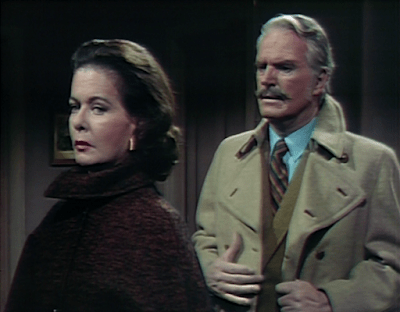
Episode 916: Julia Hoffman has had her dream

Certain People

Six weeks ago, old world gentleman Barnabas Collins was absorbed into a group serving supernatural beings known as the Leviathans. Also in the group is matriarch Elizabeth Collins Stoddard. Barnabas and Liz are worried that mad scientist Julia Hoffman, Barnabas’ sometime best friend and Liz’ permanent houseguest, is catching on to the truth about their group. They decide Julia must be absorbed into it.

Barnabas finds Julia on a couch in the drawing room, reading a book about lycanthropy. He strikes up a conversation about Chris Jennings, a young man who suffers from that condition. Julia replies bitterly that she still cares about Chris, unlike Barnabas. He tells her that he does care, and they quarrel a bit. He then strokes Julia’s cheek. He did the same thing with Chris’ little sister Amy in #912, at which point Amy fell asleep. Shortly after Amy woke up, she had become part of the Leviathan group. Julia gets a headache and goes to her room, where she does fall asleep.

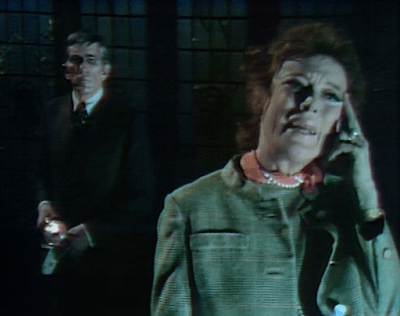
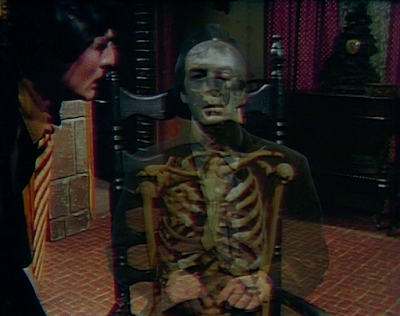
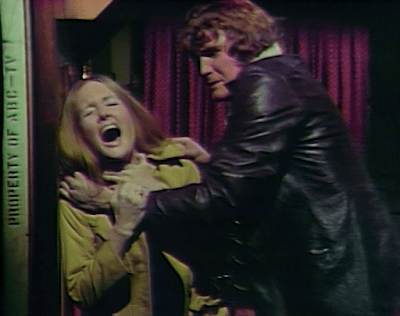
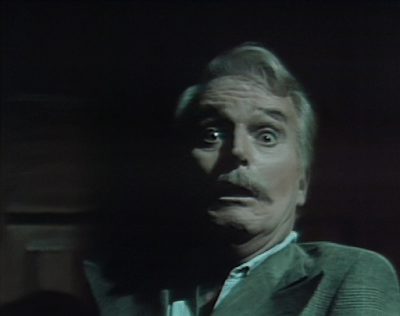
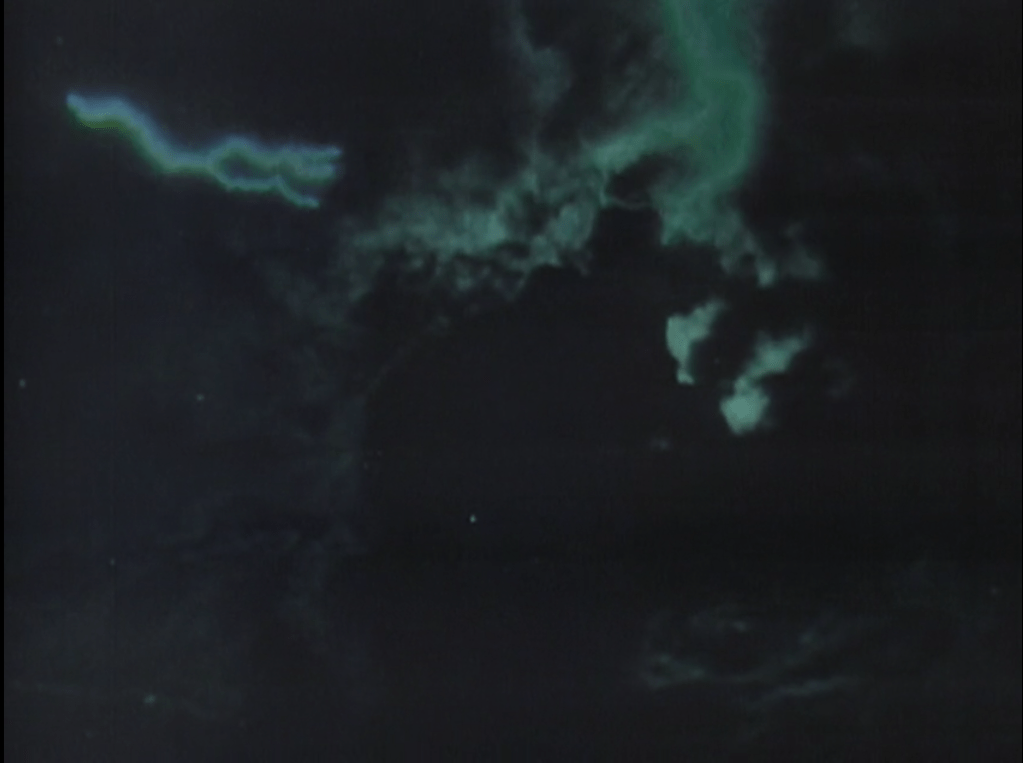
We didn’t see a dream sequence when Amy fell asleep, but do see one for Julia today. The visuals alternate between two stock clips of lightning flashes as we hear Jonathan Frid give a dramatic reading of some portentous nonsense, then give way to Julia finding Barnabas in the drawing room inviting her to open a wooden box. We saw a dream of Liz’ in #904; she woke from it already transformed into a faithful devotee of the Leviathans. But when Julia wakes up, she just has a worse headache.

They’ve shown us this clip more times than I can count…
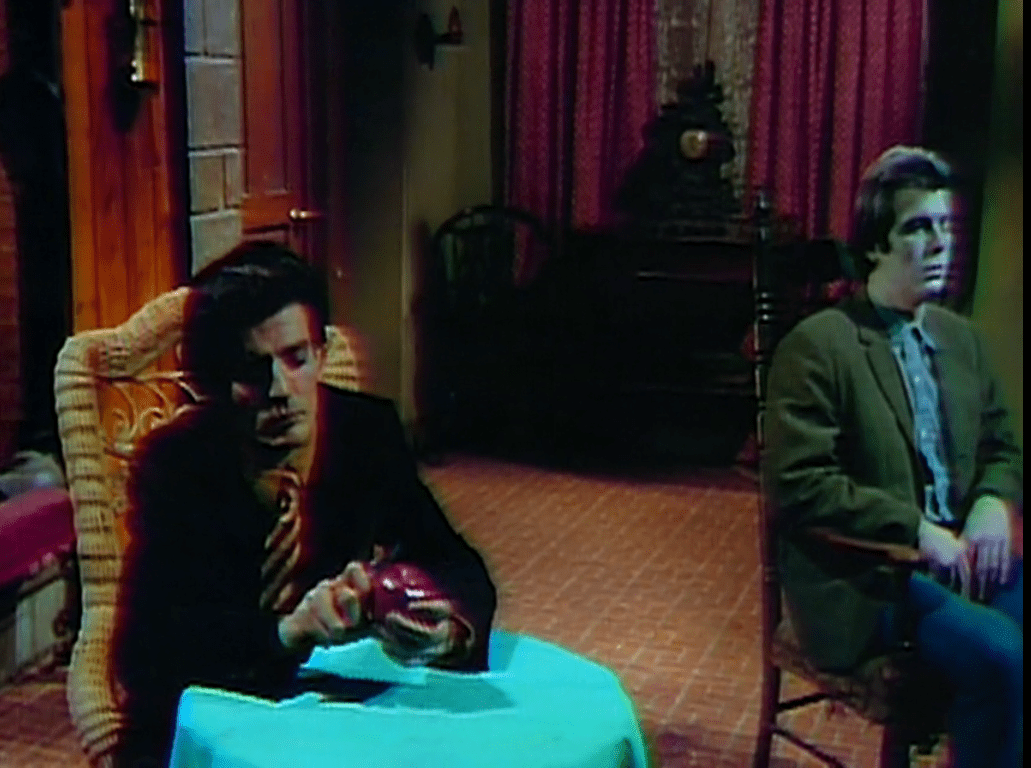
… but I don’t think we’ve seen this one before. It’s fascinating to me, like an image David Lynch would have used in Eraserhead or the third season of Twin Peaks.

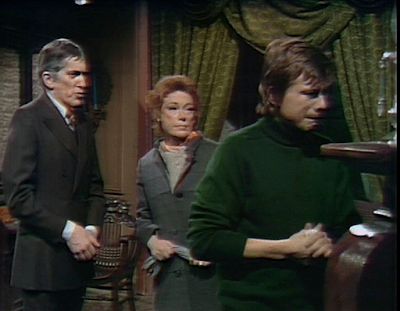
Julia goes downstairs and find Liz holding the box from her dream. She is urging her to open it. Julia is confused by the situation. A knock comes at the door, and she rushes to answer it. It is Chris, saying that it is time for Julia to drive him to the institution where he is locked up on nights of the full moon. Julia calls back to Liz that she will be back later in the evening.

Barnabas enters and says that Julia will never be absorbed into the cult. If she were suited for absorption, the knock at the door would not have distracted her. He explains that “There are certain people, Elizabeth, whom we are not able to absorb. It has to do with their genetic structure. And Julia Hoffman is one of them.” As a former vampire who is now leading a cult that is trying to bring a race of Elder Gods back into the world where they will destroy and replace humankind, Barnabas is supposed to be strange and unnerving, but hearing him talk about “certain people” and their “genetic structure” is off-putting in a whole other way. Why not just say that she’s Jewish, we know you mean that she’s Jewish.

Barnabas then tells Liz that it is now up to her to handle Julia. So far as we know, Liz does not have any special powers like those Barnabas uses when he fondles people’s faces. Liz doesn’t even know what the cult is all about- today, she asks Barnabas what the goal is they are working for, and he tells her he isn’t at liberty to say. So when Barnabas tells her to deal with Julia, we can only remember the last time we saw Joan Bennett playing a character under the control of an uncanny force, when Judith Collins shot and killed neurotic intellectual Rachel Drummond on the orders of vampire Dirk Wilkins in #776.

In #915, one Leviathan ordered Barnabas to kill Julia. When he refused, another caused him to have nightmares, then told him it was OK to leave Julia alive if he could find another way to keep her under control. That episode was written hurriedly and rushed into production at the last minute, three full weeks after this one was in the can, in response to complaints from fans dissatisfied with the Leviathan story in general and Barnabas’ coldness to Julia in particular. It’s anybody’s guess what they were originally planning to do with #915, but today’s episode makes it clear that it did not include the reset of Barnabas’ character that we saw yesterday. He is still leading the Leviathans, and when he delegates the problem to Liz murdering Julia is pretty obviously the likeliest solution.

Not a Portrait of Quentin Collins

Julia’s plan for Chris is to persuade an artist named Charles Delaware Tate to paint a portrait of him. Tate painted a portrait of Chris’ great-grandfather, Quentin Collins, in 1897. That portrait had magical powers. Once it was painted, Quentin’s own werewolf curse went into abeyance. It was the portrait that transformed on nights of the full moon, while Quentin himself remained human. Indeed, the portrait also caused Quentin to remain young and healthy. He returned to Collinsport a couple of weeks ago, and though he is 99 years old he still looks just like he did when he was 28. In #913/ 914, Julia found that Tate, also, is alive, and still looks like he did in 1897.

Quentin and Tate are not the only emigrés from 1897 currently sheltering in Collinsport. Another of Tate’s magical portraits, a concept piece depicting his ideal woman, caused its subject to pop into existence. In 1897, she went by the name Amanda Harris, met Quentin, and fell in love with him. She, too, is unchanged in 1969, though she now calls herself Olivia Corey.

Amanda/ Olivia and Julia are both hunting for paintings by Tate, and met each other through that pursuit. They have also met Quentin, and vied with each other to decide which would be the one to keep him. He has amnesia and knows only that he was carrying papers identifying him as Grant Douglas. He is open to the idea that this is not his real name, but he finds Julia’s attempt to convince him that he is a 99 year old man ludicrous and is frustrated with Amanda/ Olivia’s unwillingness to tell him when and where they first met.

Amanda/ Olivia comes back to her suite at the Collinsport Inn and finds Quentin there, swilling her booze and enormously drunk. He tells her that he finds his room depressing, because it doesn’t have a bar. He says he can’t stand not knowing who he is. She points out that he has taken this in his stride up to now, and asks why today is different. He says he doesn’t know why it is different, but it very much is. When the show was a costume drama set in 1897 and we saw Amanda, she did not know about Quentin’s lycanthropy, and now that she calls herself Olivia she still does not think of the full moon when she sees him in anguish.

Later, Julia shows up at Amanda/ Olivia’s door. She has brought one of Tate’s portraits of Amanda Harris. Amanda/ Olivia staggers back at the sight of it. She composes herself and says that it is of no interest to her, since she already has several of Tate’s paintings of her “grandmother.” Julia tells Amanda/ Olivia that the real reason she is not interested in it is that it is not a portrait of Quentin Collins. She replies that Julia is the one who is fascinated by Quentin, not she. Julia says that she wants to show the portrait to Quentin. Amanda/ Olivia does not bother pretending that his name is “Grant Douglas” or that it might be something other than “Quentin Collins”; she simply tells Julia that he is in his room sleeping off an alcoholic binge. Julia adopts her most unmistakably Mad Scientist manner when she responds “Then this is definitely the right time to see him!” She marches out, and Amanda/ Olivia follows her.

Julia had told Chris that if Quentin’s portrait has been destroyed, his lycanthropy will be back in force. If that is so, she wants to be with him when he transforms. This was a doubly confusing thing to say. First, if the portrait had been destroyed, Quentin would not only be a werewolf, he would also look his age. She therefore knows it is not so. Second, she does not have anything with her to protect her against werewolves. If she is with Quentin when he transforms, he will kill her immediately.

When Julia and Amanda/ Olivia let themselves into Quentin’s room, they find that it is a shambles and he is gone. As a closing cliffhanger, this is supposed to leave us with the fear that a werewolf is stalking Collinsport. But since we know what the portrait does for Quentin, it only leaves us wondering if Amanda/ Olivia will have to pay an extra housekeeping charge because he trashed the room she was renting for him.

When Julia met Tate in #913/914, she could not get him to engage her in any kind of conversation, much less agree to paint a portrait of Chris. She did not mention Amanda/ Olivia. Since Tate was maniacally obsessed with Amanda in 1897, Julia should have known that her acquaintance with her was the strongest card she had to play. So when she goes to Amanda/ Olivia’s suite today, returning viewers were hoping that she was going to propose they team up to persuade Tate to paint Chris. Perhaps that will still happen. If it does, it might be a lot more interesting than is the revelation that Quentin doesn’t keep his hotel room clean.

Episode 908: Mollycoddle that monster

The current phase of Dark Shadows is focused on the threat to the human race posed by the Leviathans, unseen supernatural beings who have taken control of several characters on the show. Among their devoted servants are matriarch Elizabeth Collins Stoddard and her nephew, strange and troubled boy David Collins. Today, Liz and David welcome a boy known as Alexander to the great house of Collinwood. Alexander appears to be an eight year old boy, but is in fact an extreme case of Soap Opera Rapid Aging Syndrome. Last week he was an infant, and a few days before a whistling sound coming from a wooden box. Whatever Alexander may really be, he holds a key position in the Leviathans’ plan.

At times, Dark Shadows becomes so much a kids’ show that it loses much of its adult audience. The Leviathan story so far has gone to the opposite extreme. A scene in which Alexander orders the thirteen year old David to give up the transistor radio he had long wanted and that his father just gave him will probably get similar reactions from viewers of all ages, but when Alexander scolds Liz for asking questions and she apologizes, only those who remember Joan Bennett as the great star she was in the late 1930s and early 1940s will get the full force of the moment. In general, adults will probably feel the distress Alexander’s tyranny is supposed to induce, while the fans who are running home from elementary school to watch the show will likely be either annoyed with the kid or amused to see the grownups getting theirs.

Liz’ ex-husband Paul is being persecuted by the Leviathans and their human agents. Paul is staying at Collinwood, and he is outraged to find Alexander in the house. Paul carries on like a crazy man, prompting Liz to tell him that if he doesn’t compose himself he will end up in a mental hospital. He tells Maggie Evans, David’s governess, about his suspicions; she listens sympathetically until he catches Alexander eavesdropping and roughs the boy up. Maggie then freezes in horror, and Paul goes on shaking Alexander and yelling at him until Liz enters and puts a stop to it. While Liz and Maggie stand in the corridor and talk about Paul’s lunatic behavior, he paces in the drawing room, telling himself that he mustn’t “fly off the handle” again.

David enters and hands Paul a small photo album. He says that it has pictures of Paul and Liz’ daughter Carolyn when she was a child. Since Paul wasn’t around when Carolyn was growing up, David says it occurred to him that Paul might want to look through it. Paul thanks David for his thoughtfulness.

As Paul leafs through the album, we get a look at a picture depicting Carolyn as she was when she was about ten. We haven’t seen the model before. Dark Shadows had such a tight budget that regular viewers will be fairly sure they wouldn’t have brought a girl in only to pose for a single photograph, so we might start wondering when we will meet the ten year old Carolyn.

Child Carolyn. Screenshot by Dark Shadows Before I Die.

We may also be wondering when we will see another girl of about the same age. Denise Nickerson, twelve years old in December 1969, has been in the cast for a year at this point, and has made major contributions every time we’ve seen her. We saw in #893 and #896 that her character Amy Jennings is still living at Collinwood and is still David’s chief playmate. But as is usual in episodes where she does not appear, Amy is unmentioned today. Liz tells Paul that David spends entirely too much time surrounded by adults, as if Amy does not exist. They followed the same pattern during the eight months of 1969 when Dark Shadows was set in 1897 and Nickerson played nine year old Nora Collins. When Nora was in the episode, she was often its brightest spot, but when she wasn’t her name never came up. It’s unnerving that the show does so little to reassure us that it will continue to make use of such a talented and appealing young actress.

Alexander sits on the bench that has been in the foyer at Collinwood throughout the whole series. The Dark Shadows wiki says this is only the second time the bench has been used. I want to say it is the third- I remember David sitting there in #176, when Maggie’s predecessor Vicki told him he could have two desserts, cake and ice cream, but I seem to recall either him or someone else sitting there at some point around that time. I’m not going to go back through those episodes to check, but if you’ve been watching them I’d appreciate it if you’d leave a note in the comments.

Episode 906: Like an organization

Paul Stoddard has returned to Collinsport, Maine, the town he left twenty years before when he despaired of getting his hands on his wife Liz’ money. He is being tormented by a mysterious group. What the group is and what it is doing he does not understand, but he knows that they are destroying him and that they want to get their hands on his daughter, heiress Carolyn Collins Stoddard.

Liz shows up at Paul’s hotel room. He tells her about the shadowy force that is menacing him and Carolyn. He gives her the one fact he is sure of, that her distant cousin Barnabas Collins is a leader of that force. She gets a faraway look in her eyes and says that Barnabas has been different since he “came back,” and that perhaps Paul is right about him. To his astonishment, she invites him to move back into her home, the great house on the estate of Collinwood. If he is the one who has perceived a threat to the family, then he should be in the family’s home where he can make the maximum contribution to the fight against that threat.

Liz formulating her response to Paul. Screenshot by Dark Shadows Before I Die.

Liz’ reaction to Paul’s allegation against Barnabas is intriguing for two reasons. First, Liz has been kept out of the main story consistently since January 1967, when the story centering on blonde fire witch Laura Murdoch Collins was first turning Dark Shadows into a supernatural thriller. Laura cast a spell on Liz to get her out of her way, and she never did make it back into the action. So when we hear her saying that she has noticed something disturbing about Barnabas, concerning whom she has always had a breathtakingly vast blind spot, and that she is ready to do battle, we are presented with the possibility that her character might be reinvented completely. Liz has connections to every other character on the show, and Joan Bennett still had significant star power in late 1969. So a revitalization of Liz might well revolutionize the whole show.

Second, Barnabas’ personality has indeed undergone a drastic change of late. Since every established character on the show is well acquainted with Barnabas, this cannot be concealed for very long. That suggests that the current story will move at a much faster pace than we are accustomed to seeing. If even Liz is entering the action, longtime viewers will suspect that it is already coming to a climax.

Liz sends Paul off to fetch Carolyn. Once he is gone, she picks up the telephone and places a call. We cut to the other end of the call. We see that she is telling Barnabas that everything is going according to their plan. If Liz has merely become one of Barnabas’ minions, the change in her may be temporary and the story may still have some time to run. Paul’s life expectancy, however, may be rather shorter.

Episode 904: To have fun, like everybody else

Matriarch Elizabeth Collins Stoddard (Joan Bennett) was usually a blocking figure in the first 73 weeks of Dark Shadows, and when the pace of the stories picked up sufficiently that they didn’t need to slam on the brakes so often she drifted far to the margins. When she does show up, she is usually a talk-to for characters who might actually do something. The few times she has been the center of attention have been when she was so crushingly depressed she was a suicide risk. At one point she went beyond that, succumbing to a boredom so extreme that she lapsed into a catatonic state and was mistaken for dead.

Today, Liz is being atypically dynamic. She is trying to figure out what her nephew, strange and troubled boy David Collins, has been up to. Her investigations have shown her that David stole an old book from an antique shop and bought some clothes at a department store. These aren’t exactly the most thrilling discoveries of the age, especially when it appears that David has already returned the book to its rightful owners, but it represents a big step up from her usual activity level.

Liz walks in on David in his room, and finds him reading from a book. He denies that it is the book from the antique shop, but she doesn’t believe him. Later, Liz is poring over the book in her drawing room when her distant cousin Barnabas comes in. She tells him she doesn’t recognize the language or the script in which it is written, but that she has found certain blocks of text that are repeated throughout, in the manner of ritual language. She thinks it must be a religious book of some kind. Barnabas recognizes this as a remarkably intelligent observation. He offers to take the book to the antique shop himself. Liz happily accepts his offer, and goes upstairs to bed.

Liz has a dream. In the dream, David is wearing a fat suit. He takes her to a funhouse. At first the mirrors merely add to her chronic depression, but she brightens when she sees Barnabas in one of the mirrors. And when David recites a bit of doggerel- “Fat and Skinny had a race, all around the steeplechase./ Fat fell down and broke his face./ Skinny said, I won the race!” she laughs heartily. She wakes up. In her bed, she is staring into space, all jollity gone.

David’s fat suit. Screenshot by Dark Shadows Before I Die.

Most of the dream is shot in a kaleidoscopic style, splitting the screen into many copies of the same image. Regular viewers know that Dark Shadows puts kaleidoscopic patterns on the screen when it is showing people submitting to one or another form of mind control. For example, when mad scientist Julia Hoffman hypnotizes people, we often see pictures that seem to come from inside a kaleidoscope. Liz herself asks David at the beginning of the dream if the mirrors will show her “all the people I could have been”; he says that no, “They’ll show you all the people you really are.” Since the dream is full of odd looking dolls and puppets, that suggests all the people she really is are controlled by someone other than herself. The cut from her laughing face at the end of the dream sequence to her blank expression when she wakes up would also suggest a discontinuity between the Liz who had the dream and the Liz who will rise from bed.

Over the last few weeks, the show has been developing a story about a cult devoted to mysterious supernatural beings known as the Leviathan people. The cult is secretly absorbing one person after another, enabling the Leviathans to act through them. Barnabas and David have taken turns leading the cult, and the owners of the antique shop are members of it. If Liz is no longer herself, we must conclude that she has now been coopted into the cult as well.

Liz’ daughter Carolyn works at the antique shop. Early in the episode, she met a man whom we could see only from the chest down. He was wearing a belted overcoat. In #902, we had the same view of a man wearing the same overcoat as he wandered into Liz’ house, straightened a portrait of Barnabas, hid from Carolyn, and wandered out again. Evidently this is the same man. Later, Barnabas went to the shop, and Carolyn told him she was smitten by the man and that he would be coming back when the shop closed, after 10 pm.

The man does come back as promised, but doesn’t quite make it into the shop. He is between the streetlight and the door, in a space which we must interpret as representing a sidewalk, when Barnabas runs him down with his car. Carolyn comes out of the shop and Barnabas claims that the man just darted out of nowhere, giving him no chance to stop. It is unclear when Barnabas learned to drive. When he was first on the show in April 1967, he was a vampire who had been sealed in a coffin since the 1790s. He was cured of the effects of vampirism in March 1968, and in #687 we heard about him driving. Perhaps his training in the rules of the road was irregular. Still, you would think he would have a better excuse for driving into a pedestrian than failing to expect him to be on the sidewalk.

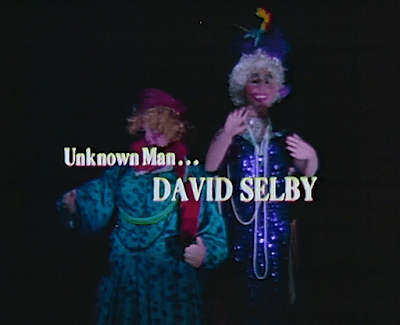
The camera zooms in on the injured man’s face. We don’t see enough of it to be sure who it is. The closing credits tell us that “Unknown Man” is played by David Selby. It must be a goof that we don’t see much of Mr Selby’s face. Over the year he has been playing the rakish Quentin Collins, Mr Selby has become a huge breakout star, rivaling the fame Jonathan Frid has gained as Barnabas. Surely they wouldn’t put him on unless they wanted us to recognize him.

Quentin first came on the show as a ghost at the end of 1968, and found his greatest success from March to November 1969, when the show was set in the year 1897. Since the show returned to a contemporary setting, we have been sure that Quentin will be back, but we haven’t had any reason to expect him to return at any particular time. In #887, the first episode set in November 1969, we saw the back of a man prowling about the estate of Collinwood; we might have suspected he was Quentin. But he turned out to be Liz’ ex-husband Paul Stoddard, who had never before been a real character on the show and who has been unmentioned for more than two years. So when we are kept from seeing the face of another prowler, he could be anyone at all. Perhaps Frank Garner is training to be a ninja, or Ezra Hearne is having a personal crisis.

The closing credits run over this image from Liz’ dream. The dolls move while the credits are scrolling over them, the effect is hilarious. I didn’t think the dream sequence was particularly effective, but I wish every episode ended with these two figures doing their little act.

The real stars of today’s show. Screenshot by Dark Shadows Before I Die.

Episode 903: Rhinoceros

For eight months, from March through November of 1969, Dark Shadows was a costume drama set in the year 1897. Among the characters we got to know during that period were Amanda Harris (Donna McKechnie,) who came to life when an artist named Charles Delaware Tate used magical powers he didn’t know he had and painted a portrait of an imaginary woman. As long as the portrait exists, Amanda will live, remaining young and beautiful. Tate also painted a portrait of the rakish Quentin Collins. As Amanda’s story is a retelling of the ancient Greek tale of Pygmalion and Galatea, so Quentin’s portrait is a version of Oscar Wilde’s Picture of Dorian Gray. Quentin had been a werewolf when Tate painted him, but as long as the portrait is intact it will change on moonlit nights, while Quentin remains human. Like Amanda, Quentin is immune from aging while his portrait lasts.

These two conditionally immortal beings found each other towards the end of the 1897 storyline and fell in love. They were going to run off together, but Tate had stolen Quentin’s portrait and Quentin couldn’t leave without it. Shortly before the show came back to contemporary dress, it seemed that the portrait had been destroyed when Tate’s cottage burned down, though we did not see this happen.

In September, mad scientist Julia Hoffman managed to travel back in time and spend a few weeks in 1897. She befriended Quentin and saw Amanda’s portrait. After returning to 1969, Julia found a mediocre landscape Tate painted in 1949 at an antique shop in the village of Collinsport and shelled out a ridiculous sum for it, hoping that it would help her find out whether Quentin is alive, where his portrait is, and whether Tate himself might be alive and able to help Quentin’s great-grandson Chris Jennings, who has inherited the werewolf curse.

Another woman is interested in the portrait. She is Olivia Corey (Donna McKechnie,) a famous Broadway actress. Olivia has come to Collinsport to try to persuade Julia to sell her the painting. Julia sees Olivia’s resemblance to Tate’s paintings of Amanda and suspects that the women are one and the same, but since she did not meet Amanda when she was in 1897 she cannot disprove Olivia’s story that she is Amanda’s granddaughter.

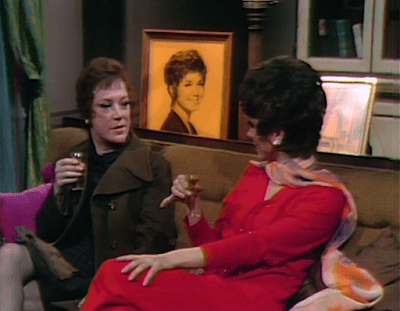
We fade in on Julia today, sitting with Olivia on a couch in Olivia’s suite in the Collinsport Inn. We can tell Olivia is staying there, because she has decorated it with a copy of her professional headshot, among other things.

What, don’t you set your headshot on a table when you stay in a hotel room? Screenshot by Dark Shadows Before I Die.

The two are having a conversation in which they declare themselves to be devoted admirers of Tate’s works. We saw many of Tate’s works in the 1897 segment, and few of them were any better than the crummy landscape that has brought them together. When Julia found the painting, heiress Carolyn Collins Stoddard expressed amazement she would pay a hefty sum for such an undistinguished piece, and later today Olivia will say in so many words that it is of little interest to anyone but a Tate completist, so the show is not pretending that Tate’s pictures had great aesthetic value. We can therefore be sure that Olivia, like Julia, has an ulterior motive.

Olivia claims to be working with a figure in the fine art business in New York City who wants to stage an exhibition of Tate’s works. She refers to this figure as “he,” disappointing our hopes that she might be in league with the show’s most interesting character, NYC art dealer Portia Fitzsimmons, whom we met in #193. Then again, Olivia represented herself as “Mr Corey” in the telegrams she sent to the antique shop inquiring after the painting in an attempt to conceal her identity, so maybe she is doing the same thing on behalf of Mrs Fitzsimmons.

Olivia asks to be allowed to photograph the painting, and under the circumstances Julia can hardly refuse that request. Olivia asks when she can call at the great house on the estate of Collinwood, where Julia has been in residence since 1967. Julia says that she will have the chauffeur bring the painting to the hotel later that evening.

This is only the second time we have heard anything about a chauffeur at Collinwood. The first time was in #543, when Carolyn hired unsightly ex-convict Harry Johnson to help her manage Frankenstein’s monster Adam and covered up his true responsibilities by putting him on the payroll as chauffeur. We haven’t seen or heard of Harry since #669, which was also the only episode in which he was played by Edward Marshall. In previous episodes Harry had been played by Craig Slocum, usually pretty badly, but Mr Marshall did such a good job with the character we would be glad to see him again.

We have little hope this will happen, however. Not only is Harry generally forgotten after his long absence, he and Julia never had much to do with each other when he was on the show. Since her activities concerning the painting are a big secret, she would choose only an assistant whom she could trust. That means Chris.

Carolyn hired Chris as groundskeeper at Collinwood in #677, by which time he was already living in the cottage on the estate that goes with the job. By the time the show went to 1897, his lycanthropy had surpassed all bounds and he was a wolf at all times, even during the day. In #889, set in 1969, we saw that he had regained his human form and spent the eight months of the 1897 flashback confined to a mental hospital Julia controls. We also saw that Carolyn had no idea where he had been or what his problem was. That made it rather a surprise in #897, when we saw that he still lived in the cottage. Presumably he still has the job, as well. You’d think an unexplained absence of eight months, followed by a confrontation in which he told Carolyn that he was a monster who would kill her if she didn’t watch out, would lead to a firing, but evidently the Collinses have a relaxed attitude towards their staff.

When we cut to Julia after her scene with Olivia, we see her in the drawing room of the great house with Chris. She shows him a handwritten note from Amanda to Quentin, written in 1897, that she dug up someplace. He tells Chris that he is to take the painting to Olivia’s room and get a sample of her handwriting to compare to that standard. He is to present himself as the chauffeur at Collinwood. Since he is in fact the groundskeeper at Collinwood and he will give Olivia his right name, it’s hard to see what the point is of claiming to have a different position in the household. Chris is skeptical that Olivia and Amanda can be the same person, but Julia tells him that he of all people should be willing to accept the apparently impossible.

Chris is nervous in Olivia’s room, especially when she introduces him to a Mr Nakamura. She gives the painting to Mr Nakamura, who takes it to another room. She explains that Mr Nakamura is a professional photographer and will be taking the picture. She says she will call Chris when Mr Nakamura is finished. Chris says that Julia explicitly told him to wait for the painting. This is odd- if the goal is to get a sample of Olivia’s handwriting, why not insist on leaving it with her? Then she would have to write out a receipt.

Mr Nakamura takes a long time. Olivia takes out her silver tea service and keeps offering Chris more tea. It’s for just such situations that I take my silver tea service with me every time I check into a hotel, it really is a pity more people don’t think ahead like that. Eventually Chris gets restless and barges into the room where Mr Nakamura took the painting. He finds a fancy camera there, but no person and no painting. We don’t see much of the room, but from what we can see of the layout of the suite, there doesn’t appear to be any way Mr Nakamura could have exited except the way he went in. Chris is upset, but eventually Mr Nakamura comes back with the painting. He says that he had to go to a local shop to have it done, and shows Olivia a large photograph of the painting. She says that it is acceptable, and tells him that Chris is ready to call the police if they don’t return the painting to him at once.

Chris takes on a sheepish manner and apologizes for his nervousness. He tells Olivia he is an admirer of hers and asks for an autograph. She writes a little note for him. He takes it and the painting and goes.

Back at the great house, Chris delivers the painting and the autograph to Julia. She can see that Olivia’s handwriting is similar enough to Amanda’s to warrant an expert analysis. She thinks of her friend, Professor Timothy Eliot Stokes. Stokes is an expert on the occult, an expertise which typically arises in fields like history or classics that involve the study of manuscripts, so it makes sense that he would be trained in recognizing hands. Chris marvels at Olivia’s attractiveness.

Alone with Olivia, Mr Nakamura says that he found the best radiographer in Collinsport. He paid him to x-ray the painting and to keep quiet about it. Since Collinsport is supposed to be a very small town, one wonders how many radiographers Mr Nakamura had to choose from. At any rate, the x-ray confirms that there is another painting underneath the landscape. Olivia looks at the x-ray exposure, and says that it looks like a portrait.

Chris’ attraction to Olivia recalls the 1897 segment. Amanda came to Collinsport in the company of miserable schoolteacher-turned-unscrupulous adventurer Tim Shaw, who like Chris was played by Don Briscoe. Amanda and Tim stayed in the Collinsport Inn together, perhaps in this suite. We don’t know if Tim and Chris are supposed to resemble each other, and Olivia doesn’t show any signs of recognition. But regular viewers will enjoy seeing Briscoe and Donna McKechnie together in a situation so different from those they explored before.

Olivia’s conversation with Julia, like her headshot on the table, emphasizes that she is A Big Broadway Star. A few years after this episode, Miss McKechnie originated the role of Cassie in A Chorus Line, and actually became A Big Broadway Star. Watching this episode, I wonder if she found herself imitating Olivia when that happened to her.

Mr Nakamura is played by Sho Onodera. Onodera was born in Seattle in 1915 and died in New York in 1974. According to his obituary in The New York Times, Onodera served in US military intelligence during the Second World War, and was the court’s chief interpreter at the Tokyo war crimes trials after the war ended. In later years he.worked as a reporter for both American and Japanese news services. The Times does not mention that Onodera, like 120,000 other Americans of Japanese extraction, spent part of the period of US involvement in the war as an internee, in his case at the Manzanar camp. That fact is recorded in his IMDb biography. As an actor, he appeared in several television shows and a couple of movies, most notably the 1974 film The Taking of Pelham One Two Three, in which he took the role of Mr Matsumoto.

This episode marks Onodera’s only appearance on Dark Shadows. He was one of only three visibly non-white actors to appear in the series. The others were Beverly Hope Atkinson, who had a speaking role as an unnamed nurse in #563, and Henry Judd Baker (also known as Judd Henry Baker,) who was visually prominent but silent as Rroma tough guy Istvan in #821, #825, #826, and #827. From now on, the cast will be all-white. Granted, fishing villages in central Maine in the late 1960s and early 1970s didn’t tend to have a lot of racial diversity, but enough visitors come to town that you might think they could have found more opportunities than that to use the talents of the nonwhite actors who were working in New York in 1966-1971.

Episode 902: I heard breathing

Heiress Carolyn Stoddard is working for her friends, Megan and Philip Todd, in their antique shop. She goes upstairs to tell Megan that Philip has telephoned. Carolyn hears heavy breathing coming from the room where a baby the Todds are taking care of sleeps. Megan comes out of the room and in a most imperious tone demands to know what Carolyn is doing there. She tells her Philip called, and asks about the breathing sounds. Megan sweetens up and says “It’s the radiator!” She says she’ll have to call the plumber about it. Carolyn is unconvinced.

Downstairs in the shop, Carolyn and Megan notice someone looking in the window. The shop is open for business and there is merchandise displayed in the window, but for some reason it unnerves them that they have attracted the notice of a potential customer. All we can see of the man is his clean-shaven upper lip. When Carolyn approaches the window, he runs away. The only sneaky man we have met so far in the current phase of the show is Carolyn’s long-absent and recently returned father Paul. Since Paul wears a mustache, the upper lip is enough to show us that this is a new character, at least new to the ongoing stories.

No mustache. Screenshot by Dark Shadows Before I Die.

Carolyn and her mother Liz live in the great house on the estate of Collinwood. Also among the residents of the great house are Liz’ brother Roger Collins and Roger’s son, strange and troubled boy David. We cut to David’s bedroom, where a book opens by itself. We have seen books do this before on Dark Shadows, but I believe this is the first time I couldn’t see a cord being pulled. They really have come a long way with practical effects.

David reads aloud from the book, something about a child being cloaked in radiant garments. He is interrupted by his Aunt Liz. She asks him to notice that she knocked on the door, and tells him that she is learning to respect his privacy. She says she heard him reading aloud, and asks what it was. He says it was a school book. She starts talking about how terribly cold it is in his room. He brings up her ex-husband, Paul. Liz hadn’t known David was aware of Paul’s return, and gets very uncomfortable. She says he needs friends his own age, and hurries out of the room. Once she is gone, he goes through the room and gathers a lot of cash. Evidently David raised the subject of Paul to get the room to himself.

David does have one friend his own age, Amy Jennings. Amy lives in the great house, down the hall. We just saw Amy in #893 and #896, but she tends to be unmentioned in between appearances. Amy is a favorite of mine, and when they don’t use her name for long stretches I worry they are about to drop her from the show. It would have reassured me if Liz had named Amy as someone David ought to spend more time with.

Joan Bennett tends to do a lot of acting with her eyes when she plays a two-scene with David Henesy, and this is a good example. When Liz is pointing out her own good manners in knocking, it is her eyes that convey her mild amusement at the situation; when she is offering to help David with his schoolwork, her eyes follow him so closely that we notice all of the little movements he makes as he tries to get out of a tutoring session; when she talks about the coldness in the room, she looks from side to side, searching for the open window with increasing consternation; when he asks about Paul, her eyes bulge in their sockets, showing deep alarm. When she tells him he needs friends his own age, she raises her eyebrows, making it sound like a threat. Bennett had been so famous for so long that many of her scene partners would not react to what she was actually doing, but to what they expected her to do, forcing her to add Joan Bennett-isms to her performances. With Mr Henesy, she was free to work simply, and the result was consistently very effective.

Downstairs, Liz answers the telephone. To her disgust, Paul is calling. He tells her that if she doesn’t meet with him for a talk, she is in danger of losing Carolyn. She agrees to go to his hotel. Carolyn enters in time to catch the end of the conversation. Liz doesn’t want to talk about Paul with her any more than she did with David, and she exits.

Carolyn and David have a scene in the drawing room. She tells him he should go to bed; he says he wants to read the newspaper. He asks her if she hasn’t noticed that he has grown. Since the thirteen year old David Henesy was about the same height as Nancy Barrett, this question is worth a chuckle. David gets excited when he sees that Brewster’s Department Store in the village of Collinsport is going to be open nights until Christmas. He tears the Brewster’s ad out of the paper while Carolyn reminds him he can’t leave the house tonight. He says that of course he can’t, it’s late.

In his post about the episode on his great Dark Shadows Every Day, Danny Horn asked if David’s reaction to the Brewster’s ad is the only reference to Christmas in the whole series. His commenters responded that Christmas is also mentioned in #92, #123, #257, #810 (twice,) #887, and #1050. It’s hilarious to read through the thread and see the citations mount up. I sympathize with Danny, though- I tagged my posts about the first couple of episodes on that list with “Christmas,” because I, too, was sure that the holiday was only named once or twice in Dark Shadows.

Carolyn exits, and David sneaks out the front door. As he does, a man in a belted overcoat walks into the house. We see him only from the midsection down. He straightens the portrait of the Collinses’ distant cousin Barnabas that hangs in the foyer of the great house. This suggests that whoever he is, he has some connection with Barnabas. Carolyn comes back, and the man hides behind the curtains in the drawing room. This has been a favored hiding place for the last several months, suggesting that the man knows the house. Carolyn leaves, and the man goes out. If all he wanted to do was straighten that portrait, he could count his journey a success. Otherwise, it’s hard to see what the point of it was.

At the hotel, Paul struggles to explain his concerns to Liz. He is hampered by his own ignorance- he does not know exactly who is after him or what they want to do, but he knows they have some kind of sinister plan for Carolyn. Paul admits that Liz has no reason to believe anything he says, after his total failure as a husband, but he keeps urging her to take Carolyn and go far away, not telling anyone that they are going. She is exasperated with what she takes to be yet another of his scams, and tells him that “I’ll never figure out this latest plot of yours.” Indeed, the story is taking shape slowly enough that some viewers will have been saying the same thing.

Bennett and Dennis Patrick had many scenes together from March to July 1967, when he played seagoing con man Jason McGuire. Liz’ relationship with Jason was one-dimensional, consisting of nothing but a series of blackmail threats from him followed by capitulations from her. As her ex-husband, Paul offers far more for Liz to react against, and this scene is far richer and more satisfying than was anything we saw in the dreary Liz/ Jason story.

Liz goes out of the Collinsport Inn and sees David entering the antique shop across the street. The Inn has been part of the show from episode #1, but this is the first time we see a set representing its outside. Cutting between that set and the set representing the exterior of the antique shop, they make an attempt to create a sense of Collinsport as a place. When the show was in black and white, they would occasionally insert video they had taken at various locations in upstate New York and southern New England to achieve that effect, but they haven’t left 433 West 53rd Street since they went to color in August 1967. This quick cut between minimally decorated parts of the studio doesn’t work as well as that footage did, but it is a valiant effort in its own way.

Liz goes into the antique shop and insists Megan let her search the place for David. Since Liz essentially owns the town, Megan can’t say no. We conclude with Liz outside the door of the room upstairs from which Carolyn heard the breathing when we began. We hear the breathing again. David is inside the room, telling some unseen presence that it will like what he bought for it at Brewster’s. Perhaps he found it in the Unseen Presences section of the store. It’s in Collinsport, after all. David stops talking when he hears Liz’ voice; the breathing cuts out at the same time.

Episode 899: How well I remember that charm of yours

When Dark Shadows debuted in June 1966, matriarch Elizabeth Collins Stoddard (Joan Bennett) had not left the estate of Collinwood in eighteen years. We soon gathered that Liz was afraid that if she strayed far from the house someone might open the locked room in the basement and discover that her husband Paul was buried there, dead of a blow she dealt him when he was trying to run off with a chunk of her patrimony.

Liz’ reclusiveness was a major theme of Dark Shadows‘ first 55 weeks. After the show committed itself to becoming a supernatural thriller with the story of Laura the humanoid Phoenix, which ran from December 1966 to March 1967, they brought in Paul’s old friend and partner in crime Jason McGuire (Dennis Patrick) as an in-betweener to sweep away the few miscellaneous this-worldly narrative threads not already subsumed in the Laura story and to help introduce the next uncanny Big Bad, vampire Barnabas Collins.

It turned out Jason was the one who agreed to bury Paul for Liz, in return for the money Paul had been trying to steal from her. Upon his return to Collinwood, Jason blackmailed Liz with this information. Time and again she caved in to his demands. Liz let him stay in the great house, gave him money, hired him for a lucrative non-job in the family business, let his rapey sidekick Willie Loomis stay in a room just down the hall from those occupied by her daughter Carolyn Stoddard and her all-but-acknowledged daughter, well-meaning governess Victoria Winters, and was in the middle of a wedding ceremony meant to unite her with Jason when she finally burst out with the truth. When she did that, Carolyn dropped the loaded pistol with which she had planned to prevent Jason becoming her stepfather. For his part, Jason said that Paul wasn’t dead, and that he hadn’t buried him. Perhaps the whole thing started when Jason said “cranberry sauce,” and Liz misheard it as “I buried Paul.” With that, the wedding was off, and a few days later Barnabas killed Jason. Since Jason was on his way out of town and had no friends left, no one missed him. He has barely been mentioned since.

Now, Paul himself has come back. Like Jason, he is played by Dennis Patrick. He has charmed Carolyn into thinking he had nothing to do with faking his own death, and she is falling over herself in her eagerness to establish a relationship with the father who left the family when she was an infant. Carolyn and Liz are on their way out the front door of the great house, heading to a committee in charge of raising funds for the hospital, when the phone rings. It is Paul, asking Carolyn to come to his hotel room at once. She agrees. She gives her mother a vague excuse, irking her, and the women leave the house separately.

In the hotel room, Paul tells Carolyn that he is in some kind of trouble that he can’t explain. Someone is trying to do something terrible to him, but he does not know who or what. Carolyn takes a firm tone when she urges him to tell her what he does know, and when she tells him that whatever is happening she will help him.

Father and daughter embrace, and Liz enters. She is furious to see Paul. She demands Carolyn leave the room. Only when Paul says that he and Liz need a moment together does Carolyn comply. The ex-spouses have a confrontation in which Liz gets to voice her righteous indignation with Paul. She tells him that she expects him to be on the next train out of town. She lists some of the people she will call if he isn’t. Among these is the proprietor of the hotel, who will presumably throw him out in the street at her behest.

In its first months, Dark Shadows tended to attract an aging audience, largely composed of people who still thought of Joan Bennett as the star she was in the late 1930s and early 1940s. Now, with its cast of vampires and werewolves and witches and ghosts and zombies and mad scientists and heaven knows what, it is more of a kid’s show. By the end of the costume drama segment set in the year 1897 that ran from March to November of 1969, viewers over the age of twelve would find themselves reacting to more and more episodes with little more than an indulgent chuckle.

Now that they have returned to contemporary dress, they have swung sharply back towards an adult audience. Carolyn was supposed to be a teenager when the show started; Nancy Barrett was significantly older than the character, and they let Carolyn catch up to her age after a while. But having her spend her evenings serving alongside her mother on the hospital’s fundraising board suggests that they’ve aged her up quite a bit further than that, foreclosing any youth-oriented stories. The conventionally soapy situation the Stoddards find themselves in today is of course something that will be of little interest to the elementary school students who are running home to see the show at this period. And while the main overall story is supernatural, about a cult controlled by unseen beings called the Leviathans that assimilates to itself one character after another, it is understated in tone, allegorical in development, and densely allusive in its relation to its literary antecedents. However many older viewers the show may have lost in the second half of the 1897 segment, they are in danger of shaking off an even larger number of their very young fans if they continue down this road.

In Art Wallace’s original story bible for Dark Shadows, titled “Shadows on the Wall,” the blackmail story was to be followed immediately by Paul’s return. Wallace called for Paul to be a man pursued by dark forces from his past. They made major changes to “Shadows on the Wall” long before they taped the first episode, and it has been almost entirely forgotten for years now. Indeed writer Ron Sproat, who was with the show from October 1966 to January 1969, said that executive producer Dan Curtis told him when he joined the staff that they were going to be leaving “Shadows on the Wall” behind and never let him see it. But they did dip into it in the case of Paul’s return- he is indeed being pursued by dark forces from his past. The Leviathan cult is after him.

After his confrontation with Liz, we see Paul sitting at the bar in the Blue Whale tavern. The jukebox plays a tune familiar from the early days of the show, when the Blue Whale was a frequent set and there were usually extras dancing in the background. Today the only people we see there are Paul and a middle aged sailor sitting next to him.

The sailor keeps looking at Paul. We hear Paul’s thoughts as he wonders if the sailor is “one of them.” Paul irritably asks him why he is looking at him. The sailor says that he wants to buy Paul a drink. Paul angrily snaps back that “I buy my own drinks!” After some sharp words, the two men warm to each other. They wind up getting handsy with each other and disappear for some private time together.

Paul and his new fella. Screenshot by Dark Shadows Before I Die.

This scene turns out to be motivated by the two men’s mutual awareness of the Leviathan cult. Over the years, I’ve seen lots of guys in bars interact with each other in exactly this way. I don’t know what that’s all about, maybe the Leviathans are real.

Since I mentioned “Shadows on the Wall” above, I should say that the tavern figures in there as well. Only it isn’t called “The Blue Whale,” but “The Rainbow Bar.” I don’t know, somehow I think Paul and the sailor might not have got off to such a rocky start if the show had gone with that name. Sounds friendlier, somehow, at least to lonesome sailors and the mature men for whom they want to buy drinks.

Paul’s new buddy, unnamed in the dialogue, is identified in the closing credits as “Jack Long.” He is played by Kenneth McMillan, in his first screen credit. In the 1970s and 1980s, McMillan was one of the busiest television actors in the USA. I always mixed him up with Dolph Sweet, who was a similar physical type. Sweet appeared on Dark Shadows once, in #99. He played Ezra Hearne, the most loyal employee at Liz’ cannery. Sweet was a tremendous actor, McMillan a very good one, and they occasionally worked together. So long as they are doing normal soap opera stuff, it would have been nice if they could have had a little story about Ezra’s reunion with his long-lost cousin Jack. Maybe Jack could have introduced Paul to Ezra, we could have seen how he’d fit in with the family.

Episode 884: Departure date

It is November 1897, and time traveler/ recovering vampire Barnabas Collins is searching through the burned remains of a cottage recently occupied by famed artist/ criminal lowlife Charles Delaware Tate. Barnabas finds a pair of glasses just outside the front door and a length of chain just inside. The glasses belonged to Tate’s master, evil sorcerer Count Petofi, the chain to a creature named Garth Blackwood whom Petofi and Tate summoned from the depths of Hell. When Barnabas was last in the house, Blackwood had taken Petofi prisoner there and announced his intention to kill him. Petofi couldn’t get far without his glasses, and the chain was Blackwood’s very favorite murder weapon. So Barnabas has reason to believe both of them died in the fire.

Tate shows up. Barnabas demands he paint another portrait of Quentin Collins to replace the one destroyed in the fire. Quentin is Barnabas’ friend and distant cousin, and, because of some magical powers Petofi long ago gave Tate, the portrait kept Quentin from turning into a werewolf. Tate is a jerk about Barnabas’ demands, as he is a jerk about everything, but finally says he will comply. He tells Barnabas to come back to the ruins of the cottage at 10 PM to pick up the portrait. Barnabas is surprised to hear that Tate can work so quickly, and Tate does not explain why he needs so little time. But after all, the important thing is simply that the magic spell is renewed- the portrait doesn’t have to have any particular aesthetic quality. Perhaps a simple sketch will serve that purpose as effectively as did the full oil painting Tate did previously.

Meanwhile, back at the great house of Collinwood, Quentin’s sister Judith is busy with a project of her own. She is torturing her husband to death. He is the odious Gregory Trask, so she has the audience’s sympathy, at least up to a point. She has had Trask bricked up in Quentin’s old room. There is a telephone there which can receive incoming calls, but not make outgoing calls. Judith has been using it to torment Trask. Today, she directs Trask’s attention to two objects which he has somehow overlooked in his time in the room. One is a portrait of Amanda Harris, a woman he tried to seduce while he had Judith imprisoned in a sanitarium. The other is a loaded gun. When she calls him for the last time, she does not receive an answer, evidently because he has shot himself to death.

Judith is the third role Joan Bennett played on Dark Shadows. In the parts of the show set in the 1960s, she plays matriarch Elizabeth Collins Stoddard. Liz is a depressive personality who keeps trying to kill herself. When from November 1967 to March 1968 the show was set in the 1790s, she played Naomi Collins, Barnabas’ mother, who actually did kill herself when she found out that her son was a vampire. Now she plays someone who, though she was introduced as a psychologically fragile individual, does not kill herself, but drives one of the major villains to commit suicide. Judith’s method of disposing of Trask is not morally defensible, but it is interesting to see Bennett playing a more assertive character.

Trask’s discovery of the portrait of Amanda leads to an interlude in New York City, a place the show hasn’t taken us since #8. Quentin is in a hotel lobby there, waiting for Amanda. She is surprised to see him. They had been lovers, and had planned to leave Collinsport together. He did not meet her at the train station. She had told him that if he did not, she would understand that he had given up on their relationship, so she had gone ahead without him. She says she is so overjoyed at the sight of him that she won’t ask for explanations, but he gives one anyway. He tells her about the portrait. Since she herself came to life as the result of another of Tate’s magical paintings, she can’t very well dismiss the story out of hand. He says that because he does not know where the portrait is, he cannot be sure he won’t become a mindless ravening beast at the next full moon, so he will have to leave her.

Oddly, Judith takes time out from her torture of Trask to perform the same function of motherly talk-to that Liz and Naomi often served. Kitty Soames, the dowager countess of Hampshire, has been staying at Collinwood for the last eight weeks, and is engaged to marry Judith’s stuffy but lovable brother Edward. Contrary to what her title would suggest, Kitty is an American woman in her twenties. Judith sees Kitty coming downstairs with two leather overnight bags. Kitty explains that she will be leaving at once and never returning. She has realized that she cannot marry Edward. She says that she has not told Edward this. Judith says that she is disappointed that they will not be sisters, but that she admires her for facing the truth and doing something about it.

Later, Barnabas comes to the great house. He finds Judith worried that Kitty’s bags are still in the foyer, though she has been gone for hours. He says that he knows where she is. She is waiting for him. They will be married later tonight. Judith is bewildered by this. Barnabas says that they will come back after their wedding and tell Edward what they have done, and that they will then leave Collinwood forever. She is sad to think that they will be going.

In fact, Kitty is two people at once. The young dowager shares her body with the soul of the late Josette DuPrés, whom Barnabas loved when he was a living being in the 1790s and whom he tried to recreate when he was a vampire in the 1960s. Ever since Kitty arrived at Collinwood in #844, Josette has been forcing her way into her conscious mind, triggering psychotic episodes and from time to time pushing Kitty aside and living through her body. Now Kitty is in the bedroom once meant for Josette in the Old House on the grounds of the estate. Josette’s voice keeps speaking to Kitty through the portrait of her that hangs there, urging her to let go and accept her place as part of a combined entity that will love Barnabas and live with him in the bonds of matrimony. Kitty struggles against the voice. For a time she hopes Barnabas will help her thwart Josette’s attempt to come back to life and take the leading part in their symbiotic existence, but when he enters he urges her to give up the fight and become Josette.

Kitty is alone in the room when she suddenly finds herself wearing Josette’s white dress. She floats off the floor and into the portrait. Barnabas enters just in time to see Kitty merge with the portrait. He reaches up to the Kitty/ Josette entity in the frame above the mantel, and he and Kitty both disappear from the screen at the same time.

Josette puts Kitty in the picture. Screenshot by Dark Shadows Before I Die.

Josette was first mentioned in #5 as the lady who went over the cliff at Widows’ Hill, and her ghost emerged as the tutelary spirit of Collinwood in the months that followed. In #70, our first view of the Old House involved the first truly ambitious special effect, when Josette’s ghost, who was Kathryn Leigh Scott in a veil and a white dress, emanated from the portrait and took three steps from it down to the floor. When Miss Scott’s Kitty rises up into the same portrait today, longtime viewers will see that momentous little journey in reverse.

Barnabas was not dreamed of until long after Josette’s ghost emerged. When we first saw him in the Old House in #212, he delivered a speech to her portrait telling her that her power on the estate was ended, and for several weeks afterward strange and troubled boy David Collins, who had been the ghost’s close friend, lamented that he could no longer feel her presence. In those days it sounded like Josette was Barnabas’ grandmother, and she had sided with his father in the fateful conflict that led to his becoming a vampire.

Later, Josette was retconned as Barnabas’ lost love. In a plot borrowed from the 1932 film The Mummy, Barnabas decided that Maggie Evans, The Nicest Girl in Town, was Josette’s reincarnation, and he tried to torture her into accepting this fact. Maggie resisted Barnabas. She ultimately escaped, only to have her memory of his abuse wiped clean by her psychiatrist, Barnabas’ accomplice and future best friend Julia Hoffman, MD.

Maggie was another Kathryn Leigh Scott character. When Miss Scott played Josette in the 1790s segment, the show was sticking to its source material, in which Zita Johanns played Imhotep’s victim Helen Grosvenor in the contemporary sequences and his lost love, Princess Ankh-Esen-Amun, in the flashback to ancient Egypt. It also left us with the uncomfortable feeling that perhaps Barnabas was onto something when he devised his horrifying program of cruelty towards Maggie. Sure, his methods were wrong, but if she “really” was Josette, he wasn’t just crazy.

With Kitty, they take us a step further. Barnabas’ attempt to Josettify Maggie made the show so bleak for so many weeks that longtime viewers will flinch at the thought that Kitty would be right to yield to Josette’s importunings, and even more at the idea that this will lead to a happy marriage between the Kitty/ Josette symbiont and Barnabas. Yet within the context of what we have seen in the 1897 segment, these would seem to be plausible conclusions. The body they share is as much Josette’s as it is Kitty’s, and Kitty has nothing to lose by merging fully into the being who lurks in the substrata of her mind.

For his part, Barnabas’ relationship to Kitty represents almost as drastic a departure from the personality he showed in his relationships to Miss Scott’s previous characters as the reinvention of Josette as his lost love rather than his estranged grandmother did in his early days on the show. He does not abduct her, torture her, or even give her Josette’s hypnotic music box. It is Josette’s ghost, always before shown as a benevolent force, that keeps pressing the transformation on Kitty. Barnabas is a gentle and considerate lover to the Josette part of the Kitty/ Josette complex, and is solicitous to the Kitty part. When Barnabas disappears with Kitty, we reverse not only the walk Josette’s ghost took in #70, but also the speech he gave in #212. So far from wanting to expel Josette from the world of the living as he did then, or turn her into his vampire bride as he tried both with Maggie in 1967 and with the living Josette in 1796, he wants to revive her as herself.

Barnabas’ function on the show, both when he is an outright villain and when he is trying to be the good guy, is to create problems that other characters will have to solve. So this moment of benevolence and rationality cannot last. It is the ultimate indication that the 1897 segment has indeed ended. But it is a beautiful little thing, for the few minutes it lasts.

This episode marks the final appearance of Trask and of Judith. We will see Kitty again tomorrow, but only in a reuse of today’s closing scene. After that she will only be implied as a feature of Josette’s unconscious mind.

Episode 861: Complete control of my faculties

Judith Collins Trask, owner of the estate of Collinwood and all the Collins family businesses, has returned home after more than thirteen weeks confined to a sanitarium. Her return is supposed to be a big shock, but they spoil it by having Joan Bennett do the opening voiceover. They really should have paid more attention to that sort of thing.

Judith’s husband, the odious Gregory Trask, gaslighted her into the sanitarium, and has been exercising control over the Collins family’s wealth ever since. Today, Judith tells her stuffy but lovable brother Edward that Trask never visited her during her time as a mental patient. Edward is surprised, telling her that Trask left the house for an overnight stay every week during that period, and presented these absences as visits to her. In fact, he is on such a trip now. She does not want to hear any more, and says she will give Gregory a chance to explain himself when he comes back to Collinwood.

Judith claims to be entirely herself. That puts her in the minority today. When she left Collinwood in July, Judith had a stepdaughter named Charity Trask. When she enters today, she sees someone who is to all appearances Charity leading Edward and a lady named Kitty Soames in a séance. The body is indeed Charity’s, but sorcerer Count Petofi erased Charity’s personality in #819 and replaced it with that of the late Pansy Faye, a Cockney showgirl and “mentalist” whom Judith met in #771, when Judith’s late brother Carl brought her to Collinwood as his fiancée. Pansy noticed Judith’s disapproval of her when she was alive, and is quite indignant about it now. That Judith keeps live-naming her, calling her “Charity,” doesn’t help.

Judith does manage to do something Edward failed to do a while ago, and talks Pansy into moving back into the great house of Collinwood. She agrees to give up the apartment she rented in the village of Collinsport after she took a job doing her old act at the local tavern, the Blue Whale. We saw her at the Blue Whale in Friday’s episode; it was shortly before nine PM, and she was the only person in the place. So perhaps her income as a cabaret performer is not particularly lavish, and the mansion is a more appealing place to live than the apartment that job would pay for.

For her part, Kitty is still, most of the time, the dowager countess of Hampshire. But the ghost of Josette Collins has been possessing her off and on ever since she arrived at Collinwood in #844, and the trend is definitely towards “on.” In Friday’s scene at the Blue Whale, Kathryn Leigh Scott played Kitty quietly and let Nancy Barrett’s Pansy provide the scene with all its Crazy Lady Energy; today, it is Miss Barrett’s turn to stand back and let Miss Scott show that Kitty is Pansy’s match in that department.

Crazy Lady Energy, also known as “CLE,” the main driving force of Soap Opera Land. Screenshot by Dark Shadows Before I Die.

Judith and Edward’s brother Quentin is in an even stranger predicament than are Pansy and what’s left of Kitty. Between #854 and #856, Petofi forced Quentin to swap bodies with him, so that David Selby now plays Petofi and Thayer David plays Quentin. I call Mr Selby’s portrayal of Petofi “Q-Petofi,” and Thayer David’s portrayal of Quentin “P-Quentin.”

Kitty with P-Quentin. Screenshot by Dark Shadows Before I Die.

The initial shock of finding himself estranged from his own body and trapped in Petofi’s left P-Quentin bewildered. All he could do was go to one person after another and tell the true story of what had happened, which produced only a widespread belief that Count Petofi had gone mad. Now he is starting to figure out how to use his resources.

P-Quentin’s first attempt to take advantage of the fact that everyone thinks he is Petofi was not successful. In #859, he exploited Kitty’s fear of Petofi and threatened to make her vanish if she did not bring him a portrait of Quentin later that night. Kitty tried to comply, but failed, and now it is long past the deadline. Soon she will realize that his threat was an empty one, and so far from being useful to him as a cat’s paw, she will be in a position to expose him as powerless.

Today, P-Quentin runs a smarter game. He introduces himself to Judith as Petofi, and claims to have psychic abilities. He pretends to read her palm, and tells her a story from their childhood that very few people could know. She is delighted, and decides that Count Petofi is someone she wants to see more of.

P-Quentin and Judith. Screenshot by Dark Shadows Before I Die.

In her bedroom upstairs at Collinwood, Kitty has another fit of Josettification. She opens the trunk at the foot of her bed and finds Josette’s wedding dress. She puts it on and wraps a red cloak around it. She goes to the top of Widow’s Hill, the cliff from which Josette jumped to her death in the 1790s. The ghost of Josette’s husband Jeremiah appears to her.

The show is set in 1897 now. It was set in the 1790s from November 1967 to March 1968. Miss Scott played Josette then, and for most of the segment Anthony George played Jeremiah. After Jeremiah’s death, Timothy Gordon played his ghost in a memorable part of the 1790s story. Gordon made two appearances as the ghost after the show returned to contemporary dress, playing him in #462 and #512. This is Jeremiah’s first appearance in 1897, and the second time, after #462, that Gordon’s name appeared in an on-screen credit on Dark Shadows.

Episode 790: Making a demon of her

The evil Gregory Trask orchestrated a plot to murder his first wife, Minerva, and has married wealthy spinster Judith Collins. Now he and his accomplice, lawyer/ Satanist Evan Hanley, have conjured up a simulacrum of Minerva to hang around Judith and drive her insane. Once Judith is safely confined to the nearest high-class asylum, Trask will enjoy Judith’s riches, minus only whatever percentage Evan squeezes out of him.

Today, Judith stands in her bedroom in the great house on the estate of Collinwood. She isn’t ready to go to bed, and the simulacrum of Minerva is sitting in the rocking chair, sewing. Trask pretends he cannot see the simulacrum, and forbids Judith to leave the room. When Judith becomes upset, he slaps her. This slap occurs on the soundtrack and in our imaginations. What we see on screen some time before the slapping sound effect plays is Jerry Lacy waving his hand a considerable distance short of Joan Bennett’s face. The two of them do such a good job of acting that this failure of blocking does nothing to undercut the oppressive atmosphere. For her part, Clarice Blackburn plays the pseudo-Minerva with just enough animation that we cannot predict what she will do. These performances take a sequence which may not have seemed like much on the page and make it into one of the most frightening scenes on Dark Shadows. When Judith lies to Trask and says that she does not see Minerva, it’s enough to produce a shudder.

Trask slaps Judith while pseudo-Minerva sews. Screenshot by Dark Shadows Every Day.

Downstairs, Trask answers a knock at the door and broad ethnic stereotype Magda Rákóczi enters. Regular viewers know that Judith despises Magda and Magda hates her, and so it is surprising when we hear that Judith has sent for Magda. Trask blocks her way upstairs. Magda is defiant towards Trask; she knows what he did to Minerva, and is using that knowledge to force him to let her and her husband stay in the Old House on the grounds of Collinwood. But Trask has a new threat to make.

Trask knows that Magda is the sister of the late Jenny, who married Judith’s brother Quentin. He also knows something that not even Quentin knows, that Jenny bore twin children to Quentin after he left her. He threatens to send Jenny’s children away from the village of Collinsport. Evidently Magda wants the children to stay where they are, in the care of a woman named Mrs Fillmore. It is unclear why this would matter to her; we have had no indication that she has met Mrs Fillmore, much less visited the children at her house. But it is important enough to her that they not be moved that Magda responds to Trask’s threat with “What do you want me to do to her?”

We cut to Judith’s room. Magda enters. Judith tells her that the ghost of Mrs Trask vanished a few minutes ago, after sitting in the rocking chair for hours. Judith asks if she thinks she sounds mad, to which Magda replies there is nothing so strange about a simple ghost. The simulacrum reappears, and Judith asks Magda if she sees it. Magda says she does not.

Back downstairs, Magda tells Trask that he is a swine. She spits on the floor next to him and stalks off. Much as Magda hates Judith and many as are the crimes in which she is implicated, she is a warm-hearted sort, and Trask’s bloodless cruelty is not to her liking. Indeed, it is strange she did not tell Judith of Trask’s attempt to extort her complicity and make an alliance with her against him.

Meanwhile, Quentin is being held in the jail. When Magda realized that he murdered Jenny, she turned Quentin into a werewolf. She did not then know about the twins, and so she made the curse hereditary. Once she found out that her own kin were in line to become monsters, she started looking for a way to undo the curse.

The police captured Quentin the night before, while he was in his lupine form. As a result of Magda’s latest futile attempt to cure him, Quentin emerged from his bout of lycanthropy with his face disfigured and his memory a blank. Though his clothing and his hairstyle are so highly distinctive that virtually everyone who has seen the show before can tell that the man in the cell is Quentin, the Collinses suffer from a peculiar form of blindness that keeps them from recognizing people with globs of makeup on their faces, so his brother Edward is at a loss as to who he could be.

Magda is working with time-traveling vampire Barnabas Collins, distant cousin of Quentin, Edward, and Judith, who has set out on a mission to set the events of the year 1897 right so that Quentin will not become a malign ghost ruining things for everyone at Collinwood in 1969. Unfortunately, vampires are not problem-solvers; their function in a story is to create problems. Since coming to 1897, Barnabas has been responsible for at least six homicides. He has wrought a great deal of havoc even beyond those killings. For example, it was as a direct result of his actions that Judith and Trask got together in the first place. Today, Magda goes to Quentin’s cell and tries to tell him that Barnabas will come to him after nightfall and take him to the Old House.

We do not see Barnabas. We are watching Quentin in his cell when we hear a bat squeaking outside the jail. Barnabas can materialize wherever he chooses; he does not choose to materialize in the cell, where Quentin is alone and unattended, but goes into the outer office in his bat form. We hear a deputy in that office talking to the bat affectionately, asking him where he came from. We haven’t seen the deputy before this episode, but one suspects that a fellow who sees a bat in his office and strikes up a friendly conversation with it must have an extremely sweet personality. We then hear the deputy make a horrified exclamation, and the doors to Quentin’s cell and to the world outside open by themselves. As Quentin walks out, we see the deputy slumped at his desk, two bleeding wounds on his neck.

We cut to the darkened interior of the great house at Collinwood. Quentin comes ambling in. Biting the deputy was certainly not part of any plan Barnabas made with Magda, but it isn’t completely surprising- he hadn’t had a square meal for quite a while. But even for Barnabas, it shows an unusually low degree of operational competence to let Quentin wander off by himself when the whole idea is to get him to the Old House.

In the drawing room, we hear Quentin’s thoughts as he dwells on his amnesia. He does not know who he is, where he is, or why he has come. He sees his gramophone, and starts playing his only record. That brings him back to himself.

Judith enters. Quentin is not only wearing his usual suit and his distinctive hairstyle, he is listening to the music he has been playing obsessively for months and reciting the lyrics to it. As if that weren’t enough, his voice is quite outstanding- he must be the only senior member of an aristocratic Maine family with a West Virginia accent. Yet Judith not only fails to recognize her brother, she refuses to believe him when he identifies himself to her by name.

The simulacrum of Minerva enters, holding a letter opener above her head. Earlier this week, Minerva’s actual spirit had possessed Judith, and under her power Judith had held that same letter opener in that same position as she confronted Evan and accused him of her murder. Judith does not remember that, and she screams at the sight.