Haughty overlord Joshua Collins and his long-term house-guest the Countess DuPrés have summoned good witch Bathia Mapes to lift the curse that has made Joshua’s son Barnabas a vampire. Meanwhile, Barnabas has bitten his second cousin Millicent and gone to the waterfront to find another victim. Bloggers Danny Horn, Patrick McCray, and John and Christine Scoleri have said so much so well about this episode that I have only a few points to add.
Millicent tells Joshua that it is wrong of him to have “that man who says he is Barnabas” in the house when he does such frightful things. Nancy Barrett’s performance as a woman made insane by her encounter with the undead is achingly beautiful. And her idea that Barnabas is an impostor is an intriguing one. Should Bathia succeed, Barnabas will need a story to account for the several sightings people made of him when he was cursed. That success seems unlikely- if Barnabas is freed from the curse now, what will we find when Dark Shadows stops being a costume drama set in the 1790s and returns to a contemporary setting? But it is something to file away for future use…
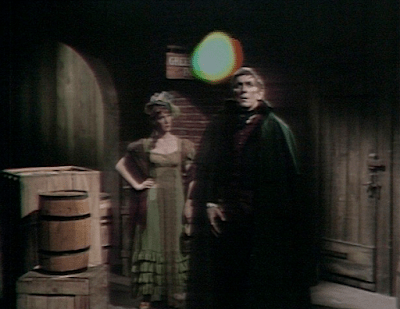
Bathia summons Barnabas away from the docks, where he is about to kill a prostitute, by sending the flame from a candle to him. The movement of the flame is an interesting effect, but what most held my attention was the scene between Barnabas and the woman he almost victimizes. Jonathan Frid and day player Rebecca Shaw play this scene in silence, with exaggerated movements, against a heavy musical score. The resulting balletic interlude is a striking departure from Dark Shadows’ previous form.
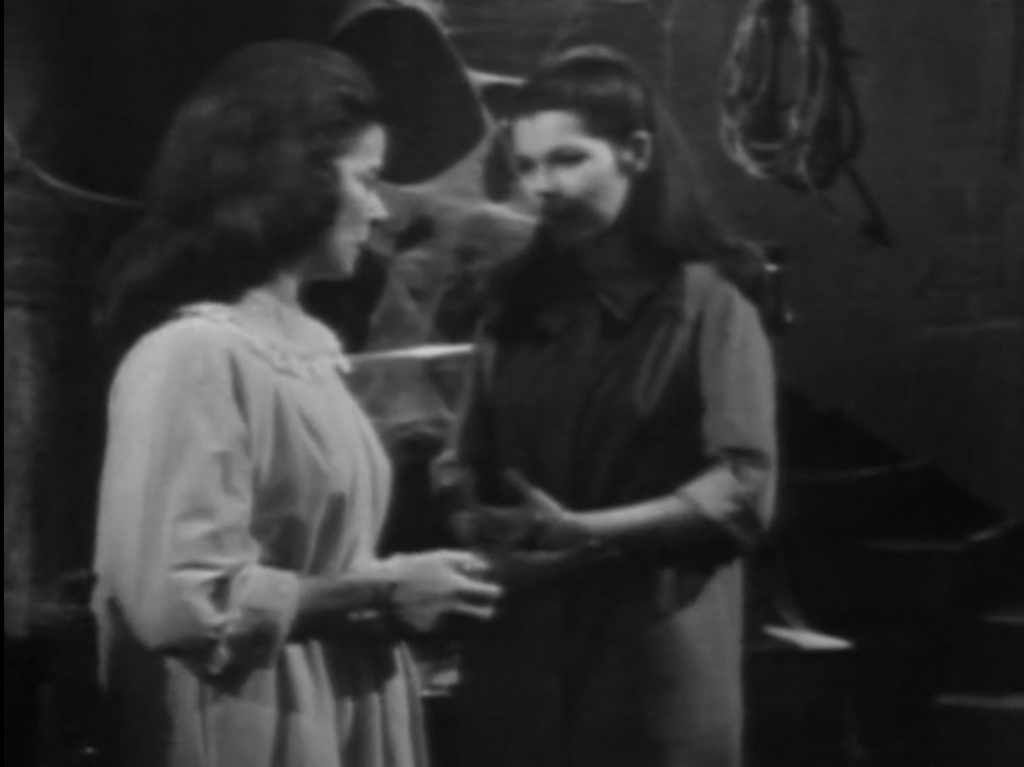
Barnabas disappoints his partner at the end of the ballet sequence. Screenshot by Dark Shadows Before I Die.
Bathia keeps Barnabas in place by showing him a cross from which he recoils. This is the first time we have seen this reaction. Barnabas routinely comes and goes through a cemetery where many of the grave markers are in the shape of the cross, and they don’t bother him a bit.
Not only is it the first time this particular symbol has been a problem for Barnabas, it is the first time Dark Shadows has suggested there might be something to Christianity. The representatives of the faith we have seen so far in the 1790s have been Barnabas’ Aunt Abigail, a disastrously repressed spinster; the Rev’d Mr Bland, of whom the best that could be said was said by the doomed Ruby Tate when she described him to Barnabas as the preacher who looked like a duck; and the Rev’d Mr Trask, a fanatical witchfinder who inadvertently became the handiest tool wicked witch Angelique had at her disposal. The 1960s characters, aside from one fleeting mention of the word “Christmas” in 1966, have not betrayed any awareness that there is such a thing as Christianity.
Bathia commands the spirit of Angelique to speak to them through Barnabas. When Angelique was first on the show, she very conspicuously kept doing many of the weirdest things Barnabas was in the habit of doing in 1967. So Barnabas exasperated his henchmen by fixating on well-meaning governess Vicki but refusing to bite her, insisting that Vicki would eventually come to him “of her own will.” Angelique exasperates her thrall, much put-upon servant Ben, by casting spells on everyone but Barnabas when her goal is to win Barnabas’ love, insisting that Barnabas would eventually come to her “of his own will.” When in 1967 Barnabas sends his thrall Carolyn to steal an incriminating document and she asks what will happen if she is caught, he replies “See that you don’t get caught.” When Angelique sends Ben to steal a hair ribbon from Abigail and he speaks of what will happen if he is caught, she replies “See that you don’t get caught.” Moments like these suggest that the vampire Barnabas is not simply cursed by Angelique, but possessed by her. Perhaps it was Angelique, wearing Barnabas’ body as a suit, that we saw in 1967, not the son of Joshua and Naomi at all.
This fits with the general idea of the supernatural developed in the first 73 weeks of Dark Shadows. The first supernatural menace on the show was undead fire witch Laura Murdoch Collins, who was on from December 1966 to March 1967. Laura was a complex of beings, made up of at least two material bodies and an indeterminate number of spirits, some of which seemed to be unaware of the other parts of the system and pursuing goals incompatible with theirs. From June to November of 1967, the ghost of Barnabas’ little sister Sarah kept trying to contain the damage her big brother was doing to the living characters. Sarah too turned out to be a complicated sort of phenomenon, and the form in which she visited people when they were awake was unaware of and at odds with the form in which she visited them in their dreams. If we go by Laura and Sarah, we would have to assume that supernatural beings are multifarious and fissiparous. So perhaps each time Angelique casts a spell, she splits a bit off of herself and the fragment springs up as another version of her, functioning independently of the rest. In that case, the vampire Barnabas is an avatar of Angelique. When Bathia compels Angelique to speak, she is compelling one of the Angeliques to drop a mask.
The given name “Bathia” is rare; the only person with it who ranks higher in Google search than Bathia Mapes is a musicologist named Bathia Churgin. Professor Churgin was born in New York in 1928, went to Harvard, and taught in the USA until she moved to Israel in 1970. So it is possible that someone connected with Dark Shadows may have heard of Professor Churgin and named Bathia Mapes after her, either as a tribute or just because the name stuck in their mind.
The surname “Mapes” is somewhat less rare; apparently “it is borne by around one in 903,601 people.” In 1963 and 1965, Frank Herbert published two novels that were later issued together under the title Dune; there is an elderly woman with a mystical bent named The Shadout Mapes in those. I’ve never taken much interest in Dune, and owe my awareness of this to comments on Danny Horn’s blog (from Park Cooper here and from “Straker” here.) There doesn’t seem to be much doubt that Bathia’s family name is a nod to The Shadout Mapes; whether it was Sam Hall or another of the writers or someone else who worked on Dark Shadows or one of their kids who had read Dune, I cannot say.
Yesterday, haughty tyrant Joshua Collins found out that his son Barnabas is a vampire. Today, he shoots Barnabas in the chest and learns that vampires can’t be killed by gunshots. So Joshua insists that Barnabas come with him to a place where he can be kept until they figure out a way to lift his curse.
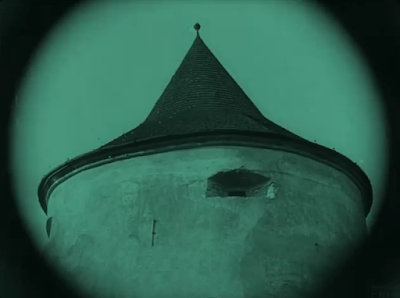
Barnabas is always making plans that fail spectacularly the moment they come into contact with reality. Today, Joshua shows that Barnabas inherited his planning abilities from him. The hiding place Joshua chooses for Barnabas is not one of the underground prison cells on the estate or a cabin off in the woods somewhere, but the many-windowed room on top of the tower in the center of the great house. No one in the house can avoid seeing the light of the candle Joshua carries up there.
The tower at Collinwood.
The tower room has been vacant up to this point, so when Joshua returns to the drawing room his wife Naomi meets him with questions about why there was a light there. He is reduced to insisting that she didn’t see what she clearly knows she saw.
Joshua realizes Naomi saw the light.
There are a couple of interesting visual echoes today. Naomi and Joshua are played by Joan Bennett and Louis Edmonds, who in the parts of Dark Shadows set in the 1960s play reclusive matriarch Liz and her brother, high-born ne’er-do-well Roger. Liz was standing at this window when we first saw her in episode #1. Roger approached her there and whined to her about her decision to hire well-meaning governess Vicki. The selfish, cowardly, weak-willed Roger represents the ultimate destination of the path on which Joshua’s habit of denial and concealment has set the family. Joshua’s absurd insistence that Naomi did not see a light in the tower puts him in a position as ridiculous and contemptible as any that Roger brings upon himself.
From episode #1.
In their post about this episode on Dark Shadows Before I Die, John and Christine Scoleri point out that the tower looks very much like the one in F. W. Murnau’s Nosferatu. That movie was not widely available in the 1960s, but books about film history were finding a mass audience in those days, and some of them would have had stills from it.
When well-meaning governess Vicki came unstuck in time and found herself in the year 1795, regular viewers of Dark Shadows could expect certain plot points to be resolved before she returned to the 1960s. We would learn how Barnabas Collins became a vampire, and how he wound up trapped in a chained coffin in the secret chamber of the Collins family mausoleum. We would learn how Barnabas’ little sister Sarah died. We would see Barnabas’ lost love, gracious lady Josette, marry his uncle Jeremiah Collins. We would see Josette jump to her death from the precipice atop Widows’ Hill. And we would see Vicki escape from some dangerous situation and find herself back in her own time.
Now, the only items on that list left unresolved are Barnabas’ chaining and Vicki’s return. The show has made it clear to people paying close attention how each of those events will happen, and they could fit them both into one episode. Into any given episode, in fact- they’ve given us all the foundation we need for both stories.
But they aren’t going home to a contemporary setting quite yet. The eighteenth century segment has been a ratings hit, Dan Curtis Productions owns the period costumes, and several fun characters are still alive. So they have decided to restart some storylines they had shut down earlier and to build up some new ones.
The main thing that happens today is the first step towards restarting an apparently concluded story. Fluttery heiress Millicent Collins had shared a series of wonderful comedy scenes with untrustworthy naval officer Nathan Forbes, become engaged to him, and discovered that he was already married to someone else. Since that discovery, Millicent has been grimly determined to exact revenge on Nathan, and the rest of the Collins family has regarded him with icy disdain.
Nathan has made a discovery of his own. He has learned that Barnabas did not go to England, as his family has been telling everyone, but that he is still in Collinsport, and is the serial killer preying on the young women of the town. Last week, he made it clear to the audience he had a plan to turn this information into money, apparently by blackmailing the Collinses. Today, we learn that his plans are more complicated, and involve a renewal of his relationship with Millicent. Late at night, he shows up at the lodgings of a visiting witchfinder, the Rev’d Mr Trask. He asks Trask to take a letter to Millicent.
Trask does not want to let Nathan into his room, since the corpse of a prostitute is sprawled across his bed. She is Maude Browning. Barnabas murdered her in Friday’s episode. As part of his campaign to make life difficult for Trask, he deposited her remains at his place.
Nathan won’t take no for an answer, so Trask throws a blanket over Maude and lets him in. Nathan notices Maude’s arm sticking out from under the blanket and is delighted to think that Trask is not the fanatical ascetic he seems to be. Trask breaks down and starts telling Nathan what happened. He tells him that he was astounded to find Maude’s body on his bed, and he asks him to help get rid of it. Nathan agrees to do so on condition he deliver the letter to Millicent.
We then cut to the great house at Collinwood, where Millicent is studying a layout of Tarot. All the Dark Shadows fansites point out that Millicent misidentifies the Queen of Cups as the High Priestess. This is not the fault it is often made out to be. On Dark Shadows Before I Die, Christine Scoleri reminds us that the Countess DuPrés made the same mistake in #368. Since the countess introduced the Tarot to Collinwood and presumably taught Millicent how to read the cards, it would have been a break in continuity had she called it anything else.
Millicent looks at the cards and addresses the absent Nathan, telling him that she is filled with hatred for him and that he faces certain destruction as punishment for his mistreatment of her. Naomi Collins, mistress of the house, enters and asks Cousin Millicent to whom she is speaking. When she answers that she is talking to Nathan, Naomi tells her Nathan is not there. Millicent replies that he does not need to be present to hear her voice. Since Barnabas was able to magically project his own taunting voice across space into Trask’s hearing in Thursday and Friday’s episodes, this claim of Millicent’s has a curious resonance for returning viewers.
Trask shows up with Nathan’s letter. He wants to meet with Millicent alone in the drawing room to give it to her, but Naomi insists on being present. They stay in the foyer. When Naomi forces Trask to tell them that the letter is from Nathan, Naomi takes it and tears it to pieces. Millicent says that she approves of Naomi’s action, but we can see a flicker in her eye and hear a quiver in her voice that suggest the hatred of Nathan she spoke of a few minutes before may not be quite so undiluted as she would like to believe. Trask leaves the house, Naomi leaves the foyer, and Millicent gathers up the shredded pieces of the letter.
Back in his room, Trask goes to sleep. He has a dream. The dream sequence begins with an image reminiscent of pieces moving in a kaleidoscope.
That kaleidoscopic pattern was part of a visual effect we saw when Dark Shadows was still set in 1967. That effect introduced scenes that took place in #347, #352, and #354, when mad scientist Julia Hoffman hypnotized Vicki and took her to the Old House at Collinwood. At Collinwood, Barnabas’ helper Carolyn spotted Julia and Vicki, putting Julia in great danger.
The echo of those episodes is startling coming on the heels of the scene we just saw, in which Millicent figures as a student of the countess. Julia and the countess are both played by Grayson Hall, and Millicent and Carolyn are both played by Nancy Barrett. The relationships between their characters are different now, shifted as the colored pieces shift in a turning kaleidoscope. But remembering those earlier episodes, we might remember that what is seen in a semiconscious state might be a message sent to manipulate and deceive, and we certainly remember that people who go to the Old House are in danger from Barnabas.
Trask’s dream brings him face to face with the ghost of Maude, accusing him of having her remains dumped in the sea, so that she cannot rest. She predicts that everyone will learn that her dead body was in his bed. He denies both her accusation and her prediction, but does not convince either her or himself.
Another ghost then appears. It is that of Trask’s great supporter, repressed spinster Abigail Collins. Trask tries to tell Abigail that he is innocent of Maude’s charges, but she tells him she has no idea what he is talking about. She wants to tell him that there is a great evil he must destroy. Trask has a vision telling him the evil is lurking in the Old House. He resolves to go there.
All of the acting is excellent in this one. That’s no more than we would expect from most of the cast members we see today, but Vala Clifton’s two turns as the living Maude were pretty bad, so that it is a pleasant surprise that she is so good as Maude’s ghost. The physical space gives her a hard job. She is standing a very few feet in front of Jerry Lacy with only a couple of wispy stage decorations indicating that she is separated from him, but she strikes a pose and maintains a degree of stillness that really does create the sense that she is speaking to him from another realm. She also manages to keep up an ethereal quality while making it clear that Maude is determined to be avenged. I wonder what her first appearances would have been like if she had had more time to rehearse. If they had been as good as this one, Ms Clifton and Maude would be among the more fondly remembered parts of the eighteenth century segment.
Nathan Forbes, naval officer and scoundrel, goes to the Old House on the great estate of Collinwood and finds his estranged wife Suki dying. With her last breath, Suki gasps out the name “Barnabas Collins.”
Nathan goes to the great house and informs the master of the estate, haughty tyrant Joshua Collins, of what he has found. Joshua accompanies Nathan to the Old House. Suki told the Collinses that she was Nathan’s sister, lest she disrupt Nathan’s engagement to fluttery heiress Millicent Collins, a second cousin of Joshua. Suki had planned to force Nathan to divert a large percentage of Millicent’s vast wealth to her. Unaware of the true nature of Suki’s relationship to Nathan, Joshua is only mildly suspicious that Nathan might have murdered her.
Nathan brings up the fact that in her dying words Suki named Joshua’s son. This irritates Joshua, who reminds Nathan that Barnabas has gone to England. Nathan tells Joshua that he thought he saw Barnabas the other night, from a distance, in the dark. Considering that the most Nathan could have been sure he saw under those conditions was Barnabas’ coat, no one would be impressed by such an account. It’s an unusual coat, but there’s nothing to prove Barnabas didn’t get rid of it and wear a new one to England. Joshua is particularly bland about Nathan’s thought that he may have seen Barnabas, since he made up the story that Barnabas went to England to conceal the fact that he died. Joshua believes that Barnabas died of the plague, and that if that news got out the men wouldn’t show up to work at the family’s shipyard. So he does not share Nathan’s suspicion that Barnabas may have had something to do with Suki’s death.
What we know that Joshua does not is that after his death, Barnabas became a vampire. Suki discovered him in the Old House, and he was indeed the one who murdered her. But so far as anyone can tell, Nathan is the only suspect, and whoever learns that Suki was actually his wife will have to regard him as something more than a suspect.
Joshua and Nathan are about to search the house when the gracious Josette comes staggering downstairs. Josette had come to Collinwood to marry Barnabas, had been put under a spell that caused her to marry Barnabas’ uncle Jeremiah instead, and was miserable when both Barnabas and Jeremiah were dead. Now Barnabas has bitten Josette and is planning to kill her and raise her as his vampire bride.
When Suki was killed, everyone around the estate was involved in a search because Josette had gone missing. Joshua and Nathan are shocked to find her here, and even more shocked by her physical condition. She reaches the foot of the stairs, says Barnabas’ name, and collapses.
Joshua and Nathan bring Josette back to the great house. Joshua orders his wife Naomi to look after Josette; Nathan tells Millicent that Suki is dead. When Naomi asks Joshua if Josette said anything when they found her, he lies, concealing Barnabas’ name. Naomi knows as much about Barnabas’ death as Joshua does; that he lies to her suggests that he himself is unsure what to make of the situation.
Millicent decides to make herself useful. She goes through Suki’s papers, looking for the address of the maiden aunt in Baltimore whom Suki told her was the only living relative she and Nathan had. While Nathan tries frantically to stop her, Millicent finds Suki and Nathan’s marriage certificate. She bursts into tears and runs away. The comedy portion of the Millicent and Nathan story has ended.
As Josette, Kathryn Leigh Scott has some scenes in bed today, adding to many such scenes she has already had. Her character in the parts of Dark Shadows set in the 1960s is Maggie Evans, The Nicest Girl in Town. Maggie also spends a lot of time in bed. In their post about this episode on Dark Shadows Before I Die, John and Christine Scoleri speculate that Miss Scott must have been the best-rested member of the cast, and append an album of screenshots from 22 scenes we have seen so far where Miss Scott was in bed to substantiate their case.
We open on a set we haven’t seen since #180, the archives of the old cemetery north of town. There, a scene plays out between two actors who aren’t really on the show. Daniel F. Keyes created the role of the Caretaker of the cemetery; Robert Gerringer took over the role of Dr Dave Woodard some months ago and did as much with it as anyone could. But neither of those men was willing to cross a picket line and break the National Association of Broadcast Engineers and Technicians strike, and so they were replaced with a couple of stooges.
The stooges are both terrible. Patrick McCray, Danny Horn, and John and Christine Scoleri all go into detail documenting non-Woodard’s incompetence, but the non-Caretaker is just as bad. Patrick McCray memorably described the Caretaker, in Keyes’ realization, as a “refugee from the EC comics universe.” This fellow has none of Keyes’ zest or whimsy; he simply recites his lines.
At one point, the non-Caretaker tells non-Woodard that it will take some time for him to locate the document he is asking about. Non-Woodard replies “Take your time!” We then have about ninety seconds of the non-Caretaker sorting through papers. The show is moving away from the real-time staging that had often marked its earlier phases, so this comes as a surprise.
The episodes in which the archive set was introduced included a lot of talk about the geography of the cemeteries around the town of Collinsport. They told us that the old cemetery north of town was the resting place of the Stockbridges, Radcliffes, and some other old families, but that most of the Collinses were buried in their own private cemetery elsewhere. They also mentioned a public cemetery closer to town where the remains of less aristocratic Collinsporters might be found. In today’s opening scene, non-Woodard tells the non-Caretaker that they had met previously in Eagle Hill Cemetery. Eagle Hill is the name now associated with the old cemetery north of town. So perhaps this building, which also houses a tomb in which several of the Stockbridges were laid to rest, is not in Eagle Hill Cemetery, but one of the others.
Reading roomStacksThe Tomb of the Stockbridges.
In his last few episodes, Robert Gerringer had a couple of scenes in which he and David Henesy established a close relationship between Woodard and strange and troubled boy David Collins. Today, non-Woodard sits on the couch in the drawing room at Collinwood and tells David he has come to believe everything he has been saying, including the stories that have led the other adults to call in a psychiatrist. As my wife, Mrs Acilius, pointed out, that would have been a great payoff from Gerringer’s earlier scenes if he had been in it. It might have been effective enough if any competent actor had played the part of Woodard. Certainly Mr Henesy’s performance gives non-Woodard plenty to respond to. But he barks out his lines as if they were written in all-caps with randomly distributed exclamation points. It is a miserable disappointment.
There is also a scene where David’s father, high-born ne’er-do-well Roger, tries to convince his sister, matriarch Liz, that they ought to send David to military school. This both harks back to the first 39 weeks of Dark Shadows, when Roger openly hated his son and jumped at every chance to send him away, and illustrates the changes that have taken place since then, as Liz acknowledges that Roger is motivated by a sincere concern for David’s well-being. The scene is intelligently written and exquisitely acted. The high caliber of their work makes it all the more distressing to see Joan Bennett and Louis Edmonds on a scab job. David Henesy was ten years old, and had a stereotypical stage mother, so you can excuse his presence and marvel at his accomplished performance. But these two old pros don’t have any business on the wrong side of a strike.
Nor does Jonathan Frid. When non-Woodard goes to confront Barnabas, there are moments when Frid seems to be showing his own irritation with his scene-mate more than his character’s with his adversary. As well he might- neither man knows his lines particularly well, but even when Frid stops and looks down he expresses emotions Barnabas might well be feeling, and he is fascinating to watch. When non-Woodard doesn’t know what words he’s supposed to bark, he drifts away into nothing. But it serves Frid right to have to play off this loser- by this point, he knows full well that without him the show wouldn’t be on the air. He had no excuse at all for crossing that picket line.
The cemetery’s combination archive/ tomb was a prominent part of the storyline of undead fire witch Laura Murdoch Collins. That storyline approached its climax in #183 when Peter Guthrie, PhD, confronted Laura in her home about being “The Undead,” prompting her to kill him. An episode beginning on that set and ending with someone holding a doctoral degree confronting an undead menace would seem to be an obvious callback to that story. Guthrie’s confrontation had a point- he wanted to offer to help Laura find a place in the world of the living if she would desist from her evil plans, an idea which Woodard’s old medical school classmate Dr Julia Hoffman picked up in her quest to cure Barnabas of vampirism. By contrast with Guthrie and Julia, Woodard is just being a fool.
Maggie Evans, The Nicest Girl in Town, has escaped from vampire Barnabas Collins, but not before Barnabas put the zap on her brains. She is being treated at Windcliff Sanitarium, under the care of Dr Julia Hoffman.
Dr Hoffman’s old acquaintance Dr Dave Woodard shows up with Maggie’s father Sam and boyfriend Joe. Woodard and Hoffman are Dark Shadows ‘ current versions of Bram Stoker’s Dr John Seward and Professor Abraham Van Helsing. As Seward called Van Helsing in when he needed help solving the mystery he encountered treating the victims of Count Dracula, so Woodard has called the expert Dr Hoffman in to help him solve the mystery he has encountered treating Barnabas’ victims. As Van Helsing refuses to answer any of Seward’s questions when they first start working together, so today Dr Hoffman refuses to answer any of Woodard’s questions about the case. There is one departure, in that Dr Hoffman combines Seward’s occupation as chief physician at a sanitarium with Van Helsing’s role as mysterious expert from out of town.
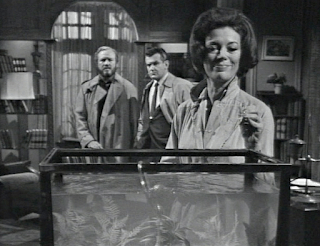
Dr Hoffman tells Dr Woodard that she believes it will be bad for Maggie to see Sam and Joe, but she consents to the visit as a way of discouraging them from trying to come back. When Sam and Joe join them in her office, she attends to her aquarium. In the post about this episode on Dark Shadows Before I Die, Christine Scoleri points out that this is a rather direct way of telling us that there is something fishy about Dr Hoffman.
When Sam and Joe go to Maggie’s room, she has a mad scene. She starts singing “London Bridge,” gets to an obscure verse running “Take the key and lock her up,” and starts screaming “Lock her up!” over and over. It’s magnificently terrifying.
In his post on Dark Shadows Every Day, Danny Horn raves about Grayson Hall’s performance as Julia Hoffman. Rightly so, she will quickly make herself indispensable to the series. He includes a lot of screenshots of her face, showing the wide variety of expressions she uses. I have a more complicated response to this aspect of her style.
As many screenshots as Danny gives of Grayson Hall’s face in his post, I presented even more screenshots of Lovelady Powell’s face in my post about #193, where Powell plays art dealer Portia Fitzsimmons. What impressed me about Powell’s performance is that she takes one of the most basic rules of screen acting- choose one of your eyes and look at your scene partner only with it- and builds a whole character around it. Her left eyelid is all she needs to command the stage and leave an indelible impression.
Hall was at the opposite extreme. She ignores the one-eye rule, and virtually every other piece of guidance professionals give about how to create a character on camera. She uses every muscle at every moment. Her broad, stagy approach works well for Dark Shadows, and the three actors with whom she shares her shots today stay out of her way. Still, she does make me miss Powell’s dominating simplicity.
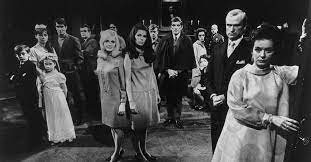
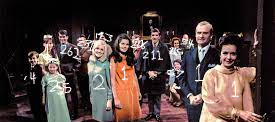
With Julia’s introduction, all of the actors in the photo I use as the header for this blog have joined the cast of Dark Shadows. There is also a version of the picture where the actors are frowning.
Gloom in the shadows
Here’s the smiley version. I’ve marked each player with the number of the first episode in which s/he appeared:
Two of the best blogs about Dark Shadows share the same web address. One is Dark Shadows Every Day, a series of more than a thousand well-crafted, insightful, often hilarious essays by Danny Horn about episodes #210 through #1245 and related topics. The other is the group blog that Danny’s readers maintain in the comment threads under each of his posts. The commenters outdid themselves in their remarks on Danny’s post about this episode.
At the beginning of the episode, addled quack Dr Woodard has figured out that the two victims of vampire Barnabas Collins, sorely bedraggled blood thrall Willie Loomis and missing local girl Maggie Evans, have something in common. He hopes that if he can compare a sample of Willie’s blood with Maggie’s he will figure out what that is. Willie is terrified that this will lead to the exposure of Barnabas. Puzzlingly, Barnabas is unworried and orders Willie to cooperate. Only after Willie has given the blood and the doctor has left do we learn that Barnabas switched Willie’s sample with a normal one. “DS Willie” comments:
Barnabas is seriously messing with Willie’s mind in this one. So much of what Barnabas says has double meanings, even triple. Of course he’s playing with Woodard too, but Woodard never realizes it.
For one thing, just after Willie’s blood is taken, Barnabas makes creepy blood comments, ending with “…surrendering your utmost self” and his next line “Now, you had no choice.” I suspect this is all meant more for Willie than for the doctor. Willie had no choice but to surrender his utmost self.
Barnabas delights in repeatedly demonstrating his control over Willie, all to the doctor’s approval. When Willie flares up momentarily at Dr. Woodard’s remark about understanding being frightened, Barnabas immediately brings Willie to heel with a harsh word and harsher look.
Later Barnabas jerks Willie’s chain some more, just because he can, and to tighten his control even more. It’s classic Stockholm syndrome type stuff. The victim is abused and in absolute fear for his life, and yet any lessening of the captor’s threats or violence can be perceived as mercy, bonding the victim to his captor.
His shirt in Barnabas’ menacing grasp, Willie swears he would never, never betray Barnabas. He is only thrown to the ground instead of being choked or beaten. Barnabas proceeds to make Willie feel stupid and disloyal and dishonorable and undeserving of future protection. Add enthrallment on top of that. Oh, and the police having Willie as their top suspect, and Jason having beaten and threatened to kill Willie, even though Willie was trying to protect him.
It is actually pretty amazing that Willie has held up under the strain. He is in full-on survival mode, and yet still has the decency to try to shield Maggie and others insofar as he can, given his powerlessness.
Hey, what was up with Barnabas saying Willie’s blood is a “delicate little flower painted on glass”? He says it twice (once to Woodard and once to Willie) while looking directly at the slide. That doesn’t come across as a remark about blood in general.
Oh. Barnabas was using yet another method to get Willie under his thumb: verbally emasculating him with the “delicate little flower” reference to Willie’s blood on the slide. But I think Willie was so relieved that he missed the diss.
I made a contribution of my own to the thread. In response to Danny’s unfavorable comparison of Dr Woodard with Bram Stoker’s Professor Van Helsing, I commented:
I don’t think Woodard is Van Helsing at all. He’s Dr John Seward, treating Lucy and Renfield and baffled by the whole thing until he calls in his brilliant old professor. The mysterious Hoffman, one of the best men in the field, that’s the expert who is going to shake things up.
Seward is young, dynamic, and ready for adventure, while Woodard is middle aged, pudgy, and ready for an afternoon tee-time at the local country club. But that change is necessary. Readers of the novel have plenty of time to think about the sort of group that might go on the expedition Van Helsing organizes, and will expect a bunch of high-spirited youths. On a soap, a character like Seward would be the heroine’s new love interest, and Dark Shadows is flailing about trying to figure out what to do with the love interests Vicki and Maggie have now. The last thing they want right now is another bold, handsome young man who is apparently under a vow of celibacy.
In response to Danny’s remark that Jonathan Frid’s bobbles make it hard to guess what lines the script originally gave vampire Barnabas Collins, commenter “TD” replies:
#1. “Now, in a way, isn’t that understandable?
#2. “After all, blood is the life force.
#3. “It reaches into the deepest recesses of both the heart, and the brain.
#4. “It is the familiar of our complete being.
#5. “To surrender even one drop of it is to suggest a partial surrender of one’s utmost self.”
I’m not so sure this is actual Fridspeak. Yes, it’s kind of gibberishy, but it does make grammatical sense and some sort of syntactical sense. Frid delivers it smoothly and with confidence, unlike his halting fumblings when he can’t remember his lines. When he says this, it’s in a close-up shot, and he’s looking down. My guess is that he is reading it directly from a script. Also, this is Joe Caldwell’s first script (or first credited script–he did some writing on earlier Ron Sproat scripts, if another website is accurate). Maybe this is Caldwell exhibiting the enthusiasm of a first solo outing. Dr. Woodard has a couple of hi-falutin’ and rhetorically “poetic” (and gibberishy) speeches of his own in this episode.
Also, might this episode be marked as the first one to demonstrate the “reluctant” or “sympathetic” vampire in Barnabas’s character? In this episode (in another speechy series of lines), when Dr. Woodard and Barnabas are discussing the “madman” who broke into Woodard’s office and stole the blood sample, we get this exchange:
Dr. Woodard: You know, it’s the peculiar magnificence of the human spirit that’s required to provide the potential for such corruption. [See? This is like the Barnabas “blood is the life force” speech–who talks like this???] Barnabas: Yes, I know what you mean. Whoever he is, he must certainly be, at one and the same time, more than a man…and less than a man. Dr. Woodard: You seem almost sorry for him. Barnabas: Sorry? No, I’m not sorry. The truth is, I loathe him. I loathe him very, very deeply.
I agree with “TD” that today’s dialogue is marred by purple passages; I would go so far as to say that none of the lines would have survived a rewrite. Not among the lines delivered by the human actors, anyway- our beagle was fascinated when the hound howled on the soundtrack.
I should mention that at least one perceptive critic of Dark Shadows disagrees with me and “TD” about the script. Patrick McCray’s Dark Shadows Daybook is in its own way the equal of the two blogs at Dark Shadows Every Day. Patrick wrote two posts about this episode. In one from 2016, he wrote that “The language is poetic and evocative. Barnabas has moments of self-loathing and ambiguity that are gorgeously, hauntingly phrased, and the same can be said for Woodard’s exploration of science and mystery.” In 2019, he went so far as to call it “the best written episode of the series.”
John and Christine Scoleri also include some interesting material in the post about this episode on their recap-heavy blog Dark Shadows Before I Die. I particularly liked the series of screenshots at the end of the post captioned with some of the purple prose from today’s dialogue.
Well-meaning governess Vicki and flighty heiress Carolyn are in the drawing room of the great house of Collinwood talking about how nervous the electrical storm outside is making them. Vicki describes her reactions while driving a car a few moments before. This deepens a mystery that opened yesterday- what car? They’ve so often made a point of having Vicki ask to borrow Carolyn’s car, or accepting rides from people, or catching the bus, or walking much further than people thought was sensible that you’d expect them to have mentioned something if she got a car of her own.
The lights go out, and the women get even more nervous. A figure appears in the doorway and frightens them. They are relieved to discover that it’s just cousin Barnabas. Barnabas is getting to be such a familiar presence that one suspects they might have been relieved to see him even if they knew he is a vampire.
Barnabas looks out the window at the storm and talks about how fierce the storms are on the hilltop Collinwood occupies. He mentions something we haven’t heard about for months, the “Widows’ Wail.” The wind makes a peculiar sound as it blows over Widows’ Hill, and there is a legend that it is really the disembodied voices of the widows whose menfolk died on the fishing boats of the cruel Collins family. We heard the sound effect several times in the first ten weeks of the show, and the legend often came up in those days.
Barnabas then goes on at great length about a woman who leapt to her death from the cliff on Widow’s Hill well over a century before. He makes it clear that the woman was alone with her lover, then describes particular words and gestures in such detail and with such feeling that only the lover himself could provide them. He assures the women that “every word” of his account is true, including the parts about the woman unable to face a future in which she would be transformed into something she found intolerable, the lover putting his lips on the woman’s neck, her growing faint as a result, her finding a last burst of energy to fling herself to death on the rocks below, and her body found bloodless, but with a look of serenity on her face.*
Carolyn was on edge to start with, and the story deepens her anxiety. She excuses herself to go to bed. Vicki was even more anxious than Carolyn before Barnabas started his tale, but as he goes on her fear vanishes. She tells Barnabas that she wonders if there is a connection between the “bloodless” body and the recent incidents of blood loss involving cows, Barnabas’ servant Willie, and Maggie Evans, the Nicest Girl in Town. Barnabas reminds her that his story took place in an earlier century. She says she knows that, but that she is thinking that the ordinary logic of the natural world may not be enough to solve the ongoing mysteries. Regular viewers will remember that Vicki has had extensive experience with the paranormal, and have been expecting her to be the first to consider the possibility that Willie, Maggie, and the cows have encountered something that is not subject to the same laws that describe ordinary phenomena.
Barnabas squirms, and at one point drops his “cousin from England” mask altogether. As Vicki is explaining her thinking, he says in a bland voice that she is a “very clever girl” and should be careful lest the same thing happen to her that happened to Willie, Maggie, and the cows. Then he looks up and starts to walk away from her, leading to an ominous music sting and a commercial break.
After the break, we see that Barnabas is still in the drawing room with Vicki. She looks startled, and asks him what he meant by his remark. He says that he merely meant that whatever happened to them might happen to anyone. If that is intended to retroactively veil his unveiled threat, it fails miserably- it sounds even more menacing.
Among the representatives of the show’s supernatural back-world whom Vicki has already met, none is more important than the ghost of Josette Collins. The woman Barnabas is describing threw herself to her death off Widow’s Hill in a previous century while wearing a white dress, as Josette did. Other women have jumped from there in the years since, but Josette is still the most famous. When Maggie’s father, artist Sam Evans, saw the portrait of Josette in #185, he asked if she was the lady who went over the cliff. Vicki’s excited reaction to the story suggests that she thinks Barnabas might be talking about Josette.
If he is, it is a major retcon. When we first saw Barnabas in the Old House in #212, he told strange and troubled boy David Collins that she was “our ancestor,” meaning a forebear both of David’s branch of the family and of “the original Barnabas Collins,” that is, himself. After David left, he told the portrait that the house was his now, and that the spirits of his father Joshua and of Josette have no more power there. When he refers to Josette as his ancestor and brackets her with his father, he implies that she sided with his father against him. Since we know that Joshua’s wife, Barnabas’ mother, was named Naomi, and that Josette’s husband was named Jeremiah Collins, the likeliest explanation of these lines would be that Josette was Barnabas’ grandmother. Just a few weeks later, they seem to have reinvented her as his lover.
Barnabas’ story is also a bit of a departure from the usual depiction of vampires. Bram Stoker’s Dracula may have been a revenant form of Vlad III of Wallachia, but he doesn’t mope around obsessing over the good old days in the fifteenth century when he could stay up all day impaling people to his heart’s content. He is entirely focused on the task before him. Dracula’s colleagues in film and on stage had likewise tended to be killing machines, not given to nostalgia or introspection.
Barnabas’ claims to be a devotee of the late eighteenth century have so far been a technique for shifting the conversation from current events, of which he is after all comprehensively ignorant, to the deep past, in discussion of which he can show that he knows so much about the Collins family that he must be a member of it. Even when he gets carried away, as in #214 when he was telling Vicki about the construction of the Old House and started laughing maniacally about the word “death,” it’s a reminder that the events he is talking about seem quite recent to him, since he emerged from his coffin not long ago. But today, he seems to be brooding over the past in a way that has less to do with previous vampires than it does with the character Boris Karloff played in The Mummy (1932). Indeed, Jonathan Frid’s voice and movements are so strongly reminiscent of Karloff that one wonders if Barnabas will turn out to be a merger of Dracula with Imhotep.
Seagoing con man Jason McGuire enters. Vicki hates Jason, who is flagrantly blackmailing reclusive matriarch Liz. She likes Barnabas, but the encounter with him is getting extremely awkward. She quickly excuses herself to go to bed. When Barnabas says that he too must be going, Jason insists that he stay.
Barnabas’ reaction to Jason is pretty funny. When Jason says he wants to discuss something with him, Barnabas tenses and rolls his eyes. Suddenly the drawing room is the scene of a drawing room comedy, and Barnabas is the classic snob forced to deal with an uncouth bounder. For regular viewers, their scene is not just a well-played, if not particularly well-written, specimen of this genre. Barnabas is the latest of the supernatural beings who have been driving the action of the show for six months, while Jason is a throwback to the days when Dark Shadows was a noir-ish crime drama centered on the search for Burke Devlin’s fountain pen. Barnabas’ disdain for Jason mirrors our lack of interest in reviving that phase of the show.
Jason reveals to Barnabas that he had seen Willie earlier that night, that he suspects Willie is involved somehow in the troubles afflicting Maggie, and that he knows Willie has been visiting Eagle Hill cemetery. All of this is unsettling to Barnabas. He goes home to the Old House on the estate, shouts “Willie!,” and raises the cane he had earlier used to give Willie a severe beating.
The first shot of the first episode of Dark Shadows featured well-meaning governess Vicki sitting on a train next to a window in which we saw the reflection of dashing action hero Burke Devlin. Vicki was on her way to the great estate of Collinwood, where she hoped to learn who her birth parents were. Burke was on his way to the village of Collinsport, where he hoped to exact revenge on high-born ne’er-do-well Roger Collins and other residents of Collinwood.
Vicki’s quest to learn her origins never took off, and hasn’t been mentioned for months. Burke’s pursuit of revenge drove a lot of action in the first twenty-one weeks of the show, but has been fading ever further into the background in the nineteen weeks since. Today, it fizzles out altogether.
In his original story bible for Dark Shadows, titled Shadows on the Wall, Art Wallace had proposed that Burke’s pressure on Roger would culminate in Roger’s death. Roger was to inadvertently reveal to Vicki that he was guilty of the crime that sent Burke to prison long ago. Roger would then try to push Vicki off the cliff at Widow’s Hill, but would miss her and go over the edge himself. The show discarded this resolution when Roger’s relationships with several other characters proved to be consistently interesting, particularly the Bossy Big Sister/ Bratty Little Brother dynamic between him and reclusive matriarch Liz. Besides, Louis Edmonds had such a gift for comic dialogue that he could get a laugh out of even the lines in which Malcolm Marmorstein attempted to be funny. So they couldn’t afford to kill Roger off.
Further, they have gone over Roger’s crime so frequently and made all the details so clear to everyone concerned that a trial wouldn’t give the audience any new information about what happened or show us any characters reacting to shocking news. It would be like a real trial, where all the evidence has gone through a discovery process and there are no surprise witnesses. No one is going to put that on commercial television in 1967.
So when Burke shows up at the great house of Collinwood with drunken artist Sam Evans, who has finally admitted that he saw what happened and took Roger’s bribe to keep quiet about it, the only real question is how Burke can leave the status quo in place.
Burke demands that Roger and Liz meet with him and Sam in the drawing room. Burke demonstrates his mastery by closing the drawing room doors, something that Liz, the mistress of Collinwood, usually does, and that Vicki did several times during the weeks when Liz was away and she was effectively in charge of the place.*
Roger of course tries out a series of lies in his attempts to deny Burke and Sam’s charges, but Liz is convinced. When she picks up the telephone and calls the sheriff, Burke reaches in and disconnects her. He says that she doesn’t have to turn Roger in- it is enough for him to know that she really would do it. She declares that she won’t let Burke keep coming back and using Roger’s guilt to blackmail the family, apparently intending to place another call. Burke says that he will never bring it up again, provided Roger confesses here and now in front of the three of them. He does. Burke tells Roger that he used to want to see him rot in jail but that now he realizes that “People like you rot wherever they are.” Burke and Sam leave, and that’s that as far as they are concerned.
During a few scenes scattered throughout the first forty weeks of Dark Shadows, Burke had considered relenting from his quest for vengeance. Those scenes hadn’t been developed in any great depth, and hadn’t been connected to each other. Only in the climactic week of the “Phoenix” storyline, when Burke and Roger briefly joined forces to save Roger’s young son David from death at the hands of his mother, blonde fire witch Laura Murdoch Collins, did we have a sustained glimpse of something other than all-consuming enmity between the two men. That was such an extreme situation, and was followed so quickly by a renewal of their hostilities, that Burke’s decision to peace out cannot be said to have any foundation in what we have seen the characters do so far. It is simply a convenient way of discarding a story element that has outlived its usefulness.
Most episodes of Dark Shadows have a cast of five actors. The rest are almost evenly divided between casts of six and casts of four. Today is a rarity with eight on screen. Six of these eight have been deeply involved in the Revenge of Burke Devlin storyline, and are at loose ends now that it has reached its abrupt conclusion. Burke, Roger, and Sam suddenly find themselves with nothing in particular to do. Also, flighty heiress Carolyn had a mad crush on Burke that alarmed her mother Liz and terrified her uncle Roger; that ended months ago, and she’s been a utility player ever since. Vicki is starting to date Burke; if Burke is no longer a threat to the family, there’s no obvious drama in that relationship, and she doesn’t have much else going on. David was as fascinated by Burke as Carolyn was; now that Laura is gone and he is happy with Vicki as his substitute mother, he’s pretty well settled in too.
We don’t see wildly indiscreet housekeeper Mrs Johnson today. She had come to Collinwood as Burke’s secret agent. Now that Burke is satisfied, presumably that’s over. Nor does Sam’s daughter Maggie, The Nicest Girl in Town, appear. She’s been dating hardworking young fisherman Joe, rebuffing his suggestions that they think about marriage because she is worried about what is going on with her Pop. Now that Sam’s conflict with Roger has come to its conclusion, there isn’t any reason the two of them shouldn’t get married, or stay unmarried, or whatever. So today’s episode leaves nine of the eleven major characters with no specific connection to any unresolved storyline.
Indeed, there is only one ongoing narrative arc. Long before he wrote Shadows on the Wall, Art Wallace wrote “The House,” a 1954 episode of The Web, an anthology series produced for CBS by Mark Goodson and Bill Todman.** Wallace recycled the story of “The House” for a 1957 installment of an hourlong anthology, Goodyear Playhouse, on NBC. Alternating with Alcoa Theatre in a window known collectively as A Turn of Fate, Goodyear Playhouse featured many pilots. The only one that seems to have been picked up was My World and Welcome to It, which went to series after an interval of more than a decade. I haven’t seen Wallace’s Goodyear Playhouse episode, but the 1954 version is too thin to fill a half hour, so I can’t see that an hourlong reworking would have been likely to catch the eyes of networks that passed on so many other pilots presented in that series, including teleplays by Rod Serling and Paddy Chayefsky. Wallace incorporated the story of “The House” in Shadows on the Wall, and a couple of weeks ago Dark Shadows dredged it up.
Seagoing con man Jason McGuire presented himself at Collinwood, to Liz’ great dismay. So far, they have had five conversations, two of them in Friday’s episode. All have followed the same pattern. Jason and Liz meet in the drawing room; he makes a demand of her; she resists; he threatens to expose her terrible secret; she capitulates. It’s true that on Friday they varied this a bit. Roger was with them during the first session, so that they had to veil their meanings, and in the second session Jason finds that Liz is unable to meet his initial demand, so that he shifts to a second one. In the first scene, they have a lot to show us as Liz and Jason manage to communicate their usual messages without letting Roger in on anything, and in the second they show us that Jason puts a higher priority on keeping Liz under his control than on any particular item he might want her to give him, so they managed to be interesting that day.
Today, Jason and Liz have their sixth conversation. It isn’t in the drawing room this time, but in the basement. While looking for David, Vicki had caught Jason listening at the doors of the drawing room at the moment when Liz was talking about going to the police, and he had rushed up to his room and telephoned*** his associate Willie, telling him they should be ready to get out of town fast. This conversation lets the audience know that Jason’s threat to Liz is a bluff. David had then caught Jason trying to get into the locked room in the basement. David told Liz what he saw Jason doing. Liz then goes down to the basement herself and shines a flashlight directly into the camera. We can see her in the halo, but Jason cannot. He seems helpless while she shines the light at him.
Jason blinded by the light
Jason scrambles a bit to regain control of the situation. Liz tells him he must leave the house immediately. He finally puts into words what the audience has long since figured out is on Liz’ mind, that she killed her husband Paul Stoddard eighteen years ago, that Jason buried him in the room, and that Jason will take this information to the police if she does not comply with his demands. She yields.
Liz’ reaction is interesting in the light of her scenes with Roger. When Burke was in the room, she explained her determination to call the police by saying that blackmail is no life for anyone to live. After Burke and Sam have gone, Roger starts begging Liz to let him and David keep living in her house. She doesn’t seem to know what he is talking about. She says that “Everyone does terrible things,” a remark she had also made to Burke and that is certainly true of characters who last on soap operas. He wants to go on pleading with her, but she just walks off, deep in thought about something else.
Remembering those scenes, we see Liz not simply giving in to Jason, but making a decision to keep going along with him. That makes today’s iteration of Jason Threatens Liz a bit more worthwhile than were the first three, if not quite as lively as the two we saw Friday. We can see something going on in her mind that raises the possibility she might do something different next time.
Two actors have bad trouble with lines today. When Burke is supposed to be saying something very dramatic and powerful about “hypocrites,” Mitch Ryan is actually blabbering about “hippie-crippie… er… hippie-crizz.” And when David Collins meets his Aunt Liz on the stairs and tells her he saw Jason in the basement, David Henesy stumbles over so many lines he falls out of character. Eventually he gets enough of the words out that you can tell what he’s trying to say, but he never really recaptures David Collins’ rhythm and intonations.
This latter slip-up leads to a reminder that there are always people in the audience checking in to a series for the first time with any given episode, so that actors are subject to judgments that don’t take into account what they have done before. At the bottom of their post on this episode, John and Christine Scoleri transcribe a conversation with a friend of theirs who hadn’t seen any of the episodes before this one. He says “Those who think the kid playing David went to any kind of acting school, raise your hand. Now leave the auditorium, please.”
In fact, David Henesy had been working steadily as a professional actor for four years before joining the cast of Dark Shadows at the age of nine. During that time, he had studied under many teachers, among them Uta Hagen. Usually, that background shows through, even when a particular script gives him problems. For example, he had a lot of difficulty with his lines in #191, and I rated that one as one of his weaker efforts. But here’s what Patrick McCray said about it on his Dark Shadows Daybook:
The success of this installment rests on the narrow shoulders of David Henesy. At the end of a big Henesy episode or scene, it’s common to announce that the kid nailed it, and this episode is no exception. His scene partners have it easy. They have straightforward, high stakes objectives to pursue. Either David goes into the fire or he doesn’t. There are only so many ways that people can implore the kid to come to them. On the other hand, Henesy has to stretch out indecision and keep it fresh for twenty minutes… with the help of an “ancient legend” that he recites. Not only does he succeed like a champ, but he concludes one of his better Hagen Days with a tearful catharsis that reads as properly-uncomfortably authentic.
Patrick McCray, Dark Shadows Daybook, 7 March 2018
I disagree with McCray overall about #191- I think Henesy’s line troubles in that one are bad enough that he doesn’t “succeed like a champ,” but I do agree that there are also some good things in his performance, particularly the way he uses his eyes and his posture. And there is no doubt that the last two minutes are very good.
Not even McCray comes to Henesy’s defense regarding #201, though the scene in the basement is all right. David Collins has a pleasant little conversation with Jason, and David Henesy gives sufficient support to Dennis Patrick that we can see just how badly wasted that talented actor is in all of those scenes where Jason repeats his threat to Liz.
*When we were watching the episode, my wife, Mrs Acilius, noticed the significance of Burke’s closing the drawing room doors. She had a lot to say about it, I wish she could remember her WordPress password and write her observations here.
**Later to become game show specialists, Goodson and Todman would be the producers of Match Game, which in the 1960s was on CBS 4:00-4:30 PM Monday through Friday opposite Dark Shadows, and of Password, a version of which would replace Dark Shadows on ABC in that timeslot when the show was canceled in April 1971.
***Just a few weeks ago, Laura nearly succeeded in killing David because there were no telephones upstairs. Apparently that has led Liz to have some new lines installed.
The residents of the great house of Collinwood stand around recapping the series so far. The only unanswered question that comes up is matriarch Liz’ extreme reluctance to leave the house.
Regular viewers could probably explain that to the characters. She has nowhere to go. She conducts the family’s enterprises from the drawing room, doing paperwork on a coffee table and holding meetings on the couch. The only room we’ve seen in the headquarters of the company is the office assigned to her brother Roger, and no work is done there. Since dashing action hero Burke Devlin is supposed to be a major corporate raider and he runs his business from his hotel room, the show takes a firm stand in favor of remote work.
The only spaces for socializing that we’ve seen are the Blue Whale tavern, a downscale hangout which wouldn’t have much to attract Liz, who is such a grand lady that she is played by Joan Bennett, and the restaurant at the Collinsport Inn, which is part of her adversary Burke’s territory. The only private home that has appeared is the cottage occupied by drunken artist Sam Evans and his daughter Maggie, The Nicest Girl in Town, who represent the working class in Collinsport and upon whom the head of the Collins family decidedly does not call. We’ve also paid two visits to the Pine Hotel in Bangor, Maine, whence hapless fountain pens are launched on endless journeys. That leaves the sheriff’s office, the crypt at the old cemetery, and the waterfront as the only places not on the grounds of the estate we’ve seen more than once. There doesn’t seem to be any reason why Liz, or anyone like her, would ever want to go to any of those places.
So if they are going to launch a storyline built around the question of why Liz is a recluse, they are going to have to show us someplace she might like to go. If we know that she doesn’t have anywhere to go, we won’t be in suspense as to why she isn’t going there.
Related to Liz’ reclusiveness is her concern that no one go into certain parts of the house. This is such a dead end that not even the other characters take an interest in it. When she asks if, during her recent absence in the hospital, the late and much-missed parapsychologist Dr Guthrie went into the basement, well-meaning governess Vicki almost yawns while responding “Oh, sure, he went down there.” The show didn’t bother putting Guthrie’s explorations of the house on screen, and the audience never heard him talk about anything he found there. Vicki makes it clear to Liz that he never talked about it to her, and regular viewers will remember that she was his chief contact.
Today, we learn that Liz has been wearing a chain around her neck with a key at the end for years, and that it hasn’t occurred to anyone to ask what the key unlocks. When Roger casually puts that question to her today, she angrily tells him that they shouldn’t question each other. Later, we see her use the key to open the door to a locked room in the basement. When Vicki finds Liz coming out of that room at 2:40 AM, Liz explains that she went there because she was having trouble sleeping. Evidently it is such a dull place that going there can cure insomnia. With scenes like these, they are signaling that only Liz ever thinks about the basement, and that when she takes note of the attitudes of the people around her not even she believes that there is anything there worth paying attention to. Since Liz’ interest in the basement is the only plot point we get all day, that is not a recipe for excitement.
Vicki finds Liz trying to cure her insomnia
In their post about this episode, John and Christine Scoleri pick up on Vicki’s remark that Guthrie explored the great house of Collinwood very thoroughly. John mentions that the show didn’t put any of that exploration on screen, and Christine responds with a series of images with Guthrie inserted into various rooms of the house. It’s hilarious, you should take a look.







 Dark Shadows Commentary