
No episode of Dark Shadows premiered 56 years ago this afternoon; the show was preempted by ABC-TV’s coverage of the Apollo 11 mission. That mission included the first steps taken by humans on the surface of the Moon, at a site 25 kilometers south of a crater then known as Sabine D. The following year, Sabine D was renamed Collins. That was not an attempt to console Dark Shadows fans for the trauma of a Monday spent away from Barnabas and his relatives, but was an honor given to United States Air Force officer Michael Collins, Command Module pilot on Apollo 11. Moreover, the nearby crater named Moltke was not named for Alexandra Moltke Isles, who played well-meaning governess Vicki in 333 episodes of Dark Shadows, but for her distant cousin Count Helmuth von Moltke the Elder, who died in 1891 and never appeared on the show (as far as we can tell.)

These changes to the map of the Moon remind me that, on this 56th anniversary watch-through, I’ve been revising my mental map of the show’s development. I used to divide it into chunks with labels like “Meet Vicki,” “Meet Matthew,” “Meet Laura,” “Meet Barnabas,” “Meet Julia,” “Meet Angelique,” and so on. In that scheme, this 161st week is an early part of the chunk I would have called “Meet Petofi.” I still see that the show defaults to having a main character, but now I think in terms of larger units. I also tend to focus more on the writing staff than on the central characters. So the first 38 weeks drew their vitality from the story of Vicki’s attempt to befriend strange and troubled boy David, a story which reached its conclusion at the end of the Phoenix tale, when David chose Vicki and life over his mother and death. That was Dark Shadows version 1.0, and I subdivide it less into the parts driven by Vicki, Matthew, and Laura than into the parts written by Art Wallace alone, by Wallace in alternation with Francis Swann, and by Ron Sproat and Malcolm Marmorstein with uncredited contributions by Joe Caldwell.
Dark Shadows 2.0 ran from March to November 1967, and its most interesting theme was vampire Barnabas Collins’ attempt to pass himself off as a living man native to the twentieth century. The first part of this, written by Sproat and Marmorstein, was even more slow-paced than were the first 38 weeks. Caldwell was credited with a number of scripts from May through October, Gordon Russell joined the staff in July, Marmorstein was fired in August, and Sam Hall replaced Caldwell in November. With each of those changes, the pace picked up and the overall quality of the scripts improved noticeably. There was also a shift in story in the middle of this period, as mad scientist Julia Hoffman teamed up with Barnabas in an attempt to physically transform him into a human, shifting his masquerade from an acting job to a medical problem.
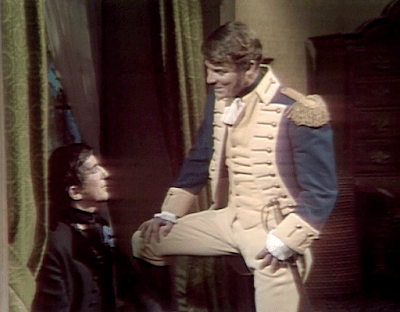
Dark Shadows 3.0 ran from November 1967 to March 1968. This was a costume drama set in the 1790s, an era to which Vicki had traveled when she came unstuck in time while participating in a séance. It seemed at first that it would invert the 1967 story, with Vicki trying to pass herself off as a native in the time to which Barnabas actually belonged, but for some reason they chose to write Vicki as a screaming ninny during this segment. Mrs Isles made a valiant effort to overcome the painfully dumb lines she was given, but by the end of it, the character was no longer sustainable.
Barnabas was a human through the first half of Dark Shadows 3.0, and a vampire for the second half. That alternation answered three questions, each of which opened a door for further development.
First, the audience wanted to see how Barnabas became a bloodsucking ghoul. When they showed this happening in the course of his relationship with wicked witch Angelique, they laid the groundwork for more stories involving her.
Second, the audience wanted to see what Barnabas was like in his lifetime. When they showed this, they proved that he didn’t have to be a vampire to be interesting, and made it possible for Julia’s experiment or some other effort to free him of the effects of the curse to succeed.
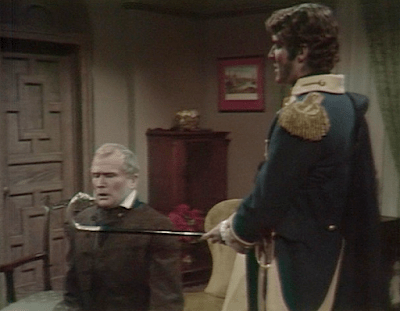
Third, the audience wanted to see what Barnabas would be like if he were as deadly as one might expect a vampire to be. In the whole of 1967, Barnabas killed only two characters, each of them a middle aged man who had run out of story and seemed likely to disappear anyway. But he kills seven people in 1795-1796, not counting people who died of fright or confusion or despair as a result of seeing him.
When it was set in contemporary times, Dark Shadows was careful to keep its characters alive. They need to fill 22 minutes a day with conversations, and if they end up with Barnabas alone on the estate of Collinwood those will get to be rather one-sided. But since they were not committed to staying in the 1790s, they could let him slaughter people with abandon. That created a fast pace that the show tried to maintain for the rest of its time on the air. In consequence of that pace, by the end of the 1790s segment the show had left behind its origins as a Gothic romance appealing to an older demographic who were impressed that Joan Bennett was in the cast and had become a kids’ show.
Vicki returned to 1968 in #461, but Dark Shadows 3.0 did not end at that moment. Vicki came back to exactly the same collection of narrative dead-ends the show had gone to the eighteenth century to escape. It wasn’t until #466 that Barnabas found that he had been cured of vampirism- not by Julia, but by another mad scientist. That set the tone for Dark Shadows 4.0. Version 2.0 may have been content with one mad scientist, but 4.0 needed at least two, in addition to multiple witches, Frankensteins, vampires, ghosts, an invisible man, and, if not the Devil himself, at least one of the assistant managers of his upper New England operations. The fast pace of the 1790s segment turned into a frantic dash through this Monster Mash era.
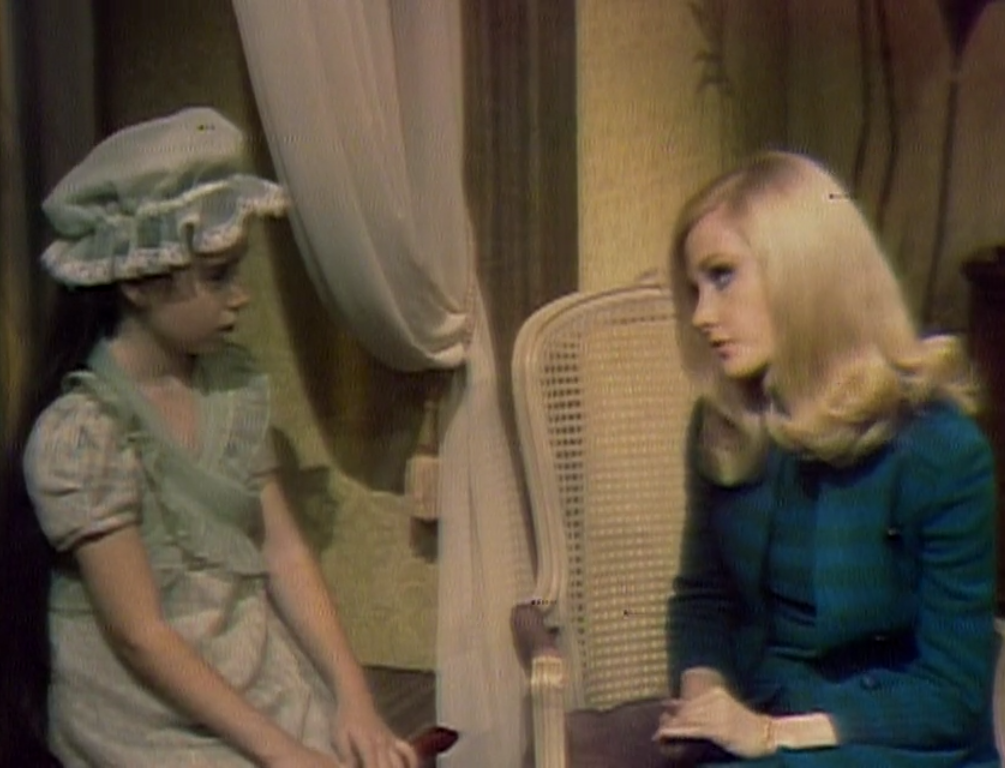
In the course of Dark Shadows 4.0, there were four personnel changes that had especially profound effects. Two were in the cast. At the end of the segment, Mrs Isles left the role of Vicki, never to return to the show. Though Vicki had been pushed to the margins long before, she was so strongly associated with the first phase of Dark Shadows that every time she appeared on screen she made a connection with those early days. With her departure, that link is broken.
Thayer David, who had played crazed handyman Matthew Morgan in 1966 and much-put-upon indentured servant Ben Stokes in the 1790s segment, returned in 1968 as Ben’s descendant, occult expert Timothy Eliot Stokes. Ben was a commentary on Matthew, an example of what he might have been had he not grown up in a community under the somber mark of the Collinses and the many curses they bear. As such, David was like the rest of the cast for the 1790s, playing a character who shed light on the part he took in contemporary dress. But as Stokes, he is playing a man who has no direct connection to Matthew, and little connection to Ben. With that doubling, we see that any performer might return to the cast in a new role at any point in the story.
The other personnel changes during Dark Shadows 4.0 took place behind the camera. Ron Sproat ended his duties as a regular member of the writing staff late in that period, and left the show altogether shortly after. Sproat was the most devoted to conventional soapcraft of all the writers, and was the only one who consistently took care to keep the show comprehensible to first-time viewers. But he didn’t have an especially fertile imagination for story points or for clever dialogue. As Hall and Russell hit their stride and really started cooking, Sproat’s relative weakness became impossible to ignore. The show entered its most exciting phase when Sproat left, but his absence would later be felt at times when the staff tried to keep the story moving at a breakneck pace even when they were too fatigued to make sure it all made some kind of sense.
The least remarked of all the personnel changes was the departure of director John Sedwick. Sedwick was an outstanding visual artist, the equal of his colleague Lela Swift. Swift stayed with the show to the end, eventually combining the role of producer with responsibility for directing half the episodes. But after several men helmed a few episodes each, they settled on the lamentable Henry Kaplan as her alternate in the director’s chair. Kaplan was a famously poor director of actors, and the visual compositions he knew how to orchestrate ran the gamut from closeup to extreme closeup to even more extreme closeup. Dark Shadows was never all that easy for first-time viewers to take seriously, and when you tune in to one of Kaplan’s efforts you’re likely to dismiss it before you hear a word of dialogue.
As Dark Shadows 3.0 didn’t end until the show had already been back in 1968 for a week, so version 4.0 ended well before it began its next time travel story. In #627, we meet werewolf Chris Jennings and hear about Chris’ little sister, who will eventually be named Amy. Amy befriends David, and together they become the central figures in the Haunting of Collinwood by the ghost of Quentin Collins. This leads Barnabas to travel back in time to 1897 in #701. Barnabas and the show will stay in that year until #884. This whole arc, from #627 airing in November 1968 to #884 airing in November 1969, makes up Dark Shadows 5.0.
The major subdivisions of version 5.0 are the “Meet Amy” section that runs from #627 to #700, the “Meet Quentin” section from #701 to #778, and the “Meet Petofi” section from #778 to #884. The transitions among these segments showed that the shift from one time frame to another is not essential for making a chapter break in the show. The reset from the focus on Quentin to the focus on Petofi rolls across a few weeks, and does not have the single spectacular moment when we first find ourselves in 1897, but it is just as definite a break. It even involves doubling Thayer David, who played broad ethnic stereotype Sandor Rákóczi in 5.0.1 (the “Meet Quentin” section,) and who plays sorcerer Count Petofi in 5.0.2 (the “Meet Petofi” section.) As Ben was an alternative version of Matthew, so Petofi is an answer to the question “What would Stokes be like if he were evil?” As such, he brings version 5.0.2 in line with version 3.0, in which characters in one time frame mirror those in another.
That we can make a major transition without returning to the 1960s raises the question of whether we need to go back there at all. Barnabas is on a mission to save David and Amy and Chris, but he could always find a fresh threat to them in the 1890s. And the characters we have met in that period are at least as compelling as are those we left behind in the contemporary time frame. Despite the deficiencies of Henry Kaplan, the writing staff of Hall, Russell, and the brilliantly witty Violet Welles combine with an almost unanimously strong cast to make the dialogue glitter. It is the strongest period of the show by far, and it is difficult to imagine wanting it to end.
We will go back to a contemporary setting, eventually. The H. P. Lovecraft-inspired monster cult known as the “Leviathans” will be the center of version 6.0; in that segment, the show will start on the most adult tone it ever adopts, and end pitched squarely at a very young demographic. The change may well have come because the three-person writing staff burned out, and became a grave matter when Welles left the show.
Version 7.0 is another time travel story, but a story of traveling sideways in time, to an alternative universe where the characters wear clothing appropriate to 1970 but have different personalities and different relationships than do the people with the same names and faces whom we have met previously.
Version 8.0 is the most ambitious of all the segments, starting with a trip in time to the far-off future year 1995, returning to 1970 for a reprise of the Haunting of Collinwood, this time by a ghost who resembles Quentin in hairstyle and wardrobe but not in height, and proceeding to a long stay in the year 1840. That version had enough characters and enough story to last indefinitely, but Hall and Russell were the only full-time writers, and they simply could not keep it up. It finally collapsed, and the last nine weeks were set in another alternate universe, with no characters in common with the stories we had seen up to that point.
Version 9.0 had a drab feeling; some say it isn’t Dark Shadows at all, but another series shot on the same sets with some of the same actors. The name Dim Reflections has been proposed for it. There is one week in the middle of Dim Reflections when Violet Welles comes back to make some uncredited contributions to the scripts; you can tell it’s her, because all of a sudden the characters have senses of humor. But after that Gordon Russell is all alone at his typewriter until Sam Hall returns for the very last day, and by that time everyone knows it is time to go.












 Dark Shadows Commentary
