Episode 290: The work itself

It’s chiasmus week on Dark Shadows. Chiasmus is when the last thing that happens in a story resembles the first thing that happened. Usually that causes the audience to look back on that first thing in a new light. Sometimes chiasmus gets very detailed, and the first several things are mirrored by the last several things.

On Wednesday, we began with well-meaning governess Vicki asleep in vampire Barnabas Collins’ house on the estate of Collinwood. Barnabas crept into her bedroom and stood over her, but did not bite. Then it was morning, and Barnabas’ sorely bedraggled blood thrall Willie delayed Vicki as she was leaving the house. Vicki took our point of view with her to the great house on the estate, where we started to see events through the eyes of visiting mad scientist Julia Hoffman. That episode ended with Julia going to Barnabas’ house. Willie delayed Julia entering the house, and Barnabas and Julia met. Their scene was tense, but Barnabas did not use any of his powers against Julia. That chiasmus marked the transition from Vicki to Julia as the audience’s main character to identify with.

On Thursday, we began with Barnabas spying on Vicki through her window, then entering her bedroom and standing over her while she slept. He again left the room without harming her. We ended with Julia spying on Barnabas through his window, then entering his house, opening his coffin, and looking at him. The parallel is completed when we see today that she left the coffin room without harming Barnabas. That chiasmus showed that Julia is capable of turning the tables on Barnabas.

Today’s episode begins with a reprise of yesterday’s cliffhanger, showing Julia gasping when she opens the coffin. So returning viewers suspect that it is likely to end with Barnabas in Julia’s room, and the suspense comes as we try to figure out how he will get there and how she will escape his malign power.

We see Julia in the drawing room of the great house talking to her friend, addled quack Dave Woodard. Dr Woodard says that her failure to report to him on the progress she has made with their common patient, Maggie Evans, The Nicest Girl in Town, coupled with her presence at Collinwood, a hundred miles from the hospital where Maggie is, has forced him to remove Maggie from her care. Julia lies to him, claiming that she has no progress to report and that the whole thing is impossibly boring. This somehow convinces Dr Woodard to leave Julia on the case.

Julia is at Collinwood pretending to be an historian studying the old families of New England, and Vicki has volunteered to help her in her research. Now Vicki is terribly afraid that if she gets involved in what Julia is doing, she will become involved in things that are too interesting for her to handle, and she wants to withdraw before she forever loses contact with tedium and drabness.

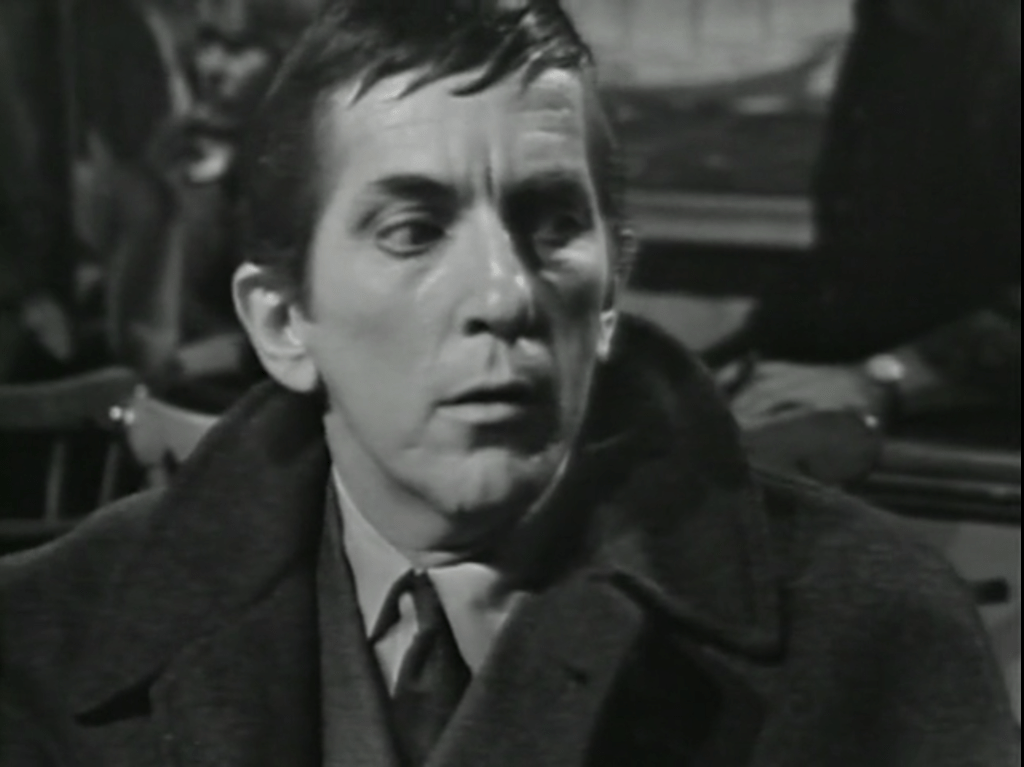
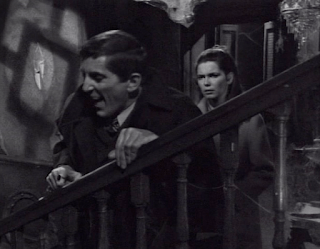
Barnabas tells Vicki that she has nothing to fear from “the past,” which at this point on Dark Shadows means the plot. While he is reassuring her, the set catches fire. We hear fire extinguishers and other noises in the background, but Jonathan Frid and Alexandra Moltke Isles don’t break character for an instant. The scene is a dreary one, marking as it does the doom of Vicki as a major part of the show, and the lines are poorly written, but they are absolutely committed to their work.

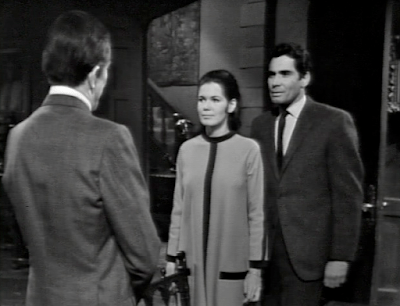
Barnabas does not believe Julia’s cover story, and is quite sure she represents a threat to him. He meets with her in the drawing room to reiterate his refusal to cooperate with her project. When Julia says that she is particularly interested in his “namesake”- actually himself- Barnabas airily asserts that he was by all accounts a dull fellow. Julia may have been able to sell that line to Dr Woodard on this same set a few minutes ago, but Barnabas doesn’t make any impression on Julia with it. The two of them continue to argue as they pass from the drawing room through the foyer. The dialogue isn’t really any better than what Barnabas and Vicki had in the previous scene, but because Frid and Grayson Hall have a lively relationship to depict- two people who each of whom knows more about the other than they are willing to say, and each of whom knows that the other knows much of what they are holding back- they make their whole sparring match seem to glisten with wit and style.

Barnabas agrees to meet Julia at his house the next evening. After he leaves, Julia tells his portrait that she can’t wait that long for their next encounter, and she knows he can’t, either.

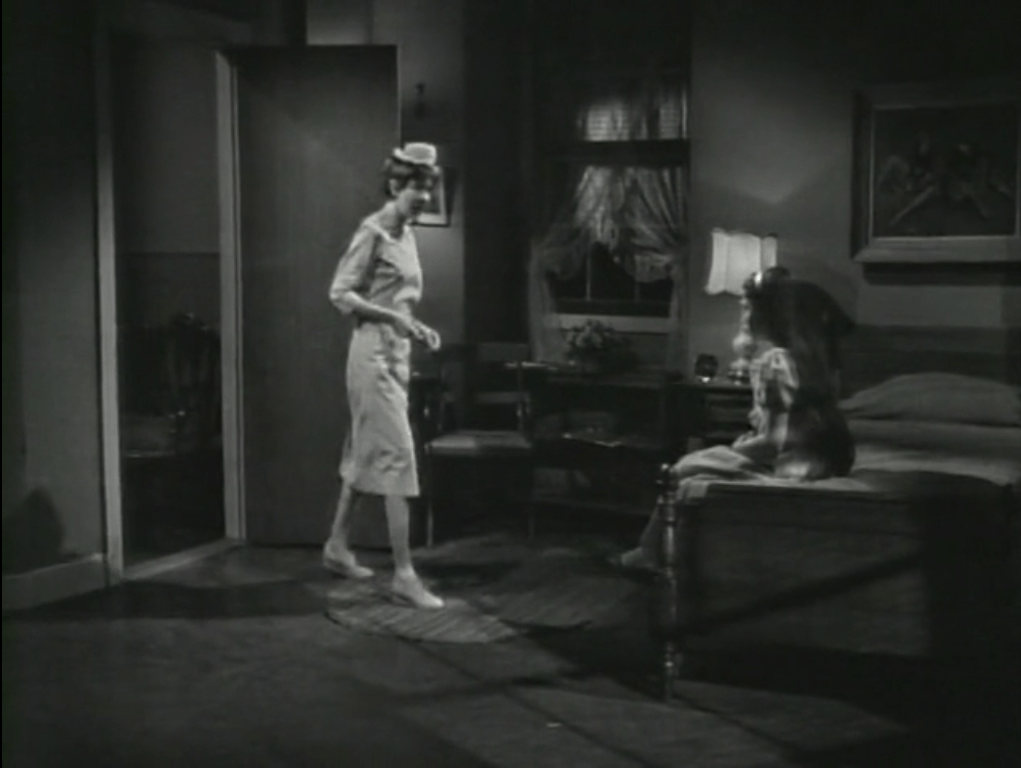
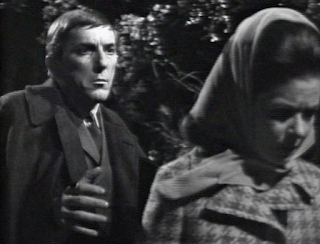
We cut to Julia in her bedroom. Vicki pays a visit, during which we hear another depressing conversation about Vicki’s newfound fear of narrative relevance. Julia assures her that “There is nothing for you to fear.” After Vicki leaves, Julia looks at her clock and sees it is a quarter to one in the morning. We dissolve to the foyer, where the hall clock reads 2:00. Barnabas appears in Julia’s bedroom and approaches the bed, where he prepares to uncover Julia. We then hear Julia greeting Barnabas by name. She emerges from the shadows on the other end of the room, and tells Barnabas she has been waiting for him a long, long time.

Julia greets her long-awaited visitor. Screenshot by Dark Shadows Before I Die.

Episode 282: Sense memories

We cut back and forth between an opulent estate called Collinwood and a mental hospital called Windcliff.

At Collinwood, we spend our time with well-meaning governess Vicki. From the beginning of Dark Shadows, Vicki has been the audience’s main point of view character. The audience is now made up chiefly of people who want to see how they are going to fit vampire Barnabas Collins into an ongoing series, and Barnabas’ principal concern is getting hold of a woman, erasing her personality, and replacing it with that of his lost love Josette. So of course Vicki is fascinated with Barnabas and fantasizes about being Josette.

Matriarch Liz has functioned as a blocking figure. Her goal has been to keep her secrets. Her actions in pursuit of that goal have slowed story development in a largely futile attempt to create suspense. She’s fresh out of secrets, but is still trying to put the brakes on. She keeps complaining that Vicki’s interest in Josette is unwholesome.

Liz has a point. Barnabas has settled on Vicki as the next subject of his experiment. To that end, he has given Vicki Josette’s music box. When he was trying his lunatic plan on Maggie Evans, The Nicest Girl in Town, he had given Maggie the music box. Evidently the music box has some kind of magical power over the women to whom Barnabas gives it. When she opens it, Vicki sits for hours staring vacantly into space listening to its simple tune.

The previous night, Vicki had worn Josette’s dress at a costume party Barnabas hosted in his house on the estate. The party ended in a séance in which Josette spoke through Vicki. Liz mentions this possession as a sign that Vicki is becoming too involved with Josette. Vicki doesn’t see anything out of the ordinary. She blandly exclaims “It’s happened before!” Indeed, the show’s first séance, in #170 and #171, climaxed with Vicki channeling a message from Josette. Liz points out that this doesn’t make it better.

Vicki goes to Barnabas’ house to return the dress. She and Barnabas’ sorely bedraggled blood thrall Willie take it to Josette’s restored bedroom upstairs. There, she blissfully tells Willie she wishes she could wear Josette’s clothes all the time. Remembering what Barnabas did to Maggie and knowing his plans for Vicki, Willie winces. He hates the things Barnabas does, but is too far under his power to actively oppose him. Vicki goes on about how close she is coming to feel to Josette, and Willie winces harder. She tells him that she has been listening to the music box for hours at a time, and he shouts “You shouldn’t do that!” When she asks why not, he takes a second to come up with something that he can say. He tells her she might damage the mechanism. Still blissful, she says, “Oh, I’ll be careful.”

Willie tells Vicki that tomorrow is Josette’s birthday. Vicki is delighted with this information. She resolves to go to the cemetery and lay flowers on Josette’s grave. When she tells Liz of this plan, Liz objects to it. Because of Liz’ function as a blocking figure, her opposition implies that it will advance the plot. To appease Liz, Vicki agrees not to go alone, but to take Liz’ fellow narrative speed-bump Burke Devlin.

At Windcliff, Maggie is in session with her therapist, Dr Julia Hoffman. As a result of her time as Barnabas’ prisoner, Maggie has amnesia and can speak only with difficulty. In his effort to Josettify Maggie, Barnabas combined his own supernatural powers with sensory stimuli like the music box that were supposed to elicit the responses he had in mind. Now Julia is trying to recreate those stimuli in her effort to recover Maggie’s memories and restore her personality.

At one point, Maggie tells Julia about a sweet scent that regular viewers know to be that of Josette’s jasmine perfume. As she does so, music starts playing on the soundtrack that we have heard when Josette’s ghost has appeared. When this happened, my wife, Mrs Acilius, said “Josette is there.” Later in the episode, when Vicki is in Josette’s room with Willie, Vicki takes a whiff of the perfume. The music strikes up then too. Josette’s ghost hasn’t manifested since March- maybe the ghost’s musical cue is now the perfume’s.

Their use of sensory stimuli is not the only way in which Julia is a reverse-image reflection of Barnabas. Barnabas is a vampire, so we expect to hate him and oppose his plans. But he is also the character who makes the show fun to watch, so we find ourselves wanting to see more of him. Further, he evolves into a comic villain, with whom we identify as we see him scramble to keep his madcap schemes from backfiring. And the longer we see him, the more of actor Jonathan Frid’s personality comes through, and Frid seems to have been adorable.

Julia is a doctor trying to help a patient we know and care about, so we expect to like her and cheer her on. Yet she always seems more than a little sinister. She takes a stern, occasionally impatient tone with Maggie today, which we might think is part of her therapeutic technique. But in her previous appearance, in #265, she took the same tone with Maggie’s father, boyfriend, and family doctor, none of whom is her patient. More than once in that episode, she made remarks suggesting that she suspected that Maggie’s condition was the result of an encounter with an undead monster, then refused to explain what she meant. We wonder why she would withhold such information. At the end of today’s installment, she insists that Maggie return to a place where something terrible happened to her. When Maggie begs her not to make her go back there, we see a closeup of Julia’s face with a look of satisfaction that led Mrs Acilius to say “Julia can do ‘evil face’ as well as Barnabas can.”*

Julia’s E-face

Julia’s grim satisfaction mirrors ours. Ever since Liz gave her great show of reluctance at Vicki’s plan to lay flowers at Josette’s grave, we’ve been wondering what kind of progress a stop at the cemetery could possibly represent for the story. Julia has unwittingly answered that question for us. The place she is going to take Maggie is, of course, that very cemetery.

*Mrs Acilius had a lot to say about Julia as Barnabas in reverse, this whole section is derived from her insights.

Episode 281: All the unhappiness of all my ancestors

Vampire Barnabas Collins is giving a costume party in his home at the Old House on the great estate of Collinwood. His distant relatives, the living members of the Collins family, are dressed as their ancestors from Barnabas’ own time as a living being. The whole thing was impossibly dull until the mischievous and witty Roger Collins suggested they have a séance. Now well-meaning governess Vicki is in a trance, channeling the spirit of Josette Collins.

The last time Josette took possession of Vicki at a séance was in #170 and #171. At that time, Josette delivered her message in French. Since Vicki could not speak French (but Alexandra Moltke speaks it fluently,) that was evidence enough to convince even the most skeptical that something was going on. Today Josette speaks English. The characters are all sure that she is the one speaking, but it doesn’t have the same effect on the audience as did that earlier irruption of a language we had not expected to hear.

I do wonder if the decision not to use French came at the last moment. Even though Vicki/ Josette’s voice is loud and clear, the others make a show of struggling to understand what she is saying and seize on a word here and there (“Something about ‘run!'”,) as people do when they are listening to someone speak a language they don’t quite understand. Perhaps writer Joe Caldwell wasn’t quite up to writing in French, and the Writer’s Guild wouldn’t let Alexandra Moltke Isles or any other Francophones on set make a translation. Or maybe they thought that the switch to French wouldn’t be as effective the second time as it was the first.

Josette is telling the story of her death. A man was chasing her, and fleeing him she threw herself off the peak of Widow’s Hill to the rocks below. Barnabas interrupts and breaks Vicki’s trance.

When the others scold him for stopping Josette before she could reveal the name of the man who ran her off the cliff, Barnabas says that the name could not have been of any importance, since whoever it was who drove Josette to kill herself must have been dead for “almost 200 years.” The others do not suspect that he was that man. They do not know that he is a reanimated corpse; they think he’s just English.

When Dark Shadows started, the stories of the tragic death of Josette and of the building of the great house of Collinwood were set in the 1830s. In the weeks before Barnabas’ introduction in April of 1967, they implied that Josette’s dates were much earlier, sometime in the 18th century. Last week, they plumped for the 1830s again. But Barnabas’ line about “almost 200 years ago” puts us back to the 1700s.

After the séance ends, we have evidence that this bit of background continuity might start to matter. Vicki looks at the landing on top of the staircase and sees the ghost of Barnabas’ 9 year old sister Sarah watching the party.

Sarah watches the party. Screenshot by Dark Shadows Before I Die

It seems that when Barnabas was freed to prey upon the living, he unknowingly brought Sarah with him. Sarah has been popping in and out quite a bit the last few weeks, and she has already made some important plot points happen. We’re starting to wonder just how many more beings will emerge from the supernatural back-world into the main action of the show. The opening voiceover today tells us that “the mists that have protected the present from the past are lifting,” so perhaps they will have to nail these dates down sooner rather than later.

The whole party had accepted instantly that Vicki was channeling the spirit of Josette and none of them ever comes to doubt it. But when she says that she saw a little girl at the head of the stairs, they get all incredulous. By the end of the episode, Vicki will have encountered so much disbelief on this point that she herself will decide that she must have been hallucinating.

Back in the great house, Roger is still overjoyed that the séance turned out to be so exciting. His sister Liz and Liz’ daughter Carolyn consider this to be in terrible taste. But Roger won’t give an inch. He has some great lines, exiting with “I think that all of the unhappiness of all of my ancestors is my rightful heritage, and you shouldn’t try to keep it from me. Good night, ladies.” Both Patrick McCray, in his Dark Shadows Daybook post about this episode, and Danny Horn, in his Dark Shadows Every Day post, make insightful remarks as they analyze the fun Louis Edmonds has playing Roger.

Carolyn approaches Vicki to speak privately. She tells her that she isn’t bothered that fake Shemp Burke Devlin is dating Vicki. Vicki’s response to this is “What?” Carolyn reminds Vicki that she used to be interested in Burke and was initially jealous of Burke’s interest in her. But she assures her she doesn’t feel that way any longer. Vicki smiles, nods, and looks away. Carolyn then says “He’s really very nice!” Vicki answers “Who?” “Burke!” says Carolyn. Again, Vicki smiles, nods, and looks away.

This is probably supposed to tell us that Vicki is coming under some kind of spell associated with Barnabas, but in fact it is likely to suggest something quite different to the audience. Burke was originally a dashing action hero played by Mitch Ryan. Dark Shadows never really came up with very much for a dashing action hero to do, but Ryan’s skills as an actor and his charismatic personality always made it seem that he was about to do something interesting. Several weeks ago, Ryan was fired off the show after he came to the set too drunk to work.

Since then, the part of Burke has been played by Anthony George. George was a well-trained actor with an impressive resume, and by all accounts was a nice guy. But he cannot dig anything interesting out of the character of Burke as he stands at this point in the series. The only scene in which George has shown any energy so far was in #267, when Burke had lost a dime in a pay phone. The rest of the time, he has blended so completely into the scenery that it is no wonder Vicki can’t remember him from one line to the next.

Back in the Old House, Barnabas talks to Josette’s portrait. In the months from #70 to #192, it was established that Josette can hear you if you do this. Several times she manifested herself either as a light glowing from the surface of the portrait or as a figure emerging from it. In #102, we saw strange and troubled boy David Collins having a conversation with the portrait- we could hear only his side of it, but it was clear that Josette was answering him.

The first time we saw Barnabas in the Old House, in #212, he spoke to the portrait. At that point, Josette was not yet his lost love. It seemed that she was his grandmother, and that she had sided against him in some terrible fight with his father Joshua. He ordered Josette and Joshua to leave the house to him. The next time David tried to talk to the portrait, in #240, it seemed that they had complied- David could no longer sense Josette’s presence in it.

Barnabas had spoken briefly to the portrait the other day, but today he makes his first substantial address to it since banishing Josette and Joshua in #212. Again he entreats her to go, but for a very different reason. Now he says that she is lost to him forever, and must allow him to live in the present. Since he has been scheming to capture a woman, erase her personality, replace it with Josette’s, and then kill her so that she will rise from the grave as a vampiric Josette, this sounds like he has decided to make a big change in his relations to the other characters.

It turns out that he hasn’t, but the writers have decided to change their relationship to their source material. Barnabas’ original plan was identical to that which Imhotep, the title character in the 1932 film The Mummy, had pursued in his attempt to replicate his relationship with his long-dead love Princess Ankh-esen-amun. Imhotep met Helen Grosvenor, whom he regarded as the reincarnation of Ankh-esen-amun because they were both played by Zita Johanns, and subjected her to the same treatment Barnabas first inflicted on Maggie Evans, The Nicest Girl in Town, and now plans to try on Vicki.

Maggie is played by Kathryn Leigh Scott. The audience in 1967 would not have known that Miss Scott also played the ghost of Josette in some of her most important appearances. However, they would have noticed when David saw Maggie dressed as Josette in #240 he assumed it was the ghost, because her face was “exactly the same” as it had been when she manifested herself to him previously. So we have the same reason to believe that Maggie is the reincarnation of Josette that Imhotep had to believe that Helen was the reincarnation of the princess, and we therefore assume that Barnabas, like Imhotep, was trying to take possession of both the ghost and the living woman.

But after Barnabas tells Josette to go away, he declares that if he is to have her, she must be someone from the present. This sequence of words is nonsensical in itself, but harks back to a theory he had laid out to his sorely bedraggled blood thrall Willie in #274: “Take the right individual, place her under the proper conditions and circumstances, apply the required pressure, and a new personality is created.” Jonathan Frid would always sound and move like Boris Karloff, but now his project of Josettery is inspired less by Imhotep than by the various “mad doctors” Karloff played in the 1940s. Of course, in the 1960s real-life mad scientists such as Stanley Milgram and John Money were performing experiments on human subjects for which Barnabas’ statement might have served as a motto. So Barnabas is coming to be less a merger of Dracula and Imhotep than of Dracula and Dr Frankenstein.

One of the devices by which Barnabas tries to place women “under the proper conditions and circumstances” for Josettification is a music box which he bought for the original Josette and may or may not have given her.* He gives this to Vicki. To his satisfaction, she is reduced to a complete stupor when she hears it play. She is in that state when the episode ends.

* In #236, he says he never had the chance to give it to her. In subsequent episodes, he implies the opposite.

Episode 267: No one has clearly defined death

Reclusive matriarch Liz is standing on the edge of a cliff, staring out to sea. Her distant cousin, Barnabas the vampire, comes up stealthily behind her. He grabs her, and she screams.

The vampire approaches the lady. Screenshot by Dark Shadows Before I Die

For months, Liz has been stuck in a go-nowhere storyline about blackmail. So it is exciting to see the beginning of a new story where she is under Barnabas’ power. Or it would be, if that were what was happening. Instead, we come back from the opening credits to find that Barnabas approached Liz that way only because he was afraid she might go over the cliff if he made a noise and startled her.*

As a result of the blackmail arc, Liz is suicidal. Barnabas fears that she may be trying to jump, and tries to cheer her up by spending several minutes delivering a semi-coherent oration about how wonderful it is to be dead.

The scene started with a disappointment, and the dialogue doesn’t make much sense, but it is always fun to see Jonathan Frid and Joan Bennett work together. Frid’s acting style was a bit of a throwback to the nineteenth century, which made him an ideal scene partner for a daughter of Richard Bennett.

In #264, Barnabas had made some remarks to Liz’ brother Roger about the importance of family. Barnabas had then gone on to bluster uselessly at Liz’ blackmailer, seagoing con man Jason. He later told his sorely bedraggled blood-thrall Willie that he might kill Jason soon. As a vampire, Barnabas is a metaphor for extreme selfishness, and his hostility to Jason fits into that- Jason does represent a possible inconvenience for him. But today, we see a hint that Barnabas might actually have some measure of concern for Liz and the rest of the Collinses. After he walks Liz home, he confides in the perpetually well-meaning Vicki that he was afraid Liz would jump off the cliff. He tells Vicki that she seems to be the person most able to help Liz.

Yesterday, housekeeper Mrs Johnson had grabbed Liz as she was about to plunge off the same cliff, and had told Vicki of the incident. But Mrs Johnson just thought Liz was fainting. Vicki had noticed yesterday that Liz was deeply depressed, but she is shocked and disbelieving when Barnabas breaks the news that she seems to be suicidal.

On his way into the house with Liz, Barnabas had seen strange and troubled boy David Collins. David had seen Liz, but Liz neither saw nor heard him- she walked silently away from him, even though he twice called out “Aunt Elizabeth!”

In #256, David had met a little girl wearing eighteenth century dress hanging around outside Barnabas’ house. Unknown to anyone but the audience, the little girl is the ghost of Barnabas’ sister Sarah. David told Willie about Sarah, and Willie himself saw her in #264 and told Barnabas about her. Today, Barnabas tells David that if he sees Sarah again he should tell her to stay away from his property.

Barnabas’ message to Sarah and David

David denies that Sarah is his girlfriend, and says that her habit of singing “London Bridge” gets on his nerves. Barnabas is startled by the mention of “London Bridge.” David says that he isn’t likely to see Sarah near the Old House again, because “I’m not allowed to play at the Old House.” He delivers this line with a pungency that led us to laugh out loud. The whole scene is a lot of fun.

“I’m not allowed to play at the Old House.” Screenshot by Dark Shadows Before I Die

Barnabas had turned his creepy, anachronistic charm on at full force when talking to Vicki, and was obviously disappointed when she told him she had a date with fake Shemp Burke Devlin. He politely responded to this news by describing Burke as “a very interesting man.”

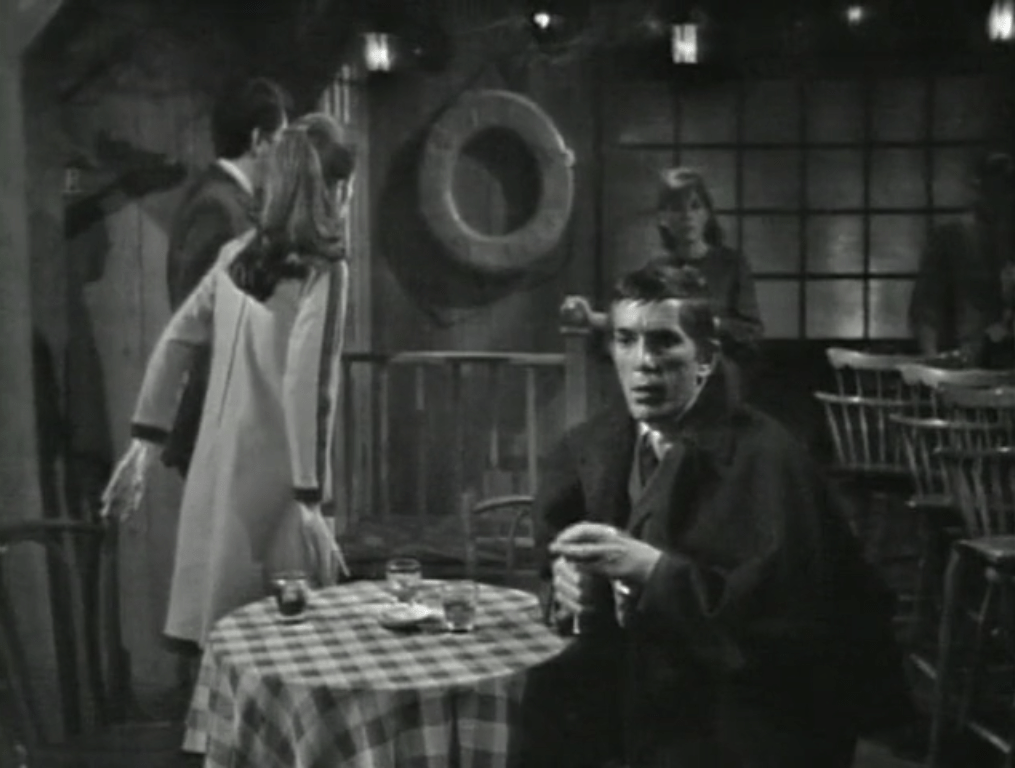
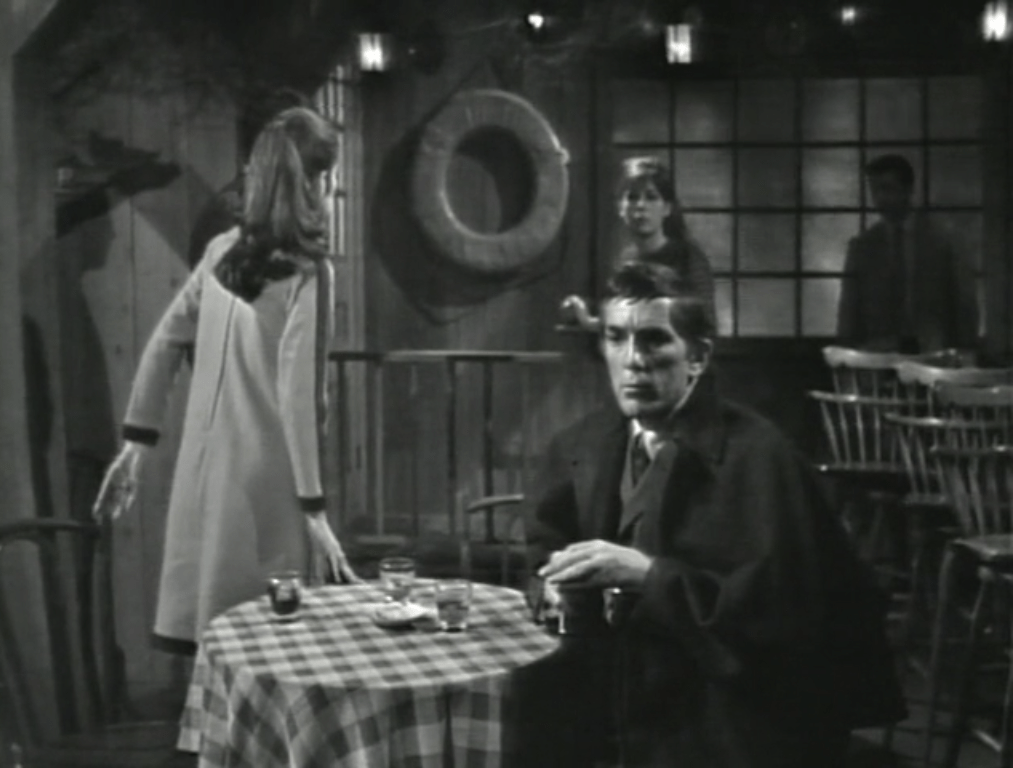
We then go to the Blue Whale tavern, where we see that “very interesting man” drinking and smoking by himself for a minute and a half. He wanders from his table to the bar to get another drink, passing some people whom first-time viewers will believe to be suffering from spastic disorders, but whom regular viewers will recognize as Collinsport residents who think they are dancing.

Notice her right hand- she has her guard up in case the convulsions spread to his arms

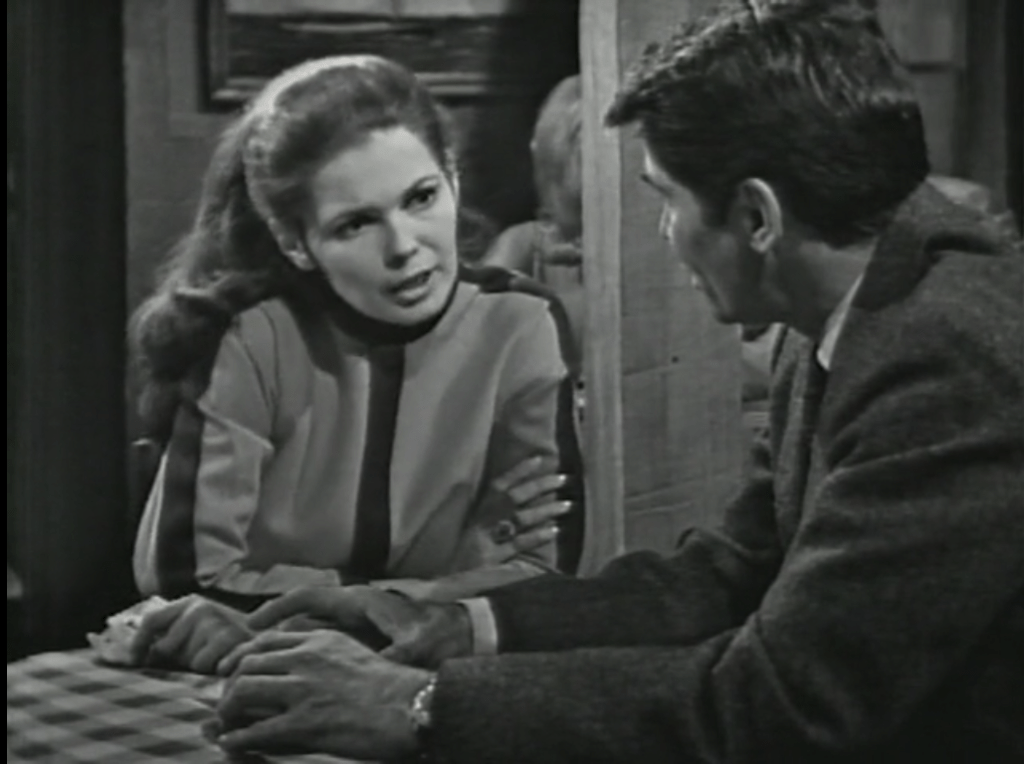
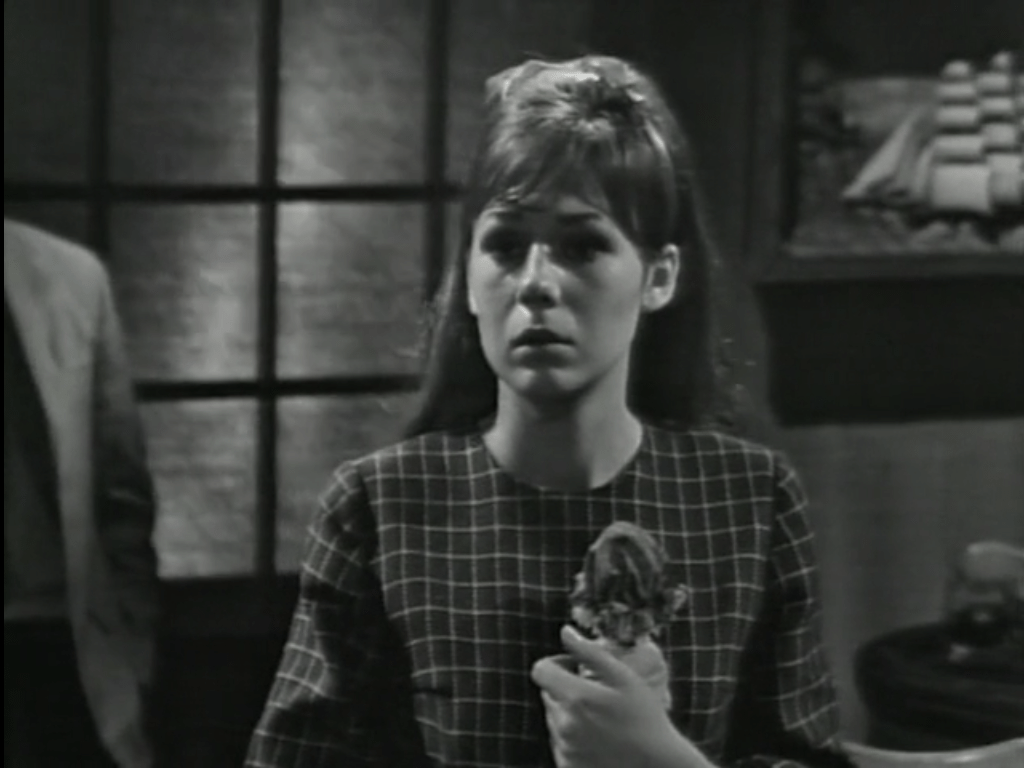
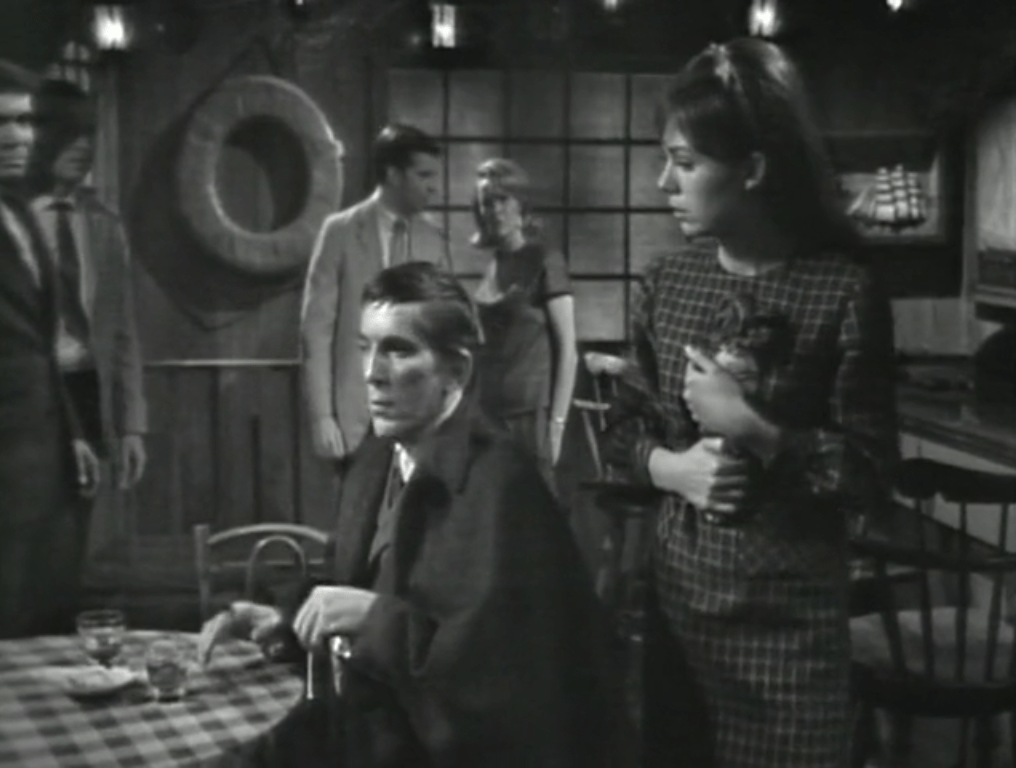
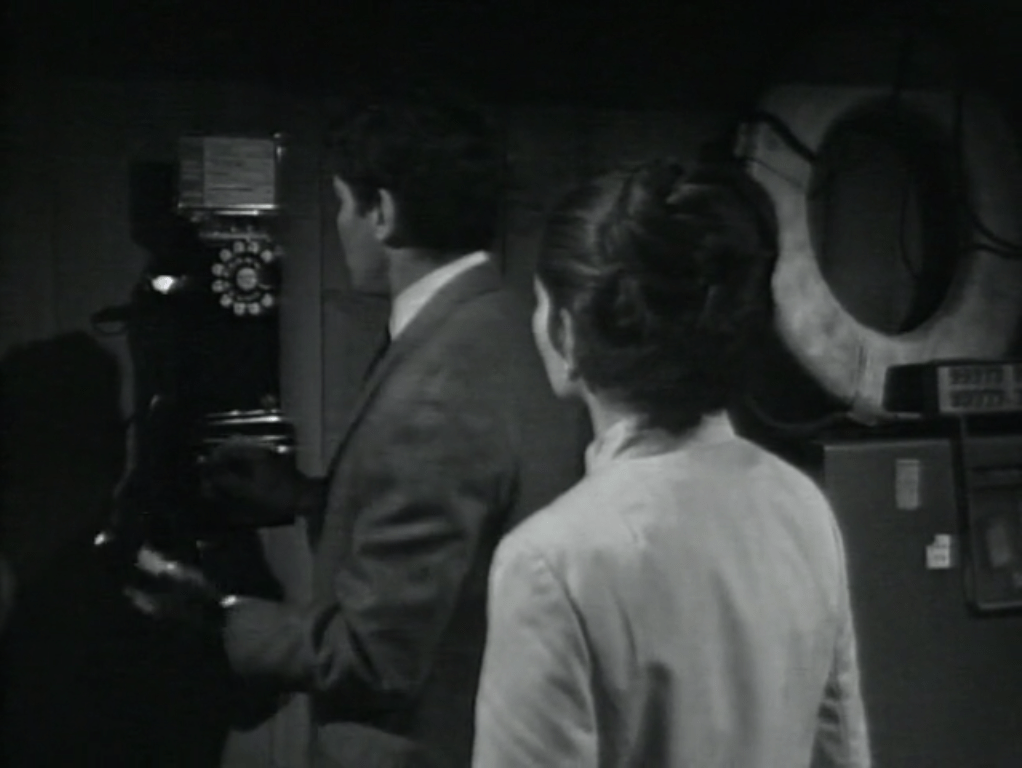
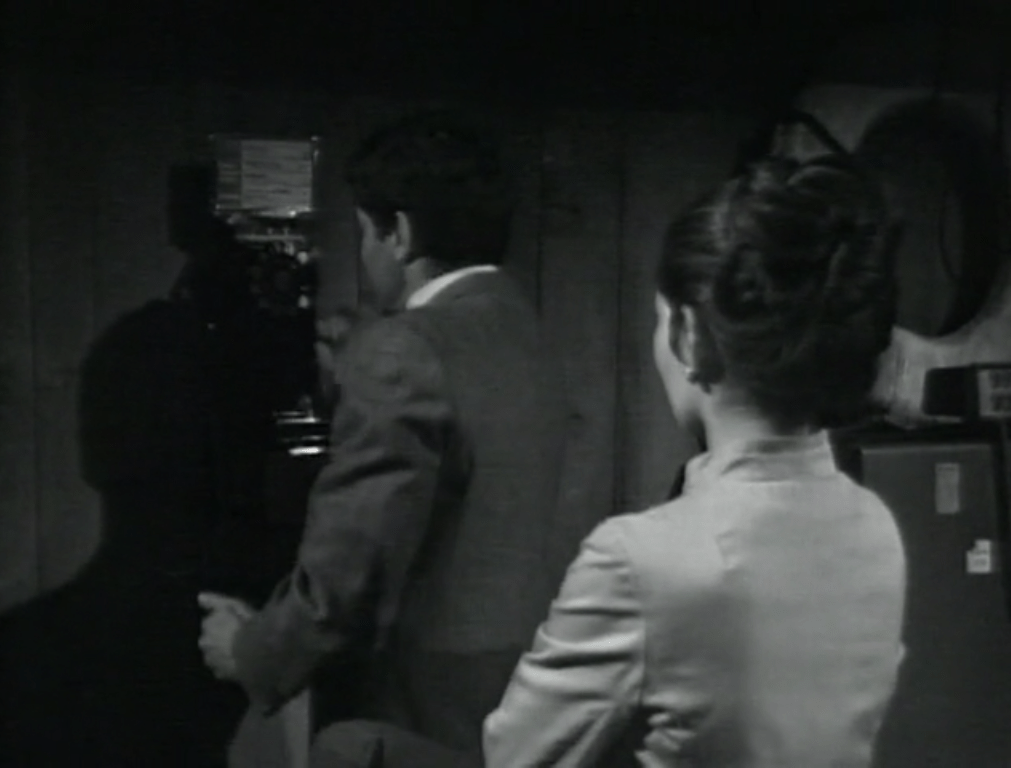
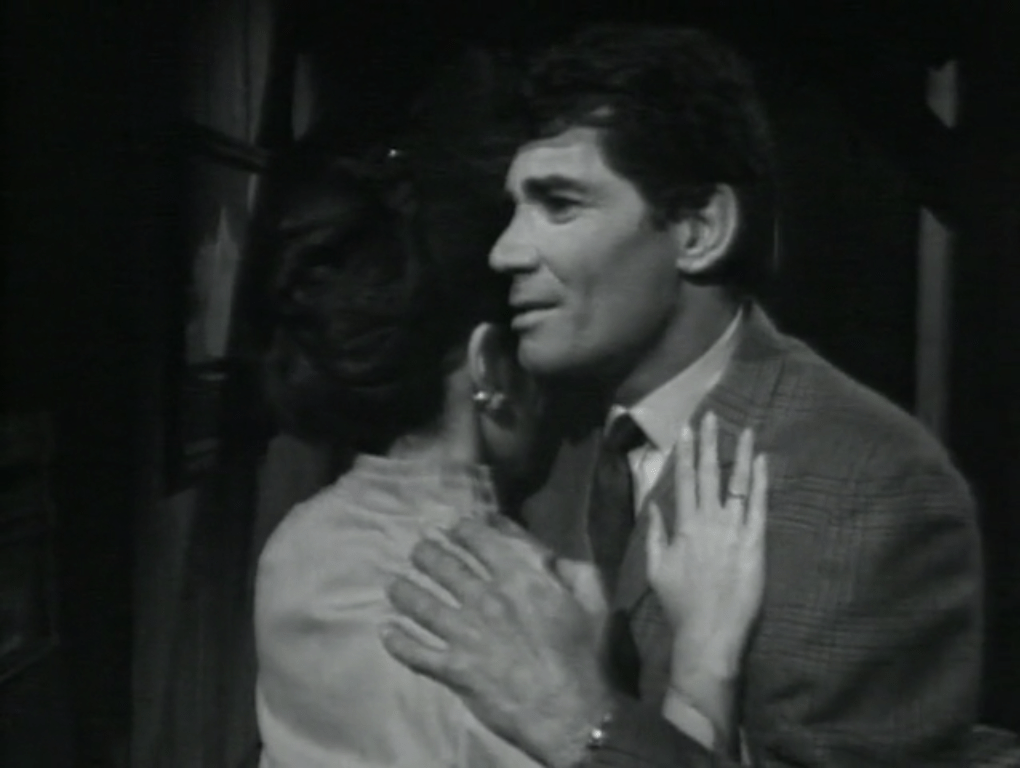
Burke goes to the pay phone to call Vicki. She enters, and he tries to get his dime back. He takes the receiver off the hook, replaces it, probes around in the coin return, bangs the side of the phone, explores the coin return again, and sadly tells Vicki that he has lost his dime. She tells him that if the purpose of calling was to get her to show up, he got his money’s worth. He agrees, but keeps looking back at the phone with longing.

Burke and Vicki dance. She tries to take his mind off the lost dime by recapping the last couple of episodes, but too little of interest has happened to refocus his attention. Vicki gives up and says she’s going home. We don’t see Burke resume his battle with the coin return slot, I guess they decided they had already given us our thrill for the day.

Back in the house, Liz is sitting in front of a table on which there is an open book. She is staring blankly into space. David enters the room. He greets her. She smiles vaguely, mumbles “Oh, David,” then gets up to leave. When Vicki comes in and says hello, Liz mutters “Hi, Vicki,” but doesn’t turn her head to look at her.

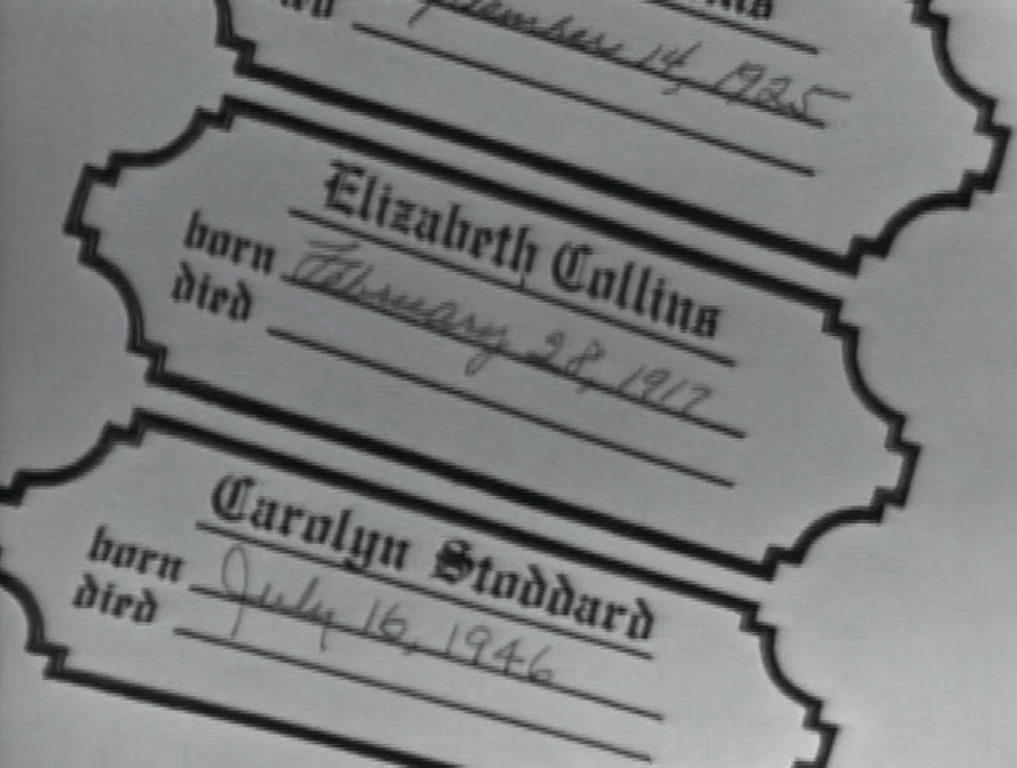
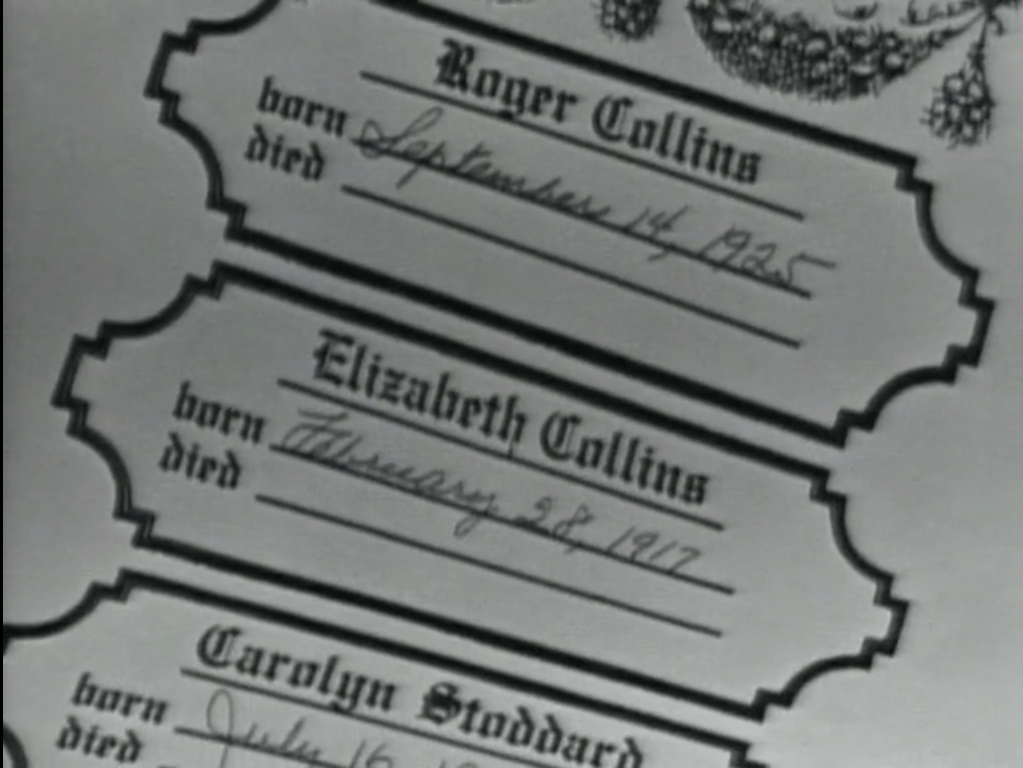
David calls Vicki’s attention to the book. It is the Collins family Bible, and was open to some plates that have been inserted bearing birth-dates for Liz and other members of the family. That’s the end of the episode. I must say, it’s quite an anti-climax after Burke’s attempt to retrieve his lost dime.

Closing Miscellany

Bob O’Connell is not on hand to play Bob the Bartender at the Blue Whale today. Instead, the bartender is Tom Gorman, who played the same role in #104 and will reprise it again in #607.

The birth-dates in the Collins family Bible are:

Roger Collins, 14 September 1925

Elizabeth Collins, 28 February 1917

Carolyn Stoddard, 16 July 1946

By comparison, the actual birth-dates of the actors were:

Louis Edmonds, 24 September 1923

Joan Bennett, 27 February 1910

Nancy Barrett, 5 October 1943

So it looks like they adjusted Edmonds’ and Bennett’s birth-dates by a few days plus a few years in setting their characters’ births, but ignored Miss Barrett’s actual birth-date in setting Carolyn’s. Maybe she refused to tell them what it was!

The show has been hinting heavily that Vicki is Liz’ biological daughter. A birth-date of 16 July 1946 for Carolyn would tend to pull against that- Vicki had apparently just turned 20 when the show started late in June 1966. Unless they were twins, one or the other of those characters is going to have to have her birth-date adjusted if they are going to resolve the question of Vicki’s origin that way.

*That’s a concern we’ve heard several times on this set- in #2, Roger introduced himself to Vicki by startling her as she stood at the edge of the cliff, and in #75 Vicki did the same thing to Roger. In #139, David was at the edge of the cliff when his mother, blonde fire witch Laura Murdoch Collins, surprised him; the episode ended with a literal cliffhanger after Laura made a move David wasn’t expecting. We’ve heard many times that the legendary Josette Collins was “the lady who went over the cliff,” as artist Sam Evans calls her in #185. It’s unclear why she did- maybe someone startled her.

Episode 243: Something about your cousin bothers me

Jason realizing he is in an awkward position

Barnabas Collins has a problem. He wants people to think of him as a mild-mannered and highly respectable English gentleman, but he is in fact a vampire from central Maine. So he leaves it to his sorely bedraggled blood thrall, Willie Loomis, to keep people away from his house while he himself apologizes for Willie’s curtness.

Today, addled quack Dave Woodard has come to Barnabas’ house asking Willie to help him investigate the case of Maggie Evans, The Nicest Girl in Town, who fell gravely ill and then vanished from the hospital. Willie refuses, but Barnabas promises Dr Woodard he will try to persuade Willie to cooperate. Since Barnabas is keeping Maggie in his house and doing various abominable things to her, we wonder how he will contrive to appear helpful.

Elizabeth Collins Stoddard has a problem. She wants people to think of her as an able businesswoman and a faultless model of virtue, but she is in fact being blackmailed. People have started to notice the money Liz is giving seagoing con man Jason McGuire, and they are certainly talking about the fact that Jason is living in her house. Today, Jason tells Liz that the solution to these problems is for the two of them to get married. Liz is not enthusiastic.

Jason has a problem. Before Barnabas enslaved Willie, Willie was Jason’s dangerously unstable henchman. So Jason doesn’t want people to think of Willie at all. But many do remember his violent ways, and suspect him of wrongdoing in connection with Maggie. Jason visits Barnabas’ house and the two of them talk about Willie and the case of Maggie Evans. Jason urges Barnabas to get Willie to cooperate with Dr Woodard.

Barnabas dislikes Jason; Jonathan Frid and Dennis Patrick play all their scenes together as a drawing room comedy about a snob burdened by the presence of an insufferable bounder. The script doesn’t always give them funny lines- today’s certainly doesn’t- but their nonverbal communication is enjoyable to watch. Frid and Patrick have so much fun with their scenes together that you never notice Frid stumbling over his lines. He is so deeply in character that you’d have to follow along with a copy of the script to catch any bobbles. He caps today’s scene with a moment when Barnabas watches Jason leave. His potentially comic expression of pained politeness gives way to a much colder look, the look of someone planning a drastic action.

Before Jason announces to Liz that he is engaged to her, he talks to her about some of Barnabas’ quirks, suggesting that he intends to continue probing into her cousin’s doings. The hour may be coming very soon when Barnabas will decide he has to deal with Jason permanently.

Episode 239: The lover of her

Vampire Barnabas Collins is taking a page from the 1932 Universal Pictures film The Mummy. Boris Karloff plays Imhotep, who rises from the dead and decides that a young lady named Helen Grosvenor is actually the reincarnation of his lost love, Princess Ankh-esen-amun. He abducts Helen, tells her she is Ankh-esen-amun, and tries to kill her so that she can come back to life as that lady. Likewise, Barnabas has abducted Maggie Evans, The Nicest Girl in Town, and set about brainwashing her into thinking she is his lost love Josette. He has made it clear to the audience, if not to the other characters, that he will kill her so that she can rise as a vampiric Josette.

Today, Barnabas and Maggie are having dinner. Maggie seems to be in a daze, and only repeats what Barnabas says to her. Still, she is smiling at him and answering to the name Josette. We can’t quite tell if she is succumbing to his lunatic plan or is simply playing along with him.

Maggie’s father Sam and boyfriend Joe knock on the door. When Barnabas’ sorely-bedraggled blood-thrall Willie Loomis mentions Joe’s name, Maggie’s head jerks to the side and her eyes open. At that, we know that she was falling under Barnabas’ spell, because we can see her coming out of it.

Maggie recognizes Joe’s name

That it is Joe’s name that breaks Barnabas’ hold over Maggie echoes another of Barnabas’ sources, Bram Stoker’s Dracula. In that novel, Professor Van Helsing is delighted to hear that the vampire’s victim Lucy Westenra is receiving blood from Arthur Holmwood, because Arthur “is the lover of her!” The vampire represents, among other things, a travesty of a sexual relationship, so that real sexuality is a weapon against him.

Willie hustles Maggie upstairs to Josette’s bedroom, which Barnabas has restored complete with hairbrush, perfume, jewelry, and a portrait of the lady herself. Included among these items is a mirror, which will be of no use to Maggie once she becomes a vampire, but which, like the other things, is among the standard appointments of an ancient Egyptian lady’s tomb. Maggie can hear her father and Joe talking in the parlor below, and their voices bring her back to herself. Willie tries to keep her quiet, and does succeed in preventing her from letting Sam and Joe know that she is there, but Barnabas hears enough to know that she is trying to escape.

Sam is an artist. Before Barnabas abducted Maggie, Sam had been coming to Barnabas’ house to paint a portrait of him. He tells Barnabas that with Maggie missing, he can’t concentrate on painting. Barnabas says that of course he wouldn’t dream of asking him to work at such a time. Sam offers to take the painting home and work on it there, but Barnabas insists it stay at the house.

It has been strange that Barnabas wanted Sam to paint at his house. Barnabas only exists at night, and his house has no electricity, so conditions couldn’t be worse for painting. Moreover, he wants to get close to Maggie, and working at the Evans cottage would mean seeing her every night. Perhaps there is some magical quality that will inhere in the painting if it is done in Barnabas’ house. We’ve already seen a number of portraits act as gateways to the supernatural. The ghost of Josette has emerged from her portrait several times. And a few months ago, Josette’s ghost went to the Evans cottage and possessed Sam to literally paint a picture of what blonde fire witch Laura Murdoch Collins was up to. So Barnabas may be leery of letting the portrait out of his sight, lest Josette or some other paranormal adversary of his take control of Sam and use it to reveal his horrible secrets.

In his scenes with Maggie at the dinner table, Jonathan Frid manages to convince us that Barnabas sincerely believes that his plan will benefit her, so much so that here would be no point in trying to appeal to his conscience. It is a tribute to his success that it is startling when the episode ends with Barnabas closing in on Maggie with the intention of doing her some kind of violence. We know that he is a vampire, we know that he has attacked Maggie and other women off-screen, and we’ve seen him beat Willie savagely. But it is still chilling to see his earnest sweetness give way to violent abuse.

Episode 236: The future, for the first time

Maggie Evans, The Nicest Girl in Town, has vanished from her hospital bed. We start with a long succession of characters talking about this fact with Maggie’s father Sam. Had David Ford played Sam as effectively as he did in his first weeks on the show, one such exchange might have made for a good scene. But Ford is overacting today, and the first part of the episode drags on and on.

We cut to the Old House on the great estate of Collinwood, where Maggie’s boyfriend Joe and dashing action hero Burke Devlin have gone. Vampire Barnabas Collins resides in the Old House along with his sorely bedraggled blood thrall, Willie Loomis. Joe and Burke have no clue there is anything odd about Barnabas, but they don’t like Willie and suspect he may know what happened to Maggie.

Barnabas lets Joe and Burke in the house and explains that he sent Willie to run some errands for him out of town. When they tell him about the evidence that has led them to think Willie might be connected with Maggie’s disappearance, he persuades them that there is nothing to their suspicions. Once they are gone, he calls out “It’s all right, they’ve gone. You’re safe here- safe here with me.” Maggie walks into the room.

Barnabas talking to Burke

This scene is very good. Barnabas is made up to look much more like The Vampire than he has been in previous encounters with characters he was trying to fool into thinking he was a harmless eccentric recently arrived from overseas. He is polite enough to Joe and Burke that they can chalk his appearance up to the lateness of the hour, but as the audience watches him extract information from them point by point, until he knows exactly what they do and don’t know, we can see him calculating when and how he will have to kill them. It is as good a scene as Jonathan Frid has had since he debuted as Barnabas.

Frid’s performance in this scene benefits from his flawless line delivery. Not so, unfortunately, the scene that follows. His bobbles are not especially bad by Dark Shadows standards, but his task is far more fragile than any he has taken on before. We’ve seen him pretending to be the Collins family’s mild-mannered cousin from England; in those moments, Barnabas himself is taking on a challenging acting job, and Frid’s difficulties sometimes dovetail with troubles we might expect Barnabas to have in his performance. We’ve seen him abusing Willie; in those moments, we might expect him to sputter a bit, and Frid can hide some of his memory lapses in that mannerism. But now, he is telling Maggie what his plans are for her. As he does so, we realize he is a crazy man spilling out his deepest and sickest obsession. That context leaves nowhere to conceal even the slightest flub. As a sign of triumphant psychosis, the lines have to flow without interruption. Every time Frid stumbles for a fraction of a second, he breaks character.

Nor can Kathryn Leigh Scott bail him out. As Maggie, her part is to wander around in a stupor and occasionally repeat the last word or two of whatever is said to her. She makes that a lot more interesting to watch than you might expect, but there’s only so far it can take you.

Barnabas’ plan takes us outside the themes we are familiar with from vampire fiction. He wants to brainwash Maggie into thinking that she is Josette Collins, who has now been retconned into the woman Barnabas loved in his human days. His goal is that Maggie Evans will cease to exist, and that in her body Josette will live again.

Dracula never wanted to do anything like that, though after Dark Shadows has a hit with this storyline it will become part of vampire lore. Prince Mamuwalde, the menace in the 1972 film Blacula, kidnapped the heroine and tried to turn her into his long-dead love. Another undead fictional man from Africa had tried the same thing in 1932, when Imhotep, played by Boris Karloff, had spent the bulk of The Mummy trying to turn the heroine into a revived form of his adored Princess Ankh-esen-amun. Frid’s face and coloring were somewhat similar to those of Bela Lugosi, a fact often remarked in connection with his casting as a vampire. But his voice and movements are strongly reminiscent of Boris Karloff, and as a mashup of Dracula and Imhotep he is a synthesis of these two actors.

Barnabas gives Maggie a music box that he had intended to give Josette. He says that he bought it for Josette in his travels in “the Orient,” intending to give it to her “on a very special day,” and “this is that day.” This leaves us wondering why the day never came when he could give it to Josette. Did he become a vampire before he returned from his travels? Did he come back from his travels to find that she was no longer available to him? Or was it supposed to be a present at their wedding, a wedding that never occurred?

Barnabas also produces Josette’s wedding dress and tells Maggie that she, as the new Josette, will wear it. When Imhotep produces Ankh-esen-amun’s clothing and jewelry, we remember that royal personages in ancient Egypt were buried with their possessions and assume that he has retrieved them from her tomb. The show did lead us to wonder if the Collinses once had a similar practice. Willie released Barnabas because he had heard a story that some of the Collinses were buried with expensive jewelry and so was trying to rob a grave. The story of the buried jewels was framed as an echo of the Gothic romances that inspired the first weeks of Dark Shadows, but has now become an anticipation of the show’s journey into Universal Pictures’ back catalogue of horror movies.

If Barnabas does manage to somehow erase Maggie and bring Josette back to life in her body, it won’t be the first time Miss Scott has played Josette. In #70, Miss Scott was the ghost who emerged from Josette’s portrait and danced outside the Old House. Miss Scott put Josette’s veil on again in #126 when she led the ghosts who scared maniacal handyman Matthew Morgan to death before he could murder well-meaning governess Vicki. In that one, she delivered a few lines as Josette. Miss Scott’s name did not appear in the credits as Josette in either of those episodes, and the only time we caught a glimpse of Josette’s face was in #149, when she was played by stand-in Rosemary McNamara. But if by any odd chance a viewer does know that Miss Scott has played Josette before, the final dissolve from a closeup of Miss Scott to one of Josette’s portrait suggests a definite possibility that Barnabas’ plan, nonsensical though it seems, will somehow succeed.

Danny Horn’s post about this episode on his Dark Shadows Every Day is particularly good. He compares its visual strategy to that of the one surviving contemporary segment of General Hospital, and praises the ambitious approach director Lela Swift took to composing images. I should also mention Patrick McCray’s Dark Shadows Daybook post, in which he analyzes the way the story alienates us from our rooting interest in Maggie’s safety by promising a more exciting story if Barnabas has his way with her for an extended period.

Episode 214: Nothing lasts forever

For the first 20 weeks of its run, Dark Shadows developed its story at a stately pace. When writers Art Wallace and Francis Swann were replaced by Ron Sproat and Malcolm Marmorstein, stately became glacial, and at times ground to a halt altogether. For the last few months, Joe Caldwell has been making uncredited contributions to the writing. While Caldwell is probably responsible for some of the glittering moments of witty dialogue and intriguing characterization that have cropped up, everything is still taking a very long time. And this is the second episode in a row in which nothing at all happens to advance the plot.

There are a few interesting moments. We begin with well-meaning governess Vicki entering the long-abandoned Old House on the grounds of the estate of Collinwood in search of her charge, strange and troubled boy David Collins. The doors swing shut, and she cannot open them. The recently arrived Barnabas Collins comes down the stairs, startling her. He opens the doors easily.

This may not sound like a big thrill, but regular viewers will remember that doors swung open at the approach of the previous supernatural menace, blonde fire witch Laura Murdoch Collins. When characters who did not know that Laura was anything other than a woman saw that happen, they didn’t react- it was a small enough thing that they could fail to notice it, and a weird enough thing that it didn’t register. So we have been prepared to watch for tricks with doors as a sign of the uncanny.

Barnabas’ big challenge today is a job of acting. He has to convince the residents of Collinwood that he is a living man from the twentieth century, not a reanimated corpse come to prey upon the living. He has trouble staying in character. When he tells Vicki that once, centuries ago, a father and son had a quarrel in the Old House that led to the son’s death, he starts laughing and repeats the word “death.” Vicki looks at him like he’s a lunatic. He gets it back together fairly quickly, but when Vicki goes back to the great house on the estate she will tell flighty heiress Carolyn that Barnabas is kind of strange.

“Death Ha Ha!” Screenshot by Dark Shadows Before I Die

Barnabas gives Vicki a long, flowery speech about the building of the house, one with no apparent motivation and many logical stopping places. Marmorstein has been giving these overheated orations to actor after actor, defeating them all. As Vicki, Alexandra Moltke Isles came the closest to selling one of them, at the beginning of #167, but she needed maximum support from the director in the form of close-up shots and lighting effects, and even then it was a relief when it was over.

Barnabas’ entire part consists of such speeches. Jonathan Frid stumbles over his lines quite a bit today, as he will do henceforth. No wonder- not only was he dyslexic, but at this point they were shooting seven days a week to make up for production time they lost in a strike late in March. That left him with precious little time to memorize the pages and pages of purple prose they kept dumping on him.

Listening to Frid struggle through his dialogue today, we discover the first reason why Barnabas became such a hit. In his voice, through his mannerisms, Marmorstein’s gibberish sounds gorgeous. Sometimes Frid’s struggle to remember what he’s supposed to say is a problem for the character. Since Barnabas is himself an actor essaying a demanding role, it gets confusing to see Frid’s own difficulties laid on top of his. But even at those times the sound of his voice is so appealing that we root for him to recover and deliver more of his ridiculous lines.

In his speech to Vicki about the building of the Old House, Barnabas mentions that the foundations were made of rocks deposited by glaciers. Any reference at all to glaciers is pretty brave, considering the rate at which the story has been moving in the Sproat/ Marmorstein era. It also raises a question about Barnabas. He is the man who posed for a portrait done in an eighteenth century style, and David told dangerously unstable ruffian Willie Loomis stories about Barnabas’ mother Naomi that would place her towards the middle of the eighteenth century. We’ve also glimpsed a plaque on Naomi’s tomb that gives her dates as 1761-1821, but that prop hasn’t received anything like the screen time the portrait of Barnabas has had, and must have been made long before David’s lines to Willie were finalized. So the trend is to regard Barnabas as someone who was confined to a coffin from the eighteenth century until Monday night. When he starts talking about the rocks laid down during the Ice Age, an event unknown until the mid-nineteenth century, we wonder which night this week he spent updating his understanding of geology.

In the great house, high-born ne-er-do-well Roger comes home from a business trip to Boston. Before updating him and the audience on recent plot developments, Carolyn reminisces about her childhood, when he used to bring gifts to her when he would come home from business trips. She tells him he was the only father she knew. This is a retcon- up to this point, they’ve taken pains to make it clear that Roger and David only moved into the house a few weeks before Vicki’s arrival in episode 1.

Vicki and Barnabas enter the great house. She introduces him to Carolyn and Roger. Roger quickly escorts Barnabas to the study where the two of them talk alone. Roger mentions that a vineyard in Spain that had been in the family in the eighteenth century was still theirs until shortly before World War Two. Barnabas does not react to the phrase “World War Two” at all. Whether this is because he has been studying history as well as geology, or because he was simply overwhelmed with so much new information, is not explained.

While Roger and Barnabas are in the study, Vicki tries to explain to Carolyn why she thinks Barnabas is a bit odd. Carolyn doesn’t want to hear it. She explains the basis of the Collins family’s attitude towards Barnabas when she says it’s a relief just to meet someone friendly after the rough time they’ve had lately. Viewers who have been watching from the beginning will understand how strong that sense of relief must be, and will know that Barnabas is in a position to ride it right into a permanent billet on the estate.

Barnabas leaves, and Roger shows Vicki and Carolyn the portrait. He points out that Barnabas is wearing the same ring as its subject. He does not point out that he is also carrying the even more distinctive wolf’s-head cane.

While those three talk about the wealthy and genial visitor from England Barnabas appears to be, we wonder what he really is. Barnabas first appeared as a hand darting out of a coffin, he has shown up only at night, he lived hundreds of years ago, and he is played by an actor who bears a noticeable resemblance to Bela Lugosi. So we assume that he is a vampire. But so far, there hasn’t been any direct evidence of blood-sucking. During the months Laura was on the show, they made a point of not assimilating her to any familiar mythology. So for all we know, he might be something we’ve never heard of.

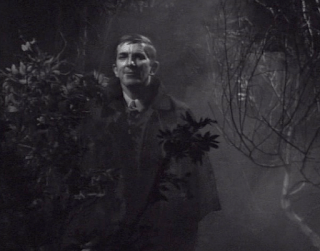
The final shot before the credits roll is in the outdoors, where Barnabas is standing perfectly still, surrounded by shrubbery, and with a big smile on his face. Perhaps that shot is telling us that Barnabas is not the vampire we might assume he is, but that he is in fact an undead garden gnome.

Barnabas the lawn ornament. Screenshot by Dark Shadows Before I Die

Episode 211: He pretended to be someone he wasn’t

The opening voiceover complains about “a frightening and violent man.” We then see a fellow with a crazed look on his face trying to break into a coffin. Assuming that he is the frightening and violent man, a first time viewer might not be especially upset when a hand darts from the coffin and chokes him, even though something like that can’t be altogether a good sign.

At a mansion identified as the great house of Collinwood, an aristocratic lady is demanding that a man in a captain’s hat account for the whereabouts of someone called Willie. The man answers to the name of Jason and calls the lady Liz. Liz has had all she can take of Willie, whoever he might be, and is not at all happy that Willie’s things are still in her house. Jason does a lot of fast talking, but cannot satisfy Liz either that Willie is really leaving or that he himself does not know where Willie is.

Jason talks with the housekeeper, a woman named Mrs Johnson. He asks her a series of questions about what she knows about Willie and she asks why he wants to know. Even though Mrs Johnson was in the room when Liz was insisting that Jason find Willie and get rid of him, for some unaccountable reason he will not tell her that he is looking for Willie.

Despite Jason’s inexplicable reticence, Mrs Johnson does tell him that Willie was preoccupied with the portrait of an eighteenth century figure named Barnabas Collins, that he was also interested in a legend that another eighteenth century personage, someone named Naomi Collins, was buried with a fortune in jewels, that Naomi Collins is buried in a tomb in a cemetery five miles north of town, and that the night before she saw Willie hanging around the toolshed. Returning viewers will recall that in yesterday’s episode, well-meaning governess Vicki had also told Jason that she had seen Willie in the vicinity of the toolshed, carrying a bag. There doesn’t seem to be a television set in the house, so everyone spends the evenings looking out the windows at the toolshed.

We see a cemetery. It soon becomes clear that it is the same cemetery we saw in the opening teaser. The gate of the tomb in which the frightening and violent man did his sinister work is swinging in the breeze. An old man in a three piece suit and celluloid collar comes upon it. He shows alarm and mutters that he can feel evil in the air.

Jason arrives at the cemetery and meets the old man. Jason says that he is looking for a friend of his, a young man. The old man identifies himself as the caretaker of the cemetery and laments the fact that a young man meeting the description Jason gives was there last night and broke the lock on the gate to the tomb. A first-time viewer’s suspicion that Willie and the frightening and violent man from the teaser are one and the same finds confirmation.

The caretaker can’t believe that Jason is unable to sense the palpable evil that emanates from the tomb. Jason overcomes the caretaker’s attempts to keep him out and makes his way into the tomb. The caretaker keeps warning Jason of the perceptible evil and Jason keeps failing to perceive it. Jason does find a cigarette on the edge of a casket in the tomb, and in closeup gives a look that can only be his recognition of a trace of Willie’s presence.

Jason finds Willie’s cigarette

Jason returns to the great house. Liz is exasperated that he still can’t tell her where Willie is, and Mrs Johnson is irritated he doesn’t put his hat and coat where they belong. After Jason and Liz have left her alone in the foyer, Mrs Johnson takes Jason’s things to the coat closet.

We see Mrs Johnson fussing with the hat and coat from inside the coat closet, an unusual perspective that has in the past been used during shots when characters have stumbled onto important evidence about whatever mystery they were puzzling over at the moment. The shot goes on long enough to lead us to wonder if Mrs Johnson is about to find something important. My wife, Mrs Acilius, mentions that each time she has seen this shot she expected Mrs Johnson to find Willie’s cigarette in Jason’s pocket and to recognize it.

Mrs Johnson fussing with Jason’s coat

That expectation is thwarted when there comes a knock at the door. Mrs Johnson answers and greets the visitor.

The next shot is from the perspective of the visitor. We see a look of astonishment on Mrs Johnson’s face as a man in a fedora and an overcoat asks to be announced to “the mistress of this house, Mrs Elizabeth Collins Stoddard.” He identifies himself as Mrs Stoddard’s cousin from England. Mrs Johnson invites the man in. He hastens across the threshold.

We cut back to the interior, and see the man and Mrs Johnson facing each other. As she bustles up the stairs, the camera tracks around to show him standing next to the portrait of Barnabas Collins, a portrait he resembles strongly. He says, “Oh, madam! If you would, you may tell her that it is Barnabas Collins.”

For regular viewers, it is refreshing to see Jason on the defensive. Ten times in the first eight episodes where they appeared together, he and Liz had a conversation in which he made a demand of her, she resisted, he threatened to expose her terrible secret, and she capitulated. Today is the second episode in which they have interacted without reenacting this drab ritual. Liz is driving the action, Jason is thinking fast, and they are each in their element. For a first time viewer wondering about the hand that came out of the coffin, it’s a lot of filler, but for those of us who have been suffering through the tedium of the blackmail plot it is a fun change of pace.

Regular viewers will also be glad to see the return of the caretaker. He appeared four times* in the storyline of Laura Murdoch Collins, the humanoid Phoenix, and managed to be simultaneously eerie and funny. His catchphrases “Died by fire!” and “The dead must rest!” are all it takes to make Mrs Acilius laugh out loud. His return in #209 moved Patrick McCray to label him a refugee from the EC comics universe, and in my post about that episode I pointed to a shot that looks so much like a panel from an EC comic book that I wonder if the similarity might have been intentional.

While first time viewers may be confused or impatient with the caretaker’s oft-repeated attempts to alert Jason to the nimbus of evil that hangs in the air around him, regular viewers know that the caretaker is the one who understands the show he is on. Jason thinks that he’s on a noir crime drama, and indeed there had been a period when Dark Shadows just about met that description.

But for months now, all the action has been pointing towards the supernatural back-world behind the visible setting. Jason’s own storyline was introduced the very day Laura’s ended, and it is a means for wrapping up all the non-supernatural narrative elements still lying around. Jason’s insensibility to the evil in the tomb is not only a sign that he is himself too corrupt to tell the difference between a wholesome space and a cursed one, but also that he doesn’t fit into the genre where Dark Shadows will be from now on. The audience in 1967 wouldn’t have known that actor Dennis Patrick always insisted on fixing a date for his departure when he joined the cast of a daytime soap, but this scene should give them a strong indication that Jason McGuire is not to be with us indefinitely.

Patrick McCray’s commentary on this episode includes an analysis of director John Sedwick’s visual strategy in the last two shots, those in which Jonathan Frid first appears as Barnabas Collins. McCray confines himself to the first thing photography students are usually taught, the “Rule of Thirds.” But that’s all it takes to get us to look closely at the imagery and to see how Sedwick tells his story with pictures:

Two clear and subtly clever images with a bridge. His introduction comes from his own perspective, rather than Mrs. Johnson’s. It’s an exterior shot of the entrance, looking in.

The grid helps us divide the image. People in the west read from left to right, and tend to circle in our gaze back to the left. Sedwick uses this model of composition in all three shots.  In image 1, we see someone — him? — through the eyes of Mrs. Johnson as the camera hangs over his shoulder, minimizing her (1.1). Why is she so transfixed? We follow her gaze up to the towering figure (1.2). Following the slope of his collar, we come back to Mrs. Johnson… specifically, her throat (1.3). After that, we circle back up to her gaze, even more worried. For what reason?

Then he enters with purpose, and we next see him again from the back, divesting himself of his cane and hat, getting a glimpse of his strangely antique cloak. His voice is rich with a uniquely tentative sense of authority. We still don’t see his face, just bits of his profile. These moments tease us, and yet they put us in the position of a confidant of the vampire’s. The composition mirrors what we saw outside. Within, Mrs. Johnson (2.1) is minimized, and the turn in the figure shows him looming, ready to pounce. Again, we begin with her, following her gaze from left to right. The mystery of what bedevils her, bedevils us, as well. The man towers (2.2) in the right, blocking the exit. Instead of following a sloping collar, we follow its larger, expanding offspring in the cape, which takes us circling to the left again where we stop on the poor, miniscule shield of his hat and then, like a wolf pulling her away, his feral looking cane (2.3).

Situated so close to the predator, with his gaze elsewhere, we have a strange safety. We don’t see him from the eyes of his prey. Instead, we are a quietly unacknowledged friend. Finally, as Mrs. Johnson goes to summon Elizabeth, the figure turns to face the portrait, rotating upstage to let us see him from profile to profile. As she exits, and we are alone with him, the chiseled face comes into focus from the side. It is alien. It is familiar. We think we know why, but then we see why. They are only face to face for a moment before the camera takes us away from him and uncomfortably close to the painting from 1795, cold and haughty and haggard and sad. He then steps even uncomfortably closer to it and spins to give his inevitable name. We see the two men in mutual relief.

The painting of Barnabas is a prisoner in a four-sided frame on the wall, disapproving and distant as the first thing our eyes rest on (3.1). Is the painting gazing at the man? No. The more we look, the more the painting is gazing at us, as if we’ve been caught looking. It’s natural to avert our eyes from this, and by comparison, section 3.2 is practically benevolent. His impossible doppelganger is standing before it in three dimensions on our 2D screen. Liberated, he smiles, and there is something optimistic about it. He’s gazing upward to the landing, yes, but it’s also to the future. Gazing left, he’s anticipating the next image rather than look for one that has passed. Subtly, our eyes wander down to 3.3, his medal, a subtle reminder that, despite his strange warmth, he’s a soldier as well, and a force to be reckoned with. 

Patrick McCray, “The Dark Shadows Daybook: April 14,” from The Collinsport Historical Society, 14 April 2017

*In episodes 154, 157, 179, and 180

My usual themes: Bossy Big Sister/ Bratty Little Brother

In 281 of the posts that follow, I link to comments I made on Danny Horn’s blog, “Dark Shadows Every Day.”

Not all of these comments were absolutely unique. Several times it occurred to me that a Dark Shadows features a number of older sisters who clean up messes that their misbehaving younger brothers make, and that a variety of male-female relationships on the show take on the dynamic of a bossy big sister and her bratty little brother. Danny doesn’t cover the first 209 episodes of the show, when we learn that Roger Collins has managed to squander his entire inheritance, half of the family fortune, and that his older sister Elizabeth Collins Stoddard has gone deeply into debt to contain the damage that his irresponsibility has done to the family business. Elizabeth takes Roger into her house, and alternates between demanding that he reform his ways and enabling his ongoing bad conduct. She takes charge of the raising of Roger’s son David and puts Roger to work in the family business, setting bounds to Roger’s crapulence but also insulating him from its consequences.

My first remarks about this theme were in a comment on episode 565:

Watching this episode, I just realized the main relationship in DARK SHADOWS- Bossy Big Sister/ Bratty Little Brother. Liz and Roger are literally that, and each one’s struggle to safeguard their relationship by keeping the other in the dark about their shameful secrets is the background of every storyline in the first 209 episodes. Carolyn and David become the functional equivalent of a Bossy Big Sister and a Bratty Little Brother, and that’s the development that makes Carolyn a relatable character.

In Julia and Barnabas, we have the supreme example of such a relationship. They fall into it naturally; Julia is used to giving orders, and Barnabas is used to disobeying them. From the moment Julia lit her cigarette on the candles in the old house, she’s been Barnabas’ Bossy Big Sister, pursuing one plan after another meant for his own good. He’s been alternately pouting at her, raging against her, and clinging to her, at once resenting her demands on him and craving her validation for his narcissism. The climax of the episode, when they both know that a he-vampire is roaming about in search of a victim but it occurs to neither Julia nor Barnabas that Julia might be in danger, shows how deeply they have embedded themselves in these roles. Barnabas won’t even let Vicki walk to her car alone, and Julia, hearing the dognoise, understands why. But when Julia tells Barnabas that she will close up the lab and leave shortly after he goes out to join Willie, implying that she’s going to walk all the way back to the Great House by herself, he just leaves. Of course nothing will happen to Big Sis, she’ll always be OK.

That’s also why I don’t see how slashfic positing a sexual relationship between Barnabas and Julia can work. They are so much Bossy Big Sister and Bratty Little Brother that no matter how much time they spent telling themselves that they aren’t actually related, it would still be impossibly weird to try to be something else to each other.

I returned to the theme in a remark about episode 572, where Jonathan Frid gives a line-reading so pouty that I wonder if he was consciously trying to depict Barnabas as a bratty little brother to Julia:

I love the way Jonathan Frid pouts the line “I was afraid your visit would be pointless.” He’s every inch the bratty little brother upset that his big sister went out when he didn’t want her to go.

By episode 648, the idea has moved me to fanfic:

Cavada Humphrey looks quite a bit like Jonathan Frid. I wonder what 1795 would have been like if Barnabas had had an older sister who bossed him around, stood around during his ridiculously childish fits of petulance, occasionally acted as his conscience, and time and again serve as his enabler and protector. It would have been funny to see Grayson Hall’s Countess express disapproval of such a relationship.

Heck, that older sister could have been Sarah. Just because she’s a child in her ghost form doesn’t mean she has to have died at that age. Maybe she comes back in the form in which her relationship to her brother took its permanent shape, when she was about nine and he was about seven. Of course, that possibility is foreclosed at Sarah’s first appearance, when she tells Maggie not to let her “big brother” know she saw her, but I suppose they could have retconned that away with a phony flashback where she says “little brother.”

I revisited these points a few times- Danny’s blog consists of over a thousand posts, one each for episodes 210-1245, plus a few dozen about properties related to Dark Shadows, and each post has its own discussion thread. So it isn’t bad netiquette to repeat yourself a bit from one thread to another- there is always a chance someone who didn’t see a comment previously posted elsewhere will take an interest when you post a similar one. But I did try to keep from making a bore of myself to those who read everything.

I could have mentioned some other bossy big sister/ bratty little brother combos. In a comment on the 1897 storyline, I alluded to the relationship between Judith Collins Trask and her feckless younger brothers. Judith’s arc doesn’t really allow her to be a bossy big sister to any of her three bratty little brothers. But each of them does find himself attached to at least one woman who is stronger than he is, and who might well treat him as Elizabeth does Roger and as Julia does Barnabas.

It’s a shame Terry Crawford wasn’t a more accomplished actress in the 1960s- in the scripts Beth fluctuates between indulging Quentin in his every vice and insisting that he clean up his act. That’s the bossy big sister/ bratty little brother dynamic we’ve seen so many times, but unlike any previous pair who have enacted it Beth and Quentin are lovers and are not social equals. It would be interesting to explore the dynamic in that context, but Ms Crawford’s performance is so wooden that you sometimes have to think about her scenes after it is over and call to memory the dialogue and the visual composition before it strikes you what the point was.

Pansy Faye isn’t on the show very long, unfortunately but she’s clearly in the driver’s seat in her relationship with her thoroughly clownish husband Carl Collins. And Edward Collins is much the weaker personality in his connections with both his estranged wife Laura and with Kitty Soames. So each of those men was looking for a woman who was forceful enough to take charge of him, but indulgent enough to allow him to continue in all his established habits.

I also made only one brief reference to the bossy big sister/ bratty little brother dynamic in the discussions of the 1840 storyline. That’s rather odd- after all, in that one Julia actually presents herself to the family as Barnabas’ sister, and he is forced to go along with the pretense.

I did not refer to the theme in my comments on posts about “The Haunting of Collinwood” by the ghost of Quentin, and I made only a single reference to it in my comments on posts about the “Re-Haunting of Collinwood” by the ghost of mini-Quentin Gerard. Indeed, that single reference is to Julia’s failure to focus her bossiness on Barnabas. I dropped the ball there, I think- the relationship between David and Amy in the original “Haunting of Collinwood” is at its most interesting when it mixes elements of the bossy big sister/ bratty little brother dynamic with other types of interaction, while the bland, lifeless relationships between David and Hallie on the one hand and between Tad and Carrie on the other in the “Re-Haunting of Collinwood” could benefit from some kind of structure.

I also left the theme unmentioned in my comments regarding the show’s dying days, the 1841 Parallel Time storyline of episodes 1199-1245. That’s understandable- the show did not develop any bossy big sister/ bratty little brother relationships in that period. But there was an implicit one- Miss Julia Collins was the sister of Justin Collins, and she had functioned as head of the household during his years of madness. Justin dies a few episodes into the story, without sharing a scene with Julia, and she is left as a bossy big sister with no bratty brother to whom she can attach herself. Meanwhile, Bramwell is a thoroughly bratty man with no big sister. It’s rather sad for the loyal audience, having enjoyed so many scenes in which Grayson Hall and Jonathan Frid had enormous fun with the bossy big sister/ bratty little brother pattern, seeing them drift separately through these dreary episodes.

The closest we get to a bossy big sister/ bratty little brother scene in the dying days of the show is also the one genuinely irresistible moment of that segment. In episode 1215, Flora Collins (Joan Bennett) and her son Morgan (Keith Prentice) are walking through the woods on their way to Biddleford’s Creek. He whines about the pointlessness of the trip, she scolds him, and we get a brilliant little glimpse of what their relationship must have been like since he first learned to talk. That authoritative mother/ whiny son moment left me, not only wanting more such scenes between them, but also wishing it had been presented in contrast with a bossy big sister/ bratty little brother relationship elsewhere in the show.