Well-meaning governess Vicki ran out of story in #191, and has been at the fringes of the show ever since. Since March, Vicki has been stuck in a relationship with an unpleasant man named Peter who preferred to be called Jeff.
As long as Alexandra Moltke Isles played Vicki, longtime viewers could hold onto some sliver of hope that she would eventually reconnect with an interesting plotline. Mrs Isles’ last episode was #627, and the part was taken over by Betsy Durkin, who stresses random words in her lines (such as, “Jeff, you’ve got to stop thinking about the past!,”) keeps looking at her scene partners with her face still for a few seconds too long after delivering her lines, and moves about awkwardly, as if she were afraid of tripping over her costume. For his part, Peter/ Jeff is played by Roger Davis, a highly trained actor who doesn’t do any of those things, but who routinely assaults actresses on camera and who clenches his rectal sphincters whenever he raises his voice, causing him to sound like he is struggling with constipation. Miss Durkin and Mr Davis are a difficult pair to watch, and since there is no reason in the story for either fake Vicki or Peter/ Jeff to be on the show their scenes are an unwelcome intrusion.
Today, fake Vicki and Peter/ Jeff get married. The morning after their wedding, he fades into nothingness while she watches, which considering his personality is the best case scenario for her.
We spend the middle of the episode with recovering vampire Barnabas and mad scientist Julia, who unlike fake Vicki and Peter/ Jeff are actually characters on Dark Shadows. Barnabas and Julia enter the great house of Collinwood. They have been at pains to keep the residents of the great house from finding out about any of the supernatural doings, yet when they walk in the front door they blab about everything in nice loud voices.
Matriarch Liz comes in and tells Barnabas and Julia that Vicki has married Peter/ Jeff. Once Liz leaves, Barnabas, stunned and dejected, moans “Julia, why did she do it? Why did Vicki marry him?” Barnabas has often claimed to be in love with Vicki, but in fact takes remarkably little interest in her, so it is no surprise that less than a minute goes by before he shrugs the whole thing off with “I’ll accept it and pray that she’ll be happy with it.”
Julia reacts to Barnabas’ reaction to the news of Vicki’s wedding. Screenshot by Dark Shadows Before I Die.
Barnabas and Julia go off to drive a stake through the heart of witch-turned-vampire Angelique. It’s a rule on Dark Shadows that a wedding scene leads to the exposure of an empty coffin, so it will be no surprise to longtime viewers that when Barnabas and Julia open Angelique’s coffin they find she isn’t in today. Barnabas fears that she has changed in some way that will make her even more dangerous when she eventually returns.
Angelique and Peter/ Jeff were the last loose ends left over from the big collection of storylines introduced in the spring of 1968; her absence and his vanishing wrap up the Monster Mash period that constituted Dark Shadows 4.0. The only indication we have had so far as to what version 5.0 will turn out to be was a scene in #632 between werewolf Tom Jennings and his sister Amy. It remains to be seen how the Jenningses will connect with the Collinses and what other characters will join them.
Robert Rodan joined the cast of Dark Shadows in #485 as Frankenstein’s monster Adam. For his first few months, Adam could barely speak, limiting Rodan’s performance to facial expressions expressing his very intense emotions. He did well with that, and, as Adam came to master English, Rodan’s considerable range as an actor quickly became apparent. He gets a showcase today.
An experiment meant to bring Adam’s mate back to life has failed, and he decides that old world gentleman Barnabas Collins is at fault. Adam originally extorted Barnabas’ cooperation with the experiment in #557 by threatening to kill well-meaning governess Vicki and everyone else in the great house of Collinwood unless he were given a mate. Now Adam is in that house ready to carry out his threat.
He stands outside Vicki’s bedroom door. Through it, he hears heiress Carolyn Collins Stoddard talking with Vicki. Adam fell in love with Carolyn some time ago, while she was protecting him from the police. Since Vicki is Carolyn’s best friend, and since Carolyn, her mother, her favorite uncle Roger, and Roger’s son David all live in the great house, Adam’s threat to kill everyone there always lacked a certain credibility. He eavesdrops as Carolyn tells Vicki she was recently very much attracted to a man, she can’t say who, and that ever since that man had to go away she has been depressed. Regular viewers know that Carolyn is talking about Adam, and he may know as well. Once Carolyn has left the room, Adam slips in. He tries to abduct Vicki. She screams, and Carolyn comes.
Adam slaps Vicki in the face and she collapses on the floor. In #515, Adam struck his friend Sam Evans across the face, inflicting an injury that contributed to Sam’s death shortly after. Adam didn’t know his own strength then; now, he only knocks Vicki unconscious. Carolyn tries to call the police; Adam takes the telephone from her hand and rips it from the wall. She is shocked that he is prepared to hurt even her. He puts his hands on her throat and squeezes it between his thumbs. The reason his mate needed to be brought to life a second time is that he strangled her in #626, and what he is doing to Carolyn looks unnervingly like what we saw him do then.
Rodan is self-possessed and deliberate when Adam is alone with Vicki, apparently smug in his certitude that whatever plan he has for her will work. When Carolyn enters, he abruptly shifts to a mixture of sorrow and rage. While he is strangling her, the sorrow overwhelms him completely. He knows exactly what he is doing, and is utterly miserable to be doing it.
Mad scientist Julia Hoffman is in Barnabas’ house. Barnabas had figured out that Adam was likely to go to Collinwood to carry out his threats, and she is waiting for him to come home and tell her whether he succeeded in thwarting Adam. She hears a noise, and calls out for Barnabas. He does not come, but the equipment in her basement mad science laboratory starts making its noises. Adam enters.
Julia and Adam exchange some mutually evasive dialogue. Rodan had played Adam’s scene with Carolyn and Vicki very hot, his emotions right on the surface. Now he shows that he can just as effectively play cold. Julia keeps asking him questions, which he parries without losing his smile, becoming excited, or in any way giving a clue as to what is in his mind. He deploys each syllable like a chess player selecting the right square for a piece. He shows a bit of feeling at first when he refers to the charred skeleton in the basement as “the only bride I ever had,” but then settles into an imperturbable calm. He responds to Julia’s repeated questions about his plans for vengeance against Barnabas with perfectly logical questions of his own about what he would have to gain by hurting Barnabas- “or you, for that matter?” He is indifferent to the news that suave warlock Nicholas Blair, whom he once considered a friend, has vanished, never to return. When Julia tries to escape, he asks her where she is going, and she tries to deflect the question. He is still altogether composed until the very second Julia turns to go to the basement, when the placid surface suddenly breaks and he knocks her out.
Barnabas donated the “life force” that brought Adam to life, and there are moments when longtime viewers will recognize deep similarities between the two characters. For example, when Julia first met Barnabas he was a vampire, and he was deeply suspicious of her interest in him. In that period, they often faced each other in this room in conversations that could easily have ended with Barnabas murdering her. Barnabas would not condescend to using Julia’s first name, addressing her only as “doctor.” Adam has no way of knowing about that history, but he does know that each time he calls Julia “doctor” she seems a little bit more uncomfortable. So he does it as often as possible.
Julia regains consciousness sometime after Adam attacked her and finds that Barnabas is with her. She tells him that Adam is in the basement doing something with the equipment; he tells her what he found when he talked with the slightly injured Carolyn earlier, that Adam has abducted Vicki. They put two and two together, and go to the cellar door. It is locked, so they have to find another way to the basement.
We cut there to see Vicki strapped on a table, energy flowing from the equipment into her while she writhes and cries out in pain. Adam is at the controls. Images of Julia and of Carolyn, speaking and pleading with Adam to show mercy to Vicki, wipe across the screen. These effects may seem a little corny nowadays, but must have been quite startling on daytime television in 1968, and are typical examples of director Lela Swift’s visual artistry and technical ambition.
Barnabas and Julia enter. Barnabas points a gun at Adam and says he will kill him unless he lets Vicki go. Adam laughs at him. He and Barnabas have a connection like that between Alexandre Dumas’ Corsican brothers, so that any harm one suffers will endanger the other. Adam knows this, and he also remembers an audiotape in which the designer of the Frankenstein experiment that created him says that if he dies, “Barnabas Collins will be as he was before.” Barnabas knows about the Corsican brothers thing, but he never heard that tape, so he is puzzled when the laughing Adam says “If I die, you will revert back to what you were. That’s what it said on Dr. Lang’s tape and I heard it. I memorized it. I don’t know what you were but I know you don’t want me to die.” While Adam reaches for the switch to give Vicki a lethal jolt of electricity, Barnabas shoots him in the shoulder and he falls.
Adam’s laughter in this scene is of a piece with his sorrowful expression while he chokes Carolyn. Nothing matters, no one matters, life and death are just the same, he will kill and torture and maim and it will all be a big joke. Viewers who remember the first weeks of Adam’s life, when Julia the mad scientist and Barnabas the recovering vampire, symbols of extreme selfishness both, kept him locked in a cell a few paces from the spot where he is standing now, will see in this total nihilism the logical outcome of that horrifying act of child abuse. As Rodan sold Adam’s heartbreak so effectively that his scenes in the cell were hard to watch, so he sells his total alienation from humanity so effectively that we can believe that he is ready to commit any crime against any person and to laugh all the way through it. This utterly bleak moment brings the character’s development to a fitting climax.
There are a couple of notable goofs in this one. The right sleeve of Adam’s sweater can be seen at the edge of the shot when the closing credits start; the camera zooms in to get clear of him. Robert Rodan had played his part with so few slips that he hadn’t quite seemed at home on Dark Shadows; it’s good to see him making up for lost time now. Much more embarrassingly, while Barnabas and Julia are looking through the barred window of the cellar door Jonathan Frid touches his face, and it looks very much like he is picking his nose.
Suave warlock Nicholas has had bad news. His boss, Satan, will be recalling him to Hell, and does not plan to send him out to the world of the living again. Satan gave Nicholas two tasks to complete before his time runs out. He is to perform a Black Mass during which he will sacrifice Maggie, The Nicest Girl in Town, and afterward take her to Hell with him as his bride. He is also to complete the project he has been working on, forcing mad scientist Julia and old world gentleman Barnabas to resurrect Eve, the mate of Frankenstein’s monster Adam. Yesterday, we saw that Nicholas plans to make Barnabas and Julia use Maggie as the donor of the “life force” that will bring the mate back to life. It was entirely unclear how Maggie could both be sacrificed on Nicholas’ altar and used as the “life force.”
We open today with a reprise of yesterday’s closing sequence, showing Nicholas performing a rite while Maggie lies on his altar. We then cut to the basement of Barnabas’ house, where Eve’s body lies on a bed in a laboratory full of mad science equipment. Barnabas vows to Julia that this is the last time they will ever go through the vivification procedure; she asks “What’s the point of saying that? We’re at Nicholas’ mercy.” The other day, Barnabas confronted Nicholas with some demands, threatening to stop cooperating with his project unless he complied. Nicholas gave some ground in response, suggesting there might yet be some dramatic tension left in his relationship with Barnabas and Julia. But when Julia sounds this note of total defeat she is telling us that their conflict with Nicholas is exhausted, that the Frankenstein story has nowhere to go, and that Barnabas is therefore right and this is the last time we will see them run the experiment.
Julia looks at the body and expresses sympathy for “poor motherless Eve.” “There’s a poem about that,” she says. Indeed there is, and it is an apt reference here. Nicholas’ attachment to the ingenuous Maggie has always been jarringly out of character for him; Ralph Hodgson’s 1913 poem “Eve,” with its juxtaposition of the innocent Eve with the crafty serpent, not only tells a story that is as broadly melodramatic as any episode of Dark Shadows, but also dwells on the incongruity of Eve and the serpent, the sheer strangeness of the fact that they coexist at all. “Here was the strangest pair/ In the world anywhere.”
Yesterday we caught our first glimpse in a long time of a character who, like Maggie, was introduced in the first episode. He was Mr Wells, the innkeeper. Maggie has been with us through all of the show’s transformations, but we hadn’t seen Mr Wells since #61, when Dark Shadows was all about what went on among people while they were drinking coffee together. Seeing him again puts that 1966 show side by side with this dramatization of “The Monster Mash,” and that contrast is as jolting as anything Hodgson manages.
Visitors let themselves into the lab. First comes Nicholas. He is trying to seem cheerful. He comes down the stairs with a bounce in his step and greets Julia and Barnabas with a jokey “Why are my conspirators so reluctant?” He might be trying to evoke the same unholy jollity that we see at the end of Hodgson’s poem, “Picture the lewd delight/ Under the hill tonight/ ‘Eva!’- the toast goes round-/ ‘Eva’ again.” But the imminent prospect of his return to Hell has Nicholas in no jolly mood, and his mask of good cheer falls away the moment Barnabas complains of his untrustworthiness.
It is true that Barnabas’ complaint strikes Nicholas at a most sensitive spot. He tells him that “You seem to specialize in second chances” and gripes that he revived vampire Tom Jennings and left him to do the dirty work of ensuring Tom would never rise again. Giving second chances was the very habit for which Satan reproved Nicholas in #629 when he told him he would soon be returning to Hell. Stung by the echo of his master’s words in Barnabas’ mouth, Nicholas retorts that destroying a vampire must have been “traumatic” for Barnabas, who was until recently a vampire himself. Because of some magical business, Barnabas will revert to that condition if Adam dies, and it is Nicholas’ threat to kill Adam that has compelled him and Julia to assist in his diabolical plan. Having reminded Barnabas and Julia of the source of his power over them, Nicholas composes himself, agrees with Julia that there is no time for quarrels, and leaves the room.
A moment later, Adam enters. Adam hates Barnabas and Julia, believes that Nicholas is his friend, and looks forward to Eve’s resurrection. Barnabas tells Adam he doesn’t want him there, but Nicholas enters with the command “He stays, Mr Collins.” A third visitor follows and shocks Julia and Barnabas even more deeply. It is Maggie.
The rite on the altar dedicated Maggie to Satan, but it did not involve her death. When Julia and Barnabas see that Nicholas has brought Maggie, they declare that they will not go ahead with the procedure. But Maggie declares that she is there of her own free will. Quite calmly, she looks around the laboratory in Barnabas’ basement, and says “I’ve been here so often.” Indeed she has- in May and June of 1967, Barnabas was still a vampire, Maggie was his victim, and he kept her imprisoned in a cell here. Julia used her extraordinary hypnotic abilities to make Maggie forget her ordeal, but this line suggests that she now remembers what Barnabas did to her, and that she is, terrifyingly enough, happy about it.
When Maggie was Barnabas’ prisoner, he was trying to erase her personality and replace it with that of his lost love Josette. Later, the show took us back in time to the year 1795, where we saw Josette when she was alive and realized that she wasn’t on board with Barnabas’ plans then any more than Maggie was in 1967. But it looks like Nicholas has succeeded where Barnabas failed and remade Maggie as a companion fit for a demon. Barnabas is already miserable at being forced to toil in Satan’s cause, and now he goes nuts with jealousy.
Barnabas loudly protests that he will not be a party to the experiment. Nicholas silences him by causing Adam’s heart to beat dangerously fast. Their magic bond gives Adam and Barnabas the connection Alexandre Dumas’ Corsican Brothers had, so that Barnabas also suffers the pain. Julia was originally introduced as Maggie’s doctor, but she long ago betrayed her patient for Barnabas’ sake. She pleads with Maggie to stop Nicholas, but Maggie just smiles and asks “Why should I?” Julia tells her that otherwise Nicholas will kill both Adam and Barnabas. Perfectly relaxed, Maggie responds “Then you stop him. Do what he wants.” Julia capitulates, saying “We’ll use her.”
This glimpse of Evil Maggie is breathtaking for longtime viewers. In #1, Maggie premiered as a wisecracking waitress who was, in the words of the original series bible, “everybody’s pal and nobody’s friend.” Soon, we saw her with her father Sam, the town drunk, and she emerged very clearly as a classic Adult Child of an Alcoholic (ACoA.) In #20, Maggie left behind the short blonde wig she had worn in her first appearances, and from then on she was The Nicest Girl in Town.
When Barnabas first bit Maggie, she went through the phases the vampire’s victim usually experiences, including snappishness towards her loved ones when they try to get between her and the ghoul on whom she is becoming dependent. During her time in Barnabas’ house, her level-headedness and warm-heartedness reasserted themselves, and even when she was in the mental hospital as a psychological wreck after escaping from him she was never far from a display of kindliness. In the eighteenth century flashback, Kathryn Leigh Scott took on the part of Josette. Josette was so unfailingly virtuous that not even Miss Scott could find a way to make her interesting. This brief moment of a Maggie utterly indifferent to the value of human life, even her own, is such an extreme departure that we can immediately see a world of possibilities opening up for her as a character and for Miss Scott as a performer.
Maggie is strapped to a table and Julia and Barnabas get to work. We have seen the procedure often enough that it is far from fresh, but in-universe it is still highly experimental. The equipment doesn’t work as Julia and Barnabas expected; gauges indicate higher readings than they want, and the adjustments that are supposed to bring them down just make them go even higher.
Maggie cries out that she is dying; Eve barely moves. The readings get even worse; Barnabas shuts the apparatus down. Nicholas tries to cast a spell to immobilize Barnabas; he struggles against Nicholas’ power at first, but still smashes the equipment, and soon is free of the spell altogether. Nicholas calls out to his master and pleads “Don’t desert me now!” His powers gone, he runs to Adam and starts trying to choke him, but Adam brushes him aside easily. Nicholas runs away; Barnabas runs after him, saying that he will take the opportunity to kill Nicholas.
Adam is shocked that Nicholas attacked him. He and Julia find that nothing is left of Eve’s body but a skeleton with a wig. Adam sobs, declaring that now he has no one. Adam decides that Barnabas is to blame for Eve’s destruction. He goes upstairs, tells himself that Barnabas “doesn’t deserve to love,” then leaves the house. Later, we see him in the great house of Collinwood. Regular viewers know that Adam has in the past thought of punishing Barnabas by murdering well-meaning governess Vicki, in whom Barnabas does not actually take much interest but whom he frequently claims to love. So we can expect that Friday’s episode will involve some apparent danger to Vicki.
Julia is too busy with Maggie to take any notice of Adam’s doings. The last time Julia ran the experiment, the “life force” donor died. Julia is frightened when she cannot get Maggie to respond to any stimulus. She gives her a shot, and Maggie opens her eyes.
Longtime viewers wonder what Maggie will be like now. If Satan has lost interest in Nicholas, it seems unlikely that the heartless Maggie of a moment ago will stick around. If she returns to her usual sensibilities with her memories of Barnabas’ crimes restored, the show will no longer be able to use the sets representing the houses at Collinwood since Dark Shadows will become a prison drama about the activities of Barnabas and Julia on their respective cell blocks. If she just snaps back to the way she was before she got involved with Nicholas, it will feel like a cheat.
What they actually choose to do is to give Maggie total amnesia. She does not recognize her own name or Nicholas’, refuses to believe she has ever met Julia, and has no idea where she is. Julia tries desperately to reactivate Maggie’s memory. She takes her up to Barnabas’ living room. In a moment longtime viewers will find impossible to believe, Julia takes a music box and plays it for Maggie. She tells her that it once belonged to Josette and that Maggie has heard it many times. Indeed she has- Barnabas forced her to listen to it incessantly during the weeks when he was trying to Josettify her. Julia, who has gone to such great lengths to bury Maggie’s memory of what Barnabas did to her, is now trying to dislodge her recollection of his very worst crimes. When Maggie does not remember the music box, Julia takes her up to Josette’s bedroom, where Barnabas kept her for much of her time as his prisoner. It is simply impossible to imagine what Julia could be thinking at this point.
Meanwhile, Barnabas is skulking in the foliage near the peak of Widow’s Hill. He is eavesdropping on Nicholas, who is pleading with Satan to give him another week to get the Frankenstein project back on track. He dissolves into a process shot depicting flames, and Barnabas smiles the most evil grin anyone has ever managed.
Even though poor motherless Eve is on screen for only a minute or two, doesn’t open her eyes, has no lines, and moves only a couple of fingers and those just barely, they brought Marie Wallace back to play her. That was $333 well spent. Miss Wallace’s presence on screen convinces us that Eve is really dead and that she will not be back. Combined with Maggie’s amnesia, that leaves Nicholas without any connection to an unresolved storyline. The only former underling of his still at large is witch-turned-vampire Angelique, and she had broken from him decisively a couple of weeks ago. When he vanishes, we can accept it as a line drawn under the part of the show in which he was the principal villain.
Eve’s decomposition and Nicholas’ damnation are not the only departures today. This was the final episode directed by John Walter Sullivan. As “Jack Sullivan,” he was credited as an associate director on a great many episodes, from #15 to #549. When John Sedwick left the show in the summer of 1968, Sullivan took over his share of the directing duties, alternating with Lela Swift. He directed a dozen episodes as “Jack Sullivan,” from #504 to #580. He then took the name “Sean Dhu Sullivan,” and directed 50 more. Sullivan was not as accomplished a visual artist as either Swift or Sedwick, and the camera operators had more trouble keeping his episodes in focus than they did either Swift’s or Sedwick’s. But his scenes were never any more confusing than you would have expected, considering the ridiculously convoluted stories the scripts gave him to work with, and he seems to have been as good a director of actors as either of them. The period when he was helming segments happened to be the one when the show had its most explicitly Christian elements, which you might say made him a Sean Dhu for the Goyim,* but I doubt he had anything to do with that.
*This is my only chance to make this joke, please just let me have it.
Angelique, wicked witch turned vampire, is dissatisfied with her boss, suave warlock Nicholas. She finds out that Nicholas has botched his current project and sees an opportunity to report him to his boss, a figure identified in the dialogue simply as “The Master” but in the closing credits as “Diabolos.” She performs a ceremony that is intended to get Diabolos to come to her in the basement of Nicholas’ house, but Diabolos insists she meet him in his office. That is obviously a redress of the set used for the basement of old world gentleman Barnabas Collins’ house. The show never does explain where Barnabas gets his income, so I guess it makes sense he rents out space to local businesses.
Diabolos is impatient with Angelique. When she starts complaining that Nicholas has been harsh with her, he responds “From what I know, you deserved it.” When she persists on this point, he says “I don’t want to hear anymore.” He goes on to praise Nicholas, saying that “His plan for creating a super-race which will follow only me is excellent.” Angelique then tells him that this plan has in fact failed. “One of the beings chosen for the plan has destroyed the other.” Indeed, the male Frankenstein’s monster known as Adam killed the woman built to be his Eve on Monday. Diabolos is shocked to hear this, and at the end of the episode we hear his voice telling Nicholas that he will soon face judgment.
Duane Morris plays Diabolos. Morris appeared several times as a stand-in for Adam before Robert Rodan wa s cast in the part; this is his first speaking role on the show. It would be a very difficult challenge for any actor. In the first place, his costume conceals his face altogether, so his physical movements and his voice acting in his scene with Angelique are two separate performances which he has to give simultaneously. Second, in that scene he spends much of his time looking away from her, so he cannot use his imposing height to create a sense of menace. Third, his voiceover at the close plays during an extreme closeup on the motionless face of Maggie, The Nicest Girl in Town, who is supposed to be acting as his medium. But there is nothing to suggest Maggie is in peril, so even the mood lighting and other practical effects that precede the speech do not focus our attention on Diabolos as a threat. Fourth, the lines Morris has to deliver are written for a middle manager in a mundane office, not for one of the principalities of Hell. At every turn, Morris has to convince us of Diabolos’ dread might with only his voice. Unfortunately, his voice was anything but intimidating. As a result, the whole episode falls flat.
There is also some business with Adam and mad scientist Julia. An unpleasant man known variously as Peter and Jeff is in police custody, charged with Eve’s killing, and Julia tries to convince Adam to help her clear him. In recent months Julia has become the audience’s chief point of view character, but in this case it is Adam’s resolute indifference to Peter/ Jeff’s fate that reflects our attitude. Julia tells Adam that Peter/ Jeff’s life may be on the line if he is tried for murder. In the state of Maine that exists in our universe, capital punishment was abolished for the last time in 1887. In November 1966, this was also true of the version of Maine in which Dark Shadows was set. It was mentioned in #101, broadcast that month, that the state did not carry out executions. Perhaps the fictional Mainers in the show’s universe responded to the horrendous news continually emanating from Collinsport by reestablishing the death penalty, or perhaps Julia realizes that no true statement could enlist anyone’s sympathy for the entirely repellent Peter/ Jeff and so she is resorting to a desperate lie.
Mad scientist Julia Hoffman and bedraggled servant Willie Loomis have been in the woods, looking for old world gentleman Barnabas Collins. Barnabas has become the victim of vampire Angelique, and loss of blood has brought him very low. Julia and Willie fear that if they do not find Barnabas before nightfall, he will die. Barnabas was a vampire himself until March; they fear he will revert to that condition if they cannot save his life.
Despairing of the search, they return to Barnabas’ house. Julia remarks that “I actually found myself feeling that we’d come home and find him here.” Willie lives there, Julia doesn’t, but as Barnabas’ inseparable friend and partner in all his adventures she may as well. Julia and Willie decide that the only way to save Barnabas is to drive a stake through Angelique’s heart. She tells Willie that she believes the suave Nicholas Blair to be keeping Angelique’s coffin in his house. She sends Willie to fetch a stake and mallet, and she ventures forth to visit Nicholas.
Julia and Nicholas had a very dramatic confrontation in his living room in #619. Today, she tells him she has come to provide medical attention to Frankenstein’s monster Adam. Adam and Barnabas have a Corsican brothers connection, so Julia knows that Barnabas’ injuries will have reduced Adam to a dire state. Nicholas is keeping Adam at his house because he has plans for him, and if those plans fail it “will bring down the Master’s wrath.” Facing that prospect, Nicholas has little choice but to allow Julia to attend to Adam. She gives him some shots, which do provide him with considerable relief. But she says this is only temporary. She proclaims that “the only known cure” for Adam and Barnabas’ joint condition is Angelique’s destruction.
Early in the scene, Julia says that she and Nicholas must work together to help Adam and Barnabas. Nicholas tells her that he has no healing powers. At that, we may think he is about to talk forthrightly about himself as a warlock. But when she asks where Angelique’s coffin is, Niccholas starts playing dumb again. This frustrates Julia, as it might frustrate the audience. Danny Horn’s whole post about the episode on Dark Shadows Every Day is about how much it frustrates him. Julia leaves the stake behind when she goes, and Nicholas takes it downstairs to Angelique’s coffin with the intention of destroying her.
Meanwhile, Julia’s ministrations have done enough to revive Adam and Barnabas that the latter is able to cry out in the woods. Willie finds him and takes him home. Julia comes back, sees them, and sends Willie to call for an ambulance to take Barnabas to Windcliff, a sanitarium of which she is the nominal head and which is located about a hundred miles away. Barnabas objects to that, but Julia insists.
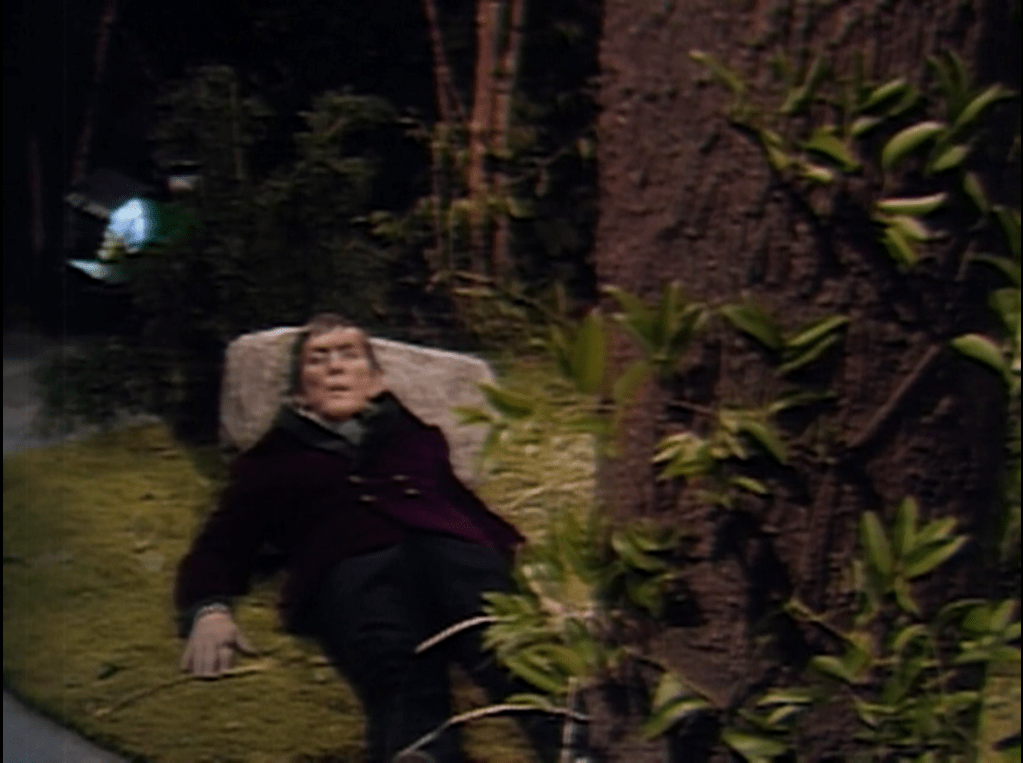
There is a spectacular goof in this one. We see Barnabas lying on the “grass” in the “woods.” For several seconds we can see the edges of the little green rug Jonathan Frid is on, and a studio light on the floor next to it.
They gave a number to each episode of Dark Shadows reflecting its place in broadcast order. They skipped the numbers for the days the show wasn’t on, so that episode #620 was actually the 613th episode. Fascinating, I know. Even more interesting, there were a total of 1225 episodes, making this one the exact middle of the series.
When Dark Shadows started in June 1966, its undisputed star was Joan Bennett as matriarch Elizabeth Collins Stoddard. Describing Dark Shadows’ overall narrative structure, Bennett said “We ramble around.” At its beginning, the show was heavily atmospheric and slow paced, with stories very much aimed at an adult audience who remembered Bennett’s heyday in the 1930s and her father’s in the early twentieth century. As it developed, supernatural elements that had at the outset lurked in the background came to the fore and attracted a much younger audience. By this time, Dark Shadows is a slam-bang kid’s show with a cliffhanger at every commercial break and a cast including witches, vampires, mad scientists, and Frankenstein’s monsters. So it is appropriate that the episode at its chronological center is in a way the most unrepresentative of them all. Dark Shadows tended to go to great lengths to avoid anything that would get the audience thinking about Christianity. Yet this outing is all about the saving power of the cross.
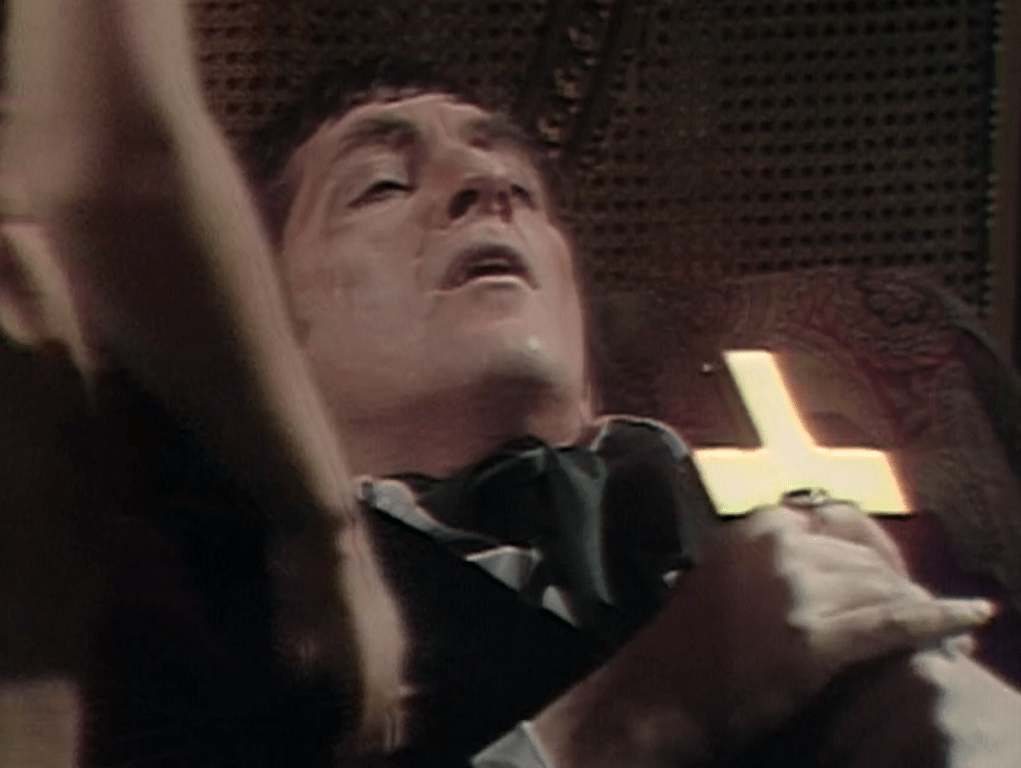
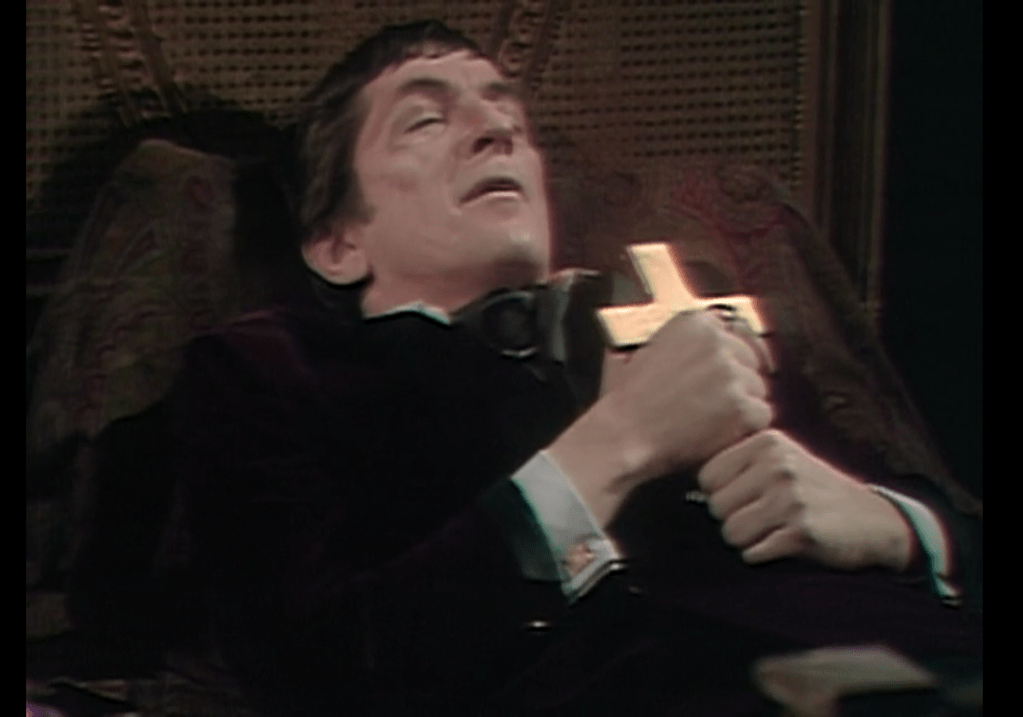
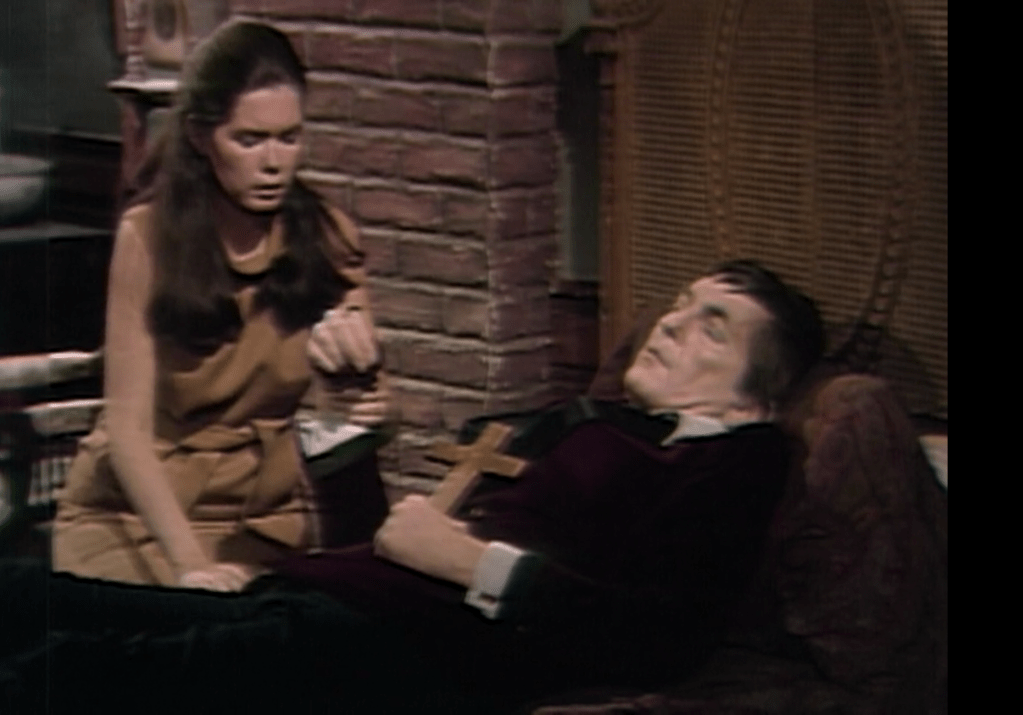
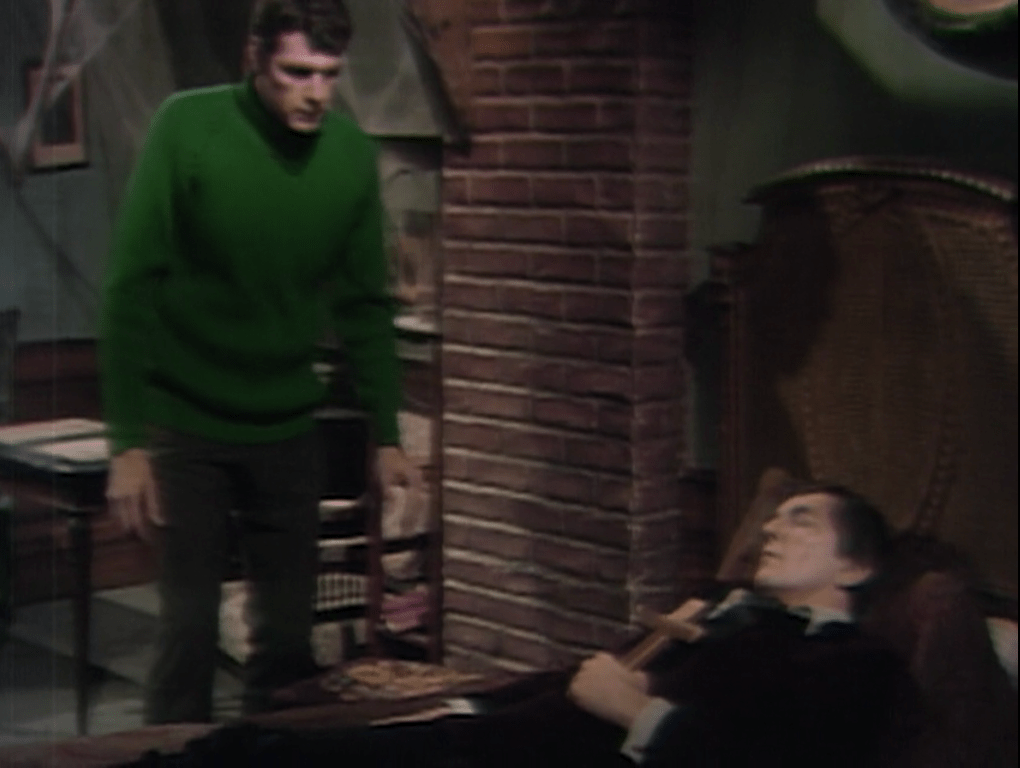
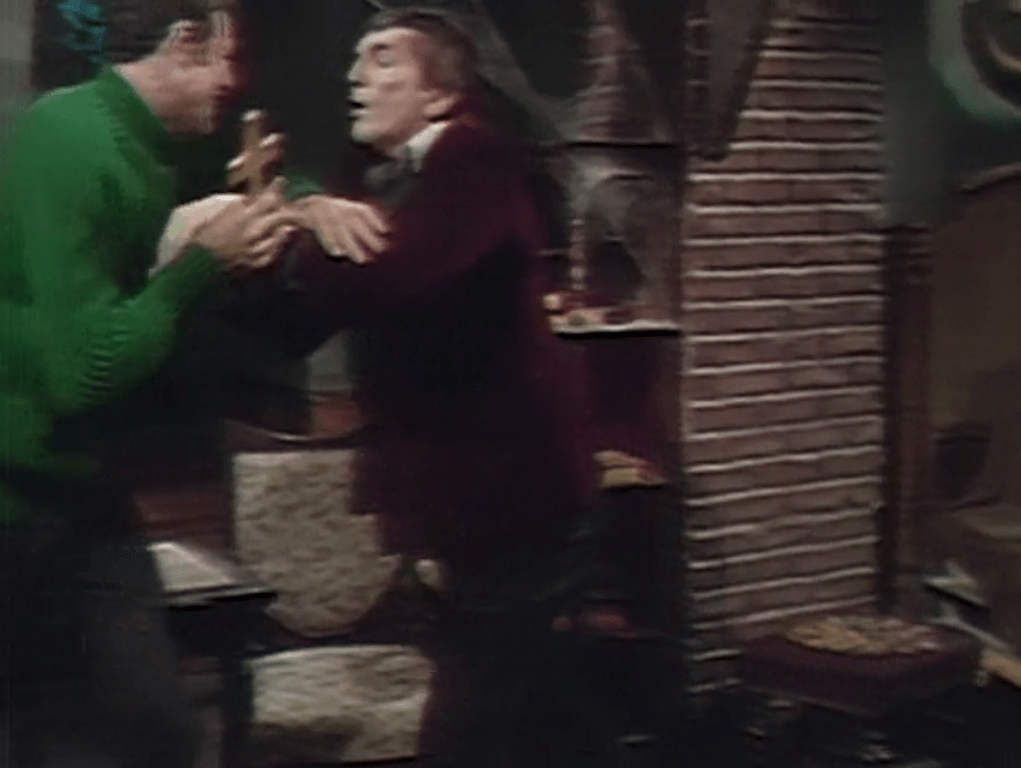
Old world gentleman Barnabas is hiding in the long deserted west wing of the great house of Collinwood. Well-meaning governess Vicki took him there after finding him lying on the ground in the woods, grievously injured. Vicki does not know that Barnabas is the victim of a vampire, and so she does not know why he is anxious that she bring him a cross. When he sees that she has brought one, he mutters “The cross… I need it so.” He clutches it to him and tells her “I need no one but you, and nothing but this.” At the middle of the episode, he is going on about this again, saying “No one frightens me… All I need is the cross. The cross!”
When the vampire’s helper Adam comes to steal the cross from him, Barnabas exclaims “The cross! The cross, it will save us both!” Adam takes the cross back to the vampire. He offers it to her. She recoils from it and tells him to destroy it. She runs away, and he looks at it in wonder, not knowing what it is. We are left to ask if he will find out what gives the cross its power, and if learning about it will indeed bring salvation both to him and Barnabas.
Over the next few weeks, much will change on Dark Shadows. There will be major changes in the cast, several storylines will be resolved, new storylines will start, and the pacing will become more deliberate. As that goes on, the show will curve back around to something at once more reminiscent of its early days and more suggestive of what is to come than is this utterly zany period. Not that it will stop being weird- the weirdness will just be developed in greater depth over longer periods. I would say that this bizarre detour into Christian piety marks the most remote point it ever reached in its rambling away from its original concept.
Well-meaning governess Vicki has found a grievously injured Barnabas Collins in the woods. Barnabas insists Vicki not take him to a doctor or anyone else, but hide him somewhere no one will find him. She thinks of a secret door to the long-abandoned west wing of the great house of Collinwood, and uses that to take him to a hiding place there.
For the first year of Dark Shadows, the west wing was strongly associated with Vicki. In #14, she alone saw the locked door separating the bedrooms from the west wing open and close, apparently by itself. That was the first unequivocal evidence of supernatural activity on the show. In #84, Vicki’s charge, strange and troubled boy David, led her into the west wing, the first time we had seen its interior. He then trapped her in a room there, hoping she would die. She would languish in that room until David’s father, high-born ne’er-do-well Roger Collins, rescued her in #87. When Vicki was engaged to Roger’s nemesis Burke Devlin in #338, matriarch Liz offered to restore the west wing and let Vicki and Burke live there. After Burke died in a plane crash in #345, Vicki vowed to go on with the project of restoring the west wing. In #347, permanent houseguest Julia Hoffman, MD, exploited Vicki’s interest in the west wing to get her to stare into a crystal supposedly taken from a chandelier there until she is in a state of deep hypnosis.
More recently, Frankenstein’s monster Adam stayed in the west wing for many weeks as the guest of heiress Carolyn. Vicki’s connection with the wing was renewed when Adam abducted her and hid her there for a few days starting in #553. Today, Vicki hides Barnabas in Adam’s old room, re-establishing the west wing as her space. Thus we loop back to a theme that goes back to the third week of the show.
Later in the episode, Barnabas wakes up and is distressed to find that it is almost sunset. He pleads with Vicki to bring him a cross as quickly as possible. The audience knows, but Vicki does not, that Barnabas is the victim of vampire Angelique. Vicki’s ignorance of this point reminds us that she has been excluded from the show’s A-plots ever since #211, when Barnabas was introduced, himself in those days a vampire. Her calm departure to go fetch a cross reminds us that she knows this part of the house well. Every room in it is stuffed with bric-a-brac, undoubtedly she will have seen something nearby that is in the shape of a cross.
Meanwhile, Julia is in a hospital room, visiting local man Joe Haskell. Julia has become Barnabas’ inseparable friend, and Joe is Angelique’s other victim. She does not know that Angelique is the vampire, though she had surmised as much in #608. She questions Joe. At first he denies everything, but after she discloses that she was for a time the victim of yet another vampire he tells her that she must know why he can’t tell her who has been sucking his blood. She asks if the suave Nicholas Blair is hiding the vampire. Joe closes his eyes and scoffs at the idea. This reaction does nothing to curtail Julia’s suspicions of Nicholas.
Julia goes to Nicholas’ house. He genially escorts her into his living room. There, he takes a seat while she stalks about the room and tells him what she knows about him. Barnabas has a self-defeating habit of showing his cards to his adversaries, and longtime viewers may at first be afraid Julia has picked it up from him. Since Nicholas is a warlock who not only controls Angelique but has a wide range of magical powers that he uses to promote Satan’s interests on Earth, he is not an opponent with whom one can afford to make mistakes. Angelique herself was once a witch who, in #378, was able to turn a man into a cat at a moment’s notice. Nicholas’ command of the black arts goes far beyond Angelique’s. He was able to strip Angelique of her powers, raise her from the dead at least twice, and turn her into a vampire. Julia is simply a mad scientist, and she does not have any equipment with her. There’s no telling what Nicholas might do to Julia if their interview displeases him.
On his great blog Dark Shadows Every Day,Danny Horn lists three reasons why we know Julia will survive this confrontation without being turned into a toadstool:
Really, the thing that everybody wants to know is: why can’t the Stormtroopers shoot straight in Star Wars? It turns out there are three simple answers. #1. Stormtroopers shooting laser bolts are more interesting to look at than Stormtroopers who stand around complaining. #2. Shooting Luke Skywalker in the head halfway through the first movie is going to leave a rather obvious gap in the trilogy. #3. ‘Strong Guy Kills Weak Guy’ is not headline news.
Danny Horn, Dark Shadows Every Day, “Episode 619: The Gunslinger,” posted 4 April 2015
This is all very true- of course Nicholas and Julia will not leave each other alone indefinitely, of course the show cannot spare her, of course she will overcome her disadvantages and come away from their showdown with the upper hand. But it misses the point. Suspense comes when we know what must happen, but cannot see any way it might happen. What makes the scene work is the moment when Julia tells Nicholas that Barnabas is missing. That is news to him, and as Danny says elsewhere in his post, it is “the first sign of a crack that’s going to bring his entire operation crashing down,” as his shocked reaction suggests it might be.
The scene is one of the best in the series, though it is marred by a miscalculated ending. In the early part, we see Julia making an effort to keep her cool while Nicholas sits watching her smugly. She succeeds in keeping her brave face on until she senses that she has Nicholas off guard, at which point she moves in for the kill and tells him about Barnabas. She is then firmly in command. He composes himself and dismisses her.
That’s when it goes wrong. When Julia is heading out the door, Nicholas recovers his smugness and tells her that he must admit that he admires her for coming to see him. She looks alarmed and asks why. He replies, in a half-whisper, “You know.” She hastens out. I can see that this ending may have seemed like a good idea. We clearly saw in the beginning how hard it was for Julia to keep her fear in check and how easy it was for Nicholas to bask in the superiority his powers give him over a mere mortal. Though Julia has emerged as the winner in this engagement, she still has grounds for immense fear, and he for boundless self-confidence. But it is so broadly drawn as to be confusing. Has Nicholas already found a way to turn Julia’s success against her? Has she realized too late that she has made a mistake we aren’t aware of?
We learn shortly after that neither of these things has happened. Angelique comes upstairs. She sees Nicholas being very still. She makes several attempts to engage him in conversation. He finally approaches her and strikes her across the face. He then orders her to undo what she has done to Barnabas before it ruins his plans.
This is the second time Nicholas has slapped a woman in the face. The first time was in #610, when he struck Frankenstein’s monster Eve. Humbert Allen Astredo and Marie Wallace executed that business well, as he and Lara Parker execute it well today. For that matter, Grayson Hall and Lara Parker had done a good job when Julia slapped Angelique in the face in #535. Watching them, you can admire trained professionals practicing a specialized aspect of their craft. But since Nicholas has such vast powers, he is persuasive as a villain only when we are left guessing about just what he is up to. When we see him is reduced to hitting a woman, he shrinks from avatar of Satan to cheap pimp.
After Julia leaves Nicholas’ house, she lingers in the woods outside, watching his front door. She sees Nicholas leave the house, then sees Angelique and realizes that she is the vampire.
Julia is the most intelligent character on the show, and while we watch her in the woods her face suggests that she is thinking clever thoughts. Unfortunately, we hear her interior monologue in a recorded voiceover, and her lines are remarkably obtuse. On the heels of her overdone fear on the way out of Nicholas’ house, it does as much to undercut Julia’s image as a smart person who can win a duel with the Devil as Nicholas’ physical abuse of Angelique undercuts his image as a demonic sorcerer.
In June 1967, vampire Barnabas Collins locked his victim Maggie Evans, The Nicest Girl in Town, in the prison cell in the basement of the Old House on the estate of Collinwood. The ghost of Barnabas’ little sister Sarah appeared to Maggie several times while she was in the cell. Sarah told Maggie that no one could know she had been to the cell, and particularly warned her not to tell her “big brother” she had seen her. With some reluctance, Sarah eventually gave Maggie a clue that led her to a hidden passage. Sarah’s father had sworn her to secrecy about the passage, and that not even her big brother knew about it. Maggie finally puzzled out the clue, enabling her to escape just moments before Barnabas came to the cell with the intention of killing her. When Barnabas chased Maggie through the hidden passage in #260, the wondering expression on his face confirmed that he had never had any idea the passage was there.
From November 1967 to March 1968, Dark Shadows was a costume drama set in the years 1795 and 1796, the period when Barnabas and Sarah were living beings and the Old House was their home. We saw how cruelly their father, haughty overlord Joshua, treated his indentured servant Ben, and we saw that Joshua had the great house of Collinwood built with a prison cell in its basement. Joshua confined Ben to that cell in #401. With that, we could be sure that Maggie’s cell was already in the basement of the Old House when Barnabas and Sarah lived there, and could surmise that Joshua really did forbid the living Sarah to share with Barnabas or anyone else what she had found about the hidden passage.
The show never explained how Sarah found out about the passage. We might imagine her hiding and watching Joshua or someone else do maintenance on the cell. But the fact that Joshua kept the existence of the escape hatch from Barnabas suggests he wanted the option of locking his son in the cell. Why not his daughter as well? Perhaps Sarah found the passage while confined in the cell herself. Or perhaps some other, older ghost appeared to her while she was there and told her about it. That the clue she gives Maggie is in the form of a rhyme (“One, two, away they flew…”) would suggest this latter possibility. Sarah may have memorized the rhyme as she memorized the lyrics to “London Bridge” and may have solved the riddle as Maggie solves it.
Shortly after Dark Shadows came back to a contemporary setting in March 1968, Barnabas was cured of vampirism. That cure was stabilized in May, when he donated some of his “life force” to the creation of Frankenstein’s monster Adam in an experiment completed by his friend, mad scientist Julia Hoffman. Barnabas and Julia locked Adam up in the basement prison cell for the first weeks of his life. Vampires and mad scientists are metaphors for selfishness, so it is hardly surprising that they are horribly bad parents. But if Joshua was in the habit of locking his children in that same cell, the moments when Barnabas takes fatherly pride in the imprisoned Adam take on a special pathos. It really does seem like a normal situation to him.
Adam escaped from the cell in #500, demolishing the doorway in the process. Today we see that it has been rebuilt. Perhaps to Barnabas, a house just isn’t a home unless it has a prison cell in the basement.
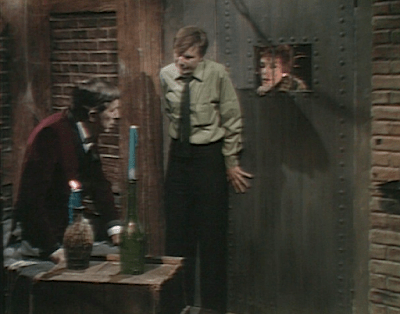
Now, Barnabas has himself become the blood thrall of a vampire, his ex-wife Angelique. Discovering the bite marks, Julia decides to address the situation by locking Barnabas and his servant Willie in the cell. Barnabas won’t be able to get out to heed Angelique’s summons, and Willie hangs a cross over the door to keep her from materializing inside it.
Left to right: Barnabas Collins (Jonathan Frid); Willie Loomis (John Karlen); Julia Hoffman (Lady Elaine Fairchilde.) Screenshot by Dark Shadows Before I Die.
We cut to Maggie’s house. Maggie’s memory of her ordeal as Barnabas’ victim has been wiped from her mind a couple of times. She receives a visitor, the suave Nicholas Blair. Unknown to Maggie, Nicholas is a warlock and Angelique’s master. He has a crush on Maggie which has distracted him from his managerial responsibilities, which to be frank he had not been handling very diligently in the first place. Maggie gives Nicholas several pieces of news that he really ought to have been aware of for some time. She tells him that her ex-fiancé, Joe Haskell, is still alive; that she visited Joe twice while he was at the Old House recovering from some injuries; that Joe is now in the hospital under police guard; and that Joe tried to kill Barnabas and keeps vowing that he will try again, since he believes Barnabas is trying to kill him. Nicholas is flummoxed by all of this, and meekly goes along when Maggie insists on visiting the Old House to pay a call on dear, sweet Barnabas.
The scene in Maggie’s house has an odd feature. We’ve just had a closeup of Willie hanging a cross above the door in the cell to keep Angelique away. In the early days of the vampire storyline, it was not at all clear that the cross would deter vampires in the world of Dark Shadows, since Barnabas was often seen strolling comfortably through a cemetery where half the grave markers were cross-shaped. It was not until #450, during the 1790s flashback, that we saw Barnabas recoil from a cross. In #523, we learned that the cross also immobilizes Nicholas. Yet Maggie is today wearing a dress the front of which is dominated by a red cross, and it doesn’t bother Nicholas a bit. The show is drifting into a spot where it may have to stop and spend time explaining its theurgy. Does the cross only work against a demonic creature if it is specifically aimed at that creature? Or if the person setting it up knows about the creature? Or is there some other qualification? It’s getting confusing.
At the Old House, Julia tells Maggie and Nicholas that they cannot see Barnabas, because he is resting. Maggie keeps insisting, and Julia shifts her ground, claiming that Barnabas went out, she knows not where. When Julia says this, Maggie is incredulous, but Nicholas brightens. Evidently he wants to believe that Barnabas has gone off to respond to Angelique’s call, and accepts Julia’s statement happily. Maggie apologizes for demanding to see Barnabas, and she and Nicholas leave.
Meanwhile, Barnabas is scheming to get out of the cell. While Willie is complying with his request to pour a glass of water, Barnabas bashes him on the head with an empty bottle. He then goes to the hatch for the secret panel, remembers that “Maggie found it a long time ago!” and figures out how to open it. Since we saw Willie open the hatch and show Adam Barnabas’ jewel box in #494, you would think Barnabas already knew how it worked. At that time, it also seemed that the passage behind the hatch had been sealed up, so that it no longer led to the beach. Apparently we aren’t supposed to remember that. Barnabas crawls out and closes the hatch behind him before Julia comes back.
As Barnabas, Jonathan Frid usually moves in the stateliest possible manner. When he escapes from the cell today, the camera lingers on him crawling, driving home the contrast with his typical gait. That is quite different from what we saw in #260, when he followed Maggie into the hatch- then, we saw him move toward the opening, but cut away before he had to take an ungainly position. Today, the makers of the show want us to hold the image of a crawling Barnabas in our minds.
Crawling suggests Barnabas’ weakness under Angelique’s power, certainly, but in this setting it suggests more. This is the house where he was born, and what he is crawling into is a lightless passage that it looks like he will have to squeeze through to emerge outside. He has regressed not only to infancy, but all the way back to birth. If Joshua did indeed confine him to this cell in his childhood, Barnabas would likely have experienced that same regression in those days as well.
The sign of the cross reminds us of one who said that we must be born again to receive a life in which our hopes will be fulfilled more abundantly than we can ask or imagine; Barnabas labored for 172 years under a curse that compelled him to die at every dawn and revive at every sunset, but perhaps even before that he was the prisoner of a cycle of abuse that forced him to experience the trauma of birth over and again, each time finding himself in the same narrow space, a stranger to all hope. Indeed, when Barnabas first became a vampire in the 1790s, he put his coffin in this basement, near the cell, and he persisted in putting it there even after it became obvious that it was very likely to be discovered. That persistence made no logical sense in terms of Barnabas’ need for operational security, but if he saw his vampirism as a continuation of his childhood experience of confinement in the basement cell, it would make all the sense in the world. That is his place, that is where he belongs, that is his reality.
Sheriff Patterson is at the estate of Collinwood. In yesterday’s episode, local man Joe Haskell tried to strangle old world gentleman Barnabas Collins in his house on the estate. Joe is in custody now, and the sheriff opens the episode with questions for some people in the great house.
Sheriff Patterson is played today by one-time substitute Alfred Sandor. I don’t know how much notice Sandor had that he would be playing the part, but it wasn’t enough for him to memorize his sides. He takes at least as many glances at the teleprompter as he has lines. He has a fine sonorous voice, an easy physicality, and when he can break free from the teleprompter he creates the impression that the sheriff is listening and thinking. I wish that he, rather than Vince O’Brien, had become the default Sheriff Patterson after Dana Elcar left Dark Shadows. The sheriff never gets to catch any of the bad guys, but it would be nice if he at least seemed like he had some brains.
The sheriff tells Barnabas’ inseparable friend, Julia Hoffman, MD, that Joe had claimed Barnabas was trying to kill him. Julia dismisses this as absurd. Joe says he was in Barnabas’ house recuperating from an injury, and awoke to find Barnabas offering him medicine that was poisoned. Only Julia’s intervention kept Joe from taking the medicine. Julia concedes that this is true.
New viewers might conclude from this that Julia is a compulsive truth-teller; after all, she is the only one who really knows that the medicine was poisoned, and she found that out by conducting tests which would probably consume all of it. But not only does she share her findings with the sheriff, she went out of her way to leave a sample of the poisoned medicine for the police to do follow-up testing on.
In fact, Julia is Dark Shadows‘ most fluent and most persuasive liar. It is unaccountable, not only that she confirms that the medicine was poisoned, but that the only suspects she lists when the sheriff asks who could have added the poison to the medicine are herself, Barnabas, Barnabas’ servant Willie, and Maggie Evans, The Nicest Girl in Town. While she and Barnabas have already proven their willingness to pin their crimes on Willie, he is too closely associated with them to be a desirable choice for the role of patsy, and no one will believe Maggie is guilty of anything- “The Nicest Girl in Town” might as well be her legal name.
Barnabas has been under the power of vampire Angelique for a couple of weeks. Julia is an expert on vampirism; she joined the cast in the summer of 1967 when she was treating Maggie for the aftermath of abuse she suffered from Barnabas when he was a vampire. She then won her way into Barnabas’ confidence and used him as the subject for an experimental treatment she had devised to cure vampirism. After that treatment failed, another mad scientist devised a different procedure for freeing Barnabas of the effects of his curse, and it was Julia who completed that procedure successfully. She then herself spent time as the victim of another vampire, giving her another perspective on the topic and making her uniquely knowledgeable on it. She has seen abundant evidence of Barnabas’ condition in the many days since Angelique first bit him, but it is only at the end of today’s episode, when she pulls back his cravat and sees the bite marks, that she finally puts two and two together. Combined with her sudden fit of honesty when the sheriff is questioning her, her slowness in figuring out what’s going on with Barnabas makes us wonder what is wrong with her. It’s true she hasn’t been getting much sleep lately, maybe that’s the problem.
There is a little support for this idea in a scene when the sheriff meets Julia in the woods. He is coming from Barnabas’ house, she is going there. He says that he’s surprised to find her in the woods at night, and she says “The woods are- are scary.” It isn’t like her to stumble and repeat a word, nor is “scary” a word she would typically use. Educated adults on Dark Shadows favor a more formal lexical register, saying “frightening” or something like that, leaving such words as “scary” to mark a grossly uneducated character like Willie or a child like young David Collins. Perhaps this line indicates that Julia just needs a good rest.
Many commenters remark on some irregularities in Angelique’s costume, speculating that one of them might be Lara Parker’s left nipple. I don’t think so; it just looks like fabric pilling, as witness the fact that there are multiple prominences in different spots. In the first year of Dark Shadows, Joan Bennett and Alexandra Moltke Isles sometimes did wear tight-fitting tops that revealed the shape of the flesh underneath more precisely than you might expect; that happened often enough that I took it to be a conscious decision to challenge the audience to take a matter-of-fact attitude toward female anatomy, and thought the grownup thing to do was not to mention it. But the show long ago forgot about grownup attitudes, so it is only to be expected that people are still giggling about what they think they can see in this shot.
There is a small prominence in the right spot, but the more conspicuous one is some inches above and to the left. So I suggest you all calm down. Screenshot by Dark Shadows Before I Die.
Recovering vampire Barnabas Collins has himself become the victim of a vampire, his onetime wife, Angelique. Barnabas and his friend, mad scientist Julia Hoffman, are taking care of Angelique’s other blood thrall, Joe Haskell. Julia does not know about Barnabas’ predicament, but when he brought the dying Joe home she examined him, found the bite marks on his neck, and not only recognized what had happened to him but figured out that Angelique was the vampire. Under Julia’s care, Joe is recovering in Barnabas’ upstairs bedroom, but Angelique has now ordered Barnabas to kill him. Julia walks in just as Barnabas is about to put a spoonful of poisoned medicine into Joe’s mouth.
Julia takes the medicine from Barnabas and asks him what he’s doing. He looks down and pretends he was confused about what she had told him. She is unconvinced, and he keeps looking down and lying. He looks for all the world like a little boy whose mommy caught him being naughty. It’s hilarious, and when they have another conversation about the same topic later in the episode it is hilarious again.
Barnabas is BUS-TED!!!
Barnabas is back at his bedside when Joe comes to. Joe knows Barnabas tried to kill him, and starts talking about revealing secrets. Barnabas asks if he wants his ex-fiancée Maggie Evans, The Nicest Girl in Town, to know what he has become. Joe says no, that Maggie must never know what Angelique has made of him.
Maggie stops by. Julia urges her to talk with Joe. She is reluctant to do so, fearing she will upset him, but after Julia presses her she agrees. Alone with Joe, Maggie asks him about the other girl in his life. He is tempted to tell her about Angelique, saying that she is the only person he could possibly talk to, but the resolution he had earlier expressed to Barnabas reasserts itself and he clams up. He does tell her that Barnabas is trying to kill him, and that if he dies it will be Barnabas’ doing. Maggie refuses to believe that Barnabas could have done anything to harm Joe.
Longtime viewers will find an irony in this. In May and June 1967, Barnabas was a vampire and he kept Maggie prisoner in this room. Julia would later hypnotize her to forget that ordeal, and now she is inclined to think Barnabas is just peachy. Downstairs, Maggie tells Barnabas and Julia Joe did not say anything coherent. She thanks Julia for treating Joe and Barnabas for “everything you’ve done!”
Julia goes to the great house of Collinwood, where she has been a permanent houseguest for about a year. Housekeeper Mrs Johnson meets her in the foyer. Unknown to Julia, Angelique bit Barnabas last night, and left him unconscious in the woods. Mrs Johnson’s son, unsightly ex-convict Harry, found Barnabas there and took him back to the great house, where Mrs Johnson vainly offered to call a doctor for him. Barnabas insisted on going back to his own house, where he told Mrs Johnson that Julia would take care of him. Julia has no idea any of that happened. Mrs Johnson asks her how Barnabas is doing. She describes the symptoms he showed the night before. With her background, Julia must surely recognize these as signs of a vampire attack, but she has to keep a bland face while with Mrs Johnson.
Joe comes to and decides to kill Barnabas before Barnabas kills him. We end with him pulling a rope tight around Barnabas’ throat.







 Dark Shadows Commentary